Monday, April 10, 2023

Batman in the 1980s Issue 76: September/October 1988


The Dark Knight in the 1980s
by Jack Seabrook &
Peter Enfantino


McFarlane
Batman #423

"You Shoulda Seen Him..."
Story by Jim Starlin
Art by Dave Cockrum & Mike DeCarlo

A young Black man named Kenny stands on the railing of the Gothamboro Bridge, threatening to end his life with a leap into the water far below. Batman appears and tries to talk Kenny out of jumping but he leaps into the abyss; Batman leaps after him and saves him by means of a harness and a very long rope. "'You Shoulda Seen Him...,'" says one cop to another next morning at Willy's Diner. But the other cop has a story of his own.

Early that morning he was called to defuse a hostage situation at a deli; Batman disarmed three punks and saved an old woman from being shot and killed. A third cop joins the duo at their table and tells a very different Batman story. This officer was chasing two runaway children through the warehouse district when Batman appeared out of nowhere. The Caped Crusader took his time and listened to the kids, eventually learning that their parents had died and they refused to be separated by a social worker. Instead, they have been living in a packing crate under the highway. Batman promises to have them returned to an aunt so they can stay together. The cops are surprised to hear about three very different sides of the famous crimefighter; at Wayne Manor, Bruce checks on the children and Alfred asks if "'the avenging Dark Knight of Gotham'" has gone soft!

Peter: The Cockrum/DeCarlo art on "You Shoulda..." is the pits, the very definition of the low-grade art that permeated the major comic companies in the 1980s. Who is that guy who's supposed to be Bruce Wayne in the final panel? Search me. The story is maudlin and cheesy and tells us nothing new about the Bruce/Bats character. Dateline 1988: Batman's a good guy at heart... he's selfless... he helps people... he's got a soft spot for orphans. Get me back to the violent and edgy Starlin quick.

Jack: Call me sentimental, but I enjoyed this slice of life story that shows the different sides of Batman. He can be direct and effective, as with the young man who jumps off the bridge; he can be brutal and violent, as he is with the hostage-takers; or he can be sensitive and patient, as he is with the children. A tear even slips out from beneath his mask! The art by Cockrum and DeCarlo isn't the best we've seen, but it is nowhere near the worst and I'd take it over some of the other art combos we've seen recently on the monthly books.


Breyfogle
Detective Comics #590

"An American Batman in London"
Story by John Wagner & Alan Grant
Art by Norm Breyfogle

Syraqui terrorists break into the Gotham Vets Club and mow down 20 defenseless men before committing suicide. The man responsible for arming the gunmen is Syraqui diplomat Abu Hassan, granted diplomatic immunity. That "Get Out of Jail Free Card" means nothing to the Batman but Hassad has already hopped a plane back home to London. Before you know it, Bruce Wayne is landing at Heathrow.

Since Wayne has arrived in England on Guy Fawkes Night, the city is alight with fire and, unbeknownst to our hero, it may get even hotter in the old town. Fresh from his American massacre, Hassan plans to do what Guy Fawkes only dreamed of: blow up Parliament.

The Batman slips into the Syraqui Embassy and confronts Hassan, who lets slip his plans for the night. Hassan argues that the Caped Crusader's land of milk and honey perpetrates worse acts of terrorism every day in the name of the red, white, and blue and the hero's resolve falters. Could this madman be right? One of the terrorist's henchmen attempts to garrote the Dark Knight but our man in London flips him over his shoulder... right into Hassan, causing him to crash through the window and fall to his death below.

The Batman hurries to Parliament to stop the attack and arrives just after the Syraquis have killed off security. Batman steers a car into the machine gun-wielding quartet, setting off the explosives meant to destroy Parliament. London is safe once more but the Batman ponders his place in a world full of selfishness and greed.

Peter: Despite the preachiness, I liked this adventure very much and I'm not a funny book reader who really cares for his capes and cowls to be mixed with politics. Bruce Wayne/Batman seems to come off as more than just a little naive, not understanding the definition of a diplomat and his immunity; his rant in front of the FBI agent and Gordon is childish. The massacre at the Vets' Club is pretty violent stuff; there's no looking away here. I'm not sure why Wagner and Grant have to concoct a phony country since we all know who they're talking about circa 1988. There's quite a bit going on for a one-off story. Breyfogle's pencils remain (literally) sketchy. Just when I think he's gotten over the hump, the shadow of Frank Robbins descends yet again.

Jack: Breyfogle's art is too stylized for me and in places it's just plain ugly. Some portions of this story remind me of the work of Alex Nino at Warren; impressionistic page designs that get in the way of clear storytelling. Still, Wagner and Grant tell a good yarn and the 22 pages rush by with a propulsive fervor. It's a good story but the art keeps it from being great. The cover is in the running for best of the year, however.


Wrightson
Batman: The Cult #1

"Ordeal"
Story by Jim Starlin
Art by Bernie Wrightson

Why are homeless people and criminals disappearing from the streets of Gotham City? It's not Batman's doing--he's been chained to an overhead pipe in an underground sewer for a week, barely kept alive by men who worship Shaman Blackfire. He used to be Deacon Blackfire, who ran a shelter for the homeless in crime alley, but now he has poor souls convinced that he's the messiah.

Ridding Gotham City of violent criminals by killing them in the streets is a mode of operation that causes various reactions, from Batman's ("'It's wrong...'") to regular citizens ("'It's about time the honest folks got a break in this city.'") Shaman Blackfire and his disciples use tried and true brainwashing techniques on Batman and finally, with the aid of drugs, they appear to convince the Dark Knight that their cause is just. But what is Blackfire's real goal? When he tells his colleague that "'the competition is weakening,'" does that mean he's eliminating the opposition and plans to run the crime world himself? And will a mind-altered Batman be at his side?

Peter: "The Cult" explores the "What is a Vigilante" themes that were suddenly in vogue in the 1970s and 1980s, so there's nothing startlingly original in the plot (at least so far), but it's still got my interest. Starlin was obviously influenced by The Dark Knight (especially in how he handles the Gotham media) but, by this time, who wasn't? The Wrightson art is the key to the success or failure of The Cult, in my opinion. So far so good, but can Bernie sustain the quality for (ulp!) 188 pages?

Jack: I was excited to see that Bernie Wrightson drew this extra-long comic (46 pages!) and, while some of it looks great, I don't think it entirely plays to his strengths, which lay in depicting the weird and ghoulish. His regular folks look like any other well-drawn DC comic characters of the late 1980s. He certainly doesn't draw a great Joker, who appears briefly in a dream sequence early in the story. I was shocked by the four-letter words sprinkled through the story and I guess DC had, by this time, decided that these non-newsstand comic events were geared toward adult readers. Starlin's story is intriguing but not at the level of The Killing Joke, at least not in part one.


Bright/Rubinstein
Batman #424

"The Diplomat's Son"
Story by Jim Starlin
Art by M.D. Bright & Steve Mitchell

Responding to a woman's screams, Robin bursts into the home of Felipe Garzonas. While Felipe is no match for the Teen Wonder, his partner has a knife! Fortunately, Batman was keeping an eye on his young partner and quickly dispatches with the goon. In a bedroom, Robin finds a model named Gloria Stanson, whose black eye came from Felipe's fist. At the police station, Commissioner Gordon explains that Felipe's father is Jose Garzonas, the ambassador from Bosatago, so Felipe is free in no time.
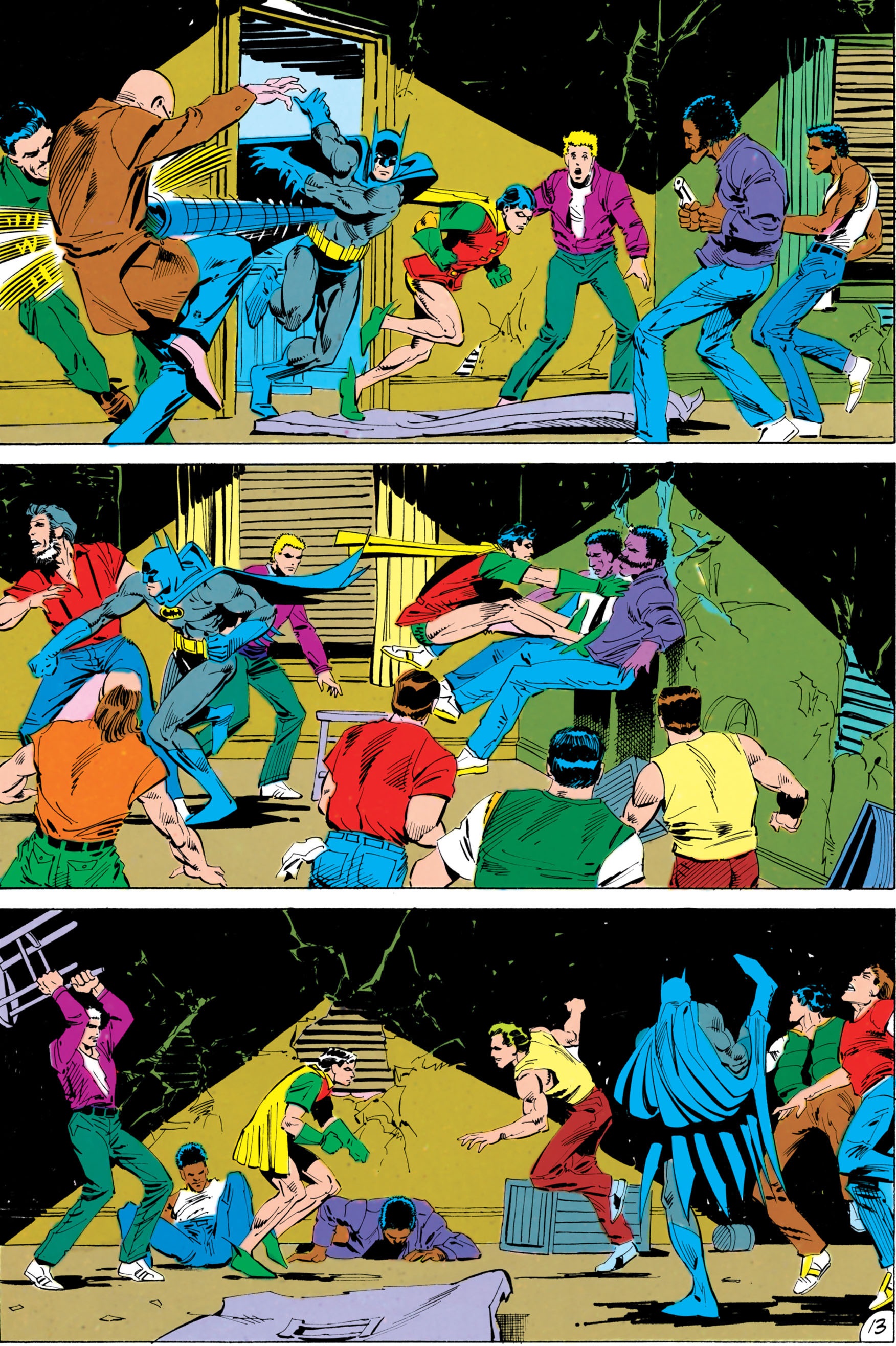
Robin is not used to the bad guys getting away so easily. Batman explains to him that Felipe was high on cocaine and, in the days that follow, the Dynamic Duo surveil Felipe until they discover where he's buying his drugs. Batman and Robin burst in and dispatch with the drug dealers before taking Felipe to be arrested. Although he is out quickly, he'll be recalled to Bosatago. On his way out of the station, Felipe telephones Gloria to say he'll see her tonight; Batman and Robin rush to her apartment and found that she has hanged herself. Robin pays a visit to Felipe at home and, next thing we know, Felipe takes a long, fatal fall from his balcony to the pavement. Batman arrives and Robin says Felipe fell, but the Dark Knight isn't so sure.

Peter: A hard-hitting, well-written story; I never saw that climax coming. Hopefully, writer Starlin and editor Denny don't water down the impact, but I find it hard to believe they'd leave a big question mark hanging over Jason Todd's head. Could Batman ever be aligned with a legit killer? We'll see next issue when the conclusion appears. The art, while not spectacular, is certainly miles more palatable than the swill we were sold last issue.

Jack: This is excellent! Steve Mitchell once again cleans up some shaky pencils, as we've seen him do with other artists, and the result is better than what Breyfogle is doing in Detective. Starlin's story is very good, and I'm also intrigued to see what happens next issue. I especially liked the wordless fight sequence on pages 12-14.


Breyfogle
Detective Comics #591

"Aborigine!"
Story by Alan Grant
Art by Norm Breyfogle

Bruce Wayne is throwing a charity function at the home of Mr. Kerry Rollo, a man who owns the largest collection of antiquities in the world. One of Rollo's prize possessions is the "Power Bone," an Aborigine relic dating back fifty thousand years. 

Coincidentally, an Aborigine is stalking the streets of Gotham, looking for that aforementioned curio and stopping at nothing to track it down. The Batman gets wind of an incident in a local gym and investigates, finding one dead and two seriously wounded, all three victims of the Aborigine.

The foreigner finally tracks the Bone to Rollo and bursts into the collector's apartment, demanding the return of his sacred relic. Once the Bone is in hand, the Aborigine is ready to dispense some outback justice when the Dark Knight bursts through the door and engages the giant in combat. The Aborigine stops the fight long enough to relate the true story of how Rollo acquired the Power Bone. Despite his disgust at Rollo's murderous ways, the Batman protects the man from his attacker. But the Aborigine pushes the Caped Crusader aside and, grabbing Rollo, smashes through the window of the skyscraper. Rollo SPLATS on the sidewalk far below but the Batman can find no sign of the Aborigine. Our hero once again ponders whether some kind of justice was meted out.

Peter:
As in the London story last issue, "Aborigine!" finds Batman in a quandary during his signoff. Just how far can one push this justice stuff without crossing the line into "Judge, Jury, and Executioner?" I like that Grant hints that some supernatural force might be at work here. I'm also curious as to why the team is avoiding the Rogues' Gallery, instead focusing on contemporary "real world" problems like drug addiction. Perhaps because they felt the Gallery had been overused and wanted to prove themselves capable of playing in the sandbox without the usual toys? Good job so far. And, weirdly enough, I'm getting used to Norm Breyfogle's art, which is still just as rough as Jerry Grandenetti's was back at 1960s Warren, but which shows signs of brilliance now and then.

Jack: An excellent story from start to finish, but I just can't seem to warm up to Breyfogle's style. I'm starting to feel like a crank. I liked seeing Alfred driving the Batmobile to pick up Batman so he could change into his civvies in time to get to the party! It's interesting how prevalent drugs are becoming in the late 1980s Batman stories--the trend mirrors what was going on in the U.S., I guess. Maybe I'll get used to Breyfogle's art eventually, but for now I prefer everyone else's work.


Wrightson
Batman: The Cult #2

"Capture"
Story by Jim Starlin
Art by Bernie Wrightson

Now part of Blackfire's cult, Batman somewhat unwillingly finds himself participating in the wholesale murder of a group of Mafia criminals. His attempt to think clearly after returning to the underground lair is interrupted when he is asked to accompany one of Blackfire's men to kill a man described as a drug fiend and pimp; after the other man commits murder, Batman knocks him out, saving a policeman who happens on the scene.

Still drugged, Batman punches the cop and heads off to find some food. The pimp killer tells the cops about Blackfire's plan to take over Gotham City, but when it hits the news, the fine citizens support the vigilante's mission. Robin goes undercover and underground as Batman's head clears and the Caped Crusader knows that he, too, will have to return to the sewers. While Blackfire riles up the homeless masses, Batman discovers that the deacon has been living in extreme luxury. Suddenly, the Dark Knight is hit from behind and knocked unconscious by one of Blackfire's men.

The mayor is killed when his car explodes and the members of the City Council are killed soon after; Blackfire announces that the deaths are linked to organized crime. Batman fights back against his captors and escapes into the water running underground; Robin dives in after him and finds Batman among a pile of rotting corpses.

Jack: Another 46 pages and I'm beginning to think "The Cult" is too long and overblown. I'm not convinced that Deacon Blackfire and his group of homeless people could do what the Joker, the Penguin, et al. could never do, and that's drug and starve Batman into changing his personality. The scenes where Batman is addled or in a daze don't work well; he's too strong-willed to be acting like this. The story also seems to go nowhere fast and has many of the same things we've seen before, such as the talking heads on TV shown in pages of small panels. I'm happy to see Robin doing more than just following Batman around but, again, this doesn't seem like Jason Todd as much as Dick Grayson. We'll see what part three has in store, but I'm not holding my breath that "The Cult" will suddenly get very interesting.

Peter: We are in total agreement here, Jack. Why would this Deacon guy be able to control Batman so easily? This is weak for a "prestige" project. Way too long and Bernie's art is lackluster. Knowing how incredible a talent the guy was, I'm sure it had to do either with the deadline or the inker. The only standout from this overblown chapter is the final image we have of Batman and Robin. That is Bernie Wrightson!


Janson
Detective Comics Annual #1

"Fables Part 1: The Monkey Trap"
Story by Denny O'Neil
Art by Klaus Janson & Tony DeZuniga

In 19th-Century Manchuria, a captain in the Japanese Army makes a promise to his dying prisoner. In present day, that captain (now a sensei) and his pupil, Shiva, make their way to America on a junk. Their goal: to meet the Batman.

Meanwhile, in North Africa, Ra's Al Ghul tells his daughter Talia that she must travel to Gotham to meet up with Oswald Cobblepot, who has stolen a deadly drug from Ra's. The serum, when injected into a bird's bloodstream, becomes a killing virus that affects only women and small children. Talia agrees, but hopes (out loud) that she doesn't have to meet him, that masked guy she used to be in love with.

In Hub City, The Question enters a bar and orders the men within to relinquish the charity money they stole. They refuse and a brief contretemps ensues, with the faceless hero surviving the skirmish unblemished. He meets up with gal pal Lady Shiva outside the bar and she tells him he must help her locate the Batman for some mysterious reason. The Question relays a message to the Dark Knight (who had aided him in an adventure some months before) and a meeting is set up at a Gotham pier.

At the pier, the Batman arrives to find Shiva and her silent partner, the 150-year-old Sensei. Since the Batman has a reputation for skillful battle and Shiva fancies herself a mistress of the martial arts, she has a go at the Caped Crusader. Bewildered and somewhat annoyed, the Detective fights off her advances and then listens as the old man mumbles some odd mumbo-jumbo about monkeys and cages. Deciding he's had enough of this David Lynch movie, he takes his leave. But something nags at the back of his mind.

At the Penguin's lair, the master criminal reveals his secret plan for Gotham-wide murder and destruction to the man who sold him Ra's's virus. The scientist explains that Ra's is closing in on him and he needs more dough. Penguin promises that Ra's won't harm a hair on the man's head and then releases his two pet falcons, who tear the scientist to pieces. 

Later, at the Gotham morgue, the Batman examines what's left of the falcons' lunch and pulls a few clues from the corpse. just as Talia emerges from the shadows and tells her ex-lover about the Penguin's plan. From the clues on the body the Dark Knight determines that Penguin is hiding out in a local shoe factory (no, seriously, he got that from the dead guy's shoes!) and he and Talia hop in her rental. 

Penguin's henchmen put up a fight but, in the end, they're no match for the brawn and skills of the Batman. The two falcons, however are another story. While Bats is attempting to fight off beaks and claws, Oswald injects Talia with the toxic bird virus. Bats defeats the falcons and then gives the Penguin a right that darn near puts the portly criminal through a wall. Our hero rushes Talia to a hospital and has the doctor pump her full of testosterone. She makes a full recovery in about five minutes and then gets right back to wooing her Caped Bohunk, who rejects her advances in the name of truth, justice, and the American way. What a dope!

Peter: What a load of crap this story is. It's confusing, meandering, bewildering, boring, and a whole bunch of other -ings I can't put into words. To be fair, this is part one of a three-part "epic" crossover between the Detective, Green Arrow, and Question annuals, so the story might become clearer in part two or part three. The problem becomes that nothing in these 40 pages makes me want to read the rest. Bats doesn't even show up until a third of the way through the story; odd, since this is his title. 

The section involving the Question makes no sense at all. He's introduced, has a conversation with Shiva, and then disappears. I was a Question fanatic back in the 1980s when DC resurrected the character, but I don't remember this storyline. There's a reason for that. There's no mention of Green Arrow in this first part, so I have no idea what his role in this arc will turn out to be. There are a lot of moving parts to "The Monkey Trap" but it doesn't look like Denny had a grasp of what he wanted to do with those parts.

When did the Penguin become anything but a practical joker, a criminal who would pull off umbrella factory heists (in fact, I'd say the DC character and the Burgess Meredith version were the closest any of the 1966 TV show characters came to their funny book counterparts) but avoid any serious terrorism. Mass murder of innocent children sounds more like the work of the Joker. The art is good and bad; the characters are all competently drawn but the action is stiff. This is definitely not the sexy Talia drawn in the 1970s by Neal Adams; here she's just another dame after the Dark Knight.

Jack: Doesn't it seem like the folks at DC drag out Ra's and Talia whenever it's time for a big event? I was happy to see the Penguin but I agree with you that it's uncharacteristic of him to be so ruthless. One interesting facet of this story is the early glimpse of what would soon become the Internet; one character explains to another what a "modem" is. The art by Janson and deZuniga is pretty good, though it looks more like deZuniga to me than Janson, whose pencils have never impressed me as much as his inks. I must have missed a story arc because I don't recall why Batman is so mad at Talia. I thought the last time we saw her she was having his baby! There are plenty of wordless panels and pages, making this a quick read; overall, it's not a classic but I liked it better than you did.

I skimmed the Green Arrow and Question annuals that completed the story; Batman barely appears in either issue and so I didn't pay much attention to how it all comes out. I can say that Talia disappears after this issue.


The Best of The Brave and the Bold #1

"The Senator's Been Shot!"
(from The Brave and the Bold #85)

This issue features great art in four reprint stories. The last three are by Kubert and Heath and are pulled from the first and fifth issues of The Brave and the Bold way back in 1955 and 1956, but the first is the one that interests me--it's a Bob Haney/Neal Adams story from a 1969 issue, so we haven't covered it before. Adams does both pencils and inks, so it's not quite as amazing as the Adams/Giordano work on Batman or Green Lantern from the early '70s, but it's still great to look at. The story concerns a senator who is shot (not fatally) right before he is to cast a key vote on an anti-crime bill; Batman and Green Arrow team up to catch the man behind the shooting. Two things are of interest: Bruce Wayne plays a major part because he is appointed temporary senator to replace the injured man, and this is the first time readers got to see the "new look" Green Arrow, with the beard. It's pretty cool.


Next Week...
We blow holes in our final
issue of Creepy!

Thursday, April 6, 2023

The Hitchcock Project-Lou Rambeau Part Two-Last Seen Wearing Blue Jeans [8.28]--OUR 300TH EPISODE!!!

by Jack Seabrook

Lou Rambeau's second and last teleplay for The Alfred Hitchcock Hour was "Last Seen Wearing Blue Jeans," a disappointing adaptation of Encounter with Evil, a 1961 novel by Amber Dean.

As the book begins, Dave and Roberta Landis are driving home from a Memorial Day weekend vacation in Minneapolis late Sunday night when they get lost somewhere in Ontario and stop off around two a.m. at Cate's Cafe for pie and coffee. Their 15-year-old daughter Lauren, who was sleeping in the back seat of their white Buick, joins them for a moment before walking back out to the parking lot and unintentionally crawling into the back seat of the wrong car.

The Landis family have accidentally stumbled upon a car theft scheme, where stolen cars are driven across the border into Canada and the drivers meet late at night at the cafe. Lauren is discovered in the back seat of the car at the garage where the cars are processed; Dave and Roberta drive off thinking that she is in the back seat of their car and must return to the small town of Lennox to search for their daughter when they discover she is missing.

Lauren escapes and meets Pete Tanner, a high school senior, who takes her back to his house, but she is soon taken again by the car thieves, who also catch Pete when he comes after her. Lauren and Pete are drugged and left in a house that is set on fire by the crooks to cover their tracks and eliminate the young witnesses.

Dave and Roberta search frantically for their daughter, stymied by the town's crooked policeman. Eventually, Canadian police are tipped off to the car thieves and capture the crooks at the garage. Pete saves Lauren from the fire and the Landis family is reunited.

Encounter with Evil is a short novel where the events mostly take place in and around a small Canadian town in the course of 24 hours. The action moves back and forth among characters and locations and there is little suspense; the climax, where Pete rescues Lauren from the burning house, is described after the fact rather than shown. Dave and Roberta are detectives of a sort, faced with the mysterious disappearance of their daughter and forced to investigate what happened and solve the puzzle.

Amber Dean (1902-1985) wrote 17 mystery novels between 1944 and 1973. This was the only time one of her books was adapted for film or TV. Her papers are at the University of Rochester.

The TV version aired on CBS on April 19, 1963, and was directed by Alan Crosland, Jr. Right away, it's clear that there has been a major change to the story, since the family station wagon drives through the night and passes a sign reading "Slawson, Arizona, Pop. 1204." The location of events has been moved from the Canadian border to the Mexican border! The Saunders family (as they have been renamed) pull up at Cates Cafe, which a sign tells us is "open all nite," changing another plot point from the novel, where the cafe supposedly closes well before 2 a.m.

Dave and Roberta speak with British accents and desire "'a spot of tea'"--instead of hailing from upstate New York, as in the book, they are British tourists driving across the U.S. with their 17-year-old daughter on a sightseeing trip. The visit to Cates Cafe is streamlined from the novel, since there is no group of men meeting in the back room and Rose, the waitress, is a minor character. Outside the cafe, a similar station wagon pulls up and parks between the Saunders car and the door to the cafe, making it clear why Lauren sleepily climbs into the wrong vehicle.

She awakens in a garage in Dos Cucharos, Mexico, a town about 50 miles from Slawson. The first of three fistfights in the episode breaks out between Al, whose car Lauren mistakenly slept in; Grosse, a fat man who is part of the car theft ring; and Gato, the mechanic at the garage. Unlike the novel, where Lauren is treated kindly by the mechanic before she is driven to Rose's house and questioned, in the TV version Grosse grabs a tire iron and kills Al with a blow to the head. Lauren is seen sneaking out of the garage and the first act ends with Gato calling cafe owner Vince Cates to tell him about the murder and Vince instructing Gato to "'get that girl!'"

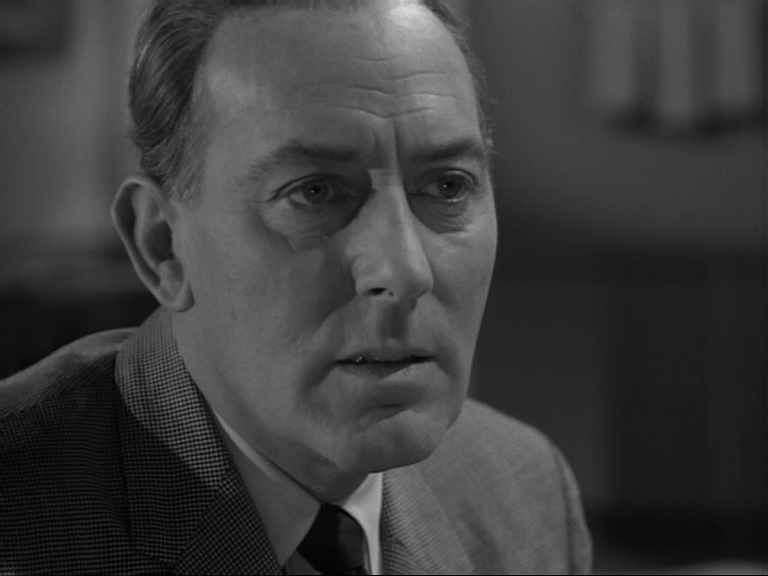
Michael Wilding as David Saunders
In the book, when Dave and Roberta return to the cafe, they are told that it was not even open at the time they had been there and that they must have the wrong place. There is no such confusion in the TV show, since the cafe is open all night. At the police station, Dave sees a map on the wall and immediately identifies Dos Cucharos as a possible destination for Lauren. In Mexico, the young woman wanders alone and is confronted by frightening strangers; as a pretty, 17-year-old blonde, she also attracts the attention of a pair of young men. As Grosse and Gato search for Lauren in the town, a kind woman brings her into her restaurant and serves her food, yet the crooks soon find her and are about to take her away when the two young men who had approached her on the street enter and the second fistfight of the episode occurs. Lauren escapes during the melee and ducks into a church, where she evades her pursuers. Her parents arrive in the Mexican town in the morning and, after an unsatisfactory visit to the police station, drive back to Slawson, just missing Lauren as she comes out of the church.

In act three, Dave and Roberta stop at the border crossing and give the guard a photo of Lauren so that he can watch out for her. In the book, Lauren meets Pete at a bus stop where he is waiting for the bus to high school. In the TV show, she is walking alone on a dirt road and hides in the brush when Grosse and Gato drive by. Pete then drives by in a jeep and Lauren flags him down. He agrees to drive her back to Slawson and stops the jeep so she can clean herself up. There is a closeup of her adjusting her hair barrette, a detail that will be important later. In an attempt to fool the border guard, Pete tries to teach the young British woman how to speak like an American; the actress playing Lauren was American and was putting on a British accent for the role, so she had to pretend to be a British girl trying to speak like an American!

Anna Lee as Roberta Saunders
At the border stop, Lauren's speech attracts the interest of the guard, who disappears into his booth. Pete drives off before the guard emerges, holding Lauren's photo! Pete and Lauren arrive in Slawson and visit the dishonest policeman, who accuses the young woman of making up her story about witnessing a murder and takes them to the cafe, where Grosse and Cato force them into the back room. In the struggle, Lauren's hair comes loose. In the novel, gangsters are in charge of the car theft ring; they have been eliminated from the TV show, as have the Canadian police who break up the ring. There is no confrontation at the garage in the TV show, nor do the crooks try to kill Pete and Lauren by leaving them asleep in Rose's house and setting it on fire.

Instead, the final scenes take place in the cafe, where Vince interrogates Pete and slaps him when he doesn't cooperate. Vince suggests staging a fatal jeep accident involving the two young people. In the last act, Dave and Roberta are at a motel in Slawson when they receive a call from the border guard informing them that he saw Lauren with Pete. They drive to Pete's home and meet Mel, his father, who accompanies them to Cates Cafe. Vince lets the trio in while Grosse watches from the back room with gun in hand. Vince denies having seen Pete and Lauren, but Roberta notices Lauren's barrette on the cafe floor and realizes the owner is lying. She shows Dave, who hauls off and punches Vince, leading to the third and last fistfight of the episode, a melee in which Mel disarms Grosse. The young people are rescued and Roberta embraces Lauren.

The last scene finds Lauren bidding farewell to Pete and inviting him to visit her in England next summer.

"Last Seen Wearing Blue Jeans" is a poor adaptation of a fairly interesting novel; the TV version is streamlined and ridden with cliches, featuring a plodding script and pedestrian direction. Katherine Crawford, as Lauren, is the star of the show and does her best with the role; Michael Wilding and Anna Lee, as her parents, seem miscast. The three fistfights seem like trite ways to solve dramatic problems, and having Dave take a swing at Vince near the end of the show appears to be out of character.

Katherine Crawford as Lauren Saunders
Alan Crosland, Jr. (1918-2001), the director, started out as a film editor, working on features from 1944 to 1954 and on TV from 1955 to 1957, then began directing episodic television in 1956. He directed 16 half-hours and three hours of the Hitchcock series, including "The Woman Who Wanted to Live," as well as episodes of The Twilight Zone and The Outer Limits. Crosland directed a handful of movies, but his main focus was on TV, and he directed his last show in 1986. "Last Seen Wearing Blue Jeans" was the last episode he directed for the Hitchcock show.

Receiving top billing as David Saunders is English actor Michael Wilding (1912-1979), who was on stage, film, and TV from the early 1930s to the early 1970s. He appeared in two Hitchcock films, Under Capricorn (1949) and Stage Fright (1950), but this was his only role on the Hitchcock TV show.

Anna Lee (1913-2004) plays his wife Roberta. Born Joan Boniface Winnifrith in England, she was on stage, film, and TV from the early 1930s through 2003, including a regular role on the soap opera, General Hospital, from 1979 to 2003. She appeared in Fritz Lang's Hangmen Also Die! (1943) and Val Lewton's Bedlam (1946), but this was her only role on the Hitchcock TV show. From 1934 to 1944 she was married to Robert Stevenson, who later directed episodes of Alfred Hitchcock Presents. One wonders if Michael Wilding was available for this episode and the script was revised to make the Saunders family British.

Randy Boone as Pete Tanner
Lauren is played by Katherine Crawford (1944- ) and this episode was her first TV credit as well as her only appearance on the Hitchcock TV show. The daughter of TV writer Roy Huggins, she went on to appear almost exclusively on TV until 1976; her final role was as a regular on the short-lived series, Gemini Man.

Randy Boone (1942- ) plays Pete; a folk singer turned actor, he was on screen from 1962 to 1987. This was his only role on the Hitchcock show, but he was a regular on three TV series: It's a Man's World (1962-1963), The Virginian (1964-1966), and Cimarron Strip (1967-1968). He was also seen on The Twilight Zone and The Night Stalker.

In smaller roles:
  • James Anderson (1921-1969) as Vince Cates; also known as Kyle James, he was on screen from 1941 to 1970 and had a role in To Kill a Mockingbird (1962).
James Anderson
  • Jesse Jacobs (1922-1998) as Grosse; he served in the Army in WWII and was involved in theater as both actor and teacher. He made a handful of TV appearances between 1959 and 1986 and was also in "The Big Score" on Alfred Hitchcock Presents.
Jesse Jacobs
  • Eve McVeagh (1919-1997) as Rose Cates, the waitress; she acted on Broadway and on radio and had a screen career from 1946 to 1987. She was on The Twilight Zone and Thriller and she appeared in six episodes of the Hitchcock show, including "The Gloating Place."
Eve McVeagh
  • Russ Conway (1913-2009) as Henderson, the border guard; born Clarence Russell Zink in Canada, he made numerous appearances on screen from 1947 to 1977 and also appeared on Thriller.
Russ Conway
  • Kreg Martin as Al, who is killed by Grosse; in a short TV career from 1962-1963 he was seen on The Twilight Zone and in seven episodes of the Hitchcock show, including "Maria."
Kreg Martin
  • Jose de Vega (1934-1990) as Gato, the mechanic; a dancer, choreographer, and actor, he was on screen from 1961 to 1987 and had a role in West Side Story (1961).
Jose de Vega
  • Frank Albertson (1909-1964) as Tom Batterman, the corrupt Slawson policeman; on screen from 1923 to 1964, he has a star on the Hollywood Walk of Fame and appeared in four episodes of the Hitchcock show, including "Out There--Darkness." He was also on Thriller and played Sam Wainwright in It's a Wonderful Life (1946). He had small parts in The Man Who Knew Too Much (1956) and Psycho (1960).
Frank Albertson
  • Karl Lukas (1919-1995) as Mel Tanner; born Karol Louis Lukasiak, he was on screen from 1951 to 1991 and had roles on Batman, Night Gallery, and The Odd Couple. He had begun his career on Broadway in the 1940s and was a semi-regular on The Phil Silvers Show (1955-1958). He was in five episodes of the Hitchcock show, including "Bang! You're Dead."
Karl Lukas

Watch "Last Seen Wearing Blue Jeans" online here. Read the novel here.

Sources:

Dean, Amber. Encounter with Evil. Roslyn, NY: Detective Book Club, 1961.

"Dean, Amber." Gadetection / Dean, Amber, http://gadetection.pbworks.com/w/page/7930339/Dean%2C%20Amber.

The FICTIONMAGS Index, http://www.philsp.com/homeville/FMI/0start.htm.

Grams, Martin, and Patrik Wikstrom. The Alfred Hitchcock Presents Companion. OTR Pub., 2001.

IMDb, IMDb.com, https://www.imdb.com/. 

"Last Seen Wearing Blue Jeans." The Alfred Hitchcock Hour, season 8, episode 28, CBS, 19 April 1963. 

Wikipedia, Wikimedia Foundation, https://www.wikipedia.org/.


Listen to Al Sjoerdsma discuss "John Brown's Body" here!

In two weeks: Our brief series on Talmage Powell begins with a look at "The Kiss-Off," starring Rip Torn!

Monday, April 3, 2023

The Warren Report Issue 107: September 1979


The Critical Guide to
the Warren Illustrated Magazines
1964-1979
by Uncle Jack
& Cousin Peter


Sanjulian and McQuaite
Vampirella #81

"Vampirella and the Alien Amazon" ★1/2
Story by Bill DuBay
Art by Pablo Marcos

"Scourge of the Dragon Queen" 
Story by Bill DuBay
Art by Gonzalo Mayo

"...And Be a Bride of Chaos"
(Reprinted from Vampirella #16, April 1972)

"Dracula Still Lives!"
(Reprinted from Vampirella #18, August 1972)

Captured by Slandra and zipping across the universe, Pantha and Vampirella are forced to listen to the scantily-clad Alien Amazon while she recounts the history of war between her planet and Drakulon. 

History lesson complete, Slandra is drawn to the bridge by a cryptic message from her AI pilot. Just as she leaves, the demon N'Gorath appears and frees the girls. Vampi heads to the bridge to confront Slandra and meets up with her in the hallway while Pantha destroys the Amazon's AI pilot. Vampi and Slandra have a vicious battle, with Vampi coming out on top, but the outcome of Pantha's hissy fit over the controls is that the ship is now in self-destruct mode. Vampi insists on saving Slandra (to end the centuries-old war) but the Amazon is more intent on wiping the girls' memory of the history of war. 

Pantha and Vampi escape the dying ship in a rescue pod just in time and head for Earth. Immediately upon splash-down, Vampirella visits the recovering Pendragon and thanks him for sending N'Gorath to rescue her. Pen begs Vampi to pray for him. He's out of gin.

At least a third of "Vampirella and the Alien Amazon" is given over to a history flashback. Once we've been educated, there's not much room to tell a story and the narrative just flops like a dead fish. I couldn't understand why Slandra would be sent out into space to search for surviving Drakulons out of revenge when the war was essentially started by her people. The finale with Vampi and Pen is weepy and maudlin and Pen's "life-altering sacrifice" will doubtless be forgotten by Dube within a couple issues. I've almost forgotten it already. I've already given my thoughts on Marcos's art on Vampi (and elsewhere, for that matter) and nothing's changed. Slandra, Vampi, and Pantha pose with their asses in strange contorted ways all through the story. It's a 13-year-old's wet dream but for us old-timers it's just a mess.

When she discovers that Pen and Pantha have been kidnapped by pirates, Vampirella makes it her goal in life to rescue her friends, but her poor, tiny wings become tired and she dips into the drink. Luckily, once she passes out, her leathery form transforms back into that of a supermodel, a form easily visible to a Chinese Navy ship. Once on board, Vampi discovers the stinkin' Commies are going to take her back to base and torture her for secrets of American Intelligence. 

Laughing, she changes back into a bat and flutters away and very soon comes across the hideout of the pirates. She unties Pantha (who changes into her animal form) and the two terrorize the bad guys. Most of the pirates head back to their junk and set sail, but Vampi puts the kibosh on their escape and they crash into a conveniently-placed set of rocks, killing all aboard. 

Pantha hypnotizes Robbins, the surviving pirate, into taking them to the ship of the Dragon Queen, who sees the approaching boat and realizes what's going on. She ducks down into a lower deck to hide. Vampi boards and hears a terrifying scream from below and enters the room just as a huge dragon emerges from the shadows. Believing the creature to be (duh!) the Dragon Queen, Vampi prepares for battle but then watches as it transforms back into its human shape, that of the Queen's assistant, Sin Tsung. The old man relates the story of his only son dying from heroin acquired from the Dragon Queen. He swore revenge and now that revenge is his.

Drama over, Vampi returns to shore, where she finds a very hands-on Adam Van Helsing, who calls her mid-1970s sobriquets such as "Lover" and "Baby." Hiding her disgust at the dopey stalker, she holds his hand and they walk into the sunset, unaware that their next adventure has already happened.

That's because "Scourge of the Dragon Queen" takes place before the events of "Alien Amazon," thanks to the United States Postal Service or whoever Dube decides to blame from month to month for delays. I'd love to see a chronology of these arcs as there must be months between events for these globe-hoppers. The story and art here are certainly better than "Alien Amazon," but I wouldn't go overboard and recommend that anyone actually read the thing. It's confusing as all get out, sometimes due to the cast of characters, sometimes due to Mayo's pose-heavy art.

We learn that Conrad Van Helsing's telepathic abilities have grown so fine-tuned that he can "feel" a barge coming into the harbor with heroin stashed aboard. Now that's some power! And... just thinking out loud here... why does Pantha need Vampi to untie her so that she can transform into a panther? Does she have wrist bracelets like Wonder Woman? And if Vampi can hypnotize Robbins into doing her bidding, why doesn't she use that power more often? Inquiring minds want to know. 

For some reason, Warren blessed us with two Vampi almost-annuals this year, this issue and Vampi #83. The two reprints are not bottom of the barrel, but they're certainly not top-notch graphic entertainment. The former is Archie's swan song for the series and the latter kicked off the Dracula arc.-Peter

Jack-The best thing I can say about this issue of Vampirella is that it was a quick read. I think DuBay was trying to explain why Pantha's people and Vampi's people both inhabited Drakulon, but the history lesson is rather confusing. The art by Marcos is okay and the story is fair at best, but overall it's a weak conclusion to an unremarkable saga. "Dragon Queen" is worse and I found it nearly unreadable, mainly due to the horrible art by Mayo. He just doesn't have much of an ability to tell a story in panels. My favorite part was when the Commie exclaimed, "Marx preserve us!" The reprints are mid-level Vampi; I called the first unsatisfying when we reviewed that issue and I wrote that the second featured poor writing and gorgeous art. It's a shame we now have Marcos and Mayo rather than Gonzalez drawing Vampi.


Duane Allen
Creepy #111

"Dreams of Grandeur" 
Story by Budd Lewis
Art by Val Mayerik & Klaus Janson

"A Stiff Named Sczynsky" ★1/2
Story by Bob Toomey
Art by Rafael Auraleon

"Heart of the Warrior" 
Story by Bill DuBay
Art by Alejandro Sanchez

"Blood-Lust" 
Story by Cary Bates
Art by Leo Duranona

"Night Wind" 
Story by Masanabo Sato & Bob Toomey
Art by Masanabo Sato

"A Switch in Dime" ★1/2
Story by Nicola Cuti
Art by Leo Duranona

Working in the Areo boiler room is anything but exciting for nebbish Grunder Belkn, but one day, while daydreaming, the little man finds he can "visit" the brain of ace Areo pilot Captain Janathan and experience what it's like to fly through space. The only problem is that, when Grunder cohabits Janathan's brain, the pilot's senses overload and he can't use his masterful flying skills. The jaunts become more and more dangerous. 

When Grunder slips and reveals his true identity, Janathan corners him in the boiler room and beats him to a pulp. Bad move since, very soon after, Grunder's psychic skills could save Janathan's life. An anomaly at late 1970s' Warren: an entertaining fantasy! The plot of "Dreams of Grandeur," that of cohabitation of one brain, seems very familiar, but Budd Lewis puts a humorous spin on the trope and the results are delightful. The meshing of Mayerik and Janson is an interesting one; it doesn't always work, but it gets the job done. There are times when I saw only Mayerik and other times when it seemed only Janson was visible.

It's 1967. There's a ghoul on the loose aboard a Navy hospital ship off the coast of South Vietnam and bodies are starting to disappear from the morgue. When the guilty party is revealed, one of his victims rises from the dead (maybe) and guts him with a bayonet (we think). "A Stiff Named Sczynsky" is a very simple, very stupid tale that has no underlying themes or unpredictable twists to throw the reader off. It's the art that may lead to trouble walking down the path. Auraleon's characters all look alike, so it's hard at times to figure out who is who. Writer Bob Toomey must have figured that would be a problem since he has the body-muncher utter a catch phrase about the morgue being "so damn cold." Where does Sczynsky's body (or spirit?) go once he's done the deed on his defiler? That climax is more than a bit confusing.

Gorraz the Warrior has returned after months of toiling in the Zolarian Border Wars and he needs a frothy pint of ale and a warm bed shared with his favorite barkeep, Shira. He finds both at the Red Dragon Inn but, before he can indulge in his busty maiden, she is stolen away by a griffin. Gorraz learns that the village has come under the bloody rule of a wizard named Krothar and he swears by the Beard of Bathsheba that the warlock's head shall soon be separated from his body. 

But the trek is much more dangerous than Gorraz imagined, since the wizard is tracking the barbarian's trek and hurling monster after monster in his path. Finally, he enters Krothar's castle and the magician confesses that he could have killed Gorraz at any point but needed to test the warrior's mettle. He hypnotizes Gorraz, cuts his heart out, and gleefully adds it to the other ingredients required to cook up a spell of evil.

Barbarians in search of lost girlfriends was a genre returned to so many times by the Warren writers over the years, I'd forgive anyone who didn't finish "Heart of the Warrior." But the twist is actually a good one, a surprise for once. An extra couple of  panels detailing just what the sorcerer was conjuring up might have been overkill; this way we're left to wonder if the villagers will become mindless zombies and Shira the new queen of magic. You might think it thoughtful of Krothar to leave Shira with a sports bra (despite stealing the rest of her clothing), but Daniel Horne (in Gathering Horror) informs us that a few of the panels in "Heart of a Warrior" were inexplicably censored. 

In the future, the vampire population has boomed to such extraordinary levels that a Vampire Elimination Board has been created. Their premier agent, Wilma Jennel, has become adept at seeking out and destroying blood-suckers through a specially-formulated serum in her blood that kills vampires within ten seconds of ingestion.

But Wilma has grown tired of the VEB life and wants to retire. Her boss, Mr. Cryker, assures his ace agent that, once she takes care of this final assignment, her duty will be done. But that last target will be legendary: Count Dracula himself! Wilma woos and wins the heart of the king of the undead but finds herself falling in love. She calls Dracula and warns him, but the vampire surprises her by confessing that he knew her secret all along; in fact, he's created an antidote that makes him immune to the virus in Wilma's blood. Now, if she will allow, he can take a bite and transform his love into a creature of the night; they can "live" together forever. Unfortunately, Mr. Cryker anticipated Wilma's treachery and replaced her blood with fluid laced with garlic. Dracula unwittingly takes a bite and both he and Wilma are dead dead.

"Blood-Lust" is extremely hokey, the kind of story that sometimes might be so bad it's good. Not this time out; the plot is loaded with logic holes (if a vampire bites Wilma's jugular, wouldn't she be in a bit of trouble? Wouldn't the marks be left to warn off future vampire victims?) and the dreaded multi-panel expository done the clunky way (two characters sit in a room and have a very long conversation regarding events they already know about). But add to all this inanity Leo Duranona's ugly penciling and ink blotches and you've got yourself something no one in their right mind should bother with.

"Night Wind" is some sort of incomprehensible muck about a female warrior, clad in mail, who rescues her sister from a castle dungeon and then must face an evil demon or two. Why this is set in a post-apocalyptic future (we know this because of the goofy splash picturing the Statue of Liberty sharing a giant chasm with a half-dozen skyscrapers, surrounded by what appears to be either water or fire) is anyone's guess. Thankfully, there's no dialogue and very few words stuck in caption boxes, so we can get the gist of what might have been had the Sato/Toomey team been a bit more verbose (What is done is done and done again. The sparks consume themselves within a living core of darkness, and still more sparks are struck against the night, flashing briefly in the glow of their own extinction.). Sato seems, at times, to have struggled with bodily proportions; here, the mailed maiden's head seems to be larger than her body.

Merz is a scientist working on a machine that could revolutionize traveling through dimensions. He switches on his gizmo and is sucked into our world, trading places with a vagrant who's about to start work at a carnival. Merz, meet the carnival; hobo, meet the other place. All the usual shenanigans you'd expect from a Cuti script occur and all the dark icky graphics you'd expect from a Duranona job materialize before your tired, weary eyes. "A Switch in Dime" is the perfect capper for a generally miserable issue of Creepy-Peter

Jack-Everything is relative as we edge closer to the end of our Warren quest. Compared to a good issue of Creepy, this is poor, yet compared to this month's Vampirella, it's not bad. "Dreams of Grandeur" was best, despite the somewhat confusing narrative, the odd art pairing, and the letdown of an ending. I kind of liked the art in "Heart of the Warrior," a story where I couldn't tell from one page to the next if DuBay was trying to satirize the subject or not. "Night Wind" wasn't awful, it just didn't have much substance. I did like seeing a female knight for a change.

"A Stiff Named Sczynsky" was disgusting and weird with art that made normal characters appear diseased. Naturally, the two stories drawn by Duranona were the worst. "Blood-Lust" was too long but at least it had some interesting twists and turns; "A Switch in Dime" seemed much longer than 11 pages and the twist ending wasn't worth the buildup.


Kirk Reinert
Eerie #104

"The Trouble With Tin Men!"★1/2
Story by Bill DuBay
Art by Alfredo Alcala & Jim Janes

"Dusk"★1/2
Story by Don McGregor
Art by Paul Gulacy

"City of Shadows"
Story by Jean Michelle Martin
Art by Leo Duranona

"Beastworld [I]"★1/2
Story by Bruce Jones
Art by Pablo Marcos

"Vladimir"
Story by Bob Toomey
Art by Jose Ortiz

"Temple of the Ravagers"★1/2
Story by Leo Duranona & Cary Bates
Art by Leo Duranona

Restin Dane heads off to the time factory and leaves Bishop and Manners behind, knowing full well that they'll hop into a time castle and travel. Restin finds the factory in chaos, under siege from a band of renegade work robots, while Bishop and Manners are transported into the future, where they come under attack by spaceships. Similar events play out in present and future and Restin discovers that the dangerous Mandroid has escaped!

If there's one thing I can say about stories written by Bill DuBay, it's that they're overwritten. "The Trouble with Tin Men!" runs 11 pages but seems more like 20. It's yet another Rook tale where Restin is in one place and Bishop is in another; there are lots of Star Wars-like characters and pieces of flying hardware but not much plot. As seems to be the norm in 1979 Warren mags, the story is continued next issue, but so little suspense is created that I'm not anxious to find out what happens next. At least the art, by Alcala and Janes, is above average--too bad it's wasted on this script.

Rebecca Cope argues with her disfigured husband Harris as Dr. Cavanagh is led away by Rurik and Rush, the security guards wearing dark sunglasses. Harris shoves Rebecca down a flight of stairs when she utters one too many truths; Cavanagh awakens in the wine cellar and finds that he shares it with Kelsey, who explains that Rebecca is dying of leukemia and Harris is acting out. It seems the house was built on a radioactive waste dump! Rebecca suddenly appears and leads Cavanagh and Kelsey outside to freedom, but as they cross a rickety bridge that is suspended over a salt marsh they are menaced by a rifle wielded by one of the twin security guards. A struggle ensues, the bridge breaks, and all fall into the water as alligators approach and chow down on the guard. Rebecca and Cavanagh turn to see her house in flames!

Blecch. I used to like Paul Gulacy's art, but it's awfully stiff in "Dusk" and the photo swipes are egregious. Once again, Cavanagh is James Coburn. Don McGregor's pretentious prose and heavy-handed treatment of his subject makes for slow reading. Not surprisingly, the story is continued next issue.

Khari, Ragan, and Aussa search a sandy wasteland for the City of Dreams. They survive attacks by dragons and bats, but Ragan is done in by a sandstorm. Finally, after a day's journey, the wind dies down and Khari and Aussi find the remnants of Manhattan, which has been buried for centuries.

Good Lord, have we finally reached the absolute bottom? This six-page waste of newsprint titled "City of Shadows" is truly awful and looks like Leo Duranona posed "action figures" (dolls), photographed them, and drew some of his special doodles to create one of the dumbest stories I've ever read. The "surprise" ending, where Manhattan is revealed under the shifting sands, is laughable. Jean Michelle Martin is quickly speeding past Bates, Cuti, and DuBay to become the worst writer at Warren. That's an accomplishment!

Handsome, smart, musclebound Tyler Callwell and his gorgeous girlfriend Monica Benchly fly 6000 light years to visit Tyler's college pal Peter Thomas, who lives on "Beastworld." Peter introduces Tyler and Monica to his super-hot wife Ruth and flatters Tyler; Peter even has a scrapbook detailing all of Tyler's exploits. Tyler and Monica's drinks are drugged and they pass out. Monica awakens with Peter, dressed in different clothes and left out in the wilderness, where she is quickly attacked by a giant, flying beetle. Peter kills the beast. Meanwhile, Tyler awakens and Ruth warns him not to go after Peter, but he ignores her entreaties and takes her to find his girl.

Yet another story cut off in the middle! It seems that Louise Jones didn't care where the stories were divided, since they often don't end at any particular point of suspense or rising action. Instead, they just stop, with a note that they will be continued next issue. When I saw that this one was written by Bruce Jones I had a glimmer of hope that it might be decent, and it's okay, but that's about it. The Marcos art is the usual, with every male character handsome and full of muscles, while every female character is beautiful and perfectly proportioned. The story seems like a retread of The Most Dangerous Game. We'll see how it comes out next time.

"Vladimir" and Nikolai, a two-headed man, is/are floating along in a hot air balloon. They land and meet a horseman with a jade arm; he asks to buy their balloon and takes it by force when they refuse to sell. He leaves his horse and floats off into the air. Vladimir and Nikolai are approached by Moonshadow and his companion, Arianne, who explain that their horse was killed two hours before by a man in a similar balloon. After some quick sword fighting, the trio/quartet take off in another hot air balloon.

Moonshadow explains that the man with the jade arm is Francois, who led the League of Assassins. Their balloon heads off over the mountains and above the sea, where a storm rages briefly. Soon, a cauldron of bats attack; they are the bat-people whose leader Moonshadow killed. The bats grab Moonshadow and Arianne grabs his feet and hangs on. They are flown out over the waves and dropped into the sea. The two-headed man floats away in his/their balloon.

I really like Jose Ortiz's art and it seems like he gives it the old college try most every time, even when handed a script like this that is filled with nonsense. Why is there a two-headed man? Why does the other man have a jade arm? What does it all mean? Beats me. The events seem to follow one after another without any purpose. Still, the pages look nice and it's not like a DuBay story where the dialogue and captions take an eon to plow through.

Allison and Jesse march on through the desert and Jesse carries the aged Merlin on his back. They come upon the wreckage of an ancient ship that must have sunk when water covered the area. Jesse leaves Merlin under a lean-to and he and Allison explore the ship, finding only the remains of a hanged man. Atop a nearby hill they see the ruins of a temple; inside, Allison falls through some rotted floorboards and is captured by a band of wild cannibal women. Jesse continues to explore the "Temple of the Ravagers" and is soon captured himself. Only by pretending to be ill are the duo spared the indignity of becoming a meal; the cannibal women fly into a rage and kill each other. Allison and Jesse head back to find Merlin.

The Horizon Seekers keep seeking the horizon and finding one dumb thing after another. Leo Duranona keeps scratching out page after page of ugly, uninspired panels. When will it end? The final page says the saga will be concluded in Eerie #105. Here's hoping.-Jack

Peter-The Rook is, as always, slow, talky, and hard to follow. All I got from this one is that Dube really wants to recreate a Marvel comic book from the mid-'70s and rip off Star Wars at the same time. Ergo, Manners's insufferable C-3PO dialogue and the new robot guy who's a dead ringer for Thanos. If this was a Marvel funny book in the mid-'70s, it wouldn't have made it past the fourth issue. 

Part two of "The Trespasser" is a bloated, pretentious mess, even more so than its opening chapter. I don't have the time or energy to see if McGregor swiped any of the dialogue from a Yeats poem, but it sure smells flowery to me. Gulacy's borrowing of James Coburn's face (I'd say likeness but there's nothing sorta-kinda about this... it's a swipe) has become annoying, but not as annoying as his lifeless choreography. And we still have a conclusion to wade through.

I used to stage my Mego dolls just like Leo Duranona does in "City of Shadows," but no one paid me for it. I think I might have been able to come up with a more original story (certainly a more original twist) than "Damn you all to hell!" "Beastworld" is Bruce Jones slumming it in mindless superhero fashion. The dialogue is eye-rolling ("Take your hands off me, you Jovian mind worm filth!"), but the series has something of a good rep out there so I'll give it another shot. What are my options, anyway? I can't stand to look at these Pablo Marcos gods and goddesses anymore; it makes me wonder why I liked his stuff over at Marvel. 

"The Open Sky: Vladimir" is easily the best thing in this issue; it's an oddball story filled with weird characters and events that seem to happen randomly and with no purpose. And yet, it all works for me. The story is engaging and the art is top-notch. There will be one more installment of "The Open Sky" (in #110) which, I assume, will flow into the events that took place way back in Moonshadow, Chapter One (in Eerie #91). I may just take a gander at that last piece of the puzzle at some point. Four Duranonas in one month is entirely too much for my system. To be fair, I knew I wouldn't like "Temple of the Ravagers" because nothing in the series before it was remotely interesting. Therefore, it did not disappoint.

Thanks, but no thanks!

Next Week...
Batman finds himself
face-to-face with...
The Cult?