Showing posts with label Frank Frazetta. Show all posts

Monday, October 2, 2023

Journey Into Strange Tales Issue 96: Atlas/ Marvel Horror


The Marvel/Atlas 
Horror Comics
Part 81
April 1955 
by Peter Enfantino
and Jack Seabrook


Astonishing #38
Cover by Carl Burgos

"The Man Who Didn't Belong!" (a: Paul Reinman) ★★★
"It Waits in Space!" (a: Robert Q. Sale) ★★1/2
"For the Birds" (a: Mort Lawrence) ★★
"Pleasant Dreams, Sir!" (a: Hy Rosen) ★
"The Dungeon" (a: Tony DiPreta) ★1/2

Willy has always felt as though the world despised him; being homely didn't help. So Willy became a seaman, working where few could bother him. One day, while out at sea, Willy overhears a conversation between two scientists traveling on Willy's ship about the strange caskets stored below deck. The men reveal that the boxes contain an experimental life form, a near-perfect human android.

That night, disaster strikes when the liner hits an old World War II mine and sinks. All crew and cargo are lost except for Willy, who drifts to a nearby island courtesy of one of the mysterious caskets. When he opens the box, Willy discovers a beautiful android who has no preconceived notions of beauty and wants only to make her new master happy.

Willy names his new friend Andra and life on the island becomes magical but, in the back of his mind, he knows he'll miss civilization eventually and that they must be rescued at some point. Salvation arrives in the form of a passing ship but, as Willy is about to light a bonfire, he realizes everything he ever wanted is right here on this deserted island.

"The Man Who Didn't Belong!" is an easygoing fantasy that veers away from the maudlin and also, thankfully, steers clear of the "revenge" factor. Willy accepts his standing in life; he doesn't plot bank robberies or world domination but, instead, seeks happiness elsewhere. Perhaps the coming of the Code precluded the finale where we discover that Andra must eat human flesh to keep her gears spinning. The moment when the lightbulb goes on over our protagonist's head is genuinely heartwarming. There, I said it.

Space pilot Norman Hall is attempting to break the altitude record when his ship runs out of gas and he drifts aimlessly in space. A huge ship comes along and pulls his craft in. When he disembarks, Norman's greeted by friendly aliens who tell him they're from the "fourth planet beyond our common sun" and confess they've had their eye on the violent planet Earth. Does Earth plan an invasion?

Though Norm answers "No, certainly not," the creatures strap him into a truth chair and grill him. Once the aliens leave the room to study the data they've retrieved from their guest, Norman escapes and boards his ship, releasing it out into space. Knowing the ship will crash on Earth, Norman makes peace with himself but is elated when he discovers the aliens have guided his super-jet down to a safe landing. Obviously, they liked Norman's answers. A few months prior, "It Waits in Space!" might have ended with Norman discovering the aliens had let him go because they'd loaded his ship with a deadly toxin or a similarly dark wrap-up, but a more optimistic outlook seems to have been the order of the day. We'll see.


Melvin has been the taste tester for Mr. Boulder's Bird Feed Company for twenty years and he's never gotten a raise. His boss, Mr. Boulder, is a sadistic tyrant who keeps Melvin in a cage but the bright side is that, after two decades of eating bird feed, Melvin has sprouted a huge pair of wings. Mr. Boulder, seeing Melvin fly for the first time, wants to play too and begins eating his own feed. For some reason known only to uncredited scripters, Boulder grows wings quickly, eschewing the 20-year route. But, to Melvin's delight, Boulder is now a chicken and Melvin is a chicken hawk. Raaaawk! Perfect title here, as this one is "For the Birds!"

In the unremarkable "Pleasant Dreams, Sir," a man enters a steam room and sees an alien from outer space. He's taken captive by the alien and is about to be killed when he wakes up, walks into a steam room and sees an alien from outer space… (yawn). In the equally predictable "The Dungeon," Edouard marries the "ugliest woman in France" in order to gain her riches and estate. Shortly after the honeymoon, he dumps his wife in a dungeon cell and leaves her to starve as he searches for prettier company. After the funeral, Edouard marries a lovely girl… who dumps him into the same dungeon cell to rot. Some nice Tony DiPreta art here, but don't bother reading the little word boxes.-Peter


Journey Into Unknown Worlds #34
Cover by Carl Burgos

"The Lady Who Believed" (a: Bill Benulis & Jack Abel) 1/2

"Personality Zero" (a: Paul Reinman)

"When Ends the Dream" (a: Angelo Torres and Frank Frazetta) ★★★

"Double or Nothing" (a: Ed Winiarski) ★★1/2

"The Man Who Vanished!" (a: Joe Kubert) ★★★


Lefty Louie thinks he's onto the perfect heist when he overhears an old woman at the mall tell a Santa Claus she believes in him. Smelling the perfect break-in (if the old woman wakes up, Lefty will tell her he's the real deal), Lefty dons the big suit and climbs through the old woman's window. But Lefty didn't bargain that he'd run into the real Santa on his rounds! The script for "The Lady Who Believed" is pure corn but the Benulis/Abel graphics are hilarious.

 
Tom sees a little man being pushed aside on the street and takes an interest. He strikes up a conversation with the guy, who tells him his name is Mr. A. Lien (oh boy), but what Tom finds alarming is that the small fry has no personality whatsoever. Determined to help his new friend, Tom enrolls Lien in a gym and Lien takes to it immediately, building muscle and confidence. From there. Lien graduates to public speaking and does so well, he runs for office. Mr. A. Lien wins in a landslide and calls his comrades back on Mars to begin the invasion.

"Personality Zero" is a mess in both script and art chores. There's no good reason for Tom to take an interest in Lien but then, inexplicably, Tom disappears on page 2, never to be seen again. The final reveal, a panel of celebratory Martians, would be a surprise if the (uncredited) scripter didn't find it necessary to throw a "Mr. A. Lien" wink-wink-reminder every couple panels. We know this guy's from outer space from the get-go. Where's the surprise? Paul Reinman's art looks hurried and unfocused.

A man awakens from a nightmare to find that everything around him has changed. Is he still dreaming? "When Ends the Dream" is nothing more than a vignette but it's got a nifty twist in its final panel and the art crew cannot be ignored. This was Frank Frazetta's first full-length work for Marvel/Atlas (he had done a few one-page public service announcements and a cover for The Phantom Rider #2, but that's about it) and his style overpowers Angelo Torres's pencils.

Similarly, "When Ends the Dream" is Torres's first work for Atlas/Marvel and only his second pro sale but, unlike Frazetta, he'll stick around for a while, illustrating 28 Atlas horror/sf stories before becoming a mainstay (and editor) on DC's mystery titles.

In "Double or Nothing," a space expedition lands on a planet of duplicates. Every plant, every rock, every river has a twin but the secret is that one is good and the other evil. The boys find this out when they attempt to study a fern and the plant eats one of the astronauts. Running back to their ship, the two surviving explorers discover there are now two rockets. But which one is good and which one bad? And which one holds the evil twin astronauts? Though poorly visualized (Ed Winiarski is celebrating his 50th contribution to the Atlas oeuvre), "Double or Nothing" is a fun space opera with a potent final panel.

A trio of buddies go hunting for raccoon and jaw about the supernatural. Charley and Al scoff at the existence of the devil, but Ben is a believer and makes a wager: he bets his partners five bucks each that they won't sign a contract handing over their souls to the devil. Charley demurs but Al grabs the paper and signs. The wail of hounds indicates the boys have trapped a raccoon and they head off into the woods. Al sees something dark "with luminous eyes and horns" just as Ben disappears, gone forever.

 
A truly unsettling finish, which gives me hope that the Atlas talent could still find a way to run shivers up the back of their readers even though the CCA had, essentially, declawed the business. We don't see any horns on the shadowy figure, so we have to take Al's word for it. "The Man Who Vanished" is graced with evocative Joe Kubert art, his last solo work for the Atlas horror titles and only a few months before he shifted over to DC for his legendary run on the war titles. That aforementioned panel of Ben in the shadows is brilliant, showing us nothing and everything at the same time.-Peter
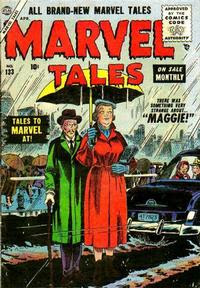

Marvel Tales #133
Cover by Sol Brodsky & Carl Burgos

"Meet Maggie" (a: Sid Greene) ★
"The Lonely Little Boy!" (a: Vince Colletta) ★★
"Inside the Box" (a: Ed Winiarski) ★★
"The Talking Dog" (a: Bob Powell) ★★
"The Coward!" (a: Mac Pakula) ★★1/2

Maggie Moran is the world’s luckiest woman. Cars have run her down, theater marquees have fallen on her head, and yet she just gets up and dusts herself off as though nothing happened. Maggie chalks it all up to being married to Harry, her own personal guardian angel. When Maggie runs afoul of some stinkin' commie spies and they break into her flat to ventilate her, the Russkies are astounded when the bullets bounce right off the woman. After the cops haul off the spies, we see the wings on Harry's back and believe what Maggie has to say. Tame and tepid, "Meet Maggie" and meet the new Atlas. Laughably, artist Sid Greene can't even illustrate bullets thanks to the stranglehold of the CCA; we’re simply told through word balloons that the woman has been fired upon.
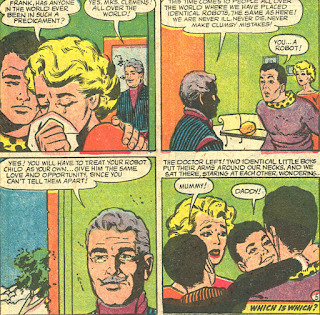
In the futuristic "The Lonely Little Boy," Bobby's parents have become concerned over his lack of social manners and the way the boy is slowly but surely crawling back into his shell. They seek the advice of a psychiatrist, who recommends they have a twin robot fashioned for Bobby to pal around with. The experiment is a success and Bobby is a happy, playful child once again. Only problem is, Bobby's "twin," Billy, wants to be Bobby. "The Lonely Little Boy!" has an intriguing hook and a creepy premise but doesn't follow through, instead settling for the maudlin and a climactic public service message about parenting.

A similar message about beauty being skin deep (or something like that) can be found at the end of "Inside the Box." Roby Wicker is given a box and told it's been willed to him by his dead uncle. Determined to share his newfound wealth with his friends, Roby heads down to the local market where his pals hang out around the stove and gossip about the other townies. When Roby opens the box, he finds a small glass tube and instructions from his uncle to point it at someone and Roby will see their true colors. Roby's friends aren't the kind souls he thought they were. More really rough art here by Winiarski.

 
Bob Powell's art is the best thing about "The Talking Dog," about a pet owner who discovers his dog can talk and wants to make money off the canine. Once his master’s plan is unveiled, the dog shuts his yap. Best of the lot this issue is Mac Pakula's "The Coward," starring Andre, a cowardly security guard in France who is mistaken for a famous General and brought to Paris to command the troops. After Andre’s second-hand battle strategy helps win the war, he's awarded the Medal of Bravery but opts to tell the adoring crowd the truth about his real identity. A pleasant enough moral fable but we never find out what happened to the real General.-Peter

Mystery Tales #28

Cover by Carl Burgos & Sol Brodsky

“A Pair of Shoes!” (a: Art Peddy) ★★
“Stop” (a: Bill Benulis & Jack Abel) ★★1/2
“The Brain” (a: John Forte) ★★1/2
“The Man in the Rain” (a: Jack Katz) ★★★
“The Unseen!” (a: John Tartaglione) ★


Ed Bannon is a clumsy oaf who can't make a living climbing fire escapes and robbing apartments because he has a bad habit of tripping over flower pots. At home he blames his slovenly wife, who promises to do a better job of keeping house. One day, Ed come up with the bright idea of putting magnets in "A Pair of Shoes!" so he can walk up the outside walls of buildings like a human fly. Too bad his wife takes the shoes to the cobbler without telling Ed, who steps off a roof and goes splat.

I guess Ed's plan might make more sense if city buildings were made out of metal but, as it is, it's pretty stupid. The surprise ending is cute but it's executed so subtly that I had to look twice to see that what I thought had happened was what really happened. We see Ed stepping off the top of a building, then two panels of his wife at the cobbler's shop, then an image of Ed flat on the pavement.

Several people take a break and "Stop" to consider their actions when they come upon a stop sign in the road. Ironically, the sign is in the wrong place and will be moved. Benulis and Abel contribute decent art to a little morality play that is more a slice of life than a mystery tale.

Hoping to be the one appointed Master Scientist of the World for creating the perfect robot, Prof. Flemming implants into one of his mechanical men a "throbbing, pulsating" mass that his son found in a tomb beneath the Sphinx. Sure enough, the robot is a genius, but when Flemming demonstrates it for the scientific board, they appoint the robot as Master Scientist of the World instead of Flemming.

There's not much a writer and artist can do in a four-page story, but the uncredited scribe tells the tale efficiently and John Forte adds a certain something with his illustrations. Prof. Flemming is short and wide, bald on top with tufts of hair on the sides and a great big mouth. The art is what makes "The Brain" a bit of fun.

A rebel cell in Eastern Europe is betrayed by one of its members named Vorac to the Reds, so the rebels have to gather up their presses and radio equipment and get out of their hiding place right away. They manage to escape and make their way to Jan Felsen's farm, but the Reds are hot on their trial. The soldiers follow them in thick fog and ask "The Man in the Rain" for directions along the way; he points to the right. Time passes and the search is fruitless, so they return to the square where they received directions from the man, only to discover that the man is a statute of the late patriot Belti, and his arm is pointing in the other direction!

Jack Katz's art is interesting and looks forward to what we'd later think of as an underground style. The idea that soldiers would mistake a large statute in a famous square for a human being is a bit far-fetched.

In "The Unseen!" a woman takes her dog to a shrink to try to figure out why he's seeing creatures that don't exist. The trick of the story is that we don't know it's a dog till the last panel. Tartaglione's art is sub-par and looks like a series of photo swipes.-Jack


Strange Tales #35
Cover by Carl Burgos

"Danger Signal!" (a: Joe Sinnott) 

"The Man in the Bottle!" (a: Ed Winiarski) ★1/2

"The Target!" (a: John Romita) ★1/2

"The Character" (a: Dick Ayers) ★1/2

"Freddie’s Face!" (a: Art Peddy) 


A freight train hurtles toward certain doom because a switch hasn't been pulled. Someone puts a lantern on the tracks and the train stops just in time! It turns out it's all happening on young Peter's model train set, but when Dad gets home he tells his wife that the train he was driving was saved by the appearance of a "Danger Signal!" in the form of a lantern!

You know something's up when a story's first four (out of five) pages are told in the second person and don't show you the main character. Still, the twist is fun and Joe Sinnott's art is effective.

Fisherman Adam Halley catches "The Man in the Bottle," who promises great riches and power if he's let out. Nosy reporters see the bottle so, to distract them, Adam buys 1000 bottles and puts 1000 dolls in them; he sets them afloat and claims it was all a publicity stunt. At home, he lets the man out of the bottle and finds himself bottled up in his place, since the one who gets out replaces himself with the one who frees him. Halley floats on the ocean and is picked up by another fisherman, but this guy tosses him back, convinced it's one of the bottles from the publicity gag.

That's a lot of plot twists for a five page story, and the whole thing is far-fetched. I can buy the genie in the bottle who replaces himself with the person who frees him, but a rush order of 1000 bottles and 1000 male dolls just to trick reporters? That's the kind of clunky plot development that makes stories like this not work.

Young Randy builds a model spaceship and dreams of space travel, but his parents tell him it'll never happen. He speaks with two scientists, who agree with Mom and Dad. When Randy finally goes out to play with the other kids, he discovers a wrecked spaceship in a ravine! What he doesn't know is that his parents were among a thousand refugees who left a war-mad planet, the same planet that Randy is obsessed with--Earth.

Perhaps the kids who bought and read these comics in 1955 had never read any science fiction stories before and were surprised by the ending of "The Target!" I know I wasn't. Still, it's nice to see early work by John Romita, who would make such a splash at Marvel in the '60s.


A bearded man in a derby hat complains all the way through a bus tour of London, but when "The Character" reaches Soho he expresses disappointment that no one recognizes him--he's Merlin the Magician!

The half-page splash panel by Dick Ayers and Ernie Bache is the only reason to spend any time on this pointless four-pager.

"Freddie's Face!" is so ugly that he can't stand to see his reflection in a mirror. A pretty girl at the office tells him to change his attitude, but he stays homely. Finally, he takes a job as a lighthouse keeper. In his isolation he grows handsome, but without mirrors or other people, he doesn't realize it.

I suppose I need to get used to coming to the end of an Atlas story and thinking, "that makes no sense." That's the case with "Freddie's Face!" What's the point?-Jack


Uncanny Tales #30
Cover by Carl Burgos

“Too Human” (a: Dick Ayers & Ernie Bache) 

“Collector’s Item!” (a: Bill Benulis) ★1/2

“Stumblebum” (a: Sid Greene) ★1/2

“One in a Million” (a: Ed Winiarski) 

“First Prize!” (a: John Forte) ★1/2


Chess master Felix Blanik can't beat chess master Janipolo, so he uses his skills as an electronics expert to invent chess pieces that think for themselves, led by the king. At the next tournament, Blanik beats all comers but can't understand why Janipolo still prevails in the championship match. It seems Blanik's king is all "Too Human" and fell in love with the opposing queen, leaving him unable to beat her!

It's not often that these fantastic tales accurately predict the future, but chess computer programs have made Blanik's technological advances come true. The ending, where the sentient king piece falls hard for the queen piece and gallantly loses on purpose, adds a human element to the scientific advances.

World landmarks are disappearing and someone leaves behind a calling card at each vacant site that reads "MGYD, Collector." A reporter named John Rand is mistakenly taken when the Taj Mahal disappears and finds himself on another planet, where he meets the collector, an alien named MGYD. MGYD explains how he teleports items from other planets to add to his collection; Rand can't escape until suddenly MGYD disappears. Left behind is another card reading "NOFLI, Collector of Collectors."

Hang on, didn't we just have a story last month about buildings disappearing? I like the Benulis art but the conclusion is mystifying. An alien named NOFLI collects collectors? So what? Can Rand use MGYD's teleporter to return to Earth? "The End" at the bottom of page four means we'll never know.

'Twas the night before Christmas and a "Stumblebum" by the name of Harvey Croy has no money or prospects for a meal, so he decides to commit a small crime and land in jail in order to be fed. He breaks a store window, but it leads to a robber being captured. He pulls a fire alarm, but a real fire is put out. On the sidewalk he finds a lucky coin from Meltzer Shoes; he avoids two accidents and finds a five dollar bill on the sidewalk.

Harvey is about to treat himself to a meal at Dave's Diner when he sees a poor woman with two children looking hungrily through the window. He gives her the fin and his act of generosity is witnessed by a wealthy businessman who invites him to Christmas dinner and promises to discuss employment. The next day, Harvey is forced to use the lucky coin at a subway turnstile, only to find himself arrested and thrown in jail. In the end, he gets just what he wanted for Christmas--a hot meal!

I'm a sucker for a story like this, which mixes pathos and humor in a holiday setting. Sid Greene's art is above average for what we've been seeing in the pages of Atlas, so the story is a satisfying piece of corn.

When the doctor tells Phillips that he has a heart condition and says a cure is a "One in a Million" chance, the patient has reason to worry. On his way home, everything starts to spin and he emerges from the attack to see a bright, sunny day and his house all fixed up. He realizes that he's been catapulted twenty years in the future and sees himself and his family as older folks. Another attack and he's back in the present, realizing with gratitude that he'll survive his seemingly fatal medical condition.

What's happening to me? This is two hokey stories in a row that I've enjoyed. There's very little to this one but the sentiment is welcome and the art's not half bad.

Visitors from the planet Saturn arrive at the home of Joe Ganby to tell him he's won "First Prize!" in a contest and gets a Saturnian butler. Joe quickly tires of the butler and just wants to go out and play chess at George's place. He comes up with a reason to be disqualified and the Saturnians take the butler away and give it to the second place finisher. Too bad that's George and Joe can't visit to play chess!

Just plain dumb from every angle. At least the art by John Forte is bearable.-Jack

Next Week...
The spoiled rotten Boy Blunder
jumps ship!

Monday, May 20, 2019

The Warren Report Issue 8: September/October 1966


The Critical Guide to 
the Warren Illustrated Magazines
1964-1983
by Uncle Jack
& Cousin Peter


Frazetta
Eerie #5 (September 1966)

"The Mummy Stalks!"★1/2
Story by Roy Krenkel and Archie Goodwin
Art by Reed Crandall

"The Jungle"★1/2
Story by Archie Goodwin
Art by Al Williamson

"Black Magic"
Story by Archie Goodwin
Art by Steve Ditko

"A Matter of Routine!"★1/2
Story by Archie Goodwin
Art by Gene Colan

"Dr. Griswold's File!"
Story by Carl Wessler
Art by Rocco Mastroserio

"The Swamp God!"★1/2
Story by Archie Goodwin
Art by Angelo Torres

"Vampire Slayer!"★1/2
Story by Archie Goodwin
Art by Jerry Grandenetti and Joe Orlando

"The Mummy Stalks!"
"The Mummy Stalks!" Or so it seems at the museum after a guard is found dead near the mummy case of Harat-Ankneb, the guard's body horribly mangled. Inspector Nigel of Scotland Yard is on the case! After a policeman is killed in a similarly horrible fashion, Nigel decides to take the next night watch himself. Around midnight, with moonlight streaming through the museum windows, the inspector observes the mummy come alive as a werewolf! Fortunately, Nigel has a silver-handled cane and succeeds in beating the werewolf-mummy to death.

Only five issues in, and how many times have we already seen the werewolf bit? Reed Crandall's art is delightful and I was happily going along with the story, wondering what was killing people and why they were so mangled. I thought that it would not be a straightforward explanation, this being Eerie, but when it turned out to be a werewolf I was let down, basically because it's so stupid. I should have known--at Warren, the big reveal seems to be either "it's a werewolf" or "it's a vampire," and there were no neck puncture holes in sight.

"The Jungle"
Greedy Leo should not have shot the witch doctor and headed off into the Amazon jungle with a bag of valuable shrunken heads, say his two companions. Back in his village, the dying witch doctor comments that "The Jungle" will take care of the evil white man. And he's right! A snake bites one of Leo's companions and Leo, rather than try to suck out the venom, finishes off the poor man with a shot from his pistol. Leo's other companion finds himself tumbling into a lake of hungry piranha. Alone, Leo tries to hack his way through the undergrowth but eventually is strangled to death by vines that almost seem sentient.

Slightly better than the mummy story, this jungle story features more sharp art and a wafer-thin plot. We know from the start that Leo will get his just desserts; the only suspense in the short six pages is how. The conclusion, once again, is a letdown--why do the vines strangle Leo and why is his machete suddenly less than effective? It matters not--all that counts is the final image of him hanging dead in the jungle.

"Black Magic!"
Way back in the Dark Ages, Europe was a scary place! An expert in "Black Magic!" by the name of Valdar holds court at a castle, demonstrating his powers and conjuring up a spirit to kill a man who dares doubt them. He heads for the crypt, only to be met by a very old man, his former teacher, who warns him of the consequences of what Valdar is about to do. Ignoring the admonitions, Valdar heads down to the crypt and raises from the dead a beautiful woman whose corpse has been decaying for a century. Her mind does not seem to come back with her beauty, however, and she attacks Valdar's assistant with fury. Valdar recites a spell to reverse her revivification, but he joins her in decomposing. His ancient teacher reveals that he had raised Valdar from the dead years before, and we are left to assume that Valdar's spell of reversal not only affected the woman, but also Valdar himself, who reverts to skeletal form.

This panel reminds us of the work of Jack Davis
("Dr. Griswold's File!")
I quite like Ditko's work in "Black Magic!" and think it shows why it's such a shame that he had a fit and left Marvel when he did. Valdar is almost a dead ringer for Baron Mordo and his old teacher is a de-Orientalized Ancient One; there are plenty of Dr. Strange-like flourishes, including those special Ditko finger positions. Goodwin's story is exciting and moves swiftly from start to finish; for once, the conclusion is not a disappointment, though for some unexplained reason the woman who is revived seems to have the fangs of a vampire in one panel.

Commuting home from work every day is "A Matter of Routine!" for George Simmons. He sees the same folks on the rush-hour train and utters the same phrases, day after day. But not today! Today, he opens the front door of his home to witness a scene of horror: a barren landscape where violent creatures rip a man to pieces! That man turns out to be his friend Phil, who tells George that he's entered the land of the dead. George insists he's not deceased and makes a run for it, only to be captured and brought before the executioner. But wait! Something's wrong! George's name is not yet in the ledger book! Suddenly, he finds himself back in mid-commute and when he reaches his front door, he wonders--should I open it?

Gene Colan turns in another masterful art job on this intriguing tale of one man's malaise being interrupted by horror. Once again, Colan's page layouts are inventive and follow no panel rules, and the full-page drawing (see below) when he opens the door is quite impressive. I also like how Goodwin ends the tale on a question mark.

We don't actually see Croft being
devoured... ("The Swamp God!")
Dr. Harry Griswold disinters recently-buried criminal Vincent Coe and brings the corpse back to life in his laboratory. Dr. Griswold's lovely wife, Lucille, wants an emerald pendant that costs 4000 pounds (this being 1910 London, that would be just over $600K today), so Dr. Griswold has the reanimated corpse/zombie pull a patient's card at random from "Dr. Griswold's File!" and then go and rob the patient. Coe can't help himself and also kills the people he robs, but this doesn't faze Dr. Griswold, who just needs the money. Soon, he has enough cash to buy the pendant and gives it to his wife, who promptly announces that she wants a 2500 pound fur coat to go with it! Dr. Griswold sends Coe out on another mission, but this time the zombie returns with an emerald pendant, and the doc recalls too late that his wife used to be his patient.

It's not a good sign that Carl Wessler has joined the ranks of Warren's writers, though the GCD tells me he'll only write one more story for the publisher in the '60s. The advent of Wessler coincided with the decline of EC and his work later on at DC was not too great, either. This story is not that bad, though Mastroserio's art veers from what may be swipes of Wally Wood (the doctor's wife) to one panel that really looks like Jack Davis's work (when the zombie pounds his second victim).

Great White Hunters Douglas and Croft sit in a boat as Johnny, their native guide, poles them deeper and deeper into a mysterious bayou in search of "The Swamp God!" After Johnny explains that his people have spent generations offering human sacrifices to the beast, he stops at a spot he calls the killing ground, blows a horn, and summons a Tyrannosaurus Rex, untouched by time, which gobbles up Croft, since Douglas's rifle seems to have stopped working. To Douglas's horror, Johnny blows the horn again and, as the monster heads back for a second course of Douglas, Johnny admits that he removed the bullets from the hunters' rifles. After all, he's tired of his own people being fed to the beast and from now on he plans to use only outsiders!

I got a chuckle from the ending of this story, which plods along without much surprise and which features decent but not superb art by Angelo Torres. Of course, it's tough when the story you illustrate turns out to be the one Frank Frazetta chooses to turn into the cover, which is invariably spectacular.

Yep, she's a vampire all right!
("Vampire Slayer!")
Baron Alexi is a "Vampire Slayer!" and he's so proud of it that he tells everyone within earshot on a luxury liner. Countess DeVille thinks his story is in poor taste and storms out of the dining room, but soon they're cozying up to each other and he's calling her Corrine. When her luggage is unloaded and is the size of a coffin, the baron begins to suspect something's amiss, and when he visits her creepy home, he's certain, especially when he sees a drapery covering a large mirror. He's about to pound a stake into her heart when the drapery falls off and he sees that she casts a reflection, so he apologizes and destroys all the tools of his trade. Unfortunately, she does turn out to be a bloodsucker after all, and the reflection in the mirror was none other than her twin sister, a ghoul!

The bottom of the barrel has officially been scraped by the last story in this fair to middling issue of Eerie. The GCD credits Grandenetti on pencils and Orlando on inks; though Joe signed the final product, it sure looks like Jerry's work to me. Goodwin was really leaning hard on vampires and the end, where a ghoul is thrown in for good measure, is worthy of a groan.-Jack

"A Matter of Routine!"
Peter-"A Matter of Routine!" is far and away the best story this issue and the name Gene Colan has become something of a barometer for quality in these parts of late. Each one of Gene's assignments is like a short noir film, virtually drowning in atmosphere and bad vibes. Runner-up is Steve Ditko's masterful job on "Black Magic," returning to the genre he pretty much created with Marvel's Doctor Strange. Yes, the punchline seems a bit far-fetched (why would the sorcerer revive a corpse as a pupil?) and coincidental, but it works nonetheless. Not so most of the other tales this issue. A mummy who's really a werewolf? Oh boy, I never saw that one coming! A vampire who has a ghoul for a sister? Enchanting! One last gripe on my part: why is that Jack and I are the only ones who seem to realize that putting Joe Orlando art on the final story of each issue is tantamount to tacking on a Yoko One tune to an expanded version of Abbey Road? Didn't Archie want to have the readers closing the cover on a high note?


Frazetta

Creepy #11

"Hop-Frog!" ★★1/2
Story by Edgar Allan Poe
Adaptation by Archie Goodwin
Art by Reed Crandall

"Sore Spot" 
Story by Archie Goodwin
Art by Joe Orlando

"The Doorway!" ★★
Story by Archie Goodwin
Art by Dan Adkins

"The Black Death!" 
Story by Ron Parker
Art by Manny Stallman

"Beast Man!" ★★
Story by Archie Goodwin
Art by Steve Ditko

"The Devil to Pay!" ★1/2
Story by Archie Goodwin
Art by Norman Nodel

"Skeleton Crew!" 
Story by Archie Goodwin
Art by Angelo Torres

"Hop-Frog!"
The King surely loves his sadistic fun and his court jester, "Hop-Frog!," born with deformed legs, is usually his majesty's target for vicious barbs. Hop-Frog does his best to swallow his pride and continue his pranks and antics but when the king mistreats the jester's young dancer friend, Trippetta, he can take no more and devises a nasty game of revenge. He tricks the king and council into dressing as orangutans to startle the villagers and then acts the hero when he strings the three costumed royals up and burns them alive. Hop-Frog and Trippetta then escape the kingdom to seek out whatever happiness a dwarf and a pre-teen girl can find. At least I think she's a pre-teen... is the girl actually a dwarf as well? Regardless, this isn't Poe's best work but Reed Crandall seemingly could do no wrong.  There are a heck of a lot of checkerboard patterns here and yet nothing Reed draws gets lost in a muck of squares. Poe will get a lot of mileage from the Warren zines in the years to come.

When executioner Henri Arnaud drops the guillotine blade onto the neck of accused murderer Claude Remarque, some of the man's blood sprays onto Arnaud's shirt. When he gets home, he discovers the stain has not only soaked through his shirt onto his chest but that the blood won't wash off. The stain becomes a growth and, by story's end, we discover that Arnaud framed Remarque for a murder that Arnaud himself committed. The finale finds the executioner lying dead on the floor of his flat from a self-induced gun wound, the sore having finally grown into the face of Claude Remarque. For just a few pages, "Sore Spot" actually shows some promise but its inane plot twist and awful graphics sink it fast.

"The Doorway!"
Charles Damon, "secret guard at Project Zeus," discovers that the lab of the Project's top scientist, Doctor Crane, has been destroyed and the egghead is missing. Exploring further, Damon discovers a strange inter-dimensional "doorway" and enters it. He plunges into a vast darkness but finally lands on some kind of platform, where he encounters Professor Crane, running for his life from a winged demon. The creature catches up with the scientist, kills him, and enters his body. Crane is able to hold on to his own faculties long enough to explain to the security guard that he had been tinkering with the black arts and cut a hole into another dimension; he pleads with Damon to kill him before the demon takes over and invades our world.

Damon shoots the professor, but the monster parts ways with the dead flesh and attacks our hero; both stumble through "The Doorway!" Damon awakens from unconsciousness, destroys the doorway, records his final message on tape and, believing the creature is inside him, commits suicide. An officer enters and erases the tape, musing that he'd better get started on opening another doorway so the rest of his demon pals can help him take over this new world.  Sure, it's pretty far-fetched (Professor Crane remarks that "scientific study only takes you so far..." so he had to pick up a copy of the Necronomicon down at the corner bookstore) but "The Doorway!" is also very effective and (even though it's very obvious this is a job for Wally Wood) Dan Adkins does a nice job visualizing the other-dimensional beastie. I love that Archie is exploring those weird in-between dimensions that HPL and Clark Ashton Smith excelled in.

"The Black Death!"
Jacques and Pierre make a living off the dead by dragging victims of "The Black Death!" to the outskirts of their village and burning the bodies in a huge pit. They then rummage for valuables and sell the plague-infested baubles to rich and unaware customers. Their latest stooge is the wealthy (but not too bright) Count Eschelles, who gives the deadly pair lots of dough for the jewels they bring to his castle. The next day, J&P are summoned to the Count's estate, where they are told to haul off his dead body and burn it (this plague incubates just like that!). The two dummies decide to return after their shift to the estate to search for the jewels they had sold to the count the day before. They find the treasure but discover, too late, that the count knew the pair had killed him and set a trap for them.  A bad riff on Stevenson's The Body Snatcher, "The Black Death!" is just too dumb for its own good. Author Parker whips up a plague that must incubate and fully engulf the victim within minutes, since the Count has time (while huge boils grow on his body and he vomits blood) to erect an elaborate revenge trap! Manny Stallman's art is wretched; objects and humans seem to just blend together without any kind of lines to hold their forms in. It's all just a yecchy mess. While I wouldn't exactly call Stallman's pre-code Atlas work (which I'm currently dissecting every other Thursday) ground-breaking, it certainly was better than his limited 1960s' work for Warren.

All eyes are on the "Beast Man!"
"Gorilla" Ames, a carnival attraction who can take any man daring to get in the ring, has a big problem with his new heart. The carnival doc (an animal vet/constant drunk) patches Ames up when his ticker goes bad, swapping out his heart with that of an ape. Only problem is, Ames now dreams he's transforming into a "Beast Man!" and savagely killing innocents at night. Only Ames's boss, Walsh, and the doc know there never was an operation; the men simply told Ames he was getting a good ticker to keep his mind off quitting the carnival. But Ames is convinced he's become savage and, very soon, Walsh will agree. A whole lot of fun without a lot of strain on the brain, "Beast Man!" is a mixture of all sorts of horror cliches but Archie does it in such a tongue-in-cheek fashion that we can forgive the overcooked ingredients. Picture this as a really bad Universal-International flick from the late 1950s, starring Lon Chaney as "Gorilla" Ames and Whit Bissell as Walsh. Ditko's art is great but Steve sometimes has a problem with conjuring up attractive female characters (see the splash), though he's certainly got the headlights down (see page 2!).

Nodel page 2
The same Nodel
four pages later
In "The Devil to Pay!," Lugerio, Duke of Corona, tires of his shabby existence and attempts to make a pact with the devil to trade up to the good life. Unfortunately, Satan is on vacation and one of his grunts gets the task of making Lugerio happy. Explaining that Lugerio's soul is already lost to the devil and that he'll be poisoned by one of his assistants in only a year, the demon offers up a consolation prize: the upcoming poisoning will be postponed if Lugerio can convince another man to offer up his soul willingly. Bribes and threats won't work, so the Duke has to resort to his other vocation, black magic, to come up with a potion that will render one of his subjects weak to suggestion. Subject in hand, Lugerio meets up with the demon, only to learn he has accidentally put a spell on Satan himself. And Beelzebub ain't too happy about it. I didn't care for Archie's script at all; it's way too familiar (yes, I know I'm never consistent, since I just gave "Beast Man!" high praise despite its familiarity), and the twist is just dumb. What's with Donald Norman Nodel's art on "The Devil to Pay!"? The first two pages are filled with very interesting, intricate images (as if done in woodcutting) and then, abruptly on page three, we get the Nodel we saw on "Undying Love" (Eerie #4), cartoony and unimaginative.

"Skeleton Crew!"
A pair of sea pirates, Manuel and Carpenter, pull their small tug up to a huge freighter, ground on a shelf, and board her with an eye to loot. They stumble onto a terrifying sight: the white, skin-free skeletons of the crew! When they stumble onto a skeleton with a log book in its bony fingers (oh yes, you heard me correctly!), Manuel reads the journal while Carpenter goes to investigate the cargo hold. The diary tells a terrifying tale of nightly murders and a black shadow that descends on the crew, one by one. When Manuel gets to the final entry, he screams in horror to Carpenter to get out of the hold but, too late, as he looks down at his partner in crime, writhing in agony amidst a carpet of army ants. I've got a whole boatload of questions concerning army ants and just how smart they are. First of all, we're told (in the journal) that the ants were loaded into a box by angry natives during a stop-over. Fair enough, but how do you get a billion, zillion ants to behave in one box for several hours and only come out now and then to "feed" and then return to the crate? How is it Manuel and Carpenter don't see any sign of the ants when they board? None of the little critters were harmed during their lunch-time activities? And, when confronted by a sea of ants, why not jump into the ocean? This has to be one of the dumbest scripts we've yet read.

Trivia: For some reason, the contents page lists "Trial By Fire" (which appears in Eerie #6) instead of "The Doorway!" And no "Creepy Fan Club" page this issue.-Peter

Jack-"Hop-Frog!" was easily the highlight of this below-average issue of Creepy for me. Archie does a great job adapting Poe's story and Crandall's line work is exquisite. Next best is "The Doorway!," which has art by Adkins that seems like a cross between Wally Wood and Steve Ditko. It's all downhill from there. "Beast Man!" has a weak story and is not Ditko's best work, while "Skeleton Crew!" seems like a fairly good tale of horror in a confined space until the head-scratching climax with the ants. "The Devil to Pay!" is the least bad of the three real clunkers; "Sore Spot" is clearly more ghost work by Grandenetti, while "The Black Death!" seems like a mix of proto-Corben and Sam Glanzman, which is not a pretty sight.

Next Week...
Things go from bad to worse
on the Kirby front!