Showing posts with label Joe Kubert. Show all posts

Monday, December 30, 2024

Batman in the 1960s Issue 38: March/April 1966


The Caped Crusader in the 1960s
by Jack Seabrook
& Peter Enfantino


Kubert
Detective Comics #349

"The Blockbuster Breaks Loose!"
Story by Gardner Fox
Art by Carmine Infantino & Joe Giella

The Blockbuster is back! How, you say? Well, hang on and I'll try to translate the ancient hieroglyphs known as a DC funny book script. Seems the BB survived the ocean's rage (see Detective #345 - editor) and hid in an undersea cave. Here's where it gets kinda sketchy. Either the undersea cave is right below a local department store or BB switches locales after an undisclosed amount of time. Anyway, the Mutant Monster of Mayhem cracks through the dept. store floor just as Batman and Robin are putting the kibosh on a trio of safe-crackers.

Robin escorts the thieves to a back room while Batman doffs his mask, revealing the face of Bruce Wayne to BB. Those of you who don't remember the thrilling details found in "The Blockbuster Invasion of Gotham City" (see Detective #345 - editor), I'll just say that Blockbuster's best friend in the whole world is, ironically, Bruce Wayne, and the millionaire playboy's face is a soothing balm to the soul of the Neanderthal Ninnie. But, what's this? As soon as Bats doffs, the mask reattaches to his face and refuses to let go. "Obviously," thinks the World's Greatest Detective, "Something's going on here!" 
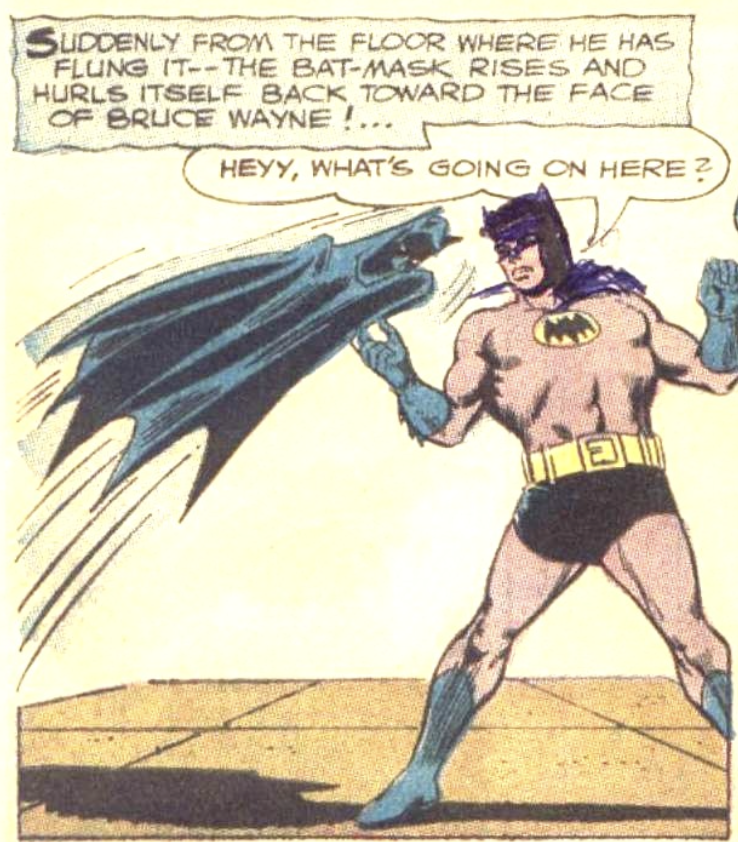
BB beats Bats to a pulp and is about to deliver the killing blow when the Dark Knight imitates the voice of BB's brother, Roland Desmond, commanding him to leave the Batman alone and return to the Blockbuster headquarters. BB does so, leaving an exhausted and beaten Caped Crusader to lick his wounds. Back in the Batcave, the Dynamic Duo cook up a plan to defeat their nemesis, using "a special calcium compound only visible in a calcium light," wherein Bats takes on the features of Roland.

Obviously not bathing for a week, Batman sets out each night on patrols with the Teenage Tornado, but there is no sign of the Mammoth Mauler. Finally, while breaking up a theft at the Gotham Art Museum, the boys hear a thundering, rumbling crash and Blockbuster enters through a wall. Robin shines his calcium light on his partner and Batman magically grows a mustache and second chin, perfectly aping the features of Roland Desmond. The act lasts three or four seconds before all hell breaks loose. Pictures fly off the wall, statues hurtle through the air, rugs are pulled out, and Robin's attention is broken. The calcium light goes out and Blockbuster sees our hero for what he is: a caped and cowled enemy!

The Blockbuster delivers a crunching blow to the head of the Dark Knight and then turns away as a mysterious figure steps out of the shadows and encases Batman in a sarcophagus. The mystery man lets us know the tomb is laced with a special radiation that ages anyone who comes in contact. The tomb will be the death of the Batman! Luckily, the radiation has melted the calcium from Batman's face but somehow hardened the substance on our hero's glove (don't look at me - editor), giving him a rock-hard karate limb. Batman chops his way through the solid stone tomb and then uses the super fist to level Blockbuster. The boys turn their misunderstood enemy over to the scientists at the Alfred Foundation for research purposes.

Meanwhile, somewhere in a Gotham alley, the Outsider admits to us that he was behind all the oddball occurrences of the installment and vows to return someday!

In the end, most of the confusing lapses in credibility can be laid at the Outsider's feet (well, except for Batman's sudden use of dried milk to punch his way out of a thick sarcophagus), but the sophomore adventure of the Blockbuster is threadbare entertainment. Several of the pages are used to remind readers who the big ape is and the final page exposition, delivered by the shadow of the Outsider, is pretty lame. I will say, though, that the identity and purpose of the Outsider are still interesting me. Too bad the script is so bad, because the art is pretty darn good.-Peter


Jack-The best thing about this issue is Kubert's cover. Blockbuster is a character of limited interest and Infantino's art this time out isn't his best work. I was surprised to see the return of the Outsider; isn't it about time to reveal his identity?


Kane/Anderson
Batman #179

"Clay Pigeon for a Killer!"
Story by Robert Kanigher
Art by Sheldon Moldoff & Sid Greene

"The Riddle-Less Robberies of the Riddler!"
Story by Gardner Fox
Art by Sheldon Moldoff & Joe Giella

After three crooks wearing animal head masks succeed in stealing three million bucks from an armored car and killing the guards, the heist becomes the subject of a TV show called "Unsolved Crimes of the Century," where host Roger Kay promises to reveal the identity of the killer on tomorrow's show. Unfortunately, Kay has no idea who the guilty party is, so he visits Bruce Wayne to confess that he's terrified he'll be assassinated by the murderer. Bruce volunteers his pal Batman to be a "Clay Pigeon for a Killer!" on the TV show by impersonating Roger.

Bruce disguises himself as Kay and, as expected, the three robbers/killers show up and one shoots Kay/Batman point blank! Our hero awakens to learn that he was shot with an "anesthetic bullet" and that he is now prisoner in a tunnel that is rapidly filling with 1) water and 2) boastful words from Elon Musk Victor Iago, world's richest man, who can't help bragging about having committed the perfect crime. Iago was one of the trio of robbers; when they got to their hiding place after the crime, he had another man, who was wearing the same disguise as Iago, shoot the other two robbers. Iago then shot the shooter, making it appear that the three crooks had all been killed by an unknown person. The cops figured the three crooks did away with each other and closed the case.

Batman removes his Roger Kay disguise, avoids being drowned, and exits the tunnel to find himself on the grounds of Iago's mansion, where he must escape being mauled by a lion and other big game. The Caped Crusader is caught by Iago's gunsels and brought to the rich guy himself; he quickly overpowers them all. In the end, Iago is in the looney bin, having gone insane.

Bob Kanigher certainly knows how to keep a story moving and, while this one isn't very good, at least there's plenty of action. Moldoff and Giella's art is below average, even for them. You'd think Batman would wear some sort of bullet proof vest, but apparently not. He is shot in the chest and recovers immediately.
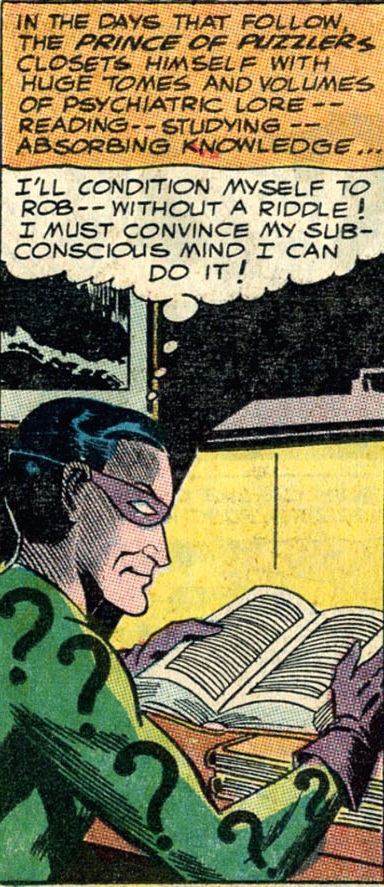
The Riddler escapes from prison and vows to stop tipping off Batman to his crimes with riddles. The first time he tries to commit a crime, however, he can't go through with it because he hasn't sent out any riddles beforehand! He vows to cure himself of his compulsion by means of psychoanalysis. After much work, he succeeds in robbing old coins from a soda factory.

While the Riddler has been working on his brain, Batman and Robin have been busy stopping other, more run-of-the-mill crimes. Finally, the Riddler's soda company theft occurs and he is seen running off, leading Batman to wonder why no clues preceded the felony. Batman and Robin soon determine that the Riddler actually has been leaving clues that they did not realize were from him. New clues begin to appear and the Dynamic Duo foil the Riddler's plan to rob the Corsican Glove Factory. Upon capture, the Riddler deduces that he was subconsciously leaving clues while he thought he was taking cat naps during his studies! He returns to jail and vows to outwit Batman soon.

I have been a big fan of the Riddler ever since I was a kid and saw Frank Gorshin on the Batman TV show, so I'm always happy to see a new story with this member of the Rogue's Gallery. Gardner Fox turns in an interesting script, filled with the usual goofy riddles and some unexpected psychoanalysis. Peter, what did you think?-Jack

Peter-I found the plot device of "Riddle-less Robberies" to be an intriguing one but the story was way too talky for my tastes. For a comics-code-approved funny book aimed at an audience of eight-year-olds, "Clay Pigeon for a Killer!" sure has a high body count. Why does millionaire Victor Iago shoot Kay (Bruce Wayne) in the chest with a tranqui-bullet if he's going to drown him hours later anyway? I find most of these stories illustrated by Moldoff and (whoever) to be almost unreadable due to the clunky art. Teasing us with Joe Kubert and Gil Kane covers just to serve up the same old Swanson's on the inside seems, to me, tantamount to bait-and-switch.


Kubert
Detective Comics #350

"The Monarch of Menace!"
Story by Robert Kanigher
Art by Sheldon Moldoff & Joe Giella

Dick Grayson arrives at the airport after a visit to a buddy's crib, only to witness Batman taking on a group of escaped cons armed with dynamite on the runway.  With a little help from the Teenage Twister, Bats puts the dynamite and the cons out like a light. Dick grabs ahold of one of the Dark Knight's biceps, rolls his eyes heavenly, and blurts out that "Batman is the King!"

The World's Greatest Detective sighs and admits to his underage ward that he is not the "king" as long as his old nemesis, the Monarch of Menace, walks the streets a free man! In a frenzied flashback, we learn that the Monarch had a quartet of Little Lord Fauntleroy impersonators who talk like Bowery Boys and carry very little muscle, if their battle with Batman (shown in flashback) is an indicator.

But the Monarch didn't seem to need his henchmen since he had a clutch of deadly weapons at his disposal (including the nefarious AC/DC Scepter!). Batman could only watch in abject disgust and horror as the Monarch ventured out on an unparalleled crime wave and then disappeared without a trace. Bad memory over, Bruce and Dick (now back at the Bat-Cave) both sigh and admit they hope there's a chance they'll have a crack at the Monarch again someday.

Coincidentally, thousands of miles away in his jungle retreat, the Monarch relives his glory days with his merry men in tights and his own son, a kid he belittles as the court jester. Tired of his father's derision, the youth dons his pop's costume and heads to Gotham to make the old man proud. Only problem is, the kid is a klutz; he robs a bank, runs into Robin while exiting the building, and can't seem to operate his dad's weapons. Robin puts Monarch Jr. down like dirt and escorts him back to the Batcave.

After rubbing his victory in the face of the man who made him what he is, Robin unmasks the Monarch and Batman snickers at his ward; a fool caught by a fool. Monarch Jr. confesses he's a fraud and only took up a life of crime to impress the old man. Taking advantage of having the Monarch's costume and tools in the Batcave, Bats examines the articles in great detail, obviously forgetting Jr. is just hanging around, hoping these guys will forget about pressing charges. But the Dark Knight knows that all the data is useless unless he can smoke the real Monarch out of hiding (or, I guess, he could ask the kid where pop's lair is located?), so the World's Greatest Detective unleashes brilliance: he has Gotham's reporters write up stories on how Batman finally caught the Monarch of Menace.

The plot works. Pissed off by his bad press, the Monarch leaves his jungle burrow and flies to Gotham to reclaim his crown. Unfortunately, he discovers too late that Batman has an answer to all his wonderful devices. The final blow is delivered and the Monarch is finally put on ice after all these years. The Caped Crusader visits Jr. in the pen and is flattered when the kid vows to become a superhero rather than a villain. 

Despite (or more likely, because of...) the total inanity of "The Monarch of Menace," I actually enjoyed this adventure. Jr.'s descent into full-blown stooge would be genuinely funny if you erased the bits of parental abuse. Where's Mama Monarch? Also, can we put on hiatus the villain who returns only hours after being discussed?

The panels of Batman wallowing in his own pity, continually moaning that he's a failure because he couldn't bring the Monarch to justice, brought tears to my eyes. Tears from laughing. Why, if this defeat was so overbearing, had we never seen our hero leaning against a lamppost in the middle of an adventure, reminding Robin that, sure, it's a jewel in the crown to put the Joker back in jail for the third time in a twelve-month span, but what about the Monarch? 

Clearly, Big Bob Kanigher wasn't paying attention to his own script, since we clearly see Monarch Jr. coming out of a bank with a bag of loot in his fist but, eight panels later, MJ claims Robin caught him "before he could rob that bank!"-Peter

Jack- Once again, a great cover hides a mediocre story inside. My biggest question is how these villains find henchmen willing to dress in silly costumes and to keep wearing them even when the boss is retired and they're just hanging out and shooting the breeze. Don't the skirts and lace-up shoes get uncomfortable after a while? By the way, an ad in this issue claims that DC sells twice as many comics as any competitor. Take that, Marvel!


Kane
The Brave and the Bold #64

"Batman versus Eclipso"
Story by Bob Haney
Art by Win Mortimer

One night on a Gotham City pier, Batman saves a pretty redhead named Marcia from being shot with an arrow. They embrace and kiss passionately before she shows him the Cat Emerald and explains that her ex-fiance, Nicky Jarvas, stole it from a museum to get rich and prove he was Batman's equal. He was pursued and killed by Cyclops, the international crime syndicate, and just before he died, he gave the emerald to Marcia to return to the museum. An assassin targeted Marcia in order to get the emerald, so she gives it to Batman to return to the museum.

The not so Dark Knight recalls how he met and fell for the rich playgirl, even going so far as to propose marriage, until she dumped him and broke his heart. After agreeing to help her, Batman sneaks into the museum and replaces the Cat Emerald in its case. Hours later, he is arrested by Gotham's finest after a photo showed him seemingly stealing the emerald, which has again gone missing. In jail, Batman overhears two goons discussing the imminent arrival of someone named Mister E, who will join another person named Queen Bee!

In far-off Solar City, an eclipse causes Eclipso to separate from the body of Dr. Bruce Gordon. A pair of crooks dressed in bee costumes appear and grab Eclipso, taking him to the Apis Enterprises building, where Queen Bee is planning to take over Gotham City in Operation Sting! Mr. E arrives and turns out to be none other than Eclipso, who gets busy that evening with Queen Bee and her drones committing jewel robberies. After a crime wave hits Gotham City, Batman breaks out of jail and trails a crook to Queen Bee's hideout, where he is knocked out with gas and thrown into the river. The Caped Crusader wakes up and surfaces before avoiding a police patrol boat, which leads the cops to think he's dead.

Commissioner Gordon receives a visit from Dr. Gordon, who offers to help fight the crime wave and who happens to be an expert on Eclipso. Back at the Hive, Queen Bee's hideout, Eclipso puts the moves on the pretty redhead (hmmm....) just as a hooded agent from Cyclops arrives and announces that he is taking over the criminal operation.

Eclipso tries to zap the agent with a ray beam, but the agent runs and his hood flies off to reveal that it's Batman! Queen Bee saves the Dark Knight in the nick of time and he immediately recognizes her as Marcia, who explains that she undertook a career in crime to save her father from Cyclops. She wanted Batman in jail to keep him safe and helps him escape the Hive, handing him the Cat Emerald once again. Batman bursts out of the building, avoids attacking drones, and battles with Eclipso high above the city street. Just in the nick of time Dr. Gordon appears and shines a light on Eclipso that causes him to be reabsorbed into Gordon's body. Batman hands the emerald to Commissioner Gordon, Dr. Gordon makes a hasty exit, and the Caped Crusader is left holding Queen Bee's costume, wondering where the woman who broke his heart has gone.

"Batman versus Eclipso" is 25 pages of dense plot and high action and it's more entertaining than most of the run-of-the-mill stories we've been reading in Batman and Detective. This is Batman's second appearance in The Brave and the Bold and soon he'll take over the comic for good. Win Mortimer's art is certainly better than that of Sheldon Moldoff, but not as good as Carmine Infantino's. I'm looking forward to reading more team-ups!  The editor points out in this issue's letters page that this is the first time that B & B has featured a hero fighting his co-star, rather than teaming up with him.-Jack

Peter-I knew nothing about Eclipso, a villain who's nothing more than a DC version of Jekyll & Hyde and had to read a few blog posts to bring me up to date. The character ran as a back-up in House of Secrets from #61 (August 1963) through the 80th issue (October 1966). HoS slipped into limbo for three years and was rebooted as one of the DC mystery titles (see here for that story) and Eclipso became a footnote in comic history until he was rebooted in the '90s and became a first-class badass.
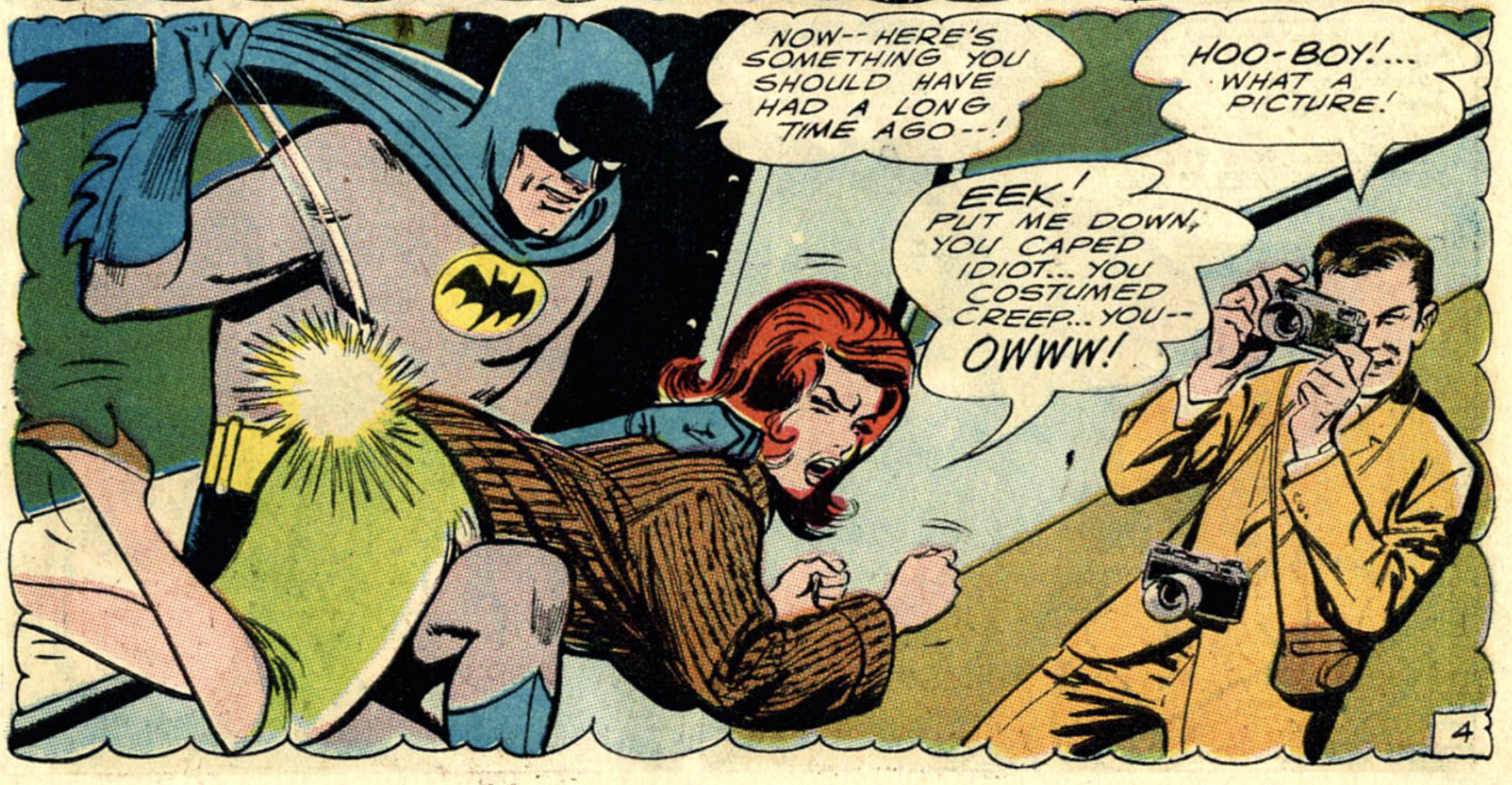

I love the x-ray panel that shows the inside of "The Hive" but I'm struggling with the fact that Queen Bee keeps her helicopters on an enclosed third floor. Maybe this gal isn't such an evil genius at that. Hearing Bats use the word "baby" is off-putting, maybe because I don't want the inevitable hippy era to come so soon but seeing him put an attractive babe across his knee for a good Wertham-enraging spanking is gold. Don't tell any of the eight-year-olds reading this strip, but Professor Gordon's head-first leap from atop a high building into a fireman's net would break his neck and put a damper on any victory celebration.

Next Week...
Can a Little Colan
Save Jack and Peter
From the Mid-50s Doldrums?

Monday, October 16, 2023

Journey Into Strange Tales Issue 97 Atlas/ Marvel Horror


The Marvel/Atlas 
Horror Comics
Part 82
May 1955 
by Peter Enfantino
and Jack Seabrook


Journey Into Mystery 24
Cover by Sol Brodsky

"The Locked Drawer" (a: Bill Benulis) ★★★

"High-Pressure Man!" (a: John Tartaglione) ★

"The Stone Bird" (a: Angelo Torres) ★★★

"The Long Night" (a: Paul Reinman) ★1/2

"The Eager Beaver!" (a: Mort Lawrence) ★★


The Bordens buy a mysterious chest of drawers that was once the property of a woman burned at the stake for witchcraft. Legend has it that, just before the woman was lit up, she hid all her magical secrets in the bottom drawer and sealed it forever. Mr. Borden tries everything but can't get the darn thing open, so he calls in an expert, a carpenter who carries it off to his shop and pulls out all the stops. The man is just able to wedge a crowbar between the bottom drawer and its frame for a peek in. Whatever he sees, he tells no one and returns the chest to its owners, begging them to just let it be.


I've always loved a good horror story that leaves you guessing at what's going on, and "The Locked Drawer" does just that. When he looked into that drawer, could the carpenter have seen into another dimension? Did he look into the face of the long-dead witch? Or was there just a pair of dusty bloomers? Bill Benulis is one of the unsung heroes of the Atlas horror/sf era, an artist who perfectly blends the ludicrous with an almost photo-realistic style; no false notes nor obvious shortcuts taken.

In the idiotic "High-Pressure Man," a publicity man can't work up a good enough stunt to land him new clients until a stooge (think Jerry Lewis) walks through his door looking for a publicity man. Several stunts go awry for our two hapless heroes until our main protagonist decides they have to jump out of an airplane. The PR guy survives but the stooge doesn't because... he's a robot! A shock ending simply because it makes no sense whatsoever!

Someone (or something) has been stealing the chickens from Ezra Brown's farm and the rancher has had just about enough. After the local sheriff visits and can offer no solution, Ezra decides that only he can solve his problem. He sits outside the chicken coop one night and, after being alerted by panicked chickens, watches as a huge bird of prey flies away from the building. Ezra gets off both barrels but the thing continues its escape. Bizarrely, the farmer finds chunks of stone on the ground where the bird had been shot. Meanwhile, the gargoyle atop the building on Main Street smiles, despite the partial loss of a wing.

Another tale to file under "What the Hell was Really Happening?" Why does a stone gargoyle need sustenance? Wouldn't alley cats do? Why pick on poor Ezra Brown? I suspect that the uncredited writer had a great concept but couldn't figure out a way to explain it. That's fine, though, because, as with "The Locked Drawer," any elucidation would no doubt ruin the effective outcome. Angelo Torres is a major addition to the Atlas bullpen, immediately lending a darker edge to this softer material.

A dying millionaire longs to get on the boat to Heaven but he's stopped at the gate and told he can't board until he can prove that someone loves him. Fighting back to life, he discovers a roomful of friends and family watching over him at his bedside and decides that he doesn't want the afterlife just yet. Metaphysical poppycock but, worse, boring and long even at five pages. Not Paul Reinman's best work, either. In the closer, "The Eager Beaver," Murray Murdock makes a living being first in line for everything, but when he volunteers for a trip to Mars, he wishes he'd stayed home. The Mort Lawrence art is nice to look at but the climactic twist is an obvious one.


Marvel Tales 134
Cover by Carl Burgos

"The Lonely House" (a: Manny Stallman) ★

"And a Little Child…" (a: Harry Anderson) ★

"No Time Like the Future" (a: Dick Ayers & Ernie Bache) ★★

"The Strange Ones" (a: Joe Kubert & Sy Moskowitz) ★★1/2

"Little Black Bag!" (a: Robert Q. Sale) ★

An elderly couple seem to have magical healing powers for the wayward travelers who happen upon "The Lonely House." The twist is that the old folks are ghosts who have been allowed to revisit their house one last time. It's all very maudlin and the stilted dialogue is hard to read through the tears of laughter. In the equally saccharine "And a Little Child…," Earth is visited by alien beings and only the children are unafraid and prepping for annihilation. The CCA had gelded the comics industry, but surely the writers could have come up with better material than this syrupy family fantasy.

Newspaperman Cal Nort has a theory that Hero of Alexandria, Da Vinci, and Nostradamus were all able to make spot-on predictions because they were time travelers. Laughably, his editor buys this preposterous theory and puts it on the first page of the New York Daily Views! Cal becomes the toast of the town, but fellow reporters want pesky stuff like proof, and Nort provides them with the blueprints for a time machine. He cautions that, since this machine was actually built 500 years into our future, the scientists will only scratch their head in awe.

Actually, the scientists think Cal is a loon and they have him taken away to the funny farm where life is beautiful all the time and I'll be happy to see those nice young men in their clean white coats and… (sorry), but the joke is on the big brains since Cal disappears from the back of the ambulance and reappears in the future. There, he sighs and admits to Hero, Da Vinci, and Nostradamus that they were right. No one believed him. "No Time Like the Future" is a pleasant enough little fantasy tale that doesn't tax the brain cells and has a cute twist in its climax. The Ayers/Bache art makes me want to invent a time machine to go back to 1955 and plead with the editor. "Anybody but these guys, Stan!"

An alien from space is captured and interrogated by scientists, but the poor thing seems to have a complete loss of memory. You can barely see a bit of the Kubert style peeking out from under those Moskowitz inks here and there but "The Strange Ones," which begins as your routine "invasion" tale, comes up with a very effective twist that I never saw coming.

In the preposterous "Little Black Bag," a time warp sends physicians' medical bags from 1980 to 1955 and vice versa. Imagine the breakthroughs the doc from '55 could make with tools fashioned 25 years' hence! That aspect is explored but the uncredited writer seems more interested in heaping goofy (and needlessly complicated) twists on top of each other, with each successive panel more outlandish than the last.


Mystery Tales 29
Cover by Carl Burgos


"Up in the Air!" (a: Tom Scheuer) ★

"Mind Over Matter!" (a: Bill Everett) ★★

"Honest Abe" (a: Bob Powell) ★1/2

(r: Chamber of Chills #13, November 1974)

"The Crooked Stick!" (a: John Forte) ★★

(r: Crypt of Shadows #14, November 1974)

"Two Faces Have I" (a: Art Peddy) ★★

Little Tommy’s dad is testing the all-new X-16 fighter jet but, for some strange reason, the boy’s model plane (a scale model of his pop’s aircraft) is following all the same moves as its twin high above in the clouds. One morning, while dad is running a top secret mission, Tommy notices his toy has a split cylinder head (!) and calls the base immediately to inform his father’s C.O. of the problem. Naturally, the brass scoffs and Tommy's pop flies off into the heavens. Sure enough, the jet starts malfunctioning and the pilot surmises the problem immediately: a split cylinder head!

After an emergency landing, dad can't get himself out of the burning cockpit until an invisible hand lifts him and throws him clear of the fire. At home that night, Tommy Sr. learns from his wife that Tommy’s toy caught on fire and the boy’s hand was burnt as he lifted the toy pilot out of the flames. Never before has an Atlas strip so resembled the safe, cookie-cutter fantasy that would define Gold Key and Charlton in the early 1960s. The script is negligible and the art is uninspired. There were only two Tom Scheuer appearances in the post-code Atlas SF/H titles and thereafter the artist contributed mostly spot illos for the text stories in the romance books.

A scientist, studying "Mind Over Matter" learns how to make himself disappear for minutes at a time. He calls the leading scientists in the area to show them what he's capable of but changes his mind when he realizes this power can be used for villainous purposes. By mid-1955, the Atlas horror scripts had become as tame and violence-free as the romance comics, but at least we still had a few artists who could provide stunning graphics for the silly words. One of those was Bill Everett, who was responsible for dozens of gorgeous strips in the pre-code years and, fortunately, will be around to contribute 36 more times during this new era.

With his charity clinic closing due to lack of funds, a doctor looks to faith and his fondness for "Honest Abe!" Lincoln to find a way. Lackluster Bob Powell work here accompanies the predictable story. "The Crooked Stick!" is four pages of ludicrosity, anchored by some fine John Forte graphics. Elmer Bittle uses his divining rod to locate multiple wells during a debilitating drought but those around him can't figure out how he does it. One day, there's an accident on the job site involving Bittle and a doctor draws blood, only to discover the man's veins are filled with water! Huh? Cute twist doesn't really hold water (see what I did there?).

Harry Norton is in love with the gorgeous girl who pops in at the diner every afternoon for lunch. Problem is, Harry’s so homely this girl might do the scream-and-scram if she were to see him looking her way. So Harry does what any red-blooded male in love with a gorgeous Atlas doll would do: he buys a handsome mask to wear when he asks her for a date.

Well, Gloria flips over this hunk of guy and one date becomes many. After a bit of time passes, Gloria professes her love for Harry and the poor schmuck feels like a heel. He admits to her he's wearing a mask and doffs the plastic only to discover that his inner beauty has taken over and his face is the same as the mask! Gloria flips all over again. The climactic reveal was a different one from the other obvious twist (Gloria has a mask too), so I bumped the rating up a star but, seriously, if we have to wade through these sub-par panels for another six years worth of material, I hope there are plenty of surprises to come.


Mystic 37
Cover by Carl Burgos

"There Grows a Rose" (a: Gene Colan)

(r: Crypt of Shadows #12, September 1974) ★★★

"The Strange Valley" (a: Mort Lawrence)

(r: Beware #8, May 1974) ★1/2

"Mr. Meek" (a: Mort Lawrence) ★★1/2

"Man in the Dark!" (a: Pete Tumlinson) ★★1/2

(r: Weird Wonder Tales #14, February 1976)

"On the Air" (a: Tony DiPreta) ★★


After a lifetime spent as a landscape gardener, old Mr. Mooney finally opens his own flower shop, but the stalks of his roses are sentient and one reaches out and steals a visitor's wallet right out of his pocket! The next customer is a woman, and one of the roses reaches out and steals her pearl necklace. Mooney figures out what's going on and returns all of the stolen goods, but the cops put him in jail because his story sounds implausible. Mooney's mighty rose stalks reach all the way from his shop to the jail cell and bend the bars to set him free, so the old man shows the astonished cops. He's sent to a shrink who says that the only solution is to hypnotize Mooney and remove his love for the roses; that way, they'll have nothing to return and will lose their power. The scheme works and Mooney ends up back in his shop, reduced to selling knick-knacks and curios.

"There Grows a Rose" is a strong story up to the disappointing finale, with flashes of the style we'd grow accustomed to seeing from Gene Colan on titles like Daredevil and Tomb of Dracula. It would be better if it had a less mundane, downbeat ending.

Jaded tourists from New York don't see anything unusual about "The Strange Valley" and don't believe their Native American guide when he calls it a place where the gods hunt, dance, and sing. Sam the Indian takes the visitors into the valley the next day and they witness a giant foot stepping on a stone. Skeptics no more, they leave the valley in a state of shock and never speak of what they saw.
Mort Lawrence's art is sub-par and four pages isn't long enough to do more than set something up and deliver a payoff. Too bad all we see is a big foot.

"Mr. Meek" is bald and skinny and everyone pushes him around. The only person to show him kindness is the barber, who gives him a bottle of hair restorer that works like a charm. With a full head of hair, Mr. Meek is suddenly popular--he even has super strength that allows him to stop a runaway car! All the attention bothers him so much that he shaves all of the hair off of his head and is again weak and disrespected, but he prefers it that way.

The third story in this issue is very funny, and Mort Lawrence's art, which was a letdown on "The Strange Valley," fits the humorous tone perfectly.

Who is the "Man in the Dark!" who paces the snowy streets of town thinking about how cold and uncaring the people of Earth are? He's an alien, who has spent three days observing and who will now report back that this planet's population must be destroyed by war rather than befriended in peace. Suddenly, he is struck by a skidding car, whose driver takes him home to join his family's Christmas celebration. The alien is so impressed by the humans' kindness and generosity that he changes the message he plans to send home to his planet.

I'm a sucker for a sentimental Christmas story, and this is certainly a good example of that sub-genre. The art is more reminiscent of 1940s comics than those of the mid-'50s, but it fits just right.

Popular radio personality Morty Quirt suddenly starts insulting his listeners "On the Air..." and nothing anyone can say or do will stop him; he has a lifetime contract and is free to do what he wants. Everyone leaves except Bill Sawyer, his manager, who has no other clients, so Morty lets him stay. Morty is such a heel that Bill brings him tea and, after the radio announcer drinks it, Bill tells him it was poisoned and locks him in the studio. Morty appeals to his listeners for aid, but no one's tuning in, so he's convinced he's about to die. Bill returns to say it was a trick and Morty has learned his lesson.

Tony DiPreta's art is about the only thing to recommend in this rather pointless exercise in morality.-Jack


Uncanny Tales 31
Cover by Carl Burgos

"Paid in Full!" (a: Sid Greene) ★★1/2

"Moon Ahead" (a: Manny Stallman) ★★

"Paddy and His Leprechauns!" (a: Sid Greene) ★★1/2

"It Grows on Trees!" (a: Ed Winiarski) ★★

"The Miracle!" (a: Art Peddy) ★1/2


Bill is a handsome young man who keeps taking out loans to buy things for his wife and his house. He always pays off the loans to a lonely man whose name he learns is Tucker. Bill's wife has pity on Mr. Tucker and so Bill invites him over for dinner; the little man is overwhelmed by the kindness of the young couple. Later that night, Bill is driving his truck when he sees Tucker, standing in the road and waving him away from a bridge that is about to be washed away. Bill returns home safely to find that Tucker dropped dead of heart failure right after he left; from his pocket Bill pulls a receipt that reads, "Paid in Full!"

A rare story where the writing outshines the art, this one doesn't deliver any great surprises at the end but is nevertheless tender and satisfying. Despite Sid Greene's pedestrian art, the story of lonely Mr. Tucker and his ghostly way of thanking Bill for his kindness makes for an enjoyable five pages.

"Moon Ahead" tells of the first rocket ship to the moon, whose astronauts read Jules Verne's novel, From the Earth to the Moon, to ease the boredom of the trip. They ridicule his work and laugh at those who thought he was reporting on a real trip, but the joke is on them when they land and discover that Verne left his diary behind. There's not much Manny Stallman could do with this one, which is basically four pages of bored guys sitting around talking.

'Tis an unhappy man is Paddy O'Toole, since Casey will not give his blessing for Paddy to marry Casey's stepdaughter, Pegeen. Paddy tramps off through the woods at night, picks up a large stone, and throws it to let off steam. This act frees several leprechauns, who had been imprisoned in a hold beneath the stone. To repay Paddy, they visit Casey and drag him out into the woods to exact his pledge to let the marriage go forward. Casey reasons that there must be a pot of gold involved and agrees, but when he tells Paddy, the young man is so delighted that he picks up the stone and tosses it again, unknowingly re-imprisoning the leprechauns.

"Paddy and His Leprechauns!" suffers from a disturbing trend among many Atlas stories: it seems to be going along just fine and then just ends with a thud. At least Greene's art here is an improvement over his lifeless work on "Paid in Full!"

Mr. Gorse notices that "It Grows on Trees!" in Mr. Lewton's back yard--"it" being money. Lewton insists that Gorse is playing a prank on him and sells the tree to Gorse for fifty dollars. Lewton tells his friends that he grafted the bills onto the branches to fool Gorse, but the next morning he discovers that his grafts took so well that real money has continued to sprout!

There are too many twists and turns here for a four-pager and the back and forth pranks seem pointless.

"The Miracle!" is about as far from a horror comic story as you can get. A little girl believes that she can keep a rose alive through winter if she cares for it with love. Her mean brother cuts it off and presents it to her, but her faith keeps it alive. These Code-approved Atlas comics sure run the gamut, but there's not much horrible about them.-Jack

Next Week...
Who's That Bat-Girl?