Rising from the ashes of the beloved (if erratic) print digest (that itself rose from the ashes of The Scream Factory magazine), we'd like to welcome you to the bare•bones e-zine. We look forward to offering the same irreverent reviews and commentary you've come to expect from us. And yes, we're back in PRINT, too! Click the links to the right to check out our recent issues!
Mort Kunstler's The Omega Man/I Am Legend cover painting
This is not appearing as another "In Search of..." entry on bare•bones, since before it arrived in my mailbox I had no idea that it even existed. And I should start off by clarifying that no, you didn't somehow miss it—a novelization of the John William Corrington and Joyce H. Corrington screenplay to The Omega Man was never published.
In August of 1971, coinciding with the release of The Omega Man, Berkley-Medallion released Richard Matheson's novel I Am Legend in a movie tie-in edition featuring both titles and a nice painting by Mort Kunstler (reproduced above, from mortkunstler.com). This particular edition would go on to be reprinted at least five times. Those familiar with both the novel and the film know that a reader coming to the book by way of the film will be very surprised just how different they are. But the same was not true for moviegoers who happened to pick up the latest issue of Screen Stories magazine in October of 1971.
I recently came across an auction listing for Screen Stories magazine noting that The Omega Man was covered in this particular issue. I assumed it most likely contained a PR puff piece on the film, but I decided to add a copy to my I Am Legend Archive anyway. As you can see, there's nothing on the cover to suggest that The Omega Man is even featured inside.
When I received it, I was pleasantly surprised to find that it contained an adaptation of the film story (along with similar story adaptations of See No Evil, Willy Wonka and the Chocolate Factory, and Camille). While I wasn't aware of the fact when I ordered it, Screen Stories (which had been published since the late 1920s—originally as Screen Romances) regularly contained complete story adaptations of first-run films.
The adaptation of The Omega Man is illustrated with ten stills from the film, as seen in the shots below (I've included the full versions of the stills for six of the included images).
The adaptation was written by Jean Francis Webb, who had published several articles and stories in pulp magazines, and authored a number of gothic novels.
Webb's adaptation provides a reasonable, albeit abridged, retelling of the film story. Of particular interest is the inclusion of a scene that didn't make the final cut. After Richie shows improvement from Neville's blood transfusion, Lisa goes to visit the gravesite where she and her brother had buried their parents. In a nearby cemetery crypt, she finds a 'turned' woman weeping over her stillborn child. The scene was shot, yet ultimately cut from the film, leaving an orphaned end credit for Anna Aries (Invasion of the Bee Girls), who portrayed the "Woman in Cemetery Crypt."
The inclusion of that scene, along with dialog lifted directly from the screenplay that does not appear in the film, confirms that Webb was actually working from a copy of the Corrington's script.
While there wasn't an official novelization of The Omega Man published to coincide with the release of the film, this particular issue of Screen Stories magazine offers up the next best thing. At the very least, it's an interesting curiosity that has been hiding (at least from this fan) for the past 47 years!
* * *
I'm sure that die-hard fans of The Omega Man have already hit up eBay in search of the October 1971 issue of Screen Stories, but for the rest of you, I've included the adaptation in its entirety below. Enjoy!
by Peter Enfantino, Christine Scoleri, John Scoleri and Jack Seabrook
The Night Walker (1964)
A Universal Picture
Directed by William Castle
Screenplay by Robert Bloch
Music by Vic Mizzy
Starring Robert Taylor, Barbara Stanwyck, Judith Meredith and Lloyd Bochner.
John: William Castle. Robert Bloch. Vic Mizzy. I know we're here to celebrate Barbara Stanwyck, but man, what a lineup! I'm sure many of you are thinking--what gimmick did Castle have up his sleeve this time? Well, I'm sorry to disappoint you. The Night Walker is not only gimmick-free, it also lacks an introductory appearance from the jovial director. Instead, we get an interesting and somewhat surreal prologue about dreams narrated by none other than the great Paul Frees, which ends with a bizarre image of an eyeball in a closed fist.
Peter: That intro goes on and on and... I thought we'd never get to the film itself. Little did I know, once we got to the film, that was about as good as it gets.
Christine: Perhaps the gimmick was to get Barbara Stanwyck and ex-hubby, Robert Taylor, together for this film.
Jack: They seem pretty chummy--you wouldn't know they had been divorced in real life.
John: I think you’re right. In his autobiography, the fantastic Step Right Up! I’m Gonna Scare the Pants off America, Castle said, “I felt the declining box office on my next picture, The Night Walker, co-starring Robert Taylor and Barbara Stanwyck, both big stars that I felt would be strong enough to pull customers in. The picture played to almost empty theaters.”
Christine: I have seen many of Barbara Stanwyck's movies from the 1930s and '40s and it's great to see that she retains the same energy and acting talent here in her last feature film that has always made her a pleasure to watch. Including Stanwyck in a film automatically elevates its potential. Some sources state that Castle originally offered the part of Irene Trent to Joan Crawford, though I have not found much evidence to support the veracity of that claim. Although Crawford made an excellent axe-murderess in the previous Castle-Bloch feature, Strait-Jacket, I think that Stanwyck is the better choice for this role. Get a load of the way this lady screams. Yowza!
Jack: Does the five-note musical phrase that plays over and over remind anyone else of "Food, Glorious Food" from Oliver!? I kept waiting for Barbara Stanwyck to ask for more.
John: It didn't until you mentioned it. I'm just glad I had already watched the film!
Peter: Actually, Jack, the guitar bit reminded me of the intro to "2000 Light Years From Home" off Their Satanic Majesties Request by The Rolling Stones. Perhaps Mick and Keef were William Castle fans?
Christine: So, right off the bat, in creepy Castle fashion, we've got a milky-eyed guy, who looks like something bad happened to his face, leering over the bed of a woman while she whispers sweet nothings to her dream lover in her sleep. Shortly thereafter, we find out it's her freaky husband who also enjoys making recordings of her intimate vivid dreams. I love the way Stanwyck delivers the line, "My lover is only a dream, but he's still more of a man than you!" as only she could when he confronts her on her somnambulant infidelity. Now I've just got to wonder, what is this important work he's doing up in his lab, and why would a blind man go exploring the cause of a smoky explosion? We can surmise the cause of his blindness and disfigurement.
John: What was it exactly that brought these two lovebirds together? The explosion in the lab might have been the best thing to happen to Howard Trent (Hayden Rorke). Fortunately, it’s well-isolated, so a quick padlock on the door and the house is A-OK for the new widow, Irene. Unfortunately, she wants out of the place, pronto.
Peter: I like when the arson detective says the blast created a temperature so intense it melted everything beyond recognition... all while he's surrounded by damaged but still pretty recognizable equipment.
John: Howard's attorney, Barry Moreland (Robert Taylor), informs her that while she’ll inherit Trent’s fortune, she can’t sell the house just yet, so she chooses to shack up in the apartment behind the old beauty shop she used to manage (Irene’s — natch!).
John: Fortunately for Irene, the literal man of her dreams (Lloyd Bochner) is not turned off by her newly-claimed widowhood. It gives him the perfect opportunity to pop the question.
John: Aside from the Vic Mizzy score, to me the creepiest thing about the movie was their dream wedding sequence with a mannequin priest and witnesses. And rather than just relying on the voiceover dialog, Castle had the characters shaken when they were speaking, which added to the eerie effect.
Peter: Though I liked the Mizzy score (of course, it doesn't hold a candle to his themes from Green Acres and The Addams Family), I thought in several scenes (most notably when Irene is explaining her dreams to Barry), the music is intrusive and threatens to distract the viewer from the dialogue. Of course, considering that the dialogue isn't all that good, that may be the point.
Christine: Nothing says bad dream like wax figures at a wedding. The dramatic organ music helps create the nightmarish atmosphere. This is my favorite part of the whole film.
John: The shot of the organ playing while the unmoving hands hovered above the moving keys reminded me of another Vic Mizzy favorite, The Ghost and Mr. Chicken! Sadly for Irene, her former (toasted) husband also received an invitation to the nuptials.
Christine: Do you think William Castle may have seen "The Cheaters"?
"The Cheaters" episode of Boris Karloff's Thriller
John: Hmmm... that episode of Thriller was based on a Robert Bloch story. Can you believe that behind that make-up, Irene's dead husband is Dr. Bellows from I Dream of Jeannie? Hayden Rorke also played a role in another Robert Bloch penned episode of Thriller, "The Devil's Ticket."
Jack: Barbara Eden later wrote that Rorke was "unashamedly gay" and his partner was a TV director named Justus Addiss. I never suspected! He wasn't campy like Paul Lynde or Charles Nelson Reilly.
John: There’s nothing like your ex showing up at your wedding to send you off into a strange psychedelic dream within a dream sequence… a screenshot doesn’t even do this one justice!
John: Scream and scream again! I don't think I ever thought of Barbara Stanwyck as being a scream queen, but she certainly pays her dues in this film.
Christine: She was warming up for this in Sorry, Wrong Number. She has an impressive lung capacity for someone who had reportedly been smoking since she was nine years old.
John: Joyce (Judith Meredith), the new gal at Irene’s beauty shop, has an interesting technique to make Irene feel better… but it turns out she’s more involved in the plot than even Irene knows.
Jack: Judith Meredith spiced up the movie for a few minutes but never had much of a career.
John: Of course, that results in her ending up in Irene’s bedroom in the middle of the night with a knife in her back!
Christine: Irene was apparently all out of screams by this time.
John: This is where things sadly fell apart for me. All of the build-up to this point leads to a revelation straight out of Scooby Doo, and while there are a few twists in the final minutes, it basically amounts to everyone being ‘in on it’ with the exception of Irene.
Peter: I thought, aside from the set-up scenes which were tense and showed promise, The Night Walker was a sloooooow burn that never went anywhere. I sure liked it when I was a kid. Scared the hell out of me, but then so did my fourth grade teacher, Mr. Stack. Difference is, I don't have to revisit him forty years later to find out he was just a big pussy cat.
Christine: Despite William Castle's warning, I don't believe many viewers will be forced to dream of secret desires they're ashamed to admit as a result of watching this movie. It is a bit of a let down after the way it was built-up, but I enjoyed the unexpected twists at the end, and Barbara Stanwyck and Robert Taylor make it an entertaining ride that's worth watching. Vic Mizzy's music makes it all the more delightful. The Night Walker's lack of success may have had something to do with Stanwyck's decision to work exclusively in television henceforth. Apparently she complained that she was only offered parts thereafter about "grandmothers who eat their children."
John: When all was said and done, The Night Walker reminded me of one of those episodes of Boris Karloff's Thriller that led you to believe something supernatural was at play, only to reveal at the climax that it was not supernatural at all. That said, I still think it’s a fun entry in William Castle’s filmography.
Peter: Not Robert Bloch's finest moment.
Legendary poster artist Reynold Brown's art for The Night Walker.
Michael Avallone's tie-in paperback. Note that Robert Bloch's name is highlighted
Ralph McQuarrie already had a varied career as a technical illustrator at Boeing and a movie poster artist (including The Legend of Boggy Creek and several others for producer Charles B. Pierce) when George Lucas hired him to do the illustrations for Star Wars that would change his life forever.
Among the many things Ralph's contributions to Star Wars led to, there is one frequently overlooked tangent—an entire line of science-fiction book cover illustrations for Ballantine/Del Rey. Long before I began work on The Art of Ralph McQuarrie (Dreams and Visions Press, 2007), I had already assembled a complete collection of his paperback book covers. Little did I know at the time (and unlike many contemporary book cover artists who rely solely on art directors) Ralph read every book he painted a cover for.
It all began in the summer of 1976, as Del Rey prepared to release the tie-in to Star Wars (six months before the film’s theatrical release). Judy Lynn Del Rey hired Ralph to provide the painting for that cover, having previously described seeing his Star Wars production paintings (which were also offered as a portfolio from Ballantine) as “seeing money.”
Based on that one cover (which was replaced on all subsequent printings of the novelization by the more familiar John Berkey artwork) Ralph began a long and fruitful relationship with Ballantine/Del Rey, the complete* results of which are documented below in chronological order of publication.
December 1976
Star Wars by George Lucas (Written by Alan Dean Foster).
Ralph’s concepts for the cover all included dynamic logos and type design, much more interesting than the plain yellow type ultimately used. Despite the fact that the characters had been realized on film by the time this painting was completed, Ralph chose to utilize an amalgam of his early concepts and the final character designs for the cover.
February 1978
Splinter of the Mind’s Eye by Alan Dean Foster
Ralph’s first hardcover jacket artwork for this sequel novel to Star Wars is one of his most famous Star Wars images not created for the films. Also used on the paperback released in April of 1978.
The Web of the Chozen by Jack L. Chalker
In an early issue of Locus before the book was published, author Chalker expressed his excitement that the artist who had worked on Star Wars was painting the cover to his next novel.
June 1978
The Best of Jack Williamson
While the fourth book released, this was the second painting Ralph completed for Del Rey. He used his wife Joan as the reference for the robot holding the groceries. The original painting was given to George Lucas as a gift.
July 1978
The World is Round by Tony Rothman
A favorite image of Ralph's Star Wars fans as it resembles a number of his early character costume sketches, however the true inspiration for the headgear featured was Flash Gordon, one of the few examples of science-fiction Ralph was fond of as a boy.
November 1982
The Jedi Master’s Quizbook by Rusty Miller
Ralph’s famous painting of Yoda was initially commissioned for a children’s book. Ralph took great pains to make a colorful piece featuring Yoda surrounded by his friends on Dagobah. When the art director decided the image would be ‘too scary’ for kids, the project was scrapped. The image was issued as a sticker for members of the Star Wars fan club before being used as the cover for this book of Star Wars questions assembled by a 11 year-old fan.
November 1983
The War for Eternity by Christopher Rowley
While commonly seen as resembling Ralph’s early concept for Chewbacca., Ralph's cat was the model for the creature on this cover. Ralph went on to paint covers for three of Rowley's books.
June 1985
Walk the Moons Road by Jim Aikin
Ralph worked through nearly a half dozen different concepts before arriving at the dancing creature for this cover.
July 1985
The Black Ship by Christopher Rowley
This is one of Ralph’s favorites of all his paintings.
August 1985
Red Flame Burning by Ward Hawkins
Ralph's original concept did not include the human character, which was added at the behest of the art director. This is the first of four covers Ralph would paint of Ward Hawkins books.
October 1985
Starquake by Robert L. Forward
The only other hardcover jacket artwork Ralph painted for Del Rey, also used on the paperback issued in September 1986.
Sword of Fire by Ward Hawkins
Ralph incorporated a great level of detail in the scenic background of this image, which was unfortunately obscured by the title.
December 1985
With Fate Conspire by Mike Shupp
Ralph only painted the cover for the first volume in this series.
January 1986
Sinister Barrier by Eric Frank Russell
A rare instance where the book in question was not a paperback original. Ralph used a friend for the photo reference for this painting.
July 1986
Blaze of Wrath by Ward Hawkins
Ralph enjoyed painting the lizard people from Hawkins' books.
November 1986
The Genesis Quest by Donald Moffitt
This is the first of two paintings Ralph did for Moffitt's books.
December 1986
Second Genesis by Donald Moffitt
The art director at Ballantine did not like this particular illustration, likening it to a "lunch box painting."
April 1987
Copernick’s Rebellion by Leo A. Frankowski
May 1987
Torch of Fear by Ward Hawkins
July 1987
Golden Sunlands by Christopher Rowley
Another very popular image as it is so evocative of Ralph's earlier Star Wars work.
August 1987
The Stone Arrow by Richard Herley
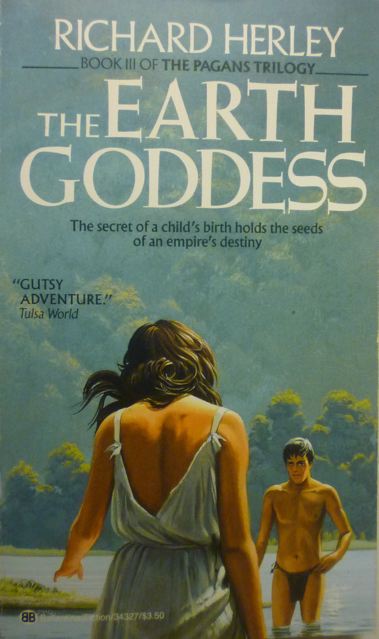
A departure in theme as well as size, this book featured Ralph’s first wraparound cover art, as would the remaining two book covers he painted for Ballantine, all part of Herley's Pagan's Trilogy.
October 1987
The Flint Lord by Richard Herley
December 1987
The Earth Goddess by Richard Herley
The Lost Del Rey Art of Ralph McQuarrie
During the making of The Empire Strikes Back, Ralph worked on numerous concepts for the cover of the novelization for that film. His final concept was a reformatting of his famous production painting of Luke Skywalker exiting his downed Snowspeeder. Unfortunately, Del Rey went with the Gone With the Wind style poster art instead.
Star Wars fans may remember the L. Neil Smith series of Lando Calrissian novels released in the early 80s. While Ralph did not provide the final cover art for those books, we recently uncovered his original concepts for the first book in the series, Lando Calrissian and the Mindharp of Sharu. It's hard to believe that Del Rey went a different direction than using Ralph McQuarrie for a Star Wars book cover.
Following his work for Ballantine/Del Rey, Ralph went on to provide book illustrations for other companies, including Byron Preiss Multimedia, as well as having some of his movie poster artwork re-purposed on paperback book covers. If there's interest, I will cover those in a future article.
*It’s worth noting that the cover to Alexis Gilliland’s novel The End of the Empire, while credited to Ralph McQuarrie on the copyright page of the book, is not his painting (as evidenced by the presence of the actual artists signature on the cover). Unfortunately, if you search internet listings for Ralph's work you will often find this book included based on the incorrect attribution.