Showing posts with label Lou Rambeau. Show all posts

Thursday, April 6, 2023

The Hitchcock Project-Lou Rambeau Part Two-Last Seen Wearing Blue Jeans [8.28]--OUR 300TH EPISODE!!!

by Jack Seabrook

Lou Rambeau's second and last teleplay for The Alfred Hitchcock Hour was "Last Seen Wearing Blue Jeans," a disappointing adaptation of Encounter with Evil, a 1961 novel by Amber Dean.

As the book begins, Dave and Roberta Landis are driving home from a Memorial Day weekend vacation in Minneapolis late Sunday night when they get lost somewhere in Ontario and stop off around two a.m. at Cate's Cafe for pie and coffee. Their 15-year-old daughter Lauren, who was sleeping in the back seat of their white Buick, joins them for a moment before walking back out to the parking lot and unintentionally crawling into the back seat of the wrong car.

The Landis family have accidentally stumbled upon a car theft scheme, where stolen cars are driven across the border into Canada and the drivers meet late at night at the cafe. Lauren is discovered in the back seat of the car at the garage where the cars are processed; Dave and Roberta drive off thinking that she is in the back seat of their car and must return to the small town of Lennox to search for their daughter when they discover she is missing.

Lauren escapes and meets Pete Tanner, a high school senior, who takes her back to his house, but she is soon taken again by the car thieves, who also catch Pete when he comes after her. Lauren and Pete are drugged and left in a house that is set on fire by the crooks to cover their tracks and eliminate the young witnesses.

Dave and Roberta search frantically for their daughter, stymied by the town's crooked policeman. Eventually, Canadian police are tipped off to the car thieves and capture the crooks at the garage. Pete saves Lauren from the fire and the Landis family is reunited.

Encounter with Evil is a short novel where the events mostly take place in and around a small Canadian town in the course of 24 hours. The action moves back and forth among characters and locations and there is little suspense; the climax, where Pete rescues Lauren from the burning house, is described after the fact rather than shown. Dave and Roberta are detectives of a sort, faced with the mysterious disappearance of their daughter and forced to investigate what happened and solve the puzzle.

Amber Dean (1902-1985) wrote 17 mystery novels between 1944 and 1973. This was the only time one of her books was adapted for film or TV. Her papers are at the University of Rochester.

The TV version aired on CBS on April 19, 1963, and was directed by Alan Crosland, Jr. Right away, it's clear that there has been a major change to the story, since the family station wagon drives through the night and passes a sign reading "Slawson, Arizona, Pop. 1204." The location of events has been moved from the Canadian border to the Mexican border! The Saunders family (as they have been renamed) pull up at Cates Cafe, which a sign tells us is "open all nite," changing another plot point from the novel, where the cafe supposedly closes well before 2 a.m.

Dave and Roberta speak with British accents and desire "'a spot of tea'"--instead of hailing from upstate New York, as in the book, they are British tourists driving across the U.S. with their 17-year-old daughter on a sightseeing trip. The visit to Cates Cafe is streamlined from the novel, since there is no group of men meeting in the back room and Rose, the waitress, is a minor character. Outside the cafe, a similar station wagon pulls up and parks between the Saunders car and the door to the cafe, making it clear why Lauren sleepily climbs into the wrong vehicle.

She awakens in a garage in Dos Cucharos, Mexico, a town about 50 miles from Slawson. The first of three fistfights in the episode breaks out between Al, whose car Lauren mistakenly slept in; Grosse, a fat man who is part of the car theft ring; and Gato, the mechanic at the garage. Unlike the novel, where Lauren is treated kindly by the mechanic before she is driven to Rose's house and questioned, in the TV version Grosse grabs a tire iron and kills Al with a blow to the head. Lauren is seen sneaking out of the garage and the first act ends with Gato calling cafe owner Vince Cates to tell him about the murder and Vince instructing Gato to "'get that girl!'"
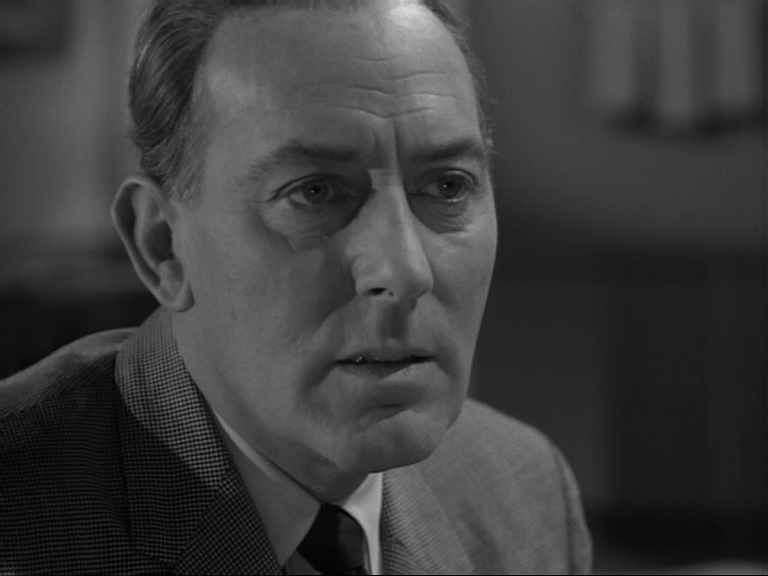
Michael Wilding as David Saunders
In the book, when Dave and Roberta return to the cafe, they are told that it was not even open at the time they had been there and that they must have the wrong place. There is no such confusion in the TV show, since the cafe is open all night. At the police station, Dave sees a map on the wall and immediately identifies Dos Cucharos as a possible destination for Lauren. In Mexico, the young woman wanders alone and is confronted by frightening strangers; as a pretty, 17-year-old blonde, she also attracts the attention of a pair of young men. As Grosse and Gato search for Lauren in the town, a kind woman brings her into her restaurant and serves her food, yet the crooks soon find her and are about to take her away when the two young men who had approached her on the street enter and the second fistfight of the episode occurs. Lauren escapes during the melee and ducks into a church, where she evades her pursuers. Her parents arrive in the Mexican town in the morning and, after an unsatisfactory visit to the police station, drive back to Slawson, just missing Lauren as she comes out of the church.

In act three, Dave and Roberta stop at the border crossing and give the guard a photo of Lauren so that he can watch out for her. In the book, Lauren meets Pete at a bus stop where he is waiting for the bus to high school. In the TV show, she is walking alone on a dirt road and hides in the brush when Grosse and Gato drive by. Pete then drives by in a jeep and Lauren flags him down. He agrees to drive her back to Slawson and stops the jeep so she can clean herself up. There is a closeup of her adjusting her hair barrette, a detail that will be important later. In an attempt to fool the border guard, Pete tries to teach the young British woman how to speak like an American; the actress playing Lauren was American and was putting on a British accent for the role, so she had to pretend to be a British girl trying to speak like an American!

Anna Lee as Roberta Saunders
At the border stop, Lauren's speech attracts the interest of the guard, who disappears into his booth. Pete drives off before the guard emerges, holding Lauren's photo! Pete and Lauren arrive in Slawson and visit the dishonest policeman, who accuses the young woman of making up her story about witnessing a murder and takes them to the cafe, where Grosse and Cato force them into the back room. In the struggle, Lauren's hair comes loose. In the novel, gangsters are in charge of the car theft ring; they have been eliminated from the TV show, as have the Canadian police who break up the ring. There is no confrontation at the garage in the TV show, nor do the crooks try to kill Pete and Lauren by leaving them asleep in Rose's house and setting it on fire.

Instead, the final scenes take place in the cafe, where Vince interrogates Pete and slaps him when he doesn't cooperate. Vince suggests staging a fatal jeep accident involving the two young people. In the last act, Dave and Roberta are at a motel in Slawson when they receive a call from the border guard informing them that he saw Lauren with Pete. They drive to Pete's home and meet Mel, his father, who accompanies them to Cates Cafe. Vince lets the trio in while Grosse watches from the back room with gun in hand. Vince denies having seen Pete and Lauren, but Roberta notices Lauren's barrette on the cafe floor and realizes the owner is lying. She shows Dave, who hauls off and punches Vince, leading to the third and last fistfight of the episode, a melee in which Mel disarms Grosse. The young people are rescued and Roberta embraces Lauren.

The last scene finds Lauren bidding farewell to Pete and inviting him to visit her in England next summer.

"Last Seen Wearing Blue Jeans" is a poor adaptation of a fairly interesting novel; the TV version is streamlined and ridden with cliches, featuring a plodding script and pedestrian direction. Katherine Crawford, as Lauren, is the star of the show and does her best with the role; Michael Wilding and Anna Lee, as her parents, seem miscast. The three fistfights seem like trite ways to solve dramatic problems, and having Dave take a swing at Vince near the end of the show appears to be out of character.

Katherine Crawford as Lauren Saunders
Alan Crosland, Jr. (1918-2001), the director, started out as a film editor, working on features from 1944 to 1954 and on TV from 1955 to 1957, then began directing episodic television in 1956. He directed 16 half-hours and three hours of the Hitchcock series, including "The Woman Who Wanted to Live," as well as episodes of The Twilight Zone and The Outer Limits. Crosland directed a handful of movies, but his main focus was on TV, and he directed his last show in 1986. "Last Seen Wearing Blue Jeans" was the last episode he directed for the Hitchcock show.

Receiving top billing as David Saunders is English actor Michael Wilding (1912-1979), who was on stage, film, and TV from the early 1930s to the early 1970s. He appeared in two Hitchcock films, Under Capricorn (1949) and Stage Fright (1950), but this was his only role on the Hitchcock TV show.

Anna Lee (1913-2004) plays his wife Roberta. Born Joan Boniface Winnifrith in England, she was on stage, film, and TV from the early 1930s through 2003, including a regular role on the soap opera, General Hospital, from 1979 to 2003. She appeared in Fritz Lang's Hangmen Also Die! (1943) and Val Lewton's Bedlam (1946), but this was her only role on the Hitchcock TV show. From 1934 to 1944 she was married to Robert Stevenson, who later directed episodes of Alfred Hitchcock Presents. One wonders if Michael Wilding was available for this episode and the script was revised to make the Saunders family British.

Randy Boone as Pete Tanner
Lauren is played by Katherine Crawford (1944- ) and this episode was her first TV credit as well as her only appearance on the Hitchcock TV show. The daughter of TV writer Roy Huggins, she went on to appear almost exclusively on TV until 1976; her final role was as a regular on the short-lived series, Gemini Man.

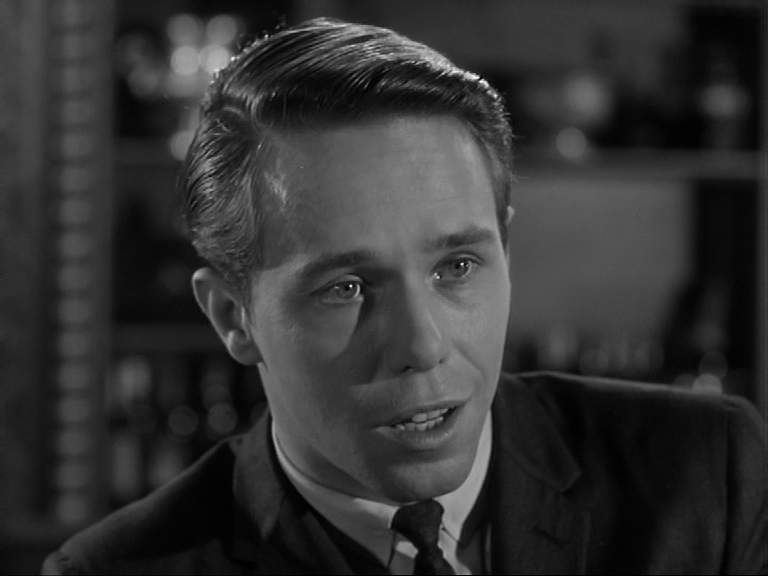
Randy Boone (1942- ) plays Pete; a folk singer turned actor, he was on screen from 1962 to 1987. This was his only role on the Hitchcock show, but he was a regular on three TV series: It's a Man's World (1962-1963), The Virginian (1964-1966), and Cimarron Strip (1967-1968). He was also seen on The Twilight Zone and The Night Stalker.

In smaller roles:
  • James Anderson (1921-1969) as Vince Cates; also known as Kyle James, he was on screen from 1941 to 1970 and had a role in To Kill a Mockingbird (1962).
James Anderson
  • Jesse Jacobs (1922-1998) as Grosse; he served in the Army in WWII and was involved in theater as both actor and teacher. He made a handful of TV appearances between 1959 and 1986 and was also in "The Big Score" on Alfred Hitchcock Presents.
Jesse Jacobs
  • Eve McVeagh (1919-1997) as Rose Cates, the waitress; she acted on Broadway and on radio and had a screen career from 1946 to 1987. She was on The Twilight Zone and Thriller and she appeared in six episodes of the Hitchcock show, including "The Gloating Place."
Eve McVeagh
  • Russ Conway (1913-2009) as Henderson, the border guard; born Clarence Russell Zink in Canada, he made numerous appearances on screen from 1947 to 1977 and also appeared on Thriller.
Russ Conway
  • Kreg Martin as Al, who is killed by Grosse; in a short TV career from 1962-1963 he was seen on The Twilight Zone and in seven episodes of the Hitchcock show, including "Maria."
Kreg Martin
  • Jose de Vega (1934-1990) as Gato, the mechanic; a dancer, choreographer, and actor, he was on screen from 1961 to 1987 and had a role in West Side Story (1961).
Jose de Vega
  • Frank Albertson (1909-1964) as Tom Batterman, the corrupt Slawson policeman; on screen from 1923 to 1964, he has a star on the Hollywood Walk of Fame and appeared in four episodes of the Hitchcock show, including "Out There--Darkness." He was also on Thriller and played Sam Wainwright in It's a Wonderful Life (1946). He had small parts in The Man Who Knew Too Much (1956) and Psycho (1960).
Frank Albertson
  • Karl Lukas (1919-1995) as Mel Tanner; born Karol Louis Lukasiak, he was on screen from 1951 to 1991 and had roles on Batman, Night Gallery, and The Odd Couple. He had begun his career on Broadway in the 1940s and was a semi-regular on The Phil Silvers Show (1955-1958). He was in five episodes of the Hitchcock show, including "Bang! You're Dead."
Karl Lukas

Watch "Last Seen Wearing Blue Jeans" online here. Read the novel here.

Sources:

Dean, Amber. Encounter with Evil. Roslyn, NY: Detective Book Club, 1961.

"Dean, Amber." Gadetection / Dean, Amber, http://gadetection.pbworks.com/w/page/7930339/Dean%2C%20Amber.

The FICTIONMAGS Index, http://www.philsp.com/homeville/FMI/0start.htm.

Grams, Martin, and Patrik Wikstrom. The Alfred Hitchcock Presents Companion. OTR Pub., 2001.

IMDb, IMDb.com, https://www.imdb.com/. 

"Last Seen Wearing Blue Jeans." The Alfred Hitchcock Hour, season 8, episode 28, CBS, 19 April 1963. 

Wikipedia, Wikimedia Foundation, https://www.wikipedia.org/.


Listen to Al Sjoerdsma discuss "John Brown's Body" here!

In two weeks: Our brief series on Talmage Powell begins with a look at "The Kiss-Off," starring Rip Torn!

Thursday, March 23, 2023

The Hitchcock Project-Lou Rambeau Part One-Hangover [8.12]

by Jack Seabrook

Lou Rambeau is credited with writing the teleplays for two episodes of The Alfred Hitchcock Hour, "Hangover" and "Last Seen Wearing Blue Jeans." But who was Lou Rambeau? He or she has no other writing credits anywhere and I have been unable to find any biographical information, yet it seems unlikely that the producers of the TV show would assign a writer with no track record to adapt two short stories and a novel for TV. Is the name a pseudonym?

*   *   *   *   *

"Hangover" is based on two short stories of that title, one by John D. MacDonald and the other by Charles Runyon. MacDonald's story came first, having been published in the July 1956 issue of Cosmopolitan. It begins as the main character, Hadley Purvis, awakens with a bad hangover. He is a 39-year-old ad executive whose wife, Sarah, worries that he may be an alcoholic. Trying to reconstruct the prior evening's events in his mind, he recalls his colleague, Bill Hunter, telling him that Driscoll, their boss, was concerned that Hadley would be unable to behave himself at an important event that evening to preview new car models.

MacDonald's story was
first published here
As the evening wore on, he got progressively more drunk and embarrassed himself in front of an important client before insulting the man. Driscoll fired him and sent him home. On his way home he bought a necktie and he recalls little after that besides a quarrel with his wife. He gets dressed but can't find his new necktie. Deciding to face his wife, he searches their apartment and locates the tie, which is tightly wrapped around his dead wife's neck.

Runyon's story was published in the December 1960 issue of Manhunt and is similar to MacDonald's tale. This time, Greg Maxwell wakes up with a hangover and calls out to his wife Marian before recalling that she's been gone for almost two weeks. He discovers another woman in his bed; her name is Sandy and he is repelled by her. She tells him that she works as a bar hostess and they have been together since Wednesday night; it's Tuesday and he has lost the memory of the last five days.

Runyon's story was
first published here
Greg recalls hiring a detective, who caught Marian cheating on him. He wonders why his suit is wet and muddy and Sandy explains that his boss came to his house on Friday night and fired him, so Greg followed the man out onto the lawn, yelling at him as he drove away. Greg tells Sandy to leave before his wife comes home and calls the hotel where Marian was staying, only to learn that she checked out yesterday; Sandy tells him that Marian came home last night and he shoved Sandy into the bathroom. Much later, he told her that Marian would not get in their way again.

All at once, Greg recalls the argument that ended with him murdering his wife by hitting her with stones from the patio. As Sandy suggests that they get drunk together, he hears dogs fighting over something out on the patio and realizes that it's his wife's corpse.

The stories are remarkably similar. In both, a man has a bad hangover and gradually remembers being fired from his job and killing his wife. In MacDonald's story, which is told in the third person, the man finds his dead wife but does not recall the act of murder, while in Runyon's story, the man recalls the act of murder but does not seek out the corpse. The main difference is the addition of Sandy, the other woman in Runyon's story; she serves to remind Greg of what happened while he was drunk and she is contrasted with his wife. In both stories, excessive drinking ruins the lives of a married couple.

Tony Randall as Hadley Purvis
The stories were purchased for The Alfred Hitchcock Hour and teleplay writer Lou Rambeau wove them together into a harrowing episode that features a strong performance by Tony Randall as Hadley Purvis.

The show opens with an establishing shot of the suburban Purvis home. Inside, the camera pans over the mess that Hadley left the night before, while jazzy music plays on the soundtrack. We see twin beds, of course, this being a 1962 TV show; one is empty but has been slept in, while the other still contains Hadley, who awakens with a yell. The camera pans rapidly around the room in circles to convey his dizziness and there is a three-note sting of music that suggests an "I told you so."

An extreme close up of Hadley's face shows him to be unshaven and in pain. In voiceover, he says that he blacked out and doesn't know what happened; the use of voiceover at various points in the episode gives the viewer Hadley's first-person narration, as in the Runyon story, while the rest of the events are shown to the viewer, like MacDonald's third-person narration. The first of five flashbacks follows, establishing a piece of what happened to Hadley the day before. He is at breakfast, hung over, talking to his wife, Sandy (the women's names have been swapped from the Runyon story); he sneaks a drink when he thinks he's alone but she sees him and is not surprised. There is tension between them and when she tells him that he is an alcoholic who is ruining his life and his career, he denies it. Sandy reminds him that today may represent his last chance at work and adds that she'll leave him for good the next time he goes on a binge.

Jayne Mansfield as Marian
The flashback ends and we return to the present, the jazzy score resuming on the soundtrack. Hadley searches for Sandy but instead finds Marian, wearing Sandy's bathrobe. There is a carefully-placed statute of a woman's torso in the background that reminds the viewer of the famous body of Jayne Mansfield, the actress who pays Marian. The second flashback follows, as Hadley recalls an incident from the prior night when he staggered into a bar, drunk, and met Marian, a B-girl who he picks up after accidentally calling her Sandra. The flashbacks in "Hangover" are not sequential in time; they are connected to events in the present that spur Hadley's memory.

Back in the present, he asks Marian what happened and she tells him that Sandy was not there when they got home last night. Soon, Hadley is dressed for work but Marian is still in her bathrobe, eating breakfast and comfortable in his home. There are establishing shots of Manhattan's busy streets and a high-rise office building, followed by a shot of Hadley arriving at the ad agency where he works, looking exhausted. A young man named Albert tells him that Driscoll, the boss, said that he didn't want to talk to Hadley, and Bill Hunter, Hadley's colleague, emerges from Hadley's office and invites him in. Bill tells Hadley that he was fired the night before and it was all his own fault. Hadley is rude to Bill, even though the man is gentle and tries to let him down easy. This episode takes place in the time and milieu of Mad Men and Hadley is not unlike Don Draper, another brilliant ad man who has a hard time curbing his desires for alcohol and women.

Robert Lieb as Bill Hunter
Hadley tells Bill that he does not remember anything and the third flashback begins, in which Hadley arrives late at a meeting with clients where he was to unveil a new ad campaign for the Colton Cosmic, a futuristic car. Hadley goes to the bar outside the conference room where the meeting is taking place and is again arrogant, having drinks and peeking in to see the ad executives awaiting his arrival. Hadley confirms that the presentation is not going well; he is the star of the show and everyone is waiting for him, but instead of being contrite he makes them wait. Finally, Bill Hunter comes out to get Hadley and reminds him that everything depends on him. After Bill goes back into the room, Hadley fills a water pitcher with clear alcohol, grabs a glass, and enters.

Hadley depends on alcohol to get him through every situation he encounters and mistakenly thinks that he can hide it from others. He takes the stage with arrogance, smoking a cigarette and placing pitcher and glass on the table before him. His presentation is embarrassing, marked by side remarks that he thinks are funny but that fall flat with the audience. He repeatedly starts to cough so that he can take drinks of "water" and the musical stings continue on the soundtrack with each misstep. The audience grows increasingly disgusted with Hadley's behavior as he self-destructs in front of his colleagues; Tony Randall, as Hadley, is particularly good in this extended scene, even managing to find moments of cringe-inducing humor.

Myron Healey as Bob Blake
Finally, the meeting breaks up, the audience leaves, and Driscoll fires Hadley on the spot, yet Hadley remains arrogant. The scene fades out with Hadley alone onstage. The flashback ends and we are back in the present, with Hadley in the office telling Bill that he now remembers what happened. He leaves, saying that he needs a drink, and there are more exterior shots of busy Manhattan streets. We next see Hadley sitting in a bar where Albert, the young man from the office, approaches him and asks him to repay money that Albert spent on his behalf when Hadley sent him out for a bottle of alcohol. Albert is kind, apologetic, and sincere, but Hadley is again rude and curt.

Hadley gets up to leave but Albert stops him and hands him a piece of paper that fell out of Hadley's wallet. It is a receipt from a store on Broadway near 47th Street called The Sweaterama that advertises that it is Open Till Midnight; Hadley bought a scarf there the night before but does not remember doing so. He visits the store and the saleswoman remembers him, which leads to the fourth flashback. This time, it's late in the evening, after Hadley's meltdown at the meeting, and he walks into the store very drunk. He buys the scarf and insists that his ability to select and purchase it for his wife proves that he's not inebriated. Back in the present, Hadley realizes that he's filled in another piece of the puzzle and leaves the store.

He goes home and finds Marian still there; Jayne Mansfield is shown wrapped in a bath towel, once again playing off her image as a sex symbol. As with the shot of the empty bed at the beginning of the episode, nudity and sex are implied but never shown, except for the bust on the table in Hadley's living room, which represents everything that the viewer is not allowed to see in regard to the character of Marian. Hadley calls Bill Hunter at home and confirms that no one called Sandy the night before to tell her that Hadley had been fired. Marian walks seductively into the living room wearing Sandy's pajamas, but Hadley is uninterested, filled with self-pity and desperate to find his wife.

Hadley rudely orders Marian to leave and she responds in kind, calling him a creep and a drunk. They struggle and he begins to strangle her before pulling away, horrified at his own capacity for violence. We next see Marian, applying makeup and dressed to kill. Hadley apologies to her for losing his temper and gives her money, as if paying a prostitute for services rendered. She tells him that the money is to keep her mouth shut so that she won't tell the police that he attacked her, which would result in his wife learning of their night together. Marian departs and Hadley is left alone.

He immediately starts searching for a bottle of booze, frantically pulling clothes out of drawers. His forehead bathed in sweat, Hadley has already forgotten his bad acts and his missing wife. He goes down to the basement and we hear more voiceover as he sees the corner of a scarf sticking out from a closed closet door. He recalls bringing it home and the fifth and final flashback begins, showing what happened when Hadley came home last night. Sandy realizes right away that he is drunk and says she will pack and leave in the morning. Hadley insists that he isn't drunk, pulls out the scarf, and argues that it is proof of his sobriety. He loses his temper, yells at his wife, wraps the scarf around her neck, and tightens it, the camera looking up at him from his dying wife's perspective as he strangles her, telling her it's "'just for you.'"

Dody Heath as Sandy
Hadley does not intend to kill Sandy but he can't control his behavior when he's drunk. Back in the present for the last time, Hadley remembers what happened, opens the closet door, and sees Sandy, dead, with the scarf wrapped around her throat. The show ends with a closeup of his face as he realizes what he's done.

Everyone in "Hangover" is a victim. Sandy is murdered, Marian is physically and verbally abused and discarded, Hadley's colleagues lose a business opportunity, and Hadley loses his job, his wife, and his freedom. He will surely be caught and he'll probably confess. The only people who seem satisfied in the entire show are the bartenders!

Lou Rambeau's teleplay does a wonderful job of merging the two short stories together and using the visual medium to tell the story. Hadley is like a detective, who pieces together forgotten memories of the events of the day before until he solves the mystery of his missing wife. Rambeau and director Bernard Girard use classic film noir elements such as voiceover and flashbacks to lead the viewer through Hadley's investigation of what happened, making him not only the detective but also the killer and, in a sense, one of the victims. The episode is riveting from start to finish and does not deserve John D. MacDonald's characterization of it as "cluttered nonsense."

Hadley views Sandy's corpse.

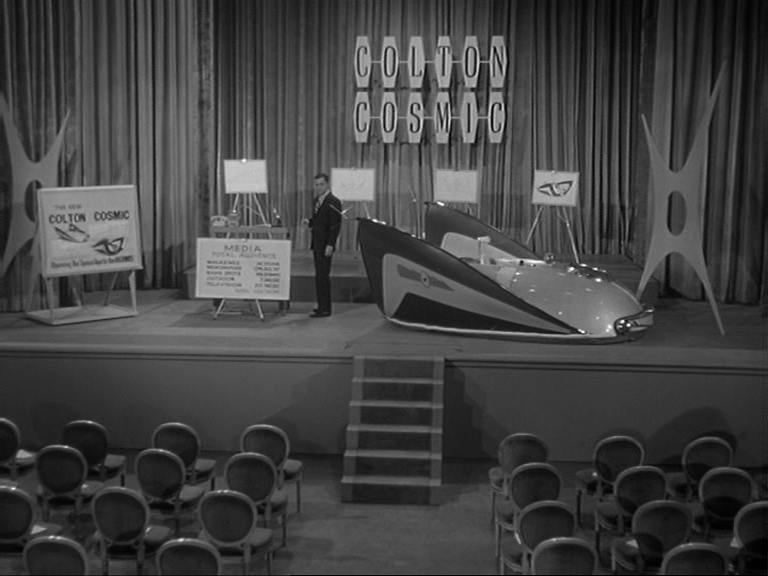
An interesting aspect of the show that has nothing to do with alcoholism is the futuristic car that is displayed on stage at the client meeting where Hadley self-destructs. Referred to as "The New Colton Cosmic, a Revolution in Transportation," it resembles a single-seat spaceship on wheels, with space-age antennas, looking nothing like any real car from 1962!

Hadley is left alone with the Colton Cosmic.

A closer look at the space age car.

Bernard Girard (1918-1977) keeps the story moving quickly and chooses interesting shots and transitions between the present and the past. He was born Bernard Goldstein and he worked as both a writer and director of movies and TV from the late 1940s to the mid-1970s. He directed a Twilight Zone as well as four half-hour Hitchcock episodes and eight hour-length Hitchcock episodes, including the Robert Bloch classic, "Water's Edge."

Tyler McVey as David Driscoll
John D. MacDonald (1916-1986), who wrote one of the short stories upon which the show was based, served in the Army and the OSS during WWII and wrote short stories, novels, and non-fiction from 1946 until his death. He is best remembered for the series of books featuring Travis McGee and he was named an MWA Grand Master. Among the many movies and TV shows adapted from his work were an episode of Thriller and the film Cape Fear (1962); there is a website devoted to him here.

Charles Runyon (1928-2015), who wrote the other short story, wrote stories and novels from 1958 until his death, although he began to use the pen name Mark West in 1999. He wrote three novels as Ellery Queen and "Hangover" is the only screen adaptation of any of his works. There is an interesting article about him here.

James Maloney as Cushman
Giving a tremendous performance as Hadley Purvis is Tony Randall (1920-2004), who was born Aryeh Rosenberg and who served in the Army in WWII. He was a busy actor on Old Time Radio starting in the early 1940s; he began appearing in films in 1942; he began a long stage career in 1947; and his TV career started in 1950. He founded the National Actors Theatre and he was featured in several TV series, including Mr. Peepers (1952-1955), The Odd Couple (1970-1975), The Tony Randall Show (1976-1978), and Love, Sidney (1981-1983). He won an Emmy for The Odd Couple. Among his films were 7 Faces of Dr. Lao (1964) and Will Success Spoil Rock Hunter? (1957), where he played an ad man and co-starred with Jayne Mansfield.

June Levant as the saleswoman
Sex symbol Jayne Mansfield was only 29 when she co-starred as Marian in "Hangover," but her years as a star were behind her. Born Vera Jane Palmer, she won beauty contests in college and appeared on stage from 1951 to 1953 before starting to appear on TV in 1954 and on film in 1955. She was seen several times in Playboy and her films include The Burglar (1957), adapted from the novel by David Goodis. There is a website devoted to her here.

Dody Heath (1926- ) plays Sandy, Hadley's wife. Born Rowena Delores Heath, she was on screen from 1953 to 1973 and appeared on The Twilight Zone, as well as in three episodes of the Hitchcock series, including "Touche."

In smaller roles:
  • Robert Lieb (1914-2002) as Bill Hunter, Hadley's colleague; on screen from 1946 to 1999, he was in three episodes of The Alfred Hitchcock Hour but is most familiar as Officer Flaherty in the Twilight Zone episode, "Night of the Meek."
  • Myron Healey (1923-2005) as Bob Blake, the unhappy client at the ad meeting; he has countless credits on film and TV from 1943 to 1994 and appeared in five episodes of the Hitchcock show, including "Incident in a Small Jail."
  • Tyler McVey (1912-2005) as David Driscoll, Hadley's boss; his long career began in the 1930s on the radio and he was on screen from 1950 to 1986. He can be seen in eight episodes of the Hitchcock series, including "Human Interest Story," and he was the president of AFTRA from 1965 to 1967.
  • James Maloney (1915-1978) as Cushman, the boring speaker at the client meeting who precedes Hadley on stage; he had a bit part in Will Success Spoil Rock Hunter? and was mostly seen on TV from 1950 to 1964. He was also in "Body in the Barn."
  • June Levant (1911-1996) as the saleswoman at The Sweaterama; born June Gilmartin, she also acted under the name June Gale and started out as a dancer before acting in films from 1932 to 1948. She was married to Oscar Levant and she hosted a TV talk show in the 1950s. "Hangover" was her last credit.
  • William Phipps (1922-2018) as the bartender outside the client meeting; he served in the Navy in WWII and had numerous screen credits from 1947 to 2000. He was on The Twilight Zone and Thriller and he was the voice of Prince Charming in Disney's Cinderella (1950).
William Phipps
  • Chris Roman, who plays Cliff, the bartender at the bar where Hadley picks up Marian, has only three TV credits, all in 1962 or 1963.
Chris Roman
  • Richard Franchot (1933- ) as Albert, the young secretary at Hadley's office, has a handful of TV credits from 1952 to 1963, directed many episodes of a TV soap opera called Bright Promise between 1969 and 1972, and was also in "Ride the Nightmare."
Richard Franchot
Watch "Hangover" online here.

Sources:

Charles Runyon: Interview and Bibliography, https://www.mysteryfile.com/Runyon/Interview.html. 

The FICTIONMAGS Index, http://www.philsp.com/homeville/FMI/0start.htm. 

Grams, Martin, and Patrik Wikstrom. The Alfred Hitchcock Presents Companion. OTR Pub., 2001. 

"Hangover." The Alfred Hitchcock Hour, season 8, episode 12, CBS, 6 Dec. 1962. 

IBDB, IBDB.com, https://www.ibdb.com/. 

IMDb, IMDb.com, https://www.imdb.com/. 

MacDonald, John D. "Hangover." Hitchcock in Prime Time, Avon, New York, 1985, pp. 225–237. 

Runyon, Charles. "Hangover." Hitchcock in Prime Time, Avon, pp. 238–253. 

Scott, Steve. "The Trap of Solid Gold." The Trap of Solid Gold, http://thetrapofsolidgold.blogspot.com/. 

Stark House Press, http://starkhousepress.com/runyon.php. 

Stephensen-Payne, Phil. Galactic Central, http://philsp.com/.

Wikipedia, Wikimedia Foundation, https://www.wikipedia.org/.

Listen to Al Sjoerdsma discuss "Mr. Blanchard's Secret" here!

In two weeks: Our brief series on the mysterious Lou Rambeau concludes with a look at "Last Seen Wearing Blue Jeans," starring Michael Wilding!