Showing posts with label Comix International. Show all posts

Monday, March 28, 2022

The Warren Report Issue 81: January 1977


The Critical Guide to
the Warren Illustrated Magazines
1964-1983
by Uncle Jack
& Cousin Peter


Kelly
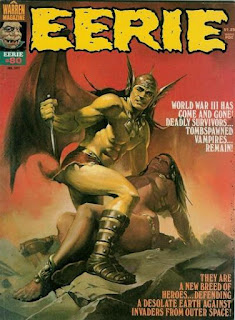
Eerie #80

"The Invisible One"
Story by Budd Lewis
Art by Jose Ortiz

"Retribution"★1/2
Story & Art by Jim Starlin

"On Moonlight Bay"
Story by Budd Lewis
Art by Leopold Sanchez

"Pieces of Hate"★1/2
Story by Gerry Boudreau
Art by Gonzalo Mayo

"Third Person Singular Part II"
Story by Bruce Jones
Art by Luis Bermejo

"Queen of the Purple Range"
Story by Nicola Cuti
Art by Carmine Infantino & Al Milgrom
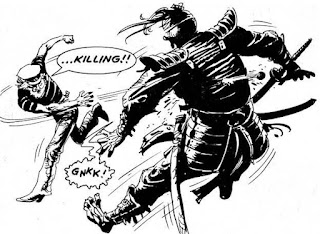
After Japan opened up to foreigners in 1854, attacks on foreign ships became commonplace as former samurai roamed the country without masters. When an Irish "Scallywag" appears on the docks, several ronin attack him, only to discover that he is handy with Ben Wa balls and can throw them with enough speed and accuracy to kill. One samurai, Konishi, remains calm and agrees to join the Irishman, Hues "Sully" Sullivan, on his Chinese junk, where beautiful girls await with trays laden with food. That night, as Konishi and Sully sleep, a ninja, "The Invisible One," steals aboard the vessel, butchers crew members, and steals a cursed statue and some jewels. Sully vows revenge.

The first entry in the "Scallywag" series is intriguing, with a good evocation of the place and time and the usual fine art by Ortiz. I'm interested in mid-nineteenth century Japan and I'd like to see where this goes.
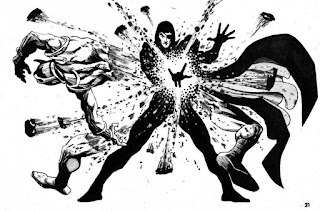
Darklon's severed head is placed on an altar and he is shown all sorts of freaky stuff. He awakens, having been through black baptism and rebirth, only to learn that he is now owned by the Nameless One. Prince Darklon has been transformed into Darklon the Mystic and, as such, he heads to the capital city of Nebularia, where he gains "Retribution" by killing Blacklore's minions and then blowing Blacklore to pieces. Darklon frees his captive father and renounces any claim to his throne. In the present, he wonders if his father sent the assassins who have been bothering him.

The art is classic Starlin, but as I stifled a yawn while reading this entry in the Darklon saga. I had to wonder if my awe at Starlin's work back in the mid-1970s, when I was a teenager, was due more to my youth than to anything terribly exciting in the presentation. So far, Darklon seems kind of predictable.
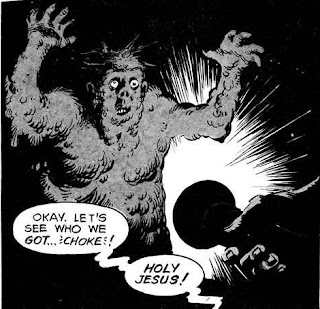
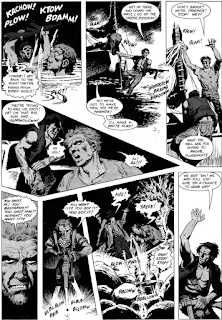
Al Greene ("Owl") and Eric Plusenkat ("Pussycat") have survived nuclear war and now sail their vessel toward Greenland, uncertain if anyone else remains alive. They are fired on as they approach port and, after Al is shot in the leg, Eric returns fire. The duo go ashore and meet a group of people who fear a monster that comes every night and steals a sleeping child. That night, Owl and Pussycat discover a "monster" on a sailboat; the creature turns out to be a man who suffers the physical and mental effects of radiation poisoning. Eric volunteers to put the creature out of his misery and he and Al sail off for the next port.

This series is depressing. The world has been destroyed by nuclear war, so a couple of guys who survived sail around and find that things are as expected. The art is shaky, hardly Sanchez's best work, and the "monster" is almost more humorous than frightening. I suspect Budd Lewis will drag this out for a while longer and teach us lessons about violence and tolerance.
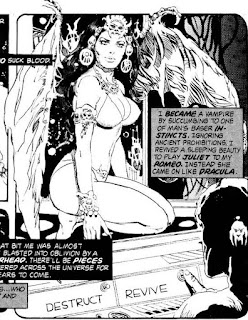
In 1992, nuclear war has wiped out much of Earth's population. What's left of the human race has returned to savagery and hunting game to survive. There is also a growing number of vampires, who orbit the Earth in a spaceship in between biting necks down below. The vampires discover a third group made up of members of an international cartel that controlled wealth and still has nuclear weapons; they destroyed the world out of boredom. For sport, the cartel members challenge the vampires to a game of hunting, to see who survives.

Gerry Boudreau's "Pieces of Hate" is a jumble of old ideas, cribbing from "Arena," The Most Dangerous Game, Planet of the Vampires, and who knows what else. The story takes time to get going and then just ends, presumably setting this up as another series called "Tombspawn." Mayo's art recalls that of Maroto; in some places, it looks great, while in others, it looks unfinished. He manages to shoehorn in a few panels of beautiful, scantily clad women for no particular reason.
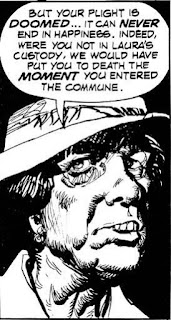
Having discovered that the Snuffer who attacked him is a woman, Rick lets her escape and she promises to repay him someday. Rick and Lee visit the library and discover a subterranean room filled with rare books, including a sex manual written by a woman over 800 years ago. A Snuffer bursts in but, luckily for Rick, it's the gal who owes him a favor. Rick explains that he likes girls and, before you know it, he and the Snuffer are rolling on the floor, with no Kiss records in sight. The Snuffer, whose name is Laura, takes Rick to the hidden world of women, where Old Greida, the commune leader, explains how they reproduce, though the details were lost on this reader. Suddenly, Snuffers burst onto the scene and attack the women; Rick and Laura escape through a secret tunnel and survive, though Laura seems to have lost her clothes in the fracas.

We'll have to give Bruce Jones a pass on this silliness, which is the sequel to last issue's story. Bermejo's art isn't bad, though he seems to be imitating Jack Davis in the way he portrays Old Greida. The scene where Rick convinces Laura that she really does have the hots for him is unintentionally hilarious: "...but you've wanted to, haven't you? You've thought about it for years... dreamed about it at night... tossed and turned and awakened hot with restless sweat, the way I have..." Hoo boy, Rick, if that line works, I should have tried it long ago.
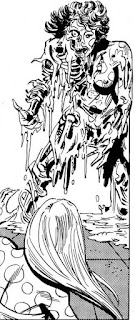
Cronk, the Satyrian Devilboar last seen in Eerie #77, has been hired to deliver six eggs to a Gagoian colony, but one of the eggs hatches early and out pops a sexy "Queen of the Purple Range." Cronk is more in need of a mechanic than a girlfriend, so he sticks her in the navigator's chair and hopes for the best. When Cronk has to venture outside the spaceship for a repair, another queen stalks the navigator, who makes short work of her. Cronk teaches the queen how to fix the ship and, when they land on Gagos, he has to forfeit his money, since she's now more grease monkey than royalty.

Al Milgrom's inks make this story look like classic 1960s' Infantino, and the Gagoian queen is depicted surprisingly well. Cuti's script has plenty of humor and, though the story is nothing special, at least it's a pleasant way to pass eight pages at the end of a half-decent issue of Eerie.-Jack
The Pussycat flexes his claws
Peter-
Devoid of anything resembling fantasy or horror, "Scallywag" is definitely a stretch for the kind of series that should appear in Eerie. Thank goodness DuBay was out to lunch when this series was okayed (or else it would have been retitled "Scallywag and the Infinitesimal Junks of Samurai Swag," or something idiotic like that. I'm not sure how the remaining four chapters of "Scallywag" will turn out, but the opener is just what the doctor ordered: exciting and enthralling, with some great graphics.

Darklon still looks great but, more than ever, it reads like Stan Lee was moonlighting ("Your old body was too frail to house the awesome soul-searing might I have granted you!"). The panel designs Starlin throws at us are awesome and soul-searing! I will say that the series does feel more at home in this title than does Scallywag. The saga of Al and Plusenkat ("The Owl and the Pussycat"--oh my god, that kills me every time--what are the chances two guys with names like that would team up?) continues with a part two that doesn't measure up to the initial outing. Pretty tame, cliched stuff. Nuclear-mutated menace? Check. Frightened survivalists? Check. The scene where the optimist has enough and starts blowing away anyone in his sights? Oh yeah, that's definitely there.

"Tombspawn" is an unnecessarily complicated bore, stuffed full of lame cultural references that make it seem much more dated than it should be. When all is said and done, most of these post-apocalyptic extravaganzas follow the same dopey rules. "Tombspawn" just adds vampires. Neither "Third Person Singular Part II" nor "Cronk" did a thing for me. "Cronk," even more than "Darklon," reads like a bad Marvel try-out. Neither will see another chapter (which is weird, since "Third" seems to end in the middle of the story... but I won't complain).


Enrich
Vampirella #57

"City of Ghosts"
Story by Roger McKenzie
Art by Jose Gonzalez

"Rusty Bucklers"★1/2
Story by Bruce Jones
Art by Esteban Maroto

"Stand-In"
Story by Bruce Jones
Art by Carmine Infantino & Dick Giordano

"Magnificent Ephemeral"
Story by Bruce Jones
Art by Ramon Torrents

"An Insult to Science"
Story by Fernando Fernandez
Art by Jose Mirales
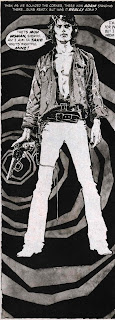
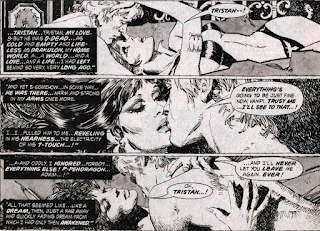
As Adam van Helsing drives a jeep through the New Mexico desert, with Vampirella riding shotgun and Pendragon hiccupping in the back seat, a stagecoach suddenly crosses their path and they crash. Vampi wakes up alone and finds Tristan, her old lover from Drakulon, unexpectedly at her side and also the sheriff of an Old West town. Adam appears and loses a shootout with Tristan; Pendragon turns up as a talking skull, seated at a bar. Vampi realizes it's not real and turns into a bat to escape before waking up to find Adam and Pendragon alive and well.

"City of Ghosts" is as old (and dumb) as they come, with Vampi hitting her head and having a fantasy before returning to consciousness and reality. Fortunately, the art by Jose Gonzalez is terrific, some of the best we've seen in quite a while from him. He throws in a couple of panels that look like copies from photos (who was the model?), which more than make up for the unintentionally hilarious panel of Adam as a desperado/mid-'70s member of The Eagles.

An old man named Dete welcomes a young knight, who rides up and announces that he plans to free the maiden Charlot from the clutches of the sorcerer Nieche. Dete hops on his old nag and accompanies the knight on his quest. The knight defeats an ogre and reaches the home of the legendary fire lizard, but the lizard has died and is now a pile of bones. When they reach Charlot, they find her middle-aged and overweight, and her captor has been dead for years. Dete meets Charlot in the stable for a naked romp, but when the knight discovers them, he runs Dete through with his sword for compromising the lady's honor. She tells the knight to ride off and rescue someone else because she's too old and set in her ways to accompany him.
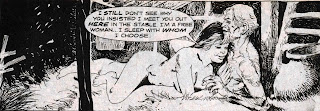
Yawn. Eight pages of pretty pictures from Maroto can't fix this tired script, and it's all been done before, over and over again. The modern take on the knight's quest is so old by now in the pages of a Warren mag that I kept looking for a new twist, but it was all in vain. The only surprise was the somewhat chunky heroine, an unusual approach for a woman in a Maroto story. Even then, she's still pretty attractive, which probably is not what Bruce Jones intended when he wrote "Rusty Bucklers." The title is probably the cleverest thing about this one.
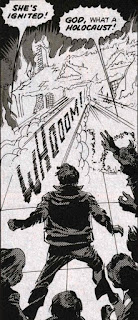
In the future, one can predict exactly when and how someone is going to die in an accident, and McHenry, a representative of Surgo, Inc., can be hired as a surrogate for the person about to die. He replaces them just before the accident and does his best to survive. If he lives, he gets $10,000 and the other person is put to death. If he dies, the other person lives. He makes it through a terrible car crash and collects his money; a child will be put to death instead. A reporter named Ms. Reynolds is disgusted by the practice and by McHenry, who next survives a house fire that would have killed a little girl, who turns out to be the daughter of Ms. Reynolds. Romance blooms but is soon finished when McHenry takes Ms. Reynolds's place in an accident; he appears to die and leaves her his insurance money, which is enough for her to travel to Earth. But wait! McHenry is alive and well and meets back up with Ms. Reynolds once she has reached Earth, with the insurance company none the wiser.

The team of Infantino and Giordano produce smooth art, but it's not enough to iron out the wrinkles in this needlessly over-complicated story. "Stand-In" doesn't make a whole lot of sense. If McHenry survives, that means Miss Reynolds's daughter is put to death. After that, she's willing to get romantic with him? The business with him faking his own death is a bit confusing, as well.
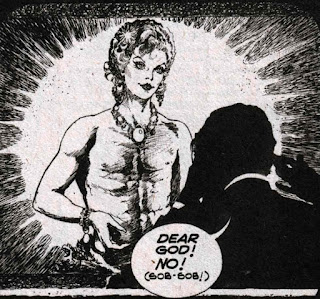
The 1948 diary of reporter Scott Westly tells of his search for movie star Gloria Winsome, who seduced all of Hollywood with her beauty and then disappeared after making but a single film, "Magnificent Ephemeral." Scott goes from person to person and place to place, looking for the elusive star, and finally tracks her down, living alone in a mansion with a butler. When Gloria screens her famous nude scene for Scott, he discovers the truth--she's a man! She hands him a knife and asks him to put her out of her misery.

The first two pages of this story suggest that, after Scott killed Gloria, he hung himself. Who can blame him? The story goes on way too long and mixes together bits and pieces from various old Hollywood movie plots, but the main thing I thought of at the end was Austin Powers remarking, "It's a man, baby!" Ramon Torrents has become one of my least favorite of the regular Warren artists, mainly due to what seem like numerous photo swipes, and twelve pages of his work is more than I'd like to see in any one issue.
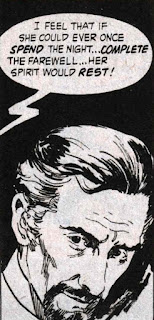
Ghost-breaker Dr. William Miller attends a seance, intending to expose it as nonsense, but receives an unexpected message telling him not to go to Boston or else he'll be part of a haunting. Undaunted, he heads for Boston, but on the way he meets a beautiful woman in the woods. She thinks he's her lover and tells him that she must hurry home to her husband, Edward. William subsequently gets lost and seeks shelter at a creepy old house, only to find the same woman there. She claims to be dying and to fear her jealous husband. William takes advantage of the situation and embraces her, but before they can consummate their passion, Edward strangles and kills his wife. William shoots Edward, who falls through a window to his death.

William goes to the police, only to learn that the woman's house is in ruins and he was part of an annual reenactment by spirits of events a quarter century before. He journeys on to Boston, where he addresses other scientists and admits that the spirit world does exist.

"An Insult to Science" is a competent version of a story told many times before, with stilted but nice-looking art by Mirales. As Peter points out below, he relies on stills quite a bit; in one panel, a character is a dead ringer for Peter Cushing.-Jack
Peter-
It was all a dream! A really well-illustrated dream, but a dream, nonetheless. I think we can all agree at this point that the Vampirella feature each issue would be better represented by pin-ups rather than an attempted stab at cohesion. Leave it to Bruce Jones to take sword and sorcery, a genre literally impaled by Warren writers, and make something interesting of it. Though "Rusty Bucklers" doesn't end with a big surprise, it does go out with a smile. 

"Stand-In" is a bit confusing in its rulemaking (so McHenry can put on a crash suit when he climbs in the car but not flame-retardant gear for the fire?), and Glenda's recovery from her kid's death is quite speedy, but I thought it was clever enough for a few minutes' distraction. Carmine's really getting into a groove and it seems the editorial staff knows just what type of material to use his talents on. The third Jones vehicle this issue is the best one, a goofy homage to Sunset Boulevard and Laura, delivered with a wink that you'll either love or hate. I loved it, although I'll admit the running time is a bit long. As is the page count for "An Insult to Science," an okay Gothic ghost story that features the one and only appearance by artist Jose Mirales, whose work, like a lot of the Spanish artists in the Warren pubs, draws heavily on stills. One of the better issues of Vampirella in quite a while.


Kelly
Creepy #85

"Like Icarus, Quickly Falling" ★1/2
Story by Roger McKenzie
Art by Leopold Sanchez

"Hide and Go Mad" ★1/2
Story by Budd Lewis
Art by Carmine Infantino & Walt Simonson

"The Thing in the Well" 
Story by Roger McKenzie
Art by Leopoldo Duranona

"Orem Ain't Got No Head Cheese!" 
Story by Bill DuBay
Art by Jose Ortiz

"The Terrible Turnip of Turpin County" ★1/2
Story by Roger McKenzie
Art by Martin Salvador

"A Way in the Woods" ★1/2
Story by Bruce Jones
Art by Luis Bermejo
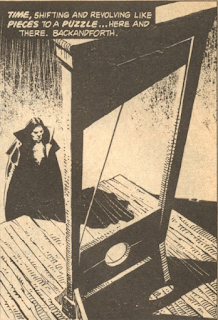
An All-Monster Issue? Count me in! But how well will the Warren writers represent the monster kingdom? Let's see.

A vampire tracks the man who made him into a bloodsucker across the centuries, finally finding him in a post-apocalyptic future. He beheads the demon and then flies out to sea and is reduced to bones by the sun. A wordy, pretentious mess (And like Icarus, quickly falling, time rushes back upon itself... spinning and tumbling out of control.), "Like Icarus, Quickly Falling" makes little sense, jumping back and forth between its time frames. McKenzie makes it (abundantly!) clear that the opening is set in the future, but the Armageddon side of things is just quickly mentioned and not really explained. Everyone on Earth is dead except for these two vampires. Why wouldn't the multitude of blasts (described by McKenzie as "exploding suns") vaporize these bloodsuckers as well? The continual time-jumps are mind-frazzling and McKenzie's adjective-stuffed captions are a real chore to wade through. Icarus didn't fall fast enough for me.

Television actor Oliver Munday climbs the treacherous Mt. Kula Kangri in search of the elusive Yeti. Munday has made it his personal mission to come back to civilization with a snowman pelt to prove he's just as much a man as the stud he portrays on his TV show. The weather turns violent halfway up the mountain and Munday leaves his guides behind, only to come face-to-face with the giant monster shortly after. He takes a shot at the thing, but the rifle's roar sets off an avalanche and Munday is buried.
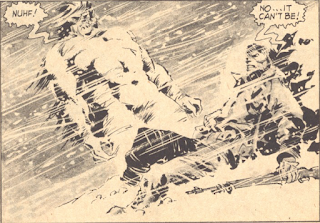
Digging himself out, Munday is lucky to be alive, but certain death stands looking down on him in the person of the great white Yeti. A bullet fells the creature and Munday steals its hide. As he's making his way down the mountain, he puts the skin on for warmth, but the blizzard is too much for him. Suddenly, the skinned monster appears from out of the snow. Munday tries to give the thing back its hide, but the pelt has frozen itself to his body. Later, the two guides come across the skinned Munday and agree that the actor went insane and tore himself to ribbons.

Nothing spectacular script-wise (I think I read at least three Harvey stories that followed much the same pattern), but "Hide and Go Mad" is an entertaining EC-esque horror story with some decent (though, at times, way too light) art by Carmine and Walt. I'm a sucker for stranded explorers atop giant glaciers; though I'm not the kind to ever get caught in that situation (hello, I live in Arizona!), the whole scenario gives me the creeps. I would question why this monster would lie still while Munday stole its skin.

Young Nancy has been lonely since her mother left the little shack she lives in with her stepfather. But now she has a friend she can talk to who lives in the well out in the woods. Nancy has vague recollections of the night her mother disappeared: a fight, the sound of something hitting the floor, and then her stepfather carrying something out into the woods. Her stepfather beats her and tells her to stay away from the well; it's not safe. But being lonely outweighs being afraid of the violent drunk her mother was married to, so Nancy steals away one night at the same time her step-pop decides to board up the old well. Seeing Nancy leaning into the well, the man hits her in the head with a hammer, but before she dies, the girl sees "The Thing in the Well" rise one more time to comfort her dying daughter.
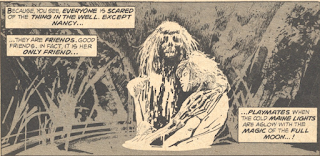


Though it has DNA lifted from several sources (chief being Theodore Sturgeon's "It!"), "The Thing in the Well" goes where I least expected it to go. That's a pretty downbeat climax; step-pop doesn't even get disemboweled or turned into a human well or anything so final. He's driven insane by the sight of his wife's moss-laden body, and that's our final glimpse of the bad dude. While, conversely, the truly sympathetic Nancy has her head beaten in. How depressing is that? The final panel, of mom and daughter reunited in death, is a powerful one.
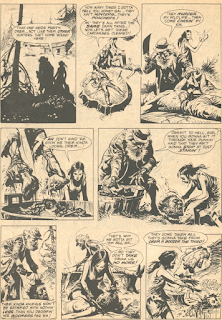
Orem P. Boozer the Third and his purty cousin, Honey Gal, hunt the woods near their shack for poachers. When they run across the varmints, they blow them away, skin them, and use 'em as vittles. But unfortunately, Orem's latest kill had brain cancer, and the disease fuses together the leftovers from Orem's past kills to become a huge, globby-brained monster. After the creature attacks Honey Gal, Orem chases it off and muses that once them "city slickers" see the monster crawling out of the hills, they won't be comin' back to poach.

With the new wave of violent horror films cashing in at the box office, Bill DuBay sees a quick and convenient way of capitalizing on the trend. Bill must have watched Texas Chainsaw Massacre and come away thinking cannibals were cool, rather than recognizing the reason the film worked: tension and terror. Neither asset can be found in "Orem Ain't Got No Head Cheese," a vile, disposable piece of garbage. No doubt the centerpiece, Orem and Honey Gal discussing changing times for rednecks while butchering a naked woman, is DuBay's idea of depth in character. I defy Louise Jones (Simonson) to find relevance, insight, terror, or tension in these nine sheets of used toilet paper; what justification could Louise have had in running this thing? "Orem" ain't sly enough to be social commentary, so don't go grasping for that straw. Easily, the worst thing Warren has run in its 13 years of funny book publishing. Alas, that milestone might still be surpassed in the next six years.
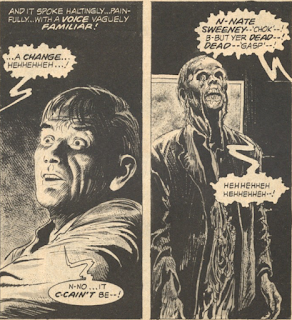
A comet falls from the sky and lands in Charlie Smithers's wheat field. The next day up pops a giant vegetable. Charlie insists the thing is a turnip, but the growth has a life of its own. Digging into the ground, the thing gets its rooty tendrils around the corpse of Nate Sweeney, buried in a nearby cemetery. Nate rises from the grave and attacks farmer Smithers and his wife, and the couple become animated corpses just like Charlie. Marcus and Sam, Charlie's friends from town, come to investigate the new vegetation, but when they get to the farm, they discover the land has been overrun with the giant green monsters. Sam is killed and revegetated but, luckily for Marcus, help arrives in the form of a swarm of locust. "The Terrible Turnip of Turpin County" is no more.

Unlike the previous story, I accept "Turnip" as, simultaneously, a loving homage to and a parody of such cinema classics as Night of the Living Dead, Little Shoppe of Horrors, and Invasion of the Body Snatchers. There's a goofiness to its die-revive repetition and its naive climax, where this insanely robust locust swarm wipes out an entire farmland in three minutes flat. A pity it has to come wrapped in a lifeless Martin Salvador package.
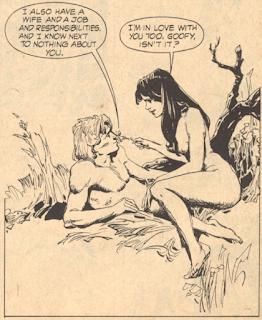
Richard Connors crashes his small plane in the Canadian wilderness and attempts to survive with no food or water. He feels the presence of someone in the woods and follows the shape to a cave surrounded by a lake filled with clean drinking water. Later, the shape makes itself visible to Richard in the form of the beautiful Shara. The two quickly fall in love, but Shara has some dangerous secrets that threaten to tear the couple apart. One of those secrets is a bond with a wolf named Falla. The wolf injures Shara and Richard kills the beast, receiving a bite in the process. Shara explains the rest of her secret to her new lover and the two transform into wolves, loping off into the forest to hunt.

A very simple, predictable fable but a sweet one, nonetheless. "A Way in the Woods" is hampered a bit by some dopey dialogue ("I've been watching your eyes, Richard. I know you've thought of making love to me!") but it's blissfully free of expository and Bermejo's rough sketches have never been more gorgeous.-Peter 

Jack-Peter, you went pretty easy on this dreadful issue of Creepy. "Hide and Go Mad" is the best of the lot, with an engaging story, an unexpected ending, and above-average art. "A Way in the Woods" is next, with more decent art that reminded me in spots of the work of Berni Wrightson; I wasn't exactly sure what happened in the story, but I'll take your word for it. The muddy art made "The Thing in the Well" hard to decipher and, unfortunately, the panels that were most clear were ugly. Haven't we had enough muck monsters? Apparently not, since "Orem" and his head cheese presents us with another one right away. I agree that the story is disgusting, but I can't give it one star with art by Ortiz, and I don't think it's anywhere near the worst thing we've read at Warren.

As if this issue weren't bad enough, we have to endure a Martin Salvador story about a sentient turnip? At least the zombies were pretty well done. For me, "Like Icarus" was worse than "Orem" and received a rare, one-star rating. This terrible, pretentious, confused mess features mediocre art and an inscrutable story. I'm glad you were the one who had to figure it out to write a summary!

Corben
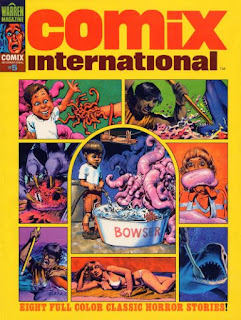
Comix International #5

"Bowser"
(Reprinted from Vampirella #54, September 1976)

"The Succubus Stone"
(Reprinted from Vampirella #49, March 1976)

"The Corpse with the Missing Mind"
(Reprinted from Vampirella #55, October 1976)

"...And an End"
(Reprinted from Eerie #48, June 1973)

"Deja Vu"
(Reprinted from Creepy #51, March 1973)

"Demons of Father Pain"
(Reprinted from Eerie #77, September 1976)

"The Origin of the Spirit"
(Reprinted from The Spirit #10, October 1975)

"In Deep"
(Reprinted from Creepy #83, October 1976)

Jim Warren's overpriced experiment in overkill comes to an end after five full-color issues. "In Deep" is presented sans its black and white intro page and its outro gets a weird red and white finish on the inside back cover. That's class. To add insult to injury for the unwary buyer, the final Mummy story, "...And an End," had just been reprinted a few months before in the All-Mummy Reprint issue of Eerie. Albeit the new version is colorized (as is "The Corpse with the Missing Mind"), but that doesn't make the triple dip any better. Warren's pilferage of his own funny books would worsen as time went by. The only difference between Comix International and the titles that followed it is that CI looked classy.-Peter

Jack-How in the world did they decide which stories to put in these issues? "Bowser" is good and "In Deep" is great, but most of the others are nothing special, except for the Spirit story (of course) and "Demons of Father Pain," which I liked the first time around. The price of $2.99 was steep back in 1977 (at least for me, as a teen) and I would've wanted something more than what we get here to part with that kind of money.

Next Week...
Doug Moench puts another rogue
in his toybox!

Monday, November 15, 2021

The Warren Report Issue 72: March 1976


The Critical Guide to
the Warren Illustrated Magazines
1964-1983
by Uncle Jack
& Cousin Peter


Torres
Vampirella #49

"The Blood Red Queen of Hearts" 
Story by Bill DuBay
Art by Esteban Maroto

"The Thing in Jane's Closet" ★1/2
Story by Budd Lewis
Art by Ramon Torrents

"Then One Foggy Christmas Eve" ★1/2
Story by Gerry Boudreau
Art by Joaquim Blasquez

"Jewel in the Mouth of a Snake" 
Story and Art by Jose Bea

"The Succubus Stone" ★1/2
Story by Gerry Boudreau & Steve Clement
Art by Ramon Torrents

"Edgar Allan Poe's The Oblong Box" ★1/2
Story by Edgar Allan Poe
Adapted by Rich Margopoulos
Art by Isidro Mones

"The Blood Red Queen of Hearts," a servant of Chaos, has delivered to her God hearts torn from six of his greatest enemies. It occurs to her that the seventh gift should be the heart of Vampirella. She sends a demon into the body of Pendragon (who, if you can remember, is in a coma after being attacked by someone somewhere for something), just as Vampi is about to deliver a transfusion of her high-powered blood to her friend, Pen.

As Vampi is lying like a porn model on the operating table with a hose running from her arm, the ghost of Dr. Van Helsing appears to her and warns her of danger. Just then, a demon emerges from Pen's body and begins draining the blood from the Draculonian at a rapid clip. As the demon giggles and prances, a huge shadow appears on the wall: the horned god of Chaos! The demon is distracted just as police enter the hospital room and empty their bullets into the thing. 

Vampi regains consciousness and discovers that the illusion was created by her friend, Pendragon, who has made a complete recovery from his bullet wounds and is already halfway to the corner liquor store. But that's not the only surprise on tap for our lovely vampiress as the detective tasked to bring Vampi in on charges of murder informs her that they've uncovered other evidence and she's free to go. But wait, there's more!

From behind door number three emerges the living, breathing Dr. Van Helsing himself, hidden by the police in order to lure Vampi out of hiding. The warning, Van Helsing explains, was delivered not by his ghost but by telepathy! The team back together, they all giggle and head out on the street to search for their drunken buddy, who's probably already been kidnapped by aliens.

Forget the chronology; I'm tired of complaining about the fact that none of this makes any sense and I can't keep the previous events in mind. DuBay obviously decided the same thing and wrote a script that swept away all those dreary and confusing subplots that none of the writers stick to anyway. The climactic twist, that ol' Doc Van Helsing is alive and well and living in New York, is a hoot, but nobody really believed he was dead, did they? Well, those who even remembered that his character was a part of the series, that is. The Maroto art is spectacular. Lots of great naked breasts and come hither poses (I do have to mention again Vampi's "come and f**k me" look during the transfusion scene) to keep the pages turning while you scratch your head at Dube's words.

Seventeen-year-old Jane Smithpot claims there's a monster in her closet. No one believes her, of course, and her mother comes this close to sending her beautiful daughter off to an asylum. Then Jane's psychiatrist explains to Mrs. Smithpot that Janie is metaphysically projecting her dark, inner fears into this closet. Mrs. Smithpot tries to relay the message to Jane by sticking her head in the closet and showing her there's nothing to fear. But then something grabs the old woman and pulls her in. Moments later, Jane's psychiatrist makes a house call and finds the home empty. Curious about the famous closet, he opens it... and screams out in fear. Jane closes the closet and leaves the house, ready to face her fears.

I'm not entirely sure about the deep message contained in the last couple of pages of "The Thing in Jane's Closet" (teenagers can be real complicated and grownups just don't get them, I suppose), but I did think, for the most part, that Budd managed to type up a good yarn without much preaching. We all know the sermon we'd get from Moench or McGregor in this instance. Torrents's work is really good here, even though there's not much heavy lifting. 

Melvin the Monster is a huge hit at Christmas, despite being an extremely ugly little toy. Every kid wants one and Art Sharrock's Toy Shop has stocked up enough to put one under every tree in Waterville. But then suspicious deaths, first animals and then townsfolk, alert Ed and the town sheriff that something evil might be at work in the guise of these little dolls. Sure enough, Ed and the sheriff get a visit from a plethora of Melvins, informing them that if they don't pack them up and ship them to New York City, the town will be slaughtered. What are the men to do?

There are elements of Trilogy of Terror here, but since it's so obvious that the Melvins are the menace, "Then One Foggy Christmas Eve" works up none of the suspense that the TV movie was filled with. The scene with the dolls at their powwow with Ed and the sheriff is hilarious, as are Ed's sudden mathematics about a story he read in the paper the year before about a couple of men dying at a toy factory and their current dilemma. That's a heck of a memory there, Ed! It occurred to me halfway through the story that perhaps Boudreau was putting us on, but the climax is so dead serious, I doubt it. Blazquez's art is dark, murky, muddled, fill in the blank with a synonym for "I can't figure out what's going on from panel to panel." Any way you carve it up, this is a foggy story.

Archaeologist Pedro Vasquez searches for the mythological Feathered Serpent, a creature which holds a giant diamond in its mouth, in the jungles of Guatemala. Incredibly, Pedro finds the creature and manages to steal away with the jewel, but he becomes obsessed with his new prize and it draws him in. There, he finds a group of men, all trapped within the diamond. The serpent takes back its jewel and returns to Hell.

I used to look forward to Jose Bea's art, but now it's just meh. Gone are the days when Bea used his heavy inks to draw us into his nightmare worlds. Now those inks just seem like an afterthought. As in "The Incredible People-Making Machines" (Eerie #72), Bea seems to think goofy Monty Python art in the middle of a supposedly scary story is cool. It just draws my attention away from the plot. Which, in the case of "Jewel in the Mouth of a Snake," might not be such a bad thing, actually. 

Detective Christopher Matheson has seen some odd things in his career, but none can compare with the two suspicious deaths he's investigating. Both men were in their thirties just before their deaths, but both look decades older. What's up? Like any good detective, Matheson follows the clues and they lead him right to Madame Gorvay's palace of prostitutes, a quartet of beauties who happen to be succubi. To maintain their youth, they use "The Succubus Stone" to drain the energy out of their Johns. Matheson confronts the women and blasts the stone with a well-placed bullet. The women age and crumble to dust.

If you close your eyes, you can hear Darren McGavin narrating "The Succubus Stone" (although if you close your eyes, you can't read the caption boxes); the nod is that obvious (Matheson? And his partner's name is Kolchinsky!). Yeah, the main protagonist is a cop, but this is just the kind of "monster" Kolchak would bump into on a weekly basis. As a matter of fact, he did encounter a comely succubus in his brief TV career. Anyway, the read is breezy and fun, but the paint-by-numbers color is wasted. There's an obvious disconnect at one point between writer and artist when a "kid" visits Madame Gorvay's and the "youth" looks like a forty-ish, goateed Wall Street executive. 

On a sea voyage, a man wonders about "The Oblong Box" his friend has brought aboard with him. Though our protagonist insists that there must be a valuable painting sealed inside the box, we know better. Poe is me! I've got an Edgar Allan Hangover! Surely this must be the finale of the raping and pillaging of the man's work? I mean, he wasn't even around to complain or collect royalties. Of course, we all know that's why there were so many Poe adaptations. Like so many of previous Poe visualizations, there isn't much meat on the bone. The guy has a coffin. It's got his dead wife in it. Horror of horrors! In fact, when the obligatory AIP movie adaptation happened in 1969, the screenwriter wisely jettisoned most of the Poe story and tossed in some voodoo to spice things up. Much more interesting.-Peter

Jack-I enjoyed "The Blood Red Queen of Hearts" for two reasons: Maroto's art, which features a very sexy Vampirella and a topless Queen of Hearts, and DuBay's goofy script, which ties together so many loose plotlines that now I hope the saga can move forward. How could you not like the scene where Vampi disguises herself in what looks like a Halloween-style "sexy nurse" getup and the doctor gives his name to the guard as "Dr. Goldfoot"? The next best story for me was "The Oblong Box," though I didn't understand why the main character went nuts over his wife's coffin. At least Poe could tell a coherent narrative, unlike the other writers in this issue.

"The Thing in Jane's Closet" seemed like page after page of talking heads, with too many blacks in the art and no panel displaying the title character. The story of "Then One Foggy Christmas Eve" was hard to follow and featured more murky, heavily-inked art. "Jewel in the Mouth of a Snake" was a simplistic story with unappealing visuals, while "The Succubus Stone" featured more bad writing, but at least the Torrents art looks better in color. Vampirella has really gone downhill over the years, hasn't it?


Kelly
Eerie #73

"Death of the Phoenix"★1/2
Story by Budd Lewis
Art by Paul Neary

"Carnival at Midnight"
Story by Budd Lewis
Art by Leopold Sanchez

"Day of the Vampire 1992"★1/2
Story by Bill DuBay
Art by Gonzalo Mayo

"A Grave Terror Leads to Death!"
Story by Carl Wessler
Art by Jose Gual

"Voyage to the Final Hole"
Story and Art by Jose Bea

Yaust explains to Karas and the Exterminator that he's actually the good guy and what they've been fighting for is all a lie. Karas hops on the back of a dragon and flies back to confront Mandragora, who admits having duped Karas. Karas shoots and kills Mandragora and the castle begins to collapse around him, but he manages to escape and sets off alone to find other people with whom to create a new world.

At least that's what I think happened in "Death of the Phoenix"! I was able to understand the prior stories in this series, mostly because they followed a pattern, but this one leaves me scratching my head. Yaust is a good guy and Mandragora is a bad guy? It would help if I remembered who Mandragora was. As usual, Neary's art works best when his hero's head is covered with a helmet. He draws great helmets.

John and Jerry are two brothers who sense that something unusual has come to town, and they rush off to discover a "Carnival at Midnight"! John was born "crippled" and Jerry sensed that before it happened, too. Jerry runs from the "monsters" they encounter outside the tent of "freaks," but John is unable to run because he left his leg braces at home. Knowing that too much time spent walking on unbraced legs will cause permanent damage, their father heads for the carnival, rifle in hand. He finds the freaks hovering over John, who lies on an operating table. Dad starts shooting until the freaks subdue him and tie him up. He manages to free himself and runs for help; his posse opens fire but the freaks fight back until Grimilkii, a dwarf, puts a halt to the carnage. He explains that he was a surgeon in Europe and his operation has repaired John's legs. The carnival leaves for its next destination.

It was obvious where this was going from the start, but the revelation that Grimilkii was a renowned orthopedic surgeon was unexpected--I thought the freaks would just do some unexplained operation to fix the boy's legs. Lewis's scripts have taken a turn for the preachy and heavy-handed, which is not a great development, but at least this story features some evocative art by Sanchez.

It's 1992, and the nuclear bombs have left the world in a state of pre-civilization, where men hunt elk and wear loincloths. Mutant creatures also roam the Earth. Exploring some ruins, two hunters happen upon a beautiful maiden in suspended animation; a holograph of a doctor from 1976 explains that the woman is a vampire who has been put to sleep until she can be cured. One of the hunters departs while the other, overwhelmed by desire, pushes a button marked "revive" and watches the woman awaken. They make whoopie, surrounded by monsters left to frighten travelers away from her, and she drains his blood. She flaps her wings and takes off into space, where cosmonauts blow her up. The man she drained arises as a vampire and sets out to hunt human prey.

"Day of the Vampire 1992" has a dreadful script, filled with DuBay inanities like one of the hunters referring to an elk as "a beautiful chunk of meat that'll keep the tribe in baloney sandwiches for the next week" and a caption that refers to "back in the days of Archie Bunker, Elton John and low cholesterol Mazola." He's trying to show that the main characters grew up in the 1970s and still refer to memories from those pre-Armageddon times in the post-apocalyptic world, but it just ends up sounding forced. Peter has remarked before on Mayo's tendency to draw pages that seem to be dripping and oozing with images that run into each other and create confusion; that is fully on display here, though he draws one heck of an attractive female vampire.

Jan Foley, last survivor of the Foley family, is menaced by two men who think that a chest of gold coins is hidden in the house. Little do they know that Jan is protected by "It--The Dead Thing!" It shambles in from the graveyard and the thieves make a run for it. It returns to Its grave. Later that evening, Jan and her fiancee Roy go to the circus, where Jan recognizes two clowns as the men who tried to rob her. The clowns go to the cemetery and plant a bomb that is meant to obliterate It, but Roy and Jan follow and set off the bomb somewhere else in order to protect It.

Jan and Roy return to her house and find the thieves once again looking for the gold. They think that It is no longer a threat, but they're wrong, because "A Grave Terror Leads to Death!" It shambles in and saves Jan and Roy by crushing the skulls of the crooks. It returns to It's cozy grave.

Just when we think it's safe to read another issue of Eerie, here comes good old Carl Wessler with another cockeyed tale about the corpse that walks! It seems like all of the events in this story take place in the course of one very long evening, but no one told Jose Gual, since most of the panels seem to occur in daylight. The other thing Gual seems to have been unaware of is that the story takes place in 1929. The hairstyles and clothing are very 1976. The whole thing is a mess, but I still like It. It's kind of cute.

Peter Hypnos is relaxing in the countryside on a sunny Sunday when suddenly he is swallowed by a giant rose. He shrinks inside the flower and meets many strange creatures in his efforts to escape. Peter is consumed by a strange creature and expelled out the other end, on his "Voyage to the Final Hole"; eventually he escapes and returns home safely.

I can't decide if this is very clever and inventive or just pointless. Bea's art seems heavily influenced by the work of Terry Gilliam and his storytelling owes a clear debt to Lewis Carroll. It's not terrible, but it's not very enjoyable, either. It's an anomaly in a mediocre issue of Eerie.-Jack

Peter-"Death of the Phoenix" is an unreadable mess composed of deep 1970s messages and what Budd thought was a gaggle of funny one-liners ("Hmm. If the robot were just here yeah! He'd laugh at me for being made to sit in the corner while daddy bangs mommy!"). You know you're in deep trouble when the introductory exposition that's supposed to catch you up on what's going on in the story confuses the hell out of you. I've got good news and I've got bad news. Good news first--this is the last Hunter II. Bad news? Hunter III is right around the corner.

Budd Lewis's message within "Carnival at Midnight," that man must love his fellow man even if he looks like a seven-foot-tall boa constrictor, kinda gets lost in Budd's cheat of a set-up. Who here, upon opening a door and seeing their son roped and tied to a gurney, wouldn't open up both barrels without asking questions? That scenario has nothing to do with freaks; it has to do with protection and observation. Are we meant to assume this is the same circus of freaks we saw in the last installment? Again, I'm lost.

The initial installment of "The Tombspawn," "Day of the Vampire 1992," is one part goofy and several parts confusing (are you seeing a pattern?), but it's got some really nice Mayo art (even though some of the panels look like that time your mom made mashed potatoes and peas for Thanksgiving and you wouldn't eat the taters cuz the pea juice made them gross). Very Maroto-esque. I'm afraid I'm not buying that these unusual mutation monsters popped up in just 16 years, but what do I know about science and radiation?

It would seem as though Carl Wessler's "A Grave Terror Leads to Death" could be the very definition of beating a dead corpse, but I have to believe the sheer stupidity of this story is intentional. Seriously, how could this not be a parody of Warren horror series? You say the dumb dialogue and silly dead guy pratfalls only strengthen the argument that Carl was a pulp hack. Let's call it a draw, but I laughed through this more than the last season of Curb Your Enthusiasm. Jose Bea once again shows his love for Peter Max and The Yellow Submarine with "Voyage to the Final Hole" (a dodgy title if there ever was one!) and yeah, I'm out of here.-Peter


Corben
Comix International #4

"The Believer!"
(Reprinted from Creepy #77, February 1976)

"The Power and the Gory!"
(Reprinted from Vampirella #28, October 1973)

"A Thin Dime of Pain"
(Reprinted from Eerie #72, February 1976)

"Child"
(Reprinted from Eerie #57, June 1974)

"Tell-Tale Heart"
(Reprinted from Creepy #3, 1965)

"Exterminator One"
(Reprinted from Eerie #63, February 1975)

"Hunter"
(Reprinted from Eerie #57, June 1974)

"The Monster Called Vampirella"
(Reprinted from Vampirella #46, October 1975)

Since the Overstreet Comics Price Guide and Daniel Horne's Gathering Horror both list multiple variants of this issue, I'm inclined to believe Jim Warren gave one of his office boys ten bucks, a six-pack of whatever the cheapest beer was in 1976, and a stack of Creepy, Vampirella, and Eerie magazines, and instructed the kid to tear out all the color inserts and staple them together. Jim then smartly sold the potpourri of recent material as Comix International #4 for nearly three bucks to whoever was interested. Jim could always sniff out a sucker, but obviously the hefty price tag of CI #3 must have kept away more than a few customers, so witness the new lower price.-Peter

Jack-The ad on the back cover of Eerie 73 lists Comix International #2 & #3 for $2.98 each but, as usual, issue #4 has no price anywhere on the cover or inside. It's all in color and the stories range from the great ("The Believer!") to the terrible ("The Monster Called Vampirella"). "A Thin Dime of Pain" is reprinted from Eerie 72, which has a cover date of February 1976, so it couldn't have been too long between the first printing of that story and this reprinting.


Next Week...
Yet Another Anniversary!
the 500th appearance of the Batman
in Detective Comics!

Monday, October 4, 2021

The Warren Report Issue 69: December 1975


The Critical Guide to
the Warren Illustrated Magazines
1964-1983
by Uncle Jack
& Cousin Peter


Enrich
Vampirella #47

"Mother's Coming Home" 
Story by Bill DuBay
Art by Gonzalo Mayo

"The Secret Legacy of Gaslight Lil!" 
Story by Bill DuBay
Art by Luis Garcia Mozos

"Children of Wrath" 
Story by Gerry Boudreau
Art by Ramon Torrents

"Gamal and the Cockatrice" 
Story by Bruce Bezaire
Art by Rafael Auraleon

"The January Man" ★1/2
Story by Gerry Boudreau
Art by Luis Bermejo

While sheltering in a church and craving blood, Vampirella overhears a conversation between a priest and one of his troubled parishioners. Barbara is convinced that her mother, who has been dead exactly one year, will return to the land of the living to visit her daughter. The priest reminds the girl that her mother's body was never found and she might well be alive out there somewhere. 

Explaining that she must head home and await her mother's arrival, Barbara turns to go but the father insists he accompany her to her house. Upon arriving, the frazzled girl tells her priest she'll be fine and enters the house alone. It's then, while she's alone, that we learn that Barbara murdered her mother with a cleaver after the woman made disparaging remarks about a new beau. As the woman drifts off to sleep, a bat flies in and transforms into Vampirella. Our Drakulonian heroine theorizes to herself that this is a woman who does not deserve to live and drains Barbara of her blood. In the final panel, we see the corpse of Barbra's mother lying next to her dead daughter.

A nice, tidy eight pages, devoid of the usual Pendragon/Van Helsing BS. No, it's not a great story, but I'll take a one-off like "Mother's Coming Home" over the eighteen-page droning bores we've gotten used to (I assume by now that the writers have completely forgotten what threads they've left dangling and figured f**k it, the fanboys aren't paying attention to the words anyway). The last panel makes no sense unless the image is metaphorical. The previous handful of panels clearly shows that side of Barbara's bed empty but, voila!, there's mommy! Barbara might be living in a town that houses a caring and loving priest, but I wouldn't want to depend on their police department for anything. Ma's disappeared and the cops don't think to search Barbara's house? Hmmm. 

The art is nice; Mayo certainly knew his way around a lady (on paper, at least) and that's the number one aspect for 13-year-old fanboys. My favorite part of reading these things now is "spotting the steal," trying to spot inspirations for the artist's pencil. There's definitely some Caroline Munro on page 9, panel 3.

Gaslight Lil runs a cathouse out in the middle of nowhere, but the woman's real vocation is as a succubus. Lil drains the years off her lovers and stores them deep down inside for herself. Little does Lil know that one of her employees has learned how to use "the power" as well and, when two half-wits come to Lil's to use her services, the girl bewitches the pair and the trio go on a long robbery spree.

But small-time thefts become tiring for our pretty little succubus and very soon she's desiring a change of scenery and bigger scores. She and her two love-slaves head to San Francisco. "The Secret Legacy of Gaslight Lil!" is another long, boring, meandering Dube mess. Bill can't figure out which genre he wants to land in, so he veers back and forth. There are way too many words on way too many pages and the payoff is anticlimactic. Garcia's art is okay but, like Mayo's (and Maroto's and Bermejo's and...), it has a staged look to it. Several of the panels are obviously inspired by actor photos (Garcia doesn't even try to mask the fact that his traveling reverend is Paul Newman) and that can be extremely distracting at times. 

Successful businessman Danby Stockbridge chucks it all and joins a "Christian" group known as the Brothers of Brandon. For a cool million, Danby is promised the peace of mind he couldn't find in the big city. Unfortunately for Brandon, he's left behind one very pissed-off girlfriend and Elizabeth Bonner is one girl you don't want to make angry. Elizabeth packs a nasty dagger and heads for Brandon Abbey.

Elizabeth sneaks into the Abbey but is immediately caught and the true draw of the Brothers becomes clear to the harried miss: the Abbey is a bordello and women who wander onto its grounds are kidnapped and forced to serve the Brothers' every need. 

After being told Elizabeth has become one of the new attractions at BrandonLand, Danby decides he cannot have true peace of mind until he kills his former mate. He visits Elizabeth's cell, but before he can so much as mouth his intentions, the woman stabs him to death (bad security?). The other women, viewing Elizabeth's act of defiance, follow their savior up the staircase, where they liberate the Abbey of its male occupants. A few months later, Liz and the girls open Bonnerville, a getaway for bored female millionaires. 

"Children of Wrath" isn't an awful story, but it's not one I'd ever bother re-reading. The conceit, that a rich man would pay a fortune for some private sex, makes no sense to me since, ostensibly, with a little subterfuge, Danby could have saved some money and taken a mistress. Elizabeth is one of those extreme characters you really can't believe exists, while mentally remembering that crazy brunette you dated in high school. So, nothing in the way of story, but certainly some striking images courtesy of Mr. Torrents.

The Cockatrice is the most deadly of animals: a flying rooster-lizard-thing that spits venom and whose very hiss can bring death to those unfortunate enough to be near. Hoping for a huge reward, brave Gamal goes out into the desert to find and kill the Cockatrice and, months later, he returns triumphant. But there are certain members of the tribe of Sheikh Rahamid-Ul-Ifni who want proof that Gamal has slain the vicious beast before he is proclaimed Bravest in the Land.

Gamal then tells them the harrowing story of how he used his wit and cunning to kill the beast. Unfortunately, Gamal was infected with the venom of the Cockatrice and was forced to sever his hand. That, he claims, is his proof. When the scoffers amongst the men speak up, Gamal explains that his story is not finished. He had come across a second Cockatrice and successfully captured this one, bringing it back in a box lined with weasel pelts (everyone knows that the only animal immune to a Cockatrice attack is a weasel). How would his friends like a glance? The crowd disperses quickly and Gamal is handed his reward.

A nice change of pace, "Gamal and the Cockatrice" is like an Arabian Knights tale with a heaping helping of subtle humor. The art is gorgeous and Auraleon wisely keeps the creature mostly in shadow (the one clear shot of the Cockatrice brings to mind the flying turkey in The Giant Claw), focusing instead on his human protagonists. Bezaire tells us just enough for us to grasp what is going on, saving the overstuffed captions and flowery prose for another day. One of the best stories to appear in Vampirella in quite a while.

Twelve year-old Tommy Birkin and a handful of his friends follow "The January Man" into the magical "Land of the Seasons," where Tommy and the boys must battle the evil "Summer Guardians" for the fate of the world... or something similarly boring like that. It's never good when a fantasy tale has to stop every few pages to explain itself. It's like the medication commercials ("Side effects may include death, diarrhea, bad knees...") that pop up while a critical play is being reviewed in a Patriots game. Takes me completely out of the moment. And "The January Man" (roots borrowed from The Pied Piper and Bradbury's Mr. Dark) has several of those interludes before it grinds to a screeching halt and delivers nothing. The climactic battle is handled "off panel" and we get an "And so it was a happy ending for Tommy and his pals... until next time!" A couple years before, stories like "Gamal" and "The January Man," tales completely devoid of half-nekkid chicks, would never have been found in the pages of Vampirella.-Peter

Jack-As I read this issue, I thought it was not bad, but then I looked at my star reviews and saw that I gave every story either two or two and a half stars. Mayo gives us excellent Good Girl Art in "Mother's Coming Home" that isn't just one posed panel after another. The story is short at eight pages and the end comes too suddenly. I really like the photo-realistic art by Mozos in "Gaslight Lil" and I think his use of black on the pages looks great. The story is an effective blend of the horror and western genres, though (like other stories in this issue) it peters out before the end.

The art on "Children of Wrath" doesn't do the story any favors; I like the idea of the woman spurned who is out for revenge but Boudreau doesn't know where he's going with the end of the tale. I liked "Gamal" but I thought Auraleon's art was unusually muddy. In contrast, the Bermejo art on "The January Man" is clean but the story is confusing and the ending abrupt.


Eisner/Kelly
The Spirit #11

"Crime" (10/2/49)
Story & Art by Will Eisner

"The Torch" (4/25/48)
"The Fighting Machine" (11/16/47)
"Nazel B. Twitch" (10/17/48)
"The Fortune" (5/11/47)
Stories by Will Eisner
Art by Will Eisner & Jerry Grandenetti

"The Crime of Passion" (5/15/49)
Story by Will Eisner & Jules Feiffer
Art by Will Eisner

"Plaster of Paris" (11/7/48)
Story & Art by Will Eisner

"Blackmail" (2/8/48)
Story by Will Eisner
Art by Will Eisner & Jerry Grandenetti

Peter-My favorite story this issue would have to be "The Fortune," for its spooky old house framework and its eye-catching art. I'm no expert but is that charcoal that Eisner and Grandenetti dabble in on the splash before settling in to the usual pencil and ink visuals? Anyone wishing to see this one in color should seek out Kitchen Sink's The Spirit #17 (March 1986). Warren's black and white Spirit is good but Kitchen Sink's color is gooder. A close second to "The Fortune" would be the noir-ish "Plaster of Paris," an exquisitely atmospheric romp. I can hear you saying, "But Peter, my good man, every nook and cranny of every Spirit adventure is noir." Yep, I know but "Plaster" is NOIR! One more highlight for me this issue is "The Torch," Eisner's hilarious parody of the advertising industry and their evil grip on "art." Perfect climax when the Spirit breaks the fourth wall and refuses to be a clown in the name of commerce anymore. No color this issue? What a gyp!

The end of "Crime."

Jack-I really like the cover! "Crime" is my favorite story this time out, with irony, humor, murder, and the gorgeous Autumn Mews. I wasn't very impressed with the rest of the issue. I think the fake ads in "The Torch" have dated badly and Eisner relies on this joke too often. "The Fighting Machine" is uneven and the ending, where the trainer shoots and kills the defeated boxer, was harsh and unnecessary. I like "Nazel B. Twitch" mainly because he's another Eisner eccentric, the man who is devoted to his old jalopy. "The Fortune" is a weird story where I wasn't clear who the main woman was or what was happening for most of the story's length.

I had a hard time working up any interest in "The Crime of Passion" and I was disappointed in "Plaster of Paris," especially after the great cover featuring a scene from the tale. As for "Blackmail," I find it very hard to put up with Ebony in 2021, and he's the star of this story. 


Corben, Maroto
Comix International #3

"Mind of the Mass!"
(Reprinted from Eerie #58, July 1974)

"Childhood's End"
(Reprinted from Eerie #60, September 1974)

"Wizard Wagstaff"
(Reprinted from Eerie #56, April 1974)

"An Angel Shy of Hell!"
(Reprinted from Creepy #64, August 1974)

"Harry/Dead Run"
(Reprinted from Vampirella #32, April 1974)

"A Wonderful Morning!"
"Puppet-Player!"
(Reprinted from Vampirella #36, September 1974)

"Chess"
(Reprinted from Eerie #41, August 1972)

"Black and White Vacuum to Blues"
(Reprinted from Vampirella #34, June 1974)

"Return Trip"
(Reprinted from Vampirella #27, September 1973)

"Wizard Wagstaff"
Jack-Another batch of color reprints, and a relatively weak group, judging from our reviews of the original publications. The first four stories are drawn by Corben and include the two "Child" tales and "Wizard Wagstaff," which is surely the best selection in the entire issue. The remainder include works illustrated by Jeff Jones, Fernandez, Bea, and Maroto. There is one oddity: Peter's table of contents, which is presumably taken from the GCD, lists "Return Trip" as the last story. The GCD notes that some editions omit that and have "Black and White Vacuum to Blues" as the last story. What they don't mention is that some editions have as the next to last story, "Mate," from Creepy 64 (August 1974). That's the version that's available to read online for free at a site I won't mention. Were these published to be sold in the U.S. and abroad? Is that why there is no price? The table of contents page says "1975" and "published quarterly," but gets no more specific than that. Can someone educate me? I've not read the Warren Companion, so this may be old news to everyone else.


The Spirit Special


Similar in format to Comix International, The Spirit Special reprinted stories that had already been published in Warren's The Spirit. David Horne notes in Gathering Horror that there was a very limited 2000-copy run and that it was attainable only through the mail. 500 copies were water-damaged, so only 1500 copies are out there in the wild. I somehow got my young paws on one from a stack of zines at Bob Sidebottom's shop in '76 or '77. There are currently about a half-dozen copies on eBay for as little as 40 bucks and a high of 600! This and the Comix Intl. projects proved how much Jim Warren loved to soak his customers, charging three bucks for twice reprinted material. By the way, Horne also targets summer 1975 as the on-sale date based on interior ads. I somehow missed those ads the first couple times out so here it lies.-Peter

Jack-Looking back at our reviews of the stories in this issue, we thought seven were great and three were not. What is odd is that this issue reprints the color stories from The Spirit 1 and 3-9, along with the stories from Eerie 54 & 55. What happened to the color story from issue #2 of The Spirit? How did Warren decide what to reprint? It seems random.


Next Week...
The Return of
Solomon Grundy!