Showing posts with label Stirling Silliphant. Show all posts

Thursday, March 26, 2020

The Hitchcock Project-Stirling Silliphant Part Nine: Graduating Class [5.14] and Wrapup

by Jack Seabrook

Wendy Hiller as Laura Siddons
"What we have here is a failure to communicate."--Cool Hand Luke

Stirling Silliphant's final teleplay for Alfred Hitchcock Presents was "Graduating Class," which was broadcast on CBS on Sunday, December 27, 1959, making it the last episode of the series to be shown in the 1950s. "Graduating Class" is a gentle story with an unexpected ending, where one character's attempt to protect another has unintended and harmful consequences.

An establishing shot opens the show, depicting the front of "Briarstone," a women's college located in a beautiful, large house. In the main lobby, as young women scurry to class, a middle-aged woman with a battered suitcase makes her way uncertainly through the crowd to the office of the principal, where she is welcomed. The woman is Laura Siddons, a teacher and former classmate of the principal, twenty-five years before. Laura has been out of the United States for a long time and she has just been hired at Briarstone as the new teacher of European literature. She remarks on how things have changed in the years she has been away and, after she leaves the room, the principal and the assistant principal discuss Laura's past: she wrote a desperate letter seeking employment and she has lived a desperate life, in which both of her parents died and she was left alone to survive World War Two and its aftermath. With no family, no money, and no job, Briarstone was her last chance at survival.

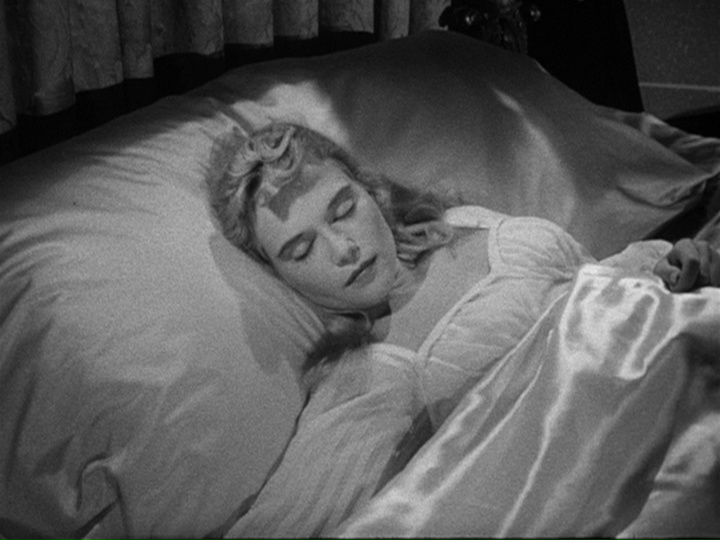
Gigi Perreau as Gloria
We next see Laura enter her classroom, where she teaches a group of young women. After the school day ends, she stands at the bus stop in front of the school and accepts an offer of a ride in a convertible driven by Gloria Barnes, a pretty, popular girl accompanied by four other students. Laura declines an offer to "split a calorie" at the "soda saloon" and instead is dropped off at the Clifton Arms. In the hall outside her apartment, she meets Ben Proudy, a gregarious man who is happy to meet his new neighbor. He invites her to join him at a bar down the street but she says she doesn't drink, so he suggests a movie; Laura is polite but cold.

Time passes, and Laura is back in the classroom, teaching Mary Shelley's Frankenstein, when Vera, one of the students, tries to sneak in late for the third time in a month. Vera confuses Prometheus with paramecium and questions why they are being asked to waste their time on people who have been dead for hundreds of years. As Laura said to the principal, things have changed in the time that Laura has been away. After class, Gloria, the student with the convertible, approaches Laura in the hallway and asks about The Last Man, a little-known novel by Mary Shelley that Laura had mentioned in class. (The Last Man is an obscure novel that was not well thought of until it was reprinted in 1965 and began to receive critical attention. The fact that it was mentioned in a 1959 TV show demonstrates that Laura Siddons had a detailed knowledge of European literature.) Laura offers to look for a copy and praises Gloria's classwork.

Robert H. Harris as Ben Proudy
Laura accepts Gloria's invitation to come home with her for tea and to meet her mother; she learns that Gloria's mother's health is fragile and that her father is in the state department, currently in Iraq. (Iraq was particularly unstable in 1959, after a revolution in 1958 overthrew the monarchy. Many people were fleeing the country at the time of the events of "Graduating Class," and the fact that Gloria's father was there on a mission for the U.S. State Department surely did not help his wife's health.)

Laura visits a used bookstore looking for a copy of The Last Man. Mr. Proudy appears and she declines an invitation for dinner but encourages him to ask her another night. While browsing through the books, she looks across the street and sees a nightclub called "The 7th Heaven." Gloria, her student, drives up in her convertible and walks into the club on the arm of a man. The recently jobless and desperate Laura Siddons is so rattled by the sight of her student entering what appears to be a racy club that she absent-mindedly pays $10 ($88.89 in 2020 dollars) for a copy of The Last Man. She rushes across the street and tries to enter the club but is denied entrance by a doorman, since she lacks an escort.

Jocelyn Brando as the assistant principal
Back in class the next day, Gloria wears dark sunglasses and falls asleep during Laura's lecture. After class, Laura gives her student the book she bought and Gloria explains her fatigue by claiming that she stayed up all night with her sick mother. Is she lying? Laura appears convinced by the story.

Some time later, on another evening, Laura exits a movie theater with Ben Proudy. They walk by the used bookstore and Laura again sees Gloria and the man come out of the club; this time, he kisses her in the dark against a wall next to the club's entrance. Laura tells Ben that the girl is one of her pupils and she is sure that the girl's parents would not approve of her spending time in such a place. Gloria drives off with the man and Ben and Laura follow them in Ben's car to the Cartwright Apartments. They see Gloria and the man together behind curtains in a second-floor flat. The lights in the apartment go off and Laura enters the building in order to slip a note under the door of the apartment for her seemingly wayward student. Ben tries to tell her that young people have different ideas about things today, but Laura says that right and wrong have not changed.

Sheila Bromley as the principal
The next day is Saturday and, early that morning, Gloria visits Laura at the teacher's apartment, angry at Laura for prying into her personal life. Laura explains that she sees Gloria as a special student of the sort who makes years of teaching worthwhile, telling the young woman, "'That is why I couldn't let you be harmed.'" Gloria reveals to Laura that she is secretly married and that she does not want to tell her sick mother for fear of giving her a shock. Her husband's father owns the nightclub and her husband is learning the business. Laura is satisfied with the explanation and pleased to have been taken into Gloria's confidence. When Gloria leaves the apartment, Ben sees her and Laura in the hallway and asks Laura what happened. Laura tells him only that Gloria shared a secret with her.

Back at school on Monday morning, Laura enters her classroom to find the students stone-faced, Gloria's seat empty, and a letter on her desk. As Laura reads the letter, we hear Gloria's voice on the soundtrack telling her that her friend Connie has already read it to the rest of the class. Gloria accuses Laura of being in partnership with Ben Proudy to spy on her. Ben tried to blackmail her mother, demanding $20,000 or he would go to the principal about what he called her "affair." He was picked up by the police and confessed, claiming that Laura had planned the whole thing. Gloria's mother is in a coma from the shock and may die, and the police are coming for Laura. The students stand and exit the classroom, leaving Laura alone.

Madge Kennedy as Mrs. Barnes
"Graduating Class" is the story of an unfortunate woman who means well but whose actions unintentionally lead to tragedy. Laura Siddons is the product of an earlier time and, despite the concerns of the principal and the advice of Ben Proudy, she thinks that she is doing the right thing by slipping a note under Gloria's door, presumably cautioning her about her seemingly inappropriate behavior. Little does Laura know that Ben Proudy is not above blackmail and that he (like she) assumes that Gloria is sleeping with a man who is not her husband. While Laura attempts to help the young woman privately, Ben takes advantage of the situation and commits a crime. The shock of the news--which is untrue--that her daughter is carrying on an illicit affair sends Mrs. Barnes over the edge, though one can assume that she held it together long enough to call the police and tell them about Proudy's attempt at blackmail.

What happens next? This episode of Alfred Hitchcock Presents is so well done that one would like to see the aftermath of the rather abrupt ending. No policeman in his right mind would seriously think that Laura Siddons had planned a blackmail scheme with Ben Proudy so, even though Gloria writes in her letter that the police are coming for her, Laura will surely be exonerated almost immediately. When that occurs, one would hope that Gloria would forgive her and that she could return to teaching her class. Even the principal, who was in school with Laura 25 years before and hired her when she was in desperate straits, would surely understand that the fault lies with Ben Proudy and that Laura's intentions were good.

This episode is based on a story by Edouard Sandoz (1881-1971) that is the untitled fifth story in his book, Innocent Without Cause (1958). Sandoz was a Swiss sculptor and painter who was also a member of a family that built a pharmaceutical empire. He wrote or illustrated a few juvenile books, but he also had this one collection of stories published. It is very rare and has never been reprinted; only a handful of libraries in the U.S. hold copies.

Josie Lloyd as Vera Carson
In the story, the teacher's name is Gloria Siddons and the student's name is Laura Pope, so Silliphant flipped the characters' given names for his teleplay. The story is very long, at 52 pages, and contains a theme that is absent from the teleplay. It opens with the teacher traveling by train, recalling her childhood in Nazi Germany and her pride at seeing "Germany take her rightful place." She only learned of the Nazis' crimes after the war ended.

The decision to hire her is discussed by the headmistress of the school and her husband, a judge, and there is much attention paid to her time in Germany and to a broadcast that she made the day before Pearl Harbor was attacked; in the broadcast, she attacked "certain Americans whom ... she believed to be slanderers." Once she arrives at school, she is sensitive to a remark by a Jewish fellow teacher who says that "'I ought to hate you,'" though it turns out that the other teacher is just referring to Gloria's taking away various great books to teach in her class. Gloria's background of hardship is contrasted with the lives of the privileged young women whom she teaches. The basic plot is the same as in the TV show, though the story contains much more detail. It takes up the better part of an entire school year, from the beginning in September all the way to the end of the story, which is in early spring.

Instead of the quick observations of her student outside the club, Gloria ends up sitting in a coffee shop across the street, watching her student come and go night after night as the young woman's school work suffers. Gloria enlists the aid of Proudy as her escort and ventures inside the club, where she learns that the man she has seen with her student is the club's manager. Gloria first mentions the idea of blackmail to Proudy when she expresses concern that the student's male friend might blackmail the young woman. Proudy suggests that Gloria approach her student directly and, after Laura reveals the truth of her marriage to her teacher, Proudy assumes that Gloria demanded money from her student and demands his share.

Julie Payne as Connie
In the letter from student to teacher at the end of the story, Laura calls Gloria a "dirty-minded, hypocritical, treacherous, blackmailing Nazi," showing that Gloria's youth in Germany and her problematic broadcast the day before Pearl Harbor have not been forgotten.

In adapting the story for television, Silliphant removed all of the references to Gloria's youth in Germany and thus there is no reason for her to be called a Nazi in the final letter. His teleplay does a great job of streamlining a long story, but reading the source material does help to clear up some of the incidents in the TV show that seem to occur too quickly or without sufficient foundation, especially the abrupt ending. Edouard Sandoz has no other credits in film or television besides this one.

Director Herschel Daugherty (1910-1993) worked mostly in television from 1952 to 1975, directing 27 episodes of the Hitchcock show and 16 episodes of Thriller. He also directed "Little White Frock," from a teleplay by Stirling Silliphant.

In addition to a great teleplay by Stirling Silliphant, "Graduating Class" benefits from excellent acting, especially by the leads.


David McMahon as the doorman
Playing Laura Siddons is Wendy Hiller (1912-2003), the great English actress whose career began on stage in the 1930s. She was on screen from 1937 to 1992 and won an Academy Award for Separate Tables (1958). She was in Murder on the Orient Express (1974) and The Elephant Man (1980) and she was made a Dame in 1975. This was her only appearance on the Hitchcock series.

Gorgeous Gigi Perreau (1941- ) plays Gloria Barnes. A child actress from the age of two, Perreau was on screen from 1943 to 1977 and returned to acting with voice work in 2008, something she still does today. She has a star on the Hollywood Walk of Fame. Like Wendy Hiller, this was her only role on the Hitchcock series.


Olan Soulé as the bookstore clerk
Jocelyn Brando (1919-2005), Marlon's older sister, appears briefly as the assistant principal. Trained at the Actors Studio, she was on stage from 1942 and on screen from 1945 to 1983. She was in Fritz Lang's The Big Heat (1953) as well as two episodes of Thriller and four episodes of the Hitchcock show, most notably "The Jar."

Ben Proudy is played enthusiastically by familiar face Robert H. Harris (1911-1981). Born Robert Hurwitz, he was on Broadway from 1938 and on screen from 1948 to 1978, mostly on TV. He was on Thriller and he was seen in nine episodes of the Hitchcock series, including "The Greatest Monster of Them All."

In smaller roles:
  • Sheila Bromley (1911-2003) as the principal; she was on screen from 1930 to 1975 and was also known as Sheila Le Gay and Sheila Manners. She was in two other episodes of the Hitchcock series, including "The Evil of Adelaide Winters."
  • Madge Kennedy (1891-1987) as Gloria's mother; she was on Broadway from 1912 and in films from 1917 to 1928 before taking a long break. She returned to the screen in 1952 and kept working until 1976. She has a small part in North By Northwest (1959) and was in six episodes of the Hitchcock show, including "Help Wanted." She was also seen on The Twilight Zone and The Odd Couple.
  • Josie Lloyd (1940- ) as Vera Carson, one of the students; daughter of producer Norman Lloyd, she had roles on TV between 1959 and 1967 ("Graduating Class" appears to have been her first). She appeared once on The Twilight Zone and six times on the Hitchcock show, including "Coming Home."
  • Julie Payne (1940- ) as Connie, another student; she had a brief career on screen from 1959 to 1965.
  • David McMahon (1910-1972) as the doorman at "The 7th Heaven" club; he played countless bit parts on screen from 1947 to 1965 and also appeared on Thriller.
  • Olan Soulé (1909-1994) as the bookstore clerk; he had a long career: on radio from the 1920s to the 1940s and on screen from 1949 to 1991, he was on The Twilight Zone and in eight episodes of the Hitchcock show, including "The Faith of Aaron Menefee." 
"Graduating Class" may be seen on DVD here or may be viewed for free online here. Read the GenreSnaps take on this episode here.

Sources:

"Graduating Class." Alfred Hitchcock Presents, season 5, episode 14, CBS, 27 Dec. 1959.
Grams, Martin, and Patrik Wikstrom. The Alfred Hitchcock Presents Companion. OTR Pub., 2001.
IMDb, IMDb.com, www.imdb.com/.
Sandoz, Edouard. Innocent Without Cause. NY: Vantage Press, 1958. 190-241.
Wikipedia, Wikimedia Foundation, www.wikipedia.org/.


Stirling Silliphant on Alfred Hitchcock Presents: An Overview and Episode Guide

Stirling Silliphant wrote eleven teleplays for Alfred Hitchcock Presents between 1956 and 1959. The first two, "Never Again" and "Jonathan," appear to be instances where he was asked to take a teleplay already written by someone else and polish it up to put it in filmable form. With the exception of "A Bottle of Wine," which was based on a story published in the first issue of Alfred Hitchcock's Mystery Magazine, and "Graduating Class," the stories that Silliphant was asked to adapt were either unpublished story ideas ("The Manacled," "The Return of the Hero") or else older short stories that had appeared in mainstream magazines.


"Never Again" is a tragic story of an alcoholic woman, based on a story from 1934, "The Glass Eye" is based on a story from a British collection published in 1944, and "The Perfect Crime" is based on a 1928 story from Harper's. "The Canary Sedan" is based on a 1930 story from The Cornhill Magazine, "Little White Frock is based on a 1920 story from The Story-Teller, and "The Crystal Trench" is based on a 1915 story from The Strand Magazine. It seems like Silliphant was often asked to adapt stories that were more in the nature of dramas than crime stories; like many other early-TV anthology series, Alfred Hitchcock Presents often showcased tales that were not strictly suspense, even though the series was hosted by the master of that form.

Silliphant's stories did not always contain a murder or even a crime; witness "The Return of the Hero," about a disabled soldier who is not welcome among his wealthy family members, or "Little White Frock," about an aging actor spinning an elaborate story as part of an audition. "The Perfect Crime" and "The Crystal Trench" were both directed by Hitchcock himself, while "The Glass Eye," directed by Robert Stevens, was awarded the only Emmy in the ten years that the series was on the air.

Stirling Silliphant's eleven half-hours for Alfred Hitchcock Presents are marked by high quality and demonstrate some of the highlights of the show's first five seasons.


EPISODE GUIDE-STIRLING SILLIPHANT ON ALFRED HITCHCOCK PRESENTS

Episode title-"Never Again" [1.30]

Broadcast date-22 April 1956
Teleplay by-Gwen Bagni, Irwin Gielgud, and Stirling Silliphant
Based on "Never Again" by Adela Rogers St. Johns
First print appearance-Cosmopolitan, April 1934
Notes
Watch episode-here
Available on DVD?-here

Episode title-"Jonathan" [2.10]
Broadcast date-2 December 1956
Teleplay by-Bernard C. Schoenfeld and Stirling Silliphant
Based on "Turmoil" by Fred Levon
First print appearance-Maclean's, 15 October 1948
Notes
Watch episode-here
Available on DVD?-here


"The Manacled"

Episode title-"The Manacled" [2.18]
Broadcast date-27 January 1957
Teleplay by-Stirling Silliphant
Based on an unpublished story by Sanford Wolf
First print appearance-none
Notes
Watch episode-here
Available on DVD?-here

Episode title-"A Bottle of Wine" [2.19]
Broadcast date-3 February 1957
Teleplay by-Stirling Silliphant
Based on "A Bottle of Wine" by Borden Deal
First print appearance-Alfred Hitchcock's Mystery Magazine December 1956
Notes
Watch episode-here
Available on DVD?-here

Episode title-"The Glass Eye" [3.1]
Broadcast date-6 October 1957
Teleplay by-Stirling Silliphant
Based on "The Glass Eye" by John Keir Cross
First print appearance-The Other Passenger: Eighteen Strange Stories by John Keir Cross
Notes
Watch episode-here
Available on DVD?-here

"The Perfect Crime"

Episode title-"The Perfect Crime" [3.3]
Broadcast date-20 October 1957
Teleplay by-Stirling Silliphant
Based on "The Perfect Crime" by Ben Ray Redman
First print appearance-Harpers August 1928
Notes
Watch episode-here
Available on DVD?-here

Episode title-"The Return of the Hero" [3.22]
Broadcast date-2 March 1958
Teleplay by-Stirling Silliphant
Based on an unpublished story by Andrew Solt
First print appearance-none
Notes
Watch episode-here
Available on DVD?-here

Episode title-"The Canary Sedan" [3.37]
Broadcast date-15 June 1958
Teleplay by-Stirling Silliphant
Based on "The Buick Saloon" by Mary O'Malley
First print appearance-The Cornhill Magazine, June 1930
Notes
Watch episode-here
Available on DVD?-here

"Little White Frock"

Episode title-"Little White Frock" [3.39]
Broadcast date-29 June 1958
Teleplay by-Stirling Silliphant
Based on "Little White Frock" by Stacy Aumonier
First print appearance-The Story-Teller, November 1920
Notes
Watch episode-here
Available on DVD?-here

Episode title-"The Crystal Trench" [5.2]
Broadcast date-4 October 1959
Teleplay by-Stirling Silliphant
Based on "The Crystal Trench" by A.E.W. Mason
First print appearance-The Strand Magazine, December 1915
Notes
Watch episode-here
Available on DVD?-here

"The Crystal Trench"

Episode title-"Graduating Class" [5.14]
Broadcast date-27 December 1959
Teleplay by-Stirling Silliphant
Based on an untitled story by Edouard Sandoz
First print appearance-Innocent Without Cause (1958)
Notes
Watch episode-here
Available on DVD?-here

In two weeks: Our series on Morton Fine and David Friedkin begins with "Change of Address," starring Arthur Kennedy and Phyllis Thaxter!

Listen to Annie and Kathryn's entertaining discussion of the Alfred Hitchcock Presents episode, "The Dangerous People," on the Good Evening podcast here!


Listen to Al Sjoerdsma's incisive podcast about the Alfred Hitchcock Presents episode, "And So Died Riabouchinska," here!

Thursday, March 12, 2020

The Hitchcock Project-Stirling Silliphant Part Eight: The Crystal Trench [5.2]

by Jack Seabrook

At the Rifflealp Hotel in the Swiss Alps, a British climber named Dennis Challoner looks up at the nearby mountain and converses with a young woman named Stella Frobisher about the wisdom of climbing with guides. Later that day, a German tourist looks through the big telescope at the hotel and sees two men on top of the Weisshorn. Challoner is concerned that anyone would be so high on the mountain that late in the afternoon when a storm had occurred and, the next day, word comes of an accident. Two young Englishmen, Mark Frobisher and George Liston, had attempted a dangerous ascent in the company of Herr Ranks, who was known to take risks. After being caught in the storm, Frobisher collapsed and died, and his companions left his body tied to a rock because they were unable to bring him down.

As a fellow Englishman, Challoner is elected to break the news to Stella, the wife of the deceased climber. The next day, Challoner tells her that her husband is dead and she asks that the body be brought back to her. With a climbing party, Challoner ascends the mountain and finds the body, but in the process of bringing it down a rope gives way and the corpse slides down the side of the snowy slope, disappearing into a glacial crevasse. The climbing party descends and Challoner tells Stella what happened to her husband's body.

Just before the body slips off the ledge.
Challoner remains haunted by the memory of Stella, who sends him a letter of thanks at the end of the year. He visits her and they begin to spend time together; the next summer, he proposes marriage but she refuses. Stella tells Dennis that she has been to see Professor Kersley, an expert on the movement of glaciers, and that he calculated that, on July 21st, in 24 years, Mark's body will emerge from the glacier. Stella plans to devote her life to waiting for her late husband's body to reappear.

The years pass and, 24 years later, Dennis accompanies Stella back to the Rifflealp Hotel where, one morning in July, he finds a gold watch lying on the ice. Stella confirms that the watch belonged to Mark, and the two go to the spot on the glacier where her husband can be seen under the ice. His body has been preserved in its youth, unlike that of Stella, who has aged 24 years. The ice is cut away and, when the body is exposed to the air, it crumbles to dust, leaving only a gold locket on a thin chain. Challoner picks up the locket and opens it to find a portrait of a young woman other than Stella. He tells Stella that the locket contains a picture of her but she replies that "'He had no locket with a portrait of me.'" The story ends with this sentence: "Over the shoulder of a hill the sun leapt into the sky and flooded the world with gold."

James Donald as Mark Cavendish
"The Crystal Trench," by A.E.W. Mason, is a beautifully-written short story that was first published in the December 1915 issue of the popular British fiction journal, The Strand Magazine. It is a story of romance and irony, set in the Swiss Alps and the countryside of England. Working backwards from the date of publication and assuming that the conclusion takes place around 1915, the fatal climb at the start of the story must be dated to about 1890. In fact, the Rifflealp Hotel first opened in 1884 and a tram was built in 1899 to connect the hotel to a nearby railway; in the story, when Challoner returns to the hotel after a 24-year absence, he notes that "a railway climbed nowadays to the Rifflealp."

Challoner estimates Stella to be a girl of "nineteen or less ... who looks out at life from the secure shelter of a schoolroom," so even after the long wait to see her husband's body she would only be about 45 years old. Challoner himself is 26 when the story begins, making him about 50 at the end. When Frobisher dies, the woman who manages the hotel tells Challoner that "'they had only been married a couple of months ... I would not have trusted him with the happiness of anyone I cared for.'" Decades later, when Challoner finds the locket, he recalls the words of the hotel manager.

Patricia Owens as Stella Ballister
The truth of the locket and the picture it contains are a shock to Dennis and Stella, since both put their lives on hold for 24 years while they waited for natural processes to reveal the man Stella loved. The final line of the story suggests that the revelation of Mark Frobisher's deceit may have freed Stella to respond to Dennis's love; how else to interpret: "Over the shoulder of a hill the sun leapt into the sky and flooded the world with gold"? The gold with which the world is flooded is like the gold of the locket, and it may also be life and love that are flooding back into the hearts of Dennis and Stella when they discover that her devotion to her late husband was misplaced.

In addition to the story's romantic aspects, A.E.W. Mason writes two brilliant passages of horror. The first comes when the climbing party finds Mark's body, frozen atop the snowy mountain:

He was astride a narrow edge of snow, a leg dangling down each precipice. His eyes stared at them, his mouth hung open, and when any stray gust of wind struck the ridge, he nodded at them with a dreadful pleasantry. He had the air, to Challoner's eyes, of a live paralytic rather than of a man frozen and dead.

The second shocking passage occurs when the body becomes dislodged and tumbles down the side of the mountain:

The lashing of the rope got loose as they dragged the body down the glacier, and suddenly it worked out of the sacking and slid swiftly past them down a steep slope of ice. A cry of horror broke from the rescue party. For a moment or two they watched it helplessly as it gathered speed and leapt into the air from one little hummock to another, the arms tossing and whirling like the arms of a man taken off his guard. Then it disappeared with a crash into a crevasse, and the glacier was empty.

Even someone who has never climbed a snowy mountain can picture this horrible scene!

Werner Klemperer as Herr Ranks
The story's title, "The Crystal Trench," had a different connotation to British readers in 1915. World War One was raging just across the English Channel where, by the fall of 1914, enormous trenches filled with soldiers spanned the front in France and Belgium. Often seen as a symbol of the futility of war, the trench of this short story becomes a symbol of the futility of waiting; instead of bloody soil, this trench is made to seem like crystal by the snow and ice that surround it.

A.E.W. Mason (1865-1948) was a popular British author of plays, short stories, and novels, including The Four Feathers (1902). Many films were adapted from his works but this is the only episode of Alfred Hitchcock Presents to be based on a story of his. The story may be read online here.

Ben Astar as the hotel manager
After not contributing any teleplays to the fourth season of Alfred Hitchcock Presents, Stirling Silliphant returned to adapt "The Crystal Trench" for television, and the episode, directed by Alfred Hitchcock, was broadcast on CBS on Sunday, October 4, 1959. Unlike the short story, which is told in the third person, the TV show is told in the first person by Mark Cavendish, as Silliphant has renamed Dennis Challoner. The first images we see are stock footage of the Alps, with glaciers and a train arriving, as the narrator recalls a day 40 years in the past, a Wednesday in September 1907. Already, Silliphant has made a significant alteration to Mason's work, moving the events of the past up to 1907 and the events of the present up to 1947, twelve years before the TV show aired. Instead of 24 years between fall and reappearance, as in the short story, the span of time is now 40 years, which allows for an even greater contrast between the youth of the man preserved in ice and the age of the man and woman who waited so long for him.

Challoner's first meeting with Stella is deleted and we instead see him arrive in the lobby and find the guides arguing by the telescope. More voiceover narration quickly sets the scene and creates suspense by suggesting an unforgettable event seen from 40 years in the future; it is made clear that what we are watching is an extended flashback.

Patrick Macnee as the professor
The next scenes follow the short story closely, until Cavendish meets Stella (her last name has been changed to Ballister) in the dining room. In the story, he sees her happily dancing alone and decides to wait until the next day to tell her about her husband's death. In the TV show, he joins her at her table and she invites him to dance; they waltz briefly before going out onto a balcony, where he breaks the news. As she looks up at the mountain, the camera focuses on the back of her head, setting up a similar shot in the show's final scene, when she has aged 40 years.

Particularly well done is the scene where the climbing party ascends the mountain to recover the body of Stella's husband; it is especially impressive for having been shot on a Hollywood soundstage. More voiceover describes the events as the wind blows on the soundtrack and there is a memorable shot from above as Ballister's body slides down the snow-covered side of the mountain.

Harald O. Dyrenforth
Stella next asks Mark to accompany her to the Swiss town of Brig, where Liston and Herr Ranks, both of whom accompanied Michael Ballister on his fatal Alpine climb, are recovering from injuries they sustained in the cold. She insists that she needs to find out the truth, suggesting that the story she was told of her husband dying of exhaustion and exposure could not have been accurate. This scene is an attempt by Silliphant to inject some drama into the story, and the following scene finds Mark and Stella interviewing Herr Ranks as he sits in a wheelchair. He takes some of the blame for the accident and Stella angrily accuses him of leaving her husband on the mountain to die, despite his insistence that they stayed with him until after he was dead.

Stella next tells Mark that she had a "'perfect marriage'" and announces that she will spend her life remembering every moment of her wedded bliss. The look in her eyes at the end of this scene suggests insanity, and John McCarty and Brian Kelleher suggest that the episode deals with "Romantic obsession a la Vertigo." Donald Spoto comments on "the stare of madness, the gaze of one immobilized within the prison of his own flesh or sin or emotional constriction," and I submit that Stella, in this scene, demonstrates the very emotional constriction of which Spoto writes.

Frank Holms
More voiceover narration accompanies Mark's visit to Stella at Christmas and his ill-fated marriage proposal. He misunderstood the purpose of her invitation, since she takes him with her to see a professor, who explains that the glacier will recede and reveal her husband's body. As the professor gives a detailed, scientific explanation, Stella sits enraptured while Mark paces the floor, distracted. Mark is shocked when the professor announces that Michael's body will emerge from the ice on July 21, 1947! In voiceover, he says that he now knows that Stella will wait 40 years for Mark while he waits for her.

There is a fadeout and then a fade back in to more stock footage of the Alps, mirroring the shots at the opening of the episode. Mark narrates again, calling the glacier "'a vast crystal trench which had enveloped us.'" We then see Mark and Stella from behind, watching as men with picks chip away at the ice. The camera angle shows the back of Stella's head, as it did in the earlier scene on the balcony, but this time we wait for her to turn around and reveal how she has changed in 40 years.

There is a shocking shot of Michael's frozen face, preserved in the ice, and Stella bends down to look closely, turning to let us see how she has aged in contrast with his unnaturally youthful appearance. The camera cuts to Mark, who has also aged significantly. He finds the locket and, after Stella tells him that Michael had no locket with a picture of her, he tosses it back onto the ice and turns with a look of despair. The shot fades to black and there is no sun flooding the world with gold as there is in Mason's short story; the TV version ends on an unhappy note with no indication that the characters have been set free from their self-imposed prison.

Oscar Beregi
In his article, "Cinema en miniature: The Telefilms of Alfred Hitchcock," Ulrich Rudel calls "The Crystal Trench" a "condensed epic, a futile love story encompassing four decades." He also asks whether Hitchcock may have been influenced by a 1929 film co-directed by G.W. Pabst called The White Hell of Pitz Palu, which concerns the search for a woman who falls into a glacier in the Swiss Alps. This film is available online here and features stunning camerawork.

Patrick McGilligan quotes screenwriter Evan Hunter, who visited the set while "The Crystal Trench" was being filmed from August 25, 1959, to August 27, 1959, and who recalls the technical difficulty of shooting the scene with Michael Ballister trapped under the ice: "'the ice was resting on a narrow wooden ditch into which the actor had crawled.'"

Finally, returning to Spoto and "the stare of madness," Stella is not the only one with madness in her eyes. Michael, Spoto writes, "gazes in apparent repose while actually in a timeless twilight of guilt." He is encased "within the prison of his own ... sin ..." Spoto may be stretching a point when he compares this to "the director's own deadpan attitude to camera and viewers each week," and argues that "the motif of fidelity and hidden passion" suggests Hitchcock's own "relationship with Alma and his yearning for several of his leading ladies."

In old age makeup, James Donald resembles Bill Nighy!
Clearly, "The Crystal Trench" can be read many ways, and Spoto refers to it as "the strangest teleplay of [Hitchcock's] career." During the summer of 1959, when this episode was filmed, Hitchcock was preparing to make Psycho, a movie whose contemporary American setting was in stark contrast to "The Crystal Trench," a story set in the past and taking place in England and the Swiss Alps. In a way, the episode harks back to Hitchcock's British films of the mid- to late-1930s, such as The Lady Vanishes.

James Donald (1917-1993) receives top billing as Mark Cavendish. Born in Scotland, he entertained troops in WWII before joining Army Intelligence. His screen career lasted from 1937 to 1978 and he was in two episodes of Alfred Hitchcock Presents, including "Poison." Learn more about him here.

Stella Ballister is played by Patricia Owens (1925-2000), who was born in Canada. Thirty-four years old when "The Crystal Trench" was filmed, she was considerably older than the character in the short story. Her screen career lasted from 1943 to 1968 and she co-starred with David Hedison in The Fly (1958). This was her only appearance on the Hitchcock series.

In supporting roles:
  • Werner Klemperer as Herr Ranks (1920-2000); born in Germany, his family emigrated to the U.S. in 1935 and he served in the Army in WWII. His screen career lasted from 1952 to 1993, mostly on TV, though he had a bit part in Hitchcock's The Wrong Man (1956). He appeared in one other episode of Alfred Hitchcock Presents, along with episodes of Thriller, Batman, and Night Gallery, but he is best known for his role as Colonel Klink on Hogan's Heroes from 1965 to 1971.
  • Ben Astar (1909-1988) as the hotel manager; he was on screen from 1950 to 1983. This was his only appearance on the Hitchcock series.
  • Patrick Macnee (1922-2015) as the professor; born in London, he served in WWII and was on screen from 1938 to 2003. He was in one other episode of Alfred Hitchcock Presents ("Arthur"), as well as episodes of The Twilight Zone and Night Gallery, but he will always be remembered as John Steed on The Avengers (1961-1969) and The New Avengers (1976-1977).
  • Harald O. Dyrenforth (1913-2005) as Frederick Blauer; born in Germany, he was on screen from 1945 to 1971 and had a small part in Hitchcock's Torn Curtain (1966). This was his only appearance on the Hitchcock series.
  • Frank Holms (1931- ) as Hans Blauer; born Frank Diernhammer in Germany, he was in the Hitler Youth but joined the U.S. Army after the war and eventually became an actor, appearing in German films from 1955 to 1959. In the 1960s, he worked as a fashion and portrait photographer in Los Angeles; he made some more appearances on U.S. television in the 1980s. This was his only appearance on the Hitchcock series.
  • Oscar Beregi (1918-1976) as the tourist who sees the climbers through the telescope; born in Hungary, he appeared on screen from 1959 to 1976. He had roles on Thriller and Batman and was in three episodes of The Twilight Zone.
"The Crystal Trench" is available on DVD here or may be viewed for free online here. Read the GenreSnaps take on this episode here.

Sources:

"The Crystal Trench." Alfred Hitchcock Presents, season 5, episode 2, CBS, 4 Oct. 1959.
The FictionMags Index, www.philsp.com/homeville/FMI/0start.htm.
Frank Holms (Frank Diernhammer), www.steffi-line.de/archiv_text/nost_film50_deutsch/91_holms.htm.
Grams, Martin, and Patrik Wikstrom. The Alfred Hitchcock Presents Companion. OTR Pub., 2001.
IMDb, IMDb.com, www.imdb.com/.
Mason, A.E.W. "The Crystal Trench." The Strand Magazine, Dec. 1915, pp. 746–755.
McCarty, John, and Brian Kelleher. Alfred Hitchcock Presents: an Illustrated Guide to the Ten-Year Television Career of the Master of Suspense. St. Martin's P., 1985.
McGilligan, Patrick. Alfred Hitchcock: a Life in Darkness and Light. ReganBooks, 2003.
Spoto, Donald. The Life of Alfred Hitchcock: the Dark Side of Genius. Collins, 1983.
Wikipedia, Wikimedia Foundation, www.wikipedia.org/.


In two weeks: Our series on Stirling Silliphant concludes with "Graduating Class," starring Wendy Hiller!

Listen to a podcast on the adaptation of Fredric Brown's "Human Interest Story" on Alfred Hitchcock Presents here!

Thursday, February 27, 2020

The Hitchcock Project-Stirling Silliphant Part Seven: Little White Frock [3.39]

by Jack Seabrook

Stacy Aumonier's short story, "Little White Frock," was first published in the British magazine, The Story-Teller, in November 1920. The tale is told in the first person by a narrator who recalls meeting an old actor named Colin Brancker. After the two run into each other a number of times, Brancker invites the narrator over to dinner, where the narrator meets Mrs. Windsor, the middle-aged woman who takes care of the old actor. There are souvenirs and signed photographs scattered around the house and the narrator begins to enjoy visiting every Thursday for dinner, when the old actor would regale him with tales connected to his various keepsakes.

"Little White Frock"
was first published here
On one visit, the narrator finds a child's little white frock, but Brancker's reaction to being asked about it is one of "utter dejection and remorse." The next night, the narrator brings his young wife, Alice, to dinner at the home of the old actor, and the two hit it off famously. Alice asks to see the frock and to hear the story behind it. Brancker recalls his old friend and fellow actor, Terry O'Bane, with whom he toured the provinces. They both fell in love with a beautiful actress named Sophie Wiles, who seemed to favor O'Bane over Brancker. However, when O'Bane inherited a fortune, Wiles refused to marry him for fear that she would be thought to have done it only for the money. O'Bane married another woman and she bore him a child named Lucy; unexpectedly, Wiles became devoted to that child and Brancker became devoted to Wiles. O'Bane died tragically and Lucy grew up to be a spoiled young woman, for whom Sophie made many frocks. One year, as the Christmas season approached, ten-year-old Lucy wrote to Sophie asking her to make a special frock that she could wear to a Christmas Eve ball. Sophie sewed a plain, white frock, intending that Lucy should stand out among the other gaudily-dressed girls at the ball in her lovely simplicity. Sophie took ill but worked to finish the frock in time.

Herbert Marshall as Colin Brancker
The narrator and Sophie arrived in London on Christmas Eve and Sophie, sick as she was, completed the frock early that evening. The narrator rushed out and delivered it to Lucy, who scorned it. The narrator left Lucy's house and suddenly realized that he did not know the address where Sophie was staying. He reasoned that it was better that he not find her, instead allowing her to die in the belief that Lucy had been delighted with her gift.

Brancker ends his story with a sob and, just then, Mrs. Windsor enters and asks if he has seen that little white frock she made for her niece the week before. Later that night, back at home, the narrator's wife calls him a "'boob'" and suggests that she knew all along that the old actor was pulling their legs.

Tom Helmore as Adam Longsworth
"Little White Frock" is a delightful story of performance, told in the first person by an unnamed man but dominated by the tale told by the old actor, Colin Brancker. Published in 1920, it shares characteristics with two famous stories by Charles Dickens from the mid-nineteenth century: A Christmas Carol (the climax on Christmas Eve) and Great Expectations (the sudden and unexpected inheritance of a fortune from a man in Australia). It is not surprising that Aumonier, the story's author, should look to Dickens for inspiration, since the main character in the short story is an aging actor, who surely was familiar with the works of the British writer.

Julie Adams as Carol Longsworth
The story depends on the believability of Brancker's tale, which captivates the narrator and his wife, and upon the discovery that it was all a performance, something that seems clear to the reader in retrospect. The narrator describes his wife as "younger than I ... less critical and introspective ... out to have a good time." Is this why she seems to see through the old actor's tale? In the story's final paragraphs, Aumonier has the narrator suggest that his wife realized all along that not only was Brancker's story a fabrication, but many of his keepsakes were invented as well. The narrator asks, rhetorically, "'what is the line of demarcation between what we call reality and what we call imagination ... What is reality? Indeed, what is life?'" His wife, discounting his high-minded speech, replies, "'I don't know what life is ... But I know what you are. You're a dear old--perfect old--BOOB!'" Her amused mockery of her husband also pokes fun at the readers of the story who were taken in by Brancker's performance.

Jacqueline Mayo as Lila Gordon
in a flashback, playing Desdemona
Stacy Aumonier (1877-1928) was a British author best known for his short stories. He began writing them in 1915 and served in WWI briefly in 1917-18 when he was 40 years old; he later developed tuberculosis and died at the relatively young age of 51. A handful of short films and a few television shows have been adapted from his stories; among them are three episodes of Alfred Hitchcock Presents, including the delightful, "Miss Bracegirdle Does Her Duty."

When Stirling Silliphant was given Aumonier's story to adapt for the small screen, he had several challenges. Should he update the story from 1920, when it was published, to 1958, when it first aired on CBS on Sunday, June 29, as the final episode of the third season? And what to do with the structure, where an unnamed narrator relates a tale told by an old actor, who relates events supposedly from the past? Working with director Herschel Daugherty and the superb actor, Herbert Marshall, Silliphant succeeded in transforming the short story from the page to television in thoroughly entertaining fashion.

Roy Dean as Terry O'Bane
The first scene takes place in a theater, as Adam Longsworth (the name given to the character who narrates the short story) and a colleague named Robinson sit alone in the audience watching as an old actor gives a halting audition on stage. The speech the actor reads is one in which an aging character talks of expecting gratitude from one's children when one has grown old; this reflects the episode's theme, that of old people trying to gain the respect of the young. The lines the actor reads are supposedly lines from a play that Adam has written; he has a week to finish assembling a cast.

The second scene takes place at "the club," where Brancker approaches Longsworth and Robinson. The playwright recognizes the old thespian and remarks, "'I saw you play Othello when I was a kid.'" Brancker returns the compliment by calling Longsworth "'the most brilliant young playwright of this new generation.'" Brancker asks Longsworth to dine with him but Longsworth dodges the invitation by saying that his wife handles his social affairs. Silliphant thus compresses the events in the story's opening pages, where the narrator tells how he met and became acquainted with the old actor. The teleplay gives the narrator a name, changes the narration from first-person to third-person, updates the time to the present, and moves the location from London to New York City. After Brancker walks away, Longsworth and Robinson discuss the faded star's transparent effort to secure a role in the new play, continuing the theme of age discrimination.

In scene three, Adam returns home to his modern apartment and his beautiful, young wife, Carol, who tells him that they are dining with Brancker the next evening. Longsworth laments that the old actor's "'style is passé, you just can't believe him anymore.'" Longsworth is more cynical than his counterpart in the short story, who is not a playwright and who thus holds no economic power over the old actor. The show's first three scenes quickly set the stage for the visit to Brancker's home, which comprises the rest of the episode.

Bartlett Robinson as Robinson
The Longsworths are next seen at Brancker's dinner table, where he offers a heartfelt toast to forgotten actors after telling his guests that he started acting before they were born. Carol is forthright, making no secret of her recent good fortune and her husband's newfound success, and when she starts to pick up her dinner plate to clear it away, Brancker tells her that he has a woman who cleans up and who will arrive soon, thus setting up the maid's unexpected entrance at the end of his tale. Brancker denies wanting a part in Longsworth's new play and instead says he is leaving the theater. He wants to leave his collection of theatrical souvenirs to Longsworth, who can appreciate their importance. Carol points out the little white frock and Brancker begins to tell his story.

Sophie Wiles of the short story is renamed Lila Gordon and Brancker recalls that she joined the touring company of which he was a part when he and Terry O'Bane were alternating roles as Othello and Iago in Buffalo. In retrospect, knowing how the episode ends, one can surmise that the wily old actor intentionally chose the play Othello as the background for his story, since Longsworth had said at the club that he saw Brancker perform the role decades before. In the first of three flashbacks, we see Lila as Desdemona and Terry as Iago, both shown from Brancker's point of view, but we do not yet see Brancker as he would have appeared 40 years before.

Edwin Jerome as Andrews
By this point, Herbert Marshall, as Colin Brancker, has taken over the show completely, telling the story with his magnificent voice as his two guests look on, captivated. Years later, Julie Adams, who plays Carol, recalled that "'I think I did make real tears ... Herbert Marshall was an utterly charming man.'" He continues to tell the story while sitting in his chair, and there is a second flashback, which again begins from Brancker's point of view as he watches an old stagehand deliver a telegram to O'Bane in his dressing room. Brancker enters and sits next to Terry and we see them in the mirror. Colin Brancker as a man 40 years younger is played by none other than 68-year-old Herbert Marshall, in makeup as Othello. The makeup somewhat hides his obvious age and we can also accept this choice as portraying the way the old actor recalls the scene in his memory; additional distance from reality is provided by the fact that the scene between Brancker and O'Bane plays out in reverse, as reflected in the large, dressing-room mirror.

Otto Waldis as Koslov
In a slight change from the short story, Brancker relates that Lila accepts O'Bane's marriage proposal, though they never get married because he falls in with "'loose characters'" in New York (the way Marshall pauses between "loose" and "characters" is wonderful). The tale continues as it does in Aumonier's story, with Lucy's name changed to Jeanine, and concludes in a third flashback. This time, Brancker tells his listeners that he had just opened on Broadway in The Slap, a fictional play that recalls a real play, He Who Gets Slapped, that ran on Broadway in 1922 and that was made into a film starring Lon Chaney in 1924. As in the Chaney film, we see Brancker in flashback in his dressing room after a performance, dressed as a clown/tramp, with clown face paint and a bald cap; once again, we see him reflected in a mirror. He is called to see Lila on an urgent basis; he finds her ill and looking older and the face paint he still wears from his stage role in The Slap underscores the tragedy of the events that unfold, since he has tears painted below each of his eyes.

Kitty Kelly as Marie
Lila gives him the frock to take to the child and, in another slight change to the short story, he tells the Longsworths that he returned to find her dead, eliminating the needlessly complicated and rather incredible business of his not knowing her address and being unable to find his way back to her. The surprise of the maid's entrance is the same as in the short story, though on screen we get the benefit of seeing the shocked looks on the faces of the Longsworths and the look of mild embarrassment on the face of Brancker. Rather than end the trio's interaction there, however, as in Aumonier's story, Silliphant extends the final scene and has Longsworth confront the old actor. Was it "'All an act?'" he asks, and Brancker admits that this was the only way he could think of to audition for the playwright. In response, Longsworth admits he was wrong and asks the thespian to be at the theater at eleven o'clock the next morning.

"Little White Frock" ends happily, with no crime or murder in sight. Yet one question remains: did Colin Brancker plan the maid's sudden entrance as part of his performance? It seems that this must be the case, since had she not come in and revealed the artifice of his tale, how would Longsworth have known that it was all an audition conducted for his benefit? What in the short story was presented as an embarrassing surprise has become, in Silliphant's adaptation, the final piece of a puzzle carefully constructed to demonstrate Brancker's skill to the upstart playwright.

Joe Hamilton as the stage hand
"Little White Frock" is a superb episode, where a skilled translation of the story from page to small screen is brought to life by a great performance by the lead actor, solid supporting performances, effective direction, and appropriate lighting.

The great Herbert Marshall (1890-1966) plays Colin Brancker. Born in London and the child of two stage actors, Marshall fought in the trenches in WWI and lost his right leg after being shot in the knee in 1917. His long stage career had begun back in 1909 and he overcame his disability to become a respected and beloved actor on film, starting in 1927, on radio, starting in 1936, and on television, starting in 1950. His many film roles included Hitchcock's Murder! (1930), Lubitsch's Trouble in Paradise (1932), Hitchcock's Foreign Correspondent (1940), Crack-Up (1946), which was based in part on a Fredric Brown novelette, and The Fly (1958). "Little White Frock" was one of his two appearances on Alfred Hitchcock Presents. The other was "A Bottle of Wine," also with a teleplay by Stirling Silliphant.

Olan Soulé
Perhaps a bit long in the tooth to be playing brilliant young playwright Adam Longsworth is Tom Helmore (1904-1995) who, like Herbert Marshall, was born in London and whose career on screen lasted from 1927 to 1972. He also appeared on Broadway from the 1940s to the 1960s. Helmore was in three Hitchcock films: The Ring (1927), Secret Agent (1936), and Vertigo (1958), in which he played a key role in Hitchcock's masterpiece that was released the month before "Little White Frock" aired. Helmore was in one other episode of Alfred Hitchcock Presents and he also appeared on Thriller and on Night Gallery, which was his last credit.

Julie Adams (1926-2019) is lovely as Carol Longsworth; she was on screen from 1949 to 2018 and her most famous role was in Creature from the Black Lagoon (1954). She was in three episodes of Alfred Hitchcock Presents, as well as episodes of Night Gallery and The Night Stalker. There is a website devoted to her here.

In supporting roles:
  • Jacqueline Mayo (1933- ) as Lila Gordon in the flashbacks; resembling Tuesday Weld or Mia Farrow, she had a short career on TV from 1958 to 1969 and was in one other episode of Alfred Hitchcock Presents, "The Deadly."
  • Roy Dean (1925-2002) as Terry O'Bane, Brancker's fellow thespian in the flashbacks; he was on TV from 1947 to 1972 and had bit parts in films; he was also a successful athlete, photographer, and writer. This was his only appearance on the Hitchcock show.
  • Bartlett Robinson (1912-1986) as Robinson, who joins Longsworth in the early scenes; his long career included a stint in the 1940s as Perry Mason on radio, stage work from the 1930s to the 1950s, TV roles from 1949 to 1982, film work from 1956 to 1973, parts on The Twilight Zone and Thriller, and eleven appearances on the Hitchcock show, including "Bad Actor."
  • Edwin Jerome (1885-1959) as Andrews, the old actor who auditions in the show's opening scene; born Edwin Jerome Rath, he was on screen from 1929 to 1959 and he was in one other episode of Alfred Hitchcock Presents. His wife Helene was the victim in a celebrated murder case in 1958.
  • Otto Waldis (1901-1974) as Koslov, who speaks to Longsworth and Robinson at the club in the show's second scene; born Otto Glucksmann-Blum in Vienna, he was in Fritz Lang's M (1931) and had many other roles on film and television from 1947 to 1970; he was also in the Alfred Hitchcock Presents episode, "Lamb to the Slaughter."
  • Kitty Kelly (1902-1968) as Marie, the maid; born Sue O'Neil, she was a member of the Ziegfeld Follies and had parts on screen from 1925 to 1968. She was also in "Listen, Listen.....!" on Alfred Hitchcock Presents.
  • Joe Hamilton (1929-1991) as the stage hand who delivers the telegram in the second flashback; his brief screen career lasted from 1954 to 1965 but in that time he appeared on The Twilight Zone and in five episodes of the Hitchcock show, including "The Five-Forty-Eight."
  • Olan Soulé (1909-1994) can be glimpsed briefly in an uncredited role in the show's first scene as the man sitting at the table on the right side of the stage, presumably feeding lines to Andrews, who gives the audition; he had a long career: on radio from the 1920s to the 1940s and on screen from 1949 to 1991, he was on The Twilight Zone and in eight episodes of the Hitchcock show, including "The Faith of Aaron Menefee." 
Director Herschel Daugherty (1910-1993) worked mostly in television from 1952 to 1975, directing 27 episodes of the Hitchcock show and 16 episodes of Thriller. He also directed "The Return of the Hero," from a teleplay by Stirling Silliphant.

Read "Little White Frock" for free online here or watch the TV adaptation here. Order the DVD here. Read the GenreSnaps take on this episode here.

Sources:
Aumonier, Stacy. "Little White Frock." The Golden Windmill and Other Stories, Macmillan, 1921, pp. 109-133.
The FictionMags Index, www.philsp.com/homeville/FMI/0start.htm.
Galactic Central, philsp.com.
Grams, Martin, and Patrik Wikstrom. The Alfred Hitchcock Presents Companion. OTR Pub., 2001.
IMDb, IMDb.com, www.imdb.com/.
"Little White Frock." Alfred Hitchcock Presents, season 3, episode 39, CBS, 29 June 1958.
Wikipedia, Wikimedia Foundation, www.wikipedia.org/.

In two weeks: "The Crystal Trench," directed by Alfred Hitchcock!