Showing posts with label Allan Gordon. Show all posts

Thursday, September 7, 2023

The Hitchcock Project-Allan Gordon, Part Two-The Man Who Found the Money [6.13]

by Jack Seabrook

While on a gambling vacation in Las Vegas, William Benson, a professor from St. Louis, finds $92,000 in a gold clip with the initials "C.N." on a sidewalk. He puts it in a bank's safe deposit box and visits the police station, where a captain is already aware of the missing money, though the missing amount is said to be $102,000. Benson lost all of his savings, or $400, the night before while playing roulette. Soon, a flashy car pulls up and Mr. Newsome strides into the captain's office. Benson tells Newsome that he found $92,000 and Newsome does not seem disturbed by the discrepancy.

"The Man Who Found
the Money" was first
published here
Though the captain wanted to put Benson on the 11 o'clock train out of town, Newsome has other plans. He and Benson visit the bank, where the money is returned, and Newsome drives Benson to his casino, the Pinto, offering to fly his wife Joyce out to Vegas for a weeklong stay, on the house. Newsome leaves Benson in the casino, where he is given free chips and wins even more. Eventually, Benson is taken to Newsome's office, where Newsome hands him a telephone receiver and Benson hears his wife's terrified voice telling him that two men are at their house. Newsome hangs up the phone and tells Benson that his wife and child will be dead soon unless he hands over the missing $10,000.

"The Man Who Found the Money" is a straightforward story where the ending is no great surprise. The suspense comes from the question of whether Newsome's kindness to Benson is sincere. Benson is in a no-win situation; his best option would have been to leave the money on the sidewalk or to figure out a way to turn it in anonymously, yet he had no way of knowing that $10,000 was missing and by the time he learned that fact it was too late.

Arthur Hill as Benson
The story was first published in the February 1954 issue of Manhunt and appears to be the only published fiction by James Cronin, a professor who taught a creative writing workshop at St. Louis University and who founded that school's Writer's Institute. The story was reprinted in the 1958 collection, The Best from Manhunt, which is probably where associate producer Norman Lloyd saw it.

Allan Gordon adapted the story for TV and the show aired on NBC on Tuesday, December 27, 1960. "The Man Who Found the Money" is an excellent adaptation, one that improves on its source while following the plot closely. While the short story begins as Benson places an ad about the money in the newspaper and we learn what happened leading up to that when Benson speaks to the police captain, with his thoughts revealing what he's leaving out, the TV show presents the events chronologically as they occur, beginning with an establishing shot of the Las Vegas strip at night.

Rod Cameron as Newsome
There is a dissolve to the interior of the casino, which is soon identified as the Pinto Inn (in the story, Benson had played at a different casino), where we see Benson lose his money at the roulette table. He leaves and finds the money in the parking lot outside; there is a dissolve to the interior of his motel room and the camera at first hovers high above Benson from a God's eye point of view as he sits on the bed and counts the money. A neon sign blinks on and off outside the room's window, visible through the closed curtains, demonstrating that he's staying at a cheap motel rather than the more expensive casino hotel. Clearly, $92,000 is a significant sum of money for this man.

Benson takes out his suitcase and opens it, seemingly to put the money inside, but when he picks up a framed photo of his wife he slams the suitcase shut and it seems like her face triggered an attack of conscience. A shot of Benson in a large mirror suggests that he's of two minds about what to do with the money. He ends up sitting in a chair, looking at the money and thinking, and we see that the time is 3:50 a.m. The camera pulls back up to the Godlike angle and there is a dissolve to a close-up of another clock; this time, it reads 10 a.m. and it's on the wall at the bank, so we understand that Benson has decided not to run off with the cash.

R.G. Armstrong as Captain Bone
He puts the money in the safe deposit box and we learn his name for the first time as the teller addresses him as Mr. Benson. The camera watches him from a high angle as he puts the money in the box, again implying judgment. There is a dissolve to the office of the Las Vegas Times, and at this point, the TV show picks up where the short story begins. From here on, the events and dialogue follow the short story closely. Benson goes to the police station, where some of his thoughts from the story are converted into dialogue and R.G. Armstrong is excellent as police Captain Bone; he's all business and presents a sense of strength and menace.

The show's best performance comes from Rod Cameron as Newsome. He arrives at the police station and the desk sergeant calls him by name; he walks into the captain's office without being asked, as if he's been there before and knows that he won't be challenged. Newsome is clearly a wealthy local man who is treated with deference by everyone he meets, in contrast to Benson, the visitor from out of town who is harassed even though he is trying to be honest. An earlier remark by the newspaper editor about people in Las Vegas being very concerned about money proves to be prescient.

At the bank, the teller, Miss Purdy, also calls Newsome by name and, after Newsome drops the captain back at the police station, his car is seen pulling up in front of the casino. Everyone knows Newsome and addresses him by name: the young man who parks his car and, most entertaining of all, the hat check girl, to whom Newsome cheerfully barks, "'Park it, honey!'" as he tosses his hat to her behind Benson's back. The rest of the show follows the story closely for the most part. Benson gambles and is taken to Newsome's office, where he briefly hears his terrified wife's voice on the phone; unlike the story, there is no mention of a baby and here, Newsome's threat is less specific--in the short story, he says, "'they're going to find your wife and kid at the bottom of a hill in a burning car,'" while on the show this is softened to, "'something will happen to your wife.'"

"The Man Who Found the Money" is an excellent adaptation of the short story of the same name. The acting is great, with Arthur Hill seeming suitably nervous and indignant as Benson, Rod Cameron embodying the local bigwig, Newsome, and R.G. Armstrong, as Captain Bone, caught in the middle and knowing all too well the danger the out of town visitor faces. Director Alan Crosland, Jr., keeps the story moving along briskly and uses unusual and interesting camera angles to keep viewer interest high and to subtly comment on the proceedings. Even the stock music cues, presumably selected by music supervisor Joseph E. Romero, are effective, demonstrating once again how the later seasons of Alfred Hitchcock Presents had a better library of musical themes to choose from than the earlier seasons.
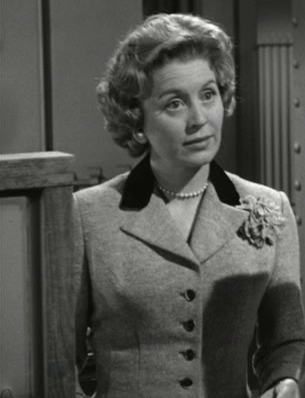
Lucy Prentis as Miss Purdy
Alan Crosland, Jr. (1918-2001), the director, started out as a film editor, working on features from 1944 to 1954 and on TV from 1955 to 1957, then began directing episodic television in 1956. He directed 16 half-hours and three hours of the Hitchcock series, including "The Woman Who Wanted to Live," as well as episodes of The Twilight Zone and The Outer Limits. Crosland directed a handful of movies, but his main focus was on TV, and he directed his last show in 1986.

William Benson is played by Arthur Hill (1922-2006), a Canadian actor who served in the Canadian Air Force in WWII and began acting on stage, TV, and film in the late 1940s. He won a Tony Award for his role in Who's Afraid of Virginia Woolf? on Broadway and starred in the TV series, Owen Marshall, Counselor at Law, from 1971 to 1974. He was in one other episode of Alfred Hitchcock Presents, "Human Interest Story."

Giving an energetic performance as Newsome is Rod Cameron (1910-1983), another Canadian actor. Born Nathan Roderick Cox, he started out as a stuntman in Hollywood and has a star on the Hollywood Walk of Fame. His screen career lasted from 1939 to 1977 and he starred in three TV series: City Detective, from 1953 to 1955, State Trooper, from 1956 to 1959, and Coronado 9, from 1960 to 1961. This was the only episode of the Hitchcock TV show in which he appeared.

Clancy Cooper
R.G. Armstrong (1917-2002) plays Captain Bone. He was on four episodes of the Hitchcock show, including "Final Vow," and had a long career, spanning the years from 1954-2001. He was also in many westerns. Online sources report that he grew up in a family of fundamentalists and that his mother wanted him to be a pastor, but he became an actor instead and his onscreen roles sometimes played off the tension between his upbringing and his profession.

In smaller roles:
  • Lucy Prentis as Miss Purdy, the bank teller; born Lucy Propst, she had a television career from 1950 to 1962. She also appeared in one other episode of Alfred Hitchcock Presents, "Bang! You're Dead."
  • Clancy Cooper (1906-1975) as the newspaper editor; he was on screen in small roles from 1938 to 1972, appearing on The Twilight Zone, two episodes of Thriller (including "Knock Three-One-Two"), and three episodes of the Hitchcock show.
  • Baynes Barron (1917-1982) as Lent, who takes care of Benson in the casino near the end of the show; Barron was onscreen from 1946 to 1979 and appeared in three episodes of Alfred Hitchcock Presents, including "Listen, Listen . . . . .!"
Baynes Barron
  • Mark Allen (1920-2003) as the desk sergeant at the police station; he played small roles onscreen from 1952 to 1975 and this was the only time he was seen on the Hitchcock show.
Mark Allen
Watch "The Man Who Found the Money" online here or buy the DVD here. Read the GenreSnaps review of this episode here.

It's too bad that Allan Gordon did not write any more episodes of Alfred Hitchcock Presents. The two episodes he adapted from short stories show real skill in translating events from the page to the small screen and I would love to find out more about him!

Sources:

Cronin, James. "The Man Who Found the Money." The Best of Manhunt. Ed. Jeff Vorzimmer. Eureka, CA: Stark House, 2019. 122-127.

The FICTIONMAGS Index, www.philsp.com/homeville/FMI/0start.htm.

Galactic Central, www.philsp.com/index.html.

Grams, Martin, and Patrik Wikstrom. The Alfred Hitchcock Presents Companion. OTR Pub., 2001.

IMDb, www.imdb.com/.

"Jeff Vorzimmer." Interviewed by Richard Krauss. The Digest Enthusiast 11, 2020. 150-157.

"The Man Who Found the Money." Alfred Hitchcock Presents, season 6, episode 13, NBC, 27 December 1960.

Wikipedia, www.wikipedia.org/.

“Writers Who Joined the Peace Corps to ‘Burn with a Hard, Gemlike Flame.’” Peace Corps Worldwide, 9 Mar. 2016, peacecorpsworldwide.org/writers-who-joined-the-peace-corps-to-burn-with-a-hard-gemlike-flame/.


Listen to Al Sjoerdsma discuss "The Manacled" here!

In two weeks: Our series on Dick Carr begins with a look at "Triggers in Leash," starring Gene Barry and Darren McGavin!

Thursday, August 24, 2023

The Hitchcock Project-Allan Gordon, Part One-Very Moral Theft [6.3]

by Jack Seabrook

If a crime is committed to help a desperate loved one, is it excusable? That's the question at the center of "Very Moral Theft," a short story by Jack Dillon that was first published in the May 1960 issue of Alfred Hitchcock's Mystery Magazine.

Helen is 38 years old and unmarried and she has been unlucky with a series of men. The most recent is Harry, a 50-year-old tire distributor whom Helen's brother, John, thinks looks like a gangster. Harry pays alimony to his ex-wife and Helen, who went to finishing school and works for a real estate firm, sees him as earthy. One evening, when Harry picks Helen up to go to dinner, he reveals that one of the companies he deals with has gone out of business, which means his own business will fail. He needs $8000 in 48 hours to stay afloat. Helen volunteers to mortgage the home she lives in with her brother, as long as Harry can repay her within 48 hours so that John doesn't find out. In reality, Helen plans to take the money from the real estate business where she works.

Betty Field as Helen
The next morning, she gets the money at the bank and gives it to Harry, who assures her that he'll pay her back in 48 hours. For the first time, he mentions marriage, to her delight, and when she goes home, she proudly tells her brother. Helen goes to work the next morning and receives a call from Harry, who says he'll have the money for her tonight. That night, Harry arrives at Helen's house to pick her up and angers John when he mentions that Helen mortgaged the house. Harry is upset and tells Helen that he can't get the money; she admits that she stole it. Harry then insists that he'll pay her back on time.

The next day, Helen goes to work and waits for Harry to call. He shows up at the office and hands her the money in an envelope; they go to deposit it in the bank and he reveals that he got it from crooks. Harry reassures Helen that he can safely delay paying them back. She does not hear from him for several days and goes to a bar where they had been together before. She asks the bartender about Harry and he tells her that Harry is dead, remarking that "'you just don't get cute with a couple of ex-racket guys.'" Months pass, and Helen concludes her story by writing that, "somehow, I'm not lonely anymore."

Walter Matthau as Harry
In the end, Harry, a con man, sacrifices himself to protect Helen. She may be alone now, but she knows that, at least once, she was loved. "Very Moral Theft" was adapted for television by Allan Gordon and it was broadcast on NBC on Tuesday, October 11, 1960. While the short story is narrated by Helen, who tells the reader her background, her thoughts, and her observations, the TV version features no narration at all, so the story's non-verbal elements must be conveyed to the viewer by other means. The story opens with Helen providing details about herself, her history with men, Harry's reputation, and John's poor opinion of him. The TV show instead opens with a scene that portrays Harry as an unscrupulous businessman who runs a lumber yard and cheats his customers. Helen meets Harry and they walk off together; we next see them as Harry drops her off at home after dinner. She invites him in but he refuses because her brother is there--"'I met better guys up the river,'" Harry remarks.

Karl Swenson as John
Inside, John tells Helen about his upcoming marriage and she avoids discussing how it will affect her. Scriptwriter Allan Gordon takes pages of narrative from the short story and compresses them into short scenes that introduce the main characters, their relationship, and their personalities. A short scene at the bank follows, as in the story, where Fescue gives Helen a check; the next scene moves the action from Harry's car (in the story) to the inside of a bar, where Harry explains his business problem and the dialogue follows that of the story closely.

Sal Ponti as Carl
The TV show eliminates Harry's ex-wife entirely and there is no mention of his having to pay alimony; instead, some humorous banter between Harry and the bartender is added. In this scene, director Norman Lloyd adds visual interest by using the camera to pan from side to side and zoom in on characters to avoid having to rely on too many shot/reverse shots as they converse. As the conversation comes to an end and Helen lies to Harry about the money, the camera zooms in tight on a two-shot that makes them look like conspirators.

The next scene shows Helen at the office, lying to Ivers, as in the story, then Helen goes to the bank, where her nervousness is underlined with ominous music. Everyone seems suspicious of her and the first act ends with her asking for the cashier's check. In the second act, instead of Harry picking her up in his car, she goes to his office and gives him the check. This is the second important scene to be moved from Harry's car to the inside of a building; perhaps Gordon thought that scenes heavy with dialogue would work better in a room than in a car. A line is added when Harry jokes, "'You sure you didn't steal that money?'"--he laughs and smiles for the first time in the show.

David Fresco
as Parker
At home that night, Helen proudly tells John about her engagement and again any mention of Harry's ex-wife or alimony is omitted. The following scene marks a change from the story as Harry, clearly drunk, arrives at Helen's office the next morning, looking for her. He asks Ivers to tell Helen that "'Tonight's the night.'" In the story, Helen fears that she'll be found out and arrives at the office to discover that Ivers has gone on a trip. In the show, she encounters Harry on the sidewalk. That night, he arrives at her house and she lets him in; in the story, she's upstairs and he gets into an argument with John downstairs. In the TV show, Harry breaks the bad news to Helen and John walks in and hears about the mortgage; he berates his sister in front of Harry and events are again compressed.

Harry leaves and John verbally attacks Helen, referring to two of her prior bad relationships, something she tells the reader about at the beginning of the short story. The next day, before Helen gets to the office, Harry meets her on the sidewalk and gives her the money. In the following scene, she sits, morose, on her front porch. John mentions that she hasn't heard from Harry in three days; in the short story, this is part of her narration. The final scene in the bar follows the story closely, though a line of dialogue is added for clarification when the bartender says, "'He took two of the guys in the racket for $8000.'" The show ends with a fadeout on Helen sitting alone at a table and does not include her concluding comments from a later date that end the story.

Rusty Lane as Ivers
Allan Gordon's script for "Very Moral Theft" does a fine job of removing all of the first-person narration that drives the short story and conveying all of the important information by other means. I have not been able to find any information at all about Gordon other than that he is credited for two teleplays--this one and one more for Alfred Hitchcock Presents.

Jack Dillon (1923-1991), who wrote the short story, was an advertising executive who also wrote short stories from 1958 to 1968 and who wrote four novels. Two TV episodes were adapted from his stories: this one and an episode of Hawaiian Eye.

Sam Gilman as Charlie
"Very Moral Theft" is directed by Normal Lloyd (1914-2021), who was one of the people most responsible for the success and quality of Alfred Hitchcock Presents and The Alfred Hitchcock Hour. Born Norman Perlmutter and active in the theater in the 1930s, he had a long career as a film and television actor, from 1939 to 2015, and appeared in Hitchcock's Saboteur (1942) and Spellbound (1945). He also directed for television from 1951 to 1984. He acted in five episodes of the Hitchcock series and directed 22, including "Man from the South."

William Newell as Fescue
Betty Field (1916-1973), who plays Helen, was 47 when this episode was filmed, making her almost a decade older than the character as described in the short story. She began acting as a teenager and had a long career on Broadway, from 1934 to 1971. She appeared in films from 1939 to 1968, on radio from 1939 to 1954, and on TV from 1948 to 1968. She trained with the Actors Studio and also appeared in "The Star Juror" on The Alfred Hitchcock Hour.

Her co-star, Walter Matthau (1920-2000), was only 39 when this was filmed, making him over a decade younger than the Harry of the story, who is 50. Matthau is wonderful as Harry, his laconic speech and manner seeming at once vaguely humorous and also unsavory. Born Walter Matthow in Manhattan, he was a child actor in Yiddish theater who served under Jimmy Stewart in the Air Force in WWII, earning six battle stars. He went on to star on Broadway, then on television, and finally in many films. He won two Tony awards and an Oscar. His TV career began in 1950 and his movie career followed in 1955. He appeared in four episodes of Alfred Hitchcock Presents, including "Dry Run," but he will always be remembered for his comedic film roles, especially The Odd Couple (1968) and The Bad News Bears (1976).

In smaller roles:
  • Karl Swenson (1908-1978) plays Helen's brother, John. His acting career lasted from 1935 until his death and he was frequently seen on episodic TV. He was on the Hitchcock show three times, including "On the Nose," he had a small role in Hitchcock's The Birds (1963), and he was a regular on Little House on the Prairie.
  • Songwriter turned actor Sal Ponti (1935-88) plays Carl, the workman at the lumber yard in the first scene; he was on TV from 1959 to 1978 and he appeared in three episodes of Alfred Hitchcock Presents, including "Keep Me Company."
  • David Fresco (1909-1997) as Parker, the nosy man in the bank; he was on screen from 1946 to 1997 and he was blacklisted in 1956. Despite that, he appeared in twelve episodes of the Hitchcock show, including "The Day of the Bullet," as well as episodes of The Twilight Zone and Night Gallery.
  • Rusty Lane (1899-1986) as Ivers, Helen's boss; born James Russell Lane, he was in nine episodes of the Hitchcock series, including "The Manacled."
  • Sam Gilman (1915-1985) as Charlie, the bartender; his career is most interesting. He started out as a comic book artist for Marvel and Centaur from 1939 to 1942, drawing a text illustration for Marvel Comics #1. He then served in World War Two. On returning to civilian life, he became an actor and befriended Marlon Brando. He moved to Hollywood and got his first role in Brando’s film, The Men (1950). He went on to a career on screen that lasted until 1983 and he may be seen in five episodes of the Hitchcock show, including "Insomnia." He was also on Thriller.
  • William Newell (1894-1967) as Fescue, who gives Helen the check at her office; he was on screen from 1930 to 1965 playing countless bit parts, including the role of Alfalfa's father in the Little Rascals shorts; he was on the Hitchcock TV show five times, including "The Horseplayer."
  • Charles Carlson (1930-2013) as George, the bank teller; he was on TV from 1960-1967 and appeared in five episodes of Alfred Hitchcock Presents, including "Where Beauty Lies."
Charles Carlson
  • Keith Britton (1919-1970) as Ben, the bank guard; he had a brief career on screen from 1955 to 1962 and appeared in three episodes of the Hitchcock show, including "Crack of Doom."
Keith Britton

Watch "Very Moral Theft" online here or buy the DVD here. Read the GenreSnaps review of this episode here. Thanks to Peter Enfantino for providing a copy of the story!

Sources:

CTVA-The Classic TV Archive, Alfred Hitchcock Presents, Season 6, http://ctva.biz/US/Anthology/             AlfredHitchcockPresents_06_(1960-61).htm

Dillon, Jack. "Very Moral Theft." Alfred Hitchcock's Mystery Magazine, May 1960, pp. 82-97.

The FICTIONMAGS Index, www.philsp.com/homeville/FMI/0start.htm.

Galactic Central, www.philsp.com/index.html.

Grams, Martin, and Patrik Wikstrom. The Alfred Hitchcock Presents Companion. OTR Pub., 2001.

IBDB, www.ibdb.com/.

IMDb, www.imdb.com/.

"John Dillon, A Novelist And Ad Executive, 68." New York Times, 8 Nov. 1991,sec. D, p. 19.

"Very Moral Theft." Alfred Hitchcock Presents, season 6, episode 3, NBC, 11 October 1960.

Wikipedia, www.wikipedia.org/.


Listen to Al Sjoerdsma discuss "My Brother Richard" here!

In two weeks: Our series on Allan Gordon concludes with a look at "The Man who Stole the Money," starring Arthur Hill!