Showing posts with label Morton Fine. Show all posts

Thursday, June 4, 2020

The Hitchcock Project-Morton Fine and David Friedkin Part Five: The Monkey's Paw--A Retelling [10.26] and Wrapup

by Jack Seabrook

Morton Fine and David Friedkin's fifth and final teleplay for The Alfred Hitchcock Hour was "The Monkey's Paw--A Retelling," broadcast on NBC on Monday, April 19, 1965. The episode was adapted from the famous short story, "The Monkey's Paw," by W. W. Jacobs.

In the story, the White family's peaceful evening at home is interrupted by a visitor, Sergeant-Major Morris, who tells tales of "wars and plagues and strange peoples." Morris takes from his pocket a monkey's paw, "'just an ordinary little paw, dried to a mummy.'" An old fakir put a spell on it "'so that three separate men could each have three wishes from it.'" The first man's third wish was for death, and Morris has had his three wishes as well, but when he throws the paw on the fire, White grabs it off and insists on keeping it. Morris reluctantly complies but urges his old friend to "'wish for something sensible.'"

"The Monkey's Paw"
was first published here
After the old soldier leaves, White wishes for 200 pounds to pay off the house. He feels the paw twist in his hand "'like a snake'" but, by the next morning, no money has appeared. Herbert, his son, goes off to work but has not returned by dinner time. Instead, a solemn man arrives to report that Herbert was "'caught in the machinery'" and killed; he delivers compensation in the amount of 200 pounds.

A week after her son is buried, Mrs. White awakens in the night and demands that her husband use the monkey's paw to grant her wish: "'I wish my son alive again.'" Soon, there is a knock at the door. Mrs. White runs to the door and struggles to open it as her husband begs her not to. He grabs the monkey's paw from the floor and makes his final wish just as his wife opens the door to find "a quiet and deserted road."

A powerful and justifiably famous horror story that most everyone has read or knows from one variation or another, "The Monkey's Paw" still captivates the reader well over a century after it was written. The themes are universal and it is easy to empathize with Mr. and Mrs. White, both grieving the loss of their son, one desperate to see him again, the other knowing the horror that waits outside the door. Jacobs tells the tale sparingly, using five characters and a single setting, working in magic and the supernatural so subtly that the reader hardly has time to question it.

Leif Erickson as Paul White
W. W. Jacobs (1863-1943) was a British author known more for humor than for horror. He worked as a civil servant for the Post Office and his first short story was published in 1885. "The Monkey's Paw" is his most enduring tale and it has been adapted countless times for stage, film, and television, from a 1903 play to films currently in production. The story itself was first published in Harper's magazine's September 1902 issue. Some sources claim that the story's first publication was in the short story collection by Jacobs titled The Lady on the Barge, but British newspapers of the time confirm that the magazine came out in late August 1902 while the book was not published until October of that year.

Why did the creators of The Alfred Hitchcock Hour choose this story to dramatize near the end of the show's final season? Perhaps they thought they could bring something new to the tale. A teleplay was written by Morton Fine and David Friedkin, but it must not have been thought satisfactory, since it was revised by Anthony Terpiloff. In addition, the first four episodes of this series with teleplays by the team of Fine and Friedkin were also directed by Friedkin and produced by the duo; "The Monkey's Paw--A Retelling" is directed by Robert Stevens and has no producer credited. (Norman Lloyd is executive producer, as he was on the other four episodes produced by the team of Fine and Friedkin.)

Jane Wyatt as Anna White
The episode seems like a rush job, with a script padding the story out to the hour length and direction that recalls some of the less impressive aspects of Robert Stevens's work in early, live television. Set on one of "'the islands,'" presumably in the West Indies, the show opens at a mansion where a large, diverse group of party goers watch with cynicism as a gypsy woman and her sons chant, shake a tambourine, and pound a drum. This initial scene is most interesting for its diversity, reflecting the changes in what was acceptable on network television in the spring of 1965. An African-American woman is paired with a white man, while another white man kisses a woman who may be Hispanic or Asian--quite a progressive group for a broadcast during the civil rights movement.

In an adjoining room, Paul White is having a difficult phone call: he owes $150,000 and must come up with it quickly. This is a huge increase from the short story's $200! Meanwhile, at the party, the gypsy woman foresees "'doom and death for one.'" These initial scenes set up conflicts between characters, including Celina, the girlfriend of Howard White (Paul's son), and his mother, Anna, both of whom compete for his affection.

Collin Wilcox as Celina Royce
The rich, rude Celina (who owns the mansion where the Whites are staying as visitors) tosses fistfuls of money at the gypsy woman in an attempt to pry from her the name of the doomed person. The gypsy woman produces the monkey's paw and, of course, it ends up in the possession of Paul, who is desperate for money and who pulls it out of the fire, as did his counterpart in the short story. Later, after he and his wife have gone to bed, Paul impulsively wishes on the paw. Son Howard is a race car driver in this version, and the conflict between Celina and Anna increases as he completes time trials at the track. Anna begs him not to drive, but he does so anyway; viewers familiar with the short story expect his death to occur, but it is delayed.

Later, on the day of the race, Anna wraps her favorite scarf around her son's neck to bring him luck and, despite Paul's reassurances that everything will be alright, Howard dies in a racing accident. Later that day, Anna thinks she hears a race car's engine revving and looks outside to see Howard's friends gathered silently in the yard, surrounded by fog. In a dreamlike scene, she questions them, but they all walk away without responding. A representative from the company that sponsored Howard's race car appears, breaks the news of his death to his parents, and presents Paul with a check for $150,000.

Lee Majors as Howard White
The gypsy is brought back for a seance to try to get Howard's spirit to speak; the extended scene feels like padding and serves little purpose other than to show Anna's desperate wish to contact her son. In the wake of his death, she becomes increasingly convinced of the value of supernatural methods. She has a sudden inspiration to wish on the monkey's paw, despite Paul's warnings; she insists that Paul make the wish and he reluctantly complies. There is an immediate knock at the door and, once again, those who know the short story thinks it is Howard's corpse knocking, but it is only Celina and a companion; the young woman tells the Whites that they must leave.

In this final confrontation between Celina and Anna, it becomes clear that the shallow young woman no longer loves Howard (and perhaps never did), but she recalls and comments on the beauty of his face, something that has been a refrain throughout the show. That night, there is a knock at the door and the show ends as does the story, with the added detail of Anna's scarf being left on the front landing and an emphasis on Howard having no face, in contrast to the beautiful countenance he had while still alive.

Janet MacLachlan
as Gayle
"The Monkey's Paw--A Retelling" features good performances by the two leads, but Collin Wilcox, in an interview many years later, recalled that "'I hated that... I was terrible!'" and it is hard to argue with her characterization of her work in this episode. Lee Majors, who plays Howard, speaks like Elvis Presley in this, one of his very first credits, and Jane Wyatt, who plays his mother, recalls that he was nervous during filming. Robert Stevens, who directs the show, often falls back on extreme close ups of the sort he used so often in his early, live TV work; the effect is to give the show the look of a production that was put together quickly and without much planning. The extreme close ups were necessary in early, live TV due to the small size of screens and the often poor reception, but by 1965, they were not needed and usually avoided.

Stuart Margolin
as Robin
Anthony Terpiloff (1929-1978), who revised the teleplay from Fine and Friedkin's original effort, was born in New York and died in Wales. He wrote for television from 1963 to 1978 and this is one of his two scripts for The Alfred Hitchcock Hour in its final season. He also wrote two episodes of The Avengers and five of Space: 1999. There is a website devoted to him here.

Robert Stevens (1920-1989) directed mostly television shows from 1949 to 1987, including 49 episodes of the Hitchcock show; "The Monkey's Paw--A Retelling" was his last and one wonders if he was brought in at the last minute to replace David Friedkin. He won an Emmy for his work on the third-season premiere episode, "The Glass Eye." Stevens directed two live TV versions of "The Monkey's Paw" for the early TV series, Suspense; the first, in 1949, starred Boris Karloff; the second was broadcast in 1950. Both are now lost.

Zolya Talma as the gypsy
Starring as Paul White is Leif Erickson (1911-1986), who was born William Anderson. He performed in vaudeville, sang and played trombone in a band, and was on screen from 1933 to 1984. He also served in the Navy in WWII. He was in three episodes of the Hitchcock series, including "The Equalizer," and he was a regular on High Chaparral (1967-1971). He also appeared on Night Gallery twice.

Anna White is portrayed by Jane Wyatt (1910-2006), who was a familiar face on screen from 1934 to 1992. This was her only appearance on the Hitchcock show. She played Spock's mother in a memorable episode of Star Trek and is best-remembered for her co-starring role on the long-running sitcom, Father Knows Best (1954-1960).

Gil Stuart
Collin Wilcox (1935-2009) plays Celina; trained at the Actors Studio, she was on screen from 1953 to 2003 and appeared in three episodes of the Hitchcock series, including "The Jar." She was also on The Twilight Zone and had an important role in To Kill a Mockingbird (1962).

Lee Majors (1939- ) has had a long career on screen and this was just his second TV credit and his only role on the Hitchcock show. He was a regular on many TV series for almost three decades, starting with The Big Valley (1964-1969), reaching huge stardom as The Six Million Dollar Man (1974-1978), and continuing into the 1980s as The Fall Guy (1981-1986). Majors is still performing on screen as of this writing.

In smaller roles:
  • Janet MacLachlan (1933-2010) as Gayle, the outspoken African-American party goer; this was her second appearance on the Hitchcock series and she had a busy career onscreen from 1965 to 2003, including a role on Star Trek.
  • Stuart Margolin (1940- ) as Robin, another party goer; he has been on screen since 1961 and is still working today. He also worked behind the camera as a TV director from 1973 to 2010. He was a semi-regular on The Rockford Files and won two Emmy Awards for his role on that series.
  • Zolya Talma (1895-1983) as the gypsy; she was in a couple of films in 1917 and 1920, appeared often on Broadway from 1918 to 1951, and had a career on the small screen from 1949 to 1974. This was one of her two appearances on The Alfred Hitchcock Hour. Despite the fact that her entire performance on this episode is in another language, she was born in California.
  • Gil Stuart (1919-1977) as the man who brings the Whites the check for $150,000; he was born in London as Derek Grist and he was on screen from 1941 to 1977. He was on Thriller twice and the Hitchcock show three times.
Read "The Monkey's Paw" for free online here and watch the TV version here; it is not yet available on DVD.

Sources:
British Newspaper Archive, www.britishnewspaperarchive.co.uk/.
The FictionMags Index, www.philsp.com/homeville/FMI/0start.htm.
Grams, Martin, and Patrik Wikstrom. The Alfred Hitchcock Presents Companion. OTR Pub., 2001.
IMDb, IMDb.com, www.imdb.com/.
Jacobs, W. W. “The Monkey's Paw.” The Project Gutenberg EBook of The Monkey's Paw, www.gutenberg.org/files/12122/12122-h/12122-h.htm.
“The Monkey's Paw--A Retelling.” The Alfred Hitchcock Hour, season 10, episode 26, NBC, 19 Apr. 1965.
Wikipedia, Wikimedia Foundation, www.wikipedia.org/.

Morton Fine and David Friedkin on The Alfred Hitchcock Hour: An Overview and Episode Guide

Morton Fine and David Friedkin co-wrote five teleplays for The Alfred Hitchcock Hour during its final season. The first three served as the basis for excellent shows, while the fourth was a weaker entry and the fifth had to be rewritten by someone else. The first four teleplays were expanded from short stories that had been published in mystery digests in the 1950s and early 1960s, while the fifth was an unfortunate adaptation of a classic horror story from the early years of the twentieth century.


"Change of Address" tells of a middle-aged man who lusts after a much-younger woman and murders his unhappy wife. In "The McGregor Affair," a man takes advantage of two unscrupulous men who sell bodies illegally to a medical school in order to do away with his drunken wife; unlike the murderous husband in "Change of Address," this man is haunted by his loss. "Crimson Witness" also deals with an adulterous husband, but this time he kills the man who has stolen his wife's affections. The title character in "Thou Still Unravished Bride" is thought to have been murdered by a serial killer but turns out to be hale and hearty, while "The Monkey's Paw" spells death for the son of a man who desperately needs money.

Fine and Friedkin's best teleplays for The Alfred Hitchcock Hour mix murder, marital discord, and humor; they demonstrate great skill in expanding mediocre short stories into longer tales and giving them layers missing from the originals.

It was unusual for the same person to write and direct episodes of the Hitchcock series; David Friedkin co-wrote and directed four, while he and Fine co-wrote and co-produced the same four. This likely gave them an unprecedented amount of creative control over the final product.


EPISODE GUIDE-MORTON FINE AND DAVID FRIEDKIN ON THE ALFRED HITCHCOCK HOUR

Episode title-"Change of Address" [10.2]

Broadcast date-12 October 1964
Teleplay by-Morton Fine and David Friedkin
Based on "Change of Address" by Robert Arthur
First print appearance-The Mysterious Traveler, January 1952
Notes
Watch episode-here
Available on DVD?-no

Episode title-"The McGregor Affair" [10.7]
Broadcast date-23 November 1964
Teleplay by-Morton Fine and David Friedkin
Based on "The McGregor Affair" by Sidney Rowland
First print appearance-Ellery Queen's Mystery Magazine, July 1953
Notes
Watch episode-here
Available on DVD?-no


"Crimson Witness"

Episode title-"Crimson Witness" [10.12]
Broadcast date-4 January 1965
Teleplay by-Morton Fine and David Friedkin
Based on "Crimson Witness" by Nigel Elliston
First print appearance-The London Mystery Selection, December 1962
Notes
Watch episode-here
Available on DVD?-no

Episode title-"Thou Still Unravished Bride" [10.22]
Broadcast date-22 March 1965
Teleplay by-Morton Fine and David Friedkin
Based on "Thou Still Unravished Bride" by Avram Davidson
First print appearance-Ellery Queen's Mystery Magazine, October 1958
Notes
Watch episode-here
Available on DVD?-no


"Thou Still Unravished Bride"

Episode title-"The Monkey's Paw--A Retelling"" [10.26]
Broadcast date-19 April 1965
Teleplay by-Morton Fine, David Friedkin, and Anthony Terpiloff
Based on "The Monkey's Paw" by W. W. Jacobs
First print appearance-Harper's, September 1902
Notes
Watch episode-here
Available on DVD?-no


In two weeks: Our series on Harold Swanton begins with "Premonition," starring John Forsythe and Cloris Leachman!

Listen to Annie and Kathryn discuss "Dip in the Pool" here!

Listen to Al Sjoerdsma discuss "Place of Shadows" here!

Thursday, May 21, 2020

The Hitchcock Project-Morton Fine and David Friedkin Part Four: Thou Still Unravished Bride [10.22]

by Jack Seabrook

In "Ode on a Grecian Urn," John Keats wrote: "Thou still unravish'd bride of quietness..." The Romantic poem tells of figures on an ancient urn, including a woman who is being chased, always running but never caught. For their fourth teleplay for The Alfred Hitchcock Hour, Morton Fine and David Friedkin adapted a short story by Avram Davidson titled "Thou Still Unravished Bride," which had been published in the October 1958 issue of Ellery Queen's Mystery Magazine.

While the story is well written and ends with, in the words of Richard Lupoff, "at least two startling twists," the televised version is not entirely successful, mainly due to the authors' decision to add a serial killer to the mix and to pad the short story to fit the show's running time.

Sally Kellerman as Sally Benner
Davidson's story begins as Sally Benner, age 30, awakens on the morning of her wedding and joins her parents for breakfast. Her parents bicker good-naturedly as they discuss her fiancee, Bob Mantin and, by 10 a.m., Sally is dressed and announces her plan to go out to pick up a few things from the store. Leaving her family at home to continue wedding preparations, Sally walks off and runs into her fiancee, awkwardly exchanging pleasantries.

When Sally has not returned by noon, her family begins to look for her. By 2:30 p.m., they call the police. The wedding is called off and Detectives Bonn and Steinberg investigate, but no one has seen Sally since she stopped in the drugstore just after 10 a.m. The area is searched but no one can explain the disappearance. The next day, someone suggests dragging the river for her body. Sally's mother and her friends appeal on television for information and begin to receive letters and phone calls from people who claim to have seen her. The detectives check the bars and are intrigued when a man named Oscar Portlin suggests dragging the river. They realize that he was at the Benners' house the day before and made the same suggestion.

Ron Randell as Tommy Bonn
Pretending to be reporters, the detectives take Portlin to the river's edge and he suggests that the woman could have accidentally fallen in the water. He admits to a previous incident where he was accused of statutory rape and they reveal that they are police detectives. Mrs. Benner is interviewed by a reporter and reveals Sally's love of poetry, especially that of Keats, with a favorite quotation being "Thou still unravished bride of quietness..."

Meanwhile, Bonn and Steinberg continue to question Portlin, who admits to having been charged with rape in the past. They press him to admit what happened to Sally and he agrees that she fell and hit her head. When he saw she was dead, he threw her in the river. The detectives resolve to drag the river and Bonn drives to the Benner house to break the news. He is shocked to find that Sally has returned! Uncertain about her impending wedding, she took a bus to the station and a train to Chicago, where she saw the story about herself being missing. She took the train back home and is ashamed to have caused four days of distress.

David Carradine as Edward Clarke
Bonn calls Steinberg to tell him to call off dragging the river, only to learn that a different girl's body has been found.

Avram Davidson (1923-1993) was born in Yonkers, New York, and served in the Navy in World War Two in the Far East. He went on to fight in the Israeli Army in the 1948 War of Independence. His first short story was published circa 1947 and, from 1954 until his death, he wrote over 200 short stories and at least 15 novels. He was prolific in science fiction and detective fiction and ghost-wrote two novels featuring Ellery Queen. He won a Hugo Award in 1958, an Edgar Award in 1962, and World Fantasy Awards in 1976 and 1979. He also edited The Magazine of Fantasy and Science Fiction from 1962 to 1964. There is a website about him here.

Michael Pate as Stephen Leslie
Morton Fine and David Friedkin wrote and produced the television adaptation of Davidson's story, which was directed by Friedkin and which premiered on NBC on Monday, March 22, 1965. From the first shot of the episode, it is apparent that the writers decided to make significant changes to the short story, though these alterations do not improve upon the original. A title card superimposed over a shot of the Thames River establishes the location as "London," and there is a dissolve to a street scene, where police surround the body of a woman lying in the street. Detective Thomas Bonn unties a silk stocking from around her neck and his fellow detective, Stephen Leslie, comments on the grim nature of Bonn's welcome back from a holiday spent in New York.

Kent Smith as Mr. Benner
Leslie remarks that this is the fourth woman of about age 30 to be strangled with a silk stocking; all of the murders occurred while Bonn was away. A young man, who will later be identified as Edward Clarke, tries to get a closer look at the body but is prevented by a policeman. Out of nowhere, Leslie wishes Bonn a happy wedding day, and we learn that Tommy met his fiance on board ship, presumably during the voyage from New York to London; she and her family were traveling to Europe to see the sights. He describes her as lovely inside and out and remarks that she is a lover of Romantic poetry.

Their wedding must occur today because her parents "'are sailing tomorrow to continue the cruise.'" Like the victims of the strangler in London, Sally is about thirty years old. This odd first scene sets up the show's dichotomy between the serial killer on the loose in London, strangling women with a silk stocking, and the detective investigating the crimes, who has just returned and who has a wedding that day to a woman who fits the profile of the victims. In Davidson's short story, the murder is not revealed until the very end, and the fact that the woman whose body is found is not the woman who is to be wed represents the tale's biggest surprise. By starting off the TV show with the discovery of a murder, Fine and Friedkin remove much of the suspense from the plot, and by making Sally's fiancee a detective, they add an odd element that never really works.

Edith Atwater as Mrs. Benner
Tommy and Sally chat at a London landmark said to be famous for its association with Romantic poets. She admits her uncertainty about their impending nuptials and he presses her to confess her love for him. This scene parallels the one in the story where Sally and Bob meet awkwardly on the morning of their wedding right after she leaves home to go for a walk. Here, the repeated mentions of Romantic poets don't seem to amount to much.

At her parents' hotel room, Sally's mother and father prepare for the wedding. Fine and Friedkin chose to move this scene later in the narrative in order to focus on the murder first; Sally admits to feeling "'terror'" when Tommy wanted to touch her that afternoon and she plans to go for a walk. Three more characters are added to the mix as another family--father, mother, and grown son--arrive at the hotel room. They are the Setlins; the two families met on board ship and the Benners invited the Setlins to the abrupt wedding. The son, Elliot, exhibits an unhealthy interest in the murders. The Setlins seem to have been added to the story to pad the running time and to give the Benners people to talk to besides each other.

Virginia Gregg as Mrs. Setlin
For much of the rest of the episode, the scenes alternate between Sally, exploring the streets of London, and her parents and their friends, growing increasingly worried about her failure to return. In the short story, Sally leaves in the morning and is not seen or heard from again until she returns at the end, having taken a train trip to Chicago and back. In the TV show, the camera follows her as she walks from place to place and, admittedly, these are the most interesting and atmospheric scenes in the show. However, the fact that we see what she is doing while her family worries about her disappearance means that we do not share their concern, at least not until very near the end.

Sally visits a drugstore, as she does in the story, and a young man emerges from inside and follows her. Is he the strangler? He is only the first man in the TV show about whom we will ask this question. The next time we see Sally, an ominous pop song plays from what appears to be a speaker outside a store, and the lyrics warn women not to be out at night. Back at the hotel, the two families are joined by Myrna, an attractive young woman who was the social director on board ship; she plans to serve as Sally's maid of honor, thus reinforcing the sudden and unplanned nature of the wedding.

Richard Lupino as Guerny Jr.
Sally then visits a used book store, where the old, bearded owner reads poetry to her and she buys a rare book. She meets a prostitute on the sidewalk and the young woman mistakes Sally for a fellow streetwalker, counseling the rather dimwitted bride-to-be about the value of safety in numbers with a strangler on the loose. Sally naively remarks that her guidebook states that Percy Shelley once walked where they are standing.

Finally, at the hotel, Detective Tommy telephones, learns that Sally is gone, and arrives on the scene with his partner. Meanwhile, Sally enters a  bar, where Edward Clarke, whom we recall from the first scene, stares at her, making her uncomfortable. Finally, the investigation begins, and from this point on we don't see Sally again until she reappears in her parents' hotel room. The camera follows the two detectives as they walk the dark streets of London and revisit each of the places Sally was seen. At the drugstore, the older druggist provides information while his son, whom we saw earlier exit the store and follow Sally, exhibits odd personality traits and admits to having followed the young woman, making us wonder once again if he is the killer.

Ben Wright as Sutherland, the bookstore proprietor
The detectives interview the bookstore proprietor, who admits to having felt a stirring when Sally asked him to read poetry to her and who comments on how she fits the pattern of the strangler's victims. He tells the detectives that he read to her the Keats poem whose first line supplies the episode's title. Finally, they visit the bar, where they meet and interview Clarke, who corresponds to the short story's Oscar. Like the other men in London, he exhibits bizarre behavior, claiming that he and Sally had a drink together and went for a walk before he returned alone. He suggests dragging the river and takes the detectives to a bridge on the Thames.

Howard Caine as Mr. Setlin
Clarke says that he and Sally sat on a bench and talked, and the detectives come right out and ask him if he strangled her. His reactions are odd and he has a dreamy affect to him, claiming that he is a hunter of people. He admits to his criminal history with women and, when Tommy accuses him of killing Sally, he says that it could have been an accident. He shows them the spot where he threw her in and they arrange to have the river dragged. Steve tells Tommy to go back to the hotel. There is then a sudden cut to Sally, alive and well in the hotel room. This is where the episode fails badly, especially in comparison to the short story. Sally's appearance should elicit shock and relief, but it only creates confusion in the viewer's mind. Had Fine and Friedkin not gone to such lengths to set up the strangler on the loose and make it clear that murders were happening in London, we might think that the entire idea that Sally had met with a violent end was misguided. As it is, her decision to go for a walk seems to be of little concern. The teleplay twists itself into a pretzel to try to create suspense: the wedding has to be today, it's set for the unusual hour of 8 p.m., and the guests and wedding party are strangers to the bride's family. In the story, Sally is gone for four days and the length of her disappearance is explained by her trip to Chicago. In the show, she is gone for a few hours at most and, were it not for the strange urgency to have the wedding to avoid the need for her parents to change their travel plans, the time would not be very concerning.

Ted Bessell as Elliot Setlin
In any case, Sally and Tommy reconcile, both admitting to having had (understandable) jitters and both pledging their love to each other. Tommy announces that the wedding is still on for that night, despite the lateness of the hour, and calls Scotland Yard to report that his fiance is safe and sound. There is a cut back to the bridge, where Steve looks at a woman's body that has been recovered from the river. Clarke smiles and says, "'I told you I killed her. But not like you said. I ran after her, yes. But after that, it was different.'" The ending is satisfying in that the serial killer has been apprehended, but the shock of there being a dead woman who is not Sally is completely deflated by the viewer's knowledge that, all along, women were being murdered in London.

The episode has a couple of tangential connections with Hitchcock's work: in 1972, Frenzy was released, directed by Hitchcock and based on a 1966 novel, Goodbye Piccadilly, Farewell Leicester Square. The film deals with a serial strangler of women in London. The other connection is some of the episode's music, which is comprised of pieces of themes written by Bernard Herrmann for other episodes of The Alfred Hitchcock Hour, though Herrmann is not credited in this case.

Alan Napier as Guerny
Detective Tommy Bonn is played by 45-year-old Ron Randell (1918-2005), who appears rather old for the role of Sally's fiancee. Born in Sydney, Australia, Randell began acting as a teenager, served in World War Two, and had a film and TV career from 1942 to 1983 in which he bounced back and forth among the United States, England, and Australia for roles. He hosted a British TV series called The Vise (1954-55) and starred in another British TV series called O.S.S. (1957-58). He appeared on The Outer Limits and this was his only role on the Hitchcock TV show.

Sally Kellerman (1937- ), on the other hand, was 27 years old when this episode was filmed, a bit young for the thirtyish Sally Benner, whose parents are worried that she remains unmarried at such an advanced age, and certainly too young for Ron Randell! Kellerman's career on screen stretched from 1957 to 2017 and her most famous role was as Hot Lips Houlihan in the 1970 film, M*A*S*H. She appeared on The Twilight Zone, The Outer Limits, and Star Trek, but this was her only appearance on the Hitchcock series.

Receiving second billing for an early role in his career is David Carradine (1936-2009) as Edward Clarke, the dreamy killer. Born John Arthur Carradine, son of John Carradine and brother of Keith Carradine and Robert Carradine, David had a long screen career, from 1963 to his death in 2009, and has a star on the Hollywood Walk of Fame. This is his second appearance on The Alfred Hitchcock Hour; the first was in "Ten Minutes from Now." He appeared in many films, such as Death Race 2000 (1975), Bound for Glory (1976), and Kill Bill (2003-04), but he will always be best known for his starring role as Caine in the TV series, Kung Fu (1972-75). There is website devoted to him here.

Betty Harford as the prostitute
Detective Stephen Leslie is played by Australian actor Michael Pate (1920-2008), which means that both London detectives are portrayed by Aussies! Pate worked Down Under in the late 1930s as a radio broadcaster and writer before serving in the Australian Army in WWII. He acted on the radio after the war prior to coming to America for TV and film roles from 1950 to 1968. He then returned to Australia and continued his career, doing some voiceover work in his later years. He appeared on Thriller and Batman and he was in one other episode of The Alfred Hitchcock Hour, "The McGregor Affair," which also features a script by Fine and Friedkin.

Kent Smith (1907-1985) plays Sally's father. He had a long career on screen from 1936 to 1978 and appeared in such films as Cat People (1942) and Curse of the Cat People (1944). On television, he was on The Outer Limits and Night Gallery and he was a regular on Peyton Place (1964-66). He was in four episodes of the Hitchcock series, including "A True Account."

Smith's wife in real life, Edith Atwater (1911-1986), plays his wife in this episode. She was on screen from 1936 to 1985 and also played Smith's character's wife on Peyton Place (1964-65). In addition, she was in The Body Snatcher (1945) and Hitchcock's last film, Family Plot (1976).

 In smaller roles:
  • Virginia Gregg (1916-1986) as Mrs. Setlin; a busy actress on radio, film and TV, she was one of three actors to voice Mrs. Bates in Hitchcock's Psycho (1960) and she was on the Hitchcock TV show seven times, including "Nightmare in 4-D." She was also seen on The Twilight Zone, Thriller, and The Night Stalker. There is a website about her here.
  • Howard Caine (1926-1993) as Mr. Setlin; born Howard Cohen, he was on screen from 1953 to 1988. He had a recurring role as a Nazi on Hogan's Heroes and was seen on The Twilight Zone and The Outer Limits. His three appearances on the Hitchcock TV show included "Mrs. Bixby and the Colonel's Coat."
  • Ben Wright (1915-1989) as Sutherland, the bookstore owner; born in London, he was on screen from 1936 to 1989, played roles on The Twilight Zone and The Outer Limits, and was in three episodes of The Alfred Hitchcock Hour, including "Murder Case." He is best-remembered as Herr Zeller in The Sound of Music (1965).
  • Richard Lupino (1929-2005) as Guerny Jr., the odd young man who works at the drugstore; Ida Lupino's cousin, he was on screen from 1943 to 1985 and he was seen on The Twilight Zone, Thriller, and in four episodes of the Hitchcock show, including "The Hero."
  • Betty Harford as the prostitute who chats with Sally on the street; on screen from 1951 to 1991, she was in five episodes of the Hitchcock show, including "The Manacled," as well as being a regular on The Paper Chase (1978-79, 1983-86).
  • Ted Bessell (1935-1996) as Elliot Setlin; he was in front of the camera from 1955 to 1985 and behind it from 1987 to 1995. His most famous role was as Marlo Thomas's boyfriend on the series, That Girl (1965-71).
  • Alan Napier (1903-1988) as Guerny Sr., the older druggist; he was a busy actor on film and television from 1930 to 1981 and will forever be remembered as Alfred the butler on Batman (1966-68). He was in eight episodes of the Hitchcock series, including "Whodunit."
Read "Thou Still Unravished Bride" for free online here or watch the TV show here. It is not yet available on DVD in the U.S. Thanks to Peter Enfantino for providing a copy of the story!

Sources:
"The Avram Davidson Website." The Avram Davidson Website, avramdavidson.org/.
Bernard Herrmann Music - Television Music, folk.uib.no/smkgg/midi/soundtrackweb/herrmann/m_tel_ad.html.
Davidson, Avram. "Thou Still Unravished Bride." Ellery Queen's Mystery Magazine, Oct. 1958, pp. 119–130.
The FictionMags Index, www.philsp.com/homeville/FMI/0start.htm.
Galactic Central, philsp.com/.
Grams, Martin, and Patrik Wikstrom. The Alfred Hitchcock Presents Companion. OTR Pub., 2001.
IMDb, IMDb.com, www.imdb.com/.
Lupoff, Richard A. "Avram Davidson, My Friend, This Stranger." The Investigations of Avram Davidson, St. Martin's Press, 1999, pp. 1–12.
Lupoff, Richard A. "Introduction to 'Thou Still Unravished Bride.'" The Investigations of Avram Davidson, St. Martin's Press, 1999, pp. 27–28.
"Thou Still Unravished Bride." The Alfred Hitchcock Hour, season 10, episode 22, NBC, 22 Mar. 1965.
Wikipedia, Wikimedia Foundation, www.wikipedia.org/.

In two weeks: Our series on Morton Fine and David Friedkin concludes with a look at "The Monkey's Paw--A Retelling"!

Listen to Annie and Kathryn discuss "Dip in the Pool" here!

Listen to Al Sjoerdsma discuss "Place of Shadows" here!

Thursday, May 7, 2020

The Hitchcock Project-Morton Fine and David Friedkin Part Three: Crimson Witness [10.12]

by Jack Seabrook

Peter Lawford as Ernest Mullett
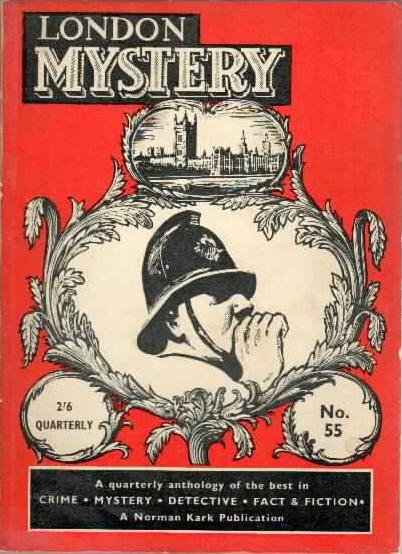
"Crimson Witness," the third episode of The Alfred Hitchcock Hour to be adapted for television by Morton Fine and David Friedkin, is a good example of how to take an unremarkable short story and expand it into an entertaining hour of drama. Nigel Elliston's story of the same title was published in The London Mystery Selection no. 55 [December 1962] and never reprinted.

Ernest Mullet's two successes in life are marrying Judith Harlow and displaying a perfect bloom from his own garden in his lapel each day. When his wife's affections are stolen by his co-worker Roger Farnum, Ernest resolves to kill the man. The Mullets are divorced and things settle down for a few months, but when Roger begins sporting a flower in his buttonhole each morning from a local florist, Ernest's anger and jealousy are rekindled and he sets his mind to murder.

"Crimson Witness"
was first published here
A news report about a bank robbery in which a manager is killed gives Ernest an idea and, after figuring out that Roger has changed the combination on his large office safe to J-U-D-Y, Ernest visits the man one afternoon and kills him with a blow from a lead pipe before hiding his body in the safe. When Farnum's secretary looks into his office before leaving for the day, she thinks that her boss has already departed by the other door when, in reality, Ernest has hidden his body in the safe.

Ernest spends the evening at home with his sister before returning to the office after two a.m. He opens the safe, takes $5000 in cash, and leaves Roger's corpse in full view. A cleaner finds the body just after 6 a.m. and the police question employees as they arrive. Unfortunately, Ernest confirms that Roger had a white gardenia in his buttonhole, while the crimson rose petal found inside the safe matches the flower in Ernest's lapel.

Martha Hyer as Judith Mullett
Just six pages in length, "Crimson Witness" is a brief tale whose success hinges on its twist ending, a conclusion that is set up when writer Nigel Elliston makes the flowers in the main characters' buttonholes affectations that the reader notices, fails to focus on, but recalls at the end. The story's author has no other credits on IMDb or in The FictionMags Index, and a detailed search has only revealed two other possible mentions: the British radio program Morning Story aired a reading of a tale called "Off the Record" by Nigel Elliston on March 7, 1960, and the 2017 obituary of a woman named Olive Elliston, who died in Ipswich Hospital in Southeast England, mentions her late husband, Nigel Elliston. Any other information about the author would be appreciated.

Surely attracted by the twist ending, the producers of The Alfred Hitchcock Hour bought the rights to the story and assigned it to the writing team of Morton Fine and David Friedkin, who expanded it into a highly entertaining television program that aired on Monday, January 4, 1965. Everything works in "Crimson Witness": the dialogue is sparkling, the direction solid, the performances perfect. The music score, by jazz musician Benny Carter, underscores each scene and highlights the absurdity of the situation.

Joanna Moore as Madeline
While the short story is focused on Ernest and the murder of Roger, the TV show takes a different approach and focuses on three beautiful women and their shifting loyalties between the two men. Instead of being co-workers, as they are in Elliston's piece, Ernest and Roger are brothers, even though Peter Lawford, as Ernest, and Roger C. Carmel, as Farnum, look nothing alike. The show begins with Ernest in his large, fancy office, as he checks the walk-in safe that is hidden behind two curtains. When he is done admiring the safe, he turns his attention to his gorgeous secretary, Barbara, who resists his amorous advances in the workplace and instead comments on his habit of embezzlement. Benny Carter's jazzy score serves as a transition between scenes, and the boss, Mr. Baldwin, summons Ernest to his office, only to inform him that he lacks drive and is being reassigned.

Baldwin points out that Ernest wears a different rose in his lapel each day and Baldwin's own beautiful secretary enters, demonstrating that this office is one where women are hired for their looks. The entire episode of "Crimson Witness" is almost like an episode of the much later TV series Mad Men in its depiction of the relations between the sexes in a big-city office in 1965. In any case, Baldwin tells Ernest that he is being replaced as plant manager by his brother Farnum. There is a cut to Ernest's home, where we see Farnum, overweight, balding, and sporting a walrus mustache, contrasted with Ernest, who is suave and handsome. Ernest's wife Judith is nonplussed when Ernest tells her that Farnum is replacing him at work; poor Ernest can't even get the best of his brother physically, as he learns when he tries to throw his long-term house guest out and instead ends up on the floor himself.

Julie London as Barbara
Even worse, Farnum announces that Judy loves him and is leaving Ernie, which she does right then and there. Ernest's life is not all bleak, however, as we see when the scene moves to the apartment of his secretary Barbara, with whom Ernest is carrying on an extra-marital affair. She informs Ernie that Farnum is "'self-centered, cunning, greedy, and calculating'"--and that she finds him "'fascinating, cruel, exciting.'" Like Judy, Barbara is in love with Farnum! Ernest's brother has now stolen his wife, his lover, and his job, and Ernest understandably lashes out, telling Barbara that Farnum has taken up with Judy. Barbara is upset but sighs that she will wait for Farnum to tire of the woman and turn to her.

In his new (smaller) office, Ernest meets his new secretary, Madeline, whom which he shares with five other men. Madeine is beautiful, yet less refined in speech and manner than Barbara. Even she brags about Farnum! Ernest visits his brother in the office that used to be his and Farnum remarks that he now wears a flower in his lapel, though his flower is exotic and must be flown in, unlike Ernest's home-grown variety. Farnum has an annoying habit of quoting great authors, such as Jane Austen and Hegel, and has already discovered that Ernest was "'dipping into the till,'" something he volunteers to cover up. Farnum does not even try to disguise his glee at stealing Ernest's job and wife; in addition to the other negative qualities that make him a success in business and with beautiful women, Farnum is a blackmailer, offering to keep quiet in exchange for his brother's friendship.

Roger C. Carmel as Farnum Mullett
Ernest gets Farnum to open the safe, in a not very subtle attempt to learn the new combination, but Farnum conceals it from view. At home, Ernest prepares the murder weapon, a pipe concealed in a sock, and back at the office Ernest begins to set up his alibi for murder by inviting his new secretary to dinner. He visits Farnum, kills him with a blow to the head, and hides the body and the murder weapon in the safe. Fine and Friedkin pepper the script with repeated references to the safe and the flowers, keeping both in the viewer's mind in preparation for the show's conclusion, while playing out a black comedy of manners and shifting alliances between the two brothers and the three women.

Ernest and Madeline dine out together, allowing him to establish an alibi; she is forward and invites him back to her place for drinks but he declines, instead returning to the office to stage the murder scene for discovery in the morning. When the sun comes up, Ernest is interviewed by two detectives in Farnum's office, where a black outline has replaced the corpse. Now that Farnum is dead, Ernest's unfaithful wife rushes to his arms, begging forgiveness. As Judy, Martha Hyer really pours it on in this scene; she is deadpan and funny, kissing his head and caressing his ear while he speaks to his boss on the phone. It is a credit to Peter Lawford as an actor that he made it through this scene without dissolving into giggles.

Alan Baxter as Baldwin
Madeline catches him kissing his wife and calls him a rat out in the hallway; this is the same term Barbara had used earlier in the episode to describe Farnum. Ernest visits Barbara, who is also suddenly attracted to him once again and, just as he is leaving, the detectives summon Ernest back to Farnum's office, where their discovery of the rose petal in the safe reveals Ernest as the killer. By this time, the mystery has become secondary to the fun of seeing the three beautiful women throw themselves at two undeserving men, making "Crimson Witness" a wry commentary on relationships between the sexes in 1965. Making Ernest and Roger brothers rather than co-workers heightens the irony; the men are physical opposites, yet their natures are similar.

Paul Comi
Peter Lawford (1923-1984) plays Ernest perfectly, never losing his cool and always appearing smooth and refined. Born in London and married to the sister of President John F. Kennedy at the time this show aired in 1965, Lawford was in the middle of a long career on screen that begin in 1931 and ended in 1990. He was in an episode of Alfred Hitchcock Presents way back in 1955 and he later was awarded a star on the Hollywood Walk of Fame. Lawford was a member of the Rat Pack, the group of swinging actors and singers who hung around Frank Sinatra, and appeared in many films.

Judith Mullett, Ernest's unfaithful wife, is played with icy cool by Martha Hyer (1924-2014), who was on screen from 1946 to 1974 and who appeared in one other episode of The Alfred Hitchcock Hour. She published her autobiography in 1990.

Larry Thor
The chatty secretary, Madeline, is played by Joanna Moore (1934-1997). Born Dorothy Joanne Cook, she was on screen from 1956 to 1984 and had a role in Orson Welles's classic film noir, Touch of Evil (1958). She appeared in six episodes of the Hitchcock series, including "Most Likely to Succeed," and was the mother of actress Tatum O'Neal.

Nancy Hseuh
Julie London (1926-2000) plays Barbara, Ernest's first secretary. She was born Nancy Gayle Peck and her parents had a song and dance team in vaudeville. In addition to being a busy actress on screen from 1944 to 1978, London was an accomplished singer who released many record albums. She was a regular on the TV series Emergency from 1972 to 1978 but this was her only appearance on the Hitchcock series.

Giving an entertaining performance as Farnum Mullett is Roger C. Carmel (1932-1986), who seemed to light up the screen whenever he appeared. He was on TV and in film from 1958 to 1986 and played memorable roles on Batman and Star Trek, as well as being a regular on the TV series, The Mothers-In-Law (1967-68). Unfortunately, this was his only appearance on the Hitchcock show.

In smaller roles:
  • Alan Baxter (1908-1976) as Baldwin, Ernest's boss; he served in the Army Air Corps in World War Two and studied at the Group Theatre; he was on screen from 1935-1971 and had a part in Hitchcock's classic, Saboteur (1942). He was also seen on Thriller, The Outer Limits, and in one episode of Alfred Hitchcock Presents, "Backward, Turn Backward."
  • Paul Comi (1932-2016) as the younger of the two detectives who interview Ernest after the murder; he was on screen from 1958-1995, mostly on TV, and appeared on The Twilight Zone, Star Trek, and one episode of Alfred Hitchcock Presents.
  • Larry Thor (1916-1976) as the older detective; he was born in Canada as Arnlelfur Lawrence Thorsteinson and he was known chiefly as a radio broadcaster and announcer, playing roles in film and television from 1952-74.
  • Nancy Hseuh (1941-1980) plays Baldwin's secretary; she was on film briefly as a child from 1945-1947 and then had a career as an adult onscreen from 1960-1978, including a role in Peter Bogdanovich's Targets (1968).
Benny Carter (1907-2003), who composed the score for this episode, was a saxophone player and bandleader who had a long and successful career writing and playing jazz and swing music. He composed scores for TV and film from 1957-1986 and there is a website devoted to him here.

Once again, David Friedkin did not just co-write "Crimson Witness" with Morton Fine; he also directed it, and he does a fine job, keeping the action moving swiftly and handling the humor deftly.

"Crimson Witness" is not yet available on DVD in the U.S. but it may be viewed online for free here.

Sources:
"Crimson Witness." The Alfred Hitchcock Hour, season 10, episode 12, NBC, 4 Jan. 1965.
Elliston, Nigel. "Crimson Witness." The London Mystery Selection, Dec. 1962, pp. 21–26.
Grams, Martin, and Patrik Wikstrom. The Alfred Hitchcock Presents Companion. OTR Pub., 2001.
IMDb, IMDb.com, www.imdb.com/.
"Olive Elliston." Olive ELLISTON - Death - Ipswich Star Announcements - Family Notices 24, www.familynotices24.co.uk/est/view/4289640/olive-elliston.
"Radio Times 1923-2009." BBC News, BBC, genome.ch.bbc.co.uk/schedules/light/1960-03-07.
Wikipedia, Wikimedia Foundation, 19 Apr. 2020, www.wikipedia.org/.

In two weeks: "Thou Still Unravished Bride," starring Ron Randell and David Carradine!