Showing posts with label Victor Wolfson. Show all posts

Thursday, August 11, 2022

The Hitchcock Project-Victor Wolfson Part Four: The Ikon of Elijah [5.16] and Wrapup

by Jack Seabrook

Victor Wolfson's last teleplay for Alfred Hitchcock Presents was "The Ikon of Elijah," which is credited to him and Norah Perez. The episode was based on a short story of the same title by Avram Davidson that was first published in the December 1956 issue of Ellery Queen's Mystery Magazine.

The story begins in Nicosia, the capital of the island of Cyprus, which was a British colony at the time. Mr. Carpius, a dealer in antiquities, arrives home to his shop and greedily asks his assistant, Paul, what was sold while he was away. Complaining about his own failure to purchase an ikon of St. Mamas that had been removed from a chapel by the bishop for safekeeping, Carpius plans to have it stolen or "'to offer to sell it on commission.'" A man named Calloost Chiringirian arrives with an English customer who is looking to buy a farewell present for his superior officer; Chiringirian boasts about having bought the ikon that Carpius had sought and Carpius recalls fondly the unrest in Russia and Asia Minor that had resulted in many treasures from churches and monasteries being bought and sold.

"The Ikon of Elijah"
was first published here
As he is closing up for the night, Carpius receives a visitor, a young monk named Theodoros from the monastery of Saints Barnabas and Basil, with a copy of an ikon to sell. It depicts the prophet Elijah in his fiery chariot. Carpius buys it and, after the monk leaves, asks his cook about the monastery, learning that it houses monks who have not only withdrawn from the world but also have split from the Greek Orthodox Church. Finding information about the original ikon in a reference book, Carpius decides to steal it. He travels by bus to the mountainous region where the small monastery is located and walks alone down the remote road that leads to its door. On arrival, he asks to see the Father Superior.

Carpius flatters the man and pretends to be seeking "'true religion'"; he is welcomed and given food and a bed for the night. Later that night, he sneaks into the cell where the ikon is guarded by a sleeping monk. Carpius reaches for the ikon, intending to switch it for the copy he bought, when the monk awakens and raises the alarm. Surprised, Carpius strikes and kills the monk with his heavy flashlight. The other monks rush to the cell and Carpius explains that the death was an accident. The Father Superior forgives him and, as Carpius turns his back to switch the copy of the ikon for the original, he hears the cell door close and the lock turn. The Father Superior instructs him to "'Pray without ceasing'" and tells Carpius that they will feed him as long as he lives.

Oscar Homolka as Carpius
"The Ikon of Elijah" is a brilliant, haunting story in which a greedy man gets his just desserts, rewarded by the very people he thought he would rob. Carpius is depicted as morally bankrupt, profiting from war and the misery it brings and happy to take religious treasures from the church and sell them to collectors. When he can't buy them legitimately, he will purchase them illegally or steal them.

Carpius is welcomed by the monks in keeping with their tradition of generosity to strangers, yet he intends to take advantage of them. At the end, the Father Superior promises to "'feed you as the ravens fed Elijah,'" and the command to pray for forgiveness seems apt in light of Carpius's crime of murder. He has been given a life sentence and locked in a cell, just as he would have been if he were convicted in civil court.

The Alfred Hitchcock Presents adaptation of "The Ikon of Elijah" aired on January 10, 1960, but it was not the first time that Davidson's story had been adapted for television. A Canadian TV series called The Unforeseen aired an adaptation on October 23, 1958, and IMDb credits the teleplay to Norah Perez, who is also co-credited with writing the teleplay for the version produced for Alfred Hitchcock Presents. I have not been able to find any episodes of The Unforeseen available for viewing, so this one may be lost. It is possible that Victor Wolfson revised Perez's teleplay for Alfred Hitchcock Presents and she was co-credited because she wrote the original teleplay. She is still alive and I have written to her to ask if she recalls this project; I will update this post if she replies.

Sam Jaffe as the Father Superior
The Alfred Hitchcock Presents version of "The Ikon of Elijah" is a powerful episode that differs from the short story in certain ways but is remarkably faithful to Davidson's original text. The show opens in the antique shop, with the camera peering between antiques as Carpius arrives home and his assistant Paul tells him that a monk had been there to sell a copy of an ikon. The initial scene setting in the story has been removed and the central event is introduced right away. Carpius complains about his time away from the store, saying "'How I despise this miserable island! It's a filthy prison cell, but someday I shall break free!'" The teleplay plants the seed of a prison cell in the viewer's mind, but Carpius does not know that his metaphor will soon become reality.

In addition, while the story has Carpius complain about his inability to procure a different ikon on his trip, the teleplay eliminates that potential source of confusion for the viewer and has Paul introduce the ikon of Elijah right at the start. After the initial conversation between Carpius and Paul, the TV version introduces a new scene and a new character in Malvira, a beautiful young woman who appears to be Carpius's wife. In the short story, there are a few references to "old Eleftheria in the kitchen," who seems to be Carpius's cook rather than his spouse. He questions her about the monastery before she totters off to bed. In the TV version, Malvira enters and appears bored; Carpius strokes her cheek and kisses her neck. She serves him food with a cynical demeanor while he expresses excitement over his dinner; he promises her more but she has heard it all before.
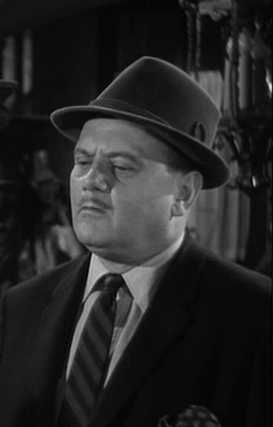
A.E. Gould-Porter as
Major Parslow
After adding a pretty woman to the story and suggesting a motive for Carpius's later acts in his desire to please her and keep her by his side, the teleplay returns to the scene in the story where Chiringirian brings Major Parslow to the shop to select a gift. A large, Christian statute is displayed prominently in the store, foreshadowing the later scenes in the monastery and, instead of Chiringirian boasting to Carpius that he bought the ikon Carpius had set out to purchase on his recent trip, Chiringirian takes Carpius aside and asks if he has found an item for another client, who wants a genuine ikon and who is not particular about its provenance. This gives Carpius another reason to want to pilfer the ikon from the monastery; now, both his wife and his business associate demand more from him. Chiringirian's approach also demonstrates that Carpius is not alone in his willingness to pilfer religious treasures for profit.

In the story, even though Carpius agrees to Chiringirian's reduced price when he sells an item to the major, it is revealed that he still made a "four hundred per cent profit," while in the show, it seems likely that the two colleagues are secretly working together to take advantage of the representative of the country's colonizers. Malvira returns for another scene that is not in the story, as she tells Carpius she is leaving him. At first, he flatters her and counsels patience, but when she is not swayed he reminds her that she owes everything to him since he took her out of the marketplace and brought her into his home. He threatens to kill her and they both laugh, suggesting that this exchange has occurred many times before.

Richard Longman as
Chiringirian
As in the story, Carpius is about to close up shop for the night when Theodoros the monk arrives with the ikon copy. The exchange between the two men follows that of the story closely and it is Theodoros who tells Carpius the history of the monastery; in the story, Carpius questions Eleftheria after the monk departs. In the TV version, Carpius rushes in to tell Malvira about the ikon, planning to travel to the monastery and return with the treasured item that Chiringirian has asked him to procure.

The first half of "The Ikon of Elijah" is set in the secular world of Carpius's antique shop, where he is in charge and makes deals with both his customers and his wife to maintain his lifestyle. He sees religious ikons as simply more items to profit from and he is willing to do whatever it takes to get them. The second half of the TV show is set in the sacred world, and the story's description of Carpius's trip from his home to the monastery is deleted. Instead, the scene fades in on a shot of mountains, then dissolves to a shot of the exterior of the stone monastery, and finally dissolves to a shot of Carpius knocking on its wooden front door. In three wordless shots, all of the information the viewer needs to know is provided.

David Janti as Paul
Carpius is admitted by Brother Constantine, a monk who has taken a vow of silence, and when Carpius meets and speaks with the Father Superior, his words carry the same false piety that they do in the short story. In the TV version, Carpius successfully petitions the old monk to let him see the original ikon before retiring to his cell; he is taken to a downstairs room where he looks through a small window in a door and sees a monk praying before the ikon, which is displayed on a wall. Entering the room, Carpius sees that Brother Damianos guards the treasured object and the Father Superior tells the antique dealer that it is "'An honor not lightly earned--Brother Damianos would give his life for it.'" This turns out to be more foreshadowing of later events since the monk will later be killed while trying to guard the ikon.

The expression on Carpius's face as he regards the ikon is one of naked greed. Hours pass and, at midnight, we see Carpius sitting alone in his cell, eating, when a bell tolls the hour. He takes a cloth and a bottle of ether from his bag, along with the copy of the ikon and a heavy flashlight. Carpius removes his shoes and exits his cell, but he does not see a monk observe him, though we witness it in shadow. This moment of near discovery is not in the short story, but in the TV version, Brother Constantine follows Carpius and they struggle in silhouette. Constantine takes the flashlight and Carpius insists he is just walking about because he couldn't sleep. He returns to his cell. This scene succeeds in increasing the suspense of the situation and it is followed by a similar one, where Carpius again sits in his cell and a bell tolls two a.m.

William Green as Brother Theodoros
Sneaking out once again, he sees Brother Constantine asleep in his cell and approaches the room where the ikon is kept. He peers in and sees brother Damianos asleep, then creeps in silently and switches the copy for the original. Carpius suddenly stumbles and awakens the monk; the antique dealer grabs a heavy candlestick and bludgeons him with it. The candlestick replaces the flashlight as the murder weapon and symbolizes Carpius's willingness to turn a sacred item into a secular weapon. The final moments of the concluding scene follow those in the story closely, with one exception: in the story, Carpius turns to switch the copy of the ikon for the original, while in the TV version he turns and kneels down to pray for forgiveness before the copy on the wall.

"'As long as you live, this will be your world,'" says the Father Superior, and the show ends with a shot of Carpius staring out of the small window in the locked door as the Father Superior walks away and the screen fades to black. The expression on the antique dealer's face is one of puzzlement--what is happening to him? He seems amazed at the suddenness of his fate and how things have turned against him. Minutes ago, he was a successful businessman who was confident in his ability to steal a religious treasure and get away undetected. Now he is a prisoner for life, his fate dealt to him by the very monks whose piety he inwardly mocked. The sense of divine retribution is delicious!

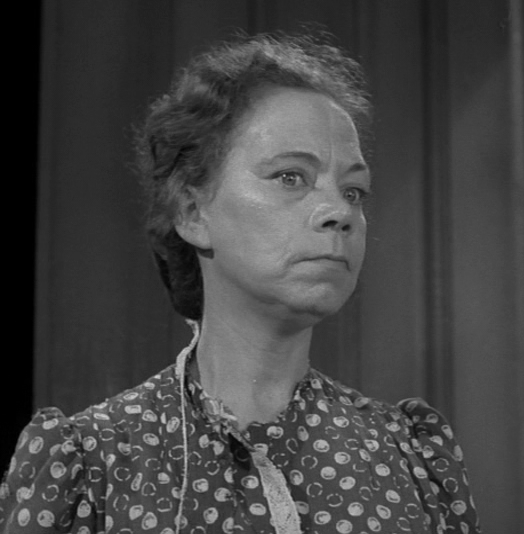
Danielle de Metz as Malvira
The adaptation of "The Ikon of Elijah" for Alfred Hitchcock Presents is outstanding, keeping all of the important elements of the short story while adding new emphases that help to tell the story in a visual medium. Oscar Homolka gives an excellent performance as Carpius and is totally believable as the grasping, greedy character whose motivations in the TV version seem a bit more complex than they do in the short story. Perez and Wolfson's teleplay succeeds in making the ending both unexpected and inevitable, and Paul Almond's direction contrasts the more brightly lighted secular world of the first half with the shadowy confines of the monastery in the second half. The honest behavior of the monks is contrasted with the dishonest behavior of Carpius, and each of their acts generates different results.

Avram Davidson (1923-1993), who wrote the short story, was born in Yonkers, New York, and served in the Navy in World War Two in the Far East. He went on to fight in the Israeli Army in the 1948 War of Independence. His first short story was published circa 1947 and, from 1954 until his death, he wrote over 200 short stories and at least 15 novels. He was prolific in science fiction and detective fiction and ghost-wrote two novels featuring Ellery Queen. He won a Hugo Award in 1958, an Edgar Award in 1962, and World Fantasy Awards in 1976 and 1979. He also edited The Magazine of Fantasy and Science Fiction from 1962 to 1964. There is a website about him here. One other episode of the Hitchcock TV series was based on a short story by Davidson: "Thou Still Unravished Bride," on The Alfred Hitchcock Hour. An article about Davidson states that he visited Cyprus in 1952 and subsequently used it as the setting for "The Ikon of Elijah."

Robert Richards as
Brother Constantine
Norah Perez (1933- ) is a Canadian author whose first credit was as an actress in a 1948 film written and directed by her father, Leslie MacFarlane, who wrote the first 21 books in the Hardy Boys mystery series under the pseudonym of Franklin W. Dixon. Perez co-wrote an episode of a TV show with her father in 1954 and is credited with writing the teleplays for three episodes of The Unforeseen, a Canadian suspense TV series that ran from 1958 to 1960. She seems to have stopped writing for TV and focused on writing novels for young adults, and she has published at least eight of them since 1968. Perez is still alive at age 89 and living in upstate New York, near the Canadian border; her most recent novel was published last year.

The director of "The Ikon of Elijah," Paul Almond (1931-2015), was also Canadian. He wrote for TV from 1955 to 1966 and for film from 1968 to 1992; he directed for TV from 1955 to 1979 and for film from 1962 to 1992. He also worked on the Canadian TV series On Camera and The Unforeseen, as did Norah Perez, and it's possible that he directed the 1958 TV version of "The Ikon of Elijah," whose director is uncredited in available sources. It is possible that the producer of Alfred Hitchcock Presents was aware of the earlier adaptation and used Perez's teleplay and that version's director to craft a new version. Like Perez, Almond was also a novelist.

Fred Catania as
Brother Damianos
Starring as Carpius is the great actor Oscar Homolka (1898-1978). Born in Vienna, Homolka served in the Austro-Hungarian Army in WWI and began his career on the Austrian stage before leaving Germany when Hitler came to power. He was on screen from 1926 to 1976 and his films included Hitchcock's Sabotage (1936), Ball of Fire (1941), and I Remember Mama (1948). He was on TV from 1951 to 1976 and he was seen on Thriller and in three episodes of Alfred Hitchcock Presents, including "The Hero."

Sam Jaffe (1891-1984) plays the Father Superior; born Shalom Jaffe, he was on screen from 1934 to 1984 and appeared in films including The Asphalt Jungle (1950) and The Day the Earth Stood Still (1951) and TV shows such as Batman and Night Gallery. He was in one other episode of Alfred Hitchcock Presents: "The Greatest Monster of Them All."

In smaller roles:
  • A.E. Gould-Porter (1905-1987) as Major Parslow; a British character actor, he was onscreen from 1942 to 1977 and appeared in Assault on a Queen (1963), Hitchcock's Torn Curtain (1966), and ten episodes of Alfred Hitchcock Presents, including "Back for Christmas" and "The Glass Eye."
  • Richard Longman (1914-2002) as Chiringirian; he was also born in England and appeared on screen from 1947 to 1978.
  • David Janti (1941- ) as Paul, Carpius's assistant; he was born in Iran and had a brief career, mostly on TV, from 1959 to 1964.
  • William Green (1893-1962) as Brother Theodoros; he was onscreen from 1945 to 1961.
  • Danielle de Metz (1938- ) as Malvira; born in Paris, her screen career lasted from 1959 to 1972 and included a role in Return of the Fly (1959) and an appearance on Thriller.
  • Robert Richards as Brother Constantine; he was on TV from 1955 to 1961 and appeared in a few films.
  • Fred Catania (1909-1978) as Brother Damianos; he was born in Sicily and played small parts on screen from 1952 to 1968.
Truly an international production, "The Ikon of Elijah" had a crew from the U.S. and Canada and a cast from Austria, England, Iran, France, Sicily, and the U.S.A.! read "The Ikon of Elijah" online here or watch the TV version online here. Buy the DVD here. Read the GenreSnaps take on this episode here.

Sources:

"Alfred Hitchcock Presents - 'the Ikon of Elijah' (1960)." Alfred Hitchcock Presents - "The Ikon of Elijah" (1960), 30 Oct. 2021, http://www.honeyandhemlock.com/2021/10/alfred-hitchcock-presents-ikon-of.html.

Davidson, Avram. "The Ikon of Elijah." The Investigations of Avram Davidson, St. Martin's Press, New York, NY, 1999, pp. 55–70.

The FICTIONMAGS Index, http://www.philsp.com/homeville/FMI/0start.htm.

Fox, Margalit. "Paul Almond, Who Directed First 'Seven Up!,' Dies at 83." The New York Times, 14 Apr. 2015.

Grams, Martin, and Patrik Wikstrom. The Alfred Hitchcock Presents Companion. OTR Pub., 2001.

"The Ikon of Elijah." Alfred Hitchcock Presents, season 5, episode 16, CBS, 10 Jan. 1960.

IMDb.com. IMDb, https://www.imdb.com/.

Lupoff, Richard A. "My Friend, This Stranger.”"The Investigations of Avram Davidson, pp. 1–12.

Stephensen-Payne, Phil. Galactic Central, http://philsp.com/.

Wikipedia, Wikimedia Foundation, www.wikipedia.org/.

*  *  *  *  *

Victor Wolfson on Alfred Hitchcock Presents: An Overview and Episode Guide

Victor Wolfson wrote or co-wrote six episodes of Alfred Hitchcock Presents that aired between 1956 and 1960, two each in the first, second, and fifth seasons.

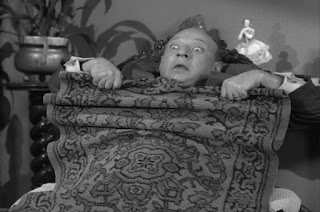
In season one, "The Perfect Murder" is a superb adaptation of a classic crime story. The teleplay mixes humor and horror and turns narrative into dialogue, following the source closely and making it more entertaining. Wolfson next adapted Stanley Ellin's "The Orderly World of Mr. Appleby" with Robert C. Dennis and the teleplay streamlines the story's plot and makes the central character more a victim of circumstance than a Bluebeard.

For season two, the source for "Toby" is unavailable, so it is not possible to determine how Wolfson altered it, but the episode is flawed and features an unlikely twist ending. More successful is "Malice Domestic," based on another classic crime story, where events are compressed and structure is strengthened in order to improve the effect of the ending.

Finally, Wolfson was involved with two classic episodes in season five. "Specialty of the House," which he co-wrote with Bernard C. Shoenfeld, makes important changes to a famous short story, toning down religious themes in a classic, unforgettable half-hour. "The Ikon of Elijah," Wolfson's final teleplay to be broadcast, is based on another classic short story. Again, he focuses on making improvements to story structure and this time religious themes are central. This episode is an outstanding example of how to translate words on a page into a visual medium.

                                                            *  *  *  *  *

EPISODE GUIDE-VICTOR WOLFSON ON ALFRED HITCHCOCK PRESENTS

Episode title-"The Perfect Murder" [1.24]

Broadcast date-11 March 1956
Teleplay by-Victor Wolfson
Based on "The Perfect Murder" by Stacey Aumonier
First print appearance-The Strand Magazine, October 1926
Notes
Watch episode-here
Available on DVD?-yes
"The Perfect Murder"

Episode title-"The Orderly World of Mr. Appleby" [1.29]
Broadcast date-15 April 1956
Teleplay by-Victor Wolfson and Robert C. Dennis
Based on "The Orderly World of Mr. Appleby" by Stanley Ellin
First print appearance-Ellery Queen's Mystery Magazine, May 1950
Notes
Watch episode-here
Available on DVD?-yes

"The Orderly World of Mr. Appleby"

Episode title-"Toby" [2.6]
Broadcast date-4 November 1956
Teleplay by-Victor Wolfson
Based on an unpublished (?) story by Joseph Bates Smith
First print appearance-unknown
Notes
Watch episode-here
Available on DVD?-yes

"Toby"

Episode title-"Malice Domestic" [2.20]
Broadcast date-10 February 1957
Teleplay by-Victor Wolfson
Based on "Malice Domestic" by Philip MacDonald
First print appearance-Ellery Queen's Mystery Magazine, October 1946
Notes
Watch episode-here
Available on DVD?-yes
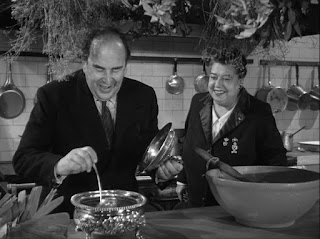
"Malice Domestic"

Episode title-"Specialty of the House" [5.12]
Broadcast date-13 December 1959
Teleplay by-Victor Wolfson and Bernard C. Shoenfeld
Based on "The Specialty of the House" by Stanley Ellin
First print appearance-Ellery Queen's Mystery Magazine, May 1948
Notes
Watch episode-here
Available on DVD?-yes

"Specialty of the House"

Episode title-"The Ikon of Elijah" [5.16]
Broadcast date-10 January 1960
Teleplay by-Victor Wolfson and Norah Perez
Based on "The Ikon of Elijah" by Avram Davidson
First print appearance-Ellery Queen's Mystery Magazine, December 1956
Notes
Watch episode-here
Available on DVD?-yes

"The Ikon of Elijah"

Listen to Al Sjoerdsma discuss "Toby" here!

Listen to Annie and Kathryn discuss "The Ikon of Elijah" here!

In two weeks: Our coverage of Kathleen Hite begins with "Disappearing Trick," starring Robert Horton!

Thursday, July 28, 2022

The Hitchcock Project-Victor Wolfson Part Three: Malice Domestic [2.20]

by Jack Seabrook

Philip MacDonald's short story, "Malice Domestic," was first published in the October 1946 issue of Ellery Queen's Mystery Magazine. The story begins as a writer named Carl Borden stops into a bar for a drink before meeting his wife Annette, who has been shopping. Among her purchases are The Rose-Grower's Handbook and a carton labeled "Killweed." They drive home and are met by G.B., a Giant Schnauser named after George Bernard Shaw. In the kitchen, Carl and Annette express feelings of unease regarding each other's recent behavior.

Carl spends the afternoon writing and, after dinner, takes the dog for a walk, but he begins to feel sick and is tended to by Parry, a neighbor. Dr. Wingate asks what Carl has been eating and takes him home. Ten days later, Carl has another attack of stomach cramps, convulsions, and vomiting. Dr. Wingate is summoned again and Carl feels better the next day, though the doctor insists on doing some tests before Carl has any more to eat. At the doctor's office, Carl learns that his sickness was caused by a large dose of arsenic. Angry at Dr. Wingate, Carl rejects any suggestion that Annette is responsible.

"Malice Domestic" was
first published here
At home, his wife serves him soup, which he reluctantly consumes. A week of good health follows, until Carl returns home one night after walking the dog to find Annette collapsed on the floor. He calls Dr. Wingate, who rushes over, but Carl's wife is dead. The doctor finds two coffee cups, one of which contains traces of arsenic, and concludes that Annette was overconfident, got distracted, and drank from the wrong cup. Wingate gives Carl a sedative and promises to keep the matter quiet. Three weeks later, Carl is heading to meet another woman in another city and remarks to his dog, "'I nearly took too much that second time!'"

The story is set in El Morro Beach, California, and Carl is said to be a writer "of some merit, mediocre sales, and--at least among the wordier critics--considerable reputation." His creativity with murder is outstanding and demonstrates a capacity for creating a fictional situation in real life. There is a suggestion of marital problems right at the start of the story, as Carl looks around "to see if his wife were in view" before ducking into a bar. Strangers see him and Annette as an ideal couple, but intimates are "vaguely unsure." This sense of unease creates doubt in the reader's mind about the couple's happiness.

Ralph Meeker as Carl Borden
The first hint of poison comes when Carl picks up Killweed that his wife had purchased; this is a distraction by the author, who tries to make the reader think Annette is the guilty party. Carl appears to be dissatisfied with his work, admitting to a friend that his book is "'tough sledding.'" Weeds poke through the gravel of Carl's driveway, symbolizing the problems in his marriage and justifying the purchase of weed killer. Even Carl's dog is unfriendly toward Annette but friendly toward Carl. Annette's dinners are said to be works of art, suggesting that the poisoning is not accidental, and Carl's first attack is attributed to nerves. Ten days pass between attacks and the fact that the second one is nearly fatal makes it seem unlikely to have been self-inflicted.

When Dr. Wingate suggests that Annette may have tried to poison her husband, Carl's anger and seeming devotion to his wife make him appear to be a loving husband, who refuses to think the worst of his spouse. Back at home, he reluctantly drinks the soup she offers him, suggesting that his love for her is greater than his fear of death. It is not surprising that Dr. Wingate blames Annette for her own demise, since Carl has plotted the story of her guilt so intricately in the preceding weeks. The surprise ending occurs in San Francisco, as Carl admits the truth to his dog--man's best friend and a companion certain not to repeat the secret.

Phyllis Thaxter as Annette Borden
"Malice Domestic" is a well-written short story that manipulates the reader from start to finish. The author, Philip MacDonald, was born in London around 1900 (sources vary on the date) and served in the British cavalry in WWI. He wrote mystery novels, including The List of Adrian Messenger (1960), short stories from 1930 to 1973, and screenplays from 1930 to 1954. He worked on adapting Rebecca from novel to screen for Hitchcock and wrote teleplays from 1955 to 1961, but he did not write any for Alfred Hitchcock Presents and this is his only story to be adapted for that show. One of his stories was later adapted for Thriller, a series for which he also wrote one teleplay. He died in 1980 and his papers are archived at the Online Archive of California.

Victor Wolfson adapted "Malice Domestic" for Alfred Hitchcock Presents, and the show aired on CBS on Sunday, February 10, 1957. Wolfson's teleplay makes several important changes to the story and serves as the basis for a satisfying and successful episode. The first scene of the short story is replaced by a scene at a fancy-dress dinner party, where Carl and Annette say goodbye to Lorna, a pretty young woman who is moving to San Francisco and leaving her dog with the Bordens. In the next scene, the dog shows a preference for Carl, as it does in the short story, but now the dog is a new arrival in the house. Since the first scene of the story has been deleted, there is no reference to weed killer or to Annette's gardening hobby. Instead, Annette is portrayed as an artist who has a home studio in which she makes clay pots.

Vinton Hayworth as Dr. Wingate
In subsequent scenes, Carl's poisoning episodes do not happen while he is out walking the dog, but rather at home, when he and Annette are having dinner with Perry, who is now a guest instead of a neighbor. Perry invites Annette to lunch and they eat together at a restaurant, suggesting to the viewer that they might be having an affair, something that is not in the short story. Carl does not go to Dr. Wingate's office; the doctor makes house calls. At one point, Lorna is again brought up when Annette mentions that she spoke with her by phone and plans to visit her in San Francisco. This helps keep Lorna in the viewer's mind, though her character does not appear (at least, not by name) in the short story.

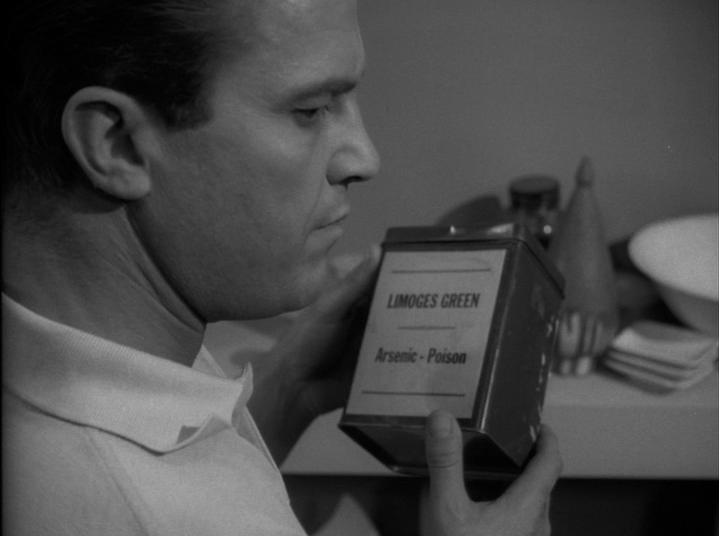
The first time arsenic is mentioned is when Dr. Wingate suggests that Annette poisoned Carl's food, as in the story. In the TV show, the arsenic comes from a different source; Carl compliments Annette on a vase that she has made, commenting on its translucent green color. Annette admits that she uses a copper glaze and, after she walks out of the room, Carl sees that the glaze contains arsenic. Annette's hobby still provides an excuse for using the poison, but in the TV version she is an artist rather than a gardener. Annette's collapse also happens differently in the TV version. In the story, Carl returns from walking the dog to find her dead on the floor. In the TV show, they are getting ready to go on a much-needed vacation. Carl takes bags and sports equipment out to the car and comes back inside the house to find Annette on the floor.

Ralph Clanton as Perry
The biggest change from story to show occurs in the final scene. In the story, Carl is talking to his dog as he drives to meet a woman in San Francisco. In the TV version, this conversation begins with a tight close up on Carl's face before the camera pulls back to show him sitting in the front seat of his car with the dog in the middle and Lorna in the passenger seat. This time, Carl announces that he almost took too much poison and Lorna hears him and understands what he means. Having introduced her in the show's first scene and reminded viewers of her midway through, her participation in the last scene puts a different cast on some of the events of the story and introduces a level of complicity to her character. In retrospect, one may assume that the dog responded to Carl because it already knew him from time he had spent with Lorna. In adapting MacDonald's story for the small screen, Victor Wolfson made improvements, compressing the time of certain events and creating a parallel structure that makes for a more satisfying twist ending.

"Malice Domestic" was one of three episodes of Alfred Hitchcock Presents directed by John Meredyth Lucas (1919-2002), a writer and director who worked mostly in television from the early 1950s to the early 1980s. He also directed episodes of Star Trek and Night Gallery. He grew up in the movie business and wrote a memoir called Eighty Years in Hollywood; his stepfather was film director Michael Curtiz.

Lili Kardell as Lorna
Ralph Meeker (1920-1988) stars as Carl; he was born Ralph Rathgeber and served in the Navy in WWII. He started on Broadway after the war in 1946 and was on screen for thirty years, from 1950 to 1980, appearing both in film and on TV. Key roles include Kiss Me Deadly and Paths of Glory (1957), as well as the TV movie, The Night Stalker (1972). He appeared on The Outer Limits and in four episodes of Alfred Hitchcock Presents, including "Revenge."

Phyllis Thaxter (1919-2012) co-stars as Annette. She was a fine actress who deserves more attention than she has received. Born in Maine, Thaxter started out on Broadway in 1939 and made her first film in 1944, with her first TV appearance coming in 1953. Among her nine appearances on the Hitchcock show are "The Five-Forty Eight," in which she also plays a mentally unstable woman, and "The Long Silence," where she lies in bed, unable to speak and in great danger. She also appeared on The Twilight Zone and Thriller and she played Ma Kent in Superman (1978). She continued to appear on TV until 1992.

In smaller roles:
  • Vinton Hayworth (1906-1970) as Dr. Wingate; he started on radio in the 1920s, moved into movies in the 1930s, and then began a long TV career in the 1940s. He was the president of AFTRA from 1951 to 1954 and the uncle of both Rita Hayworth and Ginger Rogers. He was a regular on I Dream of Jeannie from 1968 to 1970 and may be seen in four episodes of Alfred Hitchcock Presents, including "Night of the Execution."
  • Ralph Clanton (1914-2002) as Perry; his screen career lasted from 1949 to 1983 and included seven episodes of Alfred Hitchcock Presents (including "Dip in the Pool") and three episodes of Thriller.
  • Lili Kardell (1936-1987) as Lorna; she was born in Stockholm and appeared on TV from 1956 to 1983. She was also in two films. She dated both James Dean and Troy Donahue.


Watch "Malice Domestic" online here or buy the DVD here.

Sources:

The FICTIONMAGS Index, http://www.philsp.com/homeville/FMI/0start.htm.

Galactic Central, http://philsp.com/. 

Grams, Martin, and Patrik Wikstrom. The Alfred Hitchcock Presents Companion. OTR Pub., 2001. 

IMDb, IMDb.com, https://www.imdb.com/.

MacDonald, Philip. "Malice Domestic." Fifty Best Mysteries. Ed. Eleanor Sullivan. NY: Carroll & Graf, 1991. 73-87.

"Malice Domestic." Alfred Hitchcock Presents, season 2, episode 20, CBS, 10 Feb. 1957. 

Wikipedia, Wikimedia Foundation, https://en.wikipedia.org. 


In two weeks: Our series on Victor Wolfson concludes with a look at "The Ikon of Elijah," starring Oscar Homolka and Sam Jaffe!

Listen to Al Sjoerdsma discuss Alfred Hitchcock Presents here!

Listen to Annie and Kathryn discuss "A Night with the Boys" here!

Thursday, July 14, 2022

The Hitchcock Project-Victor Wolfson Part Two: Toby [2.6]

 by Jack Seabrook

Around the year 1890, a poor young man in the upstate New York city of Canandaigua fell in love with a wealthy young woman, who returned his affections. He went away to college hoping to become a lawyer but ran out of money and ended up moving to New York City, where he became a bookkeeper in a department store. Certain that his lack of money and social position would prevent his former love from agreeing to marry him, he never returned home and lost contact with the young woman.

To his surprise and delight, twenty years after leaving Canandaigua, the man, now living in an apartment in lower Manhattan in 1910, sees an ad in a newspaper's personal column from the young woman, who is looking for him. He responds and she travels from upstate New York to New York City, where he has arranged for her to rent the basement apartment in the same building where he lives, intending that they will soon marry and share a flat.

Jessica Tandy as Edwina Freel
This is the background of "Toby," an episode of Alfred Hitchcock Presents adapted by Victor Wolfson from a story by Joseph Bates Smith. The show aired on CBS on Sunday, November 4, 1956, and the year in which it is set, 1910, is revealed by Alfred Hitchcock in the show's introduction, but not specified at any point during the story that follows. The show opens with a scene that depicts the landlady, Mrs. Foster, getting the apartment ready for the arrival of the man's old flame. She is assisted by Mrs. McGurk, another tenant, and they are soon joined by the lovestruck Albert Birch, who remains young at heart but who is now a bit heavy around the middle and balding on top.

As Birch reveals details of his past with Edwina Freel, the object of his affection, to the two women, the sounds of a horse clip-clopping by in the street outside are heard, along with a cat meowing, a sound that seems innocuous at the time but which turns out to foreshadow the story's shocking conclusion. Birch brings roses and the vase that Mrs. Foster offers to hold them is chipped, a detail that will later become evident as a symbol of Edwina's fragile mind. Even worse, Mrs. Foster drops the vase and a handle breaks off, which Albert sees as a bad sign--and how right he is.

Robert H. Harris as Albert Birch
There is a cut to the front stoop and sidewalk outside the building, where people seek relief from the summer heat in the days before air conditioning kept city residents inside. Children play on the sidewalk and a woman stands beside a baby carriage, another example of foreshadowing. Soon, a well-dressed woman wearing a hat approaches the front stoop and the camera only shows her from behind. Her clothes and bearing are contrasted with those of the other women who live in the building. Birch is inside the basement apartment, still arranging flowers, when the woman knocks on the door; his eyes light up when he sees her for the first time in two decades, but to his surprise she holds a baby wrapped in a checkered blanket.

Edwina puts the baby in a bedroom and tells Albert that she keeps his face and head covered because he is just getting over scarlet fever; the baby, whose name is Toby, must remain in the dark for several weeks, according to Edwina. Albert is at first taken aback, thinking that the baby is hers, but she quickly explains that it was the child of her sister, who was killed with her husband when a train hit their carriage. Edwina became Toby's guardian after the death of his parents and Albert is puzzled when she will not let him feed the baby or even see its face.

George Mathews as Matt McGurk
The tension between the two former lovers is reflected in the weather outside, as thunder rumbles and threatens to bring rain that will break the punishing heat. Three weeks have passed and Edwina's behavior toward her neighbors has become a source of speculation; Matt McGurk, the boorish husband of Marie, who was helping to set up Edwina's apartment in the show's first scene, bullies the new tenant, blocking her way and demanding to see the baby. Thunder continues to rumble, symbolizing trouble approaching for the characters. Inside Edwina's apartment, her relationship with Albert is tense since he is anxious to know when they will be wed. The two characters have an emotional exchange as thunder continues to rumble outside, an external manifestation of their inner feelings for each other. Edwina assures him that they will be married soon and suggests dinner and a walk along the Battery to watch the ferry boats crossing the harbor.

Albert leaves her apartment and the McGurks enter; when Matt insists that there is no baby and makes a move toward the bedroom, Edwina picks up a knife in a threatening manner. Just in time, Albert enters and lies that he has seen Toby. The McGurks leave and the thunder continues. Edwina opens the apartment's front door and a baby is heard crying outside, emphasizing the eerie silence that comes from Toby's bedroom. Edwina begs for rain as the baby wails in the distance and the thunder rolls. Albert looks at her strangely, unhappy that she encouraged him to lie and wondering why the reality of the return of his lost love after twenty years is not matching his imagination.

Mary Wickes as Mrs. Foster
Edwina turns on Albert, expressing anger that he left her years before. She says that she never got over him and she blames him for depriving her of her dream of having a family. Edwina calls it a miracle that Toby was given to her and, in another symbolic gesture that foreshadows the show's conclusion, Albert gives her an artificial rose and remarks that "'it's not real, but it certainly looks real, doesn't it?'" He may only be referring to the flower, but his comment applies to so much about Edwina, Toby, and the woman's relationship with her former lover.

Albert kisses Edwina's cheek and her demeanor immediately changes. She forbids him to touch her and says she can't trust him, turning suddenly from loving to cruel and threatening to leave. Just then, she remarks that "'the gentlemen have arrived.'" A man in a bowler hat and an attendant in a white coat stand in the hallway and Edwina does not resist them; in fact, she seems relieved to see them. Ben, the man in the hat, tells Albert that Edwina has been in the county asylum for many years and likes it there. They were surprised that she wanted to escape, especially when the roses were blooming outside. Through the bedroom door, Edwina is seen saying goodbye to Toby. She then tells Albert goodbye, tenderly, and tells him that she is leaving Toby in his care. She kisses his cheek, no longer afraid of a display of affection, and leaves with the men.

Ellen Corby as Marie McGurk
Albert, in tears, gathers himself and enters Toby's bedroom, where he sees a black cat lying on the bed. Around his neck is a tag that reads, "Toby." Albert's eyes widen in surprise before he collapses in tears.

"Toby" is well-directed by Robert Stevens, who creates a sense of unease and impending doom in a story that is confined to only a couple of sets: the interior of Edwina's apartment and the sidewalk and front stoop outside the building. The most effective technique is the use of sound, with a cat meowing, a baby crying, and thunder rumbling on the soundtrack representing the episode's big surprise and the interior turmoil of the characters. When Edwina first arrives on the scene, Stevens's camera follows her from behind, delaying the viewer's impression of her face and the bundle that she carries until Albert opens the door and sees her for the first time.

Penny Santon as Mrs. Swartz
Yet the episode's central conceit, that of the baby actually being a cat, fails to stand up to examination. It seems unlikely that a cat would remain quiet and still while wrapped in a blanket, as Toby does when Edwina first arrives. Even worse, no cat would remain quiet in a bedroom for three weeks! Perhaps a more effective conclusion would have been to find a doll in Toby's place, as in "The Lonely Hours." Still, Jessica Tandy (as Edwina) and Robert H. Harris (as Albert) give it their all and are convincing as the doomed lovers.

The credits for "Toby" say that it is based on a story by Joseph Bates Smith, but an exhaustive search has revealed no such story. Smith does not appear to have published any short stories or novels, so the story was likely unpublished or else a lost radio or TV show. Born in 1907 in Sandusky, Ohio, Smith attended the University of Michigan and moved to New York City in 1932, where he had success acting in Broadway plays and, later, writing them. He served in WWII and, in the 1940s, wrote comic books (including The Shadow) and radio plays, including episodes of Death Valley Days, Young Dr. Christian, and The Shadow. More often credited as Joe Bates Smith, he also wrote for television, starting in 1949, including episodes of Kraft Theatre, a pilot for Mandrake the Magician, and episodes of a series called Modern Romances. "Toby" is his final credit and he died in Sandusky in 1968.

One possibility is that "Toby" is adapted from the soap opera Modern Romances, which ran from November 1954 to June 1958. Joe Bates Smith is credited as writer on several of the week-long serials (five 15-minute episodes per week completing each story), but I have not been able to identify any one as a source for "Toby."

Director Robert Stevens (1920-1989) worked in television from 1948 to 1987 and directed 44 episodes of Alfred Hitchcock Presents and five episodes of The Alfred Hitchcock Hour. He won an Emmy for "The Glass Eye." He also directed 105 episodes of Suspense in the early 1950s.

James Nolan as Ben
Jessica Tandy (1909-1994), who plays Edwina, was born in London and began acting on the stage in 1927; her screen career lasted from 1932 to 1994. She emigrated to the United States in 1940 and played many roles on Old Time Radio. She won Tony Awards for her performances in A Streetcar Named Desire (1948), The Gin Game (1978), and Foxfire (1983), an Emmy for the TV version of Foxfire (1987), and an Oscar for her late-career role in Driving Miss Daisy (1989). She appeared in Hitchcock's The Birds (1963) and in two other episodes of Alfred Hitchcock Presents, including "The Glass Eye."

The great character actor Robert H. Harris (1911-1981), who was born Robert Hurwitz, plays Albert Birch. He began in Yiddish Theater and moved on to roles on Broadway before embarking on a screen career that lasted from 1948 to 1978. His special brand of creepiness can be seen in nine episodes of the Hitchcock show, including "The Dangerous People," and he was also on Thriller.

In smaller roles:
  • George Mathews (1911-1984) as Matt McGurk; his career began with the WPA Theatre during the depression. He started in movies in 1943 and on TV in 1949 and worked into the early 1970s. He was in The Man With the Golden Arm (1955) and two episodes of Alfred Hitchcock Presents, including "The Big Switch," but he will best be remembered as Harvey, the pool hall bully in the episode of The Honeymooners called "The Bensonhurst Bomber." Mathews was born--where else?--in Brooklyn.
  • Mary Wickes (1910-1995) as Mrs. Foster, the landlady; born Mary Wickenhauser, she had a long career on big and small screens from 1934 to 1995. She was also in many Broadway shows, mainly from 1936 to 1948. She was a regular on Father Dowling Mysteries (1989-1991) and she appeared on The Night Stalker. This was one of her two appearances on Alfred Hitchcock Presents; the other was "The Baby Sitter."
  • Ellen Corby (1911-1999) as Marie McGurk; born Ellen Hansen, she started out as a script girl in Hollywood and played many uncredited roles on film from 1928 until she got her first screen credit in 1948. Her career continued until 1997 and included appearances on Thriller, Batman, The Odd Couple, and Night Gallery. She was in Hitchcock's Vertigo (1958) and she was featured in five episodes of the Hitchcock TV show, including "Party Line." She is best remembered for her role as Grandma Walton on The Waltons (1972-1980), for which she won three Emmy Awards.
  • Penny Santon (1916-1999) as Mrs. Swartz, the woman on the sidewalk with the Italian accent and the baby carriage. Born Pierina Burlando in New York City, she played countless roles on TV from 1952 to 1998 and appeared in movies as well. She had a bit part in Hitchcock's The Wrong Man (1956).
  • James Nolan (1915-1985) as Ben, the man wearing a bowler hat who comes from the asylum for Edwina; he was on film from 1937 to 1982 and on TV from 1950 to 1982. He also appeared on The Twilight Zone and on one other episode of Alfred Hitchcock Presents, "Number Twenty-Two."
Watch "Toby" online here or buy the DVD here.

Thanks to Ron Davidson, Special Collections Librarian at the library in Sandusky, Ohio, for information about Joseph Bates Smith.

Sources:

The FICTIONMAGS Index, http://www.philsp.com/homeville/FMI/0start.htm. 

Grams, Martin, and Patrik Wikstrom. The Alfred Hitchcock Presents Companion. OTR Pub., 2001. 

IMDb, IMDb.com, https://www.imdb.com/. 

"Joe Bates Smith Writes Songs for All-Soldier Show." Sandusky Register Star News, 5 June 1943, p. 2. 

"Joseph Bates Smith (1907-1968) - Find a Grave..." Find a Grave, https://www.findagrave.com/memorial/150954052/joseph-bates-smith. 

"Local Author-Actor Joe Bates Smith Dies." 14 Mar. 1968. 

Sandusky Register Star News, 24 Nov. 1947, p. 86. 

"Toby." Alfred Hitchcock Presents, season 2, episode 6, CBS, 4 Nov. 1956. 

Wikipedia, Wikimedia Foundation, https://en.wikipedia.org. 


In two weeks: "Malice Domestic," starring Ralph Meeker and Phyllis Thaxter!

Listen to Al Sjoerdsma discuss Alfred Hitchcock Presents here!

Listen to Annie and Kathryn discuss "The Legacy" here!