Showing posts with label E-Man. Show all posts

Sunday, October 9, 2011

E-Man Part Ten--The Witch of Hog Wallow

by Jack Seabrook

The tenth and final issue of E-Man features another painted cover by Joe Staton, a sixteen-page E-Man Story, and a seven-page Rog-2000 story.

In "The Witch of Hog Wallow," we learn for the first time that E-Man spent some time on our planet before he first met Nova Kane.  Nova comes home and finds a note tacked to his mailbox from a woman named Maisy-June, promising to visit at noon.  Jealous, Nova demands an explanation and E-Man tells her how he met Maisy-June.

When he arrived on Earth, he took the form of a fawn, copying the shape of one of the first creatures he saw.  He lived among forest animals until seeing a beautiful blond country girl walk by.  He transformed himself into a handsome prince from a fairy tale book she carried, and his demonstration of his own limitless powers led her to call him her genie.


The local hicks saw her in the woods "conjurin' up all sorts of things," and decided she must be a witch.  E-Man protected her by transforming into a super hero like the ones he'd seen in her comic books.  When the locals captured Maisy-June and tied her to a stake for burning, E-Man scared them away by transforming into the Devil.  Maisy-June was not sane, though, and E-Man had to use his powers to convince her that the local asylum was actually his castle, where she would live happily ever after.


Today, she has been cured and is on her way to visit an old friend.  Nova hates her on sight because of her beauty, but quickly warms to her once she meets Maisy-June's husband.  The story ends on a happy and humorous note.

The final E-Man story of the 1970s series is a good one, demonstrating that the title had really run its course by issue #8 and had nowhere else to go once Nova had died and been reborn as an energy being.  The story in issue #10 is a flashback, which avoids having to figure out how to handle Nova's new powers and any corresponding change in her relationship with E-Man.  Cuti and Staton comment wryly on the super-hero genre, as E-Man initially transforms himself into a costumed hero with a cape until he trips over the cape and dispenses with it.

The rural setting is also an opportunity for E-Man's creators to quote from Al Capp's L'il Abner comics; Maisy-June is a takeoff on Daisy Mae, and a small sign in one panel reads "Capp's Little Acre," a nod to Capp and also to the popular 1933 novel, God's Little Acre, by Erskine Caldwell.  In one panel, a sign tacked to a tree features a caricature of Al Capp and the slogan, "Capp for Dawg Catcher."  In another, a comic book on the ground features Capp's satirical detective, Fearless Fosdick.  Finally, the last panel reveals Maisy-June's husband to be none other than L'il Abner himself, here renamed Dabney Slocum.

The backup story in this issue again features the wisecracking, cab-driving robot, Rog-2000.  A living garbage heap named The Sog threatens New York City as it consumes garbage and citizens at random.  The city is evacuated and Rog is deputized to help the Army; The Sog is finally defeated by its own desires, when it dies from overeating--as Rog comments, "there was too much garbage in New York even for The Sog---!"

"Rog 2000 vs The Sog" is a short, entertaining story that spoofs the creatures like Man-Thing and Swamp Thing that were popular in the mid-1970s after the Comics Code had relaxed its rules and monsters returned after having been absent since the early 1950s purge.

Unfortunately, the letters page of E-Man #10 includes a note to the readers from the editor stating that this is the last issue of E-Man.  Poor sales are given as the reason for the cancellation, though I suspect this had more to do with Charlton's spotty distribution and the general glut of comics on the market.  E-Man's adventures were promised to continue in Charlton Bullseye, though only one short tale was subsequently printed in that fanzine.

E-Man remains one of my favorite comics of the 1970s.  Nicola Cuti and Joe Staton created memorable characters, from the humorous and heroic E-Man to the sexy and smart Nova Kane.  The supporting cast was good, as well, including seedy private eye Michael Mauser, and villains The Brain and Samuel Boar.  While the backup stories were forgettable during the first several issues of the series' run, once Cuti and John Byrne introduced Rog-2000, those short tales were also worth reading.

Cuti would leave Charlton soon after E-Man ended in 1975.  Joe Staton moved on the DC, where he became a popular artist on several titles.  John Byrne went on to fame with Marvel drawing X-Men and other hero books.  They all served their time at Charlton, the low-paying publisher in Derby, Connecticut, where Steve Ditko toiled on and off for decades, a company that never quite broke through to the top tier of comics but which, nevertheless, was responsible for many memorable books.

Saturday, October 1, 2011

E-Man Part Nine--The Genius Plant

by Jack Seabrook

After attending a softball game where E-Man played first base (the actual bag, not the position), Nova visits Professor Wright in order to conduct an interview for the Xanadu Gazette.  Wright has an enormous cranium and an elongated forehead, and he tells Nova that he needs a supply of genius plants to stay brilliant.  Before Nova's eyes his head shrinks and his intelligence shrinks along with it.

A flying robot bursts through a window and kills the professor; Nova dispatches the robot and transforms into her superhero garb.  After meeting up with E-Man, they visit Michael Mauser, who is working on a case he calls Highbrow.  Professor Wright was only one of several prominent men whose large foreheads coincide with their genius.  General Dove tells them that all of the men belong to an organization that plans to take over the world from its base on an island.  E-Man and Nova agree to investigate.

Energy being or not, Nova
always looks great!

Part two finds E-Man and Nova reaching the island in the form of dolphins and then birds.  Captured and brought to see Genius One, they learn that he had been a scientist who discovered a new species of plant with the late Professor Wright.  The two men ate the plants and became geniuses, with elongated foreheads and massive brains.  Genius One plans to conquer the Earth and make it a paradise.

 E-Man and Nova enter the island's computer and cause it to destroy the genius plants; the army follows and attacks the island.  Deprived of brain food, Genius One's head shrinks back to sub-normal size, making him a moron and ending the threat.

After the excitement of E-Man #8, which featured Nova's death and rebirth as an energy being and which was the first full-length E-Man story, "The Genius Plant" is a disappointment.  The first page is a rehash of the duo's origin stories.  The rest of the story doesn't make much sense.  Now that Nova is no longer human, it seems like she should not need to go to college anymore, yet she is suddenly interviewing a scientist for the school newspaper.  The menace of the genius plants is never very clearly explained, and E-Man and Nova have little trouble defeating them.  The story is, unfortunately, a series of cliches strung together.

Teddy is now a regular character
in E-Man, having accompanied
E-Man and Nova back home from
the North Pole in issue #8.
 Although I was disappointed that the E-Man story was not full-length, at least the second story features Rog-2000, the wisecracking robot.  This is his third appearance and, as always, Nicola Cuti writes and John Byrne draws.  In "The Wish," Rog breaks up a mugging and is rewarded by the victim, who turns out to be a witch.  Without his knowledge, she turns him into a human being!  Rog as a human is funny, looking like a flesh and blood version of his robot self, and he also happens to resemble someone named "Duck" Griffin.  There is a contract out on Duck, so the unsuspecting Rog becomes the target of murderous gangsters.  Only a chance encounter with the old witch on the subway allows him to turn back into a robot, just in time to bash the bad guys.

"The Wish" is another entertaining Rog-2000 story, highlighted by the very 1970s hip human version of the robot protagonist.  As usual, John Byrne's art is cartoonish and fun, making a nice complement to Joe Staton's similarly lighthearted approach in the E-Man tales.

Rog as a human, with shaggy mop
and bell bottoms.

This ad appeared in E-Man #9 for
Charlton Bullseye, a very good fanzine!

Saturday, September 24, 2011

E-Man Part Eight--In the Inner Sun

by Jack Seabrook

When two cops on the beat respond to a call reporting a disturbance at the old Boar Electronics Company building, they are surprised to discover an eight foot tall blond Amazon, who escapes by crashing through a window.  Meanwhile, Michael Mauser is teaching E-Man how to play poker when Nova arrives, followed closely behind by the Amazon, who collapses on the floor of Mauser's office.

On awakening, she murmurs something about needing to return to the North Pole and an evil man named Boar.  E-Man travels by short wave radio waves to the North Pole, where he meets an Australian named Alfie Alcott and his pet Koala, Teddy.  They are soon joined by Samuel Boar and The Battery.

In part two, Boar explains that he has made improvements to The Battery; E-Man's attempt to fight the machine ends quickly with our hero being absorbed into The Battery's glass cell.  Boar and the Battery journey across the frozen wasteland to a deep pit, which Boar says is the entrance the the center of the Earth. They travel down and come to Nuclia, a Lost World populated by dinosaurs and an Indian-like race of extra-large people.  The blond Amazon is their chief's daughter, and Boar plans to hold her hostage on the Earth's surface while he steals power from the small sun that lights their landscape.  E-Man takes advantage of a dinosaur attack to escape by turning into a small, orange dinosaur himself.


Part three opens with Nova, Mauser and the Amazon in Mauser's office.  On the street outside, Nova is chased by fake FBI agents straight into the waiting arms of Alfie, who transports her to Nuclia, where she is lashed between two pillars near the small sun.  Boar tells her that she will die unless E-Man agrees to help him steal the sun's power.  E-Man arrives to rescue Nova but the sun erupts---and Nova is killed.


E-Man grieves over her death and vows revenge on Boar, but Nova returns quickly--this time as pure energy, just like her partner!  She assumes her human form, but this time she wears a costume similar to that of E-Man.  Together, the two energy beings destroy the battery and defeat Boar once again. As the story ends they kiss, setting off an atomic blast.


E-Man #8 features another painted cover by Joe Staton, and it is the first time that an E-Man story has been full-length (23 pages).  The death and rebirth of Nova are surprising, since they occur without any warning.  Through the first seven issues of the series, we had grown used to E-Man saving the day, and it is a shock when he fails.  It is even more of a shock to see the character of Nova transformed into an energy being with the same powers as E-Man!


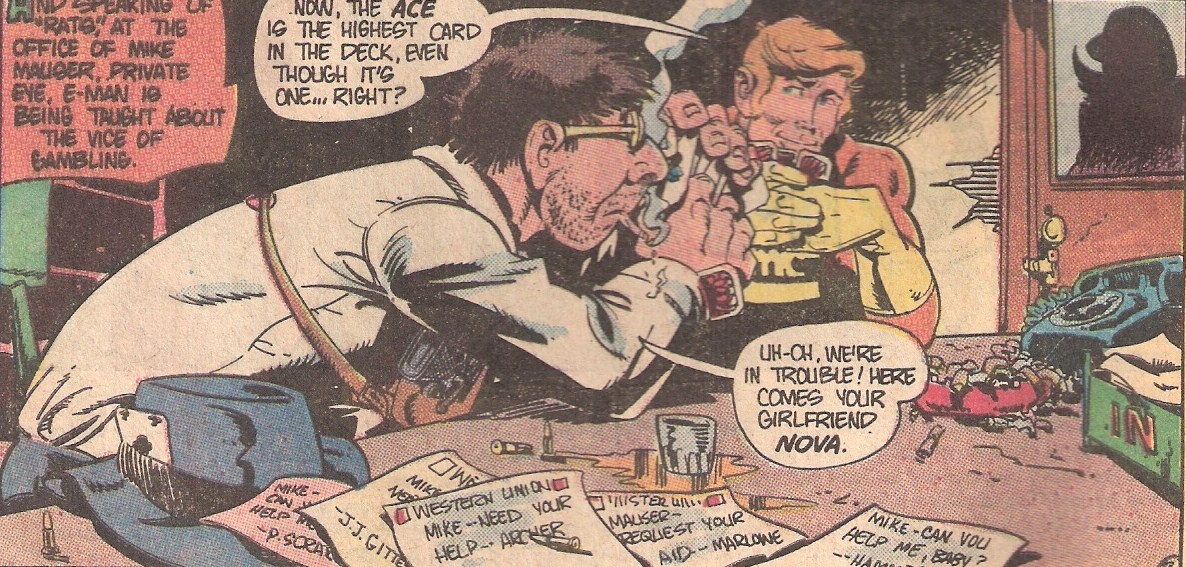
Staton's playfulness really goes wild in this issue.  On page one, Plastic Man is seen hitchhiking at the side of the road.  A newspaper headline reads, "Capt. Atom Promoted."  On page two, Michael Mauser's desk is strewn with telegrams from various private eyes requesting his aid--"Mike, can you help me, baby" writes Mike Hammer; "Mauser-request your aid" writes Philip Marlowe, etc.  A boy who operates a ham radio and helps transport E-Man to the North Pole has a poster on his door featuring The Blue Beetle, and so on.

The return of Boar and The Battery is welcome, as they make a particularly evil and dangerous team.  Cuti and Staton really go all out in this story, moving from the gritty, grimy streets of New York and the slovenly interior of Mauser's office, to the frozen landscape of the North Pole, to the lush, dinosaur-populated lost world of Nuclia.  The characters are so busy that Nova doesn't even have time to dance, though she does look stunning in the costume she creates for herself.

I remember this as a really cool booklet!
"In the Inner Sun" is the beginning of the end for the 1970s E-Man series.  No longer is Nova a college student working as an exotic dancer; now, she joins E-Man as a bonafide superhero.  The Teddy character is introduced, and Mauser becomes a more regular character.  Finally, the story is full-length, eliminating the need for a second story.  E-Man's last two appearances in his original run would continue to develop all of these new ideas.

This all seemed so innocent in those
days before Rocky Horror!

Sunday, September 18, 2011

E-Man Part Seven--TV Man

by Jack Seabrook

The seventh issue of E-Man features the first of Joe Staton's painted covers!

Inside, the story begins as Nova ends another night working as an exotic dancer.  "You are doomed to die, Ms. Kane--Yours Truly, Jack the Ripper" reads a message scrawled on the back of a poster in her dressing room.  The words ring true minutes later, when E-Man transforms into Mr. Hyde as they walk through a dark alley, his hand a gleaming meat cleaver!


Not Jack the Ripper, but Mr. Hyde
E-Man changes back to his familiar form just in time to receive a sock to the jaw from his frightened and angry companion.  A hooded figure on a nearby rooftop changes channels on a strange gun and E-Man transforms into The Brain Eater From Planet X!  The hooded villain retires to a lonely basement apartment to make a telephone call that gives a clue to his identity.


Xanadu University!
Part two of the story is called "The Duel."  It begins with the return of Michael Mauser, the seedy private detective last seen in E-Man #3.  The hooded villain threatens Mauser at gunpoint, seeking information about the location of E-Man, who has not been seen for almost a week.  Nova is busy studying at her university (Xanadu!) when she is approached by Juno, the female member of the Entropy Twins, last seen in E-Man #2.  She explains that her lover Michael is behind E-Man's strange transformations; he has invented a microwave gun that uses TV signals to make E-Man change into whatever character is on TV at the time.

The next day, E-Man and Mauser appear at New York's Rockefeller Plaza for a showdown with the bitter twin.  E-Man is suddenly transformed into Konga and, with Nova as his Ann Darrow, he re-enacts the conclusion of King Kong.  All ends well, however, when Michael relents at Juno's urging, and the story ends with E-Man promising to reunite the separated lovers.


"TV Man" has something for everyone!  We get a glimpse of Nova's act, followed by a reference to a classic episode of Thriller that must have been airing on New York's WOR-TV as Nova and E-Man walked home.  It matters little that our hero is involuntarily transformed into Mr. Hyde rather than Jack the Ripper--the visuals are effective and the idea is the same.  "The Brain Eater From Planet X" is not a real movie, but it allows Joe Staton to draw another full-page monster, as he did in "City in the Sand" (E-Man #4).  Things never get too serious in E-Man, however: the monster has E-Man's "E=mc2" emblem displayed prominently on its forehead!

E-Man comics usually
include jokes like this
in one or more panels.
The return of Michael Mauser and the Entropy Twins is welcome, adding to the increasingly complex mythology that Cuti and Staton had begun to develop in the first six issues of the series.  Konga, from the movie of the same name, allows E-Man to play another classic scene, again with his emblem on his hairy chest.

Finally, E-Man's promise to cure the problem he had created previously for Juno and Michael resolves one of the few inconsistent actions taken by our hero in the series to date.

This month's letters column includes a letter by Bob Rodi of Oak Brook, Ill., who was featured regularly in 1970s letters columns of DC and Marvel titles.  He calls Alec Tronn and Nova Kane "the most wonderful comix couple in existence."

To boldly go . . .
The second story in E-Man #7 is also the second in a row to feature the wisecracking robot, Rog-2000.  He drives a purple Volkswagen Beetle with the license plate "NCC-1701," and in "Withering Heights" he runs out of gas and spends the night at a haunted hotel.  The young woman behind the reception desk looks remarkably like the robot in last issue's tale, but this time she is the daughter of a very hungry transparent monster that oozes out of a closet to devour its victims.

John Byrne's girls
all look the same--
at least so far!
E-Man #7 is a great comic, mixing horror, humor, science fiction, detective fiction, and satire into a very satisfying melange.

No post would be complete without Nova!

Saturday, September 10, 2011

E-Man Part Six--Wunderworld

by Jack Seabrook

E-Man and Nova visit Florida's Wunderworld, a thinly-disguised Disneyworld, where Nova wins a beauty contest, defeating a bevy of lovelies that includes her friend Rosie, last seen in E-Man #3.  Our heroes are given a tour of the park by its owner, William Wunder, who turns out to be a robot controlled by the Brain From Sirius (last seen in E-Man #2).


In part two, E-Man and Nova investigate a mysterious swamp shanty in Fearland, one of the sections of the park, only to find that it is the home of the Toyman and his young daughter, Annie.  E-Man deduces that the Brain must have created the William Wunder robot, and he sets out in search of his old nemesis.

Dexter Duck is scaring me . . .
E-Man battles a war machine sent by the Brain, followed by a group of frightening toys.  Meanwhile, the Brain sends a monster to capture Nova; the monster kills Annie, breaking the Toyman's heart (even though Annie is revealed to have been a robot herself).

The orange war machine is E-Man.
The Brain tells Nova of his plan to convert the entire United States into an amusement park, a plan that is foiled when the Toyman throws an orange wrench and shatters the Brain's protective dome.

The story is capped when Nova's friend Rosie is revealed to be the Toyman's long-lost daughter, and E-Man explains that the orange wrench was yet another of his unusual disguises.

"Wunderworld" is another outstanding story from Cuti and Staton.  E-Man is now so well known that a young woman at Wunderworld recognizes him out of costume and knows his history.  The usual humor is present, as E-Man mistakenly attends a beauty contest for children while looking for Nova.  Joe Staton's talent for drawing beautiful women is on display with the adult beauty contest and the dressing room scene that follows it.


Wunderworld is both funny and scary in its satire of Disneyworld, and the return of the Brain is welcome.  Staton moves seamlessly from science fiction, in the scene where E-Man battles the Brain's war machine, to classic horror, in the scene where the Brain sends monsters to attack our hero.  In the story, the monsters are variations on a vampire, a werewolf, and Donald Duck.  The duck on the cover, however, reminds me of Howard the Duck, who was not yet at the height of his popularity when E-Man #6 was published in late 1974.

For the first time, the second story in an E-Man comic is worth reading, as this issue features the premiere adventure of the wisecracking robot, Rog-2000!  "That Was No Lady" is written by Nicola Cuti and drawn by John Byrne.  It features in jokes for comic fans, as well as the same sort of satire found in Cuti's E-Man tales.

Rog-2000, a very modern robot, enters a bar with a beautiful young woman on his arm, and proceeds to tell Duffy the bartender about how he and the woman met.  Rog drives a taxi, and one night he picked up a mysterious man, who turned out to be a hero/villain named Magno.  Magno used a powerful ray gun to destroy slums in the Bowery.

Rog and Syntac
Rog travels to Canada and confronts Burns, his creator, who shows him Syntac, a robot in the form of a beautiful young woman.  Rog and Syntac return to New York, and she quickly uses a Cyclops-like eye beam to disarm Magno.  She and Rog walk off arm in arm, and Rog tells Duffy that they will just be good friends "so long as she can do that."

Rog visits Burns, his Canadian creator.
Among the in jokes for 1974 comic fans is bartender Duffy, based on the late fan-turned-Marvel-inker Duffy Vohland.  Rog's creator, the Canadian Burns, is artist John Byrne, another fan-turned-pro (and the artist of this story).  This was Byrne's first color comic story--he would take over Marvel's X-Men less than three years later.  And, in a nod to Joe Staton's little touches in the E-Man stories, one of Byrne's panels features an ominous newspaper with a headline that reads, "Staton Dies!  Famed cartoonist eaten by frogs."

Rog and Duffy
E-Man #6 has a cover date of January 1975, which means it followed the bi-monthly schedule for only the second time in the series' run to date.  The letters column in this issue features a well-written article reprinted from "The New York Review of Comics and Books," in which Steve Stern argues that E-Man is the comic of the year.

I would really like to know
more about this!

Sunday, September 4, 2011

E-Man Part Five--The City Swallower

by Jack Seabrook
A day at the beach for E-Man and Nova gives Joe Staton the opportunity to place our favorite heroine in a skimpy green bikini!
But all is not well at Coney Island.  E-Man spots a mysterious blonde emerge from the ocean waves and he follows her under the sea, quickly passing into another dimension, where cities are menaced by a Norwol, depicted by Joe Staton in a full page of horror!
These shades are very 1974!
E-Man turns himself into a harpoon, but his attempt to spear the behemoth is thwarted by its thick hide.  Meeting up with Heidi (the blonde, in very 1970s sunglasses) and her boyfriend Peter, E-Man learns of Peter's plan to defeat the Norwol.  His idea involves joining cities together in order to succeed through cooperation, but this is quickly voted down by the oligarchs who tell him that they don't possess the necessary raw materials.  Meanwhile, Heidi is out air-skiing, unconcerned with the Norwol, which soon bears down on her with a lean and hungry look.

E-Man battles the beast without success, until he decides to imitate Jonah and attack the problem from the inside.  Battling off antibodies, he destroys the beast's heart with an energy beam and saves the city.

Returning to our world through the portal beneath the waves, he receives a parting kiss of thanks from Heidi, which leads to an angry confrontation with Nova, demonstrating a streak of jealousy that hints at her feelings for E-Man.

The fifth issue of E-Man shows Joe Staton's art continuing to improve, with ever more Gil Kane influence apparent.  In this series of articles, I have focused mostly on Staton's work, but the scripts by Nicola Cuti are excellent as well.  The series succeeds in mixing humor, science fiction, and suspense, and the characters are always engaging.  Cuti's importance would become even more clear in retrospect when he was replaced by Martin Pasko for the initial issues of E-Man's run in the 1980s with First Comics.

I have a hard time
accepting that anyone
in 1974 looked like this!
Once again, the eight-page backup story is a Steve Ditko disaster:  "Liberty Belle in Freedom's Star."  This story seems dated even for 1974 and Ditko's art strongly suggests that this story was pulled from the file cabinet of 1960s rejects, or that Ditko was unaware of what people in 1974 actually looked like.

On the splash page, Liberty Belle remarks, "You talk too much Commie... like most of your breed!"  Yet the story's heroine becomes the first woman launched into space, ready to work on "Skylab III."

What had looked so fresh and exciting ten years before now looks dated and awkward.  Compared to the rushed, early 1960s Marvel work of Kirby and Ayers, Ditko's art was exciting.  By 1974, comics had matured, and artists like Neal Adams, Jim Steranko, Frank Brunner and Gene Colan had raised readers' expectations to a level where Ditko's work--at least in his three E-Man backup stories--seemed like a relic from comics' childhood.

Notes:  My copy of E-Man #5 does not include a British price on the cover, unlike the past two issues.  The "bi-monthly" publication schedule also continues to be haphazard; this issue has a cover date of November 1974, three months after that of the prior issue.

Tuesday, August 30, 2011

E-Man Part Four--City in the Sand

by Jack Seabrook

E-Man and Nova are in Egypt!  Nova knocks 'em dead at a dance club, but her real purpose is to get a map to a lost city.  Mr. Bogni gives her the map at the cost of his life; E-Man appears as the god Ra and stuns the killers with a power bolt.

E-Man and Nova follow the map and find the lost city.  Once inside, they discover futuristic machines built five thousand years ago!  The city's central tower is a time machine, and our heroes travel back to 3000 B.C., where they find an Egyptian city ruled by fear.

Ramis, the dethroned ruler of Naab (the ancient city), explains that his people came from another star to escape oppression.  On Earth, they experienced a plague and blamed Ramis.  E-Man and Nova darken their own skin in order to pass as Naabians.

E-Man discovers that the plague that has haunted the Naabians is carried by fleas on pets given to the children by the evil Faro.  He warns the people, and Ramis regains control after Faro becomes infected by the very plague he had set upon his fellow Naabians.

Nova is going far afield to earn money for college!


I see a Gil Kane influence here.
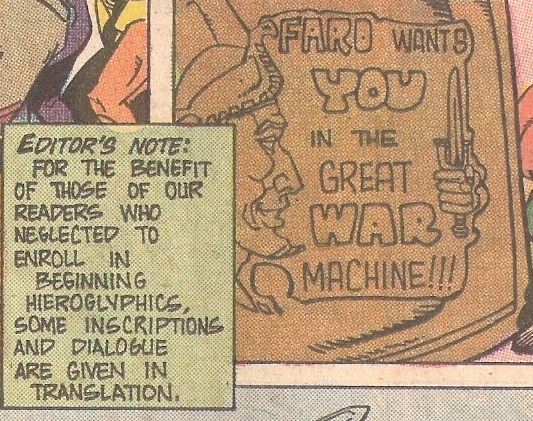
"City in the Sand" is a sixteen-page story with much to recommend it.  The splash page is a treat, as it is the first time we have actually gotten a glimpse of one of Nova's performances.  The humorous touches continue, with signs all over the lost city urging Naabians to join the "Great War Machine."


Joe Staton's art is excellent, as usual, and has a hint of Gil Kane in some of the facial angles.  Nova never looked better.  Near the end of the story, at Faro's palace, she is bathed and dressed in a skintight black costume, which only serves to accentuate her superb figure.


Staton must have loved drawing Nova!
The letter column is replaced this issue by a full-page letter reprinted from "Fantastic Science Fiction and Fantasy Stories."  This letter is addressed to science fiction fans, and it talks about E-Man, praising its satire of science fiction tropes.

The backup story is another Killjoy tale by Steve Ditko.  Much like the prior one in E-Man 2, this is an almost incomprehensible mess in which Ditko criticizes liberal ideas of how to deal with criminals.  The art is not bad, but the storytelling is terrible and so many panels are clogged with dialogue balloons that the artwork is overwhelmed.

A typical Killjoy panel.


This issue has a cover date of August 1974.  While the indicia says it was published bimonthly, the first four issues have been dated October 1973, December 1973, June 1974 and August 1974.  Issues one and two were 20 cents; the price went up to 25 cents with issue three.  Oddly enough, issues three and four also feature a cover price of "UK 6p," perhaps anticipating big sales in England.  Subscriptions were $1.20 a year at 20 cents a copy, then $1.25 a year at 25 cents a copy.  I recall ordering a subscription directly from Charlton because these comics were so hard to find on the newsstand.

E-Man or Plastic Man?

One more thing to note about this issue is the influence of the Ancient Astronaut craze that hit in 1968 when Erich von Daniken's Chariots of the Gods was published.  This idea had a significant influence on Marvel comics mythology and here it pops up in E-Man as well.  One of the fun things about reading the E-Man series is to see what was on peoples' minds in the 1970s.