The EC Reign Month by Month 1950-1956
34: May, 1953
 |
| Kurtzman |
"Superduperman!" ★★ 1/2
Story by Harvey Kurtzman
Art by Wally Wood
"Flob was a Slob!" ★★ 1/2
Story by Harvey Kurtzman
Art by Jack Davis
"Robin Hood!" ★★
Story by Harvey Kurtzman
Art by John Severin
"Shadow!" ★★★ 1/2
Story by Harvey Kurtzman
Art by Bill Elder
Genuine twerp Clark Bent might clean out spittoons and vie for the frosty affections of “girl reporter” Lois Pain during working hours at the Daily Dirt, but when trouble arises in the fair city of Cosmopolis Clark stumbles his way into the nearest telephone booth to transform into the mighty “Superduperman”! The big boy in blue runs up against his match in strength when the previously goody-two-shoes Captain Marbles decides to use his mountain-punching powers for personal gain instead of saving kittens from trees. Thankfully our brave Superduperman is able to cunningly trick Captain Marbles into punching himself in the face, but even when in the guise of a hunky hero Clark finds out that Lois thinks he’s still nothing but a creep!
 |
| The lawyers at DC and Fawcett were out to lunch. ("Superduperman!") |
Ramona Snarfle is one of those young all-American virgins caught in a romantic whirlwind of trouble the likes of which you would normally see in bad comic books (hmmm…): she can’t seem to choose between the simpleton charms of her butterfly-chasing childhood sweetheart Sheldon Flob or the devilish advances of bronze-skinned Rackstraw Him. After settling on Rackstraw, Ramona is pushed away by his rakish ways—which includes robbing banks and selling reefer to schoolchildren (!)—and runs towards the open arms of Sheldon… only to dump the slob for a more lucrative life of drug peddling to minor.
Like Peter, I didn’t even realize “Fob was a Slob” was the work of Jack Davis at all. I thought surely this was Harvey’s penmanship; the character of Sheldon in particular seems like something we’d see from him. Again, this is a story that’s more miss than hit, but you really have to hand it to those morally-corrupt degenerates at EC for having the cajones to end their romance tale with the sweet-faced heroine transforming into a snarling drug dealer offering joints to children. Easily gets a half star just for that!
 |
| The Senate Subcommittee was out to lunch. ("Flob was a Slob!") |
Big John and Sparkie are two pals in Merry Olde England bemoaning their penniless states when they suddenly hit on the idea to seek out that great bastion of the impoverished, “Robin Hood”! The bloke steals from the rich and gives the booty to the poor… Big John and Sparkie are poor… and, well, as Einstein would say, “You do the math!” The bums run into Robin Hood in short order and tell him and his Merry Men about a caravan of well-to-do snobs that just passed through, which they verily loot and pick clean. When our heroic bums bemoan that they only have two cents to their name, Robin and Co. verily loot and pick them clean before going back for the shirt on their backs.
 |
| Fredric Wertham was out to lunch. ("Robin Hood!") |
Margo Pain, female companion of the mysterious Shadow (short for Lamont Shadowskeedeeboomboom), walks into a regular den of iniquity fit to bursting with gruesome thugs and hoodlums and starts yapping about her tight relationship with the invisible avenger. Shadow makes his (dis)appearance and a bloody shootout ensues with every evil-doer biting the dust and Margo getting a kick in the rear for her indiscretion. Things turn decidedly more serious when attempts on Margo’s life begin to occur, covering everything from falling pianos to exploding apples! Responding to a note sent on a messenger dagger, Margo and Shad journey to the outhouse at the end of the street where our brave heroine waits on a seat of dynamite while the invisible avenger checks outside for any evil-doers. But in actuality what he does is ignite the fuse to the TNT and blows Margo sky-high, effectively ensuring that his secret identity remains a secret!
Out from the muck of Mad’s fourth issue comes this genuine classic, a rib-tickling good time from start to finish that’s furnished with Bill Elder’s indelible, zany art and more background gags than you can shake a contaminated chicken leg from the Cafeteria Bacteria at. When I look at Bill Elder’s work in this series, I always end up saying to myself that *this* is what a Mad story should look like, and what so many of the other artists seemed to be striving to do but could never pull off. You get the impression that dreaming up all this kooky and inane stuff came as easy as breathing to Elder. I could sit here and bullet point every joke that I found funny in “Shadow”, but I would only end up quoting the entire story. So go on and read it for yourself, ya creep! --Jose
 |
| Margo Pain has just lost her lunch. ("Shadow!") |
Jack: I think the cover is classic Kurtzman and "Superduperman" is classic early Mad as well. The panels are incredibly busy with gags and Wood's art is superb, though we're getting used to that, aren't we? His Lois Pain is a force to be reckoned with and the epic battle between Superduperman and Captain Marbles is especially funny in light of the 1951 resolution of the 12-year court battle between DC and Fawcett. I don't think I ever read "Flob Was a Slob! before and, while Davis's gals can't hold a candle to Wood's, the story is funny and surprising, especially the conclusion. "Robin Hood!" did nothing for me at all, but "Shadow!" has always been one of my favorites. Will Elder was born to draw Mad stories!
 |
| Feldstein |
"Piecemeal" ★★★
Story by Bill Gaines and Al Feldstein
Art by Jack Kamen
"The Assault!" ★★★ 1/2
Story by Bill Gaines and Al Feldstein
Art by Wally Wood
"The Arrival" ★★ 1/2
Story by Bill Gaines and Al Feldstein
Art by Al Williamson, Frank Frazetta, and Roy Krenkel
"Seep No More!" ★★★★
Story by Bill Gaines and Al Feldstein
Art by George Evans
Why is Eric staggering around at night next to a swimming pool, his left arm torn off at the shoulder? It all began when he visited his older brother, Sidney, and Sidney's beautiful young wife, Sally. Sidney spent much of his time tending to his collection of rare fish, so there were plenty of opportunities for Eric to hit it off with Sally, who liked to give her husband sleeping pills at night so that he would not interfere with her late-night swims with Eric. Soon enough, Sally plans to murder her husband with an overdose and have Eric all to herself. What neither of them reckoned with was Sidney's latest rare fish purchase: a man-eating shark in the swimming pool. As Sidney lays dying in his bed from too many pills, Sally is eaten by the shark and Eric loses his arm trying to save her.
 |
| Submitted without comment. ("Piecemeal") |
Lucy Cartwright has been missing for 36 hours and her parents are getting frantic. Suddenly, she returns and reports "The Assault!" She was victimized by an old recluse named Hodges. The men of the town get a posse together, pay a visit to the old man, and beat him to death. That afternoon, a handsome fellow named George shows up at the Cartwright house and takes Lucy for a walk in the woods to have a chat. It seems George met Lucy months ago at a juke joint and began a torrid affair. She was with George when she went missing but, when he proposed marriage, she laughed at him and went home, making up the story about Old Hodges, who was like a father to George. When George threatens to tell the cops, Lucy reminds him that she's 17 and he'd be confessing to statutory rape, so he rids the world of the shameless hussy by putting six bullets in her face.
 |
| George, you old smoothie! ("The Assault!) |
Martians have been watching Earth for a long time, seeing civilization wiped out by atomic war and waiting for it to be revived. When a spaceship takes off from the third planet, the denizens of Mars prepare themselves for "The Arrival." As the ship draws closer, communication is established and the Earth creatures tell the story of civilization's rise and fall. When the ship lands and the door opens, the Martians greet the only survivors of the atomic war--rats!
What a trio of artists! The GCD suggests that Williamson did most of the work, with some help by Frazetta and Krenkel, but the pictures are beautiful. The story is run-of-the-mill 1950s science fiction, the author certain that the crisis then was the one that would wipe out mankind. I did get a kick out of the ending, though.
 |
| Looks more like a squirrel! ("The Arrival") |
The best story in a strong issue, "Seep No More" recalls Poe and even Ray Bradbury's "The Fruit at the Bottom of the Bowl" in its depiction of how guilt can overwhelm the mind and cause it to see things that are not there.--Jack
 Peter: "Piecemeal" is pretty silly and pretty standard tryst fare. Even though the excited Sidney doesn't get the audience he'd hoped for his all-new, all-great specimen, you'd think he'd have the courtesy to say, "Oh, Sally, by the way, do be careful swimming in the pool as I've just acquired a man-eating shark!" Lucy, the hell-cat of "The Assault!," definitely gets what's coming to her (although six bullets in the face may be overkill), just like the women Lucy is patterned after, those fabulous bad girls of the 1950s Gold Medal novels. I'm glad Al had time to read some of the finer things in life, not just all that Shakespeare nonsense. "The Arrival" has a great climax I never saw coming and some fabulous Williamson art. The winner this issue, for me, could very well be a polarizing story. Some may see "Seep No More!" as a long, slow slog with a "twist" lifted from Poe's "The Black Cat," but I love its slow burn and the way Finner, the story's rational maniac, almost foretells upcoming human monsters of literature like Norman Bates. For once, Al doesn't fall back on a murderous adulterer or crazed owner of a meat packing plant, but rather that quiet guy down the hall at the boarding house who may just ogle Ms. Lauton a second longer than is courteous. George Evans's art is superb (especially that eerie splash, reprinted above); was Evans the most noirish artist EC employed?
Jose: My issue with “Piecemeal” isn’t so much the question of the pool’s ability to sustain a man-eating shark (I believe at one point Sally mentions to Eric that it’s a salt-water pool) but the question over how in the hell neither of the two plotting lovers saw the big, flesh-chomping beast swimming around before they decided to dive in. Outside of that, this fish story is harmless enough. “The Assault” is another *Shock Special*, a brutalizer that leaves you feeling like you have six bullet holes in your face, too. The moral lesson condemning mob violence feels more implicit here, with the focus instead being placed on the rough and seedy elements of spring/autumn romances. This one feels more nihilistic than other “preachies,” as there are precious few champions of justice here and more than enough warped and violent sociopaths. “The Arrival” perks our spirits back up with a reservedly joyous prediction of the eventual fate of the planet that posits that long after us humans have nuked each other’s brains out and our radiation-scarred bones have cooled, the cuddly rats that we so despised will rise up as the usurpers of the planet and finally make contact with the equally adorable reptilian residents of Mars. “Seep No More” takes us from the fanciful high and brings us right back down into the grime and the dark corners of a psychopath’s neurosis. Though it clearly borrows from classic literature, Gaines and Feldstein do a more-than-fine job of updating the yarn for modern sensibilities and, complemented by George Evans’ stark artwork, make this one a menacing and haunting psycho-drama.
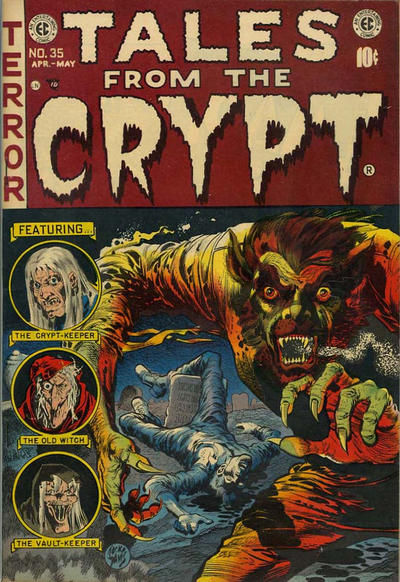
Tales from the Crypt #35
"By the Fright of the Silvery Moon!" ★★★
Story by Bill Gaines and Al Feldstein
Art by Jack Davis
"Midnight Mess!" ★★★
Story by Bill Gaines and Al Feldstein
Art by Joe Orlando
"Busted Marriage!" ★★ 1/2
Story by Bill Gaines and Al Feldstein
Art by Jack Kamen
"This Wraps It Up!" ★★
Story by Bill Gaines and Al Feldstein
Art by Graham Ingels
The Gedra men, recently emigrated from Hungary to a small farm in the American Midwest, find their peaceable existence shattered with the sudden breakout of violent murders in their fair burg. The victims look to be the target of wild animal attacks, but father Alec Gedra knows the telltale signs of the werewolf when he sees one. His youngest son Edward is completely absorbed by this notion and begins blabbing his father’s secret theories to everyone in earshot despite his older brother Peter’s attempts to rein him in. Edward’s superstitious jabber catches the ear of the sheriff, who after an afternoon of library research determines inconclusively that there definitely is a werewolf in this here town and that it’s none other than Papa Gedra! The foreigner is summarily dragged from his house and executed by firing squad in front of his two horrified children. The boys swear vengeance on the real lycanthrope and come the next full moon they head out armed with sharpened silver dollars and slingshots. After they split up Peter hears the sounds of another slaughter and finds the wolf man slavering over his latest kill. The boy’s aim is true, but after he fells the horrible beast he is dismayed to see it reverting back to its human shape of Edward, his brother.
“By the Fright of the Silvery Moon” works best if you try not to think about the developments and machinations of its plot too closely, which is something that I don’t have too much trouble doing anytime there are werewolves in the mix, and especially when they’re drawn by Jack Davis. Due to the murder-mystery trappings of the story we don’t see any signs of our trouser-wearing hellhound until the final page right before the “shocking” conclusion. So I take it that Edward was only allergic to silver in his wolf-form? Otherwise shouldn’t he have broken out into hives during all that silver dollar filing? (Jack can say whatever he likes about that, but I think that two kids going out werewolf huntin’ with nothing but razor-sharp coins and a couple of slingshots is pretty badass.) “By the Fright…” is not quite the perfect lycanthrope story we were hoping for (was there ever one?), but it’s worth it solely for bringing about that ferocious front cover if nothing else.
It’s hard for Harold Madison to enjoy his trip to see his sister in the tottering old Victorian village she lives in, what with the place being completely shuttered and deserted come sundown with nobody but crazy old coots running in the streets and talking of vampires. Harold finds that his sis Donna is no better, blaming the recent spate of bloodthirsty killings on creatures of the night. He tries to settle himself with a good meal later that night and is surprised to find the restaurant that turned him out earlier is now buzzing with activity. But as Harold dines on the suspiciously salty and thin and red delicacies that the waiter brings out, he begins to think something is terribly amiss. And he’s right: all the restaurant patrons and staff are vampires, and they celebrate the occasion of their human guest by stringing him up and tapping his jugular vein like a cask of fine Moscato.
Justly infamous for its simultaneously ludicrous and queasy finale, “Midnight Mess” lets it be known from the get-go that it will be settling in for some creaky old chills right from Joe Orlando’s opening splash depicting Harold walking through the Halloween-postcard town unknowingly menaced by flapping bats and hooded figures in black. This makes way for more visceral developments come the final part of the story that trades in the “greasy, grimy gopher guts” level of sophomoric gross-out humor that repurposes human blood as various sumptuous dishes. But the real selling point is that jugular tap, so repulsive and morbidly funny that you don’t whether to chuckle or to retch. The inclusion of the supernatural undoubtedly softens the blow here; had this been an act performed by mortals, this story would have likely raised a far bigger stink.
Jeffrey Horn likes Louise Brittling, but he likes her riches even more. But Louise doesn’t like Jeffrey. What’s a poor leech to do? Why, go to the “native” proprietor of the closest curio shop and ask for a pinch of that ol’ voodoo! Jeffrey does doo and receives two sugar dolls made up in the form of bride-and-groom wedding cake toppers, and any action performed upon them will occur to their fleshy counterparts. So since they’re already dressed for the big day then… that means the real Louise will fall in love with Jeffrey and marry him? Sure enough, she does! But then Jeffrey meets Louise’s hot, younger friend Eve and decides to cut the honeymoon short by sticking Louise’s doll in a sealed bell jar to give her a little air-cut. Louise dies, leaving Jeffrey and Eve to enjoy their own wedding night. Only until the rotting, moldy zombie sugar-doll rises from the trash heap and knocks Jeffrey’s doll down from its mantle, leaving the groom (and his new bride’s mind) shattered in pieces.
Coming in the midst of this monster mash of an issue is Jack Kamen’s old voodoo softie “Busted Marriage.” Not much can be said of its narrative, yet another threadbare gimmick constructed solely for the just punishment of the villain(s). The finale might have seemed inspired or packed some punch had we not already seen it before; Peter mentions “Drawn and Quartered” below, but we saw something a lot more familiar all the way back in Johnny Craig’s “Voodoo Vengeance” from VOH 14… and even earlier than that when Robert Bloch published his story “Sweets to the Sweet” in the March 1947 issue of Weird Tales. For what’s it worth, “Busted Marriage” features one of the closest glimpses we have had of Jack Kamen depicting a legitimate walking corpse, even if it is the walking corpse of a doll. By the way, if those dolls had the power of animation all along, then why didn’t the bride just break out of her sealed bell jar when the air supply started running low? Or was that only a capability that was made possible by the commitment of a crime on the part of the voodoo beneficiary?
Three archaeologists are overjoyed to see that their days of toiling and digging in the scorching Egyptian heat have paid off with the discovery of Pharaoh Ikah-mu-kahma’s secret tomb. The crumbling skeletons in the trophy room don’t scare the boys away, and the vast riches on hand turn the plotting Thomas and Jerome’s minds to greed and murder. Their partner Arnold had a bad ticker, you see, and all it would take would be a big enough shock to send the man into cardiac arrest. A shock such as seeing the bandaged remains of Ikah-mu-kahma reviving to enact vengeance on the defilers of his grave. The duo set it up so that Thomas will don the filthy wrappings and go into his Kharis act after his screams provoke Arnold and Jerome to “investigate” that night. The plan goes off without a hitch, but when Jerome turns the tables on his partner he discovers that the bullets in his revolver have very little effect. That’s because Thomas has already been killed by the real Ikah-mu-kahma, and the revived mummy is now closing in on Jerome.
“This Wraps It Up” puts a dull, limp bow on this issue. This seems like a plotline that would have been found in the early issues of EC’s horror titles. It still has that innocent, old-time-radio sheen about it. Compared to feral-faced werewolves and blood-tapping vampires that we saw at the start of the issue, a shambling mummy that turns out to be an actual shambling mummy seems awfully tame by comparison. And to give *that* story to “Ghastly” Graham Ingels. What a shame! --Jose
Peter: It would seem as though Graham Ingels would have been the natural choice to illustrate "Midnight Mess!," but Joe Orlando does a bang-up job in Ghastly's spot. "Midnight Mess!" is the seventh story we've come across so far of the ten adapted for the Amicus films. While the filmed version was lacking in just about everything (especially in the effects department), the comic original is a classic from Joe's detailed first panel to the laugh-out-loud finale. The menu alone brings a loud groan. "By the Fright..." is a typical werewolf tale with a predictable outcome (the dad and the sheriff are too obvious so we know who it's got to be) but Jack's art is nice, as are the semi-sorta western undertones. Al (and Bill) draw a whole lot of their inspiration for "Busted Marriage!" from Al's "Drawn and Quartered!" (Crypt #26) and Kamen drew . . . something. "This Wraps It Up!" wraps up a mixed-bag of an issue. The twist is a good one, even though the plot that precedes it has been used before and did we really have to be reminded of Arnold's bad ticker every other panel? I not only noted it but knew it meant something. The big minus to "Wraps" is that it doesn't really give Ghastly much chance to shine, does it?
Jack: Once again, the story features less than Ingels's best work but the standout panel is the splash with the Old Witch. It sure looks like he lavished most of his attention on those initial panels with the Old Witch every issue, doesn't it? "Busted Marriage!" has below average Kamen art and a dull story, but the last half-page was a surprise to me. Clunky plot mechanics are in evidence both in "Midnight Mess!" and "By the Fright..." In "Midnight Mess!," the early scene with the big mirror is a tip-off that the vampires will cast no reflection later on. I recall this story from the big 1970 collection but, on re-reading it, I thought it was mostly a long, drawn-out gag with a classic payoff. The Davis story is also weak in the art department and the idea of a slingshot and a sharp silver dollar as a method to kill a werewolf seems far-fetched to me. They had a month--find a gun and make a silver bullet!
Crime SuspenStories #16
"Rendezvous!" ★★★
Story and Art by Johnny Craig
"Fission Bait!" ★ 1/2
Story by Al Feldstein
Art by Jack Kamen
"Come Clean!" ★★★ 1/2
Story by Al Feldstein
Art by Al Williamson and Angelo Torres
"Who's Next?" ★★
Story by Al Feldstein
Art by Joe Orlando
 Joe Haines is a free-wheeling playboy stuck in a low-paying accountant’s job. To keep his girlfriend Nickie happy and well-jeweled, he’s been appropriating funds from work. When the boss gets suspicious and voices his concerns, Joe realizes he’s going to have to think up something fast. His salvation comes in the form of a time bomb and a timely business trip. Joe places the bomb in his boss’s luggage just before the man takes off, then drives to the spot in the desert where he’s calculated the crash will occur. Joe gets his expected comeuppance when he becomes part of the crash. "Rendezvous!" is not a great story in terms of the plot and the contrivances needed to pull it off (does Joe really think he could dig through the flaming wreckage to cover up any proof of the bomb?), but it's livened up by what could be one of the most sadistic characters in comics. To cover up his own foolishness, Joe thinks nothing of killing hundreds of lives. It’s also a tough story to read in the wake of 9/11. Back in the 1950s, monsters like Joe Haines populated comic books, not desert training camps and 747s.
 Eddie and Louise Miller have been living it up, making money with their small machine shop, selling parts to the military but, with the end of World War II, business dries up. Eddie falls into a funk until an Army colonel comes a-callin', explaining that the Army will pay the Millers a boatload of money for pumping out special casings designed for atomic bombs. Suddenly, the Millers are back to living high on the hog, buying big houses, nice cars, and a huge ranch in the valley. On business in Los Angeles one night, Eddie is introduced to the gorgeous Pat Walton and immediately falls in love. The two live a clandestine relationship for over a year until Pat becomes tired of the secrecy and demands that Eddie divorce Louise. In the meantime, Louise has grown suspicious of Eddie's frequent business trips to La-La Land and hired a PI to follow him. Things come to a head one night when Louise confronts her husband over his infidelity and Eddie snaps, killing his wife and burying her body in the desert. The cold-blooded killer cheerfully explains to Pat that Louise has found out about their affair and walked out on him but, as the couple are making love on the sofa, the police break in and arrest both of them. As the police car is heading for headquarters, Eddie asks the cop how he found out about the crime. The detective explains that an old prospector had been searching in the desert for uranium deposits and Louise's watch had set off his Geiger-counter. For once, it's not just Jack Kamen's stencils that deep-six a story but also the -blah- script from Al. There's not a cliche left out of "Fission Bait!" and the "startlingly ironic reveal" elicits more yawns than gasps.
 Ralph Jansen is about to be executed for the murder of Lillian Smith, a woman he picked up in a bar for a one-night stand. The prosecution’s evidence consists of the testimony of the landlady who saw him in Lillian’s apartment and his coat, which was seen on a man running from the apartment after the murder. Jansen spends his last minutes going over the night in his head, trying to come up with a missing piece. Unfortunately for Ralph, the missing piece arrives in his brain just as the switch is flipped. A wild, pessimistic story with no expository final panel. The executioner didn’t do it. No gleeful, guilty sheriff. We know Jansen is innocent, but we never find out who or why Lillian is killed. Just about the most noir-ish tale we've run across on our journey thus far, with all sorts of lines that could have fallen out of a Mickey Spillane paperback conveniently opened on Al's lap:
We started to talk! I looked her over! She wasn't bad . . . for her kind!
She drank like a fish! And she could sure hold it! Her eyes got a little bleary, but otherwise she was okay! Just a little gay . . .
This is not the best work we've seen from Al Williamson; the vibe is a bit mid-century rushed and unfinished (the police chief looks a whole lot like Edward G. Robinson) but it's also got a grittiness to it that's perfectly suited for the noir atmosphere.
 Tony's a very happy man; he's got his successful barber shop, he's got his health, and he's got his gorgeous wife, Anna. Lately, though, Anna has not been herself, rebuking Tony at the breakfast table, spurning his kisses, and not showing up for her wifely duties at night ("I was tired last night, Tony!"). Regardless of his unhappy home life, Tony still shows up to shear off his customers' unwanted locks and provide some much-needed bonding time between men. Curiously, big-time banker-man, Mr. Barker, shows up every day to inquire as to the wait for a haircut and, every day, he turns right around and leaves when his question is answered. One day, Mr. Barker comes in, inquires and leaves, but drops his wallet. Ever the good citizen, Tony scampers after the wealthy banker, only to discover why Mr. Barker is so inquisitive about Tony's workload: Mr. Barker is the reason why Anna is . . . so tired! The next day, Tony makes sure his slate is clear and, when Mr. Barker arrives, he gets a very close shave! "Who's Next?" is more of the same from Al's bag of plots, this one using the haggard frame of the poor guy with the adulterous wife who doles out revenge based on his profession (a frame we seem to be seeing quite a lot of). Nothing new here and, in fact, five of the seven pages are given over to nothing but poor Tony wondering why his wife is being so mean to him. Joe Orlando provides decent visuals for a story that would usually be handed to Jack Kamen. --Peter
Jack: I found "Who's Next?" to be satisfying from start to finish, with adult themes and solid art. I liked it best out of four good stories in a very strong issue. Johnny Craig's "Rendezvous!" is disturbing in retrospect, with the usual great art from Johnny. I like the Kamen story more than you did; it's a good little crime tale but the twist ending does seem superfluous. As for "Come Clean!," it's terrifically hard boiled and the narration is fabulous, but I think Al Williamson is the most uneven artist we're seeing in these EC comics. Perhaps it all depends on the inker.
The Vault of Horror #30
"Split Personality!" ★★★★
Story and Art by Johnny Craig
"Who Doughnut?" ★★
Story by Al Feldsetin
Art by Jack Davis
"Practical Choke!" ★★ 1/2
Story by Al Feldstein
Art by George Evans
"Notes to You!" ★★★
Story by Bill Gaines and Al Feldstein
Art by Graham Ingels
Handsome con man Ed King collects donations for a living and can't resist turning on the old charm when he learns of beautiful blond twin sisters who live together, never go out, and have a boatload of moolah. Gaining entry to their home by means of rescuing a kitten from a tree, Ed quickly makes himself indispensable and the girls fall in love with him. Being a clever con artist, Ed realizes that he can double his winnings by pretending to be twins, so he tells the girls that he and his identical twin brother Alphonso take turns minding their holdings in South Africa, each one spending a month there at a time. The gals fall for it like a ton of bricks and before you know it, Ed and "Alphonso" have each married one of the twin sisters. Sadly for Ed, an unintended tan line from a sun lamp tips the girls off, but they solve the problem quite creatively by cutting Ed down the middle with an ax, so each sister gets her fair share.
I've been waiting for a great Johnny Craig story for a while now, and I think "Split Personality!" is it! The art is perfect, blending crime, humor, and horror seamlessly, and the story is a lot of fun, all the way to the side-splitting finish. And how about that cover? If I were in Congress, I'd hold it up as Exhibit A. The bone sticking out is the worst part.
Seven women dead in under a month, blood drained from their bodies, round welts covering their skin! "Who Doughnut?" wonder the police and intrepid reporter Danny Hughes. What's more, the victims all have traces of sea brine left on them. One night, down by the docks, Danny follows a suspicious character to the aquarium and discovers that the killer is an octopus!
Were it not for Jack Davis's efforts to tell this story with a relatively straight face, it would belong in Mad. The script is awful and the ending is telegraphed a mile away. And since when can an octopus put on a hat and trench coat and slink around town?
Three fun-loving medical school students play one "Practical Choke!" after another on the unsuspecting public. They leave a severed arm hanging from a subway strap, a couple of severed legs sticking out of a sand dune at the beach, and a severed head in a photo cutout at the boardwalk. Thinking they need to hide the evidence of their misdeeds, they return to the morgue to dispose of what remains of the body they took the parts from, when a length of slithering intestines sneaks up and chokes them to death!
Only slightly better than the story before it, this one is notable for more strong art from George Evans and for the fact that the panel that mirrors Johnny Craig's cover is actually less gruesome. Think about that--the cover is more graphic than what's on the inside pages! The end is ridiculous and makes me fear that Feldstein is running out of ideas.
Judson Slack receives a poison pen letter telling him that his wife has been unfaithful. He confronts her and, not believing her denial, walks out. She kills herself and he feels remorse. Morton Cox receives a similar letter telling him that his trusted employee has robbed him. He confronts the man, who leaps from a window. The same thing happens with Averill Minton, who kills himself after a letter sent to the customers of his bank impugns his character. Finally, Mr. Popkin, who owns a candy store, refuses to serve bitter old Ambrose Baldwin in front of some kids. Baldwin complains and Popkin gives him a bottle of ink and tells him never to come back.
Baldwin goes home and writes a letter to the health department, stating that the candy store is filthy. They investigate but, when the letter is produced, it is blank. Popkin then knows that Baldwin is the poison pen letter-writer and he and the other three men who were affected realize that they all slighted Baldwin at some point in the past. To get revenge, they visit him at home and jab him repeatedly with fountain pens filled with lye until his body dissolves.
Very nice art by Ghastly in "Notes to You!" can't save another weak story from Bill and Al. The parade of poison-pen letters is fine and the story seems to be going in the direction of revenge, but the idea of sticking a man with pens filled with lye and that causing him to disintegrate into "a foul-smelling, oozing pool of putrescence" is too much.--Jack
Peter: All four stories in this extremely weak issue are hampered by dopey climaxes (y' know, those kind that are telegraphed form the splash page?). Al doesn't even try to explain how (or why) an octopus climbs into Mickey Spillane duds to prowl the street for prey. Is it an intelligent half-man/half-octo who can sense that a creature such as he should don a trench and fedora so as not to draw attention? Sheesh! The only thing to recommend in "Split Personality!" is Craig's crazed Blair sisters. Sure, they turn on a dime a little too quickly but it's a fun transformation. Speaking of quick, the fatalities of "Notes to You!" certainly didn't waste their time explaining or looking for solutions to their problems, instead ending their lives within minutes of the slights. The climax boils down (pun intended) to the same ol' same ol'. That leaves the only story this issue that garnered as high as two stars in my notes: "Practical Choke!," which begins very promisingly but then sputters and dies. I thought this one was heading into the same territory as the classic Alfred Hitchcock Presents/Hour episodes "The Cadaver" and "The Jokester" (both broadcast long after this issue was published) but, in the end, Al falls back on the patented shock finale that makes no sense.

Jose: My issue with “Piecemeal” isn’t so much the question of the pool’s ability to sustain a man-eating shark (I believe at one point Sally mentions to Eric that it’s a salt-water pool) but the question over how in the hell neither of the two plotting lovers saw the big, flesh-chomping beast swimming around before they decided to dive in. Outside of that, this fish story is harmless enough. “The Assault” is another *Shock Special*, a brutalizer that leaves you feeling like you have six bullet holes in your face, too. The moral lesson condemning mob violence feels more implicit here, with the focus instead being placed on the rough and seedy elements of spring/autumn romances. This one feels more nihilistic than other “preachies,” as there are precious few champions of justice here and more than enough warped and violent sociopaths. “The Arrival” perks our spirits back up with a reservedly joyous prediction of the eventual fate of the planet that posits that long after us humans have nuked each other’s brains out and our radiation-scarred bones have cooled, the cuddly rats that we so despised will rise up as the usurpers of the planet and finally make contact with the equally adorable reptilian residents of Mars. “Seep No More” takes us from the fanciful high and brings us right back down into the grime and the dark corners of a psychopath’s neurosis. Though it clearly borrows from classic literature, Gaines and Feldstein do a more-than-fine job of updating the yarn for modern sensibilities and, complemented by George Evans’ stark artwork, make this one a menacing and haunting psycho-drama.
 |
| Davis |
"By the Fright of the Silvery Moon!" ★★★
Story by Bill Gaines and Al Feldstein
Art by Jack Davis
"Midnight Mess!" ★★★
Story by Bill Gaines and Al Feldstein
Art by Joe Orlando
"Busted Marriage!" ★★ 1/2
Story by Bill Gaines and Al Feldstein
Art by Jack Kamen
"This Wraps It Up!" ★★
Story by Bill Gaines and Al Feldstein
Art by Graham Ingels
The Gedra men, recently emigrated from Hungary to a small farm in the American Midwest, find their peaceable existence shattered with the sudden breakout of violent murders in their fair burg. The victims look to be the target of wild animal attacks, but father Alec Gedra knows the telltale signs of the werewolf when he sees one. His youngest son Edward is completely absorbed by this notion and begins blabbing his father’s secret theories to everyone in earshot despite his older brother Peter’s attempts to rein him in. Edward’s superstitious jabber catches the ear of the sheriff, who after an afternoon of library research determines inconclusively that there definitely is a werewolf in this here town and that it’s none other than Papa Gedra! The foreigner is summarily dragged from his house and executed by firing squad in front of his two horrified children. The boys swear vengeance on the real lycanthrope and come the next full moon they head out armed with sharpened silver dollars and slingshots. After they split up Peter hears the sounds of another slaughter and finds the wolf man slavering over his latest kill. The boy’s aim is true, but after he fells the horrible beast he is dismayed to see it reverting back to its human shape of Edward, his brother.
 |
| If I had a nickel for every time *that* happened! ("By the Fright of the Silvery Moon") |
It’s hard for Harold Madison to enjoy his trip to see his sister in the tottering old Victorian village she lives in, what with the place being completely shuttered and deserted come sundown with nobody but crazy old coots running in the streets and talking of vampires. Harold finds that his sis Donna is no better, blaming the recent spate of bloodthirsty killings on creatures of the night. He tries to settle himself with a good meal later that night and is surprised to find the restaurant that turned him out earlier is now buzzing with activity. But as Harold dines on the suspiciously salty and thin and red delicacies that the waiter brings out, he begins to think something is terribly amiss. And he’s right: all the restaurant patrons and staff are vampires, and they celebrate the occasion of their human guest by stringing him up and tapping his jugular vein like a cask of fine Moscato.
 |
| Ahh, a good fear! ("Midnight Mess") |
Jeffrey Horn likes Louise Brittling, but he likes her riches even more. But Louise doesn’t like Jeffrey. What’s a poor leech to do? Why, go to the “native” proprietor of the closest curio shop and ask for a pinch of that ol’ voodoo! Jeffrey does doo and receives two sugar dolls made up in the form of bride-and-groom wedding cake toppers, and any action performed upon them will occur to their fleshy counterparts. So since they’re already dressed for the big day then… that means the real Louise will fall in love with Jeffrey and marry him? Sure enough, she does! But then Jeffrey meets Louise’s hot, younger friend Eve and decides to cut the honeymoon short by sticking Louise’s doll in a sealed bell jar to give her a little air-cut. Louise dies, leaving Jeffrey and Eve to enjoy their own wedding night. Only until the rotting, moldy zombie sugar-doll rises from the trash heap and knocks Jeffrey’s doll down from its mantle, leaving the groom (and his new bride’s mind) shattered in pieces.
 |
| Hello, Dolly! ("Busted Marriage") |
 |
| With his dying breath. Arnold revealed the one concert he always regretted missing out on. ("This Wraps It Up") |
“This Wraps It Up” puts a dull, limp bow on this issue. This seems like a plotline that would have been found in the early issues of EC’s horror titles. It still has that innocent, old-time-radio sheen about it. Compared to feral-faced werewolves and blood-tapping vampires that we saw at the start of the issue, a shambling mummy that turns out to be an actual shambling mummy seems awfully tame by comparison. And to give *that* story to “Ghastly” Graham Ingels. What a shame! --Jose
 |
| Uggh... leftovers! ("Midnight Mess") |
Jack: Once again, the story features less than Ingels's best work but the standout panel is the splash with the Old Witch. It sure looks like he lavished most of his attention on those initial panels with the Old Witch every issue, doesn't it? "Busted Marriage!" has below average Kamen art and a dull story, but the last half-page was a surprise to me. Clunky plot mechanics are in evidence both in "Midnight Mess!" and "By the Fright..." In "Midnight Mess!," the early scene with the big mirror is a tip-off that the vampires will cast no reflection later on. I recall this story from the big 1970 collection but, on re-reading it, I thought it was mostly a long, drawn-out gag with a classic payoff. The Davis story is also weak in the art department and the idea of a slingshot and a sharp silver dollar as a method to kill a werewolf seems far-fetched to me. They had a month--find a gun and make a silver bullet!
 |
| Craig |
"Rendezvous!" ★★★
Story and Art by Johnny Craig
"Fission Bait!" ★ 1/2
Story by Al Feldstein
Art by Jack Kamen
"Come Clean!" ★★★ 1/2
Story by Al Feldstein
Art by Al Williamson and Angelo Torres
"Who's Next?" ★★
Story by Al Feldstein
Art by Joe Orlando
 Joe Haines is a free-wheeling playboy stuck in a low-paying accountant’s job. To keep his girlfriend Nickie happy and well-jeweled, he’s been appropriating funds from work. When the boss gets suspicious and voices his concerns, Joe realizes he’s going to have to think up something fast. His salvation comes in the form of a time bomb and a timely business trip. Joe places the bomb in his boss’s luggage just before the man takes off, then drives to the spot in the desert where he’s calculated the crash will occur. Joe gets his expected comeuppance when he becomes part of the crash. "Rendezvous!" is not a great story in terms of the plot and the contrivances needed to pull it off (does Joe really think he could dig through the flaming wreckage to cover up any proof of the bomb?), but it's livened up by what could be one of the most sadistic characters in comics. To cover up his own foolishness, Joe thinks nothing of killing hundreds of lives. It’s also a tough story to read in the wake of 9/11. Back in the 1950s, monsters like Joe Haines populated comic books, not desert training camps and 747s.
We started to talk! I looked her over! She wasn't bad . . . for her kind!
She drank like a fish! And she could sure hold it! Her eyes got a little bleary, but otherwise she was okay! Just a little gay . . .
This is not the best work we've seen from Al Williamson; the vibe is a bit mid-century rushed and unfinished (the police chief looks a whole lot like Edward G. Robinson) but it's also got a grittiness to it that's perfectly suited for the noir atmosphere.

Jack: I found "Who's Next?" to be satisfying from start to finish, with adult themes and solid art. I liked it best out of four good stories in a very strong issue. Johnny Craig's "Rendezvous!" is disturbing in retrospect, with the usual great art from Johnny. I like the Kamen story more than you did; it's a good little crime tale but the twist ending does seem superfluous. As for "Come Clean!," it's terrifically hard boiled and the narration is fabulous, but I think Al Williamson is the most uneven artist we're seeing in these EC comics. Perhaps it all depends on the inker.
 |
| Craig |
"Split Personality!" ★★★★
Story and Art by Johnny Craig
"Who Doughnut?" ★★
Story by Al Feldsetin
Art by Jack Davis
"Practical Choke!" ★★ 1/2
Story by Al Feldstein
Art by George Evans
"Notes to You!" ★★★
Story by Bill Gaines and Al Feldstein
Art by Graham Ingels
Handsome con man Ed King collects donations for a living and can't resist turning on the old charm when he learns of beautiful blond twin sisters who live together, never go out, and have a boatload of moolah. Gaining entry to their home by means of rescuing a kitten from a tree, Ed quickly makes himself indispensable and the girls fall in love with him. Being a clever con artist, Ed realizes that he can double his winnings by pretending to be twins, so he tells the girls that he and his identical twin brother Alphonso take turns minding their holdings in South Africa, each one spending a month there at a time. The gals fall for it like a ton of bricks and before you know it, Ed and "Alphonso" have each married one of the twin sisters. Sadly for Ed, an unintended tan line from a sun lamp tips the girls off, but they solve the problem quite creatively by cutting Ed down the middle with an ax, so each sister gets her fair share.
 |
| Johnny Craig could mix humor, horror, and hardboiled in the same story. ("Split Personality!") |
I've been waiting for a great Johnny Craig story for a while now, and I think "Split Personality!" is it! The art is perfect, blending crime, humor, and horror seamlessly, and the story is a lot of fun, all the way to the side-splitting finish. And how about that cover? If I were in Congress, I'd hold it up as Exhibit A. The bone sticking out is the worst part.
 |
| Not even Jack Davis could make this work! ("Who Doughnut?") |
Were it not for Jack Davis's efforts to tell this story with a relatively straight face, it would belong in Mad. The script is awful and the ending is telegraphed a mile away. And since when can an octopus put on a hat and trench coat and slink around town?
Three fun-loving medical school students play one "Practical Choke!" after another on the unsuspecting public. They leave a severed arm hanging from a subway strap, a couple of severed legs sticking out of a sand dune at the beach, and a severed head in a photo cutout at the boardwalk. Thinking they need to hide the evidence of their misdeeds, they return to the morgue to dispose of what remains of the body they took the parts from, when a length of slithering intestines sneaks up and chokes them to death!
 |
| Compare the Evans panel to the Craig cover. ("Practical Choke!") |
Only slightly better than the story before it, this one is notable for more strong art from George Evans and for the fact that the panel that mirrors Johnny Craig's cover is actually less gruesome. Think about that--the cover is more graphic than what's on the inside pages! The end is ridiculous and makes me fear that Feldstein is running out of ideas.
 |
| Popkin's candy store stocks EC comics! ("Notes to You!") |
Baldwin goes home and writes a letter to the health department, stating that the candy store is filthy. They investigate but, when the letter is produced, it is blank. Popkin then knows that Baldwin is the poison pen letter-writer and he and the other three men who were affected realize that they all slighted Baldwin at some point in the past. To get revenge, they visit him at home and jab him repeatedly with fountain pens filled with lye until his body dissolves.
Very nice art by Ghastly in "Notes to You!" can't save another weak story from Bill and Al. The parade of poison-pen letters is fine and the story seems to be going in the direction of revenge, but the idea of sticking a man with pens filled with lye and that causing him to disintegrate into "a foul-smelling, oozing pool of putrescence" is too much.--Jack
 |
| The Terrible Twins plot Peter's demise. ("Split Personality!") |
 |
| In Our Next Issue . . . |