Monday, April 15, 2024

Batman in the 1960s Issue 20: March/ April 1963


The Caped Crusader in the 1960s
by Jack Seabrook
& Peter Enfantino


Moldoff
Detective Comics #313

"The Mystery of the $1,000,000 Treasure Hunt"
Story by Dave Wood
Art by Sheldon Moldoff & Charles Paris

"The Wizard Who Conquered J'onn J'onzz"
Story Uncredited
Art by Joe Certa

Commissioner Gordon receives a tip from an anonymous source that a heist is about to go down at the Store-All Warehouse and, rather than bother his cops, calls Batman and Robin to investigate. The boys arrive to witness Boss Barker and one of his thugs inside the warehouse, monkeying with a grandfather clock. The Dynamic Duo drop into the scene just as the clock shoots out restraining arms, trapping Barker's goon. At that moment, two members of a rival gang burst through the doors, tommy-guns a' blazin'. What gives?
After disarming and nabbing the criminals, Batman interrogates one of the hoods and learns that all the criminals in Gotham are on a high-stakes treasure hunt worth one million clams. Seems gangster Eli Maddan, lost at sea a month before, left a will with instructions for the hunt. Every goon in Gotham got one. Now they're all searching for clues to the prize. Maddan didn't want it to be too easy, though, so he tricked up each location with dangerous traps. 

Intrigued, Batman takes the copy of the will and he and Robin try to solve the puzzle. This leads them to such dangerous traps as a giant milk bottle and a huge record album that transforms into a flying cage. This cage ensnares the Dark Knight and transports him to a nearby silo, where he meets up with... Eli Maddan! Yes, reports of the man's death were exaggerated. Turns out the entire treasure hunt was designed to nab the Caped Crusader. Maddan is being paid one million to kill Gotham's favorite hero. He pushes a button and the cage containing Batman explodes. Next month in Detective Comics... J'onn J'onzz takes over the lead spot.

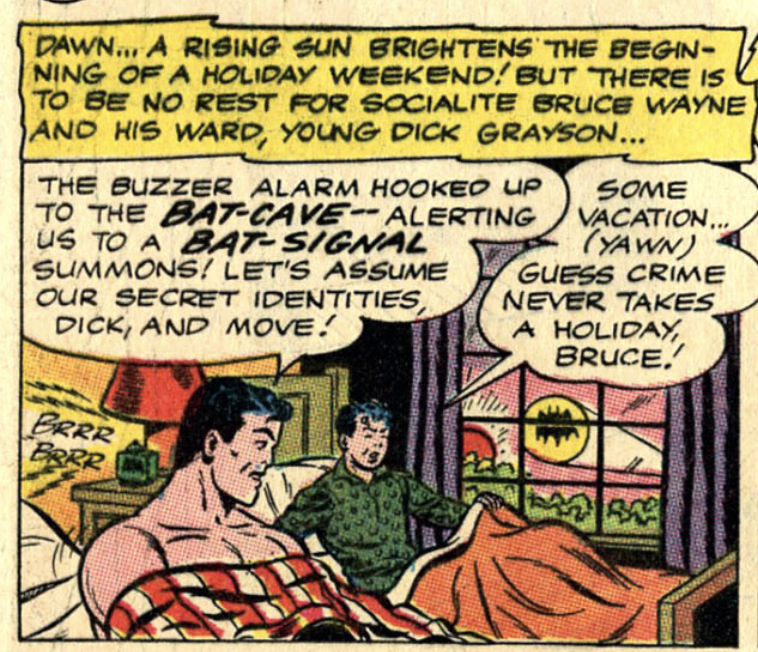
Just fooling! Batman is too smart for the gangster; picking up on an earlier clue and suspecting a trap, Batman sent Mecha-Batman in his place. The real Bats is in disguise in the silo and puts the cuffs on Maddan, who wishes he were dead. "The Mystery of the $1,000,000 Treasure Hunt" is one of those overly-complicated adventures that never satisfies in the end. It seems way too familiar. There are a couple of good chuckles to be had, though, if you pay attention. Despite Fred Wertham outing Batman and Robin as homosexuals in his groundbreaking study, I'm Gonna Run Comics Into the Ground, the professor must have frowned at writer Bill's obvious middle Finger panel of Bruce and Dick waking in the same room. Now, to be fair, they're in separate beds, but the point is that Wayne Manor has 66 bedrooms and they're sharing what appears to be one of the smallest. Gotham's gigantism fetish rears its ugly head once again with the big bottle factory. Who needs a whole factory devoted to making twelve-foot-tall glass bottles?

The Martian Manhunter tries to figure out why super-mob-boss Argus Weede is so interested in the Wand of Wodessa, an archaic, charming relic that has no power whatsoever. Or so J'onn J'onzz believes, until he sees Weede wield the wand and wreak havoc across the land. "The Wizard Who Conquered J'onn J'onzz" continues the ever-downward spiral of quality in the Martian Manhunter back-up. MM's villains are disposable, a new mob boss every issue it seems, and the routine is... routine. The only saving grace is that Zook must have been out of town this time out. Why do these early 1960s gangsters dress like business men? -Peter

Jack-What must it have been like to live in Gotham City at this time, surrounded by so many giant objects? No one seems the least bit surprised by oversized milk bottles or enormous record players that never stop. The puns fly fast and furious in this story. which I thought was pretty good. In the 1980s, this would have merited a multi-issue arc! As for J'onn J'onzz, it was good to see a villain with some power, though I did not see any explanation for his magical abilities. The art was better than usual.


Kane & Paris
Batman #154

"Danger Strikes Four"
Story by Bill Finger
Art by Sheldon Moldoff & Charles Paris

"The Amazing Odyssey of Batman and Robin"
Story by Bill Finger
Art by Sheldon Moldoff & Charles Paris

"The Strange Experiment of Doctor Dorn"
Story by Bill Finger
Art by Sheldon Moldoff & Charles Paris

Dick happens upon Alfred as the butler is writing another imaginary story about Batman II and Robin II. The young ward reads the incomplete story, which tells of a giant robot named Magog that is hijacked by a renegade scientist who demands $1,000,000 or else the robot will go rampaging through Gotham City the next day. A quick look at the crime files tells Bruce Wayne that the scientist is a rare book nut, so a fake ad is placed in the paper to draw him out. The plan works and the scientist's hideout is discovered, but the robot is accidentally launched and is heading to wreak havoc on Gotham when the story is suspended because Alfred has run out of ideas.

Bruce bursts in to tell Dick about a real emergency, so they don their costumes and rush to the state pen, where a crook reveals that his gang is set to send a buzz bomb toward Gotham unless the crook is freed by 4 PM. Using a trick from Alfred's story, they locate the hideout and find the bomb, but it (like the robot in the story) is accidentally launched! To the Batplane! Robin makes a daring leap in mid-air and sends the bomb safely out to sea; he goes home and tells Alfred how to end his story with similar heroics.

Usually, the imaginary stories by Alfred are presented with a straight face until some wacky thing happens and it's revealed that what we're reading is not really happening. In "Danger Strikes Four," there's no secret, and the story is used to parallel real events. A detail from the story helps with the real crime, and the solution to the real crime is used to end the story. It all works out neatly but it's kind of dull. The robot is named Magog, which is a name from the Bible and the Koran; thanks, Wikipedia!

I also want to note that it seems the real Bob Kane penciled the cover, which is not something we see often (ever?). I was skeptical, but all of my research seems to suggest that he really drew it.

Batman and Robin were sailing the Bat-Boat to judge the yachting regatta in Bay City, but in the morning mists by the shore, two fisherman discover the battered hulk with no sign of the Dynamic Duo! The ship's log is recovered and Commissioner Gordon reads it over the airwaves that evening to explain the tragic story of "The Amazing Odyssey of Batman and Robin" and how it led to their deaths! Six hours out of port, they encountered a submerged volcano and a tidal wave that swept them into uncharted waters. They managed to avoid being drawn in by a giant Cyclops made entirely of lodestone by ancient people and made their way to an uncharted island.

After being caught by natives, they met the Great Kardo, a former circus magician who had turned to crime. He explained how he discovered a plant whose juice causes temporary amnesia, so he planned to use it in a robbery in Gotham City. Kardo escaped by seaplane and the Bat-Boat again set sail, until a giant squid attacked--and the logbook ends. Kardo goes ahead with his robbery, but--surprise!--he is stopped by Batman and Robin, who only pretended to be dead in order to draw him into the open.

Holy complicated plan! First of all, Kardo goes to a lot of trouble collecting amnesia juice from plants on an uncharted island only to use it to make cops in Gotham City woozy so he can rob the $100,000 in prize money that would otherwise be given to the winner of a TV contest. Second, Batman and Robin cook up a crazy plan that includes faking their own deaths, just so they can capture Kardo in the act! Most surprising to me was the fact that all of the things they encountered were real! Why not just fake the logbook and head home and relax?

A big, green, hairy monster is rampaging through Gotham City! Bullets have no effect, nor does fire. Batman deduces that the monster must have been in Dr. Dorn's mountaintop laboratory and he's right--Batman and Robin  drive to the lab and the monster promptly knocks them both out with socks to the jaw. They later awaken to find it gone and trail it to a chemical supply house, where the Dynamic Duo witness the creature stealing two bottles of rare chemicals.

Still later, they find a groggy Dr. Dorn in his lab. He gives them an antidote to destroy "The Strange Experiment of Dr. Dorn," but when Batman later has the opportunity to fling some chemicals as the monster starts to dismantle a bridge, he hesitates. Later, Batman and Robin watch through Dr. Dorn's window and witness the doctor unwillingly transform into the creature. They follow him on his next rampage and, once he returns to the lab, Batman uses a gaseous antidote to cure the poor doc once and for all.

Does something smell in here? Sorry, it's just this story, which is not just poorly illustrated and boring, but also utterly lacking in surprise or suspense. A five-year-old reader would not be challenged to figure out the monster's identity early on. I need an antidote for issues like this one.-Jack

Peter-
Once again, in "Danger Strikes Four," Al neglects his Batsuit mending and puts fingers to Smith Corona for the benefit of all mankind. If Al has to have a tea and fantasy break, couldn't he come up with more imaginative plots than this drivel? I do like that Finger brought back Hal Durgin, if only for a bit of continuity. "The Amazing Odyssey..." is a tad better; lots of smiles crossed my face as I imagined an undersea volcano eruption and an "uncharted" island between Gotham and Bay City (wherever that is) that no one notices. Also, I love the Lovecraftian diary entry from Bats while Robin risks his life: "...Robin fights the tentacles of the gigantic octopus up top while I put these important words on paper. Wait, it's coming through the door... it's reaching for me... aaaaargh..." Did the lodestone statue have anything to do with any of the other events that transpired in this white-knuckler? Of the three stories this issue, I enjoyed "Dr. Dorn" the most, despite its truly hideous art. Better Dr. Jekyll than Trorg, Invader from the X-5 System, I always says. This story really accentuates Batman's wild stabs at what's going on (and 100% of the time he's on the money); he sees a piece of lint laying on the road and hypothesizes it's from Dr. Dorn's belly-button. World's Greatest Detective.


Moldoff
Detective Comics #314

"Murder in Movieland"
Story by Bill Finger
Art by Sheldon Moldoff & Charles Paris

"J'onn J'onzz vs. John Jones"
Story by Jack Miller (?)
Art by Joe Certa

Commissioner Gordon notifies Batman and Robin that faded screen star Roger Carlyle has made threatening threats toward his former bosses at Monarch Pictures. Carlyle's career had descended into the crapper and the strain had made his brain short-circuit. Now, he blames the trio of millionaires for his problems.

First up, dressed as the Phantom of the Opera, Carlyle drops a ten-ton chandelier on the head of Henry Austin and then avoids capture by the Dynamic Duo. As Batman and Robin speed from the scene of the crime, the Dark Knight informs Robin that the masked man dressed as the Phantom could have been anyone. It's well-known to the subscribers of Variety (of which Bruce Wayne is an avid reader) that the three Monarch bosses have been warring amongst themselves for control of the studio. Carlyle might just be a scapegoat!

The duo motor to the palatial estate of exec Will Bates to check on his status; there they find fellow studio boss, Harmon, in a state of anxiety. He's just received a typewritten death threat from Roger Carlyle and wanted to see if Bates was still standing on two legs. After getting no response to the door's huge knockers, Batman, Robin, and Harmon enter to find the mansion empty. On the kitchen table is a death threat to Bates, signed by Carlyle. But where is Bates? Just then, Batman remembers an old Rona Barrett column in Variety, where the gossip queen excitedly bragged about her trip to Bates's private island. Bats and Robin inflate the Bat-Boat and head out to the island.

En route to the island, Batman and Robin catch a glimpse of Bates's yacht just before a mechanical white whale emerges from the sea and violently rams the vehicle. Bates sinks below the waves as the Dynamic Duo watch helplessly. An evil cackle emits from a hatch atop the whale and the boys spy a masked villain exiting the blowhole; surely, this must be Roger Carlyle, reenacting his most famous role as Ahab in Moby Dick (in this universe, Gregory Peck was off making a Grade-Z oater at the time). Batman hops aboard the craft but Carlyle escapes. 

The Caped Crusaders head to Monarch Studios, where Harmon is waiting for them. When they arrive, they're told by guards that their boss has been kidnapped by Carlyle and has been stuffed onto an old locomotive at the studio's western set. The heroes arrive just as the train is heading for the cliff and Bats rescues Harmon in the nick of time. Bats picks up a Fedora and examines it closely, remembering an old column in The Hollywood Reporter about the hat sizes of movie producers, and loudly proclaims that Carlyle could never have worn a hat such as this, stuffed with paper. Robin, doing his best to keep up, proudly states that the murderer couldn't possibly be Carlyle! The World's Greatest Detective then throws his index finger skyward and reminds his pre-teen chum that Bates's body was never found!

Um yeah...
The Duo head back to Bates's castle, where they discover master thespian Roger Carlyle handcuffed to a radiator in the basement. Carlyle explains that Bates was never on the yacht (he set the wheel to steer the craft without a skipper!!!) and that he's the monster behind the murders of Harmon and Austin. Bats tells the stressed movie star that he and Robin were able to save Harmon and that Carlyle should go home and get some rest. Shortly thereafter, the masked killer enters through the window of Harmon's study, where the producer is enjoying a book and a cognac. "This time, I'll make sure of your death!" cackles the madman, just before Harmon rises from his La-Z-Boy and decks him. He then removes his face to reveal Batman (ears and all) underneath. The killer is unmasked and Roger Carlyle stands before them. "Holy double-twist, Batman!" exclaims the bewildered Boy Wonder. Batman then explains all the intricate details that went into Carlyle's plan but, by then, Robin is napping. Needless to say, Roger Carlyle will be performing To Kill a Mockingbird only for his cellmates in the future.

Um, but...
At times, Bill Finger can load his scripts with endless, unneeded intricacies, as in the fabulously enjoyable "Murder in Movieland." There's way too much plot and at least five more twists than the average eight-year-old can hold in his tiny brain; it was certainly harder to follow than the average funny book story. The two-page Agatha Christie-esque expository at the climax had me reaching for a bottle of Excedrin. But, despite those drawbacks, this was one pleasurable funny book story in both story and art (hard to believe this is the same team we cringe at most months), a harkening back to the 1940s-style murder mysteries that the Dark Knight became famous for. I love how Carlyle has access to all these movie props and, even better, that any studio would build a mechanical whale that could actually hold its own as a motorboat and a battering ram. How about the backlot western set that includes fully-fueled locomotive plus deadly cliff drop? Sign me up for more of these retro-adventures.

In "J'onn J'onzz vs. John Jones," the Martian Manhunter faces his deadliest challenge in over thirty days when an escaped con from Saturn overpowers Jones and takes on his Earthbound identity. Only pretty patrolwoman Diane Meade and sidekick, Zook, can save J'onn from "himself." Lame story, lame art, lather, rinse, repeat. Just once I'd like to finish one of these awful Martian Manhunter stories with something other than an eye-roll. What the hell does Captain Harding do besides sit behind his desk and act angry? Why is Diane Meade always in the wrong spot at the right time? Why does a guy from Saturn know about oil companies and their underground pipes? Nothing in this twelve-page abomination points to creativity.-Peter

Jack-I'm right there with you regarding the Martian Manhunter story, which features unusually stilted art, the usual gang of lame supporting characters, and the Zook, which seems to have landed in a superhero comic rather than a funny animal comic by mistake. I'm not with you on the Batman story, which I found mediocre despite what initially seemed like a good premise. It's hard to believe a story with Batman and the Phantom of the Opera could be such a drag.

Next Week...
Everett Continues to Dazzle!

Monday, April 8, 2024

Journey Into Strange Tales Issue 109: Atlas/ Marvel Horror & Science Fiction Comics!


The Marvel/Atlas 
Horror Comics
Part 94
January 1956 Part I
by Peter Enfantino
and Jack Seabrook


Astonishing #45
Cover by Carl Burgos

"The Hands from Nowhere" (a: Bill Benulis) ★★
"The Vagrant" (a: Bernie Krigstein) ★★
"Sabotage!" (a: Bob Forgione) ★1/2
"The Old House" (a: Ed Winiarski) 
"The Seekers" (a: Joe Sinnott) ★★

Police investigate the odd case of a pair of disembodied hands appearing out of nowhere in various parts of town. When the hands write out a message to "contact Professor Winston," the cops interview noted scientist Emmet Winston about the phenomenon. Winston relates a fantastic story to his audience; a colleague, Alfred Denning, was experimenting with other dimensions and was absorbed into just such a vacation spot.

The hands find their way to Winston's lab and the egghead promises the two fists he'll do everything he can to bring his old friend back from limbo. But when the magic potion is mixed and the hands are dipped into the vat, the appendages disappear and Winston finds a note from Denning, thanking him for his help. He rather likes his new home, but wandering around without hands was becoming cumbersome.

Other than a few guffaws at the ridiculous dialogue ("Prowl cars have already been alerted to hunt Denning's hands! We'll know when they're spotted!"), "The Hands From Nowhere" is another fine example of the pablum produced when the imagination is shackled. The climax just arrives and carries no emotional impact whatsoever. We're left only with the usual fine Benulis artwork.

Police arrest a man for loitering and take him to a nearby jail, where he claims he's from Mars and is awaiting the coming of his fellow Martians. The cops bring in a psychologist, who questions "The Vagrant" about life on Mars and then forwards the answers to the editor of Space Tales Magazine for verification. The editor writes back that the man's answers are indeed truthful and he would know because, as we see in the final panel, he's a Martian too! The most amusing aspect of "The Vagrant" is not that the cops would keep this well-dressed guy behind bars for what seems like months, but that they'd consult the editor of a sci-fi mag rather than, you know, a real scientist. As with dull stories featuring Bill Benulis work, at least we have the truly stylish Bernie Krigstein holding our hands as we make our way through the ho-hum script.

Jeremy Black hates mankind so much that, with the aid of "Solat's Mental Formula," he goes back to the day Noah is rounding up his animals into the ark. The idea is to "Sabotage!" the big boat so that mankind is extinguished, but Black ignores the fact that Solat was also studying reincarnation at the same time (no, really!) and the "formula" is a double-edged sword. Black arrives at the ark as a snake! Unable to lift a hammer to bash a hole in the ark, Black simply wills himself back to modern times, where he sulks about his defeat. More post-code revisionism. This guy is willing to eradicate all of Earth's life, but he's allowed to return to his humdrum existence rather than, maybe, being reincarnated as a unicorn and missing the boat. Weak.

A failed brush salesman faces eviction and, worse, the disappointment of his wife if he doesn't step up his game. After a long day of no sales, he trudges home but decides to stop at "The Old House" instead. The door is open and, as he walks inside, he hears an eerie voice call to him that it needs "brushes... lots of brushes!" and that money is waiting for him on the hallway table. Suddenly, his luck changes and everyone wants to buy his wares. Why? I don't know. Just because. Unlike the previous three entries this issue, we don't have great art to distract us from the ridiculous words.


Professor Anton Marin is convinced the Earth is shrinking and the cause is our unending thirst for oil, the Earth's blood. Resigned to the fact that he'd become a laughingstock for his beliefs, Marin burns his notes and keeps his theories to himself. Meanwhile, oil speculators gather in a secret room to discuss their recent trip to the moon to search for oil. Alas, the only thing found on the moon is the detritus of a long-dead civilization and its oil wells. The general consensus is to continue to dig for oil on Earth wherever they can. A fairly rare example of a "preachy" that doesn't outstay its welcome, "The Seekers" is, instead, a clever commentary on greed. Sadly, nearly seventy years on, things have not changed a bit. -Peter


Journey Into Mystery #30
Cover by John Severin

"The Lady Who Vanished!" (a: Bob Powell) ★★
"The Man Who Couldn't Breathe!" (a: Tony DiPreta) 
"And Then Something Happened" (a" Joe Orlando) ★★
"No Way Out!" (a: Carl Burgos) ★★
"The Endless Search!" (a: Doug Wildey) ★★★1/2

Lt. Jim Trent of the 42nd Precinct is investigating a series of bizarre robberies (the hoodlums seem to vanish with their booty into thin air) and late-night loneliness (the lieutenant has no dame) when a gorgeous blonde materializes before him in a dark alley and beseeches him to help her. Just as quickly as she appeared, she vanishes. A newspaper headline screaming that scientist Pierre Caron and his daughter Mimi have vanished catches Trent's eye. Mimi is his mystery woman! 

When Trent arrives at the Caron residence, Mimi makes another quick appearance, letting the lieutenant know he's "close!" Trent lets himself in the basement window, where he discovers the Carons held against their will by master thief, Al Bront. The criminal explains the plot to Trent: Prof. Caron has created a vehicle that allows its passengers to transport to another place and then return without leaving a trace on the other end. This is how Bront has pulled off the crimes of the century. The hoods tie up Trent and the Carons and hop into the teleporter, but they didn't guess Trent would be so clever as to keep his hands apart while being bound (!!!). He loosens his ropes, frees the Carons, calls the cops, and pretty much proposes to Mimi on the spot.

Atlas horror/sf writers have mixed genres before, but usually it doesn't work; "The Lady Who Vanished!" works for a couple of reasons: first, the dynamic Bob Powell art (see that splash I've reprinted here) and second, the fun ratio. It's camp of a high order and it doesn't take itself too seriously, making fun of both the private eye and science fiction genres at the same time. Trent whines that he probably won't get that promotion he covets because of the unsolved heists, then counters himself with the fact that he has no one to support, so why the long face? Then, at tale's end, after having saved Mimi, he tells his boss he's going to need that promotion, pronto!

After being deemed "The Healthiest Man in the World" (and receiving a nifty gold trophy), Roy Grant suddenly breaks out in a rash and finds it hard to breathe. A specialist comes to the conclusion that "The Man Who Couldn't Breathe!" can only survive on Mars. Roy is put in a chamber that mimics the Martian environment and he enjoys a brief time without wheezing and eczema but, shortly thereafter, a medical crew rushes in and must administer oxygen to the fallen hero. Turns out Roy has been the subject of invisible Martians, testing humans to see if they could live on Mars and vice versa. One of the dopiest Atlas tales I've yet read, this one at least is good for a long chuckle when Roy's doc hypothesizes that Roy's condition would improve if he were rocketed to Mars. Why it has to be the Red Planet is not fully dissected, but at least it fell in with the Martians' plans.

"And Then Something Happened" is a charming fantasy about an old man who buys a sports car and discovers that every time he drives it, he becomes young again. To impress his wife, who's not let in on her husband's fountain of youth, the man enters a sports car race and wins second prize. When he gets home, much to his surprise, he discovers his wife was one step ahead of him: she won the gold. I usually hate this kind of "stroll down memory lane" plot, but "And Then..." never approaches the maudlin heights of past such entries. Marie's reveal, that she bought a similar sports car and wanted to become young again, is handled so well. The Orlando art is sharp, but so is Carl Wessler's script. Haven't said that in a long time.

Two dopey criminals happen upon a town that doesn't guard its banks, its jewelry stores, or its clothing shops. The town's occupants, in fact, don't seem to care about their worldly possessions, so Archie and Burt grab everything they can, throw it in their back seat, and hightail it. They don't get too far out of town, however; their car comes to a stop and the townsfolk approach. Archie and Burt are informed that they've failed the test of "Honesty Town" and now must become permanent citizens. Other than covers, Carl Burgos didn't do much art for the Atlas horror/sf titles (3 pre-code and 22 post-code stories), so it's a shame that his talents were wasted on such drivel as Paul S. Newman's "No Way Out!" Those two stars are entirely for Burgos.

Searching for something better for his two boys, Nord Brosso boards a plane for "the new world." He gives each son one half of a coin in case they should become separated. When they reach America, hatred awaits and a mob chases the trio into the woods. Jon is lost in the woods and cannot find his father or his brother, Dal, but is saved by a couple out for a walk. They adopt Jon and continue to help him in his quest to reunite with his family. Years later, Jon is an adult and is informed by his neighbors that aliens are attacking. He grabs his rifle and heads off with his friends to do battle with the invaders but, once they are face to face, Jon has a better idea. 

He confronts the leader of the spacemen and extends a hand of friendship, explaining that humans are naturally suspicious of things they don't understand. If the cosmic boss will accompany Jon, he'll introduce him to his friends and peace will win out. But Jon is not such a great guy after all; he shoves the alien into a nearby building, where the townsfolk empty their shotguns into him. The remaining aliens are warned that if they don't turn tail and head back to Mars (or whatever hell they came from), they're next in line. As Jon smiles over a job well done, one of his accomplices shows him a half coin found in the dead man's pocket. Now Jon knows he comes from another planet! 

"The Endless Search!" is wildly erratic and takes several interesting twists and turns, and that's just fine with this reader. If we can't have living corpses and vampires, then what we can hope for is crazy and imaginative storytelling. "The Endless Search!" fits the bill. Jon's cold-blooded betrayal of his alien brother is chilling and Doug Wildey (doing his best Benulis impersonation) paints a perfectly creepy picture. Journey Into Mystery #30 is the best post-code comic I've read so far and (hopefully) an omen of good things to come.-Peter


Journey Into Unknown Worlds #41
Cover by Carl Burgos

"He Hides in the Night!" (a: Paul Reinman) 
"He Never Grew Old!" (a: Ed Winiarski) ★1/2
"It Happened to Finnegan!" (a: Dick Ayers) 
"The Living Dream!" (a: John Forte) ★1/2
"The Flying Saucers!" (a: Bill Everett) ★1/2

A wandering thief named Lew Jones sees what he thinks is a dirigible that has crashed, so he enters it, thinking he might find something worth stealing. He encounters a man running from a pair of Mercurians who accuse him of treason; when the man promises to reward him with diamonds, Lew knocks over the Mercurians and helps the man escape.

When the Mercurians give chase, Lew follows the man into his metallic, yellow house. Inside, the man reveals that he has four arms and that the house is really a flying saucer. They take off and head for Mars, with the Mercurians in hot pursuit on their ship. The Mercurians zap the Martian ship's directional monitor, leaving Lew and the Martian drifting aimlessly in space. The Martian is hopeful that they'll drift toward a friendly planet in five or ten years.

"He Hides in the Night!" doesn't make much sense as a title for this goofy story, with a Martian trying to escape from Mercurians. It features the usual, mediocre Atlas art (by Paul Reinman, this time) and the usual, unsatisfyingly abrupt conclusion at the bottom of page five.

Allis Crater claims to be turning 100 next week, but he looks about 50. He demands that his insurance company start paying the pension he's entitled to when he reaches the century mark, so the company sends Jason, its private investigator, to find out what's going on. Jason trails Crater to Florida and sees that he's discovered the fountain of youth! Jason tastes the water, which seems ordinary, but when he is called in to his boss's office two days later, Jason has reverted to what looks like about age twelve.

Well, I saw that one coming when Jason took a drink of the water. "He Never Gets Old!" may be the title, but Ed Winiarski's art gets old fast.

Don't believe in reincarnation? "It Happened to Finnegan!" Or to Finnegan's best pal, O'Hara, that is. The duo love racehorses and spend all of their time at the track, but their horse, "Miracle," always finishes at the back of the pack. Always, that is, until O'Hara, whose wish had been to come back as a noble horse, suddenly keels over from a heart attack and his spirit inhabits Miracle, who starts winning every race with ease.

A touch of Irish whimsy is welcome in these pages, but this story is so wordy that it's a struggle to get through, even at five pages. As is often the case with Atlas comics, the surprise is tipped off early on, so by the end I knew exactly what was going on. The best panel is the last, where Finnegan is chatting with Miracle just like Wilbur with Mr. Ed.

Young Timmy Creighton is visibly delighted by the performance of FlapFlap, the circus clown, and the clown enjoys seeing the boy's happiness in the crowd. Jimmy never tells his parents about FlapFlap, though, so when he falls ill and begins to murmur "'FlapFlap,'" they have no idea what he's talking about. The mystery is solved when Jimmy's dad sees a newspaper headline reporting that FlapFlap is seriously ill.

Jimmy's parents rush to see FlapFlap, only to discover that he's bedridden and not expected to survive. When they return home, they discover FlapFlap putting on a private show for Jimmy, who feels much better. At FlapFlap's home, the clown suddenly recovers and reports having had "The Living Dream," in which the little boy from the circus enjoyed his private performance. The clown laments that it was just a dream, unaware that his avatar saved the real Jimmy's life.

There's probably an interesting story buried in here, but four pages isn't really enough time to develop the characters or the plot. As it is, John Forte's wooden art and the brevity of the tale, not to mention the poor color reproduction in the copy I'm reading, doom this story.

After flying bombers in WWII, Lionel Arden studied to be an architect, but his plans are turned down. His gorgeous fiance Jean supports his decision to work as an airline pilot instead and, on one flight, Lionel sees "The Flying Saucers!" He talks to a reporter and is fired when the news comes out. Worse yet, Jean breaks off their engagement.

Determined to prove himself right, Lionel rents a helicopter, takes to the skies, lands on a flying saucer, and enters. He meets aliens, who look like refugees from Prince Valiant but who are really refugees from the planet Albus, which exploded. Jim agrees not to tell anyone about them, but soon his architectural drawings are a hit--he designs a city where some of the homes look like the flying saucer!

I'm not entirely sure what happens in the last panel of this story, since it depicts a quiet street, lined with palm trees, along which some houses look like flying saucers and others look like what one might see in Palm Springs. Weirder still is the fact that the man and boy Lionel met on the flying saucer are walking happily down the street! Did the aliens move into the new neighborhood? Your guess is as good as mine.-Jack


Marvel Tales #142
Cover by Sol Brodsky

"The Vanishing Boy" (a: Manny Stallman) 
"The Man Who Shrunk" (a: Bernie Krigstein) ★1/2
"Man on Mars!" (a: Paul Reinman) 
"It Wouldn't Let Go" (a: Art Peddy) 
"The Thing in the Crate!" (a: Dick Ayers) 

On the run from the police, fugitive Jimmy Blackton finds himself in his old neighborhood, where he meets a 14-year-old boy who seems familiar. Jimmy tells the boy that he's a big-shot businessman and the boy disappears. Jimmy spends the night in a hotel and sets out the next morning to look for the boy, who he sees hanging around with some shady-looking gents. Jimmy warns them to leave the lad alone.

After seeing the kid again, Jimmy begins to think about his own life, contrasting the reality of his fugitive state with the way he appears to the boy. That evening, he warns the boy to stay away from the gang and, when the men are picked up by the police, the boy thanks Jimmy for his guidance. Jimmy confesses the truth about himself and the boy fades away. Jimmy suddenly realizes that he has been talking to his younger self, and the realization drives him to turn himself in at the police station, promising to reform.

Reading these rather ephemeral stories can be an interesting experience. I suspect my reaction to many of them depends on my mood, the time of day, my level of fatigue, and any number of other factors that have nothing to do with the stories themselves. I found "The Vanishing Boy" to be a moving tale; though I knew right away that the boy was the younger version of Jimmy, the way it was written drew me in and I was satisfied with the conclusion. The Stallman art is nothing special, but I have to hand it to our perennial whipping boy, Carl Wessler, for some effective writing. Maybe I'm just a sap.

Behind the Iron Curtain, a cruel dictator basks in the adulation of the crowd assembled before his palace; his soldiers ensure that the cheers are loud. The dictator takes a shower and uses an unknown cake of soap that he finds in the dish; he emerges from the shower, dons his uniform, and sees in the mirror that he is "The Man Who Shrunk"! The country's leading scientist tells the leader that the soap contains unknown chemicals. Soon, the dictator's guards begin to laugh at his reduced stature and, before you know it, the country is free and holding elections. In outer space, two aliens admire their work on a visi-screen and agree that, when the last tyrant is gone from Earth, it will be time to establish interplanetary contact. In another country behind the Iron Curtain, another dictator starts to shower with an unknown cake of soap.

Krigstein's use of multiple, narrow panels from left to
right recalls his similar work in "Master Race."

Bernie Krigstein's art fits this story perfectly and elevates it beyond most of the four-page fillers we see in these comics. The need to have people from outer space involved is silly but, as a whole, it's a satisfying read. If only laughter were sufficient to end the threat of politicians who aspire to be dictators!

On a spaceship bound for Mars, all but one member of the crew are less than excited to reach the Red Planet. Ken Destry, however, looks forward to visiting a "new world of hope." When the ship lands, everyone but him gets out and finds just what they expected--a barren wasteland. However, when Ken exits the ship, he is welcomed to a paradise and told that it only exists for those with eyes to see it.

"Man on Mars!" is four and a half pages of whining, followed by an inexplicable finale where Destry finds that Mars is Heaven after all. These post-Code stories sometimes go too far with all of the sunshine and light. It might have been better to have it all in Ken's head and a final panel showing him lying dead on the dusty wasteland.

Phil Jamison lies to his boss and says that he can't work today because his wife is sick. In truth, he goes to a World Series game where he catches a home run ball. When he tries to remove the object from his hand, "It Wouldn't Let Go"! Phil visits a doctor, a carpenter, a cobbler, and a welder, but no one can separate ball from hand. Finally, he goes to the office, confesses to his boss, and the ball falls out. After Phil leaves the boss's office, the boss calls the chairman of the board to confess that his wife isn't sick, either, and we see that he also has a ball stuck to his hand.

So the boss was at the World Series, too, and also caught a home run ball? What are the odds? If this issue came out in October 1955, that was the year the Dodgers finally beat the Yankees in seven games. I wouldn't mind a home run ball from that series!

A crate arrives at the U.S. Customs office with a return address of Outer Galaxy 13, Planet 206. What is "The Thing in the Crate!"? It looks like a selection of space toys. The crate is picked up that night by someone from the Neptune Delegation. At a big Eastern hotel, someone signs the guest book as being from Saturn and evidence in their room suggests that they're twelve feet tall. Elsewhere in town, a souvenir guidebook is bought and paid for with money from Jupiter. What's going on?

A reporter picks up the story and finds that someone rented a car and signed for it from the Martian Office of AAA. At the botanical gardens, the reporter finds a new plant that looks like nothing on Earth. He concludes that delegates from other planets have been passing through. Two days later, a Midwestern farmer takes a large hunk of uranium to a bank for appraisal, explaining that it was left in his mailbox as payment to rent an out of the way ranch house for a big meeting. At the ranch house are gathered representatives from all of the planets in the Solar System; they chose Earth because it's a neutral planet!

An issue of Marvel Tales that started out surprisingly well sputters to a finish with this dopey story, where there is a ton of setup and no real payoff. Dick Ayers's art is an acquired taste and I've yet to acquire it.-Jack

Next Week...
Will Pete and Jack Make It Through
Another Adventure With the Zook?

Thursday, April 4, 2024

The Hitchcock Project-Don't Interrupt by Sidney Carroll [4.2]

by Jack Seabrook

In an interview at the American Film Institute, Alfred Hitchcock explained the difference between surprise and suspense. When a bomb goes off unexpectedly in a film, it is a surprise, but when the viewer is shown the bomb in advance and must wait to see if it goes off, it is suspense. Hitchcock talked about the dichotomy between the conversation among the characters on screen, which could be about a banal subject, and the viewer's increasing distress; the viewer knows more than the characters about the danger they are in and is thus consumed with increasing worry about whether they will be killed. Hitchcock added that it is imperative that once the bomb is shown it does not go off, or else the viewer will be angry at having tension build without relief.

In "Don't Interrupt," the only episode of Alfred Hitchcock Presents written by Sidney Carroll, a situation similar to that described by Hitchcock is shown. However, in this instance, a single character is aware of the danger but has a vested interest in keeping his mouth shut.

Chill Wills as Kilmer
The scene is set in a brief establishing a shot that shows a train speeding through New Mexico in a heavy snowstorm at night. Inside the train, Johnny Templeton, a young boy dressed as a cowboy and holding two toy six-shooters, creeps along a passageway, trying the doors of each private compartment until he is stopped by his parents, who have different reactions to their son. His father is patient and tries to reason with the boy, while his mother appears to be at her wits' end and is tired of his antics.

Johnny bursts into the club car, where two African American staff members await: a bartender and a waiter. On the bar itself is a radio, and a key piece of information is delivered immediately as a news bulletin is broadcast, reporting that "'The patient who escaped two days ago from the state mental hospital has been reported in the area of San Lucerne. Due to the extreme weather conditions, however, the police expect to apprehend the patient shortly.'" Johnny asks the bartender, "'Don't we stop at San Lucerno tonight?'" and is told, "'That's a fact,'" but this key piece of information is immediately forgotten by the adults in the club car. In a sense, the bulletin is the first sign of the bomb spoken about by Hitchcock.

Biff McGuire as Larry
In the dialogue that follows between Johnny's parents, we learn that he was expelled from an expensive private school, forcing his parents to travel cross-country for three days, presumably to fetch him and bring him home. Johnny's mother twice tells him, "'don't interrupt,'" when he tries to speak, providing the episode with its title and setting up the final scene, where this instruction becomes one of deadly importance. The parents continue to struggle with their energetic son until a new character enters the club car and approaches them. This character will entrance Johnny and captivate his parents for the rest of the episode with his tall tales.

Wearing a cowboy hat and a string tie, the man introduces himself as Kilmer, asks if he can join them for a drink, and immediately melts Mary's chilly exterior with flattery. Johnny is thrilled to meet "'an old cowpoke'" and, though his enthusiasm is welcomed by Kilmer, Johnny's parents continue to stifle him, telling him not to interrupt and to be quiet. Kilmer remarks that the train seems to be slowing down and he talks about the horror of being caught out in the cold, telling the family that "'I sure pity anybody out there on a night like this.'" The viewer doesn't know it yet, but his words foreshadow later events. Suddenly, the train comes to a stop and the lights go out.

Since Kilmer commented that he got on the train at San Lucerno, it seems that he could have been portrayed as possibly being the escaped mental patient described in the radio news bulletin, but Chill Wills's performance as Kilmer is so engaging that the character never exudes a sense of menace.

Cloris Leachman as Mary
An hour later, the Templeton family and Mr. Kilmer sit in the club car by candlelight when a conductor informs them that the train's generator failed and they should be on their way again in ten or fifteen minutes. The scene is set for the events that the whole show has been building toward: a small group of people are huddled together on a train at night in the middle of nowhere and a blizzard is raging outside, so they are trapped. Just then, the radio on the bar broadcasts an update: "'The police have redoubled efforts to locate the mental patient, now believed to be lost in the storm. Hospital authorities wish to emphasize the fact the man is not dangerous. He needs help.'" Unlike a prior Alfred Hitchcock Presents episode that dealt with an escaped mental patient, "The Dangerous People," this mental patient does not pose a threat to the main characters.

Kilmer says that he seems "'to be reliving something that happened fifty years ago,'" and offers to tell the Templetons another story. Larry buys Johnny's silence for the next ten minutes by promising him a silver dollar. Everything up to this point in the show is setup; what happens over the next ten minutes is where the suspense builds. Kilmer is spinning a story about his days herding sheep in 1905 and his experience being out alone in  a terrible snowstorm, when Johnny suddenly sees a man's hand outside the train window, in a blizzard similar to the one Kilmer is describing; the hand leaves lines in condensation as it slides down the window.

Peter Lazer as Johnny
At this point, the viewer realizes that the escaped mental patient who needs help is outside and that Johnny is the only one who knows it. But Johnny has been promised a silver dollar by his father if he stays quiet! Johnny tries to speak but his parents hush him, and his attention is split between the train window and the silver dollar on the table next to him. Kilmer goes on with his story, talking about the extreme cold he experienced and the sense of being alone and lost. Coincidentally, Kilmer was saved when a train came out of nowhere; as he tells his story, Johnny sees the man outside trying to climb up the side of the train car, his hands attempting to grasp the window glass.

Robert Stevens, the director of "Don't Interrupt," ratchets up the suspense by focusing on Johnny's face and cutting back and forth between shots of his anguished expression, the time on his wristwatch, and the silver dollar. Johnny tries to speak again but his parents silence him. He sees the face of the man outside the train, his cries for help unheard because of the insulated glass. The time on Johnny's wristwatch ticks closer to 9:00 and, just as Kilmer concludes his story, the man outside falls off, the train's interior lights go back on, the horn blows, and the train starts moving again.

Scatman Crothers as Timothy
Kilmer remarks, ironically, "'Imagine being caught out in a blizzard and what comes along to save you? A Train!'" Johnny tries to tell his parents about the man outside the train but they don't believe him, and the mental patient's fate is sealed. In a final note of irony, Johnny tucks the silver dollar in his belt for safe keeping but it falls to the floor at the waiter's feet. After the guests have left the club car, the bartender chastises the waiter for keeping Johnny's silver dollar, to which the waiter replies: "'What's a dollar mean to a kid like that, anyway?'"

The final irony in the show is that the dollar meant so much to Johnny that he was willing to let a man freeze to death in a blizzard outside the train rather than interrupt Kilmer's story and risk his parents' anger. In Hitchcock's terms, Johnny was in the place of the viewer, having more information about what was happening than everyone else around him. Yet the "bomb" does go off in "Don't Interrupt" when the man outside the train falls off and the train speeds away from him. This works in the half-hour television format, where suspense can lead to a surprise ending that does not show the characters living happily ever after. It would not work as well in a longer film, in which the audience would expect the tension to be broken and the man to be saved.

"Don't Interrupt" would be more engaging if the character of Kilmer were suspected to be the escaped mental patient. Also, the final scene is uncomfortable to watch today; the African American waiter essentially steals the boy's silver dollar and the boy addresses the adult waiter by his first name, Timothy, although he has addressed the white men in the show as either "sir" or "Mr. Kilmer."

Jack Mulhall as
the conductor
The end credits for "Don't Interrupt" state that the teleplay is by Sidney Carroll, "From his Story 'Don't Interrupt.'" These credits suggest two things: first, that there was a prior, published short story, and second, that the episode was originally titled something other than "Don't Interrupt." Otherwise, why would the credits give the story's name? An exhaustive search has failed to turn up any published short story that could have served as the basis for this episode; I reviewed every story listed in the FictionMags Index and none fit the bill. It appears that Carroll stopped writing short stories and began writing for TV around 1954, so it's probable that the story referred to in the credits was unpublished.

Sidney Carroll (1913-1988) wrote non-fiction articles and short stories for mainstream magazines such as Esquire and Cosmopolitan from the late 1930s to the mid-1950s. He then wrote for the screen until 1986, winning two Emmys and one Edgar. This was his only contribution to the Hitchcock TV show. He was one of the writers credited with the screenplay for The Hustler (1961), for which he was nominated for an Academy Award. His papers are held at UCLA, but they don't appear to contain any references to "Don't Interrupt."

Robert Stevens (1920-1989) directed "Don't Interrupt," one of the 49 episodes of the Hitchcock series that he directed; he won an Emmy for "The Glass Eye."

Roy Glenn, Sr., as
the bartender
Receiving top billing as Kilmer is Chill Wills (1902-1978). Born Theodore Childress Wills, he began performing as a child, first as a singer and then as an actor. He was in vaudeville and appeared on screen from 1934 until his death. He was seen in many westerns and was the voice of Francis, the Talking Mule, in a series of films. He has a star on the Hollywood Walk of Fame. This was his only appearance on the Hitchcock TV show; he later appeared in an episode of Night Gallery.

Starring as Larry Templeton is Biff McGuire (1926-2021), who was born William McGuire and who started out on Broadway, including a role in the original cast of South Pacific (1949). He acted on screen from 1950 to 2013 and was in the classic 1973 film, Serpico. He appeared in four episodes of Alfred Hitchcock Presents, including "The Gentleman from America," where he also was directed by Robert Stevens.

Geoffrey Lewis as the
escaped mental patient
Mary Templeton is played by Cloris Leachman (1926-2021), who was in the 1946 Miss America Pageant before becoming an actress. She studied at the Actors Studio and began appearing on screen in 1947. She was in Kiss Me Deadly (1955) and she appeared on The Twilight Zone ("It's a Good Life") and Thriller before winning an Academy Award for her role in The Last Picture Show (1971). She played Phyllis on The Mary Tyler Moore Show (1970-1977) and on its spinoff, Phyllis (1975-1977) and won nine Emmy Awards. She also had a memorable role in Young Frankenstein (1974). Leachman was in three episodes of Alfred Hitchcock Presents, including "Premonition."

Peter Lazer (1946-2008) plays Johnny; he acted mostly on TV from 1953 to 1967 and was in one other episode of Alfred Hitchcock Presents, "Special Delivery."

In smaller roles:
  • Scatman Crothers (1910-1986) as Timothy, the waiter who keeps Johnny's silver dollar; born Benjamin Sherman Crothers, he was a singer and a musician who also had a long, successful career on screen from 1951 to 1986. Though this was his only role on Alfred Hitchcock Presents, he appeared on The Night Stalker and The Odd Couple and had memorable roles in many films, including One Flew Over the Cuckoo's Nest (1975), The Shining (1980), and Twilight Zone: The Movie (1983). He has a star on the Hollywood Walk of Fame.
  • Jack Mulhall (1887-1979) as the train conductor; he started out in vaudeville and had a long career on screen from 1910 to 1959. He was in one other episode of Alfred Hitchcock Presents, "Never Again."
  • Roy Glenn, Sr. (1914-1971) as the bartender; he was on film, radio, and TV from 1935 to his death, but this was his only appearance on Alfred Hitchcock Presents.
  • Geoffrey Lewis (1913-1997) as the mental patient; he was seen mostly on British TV from 1957 to 1976 and this was his only appearance on Alfred Hitchcock Presents.
"Don't Interrupt" aired on CBS on Sunday, October 12, 1958. Watch it online here or order the DVD here.

Sources:

Bose, Swapnil Dhruv. "Alfred Hitchcock Reveals the Secret Ingredient for Creating Suspense." Far Out Magazine, 7 July 2020, faroutmagazine.co.uk/alfred-hitchcock-reveals-secret-to-creating-suspense/#:~:text=The%20master%20of%20suspense%20in,the%20characters%20in%20the%20movie.%E2%80%9D.

"Don't Interrupt." Alfred Hitchcock Presents, season 4, episode 2, NBC, 12 October 1958.

The FICTIONMAGS Index, www.philsp.com/homeville/FMI/0start.htm.

"Finding Aid for the Sidney Carroll Papers, 1957-1981." Online Archive of California, oac.cdlib.org/findaid/ark:/13030/kt2g5036xx/entire_text/.

Grams, Martin, and Patrik Wikstrom. The Alfred Hitchcock Presents Companion. OTR Pub., 2001.

IMDb, www.imdb.com.

"Roy Glenn." RUSC Old Time Radio - Download over 40,000 OTR Shows, www.rusc.com/old-time-radio/Roy-Glenn.aspx?t=1287.

Wikipedia, www.wikipedia.org.


Listen to Al Sjoerdsma discuss "I Killed the Count, part one" here!

In two weeks: our short series on Albert E. Lewin and Burt Styler begins with a look at "Cheap is Cheap," starring Dennis Day!