The Critical Guide to
the Warren Illustrated Magazines
1964-1983
by Uncle Jack
& Cousin Peter
 |
| Corben |
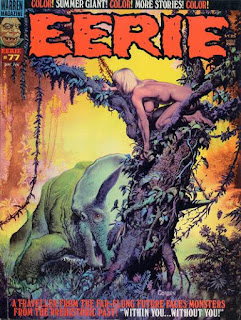
Eerie #77
"Within You... Without You"★★1/2
Story by Bruce Jones
Art by Richard Corben
"The Gift"★★
Story by Budd Lewis
Art by Leopold Sanchez
"Demons of Nob Hill"★★★
Story by Bill DuBay
Art by Jose Ortiz
"The Demons of Father Pain"★★1/2
Story by Bill DuBay
Art by Jose Ortiz
"Oogie and the Lie"★★
Story by Bill DuBay
Art by Esteban Maroto
"Stalker in the Maze"★★
Story by Nick Cuti
Art by Carmine Infantino & Wayne Howard
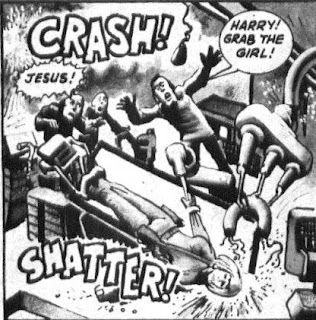
A beautiful blonde named Karen observes a Brontosaurus first-hand and reports back to her husband, Pete, and other scientists in a lab, far in the future. It seems the scientists have figured out a way to use Transcendental Meditation to allow Karen's body to remain in the future, while her mind travels into the distant past. Suddenly, an earthquake shakes the lab and Karen's supine body falls off its table and onto the floor, where she receives a nasty crack to the head. The injury leaves her mind-projected body unconscious, vulnerable, and naked in the dinosaur era. There's only one thing to do: call Jeff Lyendecker!
Jeff is awakened and summoned to the lab, where a brain scan has shown that Karen has sustained temporary brain damage that requires her mind to be summoned back from the dinosaur era so that an operation can be performed. The fact that she's being menaced by an angry triceratops makes the rescue mission an urgent one. Using the same method that sent Karen's mind back in time, Jeff is sent on his way, and he quickly rescues the young woman. It turns out that they were lovers in college and nearly got married, until Pete came along. Jeff picks up where he left off and Pete is forced to observe Karen's cries of "'Oh, darling!... Oh yes, Jeff1'"
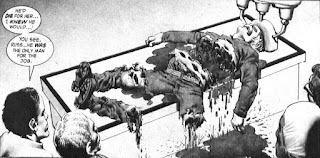
Pete tells the reticent Jeff that he must bring Karen back, but Jeff gets into a battle with a T-Rex and is bitten in half. The two have their minds and bodies reunited, and the operation on Karen's brain is a success. Sadly, Jeff's body appears torn apart in the laboratory, just as it was in the mouth of the T-Rex.
Kind of like "A Sound of Thunder" updated with a groovy '70s vibe, "Within You...Without You" seems like the sort of story Warren readers would love, but I wasn't very impressed. Corben's art is certainly an acquired taste, and I've acquired it, but I can't ignore the awkwardness in many panels. The one where the girl falls off of the table is pretty bad. I also laughed at the groovy haircut and mustache on Jeff. But what was really silly was having Karen suddenly forget that she was wearing clothes, which allowed Corben to draw her in the nude for a few pages... until her clothes suddenly return. The story, by Bruce Jones, is also weak and confusing. It seems like the entire effort was an excuse to mix up science fiction elements with dinosaurs and provide a gruesome final panel.
One night, Karyn Texlie is raped by a phantom from a faraway star. In the morning, she is happy to keep "The Gift" in her womb that the visitor has left. Across town, Gerome Adpatres, one of the Moonweavers, senses that there has been a visit from a denizen of a dark star. He and his pal, Jason, run to Karyn's house and ask if the visitor is still there, but she slams the door in their faces. Her pregnancy is soon confirmed, to the chagrin of her sterile husband, but, after eight months, there is no physical sign of the baby. After nine months, she goes into labor, but the child to whom she gives birth must be located in another dimension, because there's no evidence of him or her here.
Budd Lewis's tendency to over-write his stories is fully evident in such lines as: "She'd rolled in her sleep to welcome her night-wraith lover with Cyprian arms of semiconscious acceptance." And so on. I found it troubling that the visitor from the dark star, who is never seen, essentially rapes Karyn, but she's fine with that, even though it means her husband will be furious. She had a hot night with a ghost! Sanchez's art is okay at best and includes a couple of full-on topless panels that were unexpected. In the end, the Moonweavers is a boring series that I hope doesn't last much longer.
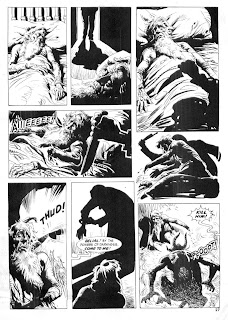
Jeremiah Pan and Jedediah Cold arrive in California [San Francisco?] in 1914 and check into a hotel, where a stranger enters Pan's room while the old man is sleeping, cuts off his hand with a knife, steals his magic bracelet, and summons up the demon, Belial. The stranger orders Belial to kill Pan, but Cold bursts in, engages in hand-to-hand combat with the demon, and kills it. [At least, I think that's what happens.] A doctor patches up Pan and tells Cold it's a dangerous town; Cold explores the area and finds a scene of great slaughter at a nearby bar, where the stranger is identified as the King of Nob Hill, also known as a weird, old peddler who goes around sharpening people's knives for a small fee.
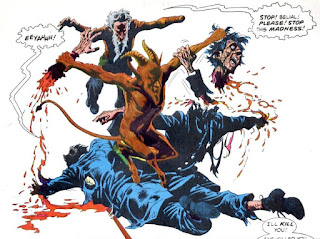
The King entered the bar and summoned up demons, who wreaked havoc among the patrons, leaving severed body parts everywhere. The King has moved on to a posh club, where he summons the demons again to tear folks limb from limb. Cold confronts the King, who orders the demons to attack the young man; Cold fights back and, somehow, the King ends up lying in the street, where a trolley car rumbles by and its wheel separates his hand from his arm. Pan and Cold stroll off, leaving the bracelet behind to be picked up by another stranger.
I gave "Demons of Nob Hill" three stars because of the terrific art by Jose Ortiz, who has become one of my favorite illustrators at Warren. The story by Bill DuBay is rather hard to follow. I usually like stories where there are wordless sequences, as happens here, but it's just awfully difficult to be sure what's going on at some key moments. Also troubling is DuBay's penchant for gore and, especially, severed body parts. We had the story with the baby whose hands were severed in a recent issue, and now we have this. I don't know if DuBay was being Freudian, but it's pretty distasteful.
Still in San Francisco [confirmed!] in 1914, the three demons summoned by the bracelet formerly worn by Jeremiah Pan are committing nightly atrocities, slaughtering innocent people in the street, taking their money, and bringing it back to a priest at an orphanage, who banishes the demons as soon as he receives the cash. Pan sees a newspaper report about the killings and realizes that his demons are on the loose. If only he had picked up that bracelet and disposed of it! That night, he and Pan stake out the area where the killings have been occurring, and they witness Belial attack a man in the street. Pan tries to stop the demon and is killed; Cold attacks Belial and is badly injured.
Cold follows the demon to the orphanage, where he witnesses the three demons give their money to the priest and then disappear. Cold tells the priest what the demons have been up to and the priest claims he was unaware of their cruelty and simply thought they were taking the money from bank vaults and wealthy businesses. He saw it as the only way to support the orphanage and thought the bracelet represented a miracle; Cold informs him that he will be haunted by what he set in motion for the rest of his life.
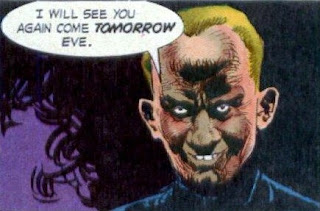
This sequel to "Demons of Nob Hill" appears to have been intended for a subsequent issue, since a caption directs the reader to "see last issue," yet here it is, coming right after the preceding story, and in full color. Ortiz's art looks better to me in black and white, and the coloring by Peggy DuBay looks muddy. Bill DuBay succeeds in penning another tale featuring plenty of carnage, but the plot holes are troubling. It made no sense, at the end of the last story, for Pan and Cold to walk away without picking up the bracelet, and now they're seeing the result of their poor decision.
As for the priest, Ortiz draws him with a decidedly evil expression at the bottom of page two, which makes his protestations at the end of "The Demons of Father Pain," that he was unaware of what the demons were doing, either a lie or simply incredible. And why doesn't Cold summon up his demons to battle Pan's demons? Why bother wearing a bracelet that allows him to do that if he's going to try to fight mano a mano with the demons whenever he encounters them? It all fails to hold together. Is the series done now that Pan is dead? Or will there be more stories with Cold? Only future issues will tell.
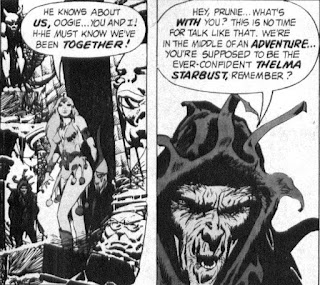
Life goes on for Leroy and Prunella, who are fated to re-enact the adventures of Buck Blaster and Thelma Starburst on a distant planet, under the guidance of the omnipotent Oogie. Leroy is depressed because Buck Blaster died in the last episode of his TV show, so when Oogie sends the Scarlet Pimple Picker of Uranus to attack them, Leroy has a hard time getting worked up, knowing that it's all a performance. What's worse is that Leroy suspects that Prunella has slept with Oogie. Prunella appeals to Oogie to help Leroy feel better and he responds by transforming her back from Goddess into human. She is still concerned about how both Leroy and Oogie can love her, so Oogie creates a second Prunella, making one for each lover. Leroy vows to take her back to civilization.
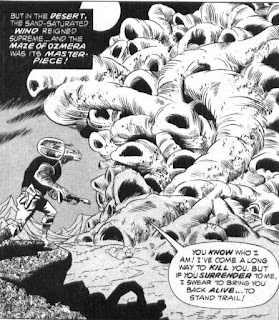
"Oogie and the Lie" isn't as bad as some of the entries in this series that preceded it. Maroto's art is still fair to middling, but he draws a lovely Prunella, and the lack of page upon page of boring battles with creatures with silly names is a welcome relief. DuBay still thinks it's funny to have his outer space characters talk like the most mundane Earthlings, but even that is toned down this time. Hopefully, we're heading toward the end of the Oogie series, if this is not already the end.
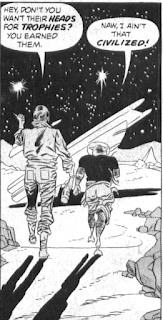
Why did the pig-like creature named Cronk kill Frank Lucas on a tiny, desert planet? And why is he after Peter Shaw? Years ago, the two humans had visited the planet Satyr, where they killed Cronk's parents and took their heads as trophies. Little Cronk ended up crawling to the Earthlings' spaceship, where he was taken in as a mascot, brought back to Earth, and raised like a human boy by another member of the crew. Eventually, Cronk identified his parents' killers and tracked them down. Shaw nearly kills Cronk, but Cronk gets the draw on him with a ray gun and kills his parents' slayer.
Post-1960s' Carmine Infantino art has never been my favorite, nor am I a big fan of Wayne Howard. I love Nick Cuti's work on E-Man but, as we've seen, some his Warren stories are below average. This first entry in the Cronk series, "Stalker in the Maze," is a short six pages and doesn't wear out its welcome. It's unusual and better than much of the Warren sci-fi we've seen to date.-Jack
Peter- I like just about anything Rich Corben produces, but whose bright idea was it to present "Within You Without You" (Hey, Bruce, great title! Can I borrow it for an idea I have for a song?) in b+w rather than glorious Warrencolor? Somehow, the Corben/Jones duo will squeeze two more "Within You" installments out of this formula. I also liked "The Gift," despite its plot being lifted from the Richard Matheson-scripted TV-flick
The Stranger Within, and Budd Lewis's cries for help in the writing department (
She'd moved against him, wantonly, making her spectral paramour burn with love's sweet fevered iron.). It's a sweet story with a satisfying wrap-up. Jack will be glad to know this was the last of the Moonweavers.
I could have done without the one-two punch of Nob Hill/Father Pain dreariness. The "bracelets from hell" plot was okay for one story but spread thin over five. As Jack notes, Ortiz's art is much better seen sans color and was clearly intended for the next issue. I'm wondering if the deadline loomed and, at the last second, "Within You, Without You" lost its intended color and the already completed "Father Pain" was substituted. Conjecture on my part, but Rich usually gets the royal treatment.
This issue seems to be a cleansing of the palette, since both "The Bracelets" (or "The Demons" or whatever DuBay called this series) and "Oogie" bite the dust. I will not lie and say I pored over every panel of "Oogie and the Lie." The first three installments were excrement, and from what I gleaned from this final chapter, Dube didn't decide to go out with a bang. Cronk is a strange animal altogether. The art feels like a throwback to the bad old days of Rocco Mastroserio and the script so dearly wants to be clever a la Harlan Ellison. Cronk isn't so much a series as a two-parter (we'll get Part II in Eerie #80), so maybe the conclusion will provide depth, but I wouldn't put money on it.
 |
| Torres |
Vampirella #54
"The Day the Music Died" ★1/2
Story by Gerry Boudreau
Art by Gonzalo Mayo
"Twilight of Blood" ★1/2
Story by Gerry Boudreau
Art by Gonzalo Mayo
"Chaos in a Sleepy Suburb" ★
Story by Gerry Boudreau
Art by Gonzalo Mayo
"Bowser" ★★★
Story by Jan Strnad
Art by Rich Corben
While wandering through Greenwich Village with her friends, Vampirella happens upon a record store playing a haunting melody (
Strains and refrains/isn't that what love is?/Pushing forward, holding back/Listening to the music of our hearts/Strains and refrains/Can you feel the rhythm?/The melody's tight/the harmony's right/Let's listen to the love song in our hearts...) and steps inside to learn more about its creator. The store owner explains to Vampi that the singer is a local guy named Paul Daltrey (Who?), but no one has ever actually seen the man, since he's a recluse. Unbeknownst to all, Daltrey is inside the store at that very moment and has fallen head over heels for Vampi ("It might have been her smile, warm as a Christmas fireplace, or the bright dancing eyes that found wonder in every detail"...
or it might have been those fabulous breasts...), convincing himself that she must be his.
The next day, the crew head over to see one of Professor Van Helsing's old buddies, Mitchell Neusner (think, oh, I don't know, Boris Karloff?), an expert on occult paraphernalia. Neusner shows them a new acquisition, the Blood Ball, and explains its origin. Centuries before, a nobleman named Tarkington had murdered a gypsy after the woman had read him a particularly bad fortune; after the act, he steals her crystal ball. The memento begins to bleed, driving him insane, and he murders his own sister, hanging for the crime shortly thereafter. Through the ages, anyone who has spilled blood and comes in contact with the Ball will lose a friend in a violent way (at least I think that's what the convoluted curse is all about!). Vampi touches the ball and it bleeds. Not a good sign.

Back at the hotel, Vampirella discovers she's got an enormous hunger and her synthetic blood is not extinguishing her lust for the sticky stuff. Conrad theorizes that Vampi has become immune to the substitute and will attempt to craft a headier brew for the vixenish vampiress. In the meantime, Conrad suggests Vampi hide out, away from humans, at a cottage owned by Mitchell Neusner. When they arrive, Conrad shackles Vampi in the basement and leaves Neusner on watch. Unfortunately, the hapless rock star named Paul Daltrey has once again followed the group and, seeing his love confined in a dungeon, knocks Neusner unconscious and releases the blood-crazed Vampirella. She dines on Paul.
Told from the viewpoints of Vampi and her supporting cast, "The Day the Music Died" (and the rest of this 42-page "Book-Length Epic!") is a meandering miasma filled with long stretches of nothingness and awful writing ("...the town was deader than a barbecued pig," or, in my favorite bit, when Vampi's dialogue contains definitions quoted from Webster's). I'm not sure why such a big deal is made about Daltrey's vocation, or why he's extinguished without leaving so much as a trace on this story, but perhaps the second chapter will give me more than just strain and refrain.

We all know that funny book writers ask for trouble when "writing songs" for their strips. Gerry Boudreau's bad Simon and Garfunkel homage, "Strains and Refrains," is no better nor worse than the time Big Bob Kanigher attempted to capture hippie music for a Sgt Rock installment, but it still smells like a Junior High "write your own song" homework assignment. And why does it seem like Vampi (clad, inexplicably, in jean cutoffs) and her crew are just wandering the streets of New York aimlessly. "Whattya wanna do tonight, Vampi?"
In the second chapter, "Twilight of Blood," Conrad and the boys desperately seek a "Synthetic Blood 2.0" before Vampi completes her transformation into man-killing monster. She attacks Adam when he tries to comfort her and, during the fray, the Blood Ball is destroyed. Vampirella escapes the dungeon. Meanwhile, escaped convict Jack Buck is creeping through the swamps of New York (do they have swamps in New York, Jack?) when he comes across the very hungry vampiress. She dines.
While dumping the body of exsanguinated ex-folk singer Roger Paul Daltrey, Conrad and the boys are confronted by hick sheriff Abner Lowery, but the lawman is quickly knocked unconscious by handy Karloff impersonator Mitchell Neusner. The boys hear Buck in the distance as Vampi sinks her fangs and they immediately dump Daltrey and head back to the dungeon, where they find the unconscious Adam. He brings them up to date.
Sheriff Abner awakens and hops in his car, only to run smack dab into the creature that was living inside the Blood Ball, now resembling a big, scary storm cloud. The thing appropriates Abner's body. The cavalry arrives in the form of Sgt. Les Doyle, who trolls the swamps, searching for the missing Abner. What he and his deputies find is the body of a local family doctor, evidently the victim of some ritual sacrifice. One of the cops interrupts Doyle's train of thought to report he was attacked by a gorgeous, scantily-clad woman. He shot and killed her.
Boudreau amps up his dopey analogies in "Twilight of Blood" ("quieter than a spider's sneeze" gives way to "smelled worse than a skunk's armpit") and steers this story straight ahead into nothingness. This second chapter is a whole lot of dead ends. Jack Buck is introduced and dispatched in no time. Same goes for Abner Doyle. And how about that cliffhanger of a final panel? Why bother having chapters? And I know I'm a dim bulb, but what does it mean when the newly-introduced police sergeant explains that he should have listened to his pa and become a brain surgeon, but then no one "should listen to anyone kinky enough to name his son Les Doyle?"

Luckily, the scantily-clad vixen shot down by a trigger-happy hick cop was not our favorite vampiress but, actually, a resuscitated corpse courtesy of Chaos, our favorite cult of darkness, practicing black magic in the woods nearby. One of the new members, gorgeous Belinda Banning, can't take the fact that it's her friend who is sacrificed and zombified by Chaos, so she grabs a shotgun and blows away the entire clan. Later, after Sgt. Doyle and the Vampi squad do away with all the zombies, the cop tells Belinda he won't be arresting her for murder, since she saved his life. Vampi and the gang head back to Manhattan, where Conrad hands over a new version of synthetic blood to the knockout nudist, and they all have a good laugh, having put in the rearview mirror the indescribable events of the last three weeks.
This has got to be one of the biggest wastes of paper Jim Warren ever mass-produced (I've never seen the Heidi Saha book, but lots of pedophiles have given it a thumbs-up). There's no linear storytelling, which wouldn't be so bad if there were actually a story to tell. The climactic chapter, "Chaos in a Sleepy Suburb," is extremely confusing with its shifting perspectives and annoyingly brief Chaos cameo. I wasn't sure if Chaos or the Blood Ball was responsible for all the supernatural shenanigans and I'm still not sure I was provided with an answer in the end.
Amazing that new editor Louise Jones thought Boudreau's big, giant, epic, colossal turd was worthy of 42 pages. My eyelids were shutting every few panels, with the only saving grace each new nugget of dialogue dumped in the road: "
I don't even have an alternate plan. Everything is based on familiar action/consequence patterns of behavior, but now these patterns have broken down... and I'm screwed!" Reading a Boudreau script is like watching Michael Bay's latest and waiting for the slo-mo shot of an American flag waving in an overgrown backyard, drying sheets fluttering in the wind. When that moment comes, you pump your fist and scream, "Yeah!" I do the same when Gerry inserts some kind of crazed perspective into his work. In this "Day the Twilight of Blood Died in a Sleepy Suburb" epic, my fist was continually in the air.
Mayo's art is all over the place here. Never before have we seen so many posed shots of V that don't match up to the dialogue (second panel from the top). I get that the artists are told they have to get in as much soft-core porn as they can in each strip but, to me at least, these "photoshop shots" completely take me out of the narrative. Sorry. Why bother paying a scripter; just publish 42 pages of peek-a-boo art.

Little Timmy loves his pet, Bowser but the tentacled monster keeps eating the neighbors. Ma and Pa say something has to be done. There's admittedly little more to the long-delayed "Bowser" than that, my friends, and I'll quickly add a "thank goodness!" This is one of those goofy, far-fetched strips Rich Corben became a master of (see "Terror Tomb!" and "Lycanklutz!"); we're not even told what kind of creature Bowser is or how Timmy's family came to be in possession of the lovable critter. To which I add a "thank goodness!" The saving grace to an otherwise awful issue. Please note that Rich restrained himself in re: mom's breasts.
-PeterJack-If the point of the Vampirella series is to give teenaged (or younger) boys sexy pictures to drool over, then this three-part "epic" is a success. If there is any intent to tell a coherent story, then it's a failure. The changing perspectives, which are labeled with occasional inter-titles identifying which character is telling the story at any given point, are initially confusing, but after a while they make some sense, even if they don't succeed in helping Boudreau craft a coherent narrative. The first part, "The Day the Music Died," is poor, but the second part, "Twilight of Blood," actually starts to make some sense partway through. However, part three, "Chaos in a Sleepy Suburb," is dreadful. There are too many pop-culture references and the return of the Cult of Chaos is handled awkwardly. The best thing about this 42-page story is the sight of Vampi in cutoffs, a look I hope she adopts on a long term basis.
On the other hand, "Bowser," delayed by almost two years, is a silly and fun story, just the sort of thing we expect from Corben. The image of the creature devouring the Avon lady is funny, and the end is a classic "eww-gross!" moment. Even stranger is that the story is in color at the back of the book.
And yes, there are many swamps in New York, including one of the biggest in the state, not far from New York City. The name Les Doyle was a play on the cleaning product, Lestoil.
 |
Next Week...
Introducing...
Robin 2.0! |