Monday, September 14, 2020

The Warren Report Issue 42: April/May 1973


The Critical Guide to 
the Warren Illustrated Magazines
1964-1983
by Uncle Jack
& Cousin Peter


Dominguez
Eerie #47 (April 1973)

"Enter the Dead-Thing!"★★★
Story by Bill DuBay
Art by Tom Sutton

"Lilith"★★1/2
Story by Nick Cuti
Art by Jaime Brocal

"Snake Man"★★★
Story by Greg Potter
Art by Martin Salvador

"The Message is the Medium"★1/2
Story by Doug Moench
Art by Paul Neary

"Gemma-5"★★
Story by Esteban Maroto & Marv Wolfman
Art by Esteban Maroto

"Enter the Dead-Thing"
As the ship sets sail on its trans-Atlantic voyage, Dracula has already put the bite on the old witch and now he adds the young prostitute to the ranks of the undead. The two vampires snack on the sailors as the weeks pass, until one night when the young vampire hooker is found by the sailors who are playing cards below decks. The captain takes her back to his cabin to have his way with her. Meanwhile, the old witch, who is blind, stumbles on the coffin of a rotting corpse that is alive.

Dracula wakes up and senses that his two fellow vampires are in danger. Up on deck, "Enter the Dead-Thing!" The rotting corpse shambles around, killing sailors and menacing the younger of the female vampires. Dracula intervenes and a sailor's torch accidentally sets the ship on fire. The vessel burns to a crisp, killing the walking corpse, but the three vampires fly off in bat form and reach Castle Dracula. It's not a great homecoming, though, when an old man in a chair blows away Drac with a shotgun.

As with last issue's story, Sutton's work is impressive, though this time DuBay struggles to know what to do with the narrative that has been set up. The shipboard horrors of the vampires are given short shrift and the Dead-Thing comes out of nowhere and is gone just as fast. What was it and why was it there? Your guess is as good as mine. The entire story seems like filler to get Dracula from point A to point B, but his supposed death at the end seems like a gimmick to get readers to clamor for next issue's follow up.

"Lilith"
A manuscript discovered in mid-eighteenth century England in a tomb marked "Lilith" tells of the sister of the Biblical Eve. Adam preferred Eve to Lilith, who vowed to destroy Eve. Many centuries later, Adam and Eve are still worried about Lilith, who uses Eve to test Adam's pacifism. He passes the test but Satan turns Lilith into a vampire. Her long slumber is interrupted when the workmen discover her tomb, and she rises in order to drink human blood.

At nineteen pages, "Lilith" is inordinately long for a story in Eerie, especially one that is not part of a series or in the issue's lead slot. Jaime Brocal's lovely art makes it more enjoyable than it should be, and the long passage in Eden is hard to take. At least Cuti doesn't overwrite and it's easy and fairly quick to read. I do not really get how Adam and Eve are still around in the 1700s (I'm guessing at the century) or why Lilith is in a tomb and rises at the end to drink blood, but it's not awful.

Lost in a sandstorm, a Bedouin named Kari is saved from certain death when a cobra that is about to strike him is killed by a shot from the rifle of a man who calls himself Jerimiah. The two travel on together and Kari is shocked to see Jerimiah kill another cobra and eat the snake whole. Jerimiah is the "Snake Man," whose facial features and slithery tongue are very serpent-like and who subsists on eating cobras.

"Snake Man"
Jerimiah had been a collector of reptile skins who was cursed by the god Slikandi and forced to subsist on cobra snacks. He now heads for Slikandi's stone temple, where Kari helps him get past a giant snake guarding the entrance. Once inside, they meet the god, who agrees to set Jerimiah free. Jerimiah has met the three conditions set out for his release. Kari is shocked to learn that condition number three was to bring a human sacrifice for the god!

"Snake Man" is surprisingly good, both in art and story, though the ending is a letdown. Having Slikandi kill Kari just doesn't seem enough of a payoff after the way the story was set up. Still, it's an enjoyable read with a good balance of writing and art.

"The Message is the Medium"
After Abe murders his wife, June, he joins his girlfriend, Lorrie, for dinner. She insists on attending a seance at Madame Mortura's parlor, but the seance only serves to call forth the spirit of the late June. Abe freaks out and breaks the circle, so June's spirit disappears. He is so angry that he kills Madame Mortura, whose spirit drives Abe to make a run for it, right into the path of a speeding car.

This issue of Eerie was moving along pretty nicely until it ran smack dab into a Doug Moench story. "The Message is the Medium" is a hodgepodge of several of the worst elements of Warren mags of this period: a groovy murderer, an obvious story, and vague, dreamy art. Fortunately, it's only eight pages long.

"Gemma-5"
Dax thinks he's all alone on the planet "Gemma-5" until he comes across a barbarian and a blonde battling a dinosaur. Dax kills the dinosaur and steals the blonde, who falls madly in love with him and makes his "insides stir." "Moon-flecked fantasies and star-lit dreams" consume the duo at night in a cave, as they share "the soft, warm throbbings of love" (I couldn't help quoting that part). The barbarians catch up with Dax and battle ensues. The blonde dives underwater and gets inside her interstellar ship--it turns out she was a scout from another planet who now will report back that this planet should not be invaded, since she secretly loves Dax.

I was going to write a much shorter summary along the lines of "more Dax nonsense," but Wolfman's purple prose was too good (or bad) to resist. Suffice it to say that the poor scribe had to rewrite whatever Maroto had written originally to accompany his pictures, and it can't have been easy to make sense of this.-Jack

"Snake Man"
Peter-I'm super happy to see a batch of new art from Tom Sutton, but is it asking too much for DuBay to explain what the dead thing on board was? Dracula wasn't really required much in this tale, was he?  "Lilith" is about ten pages too long and has a really dumb climax. Satan's a really powerful guy, but he has to rely on two dopes to stumble across the hidden papers? "Snake Man" is easily the best and most entertaining tale this issue. It's loony as hell but it's got an eccentric energy that I really enjoyed. And this could be the strip where Martin Salvador finally made a stab at greatness. That full-pager of the first meeting between Jeremiah and Kari is a stunner!

It would save me a lot of time to just keep a cut-and-paste of "Oh no, not another Doug Moench script!" on the go but, perfectionist that I am, I'm always perusing my thesaurus for different ways to say "crap" or "nonsense." "The Message is the Medium" is worth reading only for the delicious Munch-isms contained therein: "Two people have you now killed--and two spirits given birth to! Though determined enough to traverse the void of disbelief, your wife had not the control to sustain herself once the circle of remaining belief was broken..." Huh? Doug's lead characters always come off as smug, smart-ass hippies and Abe is no exception. I couldn't even figure out what was going on there in the climax. Paul Neary draws nice boobs, though. Same goes for Esteban Maroto, as we well know. What also is apparent is that Marv Wolfman, usually a very competent funny book scripter, has no idea what the hell is going on in those pretty pictures that were sent his way. Did I miss a chapter where Dax became a spaceman? What's with this "planet called Gemma-5" stuff? Is it a dimension he's been trapped in? Another dream-world? How come he doesn't need a space-suit? And why do the Gemma-5s look like cavemen? Nice boobs, though.


Torres
Vampirella #24 (May 1973) 

"Into the Inferno!" ★★1/2
Story by Bill DuBay
Art by Jose Gonzalez

"Middle-Am!" ★1/2
Story by Steve Skeates
Art by Esteban Maroto

"Homo Superior" ★
Story by Robert Rosen
Art by Ramon Torrents

"The Choice" ★★
Story by Doug Moench
Art by Rafael Auraleon

"Changes" ★
Story by Steve Skeates
Art by Felix Mas

"Into the Inferno!"
Sitting in a pub with his best friends, Pendragon suddenly starts feeling sorry for himself, muttering about his poor, lost Rosie, the wife who died years ago. He gets up and leaves the bar, with Vampi following quickly behind. At that moment, a car pulls up and four thugs hop out, grabbing Pendragon and shoving him in the back seat. Vampirella puts up a fight but one of the hoods clocks her with his machine gun. They toss the gorgeous Drakulonian in the back seat with her buddy and speed away.

When Vampi and Pendragon awake, they're in a cell and, very soon after, a man enters. He introduces himself as Richard Granville, Pendragon's son-in-law! He goes on to say that he's about to embark on a path of vengeance, a punishment of Pendragon for abandoning his family when they needed him most. In a flashback, we learn that Pen had enlisted in the Army and was accepted by the USO, leaving his wife, Rosie, and small daughter, Sara, alone to fend for themselves. Rosie got a job at an electronics plant, fell in love with her boss, Richard Pound, and divorced Pendragon. And as far as he was concerned, Rosie wanted him out of his life and he was only making her happy. Granville provides Flashback #2, an alternate history of Rosie and Sara, one in which Rosie does, indeed, marry Pound but the man then begins drinking and beating on her and Sara. One night, as he's laying into the little girl, Rosie pulls a knife and Pound pushes her out the two-story kitchen window.

"Into the Inferno!"
Sara then goes to live with young Richard Granville's family and, when Pound is released and comes looking for Sara, the elder Granville (a mafia Don!) has him killed. Flashback over, Granville has some startling news for Pendragon: Rosie is alive. And ta-da! Here she is, wheelchair-bound and extremely bitter! And, behind door number two, is the daughter who hates you so much! Sara and Rosie do everything but spit in Pendragon's face and tell him that what young Granville has planned is too good for the likes of him. Granville unveils his master scheme: he is going to hook Vampirella on pure cocaine and let Pendragon watch her deteriorate just like Granville and Sara have with Rosie. A matter of minutes later (I think), Vampirella approaches Pendragon with her fangs bared. High on pure snow, the vampiress has no synthetic blood, she's starving, and she's seeing bunny rabbits. Not a good combination.

"Into the Inferno!"
"Into the Inferno," the first of Bill DuBay's scripts for the Vampi strip, is a little too full of flashbacks and coincidences. Let's see. Pendragon just happens to be pining for his long-dead Rosie when, whattaya know, Rosie's son-in-law's thugs arrive to kidnap him. And how do these comic book thugs always know where to find their targets? The fact that Rosie and Sara are hungry for revenge against a guy whose wife (Rosie) was cheating on him while he was off to war is a little noggin-scratching, no? Since young Granville was there for the entire soap opera, I would have thought he'd have looked at hate-filled Sara and said, "Hang on, sweetheart, this guy might be the victim here!"

Still, it is kind of a nice respite from the ten or twelve different satanic cults that roam these here pages, and I'm kinda looking forward to the conclusion, where we see Vampi wearing a bat-shaped coke spoon around her neck, white powder residue all down the front of her outfit.

"Middle-Am!"
In some kind of future, a young man with a sword tries to cross "Middle-Am!" and is arrested and hanged for his troubles. There's a deep hidden message here but it's actually screamed out loud at several hundred decibels. "If you're different, you will pay." "If you question religion, you will pay." "If you waste your time reading all six pages, you will pay." To be fair, you should know what you're getting into, reading a Steve Skeates script entitled "Middle-Am!" I can only imagine the reason this was written was so that we, as the reader, would gasp and exclaim, "That Skeates is a poet!" Can we just see more Tom Sutton, please?

"Homo Superior" is a padded, meandering mess, a science fiction take on the "And Then There Were None" formula. At the monthly Big Brains social meeting at the Werner Research Institute, Dr. Horner announces that, according to his carbon dating experiments, one of the five scientists present is a "Homo Superior," a superman who is actually nearly 5000 years old. As the other scientists scoff (and die), the creature pops up now and then to ensure we know he actually exists. In the end, it's the guy we least expected but may not have stayed awake to see the results. This is an overlong dirge with some really bad dialogue and a whole lot of confusing plot detours. The Torrents art is all right but Ramon sure isn't challenged by a story that requires him to draw panel after panel of old talking heads.

Auraleon was obviously drawing inspiration
from the latest Famous Monsters.
Damien is cursed as a werewolf but, thankfully, he has an understanding wife in Lissa, who locks him up during the full moon and brings him rabbits to munch on. Alas, Damien soon discovers that Lissa is actually in love with their servant, the mysterious Karl. Who is Damien to rain on the couple's parade? How can he give his wife the love she obviously needs? That heartfelt emotion and unselfishness lasts for about three panels and, once the full moon rises and Damien becomes the wolfman, he breaks out of his cell to kill Lissa and Karl. What he witnesses changes everything. Karl is actually a vampire and he's bitten Lissa, transforming her into a vampiress. When Karl goes out to hunt, Damien burns Lissa alive to free her of her curse. As he looks into the fire, Damien struggles with "The Choice": should he free himself of his curse by leaping into the flames or stalk Karl and rid the world of another vampire? The final panel is a strong one, Damien's inner quandary is a good way to end the story. The rest of it is a bit padded (and Auraleon is probably not a good choice to draw werewolves); we don't really have to have repeated scenes of Damien, locked in his cell, musing about the wonderful wife he has. And, thankfully, My Man Moench doesn't disappoint. The adjectives flow freely like the Thunderbird wine at a Warren Awards banquet. I cursed those horrible giggling fates... Should I seek out the vampire Karl and slay him, and therefore suffer myself as a beast of prey? 

We need some "Changes"
Ted arrives home from work to discover someone has buried a "meat cleaver" (actually, it looks more like a steak knife) in his wife's head. But, since this is the future, Ted simply has to bring his wife's body down to the Operations Complex and they'll bring her back to life, with some alterations Ted insisted on (bigger breasts, etc.). Then, after his wife is up and running again, Ted gets to deliver "retribution" to the guilty party. Steve Skeates, obviously not having delivered enough messages in "Middle-Am," shows us how disposable life is in "Changes." Why, even Ted's kids can't be bothered by Mom's corpse. If Steve wrote this in 2020, I assume the two brats would be sitting in the living room with their mom's body, playing Minecraft. But then, I'm not even sure if the kids are real. Is the wife an android? My head hurts and I hate this crap. Is my subtle message getting through?-Peter

Jack-Peter, as I diligently perused the verbose stylings of the awe-inspiring Doug Moench, I could not help but scratch my noggin and wonder to myself what my esteemed collaborator would think of this story. There. See? Anyone can write like Doug! I love Auraleon's art but his swipes of old movie stills of Henry Hull and Lon Chaney Jr. were no substitute for good story telling. The two Skeates stories are terrible: "Middle-Am!" is filled with heavy-handed symbolism and "Changes" is a waste of space with a befuddling finish. What's the point of having Maroto draw a story ("Middle-Am!") with no girls?

I kind of liked "Homo Superior" for its mystery aspects, but I admit I lost track of who was who partway through and by the end I wasn't clear what the bad guy's role was. I think the art is not bad. Finally, the Vampi lead story is fun, since I really like Pendragon and am happy to get some back story on him. It's an odd tale for the series, though, since there's not much Vampirella, little horror, etc. I do like the cliffhanger, though.

From Vampirella 24

From Vampirella 24


Sanjulian
Creepy #53 (May 1973)

"A Scream in the Forest" ★★★
Story by Greg Potter
Art by Esteban Maroto

"The Stone of Power" ★1/2
Story by Steve Skeates
Art by Ramon Torrents

"Freedom's Just Another Word" ★★★
Story by Bill DuBay
Art by Adolfo Abellan

"The Creature of Loch Ness!" ★★★
Story by Doug Moench
Art by Jose Bea

"The Night the Creatures Attacked" ★
Story by Fred Ott
Art by Rafael Auraleon

"It" ★★★1/2
Story and Art by Tom Sutton

"A Scream in the Forest"
Every time there is “A Scream in the Forest,” Ussel and his fellow elves know that the faeries are hunting again. The preferred delicacy for a faerie is a bosomy naked chick, but any human meat will do if push comes to shove. And so Ussel finds himself walking through the forest one night when he is attacked by a monstrous faerie. The creature is about to sink its fangs into Ussel when a sword-carrying savior named Arn of Whitlock seemingly falls from the sky to cleave the thing in two.

Thankful, Ussel agrees to put up Arn for the night and the two discuss the state of faeries. Ussel insists that Arn is just the man to wipe out the gang of elf-eaters hidden in the forest, but Arn dismisses that notion with a cackle. Just then, a blood-curdling scream emanates from the forest and Arn is convinced. He will slay the monsters. The next day Ussel and Arn are off, tracking the faeries across the forest and into their mountain-top cave. Once they enter, Arn coldcocks Ussel and hands him over to the faeries, who pay Arn handsomely with diamonds and send him on his way. Arn will be back with another sacrifice soon.

It’s nice to finally get a readable script to pair with Maroto’s luscious art. His beasties are pretty cool, as are his landscapes (just check out the detail in the panels of Arn and Ussel atop the huge tree-bridge that leads to the cavern), though I must complain about the severe lack of nude female sacrifices. The twist is a good one; any twist is good if you don’t see it coming, I suppose.

"The Stone of Power"
A little boy finds a “powerstone” under a house while he’s playing and takes it home to stash with his other souvenirs. A few days later, while he’s fishing, he watches in horror as his house collapses around his mother and an old witch rises from the wreckage, holding “The Stone of Power” and flying away before the boy can even utter a breath. His mother’s body is never found.

Twelve years later, that boy has grown into a man and meets a woman dabbling in black magic, who claims an old woman she knows might be the witch. Together, the two go to the old woman’s house, where they find the power stone and attempt to flee when the witch appears. Sensing the power within the rock, the young man uses it to unleash a powerful ray that cuts the witch in half. Our hero has attained his revenge. But, hold on a second… as he gazes at the dead witch, it occurs to him the woman is actually his mother! Now, the power of the stone courses through his veins.

Another half-baked Steve Skeates script, with lots of confusing and confounding turns and inexplicable twists. Once you get to the climax, the setup makes no sense at all. If the old crone was actually his mother, why did she fake her death and head off to another town to take on another identity? And what a whale of a coincidence that this guy (who is never given a name) is able to latch onto this woman (that relationship is never explained either) who’s been “tutored” by a witch who obviously wants to keep a low profile but, perhaps, wants to earn a living teaching black magic! And what about that deliberately hazy climax? Man, this is supremely dopey. The Torrents art is not bad, though.

Just after the end of the Civil War, the Turners move into the all-white town of Piper’s Bluff, a group of people who might not have known the Civil War was being fought. Immediately, the townsfolk begin harassing the peaceful Turners, who build their home just outside town; all except kind-hearted Rosie, who becomes a friend of the Turners before very long.

Unfortunately, the loudest bigot voice calling out in Piper’s Bluff belongs to Ward, Rosie’s Pa, a very powerful man in town. Once Ward discovers Rosie is keeping time with the Turners, he organizes a campaign of hate and violence, insisting to anyone who will listen that the Turners are witches, culminating in the murder of the entire family at the Turners’ home. Only Gramma Turner, paralyzed and wheelchair-ridden, is left alive. A big mistake, as Rosie, who has witnessed the entire massacre, watches as Gramma speaks one word and every murderer is struck by lightning.

"Freedom's Just Another Word"
I’ve got mixed feelings about “Freedom’s Just Another Word,” Bill DuBay’s powerful condemnation of racism. DuBay doesn’t resort to the type of preaching or pandering found in Moench or McGregor’s work (it fits in comfortably with the type of anti-racism horror story that filled the pages of EC’s landmark Shock Suspenstories in the '50s); the writer liberally sprinkles his dialogue with the N-word but he uses it in a negative way (spoken by stupid and heartless rednecks… some things don’t change, do they?) rather than showing off. I get the feeling Bill wants to tell a story rather than change the world. As for the subplot of witchery, well, that’s pretty silly. If Gramma was a powerful witch who could strike men dead, why didn’t she do it before her entire family was slain? Nice twist in the end, though, when it’s revealed that Rosie is simply a friend of Charles, rather than a lover. I was also suspecting Rosie was the witch, since Gramma seemed a little too obvious. I’m sorry but I am not warming up to Abellan’s art; the action going on between the panel borders is almost indecipherable, folks. It's an ugly, scratchy mess.

"The Creature of Loch Ness!"
Scott Curtis is determined to prove to the world that “The Creature of Loch Ness!” really exists. Scott decides the best way to deliver the message is to talk Professor Simon Stambolis, a known debunker of Nessie and a Tom Petty look-alike, into accompanying him to the Loch for photographic evidence. Stambolis is, at first, skeptical of the trip but finally agrees, since he’s sure nothing consequential will materialize. They check in to a hotel on the Loch and immediately begin to stake out the water. Several times, Scott thinks he sees something but, alas, it always turns out to be something innocent like a log or a floating beer keg.

On the final night of their stay, Scott insists that they take a small boat out to one of the more remote parts of the lake. Very soon, a long neck comes out of the fog and Stambolis is forced to agree that, yep, there is a monster. Scott snaps a roll of film and, happy with life, heads the boat back to shore. The next morning, they catch a plane back to America and the hotel manager rows his little boat out to where he left his inflatable Nessie. While letting the air out, the man is eaten by the real Nessie. Back in America, the Professor gloats that the photos plainly show an inflation plug on the monster. There is no such thing as the Loch Ness monster! A fun little romp, accompanied by some great Bea graphics. Stambolis’s constant “Harumph”s and “Poppycock”s are hilarious, as is the fact that two grown men were suckered by a K-Mart swim toy.

“The Night the Creatures Attacked” is an oddity, a two-page vignette purporting to be a true story. These things were usually placed on the inside front and back cover but, for some inexplicable reason, this one was deemed so important that it was given the royal treatment. Little green men “terrorize” a small backwoods town and bullets are useless. I would have skipped this one but for my sense of duty.

"It"
The corpse of Timothy Foley rises from its grave and shambles across the countryside, inadvertently leaving a trail of mayhem and fresh corpses behind it. Timothy’s looking for something very important to him but the long and arduous journey is fruitful. He arrives at his old home, now shuttered and awaiting sale, to find his favorite teddy bear. Timothy shambles back to his grave and rests forever.

Like a lot of Tom Sutton’s lunacies, “It!” is actually better off not synopsized and if we could get away with it, I’d just as soon run the whole story rather than my sentences. Not all of it holds together (needlessly complicated in its explanation of why Timothy is actually in the grave) but “It!” is a visual delight. Sutton again plays with the standard number of panels and delivers a whole lot of text around the teensy-weensy illustrations. The first death, wherein a man who’s murdered his wife and is at lover’s lane with his new squeeze, is hilarious. The guy is convinced that Timothy is his dead wife, Martha, and his bimbo girlfriend accidentally hits the gear shift and sends them tumbling over a cliff. Seriously, was there anyone else associated with Warren (or horror comics in general) that was as equal parts talented and loony as Sutton? Nope. An absolutely top-tier issue of Creepy.-Peter

"It"
Jack-A top-tier issue includes two stories that rate one and a half stars each? (when the other four are three-stars plus? Yep!-Persnickety Pete) I agree that "It" is a great story, though. It's the best Warren tale I've read in some time, four stars all the way. Finally, we get some real horror--not sword and sorcery, or science fiction, or whatever Maroto does half the time. There's even a light touch with the teddy bear. I love the way Sutton designs the first three pages with sixteen panels each before getting creative with the panel layouts on subsequent pages. He absolutely nailed this one and I can't imagine why they stuck it in the back of the mag after all the ads.

"A Scream in the Forest" demonstrates that Maroto is better when someone else does the writing. I'm tired of reading stories about long-haired warriors with swords, but the ending was a surprise. "Freedom's Just Another Word" is a brutal, cruel story that works powerfully until DuBay drops the ball at the goal line (often a problem with Warren stories). Abellan's art looks unfinished but is intriguing enough that I wish it had been cleaned up. The witch's vengeance needs to be more prolonged to equal the horrors that are visited upon the Black family.

"The Creature of Loch Ness!" has a similarly disappointing ending, though it's pretty good up to that point. The art is technically good in "The Stone of Power" but Skeates's writing is, as usual, terrible, and the end is a mess. "The Night the Creatures Attacked' barely qualifies as a story.


SPECIAL BONUS STUFF!!!


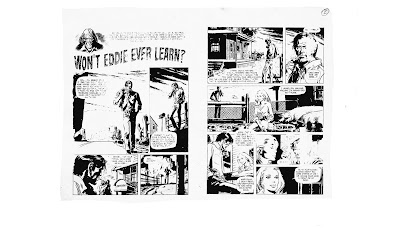
Last week, in our comments section (which was unusually active), writer Jim Stenstrum dropped the bombshell that Felix Mas was not the first artist assigned to "Won't Eddie Ever Learn" (from Vampirella #23) and that art for the story was actually completed by another artist. Here, for the first time before a live audience, we present that original art. Jim does not know the name of the artist but hopes someone with a keen eye (we have several of those keen eyes out there) can identify this mystery illustrator. Join me in thanking Jim for sharing this!


Next Week...
Michael Fleisher!!!

Saturday, September 12, 2020

Richard Matheson versus Oscar Hammerstein!

by John Scoleri

Only the most devout followers of Richard Matheson are aware of his desire to be a songwriter. A collection of his lyrics was published in 2011 (solely as a Kindle e-book) with the following description:

Few of Richard Matheson's readers know that he had hopes for writing popular music. At a very early age, Matheson taught himself how to write sheet music, but his family could not afford art supplies and so he had to give up composition. But music never left his mind and when Matheson found a creative new outlet through his writing (cheaper than music, requiring only a pencil and paper), he quickly began composing both prose stories as well as poetry. He picked up music composition again at the age of seventeen, adding music to his poems.

At the end of 1949, Matheson had yet to see his first short story published (it would be another six months before "Born of Man and Woman" would blow the minds of readers of the Summer 1950 issue of The Magazine of Fantasy & Science Fiction — the first of his 20 appearances in the magazine!).


In the December 3rd issue of the Saturday Review of Literature, Matheson came across an article titled "Where the Song Begins" by Oscar Hammerstein (who along with composer Richard Rodgers was riding high on the Broadway successes of Oklahoma!, Carousel, and South Pacific [The King and I and The Sound of Music still to come!]). The article had enough of an impact on Matheson that he was moved to write the following letter to the editor, which was published in the January 7, 1950 issue:


The editors reached out to Hammerstein for a response, whose letter followed Matheson's in the magazine:


It's probably safe to assume that Matheson wasn't expecting to read a response from Hammerstein himself, but it makes for an interesting historical anecdote so early in the up and coming writer's career!

Personally, I'm thankful that Richard Matheson didn't have a hugely successful songwriting career. I can't imagine trading any one of the following in exchange for a few great songs: I Am Legend, The Shrinking Man, Hell House, Bid Time Return ... let alone the countless short stories, teleplays and screenplays we might have otherwise been deprived of!

Matheson wasn't the only one driven to write in response to Hammerstein's article — Tess Huff (also of New York) suggested a clever way to test the lyricist's theory...

Thursday, September 10, 2020

The Hitchcock Project-Harold Swanton Part Seven: Bang! You're Dead [7.2]

by Jack Seabrook

When watching the Alfred Hitchcock Presents episode, "Bang! You're Dead," it is important to keep in mind three things that were going on at the time it was broadcast in October 1961. The first is the civil rights movement, which had been growing in the U.S. since the end of World War Two. By the spring of 1961, Freedom Riders were touring the southern states and bringing national attention to segregation and poor living conditions among African Americans. The second is the series of wars for independence in Africa that were fought by native Africans to overthrow the colonial powers that had ruled their countries; these wars were going on throughout the late 1950s and early 1960s and resulted in numerous African countries gaining their independence around 1960.

Steve Dunne as Uncle Rick
The third topic to keep in mind is the popularity of the Western genre on television in the 1950s and 1960s. In 1959 alone, there were no less than 26 Western TV series airing in prime time. Little boys across the country dressed up in cowboy hats and boots, shooting toy guns at each other and pretending to reenact the same colonial oppression of Native Americans that had been the subject of so much rebellion in Africa.

All of these themes come together in Harold Swanton's script for "Bang! You're Dead," directed by Alfred Hitchcock. According to the title card, the show is based on a story by Margery Vosper (1912-1981), an English woman who ran a talent agency for many years. She has no short stories to her credit anywhere that I have been able to find, though she is credited with writing a short play called Tea for Three (1939) that adapts an Agatha Christie story. There was a radio play titled "Bang! Bang! You're Dead" that was broadcast on June 5, 1950, as part of the series, Hollywood Star Playhouse. One online source credits Vosper as that episode's writer, but the show is lost and no summary has been found, so it is uncertain as to whether it was an earlier version of the Alfred Hitchcock Presents episode. The radio series presented original suspense plays, so it is possible that Vosper wrote the play for radio in 1950 and Swanton adapted it for television a decade later.

Biff Elliot as Fred
The television version of "Bang! You're Dead" has been written about on occasion because it was directed by Hitchcock, but the discussions have focused on the director's creation of suspense and on similarities of the plot of this episode to an incident in Hitchcock's 1936 British film, Sabotage. In his interviews with Francois Truffaut, Hitchcock recalls a sequence in that film where a boy is carrying a package that contains a time bomb. The boy is delayed on his journey and the bomb explodes, killing him. Hitchcock tells Truffaut, "A character who unknowingly carries a bomb around as if it were an ordinary package is bound to work up great suspense in the audience." Hitchcock famously commented that, in retrospect, he should have changed the events so the child's death did not occur onscreen.

Hitchcock here demonstrates the importance of the screenwriter in adapting a source and altering it for film or television. In 1936, he was a young director near the beginning of his career, adapting a novel by Joseph Conrad, one of the most admired writers in the English language. It would have been audacious for Hitchcock to change a key event in the book simply because he thought it would not sit well with the viewing audience. By 1961, when he filmed "Bang! You're Dead," and by 1962, when he spoke with Truffaut, Hitchcock was an old master, at (or just past) his prime as a filmmaker, for whom changing any source story for the screen was not a concern. The point of his comment in the context of Sabotage and "Bang! You're Dead" is that the script matters, and Hitchcock, who was a master of audience manipulation, understood that.

Billy Mumy as Jackie
The focus on suspense in the TV show misses one of its main themes. Of course, gun safety is highlighted in Hitchcock's closing comments, but colonialism, racial injustice, and the influence of television on children are all significant aspects of the episode that need to be examined to understand what Swanton was doing and how a TV audience in the fall of 1961 would have reacted to the show.

"Bang! You're Dead" was first broadcast on NBC on Tuesday, October 17, 1961. The show opens with a close up of a gun being loaded by a little boy named Stevie, who proceeds to have a pretend shooting war with another boy hiding behind a tree. The two boys are on the front lawn of a suburban American home and there is a third boy present named Jackie Chester. A few years younger than the others, Jackie wears a cowboy hat and wants to join them in battle, but Stevie tells him that "'This is our war''" and runs off, leaving Jackie alone with his pretend revolver.

Rick scares Jackie with the tribal mask
A car pulls into the driveway and Jackie runs to meet his father, who has brought home his Uncle Rick. Rick scares Jackie with an African tribal mask and Jackie's father, Fred, tells Jackie that his uncle "'was in Africa yesterday.'" Jackie's mother, Amy, greets her brother Rick and, when they enter the house, Rick asks what's going on, since a party is scheduled but the Black maid has not arrived. Fred replies, "'You think you're the only one that had trouble with the natives?'" Rick shows Amy the mask and calls it "'what the well-dressed witch doctor is wearing.'" When Amy asks if he's home for good, he responds that "'it's a little tough to do business in a country that's blowing sky high.'" Even more callous is Rick's comment about the mask that it is "all that was left--just one incident. You might even say that it had its blood bath.'" Rick says that the African country he was in was "'no place for an innocent automobile salesman, I'll tell you that. Going to sleep every night with a gun under your pillow? It leads to a certain amount of insomnia.'" Rick sighs happily and welcomes the peace he finds in suburban America.

Lucy Prentiss as Amy
Immediately, Amy looks around with annoyance and asks, "'Where is that Cleo? Nobody's even started the canapes!'" Amy is so unmoved by Rick's tales of the carnage in Africa that all she can think of is why her Black maid is late and how it will affect her role as a hostess. The irony is evident as the script demonstrates the different ways Black people are treated around the world: in Africa, they are colonialized and killed, while in America they are disparaged as servants. Watching and listening to all of this is little Jackie, who responds by pulling out his cap pistol and pretending to shoot Uncle Rick. The little boy has learned his lesson well from his elders and treats violence as a game.

Jackie leads Uncle Rick upstairs to show him his room, leaving Fred and Amy alone in the living room. She telephones to find out why Cleo is late, while Fred looks at the African tribal mask once again and remarks that "'I must say I don't care for it next to the olives.'" To him, it is merely a "'conversation piece.'" Up in Uncle Rick's bedroom, he tells Jackie that he "'never did meet Tarzan,'" perpetuating a cultural depiction of Africa that he thinks the little boy will understand. Jackie again points his gun at Rick, telling him to "'fork over,'" at which point Rick gives the boy a coin. He adds that he has a surprise for Jackie that will have to wait until after the party that will soon begin downstairs.

Fred comes in to join them and suggests that Jackie unpack Rick's bag while the two men head downstairs. As he unpacks his uncle's suitcase, Jackie finds Rick's revolver, which resembles his own cap pistol. He takes it out of its holster and practices shooting with it, pointing the barrel right at the viewer. Taking his own pistol out of the holster at his waist, Jackie compares the two guns, sees that they look very much alike, and puts Rick's gun in his own holster before putting his cap pistol in the holster in his uncle's suitcase. Even worse, he finds a box of bullets and empties them onto the bed. Jackie knows all about these items because he watched Stevie take fake bullets out of a similar box in the show's first scene to load his toy gun. He places all but one of the bullets in his pocket and loads the final one in his new gun. Five-year-old Jackie Chester is now in possession of a loaded gun.

Hitchcock uses an insert shot here to show the viewer the bullet in the revolver's chamber as Jackie spins it, the way he has seen cowboys do it on TV. The extreme close up of the gun allows us to see where the bullet is and to know how soon it will be in a position to be deployed. When discussing this episode, Hitchcock later noted the importance of what he called the "'big inserts of the gun.'" Jackie leaves the bedroom and walks downstairs, where Uncle Rick is sitting in an easy chair, holding the African tribal mask. "'I guess it's as good a way as any to work up the people,'" he says, looking at the object, "'I tell you, if you could just see it, or hear it, you'd wish you were six years old again, shooting honest Injuns.'" Jackie walks up behind Rick as he makes this comment, a comment which ties together the violence occurring in Africa with the pastime of little boys who imitate their ancestors' murder of Native Americans. The comparison between the history of the American West and the then-current events in Africa is shocking and demonstrates how, to people like Rick, Fred, and Amy, it is all something to be discussed lightly, a topic suitable for the pretend world of little boys.

Meanwhile, Amy is on the telephone, annoyed that the Black maid is late in arriving to set up for the party. Jackie approaches her with the gun. The viewer understands that there is one bullet in the gun, and Jackie spins the cylinder as his mother tells him, "'Don't bother me, honey.'" Another insert of an extreme close up of the gun shows Jackie's finger pulling the trigger and we wait to see if the one in six chance that he will shoot his own mother point blank will come true. Fortunately, the hammer lands on an empty chamber and Amy is spared. Jackie paces around the living room, the camera at his level, so the viewer sees the adults only from the waist down. As they discuss Cleo's delayed arrival, Fred tells Jackie to go outside and play, suggesting that he see if he "'can bring down a real live maid.'" Though it is said in jest, Fred has just suggested that Jackie head outside to shoot a Black woman, foreshadowing the near-miss at the episode's conclusion.

Karl Lukas as the mailman
The camera then heads outside to follow Jackie as he walks through the neighborhood. The first person he meets is a mailman, and Jackie points the gun at him. The mailman says "'I'm not a rebel soldier,'" referring to yet another violent episode in American history. The mailman jokes with Jackie and says he has to "'crank up the stage and get going before the Injuns get me,'" adding another reference to the Old West that will be understood by the little boy who watches TV westerns. Back at home, Uncle Rick unpacks his suitcase and discovers that his gun is gone and has been replaced by Jackie's toy pistol. Into the room walks Fred, who continues to make light of the violence in Africa by wearing on his head the surprise present Rick has bought for Jackie, a native headdress he referred to in an earlier scene as "'one of these Masai feather hats.'"

Jackie arrives at the supermarket and mounts a coin-operated toy horse outside, pretending to ride it. He takes a coin out of his pocket to start the horse's motor and a bullet falls out; in another insert, we see him put a second bullet in the gun. Now, instead of a one in six chance of disaster, the chance is one in three. At home, his mother is on the telephone, trying to track down her son. Fred is outside, interrogating Stevie, when Rick pulls up and tells Fred and Amy that the mailman said Jackie was "'heading for the supermarket.'" The three adults take off in pursuit of the boy, who is still riding the horse. A close up shows the position of the two bullets in the cylinder as Jackie again pulls the trigger repeatedly.

Olan Soule as the over-indulgent father
Jackie appears about to shoot a real bullet just as a bratty little girl runs up, wanting to ride the horse. Her overly indulgent father asks Jackie to let his daughter go for a ride, telling him "'You know how women are, and this one is murder!'" The father lifts Jackie off of the horse and puts his daughter in the saddle; Jackie calls him a "'horse thief'" and begins to pull the trigger, but the man is spared a bullet in the gut when Jackie spins the chamber right before firing the gun. Jackie marches in to the store, where three children loiter by the magazine rack, reading comic books. One of the little boys, who wears a cowboy hat, loads pretend bullets into his pretend gun, demonstrating to the viewer that Jackie's actions are no different than those of other little boys everywhere. Jackie is too young to be able to distinguish reality from fantasy.

Imitating what he has just seen, Jackie inserts a third bullet from his pocket into the chamber of the revolver. A friendly grocery clerk, unaware of the danger, tells Jackie to "'Keep out of mischief'" and adds that he'll "'see you on television,'" reinforcing Jackie's inability to distinguish the real danger he poses to the actions he sees on the small screen at home. At the front of the store, Amy finally arrives but has to wait her turn while the market clerk deals with a Girl Scout troop leader who is looking for cardboard cartons to make a puppet theater. Once again, the fantasy world of performance encroaches on the real world. Amy is sent to see the store manager, who also makes her wait while he deals with another customer. Just as she is asking him to make an announcement over the P.A. system, he is interrupted by a phone call, and she leaves the office to search the store herself.

John Zaremba as
the store manager
Swanton's script brilliantly ratchets up the suspense with these alternating scenes, as we see Jackie edge ever closer to shooting someone while his family members search for him. Amy stands at the end of an aisle, but her view of Jackie is blocked by a full shopping cart, and then she is distracted by the other little boy who had been at the magazine rack. She heads off down an aisle and the viewer sees Jackie sitting on a box at the end of an aisle. In an insert, he is shown loading three more bullets into his gun, which is now full. The viewer understands that the next time he pulls the trigger, a shot will be discharged.

A pretty young woman approaches the little boy and avoids being shot by popping a couple of "Jiffy Snacks" into his mouth. Amy returns to the manager's office and he makes an announcement, but at this point Jackie has once again found the bratty little girl and her father. Just as the announcement is made, the man loudly grinds coffee beans in a machine, obscuring the message. Jackie is about to shoot the little girl when the other boy with a gun runs up, and the two little boys run off down the aisle together. As Amy grows more frantic, Jackie is spotted out in the parking lot, and she runs outside to rejoin Fred and Rick, who have also been searching for the boy. Amy nearly faints when she hears what sounds like a gunshot, but it turns out to be a backfire from a jalopy.

Marta Kristen as the Jiffy Snack girl
The scene dissolves to a shot of Jackie, walking back home without a care in the world. The stage is set for the final confrontation, one that has been foreshadowed by the show's early scenes. Jackie does not know the difference between fiction and reality, he has a loaded gun, and he has heard adults joking about the killings of Black people in Africa. The Black maid was expected to arrive to set up for the white homeowners' party. What could go wrong?

Juanita Moore as Cleo
Jackie enters the house to find Cleo there, alone, setting up for the party. He sits down in an easy chair and briefly puts the African tribal mask over his face, trying out another adult identity. He points the gun at her and tells her that it was a present from Uncle Rick. "'Did he tell you all about Africa?" she asks, and he replies that "'Tarzan doesn't live there.'" She plays along jokingly, but Jackie laments that "'Nobody will play war with me.'" She tells him to put down the gun and he says "'Make me,'" rudely responding to an adult who may not be seen as fully an adult due to the color of her skin. Cleo chases Jackie, who hides behind a sofa and points the gun at her.

Fred throws the mask
Outside the house, Fred, Rick, and Amy are seen pulling up in the car. They decide to call the police at last. Inside, Cleo is busy and tells Jackie to "'go ahead and shoot me.'" "'I'll shoot you, Cleo, I'll shoot you,'" says Jackie, and the camera suddenly takes a new position, looking at the maid from Jackie's point of view, the gun looming large in the foreground. In an insert, Jackie's finger starts to pull the trigger, and the camera cuts to show his father, having grabbed the tribal mask from the chair, throwing it at Jackie's hand. The act causes the gun to jerk slightly, and the bullet misses Cleo by inches, instead shattering a mirror that hangs on the wall. Jackie rushes to his mother's arms as Fred and Rick pick up the gun and the tribal mask, looking at them and then at each other.

A near miss!
The final moments of "Bang! You're Dead" are packed with symbolism. The little boy, raised on Westerns and gunfights, has no concept of what he is doing as he shoots at the Black servant. The father instinctually grabs the mask and uses an African religious object to prevent the murder of a woman descended from Africans. The mirror shatters, preventing it from reflecting the scene of carnage. In essence, Fred has realized the world that has been created in miniature in his living room, and the picture of that world shown in the mirror is too horrible to consider. For the moment, violence has been avoided and the status quo has been maintained. But for how long? In a world of violence, even little boys are not immune.

Though Peter Bogdonovich wrote that this episode was "probably the most suspenseful of all the television films" directed by Hitchcock, it is more interesting to study this show than it is to watch it. Donald Spoto wrote that Hitchcock "took over for an ailing director" but that, by 1961, Alfred Hitchcock Presents "had little interest for Hitchcock; he would return only for one more effort in television (which was beginning to bore him) and this would be a year later" ("I Saw the Whole Thing"). "Bang! You're Dead" has all of the building blocks of suspense, but it lacks a musical score, instead using only pieces of incidental music. The key scene at the end is played in real time and thus is hard to make out--one must freeze the DVD of the episode and advance frame by frame to realize exactly what is happening. The clear subtext of race relations is something that has been overlooked in criticism of this episode to date, even though it is obvious while watching the show.

Steve Dunne (1918-1977) gets top billing as Uncle Rick. Born Francis Michael Dunne, he acted on radio in the 1940s and was on screen from 1945 to 1973. He was on Batman twice and appeared in five episodes of the Hitchcock show, including "Special Delivery," in which he also encountered a menacing little boy.

Playing Jackie's father Fred is Biff Elliot (1923-2012), who was born Leon Shalek and who served in World War Two. He was on screen from 1950 to 1986 and played Mike Hammer in I, the Jury (1953). He was also on Star Trek and he was seen in five episodes of Alfred Hitchcock Presents, including "The Day of the Bullet." A website is devoted to him here.

Amy, Jackie's mother, is played by Lucy Prentiss, who was born Lucy Propst and who had a brief television career from 1960 to 1962. She appeared in one other episode of Alfred Hitchcock Presents.

Juanita Moore (1914-2014) lights up the small screen as Cleo, the maid. She had a six-decade career on screen from 1939 to 2001, and is best remembered for co-starring in Douglas Sirk's remake of Imitation of Life (1959). She was also in three episodes of The Alfred Hitchcock Hour, including "Where the Woodbine Twineth."

Only sixteen years old when this episode was filmed from July 25th to 27, 1961, Marta Kristen is instantly recognizable as the Jiffy Snack girl who speaks to Jackie in the supermarket. Born Birgit Rusanen in Norway, she has had a long career on screen that began in 1960. She was in one other episode of Alfred Hitchcock Presents ("The Gloating Place") and will always be remembered for her role as a regular cast member of Lost in Space (1965-68).

A seven year old playing a five year old, Billy Mumy (1954- ) is the real star of the show as Jackie. He does not recall the filming process fondly and tells a story of Hitchcock playing cruel trick on him in order to get a close up shot at the end of a long day of filming. On and off screen since 1957, Mumy appeared in three episodes of the Hitchcock show, including "House Guest," as well as three episodes of The Twilight Zone. In fact, the famous Twilight Zone episode, "It's a Good Life," aired just 17 days after "Bang! You're Dead" had aired on Alfred Hitchcock Presents. Mumy went on to co-star with Marta Kristen on Lost in Space and is still acting as of this writing. A website devoted to him is here.

In smaller roles:
  • John Zaremba (1908-1986) as the supermarket store manager; he was on screen from 1944 to 1986 and was seen on The Twilight Zone, Thriller, and Batman. He was in eleven episodes of the Hitchcock show, including "The Kerry Blue."
  • Karl Lukas (1919-1995) as the mailman; born Karol Louis Lukasiak, he was on screen from 1951 to 1991 and had roles on Batman, Night Gallery, and The Odd Couple. He had begun his career on Broadway in the 1940s and was a semi-regular on The Phil Silvers Show (1955-58). He was in five episodes of the Hitchcock show.
  • Olan Soule as the overly indulgent father of the little girl at the supermarket; he started out on stage and on the radio in the 1920s and went on to a long career on screen and as a voice actor from 1949 to 1991. He was on the Hitchcock show eight times, including "Little White Frock," as well as on The Twilight Zone and Batman. Later in his career, he was the voice of Batman in cartoon series.
"Bang! You're Dead" was remade as one of four segments making up the TV movie pilot for the 1980s' color remake of Alfred Hitchcock Presents. The movie aired on May 5, 1985, and Harold Swanton's script was revised by Christopher Crowe. This time, the protagonist is a tomboy who is told to play with her dolls by one of the boys playing war games, which have replaced the cowboy and Indian games of the earlier version. Her uncle is back from Central America, not Africa, but his remark about not being able to do business in a country blowing sky high is retained.

Bianca Rose as Amanda in the 1985 version
The racial theme of the first version has been eliminated. There is no Black maid and no parallels with colonialism in Africa. The acting and direction are no match for those in the earlier version and the performance by the actress playing the little girl with the gun only serves to underline how good Billy Mumy is in the role. The highlight of the remake comes when an adult Bill Mumy makes a cameo appearance as a clerk in the supermarket. At the climax, instead of shooting at the maid, the little girl shoots at the little boy who won't let her play war games; the sequence is depicted in slow motion, which is more effective than the real-time depiction used by Hitchcock, since in Hitchcock's version the events happen too quickly for the viewer to process.

Unfortunately, the original version of "Bang! You're Dead" is not available on U.S. DVD or online. This may be part of the reason why the main themes of the episode have been mischaracterized in the ensuing decades. In fact, Bill Mumy, in his interview for the Archives of American Television, incorrectly recalls the plot as involving a little boy playing "'cops and robbers'" and says that the child's uncle returned from a holiday.

The remake of "Bang! You're Dead" may be viewed for free online here.

Sources:
"Bang! You're Dead." Alfred Hitchcock Presents, 5 May 1985.
"Bang! You're Dead." Alfred Hitchcock Presents, season 7, episode 2, NBC, 17 Oct. 1961.
Dunning, John. On the Air: the Encyclopedia of Old-Time Radio. Oxford University Press, 1998.
The FictionMags Index, www.philsp.com/homeville/FMI/0start.htm.
Grams, Martin, and Patrik Wikstrom. The Alfred Hitchcock Presents Companion. OTR Pub., 2001.
IMDb, IMDb.com, www.imdb.com/.
"Karloff's THRILLER Coming to DVD!" Classic Horror Film Board, 3 Apr. 2011, www.tapatalk.com/groups/monsterkidclassichorrorforum/karloff-s-thriller-coming-to-dvd-t26595.html.
"Mini Reviews #14." A Sign of the Crimes, signofthecrimes.blogspot.com/2018/02/mini-reviews-14.html.
New York Times, 5 June 1950.
Rudel, Ulrich. "Cinema En Miniature: The Telefilms of Alfred Hitchcock." The Alfred Hitchcock Presents Companion, pp. 97–108.
Spoto, Donald. The Life of Alfred Hitchcock: The Dark Side of Genius. Collins, 1983.
SPRING 2019 - Clearwaterbooks.co.uk. www.clearwaterbooks.co.uk/images/Clearwater_Books_Catalogue_Spring_2019.pdf.
Truffaut, Francois. Hitchcock. Simon and Schuster, 1967.
Wikipedia, Wikimedia Foundation, www.wikipedia.org/.
Www.digitaldeliftp.com. The Digital Deli Too Golden Age Radio Preservation Home Page, www.digitaldeliftp.com/DigitalDeliToo/dd2home.html.

In two weeks: The Twelve Hour Caper, starring Dick York!