Monday, November 18, 2019

The Warren Report Issue 21: November 1969-January 1970


The Critical Guide to 
the Warren Illustrated Magazines
1964-1983
by Uncle Jack
& Cousin Peter


Bill Hughes
Vampirella 2 (November 1969)

"Evily"
Story by Bill Parente
Art by Jerry Grandenetti

"Montezuma's Monster"
Story by R. Michael Rosen
Art by Bill Fraccio & Tony Tallarico

"Down to Earth!"★1/2
Story by Forrest J. Ackerman
Art by Mike Royer

"Queen of Horror!"
Story by Don Glut
Art by Dick Piscopo

"The Octopus"
Story by Nicola Cuti
Art by William Barry

"One, Two, Three"★1/2
Story by Nicola Cuti
Art by Ernie Colon

"Rhapsody in Red!"
Story by Don Glut
Art by Billy Graham


Grand-enetti
A witch named "Evily" lives in Vaalgania's Black Forest, where she talks to her magic mirror, abuses her hunchbacked servant, and holds a grand ball on Halloween. At midnight, the guests remove their disguises and Evily's mirror tells her that she is doomed but it cannot reveal the source of her troubles. After raising the dead from her dungeon, Evily discovers that her cousin Vampirella covets her throne, but the vampire escapes and Evily's spell rebounds on herself, turning her into a cat.

I'll admit that I prefer the Evily of Bill Hughes's cover to the one Jerry Grandenetti conjures up with what appear to be watercolors in the inside story, but Jerry's art is not half bad, in a shadowy kind of way. The story is not much and I hope Evily and Vampirella get more interesting soon.

"Montezuma's Monster"
Vince Harman leads an expedition into the jungle seeking Montezuma's treasure but instead finds "Montezuma's Monster" in the form of Quetzalcoatl, the feathered serpent that can take the form of any flying thing. Vince and his comrades find the treasure and head back to civilization, but one man is killed by a buzzard and another by a mosquito. Vince boards a plane to fly back to the U.S. only to discover that the feathered serpent god can even take the form of an airplane!

Didn't we just read another story with a similar "surprise" ending? Oh yes, "Death Boat!" in Vampirella #1, where the boat turns out to be a vampire bat. Add to that the awful art by our pals Fraccio and Tallarico and you have the perfect recipe for a one-star Warren story. On top of that, we have the hideous depiction of Vampirella as story host, clad in a bikini with nipple-like eyes drawn on it. Jerry Grandenetti is looking better and better.

"Down to Earth!"
After arriving on Earth, Vampirella buys a copy of Monsterella magazine and heads to the publisher's office to enter a contest to win a trip to Hollywood. She wins easily but, on the way to Hollywood, her plane crashes "Down to Earth!" and the other passengers are found drained of blood.

Good Lord, how bad can this stuff get? I never knew Forry Ackerman lent his particular brand of humor to comic stories as well as Famous Monsters of Filmland! Royer's mediocre cheesecake art is at least better than the art in this issue's first two stories, but having Vampi audition for Jim Warren and Ackerman is the height of corn, especially when they suggest an Aurora model! Oh yes, another member of Vampi's family narrates the story: her blond twin sister, Draculina. Just shoot me.

Horror film director Nat Katzman's pictures are losing money, so he tells his hapless assistant, Penworthy, to find a new angle. Monster magazine editor Gorry Hackerman suggests building up a new "Queen of Horror!" and, at a disco, Penworthy discovers gorgeous Mildred Strudd, who also happens to be a good actress. After a quick name change to Adriana, the Queen of Horror makes a series of box office hits and Katzman invites her back to his apartment, hoping for some hanky panky. What he discovers is that his Queen of Horror turns into a werewolf when the moon is full, and he's her next meal!

"Queen of Horror!"
(Sure looks like Don Perlin)
Okay, I'll admit that good humor is hard to do, but this is not even close to good humor. The art by newcomer Dick Piscopo is mediocre at best, and do we really need to see caricatures of Ackerman in more than one story per issue? The whole thing is just forced and corny.

Greycollar House sits on a cliff at the edge of the sea, and the well next to the house holds not just water but "The Octopus," which came through an underground cavern. Carl asks his brother Gary for money to trace the source of the caverns but Gary replies that the money is his children's inheritance. Gary promises his son that he will always protect him and his sister. When Gary and Carl go scuba diving, Carl stabs Gary in the chest, killing him. That evening, Carl lunges at the children but falls into the well, where he is dragged down by the octopus. That night, the octopus emerges with the evil soul (and face!) of Carl and enters the house, looking to destroy the children. They are saved by a well-placed harpoon from the gun of their father, whose skeletal form arrives to protect them.

"The Octopus"
I'm obviously grading on a curve here to give this story three stars, but it looks good in comparison to the rest of what's in this issue. I've always been a Nick Cuti fan, due to his work on E-Man, so I'm happy to see a coherent story flow from his pen--well, at least somewhat coherent. I'm not sure why Uncle Carl's "evil soul" inhabits the octopus, but let's roll with it and also not question why Dad's flesh melted off his skeleton in less than a day. The art's not great, but everything is relative at this point. The story as a whole really reminds me of something from a Charlton comic.

An android named Lia begins to experience human emotions after reading a storybook to a little girl. She falls for a man named Mark and is thrown out by the woman who owns her. She then falls for an android named Kleet, and they destroy robots sent to apprehend them. Lia and Kleet are found guilty and sentenced to live in  the desert; they enter their new home only to be vaporized by an atomic blast that fuses them together forever.

"One, Two, Three"
Another pretty good Nick Cuti story with pleasing illustrations by Ernie Colon, who is (so far) the most accomplished artist in this issue. Once again, this story has a Charlton feel to it, and I enjoyed it, even if it was fairly predictable. At least there were no more relatives of Vampirella in sight and Forry Ackerman failed to make an appearance!

Newlyweds Richard and Jane Andersen are driving their VW Bug through Transylvania on their honeymoon when they suffer a blowout in a storm. Seeking shelter in a castle, they are welcomed by the Countess Sinovitz, who looks quite a bit like a vampire. Late that night, Richard is drawn to her and she bites them, turning him into a vampire as well. He runs back to his wife, bites her and transforms her, and kills the countess, determined to remain with his beloved bride.

"Rhapsody in Red!"
Billy Graham turns in some pretty neat art in "Rhapsody in Red!," a story where nothing unexpected happens but where it's told in an interesting and shadowy way, enough to make it the most enjoyable bit of horror in an issue that saved its best stories for the back of the book. I recall Graham from 1970s' Marvel and he does nice work here.--Jack

Peter--"Evily" is silly juvenilia which, in itself, is no big deal, but the story really has no flow to it; Parente seems to (stop me if you've heard this before) jump from incident to incident rather than tell one cohesive narrative. Minus the boobs, this would be something that would feel comfortable in an Archie title. I like Grandenetti's art--it's got that drippy look to it that I've enjoyed in some of his work--but Bill Hughes's cover is so much more effective. Fraccarico boil up some more awful art for "Montezuma's Monster." Hilarious that Q looks just like every other Fracc ogre. The only entertaining aspect of the script is when one of the dopes says "That's the 28th bird I've shot today!" As bad as Parente's meandering script for "Evily" is, I found Forrest J.'s "peek-a-boo I love boobies" fantasy to be much worse. At this point, I suspect no one knew what to do with the Vampirella character but was the idea to keep traveling down the parody route? Actually, it's not so much parodic as pathetic when you consider these were grown men whipping up this garbage.

"Rhapsody in Red!"
"Queen of Horror!" is just what you've come to expect from a Don Glut script: lots of cool old movie references and bad dialogue ("She couldn't act her way out of a wet issue of Variety!"). "The Octopus" is bad beyond belief, an amateurish joke in both script and art departments. If I didn't know better, I'd think William Barry was Ernie Colon, as their art seems similar. That climax is a goofball mish-mash seemingly sewn together because it sounded "cool." Nick Cuti's "One, Two, Three" is more proof that Warren should steer clear of the science fiction genre (a fact that, I'm afraid to say, will come back to haunt Jack and me when we get around to 1984/1994). "Rhapsody in Red!" is the best story this issue by default. It has a decent twist in its climax and Billy Graham's art is fabulous to gaze at. Aside from that single story and its gorgeous cover, Vampirella #2 is a disaster I'll be happy to forget about.


Steranko
Eerie 25 (January 1970)

"Isle of the Vrykolakas"
Story by Don Glut
Art by Ernie Colon

"Mistake!"
Story by Buddy Saunders
Art by Bill Black

"Hijack to Horror"
Story by R. Michael Rosen
Art by Bill Fraccio & Tony Tallarico

"To Pay the Piper!"
(Reprinted from Eerie #2)

"Southern Exposure"
(Part One)
Story by Bill Parente
Art by Tom Sutton

"The Thing in the Cave"
Story by R. Michael Rosen
Art by Mike Royer

"House of Evil!"
(Reprinted from Eerie #4)

"Hex Marks the Spot"★1/2
Story by R. Michael Rosen
Art by William Barry

"Isle of the Vrykolakas"
On the Greek "Isle of the Vrykolakas," Zorko the shepherd claims a vampire is on the loose and he thinks it's the recently-dead Basil. If his corpse shows no sign of decay, it's proof he's a vampire and he must be destroyed. When the crypt is opened, the corpse is rotten, so it can't be Basil, but--surprise!--it is Basil, who admits that he had leprosy and was a rotting mess before he passed away.

Ernie Colon's art is a mix of competent and goofy, almost like one of those Chilling Adventures in Sorcery comics the Archie line put out in the '70s. These vampire stories with twist endings get old fast, since they're all the same--some creature bends the rules a bit and tricks someone who thought he knew the score.

One of Bill Black's lesser
panels ("Mistake!")
In the Roaring Twenties, Chicago mob boss Joe Venanti heads back to Italy one step ahead of the law and fakes his own death to avoid extradition. The folks supposed to rescue him from his coffin fail to show up, so Joe manages to get himself free, but when he's wandering through the graveyard the villagers "Mistake!" him for a vampire and drive a stake through his heart.

Bill Black's art is really hit or miss in this story, some panels looking amateurish and others like competent fan art. The storytelling is not a model of clarity, making me wonder just how hard it can be to keep a cogent narrative going for all of six pages.

"Hijack to Horror"
After a plane takes off, the captain notices that it feels weighed down, so the co-pilot checks the cargo hold and finds several coffins. A man with a gun hijacks the plane and it flies to New Transylvania in South America, where the hungry population plans to feed on the human passengers and their descendants.

Peter's favorite art duo, credited here as "Tony Williamson" (the spelling in the Warren mags is so bad they even misspell their pseudonyms!), turn in another crummy piece of work with "Hijack to Horror," illustrating a story that is stupid from start to finish. The twists and turns make little sense and aren't worth trying to figure out, and the whole thing is just plain ugly to behold.

"Southern
Exposure"
As a child, Melinda witnessed her parents being burned alive. As she grew, she began to experience seizures (or "siezures"), one of which occurs at her 21st birthday party. Her elderly grandmother, who was thought to have been struck dumb in the same conflagration that killed Melinda's parents, tells the girl's beau, Elliott, that Melinda's mother was a vampire and her father was...

To be continued!! Why? We get five whole pages of Tom Sutton illustrating a woefully overwritten Bill Parente story and there's no room for the conclusion? Why not dump one of this issue's reprints? "Southern Exposure" may hold the record for most misspelled words in a single Warren story (don't get me started) and, as usual with Parente, the "plot" is a muddled mess, but at least Sutton can draw. That has to be worth something, right?

Timmy goes exploring in an oceanside cave where he finds strange mushrooms and emerges as a monster that kills his friend Jack. Timmy recalls nothing of the incident and grows up to be a fungologist, studying mushrooms and returning to visit his parents near the site of Jack's death. Timmy's gorgeous wife Beverly is attacked by a moth that transforms into a monster; Timmy blows a hole in the creature and takes Beverly to the cave where Jack died. He suddenly remembers everything, changes into a monster, and kills her.

"The Thing in the Cave"
This issue of Eerie is so dreadful that "The Thing in the Cave," which intermittently makes sense, seems almost competent. The most interesting thing about this story, for me at least, is seeing another example of Mike Royer's art without Jack Kirby's pencils underneath. It makes me realize just how much Royer there is in those DC Kirby/Royer stories.

Hendrick and Anna Stuyvesant move to a farm and Hendrick puts up hex signs for protection. Good thing, since a warlock named Peter Van Loon lives nearby and covets Hendrick's land. Anna insists that Hendrick remove those silly, superstitious signs and he does so, but when Peter sends a demon to attack the fiend must turn back and attack Peter, because Hendrick cleverly cut a giant crop circle hex sign to protect his farm!

"Hex Marks the Spot"
Bingo! A decent story with a decent twist. "Hex Marks the Spot" is the one and only tale in this godforsaken issue that gave me a tiny bit of satisfaction, since I did not guess the ending in advance. Barry's art here is on par with his work in "The Octopus" (see above), which I liked better than Peter did. In any case, thank goodness we survived another issue of Eerie in the Dark Age.--Jack

Peter-Vampires seem to be the flavor of the month but someone forgot to tell the bullpen writers to come up with something original re: the bloodsuckers. "Hijack to Horror" might possibly be the stupidest of the bunch but it's definitely got some stiff competition. "Southern Exposure" manages to be a bloated and boring Gothic in only five pages (despite some atmospheric graphics from Sutton); I can't wait to see how it ends next issue. "Isle of the Vrykolakas" manages to have more typos than thrills (some of these typos stray from just misspellings to missing words that actually change the meaning of a sentence). "Mistake" has some nice Bill Black art and a decent twist in its tail but the plot device of Joe in the coffin is ripped off from an old EC story or two. Turning my head away from the boring and safe art of Royer, Barry, Fraccarico, and Colon makes me wish I could jump into a time machine and fast forward to 1972 when the Spanish artists arrive. Just as an example, look at the panel reprinted above, from Mike Royer's work on "The Thing in the Cave." Tim should be terrified that Beverley is about to be consumed by his flying mushroom mutation but he looks more like he's asking her to dry while he washes.


Todd/Bodé
Vampirella 3 (January 1970)

"Wicked Is Who Wicked Does!" 
Story by Bill Parente
Art by Tom Sutton

"4 -- 3 -- 2 -- 1 -- Blast Off! To a Nightmare!"  ★1/2
Story by Al Hewetson
Art by Jack Sparling

"Eleven Footsteps to Lucy Fuhr"  
Story by Terri Abrahms & Nick Beal
Art by Ed Robbins

"I Wake Up... Screaming!" 
Story and Art by Billy Graham

"The Caliegia!" 
Story by Nicola Cuti
Art by Dick Piscopo

"Didn't I See You on Television? 
Story and Art by Billy Graham

"A Slimy Situation!" 
Story by R. Michael Rosen
Art by Jack Sparling

"Wicked Is Who Wicked Does!"
Having regained her feminine form (after being transformed into a Chia Pet by Vampirella last issue), Evily sets out to find the "Tree of Her Ancestors" in order to gain her witch powers back... I think. Once in the forest, she and her constant companion, Conjure, are set upon by gypsies and taken to their leader, Shavga, who wants Evily to take him to the Tree and transform him into the Sovereign of Valgania... I think. Evily goes along with the plan until she comes across the Tree and shows Shavga who the real boss is... I think.

I really have no idea what this chapter is all about; it's meandering, confusing, and silly. I'd compare it to a L. Sprague DeCamp sword and sorcery tale, with lots of tongue-twisting names and quests for Golden Spatulas. My pal, Bill Parente, reaches deep down into his Purple Prose satchel and offers up such odiferous paragraphs as: Upon that tick of time, and an unexplainable silence that had returned without reason, a crackling of furious conflict fell between the slashed moment! Rage upon rage smashed against the hard hour... and Evily startled with the first touch of the gypsy's vision. My blind eye to the talents of Bill Parente notwithstanding, "Wicked Is Who Wicked Does!" is worth your perusal due to the unlimited talents of Tom Sutton, who takes the shortcomings of a Parente script and runs wild anyway. Sutton's strongest work (as I've said before) occurs when the artist is left to wander through nightmare landscapes populated by sorcerers and human toads. This guy was just getting warmed up!

"4--3--2--1..."
After years of toiling under the "Overmasters," a small group of hippies and spacemen are rocketed into outer space to find a new planet to colonize. Once they get there, however, they discover the world is populated by vicious creatures and savage barbarians. All their friends and companions slaughtered, two astronauts survive to discuss why this happened and they come to the conclusion that the monsters they've stumbled upon are the "Overmasters." So, was this happy band of (scantily-clad) beatniks sent to the planet known as Galact 6 for sport or for...? I have no idea, and if Al Hewetson knew, he wasn't telling. Sparling's work on "4 -- 3 -- 2 -- 1 -- Blast Off! to a Nightmare!" isn't bad (there's a rare full page panel that's effective) and he knows his way around a bikini but a few more details would have been nice. In 1972, Hewetson would become editor of Skywald magazines (Nightmare, Scream, Psycho) which was, at the time, Warren's chief competitor in black-and-white horror.

"Eleven Footsteps to Lucy Fuhr"


Seven men answer a cryptic ad in an underground sex magazine and head for a creepy old mansion on the top of a hill. Therein, they discover they're to play a part in a macabre game of life or death. A gorgeous dame, named Lucy Fuhr, in a sheer teddy stands at the top of a staircase and gives the men the chance to win her body or lose their lives. The first six are electrocuted when they fail Lucy's weird challenge but number seven, Ed Merritt, a dapper dude in a three-piece, manages to make it to the top of the hill. How did he do it? Well, the horns on his head are the first clue. I'm beginning to think there was no one resembling an editor in the Warren offices and "Eleven Footsteps to Lucy Fuhr" certainly adds to my suspicion. Like a Bill Parente script, "Eleven Footsteps" uses a pogo stick to jump from scene to scene. Who is Lucy Fuhr? Just a dominatrix with a kink for fried human flesh? Why would Satan waste his time participating in a silly game show (though it does give us a hint at what kind of literature he prefers)? This title, which presented more than a glimmer of hope, finds itself mired in a swamp of fetid typing paper.

"I Wake Up...Screaming!"
Budding actress Elena Carr is hit by a car and wakes up to discover she's been carted away by two spacemen who tell her she's actually been vacationing on Earth for several years and that she's destined to be queen of the planet they've traveled from. During the trip back to their planet, the truth unfolds: the two men are actually planning to use Elena and her untapped power to conquer the planet. More sci-fi gobbledygook that looks a lot better than it reads. The hook in "I Wake Up... Screaming!" is that the two "rescuers" can change their physical appearance at will and so transform into various movie stars throughout the story. We get Cosby and Culp, McCallum and Vaughn, John Wayne, Frank Sinatra, all delineated nicely. We also get the gorgeous Elena in several "glamour shot" poses that look just that: posed. But with Billy Graham's talented pencils we also get his incoherent script which pinballs from one head-scratcher to the next.

"The Caliegia!"
Vjor, the Hunter, is in the forest hunting KreeGee, the Stag, one day when he bumps into Djii, "The Caliegia," a centaur with that annoying hair that always manages to cover up just enough of her exposed breasts.  Explaining to Vjor that he is trespassing on the sacred land she protects, Djii admits she has a problem which Vjor might be able to solve. There's a giant demon-bird flying into the forest and snatching away the deer. That behavior is frowned upon but the demon-bird's masters are the trolls and everyone knows they can be a bit anti-social. Vjor agrees to take on the dangerous mission of killing the demon-bird and (hopefully) winning the heart of the really cute half-horse, half-babe. So, what's more annoying? Bad science fiction or bad fantasy? In this case, the fantasy, since "I Wake Up..." was partially saved by its effective art. Here, we get some very fanboy-esque sword and sorcery doodles with trolls and flying horses and muscular barbarians and blondes with big boobs. When this genre is illustrated by Wally Wood or Ralph Reese, it's bearable, but when the art looks like something ported over from Creepy's Fan Page, it's all too much nonsense for my brain to handle.

"Didn't I See You on Television?"
Casting for the daily horror-opera "Cloudy Shadows" goes well until the applicants for the role of a pretty witch start dying off nightly. Turns out one of the casting agents is a... vampire! But the last laugh belongs to the last girl standing since she's a... witch! Oh boy. Obviously Warren handed Billy Graham a stack of old Creepys as a writing tool and told him to start "creating!" "Didn't I See You on Television?" is inane and the reveal is a groaner; the whole package is amateurish. Incredibly enough, "Didn't I See You..." isn't even the dopiest story this issue; that Medal of Dishonor has to go to the finale, "A Slimy Situation!," wherein the greedy Amy steals her handsome scientist Ted's de-evolution serum in order to make a fortune (she's going to inject little critters with the stuff, turn them into prehistoric monsters, and sell them to the circus) but runs into "A Slimy Situation!" and a whole lot of typos instead. Jack Sparling's art isn't bad but this script smells as bad as some of Ted's test subjects. No Vampirella (other than the intros and outros) this issue and, judging by the overall poor quality of the scripts, no obvious helmsman in sight. At least the covers continue to be eye-catching. This one's crafted by Todd and Bode, two more uniquely talented artists that Warren was lucky to latch onto, just in time to make up for the disappearing Frazetta.-Peter

Jack-When Warren started padding out their mags with reprints, I was annoyed. After reading every last story in Vampirella #3, I say bring back the reprints! This is terrible! Bill Parente seems utterly unable to tell a coherent story but at least Sutton's art is decent. The two stories illustrated by Jack Sparling are awful and he's never been my favorite horror comic artist, either here or at DC, where he was also working at the time. I thought "Lucy Fuhr" had at least a hint of story to it, though the art is atrocious. I kind of enjoyed Billy Graham's two stories, mainly due to the '60s TV references and his passably good art. I don't care for sword and sorcery but I have a soft spot for Nick Cuti, so "The Caliegia!" didn't bother me. All in all, an issue I would prefer not to have spent the last hour reading and writing about. The only good thing was the cover, which is pretty darn nice. Did I ever tell you about the time I was in an elevator with Vaughn Bode?

Next Week...
Will Blitzkrieg become a
welcome addition or more of the
same old stuff?

Thursday, November 14, 2019

Journey Into Strange Tales! Atlas/ Marvel Horror Issue 47


The Marvel/Atlas 
Horror Comics
Part 32
December 1952 Part I


Everett
 Adventures Into Weird Worlds #13

"The Vampire Maker!" (a: Carmine Infantino) 
(r: Uncanny Tales #4)
"You Devil, You!" (a: Don Rico) 
"I Died Tomorrow" (a: Don Perlin & Abe Simon) ★1/2
"Where Dead Men Walk!" (a: Jerry Robinson) ★1/2

In a creaky old Hungarian castle, Dr. Gottfried awaits the lightning to give life to his greatest creation: the Vampire-Monster! But down in the village, a mob has gathered and is heading up the hill to destroy the mad doctor and his ghoulish creation. Luckily, the Doc has friends that can come to his aid; an army of vampire batmen delay the advance of the torch-bearing peasants long enough for the scientist to finish his work. The mob is more resourceful than expected and they defeat the batmen, smashing down the lab door just as Gottfried is about to throw the switch. A score of bullets riddle his body but the Doc manages to activate the machinery and the Vampire-Monster comes to life just as his creator dies at his feet. The frightened crowd flees as Gottfried's assistant holds the dead scientist's body and sighs that the peasants had no idea what they were doing. Gottfried had created a new species of creature, one who seeks out and destroys vampires!

"The Vampire Maker" is deliriously goofy fun but, if you stop and think about it, doesn't make much sense. Why would the vampire batmen safeguard the Doctor's castle ("...allies who want to see that his experiment is successfully completed...") if the nutty professor was creating a creature that would hunt them down and eradicate their kind? Infantino's vampires are hideous, creepy creatures with big tusks and bulging eyes; perfect for the atmosphere of this nutty little fable.

Satan tires of his overbearing wife and decides, with the help of a mask maker, to hunt for a gentler wife up-top. Things go well quickly and Lucifer falls for the gorgeous Wilma but when he pops the question she admits she's already married. Yep, she's Mrs. Satan, in disguise, on Earth to drag her simpering wimp of a hubby right back to Hell. "You Devil, You!" is an amusing change of pace with some really nice art from Don Rico. After contributing dynamite graphics for the Atlas titles, Rico became a novelist in the 1960s and created the three-book spy series, The Man From Pansy. As the title might indicate, Rico's hook was that Buzz Cardigan, his Pansy spy, was gay. Rico also penned several gothic and soft-porn novels for Lancer, including The Prisoner and The Girls of Sunset.

Jerry Robinson
"I Died Tomorrow" is another stale time-travel rip from EC, starring a greedy scientist who wants to rule the world with his recently-created time machine, but manages to visit the wrong era and ends up dinner for some Wolverton-esque monsters. In the finale, Stan Lee's "Where Dead Men Walk!," a college professor discovers a map to the lost city of Mu and, in the great tradition of all Atlas professors, decides the discovery will lead to great wealth and fame. The Professor enters the fabled city, located in a tunnel miles below the sea, and discovers that Mu is just another word for Hell! Stan's script is no great shakes (it's evident where this guy is going as soon as his true colors are revealed) but Jerry Robinson's detailed art is fantastic and some of Stan's dialogue is pretty funny:

Professor (at the door to Mu, facing the guardian of the city): Let me in or I'll blow your brains out!

Guardian: Well, you seem rather desperate about visiting our land!


Everett
 Journey Into Unknown Worlds #14

"The Lighthouse Guest" (a: George Tuska) 
"One of Our Graveyards is Missing!" 
(a: Basil Wolverton) 
"One Little Mistake"
"The Scarecrow" (a: Bill Everett) ★1/2
"The Spy" (a: Louis Zansky) ★1/2

A bank robber rows out to a secluded lighthouse, murders the keeper, and settles down to wait out the heat. Unfortunately, the killer gets a visit from the keeper's ghost, who informs him that he'll never leave the lighthouse alive. A nice splash, but the rest of the Tuska art is confined to talking heads and Stan Lee's "twist" at the climax (after spending years in the lighthouse, the killer is visited by a man who looks suspiciously like a younger version of himself) is murky. Still, "The Lighthouse Guest" is not a bad way to waste a few minutes.

Grave-digger Jeb goes off to have a beer and comes back to discover the entire graveyard has disappeared, leaving only a huge hole in the ground! The only clue is that there was a strange man with a scar on his face standing near the graveyard when Jeb went off for his liquid lunch. The stranger is found and brought to the police department, where he confesses he's a scout from Saturn and his scientists back home have stolen the graveyard to experiment on human bodies. The authorities demand the return of the resting place of their departed and promise anything in return. The Saturnian brings the entire cemetery back to Earth but at a price. "One of Our Graveyard is Missing!" is totally wonk and devoid of anything resembling reality but how can you not love something so out there? Incredibly enough, the daft script was written by none other than Daniel Keyes, who would write several "Confessions" stories for EC a few years later, and then go on to fame and fortune as the author of Flowers for Algernon (1959). This was the first of two Wolverton/Keyes team-ups for JIUW (the second arrives in the following issue and is equally goofy).

Franz is up to his eyes in gambling debt and the loan sharks are about to take their pay out of his flesh if he can't scrape together the 20Gs. Luckily, Franz's millionaire pop is on his death bead but, unluckily, brother Emil is in line for the inheritance. Franz suggests a nice hiking trip up a steep mountain and Emil happily agrees. When they get to the top, Franz shoves his brother over the side but, too late, remembers that they're tied together with a climbing rope! It's another variation on one of those overused warhorses but the uncredited writer puts a nice twist in the tale.

Elderly farmers, the Wilkens, are about to be foreclosed on by the heartless Mr. Droone but they've got a guardian angel in "The Scarecrow" which has magically sprung up in their cornfield. Many people will argue that clowns are the creepiest figures in horror literature but I'm firmly on the side of those who avow to the chilling powers of the scarecrow. We never even see the face of the titular bodyguard (Bill Everett wisely keeps him in shadow), but those panels that show him on his post in the field work their wonder just as well. "The Spy" is more red-baiting nonsense designed to show us American toddlers just how stupid and brutal the Soviets are.


Everett
 Adventures Into Terror #13

"Don't Try to Outsmart the Devil!" 
(a: Carmine Infantino)
(r: Vampire Tales #3)
"The Visitor" (a: George Roussos) 
(r: Giant-Size Werewolf #3)
"The Hands of Death" (a: Don Perlin & Abe Simon) 
(r: Giant-Size Werewolf #3)
"The Man Who Talked to Rats" (a: Manny Stallman) 
(r: Giant-Size Werewolf #3)

Four sub-par tales this issue, with the opener being the only one with anything to recommend it. Carmine Infantino continues to impress me with his fabulous art (it's time to welcome Infantino into the "favored-artist" club, whose members include Heath, Sinnott, Wolverton, and Everett); it's atmospheric and noir-ish when it needs be and quiet and detailed at other times. The (rare 8-page) script is the same ol'-same ol' about a greedy old miser who loves gold so much he wants to live forever just to enjoy his riches. The devil grants the wicked old man's request that "his heart never stop beating" and you can guess the rest from there. Moral: "Don't Try to Outsmart the Devil!"


"The Visitor" is a meandering snoozer about a mist that or may not be a supernatural entity trying to keep its presence known to Earthlings. Only one man knows what's really going on but he's about to crack from the strain and no one will believe his crazy stories. Well, actually no one will have time to hear his stories anyway since the poor slob isn't introduced until the penultimate page. The mist just drifts around terrifying civilians for the first three pages. I like the work the Perlin/Simon team was pumping out and "The Hands of Death" is no exception. Couldn't stand Perlin's solo work in the 1970s but Abe Simon seems to have muted Perlin's bad habits when he was around. The splash, for instance, is quite effective (and looks quite different from most of the Atlas intros), maybe due to a lack of captions and a grim, violent scene. But the story is deadly dumb; a female reporter breaks down on a remote country lane and must take shelter in a creepy manor owned by a man disguised as a woman. Is this the infamous strangler the reporter was sent to do a piece on? No, but the real identity of the man and his inane expository will leave you cackling. Finally, and worst of all, is "The Man Who Talked to Rats," about a man who can control a horde of man-eating rats. The only interesting aspect of this tale (which meanders in the same way as "The Visitor") is that it predates the similarly-themed Ratman's Notebooks by more than a decade.


Adventures Into Terror #14 (Winter 1952)

"The Little People" (a: Tony DiPreta) 
(r: Beware #6)
"The Hands" (a: Gene Colan) 
(r: Monsters Unleashed #4)
"Hex" (a: George Tuska) ★1/2
(r: Beware #6)
"They're Driving Me Crazy!" 
(a: Dick Ayers and Ernie Bache)
(r: Monsters on the Prowl #28)

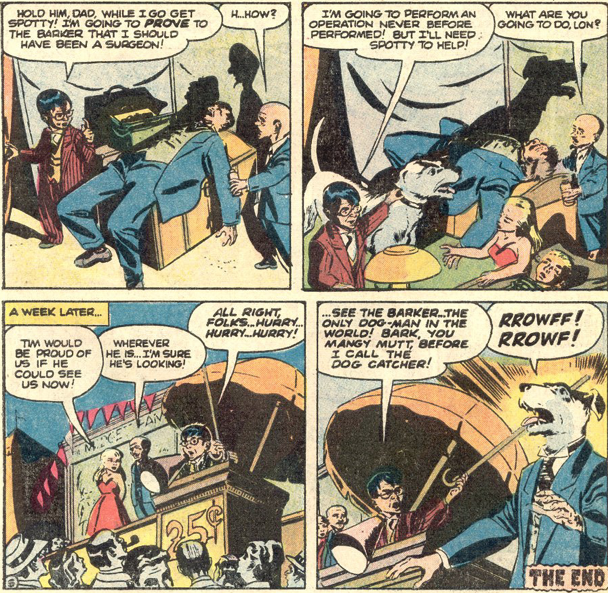
The Little family, the #1 act at the Bushman Brothers Circus, live in constant fear of their boss, the circus barker, a sadistic tyrant who beats and mistreats the family at the slightest provocation. But it was the barker that saved "The Little People" from prosecution when the cops broke in on Lon while he was attempting to operate on the Growth Glands of one of his siblings. But the barker goes too far one night when he cancels movie night and forces the Littles to rehearse their act. Tim Little heads off after the barker with his slingshot but, after a nasty altercation, ends dead from a broken neck. That's the camel that broke the straw's back as far as Lon Little is concerned; he dopes the barker and does a little circus surgery while he's out. The next day, the barker is... a real barker!


Here's a real nasty, sick gem with a Tod Browning's Freaks-inspired climax and some truly creepy DiPreat graphics. We've seen violent and twisted strips in the Atlas titles but "The Little People" has a genuine mean streak to it that I absolutely loved. And who'da thunk it was penned by Stan, who clearly has his tongue firmly in cheek with scenes like the Little family bust and ensuing courtroom panels.

Gary is born with claws instead of hands. Obviously, he feels as if he stands out in a crowd and all the poor guy wants is to be normal. All his friends at the "Men with Claws" club he frequents tell him to use be patient, change will come on his 25th birthday but Gary just can't wait. He sees a plastic surgeon who tells him that, for two grand, Gary can have normal hands. Not having the dough, the brash young man does what any brash young Atlas man would do: robbery and murder. New hands sewn on, Gary shows up at the "Men with Claws" function on the night of his 25th birthday to show off his fancy appendages. Unfortunately, at the stroke of midnight, Gary learns that his friends were right and he should have just waited a couple days longer. Now he's the only man-sized cockroach with human hands.


"Hex"
Gene Colan does his best not to spray coffee on his drawing board as the punch line is delivered but it must have been very hard for "gentleman" Gene to swallow his pride and pump out that final panel after delivering an otherwise flawlessly-noir art masterpiece. It's hard not to giggle though. And what kind of friends does Gary have? Can't these dopes just spit out what's going to happen to him on his birthday rather than hint around with mysterious "You'll be sorry, Gary" or "Just wait a little longer and your prayers will be answered" lines? I'd be interested in finding out how Gary ran across the "Men with Claws" club in the first place. Ad in the New York Times: "Got claws?" Unfortunately, the scan of AIT #14 I have is a patchwork of the reprinting and "The Claws" was reprinted in black and white in Monsters Unleashed. Fortunately, I think this might have been the ideal way to view this Colan art, without the distraction of color.

"Hex!" falls back on the "sadistic plantation foreman" plot but George Tuska does a nice job of spicing it up (something I'm not used to saying) and there's an effective twist in the tail. Alas, the same cannot be said of the final tale, "They're Driving Me Crazy!," about a scientist who makes a breakthrough in creating synthetic life. The egghead leaves his lab and discovers no one knows who he is as if his very existence has been erased. In the end, the professor discovers that man is ruled by beings in a shadow dimension who decide what will be and what will not be. Our poor schlub big brain has overstepped his boundaries and now will walk the Earth as "Anonymous." There's the germ of a very interesting hook in there somewhere but you can't help but wonder why the "rulers" don't just kill the scientist and avoid all the confusion and hassle. The full-page expository at the finale doesn't help either.


Heath
Marvel Tales #110

"The Empty Bus!" (a: Syd Shores)  ★1/2
(r: Dead of Night #9)
"Harry's Hobby!"  
"Foolproof!" (a: Russ Heath)  
(r: Strange Tales #174)
"Peter and the Puppet!" (a: Bill Benulis & Jack Abel)  
(r: Uncanny Tales #9)
"A Coffin for Carlos!" (a: Don Perlin & Abe Simon)  ★1/2
(r: Vault of Evil #18)

On his way to rub out a runaway wise guy, mobster Big Nick sits on an otherwise empty bus next to an old man who warns Nick to change his plans. The old man tells of a man he met on a previous journey who exited the bus to kill someone and was shot himself. Nick tells the old goat to shuddup and gets out at his station as planned.Of course, the twist is that the old man was foretelling Big Nick's future. At least, I think that's what was going on.

"The Empty Bus"
The plot is not entirely original (and variations would continue on down through the years), but it's not really the story that draws us into "The Empty Bus!" It's Syd Shores atmospheric art. You can almost feel the rain at the bus station. Shores might not have been the most stylish of artists but he was dependable (and would become an even more dependable inker for Marvel in the 1960s). The colorist looks like he/she was having a ball as well, with some wild choices for shading and color.

The rest of the far this issue is dismal stuff. "Harry's Hobby" sees henpecked Henry finding solace in crafting ships in bottles. Obese wife Stella can't abide by Harry having a good time so she destroys his collection and then becomes part of the collection when Harry snaps in an all too predictable (and impossibly stupid) finale. A landlord has a "Foolproof" way of making a profit off one of his buildings: by burning it to the ground. His "Fooolproof" plan (start the fire on the ground floor, race upstairs as an alibi, and call the fire department) runs into a bit of a problem after the blaze chases him up the stairs and he relaizes he has no change for the pay phone. A cute punch line and some nice (if undemanding) graphics by the Master.


"Peter and the Puppet" is the wooden (pardon the pun!) tale of a ventriloquist and his real-live talking dummy, Oscar. The two dopes fall in love with the same girl, but Peter decides she's for him and burns the puppet to cinders. Turns out the girl was a puppet too and had the hots for Oscar. Groooooan. Last up is "A Coffin for Carlos!," about a death-row inmate who's given a pill (by a grotesque one-eyed hunchback in a Fedora!) that will make him appear dead before his execution. The idea is he'll be dug up at the cemetery by his co-conspirator. As usual the plan goes wrong and the comatose Carlos ends up on the dissection table. Smells like some stale EC leftovers to me.


Everett
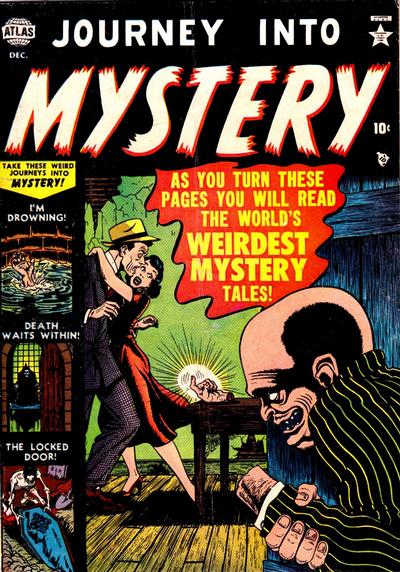
Journey Into Mystery #4

"The Bewitched Bike!" (a: Tony DiPreta) 
(r: Journey Into Mystery #8)
"Death Waits Within!" (a: Carl Hubbell) 
(r: Journey Into Mystery #8)
"The Locked Door! (a: Ed Winiarski) ★1/2
"I'm Drowning!" (a: George Roussos) 
(r: Monsters on the Prowl #25)
"Hiding Place" (a: John Romita) 

Bookie Spider kills bike shop owner and steals the loot and the titular bike, which turns out was made in 1992. Turns out the shop owner was traveling to the future, where he made his fortune. Spider tries it after a bank robbery and lands in the future only to find the bike guy is wanted for bank robbery. Nice twist climax and some snazzy DiPreta graphics.

In "Death Waits Within!," the Kumels seem such a nice old couple but they’re actually murdering the tenants of their BnB and sending the money to their son (who left home twenty years before) in America. Unfortunately for the murderous old birds, their latest victim turns out to be that long-gone son, who had popped 'round to surprise his folks!  Next up is "The Locked Door!," wherein a wanted murderer stops at an inn to rent a room. He gets his room but there’s a mysterious locked door that’s driving him nuts. The cops arrive and send the landlord up to get his new tenant. The guy strangles the old man and grabs the key to the door, opens it and reveals a brick wall behind it.

In the poorly-illustrated "I’m Drowning," a really dumb prisoner takes advantage of a nearing flood to dig his way out of his cell only to find the flooding worse underground. He decides to stick his finger in the leak a la a dyke and discovers too late that it’s a light socket! They didn’t make prison cells very good in those days. The final story in this very weak issue of Journey Into Mystery is "Hiding Place."  George really hates his brother, Harold, for always bringing snakes and spiders into the house. He vows he’ll find the place Harold hides his critters but doesn’t find it until he murders his brother. The hiding place was his own bed. Hmmm… quick funeral that, and the guy didn’t sleep in his own bed between the time he murdered his brother and the time he discovered his bed was the hiding place? Looks like John Romita was given only a couple hours to rush this one out. Uncharacteristic weak visuals from the master.


In just two weeks...
You'll learn the secret of
Men With Fangs!


Monday, November 11, 2019

Star Spangled DC War Stories Issue 168: January 1976


The DC War Comics
1959-1976
by Corporals Enfantino and Seabrook


Kubert
G.I. Combat 186

"Souvenir from a Headhunter"
Story by Robert Kanigher
Art by Sam Glanzman

"Medic in the Dark"
Story by Robert Kanigher
Art by Ric Estrada

Peter: The Haunted Tank is parachuted into the jungles of Burma to find a hidden Japanese rocket base. Safely landing, the boys make friends with a gorgeous native girl who takes them home to dad. Unfortunately, pop has old-fashioned ideas about men who lay hands on his (ostensibly) under-age daughter. Just as the boys are about to lose their heads (literally), gunfire erupts from the jungle and salvation arrives in the unlikely guise of Japanese soldiers. The boys escape but conquer the enemy and destroy the rocket base.

"Souvenir from a Headhunter"
Or at least, I think that's what happens since, I must admit, quite a bit of this rubbish was hard to follow. The writing in "Souvenir from a Headhunter" is almost as murky as the art. The Japanese "ambush" that saves our boys makes no sense whatsoever (it's almost as if the bad guys were just firing off their weapons for the hell of it and managed to lay lead on the chief as he's about to swing his sword), nor does most of the cockeyed action Glanzman plops into his panels. I don't presume to know enough about World War II to question Kanigher's use of the parachuting tank but I do cry "you got to be kidding" to the panels of the Jeb firing at approaching aircraft while 10,000 feet above the ground! Wouldn't the kickback knock them right out of the sky? I'm still a bit confused as to why the Jeb Stuart is the only tank that seems to be at every major battle in World War II.

A G.I. ambulance driver becomes a "Medic in the Dark" when the "hysterical blindness" that struck him as a child revisits at exactly the wrong time. The Army rejects this kid for his psychological problems but the Red Cross thinks it's okay for someone--who might black out when he's under pressure--to drive the wounded through battle zones? Um, yeah right.

"Medic in the Dark"
Jack: It's only January and already we have a candidate for worst story of the year: "Souvenir from a Headhunter." In addition to the problems you note, Peter, we have to put up with Leiya's offensive pidgin English. I can't imagine why Kanigher had to send the Haunted Tank to Burma, only to tell this idiotic story. I asked Google if tanks can be dropped by parachute and it seems the answer is yes, but only very close to the ground in areas where a plane can't land safely. The idea of the Jeb Stuart floating down from on high (and firing away in the meantime) is absurd. Not quite as bad--but close--is the backup story, "Medic in the Dark." Poor art, a story we've seen before, but still better than Glanzman in Burma. Sam had better watch out--no more Jack Kirby for us to kick around anymore!


Kubert
Our Army at War 288

"Defend--or Destroy!"
Story by Robert Kanigher
Art by Jack Lehti

"Medal of Honor"
Story and Art by Norman Maurer

Jack: After British paratroopers are wiped out trying to blow up a drawbridge that was supplying German soldiers holding a French port, Sgt. Rock and Easy Co. are sent to do the opposite job and hold the bridge, since the Navy plans to attack the port and the bridge is on the supply route. On the way to the bridge, a lone surviving British soldier joins up with Easy Co., but are they there to "Defend--or Destroy!"

Rock sends some of his men to attack a German ship and create a distraction that allows the rest of Easy Co. to attack the Germans holding the bridge. The German commander draws a bead on Rock but is pulled under the water by the British soldier, causing Rock later to raise a glass to his memory.

One of the less Kubert-y panels
from "Defend--or Destroy!"
Jack Lehti seems to have done a lot of newspaper comic strip work over the years, but seeing his name in a Sgt. Rock comic in 1976 is unexpected. I doubt we'll see him again in this series! The story itself is forgettable.

In June 1918, First Lieutenant Edouard Victor M. Izac displayed heroic behavior that resulted in another "Medal of Honor" being awarded. Izac was taken prisoner on a U-boat when his ship was sunk; he kept trying to escape until he was able to get out of a prison camp and make his way to Switzerland.

Norman Maurer is back with another run of the mill tale of heroism. I'm sure the real story was thrilling and inspiring, but it isn't told in a very exciting way and the art this issue is below par.

Peter: Even to my untrained eyes, it's obvious that Joe Kubert had a hand in helping Jack Lehti get his points across this issue. In the panels that look unassisted, Lehti comes off crude and sketchy (though nowhere near the extreme of Sam Glanzman). The story is decent, though nothing new. Unfortunately, I don't think we're going to see much in the way of originality in these strips anymore. "Medal of Honor" is informative and I guess that's the aim.


Kubert
Our Fighting Forces 163

"Assault on Satan's Skull!"
Story by Robert Kanigher
Art by Jack Lehti

Jack: The Losers are executed by firing squad and coffins containing their bodies are dropped from bomber planes flying over the English Channel. Fortunately, it was all a trick and the Losers are alive; they drop by parachute into the water and are picked up by a boat manned by German soldiers. The Losers quickly dispatch the enemy and head for French shores, each recalling the terrible incidents that led them to become a team.

Their present mission is to locate Dr. Tors Hanson, a scientist developing a rocket that can reach America. The Losers alone can identify him, so their execution was faked and they mount an "Assault on Satan's Skull!" to capture Hanson, who is located in a monastery nearby. They find two Dr. Hansons and take them both just to be safe. Making their way back to the boat manned by Captain Storm, the Losers run an enemy gauntlet with the two doctors in tow before making it safely back to the headquarters of General Thorne, who assigned them on the mission to begin with. The general's aide is revealed as a double agent when he kills the wrong Dr. Hanson, and the real Dr. Hanson has been brainwashed by the Germans and refuses to cooperate. Once again, the Losers manage to lose both versions of the doctor they sought!

Nah! Happens all the time!
It's such a relief to have Kirby off this strip that this book-length tale, even with some filler, is a welcome sight. Here's Jack Lehti for the second time this month, and his art is appealing in a primitive way. Best of all is having Kanigher back on script duties; even though there's nothing special about the story, its not an embarrassment like Kirby's stories were. Perhaps now the Losers can resume looking for Oona!

Peter: Why Big Bob feels the need to retell the Losers origin story is anyone's guess. If you put a gun to my head, I'd say it was to slam home the point that Kanigher was taking back the reins after a disastrous run by "The King." Though it's certainly more digestible than what Kirby wrought, Big Bob's script doesn't skimp on the outlandish. The parachuting coffins scene is ludicrous; there's no reason to take the subterfuge to such an extreme. Never mind the impossibility of activating your parachute while trapped in a coffin hurtling towards ground! Once the boys are out of sight of the traitor, they can go about their business in a much safer fashion. Are you telling me the pilot had no idea what was going on? Lehti seems to be flying solo here on this one (no Kubert trademarks that I can see) and, I have to say, the art is not half bad.


Kubert
Star Spangled War Stories 195

"The Deathmasters"
Story by David Michelinie
Art by Gerry Talaoc

"Duel in the Desert"
Story by Jack Oleck
Art by Bill Draut

Peter: In part one of a two-part adventure, the Unknown Soldier is sent to a "School for Assassins" in Romania to impersonate budding Nazi killer Klaus Oster. Once undercover, the US is to destroy the compound and kill its commandant, Count Witschenbach. The Soldier safely ensconced in the academy, he befriends Witschenbach's pet killer, Ulrich Gherner, who confides in our hero that his father died from Nazi mistreatment and his mother desperately needs expensive medicine to keep her alive. The Nazis will pay Gherner for his "kills," so he's stuck performing atrocities for the men he'd rather be putting in the ground. Gherner is given the assignment to take out a Russian higher-up and the Soldier must follow. Before he begins his trip, he happily blows the School for Ratzi Murderers to hell!

"The Deathmasters"
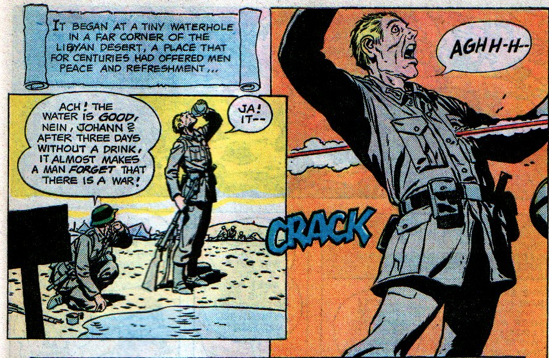
"The Deathmasters" is one of the weaker Michelinie scripts so far, due to the fact that it seems quite similar to a couple other past adventures. I do like that, as is typical of Michelinie, the writer strays from the path he puts us on to beef up a sub-plot and make it the plot. We're not even sure that Witschenbach is at the academy when it goes blooey. Make no bones about it, a weak Michelinie story is still preferable to most of the other nonsense put before us this month. "Duel in the Desert" is just another tired Jack Oleck retread of a plot device we've seen countless times before: the Germans and the English clash over a Libyan waterhole in World War II. Neither side can win but both continue to fight until both sides are eliminated. If there is a light at the end of the tunnel, it's that Bill Draut is working his way up to becoming an average penciller.

Jack: I like the cliffhanger in "The Deathmasters," with the Unknown Soldier in his Nazi disguise racing into the midst of a ceremony and leaping into action, only to have the story end in mid jump! This is easily the best DC War series going at this point, with Michelinie and Talaoc working well together to tell one exciting story after another. It's the only war comic I really look forward to at this point. I agree with you about Draut's work on the backup--it's not bad.

"Duel in the Desert"

Next Week...
Jack and Peter attempt to
wade through the cheese.


Peter leads Jack ashore
after the December 1976 post.