The EC Reign Month by Month 1950-1956
31: February 1953
 |
| Kurtzman |
Mad #3
"Dragged Net!" ★ 1/2
Story by Harvey Kurtzman
Art by Bill Elder
"Sheik of Araby!" ★
Story by Harvey Kurtzman
Art by John Severin
"V-Vampires!" ★★
Story by Harvey Kurtzman
Art by Wally Wood
"Lone Stranger!" ★★
Story by Harvey Kurtzman
Art by Jack Davis
 |
| "Dragged Net!" |
As Monday Morning Quarterbacks, we can look back at the first batch of issues of
Mad and smile as some of the soon-to-be-standards are introduced. "Dragged Net!" ramps up the "incidentals" we'd seen used sparingly so far--in most cases, the background becomes the focal point. Silly little notices ("Uncle Tom's Cabin 2 mi.") and sight gags (the head of a policeman with the words, "mounted police" below it) keep the eyes circling the panels, searching for every little nugget of humor. Unfortunately, three issues in, the humor is still sparse. It would probably behoove the reader to have seen at least a handful of episodes of Jack Webb's
Dragnet (not a tall order in 1952, since it was not only a top-rated TV series but also extremely popular on radio) but the monotone delivery and off-topic dialogues can be amusing even to the ignorant . . . to a point. "Dragged Net!" goes on far too long with its search for a murderer that takes Joe Friday and Ed Saturday to the far reaches of the globe before they discover that the killer is back at the precinct. Bill Elder's wacky art is certainly a highlight but I'll be glad when we reach the point where
Mad lifts itself from the restrictions of TV and movie parodies. If "Dragged Net!" is a drag, "Sheik of Araby!" is as humorless as the sands of the desert. A take-off on all those Foreign Legion/Errol Flynn epics of the '30s and '40s, "Sheik" is seven pages of lunacy and zaniness in search of something funny, with the ugliest John Severin art I've ever laid my eyes on (Severin's aim, no doubt).
 |
| "Sheik of Araby!" |
 |
| "V-Vampires!" |
"V-Vampires!" and "Lone Stranger!" provide hope that our funny bones will be tickled a little more often in the future. Renfrew, the vampire-hunting hero of "V-Vampires!", consults
Vault of Horror #9 for the 411 on killing a vampire ("
Right after the story of the thing in the swamp that eats up the grandma alive . . .") and Kurtzman isn't above skewering bullpen pal, Al Feldstein, with his own version of the quintessential EC horror finale. Renfrew, whose girlfriend, Godiva, is revealed to be a vampire, has a revelation of his own: he's a werewolf! One wonders if self-parody is on the horizon, since we all know Harvey could be a bit, um, . . . preachy, at times with his war stories. Jack Davis makes "Lone Stranger!" a lot of fun to look at (check out the frenzied look on the mug of Stranger's horse, Golden!) and there's one priceless gag that elevates this above the rest of this issue's satires. The Lone Stranger, looking to put the kibosh on a stagecoach robbery, locks himself into the cash-box and waits for the mangy varmints. When the box proves too tough to open, the robbers escalate their means of extricating the dough, from bullets to dropping the box off a cliff. The Stranger finally pops his own top when the hold-up men threaten dynamite, eliciting the loudest laugh of the issue from this cowpoke.-
-Melvin Enfantino
 |
| "V-Vampires!" |
Jack: The little details in "Dragged Net!" made it my favorite story this time around, since I love poring over the panels for all the little gags. I think Will Elder was the quintessential
Mad artist, at least in the early issues. Wally Wood's art in "V-Vampires!" is simply stunning, and Godiva is pretty stunning herself, at one point looking like she walked straight out of
The Spirit. I liked Severin's work on "Sheik of Araby!" mainly for the mention of Rene Goscinny, who would later co-create Asterix, and for what I think is a subtle impression of Remi's work on Tintin. I think what looks ugly to Peter is actually very clever. Jack Davis gives it his all in "Lone Stranger!" but the story falls flat for me.
 |
| "Lone Stranger!" |
Jose: While I agree that “Dragged Net” could’ve been cut by a couple of pages, this was easily the funniest story in the issue for me. I enjoy those darn Easter eggs just as much as you fellows, and they are certainly in abundance here and the source of 90% of the humor. (The blind man panting in the background as sultry dame Desire walks by got the biggest laugh out of me this time out.) “Sheik of Araby” left me pretty cold. I can see what Jack means about Severin’s art springing from a certain style, but it’s a style that makes my eyes glaze over. Even with its winking denoument, “V-Vampires” came off as the story trying most desperately for chuckles, and the transcribed Cockney accents were a bit impenetrable at times. “Lone Stranger” features some fabulous Jack Davis illustrations and can be clearly seen mocking specific aspects of its source material. Even as someone unfamiliar with said source, I could still pick up on the fact that the Lone Ranger conveniently kept his gunfights family-friendly by debilitating his foes and their weapons with incredulous shots of his silver bullets. I also really liked how Davis’ the Stranger waited for his cue line at the end of the story before he mounted his horse. That’s show business for ya!
 |
| "Lone Stranger!" |
 |
| Severin/Elder |
Frontline Combat #10
"A Baby!" ★★★
Story by Harvey Kurtzman
Art by Wally Wood
"Geronimo!" ★★ 1/2
Story by Harvey Kurtzman
Art by John Severin and Will Elder
"Napoleon!" ★★
Story by Harvey Kurtzman
Art by George Evans
"Anzio!" ★★
Story by Harvey Kurtzman
Art by Jack Davis
"A Baby!" boy is born in Korea in 1948 and his father races home to see the joyous sight. A year later, the boy has his first birthday as the Russian occupying force is leaving; the child cries until his father returns home. In the midst of a tense standoff in 1950, the boy again cries till his father comes home. Midway through the year war breaks out and the boy's mother is killed. He cries for his father but we see that the father, too, is dead, leaving the child just one of many to be gathered up by "the proper agency."
 |
| "A Baby!" |
Wood's artwork is tremendous in this heartbreaking story, and I wish it went on for a few more pages. Kurtzman's heart is on his sleeve and he manages to show a real, human drama against the backdrop of one war ending and another beginning. Unfortunately, as we see in Syria and other places today, the story is timeless.
In the Old West, "Geronimo!" led the Apaches and terrorized Mexicans with raids across the border from Arizona territory. Eventually, U.S. soldiers caught up with him and he surrendered. Years later, at the World's Fair in St. Louis, Geronimo sat, an old man, selling picture postcards to curious onlookers.
Kurtzman deserves credit for not making the conflict among Apache, Mexicans, and U.S. soldiers into a black and white affair--the Apache are vicious but eventually are nearly wiped out. The end is not terribly effective but, like the Wally Wood story that precedes it, the art by Severin and Elder is sparkling.
 |
| "Napoleon!" |
In 1805, "Napoleon!" leads the French army to a brilliant victory over the Russian army at Austerlitz.
For the most part, the George Evans art is gorgeous, but his depiction of Napoleon tries too hard to be accurate and loses the excitement of the rest of the panels. The story is told all in captions and pictures, with no dialogue and no human element, so it ends up little more than a pretty history lesson.
In 1944, tired U.S. soldiers land at "Anzio!" in central Italy. They dig in and wait, surviving German shelling for weeks that stretch into months. Finally, the German line is broken and the soldiers head for Rome.
Four out of four stories in this issue feature brilliant art and, while this one is just another story of a battle like "Napoleon!", at least there is some human element, with the tired, filthy G.I.s complaining and a Nazi commander yelling into his phone. Overall, a rather average issue of
Frontline Combat, albeit with stunning art.
--Jack
 |
| "Anzio!" |
Peter: This issue gives us one preachy and three lectures. Call me a heartless bastard but "A Baby!" did nothing for me. Yes, I get it. Horrors of war and all, but the story did not engage me at all. Surprisingly, I felt the opposite about the history lessons this time 'round. "Geronimo!" and "Napoleon!" are both well-illustrated and taught me something about subjects I really have no interest in. More importantly, they kept my interest, Not an easy thing for Harvey to do lately. I don't have the original issue in front of me (I read from the Russ Cochran color reprints), so I'm not sure if this is just a quirk in the printing, but the heavy inking in George Evans's work in "Napoleon!" gives the story more impact. The best story of the issue, by far, is "Anzio!," which highlights Kurtzman's best talent: emphasizing that war is f**ked-up on both sides.
Jose: For the most part, the art is indeed pretty stunning here. Wood seems to be taking a slightly more minimalist approach in “A Baby”, with less fun background noise and more time focused on the human element this time around. The way the story was going, I suspected that only the boy’s father would become a victim of the warfare—I know, apparently I had totally ignored the cover—so the finale wherein all of the child’s family is killed and he is left to cry amidst the corpses and the rubble hit me with that regular socko Kurtzman style. I really do love all the collaborations between Severin and Elder, and with the benefit of the reprint’s revitalized colors their illustrations in "Geronimo" just pop right out of the panels and arrest your gaze. Like a good amount of other EC war stories, this is one that makes it tough for you choose any sides. (As it should be.) The reader might not be able to abide the savagery of the fighting Apaches, but then again it’s awfully hard to condone the wholesale slaughter of nearly an entire race of people. But do you know what else I love? George Evans’ art. Evans had a cinematic flair when it came to illustrating light and shadow, and “Napoleon” is one of the best examples of that knack. As Jack said, there’s no dialogue here, so Evans had to do all the heavy lifting when it came to putting the people in the panels. His utilization of darkness makes the events unfolding feel almost operatic! “Anzio” was the only one in this bunch that I couldn’t quite dig into. It felt like something we’d seen before, and I know that Davis has done war grungier and more visceral than what’s shown here.
 |
| "Geronimo!" |
 |
| Wood |
Weird Science #17
"Plucked!" ★★
Story by Bill Gaines and Al Feldstein
Art by Wally Wood
"The Island Monster" ★ 1/2
Story by Bill Gaines and Al Feldstein
Art by Al Williamson and Larry Woromay
"Off Day!" ★
Story by Bill Gaines and Al Feldstein
Art by Jack Kamen
"The Long Years!" ★★★
Story by Ray Bradbury
Adapted by Al Feldstein
Art by Joe Orlando
At Thanksgiving dinner, Professor Sidney Hunton discusses an interesting fact his research has uncovered: every two centuries, a large number of people disappear from a population center with no explanation. His guest, James Farnsworth, suggests that hungry aliens treat the Earth like a turkey farm, visiting each 200 years to collect humans to eat at their alien holiday. No one notices that people have been "Plucked!" due to mass hypnosis and induced amnesia. As if on cue, horrible aliens come in and make off with the two men's wives, but the men don't notice and keep on chatting and enjoying their dinner.
 |
Making off with the hens.
("Plucked!") |
Hard to believe Wally Wood could draw such a boring story, but it's true. Other than a few panels of gruesome aliens, this is a talking heads snooze-fest, highlighted by two panels depicting the 1950s house, complete with carport.
Having heard tales of "The Island Monster," fabulous Broadway promoter Mike Rose charters a ship and takes a team out to the middle of nowhere, where they capture the monster and bring it back to exhibit in New York City. During the premiere, it escapes and wreaks havoc before being shot to death. Months later, a spaceship is discovered, having crashed on the remote island. A message is deciphered and it turns out the island monster was an emissary of peace from outer space.
 |
It's clobbering time!
("The Island Monster") |
I love
King Kong as much as the next guy (probably more), but a straight ripoff of the movie with a corny sci-fi ending tacked on is a waste of seven pages. The GCD says that Al Williamson was so behind on his deadlines that Larry Woromay gave a lot of help with the art on this story. That's probably why it's not top-drawer Williamson.
Professor Stanley Dingle delivers a lecture from a podium about the Law of Averages, since he is shocked to see that it has been broken. He discusses coin flips, baseball attendance, and Miami Beach vacation numbers before it's revealed that only one person out of 379 students showed up for his class. That one person solves the mystery when he admits to being the janitor and comments that it's Sunday and thus an "Off Day!" for the class.
Hoo boy, this issue is a real stinker! Blah, blah, blah goes the professor, a talking head for page after page. Gaines and Feldstein have a real problem in these sci-fi comics: they write stories as if they're not meant to be illustrated, leaving artists like Jack Kamen to try to figure out how to make something interesting out of a lecture. Thank goodness he manages to fit in a beautiful blonde in a bikini in one panel.
 |
Kamen manages to squeeze one in.
("Off Day!") |
Hathaway is the aging patriarch of the last survivors of an Earth colony on Mars. After years of waiting, a spaceship finally arrives to take him and his family back to Earth. But the truth of the matter is, everyone but Hathaway died years ago and he built replacements who have not aged. Hathaway drops dead and the spaceship crew heads back to Earth, leaving his fabricated family alone on Mars to wait out "The Long Years!"
Without comparing this to the original story, I can't say how much of Bradbury's prose is used by Feldstein, but the story remains lyrical, elegiac, and a bit dull, like most of
The Martian Chronicles. It's easily the best story in this issue, but that's not saying much.
--Jack
 |
| "The Long Years!" |
Peter: When first considered, "The Long Years!"might have been assigned to Al Williamson or Wally Wood, an artist who can do wonders with aliens and other planets but "The Long Years!" is more of a character-driven piece than a space opera (not really a surprise, given the Bradbury byline). Joe Orlando does a fine job with the illos (slowly, but surely, you can see Joe moving away from the wing of Wally) and Al sucks all the great stuff out of Bradbury's original story (this is easily the best RB adaptation thus far), wisely tipping us off to what's really going on well before the climax rather than trying to spring a shock on us. Al does the same thing with "The Island Monster" when the Captain exclaims he's seen a movie like this before ("
King Kong . . . or something!") but then wimps out with a schmaltzy message climax (one we've already seen in
The Day the Earth Stood Still, by the way). Still, it's a really purty big-monster story, a genre that EC rarely ripped its talons into. "Plucked!" could have been an Off-Broadway play, since the entire narrative (save the hypothetical light bulbs over the professor's head) takes place in one room with five characters. It's got a delightfully playful climax and great Wally art. That leaves the black sheep of the issue, the meandering bore known as (
SPOILER ALERT IN THE TITLE!) "Off Day!", a story that cries out "My name is Al and I've run out of ideas this week!" The only one who benefits is Jack Kamen, who only has to draw the same head 26 times and little else. Hey! Wait a minute. That benefits me too!
Jose: Anyone else smell turkey? Cuz this issue is full of ‘em! OK, OK, lame joke aside, it’s more like a fifty-fifty split between the good and the oh-so-bad here, but the bad is
really bad and the good only just so. Feldstein carries us through “Plucked” at a nice real-time rate that ends in a big cutesy bow, but the central conceit is just so dang silly and way too convenient to qualify this story as a lost classic. The other salvageable effort in this ish is the Bradbury adaptation, which maintains a fair amount of the author’s poeticism—red threads of rocket flame and wind whistling across dead seas—and is quietly aided by Orlando’s visuals. The curdled cream-center of this stale Oreo is undoubtedly “The Island Monster” and “Off Day.” The former is a blatant rip-off that under different circumstances might have been enjoyable were it not for Larry Woromay “helping” Al Williamson and the so-miscalculated-it’s-funny coda that has the human race discovering they’ve just killed a “peaceful” emissary from beyond the stars. Was the monster going to demonstrate a display of love and understanding
before or
after it tore down three bridges? We’ll never know now. And then there’s “Off Day.” “Off Day,” the story that surveys the vast field of mind-numbing science lectures that EC has mercilessly subjected us to in past issues and says, “Hey, let’s make one of those six pages long!” This does the last-second SF allusion of “The Island Monster” one better by building up a ridiculous probability-based apocalypse to serve as the speculative conceit of the tale before tearing it down and saying, “Just kidding! The old man’s just senile!” Think of the most drawn-out and painful knock-knock joke you’ve ever been told, then double the sadness you felt at the punchline and you’ll have a fair idea of what it’s like to read “Off Day.” I know we have quite some ways to go in this marathon, but I’m willing to bet (and pray to God) that this is the worst comic book story EC ever produced.
 |
| Ingels |
The Haunt of Fear #17
"Horror We? How's Bayou?" ★★★ 1/2
Story by Bill Gaines and Al Feldstein
Art by Graham Ingels
"Gorilla My Dreams!" ★★ 1/2
Story by Al Feldstein
Art by George Evans
"A Likely Story!" ★★ 1/2
Story by Al Feldstein
Art by Jack Kamen
"Garden Party" ★★★
Story by Al Feldstein
Art by Jack Davis
 |
| "Horror We? How's Bayou?" |
When surgeon Max Forman gets lost in the swamp (damn those unreliable road signs!), he stops at a creepy, ramshackle house for directions. The owner of the house, Sidney, answers Forman's knock and invites him in. Immediately, Forman is put on the defense when the sinister lech tells him that his brother, Everett, can't wait to meet Forman. When pressed, Sidney allows how Everett is a homicidal murderer and it's been so long since he killed, he was fearing for his own life. Just then, a monstrous figure approaches and wastes no time strangling Max. The body is dismembered and tossed in the swamp to join the pieces of two previous victims (a gorgeous blonde and a traveling salesman). Not long afterward, a hand rises from the muck, followed by a head and then three full figures. The three victims have pieced themselves together, but puzzles were obviously never the pastime of any of the unlucky travelers as all the body parts have been intermingled (the blonde's head sits atop the salesman's trunk, etc.). Understandably pissed, the three cadavers head for the shack where they met their untimely demise and, once there, perform a bit of switcheroo surgery on Sid.
 |
Sidney hosts a mixer.
("Horror We? How's Bayou?") |
"Horror We, How's Bayou?" is one of the most-oft reprinted EC horror stories (finding a place in the holy grail of EC reprints,
The EC Horror Library of the 1950s) and I
get why, but there are several plot holes and unanswered questions (for one, why was the surgeon's murder the catalyst for the rising of the dead?). The plot is an old one and the descriptive first panel of the resurrection (
... a pulpy hand reaches into the bayou night...) has also been played out several times through our journey, but when questioning why "Horror We..." has this hallowed place in EC horror, you naturally have to point to the art, one of Ghastly's creepiest and strongest realizations. Everett's attack on Forman is
very frightening; Forman has no chance to escape before the behemoth is upon him. Perhaps more unnerving is Sidney's calm demeanor when he instructs Ev to cart the body down to the cellar as he doesn't want to be around when the brute tears the man apart. There's not a drop of blood to be found on these pages; your mind does all the work.
 |
Jack Seabrook before his morning shave.
("Gorilla My Dreams!") |
Philip Stoker's life goes completely bananas when a mad scientist drugs him and switches his brain with that of a gorilla. When the kooky doc dies of a heart attack, Philip/Konga is on his own but, trying to make the local authorities aware that deep within his hairy head lies the brain of a loving husband and father is a difficult task to say the least. In the end, Philip chooses to spare his family any scandal and resigns himself to a life behind bars and a whole lot of bananas. More than any story we've encountered thus far, "Gorilla My Dreams" is packed to the brim with ludicrosity (enough so that this probably should have shown up in
Mad) but I'm assuming that was Al's point. Is the writer standing to the left us, elbowing us in the ribs, and giggling madly, "Why not a gorilla? After all, these little bozos eat up vampires and werewolves!" Proving that literature isn't his only inspiration, Al "borrows" the plot of the creaky 1941 Paramount flick,
The Monster and the Girl, for this hysterical parody of science fiction and its wacky tropes. We never find out why Dr. Heinrich Morgan picks Philip for this experiment (we only get a
he nodded his head several times as if convincing himself of some silent secret as Morgan sizes up his victim) or even why such a surgery is so important to the loon. Oddly enough, neither the medical examiner nor the mortician noticed that Philip had recently had the top of his head sawed off. Approached with the right frame of mind (three or four shots of tequila helps), "Gorilla My Dreams" is a sharp, biting essay on prejudice and society's lack of patience for those who are different. Without the booze, yeah, you get the feeling Al was taking the day off.
 |
| "A Likely Story" |
A cranky queen belittles her entire staff, beginning with her royal seamstress ("You call this finished? Look how it fits me... here... and here!"), and moving on to her royal interior decorator ("What did I tell you about that bare wall over there? I told you I wanted something on it!"), before forcing her royal artist to paint four portraits of her royal majesty. That's one member of the staff too far though, as the artist breaks down after the queen poo-poos his latest masterwork. He takes a royal hatchet and buries it in the queen's skull. The next day, the royal seamstress sews the artist's work into a canvass and the royal interior decorator hangs the portrait on the wall. Everyone's happy... except the queen. "A Likely Story" is a so-so piece of silly nonsense with a fabulous final panel but I've had enough of these "Kings and Queens" tales. The only benefit they provide is that Al handed these scripts to Jack Kamen, keeping him from working on the better, grimmer stories that Jack Davis and Ghastly excel at.
 |
| "Garden Party" |
Louella Hicks loves her garden, with its prize petunias, snapdragons, and lush green lawn but her husband Godfrey doesn't get what's so important about a bunch of weeds. All Godfrey wants is to hang a hammock in the yard and enjoy his day off, but Louella forbids him to bang nails into the trees. When Godfrey remarks that no one sees her prize garden, Louella suggests her husband invite over some of his work friends for a "Garden Party." Faster than Louella can drag out her cookbook and look up a recipe for disaster, Godfrey has invited twelve couples over for a barbecue and the guests successfully destroy both the gorgeous garden and Louella's sanity. After surveying the damage, the woman's fingers turn from green to red thanks to a handy carving knife. The police find her later that day adorned in apron and chef's cap, with hubby Godfrey literally
on the BBQ. I must say, I side with the loony Louella on this one; Godfrey had his just desserts coming. In fact, I'd have carved up the whole lot of them if they'd come into my yard, just like I did the neighbors' kids. The denouements are getting increasingly more violent and gory, as witnessed by the queen's portrait in "A Likely Story," and the Ed Gein BBQ in "Garden Party." Other than that final panel, Jack Davis' art is a tad on the reserved side, almost like the work he does for
Mad, but then he's not given much to flex his muscles with, is he?
--Peter
 |
| "Garden Party" |
Jack: I've been waiting for several stories to pop up, and "Horror We? How's Bayou?" was one of them. What sick mind could think this up and what sick mind could draw it? It's one of the essential Ghastly tales and an EC classic. "Gorilla My Dreams!" could stand alone as a short story in text, and that's the problem--the drawings are superfluous. As any student of Will Eisner will tell you, the best comic book stories show an inter-dependence between art and text that means you need to see and appreciate both to fully get what's going on. I'm already tired of the Grim Fairy Tales but Kamen gives us a socko last panel--at least for Kamen. The Davis story could be straight out of
Mad--it's hilarious! That last panel is a keeper.
Jose: Like “Lower Berth” from last month, I first encountered “Horror We…” as one of four color reprints included in Digby Diehl’s seminal coffee table book,
Tales from the Crypt: The Official Archives. (The other two were “The Thing from the Grave” and the yet-to-be-seen “The October Game” from
Shock 9. Having this book and not being aware of Russ Cochran’s reprints at the time, I had felt like I hit the frickin’ jackpot.) As such, “Horror We…” is hardwired into my brain as essential EC, so it’s hard for me to view it outside those fond parameters. Peter is right on the money when he mentions the savage nature of the story; even though we don’t see Everett rend his victims to bits, this is a story where murder is depicted not as a cute punchline or gimmick but as the soul-swallowing madness that it is. Sidney and Everett, living on the edge of nowhere, are perfectly at home in the symbolically-rich swamp, both caught in the quicksand pull of their respective neuroses as they eke out a pitiful existence feeding their endless appetites. We can see the influence of horror cinema in this tale, not just in its lost-motorists-at-the-old-dark-house conceit but in specific moments and images such as Sidney’s
Island of Lost Souls-esque vivisection, here brought to chaotic life by Ingels with a finale that would have never gotten past Joseph Breen’s doormat. Also, I’ll be damned if Ingels didn’t have a reference photo of John Barrymore as Edward Hyde from the silent 1920 film at hand when conceiving the character of Everett. The famous still of the actor is practically identical to the panel of Everett that ends Page 4, right down to the aloof pinky. Wonder why I never noticed that before…
 |
The source...
(Dr. Jekyll and Mr. Hyde, 1920) |
 |
The translation.
("Horror We? How's Bayou?") |
I guess maybe now I should comment on the other stories too, huh? “Gorilla My Dreams” is zany, B-movie fun, one that immediately put me in mind of one of my favorite old-time radio dramas, “
Spawn of the Subhuman” from
Dark Fantasy. Phillip might never have sung opera like our primate companion from “Spawn…” but like that loopy story “Gorilla My Dreams” gets extra props for keeping an unbreakable stone face about the whole thing. George Evans was a curious choice to make in assigning this story’s art, but the draughtsman’s hyper-realistic style gives the final moments an aura of genuine pathos. “A Likely Story”: another crown bites the dust. Like you two, I’m just about through reading the Grim Fairy Tales, which is a shame since there’s such a wealth of rich, diverse, and bizarre folklore to be exploited in that vein. It makes you wonder if this is what the predominant perception of fairy tales was at the time, limited to that Walt Disney-scope of castles and princesses. For that reason this mini-series might be interesting from a cultural and sociological perspective, but as far as reading goes it can be a real drag.
Ever since the introduction of
Mad, we’ve begun to see a lot of tonal cross-pollination between that title’s parodies and the “straight” horror yarns from the terror trifecta. “Garden Party” is a prime (rib) example of that interbreeding. Louella is so domineering and batty about her garden that it’s surprising that she turns out to be the victim and the one enacting the revenge. Other characters have paid for their similarly uptight, fastidious natures in the past (“The Neat Job,”
Shock 1, for example), yet we find the tables turned when Godfrey proves to be a remorseless boor who doesn’t bat an eyelash at any of his childless wife’s crushed flowers. The drunken partiers reminded me of the rambunctious gang from “Horror House” (
Vault 15), but these gate-crashers are decidedly more callous and sloppier, even going so far as to take some of Louella’s prized plants for themselves on the way out! The final panel does a pretty nice job of encapsulating that all-American Guignol feel of EC’s horror titles.
--Jose
 |
| Kurtzman |
Two-Fisted Tales #31
"Blockade!" ★★
Story by Harvey Kurtzman
Art by Wally Wood
"Campaign!" ★★★
Story by Harvey Kurtzman
Art by John Severin and Bill Elder
"Donelson!" ★★ 1/2
Story by Harvey Kurtzman
Art by Jack Davis
"Grant!" ★★★ 1/2
Story by Harvey Kurtzman and Jerry DeFuccio
Art by John Severin
The second special Civil War issue of
TFT finds us taking another look at the blunders, disappointments, victories, and general ephemera of that most unfortunate chunk of American history. “Blockade” details the seaside skirmishes of the Monitor and the Merrimac, two vessels forged completely from steel that heralded the shift from traditional wooden ships to a more mechanized and reinforced form of warfare. The South’s Merrimac thinks it’s doing alright for itself at first as it reduces its wooden enemies into kindling before the “tin can” Monitor rears its ugly, revolving battle turret and spits forth a few good whacks of its own. Wood stuffs his panels with brawny, rough-and-tumble sailors in a way that gives the reader a good sense of the confined, claustrophobic action of manning one of these “tanks of the ocean.”
 |
| "Blockade" |
“Campaign” focuses on General “Little Napoleon” McClellan as he whips his Union men into shape for months on end prior to their imminent meeting with Johnny Reb on the battlefield. The meeting is a long time coming, much to the chagrin of the fresh-faced recruits who are desperate to see the action that McClellan took part in during the fights for Fort Sumter and Bull-Run. After unbearable slogs of digging pointless ditches and trudging through muddy rain, the Union boys finally get their taste of battle and honorably defend the flag from the enemy. The army marches back to safety but McClellan is the worse for wear: he dies from sickness and exhaustion, adamantly eluding the bullets of the enemy until the very end and bequeathing his chaw tobacco to the young recruit who assumes his standards as the new sergeant. The ending, while likely embellished, nicely illustrates Kurtzman’s penchant for cyclical narratives and adds a firm touch of poignancy to the history lesson. Elder and Severin, as always, produce highly attractive and engaging artwork to accompany the story.
 |
| "Campaign" |
 |
| "Donelson" |
North and South “[jockey] for strategic positions along the rivers” out towards the West, which leads to the fight for Fort “Donelson!” More iron-clad sea battles take place, with the Rebels cannily skipping their cannon shot across the water and decapitating the smug Union soldiers who stand in the path of the “harmless” gunfire. Feeling their victory is assured, a group of Rebels heads out into the snow before running afoul of Yankees under the command of General Ulysses S. Grant who quickly determines that the rest of the Southern forces are planning on skedaddling as well instead of staying to fight. Grant uses this knowledge to spring a sneak attack and wrestle General Sherman into submission. Davis’ illustrations are mostly just fair here—he seems to really bloom when drawing more modern warfare—but Kurtzman’s script is the main attraction here, with sly character reveals and (once again) a cyclical framework wherein the ending amusingly references the opening of the tale.
 |
| "Grant" |
This issue’s biographical piece, “Grant”, is much more successful and interesting than the previous issue’s “Abe Lincoln.” Those who know little of the famous general and 18th President of the United States are sure to find a wealth of facts and curios in the finely-wrought script, one that contains a single page of copy (that’d be the flashback to Grant’s school-days incident with the ticking pocket watch on Page 3) credited to Jerry DeFuccio, assistant editor and researcher to Harvey on the war titles in addition to
Mad. (Jerry would contribute full scripts of his own in the near future.) Taken as a whole, “Grant” is a gently-told story of a lost and aimless man trying to find his way in the world before things start to gain traction for him through a combination of luck and his own perseverance. You really get a sense of Grant, at least as a character, through the words of Kurtzman and DeFuccio and John Severin’s pencils, which look much better here than they have in some of his other solo efforts. That’s really a special achievement when you consider that Grant doesn’t have much dialogue of his own and that the majority of our impression of him comes from the observations and perspectives of supporting players. And yet again we have the coming-back-to-where-we-started ending that Harvey so treasures, and its placement here acts as an assuring note of finality to the issue.
--Jose
 |
General Enfantino rallies
the spirits of his co-bloggers.
("Campaign") |
Peter: Realizing that we're looking at more of a quilt than a group of stand-alone stories makes grading the Civil War tales a bit tough. Most of these "chapters" have no beginning or end, they just peter out or, in the case of "Donelson," segue into the next installment. Other than the art, I don't care much for the issue. Purists will argue that Harvey is at his best when he's teaching a class but I'll point out that if I want a history lesson, I'll pick up a Civil War primer. If that makes me ignorant, I'll fly that banner. An interesting note: Harvey monkeys with the paging format that has been the standard for EC pretty much since the New Trend titles fired up. Rather than the usual 8-7-6-7 lengths, Kurtzman goes with a 6-8-7-7 with this 2nd Civil War special. Normalcy returns next issue. Oh, one other interesting note while I have your ear: for some reason, when Gemstone Publishing released the reprint of
TFT #31 (re-numbered #14), the issue was released sans issue number or price. Wow! How did that get out? (See the cover far below)
Jack: I liked this issue much better than you did and thought it held together quite well. My favorite story is "Campaign!" Severin and Elder's art is gorgeous and the story really conveys a sense of the boredom that came between the battles. "Grant!" is a terrific little bio of the great general that avoids hagiography and shows all the warts. "Blockade!" and "Donelson!" fit together nicely to show the debut of the ironclad ships and then how they became commonplace later on. Kurtzman and Co. give life to the dusty pages of history in this issue.
 |
| "Donelson" |
 |
| Feldstein |
Weird Fantasy #17
"In the Beginning..." ★★
Story by Bill Gaines and Al Feldstein
Art by Joe Orlando
"Ahead of the Game!" ★★★
Story by Bill Gaines and Al Feldstein
Art by Bill Elder
"The Aliens" ★★★
Story by Bill Gaines and Al Feldstein
Art by Al Williamson and Roy Krenkel
"There Will Come Soft Rains..." ★★★ 1/2
Story by Ray Bradbury
Adapted by Al Feldstein
Art by Wally Wood
After a wormhole throws a supply rocket and its crew back in time by one million years, the astronauts discover that the solar system of old contained a tenth planet, one teeming with primordial creatures including a race of ape-human hybrids. Taking two specimens back to the future with them, the astronauts astound the scientific world with solid evidence of what could be the missing link between mankind and its ancestors from the trees. The finding brings much jubilation and speculation until one scientist posits that the death of the female specimen in their time will effectively neutralize her entire potential lineage, essentially ensuring the gradual extinction of human life as we know it. Sure enough, the Earth of the future immediately slips back into the jungle age upon the female’s demise, with the remaining two specimens going on to kickstart a new line evolution on this planet.
 |
Oops!
("In the Beginning...") |
“In the Beginning” is just one in a very, very, *very* long line of SF tales, within and without the comic book medium, that tries to answer the age-old question of “how we all got here” and comes up with results that look an awful lot like ones we’ve easily seen in a dozen other stories. More than that though, this is a narrative that plays very passively and lacks concrete conflict, a symptom of casting a net too wide in shallow waters. The story tries to hit too many bases in too short a time and the far-reaching, universal approach it takes leaves us with no one to really root for or any general investment in the proceedings. (Death to all mankind, you say? I just read that in the last issue!) Orlando is a saving grace with attractive, non-showy pencilwork.
Someone’s been nabbing heads in the naked city, and it’s up to grizzled Lieutenant Dan (no, really!) to find out who’s been making off with the craniums. And also why! After getting a line that both Chicago and St. Louis have recently suffered a string of the gory crimes, Dan heads out to each metropolis to scour the newspaper archives to see if he can find any clues. There is one tenuous connection: the arrival of lecturing scientist Professor Shorham around the time of the murders. Overhearing two college punks debating the methods of increasing voltage on batteries, Dan thinks he has an idea as to motive and then calls up on the prof. Turns out Dan is all-too-right: as it turns out, old Emile is in the process of constructing a giant mechanical brain, and he needs all the severed heads he can get his hands on in order to charge it up. Sadly, our brave lieutenant only pieces this all together after becoming a link in the chain himself.
 |
| "Ahead of the Game!" |
Struck from the same zany mold as “Inside Story” (
WS 14), “Ahead of the Game” finds Bill Elder toning down the illustrations in order to better sell the surprise punch of the professor’s secret laboratory of charging noggins. This issue’s second piece has the advantage of being told more in the style of
Crime SuspenStories which keeps the proceedings moving at a nice, hardboiled clip without getting mired down in too much techno-talk. This marks the second time an EC story was related to the reader by a dismembered head, with the first being the just-desserts psycho-drama “The Trophy” from
Tales from the Crypt 25. (Spoiler alert!)
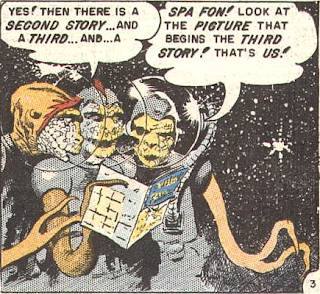
A group of reptilian aliens watch in shock as Earth blows to smithereens just as their spacecraft approaches the third planet from the sun. And just as they were on their way to warn us about the terrible potential of atomic power, too! Not ones’ to make a long trip for nothing, the extraterrestrials cruise out to one of the dead planet’s floating chunks to see if they can unearth some fragment of mankind’s past to get a clue about its identity. What they find is surprising indeed: an intact copy of
Weird Fantasy #17! Marveling at the combination of pictures and words, the aliens are doubly shocked to find a story about themselves inside. Every detail occurs exactly as it happened to them, right down to the words they speak. It’s only upon turning to the final page that our hapless aliens discover that time has a funny way of acting like an echo chamber.
 |
The gang at bare*bones seen
preparing for this post.
("The Aliens") |
Playful and delightfully irreverent without being moronic from its top to its tails, “The Aliens” can either be read as an earnest attempt at narrative experimentation and breaking down the fourth wall that separates reality from fiction or as Gaines and Feldstein throwing up their hands and saying, “Let’s just end it with the beginning!” I’m much more inclined to think that it’s the former rather than latter, but either way this puckish tale has a way of beguiling and mystifying the reader in the best of ways. An added bonus is that by the final page we are made to feel that the very issue we hold in our hands (or read on our computer screens) is itself a lost artifact from the universe of the story, floating freely in the black saucer of space, waiting to be found by curious explorers.
Dawn marks the start of a new day of the Armageddon, and though nothing remains of the people who once occupied the year of 2026 save some bleached silhouettes along the charred west side of a futuristic house and the piles of skull and ashes that dot the landscape, the computerized machinations of that house continue to go about their functions just as they did before. Meals and baths are prepared, dishes are automatically cleaned as are floors by dutiful robotic mice, and even luxuries such as pre-lit cigars and glowing nursery room landscapes are cued at the precise rotations of the house’s internal clock. And though the food goes to waste and no warm sounds of laughter or footsteps are heard in any of the rooms, the house of the future does not mourn its expired occupants nor the diseased, starving dog that comes calling back for them. A series of accidents incurred by a raging wind leads to a fire breaking out in the house and, try as the house’s built-in security might to choke back the flames, the blaze eventually prevails and destroys most of the structure, save for the errant voice of the alarm that continues to call out the time and date to a world that has no one left to heed it.

With the works of Ray Bradbury being so ubiquitous, it’s difficult to approach one of these EC adaptations without having already read the source material or even not having much knowledge of the content. Though I was familiar with the central premise of “There Will Come Soft Rains…”, I had yet to experience Bradbury’s original before undertaking this version as “retold” by Feldstein and artistically interpreted by Wally Wood. Having said that, I can tell you that this seven-page comic book iteration packs the same level of emotional wallop that I’ve received reading Bradbury’s stories in the past, so in that sense it’s safe to say that this is most certainly a successful translation of the author’s work. It definitely helps that Ray’s prose is essentially represented as-is, but even that hasn’t necessarily saved an EC adaptation before. (I’m looking at you, “The Coffin.”) And it *definitely* helps that we have Wood on board as artist. Though there’s not much here that would prove to be an obstacle for any one of EC’s other house artists (not even—gulp—Jack Kamen), Wood lends a quiet poeticism that perfectly matches Bradbury’s words, seen especially in that stunner of a splash page and the panels of the cheery house standing amidst piles of charnel remains.
In all fairness, this story could be potentially charged with the same offense that I lodged against “In the Beginning”: there’s not much of a conflict. And yet where
WF’s first story left me cold by taking on a global scale, this final piece enraptured me for its small, emotional focus. This might just be a laundry list of cool, dream-life amenities that a house of the future could provide for us, but it’s in the depiction of each of those amenities that we’re reminded of the loss, of the failure of our people to keep themselves from destroying each other before there wasn’t anyone left to enjoy those luxuries. Every automatic sandwich and heated bed that the house provides is a just as much a reminder of our hunger for death as they are a celebration of our innovation. Look at all our wonderful inventions, and look what they have wrought.
--Jose
 |
Peter discovers why you must always knock first
on the bathroom door at bare*bones HQ.
("Ahead of the Game") |
Peter: "In the Beginning," we have an enjoyable time/space paradox saga, the hook of which I'm sure I've seen before, but I'm slightly confused about that hook. If the two apes that are left over after the human race disappears are the apes that become, essentially, Adam and Eve, and the third ape ain't around to get in on the action, why would the human race just vanish? My head hurts. Speaking of heads, "Ahead of the Game" is a potpourri of the EC genres, with elements of horror, science fiction, and crime all shoved tightly into its seven pages. The final panel obviously brings to mind the sleazy low-budget gem of the early 1960s,
The Brain That Wouldn't Die. "The Aliens" is a highly imaginative and funny parody of all the “time bends back on itself” tales found in EC’s sci-fi comics, helped along nicely by Al Williamson’s art and capped off with a rare last page splash. Spa Fon! Another powerful Bradbury adaptation, "There Shall Come Soft Rains..." (from the May 6, 1950 issue of
Collier's and later collected in
The Martian Chronicles) dispenses with the hows and whys of Armageddon and is more concerned with what "lives on" in the aftermath. A stunner, and the perfect capper to an above-average issue of
WF.
Jack: Definitely above average, but still not EC's best. I like Will Elder alone better than I like John Severin alone, but the two together are unbeatable; "Ahead of the Game!" is a neat mystery with a sci-fi ending. Imagine the days when one had to travel from city to city to read the newspaper! The Bradbury story was always one of my favorites of his and this vision of the future is strangely prescient, especially with the intelligent house and automatic floor cleaners. Roy Krenkel must bring a lot of polish to Al Williamson's art because "The Aliens" looks fabulous, especially when compared to "The Island Monster" in this month's
Weird Science. "In the Beginning . . ." is over-written and tedious to read, representing yet another version of the EC science fiction story where scientists wreck everything for the rest of us.
 |
| The Gemstone reissue of TFT #31 |
 |
Next Week
In the Shrapnel-Filled 104th Issue of
Star Spangled DC War Stories
Sgt. Rock Dies?! |