Saturday, May 21, 2016

The Caroline Munro Archive: Join the Lamb's Navy

by John Scoleri

I'm back again with yet more rarities from my Caroline Munro collection, a continuing series here on bare•bones.

Caroline Munro's followers are well aware of her years modeling for Lamb's Navy Rum, appearing in advertisements and calendars, and as you can see here... coasters! Here are three that I've picked up over the years. There's at least one more that I'm aware of, and possibly several others as she was involved with Lamb's Navy Rum for more than a decade.


Thursday, May 19, 2016

Black Sails, Disco Inferno by Andrez Bergen

On June 30, 2016, a new novel by our friend Andrez Bergen will be published! Here's the press release. Watch this spot for a review!

BLACK SAILS, DISCO INFERNO

by Andrez Bergen with Renee Asher Pickup

RELEASE DATE:JUNE 30, 2016

LIST UNDER:CRIME/NOIR/PULP

PUBLISHER: OPEN BOOKS

An unnamed city, in which crime families flourish and police pinch pennies from those with most power...

Black Sails, Disco Inferno retells the classic medieval romance of Tristan and Iseult by turning things on their head, reversing the sex of our chief protagonists, and then placing them in a '70s pulp/noir world.

Andrez Bergen's latest novel (with Renee Asher Pickup) exposes Trista and Issy to a sensual, disco-infused narrative — one overflowing with double-dealings, violent brutality, and a spellbinding mystery.

Black Sails, Disco Inferno is also the novelization of critically-lauded 2015-16 comic book series Trista & Holt that Bergen wrote and illustrated (Pickup scripted #7). Feedback to the comic is included in these lovely bytes:

Captures the spirit of noir so perfectly it hurts.
GRAPHIC POLICY

The dark, brooding world of Trista and Issy is compelling.
SCI-FI JUBILEE

Trista is a breath of fresh air.
MARA WOOD

A crime story, albeit with a hell of a lot of references to medieval literature.
FLICKERING MYTH

Slow-burning, hard-boiled noir.
COMING UP COMICS

Bergen shows once again he has a firm grasp on the concepts of noir literature – perhaps due in part to his readings of Chandler and Hammett (two of the genre’s best), and his consistent great work on Bullet Gal.
ALL-COMIC

The 280-page novel is now ready for pre-order, and both writers involved are available for comment or interviews.
.
OPEN BOOKS: http://www.open-bks.com/library/moderns/black-sails-disco-inferno/about-book.html.

Andrez Bergen is an expat Australian writer, journalist, DJ, artist and ad hoc saké connoisseur who's been entrenched in Tokyo, Japan, for the past 15 years.

He makes music as Little Nobody and Funk Gadget, and ran groundbreaking Melbourne record label IF? for over a decade from 1995.

Bergen has also written articles for papers and magazines such as Mixmag, The Age, Anime Insider, Australian Style, Impact, Remix, Yomiuri Shinbun, VICE, and Geek Magazine.

He published noir/sci-fi novel Tobacco-Stained Mountain Goat in 2011, the surreal fantasy One Hundred Years of Vicissitude through Perfect Edge Books in 2012, comicbook/noir/pulp tome Who is Killing the Great Capes of Heropa? (2013), a collection of short stories and archival articles called The Condimental Op (2013), a surreal coming-of-age tale with crime/noir undertones titled Depth Charging Ice Planet Goth (2014), and the horror/noir comedy Small Change (2015).

He additionally makes comics, as writer and occasionally artist, with Tales to Admonish, Bullet Gal, Trista & Holt, Magpie, and a graphic novel version of Tobacco-Stained Mountain Goat under the belt.

Bergen has published stories through Crime Factory, Shotgun Honey, Snubnose Press, All Due Respect, Solarcide, Weird Noir, Roundfire Fiction, 8th Wonder Press, Project-Nerd Publishing, Under Belly Comics, Another Sky Press, and IF? Commix, and works occasionally on translating and adapting the scripts for feature films by the likes of Mamoru Oshii (Ghost in the Shell), Kazuchika Kise and Naoyoshi Shiotani, for Production I.G in Japan.

Renee Asher Pickup is a mellowed-out punk rocker living in Southern California.

She is senior editor at Dirge Magazine, class facilitator at LitReactor, and is one of the hosts of the Unprintable Podcast.

Renee writes fiction about bad things happening to flawed people — and stands by the statement that From Dusk Till Dawn changed her life.

Monday, May 16, 2016

EC Comics! It's An Entertaining Comic! Part Six: January 1951


Featuring special guest host, John Scoleri!

The EC Reign Month by Month 1950-1956
6: January 1951


Craig

Crime SuspenStories #2

"Dead-Ringer"
Story and Art by Johnny Craig

"A Moment of Madness!"
Story by Al Feldstein
Art by Graham Ingels

"The Corpse in the Crematorium"★1/2
Story and Art by Johnny Craig

"Contract for Death"
Story by Al Feldstein
Art by Jack Kamen

A man pleads for his life against a night sky--why? He tells his story, about how he fell into a life of crime. When he saw that a millionaire had amnesia and was resting in Saneville Sanitarium, he was shocked to notice that the man was a "Dead-Ringer" for himself! He murdered the man, buried his body in the woods, and took his place at the loony bin, eventually recovering his memory and getting discharged. But life on the outside wasn't as rosy as he expected it to be, since his marriage was a sham and his business partners hated him. When he is kidnapped by three brothers whose father killed himself after being swindled by the millionaire, he pleads for his life and explains who he really is. They shoot him anyway.

"Dead-Ringer"
I like this issue of Crime SuspenStories mainly for the cover and the two stories by Johnny Craig. The opener, in particular, features an eye-catching splash page, with four small figures against a big night sky, and a story that moves along rapidly. Craig's second story, "The Corpse in the Crematorium," is not quite as good, seeming like a mashup of "Breakdown" and a Cornell Woolrich thriller, as a woman races against the clock to save her cataleptic husband from the title fate.

The Ingels story is just OK, and it makes me wonder (not for the first time) when Ingels will really hit his stride. The Kamen story is one of those where you know what the end will be fairly early on. Why is Kamen so fond of having his characters look right at the reader?-Jack

Peter: "A Moment of Madness" is an effective little crime thriller with an abrupt but powerful conclusion. Ralph Bently is a member of an EC minority: the innocent protagonist who meets a nasty end. Bently is guilty of nothing but job-related stress and being a bit . . . rude at times (after killing a boy's dog, Bently pays the boy's father for his silence and trots off with a curt, "I'd better be on my way!") and yet, in the end, he takes his own life rather than risk killing the woman he loves. Not your typical EC baddie, eh? The other three stories are immensely forgettable with the only aspect of "The Corpse in the Crematorium" worth noting is that Johnny rips off Louis Pollock's short story, "Breakdown" (later filmed for the first season of Alfred Hitchcock Presents), for his nail-biting finale.


"A Moment of Madness!"
Jose: On the whole I found all of the stories in the second issue of Crime SuspenStories greatly readable. “The Corpse in the Crematorium” is probably the laziest of the lot, no doubt due to Craig pulling double shifts for this issue and thus leading him to “freely adapt” a story that’s been done better elsewhere. “Dead-Ringer” fares well by comparison, the publisher’s classic house style shining through in the story’s depiction of a cheap hood shooting for the high life only to sink deeper and deeper into a mire of bad news and poor timing. Although it’s hard to believe that a group of killers would patiently listen to this guy’s story of how he “slowly . . .” and “carefully . . .” impersonated the life of their intended victim, Craig’s minimalism and noirish angles really up the ante and make this a solid opener. That bleakness and irony are maintained at full boil in “A Moment of Madness” and “A Contract for Death.” Ingels’s story manages to be grim without revealing (or reveling in) much violence, and its doomed tone and vicious climax makes it feel like it’d be a touch more at home in Crime’s yet-to-be-released sister title, Shock SuspenStories. The Kamen yarn is one of the artist’s most enjoyable pieces, one that zips along nicely and packs in one or two nicely dark surprises.

"The Corpse in the Crematorium"
John: In "Dead-Ringer" we once again learn that killing someone to get yourself a good life never works out as planned. Craig's splash page is particularly effective. Perhaps because of Ingels's art, I just couldn't get into “A Moment of Madness.” I had high hopes for "The Corpse in the Crematorium," only to be let down by yet another 'nick-of-time' rescue of a character from a ghastly fate, which frankly would have made it a very chilling tale. If I wanted to read stories where everything working out for the characters, surely I'd be buying something other than EC Comics. While I enjoyed "Contract for Death," it felt as if a page was missing where they explained why the drunks would kill the doctor because a corpse was left on his doorstep.


Feldstein
Tales from the Crypt #21

"A Shocking Way to Die!" 
Story and Art by Al Feldstein

"Terror Ride!" 
Story by Al Feldstein
Art by Wally Wood

"House of Horror" 
Story by Al Feldstein
Art by Harvey Kurtzman
(reprinted from Haunt of Fear #1)

"Death Suited Him!" 
Story by Al Feldstein
Art by Graham Ingels

When mobster James Cooper is sentenced to die, he vows he'll return from the grave to get revenge on those who found him guilty. Coincidentally, a local mad scientist has been working on a theory of how to raise the dead. He seeks out Cooper's fellow gang members and asks if he might experiment on the mob boss after he's fried in the electric chair. Cooper agrees to the plan and, after he's executed, his body is whisked away to a laboratory where the professor, sure enough, brings Jimmy boy back. Cooper shows his gratitude by plugging the prof and then goes on a mad killing spree, evening up the score with the folks who did him wrong. Unfortunately, for Jim, the prof's plan wasn't foolproof and his body begins to rot. His final would-be victim, the judge who sentenced him to death, smashes the living corpse with a poker and Cooper dissolves into rotted flesh and bone. As with most of these early stories, "A Shocking Way to Die" sputters rather than shocks, though Cooper's rapidly rotting features hold the attention nicely. It's laughable how easily the professor and his mobster cohorts steal Cooper's body. The only jolt delivered throughout the narrative would be the mad scientist's murder by Cooper. Nothing else elicits more than a yawn.

Shocking!

Fresh off a wedding ceremony, George and Ruth stop at a creepy little amusement park, ignore all the CLOSED signs, and enter anyway. They happen upon the one attraction still open for the evening, the Water Wheel Ride and, once again, ignore the warnings (including a very creepy ticket taker). The boat ride turns out to be a "Terror Ride" when the couple discover that the ticket taker has been populating his scary attraction with corpses and plans to add two new figures to his ride. The only thing that saves George and Ruth is a slippery boardwalk. Another groaner, but at least "Terror Ride" is saved by Wally Wood's lovely art. It's not clear why the attraction is open that evening or why the crazed owner is killing his customers or, especially, why Ruth and George aren't holed up in a motel somewhere. Serves them right.

"Terror Ride"
Lawrence Cabot really fancied Nancy Anderson but John Baxter comes from money and we all know that girls love the green stuff. The nail in the coffin is when Lawrence can't afford to rent a tux and so can't go to the graduation dance. John pops the question to Nancy and she happily agrees, leaving Cabot in a funk. John settles into his six-figure a year job and happy matrimony while Lawrence ekes out a living as a salesman or something. One day, the poor schlub decides the only way to get Nancy and happiness is to off John . . . and so he does. Months pass and Nancy starts to warm up to Larry again; he asks for her hand and she says "Soitanly!" The wedding day approaches but only one thing is missing as far as the groom-to-be is concerned: he wants to wear the tux that John wore the night he stole Nancy from Larry. So he digs up the grave and steals the tux. Wearing it to the ceremony the next day, the air begins to thin and Larry starts to choke. No, it's not the usual wedding day jitters but, as the coroner later pronounces, embalming fluid poisoning! As dumb as they come, there's only one way to enjoy "Death Suited Him," and that's with your brain firmly in cruise control. The narrative chugs along all right until you get to the part where Lawrence decides it would be a good thing to violate John and wear a suit that perhaps Nancy might recognize! Why take the chance? Because, if he didn't, there would be no story. If you're trying to convince a young fan that EC published the greatest horror comics ever, Tales from the Crypt #21 would not be the evidence you should bring forward. Three very mediocre stories and a reprint (which was awful the first time and didn't get any better with six months of aging) will not win your case, my friend. -Peter

"Death Suited Him"
Jose: While we saw a revenant corpse in last month’s “Man from the Grave” (HoF #4), I believe “A Shocking Way to Die” marks a milestone for E. C. in that it is the first story to have a corpse come back to life with the sole drive of vengeance on its leaky little brain. Technically we have bumped into this once before with “The Dead Will Return” (VoH #13), but “A Shocking . . .” is the first time we see the walking cadaver in the act of hunting down its enemies, a logline that would become forever associated with the publisher. Outside of historical context, the story does stand up pretty well, though the nice buildup results in a rather rushed ending. Wally Wood’s art just barely keeps “Terror Ride” from becoming “terrible,” as its old hash spooky-amusement park/waxworks hijinks we’ve seen plenty of times before. I’m inclined to think that Gaines and Feldstein were reading through Bennet Cerf’s Try and Stop Me again, as “Death Suited Him” is based on a popular urban legend—the reprint this issue, “House of Horror,” was culled from Cerf’s tome—that the E. C. ghouls reconfigured to fit their needs, changing the legend’s “white satin dress” to a tuxedo and switching up the gender of the main character to fuel the villain-gets-his trajectory of the plot.

Jack: "Terror Ride!" was my favorite story, and not just for the wonderful art by Woody. I thought the journey on the boat was very entertaining, as the happy couple pass one horrifying scene after another. I liked the ending, too, and thought the plot worked out in a satisfying manner. The living corpse in "A Shocking Way to Die!" decomposes very quickly, unlike the tuxedo in "Death Suited Him," which is in perfect condition after four months underground. I guess an airtight coffin keeps things fresher longer.

John:  I'm a sucker for a good reanimated corpse tale. Or, as in the case of "A Shocking Way to Die!,"  a half-way decent reanimated corpse tale. I just couldn't understand why James Cooper proclaimed his innocence so vehemently before promising to come back and get those who sent him to his death. I might have enjoyed "Terror Ride!" for Wally Wood's art if we were shown any of the terrifying things on display in the dark boat ride. The return of “House of Horror” gives us time to consider why, if you're going to include a reprint, would you pick such a dog. Surely they could have found a better 6-page story to use. I thought “Death Suited Him” was a pretty silly premise to justify grave-robbing, but the twist elevated it above most of the other tales in this generally lackluster issue.


Craig
The Vault of Horror #16

"Werewolf Concerto!" ★ 1/2
Story and Art by Johnny Craig

"Fitting Punishment!" 
Story by Al Feldstein
Art by Graham Ingels

"The Grave Wager" 
Story by Al Feldstein
Art by Jack Kamen

"Escape!" ★ 1/2
Story and Art by Al Feldstein

Pete Luger has just had a rude awakening. Once a big-shot of the criminal underworld, he now wiles away his afternoons lugging piles of brick in a prison work yard to the jeers of his fellow hoods. All he needs is a getaway, the smallest chink in the prison’s security system to facilitate his escape to the other side. It seems like the only cons who ever make it past the exit are the ones who get carried out in pine boxes. Just like that, Luger has his plan. Securing a position as the jail’s morgue attendant, Luger passes the word to his buddies on the outside that he’ll stow himself away in a coffin to be intercepted by his comrades when the hearse makes it ways to potter’s field. The plan seems to go off without a hitch, but when two cons arrive to pick up the casket they finish Luger’s half-assed job by nailing the lid down and taking it downstairs where Pete Luger gets his second rude awakening: the piles of bricks that they’ve just spent the last few months unloading have been used to construct the prison’s very own crematorium.

"Escape!"

As clipped and sparse as a James M. Cain potboiler, “Escape!” earns high marks for its assured delivery and the smooth transition of its visuals under Feldstein’s practiced pen. In an issue brimming with ghoulies and ghosties, it says something that the most powerful of the lot is a tense little thriller about a criminal with one too many bright ideas getting one of the publisher’s most blackly ironic punishments to date. It’s a whip-smart climax that could certainly please O. Henry and Roald Dahl.

"Werewolf Concerto"
The reader may be forgiven for groaning early on in “Werewolf Concerto” as the tale’s stale-by-1951 “twist” rattles to its inevitable conclusion that finds Herbert Antone, the proprietor of a Belgian resort hotel, suffering from recent mysterious attacks by a wild animal, not only revealing to the reader the terrible curse of lycanthropy that plagues him but discovering that the famed pianist to whom he’s provided free room and board to boost up tourism and who only goes out at night is a vampire with bloody eyes set on his canine jugular. Even with some effective touches sprinkled throughout, the tale is clearly a freshman effort for later stories where Craig will have his monsters mash and upend conventions of the genre.

Kamen gets stuck with an even staler premise in “The Grave Wager,” another in a line of “bored dilettantes playing ghoulish pranks/initiations” following “Report from the Grave” (VOH #15) and “A Fatal Caper” (TFTC #20), this time focusing on two chums who challenge their cocky friend to stay up all night with a corpse for a cool hundred bucks, only for the circus performer posing as the “corpse” to get up and give the jerk a fright and thus effectively bring about the performer’s death by candle-beating and the jerk’s descent into white-haired madness.

Much better is the A Christmas Carol-by-way-of-pre-code-horror story “A Fitting Punishment.” Ingels definitely seems in his element here as he imbues his illustrations with the craven miserliness of the carrion-esque villain, Ezra Flint (heh heh). The tale’s latter third that has “old, wicked” Ezra convulsing in horror at his fireside from the thumping noises that recall the abuses he dealt to the tortured nephew whom he crippled and later maimed as a corpse to accommodate the short casket he stuffed the body in are pure ghost story gold, recalling the auditory theatricality of classics by Poe and W. W. Jacobs. It bodes well for the future of E. C.’s artist-king of Gothic terror. - Jose

"Fitting Punishment"
Peter: The obvious winner here is “Escape,” thanks to its clever twist ending. Most of the stories we’re reading in these horror comics contain either telegraphed twist finales or (pretty much) no finale at all. Witness “Werewolf Concerto,” with its obligatory “you’re a werewolf but I’m a vampire” closing panel, and “The Grave Wager,” wherein one of Roger’s pals states the bleedin’ obvious just in case we didn’t get it. On the Ghastly watch, “Fitting Punishment” shows that Graham is heading quickly for that legendary status after a slow beginning. That final panel, of Stanley’s corpse astride his crutches sans feet, is a real shocker and is a perfect example of why we sick puppies hold EC so close to our (-choke-) hearts! One thing I can state positively: 1951 will be a much better year for EC Horror than 1950.

Jack: I was surprised in "Werewolf Concerto!" when Hubert turned out to be the werewolf, but the other revelations were as expected. I do love Craig's art and method of storytelling, though. I agree with Peter about Ghastly's art in "Fitting Punishment!"--it was the best story in the issue and the art fit perfectly. Kamen's streak of mediocrity continues with "The Grave Wager," which is the weakest story, as usual. "Escape!" is fun because you know something will go horribly wrong but you don't know what or how till the last panel. The main character inspired a famous steakhouse in Brooklyn.

"The Grave Wager"
John: "Werewolf Concerto!" was definitely a groaner (the panel on the last page where Hubert hits the piano keys to the tune of CLUNK! CLUNK! CLUNK! sums it up quite nicely), but I couldn't help but smile at the absurdity of the Vampire Pianist living in her grand piano. While Jessica Mitford's seminal tome on the funeral industry, The American Way of Death, wouldn't be published until 1963, it describes abuses just like those Feldstein includes in “A Fitting Punishment.” Ingels's art is the icing on the cake to my favorite story in this issue. If only all unscrupulous funeral directors got the same just desserts as old Ezra... "The Grave Wager" reminds us that the '50s were a simpler time, when a couple of buddies would get together for a good time and go dig up a corpse in order to prank their friends. It's a shame no one has been able to make an entertaining story out of that premise. Fortunately, things end on a high note with “Escape!” As my colleagues have pointed out, it's a refreshing change of pace when the plot twist you know is coming finally arrives and it hasn't been fully telegraphed in advance. And best of all, it's clever! No, "Surprise—I'm a Vampire!" here, thank goodness.


Next Issue:
Meet Lt. Steve Savage
Balloon Buster!
On Sale Monday, May 23rd!

Thursday, May 12, 2016

The Hitchcock Project-Robert C. Dennis Part Twenty-Two: "Guest for Breakfast" [3.21]

by Jack Seabrook

After "The Equalizer," Robert C. Dennis's next script for Alfred Hitchcock Presents was "Guest for Breakfast," which was adapted from a story by C. B. Gilford, who also wrote the story on which "The Equalizer" was based.

Broadcast on CBS on Sunday, February 23, 1958, "Guest for Breakfast" is a tale of marital discord, where an unhappy couple's problems are brought into sharp focus when a crisis erupts. The show begins as Jordan and Eve Roth bicker over breakfast in what looks like just another day in a long-running argument. Eve taunts Jordan about Sylvia Lester, who has been his lover for a year, and Jordan responds with cruel remarks about Eve. The doorbell rings and a disheveled man enters; he knocks Eve down and pulls a gun out of his pocket. He is Chester Lacie, on the run without much to lose.

Scott McKay as Jordan
Jordan emerges from the kitchen and assumes that the man is Eve's lover--until he sees the gun. The three go into the kitchen, where Lacie reveals that he killed two people the day before. He plans to stay until dark and then take their car. Jordan says that he will be missed at work. He works for a publishing company and, when Lacie asks him to name some of the books that his company has published, Jordan says that the names would not mean much to Lacie, since they don't publish comic books. (Recall Fritz Lang's While the City Sleeps, released in 1956, in which a psychotic killer is seen reading a comic book. In the mid-'50s, if an adult male read comics he must have been mentally disturbed!)

Jordan is impressed with his own wit and is smooth in speech and appearance, in contrast with the rumpled, plain-spoken gunman. Lacie tells Jordan to go to work, but Eve says that if Jordan leaves, he won't be back--he hates Eve and would be happy if Lacie killed her. Jordan and Eve argue until the gunman tells Jordan to call in sick to work.

Joan Tetzel as Eve
Jordan and Eve each try to convince Lacie to take them with him when he leaves in their car. They continue to fight, dredging up years-old arguments in the midst of the current crisis. Lacie decides to take Eve with him, so Jordan convinces Lacie that he'll need money to escape. Eve reveals that Jordan keeps money in a box in his bedroom upstairs. Jordan distracts Lacie and runs and locks himself in the bedroom. Lacey blames Eve and holds her captive; he grabs her by the hair and drags her downstairs.

Jordan emerges from the bedroom and leaps on Lacie, overpowering him. Later, after the police have gone, Jordan and Eve resume their bickering. Eve admits that she pushed Lacie's arm and saved Jordan from being shot. Nether Jordan nor Eve can explain why each acted to help the other at the peak of the crisis. Jordan surmises he might not have acted boldly for anyone but Eve. She bursts into tears and he comforts her in an unexpectedly tender moment. Schmaltzy music begins to play on the soundtrack and the episode ends with this dialogue:

Richard Shepard as Lacie
Jordan: "Why did you pull his arm?"

Eve: "You Jordan, me Eve."

They are man and his mate, linked by marriage despite their mutual disappointment, and they acted on instinct to save each other in a time of crisis.

Needless to say, the ending of "Guest for Breakfast" is unsatisfactory. The rest of the episode develops a good sense of tension and the story adheres to Aristotle's three unities for rules for drama in that it follows one action, occurs in no more than 24 hours, and exists in a single physical space. The film is directed by Paul Henreid, who uses some deep focus shots to keep all three characters in focus even when they are on different planes of a shot. The performances by all three actors are strong and, were it not for the ending, it would be a very good show.

A deep focus shot
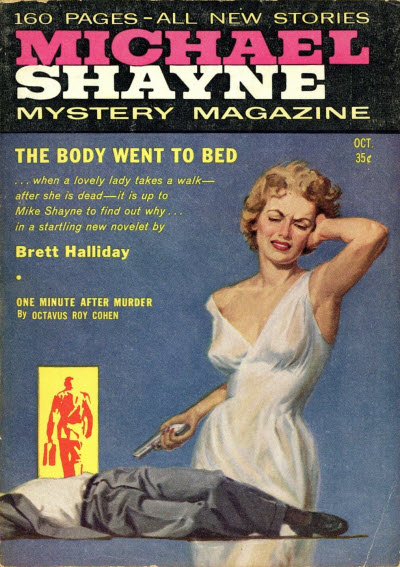
Gilford's story was first published in the October 1956 issue of Michael Shayne Mystery Magazine. Dennis's script follows the story closely. Joan Tetzel plays Eve as a much more attractive and stylish woman than she is described on paper; the Eve of Gilford's story has "gone to seed," according to Jordan, "wearing a wrapper [with] a scarf knotted around her head." In the story, when Jordan barricades himself in the bedroom, he calls out to Lacie and tells him to shoot Eve, which Dennis must have thought was too cruel to include in the teleplay. Gilford handles the ending better, the subtlety of the story's conclusion eclipsing the overly romantic turn that the television version takes. Gilford writes that, after the police leave, Eve has transformed herself: "She had changed her clothes. She was wearing a neat, dark dress, her hair was well-groomed, her mouth was bright with lipstick" She comments on the "turnabout when the chips were down" and Jordan replies that "We've had quite an emotional day and solved absolutely nothing." They are the same two people in the same marriage. "The same?" asks Eve, and Jordan replies: "I'll have to think it over."

Gilford's ending fits much better with the relationship that has been established between Jordan and Eve Roth. The crisis and their unexpected defense of each other makes them reconsider their marriage, but no sudden conclusions are reached. This is much more believable than the televised version, with its corny evocation of Tarzan and Jane and its suggestion that the Roths reverted to the law of the jungle.

A stuntman stands in for McKay
Paul Henreid (1908-1992) directed 29 episodes of the Hitchcock series; the last one examined here was "The Diplomatic Corpse."

C. B. Gilford (1920-2010) wrote stories that served as the basis for five episodes of the Hitchcock series; the last one discussed here was "The Equalizer."

Playing Eve Roth is Joan Tetzel (1921-1977), who performed many parts on the Broadway stage from the 1930s into the 1960s. She was married to Oscar Homolka from 1949 until her death, appeared in movies from 1946 to 1965 and on TV from 1953 to 1976. She was in Duel in the Sun (1946) and Hitchcock's The Paradine Case (1947). She was on Thriller twice but this was her only appearance on the Hitchcock show.

"Guest for Breakfast" was
first published here
Her husband Jordan is played by Scott McKay (1915-1987), who was born Carl Gose and who was also a stage actor for 35 years. He was in movies from 1944 to 1980 and appeared with Joan Tetzel in Duel in the Sun. On television from 1950 to 1977, he appeared in another Hitchcock episode, Henry Slesar's "A Woman's Help." He was married to Ann Sheridan for a year prior to her death.

Finally, Richard Shepard plays Lacie. He has nine credits on TV between 1956 and 1963 but I have not been able to find any other information about him.

In 1964, C. B. Gilford adapted his own short story as a one-act play, published under the same title. The story is completely rewritten though the key events are the same. In this version, Jordan and Eve's roles are reversed--he works a dull job as a bookkeeper while she has just landed a job as an advertising executive and makes more money than he does. This is the source of the friction between them and there is no mention of an adulterous affair.

Lacey broke out of prison and killed a guard; here, he did not kill his wife and her lover and does not compare the situation at his home to that of Jordan and Eve. This time, Eve also works in an office and has to cancel her appointments; she has more cash on her than Jordan does! The balance of power and motivations of the characters are much different than those in the original story or the TV version. As a result, the ending seems to work better, since they are not as estranged in the beginning. The play runs just twelve pages and was published for amateur theater companies to perform.

In the original story, Jordan and Eve have the surname "Roth" and Chester has the surname "Lacie." These are changed to "Ross" and "Lacey" in the play. The TV version does not identify the characters' names in the credits, but it may be the case that Robert C. Dennis changed the names for TV and C.B. Gilford followed suit in his play.

"Guest for Breakfast" is available on DVD here or may be viewed for free online here.

Thanks to Peter Enfantino for a copy of the story.

Read the GenreSnaps review of "Guest for Breakfast" here.

Sources:
"Galactic Central." Galactic Central. Web. 01 May 2016.
Gilford, C.B. Guest for Breakfast. Kansas Cty, MO: The Play House, 1964.
Gilford, C. B. "Guest for Breakfast." Michael Shayne Mystery Magazine Oct. 1956: 102-12.
Grams, Martin, and Patrik Wikstrom. The Alfred Hitchcock Presents Companion. Churchville, MD: OTR Pub., 2001. Print.
"Guest for Breakfast." Alfred Hitchcock Presents. CBS. 23 Feb. 1958. Television.
IMDb. IMDb.com. Web. 01 May 2016.
Wikipedia. Wikimedia Foundation. Web. 01 May 2016.

In two weeks: "Fatal Figures," with John McGiver!

Monday, May 9, 2016

Star Spangled DC War Stories Part 78: November 1965

The DC War Comics
1959-1976
by Corporals Enfantino and Seabrook


Russ Heath
Our Fighting Forces 96

"Battle of Fire!"
Story by Robert Kanigher
Art by Irv Novick

"Desert Ambush!"
Story by Hank Chapman
Art by Jack Abel

Jack: A U.S. soldier wanders through the desert, alone after everyone else in his company was wiped out in a "Desert Ambush!" Desperately seeking water, he comes upon a Nazi soldier in the same predicament. A machine gun battle erupts and soon, the American is alone again. He reaches the water hole that both he and the Nazi sought but finds it dry.

A Nazi plane makes an emergency landing; the American blows it up with a grenade but finds the pilot's canteen full of holes and the water drained. The U.S. soldier also defeats a Nazi tank and lets the men inside run to the dry water hole. Another tank and another plane attack the suddenly busy section of desert and, when the plane crashes, it blows open an artesian well. The U.S. soldier lets his Nazi prisoners have a refreshing drink before marching them back to base as POWs.

Chapman and Abel turn in an above-average story, balancing out the terrible first story that features Lt. Larry Rock. The attacking Japanese soldiers who refer to Rock as "Joe" and an "Amelican" almost make me pine for Gunner and Sarge. I said almost.

Peter: An odd choice for Irv Novick to make, illustrating his Sgt. and Lt. as twins. Whenever they’re in the same panel, it’s tough to tell them apart. Two installments in and I have to say I am not warming up to the Fighting Devil Dog one bit. At least with Gunner and Sarge we had something to make fun of; Lt. Larry Rock is no fun at all. Droning on about the time bomb in his skull (and I’d like one of our more medically-knowledgeable readers to pipe up and tell me if the sliver in Larry’s head could actually explode as advertised) and warning his Sergeant repeatedly not to rat on him. Good God, it’s like a double dose of Hank Chapman-itis. Speaking of Hank, the eternal bridesmaid actually comes up with an entertaining story in “Desert Ambush,” despite the repetitive actions of the hero. It’s certainly more readable than the drone of the opener. The letters page actually seems to be evolving into comments on the individual issues and characters rather than comments or statements pertaining to armaments and rank. Several readers rave about Enemy Ace and demand a return performance, if not his own title. Those kids will have to wait a few years for their wish to come true.


Russ Heath
G.I. Combat 114

"Battle Origin of the Haunted Tank!"
Story by Robert Kanigher
Art by Russ Heath

"My Witness--the Enemy!"
Story by Hank Chapman
Art by Jack Abel

Peter: When Jeb Stuart (the tank commander) has a case of the crazies and tells his men they're being watched over by a ghost, the men appeal to their C.O. to get their boss some help. Jeb pleads with Jeb Stuart (the ghost) to tell the men the origin of the Haunted Tank. The spiritual big brother tells his tale: while hanging out with other dead warriors, he's talked into becoming the tank crew's guardian angel by fellow general, Alexander the Great. After watching the crew work, Jeb agrees and history is made. Unfortunately, back in the present, none of the other boys have heard a word and are, naturally, skeptical when Jeb (their commander) relays the message given him by Jeb (the ghost): there's a Tiger on the way! Eventually, the boys agree to listen to their boss and hide the Jeb (the tank) under a waterfall. Twenty minutes later, sure enough, the Tiger shows up and the men blow it to kingdom come. As far as origin stories go, this one's a little sketchy and thin. Within the flashback, we see the boys at work in the hot African desert after losing their initial tank. They're followed and harassed by a Nazi tank; forcing them to walk in the blazing sun until they begin seeing mirages. The first, an oasis, is a mirage but the second, a deserted tank, turns out to be the real McCoy. First, where did this perfectly working tank come from, and second, why does the Nazi tank commander see the same mirages our heroes do? The dead warrior clubhouse (the characters are illustrated like chalk doodles on a blackboard) is a pretty cool idea and "Battle Origin of the Haunted Tank" features another fine art job by Russ Heath.

What's known as an easy payday in funny books!
Jack: I liked the black and white sequence and I liked the fact that the ghost of J.E.B. Stuart played such a significant role for a change. It's about time we had an origin story for the Haunted Tank and I'm thrilled to see Russ Heath return! I can't remember the last time he drew a full-length story in one of the DC war books. It was interesting that Stuart's initial reaction was that he wasn't going to help a bunch of Yankees but after seeing their gumption he changed his kind.

Peter: In Hank Chapman's silly "My Witness--the Enemy," the hapless protagonist wishes dearly to become a frogman but, in order to earn his flippers, another frogman must witness an act of valor. Unfortunately for this guy, he's being followed by the Navy's biggest fumblebum--the guy gets knocked unconscious, gets water in his eyes, is accosted by sea turtles, etc., etc. The only avenue left open to the "polliwog" is to bring up one of occupants of the submarine he destroys. I can't figure this situation out. The "polliwog" blows up a pillbox, bombs a fighter jet, and sinks a patrol boat but can't convince his superior he's done any of this? There's no wreckage left over? I hammer Hank Chapman endlessly but this one really isn't that bad. It's just dumb as dirt.


Jack: Dumber! This reminds me of several stories we've read where fliers shoot down enemy planes but they don't count toward "Ace" status because no one else saw it happen. What ever happened to trust among soldiers?


Joe Kubert
Our Army at War 160

"What's the Color of Your Blood?"
Story by Robert Kanigher
Art by Joe Kubert

"Jackass Volunteer!"
Story by Hank Chapman
Art by Jack Abel

Jack: Jackie Johnson, a black soldier in Easy Co., is taking a brutal beating from a Nazi fighter known as “Storm Trooper” Uhlan, the heavyweight champion of the world. Uhlan taunts Johnson, insisting that he admit that the color of his blood is black, but Johnson remains silent. Sgt. Rock and Wild Man are also being held prisoner by the Nazis, and Rock tells Johnson that he understands that a knockout of Uhlan will result in the three Americans’ being shot by their captors.

Rock and Wild Man try to fight back, but are quickly knocked down by the Nazis’ gun butts. Rock remembers back to a time before the war when Johnson had fought Uhlan in the boxing ring and Uhlan had beaten him. Johnson trained hard for a rematch and, when war broke out, he longed for a chance to meet up with Uhlan, who had made a name for himself as a Nazi paratrooper.

One day, Rock, Wild Man and Johnson are out on patrol and all three are captured in an ambush. Uhlan happens to be among the Nazis and he decides to give Johnson a chance at a rematch in order to show that the blood of the Master Race is superior to the blood of an American black man. The boxing match gets underway and, as Uhlan taunts Johnson with repeated questions of “What’s the Color of Your Blood?” the black fighter finally has had enough and gives it right back to Uhlan, knocking the man to the ground.

The rest of the Nazis are so upset that they decide to execute Uhlan on the spot and start shooting wildly. The other members of Easy Co. finally show up and chase the Nazis away. Rock discovers that Johnson ducked the shots but Uhlan was badly wounded. The only man with the same blood type as Uhlan is Johnson, who immediately offers his arm for a blood transfusion. Uhlan recovers and the scales fall from his eyes as he remarks that Johnson’s blood is as red as his.

There is so much going on in this story that it’s hard to know where to begin. Uhlan is based on Max Schmelling, who knocked out Joe Louis in 1936 and then was knocked out by Louis in 1938. Like Uhlan, Schmelling was a paratrooper with the German Air Force in WWII. Kanigher took these historical facts and wove them into a story that was a perfect fit for the mood of the country in 1965, right in the middle of the Civil Rights movement. Kubert’s art is tremendous, some of the best work I’ve ever seen from him. This is an extremely fine story and easily one of the best of the year, if not the best.

Oddly enough, the story is soft-pedaled on the cover. Even worse, the backup story features the unwelcome return of Sgt. Mule in what is one of the year’s worst stories!

Peter: “What’s the Color of Your Blood” is oft-cited as one of the best DC war stories of all time (it’s included in Michael Uslan’s anthology, America at War: The Best of DC War Comics) and, while I don’t think it’s one of the best, it is stirring and powerful for its time. The usual coincidences (Jackie meeting “Storm Trooper Uhlan” again on the battlefield is one of those “yeah, right”s we just have to put to the side sometimes while reading funny books), and jack-hammered phrases (the title, in this instance) are annoying and take my focus off the flow of the narrative, but they’re not a deal-breaker. It was still controversial, if not chancy in terms of sales in 1965, to feature a black protagonist, but it certainly helped dull the impending outcry to make the villain a stinkin’ Nazi. A good read; certainly Top Ten for the year but among the best of all time? Nope.

As if to remind readers that war wasn’t all grim and nasty stuff, Hank Chapman revisits Sgt Mule, the only ranked donkey in World War II, whom we haven’t seen since Our Army #149. The nicest thing I can say about this nonsense is that it’s a fast read and not too many brain cells were damaged. More interesting is that the letters column this issue is given over to a single missive penned by SP 4 Drury Moroz. Drury makes the case that the DC war story has been elevated to near-EC status with the coming of Enemy Ace: “Von Hammer presents to me both the highest and the lowest levels of mankind, combined in one truly human being. He is a chivalrous, and despite his cold exterior, a deeply sensitive man  . . . (A)t the same time Von Hammer is a killing machine—and one finds it hard to find sympathy for him.” Moroz goes on to make several cogent remarks and observations about Bob’s new baby. Kanigher, for his part, explains that he cut out “the usual accusations about Wonder Woman, which I am growing accustomed to . . ”(you can read about that controversy here) and a few other bits but, otherwise, ran the letter uncut. Again, I applaud Bob for turning the LOC page into discussion about the comics rather than drooling over barrel sizes.

Jack: The new letters column even rates a banner on the cover: "No holds barred! Readers' own page!"


Russ Heath
Star Spangled War Stories 123

"The Dinosaur Who Ate Torpedoes!"
Story by Robert Kanigher
Art by Gene Colan

"Terror in a Bottle!"
Story by Robert Kanigher
Art by Ross Andu and Mike Esposito

"Shooting Foxhole!"
Story by Hank Chapman
Art by Jack Abel

Peter: A double dose of dinosaur dementia this issue! In the opener, Lt. Jordan heads a trio of PT Boats that must locate a sunken "super-bomb sight"somewhere in the Pacific. Each PT is manned by frogmen who have been ordered to reacquire the bombs or destroy them, but two things stand in their way: an enemy sub and the terrors from the ancient prehistoric dinosaur ice age that have suddenly popped up way out here in the ocean. One critter, "The Dinosaur Who Ate Torpedoes," proves to be a pain in the posterior when he chows down on the targeted device without any ill effects. Lt. Jordan is forced to blow up the pesky dino, bombs and all, but at least his mission is complete.

"The Dinosaur Who Ate Torpedoes" is an odd chapter of The War That Time Forgot in that this is the first time (that I can recall) when there's no land mass to ground the dinos. One of the islands we've visited before must be somewhere in the vicinity as it's unlikely a pterodactyl could live without its aerie, right? Gene Colan's work is barely recognizable but the story is still nicely illustrated and, at a mere six and a half pages, it doesn't outlive its welcome. Thumbs up!

Jack: This installment seemed much longer than seven pages and Colan's art looks rushed and sketchier than usual. Why run the shortest story first?

Peter: After a Zero flies headlong into their Helldiver, Smitty and Skipper are forced to parachute from the burning plane and, luckily, land on a deserted Pacific island. Hold on a second, this being the Pacific in World War II, we know the island is far from deserted. In fact, this is the piece of land owned by the Son of the Great White Ape (and his pa before him, last seen in SSWS #111). The boys come across the big galoot while he's fighting a giant prehistoric horror from the stone age and give him a helping hand by firing a flare into the dino's face. Smitty and the Skip then head for high ground but are carted away by a pterodactyl and dropped into its nest. A skirmish between the ptero and a neighboring rival leaves the boys stranded in the high nest but at least in one piece. Along comes the scar-faced dino and he's not only hungry, but mad as well. The big ape returns to save our boys and Skip and Smitty prepare for life as the playthings of a giant simian.

White Ape? Brown Ape? Why do we focus on color anyway?
As for "Terror in a Bottle!" (the title refers to the message the boys send out to sea in hope of rescue), we're back to the nonsensical world of the Pacific islands. The adventures Smitty and Skipper endure this issue are almost a retelling of the events that befell "Professor" and "Skipper" (not the same Skipper as the guy featured in this story--yeah, this is confusing to me as well); so what happened to the other guys? Did they manage to ride their glider to safety? And what will happen to these fellas? Sorry to say, this is the last Great White Ape saga so you'll just have to use your imagination to fill in the blanks. By the way, the DC colorist who worked on this issue obviously didn't get the memo that a Great White Ape should indeed be white and not brown!

Jack: At eight pages, only one page longer than the opening story, but so goofy and childish that it reads quickly. The Son of Kong ripoff is not very good. Kanigher must have written this at breakfast one day when he was running late.

Peter: Since he dug sewers in his civilian life, digging foxholes is a piece of cake to Carney but the G.I. is tired of ending up in a "Shooting Foxhole" and does everything he can to get to ground he doesn't have to dig.

The days of issues packed with three stories returns and  . . . I'm not exactly grateful. Hank Chapman does his best to keep his reputation intact by peppering "Shooting Foxhole" with such realistic and flowing dialogue as "You're the digging expert, Carney! And I'm the gunnery expert! So you excavate while I triggerate!" Carney is one of those G.I.s that whine and smart off so much that you keep hoping against hope he gets his clock cleaned. Doesn't happen.

Jack: At nine pages long, Chapman's tale is the longest in the book and, as usual, the weakest. At least Sgt. Jackass is nowhere to be seen.

In Our Next Issue...
We Go to the Dogs!
On Sale May 16th!


Monday, May 2, 2016

It's An Entertaining Comic! Part Five: December 1950


Featuring special guest host, John Scoleri!


The EC Reign Month by Month 1950-1956
5: December 1950


Kurtzman
Two-Fisted Tales #18

"Conquest"
Story and Art by Harvey Kurtzman

"Hong Kong Intrigue!"
Story and Art by Al Feldstein

"Revolution!"★1/2
Story and Art by Wally Wood

"Mutiny"
Story and Art by Johnny Craig

When three unsavory characters in a bar in Port Elizabeth, South Africa, overhear some crewmen mention that Captain Steve Cutter, skipper of The Shark, is carrying a fortune in diamonds, they beat up the crewmen, steal their clothes, and get hired on as their replacements. Three days out at sea and the new crew stage a “Mutiny!” sending Cutter off on his own in a lifeboat. No one can find the diamonds, and when the sea is calm Cutter sneaks back aboard and quickly dispatches the scurvy dogs. After they’ve all been knocked overboard, he reveals that the diamonds were hidden in a bag of flour, the only food item that the baddies had tossed into the lifeboat. Yawn. This is straightforward sea action stuff, made bearable only by Johnny Craig’s usual artistic flourishes and his fine use of wordless panels to tell key elements of the story.

"Conquest"
The rest of the issue isn’t much better. Kurtzman’s “Conquest” finds Spanish soldiers cruelly abusing either Incans or Aztecs in a lust for gold. Harvey’s highly stylized art looks out of place in such a classic adventure story. Wally Wood fares a bit better with “Revolution!” where a mercenary named “Bullet” Hunter signs on to help in an uprising and accidentally kills his best friend. The downbeat ending, where Hunter intentionally crashes his plane in order to kill his employer, is the highlight. Finally, Feldstein’s contribution is “Hong Kong Intrigue!” which reads as if he cribbed all of the oldest clichés from a twenty year old pulp, even down to lines about Orientals that come right out of an old Yellow Peril howler. If they didn’t play it so straight, I’d start to wonder if this issue was a put on. -Jack


"Hong Kong Intrigue!"
Peter: In 1950, Harvey Kurtzman convinced Bill Gaines that an adventure book would be a great idea. Two-Fisted Tales was born. According to a transcript (published in the 8th issue of Squa Tront, 1978) of a panel on the war titles at the 1972 EC Convention in New York (featuring Gaines, Kurtzman, George Evans, Wally Wood, Jerry De Fuccio, Will Elder and Jack Davis), Al Feldstein edited the first issue but then Kurtzman took over with the second, making it as much his title as Robert Kanigher did Our Army at War for DC. Initially, the focus of TFT, as you can see when you read the stories included in the first issue, was a large canvas (at the aforementioned war panel, Gaines referred to the early issues of TFT as "blood and thunder tales and rip-roaring adventure") but that canvas was narrowed very soon to just war stories. The first issue features two obvious stand-outs, "Conquest" and "Revolution." The former is a violent slice of history while the latter is an atypical brothers-in-arms tale with more characterization in its six pages than some novels can claim in hundreds. Both come equipped with downbeat endings. The numbering, by the way, continues from The Haunt of Fear. Say what? Yeah, I know. This one's almost better off not being explained but suffice to say, funny book publishers had to file with the post office in the old days and those forms probably cost eight cents to file so... You get all kinds of wonky numbering systems. Like Tales from the Crypt (and unlike, say, The Haunt of Fear, the numbering won't backtrack.

"Revolution!"
Jose: For all of its one-dimensional characterizations, “Conquest” was easily the highlight of this issue for me. It’s kind of funny, because where one might expect Johnny Craig’s clean-cut, efficient art to work really well in an action-oriented series, I found his contribution incredibly plain and lackluster when stacked against the abundantly stylistic art of Harvey Kurtzman. Like in Wood’s story, you can feel the rage and sweat and blood coursing through Kurtzman’s characters, giving it more of the thick, machismo punch that the reader would hope for in a series entitled Two-Fisted Tales. Like Jack says above, Feldstein’s story is as clear an example of time-travelling as anything we’ve seen from the SF titles. Its blatant racism is matched only in its amount of hilarious earnestness.

"Mutiny"
John: This was my first time dipping my toes into TFT, so I was quite surprised to find just how few of these initial stories aligned with my expectations for cigar-chomping, steel-jawed hero war tales. As I read through the issue, I was actually excited by the thought of broader action/adventure tales, as I don't know if I can maintain enthusiasm for a steady diet of war stories. Unfortunately, none of the stories in this first issue would have lured me back for more. From Feldstein's splash page, I thought "Hong Kong Intrigue!" might prove to be an interesting (albeit racist) period adventure tale, but the story was uninspired. "Revolution!" was forgettable other than the ending, though the story itself was closest to what I had come to expect from the book. "Conquest" read like a heavy-handed history lesson, and "Mutiny," while having the most recognizable classic EC twist, suffered from the all-too common lengthy build-up to a lackluster payoff.


Feldstein
Weird Fantasy #16

"The Last City" 
Story and Art by Al Feldstein

"The Mysterious Ray from Another Dimension!" 
Story and Art by Harvey Kurtzman

"Second Childhood" 
Story by Al Feldstein
Art by Jack Kamen

"A Trip to a Star!" 
Story by Al Feldstein and M.C. Gaines
Art by Wally Wood

Two visitors from Saturn hover over what’s left of New York and tell the wild story of Professor Farley’s Electro-Magnetic Force-Field Generator. Years before, in an effort to stave off atomic annihilation, Professor Farley creates a machine that enables him to cover all of New York with a protective shield. Unfortunately, the gizmo proves to be too effective when the Professor attempts to turn it off and finds it’s permanent. With no way to ship in food, the inhabitants of New York die a slow, painful death. Ironically, the world becomes embroiled in World War III and the earth is left a smoldering pile of ashes, save for New York, whose skyscrapers live on under the indestructible force field. Ivat and Cugo, the two narrating Saturnites agree that New York should remain as a museum, a testament to what “earthmen had once...and destroyed.”

"The Last City"
“The Last City” is no-holds-barred science fiction. Whereas other publishers (Atlas of the 1950s, for instance) would have its protagonists devise a way to destroy the force field and rain happiness and relief down upon mankind, Feldstein almost gleefully kills off an entire planet and leaves only remnants for alien passersby. One panel stands out as particularly grim: two starving New Yorkers stand over a dying man; one says: “He’ll be dead, soon!” The other answers: “Light a fire!”

It’s 1970 and everyone in the world is captivated, no, obsessed with television. Everyone, that is, except radio station magnate Norman Network. Norman can’t seem to get his head around why so many people find the tube fascinating. With his station revenues falling to an all-time low, Norman devises a plan to rid the world of TV. He hires a scientist to travel the world in search of any disease that can be linked to television viewing. The scientist discovers that TV can lead to disintegration and, for a time, Norman wins his battle. It’s only in the end that Norman discovers that humans watch TV in order to disappear (literally) and he’s very soon the last man on earth (and without a TV, to boot). "The Mysterious Ray..." is prescient satire in the Kurtzman style. Could very easily have found a place in MAD Magazine a few years later.

"The Mysterious Ray..."

John Clayton, the brilliant scientist of "Second Childhood," makes simultaneous discoveries: he finds the key to halting the aging process just as he realizes his assistant, Betty, is a hot babe. Since he's "twice her age," the scientific breakthrough couldn't have come at a better time. Unfortunately, the serum reverses our hero's aging process rather than halting it and he regresses, by the climax, to an infant looked after by the same babe he'd hoped to marry. Kamen's art is perfect here since every panel is filled with talking heads and little else; let's just say Jack wasn't taxed with the layout. Al Feldstein presents a decent science fiction concept but then doesn't know where to take it, climaxing with a silly panel of Betty, feeding John a bottle and pleading with the reader to help her find a solution. The story is evocative of Richard Matheson's The Shrinking Man (which wouldn't be published until 1956) but lacks that novel's powerful denouement.

Two space travelers rocket from Earth on a voyage to Alpha Centauri but accidentally enter a time warp and end up back on Earth one million years later. "A Trip to a Star!" makes me nostalgic for the days when astronauts could travel the length of the universe dressed in James Dean shirt and trousers. Perhaps the story comes across as predictable because we've seen so many "Oh My God! We were on Earth the whole time" dramas in the meantime. The only thing missing here are damn dirty apes.
-Peter

"Second Childhood"
Jack: I like the Kurtzman story best. His art works for me when the story is tongue in cheek, as this one is. It’s yet another story about TV and very funny, and I particularly like the ending where we don’t get any explanation of where everyone went or why. Feldstein’s story is also very good—strong art as always and a clever, original story. The best thing about the Kamen story is that it’s told from the woman’s perspective, as she goes from the young doll to the unhappy mother. Woody is always great with spacemen and the mystery in the last tale held my interest. Overall, a very satisfying issue of sci fi!

Jose: Kurtzman easily serves the most enjoyable entry in this issue, his delivery just over-the-top enough to elicit hearty chuckles from the reader. I also appreciated the fact that the “wonderful world” the TV viewers disappear to is left entirely up to our imaginations. “The Last City” really starts picking up steam once the force field over New York becomes impenetrable, the situation delving into some pretty grim realities that would’ve come as a shock to young comic book fans. It’s all explained by Feldstein in a detached, documentarian style that adds exponentially to its unsettling effect. “Second Childhood” has probably been my favorite of Jack Kamen’s SF stories so far. Faint praise considering some of the material we’ve put up with, but I found the premise to be quite engaging, especially when our put-upon heroine is forced to deal with the psychological demands of disassociating John as her husband and begin looking at him as her child. (Paging Dr. Freud.) 1950s propriety undoubtedly kept the climax of the infantized-John “demanding food” from getting too discomforting. Wood’s art is always a joy to behold, but the warmed-up leftovers of  the plotline to “A Trip to a Star” guarantee that you can skip over the words here.

"A Trip to a Star"
John: I enjoyed "The Last City," which had me thinking about Stephen King's Under the Dome, and particularly how he specifically allowed for air to pass through so as not to kill off everyone trapped inside relatively quickly. While I do love the classic bubble-canopy flying saucer (which flips open to make getting in and out easy), the Saturnites themselves look too dorky to be tooling around in such a hot rod. Once you get past the silliness of the concept, "The Mysterious Ray From Another Dimension!" is quite poignant, striking chords similar to Invasion of the Body Snatchers and even a bit of Michael Tolkin's The Rapture (and let's face it, who can deny that GOD is television?). I wasn't as impressed by "Second Childhood," and think it would have been more powerful (and far more creepy) had John not just forgotten things as he grew younger. I guess they weren't prepared to suggest (let alone depict) the husband in a young boy's body sleeping with his wife. Kudos to "A Trip to a Star!" for NOT delivering the obvious, "we're on the post-apocalyptic Earth of the future" denouement. That said, I also found it amusing that on their trip out of our galaxy, they timed it accordingly so that all of the planets were in alignment on their path at the right time. My favorite bit was the off-hand reference to the 'quick test' to confirm the air was breathable on the foreign planet where they landed.


Feldstein
The Haunt of Fear #4

"The Hunchback!" 
Story by Al Feldstein
Art by Graham Ingels

"The Tunnel of Terror!" 
Story by Al Feldstein
Art by Jack Kamen

"The Living Mummy" ★ 1/2
Story by Al Feldstein
Art by Jack Davis

"Man from the Grave!" ★ 1/2
Story by Gardner F. Fox
Art by Wally Wood


"The Hunchback"

Roger Compton is walking through the village square on a dreary afternoon when he is met with the sight of panicked townspeople running through the streets. They warn Roger to hide, for “The Hunchback” is on his way! He’s surprised to discover that the miscreant in question is his old college chum, Peter Golgo, but any chance of a happy reunion is snuffed out when the half-crazed Golgo shoos Roger from his crumbling house. The villagers whisper stories of the recluse desecrating graves in order to feed on decayed flesh, but Roger puts it all down to superstitious hogwash. Consulting with the local M.D., Roger is related Golgo’s tortured history, the most shocking revelation of which is the fact that Golgo’s deformed back is actually the sentient remains of a Siamese twin that was never removed at birth. Compelled by the pain-inducing monkey on his back, Peter has been forced to feed his brother’s unholy appetites, but a final altercation takes place just as Roger returns to the house, his late intervention revealing Peter, his throat torn out by Li'l Brother, and the evil twin dead from the cessation of their shared heart.

"The Tunnel of Terror"
On paper, this story seems like a bona fide winner, a more fitting introduction for “Ghastly” Graham Ingels to The Haunt of Fear, the magazine that would soon host him as lead artist, than either “The Killer in the Coffin” (#16) or “Monster Maker” (#17), but the promise held by the tale’s logline is dampened by a surprisingly lackluster turn by the artist. Which is not to say that the art here is bad, not by a long shot, but Ingels seems to demonstrate a level of restraint that leaves the reader’s—ahem—appetite unsatisfied. His faces are still things of beauty, but when I think back to the scenes of the grave robbing and the final unveiling of Peter’s “monstrous” brother, I can’t help but wonder what could’ve been wrought had the artist pushed the envelope just a little more here. Suffice to say, we’ll see Ingels master his particular aesthetic sooner rather than later.

There are definitely some interesting ideas at work in “The Tunnel of Terror,” yet I honestly can’t say if the tale ever quite clicked for me. The switch to a more exotic backdrop was a nice change, and the fact that we’re never quite sure what is going on—Is there really a monster on the loose? Is Linda’s brother dead? Is she crazy?—is a commendable balancing act other stories have hardly attempted to accomplish, yet I find myself uselessly wishing that the freaky underground nightclub angle had been explored a little further. I’m convinced that the ending could’ve been great had Kamen not dropped the ball with those last few panels.

"The Living Mummy"
It sure is nice seeing good ol’ boy Jack Davis starting to wave his freak flag and pound the drum of delirium in “The Living Mummy.” The two-week-old casserole story isn’t much to stand for, but it says quite a bit about Davis’s talent that he manages to make almost every panel spark with momentum and kinetic energy. Could you imagine what reading this would’ve been like had it been drawn by Harry Harrison? Davis was one of the artists most adept at action (not to mention those marvelous bug-eyed, ditch-mouthed, screaming faces), and it shines through even in this sophomore credit.

“Man from the Grave” has made me excited for future horror tales drawn by Wally Wood. I don’t remember ever taking to him on my initial reading of The Vault of Horror or Tales from the Crypt, but this story, about a thinly-veiled, destitute artist who is cursed by a colleague to become consumed by his work after dunking said colleague’s head in etching acid and stealing his gear to produce covers for the editor of a “macabre magazine,” is one of the most surprising and finely-wrought tales to have come across my radar since the start of this marathon. Wood was, among other things, a master of embedding small details that, I doubt, were ever in the actual script but added immeasurably to the effect of a composition. (In addition to Jack’s note below, I’m in love with that rockin’ death's-head pipe that the Wood-surrogate character smokes.) Outside of the obvious three (Davis, Craig, Ingels), Wood was probably the only artist who managed to make one of the GhouLunatics distinctly his; I adore the sardonic troll of a Crypt-Keeper we see here. There are indeed some stunner panels here, but in truth it’s all pretty great.-Jose

"Man from the Grave"
Peter: Al Feldstein checks another two boxes on the list labelled "Classic Monsters" with "The Hunchback" and "The Living Mummy." These join the previously published "Vampire!" (from HoF #16); "Zombie! (Crypt of Terror #19); and "Werewolf" (Vault #14). "The Living Mummy" is the first EC work for Jack Davis, who will fast become one of the EC fan-addict favorites. Not one of the four stories in this issue feature a "shock ending"; all just sputter and fade. Two of them, "The Hunchback" and "Man from the Grave" even telecast their "twist" endings long before their climax.

Jack: Yes! “The Hunchback” is the kind of gross and disgusting story I’ve been waiting for! Welcome to the real Ghastly! “Man from the Grave!” also pushes the envelope of bad taste, as Wood treats us to some horrific images. There’s a great panel where a little girl watches a coffin be carried by. It’s chilling in a quiet way. Kamen’s story would have benefited from a more gruesome finish (and a different artist). Davis’s story is his first for EC and it shows, but I’m thrilled to finally be seeing work by one of the EC greats.

Night of the Living Dead (1968)
John: As I read it, I couldn't help but wonder if this particular issue of HOF was read by and made a lasting impression on a 10 year-old George Romero (who has always credited EC comics as an inspiration--to which he wrote a wonderful love letter with his film Creepshow). Devout Night of the Living Dead fans like me cannot help but notice a number of interesting if coincidental similarities spread across the stories within: we've got flesh eating ghouls ("The Hunchback!"), a quite possibly dead brother attempting to eat the flesh of his sister ("The Tunnel of Terror!"), as well as a walking corpse PLUS a face missing flesh, revealing the skull underneath ("Man from the Grave!"). Perhaps it's just me, but I'd love to put this issue in front of George to see if it brings back memories. As for the stories themselves, I was pleasantly surprised by both "The Hunchback" and "The Tunnel of Terror!" though in both cases I was disappointed that the the climactic moment either happened off-screen or the story ended abruptly before things got too nasty. Wally Wood's art in "Man from the Grave!" was a highlight this issue, particularly the acid burnt face of Bill Johnson. My least favorite of the tales was "The Living Mummy!" but even that delivered a great Jack Davis shambling corpse. And it was still more entertaining than ANY of the stories in Two-Fisted Tales this month.


Feldstein
Weird Science #15

"Panic!"
Story and Art by Al Feldstein

"The Radioactive Child!"
Story and Art by Harvey Kurtzman

"House, In Time!"
Story by Al Feldstein
Art by Graham Ingels

"I Created a . . . Gargantua!"
Story by Al Feldstein
Art by Jack Kamen

Off the coast of Argenta, a small fishing boat drifts into the area of the Bikini bomb test, exposing Luis Martinez and his pregnant wife Rosa to a fatal dose of radiation. After Luis dies, Rosa gives birth to a boy named Pedro, who soon grows into an unusually bright little boy. Knowing she is dying, Rosa brings “The Radioactive Child!” to the office of Benito Perez, certain that only the country’s president should look after her son. After she dies in the president’s office, the boy surprises Perez’s advisers with his wise counsel and the president appoints him as the country’s new prime minister. Little Pedro tells Perez how to get his country up and running and, before you know it, Argenta is strong, profitable, and declaring war on its neighbors. When the United Nations agree to bomb Argenta off the map to stop Perez’s mad ambition, Perez approaches Pedro and demands that he tell him the secret of the hydrogen bomb. Pedro is tired and tells Perez to come back the next day. Perez gives the little boy a good wallop, which causes Pedro to revert to the personality of a normal child and lose his intellect. As a result, Argenta is destroyed and Perez is killed.

"The Radioactive Child!"

We may be early in our month-by-month journey through EC comics, but so far, at least for me, Kurtzman’s work is a real revelation. This is a powerful story whose message still resonates 65 years later.

Al Feldstein’s “Panic!” starts out seeming like a tired retelling of the story of Orson Welles’s 1939 radio broadcast of “War of the Worlds,” but takes it one more step when a re-enactment of the show coincides with a real invasion, one that listeners laugh off as a hoax until it’s too late. Graham Ingels turns in very smooth art on “House, in Time!” which reads like it could be a swipe from a Ray Bradbury story but ends suddenly and unsatisfactorily. Last of all is Kamen’s “I Created a . . . Gargantua!” where a poor fellow is made to keep growing and, as usual, the scientist who assured him he could stop the process finds he cannot.
-Jack

"Panic!"
Peter: "I Created a... Gargantua!" is proof that EC didn't reign supreme over every comic book genre. I'm not sure if it's Feldstein's silly script or Kamen's big-eyed gosh-wow art that did me in but it's easily the low point of a very good issue. Kirby and Lee would revolutionize this sub-genre in the late 50s and early 60s. "House... In Time" is built around a fun gimmick but it's far too wordy (one panel is pretty much all text with the art squeezed down at the bottom). Its chief notoriety is that it's the only contribution Ghastly made to the science fiction titles; it doesn't look like the typical Graham Ingels artwork either. This was probably what led Al and Bill to keep Ingels on the grittier titles. "Panic" is a clever riff on Welles's War of the Worlds broadcast and contains the first recorded usage of the phrases, "Spa Fon" and "Qua Brot" which, like "Squa Tront," became titles for EC fanzines. "The Radioactive Child" is in a whole new stratosphere all to itself, a blackly comedic dig at politics that has not dated one bit in the sixty-five years since its publication. Kurtzman's dialogue see-saws between hilarious and chilling and should be required reading in high school literary classes. Stunning!

"I Created a . . . Gargantua!"
Jose: It’s amazing that John Paulson—a riff on Paul Bunyan?—is able to purchase perfectly-fitting clothes even after he grows thirty feet in height. There must be a specialty “Big and Tall” store in the Big Apple that I don’t know about. Even with its slightly risible qualities, I found “I Created a… Gargantua!” to be much more entertaining than the flatlining “House, in Time.” Ingels’s art was exceptionally crisp, but the all-too-brief glimpse we get of his meat-eating dinosaur feels like a wasted opportunity and gets shoved off-stage in favor for the explanation-heavy speeches that comics of the time seemed to love so much. “Panic!” is another of Feldstein’s cheeky SF tales, neatly delivering a twist when you least expect it. And I’ll add my vote that Kurtzman’s “The Radioactive Child” is a splendid, bracing read, a story that cracks you up with its boy-genius demanding to be left alone with his comic books before ungrounding you with a grim dénouement that carries the painful ring of truth to it.

John: "Panic" gets off to a slow start, hits a low point with the 'Carson Wall' reveal, and then quickly gets back on a fun track. "Qua Brot" and "Spa Fon" indeed! I guess I'm the lone dissenter when it comes to "The Radioactive Child," which did nothing for me. I felt it was just too much of a stretch to believe that radiation would cause Pedro's abilities. A quick learner, perhaps, but not an all-knowing genius. Perhaps if he was shown to be of alien origin (in a Village of the Damned kind of way), I might have bought it. That said, having the president literally knock the sense out of the kid was a classic bit right out of the EC playbook. While the story wasn't anything special, I enjoyed Jack Kamen's art in "I Created a . . . Gargantua!" Last, and very much least, "House, In Time!" can be best summed up by the single panel below:

"House, in Time!"

Next Week!
Hank Chapman makes an ass
out of Peter and Jack yet again!