Monday, February 23, 2015

Star Spangled DC War Stories Part 47: April 1963


The DC War Comics 1959-1976
by Corporals Enfantino and Seabrook


Joe Kubert
Our Army at War 129

"Heroes Need Cowards!"
Story by Robert Kanigher
Art by Joe Kubert

"The Drowned Bomber!"
Story by Bob Haney
Art by Jack Abel

"Undying Ski Fighter!"
Story by Bob Haney
Art by Jack Abel

Jack: When Sgt. Rock overhears a couple of desk soldiers joking around and calling each other cowards, he thinks about how combat vets never use that word. He recalls his own feelings of cowardice the first time he faced a tank in North Africa, though he managed to disable it with a grenade and destroy it with a bazooka. Rock recounts the story of how Ice Cream Soldier got his nickname--he melted like Ice Cream in the sun--but when the temperature grew cold he was a dynamo. The sergeant sees a pair of new soldiers in Easy Co. and their banter earns them the nicknames High Boy and Goldfish. High Boy gets scared crossing a river and Goldfish treats him like a coward afterwards, until Goldfish feels fear of his own when Easy Co. has to climb a narrow mountain pass. High Boy helps him get through it alive and the two realize, like other vets, that "Heroes Need Cowards!" because today's coward is tomorrow's hero. Kanigher tackles a weighty issue this time around and we get the origins of Rock and Ice Cream Soldier's nicknames thrown in for good measure. Kubert is really on his game here, using long, vertical panels in the mountain sequence to give a sense of height and narrow ledges.

"Heroes Need Cowards!"

Peter: A good, solid Rock yarn. Is this the first time we've seen an account of how the Sarge got his nickname? I love that last series of panels where Rock blows a smoke ring--so out of character! Another dynamite cover, by the way. The black borders almost symbolize the danger that's closing in on Rock and his men. Very stylish!

Jack: A pilot and his crew take a new flying fortress over Nazi territory. Their mission: drop a blockbuster bomb on a concrete shelf guarding a Nazi rocket factory. The combination of a storm, Nazi planes, and flak causes the fortress to be shot down and its bomb misses the target. "The Drowned Bomber!" lands in a lake and is pulled out by the Nazis and towed to the rocket factory for destruction along with its crew. What the Nazis don't realize is that a self-destruct button was pushed in the flying fortress before it crash-landed. Being dunked in the lake delayed the explosion but, back at the factory, the sun dries out the plane and boom! The worst thing about this story is that it is narrated by the plane, which insists that "I'll make it! I won't fail!" Jack Abel's art is uninspired.

"The Drowned Bomber!"

Peter: I'm not a fan of the talking equipment stories that pop up now and then. They strike me as silly and take me out of the narrative. This one's no exception.

Jack: A US soldier skis into an Alpine village, his head filled with valuable information on Nazi positions and strength. He sees a statue of another skier and learns the legend of Emile Legrand, who had thwarted Napolean's troops and led them to their deaths when he skied off the edge of a great crevasse. The American skier leads the Nazis on a chase over the mountains until a ghostly figure of a skier appears and the Nazis follow him off the edge of a crevasse to their death. Was it the ghost of Emile Legrand? Must have been! Abel's art is slightly better than in the prior story, mainly due to the snowy backdrop, but the story is a bit light on details and I saw the end coming a mile away.

"Undying Ski Fighter!"

Peter: Like everyone, I like a good ghostly war story now and then (and I'm really looking forward to tackling Weird War Tales if and when we live long enough to enter the 1970s war titles) and this one fits the bill nicely. Nice art by Abel, the standout panel being, of course, that shot of the ghostly Emile skiing by our hero.


Joe Kubert
Our Fighting Forces 75

"Purple Heart Patrol!"
Story by Robert Kanigher
Art by Jerry Grandenetti

"No Target for a Frogman!"
Story by Hank Chapman
Art by Ross Andru and Mike Esposito

Jack: Pooch has a recurring nightmare about having to pull a wounded Gunner and Sarge down a river on a rubber raft while they are being fired on by Japanese soldiers. The first raft they set out with gets shot full of holes by a sniper, while the second is destroyed by a Japanese Zero. They borrow an enemy raft filled with TNT and use the explosives to detonate a bridge, but not before Pooch's nightmare comes true. After the great Kubert cover it's a letdown to open the comic and see Jerry Grandenetti's sketchy art. I am puzzled as to how our trio of heroes manages to avoid sniper fire by hiding beneath a rubber raft. Kanigher must have loved the idea of Pooch pulling the raft, since we get to see it on the cover, the splash page, and three times in the course of the story!

Grandenetti's not so bad as long as
he stays away from human faces!
Peter: I'm not sure why Pooch doesn't use Morse code to communicate with Sarge and Gunner since he can clearly understand everything that's going on in this big war. This series is so ludicrous on so many levels, I find something new to laugh about in each succeeding episode. How is it that an entire bridge full of enemy snipers can't mow down two men and a Pooch in a slow-moving raft?

Jack: Three American frogmen are given the task of sinking a Japanese destroyer. Bill, the strong one, wants to hit it hard and fast, but the destroyer spots the frogmen and fires depth charges at them before escaping. Sam, the crafty one, gets to try to wreck target number two, a Japanese sub, but his attempt to stick TNT on its hull is foiled when he discovers it is wired to repel frogmen. Target number three is a torpedo boat, and Ed, the one with brains, leads a sneak attack but enemy frogmen capture the Americans and bring them aboard the boat. Not giving up, our frogmen manage to fire a torpedo at the destroyer, causing it to fire back and knock all of the Japanese off of the torpedo boat. Bill, Sam and Ed manage to drop depth charges on top of the sub and destroy it, then they ram the torpedo boat into the destroyer, effectively eliminating the last of their targets. This story goes on and on and features terrible writing and art that is barely adequate. Here's an example of the prose: "quicker than you can say suki yaki the sea voomed with scores of man-made volcanoes . . ." Give me Pooch any day!

The Japanese caricatures are bad enough, but blond hair?

Peter: Exciting enough but overlong. Of course, anything, including Superboy and Krypto stories, would seem exciting after a Gunner and Sarge story. I'm amazed that, even on into 1963, Andru and Esposito could get away with the buck-toothed Japanese caricatures but then, in the end, it's all equal since our boys look like The Three Stooges.


Russ Heath
All American Men of War 96

"The Last Flight of Lt. Moon!"
Story by Robert Kanigher
Art by Irv Novick

"Bail-Out Blues!"
Story by Hank Chapman
Art by Jack Abel

"Silent Pilot!"
Story by Robert Kanigher
Art by Jack Abel

Peter: Lt. Johnny Cloud must do everything he can to protect a fort pilot who's found the location of a Nazi terror-rockets site. When Cloud runs out of ammo, he prepares to launch a difficult maneuver that could spell the end of the great Johnny Cloud. While mentally preparing, Cloud flashes back to his meeting with a green lieutenant named Moon, a rookie who idolizes Johnny for all his daring feats. While on their first mission together, Moon gives his life to save Johnny by "splitting the enemy" and taking out two fighter pilots. Now, while readying himself to do just the same, Johnny hopes to pull up the same kind of luck and bravery that Moon once found.

"Lt. Moon"
"The Last Flight of Lt. Moon" is an exciting entry in the Johnny Cloud series but, as with most other Cloud adventures, there's always something just a bit annoying. Did Lt. Moon really have to be such a monumental kiss-ass? Seriously, this guy must have Cloud's picture under his bunk pillow ("Trust me, Lt. Cloud! Think I want to fly with you only once? After dreaming about this moment since ..."). Novick's air battles are nicely choreographed and the sequence at the beginning, where HQ can't get a line on what our beleaguered fort ace is broadcasting, generates legitimate tension. Oh, and let's not forget the biggest surprise of all when our favorite Rock-hard Army sgt. makes a cameo in what must have been the first (but not last) DC war title crossover. That's really cool. Maybe we'll get to see Sarge, Gunner, and Pooch eaten by dinosaurs someday?

Jack: The story starts off well by jumping right into the middle of an air battle, but it quickly sputters and dies with the flashback to the incredibly annoying Lt. Moon. I don't understand why Moon couldn't have bailed out of his plane after crashing into the other planes in mid-air--Johnny managed to do this later on! What bothered me most about this story was that it could have starred any pilot in the DC War Comics universe; there was nothing in particular that made it a Johnny Cloud tale, other than random references to Big-Brother-In-The-Sky or the Navajo Ace.

"Bail-Out Blues!"


Peter: Pilot Marty's desperately trying to save his GI buddy Rick and his brave band of GIs who are pinned down by enemy fire but Marty's got the "Bail-Out Blues!" Every time Marty gets near the site, he's shot down but three time's the charm and he finally takes out the big guns and saves the day. Another one of those stories that shows one military man defying insane odds. I'm sure stuff like this happened but, when Marty bails out safely twice and then kamikazes his plane into the cave holding the big guns and walks away without a scratch, you really do have to question the odds

Jack: A boring story except for one fabulous panel of our hero getting blown out of his plane that I'll attach below. Now that All American Men of War has settled into a pattern of having three stories in each issue featuring "Battle Aces of 3 Wars," we can expect to get a Johnny Cloud story from WWII and a story from the Korean War with Migs zooming around all over the place. I will bet that the third story has WWI biplanes. I am a little slow on the uptake, but I am beginning to think this comic book is all about planes and stuff. Just a wild guess.

Ouch!

Peter: Doug sees his little brother, Jimmy, join the squadron of WWI pilots that Doug commands but the siblings don't get along much after Doug orders Jimmy to stay out of dogfights. Doug's afraid Jimmy isn't up to battle with German superstar Von Todt just yet and, sure enough, little brother is killed in his first air battle with the deadly ace. Fists clenched, Doug hops in his brother's Nieuport and rides the ace down into the ground, his dead brother Jimmy, a "Silent Pilot" right there in the cockpit with him. Stories like this (the "brothers in arms," oh please!) usually come off as maudlin but "Silent Pilot!" managed to avoid my groans, maybe because there's a sincerity to Robert Kanigher's script or maybe because Jack Abel really steps up with his art here. The panel of the haunted Doug, flying off to destroy Von Todt, is especially powerful.

"Silent Pilot!"

Jack: Whaddya know, a WWI biplane story! Despite captions along the lines of "As I revved up the 300 Hispano-Suiza engine of my Nieuport" (I'm lost already!), Kanigher's writing is noticeably stronger than that of Chapman, who usually writes these back of the book stories. And once again, as you note, Abel's art is above average.

Peter: The annual Postal statement appears this issue and declares that All American Men of War was selling 185,000 copies a month.


What in the World...?
Find Out in Our Next Sin-tillating Issue
On Sale March 2nd!


Thursday, February 19, 2015

The Hitchcock Project-Henry Slesar Overview and Updated List of All Episodes Reviewed So Far

by Jack Seabrook

"A Night With the Boys"
Henry Slesar was born in Brooklyn on June 12, 1927. After graduating from the School of Industrial Art in New York City, he was hired to work at an advertising agency, beginning a career that would last for decades. Slesar served in the U.S. Air Force either during or just after WWII. During his lifetime, he was married three times and had two children.

"The Brat" (1955) was his first published short story and it would be followed by hundreds more. He also wrote six novels, as well as many teleplays, radio plays, and movie scripts. The Gray Flannel Shroud, a 1959 novel set in the world of advertising, won the Edgar Allan Poe Award in 1960 for best first mystery novel.

Four collections of Slesar's short stories were published: Clean Crimes and Neat Murders (1960), A Crime for Mothers and Others (1962), Murders Most Macabre (1986) and Death on Television (1989). He wrote many scripts for the CBS Radio Mystery Theater starting in the 1970s and won a Daytime Emmy Award in 1974 for Best Writing for a Drama Series; the award was given for his work as head writer for the TV soap opera, The Edge of Night.

Writing in Twentieth Century Crime and Mystery Writers, Frances McConachie noted Slesar's "mixture of detection, popular psychology, Gothic horror, and romance," and these themes were evident in his stories and teleplays produced as episodes of Alfred Hitchcock Presents and The Alfred Hitchcock Hour. Slesar was involved, either as the writer of a story, a teleplay, or both, in 47 episodes of the Hitchcock series--37 half hours and ten hours--making him the most frequent contributor among the many writers involved in this classic show.

Henry Slesar's work for Alfred Hitchcock Presents began in the fall of 1957, during the show's third season, with "Heart of Gold," an adaptation by another writer of a Slesar short story. This tough little slice of noir was followed by three more episodes in season three: "Night of the Execution," which features a good cast that includes Pat Hingle and Russell Collins; "On the Nose," a light crime story; and "The Right Kind of House," which has a classic twist and continues to examine mother-son relationships, something that was also the subject of "Heart of Gold."

"Forty Detectives Later"
The fourth season saw four more adaptations of Slesar's short stories by other writers. "The Morning After" is an excellent crime drama directed by Herschel Daugherty that includes an all-star lineup: Jeanette Nolan, Dorothy Provine, Robert Alda and Fay Wray. "The Right Price" is an attempt at comedy that falls flat, while "The Kind Waitress" is a weak crime story. "A Night With the Boys" rounds out the season with a strong noir episode directed by John Brahm.

Slesar was able to break into the business of writing teleplays with his first offering in season five, "Forty Detectives Later," an outstanding homage to (and parody of) classic private investigator films. "Insomnia" is a gritty crime drama with a haunted performance by Dennis Weaver and another teleplay by Slesar. The season's final two episodes were based on stories by Slesar but he did not write the teleplays: "One Grave Too Many" is shadowy and surprising, while "Party Line" lulls the viewer into thinking it is light fare before transforming into a shocking tale of horror with inventive direction by Hilton Green.

The producers of Alfred Hitchcock Presents liked what they had in Henry Slesar and began to rely on him heavily in season six, when he wrote teleplays for ten of his eleven stories that were adapted for the small screen. The sheer number of stories by Slesar this season meant that some of the shows were less successful than others. For every dull and uninspired effort like "Pen Pal," there was a memorable episode like "A Crime for Mothers," cannily directed by Ida Lupino and featuring an outstanding performance by Claire Trevor. Alan Crosland Jr.'s exciting direction enlivened shows like "The Money" and "Servant Problem," while the master himself--Alfred Hitchcock--directed "The Horseplayer," with a memorable star turn by the great Claude Rains. "Incident in a Small Jail" scored an Emmy nomination for film editor Edward Williams and starred John Fiedler in an unexpected role as a serial killer.

Henry Slesar was most productive in season seven, the last season in the half hour format, writing the teleplays for thirteen episodes, eleven of which were based on his stories and one of which was an original. These shows ran the gamut but were, on the whole, of high quality. Alan Crosland, Jr., directed three good shows: "Cop for a Day, a hardboiled effort starring Walter Matthau; "Keep Me Company," in which Anne Francis plays a lonely housewife; and "The Right Kind of Medicine," with Robert Redford as a cop-killer on the run.

"Party Line"
"The Test," with Brian Keith as a clever trial lawyer, prefigures the courtroom dramas Slesar would write for The Alfred Hitchcock Hour, while "The Kerry Blue" paints a portrait of a toxic marriage. "The Matched Pearl" was Slesar's first original teleplay for the series, and is a delightful tale of a trio of con artists who pull off a successful job. Most surprising is "The Opportunity," adapted by Slesar from a J.W. Aaron short story, which seems to be about sex but turns about to be about murder.

Thirty-seven episodes of Alfred Hitchcock Presents were either based on a story by Henry Slesar or featured his teleplay; he quickly grew to become a mainstay of the series. He later commented that he "much preferred writing for the half-hour show," and this may be due to the fact that his work for The Alfred Hitchcock Hour was not as successful as his work for Alfred Hitchcock Presents. Slesar was involved in one way or another in ten episodes of the hour-long series.

The four episodes that Slesar worked on in the first season of The Alfred Hitchcock Hour were, as a group, among his weakest. "I Saw the Whole Thing" was adapted from an entertaining novel by Henry Cecil but, despite direction by Alfred Hitchcock, this courtroom drama fails to come alive on the small screen. "Final Vow" was a Slesar original, and the story of a young nun trying to recover a stolen statue is dragged down by poor acting. "House Guest," with a teleplay by Slesar and Marc Brandel, is based on an exciting book by Andrew Garve but once again is less exciting to watch than to read. Worst of all is "What Really Happened," a confused adaptation of a 1926 novel by Marie Belloc Lowndes that again spends too much time in the courtroom.

Fortunately, the six episodes Slesar had a hand in during the second season of The Alfred Hitchcock Hour include some gems. The first three hours were adapted by Slesar from his own stories: "Blood Bargain" is a hardboiled tale of a hit man who falls for the wrong woman; "Starring the Defense" is his most successful courtroom drama yet; and "Behind the Locked Door" features a great performance by Gloria Swanson and one of the most shattering endings of the series. The last three hours that Slesar worked on were "Who Needs an Enemy?", adapted by Arthur Ross from a short story by Slesar; "The Second Verdict," adapted by Slesar and Alfred Hayes from a short story by Slesar; and "Isabel," adapted by Slesar and William Fay from a novel by S.B. Hough. "Enemy" is the most successful comedy of any episode involving Slesar, "Isabel" is the best transition from novel to small screen of Slesar's hours, and "Verdict" is his best courtroom drama, in large part due to strong performances by Martin Landau and Frank Gorshin.

"Servant Problem"
Henry Slesar's contributions to The Alfred Hitchcock Hour end with the show's second season; he was not involved in the third and final season. The 47 episodes of both series on which his name appears include many great half hours and several great hours, and--at least in the sixth and seventh seasons of Alfred Hitchcock Presents--Henry Slesar made significant contributions to the show's continuing success.

An episode guide to Henry Slesar's work on Alfred Hitchcock Presents may be found here.

Henry Slesar on The Alfred Hitchcock Hour Episode Guide

Episode title-“I Saw the Whole Thing” [8.4]
Broadcast date-11 Oct. 1962
Teleplay by-Slesar
Based on-Independent Witness by Henry Cecil
First print appearance-1963 novel
Watch episode-unavailable
Available on DVD?-No

Episode title-“Final Vow” [8.6]
Broadcast date-25 Oct. 1962
Teleplay by-Slesar
Based on-"Hiding Out" by Slesar
First print appearance-Alfred Hitchcock's Mystery Magazine March 1976
Available on DVD?-No

Episode title-“House Guest” [8.8]
Broadcast date-8 Nov. 1962
Teleplay by-Slesar and Marc Brandel
Based on-The Golden Deed by Andrew Garve
First print appearance-Toronto Star Weekly 5 Sept. 1959; 1960 novel
Available on DVD?-No

Episode title-“What Really Happened” [8.16]
Broadcast date-11 Jan. 1963
Teleplay by-Slesar
Based on-What Really Happened by Marie Belloc Lowndes
First print appearance-1926 novel
Available on DVD?-No

Episode title-“Blood Bargain” [9.5]
Broadcast date-25 Oct. 1963
Teleplay by-Slesar
Based on-"Blood Bargain" by Slesar
First print appearance-Web Detective Stories Sept. 1961
Watch episode-unavailable
Available on DVD?-No

Episode title-“Starring the Defense” [9.7]
Broadcast date-15 Nov. 1963
Teleplay by-Slesar
Based on-"Starring the Defense" by Slesar
First print appearance-Alfred Hitchcock's Mystery Magazine Apr. 1963
Available on DVD?-No

Episode title-“Behind the Locked Door” [9.22]
Broadcast date-27 Mar. 1964
Teleplay by-Slesar and Joel Murcott
Based on-"Starring the Defense" by Slesar (as O.H. Leslie)
First print appearance-Alfred Hitchcock's Mystery Magazine Jan. 1961
Available on DVD?-No

Episode title-“Who Needs an Enemy?" [9.28]
Broadcast date-27 Mar. 1964
Teleplay by-Arthur Ross
Based on-"Goodbye Charlie" by Slesar
First print appearance-Alfred Hitchcock's Mystery Magazine Jan. 1964
Available on DVD?-No

Episode title-“The Second Verdict" [9.30]
Broadcast date-29 May 1964
Teleplay by-Slesar and Alfred Hayes
Based on-"Second Verdict" by Slesar
First print appearance-Alfred Hitchcock's Mystery Magazine Feb. 1964
Available on DVD?-No

Episode title-“Isabel" [9.31]
Broadcast date-5 June 1964
Teleplay by-Slesar and William Fay
Based on-The Bronze Perseus by S.B. Hough
First print appearance-1959 novel
Available on DVD?-No


The Hitchcock Project--Episodes Reviewed So Far:

An introduction to The Hitchcock Project may be found here. The episodes that have been review so far are listed below. Click on any episode name to jump to the post.

"Keep Me Company"
1.18-Shopping for Death
1.20-And So Died Riabouchinska
1.23-Back for Christmas

2.1-Wet Saturday
2.24-The Cream of the Jest
2.31-The Night the World Ended
2.39-The Dangerous People

3.1-The Glass Eye
3.23-The Right Kind of House

"The Right Kind of Medicine"
4.6-Design for Loving
4.14-The Morning After
4.22-The Right Price
4.32-Human Interest Story
4.34-A True Account 

5.6-Anniversary Gift

5.10-Special Delivery
5.17-The Cure
5.24-Madame Mystery
5.26-Mother, May I Go Out To Swim?
5.27-The Cuckoo Clock
5.28-Forty Detectives Later
"The Opportunity"
6.14-The Changing Heart
6.18-The Greatest Monster of Them All
6.19-The Landlady
6.31-The Gloating Place

7.1-The Hatbox
7.3-Maria
7.4-Cop for a Day
7.5-Keep Me Company
"Behind the Locked Door"
7.9-I Spy
7.11-The Right Kind of Medicine
7.14-Bad Actor
7.16-The Case of M.J.H.
7.17-The Faith of Aaron Menefee
7.20-The Test
7.21-Burglar Proof
7.25-The Last Remains
7.37-The Big Kick

S.1-The Sorcerer’s Apprentice (shown only in syndication)

8.4-I Saw the Whole Thing

8.6-Final Vow
8.7-Annabel
8.8-House Guest
"The Jar"
8.16-What Really Happened

9.1-A Home Away From Home
9.5-Blood Bargain
9.7-Starring the Defense
9.13-The Magic Shop
9.17-The Jar
9.22-Behind the Locked Door
9.27-The Sign of Satan
9.28-Who Needs An Enemy?
9.30-The Second Verdict
9.31-Isabel

10.3-Water’s Edge
10.4-The Life Work of Juan Diaz
10.14-Final Performance
10.27-The Second Wife
10.29-Off Season

Sources:
IMDb. IMDb.com, n.d. Web. 2 Feb. 2015.
McConachie,Frances. "Henry Slesar." Twentieth Century Crime and Mystery Writers. 2d ed. Ed. John Reilly. London St. James, 1985. 806-809.
Wikipedia. Wikimedia Foundation, n.d. Web. 2 Feb. 2015.


*In two weeks: a series on Roald Dahl begins with "Lamb to the Slaughter"!

Monday, February 16, 2015

Do You Dare Enter? Part Forty-Six: April 1974


The DC Mystery Anthologies 1968-1976
by Peter Enfantino and
Jack Seabrook


Nick Cardy
Ghosts 25

"Three Skulls on the Zambezi"
Story by Leo Dorfman
Art by Alfredo Alcala

"The Specter's Last Stand"
Story Uncredited
Art by Rico Rival and E.R. Cruz

"The Phantom's Invisible Clue"
Story Uncredited
Art by Buddy Gernale

"The Devil's Own"
Story Uncredited
Art by Tony Caravana

Jack: Footloose adventurers Petrus Magden and Mikal Toremi drive through South Africa hunting the treasure of King Lobengula. They pass three skulls mounted on bamboo sticks and, while Mikal thinks the treasure is a legend, Petrus believes it is real. Do the "Three Skulls on the Zambezi" point the way to riches or despair? Their car is damaged when it hits a rock and they must camp for the night. Petrus meets a beautiful young woman who tells him that her name is Liasa and she is hunting for her father's diamonds. He follows her and sees her vanish into the side of a cliff. The next morning, Petrus sees Liasa dive into a dangerous whirlpool. He dives in after her and saves her, so she leads him through the side of the cliff to join her family and enjoy the treasure of Lobengula. Back in reality, Mikal stands over Petrus's corpse, wondering how he managed to drag himself out of the whirlpool after drowning. He also finds an ivory carving that resembles Liasa. Alcala is in his element here, but Dorfman's story is the usual vague stitching together of incidents without a satisfying conclusion.

Peter: Since "Three Skulls" is set in a jungle, we expect great things from Alfredo and he certainly does deliver but the story itself seems half-finished. We know Petrus is the character with the good heart and he dies (and, ostensibly, finds the happiness he was craving) but what happens to greedy SOB Mikal? Last we see of him, he's eyeing that ivory antiquity like a giant Mars bar. He's not headed for a good end, is he?

Jack: In South Vietnam, U.S. soldiers dig up the bodies of their fallen comrades to return them to the U.S. for burial. The ghost of one G.I. protests and makes "The Specter's Last Stand," since he had no family back home and had finally found his place in the Army. He was killed in an ambush and fell to the ground, his dying thought being that he belonged there. Enemy soldiers interrupt the disinterment of the bodies and the soldiers flee, but the Viet Cong mistake the corpses that were left behind for living American fighters and give up their attack. The soldier without a country falls back into his grave, where he will remain. Rival and Cruz provide very smooth art and I'm happy to see a story set in Vietnam, but for me this is just a quickie, five-page ghost tale.

Peter: Surely this is the best and most powerful narrative we've yet seen in 25 issues of (let's face it) mostly disposable and forgettable strips? We've seen a few of these war-torn horror stories here and there on our journey but most of them would be relegated to the pages of Weird War Tales. "The Specter's Last Stand" caught me completely off-guard; a stirring and moving script accentuated by excellent work from Rival and Cruz. Watch for this near the top of my Best of 1974 list later this year.

Jack: George Dahlmar had been jealous of Will Ferguson for years. Will was the star quarterback in high school, he got the best job at the Culver Falls Power Company, and he got Emily, the boss's daughter. George finally brains Will with the butt of a rifle and leaves his body in the snowy woods, setting the scene to make it look like he was killed by a falling tree branch. George courts Emily but is haunted either by Will's ghost or by his own guilt. George goes on a hunting trip with a new colleague named Lew Sayers, but Lew turns out to be the ghost of Will and murders George. George leaves "The Phantom's Invisible Clue," by writing "Lew no shadow" with the knife point on the floor of the hunting lodge. From this, and the fact that the fingerprints on the knife matched those of the late Will, the cops deduce that Lew was Will's ghost. Really? That's some leap of logic for a flatfoot.

Peter: Laughably, Emily is ready to jump back into the wifey role five minutes after her first husband's corpse thaws out but Will's ghost doesn't seem to be too perturbed about that. Oh, and did Will's ghost (aka Lew Sayers, no relation to crooner Leo Sayers, I hasten to add) have to interview for the job at George's office? I'd have rather seen that comic story. Disjointed and deadly dumb with amateurish art by Gernale.

Jack: Thomas Weir ministers to the sick and dying of Edinburgh with his magic stick. What no one realizes is that the angelic face carved into the end of the stick is really "The Devil's Own" and turns demonic when Weir is alone with the invalids and they die of fright. Eventually, folks catch on and burn Weir at the stake, but he and his stick continue to haunt his old home until it is torn down. My favorite moment occurs in the last panel, when a character sees Weir's ghost ride by in a flaming coach and remarks, "Will we never see the last of him?" In the same panel, there is a caption that then reads: "Neither Weir nor his Satan's staff were ever seen again!" I guess that answers that question.

Peter: Tony Caravana's art isn't hideous so much as generic. He's not given much to work with though, is he? I can't find much info on Caravana but it's likely he was another Filipino import, but not one who caught on like Redondo and Alcala. There would be only one more contribution by Tony to the DC mystery line.


Luis Dominguez
The House of Secrets 118

"The Very Last Picture Show"
Story by Michael Fleisher and Russell Carley
Art by George Evans

"Turnabout"
Story by Steve Skeates
Art by Quico Redondo

"Nasty Little Man"
Story by Jack Oleck
Art by Ramona Fradon

Peter: Thirty-five years after the runaway success of his first monster picture, "The Wolfman of Alcatraz," actor D. R. Lansing is set to attend the premiere of his latest fright flick, "Poisoned Strawberries." Musing on his success, he can't help but remember that the true brain and talent behind "Wolfman," his ex-partner  and best friend, Paul Jenkins, would have been the recipient of all the fame and glory had not D.R. tossed the man out of a window. Now, years later, strange notes and a first draft script of "Wolfman" show up at Lansing's house, ostensibly sent by the long-dead Paul. But D.R. overhears his wife, Margo, and his agent plotting more Jenkins-inspired tricks calculated to cause D.R.'s heart to pop. When Lansing arrives for the world premiere of "Strawberries," he's enraged when the first reel rolls and the title "The Night I Was Murdered by Paul Jenkins" unfurls across the screen. He busts down the door of the projection room but, moments later, the audience sees the horrifying image of a hanging man. Lansing's agent arrives moments later to confess to Margo that he was stuck in traffic and never delivered the phony film. Paul Jenkins has truly claimed his pound of flesh. Proof that even the masters stumble now and then, "The Very Last Picture Show" is easily Michael Fleisher's worst script for the DC mystery line since he showed up on the scene. Awful cliche stacks up on awful cliche and the dialogue drips purple. How was this not a Wessler script? George Evans' art is a shadow of what it once was in the EC days, now resembling a bad John Calnan forgery! Groan.

The Obligatory Expository Oratory

Jack: In my ledger, Fleisher + Evans = entertainment! The only demerit I gave this story was for the cliched moment when the agent says he got stuck in traffic and never got to the projection booth. Other than that, I thoroughly enjoyed it. I love the theme of revenge and the plotting by the man and woman against the producer, and Evans's goofy artwork had just enough nostalgia value for me that I was able to laugh with it rather than at it, even including that checkered suit Lansing is wearing!

Peter: Donna murders her adulterous hubby, Doug, and attempts to dispatch his body but, through a couple mishaps and the constant nagging of Doug's ghost, Donna ends up trapped in the trunk of her car in a river. How did she get there? Lucky enough to find a tire iron, she manages to open the trunk and prepares to exit, not knowing that the car is sitting atop a waterfall. Pretty effective final panel to "Turnabout" but, of course, the reader naturally would like to know how Donna got into the trunk and how her car got onto the waterfall in the first place. It can't be her hubby's ghost because, in a rather lame expository panel, Abel explains that, yep, Donna's gonna take a trip on that waterfall but, nope, Doug is not to blame. He's dead. And would his ghost get into the driver's seat and motor that car onto the precipice? Sharp art by Quico Redondo.

Thank you, Abel!

Jack: I couldn't really follow this one, even though I went back and scanned it a second time. Was the husband a serial rapist? A serial killer? When she backs into the open trunk and hits her head, does she fall into the trunk? Does it close itself? Does the car roll along and onto the waterfall? And why can't she escape the waterfall? Come on! I need more than this.

Peter: Patrick Terrence was a "Nasty Little Man" and a nasty little man was he. Coveting the house and wealth of the people on the hill, Patrick swears that, somehow, he'll have everything he wants someday. That someday comes quicker than Patrick figured. On his way home from the village, he runs across a leprechaun and tells him that his heart's desire is to live in a stone house. Being a leprechaun, the little guy must grant his wish. Just then, a runaway horse gallops down the lane and the young lady aboard would be thrown if not for the quick thinking of Patrick (the only good thing he does in his life, I'm sure). Turns out the girl is none other than Kathleen Corcorn, who lives with her father in the big stone house Patrick wants so badly. Naturally, the girl is smitten with her saviour and, after a short courtship, the two are married and Patrick moves into the stone house. Being the greedy sod he is, though, a little wealth isn't enough and Patrick arranges the old man's death. At the reading of the will, the murderer learns that Pop wasn't so rich after all and that they're actually in debt. Moving to humiliating digs turns man on wife and, eventually, wife has enough. Kathleen is institutionalized for murdering her husband but she's allowed to attend his funeral and muses that Patrick got his wish since she spent the last of her father's inheritance on a stone tomb. A witty, surprising twist caps a fun, if overlong, "just desserts" romp. Fradon contributes her usual saucer-eyed characters but they're really not overly annoying. Well, not much anyway.

Jack: What a clever way to kill someone--hit them in the face with a horseshoe nailed to a piece of wood and then blame the horse! I think this is the third time in a row that I've really enjoyed Ramona Fradon's art and Jack Oleck delivers the goods as he so often does. I love it when I get close to the end of a story and I start to suspect the coming surprise ending. This one was fun.


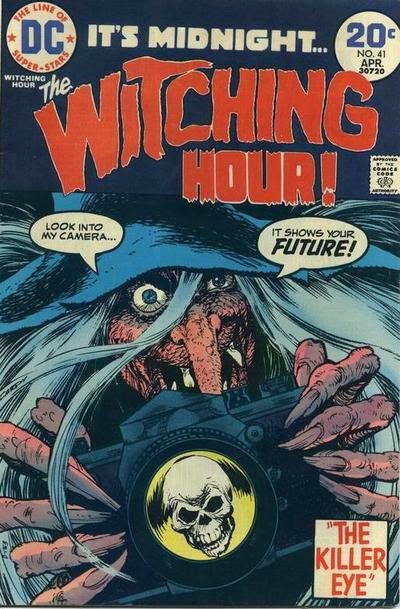
Nick Cardy
The Witching Hour 41

"The Corpse That Lived Twice!"
Story by Carl Wessler
Art by Buddy Gernale and Alfredo Alcala

"Of Greed and the Grave"
Story Uncredited
Art by Rico Rival

"The Killer Eye!"
Story by Carl Wessler
Art by E.R. Cruz

Jack: The Nazis are bombing London in the early days of WWII but Jane Carlton is only interested in how she can increase her wealth and power by manipulating her husband's career. She visits Madam Nadja, a fortune teller, who looks into the distant past and tells the tale of Adrianus who, during the Roman Empire, married a beautiful blond slave girl. Like Jane Carlton, she was ambitious and used her wiles to advance her husband's career until it all came to a crashing halt in the eruption of Mt. Vesuvius. Madam Nadja tells Jane that she is related to the slave woman and Jane asks if her own ambition will guarantee a similar fate. Just then a bomb levels a nearby house.

Jane races home to find her dwelling destroyed and her husband's charred corpse lying among the ruins. Somehow she deduces from this that her husband was a traitor. Mordred the witch explains that Jane was only related to the slave girl by marriage and that her husband was a spy. A twist ending only works when the elements of the plot are all put in place so that the ending, while surprising, is consistent with the story that leads up to it. In the case of "The Corpse That Lived Twice," Carl Wessler fails to lay a foundation for the sudden revelation that it was Jane's husband and not Jane herself who was the doomed party. Is this the first time we've seen Alcala ink such a lesser artist? I would say the inks were laid on with a trowel, since much of this resembles Alcala's work more than Gernale's, if Buddy's work in this month's issue of Ghosts is any indication.

Peter: Man, did my head hurt after reading this swill. It was like doing homework and the last few chapters of the history book are missing.

Jack: Amos Price tells his shrink, Dr. Sharpe, that he missed out on a promotion because his boss said he was too gentle to be a leader. Dr. Sharpe hypnotizes him and discovers that Price had been pirate Captain Roger Drury in a past life. Sharpe consults his encyclopedia and learns that Drury had buried treasure on a Caribbean island, so he puts Price under again and this time the patient physically transforms into the pirate captain. Sharpe makes Drury lead him to the treasure but, when the chest is opened, a booby-trap ensures the doctor's demise. Not so gentle after all, Drury reverts to Price, buries the body, and makes off with the treasure. The author responsible for "Of Greed and the Grave" is uncredited, but I'd put money on Carl Wessler as the culprit, since he wrote the other two stories in this issue.

Peter: I really can't stand hostess Cynthia's hipster lingo captions and sometimes it can take me right out of a decent story. Fortunately, that wasn't a problem this time because the story was, like, awful, man, and that climax was totally a bummer.

Jack: Sidney Stewart's wife Aggie gives him a Polaroid camera for their anniversary and he suggests that they go to the amusement park where they had their first date. He takes a photo of Aggie just as a nearby man falls victim to a pickpocket. When the photo develops, Sidney sees that the pickpocket was Marita, a fortune teller. He alerts the authorities and Marita curses his camera. From then on, whenever he takes a photo, he has power over the object photographed by "The Killer Eye!" of the camera. Once he realizes his new ability, he uses it to gain wealth and power. His evil career comes to an end when a photograph that Aggie took of Sidney and left in her purse accidentally gets a bullet through it during a robbery. Carl Wessler had a long career writing comic books, but 1974 must have been a particularly dry period for his idea factory, judging by this issue of The Witching Hour!

Peter: So much for "kind-hearted" Sidney. The witch Marita angle is dropped rather quickly and all I could think the rest of the story is "if Marita has this incredible power, why is she picking pockets?" The usually bankable ER Cruz delivers rushed, uninspired work this time around but "The Killer Eye" is a perfect cherry on top of a perfectly disposable issue.

Jack: It may be disposable, but according to this issue's circulation statement, it was selling an average of 334,454 copies a month and the most recent issue sold 434,004 copies! Those are staggering numbers, especially considering the fact that the comics industry was in what it considered to be a slump!

In our next TNT-stuffed issue!
On Sale February 23rd!