Monday, June 16, 2014

Do You Dare Enter? Part Twenty-Nine: October 1972


The DC Mystery Anthologies 1968-1976
by Peter Enfantino and
Jack Seabrook


Mike Kaluta
Forbidden Tales of Dark Mansion 7

"Eye of the Beholder!"
Story by Robert Kanigher
Art by Howard Chaykin and Tony deZuniga

"The Immortality Thieves!"
Story Uncredited
Art by Win Mortimer

"The Royal Right"
Story by Joe Orlando and Robert Kanigher
Art by Bill Draut

Peter: Hunter Ron Evans has been lost in the forest for days when he stumbles into and becomes entangled in a giant spider's web. Just before the super-arachnid is about to chow down on Ron, he passes out and comes to, staring into the eyes of a beautiful girl. The lass introduces herself as Elana and invites Ron back to her father's castle. There, Ron learns that Elana's father collects exotic spiders but when he tells the older man his story of horror he's met with derision. Ron soon falls in love with Elana but the girl refuses to marry him since, she says, her twin sister, Ora, is also in love with the young man. Bewildered, Ron exclaims that he hasn't even met Ora yet. That situation is soon rectified when Elana's father takes his guest down into the cellar to meet Ora, who happens to be a giant red spider. The man of the house explains that Ron will be blindfolded and must choose a door, behind which will be his new bride, either Ora or Elana. Ron picks Door #2 and, at first, likes his choice but beauty is truly in the "Eye of the Beholder," when the gorgeous damsel soon reveals herself to be a really big crimson spider.

She's a what?
Where to start? I suspect that was the question that popped into Bob Kanigher's head when he needed to come up with a story for Dark Mansions #7. Kanigher wrote thousands of DC war and hero stories so structure must have been one of his strong points but this narrative rambles and makes very little sense (at one point, the action jumps from Elana's revelation about Ora to her father leading Ron into the cellar as if there were a few panels missing from the finished product). The art is really sharp in spots but several panels almost look like posed Maybelline models looking off into the distance when they're supposed to be having interaction. Just look at that last panel (right) and you can see neither of the male leads is actually looking at each other. And just what the hell is that ending supposed to mean? Was it all in Ron's head? Is he being punished for hunting or dressing like a swashbuckler?

Jack: You are being too harsh on this one! The art is gorgeous, with Chaykin and deZuniga working together to bring out each other's strengths. Yes, the story is a little strange, but you can't deny it's a cool ending! I did figure out that the sister was the giant spider not too far into the tale. I'm just that good.

Actually, that should be
"Hand deliver those vials, understand?"
Peter: Edward and Laura visit Edward's dying older brother Jack but are startled to find the man magically youthful. Jack reveals the secret of his good looks, a serum that reverses age. Edward knows he must have that serum and Laura (once Jack's fiancé) goes to work on her ex with all her charms. Neither have success prying the potion from Jack so Edward has a safe cracker steal the formula. The two leave for home and youth soon follows.... for a time. Soon, the aging begins again but at an accelerated rate. In a panic, the pair race to Jack's house where they find a grotesquely old man, Jack, who explains that his plan the entire time was to get the two vultures to join him in old age and death. "The Immortality Thieves" is not a very good story and, much like "Beholder," I got the sneaking feeling it was edited crudely before publication. Let me just add that it seems sometimes as though the DC mystery line letterers had a problem with punctuation and spelling. It's no wonder my generation grew up not knowing the difference between who's and whose.

Jack: This story can't make up its mind between romance and horror! The art by Win Mortimer is his usual bland work. Can we talk about the woman who is hosting this mag? She is not impressing me. I think someone cut the head off the figure in the full-page intro and kept pasting it on in random panels along with her narration. She looks like a brunette scarecrow. And don't even get me started with the proofreading.

She's a what?
Peter: A small neighborhood in New York is home to Transylvanian transplants, including the rude and insufferable Duke, who demands that his neighbors feed him and clothe him at his whim. One of the young girls in the neighborhood, beautiful Illya, strikes the Duke's fancy and, on her wedding night, he tells the girl he wants to be her... first. Knowing she cannot refuse anything the Duke commands, the girl accompanies the man to a nearby room where she reveals that she's a vampire and bites his neck. Oy! Another of those long long long seven page stories that only seems to be seventy. The reveal at the climax is right out of the blue, which normally would be fine but, in this instance doesn't work. It's clear from the get-go that this Duke is a rotten guy and we have to suffer through incident after incident of bad behavior. Why doesn't Illya do the neighborhood a favor and take this guy out earlier? And does her husband-to-be know she's a vampire? Does her father? Doesn't look like it. All around, a lousy issue of Dark Mansions.

Jack: I liked the ending and it made the whole story better for me. The Duke is such a jerk and the people who are subject to his whims are such idiots that I was very glad to see the Duke get his just desserts. I don't think we've had a vampire story in awhile, so I was glad to see one. Too bad we didn't get any blood!


Nick Cardy
Unexpected 140

"The Anatomy of Hate"
Story by Carl Wessler
Art by Alfredo Alcala

"Born Under an Evil Star!"
Story by George Kashdan
Art by Jerry Grandenetti and Bill Draut

"Blind as the Night!"
Story by Bill Dennehy (Murray Boltinoff)
Art by Lee Elias

Jack: Greg Roberts seems like a nice guy but his father Cort is an overbearing monster. When Greg's mother dies, Cort tells him that it's just the two of them against the world and that he needs to make his wife Mona toe the line. Mona takes the kids and walks out and, after a couple of weeks, Greg tries to win her back. Cort is disappointed by his son's weakness and, one night, he is menaced by a monster that seems to be made up of energy. Cort shoots the monster, which turns out to be his son Greg. Greg's anger and hate was so great that Cort imagined that he was a monster. The cops find them both dead the next morning--Cort dead of fright and Greg dead of a gunshot wound. "The Anatomy of Hate" is sort of a good story with sort of great art, but in the end it just falls apart, especially when the narration tells us it was all in Cort's head. Alcala can draw anything, but a monster made up of pure hatred is a tall order to visualize.

It just looks funny to me!
Peter: I agree, Jack. This is not Alfredo's best work, too many "human" characters. Now, if the action had taken place in the jungle... I couldn't make much sense of that finale. Did Cort shoot his son with a shotgun in the cellar? Then what's he doing in the garden? And did he shoot him before or after he was the Great Goblin of Light? I hate comic books that force me to think.

Jack: Owen Rogg shoots and kills his friend John Turner and then assumes his identity in order to accompany Turner's associates, Fleming and Pratt, on a treasure hunt. Rogg did not realize that he was "Born Under An Evil Star," but he learns this soon enough as one problem after another befalls him, ending in his death. Bill Draut tames most of Jerry G's bizarre excesses but the result just looks wooden. And, in an UNEXPECTED twist, this story marks the return of the Mad, Mod Witch, who has not been seen around these parts in a couple of years! What would possess them to bring her back? Was this story sitting in a desk drawer?

What did we do to deserve this?
Peter: Absolutely rotten in both story and art. Grandenetti's work here looks unusually bright as if someone in the DC bullpen stole all of Jerry's trademark black ink.

Jack: Rich old Henry Jessup is as "Blind As The Night!" and so cannot enjoy all the art treasures in his home. When a new servant named Peter shows up, Jessup offers the man $30K to buy one of his eyes. The operation is a success and Jessup can see, but when everything suddenly goes dark he falls to his death in his empty swimming pool. Surprise! It was the blackout of 1965! When does copying reach the point of stealing? As I read this story, I was hoping it would not end with Jessup suddenly thinking he's blind again due to a blackout. Yes, I saw it on Night Gallery, too. Apparently, Murray Boltinoff watched that Night Gallery movie, along with millions of other TV viewers, because he copied it a little too close for comfort. For anyone keeping score, the episode was "Eyes," aired as part of the pilot on November 8, 1969.

Peter: Even though I saw that Night Gallery episode and could guess the twist at the climax, this was a decent read for me. Why didn't Jessup think about offering fifty grand to someone for their eyes before? Did this scheme just pop into his mind when he was around this young guy? Elias' art gives the story a pre-code Atlas vibe. That's a good thing!

Unexpected . . . unless you watched Night Gallery


Nick Cardy
The Witching Hour 24

"Where Nightmares Never End"
Story by Bill Dennehy (Murray Boltinoff)
Art by Alfredo Alcala

"Another Candidate for the Morgue"
Story by Carl Wessler
Art by Norm Maurer

"When the Scorpion Strikes"
Story by Carl Wessler
Art by Jack Sparling

Jack: On a bus tour into the jungle, "Where Nightmares Never End," a group of Americans is taken to see a voodoo rite. Despite being warned not to take pictures, a pushy American businessman snaps away and angers the natives. The tour guide pleads for mercy and, to everyone's surprise, the witch doctor takes an instant photo of Horton and gives him back his camera. Horton's wife is disgusted by the picture, which Horton thinks is a trick. However, on the bus ride back to civilization, he learns differently, as his face and body begin to decay to resemble the gruesome figure in the photo.


Before discussing this story, let's mention the knockout cover by Nick Cardy, where a beautiful woman walks nervously through an expressionistic, bombed-out urban landscape as the hairy hand of a strangler promises impending doom. Cardy has become one of my favorite comic book cover artists since we've been reviewing early '70s DC books.

Peter: Now this is a better example of Alfredo Alcala's exquisite artwork. That large panel of the witch doctor and his rooster is insanely detailed and atmospheric. The story... eh. Since we see our pompous traveller insult the tribesmen on the third page, the rest of the story feels like padding until we get to the inevitable twist finale (which doesn't really work anyway). Best art of the month.

Something strange, indeed!
Jack: It's 1947, and bombed-out West Berlin is being terrorized by the Jackal, who murders lonely young women with a knife. Will Elsa, a pretty waitress, become his next victim? She rebuffs the advances of a policeman named Ernst and her boss Fritz in favor of creepy Mr. Loering to walk her home, but in the end it turns out that the Jackal is none other than Elsa herself, who has gone off the deep end because her family had been killed in the war. Proofreading again ain't so hot, and our hostess, Cynthia, is at her hippest and grooviest. Witness this caption: "Ah, that Elsa! She was a bird who wanted a cat that'd put her in a guilded cage!" For the record, it should be "gilded." Norm Maurer was a long-time comic artist who actually taught with Joe Kubert. He gets a C- for this assignment.

Peter: This is another pulpy Wessler script, one that tries for Ten Little Indians and ends up with some low-budget Corman production. The physical change that overcomes our little strudel, The Jackal, is goofy. It looks as though Elsa's entire brow and eye sockets move a few inches down her face. Nicht sehr hubsch, Fraulein! Maurer's art in spots is a dead ringer for Jerry Grandenetti's. Speaking of dead ringers, Fritz could very well be J. Jonah Jameson's dad.

Jack: Poor Horace Madigan! Every night, he dreams that he's a big, hairy spider who meets a scorpion. When he wakes, he's convinced that "When the Scorpion Strikes," he'll die for real. Night after night, the dream recurs and gets closer to its tragic end; day after day, his life and family begin to fall apart. He finally consults a psychiatrist, who tells him to concentrate on who he really is. Unfortunately, when he goes home and does just that, it turns out that he is really a spider about to be killed by a scorpion! This is the kind of kooky, gruesome story that appeals to me, and Sparling's slightly bizarre art fits the bill perfectly. The twist reminds me of Ambrose Bierce and "An Occurrence at Owl Creek Bridge," except with spiders.

Peter: This one's got a fun double whammy twist but just don't you think about it too long or the whole thing will come down like a house of cards. That big, hairy spider has one heck of a well-traveled imagination to come up with psychiatrists, sneering children, bitchy wife, and a town that ostracizes the poor guy for having bad dreams.


Nick Cardy
Ghosts 8

"The Cadaver in the Clock!"
Story by Leo Dorfman
Art by Buddy Gernale

"The Guns of the Dead"
Story by Leo Dorfman
Art by Sam Glanzman

"Hotline to the Supernatural"
Story by Leo Dorfman
Art by The Redondo Studio

"To Kill a Tyrant!"
Story by Leo Dorfman
Art by Quico Redondo

Jack: As Emily Berwick is dying, she asks her friend, young Dr. White, to promise that she will not be buried alive as her brother nearly was years before. The doctor keeps his promise, and preserves Emily's mummified corpse in a grandfather clock with a glass door on the front. He also must bring the corpse back to her home at Birchen Bowers every seven years. When the doctor finally dies, the memory of these requirements gets forgotten, and Emily's ghost haunts those near the clock. They finally bury her in a grave, clock and all, but that doesn't stop the Berwick specter. Over time, her home becomes a place for the poor, run by a greedy landlord. He dies one night trying to drive a stake into her grave to lay the ghost to rest. This story isn't half bad! It gets a little confusing and tries to throw in too much plot, but I found the central conceit--the corpse in the clock--and the ghostly wanderings entertaining.

Peter: Ghosts is fast becoming the one book I dread cracking open every week. The "true ghost story" has worn out its welcome for me after seven issues of mostly forgettable material. Having said that, if more stories in this title were as entertaining as "The Cadaver in the Clock!", that dread might well turn to acceptance. This story has a breezy feel to it (who couldn't love a cadaverous cuckoo clock?) and it's nicely illustrated by newcomer Buddy Gernale, an artist who, while not quite the stylist of an Alcala, Nino, or Redondo, can hold his own against the middle-rung pencilers of the DC mystery line. We'll see a handful more of Gernale on our journey.

Jack: It's 1944 in the Marshall Islands, and two marines lament the death of their sergeant. They and their comrades rush the jungle and are being picked off by snipers when "The Guns of the Dead" roar to life and the sergeant, presumed dead, rushes forward, shooting snipers and turning the tide of the battle. Later, when all is calm, the marines discover that sarge is still buried in the grave they made, but they don't notice his M-1 pointing up out of the dirt toward the jungle. Maybe it's because we've been conditioned to expect so little from Ghosts, and maybe it's because we have a special affinity for DC war stories, but I thought this was pretty good!

Peter: "The Guns of the Dead" isn't an awful story but it's an oft-told tale. There's nothing new here but the Sam Glanzman art is very G.I. Combat-worthy. No surprise since Glanzman was a regular writer and artist for the DC war titles in the 1970s, creating the popular "U.S.S. Stevens" series that appeared regularly in Our Army at War and Our Fighting Forces.

Jack: In 1902, on the island of Martinique, a few people have premonitions of doom and get away fast. Good thing, too, because the next day a volcano explodes and the only survivors are those who heeded warnings from a "Hotline to the Supernatural." This is a forgettable, Ripley's Believe It Or Not sort of tale in three quick pages.

Peter: Even though this story is a load of wet laundry, I'm impressed that writer Dorfman was allowed access to "records of the disaster" that showed "the only survivors were those who believed in the warning from the world of the supernatural." I'd like to see that paperwork. The art, credited to The Redondo Studio (composed of unnamed Filipino artists), is weak and uninspired.

Jack: In Czarist Russia, Rasputin, the Mad Monk, has grown too powerful, so a couple of nobles try to kill him, but (like Steven Seagal) he proves hard to kill. As he is dying, he asks that his mystical, hypnotic eyes be transplanted into someone else after he is dead, since they are the source of his power. Decades later, as Stalin is dying, he trusts only his servant Olga. Though Stalin struggles for survival, he eventually kicks the bucket as well, and we learn that Olga had been the recipient of Rasputin's eyes when she was a blind girl. Did Rasputin's stare carry across time and allow the peasant woman "To Kill a Tyrant"? I don't know, but I was intrigued enough to head to Wikipedia and learn more! My quick scan of the (very long) article on the Mad Monk tells me that yes, he was a bit tough to finish off, and no, his eyes did not get transplanted in a blind girl who later won a staring contest with Joseph Stalin.

Peter: Nice art but a story that would put Rasputin's transplanted eyeballs to sleep.


Mike Kaluta
The House of Secrets 101

"Small Invasion"
Story by Sheldon Mayer
Art by Alex Nino

"The Sacrifice"
Story by Jack Oleck
Art by June Lofamia

"Hiding Place"
Story by Raymond Marais
Art by Ruben Yandoc

Peter: In the not-too-distant future, aliens from the planet Phloris will camouflage one of their own as own of our own to initiate a "Small Invasion" of earth. Set up as a logger named Dick, the alien very quickly becomes friends with his crew members and even falls in love with a local waitress, so when his commander orders him to build a platform for the first wave of invasion ships, he refuses. Enraged, his commander sends a "lethal sound wave" to earth which kills Dick and all his logging friends. After the deluge, Dick's girlfriend contacts Phlorus and tells her commander that the sound wave worked. However, she had fallen in love with Dick as well and, in a fit of revenge, she sends a sound wave right back at Phlorus, destroying the entire invasion team.

"Small Invasion"

A very old-fashioned story retro-fitted for the 1970s thanks to the knockout artwork of Alex Nino. Ignoring anything that looks like a panel border, Nino's art seems to bust at the seams with a life of its own. I wonder though how the Phlorusians manage to screw up their measurements badly enough to make Dick a small man. Twelve zoltics should really have done the job, don't you think? That must have been the logging camp of the giants.

Jack: After that dynamite cover by Mike Kaluta, this issue starts off with one of the best stories of 1972! The story is more science fiction than horror, but I enjoyed it and did not anticipate the relatively mild twist of having the girl be an alien. I did have to laugh when it was revealed that the alien "mole" who was supposed to be so big and strong was christened "Dick Brawn," a porno name if I've ever heard one. Nino's art is fantastic and reminds me of the work of Alex Toth in spots. I would love to get a look at the original artwork for this one!

"The Sacrifice"
Peter: Fifty years ago, Andrew offered his wife up as "The Sacrifice" in return for youth. Now, he's willing to do it again with his second wife, Maria. When Andrew explains the situation to Maria, she willingly goes with her husband to the small Greek island of Karres where the witches will perform the ritual. Unknown to Andrew, his wife has made the same bargain with the witches and he'll be the next one offered up on the slab. Jack Oleck opens up the creaky bottom drawer and out pops this predictable pulp, overlong by a couple pages (but you'll guess the twist by page three) and presented with newcomer June Lofamia's bland, lifeless art. Lofamia's art, at least this initial shot, is proof that not all of the Filipino artists were exploding with panache.

Jack: I thought June Lofamia was a rare female comic book artist until you pointed out, to quote Mickey Spillane in Vengeance Is Mine!, "Juno was a man!" Unlike my experience reading that great novel, I guessed the twist in this story well before the ending just like you did.

"Hiding Place"
Peter: Mob guy Freddie Sloan steals some money from his boss and runs over an old man while making his getaway. Freddie's in a heap of trouble so he needs a "Hiding Place" and he needs it fast. Salvation comes in the form of an unusual toy shop run by two mysterious oddballs who offer their shop up as a place for Freddie to lay low for a bit. Once he thinks he's in the clear, Freddie threatens the couple with bodily harm if they don't give up their fortune. Unfortunately for Freddie, these two are anything but ordinary goofballs and they drug the mobster. The next day, when police come to call, looking for Freddie, they don't notice the small, very realistic new doll in the store's front window. It's not a horrible story but it's one of those that will infuriate with its unanswered questions. Who are these shop owners and how did they shrink Freddie? What do they intend to do with him? The plot has a bit of a resemblance to an old Robert Bloch story, "Waxworks" (which was filmed as a segment of the film, The House That Dripped Blood), but it's still fast-moving and has that nice kiss in its rear. Raymond Marais seems to be a bit of a mystery. He wrote a handful of Marvel hero strips in the late 1960s, then jumped ship to DC and Warren and wrote a handful of mystery and war stories. This was the first mystery story penciled by Ruben Yandoc (aka Rubeny), yet another Filipino immigrant whose work will only get better as we witness his jumps back and forth from DC mystery to DC war (with a few Marvel blips on the radar as well).

Jack: I started out thinking this story was awful, but when Freddie got to the toy shop it turned around completely and I ended up enjoying it. I was thinking it had a real Blochian feel to it and I'm glad you pointed that out. It also seemed like something we'd see on The Twilight Zone. You just knew that a toy shop down a dead end street where they sold little torture devices would not turn out to be a great place to hide!


Bernie Wrightson
The House of Mystery 207

"Last Ritual, Last Rites"
Story by Bill Meredith
Art by Bill Payne

"The Spell!"
Story Uncredited
Art by Jim Starlin and Dan Adkins

"This Evil Demon Loves People!"
Story by Sheldon Mayer
Art by Jack Sparling

Peter: Bennett's becoming impatient with his invalid wife, Charlotte. The poison he's been dolloping her tea with each night doesn't seem to be working and his gal pal, the lovely young Hillory, won't wait for him forever. Is Charlotte just a tough old bird or could it be the mysterious Hindu maid, Amrita, who performs strange rituals every night for her mistress? In the end, Bennett just can't control himself and he murders Amrita. As he confesses his evil deeds to his wife, promising a quick death for her, Charlotte has a confession of her own: the car crash she and Bennett walked away from during their stay in India actually killed Bennett and Amrita's rituals each night kept his rotting corpse mobile. With the death of the Hindu witch woman, Bennett goes to pieces. Obviously, the first thing to mention here is Bill Payne's startlingly effective art (even though in spots it threatens to confuse the storyline). We got a glimpse of Payne's talent last month in "Sentimental Journey" (HOM #206) but the difference in that story and his art this time out is amazing. Payne's depiction of Cain the Caretaker is about the best I've seen (and that includes, yep, Wrightson), while the floating demons that permeate many of the panels reminded me of what Jerry Grandenetti used to do quite a bit: the squiggly, nondescript borders filled with eyes and open mouths. Needless to say, I think Payne pulls the trick off much better than Jerry. I love how Payne messes around with the conventional layout of a comic page, creating several full-page poster worthy images.  The story's not too shabby either and that twist ending was an honest-to-goodness surprise to me.


Jack: Payne uses black, shadows & unusual angles to great effect. I was also taken by how good his Cain looks. I had a feeling for what was coming based on the great Wrightson cover, but I thought the final page had a terrific, EC-like gruesome quality to it. This is one of the top ten art jobs of '72 DC horror.

More of Payne's mind-blowing art!

"The Spell!"
Peter: Ol' Nel is feeling dissed by the villagers who ran her out of town so the witch attempts to conjure up a "fire-breathing demon from Hell" and, instead, gets a giant pretty butterfly. My synopsis is actually longer than "The Spell!" itself but my summation will be mercifully short: deadly dumb.

Jack: Hard to believe this filler is by Jim Starlin. He must have needed a quick paycheck.

Peter: Little Geoffry has a unique power: anyone who irritates him ends up shrunken and trapped in one of his baby bottles. First there's his dad's co-worker, then the babysitter, and then his parents as well. Anytime someone crosses him, the bottle collection grows and, pretty soon, the whole world seems to bother the little imp. "This Evil Demon Loves People" is one wacky read, from its goofy premise right to its unexpected (but thoroughly enjoyable) climax. Even Jack Sparling's art is somewhat palatable this time out.

Jack: Did you ever get the feeling the editors (or censors) weren't paying attention? Sparling draws the wife and secretary as if they're posing for pinup calendars, and the flap on little Geoffry's PJs keeps falling open to display his rear end. Best of all is that the li'l tyke speaks only in rhyme, like a demonic Nipsey Russell. Crazy!


Howard Purcell
Weird Mystery Tales 2

"Toxl the World Killer!"
Story by Mark Evanier
Art by Jack Kirby and Mike Royer

"Titanic"
Story by Howard Purcell
Art by Howard Purcell and Jack Abel

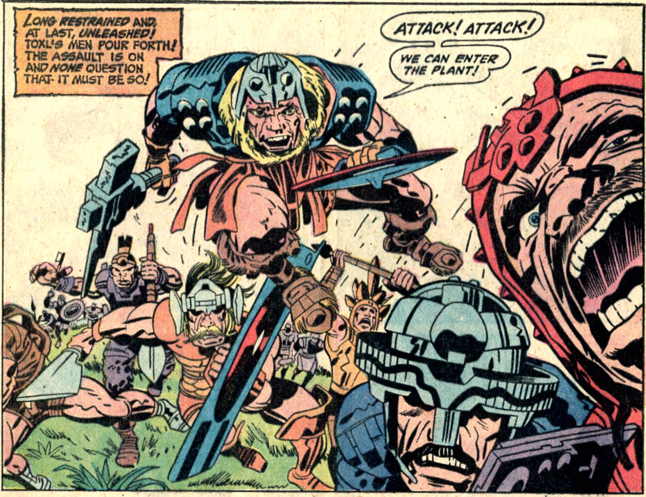
Peter: Barbarian Toxl urges his men to storm the gates of "the plant," a giant building resembling a nuclear facility. The giant believes that the men who run "the plant" are destroying his land so he aims to break in and destroy the "hell pit," the center of the compound which provides its energy source. After attacking the guards, Toxl is able to steal a key to the gate, the men break in, and soon the barbarian is in the "hell pit." He uses his sword to strike the center of the pit and... the world explodes. Another of the leftovers from the proposed second issue of Spirit World, "Toxl the World Killer" is a jumbled mess which still manages to entertain. There are a lot of grey areas and unanswered questions abound. This would seem to be Jack Kirby's nuclear protest but then again there really is no proselytizing going on here, no mutant babies, no giant fish. The effective climax (obviously borrowing the final scene of Beneath the Planet of the Apes) is nonetheless abrupt and we learn nothing about the "evil men" who run "the plant." So, why the big thumbs up from me? The art is fabulous, vintage Kirby (I never bought or read any of Jack's DC stuff but I can imagine this would fit in very well with his New Gods universe) and the story is nicely paced. It's much too short, a compliment I don't pay to many of these short strips. Two nits: 1/ if Jack wanted that finale to be a shocker, I would have advised him not to broadcast it in the title. 2/ editor E. Nelson Bridwell's policy of having two horror hosts in the same story is becoming distracting. This story ends with two sign offs in the same panel!

Jack: OK, I get that Kirby is a giant in the history of comics, but I still don't enjoy his art, especially in this stage of his career. It's all the same! And his women all look the same! They are the farthest thing from sexy. Kirby's writing is average at best. I read the Fourth World stuff when I was a kid and I read Kamandi until Kirby was gone, but looking back at it today I just can't understand what all the fuss is about.

Beneath the Planet of the Forever People

Peter: As he is placed in one of the lifeboats of the "Titanic," Gary Baldwin is warned by his father to stay away from water for the rest of his life. He gives it a shot but, of course, staying away from water is a tough thing to do when you're young. Several near-fatal mishaps occur until, as a grown man and playwright, Gary has to fly overseas to supervise a play. His plane crashes in the Atlantic and Gary is saved by a life preserver (labelled the R.M.S. Titanic) sitting atop an iceberg. Believing his curse has finally lifted, Gary buys a sailboat and enjoys his "new-found freedom"...until he drowns a year later. I'd point to "Titanic" as proof that the powers-that-be had no idea which direction to take this new title. Should it stray into "True Supernatural Hocus-Pocus" like Ghosts or settle down to straight ahead horror like House of Mystery? We'll get the answer in a few issues (hint: DC makes the right decision). Howard Purcell's art is as bland and boring as his script, with unremarkable figures and blank backgrounds. Odd then that his cover and the splash are so effective (perhaps Howard should do a skeleton story?). I'd have mistaken that cover for a Kaluta if I didn't have the GCD to rely on for credits. It's revealed in the letters column of Weird Mystery #3 that Purcell created the cover for a "proposed book of supernatural tales a few years back... that never saw the light of day." It would have been a good idea to include a few panels of Gary slipping in the shower or being sucked into the toilet. That would have answered a couple of my questions at least.

Jack: Your story ideas are better than Purcell's. This snoozer belonged in Ghosts. One question: if your parents died in the Titanic disaster and your Pop told you never to go near water, would you let a blonde in a bikini talk you into a quick ocean swim? I'd have to give that one some serious thought.


NEXT ISSUE!

Sunday, June 15, 2014

The Art of Ralph McQuarrie: ARCHIVES

In case you've been wondering what happened to that John guy who used to post random things here every once and a while, here's your answer.

My publishing partner and I have just launched a Kickstarter campaign to fund a new book of Ralph McQuarrie's non-Star Wars art: The Art of Ralph McQuarrie: ARCHIVES.


If that's something you might be interested in, I encourage you to check out all the details on our Kickstarter page.

https://www.kickstarter.com/projects/970452904/the-art-of-ralph-mcquarrie-archives-art-book


We've got a number of cool incentives for backers of the project, the most important of which is the book itself, which is available in two states.

If you're familiar with Ralph's name, it's likely due to his work on Star Wars, but there's a good chance you've seen his artwork elsewhere, including:
  • Movie posters for The Legend of Boggy Creek, The Town That Dreaded Sundown, and Creature from Black Lake
  • Numerous science-fiction book covers including Isaac Asimov's Robot Dreams and Robot Visions
  • Concept work for films like Battlestar Galactica, Star Trek IV, Cocoon, and Clive Barker's Nightbreed
  • The famous bible illustration from Raider of the Lost Ark

All that and more is included in this 432-page coffee table book. We're particularly pleased to have an extensive selection of Ralph's never before seen concept illustrations for an Irvin Kershner proposed remake of Forbidden Planet.

As you can see below, we're off to a good start, but we've still got a long way to go to reach our funding goal. Your pledge, as well as your support in sharing information on the campaign, is greatly appreciated! We now return you to your regularly scheduled program.


The Art of Ralph McQuarrie: ARCHIVES Art Book -- Kicktraq Mini

Thursday, June 12, 2014

The Hitchcock Project-Henry Slesar Part Thirty: "The Test" [7.20]

by Jack Seabrook

"The Test" was broadcast on NBC on Tuesday, February 20, 1962, with a teleplay by Henry Slesar. It was based on Slesar's short story "Thicker Than Water," which had been published the previous fall in the November 1961 issue of Alfred Hitchcock's Mystery Magazine. As the story opens, attorney Vernon Wedge reluctantly admits a prospective client, an old man named Blesker whose son Benjy has been accused of stabbing another young man to death. Blesker believes in his son's innocence and is desperate for help. Wedge tells him that the evidence against his son is strong, but Blesker is so insistent that Wedge agrees to "think it over."

Visiting Benjy in jail, Vernon finds a sullen young man who is in a gang but who says he did not commit murder. Vernon tells Benjy that he should plead guilty because the evidence against him is so compelling, but the young man refuses to follow his advice. Wedge talks to the boy's father again and finally agrees to take the case and enter a not guilty plea. The first day of trial goes badly for the defense, as witnesses identify Benjy as the killer. Benjy still insists on his innocence as the trial continues to favor the prosecution's case.

Over the weekend before the last day of trial, Vernon has an idea and goes to see Doc Hagerty. Hagerty tells Vernon about a test that can show if blood was ever on a knife, even if it has been wiped clean. He demonstrates the test, turning a solution pink to indicate a history of blood. Vernon talks to Benjy, who insists that no blood has ever touched his knife.

Make your test!
Back in court, Vernon introduces the test and explains its importance, stating that it will conclusively demonstrate Benjy's guilt or innocence. As he is about to dip the knife's blade into the solution, the prosecutor objects. The judge tells Vernon that he may not conduct the test and Vernon sums up by telling the jury that no guilty man would have allowed the test, even though he was prevented from going through with it. The jury acquits Benjy after less than an hour of deliberation.

After the verdict, Vernon meets with Benjy and his father in an adjoining chamber and explains that he had counted on the prosecutor's objection as part of his trial strategy. Vernon wants to do the test privately to satisfy his own curiosity. Blesker takes the knife, cuts his own hand, and tells Vernon, "Make your test." He and his son walk out together, having prevented Vernon from learning if the jury's verdict was a just one.

Eduardo Cianelli
Slesar did not make many changes to his story when he adapted it for television. Most puzzling is the change of the old man's surname to Marino. This is made even odder by the fact that the onscreen ending credits list him as Mr. Bleeker (not Blesker, as in the story) and his son as Benjy Bleeker. Marino is played by Eduardo Cianelli, an Italian-American actor, and I cannot help but think that the change from Blesker or Bleeker to Marino was an example of the bias against Italian-Americans that was prevalent on TV of that era--in March 1961, Italian-Americans had protested in front of the New York offices of ABC television due to the negative portrayal of their brethren on The Untouchables.

Brian Keith
As played by Brian Keith, Vernon Wedge is laconic, world-weary and disinterested in the old man's pleas. Marino tells him that "a boy without a mother is sometimes a wild, wild boy," explaining why Benjy "runs around" and "fights." Director Boris Sagal uses close-ups effectively in this scene, with the camera looking down from above on Wedge's face, then looking up from below at Marino's face, demonstrating the relative positions in society of the two men. The lighting of the faces also tells a story, as Marino's face is bathed in light, giving it a look of religious fervor, while Wedge's face is partially in shadow, suggesting that his ethics lie in a more grey area.

Rod Lauren, Brian Keith
Keith gives a strong performance as Wedge. In one scene, he plays with a cigarette, then in the next the cancer stick is replaced by a match, presumably because he is not allowed to smoke while visiting Benjy in jail. His nervous energy is apparent even as his reactions are delayed; his face is a mask but one can tell that there is plenty going on underneath the surface.

"The Test" once again finds Slesar setting a tale in New York City, with the murder occurring on the corner of Avenue C in New York's Lower East Side, long a neighborhood populated by recent immigrants and darkened by violence. The trial scenes are staged by Sagal in a manner that was already familiar by 1962, since the TV series Perry Mason had standardized the format since its premiere in 1957. Doc Hagerty's test is an early TV example of the sort of thing that would be made popular decades later on shows like CSI, and Wedge's courtroom trickery recalls similar successful work by James Stewart's "country lawyer" in Anatomy of a Murder (1959). In "The Test," Brian Keith is very intense in the courtroom scenes, especially when discussing the test in front of the jury. Television is a perfect setting for courtroom drama, as has been shown repeatedly over the years.

Steve Gravers as the prosecutor
In the end, "The Test" poses questions of guilt and innocence, truth and lies, what is true and what a jury can be convinced to believe. Is Benjy guilty or innocent? We never know for sure. What are we to make of his father's devotion and, especially, his final act that hides the truth from being known? Is it done out of filial love, out of doubt, or as protection? His son is free, so the result of the test is meaningless, yet Marino prevents even Wedge, his son's attorney, from learning what could be a shocking revelation. Marino's faith is not based on certainty in his son's innocence and he is not as simple as he had seemed to be up until the final moments of the story. He cuts his own palm with the knife without hesitation, suggesting that behind the mask of holiness lurks a man who can accept violence in the service of his family.

Rusty Lane, Steve Gravers
Both "Thicker Than Water," the title of the short story, and "The Test," the title of the TV show, have more than one meaning. Blood is surely thicker than water, but it is also what holds families together in a sometimes unbreakable bond. As for the test, who and what is being tested? On the surface, the title refers to the courtroom test that is never carried out, but the title also suggests that Wedge's skills are being tested, as is his (and Marino's) faith in Benjy's innocence and in the judicial system.

Twelve years after "The Test" aired, Slesar adapted his story a second time, this time using the original title ("Thicker Than Water") for the CBS Radio Mystery Theater. Expanded to an hour, the story was broadcast on the radio network on September 17, 1974. The crime that sets the story in motion is dramatized, though this time it is a mugging and murder rather than a gang-related fight. Wedge is shown to have been a victim of a recent mugging himself, which makes his agreement to defend the boy ironic. Slesar again follows his story closely in most ways, though in this trial the boy takes the stand in his own defense. Strangely enough, the boy and his father's surname is now Bleeker, as it was in the TV show's end credits in 1962 and nowhere else. Slesar's ability to tell this story successfully in three formats is impressive.

Rod Lauren
Boris Sagal (1923-1981), who directed "The Test," was born in the Ukraine and immigrated to the U.S. He worked mostly in TV from 1955 to his death and also directed a handful of movies, including The Omega Man. He directed two episodes of The Twilight Zone and three of Alfred Hitchcock Presents, including "Maria." Sagal was killed in a freak accident on the set of the TV miniseries World War III when he accidentally walked into the spinning tail rotor blades of a helicopter from which he had just debarked.

Brian Keith (1921-1997), who played Vernon Wedge, was a very popular actor in TV and on film. Born in New Jersey, he made his film debut in 1924 at age three. He was a Marine air gunner in World War II and then went into acting as an adult after the war. He started on TV in 1952 and eventually would star in no less than 11 TV series and miniseries, the most famous being Family Affair (1966-71). He also appeared in the prison-break film 5 Against the House (1955), based on a novel by Jack Finney. He appeared on the Hitchcock series five times. He committed suicide in 1997. A website is devoted to his memory.

Rusty Lane
Eduardo Cianelli (1889-1969), who played Marino, was born in Italy and came to the U.S. after World War II. He won a Tony Award for his stage acting in 1961 and appeared in nearly 150 movies. He was on TV from the early 1950s to his death and in movies from 1917 to 1969. Among his films was Hitchcock's Foreign Correspondent (1940). He appeared on the Hitchcock series twice and was also seen on Thriller.

Rod Lauren (1940-2007), who played Benjy, was a teen idol who had a hit song with "If I Had a Girl" in 1960. Born Rod Lawrence Strunk, "The Test" was his first acting role and his only appearance on the Hitchcock series. He had scattered TV and movie roles in the 1960s, was suspected of having killed his wife in the Philippines years later, and is believed to have committed suicide by falling to his death in 2007.


Small roles in "The Test" were played by Rusty Lane (1899-1986), who played the judge and who had been seen before in "None Are So Blind," and by Eve McVeagh (1919-1997), who played the mother of the murdered boy and who had been seen before in "The Gloating Place."

Eve McVeagh
"The Test" is not yet available on DVD or online, but the radio version may be heard online for free here.

Sources:
Grams, Martin, and Patrik Wikstrom. The Alfred Hitchcock Presents Companion. Churchville, MD: OTR Pub., 2001. Print.
IMDb. IMDb.com. Web. 08 June 2014.
Slesar, Henry. "Thicker Than Water." 1961. A Crime for Mothers and Others. New York: Avon, 1962. 127-40. Print.
"The Test." Alfred Hitchcock Presents. NBC. 20 Feb. 1962. Television.
Wikipedia. Wikimedia Foundation. Web. 08 June 2014.

Monday, June 9, 2014

Star Spangled DC War Stories Part 29: October 1961


The DC War Comics 1959-1976
by Corporals Enfantino and Seabrook


Jerry Grandenetti
Our Army at War 111

"What's the Price of a Dogtag?"
Story by Robert Kanigher
Art by Joe Kubert

"Bring Back the Enemy's Flag!"
Story by Hank Chapman
Art by Jack Abel

"Butterfingered Bombadier"
Story by Hank Chapman
Art by Joe Kubert


Jack: When Sgt. Rock notices two members of Easy Co. playing cards and using dogtags as currency, he tells them a story to illustrate "What's the Price of a Dogtag?" Private Samuel L. Gordon's big smile landed him the nickname Sunny, and he had the disposition to match from his first day with Easy. Despite danger and close calls, he always kept smiling. But one day he went out on patrol and didn't come back. Through his binoculars, Rock sees him lying motionless on the ground, and the men of Easy Co. spring into action to rescue their fallen comrade. They have to pass through dangerous crossfire and, when a tank is sent to assist them, it is blown up by anti-tank mines. A plane flies in to provide cover but has to reckon with a Nazi jet. Even a destroyer reports for duty and battles a Nazi sub. Finally, the men of Easy Co. reach Sunny and--in a last panel reveal--he is still alive and smiling! This is a great story with the usual fine Kubert art, but I don't see the connection with dogtags. I guess Rock's point is that each dogtag represents a soldier, and each soldier has a life with value.

"What's the Price of a Dogtag?"
Peter: This could be the most action-filled Sgt. Rock saga we've seen yet. I thought it a stroke of genius that, aside from the ammunition and the brief visit of a Nazi ace, Kanigher and Kubert keep the enemy hidden. All we see is the destruction. A highly entertaining script with gorgeous art.

Jack: As Frank heads off to serve as a frogman in WWII, he bears the burden of having to live up to the heroics of his father and grandfather, both of whom successfully answered the cry to "Bring Back the Enemy's Flag!" Frank fails at his first test mission, in which he has to plant our flag on enemy soil. He then angers his colleagues when he jumps into the ocean to fight Japanese frogmen; while he was under water, his post above-deck was unmanned and the enemy stole our flag. Finally, he volunteers for a dangerous mission and blows up an enemy ship, where he sees his ship's stolen flag flying alongside that of the enemy! He brings back both flags and plans to send them home to Dad. The Grand Comics Database originally credited the art on this story to Jack Abel but then switched to crediting it to Ross Andru, based on Julius Schwartz's records. This is not the first time I think the GCD relies too much on Schwartz's logs, because the artist here is most definitely Jack Abel.

"Bring Back . . ." 
Peter: That intro caption almost screams out to be "sung" by a rapper:

Chief petty officers and Navy braid heave-hoed
a seabag of sweat-popping combat assignments at me
during big brawl two!

But they were shore leave in paradise compared to the 
corn-cob rough mission
a civilian loaded on me when dad said
"Bring Back the Enemy's Flag, Yo!"

Ah, yes, the glory days of the 1940s when fathers, rather than hugging their sons and tearfully seeing them off to war, would proclaim "Get me an enemy flag just like me and your gramps did or you're no son of mine!" The single-mindedness of our young hero can't help but sink this story under the weight of repetition as he puts aside all other duties and worries and focuses on getting that doggone flag. Oh, he gets it, by the way. Big surprise that.

"Butterfingered Bombardier!"
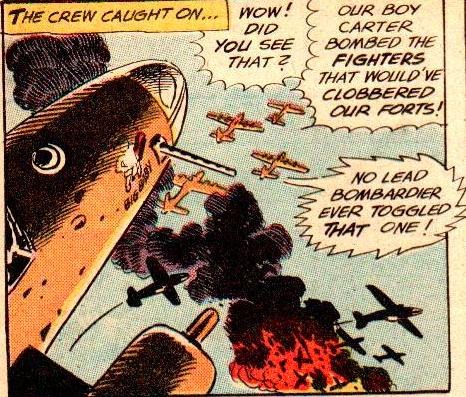
Jack: Only a few missions away from having his plane and crew take over as lead bombardier, Lt. Carter freezes and can't open the doors when his craft is over the target. Can this newly "Butterfingered Bombardier" get over his psychological problems in time to show everyone that he has what it takes to be the leader? You bet he can! Kubert's art is sensational in this six-page story that ends with our hero bombing Nazi planes in midflight.

Peter: This one was a little complicated for little ol' civilian me but I'll use both parts of my brain to focus on Joe's stunning visuals. It's not often we see aerial dogfights portrayed by Kubert since his Rock stories are set on terra firma. Russ must have been busy the week this assignment was handed out.


Jerry Grandenetti
Our Fighting Forces 63

"Pooch--Tank Hunter!"
Story by Robert Kanigher
Art by Jerry Grandenetti

"Wanted: An Ace!"
Story by Hank Chapman
Art by Jack Abel

"Time Bomb Tank!"
Story by Bob Haney
Art by Russ Heath

Jack: Gunner and Sarge continue holding the island with a little help from Pooch, who joins the fun as they fight off first a Japanese Zero, then a Banzai charge, and finally an attack by boat. The C.O. sends the threesome out on patrol to try to grab a cannon or two from the enemy until real supplies can be delivered. Unfortunately, every piece of heavy equipment they try to confiscate blows up! When they attack an enemy tank, Pooch is so excited that he leaps into the hatch and is held prisoner by the Japanese soldiers inside, until "Pooch--Tank Hunter!" drives everyone out into the open with a live potato masher that he clutches in his mouth. Happily, he drops it in the tank just in time, allowing Gunner and Sarge to return to base with a group of prisoners, if not any heavy artillery. The cover of this issue promises "Bullets and Belly-Laughs," but the story was a bit short on the latter.

Can Sarge count?
Peter: It just wouldn't be an issue of Our Fighting Forces without an adventure of the Two Stooges and their mutt. There's nothing going on here but a running joke that escalates. Pooch really surprised me this issue; the dog is smart enough to climb into a tree, make his own plan on how to commandeer a tank and then get the enemy to surrender the tank but not keen enough to drop the potato masher outside the tank when the going gets tough. Poor Gunner gets especially bad treatment from his artist this issue; Jerry gives the blonde bozo Marty Feldman eyes in a couple panels. No wonder Gunner is always stressed.

Cool!
Jack: Newly arrived in Korea, jet pilot Jackson doesn't believe the more experienced pilots who tell him that becoming an ace by shooting down five enemy jets is easy. As the missions mount and he gradually reaches the status of ace, Jackson still doesn't understand what's easy about the process, since he struggles through each battle. It's only when he becomes an ace and finds himself a target of enemy jets that he understands--becoming an ace is easier than staying one! "Wanted: An Ace!" features decent air battle art by Jack Abel but the conclusion and the lesson Jackson learns are unsatisfactory.

Peter: If there's one thing I knew at the beginning of this story it was, before the five and a half pages are through, Jackson will admit "it's easy to become an ace!" I hate it when I'm always right. At least we get Good Abel this issue.

I love these dark, shadowy panels!
Jack: Vic and Buster are a couple of soldiers assigned to destroy a Nazi pillbox at Cambrai Crossroads. They happen upon an abandoned Nazi tank and decide to use it to run over the stronghold, but as they proceed toward their target they discover that they have shut themselves inside a "Time Bomb Tank!" Will they reach their destination before their armored prison blows sky high? I think we all know the answer. There are some serious plot holes here but this is our only story drawn by Russ Heath this month, so who cares?

Peter: A story set in snow is something we don't get much of around these parts. A very well-written, very suspenseful tale with a pretty predictable wrap-up. Heath's depictions of the two men in the booby-trapped tank perfectly capture the claustrophobia. We can feel the tension, not knowing whether the next minute will be their last but not having any choice in the matter.


Jerry Grandenetti
All American Men of War 87

"Broken Ace!"
Story by Robert Kanigher
Art by Irv Novick

"Fire! 1! 2! 3! 4!"
Story by Hank Chapman
Art by Jack Abel

"Snafu Squad!"
Story by Hank Chapman
Art by Jack Abel

Peter: Poor Johnny Cloud is so overworked he's hearing "scramble" calls in his dreams and having nightmares about his squadron being shot down. The base doc declares Cloud "grounded" and Johnny has to put up with the verdict. But not for long, as just that very day a "scramble" alert is sounded and, while the men are in the air, the enemy bombs the field in an effort to keep the Allied aces in the air. Though the cockpit Johnny jumps into belongs to a "Broken Ace," he manages to save the day by eliminating the enemy. The base doc has no choice but to declare Johnny Cloud ungrounded! For the most part a tense, gritty look at the stress brought on by warfare and a lack of sleep, "Broken Ace" is marred only by a laughable climax where Johnny Cloud manages to wipe out the entire Nazi Luftwaffe with one grounded plane. The cherry on top could only be the military doctor telling Johnny Cloud's C.O. that our Native American hero is in tiptop shape (mere hours after declaring him unfit) because, after all, "nobody can really ground an ace." Probably not a good time for Johnny to admit he sees warriors in the sky.

Jack: Scramble! Scramble! Johnny's brains have gotten a little scrambled from too many missions. I think all three war comics this month had stories where a plane dropped bombs on another plane in mid-air. Did you notice that one of Johnny's fellow pilots looks about twelve tears old?

"Broken Ace"

Peter: Ever since the enemy sub known as the Barracuda sunk his father's sub, Lt. Brown has hoped for a chance at evening the score. When the enemy sub sinks the supply ship he's commanding, that determination only grows. After mapping out a plan where his sub is a decoy for the Barracuda while a real sub waits below, Brown finally gets to call out "Fire! 1! 2! 3! 4!" I don't know about you, but the minute Brown said, only a handful of panels in, "how in the world will I ever get a shot at the Barracuda?" I somehow knew he'd get just that chance. All the boxes are ticked here (among them Jack Abel's stereotypical buck-toothed Japanese sub commander) except "Good Story."

Jack: Here's a sample caption to illustrate why this is not Hank Chapman's best work: "The crew thought Brown had crickets in his crow's-nest when he began pouring millimeters into the drink." That almost requires translation! By the way, have you noticed how, whenever a soldier is assigned to a low-risk job, all he can think about is how much he wants to get into the heat of battle? I have a suspicion that, in reality, those low-risk jobs were much more appreciated than DC writers let on.

"Fire! 1! 2! 3! 4!"

Peter: In the Korean war, one group of soldiers earns the nickname "Snafu Squad" for their streak of bad luck. Then suddenly that luck turns good and they become the "Spearhead Squad." That's the story, I swear. What makes these guys transform overnight from tripping over their own boots to seasoned snipers is still trying to be sorted out by the US Army. What was never disclosed is how Kanigher got away with using a decidedly profane acronym in a kid's comic book. I look forward to "The FUBAR Forces."

Jack: The squad was ALMOST renamed the Spearhead Squad but instead chose to retain the nickname of the Snafu Squad, because "any battle they're in means SNAFU for the enemy!" I learned something new in this story. A Garand is another name for the M1 semi-automatic rifle, which was the standard issue for G.I.s in WWII and Korea. It gave our men an advantage over Axis soldiers, whose rifles were "slower-firing bolt-action" rifles, or so says the Internet. That little fact was more interesting than this story!

well... that's the title

From the letters pages of Sgt. Rock issues #354 (July 1981), #355 (August 1981) and #366 (July 1982) comes a roll-call of all Easy Co. members, compiled by comics historian Robin Snyder. Click to enlarge.