Monday, September 9, 2013

Star-Spangled DC War Stories Part 10: March 1960


By Corporals Enfantino and Seabrook


Russ Heath
G.I. Combat 80

"The Flying Horsemen!"
Story by Robert Kanigher
Art by Russ Heath

"The Nine Second Sub!"
Story by Bob Haney
Art by Jack Abel

"Downhill Soldiers"
Story by Bob Haney
Art by Joe Kubert

PE: Ever since high school, "Little" Al has been protected by his buddies "Big" Mike, "Big" Ben, and "Big" Jim. Now, in a peculiar twist of fate, the four have all become pilots in the same squadron. Hoping he can finally become a "Big" and pay the guys back for all they've done for him, Al elevates his game and becomes an Ace. About as sappy as we've seen so far in the DC war comics, "The Flying Horsemen" pushes the envelope of believability and packs in more sugar than an episode of Lassie. Can four guys go through school and then actually end up in the same squadron? Then we're to believe that Mike, Ben, and Al are all shot down but miraculously survive save a few scratches and skinned knees? Nope, I don't buy it for a minute. Even Russ is off his game on this story but more than makes up for it with his gorgeous, exciting cover.

"The Flying Horsemen!"
JS: That painted cover is another in a series of beauties that have appeared in this run of G.I. Combat. Too bad the lead story did not live up to it. Heath draws Little Al with so many freckles that it's like Jimmy Olsen went to war.

PE: Nine seconds is the average for a World War II sub named "The Fin" to dive and that's putting a crimp in the style of the ship's gunner. Since the "Nine Second Sub" disappears so quickly, the specialist has found himself with a lot of loitering time on his hands until damage from an attack leaves the sub at the mercy of enemy battleships. It's then that the gunner is relied upon and comes through in the clinch. "Nine Second Sub" could have been an exciting little sub story had it not been so concerned with the selfishness of the gunner. This guy's bemoaning the fact that, because the ship has a leg up on most subs, he has no chance to play the hero. Woe is me!

JS: I thought that this story had good momentum and some of the panels featuring the Japanese sub are the best work I've seen yet from Jack Abel.

"Downhill Soldiers"
PE: The boys of Charlie Co. have never had the glory of taking their own hill until orders send them up Hill 609. Once they get to the top, they find no enemy but are then ordered down the hill, right into Nazi mortar fire. Luckily, Charlie Co. learn quickly how to be "Downhill Soldiers" and the good guys win once again. A good enough tale, with  typically nice Kubert artwork and a quick shout out to Sgt. Rock's Easy Company (we learn that, at the point this story has taken place, the fabled Easy has conquered a dozen hills), and the best of the issue by default. In "Sgt. Rock's Combat Corner" (a letters page that all war titles share each month), Lance Travosek of Palatine, Illinois, asks: Can a grenade, thrown into the open hatch of an enemy tank, really "make mincemeat of the insides and blow holes in the sides"? Great question! Robert Kanigher asserts that "a hand grenade has a kayo ratio of 5 to 10 yards." You learn something new every issue but I'm wondering when the letters page will morph from the generic weapons questions into missives about particular stories. Stay tuned.

JS: What do you mean Robert Kanigher? Sgt. Rock answers the questions! How do I know? He drops the final "g" off of all his words, like "carryin'" and "lookin'."

"The Nine Second Sub!"


Irv Novick
Star Spangled War Stories 89

"Trail of the Terror Rockets!"
Story by Robert Kanigher
Art by Mort Drucker

" 'We' Made Ace!"
Story by Bob Haney
Art by Jerry Grandenetti

"Sink That Sub!"
Story by Hank Chapman
Art by Russ Heath

PE: Able to leap tall buildings in a single bound and don the most elaborate make-up this side of Lon Chaney, Mademoiselle Marie nonetheless finds herself up zee creek wizzout zee paddle when she attempts to track the "Trail of the Terror Rockets!" Marie does the only sensible thing she can do when faced with the insurmountable task of finding the launching pad of the Nazis' new secret weapon: dress as an old woman and get herself trapped. Luckily, Marie lives in the same universe populated by Colonels Hogan and Klink and the entire German army is outwitted by one French Femme. To her already-legendary feats of derring-do you can add jumping through a second-floor plate-glass window with nary a scratch and disarming a squadron of Ratzis seemingly single-handedly. It's hard to take the strip seriously but that problem is compounded with my inability to separate Mort Drucker's art here from the wonderful stuff he did in Mad. Many of the characters in this strip look as though they could have been lifted directly from one of Drucker's classic movie parodies.

Mlle. Mamie Van Doren
JS: Marie's undercover act as "Fifi--ze new chambermaid" is hilarious. If Commandant Von Ekt is her nemesis, one would think he would recognize her when she walks into the same room in a dress and with a kerchief over her hair. Instead of shooting her on the spot, he rigs up a piece of paper on his desk to set off an alarm when she picks it up. She then is able to jump through the aforementioned window and escape across the rooftops with Nazis shooting at her. Later on, she masquerades as an old lady, but this time she wears a skintight rubber mask. With Nazis like these, it's a wonder the war lasted as long as it did. And by the way, it looks as if Mlle. Marie has been doing her bust-enhancement exercises in between issues.

" 'We' Made Ace!"
PE: Hal is one kill away from Ace status and Mac will do anything to ensure his best buddy is elevated to hero, even sacrifice his own life it seems. The pair go trawling through MIG Alley. There's nothing to separate " 'We' Made Ace" from a hundred other average war stories, not much excitement and not a lot to look at. It's startling (and we've said this before) how different Jerry Grandenetti's art looks from his work a decade later in the mystery titles. It's not as goofily exaggerated and easier to stomach.

JS: This story confused me. I couldn't figure out who was doing what or how many planes were being shot down. In the end, one pilot shoots down an enemy plane and his friend takes joint credit. Was this some WWII rule--shoot down five planes and you're an ace? Is this where "Enemy Ace" came from? What are you if you shoot down ten planes? A King?

"Sink That Sub!"
PE: Once again, the best is saved for last with "Sink That Sub!", a somewhat non-linear tale that shows us a sub's crew witnessing the destruction of their ship and the embarrassment they must face when pulling back into harbor in joined life rafts. We come to find out that the men actually performed a brave task by sacrificing life, limb, and sub by rigging her to blow within a fleet of Nazi mini-submarines. The reveal (told from a different angle and once we've been given a bit more information) is nicely surprising and Russ Heath's art is nothing short of miraculous (and a relief after his phone-in job over in this month's G.I. Combat). Heath once again helps us experience the claustrophobia of being trapped in a sinking "tin fish."

JS: I read this story and thought how bad the art was, wondering who drew it. When I saw it was Heath, I was surprised. It does have some of his more wooden characteristics, but I think this was a down month for him. The story was fairly interesting, but I have to wonder if it was such a great idea to blow up a sub rather than take it back to port for repairs. Don't those things cost a lot of money and take awhile to build?


Jerry Grandenetti
Our Army at War 92

"Luck of Easy!"
Story by Robert Kanigher
Art by Joe Kubert

"Bait for a Desert Hawk"
Story by Bob Haney
Art by Russ Heath

"The D-Day Commandos!"
Story by Bob Haney
Art by Jack Abel

PE: Sgt. Rock is having a hard time convincing his men that brains and brawn win a war when the soldiers of Easy Company begin hanging their hats on lucky trinkets like dice and rabbits' feet. The "Luck of Easy" finally runs out and Rock, as usual, proves himself to be one smart soldier. Can't argue with the art but the story drags a bit for my tastes (it does have some nice humorous bits though). Not a misfire but a bit shy of the target. Jack has raised the point of the nameless supporting cast before but, more and more, the fact that none of these grunts have tags becomes annoying and a detriment to the storytelling. How do we know who's survived from story to story or whether it's the same band of guys at all?

"Luck of Easy!"
JS: I thought it was an entertaining story. I especially liked the ending, where the men all toss away their talismans and decide that Sgt. Rock is their most reliable good luck charm.

"Bait for a Desert Hawk"
PE: High over the Sahara, two fighter pilots (one Nazi, one good guy) play a game of chicken while their respective birds fight it out as well. I thought this was a really silly story (could a sparrowhawk really keep pace with a jet?) and a complete waste of space. There's not enough of what Heath does so well (air battles) and too much ornithology. The stilted dialogue ("That sparrowhawk took on that falcon again--and won! I can go back upstairs and fight again!") and unbelievable story threatened to put me to sleep.

JS: I liked this one. The parallels between the birds and the planes kept my interest and the last panel had a poetic feel to it: "While below...the end was written to a story in the sands!"

"The D-Day Commandos!"
PE: In "The D-Day Commandos," our nameless hero must trudge through France on D-Day to knock out a bridge used to transport Nazi weapons. His assistants along the way are Pierre, Jacques, and Marcel; respectively, a young boy, and old man and...a surprise. Evidence that Mademoiselle Marie had help destroying the Nazis in France, "The D-Day Commandos" reads like one of those "three men walk into a bar..." jokes, with our protagonist constantly complaining about his latest companion. Jack Abel does his best to ape Joe Kubert but the proof's on the page.

JS: A well-written story trumps mediocre art anytime, and this one got me. It lacked some of the corn that can mar the Mlle. Marie stories, and the use of a boy and an old man as resistance fighters showed how everyone had to pitch in to win the war.


Thursday, September 5, 2013

The Hitchcock Project-Henry Slesar Part Eleven: "Insomnia" [5.30]

by Jack Seabrook

Guilt and fear cause a mild-mannered man to explode into fatal violence in Henry Slesar's "Insomnia," a teleplay that he adapted from his own short story called "Sleep Is for the Innocent." The story, which had been published in the February 1960 issue of Alfred Hitchcock's Mystery Magazine, features Charles Cavender, a chronic insomniac, who takes his doctor's advice and sees a psychiatrist, Dr. Tedaldi. Cavender explains that his wife Linda died in a fire at their home and he still has nightmares about it. In a bit of foreshadowing, Cavender thinks that there is "no point in mentioning that his smoking in bed might have caused it."

Cavender escaped the fire without trying to save his wife and claims that he does not blame himself for her death. However, Linda's brother, Jack Fletcher, does hold Cavender responsible. Jack was in a VA hospital for nine years, since Korea, and sent Charles "'a real psychotic letter.'" He is now back in the city and has telephoned Charles to threaten him. Dr. Tedaldi helps Cavender realize that his insomnia began when he learned that Fletcher had been released from the hospital.

Cavender spends another sleepless night in his hotel room, an ordeal that is relieved only by a three a.m. trip to an all-night drugstore to replenish his supply of cigarettes. At work the next morning, he is criticized for an error in his work; he blames it on lack of sleep. The next day, he telephones Fletcher to suggest that they meet and talk, yet Fletcher tells him to "'Flake off.'" After another sleepless night, he visits Fletcher in person and discovers that his tormentor is a paraplegic in a wheelchair. Cavender feels relief, thinking that "he had lain awake, staring into the darkness, because of half a man."

They argue and Fletcher pulls a gun from a drawer. Cavender grabs his arm and they struggle; with the gun pointed at Fletcher's head, Cavender forces him to pull the trigger: "the feeling was one of power and satisfaction" for Cavender. Fletcher is killed, as "a terrible, bloody thing happened to the young face"--suggesting a Spillane influence on Slesar's crime writing.

Dennis Weaver
The story has a surprise ending that has been telegraphed: Cavender returns home after seeing a movie and falls asleep in bed with a cigarette burning. The cigarette starts a fire in his apartment and he is killed; a policeman on the scene after the conflagration remarks with unwitting irony that he "'must have been a real heavy sleeper.'"

"Sleep Is for the Innocent" is a tightly written crime story that, like so many of Slesar's short stories, was perfect for adaptation into a half-hour television program. The success of Slesar's teleplay for "Forty Detectives Later" appears to have led to a second assignment from producer Joan Harrison, since Slesar also wrote the script for "Insomnia," which was broadcast on Sunday, May 8, 1960, on CBS, only a few months after the cover date of the magazine in which it had first appeared.

James Millhollin
The teleplay follows the story closely, with a few minor changes and one major one. Alfred Hitchcock Presents had been sponsored since the beginning by Bristol-Myers and, for season five, Revlon had signed on as an additional sponsor. I can find no evidence that either company ever manufactured or sold cigarettes, but the lack of cigarettes in the TV show, in light of the product's central role in the story on which the show is based, is striking. In the story, Cavender smokes all the time, piling up butts in his ashtray at night as he struggles to sleep. There is a suggestion that the fire that killed his wife was due to his smoking in bed, and the blaze that kills him at the end of the tale is due to the same cause.

Perhaps CBS was wary of airing a program that suggested that cigarette smoking was dangerous; it may be that other shows were sponsored by cigarette makers and the network was wary of upsetting them, even though they did not sponsor this show. In any case, there is not a lit cigarette to be seen in "Insomnia." We do see an ashtray on Cavendar's bedside table, and in the first scene he explores an empty pack of cigarettes, but he never lights up or smokes in bed on camera. Instead, Slesar's script has Cavender light a portable heater in his room early in the show, and the heater looks dangerous because flames roar out of it. When Cavender visits the office of Dr. Tedaldi (actor Dennis Weaver seems to pronounce the doctor's name as "Tubaldi"), the receptionist remarks on the recent cold weather, reinforcing the need for the portable heater that Cavender is seen lighting before bed. Near the end of the episode, he lights the heater again and goes to bed; it is clear that the heater is responsible for the conflagration that kills him. The germ of this idea likely came from Slesar's own story, in which Cavender mentions having had a portable heater in the house that burned down and killed his wife.
John Ragin

The sequence of events is rearranged slightly in the teleplay: in the story, Fletcher had called to threaten Cavender in the past; in the show, the threatening phone call occurs after Cavender's visit to the doctor, heightening the tension. The urgency of solving Cavender's insomnia is also greater in the TV show, as we see him get fired by his boss for making a mistake; in the story, he was merely warned. Dennis Weaver, as Cavender, gives a convincing performance as a man exhausted by lack of sleep and by worry. Even better is John Ragin, as Fletcher; he demonstrates real anger and bitterness in his short appearance, telling Cavender: "'I'm gonna be your bad dream from now on.'"

The confrontation between Cavender and Fletcher is staged with more action than is found in the source story; Cavender flings a desk lamp at Fletcher and then rushes at him; they grapple for the gun but the viewer is spared the sight of Fletcher's young face being reduced to "a terrible, bloody thing." Back home, Cavender takes his wife's framed photograph, which had lain face down on his dresser, and sets it upright again, suggesting that, with Fletcher dead, he can finally move on with his life.

Al Hodge
"Insomnia" is the second in a row of Slesar's teleplays in which he adapts his own stories and, like the previous effort, it is a satisfying half hour of television. It is directed by master of shadows John Brahm (1893-1982), whose last directorial work on a Slesar story was in "A Night With the Boys."

Dennis Weaver (1924-2006) plays Cavender with the same folksy drawl he used so successfully in his long career as a TV star. Weaver shot to fame as Deputy Chester Goode on Gunsmoke, a role he played from 1955 to 1964. He won an Emmy for the role on May 6, 1959, almost exactly a year before this episode of Alfred Hitchcock Presents was broadcast. Though he never again appeared on the Hitchcock series, he was a fixture on TV for decades; highlights of his long career include Spielberg's Duel (1971) and his lead role in the detective series McCloud (1970-1977). A website devoted to Weaver may be found here.

Cavender reads a fake crime paperback
titled The Bashful Killer
As Dr. Tedaldi, James Millhollin (1915-1993) displays the arch sensibility he would use repeatedly in a career that lasted from the 1950s to the 1970s. His is a very familiar face to viewers of classic TV; while he appeared just this once on Alfred Hitchcock Presents, he may be seen in three episodes each of The Twilight Zone and The Odd Couple, as well as having played a part in the notorious Lost in Space episode, "The Great Vegetable Rebellion."

The part of Jack Fletcher represents the first credit for John Ragin (1929- ), who made many appearances on TV up to the early 1990s. Al Hodge (1912-1979) plays Fletcher's boss; he took over the role of Captain Video in 1950 and played it on various TV series until 1957. He believed he was thereafter typecast as Captain Video and ended up dying broke and forgotten.

"Insomnia" is available on DVD here or can be viewed for free online here.

Sources:
"Galactic Central." Galactic Central. N.p., n.d. Web. 02 Sept. 2013.
Grams, Martin, and Patrik Wikstrom. The Alfred Hitchcock Presents Companion. Churchville, MD: OTR Pub., 2001. Print.
IMDb. IMDb.com, n.d. Web. 01 Sept. 2013.
"Insomnia." Alfred Hitchcock Presents. CBS. 8 May 1960. Television.
Slesar, Henry. "Sleep Is for the Innocent." 1960. Clean Crimes and Neat Murders: Alfred Hitchcock's Hand Picked Selection of Stories by Henry Slesar. New York: Avon, 1960. 144-52. Print.
Wikipedia. Wikimedia Foundation, n.d. Web. 01 Sept. 2013.


Monday, September 2, 2013

Do You Dare Enter? Part Nine: August-September 1970


The DC Mystery Line 1968-1976
by Jack Seabrook,
John Scoleri,
& Peter Enfantino


Neal Adams
The House of Mystery 187 (August 1970)

"Mask of the Red Fox"
Story by Bob Kanigher
Art by Alex Toth

"Appointment Beyond the Grave!"
Story Uncredited
Art by Wayne Howard

"An Aura of Death!"
Story Uncredited
Art by John Celardo and Mike Peppe

Peter: Well, let's just get it out of the way now. Save The Witching Hour, none of the titles display the quality this time out that they showed last so you may just want to skip down to the bottom of the page. I would. "Mask of the Red Fox" tells the tale of Sylvia, cursed by an old hag jealous of her beauty, whose fate is intertwined with a red fox. When the fox dies, Sylvia dies. The girl is fated to marry the greatest fox hunter in the country, a man obsessed with finding the red fox and mounting its head in his mansion. The fox manages to elude the hunter for quite a while but, inevitably, the man gets his prize. Returning to his estate to crow about his kill to his wife, he finds her dead. Yep, that's the climax. Quite a surprise if you didn't read the opening where the rules are very carefully laid out. When the outcome is this inevitable, the only emotion a reader can have upon completion of the tale is a shrug. At times during the story, Kanigher almost infers that the girl is the fox but the reveal at the finish contradicts that. Alex Toth's art is as gorgeous as ever. I'm amazed an artist who produced work so offbeat was able to find a job in mainstream comic books. His style is almost the antithesis of that of every other artist working in comics at the time.

Jack: I thought this story had a lyrical quality that made it haunting and enjoyable. As you say, the art is outstanding, even though it's far from the naturalistic style of Adams that we love. Cain once again interacts with the characters in the story, helping to hide the girl and to put the hunter off the trail. The hunter even threatens Cain--whom he knows by name--and Cain stands up to him, something Abel would never do! I was hoping that the girl's head would be mounted on the wall at the end instead of the fox's head, but maybe that was too gruesome for this comic.

Red Fox
Red Fox
Redd Foxx
Peter: "Appointment Beyond the Grave" is a 3-page ghost story about a scientist who arrives at a secret meeting in 1943 to give the formula for fissionable uranium-235, a necessary element for the atomic bomb. After he divulges the formula, he disappears and it is revealed that the scientist had died earlier that day in a plane crash. Wayne Howard contributes very spare art but then he's illustrating a very spare story. "An Aura of Death" is bottom-of-the-barrel silliness about a young understudy to a funeral parlor owner who can suddenly see the "angel of death" and brings more business in to the parlor. I'm not going to spend too much time dissecting the idiocies packing the story but it's unclear whether the boy can actually make people die or if he's just present when they croak. Abysmal artwork by Celardo and Peppe.

Jack: Wayne Howard's art--now that I realize it's not a bad job by Wally Wood--always looks like a throwback to the 1950s to me. The second story, which he illustrates, looks like it was pulled from the files of 1950s filler, but we know Howard was working in the early '70s. I thought "An Aura of Death" was funny because it was so bad. Why is it set in Bavaria in the 19th century? I'm guessing at the time and place based on the clothes and goofy speech patterns. I don't know much about John Celardo, but he has quite an impressive resume, including drawing the Tarzan dailies for 14 years!

"An Aura of Death!"


Neal Adams
The House of Secrets 87 (September 1970)

"Death Has Marble Lips!"
Story by Robert Kanigher
Art by Dick Dillin and Dick Giordano

"The Man"
Story by Marv Wolfman
Art by Ross Andru and Mike Esposito

"The Coming of Ghaglan"
Story by Raymond Marais
Art by Mike Kaluta

Peter: "Death Has Marble Lips" has a good set-up but a weak finish. Peter is a sculptor obsessed with his latest work of art, a stone woman he calls Eve, and makes a deal with the devil to bring her to life. Unfortunately, her kiss turns him to stone. Why? I don't know. Like many of these mystery tales, we're not privy to some of the more important details like motive. It's not made clear that the devil has actually made the deal but Eve gains her life as the vow is made so we're naturally supposed to assume Lucifer's somewhere around the corner and yet he never makes an appearance. Eve is the vehicle of the deadly kiss and yet she has no idea she's about to turn Peter to stone. She seems genuinely upset by the turn of events. Dick Giordano could always make a lesser artist into something special and he does so with Dick Dillin, better known for his DC hero work.

Jack: I'm a little fuzzy on when this story is supposed to be set, since Peter's poor fiance, Ava, wears a bonnet that makes it look like she's auditioning for Oklahoma! Eve, the statue who comes to life, looks more than a little bit like Ava, except she wears fewer clothes. When Peter first carves her, she comes alive almost immediately and then says she's been waiting an eternity for him to free her. This turns out to be a dream, but soon after Peter calls on every demon he can think of and bang--she's alive. The whole thing is kind of scatterbrained but I was glad to see Dick Dillin's art because I always liked the Justice League, which he drew forever.

Peter: "The Man" has nothing to do with cops but instead concerns the day Art Nero walked into town. Art hooks up with Candy Baker, who falls for him immediately, but the guy just isn't biting. All he wants is to find his father's house. After a brief but heartbreaking trip to the river, Candy finally gets Art to his pop's house. It's there that the senior Nero, a professor, explains why Art's testosterone level remained at low levels while Candy was putting the moves on him: the guy's a robot! A predictable plot and cruddy art sink this one pages before the unsurprising reveal. This one should have been relegated to DC's romance line.

Jack: Why didn't I ever meet girls like Candy? Art walks around saying next to nothing, so she sits him down by the river, plants a kiss on him, and announces that she loves him! Candy is what used to be referred to as "fast." By the way, like this month's House of Mystery, Neal Adams picks a scene from one of the stories to illustrate for the cover and inexplicably sticks some children in the middle of it. Why did he always put kids on the cover? Do they represent the target audience?

Peter: Future superstar Mike Kaluta illustrates a tale of ancient Egyptian terror in "The Coming of Ghaglan." Sir Otis Rexford has found a hidden tomb which holds a scroll that contains the missing chapter from the Egyptian Book of the Dead. When Sir Otis begins to read a chant from the scroll, he collapses and his spirit leaves his body, journeying across dimensions to a strange planet of undead slaves, all waiting for a being called Ghaglan to release them upon mankind. When Sir Otis returns to his body, he discovers the scroll missing, now in the hands of an archaeologist named Ghaglan. Kaluta uses black and white to illustrate the dead world Sir Otis visits and, when he awakens, the return of color is almost shocking to the reader. By 1970, there was no such thing as an original story about hidden Egyptian tombs so a writer would have to invent some new hooks to entertain the jaded horror reader. While not exactly reinventing the wheel, Raymond Marais does a decent enough job telling a story in six pages. Marais wrote one of the greatest stories ever published by Warren, "The Rescue of the Morning Maid" (Creepy #18, January 1968), a tale that gave this impressionable lad nightmares for years (and I ain't exaggerating).

Jack: As the resident lifelong DC fan, whenever I see a character reading enchanted words I fall back on my Zatanna/Zatara training and read the words backwards to see if they make sense. "Tehfu Khaman" backwards is "Ufhet Namahk." Not very helpful.


Nick Cardy
Unexpected 120 (September 1970)

"Rambeau's Revenge"
Story by Carl Wessler
Art by George Tuska

"The Gravediggers"
Story by Carl Wessler
Art by Ross Andru and Mike Esposito

"Once a Killer!"
Story by Carl Wessler
Art by George Tuska

"House Haunted, Do Not Disturb"
Story by George Kashdan
Art by Jerry Grandenetti

Peter: Our opener stars JoJo Rambeau, born unattractive and taunted all his life. One day, JoJo goes to see a Houngan in the local swamp, who teaches him about the use of voodoo dolls. JoJo immediately puts his new skill to work, crafting dolls of all his tormentors and then distorting their features until they're uglier than he is. Wessler's WTF? climax has JoJo set the dolls on fire when the townspeople come calling, only to find their looks restored and his own face erased. An incredibly stupid, nonsensical tale kamikazied by the truly ugly art of George Tuska. You literally cannot tell which characters are supposed to be unattractive when George handles the penciling chores. Is it physically possible to have buck teeth that long? And hilarious that, despite having no mouth or any features at all, JoJo can exclaim "I suddenly can't see!" in the final panel. Amateur hour at the DC bullpen.

Jack: I think you missed the sensitive message here, Peter. JoJo needs to learn the lesson that we cannot change others, we can only change ourselves. Maybe I've been watching too much TV for the last 50 years, but this story reminded me of "The Masks" from The Twilight Zone, even down to the Louisiana setting. Tuska's art is actually perfect for this story, since the people he usually draws are on the ugly side. His proclivity for drawing every character with a great big set of choppers means that he has to go overboard to draw ugly teeth, making them huge and out sized. I kind of liked the tale until the dopey finish.
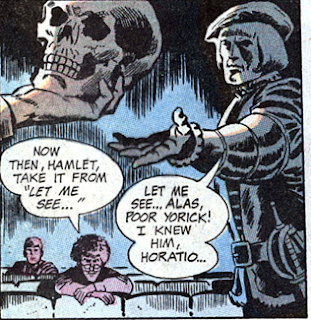


"The Gravediggers"
Peter: The three remaining stories this issue are no better. "The Gravediggers," about a practical joker who gets his comeuppance, is cliche-ridden and saddled with uninteresting illustrations by Andru and Esposito (who would soon turn things around with their stint on Marvel's The Amazing Spider-Man). "Once a Killer!", at two pages, may be the best bet since it will only take a minute to read but you still have to slag through the pulp writing of Wessler and the muddy pencil and ink of Tuska. Finally, "House Haunted, Do Not Disturb" is a creaky ghost story that actually finds a decent home for Jerry Grandenetti's exaggerated style. It's strictly Scooby-Doo territory but I'm trying to accentuate the positive in yet another awful issue of Unexpected.

Jack: This last story has such bizarre art by Jerry G. that it makes me wonder if I'm missing the boat entirely and he is taking a stab at Picasso-like illustration in comic-book form. There's one panel where a woman's eyes are practically sliding off her face! Maybe Grandenetti is an under appreciated genius whose work will find its way to a museum some day. Maybe I should start looking for original artwork on eBay to get in on the ground floor!

"House Haunted, Do Not Disturb"

Neal Adams

The Witching Hour 10 (September 1970)

"A Warp in Time ... Loses Everything!"
Story Uncredited
Art by Gray Morrow

"hold softly, hand of Death!"
Story by Gerry Conway
Art by Alex Toth

Peter: "A Warp in Time" is a confusing story anchored by fabulous art. A psychiatrist sees a man who claims to have been stuck in a time warp. The shrink has the man committed and then heads out of his office, musing that his other doctor pals will get a kick out of his story. A few minutes later, the doc realizes he's in a time warp as well, witnessing famous disappearances (missing trains, the Flying Dutchman, etc.) and feeling a desperate sense of unreality and displacement. When he comes to his senses, he finds he's back home, about to be committed and unable to convince anyone where he's been. His doctor laughs to himself and opens the door, about to step into the time warp. The art on this strip is fabulous. Gray Morrow perfectly conveys the sense of being in another dimension by using different mediums of art (it reminded me a lot of what Kirby would do now and then in the 1960s Marvels) and distorting angles. The story's a bit confusing, though. Are we to assume that anyone who finds out about this time warp will then be sent there? Still, I'll give it a passing grade for Morrow's art alone.

Jack: Great art aside, this story reinforces Cynthia's penchant for telling tales that have to do with the terrors of modern science, much to the dismay of her sisters, who prefer tales drawn from traditional gothic horror sources. By setting up this dichotomy between the past and the present, The Withing Hour is able to present a variety of scary stories and avoid becoming too repetitive and predictable. As we've started to see in the two House titles, the narrators can sometimes pop up in the middle of their own stories; in the second tale, discussed below, Mildred and Mordred are seen as guests at the party, commenting on the action.

Peter: Pierre LeBas has spent his life treating women like dogs but now he's met a woman who steals his heart. The only problem is that she may be a spectre. LeBas chases the girl to a cliff where she falls, never to be seen again. LeBas spends the rest of his lonely life sitting by the beach, waiting for the girl to come back. One year away from taking over writing chores on nearly half of the major Marvel titles, Gerry Conway shows he's a genuine storyteller with "hold softly." His bookends, of LeBas in his wheelchair, waiting at the cliff for his long-lost love, tug at the heart strings despite the knowledge that this guy was a Grade-A jerk.

Deliberate (or accidental) ambiguity drives me nuts. I can't stand it, and there's some of that here (Is the mysterious girl a spectre before she falls from the cliffs? Why do the other guests forget the girl exists?) but, since Conway's writing is so strong, it doesn't bother me. The inconsistencies that come of reading dozens of funny books a week, I guess. The image of LeBas in his wheelchair, like an illustration in a French graphic novel rather than a DC mystery title, will stay with me a while.

Jack: I have to disagree with you on this one, Peter. I thought that the writing was muddled and the denouement disappointing. Alex Toth's art is strong, as always, but this story really goes nowhere. The fact that the old man simply disappears at the end deprives the reader of a satisfying conclusion. Having followed the early work of Gerry Conway over at Marvel University, I'd say that it was a good bit more than a year before he started writing quality stories.


Monday, August 26, 2013

Star-Spangled DC War Stories Part 9: February 1960


By Corporals Enfantino and Seabrook


Kubert
All American Men of War 77

"Big Fish--little fish!"
Story by Robert Kanigher
Art by Irv Novick

"Diary of an Ace!"
Story by Bob Haney
Art by Bill Everett

"T.N.T. Yardstick!"
Story by Hank Chapman
Art by Mort Drucker

PE: Young Mickey thinks he's in for a life of loneliness at the orphanage until a kind family adopts him. His adopted brother, Harry, teaches him to swim and stay underwater for long amounts of time and, when the Japanese attack Pearl Harbor, the boys naturally sign up to be frogmen. Unfortunately, there are no places open for the boys and they're drafted into the army. While en route to battle, their ship is sunk and Harry is killed. Mickey swears he'll get revenge against the submarine with the shark design on its prow. When he rescues a battalion of his own men, the army gives him one wish and he quickly asks for a reassignment to frogman duty. Soon after, Mickey ("the Little Fish") gets his pound of flesh. I was geared up not to like this one, as the constant drone of "little fish, little fish!" was getting on my nerves, but I was pleasantly surprised at how engaging the story is. Harry's death is a surprise I didn't see coming and I found myself rooting the "little fish" on.

JS: As did I! So much for no death in these code-approved war stories. This one tugs at the heartstrings when the orphan is adopted and taken under the big brother's wing. The only false note occurs near the end, when Mickey manages to knock an oncoming torpedo off course by means of a shoulder block. I think the little fish would be fish food if he were hit by a torpedo.

PE: Bill Everett contributes his only DC war story, "Diary of an Ace," one of those "split screen" stories where we see each side of the battle from "our" perspective and the enemy's. The enemy, in this case, being the arrogant Baron Hugo Von Hoffner, "Germany's Black Ace of the skies!" Our hero, Lt. Dick Brill, flying on his first mission teaches the Baron a thing or two before delivering the death blow and retiring the Black Ace for good. It's no wonder that Everett (one of my favorite Golden Age artists) never contributed another DC war story since his art is completely wrong for the genre based on evidence shown in this story. He nails the World War I aircrafts but the characters look cut straight from a superhero strip and there's not much imagination in the choreography.

JS: I'm surprised you didn't like this one more, knowing your fondness for Bill Everett. I thought it was a solid six-pager, nothing special. I liked that the blank final page of the German ace's diary is filled in in the last panel, after he is shot down, with the words: "The End."

PE: Bogan is a grenadier, a grenade expert, and so his targets all have to be within 35 yards (thus the "TNT Yardstick"). He's finding that may be a hazard to his health and so he constantly asks for a transfer. Finally, his sarge promises him his transfer but only after he completes one more assignment. Ironically, during that mission, Bogan discovers that being closer to the target may keep him alive. I like the Mort Drucker art (but, as usual, have a hard time not thinking of MAD Magazine while enjoying it) but the story is nothing more than a series of incidents to set up our hero's inevitable change of mind.

JS: One of the fun things about doing this project is that I'm quickly becoming able to spot artists without checking the credits. This one has Mort Drucker's name written all over the gritty, determined face of Bogan as he edges closer to his target. When I first encountered Drucker's DC war work a few posts ago, I thought it was too much like Mad, but now I'm getting used to it and he's becoming one of my favorites.


Grandenetti
Our Army at War 91

"No Answer From Sarge!"
Story by Robert Kanigher
Art by Joe Kubert

"Old Soldiers Never Run!"
Story by Robert Kanigher
Art by Joe Kubert

"The Silent Piper!"
Story by Bob Haney
Art by Joe Kubert


PE: Robert Kanigher is kind enough to grace us with a triple shot of Joe Kubert's Sgt. Rock this issue and how can you find fault with that? All three stories are entertaining but I find the first, "No Answer From Sarge," to be the standout. It may be that I like the tales that fill in pieces of Rock's past and this story does a bit of that. The Sarge must deal with green recruits en route to the battlefield. One boy constantly begs the Rock to send him back, saying that he can't take the strain and that, in the end, he'll besmirch the good name of Easy Company. To shore up the kid's backbone, Rock tells him the story of Wally Street, a new recruit, equally green and equally scared of impending battle, who rises up, saves the Company and gives his life heroically. Of course, this story has the desired effect on the newbies and, in the climactic panel,  Rock sighs that "they look like the combat-happy Joes of Easy already!"

"No Answer From Sarge!"
JS: Sgt. Rock is able to keep an astounding amount of information under his tin pot. He recalls--under fire--that Wally Street lives at 4062 Third Avenue! He also demonstrates his ability to have faith in a raw recruit who gives every impression of being a coward. This is another powerful story of leadership from Kanigher and Kubert.

PE: "Old Soldiers" tackles the problem of aging in the military without resorting to cheap melodrama. "The Silent Piper" is the last survivor of a massacre on Heartbreak Ridge who needs a bit of closure to get on with his life. Both stories are well-written and (it goes without saying) exquisitely drawn by Kubert. How the artist could draw a gaggle of GI grunts and give each their own characteristics to make them stand out is beyond me.

"The Silent Piper!"
JS: Walt Dunn in "Old Soldiers" is said to have been too young for WWI but too old for WWII. Pipe Sergeant MacDuncan in "The Silent Piper!" marches around in full Scottish regalia, holding his bagpipes quietly after the rest of his outfit has been wiped out. Dunn and MacDuncan are examples of how Kanigher, Haney and Kubert are able to expand their stories beyond the tried and true to give color and flavor to harrowing tales of combat.


Kubert
Our Fighting Forces 53

"The Gunner and the Nurse!"
Story by Robert Kanigher
Art by Ross Andru and Mike Esposito

"Bomber Party!"
Story by Bob Haney
Art by Mort Drucker

"I Can't Win!"
Story by Bob Haney
Art by Joe Kubert

PE: Try as I might, I just don't think I'm ever going to like the Gunner and Sarge series. Robert Kanigher's a superior writer when he sticks to military story lines (as evidenced by the weak scripts he contributed to House of Mystery) but his attempts at humor resemble a Jerry Lewis farce (read that as desperately unfunny). Here the "wacky" pair have to take turns romancing a beautiful blond nurse. At least, the title tells us she's a nurse. Nowhere in the story is there reasoning for why this girl is out in the middle of gunfire and explosions. She's not carrying a little black bag nor does she wear the obligatory armband. The enemy soldiers look like hopping monkeys when they threaten the trio with their potato mashers. Common sense seems to have taken the day off here. This is the worst art I've seen by Andru and Esposito, by the way. I may just be grumpy because there's no Russ Heath in any of the titles this month and when I don't get no Heath...

JS: And here I thought you'd be glad that Pooch was at the vet's this month! When Miss Julie first appears, Gunner tells us that he hasn't seen a beautiful girl since he left stateside, except in magazines. Now I wonder what magazines he was reading? As for Miss Julie, her vow to kiss every hero on the island sounds like a good way to catch herpes.

PE: "Bomber Party" is yet another one of those "Grass is greener..." stories, this time about a GI who gets a three-day pass to visit his brother, a fighter pilot. The first three-quarters of the story he moans about how much better his brother is living and how tough the infantry man has it and blah blah blah... Of course, the last couple pages, our GI finds out just how hard it is to be fighting thousands of feet in the air. Seems like we just reviewed this story a couple months ago. Thank goodness Mort Drucker's art livens things up a bit. The final story, "I Can't Win" is an enjoyable piece about two competitive GI buddies who bet on anything they can.

"Bomber Party"

JS: Once again, the art is tops in these two six-page stories. "Bomber Party!" features more of Drucker's carefully drawn faces and exciting air battles, while "I Can't Win!" is highlighted by Kubert's steady hand. Too bad the long lead story didn't live up to these two!

"I Can't Win"

Coming Next Week!