Monday, December 10, 2012

Batman in the 1970s Part 48: March and April 1977


by Peter Enfantino

& Jack Seabrook


Batman 285 (March 1977)

"The Mystery of Christmas Lost!"
Story by David V. Reed
Art by Romeo Tanghal and Frank Springer

Dr. Tzin-Tzin escapes from jail by hypnotizing and mobilizing a horde of ants. Once free, he uses his sorcery to wreak havoc on the Christmas tree lighting ceremony at City Hall Plaza, where Batman fights an imaginary bear high in the branches of the Christmas tree. Tzin-Tzin swears to Batman that he will rob Gotham City of something precious and intangible. The Dark Knight soon discovers that everyone but he is unable to concentrate and cannot remember that it is almost Christmas; the intangible item Tzin-Tzin stole was the knowledge of the holiday! Batman confronts and defeats Tzin-Tzin, thus saving Christmas just in the (Saint) Nick of time.

Jack: I have made no secret of my affection for Christmas tales, but this is one of the weakest we’ve seen in the 1970s. The art is passable at best, with Dick Grayson suffering the most from the drawing style. Dr. Tzin-Tzin seems to have almost unlimited power, yet Batman never has much trouble beating him, despite Batman’s belief that he barely prevails against the villain time and again. The scene where Batman fights the bear high up in the Christmas tree is almost laughable.

PE: Couldn't agree more, Jack, though I'd argue the most laughable aspect of the story was the ants eating through the prison cell wall in no time flat. I don't have to tell you that it brought back very bad memories of Ant-Man's adventures in Tales to Astonish. The whole thing has a Rankin-Bass vibe to it as if it was to be adapted into a "How Tzin-Tzin Stole Christmas" holiday cartoon. Dr. Strange Tzin-Tzin remains an uninteresting character. Not a good story at all.

Dr. Tzin-Tzin's brilliant plan
was foiled by a can of Raid.


Detective Comics 468 (April 1977)

"Battle of the Thinking Machines"
Story by Bob Rozakis
Art by Marshall Rogers and Terry Austin

A time capsule containing the original "$24 in trinkets used to purchase Gotham" has been dug up on a construction site in Gotham. The Calculator, fresh out of jail for the sixth seventh eighth time  again, decides he just has to have the booty but Batman proves to be one step ahead of the computer whiz and sends him... back to jail. Soon after, Batman attends a meeting of the justice League in their satellite headquarters orbiting 22,300 miles above the Earth. It's here that he delivers to his JLA partners the unlikely news that Commissioner Gordon has just sent him...the Calculator has broken out of prison. All six JLA members (Batman, Black Canary, Elongated Man, Green Arrow, The Atom, and Hawkman) head back to Earth to capture the evil genius but all six, one by one, are defeated. The Calculator reveals that each time one of the heroes captured him and sent him to prison, he developed an immunity to their powers. Beaten but not bowed, The Dark Knight concocts an ingenious twist to The Calculator's powers to turn them against their user. The Calculator fittingly lands behind his own bars, hopefully for good this time.


PE: Writer Bob Rozakis must have thought every kid that read 'tec also read Justice League as there are no little asterisk boxes to explain things like how Batman gets up to the JLA satellite. Does he take a rocket? Does it blast off from the Batcave?

Jack: At last, Rogers and Austin tackle Batman! This is really worth getting excited about. The art is crisp and inventive and it really elevates the story. Throw in a cover by Jim Aparo, and you have a very strong issue of Detective. This is also a full-length Batman story (17 pages), making it (I think) only the second time in 468 issues that this has happened; the first time was the conclusion of the five-part Talia story in Detective 448 (June 1975).


PE: The art's great but I'm just glad we're done with this silly Calculator arc. Did we really need six stories (seven if you count this one) with the exact same outline? So Calc could only develop immunity from the heroes by being captured and sent to jail? Batman gets beat by Calc and then changes clothes for a day of work at The Wayne Foundation? With this multi-part "epic" out of the way, maybe we can get down to some good stuff delivered by Steve Englehart.


Batman 286 (April 1977)

"The Joker's Playground of Peril!"
Story by Denny O'Neil (with help from Julie Schwartz and E. Nelson Bridwell)
Art by Irv Novick and Bob Wiacek

The Joker escapes from Arkham Asylum yet again, this time killing his psychiatrist by shrinking him to the size of a doll. Having heard that the Joker is on the loose, Robin motorcycles home from Hudson U. to help out his old pal. Together, they trail the Joker to an amusement park, where they are distracted by his attorney, who has disguised himself as the fiend. Batman figures out the Joker’s disguise and confronts him in a hall of mirrors, disarming him and sending him back to jail.

Jack: A Joker story by Denny O’Neil and Irv Novick is a welcome sight after so many issues of crime bosses, Underworld Olympics, and Dr. Tzin-Tzin. Despite the fact that Robin has now been away at college for about seven years, it’s nice to see him team up with the Caped Crusader to fight their old foe, and Novick’s art is a welcome sight as well. This is not one of the best Joker stories I’ve read, but it’s enjoyable nonetheless.

That chin looks awfully familiar!
PE: I get the feeling that whatever insight Denny O'Neil had into the character of The Joker has musta got lost somewhere between 1973 and 1977. Mind you, O'Neil only had the one shining moment with the character (for those just tuning in, it was "The Joker's Five-Way Revenge" way back in Batman #251) and subsequent attempts to mine similar magic left us with pans brimming with fool's gold. The villain is barely in this adventure, save the brilliant opening where The Joker literally shrinks his psychiatrist! For a few panels, that psychotic, sadistic, fun old chap was back. He's quickly dispatched in the climax,  to be forgotten again until someone realizes it's been a while since they used him. As a follow-up to Jenette Kahn's introductory letter last month (reprinted below), this month sees Jenette's no-holds-barred explanation for the DC One Dollar Comics line. Since newsstand dealers (remember them?) would only make pennies on a thirty-cent comic, orders (and thus sales) were dwindling. In an attempt to grab hold of what little room was left at the stands, DC started up eighty page (all new material) one dollar comics on some of its titles. It'll be a rather short-lived experiment and we won't get a taste until December 1978's Detective Comics #481. By that time, the page count has already dropped to 64 pages.

I don't know who he is behind that cape
and cowl, but I know that we need
him, and we need him now!

Welcome, Ms. Kahn!
(from Detective 468)


Monday, December 3, 2012

Batman in the 1970s Part 47: January and February 1977


by Jack Seabrook
& Peter Enfantino


Batman 283 (January 1977)

"Omega Bomb Target: Gotham City"
Story by David V. Reed
Art by Ernie Chua


A magnesium crash helmet allows Batman to survive being shot in the back of the head at point blank range as he pilots a plane. He prevents a crash and dispatches the shooter and his partner, then decides to change course and head back to Gotham, certain that someone is tracking his every move. He arrives just in time to read a threatening note: a ship anchored in Gotham Harbor carries a nuclear bomb that will be detonated if one billion dollars’ ransom is not paid! The Caped Crusader boards the ship and defeats the crooks only to discover that there never was a bomb—the nuclear physicist who was kidnapped refused to help build it.

PE: I refuse to believe that David V. Reed, perpetrator of a whole lot of bad Batman stories (including the comic book equivalent of Fonzie riding that shark, "The Underworld Olympics"), could have come up with such an exciting adventure as this two-parter. If this had been published post-1981, I'd have said it was Reed's attempt to cash in on Raiders of the Lost Ark. The reveal that not only was there no bomb, but that Batman played an unwitting part in the whole affair (in fact, if he had not survived the plane crash, the bad guys probably would not have stood a chance of convincing the "best scientific minds in the country" that there really was a bomb!) was an ingenious twist (nope, I have no idea why the leader sent his henchmen to kill Bats if he needed him alive in Gotham). I won't hold my breath waiting for the next stellar Reed story, sorry. I'm a bit of a pessimist.

Jack: I'm surprised you liked this story so much. I thought it was okay, but not particularly strong in comparison to the other Reed stories. Chua's art continues to be uneven. I can't read a note trying to extort "one billion dollars" without hearing Mike Myers/Dr. Evil's voice in my head.

PE: The idea that 1/Alfred would suggest to Master Bruce that he wear a chromium crash helmet while flying a plane and 2/that Master Bruce would listen to anything Alfred said outside of "Dinner is served" is laughable. What good will a helmet do if the plane crashes? Are we to believe that Alfred has some kind of precognitive power that told him Batman would be shot in the head while on the plane? Lucky the bad guys didn't aim lower. It's amazing that all the "best scientific minds in the country" all dress in the same white lab coat. This was Ernie Chan/Chua's last Batman story.


Detective Comics 467 (February 1977)

"Pick-Up on Gotham 2-4-6!"
Story by Bob Rozakis
Art by John Calnan & Vince Colletta

As Batman slips through a window into Wayne Manor, he spies a shadowy figure sitting on a couch, waiting for him. When the man calls out to him though, Batman seems to know the guest. As they wait for Alfred to bring a bit of breakfast, Bruce relates to his friend the adventure he had just been on. Attempting to bust up a Gotham gambling ring, The Dark Knight shadows two-bit thug Sneaky Danton into the subway and, just before boarding the train, dons the disguise of alter ego Matches Malone. The train experiences a brief blackout and, once the lights come back on, Batman is amazed to see...another Batman. Danton has donned the garb and forced the driver to stop the car so that he can get off. After a brief struggle, Danton is electrocuted on the third rail and Batman deduces that the man handed off his booty to the motorman before exiting the car. The gambling ring is quashed and Batman turns his attention to breakfast with Carter (Hawkman) Hall.

PE: An immensely forgettable installment (in fact, to write the synopsis, I had to reread it twice) existing only, it seems, to provide the big surprise at the climax. Batman's net is getting wider and the fish are getting smaller if he has to bust gambling rings now (and would a better written Caped Crusader really think it was worth the death of Sneaky?). Isn't The Joker or Catwoman up to no good somewhere? The art of Calnan and Colletta is serviceable other than the fact that Bruce and Carter look like the same man (they actually both look like Superman!). Get used to Calnan though as he'll be back to settle into the role of regular Batman artist by the end of 1977. Unless he works on his civilian characters, that doesn't bode well.

Jack: I enjoyed the art in this story, if only because it gave us a break from The Amazing Chan and the Chan Clan. The subway scenes were pretty neat and the story as a whole had a nice dark feel to it. What concerns me most is the fact that, as of this issue, Detective Comics has returned to bi-monthly status without any warning! What happened? It was of better quality than Batman in 1976, although it was selling fewer copies. As usual, the market trumped art.

Speaking of birds, it
looks like Bruce Wayne
was flipping the bird
to Hawkman in this
panel!

"The Man Who Skyjacked Hawkman!"
Story by Bob Rozakis
Art by Marshall Rogers & Terry Austin

When an atomic energy plant overloads, there's only one person in the United States who can keep it from exploding and he's on a 747 right now. Pressed into duty, Hawkman boards the plane in flight and grabs who he thinks is Dr. Mark Peiken, atomic savior, but when Hawkman leaves the plane and opens the protective bag Peiken should be in, out pops The Calculator. The evil genius is determined to watch the atomic plant go critical. He clamps Hawkman's wings but our hero manages to break his bonds and return to the plane to get the real Dr. Peiken. Tragedy is averted!

Forget the story... check out the art!

PE: So, according to Hawkman, The Calculator's plan all this time was to fight Batman. That would account for the five previous arrests and jailbreaks we've had to endure these last several months. Surely, this could have all been done in one boring 14-page story, couldn't it? On the plus side, we get the fabulous pencils of Marshall Rogers, who'll be treated to more of very soon. Can...not...wait.

Jack: The round-cornered panels and pop-art sound effects are something new as we move into the late '70s Batman period, when new artists (some from fandom) break into the mainstream and infuse new life into tired characters.


Batman 284 (February 1977)

"If There Were No Batman...I Would Have to Invent Him!
Story by David V. Reed
Art by Romeo Tanghall & Frank Springer

After Dr. Tzin-Tzin levitates the Sphinx and drops it in the sea, he heads off to Gotham City to create more mystic mayhem. Batman is dealing with grouchy Chief Inspector Maddox, who is filling in for the vacationing Commissioner Gordon. During a parade held to open the annual convention of the Ancient Order of Explorers, Bruce Wayne saves a little girl from being run over and has to fight off the crowd that suddenly turns violent under a spell of Dr. Tzin-Tzin. Batman brushes up on his knowledge of Tibetan magic and defeats Dr. Tzin-Tzin at Gotham Stadium, which the mystic was in the middle of levitating in order to steal it. The story ends with Chief Maddox promising to read some books on Tibet.

PE: A very strange story with a few elements I liked and some I very much disliked. In the comics, unlike in Christopher Nolan's Batman trilogy, Commissioner Gordon may just as well be a faceless character. We know nothing about him after all this time other than he's Batgirl's dad and he serves only one purpose: a sounding board for Batman. I believe we'll have to wait until Frank Miller's brief tenure on the title before Gordo becomes more than just a joke. Having said that, he's a well-oiled machine next to the buffoon acting in his place this issue, a character played for laughs but not receiving any. Dr. Tzin-Tzin, an obvious rip-off of both Fu Manchu and Marvel's The Mandarin, is an honorary member of The Rogues' Gallery with a nasty psychotic edge to him. The murder of his "secretary" and casual dumping of her body over the ocean has a sadism to it that's lacking in most of Batman's adversaries. There's a spotlighted ceremony where Tz-Tz calls forth three supernatural entities, Towos (eater of men's brains), Thas Yang (demon fire-tiger), and Changchub (mystic master of magicians) and Batman constructs a "Tsam Khang," a small structure built so that Batman can "empty his mind." Both are intriguing concepts but only the "Tsam Khang" is used to further the plot. The three entities are introduced and then forgotten. Perhaps the thread will be picked up in the conclusion next issue.

Didn't we see that little girl in an
Elongated Man story not too long ago?
Jack: I really have no idea what happened in this issue or what you just wrote, Peter. I thought Dr. Tzin-Tzin was Ra's Al Ghul until I figured out that he was just a poor substitute. It seems he first appeared in Detective 354 (August 1966), then in Detective 408 (February 1971). That second appearance was covered way back in part 9 of this blog series, and it was a terrific Neal Adams story! He next appeared in Adventure Comics 418 (April 1972), where he fought Supergirl of all people! As I read this story, I got a strong feeling that David V. Reed had just finished reading a book on Tibet and wanted to share his weird thoughts with all the ten year olds reading Batman.


Ebay, here I come!


Thursday, November 29, 2012

John Collier on TV Part One: Alfred Hitchcock Presents-"Back for Christmas"

by Jack Seabrook

John Collier was born in London in 1901. He began his writing career as a poet, then had some success with his first novel, His Monkey Wife, published in 1930. In this novel, the protagonist is tricked into marrying a chimpanzee and discovers that life with her is preferable to life with the vapid women he meets. Collier moved to Hollywood in 1935 when he was hired to write the Katherine Hepburn film, Sylvia Scarlett; he continued to write screenplays and, eventually teleplays. Other screenplays included The African Queen (1951), which was credited to James Agee and John Huston but on which Collier and Peter Viertel also worked, and I Am a Camera (1955), which later inspired the Broadway musical and film, Cabaret.

Collier is best known for his short stories, many of which were collected in Fancies and Goodnights (1951), which won an Edgar Award and an International Fantasy Award the following year. Like His Monkey Wife, many of his short stories exhibit a misogynistic theme, though Paul Theroux wrote that it is "such a wickedly cheerful kind it is irresistible." Collier's stories were adapted for radio and later for television, as early as a 1946 episode of Lights Out. Five of his short stories were adapted by other writers for Alfred Hitchcock Presents, while Collier himself adapted three stories by other writers: two for Alfred Hitchcock Presents and one for The Alfred Hitchcock Hour. Collier did not adapt any of his own stories for the Hitchcock TV series.

John Collier died in California in 1980. In this series of nine articles, I plan to examine each of the episodes of the Hitchcock series either adapted from a Collier story or adapted by Collier from the work of another author. The first episode of Alfred Hitchcock Presents to be adapted from a Collier story was "Back for Christmas."

"Back for Christmas" was first published in The New Yorker on October 7, 1939 (I am using the version collected in the 1961 Bantam paperback edition of Fancies and Goodnights; sources report that Collier rewrote some of the stories in this volume for republication in book form, but I do not know if this story was one of them). The story begins as Dr. Herbert and Mrs. Hermione Carpenter host a party for their friends. The Carpenters are about to leave for America and their friends insist that they must be back in England for Christmas. After everyone leaves, Dr. Carpenter calls his wife upstairs and murders her as she leans over the bathtub, bashing in her skull with a length of lead pipe.

He strips naked to clean up the mess and has to go to the cellar to turn on the water supply, which his wife had shut off as part of her preparations for travel. While he is in the basement, the Wallingfords stop by to say farewell. He hides until they leave then cleans up the body, disposing of it in pieces in a hole that he had claimed was being dug for a wine cellar. He drives off alone, secure that he will get away with his crime. He thinks of a woman named Marion, who is waiting for him in Chicago, and plans to write letters home as if he were Hermione in order to cover his tracks.

John Williams and Isobel Elsom
In a New York hotel, he reviews letters that have arrived for him in the mail. The last letter is from a builder, whom his wife had hired as a surprise to excavate the cellar and build a sunken wine bin as a Christmas present for him. He realizes that the excavation will reveal his wife's corpse and he will indeed be summoned back to England for Christmas.

While this twist ending and the theme of the murderer getting his comeuppance seem perfectly tailored for Alfred Hitchcock Presents, the teleplay was not the first time that "Back for Christmas" had been adapted for broadcast. In fact, it was adapted for radio and broadcast four times: first, on December 23, 1943, starring Peter Lorre, as part of the Suspense radio series; second, on December 24, 1947, starring Paul Frees, as part of the Escape series; third, on December 23, 1948, starring Herbert Marshall, this time back on Suspense; and finally, on December 23, 1956, again starring Herbert Marshall and again on Suspense.

Prior to the fourth radio show, however, it was adapted for television by Francis Cockrell and broadcast on CBS on Sunday night at 9:30, March 4, 1956, as part of the first season of Alfred Hitchcock Presents. Alfred Hitchcock directed this episode, the fourth of the season that he directed himself. While the skeleton of the short story remains, the details of the television show are quite different than those found in its source.

Note the pipe in Herbert's mouth as he digs.
The show opens in the cellar, as the camera pans across the room to rest on Herbert, knee deep in the hole he is digging. He wears suit pants and a vest, and the first shot shows him smoking a pipe, though the pipe disappears with the first cut in a continuity error. Hermione comes down to see him; he is too tall for the cramped space, symbolizing both the boundaries that exist in his life and hinting at the freedom he will seek in America. Before Hermione enters the picture, Herbert is a man, digging and measuring with confidence. Once she appears, he is henpecked and bowed, his eyes downcast. In a shot that shows off Hitchcock's mastery of the camera, Herbert looks down at the hole and the camera assumes his point of view, slowly panning along the length of the hole and then up Hermione's body, making the hole's ultimate purpose clear right away. In the story, Herbert's murder of Hermione comes as an unexpected surprise; in the TV show, it is obvious from the first scenes what he plans to do.

Even the twist ending is foreshadowed as Hermione tells Herbert that she as a "nice surprise" for his lunch. After Hermione goes back upstairs, Herbert checks what appears to be a joint passport and confirms that his wife's height is 5'4"; he allowed an extra two inches in the hole and comments, "no use crowding." Herbert's henpecked nature is highlighted in the second scene, as he has lunch with Hermione and allows her to dictate to him how much he likes Shepherd's Pie, despite his weak protestations. Hermione is extremely well organized and plans everything out in detail; Herbert clearly despises her yet she is wholly unaware of his feelings.

The show's third scene is where the published story begins, as the Carpenters host a tea party for their friends to bid them farewell. When asked about Los Angeles, Herbert describes it as "large, casual, very disorganized," the opposite of his life with Hermione. At one point, the soundtrack for the party scene devolves into a chatter of voices, recalling the dinner party scene in Hitchcock's Murder (1930); here, the point is that Herbert's mind is elsewhere and he is not really listening. More foreshadowing is provided when Hermione mentions another surprise that will require them to be back for Christmas.

After the party, Elsie the maid leaves and the Carpenters share tea. Herbert then changes his clothes and proceeds to the cellar, where he picks up a lead pipe and calls for Hermione. In a humorous scene, she insists that he come back upstairs and help her change a dust cover on a hanging lamp; their byplay as he steadies the small stepladder and she replaces the dust cover is quite amusing. Hermione insists that she can do a better job than the maid did but in fact her work is much sloppier; the irony of Herbert's helping her with this task is great, since he plans to murder her moments later.

In a marked departure from the story, Herbert summons Hermione to the cellar again, where he asks her to lean over the hole to make sure it is deep enough. He raises the pipe and strikes; she falls into the hole and the picture dissolves to a scene some time later, as he finishes smoothing the dirt over the hole he has filled in. He trudges upstairs to wash his hands, only to find the water turned off. This scene is much less suspenseful than the one in the story, were Herbert strips naked and murders Hermione over the bathtub upstairs. He discovers that she had shut off the water at the main and has to run downstairs unclothed and bloody, only to be interrupted by the arrival of the Wallingfords. On TV, of course, he could not be naked and he could not cut his wife's body into pieces, so instead Herbert murders Hermione in the basement, letting her body fall conveniently into the waiting hole and significantly cutting down on the mess. Herbert's method in the TV show actually makes more sense than his method in the story!

As Herbert, John Williams's facial expressions are wonderful as he hides behind the stairs in terror, listening to the Wallingfords' banal conversation, knowing that he is a few steps away from capture. The second half of "Back for Christmas" also expands on the short story, but in a different way. We see stock shots of an ocean liner arriving in New York Harbor, followed by shots of Herbert superimposed over more stock shots of the sights of New York. More stock shots follow as Herbert is superimposed over shots of a drive westward; in the story, he received the fateful letter at his hotel in New York; in the TV show, he makes it all the way to California and moves into the Beverly Hilton in Beverly Hills.

In the final scene, he sits on the outdoor patio of his hotel room, typing a letter to friends in England: "We are established in a charming flat and Herbert begins his work on Monday," it reads, demonstrating that he is pretending to be Hermione in the letter. A new colleague stops by and remarks that Herbert is drinking beer for breakfast, something he would not have been allowed to do under Hermione's watch. A maid arrives to clean up and he tells her not to move anything--he is fulfilling his earlier description of America as "disorganized."

The trick shot near the end of the
episode highlights the letters.
The show ends as he opens the bill and the camera slowly dollies in on his shocked expression before cutting to a closeup of the bill, which is dated December 1955. The camera zooms in on the bill and a rectangle of light highlights the phrase, "To excavating cellar floor"; the rest of the picture fades to black as the camera lingers on these words, moving from left to right along the page as Herbert's eyes might. This is the second trick shot of the episode (the first was the pan along the hole and up Hermione's body early in the show). The episode ends with a humorous closeup of Herbert's shocked expression as he mutters, "Back for Christmas. She said I'd be back for Christmas."

Francis Cockrell (1906-1987), who wrote the teleplay, wrote for the movies from 1932-1956 and for TV from 1950-1973. He wrote 18 scripts for Alfred Hitchcock Presents, including "The Dangerous People," as well as scripts for One Step Beyond, The Outer Limits and Batman.

John Williams (1903-1983), who plays Herbert, was born in England and had a long and wonderful career as an actor. He was on stage beginning in the 1920s and in movies from 1930-1978. He appeared in three Hitchcock films--The Paradine Case (1947), Dial M For Murder (1954), and To Catch a Thief (1955); he also won a Tony Award for his role in the stage version of Dial M For Murder in 1953, before the film was made. He made numerous TV appearances and was on Alfred Hitchcock Presents 10 times, as well as appearing in episodes of The Twilight Zone, Thriller and Night Gallery. He was a regular on Family Affair, filling in for the ailing Sebastian Cabot as butler Mr. French's brother. Many remember John Williams for his popular TV commercial, "120 Music Masterpieces."

Isobel Elsom (1893-1981) played Hermione; she was on stage as early as 1911 and began her film career in 1915. She appeared in Chaplin's Monsieur Verdoux (1947) and Hitchcock's The Paradine Case (1947), as well as in My Fair Lady (1964). She was in five episodes of the Hitchcock TV series and also appeared on One Step Beyond and Thriller.

Others in the cast included A.E. Gould-Porter (1905-1987) as Major Sinclair; he matched John Williams by appearing in ten episodes of Alfred Hitchcock Presents, including "The Glass Eye." Mollie Glessing (1891-1971) played the English maid, Elsie, and appeared in seven episodes of Alfred Hitchcock Presents as well as three episodes of Thriller.

"Back for Christmas" is easily available on DVD or online. It was later remade as an episode of Tales of the Unexpected; that version can also be viewed online.

Sources:
Archives.newyorker.com. N.p., n.d. Web. 25 Nov. 2012. 
"Back for Christmas." Alfred Hitchcock Presents. CBS. 4 Mar. 1956. Television. 
Collier, John. "Back for Christmas." Fancies and Goodnights. New York: Bantam, 1961. 182-87. Print. 
"Escape and Suspense!" 'Escape and Suspense!' N.p., n.d. Web. 25 Nov. 2012. <http://www.escape-suspense.com/2007/12/escape---back-f.html>. 
"Ghost Radio." Ghost Radio. N.p., n.d. Web. 25 Nov. 2012. http://ghostradio.wordpress.com/tag/back-for-christmas>. 
Grams, Martin, and Patrik Wikstrom. The Alfred Hitchcock Presents Companion. Churchville, MD: OTR Pub., 2001. Print. 
IMDb. IMDb.com, n.d. Web. 25 Nov. 2012. <http://www.imdb.com/>. 
"JerryHaendiges Vintage Radio Logs." Suspense .. Episodic Log. N.p., n.d. Web. 25 Nov. 2012. <http://www.otrsite.com/logs/logs1003.htm>. 
"John Collier." Contemporary Authors. Gale, n.d. Web. 25 Nov. 2012. 
"Listen to Audio." Suspense. N.p., n.d. Web. 25 Nov. 2012. <http://archive.org/details/OTRR_Suspense_Singles>. 
N.p., n.d. Web. 25 Nov. 2012. <http://www.old-time.com/otrlogs2/sus.log.txt>. 
Wikipedia. Wikimedia Foundation, n.d. Web. 25 Nov. 2012. <http://www.wikipedia.org/>.


Monday, November 26, 2012

Batman in the 1970s Part 46: The 1976 Wrap-Up


by Peter Enfantino

& Jack Seabrook


1976 was an uneventful year for Batman and Detective Comics. In contrast to prior years, which had seen frequent changes in page count and price, the comics in 1976 were of standard length all year long, and each title had twelve monthly issues. Starting the year at 25 cents a copy, they went up to 30 cents a copy with the March (Detective) and April (Batman) issues and there they remained.

Julius Schwartz was editor of both titles all year. Batman featured one long story per issue; initially, these were 18 pages but by midyear the page count had been cut to 17. Detective continued to feature a Batman lead story and a six-page backup story with a rotating cast of featured players. The lead stories began the year at 12 pages and shrank to 11 pages by midyear. Covers for Batman were drawn by Ernie Chua (10), Jose Garcia-Lopez (1) or Dick Giordano (1). Covers for Detective were drawn by Chua (8), with one each by Chua/Vince Colletta, Giordano, Mike Grell, and Chua/John Workman. All twelve stories in Batman were written by David V. Reed, who also wrote one of the lead stories for Detective. The other lead stories in Detective were written by Elliott S. Maggin (3), Bob Rozakis/Michael Uslan (3), Gerry Conway (2), Denny O’Neil (1), Marty Pasko (1) and Len Wein (1). Pencils in Batman were by Chua (10), Garcia-Lopez, and Irv Novick, while inks were by Tex Blaisdell (6), Chua (3), Frank McLaughlin (2), and Frank Giacoia.

Pencils on the lead stories in Detective were by Chua (8), Garcia-Lopez (2), Giordano, and Grell. Inks were by Frank McLaughlin (5), Chua (2), Colletta, Garcia-Lopez, Giacoia, Giordano, and Grell. Recurring guests in the Batman lead stories included the Riddler, Robin, and the Spook. The Underworld Olympics were featured in a four-issue arc. Each issue of Batman included a one page letters column called Letters to the Batman, edited by Rozakis with occasional help from Schwartz. Jenette Kahn took over as publisher with the September issues and a one page news feature called the Daily Planet began to appear that month.

While the Batman stories in the two titles did not demonstrate much variety in 1976, the backup stories in Detective certainly did. The rotating slot featured stories with Elongated Man (5, including a co-starring appearance), Man-Bat (2), Tim Trench (2), Atom, Black Canary, Green Arrow, and Hawkman. The stories were written by Rozakis (6, including one with his wife Laurie), O’Neil (3), Pasko (2), and Bridwell. Pencils were by Pablo Marcos (4,) Grell (2), Schaffenberger (2), Chua, Garcia-Lopez, Marshall Rogers, and the Union Studio. Inks were by Terry Austin (4), Al Milgrom (2), Schaffenberger (2), Blaisdell, Colletta, Garcia-Lopez, and Marcos.

Each issue of Detective included a one page letters column called Batman’s Hot Line, edited by Rozakis. Recurring guests in the Batman lead stories included Captain Stingaree (3), the Black Spider (2), and Signalman. The Calculator appeared in four backup stories as the villain. While 1976 would hardly qualify as a banner year for either title, it was unusual for the 1970s in that each published 12 monthly issues in the standard comic book size. David V. Reed was the most prolific writer and Ernie Chua was the most prolific artist.

Batman (or related characters) continued to appear in a variety of DC comics this year. Six issues of Batman Family were published, five with covers by Chua. The Brave and the Bold saw eight issues, with covers by Jim Aparo, while the Justice League of America issued 12 monthly books, all with Chua covers. Man-Bat came and went after two issues; Aparo did both covers with help from Chua on one. World’s Finest came out 7 times, all with covers by Chua. The Joker came out four times before being canceled with issue number nine; Chua did all four covers. He also did the covers for all three issues of Super-Team Family and also an issue of DC Super-Stars that included Batman. Super-Friends began and had two issues with covers by—who else?—Chua. Finally, a Limited Collector’s Edition (C-44) came out in June and featured Batman reprints. The Dark Knight was certainly all over the newsstands as America celebrated its bicentennial!


Circulation figures:

Detective Comics            148,000
Batman                            168,164
Superman                        235,430
Amazing Spider-Man      281,860


1976: THE BEST (AND WORST) OF THE YEAR


Best Script: Denny O'Neil, "There is No Hope in Crime Alley" (Detective 457)
Best Art: Dick Giordano, "There is No Hope in Crime Alley" (Detective 457)
Best All-Around Story: "There is No Hope in Crime Alley" (Detective 457)

Worst Script: David V. Reed, "Gotham City Treasure Hunt" (Batman 274)
Worst Art: Irv Novick & Frank McLaughlin "The Corpse Came C.O.D." (Batman 271)
Worst All-Around Story: "The Bank Shot That Baffled Batman" (Batman 273)
Special Achievement for Awfulness: "The Underworld Olympics" arc (Batman 272-275)


Monday, November 19, 2012

Batman in the 1970s Part 45: November and December 1976


by Jack Seabrook
& Peter Enfantino


Batman 281 (November 1976)

"Murder Comes in Black Boxes!"
Story by David V. Reed
Art by Ernie Chua and Tex Blaisdell

When foreign intelligence agents from three countries are killed in a seemingly random car accident, Batman is called in to investigate. He discovers that each of the men tried to send him a coded message right before they died. Batman saves Pamela Drew, fiancée of Aldo Fondi, one of the dead men, from becoming the next corpse. The Caped Crusader tracks the dead man’s movements to Budapest, where he meets a group of freedom fighters and learns that Fondi had been working to help noted Hungarian nuclear physicist Lucas Nagy to defect to the West. The story ends with Batman trapped by the Hungarian secret police.

PE: The dialogue is as awful as usual (Bad guy: "The Batman!?" Batman: "Now you found out!"), as if the characters are reading badly-written cue cards off-panel rather than talking like real people. Having said that, I appreciate David V. Reed for trying something a little different this time out: taking Batman out of the streets of Gotham (and his achingly dull fight against mobsters, horse thieves, and fiends who prune their neighbor's rose bushes without permission) and making him a globe-hopping espionage seeker. I'm not sure, in the long run, this adventure will be any more entertaining than the recent fare but, hey, it's different. I'll take that for now.


Jack: In a story with mediocre art and exchanges such as “But it’s cold!” “So is death!,” it’s hard to believe that anything interesting happens, but I agree that it’s a refreshing change of pace to see Batman head to Eastern Europe. 


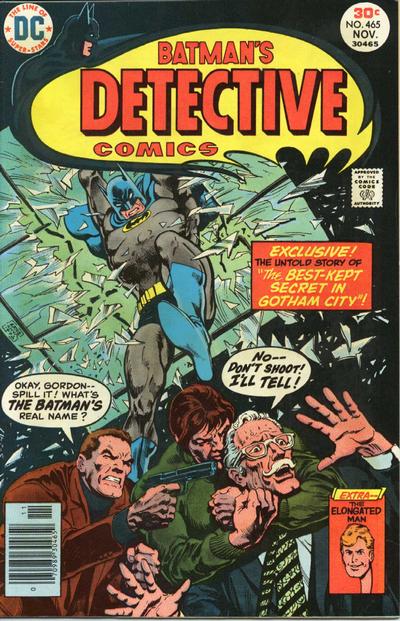
Detective Comics 465 (November 1976)

"The Best-Kept Secret in Gotham City!"
Story by David V. Reed
Art by Ernie Chua and Frank Giacoia

In a flashback to years before, we find out that The Batman, worried that Commissioner Gordon could be in danger from the mob just for knowing The Dark Knight, set up a plan for the inevitable. If Gordon should be pressed by super-villains or the mob, he is tell them that Batman's real identity is real estate agency owner Neil Merrick and that's all he knows. In the present day, a shady character enters Merrick's faux-business office looking for the man. A secretary presses a button and Bruce Wayne is watching hidden camera footage of the interested gentleman. Wayne knows that this can only mean one thing: the mob has Gordon. Using his undercover sources and a little detective work, Batman discovers that gangster Little Dutch is behind the commissioner's abduction. The Caped Crusader makes quick work of Dutch and his goons and saves Gordon's hide yet again. As Batman swings away into the night, Gordon ponders what his old friend would think about his own guesswork as to the real identity of the hero.

PE: Once again, it seems we're deep into another one of Julius Schwartz's "crime bosses, crime bosses, and more crime bosses" demand to his writers. Nary a costumed villain in sight until this title gets a radical revamping at the hands of Steve Englehart and Marshall Rogers in 1977. (What about next issue?--Jack) To be fair, this isn't a horrible story, just an unremarkable one. As with many of these shortened Batman stories in Detective, there simply aren't enough pages to get a proper plot working. It's a set-up, a battle, and a quick resolution with no consequences shown in the next installment. Silly details like the faux office for "Mr. Merrick" don't help either as your mind strays from what little story is presented to questions like "So who is the secretary, does she have a real job, and how do you explain to the woman that she's there only to push a button if someone should ask for Merrick by name?"


Jack: While the plot of this story is nothing special—Commissioner Gordon is kidnapped and Batman tracks him down and rescues him—there are some interesting things going on. First of all, the flashback to when Gordon had darker hair suggests a closer and more believable relationship between him and the Caped Crusader than what we often see when Gordon is quick to believe that Batman is a killer or responsible for whatever bad thing has just happened. Second, Batman’s use of “the Boards” is neat—he puts up coded messages on bulletin boards around town to gather information from informers. Finally, Gordon thinks he may know Batman’s secret identity but does not discuss it with the Dark Knight. Too bad these interesting sidelines are plunked in the midst of a routine story (and completely forgotten in the next-PE).

"The Elongated Plague!"
Story by Bob Rozakis
Art by Ernie Chua & Terrry Austin

On his way to a comic convention where he's the guest of honor, Ralph Dibny, The Elongated Man, runs into The Calculator, who zaps him with a ray that makes Elongo's stretchability contagious. Once Ralph arrives at the Con, many of his fans begin to feel very elastic. Ralph learns the secret of The Calculator's ray and is able to force the mad genius into putting all the stretched-out kids back to their normal overweight selves.

PE: At the risk of beating a dead horse, this story has the same structure as the last two stories featuring The Calculator and there are a few more to come. The crazy bad guy (an obvious "homage" by Rozakis to the old Fantastic Four villain, The Mad Thinker) breaks out of his imprisonment more times than Harry Houdini. You'd think they might keep an eye on the guy. The convention stuff is pretty funny and, if I'm not mistaken, the paunchy old guy in the Superman outfit is supposed to be editor Julius Schwartz. The only stretch to the credibility might be the comparative trim and leanness of some of those con attendees. Folks, I've been to a lot of cons and...

Jack: The most interesting thing about this installment of the Calculator story arc is the comics convention that the Dibnys attend; it seems to be populated by DC Comics VIPs. I think the guy in the Superman costume may be Julie Schwartz, and the official at the end looks like Dick Giordano.

Batman 282 (December 1976)

"Four Doorways to Danger"
Story by David V. Reed
Art by Ernie Chua and Tex Blaisdell

After making short work of the secret police, Batman escapes disguised as one of them and heads off in his private plane to Burundi, where he tracks the movements of Nkuma Senghor, one of the three dead agents. Flying to a remote village, he barely escapes a stampede of Cape Buffalo before disguising himself as a friar and locating a church that serves as cover for an operation to make a nuclear bomb. Batman destroys the operation and flies off to Panama, the country where the third dead agent hailed from, suspecting that he is about to find the last piece of a puzzle in a plot to blow up the Panama Canal. The story ends as Batman is apparently shot to death and his plane plummets earthward.

PE: Wow! David V. Reed has me very intrigued to see where this three-part adventure is going. This middle part reveals that the men Batman is tracking are building or have built a bomb to destroy the Panama Canal, a plot device that brings The Caped Crusader effectively into the real world for a bit. Batman has faced forms of terrorism before in the two titles but not in such realistic terms (although Reed can't help throwing in silly comic book cliches like the signs on the four doors identifying the materials for the bomb). There are a lot of cliffhanger thrills packed into this installment as well. The buffalo stampede, in particular, is very well illustrated. I'm not sure what this all has to do with Gotham but I'll tune in next month for the conclusion. I'd sure like to see where Batman keeps all those disguises he dons. The cover's a cheat, by the way. No scene even close to this takes place in this issue.

Ernie Chua was getting very tired.
Jack: The creators of Batman around this time sure loved their stampedes! At least this time it’s not on the streets of Gotham City. Batman’s disguise as a friar might be more effective if he took off his domino mask. I suspect that Ernie Chua was having a hard time meeting the demands put on him by DC to crank out about a thousand pages per month, because his art is really shoddy in spots, and we can’t keep blaming the inkers!
Batman decided to borrow Robin's mask.


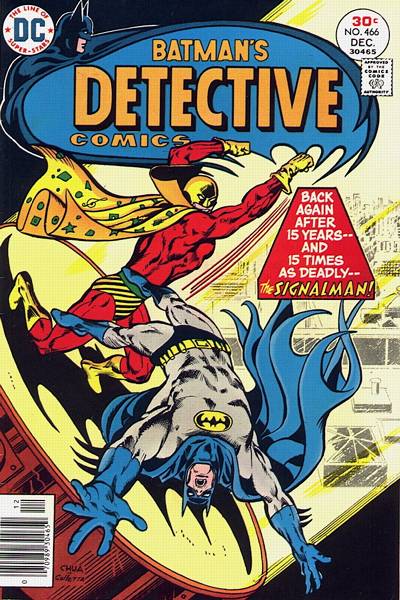
Detective Comics 466 (December 1976)

"Signalman Steals the Spotlight!"
Story by Len Wein
Art by Ernie Chua and Vince Colletta

A villain from the Golden Age of Batman, The Signalman hasn't been seen for fifteen years but he's now back to launch a new reign of crime. First, he causes a double train wreck in order to steal the priceless Heart of Allah ruby, then he attempts to steal the proceeds from the week's big football game. Batman is able to separate the man from his money but not before the villain causes a panic in the stadium. Restoring calm, The Dark Knight realizes The Signalman has escaped but knows it's only a matter of time before their paths cross again. Sure enough, the next night The Signalman steals the solid gold Citizens' Achievement Award from out of the hands of a young boy but runs right into Batman as he's exiting stage left. Once again, through trickery, The Signalman gets the upper hand on Batman and trusses him up inside the Bat-Signal, waiting for Commissioner Gordon's inevitable arrival. The Caped Crusader is too crafty, though, and escapes a fiery death. He catches up to his enemy on a windy mountain road just after the sixth-tier villain has committed his ultimate heist: the theft of a fortune in jewelry from a crypt in Gotham Cemetery. Eventually, The Signalman is killed when his speeding car plunges hundreds of feet off the dangerous road.


PE: Just when I complain that we're getting nothing but mobsters and jewel thieves, we get this oddball story written by future regular Batman scripter Len Wein. The Signalman's resurrection is the kind of stunt that Roy Thomas used to pull over at Marvel, taking a little known Golden Age villain (or hero) and rebooting him for the Silver Age. Alas, Roy would usually pick characters that had some kind of hook or uniqueness to them. If there was a lack of pizazz, Thomas could usually be depended upon to infuse some into the character. Wein takes a justifiably forgotten villain who appeared, if I've got my facts straight, only three times in the Golden Age Batman comic book and then disappeared. He'd disappear again after this one until a mention in DC's maxi-series, Identity Crisis, where's it's revealed that he apparently survived his mountain plunge. I can't figure out what the villain's M.O. is and not for lack of trying. At the beginning of the story, it seems that he's called The Signalman because he can mess with train signals but, later on, Batman says he's figured out the crook's pattern, as though he leaves clues a la The Joker and The Riddler. That particular aspect of the character isn't explained nor is where the guy's been all these years. Jail? I'd think Gordo would mention a jailbreak or parole. In any event, it's not a very good story and the art looks rushed and unfinished in spots.

Jack: Does Signalman count as a member of the Rogues’ Gallery? The internet tells me he appeared once before this under his own name and another time as the Blue Bowman. He has appeared here and there since being revived in 1976. I can’t really tell what his gimmick is, which is a problem. When he tied Batman to the Bat Signal, it seemed like a throwback to the TV show, and not in a good way. Len Wein did such a good job with the Talia 5-part series that I expected better of him when I saw his name in the credits this time around.

"Take Me Out of the Ballgame"
Story by Bob Rozakis
Art by Marshall Rogers and Terry Austin

The Calculator has escaped prison for the 40th time in ten days and this time he's heading for game seven of the World Series. Luckily, The Green Arrow and Elongated Man are there to break up Calc's nefarious scheme of stealing every ball that crosses home plate. By the end of the day, The Calculator is heading back to... you guessed it... prison.


Jack: This is the first appearance of artist Marshall Rogers in Detective, which is a milestone in itself. Pretty soon he’ll be part of the team making Batman stories exciting again. Sadly, the 1976 World Series was not hijacked by Signalman, nor did it go the full seven games: the Reds swept the Yankees in four straight.

PE: Enough of this silly nonsense already. Not even the excitement of seeing Marshall Rogers' debut in the title that would propel him to comic book fame can save this dismal waste of paper. Why would Rozakis map out a multi-issue, multi-hero arc that starts nowhere and stays right there? We'll see if any of this makes sense when it culminates in #468 but I'm not laying any money on it.

Jack: Raise your hand if you, like me, remember receiving DC comics in those half-size brown wrappers where they folded the comics lengthwise and creased the cover.