Thursday, October 11, 2012

100 Years of Vicissitude by Andrez Bergen

100 Years of Vicissitude 

by Andrez Bergen

John Hunt Publishing, 2012, 268 pp.

Set in a vague, Dickensian hereafter, Andrez Bergen’s second novel, 100 Years of Vicissitude, is a compelling read that shows a maturity in writing only hinted at in its predecessor, Tobacco-Stained Mountain Goat. Where the prior novel relied heavily on gimmicks and included so many coded references to great moments in pop culture that an appendix was provided to try to keep track of them all, the new novel is more dreamlike and manages to sustain an elegiac mood throughout its 268 pages.

Wolram E. Deaps, the corrupt millionaire/villain who was killed off at the end of Bergen’s prior novel, is back, this time not fully understanding where (or when) he is, reluctantly going along for the ride of his afterlife with Kohana, a ghostly geisha. She is also dead, having lived through 100 years of turbulent Japanese history and determined to show the highlights to Deaps.

Along the way, we are treated to visits to pre- and post-World War Two Tokyo, as Kohana shows Deaps events from her life that coincide with major events in Japan. The firebombing of Nanking plays a role, but it’s not all tragedy, as we also attend a Sumo wrestling match and even learn a little bit about Marvel comics of the 1960s and what it was like to be a boy in late 20th century Australia.

Sound interesting? It is! Once you start reading 100 Years of Vicissitude, I guarantee you’ll have a hard time putting it down. My only complaint is that the beautiful Japanese characters sprinkled throughout are not translated for those of us who can’t read the language!

Order a copy today here.

--Jack Seabrook

Monday, October 8, 2012

Batman in the 1970s Part 39: December 1975 and the 1975 Wrap-Up


by Jack Seabrook
& Peter Enfantino


Detective Comics 454 (December 1975)

"The Set-Up Caper"
Story by David V. Reed
Art by Jose Luis Garcia-Lopez and Ernie Chua

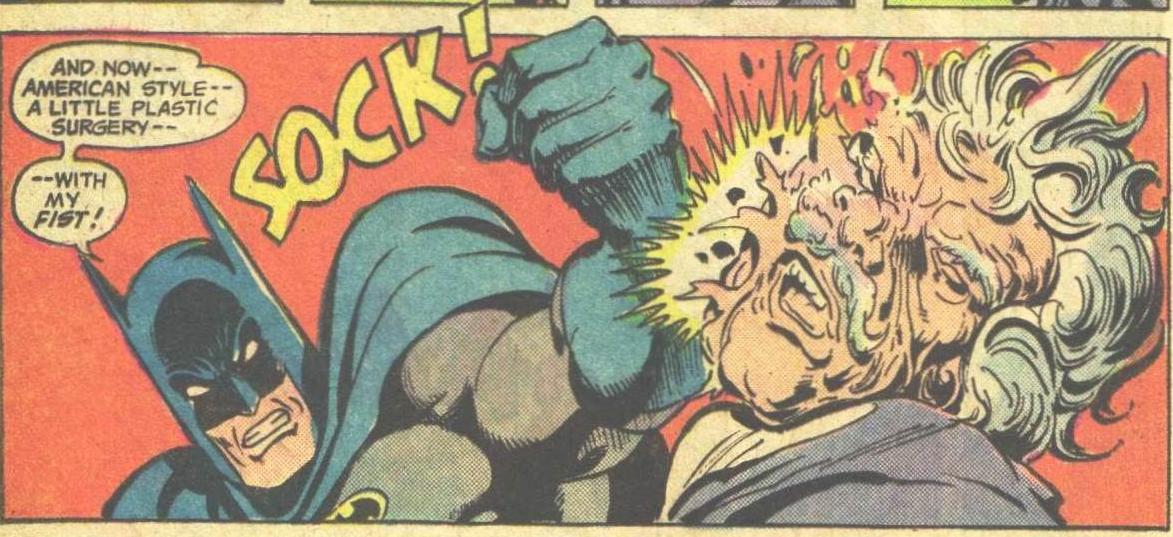
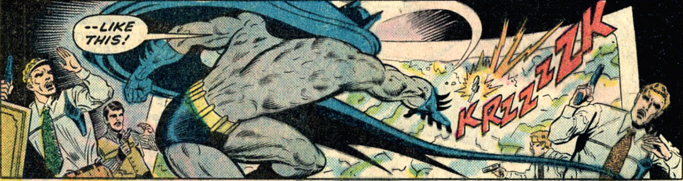
Batman confronts Public Enemy #4, Rex Giles, at a public fountain but the fugitive proceeds to be a handful to obtain. He gives The Batman a right old rogering but eventually our hero prevails and dumps the unconscious Giles at the office of Commissioner Gordon. Imagine the surprise of all involved when the man is turned over and discovered to be the heavyweight contender Kid Cobra who, rightfully, promises to sue Batman for every thing he carries in his utility belt and then some. We know better, however, as the scene switches quickly to The Kid giving the full story to Giles at his hideout. It turns out that Giles wants badly to defeat Batman in a hand to hand fight but isn't dumb enough to think he can do without a bit of cheating. The Kid shows him Batman's "tell," the tic The Dark Knight displays just before he's to use one of his fists. With the aid of his new intel, Giles heads off into battle.


PE: Here's another one of those dramas we used to see all too much - Gordo loses all faith in Batman about ten seconds after a supposed error is made, Bats fights to regain his honor and the respect of Gordo, and then goes right back to being the Commish's lapdog, answering the phone for every little emergency the cop deems too laborious for his department.


Jack: This is a pretty cool story, though, and it moves along quickly. It's basically just one fight after another. I think this is the first time we've seen Garcia Lopez's pencils with Chua's inks.

PE: I question why Giles would risk being taken by any one of the thousands of cops who have his picture on their dashboards just to prove he can beat The Batman in a fistfight. Is this DC's answer to Kraven the Hunter?

My, my, my, my, my.
"The Catch-Me-If-You-Can Crook"
Story by E. Nelson Bridwell
Art by Jose Luis Garcia-Lopez

Hawkman goes up against a small-time hood who suddenly has super powers.

PE: One of the very few back-up two-parters that makes me want to see what happens next, this fun little romp benefits from an entertaining script by Bridwell and art by a fast-essential Garcia-Lopez. If this strip (and the headliner) stay in the hands of JL G-L we're in for a nice ride. And yeah, she's a comic book character and I usually ogle flesh and blood women, but Hawkgirl is pretty fine for a bunch of penciled squiggles.

Jack: I'll admit that it was hard to pay attention to much else after seeing that panel you selected, but this was a fun story and I want to know what the heck is going on! Hawkman remains a favorite character of mine, both for his great costume and for his use of ancient weapons to fight crime.


Batman 270 (December 1975)

"The Menace of the Fiery Heads!"
Story by David V. Reed
Art by Ernie Chua

When assistant D.A. Jim Standish is strangled, Batman must find the killer. He comes close at the home of Judge Bromley, where the villain fights Batman after having dispatched the jurist, but it's not until the Caped Crusader puts together some clues that he realizes the real culprit is Harry Watkins, who threw Batman off the trail of his real goal: to steal a Rembrandt from the Gotham Art Museum.

PE: The story's a lot of fun, filled with puns (some work, some don't), and the running gag of Bruce Wayne continually disappearing in the middle of his meetings with the Youth Club had me rolling in the aisles. Yep, there's a really lame wrap-up but I'll forgive it thanks to its enjoyable build-up. All in all, the best month for Batman comic books in a long, long time.

Jack: The fiery heads were interesting but really had nothing to do with the story. In fact, the cover has nothing to do with the story, and the splash page has nothing to do with the story! I think editor Julius Schwartz may have been up to his old trick again of having the cover first and then having someone come up with a story to match.


1975 Wrap-Up: Flooding the Market

Batman and Detective Comics began 1975 (as far as cover dates go) still being issued bi-monthly in the 100 pages for sixty cents format. This lasted two issues each. The next nine issues of Detective were issued monthly, 36 pages for twenty-five cents. The third issue of Batman, on the other hand, was 68 pages for fifty cents, followed by eight monthly issues of 36 pages for twenty-five cents. The year-plus experiment with 100-page comics was at an end and the result was that DC Comics were now a quarter apiece. It was not only the overall page count that shrunk, however; when the comics went back to monthly status, the new material was reduced from twenty pages to eighteen pages. As a result, in the 22 new issues of Detective and Batman that came out with 1975 cover dates, there was a total of 404 new pages, compared to only 240 new pages in 1974 (when a total of twelve 100-page issues came out).

Batman continued to feature all full-length stories starring the Caped Crusader, while Detective featured only one full-length Batman story, with the other ten issues combining a ten-page Batman lead story with a six- or eight-page backup. Backup features alternated between Robin (4), Hawkman (3) and Elongated Man (3). Batman covers were drawn by Dick Giordano (4), Ernie Chua (3), Nick Cardy (2) and Rich Buckler (1). Detective covers were drawn by Jim Aparo (4), Chua (4) and Giordano (3). Both comics were edited all year by Julius Schwartz.

Stories in Batman were written by Denny O'Neil (7), David V. Reed (3), and Mike Fleischer (1). Pencils were by Chua (6), Irv Novick (4), or Buckler (1), and inks were by Giordano (7), Chua (2), Berni Wrightson (1) or Tex Blaisdell (1). Lead stories in Detective were written by Len Wein (5), David V. Reed (3), Elliot S! Maggin (2), or O'Neil (1). Pencils were by Chua (6), Aparo (3), Walt Simonson (1) or Jose Luis Garcia-Lopez (1), and inks were by Aparo (3), Giordano (2), Mike Royer (2), Chua (1) or Simonson (1).

The creative teams on the backup stories in Detective were varied, and this was a place for DC to let new talent try out their skills. Writers included Bob Rozakis (4), E. Nelson Bridwell (3), Mike Barr (2) and Mary Skrenes (1); pencillers were Al Milgrom (2), Garcia-Lopez (2) and, with one story each: Sergio Garcia, Chua, Buckler, someone just referred to as Martinez, Giordano and Mike Grell.  Backup inkers were Terry Austin (2), Garcia-Lopez (2) and, with one each: Chua, Grell, Klaus Janson, another one-named person called Mazzaroli, Giordano and Frank MacLaughlin.

The letters pages continued, with Batman's Hot Line appearing in Detective and edited by Rozakis (9), Guy H. Lillian III (1) or Schwartz (1); in Batman, the letters page remained Letters to the Batman, and it was edited by Rozakis (10) or Lillian (1).

The first two issues of Detective and the first three issues of Batman continued to pad their length with reprints. Batman reprints featured Batman and Robin (11), or Alfred (1), as well as filler pages such as Strange Old Laws (3) and Comedy Cover Capers. The Batman reprints were from the 1940s (4), the 1950s (2) and the 1960s (5). The reprints in Detective were more varied, featuring many other detectives than the Dark Knight. Reprints were from the 1940s (3), 1950s (8) or 1960s (4). Characters included Robin, Star Hawkins, Ray Foster, Kid Eternity, Roy Raymond, Sierra Smith, Walter Parker, Marty Moran, Manhunters Around the World, Perfect Crime Mystery, Elongated Man, Dave, and Dr. Mid-Mite. There was also filler, such as Bat-Puzzle and Cops of All Trades.

Elsewhere in the DC Universe, Batman continued to appear regularly in Justice League of America (11 issues, with covers by Cardy, Grell, Giordano, Dick Dillin, and Chua), World's Finest Comics (8 issues, with covers by Cardy, Chua and Giordano), and The Brave and the Bold (7 issues, with covers by Aparo). Batman friends/foes the Joker and Man-Bat each appeared in an issue of Brave and the Bold as well.

In September, Limited Collector's Edition C-37 came out, featuring a Batman Special All-Villain Issue that reprinted four Golden Age Batman stories and a 1940s Batman newspaper serial. The Joker premiered in his own comic, with four issues coming out in 1975. Batman Family began in October and put out two issues with a mix of new and reprint material. Super-Team Family began in November and also put out two issues of new and reprint material.

By the end of 1975, Batman or related characters were appearing regularly in Batman, Detective, The Brave and the Bold, World's Finest, Justice League, Batman Family, Super-Team Family, and The Joker. Batman would head into the Bicentennial as one of DC's most popular and heavily promoted characters.


1975: THE BEST (AND WORST) OF THE YEAR

Peter's Picks:

Best Script: Elliott S. Maggin, "The Cape & Cowl Death-Trap"  (Detective 450)
Best Art: Jim Aparo, "Bat-Murderer" (Detective 444)
Best All-Around Story: "Batman's Greatest Failure" (Batman 265)
Best Reprint: "Case of the Martian Witness" (Detective 444)

Worst Script: Denny O'Neil, "Murder Masquerade" (Batman 268)
Worst Art: Sergio Garcia & Frank McLaughlin, "The Case of the Reverse Pickpocket" (Detective 453)
Worst All-Around Story: "The Mystery That Never Was" (Batman 261)
Special Award for Achievement in Bad Writing: Denny O'Neil

Jack's Picks:

Best Script: Mike Fleischer, "Batman's Greatest Failure!" (Batman 265)
Best Art: Rich Buckler and Berni Wrightson, "Batman's Greatest Failure!" (Batman 265)
Best All-Around Story: "Batman's Greatest Failure!" (Batman 265)
Best Reprint: "A Christmas Peril" (Batman 261)

Worst Script: Denny O'Neil, "Murder Masquerade!" (Batman 268)
Worst Art: Sergio Garcia & Frank McLaughlin, "The Case of the Reverse Pickpocket" (Detective 453)
Worst All-Around Story: "Murder Masquerade!" (Batman 268)


Thursday, October 4, 2012

Ray Bradbury on TV Part Five: Alfred Hitchcock Presents "The Faith of Aaron Menefee"

by Jack Seabrook

Sidney Blackmer as Healer Jones
Ray Bradbury’s fourth teleplay for Alfred Hitchcock Presents represented the first and only time he would adapt a story by another writer for this series. “The Faith of Aaron Menefee,” based on the short story of the same name by Stanley Ellin, begins as a big car pulls into a gas station by the side of a dusty country road. Attendant Aaron Menefee fixes the carburetor and his honesty in charging only $2 for the service impresses the car’s passenger. When Aaron suffers an attack from a stomach ulcer, the man introduces himself as Otis “Healer” Jones, a radio and television faith healer.
Aaron tells Jones that he does not listen to the radio or watch television because he has heard that they portray “a load of sinful stuff . . . drinkin’ and killin’ and sinful women.” Little does he know that this chance encounter will soon lead him to experience firsthand two of those three demons. Jones lays hands on Aaron and begins to heal him, inviting him to that night’s meeting. Before the car drives off, Aaron also meets the healer’s pretty daughter, Emily.
That night, Jones leads a tent meeting and heals a woman before calling Brother Menefee forward to have his ulcer healed. Sidney Blackmer, in the role of Jones, is tremendous as the thundering preacher, his voice booming out with the certainty of his cause. After the meeting, Jones, Emily, and his driver, Charlie Fish, count up the “faith offerings” donated by grateful members of the audience and Jones hires Aaron as his new chauffeur.
Before Aaron leaves his hometown to go on the road with Jones, however, he is warned by old Doc Buckles; Buckles is a cynical healer of another sort who tells the young man that his ulcer is “bunk” and that his problems stem from his father’s “hellfire” teachings. Buckles does not come right out and say it, but his comments suggest that Healer Jones may represent a father figure to Aaron, replacing the real father whose teachings seem to have been not very different from those of Jones.
Robert Armstrong and Andrew Prine
What follows is a brief montage as Jones and his group move from town to town, healing the sick and collecting faith offerings; this segment is narrated by Aaron in a voice over. So much time spent with Emily takes its toll, however, and we see Aaron subjecting himself to a bath in ice cold water (complete with large blocks of ice) to purge his mind of sinful thoughts of the Healer’s daughter. Emily, having none of it, orders Aaron to take her out in a rowboat, threatening to fire him if he refuses.
As Aaron rows Emily around a lake he confesses that the devil is in him; she kisses him and quotes The Song of Solomon, suggesting that they marry. He is twenty-five years old, “long overdue,” according to Emily. Aaron tells her that marrying without her father’s blessing would be “sharper than a serpent’s tooth” (quoting Shakespeare’s King Lear), and they head back to the tent, where Aaron asks Healer Jones for Emily’s hand in marriage.
The old man objects, telling Aaron that he is not fit to inherit Jones’s business: “I reaped a mighty harvest, tax free!” he boasts. Aaron, naive and innocent, is putty in the charismatic man’s hands and meekly backs down when Jones tells him that Emily will be free to choose for herself after her father dies. Jones is shown to have almost supernatural power; when Emily pledges her love for Aaron out of sight of her father, his voice booms out of a loudspeaker above their heads (like the voice of God) to stop them from kissing.
Maggie Pierce as Emily Jones
After more time on the road, the troupe returns to Aaron’s home town and Aaron pays a visit to Doc Buckles, who is being held captive by Vern Byers, a gangster whose legs were paralyzed by a policeman’s gunshot. Byers does not accept the diagnosis of Doc Buckles, who tells him that his legs cannot be cured. Aaron tells Byers that he needs the attention of Healer Jones and Byers gives Aaron $1000 to bring Jones to him, promising another $1000 on arrival. Doc Buckles reveals that Byers killed the doctor in Crescent City who removed the bullet from his spine and left him paralyzed; he adds that he will kill any man who takes his money without fixing his legs. Aaron counsels him to have faith and he and Byers’s henchman drive to find Jones in his tent.
When Aaron shows Healer Jones the $1000 faith offering from Byers, the preacher leaps into action and rushes to meet the donor. As Jones head up the stairs to the doctor’s office where Byers awaits, Aaron warns him that the man is short on faith, but Jones goes in alone, confident in his abilities. Byers pulls out his gun and holds it close to his chest as Jones asks the nature of his affliction. The door closes and we are left thinking that Jones will not survive for long and Aaron will have a clear field to marry Emily.
On first viewing “The Faith of Aaron Menefee,” I wondered if Aaron took advantage of the situation in which he found himself, but on watching it a second time it was clear that Aaron is consistently faithful and is simply an unwitting beneficiary.
“The Faith of Aaron Menefee” was broadcast on NBC on Tuesday, January 30, 1962, halfway through the seventh and final season of Alfred Hitchcock Presents. The story on which it was based had been published in the September 1957 issue of Ellery Queen’s Mystery Magazine and would be reprinted in two collections of Stanley Ellin’s short stories: The Blessington Method and Other Strange Tales (1964) and The Specialty of the House and Other Stories (1979). In adapting the story for television, Ray Bradbury was very faithful to the text. The tale is narrated in the first person by Aaron, and the gas station where he works is identified as being 40 miles from Cincinnati, which could put it in Ohio, Kentucky or Indiana. The only place identified in the teleplay is Crescent City, and I was unable to find any Crescent City near Cincinnati.
Bradbury’s teleplay does an outstanding job of compressing time and place and of turning narrative into action and dialogue. While it follows the story very closely, even using dialogue verbatim in spots, there are some differences in the transition from page to screen. The tent meeting that Aaron first attends is described in the story to be attended by “maybe ten thousand people” in Aaron’s estimation; on the small screen it is a much more intimate affair. Some background on Healer Jones is omitted; Aaron tells the reader that the Healer had been living a miserable existence as a lowly bank clerk when he “felt the power seize him.”
The scene where Aaron is healed at the tent meeting is more powerful in the story than on screen, where it is somewhat subdued. Doc Buckles does not tell Aaron that his ulcer is a figment of his imagination; instead, he attributes it to verbal and emotional abuse by the young man’s father. Bradbury removed a section where Aaron first goes to work for Healer Jones and interacts with the rest of his crew; he learns that they are sinners and is teased for his righteous behavior. When Aaron gets into a fight with Everett Kane, the crew foreman, he is forced to tell Jones the truth about the men who work for him. As a result, the men are fired and Aaron is put in charge. The troupe tours the north of the country in the summer and the south in the winter, which seems like a longer span of time than that which is depicted on television. Emily Jones “wasn’t what you’d call a real pretty girl,” as opposed to the attractive Ms. Jones shown in the TV episode. (This is in keeping with a pattern on Alfred Hitchcock Presents, whose producers seemed to have trouble casting less attractive actresses in younger roles.)
Andrew Prine as Aaron
In the story, Emily and Aaron go for long walks at night and he tells her how he feels about her one night “in a grove of trees right outside Tulsa, Oklahoma.” Bradbury compressed these events in his teleplay and made Emily into a more forceful character who orders Aaron to take her out in a rowboat and threatens to fire him unless he complies. The rowboat scene does not appear in the story and recalls similar (yet far more tragic) scenes in the films A Place in the Sun and Night of the Hunter.
The story’s conclusion is altered slightly, as Healer Jones does not allow Aaron to get into the car with him to go back to Doc Buckles’s office. In the teleplay, Aaron and Emily both accompany him but Jones walks up the stairs to the office alone. The story ends as Aaron thinks, “A man’s got no right to question what is meant,” continuing a theme that runs throughout the story but was omitted from the teleplay—that is, Aaron’s willingness to accept what he sees as destiny.
In short, “The Faith of Aaron Menefee” is a great short story that was reworked by Ray Bradbury into a great half-hour of television suspense. Credit for the show’s success also goes to director Norman Lloyd (who was also the associate producer); Lloyd must have had an affinity for Bradbury, since he acted in “Design for Loving” and also directed “Special Delivery,” the previous two episodes written by Bradbury.
I have already mentioned the outstanding performance by Sidney Blackmer (1895-1973) as Healer Jones. Blackmer was in movies from 1914 and is remembered for his chilling role in Rosemary’s Baby (1968) as well as for his work in episodes of The Outer Limits (“The Hundred Days of the Dragon”) and Thriller (“The Premature Burial”). He was in one other episode of Alfred Hitchcock Presents, as well.
Don Hammer as Byers
Playing the role of Aaron Menefee was Andrew Prine, born in 1936. He has appeared in numerous TV episodes, including “Demon in Lace” on Kolchak: The Night Stalker. He is still acting today and maintains an extensive website.
Lovely Maggie Pierce (1931-2010) played Emily; she was a regular on My Mother, the Car (1965-1966), appeared in Tales of Terror (1962), and was in three episodes of the Hitchcock series. Her brief career lasted from 1959-1967.
Olan Soule (1909-1994) had the small role of Charlie Fish; he is a recognizable character actor who was in eight Hitchcock episodes and two Twilight Zones; he was also the voice of Batman in many TV cartoons.
Finally, the great character actor Robert Armstrong appeared as Doc Buckles. Living from 1890-1973, Armstrong will forever be remembered as Carl Denham in King Kong (1933); he also appeared in Son of Kong (1933) and Mighty Joe Young (1949). In movies from 1927, he appeared in over 150 films in his long career and he was on TV beginning in 1950. He appeared in three Hitchcock TV episodes.
Stanley Ellin, author of the story on which the show was based, was one of the great writers of mystery and suspense stories of the mid-twentieth century. He lived from 1916-1986, received three Edgar Awards, and was president of the Mystery Writers of America. His stories were the basis for eight episodes of the Hitchcock series, and I will review the other seven in future articles.
Olan Soule and Prine
Season seven of Alfred Hitchcock Presents is not yet available on DVD, but “The Faith of Aaron Menefee” can be seen online here. The show has never been remade.

Sources:

Ellin, Stanley. "The Faith of Aaron Menefee." 1957. The Blessington Method and Other Strange Tales. Middlesex: Penguin, 1971. 28-44. Print. 

"The Faith of Aaron Menefee." Alfred Hitchcock Presents. NBC. 30 Jan. 1962. Television. 

"Galactic Central." Galactic Central. N.p., n.d. Web. 27 Sept. 2012. <http://philsp.com/>. 

Grams, Martin, and Patrik Wikstrom. The Alfred Hitchcock Presents Companion. Churchville, MD: OTR Pub., 2001. Print.

IMDb. IMDb.com, n.d. Web. 26 Sept. 2012. <http://www.imdb.com/>.

Wikipedia. Wikimedia Foundation, n.d. Web. 26 Sept. 2012. <http://www.wikipedia.org/>. 


Monday, October 1, 2012

Batman in the 1970s Part 38: October and November 1975


by Peter Enfantino
& Jack Seabrook


Batman 268 (October 1975)

"Murder Masquerade!"
Story by Denny O'Neil
Art by Irv Novick and Tex Blaisdell

The Wayne Foundation has purchased some camels to donate to various zoos. A mysterious sheik sets them stampeding and Batman has to stop the carnage. It's too late for oil baron Frederick Goforth, who is killed by the onrushing dromedaries. That night, the Hudson U hockey team is playing at the Gotham Sports Arena and Dick Grayson is in town for the big game. During the game, the same mysterious sheik assassinates Oliver Hopkins, partner of the recently deceased Mr. Goforth. The shiekh goes three for three by killing a third partner, Leo Lunt. Batman chases the sheik but is defeated by his unexpected strength. His hands bandaged, the Caped Crusader tracks down the sheik and, with Robin's aid, unmasks him. It turns out that the murders of Goforth and Hopkins were faked so that the two men could kill Lunt and take his share of the company they owned together. Batman and Robin make short work of the two crooks during a concluding fight on ice skates on the hockey rink at the Arena.

Jack: It doesn't get much worse than this. O'Neil's script is trite, Novick's pencils uninspired, and the inks by Blaisdell make the underlying art appear rough and sloppy. The story makes very little sense and marks the second time in a few months that Batman has had to stop a stampede of large animals in Gotham City. The low point for me was when Batman had Alfred bandage his hands, which were cut badly when he stopped his own fall from a building by grabbing the electric neon lights of a sign. Batman has Alfred wrap the bandages while his hands are clenched into fists so he can still punch bad guys. Batman then can't turn a doorknob with his club-like hands, but a few panels later he has no trouble picking up a telephone.

PE: You're not kidding, Jack. Once again, Denny scrapes the bottom of the barrel with this tedious story stacked high with really bad puns. How many times will we be subjected to the same old "The dead guy ain't really dead, in fact he's the bad guy!" cliche? The bandaged mitts make our legendary Dark Knight look like a buffoon.


Detective Comics 452 (October 1975)

"Crackdown on the Crime Exchange"
Story by David V. Reed
Art by Ernie Chua and Mike Royer

Batman answers a police call at the Tower Building. Suspicious noses are heard five floors below the office of Allied Bullion. The police are convinced no one can access the office but Batman shows them how wrong they are by scaling the building. On the roof, he discovers the door into the building has been torn open and, once inside the Allied office, finds a pair of henchmen hauling away a safe. The two get the better of The Dark Knight and are able to get the safe to a waiting helicopter and then escape. The looting turns Gotham against Commissioner Gordon and Batman (yet again) so The Caped Crusader goes undercover in the ultra-secret Crime Exchange to get to the bottom of who's behind the theft. Once he's brought before the head honcho, Bats tries to convince him that he's actually just a reporter. "If he's not Batman," reasons the hooded leader, "he'll never pick up a gun and fire it into the floor even to save his own life!" Will Batman swallow his misguided sense of truth, justice and the American Way and put a bullet in the defenseless pine flooring or will he eat one to defend those principles?

Don't be a wimp!

Jack: Nice art by Chua and a swift-moving story by Reed make this an enjoyable tale. From the cover, I thought the villain was the Spook, but it doesn't look like it will be. The cliffhanger that ends the story seems kind of dopey--why won't Batman fire a gun at the floor to save his own life? That seems like taking a point to an absurd extreme.

PE: The art's okay in spots but extremely clunky in others. Batman seems to have the chest and arms of Schwarzenegger but the waist of Twiggy. In one scene, it seems as though Batman is as large as the building he's scaling. Having Batman hesitate to put a slug ion a floor is taking his "principles" to a goofy level. After all, he started his crime-fighting career armed with a gun! Julius Schwartz once told a reader that Batman with a gun was a sight we'd never see in any of the comics he edited. This is Julie making good on that promise despite how dumb it appears.

"The Curse of the Ancient Weapons!"
Story by E. Nelson Bridwell
Art by Jose Luis Garcia-Lopez

Carter Hall is supervising the unloading of a van of priceless antiquities at his museum when a wizard appears and attempts a hijacking. Carter calls upon his alter ego, Hawkman, to save the day but Hawk blunders the save. Eventually it's learned that the wizard is Hawkman's old foe, Konrad Kaslak

PE: You'd have a hard time convincing me that anything, and that goes for "a blunt-headed bolt," fired from a crossbow will only "stun its target." Ten bucks says it would make one hell of a dent in somebody. It's amazing what one "wheet!" translates to. It seems to cover every word and sentence structure known to man. Nice art by Garcia-Lopez who we'll be seeing quite a bit of very soon.


Jack: Hawkman's costume is so cool that it seems to bring out the best in the artists who draw his stories. I thought this was a fun story, even at only six pages. The wizard is an honest to gosh magician, and there is no attempt to explain away his magical powers.


Batman 269 (November 1975)

"The Daily Death of Terry Tremayne"
Story by David V. Reed
Art by Ernie Chua

On three consecutive days, derelicts are found murdered and on their persons are ID cards bearing the name of Terry Tremayne. Batman locates the real Terry--a beautiful, wealthy woman living in the suburbs whose boyfriend stole a valuable Florentine box. His confederates are killing off men one by one for a week until she gives up the box. Batman solves the crime and falls for Terry, only to discover that she, too, is a thief and a murderer.

Jack: David Reed's story is quite good and Ernie Chua's art looks more refined than the usual Batman fare. I was taken in by the Terry Tremayne/Batman/Bruce Wayne romantic entanglement and only began to suspect her as the story came to a close. I began to get a real Maltese Falcon feeling and noticed that Terry was drawn to resemble Mary Astor in the 1941 classic film. I was happy to see that, at the very end of the story, they acknowledged their debt to Dashiell Hammett. Well done, all around.

PE: I love how, right in the middle of a multi-homicide investigation, Batman tells the real Terry Tremayne that she should "relax and get some exercise." He then sets her up on a date with his alter ego, Bruce Wayne, because he's taken a shine to her. What a horndog! Doesn't he realize that these dames he's attracted to always end up being bad girls? I didn't think much of the story but some of Chua/Chan's art this issue really stood out, in particular the subway battle scene. It's got a nice, dynamic flow to it. And how about that incredible get-up Bats dons to fool the geniuses of the underworld? A purple hat and cape to disguise the fact he's wearing a batsuit and mask (which are on full view)!

Jack: Not only did I enjoy the story in this issue, but the ads are a bonanza! In an ad for a permanent binder to hold one's comics, we learn that Fantastic Four #1 is worth $100! "Imagine what your comics will be worth in a few years!" There are some nice house ads, as well as a full page promo for the new CBS Saturday morning cartoon lineup that is drawn by Neal Adams. Finally, there is a full page ad for The Buyer's Guide for Comic Fandom, showing that fan publications are starting to appeal directly to readers through ads in the actual comics. Last of all is a full page ad for the Marvel-DC collaboration comic, The Wizard of Oz, a $1.50 treasury edition. There was a lot going on at DC in the fall of 1975!

PE: As well as Julius Schwartz's announcement of the revival of All-Star Comics featuring The Justice Society of America after a 25-year hiatus! #1 JSA fan Roy Thomas, editing over at Marvel, must have been pitchin' a fit over that one.

Master of disguise?


Detective Comics 453 (November 1975)

"The Deadly Web of the Crime Exchange!"
Story by David V. Reed
Art by Ernie Chua and Mike Royer

Batman is able to worm his way out of firing a gun by using it to hurl it at the screen projecting the Crime Exchange's head honcho. In the chaos, our hero is able to reacquire his "Yak" outfit and slip away unnoticed but not before planting a bug. Our costumed vigilante uses the listening device to quash the Crime Exchange's jobs. Meanwhile, The Batman calls on his alter ego, Bruce Wayne, to convince his rich friends to report crimes that aren't actually happening. All of this activity leads The Crime Exchange to believe there's a rival network setting itself up in Gotham. A network, unknown to these villains, run by the Dark Knight. With a little detective work and the deep pockets of Bruce Wayne, the charade is a success and leads to the arrest of the big fish behind The Crime Exchange.

PE: Batman has become such a master of disguise that he's able to fumble in a pitch black room, find a costume he'd discarded (last issue) and pop it on in about five seconds, with nary an eyebrow out of place or missing a prosthetic nose. I think this is more amazing than those death-defying leaps off skyscrapers into the driver's seat of the Batmobile.

Is that a Yak suit under his Batsuit or a sack of potatoes?


Jack: While it was kind of rude of Batman to refer to the contortionist in the suitcase as a "freak," this turned out to be a fun conclusion to the two-part story! About halfway through it became obvious that the Preisdent of the Crime Exchange was going to be unmasked as TV commentator Walter Grimes, but the concluding fight is exciting and I like that it is televised to all of Gotham City. Batman's final line is a good in-joke, as he responds to a reporter's question of whether he has ever thought of having his own TV series with "Are you kidding?"

PE: That last line is the highlight of a story that was just more of the same old stuff. Introduce a character we've never seen before, then show the masked (or hooded, in this case) villain, then unmask said villain at the climax and voila, come full circle. New writer Reed was only doing what he was told to do, I'm sure. The majority of these scripts, with a little tinkering, would feel right at home on the Scooby-Doo cartoon show.

Give her the dough, Ralph. She needs it for the operation.
"The Case of the Reverse Pickpocket!"
Story by Mike W. Barr
Art by Sergio Garcia and Frank McLaughlin

The Elongated Man finds himself suddenly in possession of a wallet stuffed with cash. The road of investigation leads to a crooked hypnotist.

Jack: This forgettable story has curiously retro art that looks like it could have fit in a DC comic of the '50s. It's not very impressive in 1975, though. According to the Grand Comics Database, this is the only US comic credit for penciller Sergio Garcia.

Proof that kids in 1975 were idiots.
PE: Seriously, this is the worst art I've seen in a "professional" comic book period. There are no backgrounds to speak of (in fact, the characters seem to be lined up in front of a large white wall throughout the story) and that poor Girl Scout will never be asked to the school dance looking like Chucky from Child's Play. I think more time and effort went into the Twinkies ads that DC was running at the time. They're certainly better written and deliver a creamier center and a nice yummy aftertaste.


Monday, September 24, 2012

Batman in the 1970s Part 37: August and September 1975


by Jack Seabrook
& Peter Enfantino

Batman 266 (August 1975)

"The Curious Case of the Catwoman's Coincidences!"
Story by Denny O'Neil
Art by Irv Novick and Dick Giordano

Bruce Wayne is traveling on a train that also contains a carload of criminals en route to the state pen, including Selina Kyle--Catwoman! An accident causes a train wreck and Catwoman escapes. She makes her way back to Gotham City, where she gets the old gang together and carries out a jewel heist. Batman tracks her down by following her kitty and she's on her way back to jail.

PE: Yet again, the Commissioner calls on The Batman to help him with a little matter of jewel theft. Does Gordo ever do any police work? He's as useless as his namesake in the ABC-TV series. The fortune teller, so prominently featured on the cover, makes an ominous proclamation and then disappears. When the train crashes, we see Catwoman wandering in a daze, almost as though she's got one of those cases of selective amnesia. Next we see her in her old costume. Interesting tidbits destined to be explored? Think again. "Coincidences" is certainly better than Catwoman's last outing (the achingly bad "Circus Caper" in Batman 257) but it's a strange mishmash of fragments that don't come together well.

Jack: I'm not sure what the arrangement was for artists on these books, but Irv Novick is back and his characters look the same as ever. I agree with you that it's not a bad story, it just doesn't stand out. Why does Catwoman initially say that she was going to jail to serve her time? The moment she gets free, she's back to a life of crime. The series of coincidences that drive this story to its conclusion are not much different than the usual wild coincidences that populate lesser Batman tales.

Even cops prefer issues with the Joker!

Detective Comics 450 (August 1975)

"The Cape & Cowl Deathtrap"
Story by Elliott S. Maggin
Art by Walter Simonson

When Senator Locksley is assassinated, Batman goes after Mr. Harcourt, a man he's sure had something to do with the murder. Shortly thereafter, Harcourt employs the services of Jeremy Wormwood, free-lance assassin, to obtain Batman's cape and cowl. Wormwood uses an elaborate Wax Museum scheme in order to force the Caped Crusader to surrender his costume. When Wormwood brings the cowl to Harcourt, he discovers that the man is actually Batman in disguise, but not before he foolishly confesses to the murder of Senator Locksley.

Christian Bale circa 1975?
PE: Absolutely fabulous. Just as Neal Adams brought out the best in Denny O'Neil years before, the brilliant art of Walt Simonson surely inspired Maggin to script a satisfying, twisty tale. Even the reveal, a device in Batman that usually sucks the life out of me, works here as does the revelation that Batman has taken on the guise of Harcourt. Walt uncannily predicts Christian Bale's ascent to Bruce Wayne 30 years before the fact and contributes a Batman so dark, so perfectly dangerous, you could easily mistake this as being from the Frank Miller mid-80s era. Why, oh why, wasn't Simonson made permanent artist on this title? Easily the best Batman story since "The Joker's Five-Way Revenge."


Jack: I liked this story too, Peter, but I wouldn't rate it above "This One'll Kill You, Batman!" (Batman 260), "Break-In at the Big House" (Detective 445) or "Batman's Greatest Failure!" (Batman 265). The good news is that 1975 is shaping up to be a very good year for the Dark Knight. Simonson's art is a breath of fresh air, though I think some of the human faces (such as the guy pictured below) look a little funny. His Batman is excellent. I'm not sure his art inspired Maggin, since I don't think DC did the art before the story, but it's another in a solid group of issues this year.


"The Parking Lot Bandit!"
Story by Bob Rozakis
Art by Al Milgrom & Terry Austin

Dick Grayson isn't fast enough to prevent The Parking Lot Bandit from striking again. The Bandit's M.O. is that he steals purses and then uses the I.D. and house keys to rob the victim blind. This time, The Bandit has made off with the purse of the secretary to the treasurer of Hudson University and, before you know it, has stolen $50,000 in tuition fees. Seems that one shouldn't count their chickens before they're hatched, though, since shortly after the robbery, the police chief gets a message from The Bandit indicating he'd been framed!

Yep, Schuster's my first choice too!
PE: Could this be the very first interesting Robin story I've ever read? Sure, it's got all the earmarks of another snooze-worthy Boy Blunder adventure: our hero can't stop the bad guy, Dick Grayson cavorts with attractive women without giving anything away as to his sexuality, and all the supporting characters are drawn with invisible ink. So why give this one a thumbs-up? Well, the art by future favorites Milgrom and Austin is at the very least professional and I never saw the finale coming. Yeah, I've got a good feeling I know who the culprit really is since, as with the other cliches this strip thrives on, it's fairly obvious, but I'm cautiously optimistic I won't hate the wrap-up. These mid-1970s comic book writers must look back in embarrassment at the phrases they had to use instead of profanity. Here, Chief McDonald almost makes "This fudgin' thing never works when you need it!" sound like poetry.

Jack: I think he's the same character who burst into a room crying "What the fudge!" in a recent issue.

PE: This is a rare job outside Marvel for Al Milgrom. Not long after this appearance, he jumped ship and had stints drawing Captain Marvel and Marvel Presents. He's known chiefly for his run as an editor at The House of Ideas in the 80s, responsible for such titles as Marvel Fanfare, West Coast Avengers, and Secret Wars II. Terry Austin would become a fan favorite a couple years later as the inker to John Byrne's pencils on The New X-Men but first he'll lend a hand to Marshall Rogers on his celebrated run on Detective in 1976.

Jack: I kept thinking Mike Grell drew this story--there are some similarities in style.


Batman 267 (September 1975)

"Invitation to a Murder!"
Story by David V. Reed
Art by Ernie Chua and Dick Giordano

Commissioner Gordon receives an invitation to a jewel heist and calls Batman for help. The robbery is a success, carried out by fake firemen supposedly responding to a fire. Batman tries to foil the hijacking of an airplane and learns that the criminal he seeks has black teeth. A quick look at the Bat-Archives reveals that the culprit is Django, whose teeth are black due to his habit of chewing Betel nuts. The Caped Crusader catches Django at a rock festival and the crime wave comes to an end.

PE: A decent story, this one. It's got an interesting enough plot line, with a good portion of action and excitement, with just a few questionable holes. Ferinstance, when Django tells Batman he'll have to unmask or he'll be blown sky-high, The Dark Knight does so, revealing a Django mask. Why Bats decided to wear this disguise is anyone's guess. Did he anticipate the request? We're not privy to that information. How is it that Django can transform himself into a "whirling dervish?" One plot thread left dangling that I do appreciate is the nice throwaway final panel where the Commish asks Batman how the glowing invitations magically appeared in Gordo's office. Bats admits that's he's still working on that puzzler. Refreshing that we're not given some over-the-top revelation he couldn't possibly be privy to.

How did we not notice that?
Jack: David V. Reed wrote a nice little mystery here that contains the plot holes you mention. Chua's art is at its best, but once again we have a really cool cover that doesn't fit the story. The revelation of Django is supposed to make him look kind of skullish, but his teeth look more pointy than black and the skeleton on the cover is nowhere to be seen.

PE: We find out, after thirty five plus years of mystery, exactly what Commissioner Gordon does for a living: he answers mail. That's why he has to farm his detective work out to the Caped Crusader. David V. Reed (aka David Vern) wrote Batman stories in the 1950s, revamping the Batplane and creating Deadshot, a character who came to prominence in the 1980s as a member of DC's Suicide Squad.

Jack: This looks like Reed's first Batman story after a long absence from DC comics. He will write quite a few more before we're done with the 70s!


Detective Comics 451 (September 1975)

"The Batman's Burden!"
Story by Denny O'Neil
Art by Ernie Chua

Once again, Commissioner Gordon has asked The Batman to investigate a matter out of his jurisdiction. Seems a hit-man is on his way to the Caribbean island of San Lorenzo to off a celebrity at the Charity Backgammon Match. Only one man might know who the target is, a loser named Baldy Amber, so The Dark Knight sets off to find him. Undercover in San Lorenzo and accompanied by champion skier Molly Post and her friend Cumming Streeter, Bruce Wayne stumbles across Baldy, working as a janitor at one of the island's swanky hotels. Quickly changing into his night clothes, The Batman has to come on strong to find out the assassin's name is Lefty Colon and his target is none other than Bruce Wayne. But a blow to the head has left his mind scrambled and he soon learns that the real victim will be Molly.

PE: After last issue's high, we're back to another forgettable story with little action and questionable entertainment value. I wasn't blown away by the five-issue "Batman-Murderer" arc but at least Len Wein and Archie Goodwin were trying to break the character out of the decades-long sinkhole of one-issue stories and a lack of continuity. Three issues later and there's no fallout from that storyline. Everything is seemingly back to normal as if the police never hunted The Caped Crusader in the first place. It was all a horrible dream and let's forget all about it, says returning editor Julius Schwartz. Now the storied hero is nothing more than an errand boy for the top cop. The idea that the mafia lays high-end bets on ski matches makes one pause. The only scene that caught my interest was Molly's breakdown amidst all the violence surrounding her, but the roots of her pain were dropped quickly and not expounded on. A missed opportunity to inject some life in an otherwise lifeless corpse. No complaints about the Ernie Chan art, though. As you can see from the panel below, Chan is nicely capturing a sleek, muscular Dark Knight.


Jack: Is Cumming Streeter supposed to be a dirty joke? I thought this was a poor story and further evidence that O'Neil's writing skills were lagging in the mid-70s. The Chua art is serviceable but no longer outstanding, after what we've seen this year from the likes of Aparo, Buckler and Simonson. He seems to have taken up the mantle of Irv Novick--another perfectly good draftsman who would not often draw an exciting or original story.

"The Parking Lot Bandit Strikes Again!"
Story by Bob Rozakis
Art by Al Milgrom and Terry Austin

Dick Grayson goes undercover as a parking lot attendant (STOP sign and all) to catch the Parking Lot Bandit. When his labor bears fruit and the bandit is nabbed, the thief has some odd news for the police: he stole the purse from Hudson University's secretary, yep, but he didn't break in and rob the College of its $50,000 in tuition money. When Robin does a bit of investigative work, he uncovers the real culprit: (SPOILER ALERT!!!) H.U.'s treasurer, Paul Schuster (surprise!).

PE: "Dick Grayson - Parking Lot Attendant!" Has a ring to it. Perhaps a glimpse of a spin-off title to come? As predicted, I knew just who the real perpetrator was (and so did you) so the wind was taken out of the sails a bit. This two-parter, with a bit of tinkering, probably could have been run as one installment but, all in all, it was a fun bit of nonsense and provided the first time in the 1970s that a Robin solo story was better than its lead-in. If just by default.

Jack: Best of all, that panel reproduced above sure seems to indicate that Robin is about to get lucky with the delectable Lori! That final picture of Dick Grayson (another dirty joke, her calling him Richard instead of Dick?) is about as close to underground comix art as you'll get in 1975 Batman comics.


PE: For the second time this year, a Batman foe (well, semi-foe) gets his own title. Like The Joker, this will be a short-lived victory for Kirk Langstrom (only two issues) and shortly after he'll be relegated to an occasional back-up feature in Detective and The Batman Family.

Jack: I remember buying Man-Bat and enjoying it during its brief run.


Limited Collector's Edition C-37

Jack: Another $1.00 Batman treasury edition came out with the September comics. This time it was an all-villain issue of reprints, with four Golden Age stories and a run of strips from the Batman Sunday newspaper comics page.