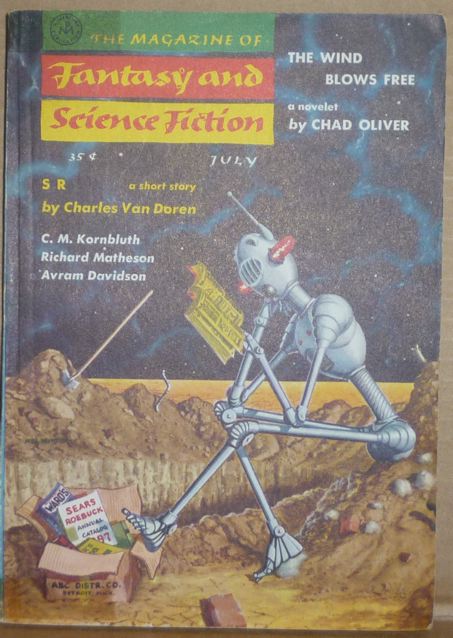
Saturday, October 23, 2010

Richard Matheson - The Original Stories: The Gauntlet Chapbooks

by John Scoleri

In the first four parts of this ongoing series, I looked at Richard Matheson's short fiction appearances in Playboy, the Sci-Fi Pulps, the Mystery Digests, and The Magazine of Fantasy & Science Fiction. In this installment, I look at the original works that debuted as Gauntlet Chapbooks.

The Original Stories - Part 5: The Gauntlet Chapbooks

For the last several years, Barry Hoffman's Gauntlet Press has been the de facto home of Richard Matheson. In addition to reprinting his many classic works in signed, limited editions, Gauntlet has published many never before seen works. For a period of time, Gauntlet offered limited edition chapbooks containing short fiction, teleplays, and non-fiction for the Matheson completist as an incentive for customers ordering titles directly. As you'll see, most of these have since been collected in Off Beat and Matheson Uncollected Volume 1.


"And in Sorrow"
Cover by Harry O. Morris.
Gauntlet, 2000.

Subsequent appearances: Off Beat: Uncollected Stories

Notes: Originally published as a 200-copy, unsigned, numbered edition for customers who ordered Hunger & Thirst from Gauntlet.


"Life Size"
Cover by David Armstrong.
Gauntlet, 2001.

Subsequent appearances: Matheson Uncollected Vol. 1

Notes: Originally appeared exclusively in the 52-copy lettered edition of Subterranean Press' Off Beat. Reprinted in this Gauntlet Press Sampler also including original and reprint fiction from R.C. Matheson, Rain Graves, Barry Hoffman, and Clive Barker. Limitation not specified.

Illustration by Harry O. Morris


"Purge Among Peanuts"
Cover by Marcelo M. Martinez.
Gauntlet, 2001.

Subsequent appearances: Matheson Uncollected Vol. 1

Notes: Originally published as a 500-copy, signed, numbered edition for customers who ordered unspecified titles from Gauntlet.


"The Prisoner"
Cover by Marcelo M. Martinez.
Gauntlet, 2001.

Subsequent appearances: Off Beat: Uncollected Stories, Matheson Uncollected Vol. 1

Notes: Originally published as a 350-copy, unsigned, numbered edition for customers who ordered unspecified titles from Gauntlet.


"He Wanted To Live"
Cover by Michael Bayouth.
Gauntlet, 2002.

Subsequent appearances: Matheson Uncollected Vol. 1

Notes: Originally published as a 552-copy, unsigned, unnumbered edition for customers who ordered A Stir of Echoes from Gauntlet.


"Professor Fritz and the Runaway House"
Cover by Michael Bayouth.
Gauntlet, 2002.

Subsequent appearances: Matheson Uncollected Vol. 1

Notes: Originally published as a 404-copy, unsigned, unnumbered edition for customers who ordered ABU and the Seven Marvels from Gauntlet.


"14 Steps to Reality: Metaphysics for the Young"
Cover by Michael Bayouth.
Gauntlet, 2002.

Subsequent appearances: N/A

Notes: Non-fiction by Matheson (included here solely to maintain a complete list of the Matheson Gauntlet Chapbooks) published in an unspecified edition for customers who ordered A Primer of Reality from Gauntlet.


"Man With A Club"
Cover by Michael Bayouth.
Gauntlet, 2003.

Subsequent appearances: Matheson Uncollected Vol. 1

Notes: Originally published as a 552-copy, unsigned, unnumbered edition for customers who ordered Come Fygures, Come Shadowes from Gauntlet.


"Richard Matheson's Kolchak Scripts EXTRA!"
Cover by Bill Walker.
Gauntlet, 2003.

Subsequent appearances: N/A

Notes: Non-fiction (included here solely to maintain a complete list of the Matheson related Gauntlet Chapbooks) published in an unspecified edition for customers who ordered Richard Matheson's Kolchak Scripts from Gauntlet. Contains 7 photos and 3 illustrations and an introduction ("Picture Perfect?")


"The Last Blah In The Etc"
Cover by Harry O. Morris.
Gauntlet, 2004.

Subsequent appearances: Matheson Uncollected Vol. 1

Notes: Originally published as "All and Only Silence" in Off Beat: Uncollected Stories, and subsequently published as a 552-copy, unsigned, unnumbered edition for customers who ordered Darker Places from Gauntlet.

"Counterfeit Bills"
Cover by Harry O. Morris.
Gauntlet, 2004.

Subsequent appearances: Matheson Uncollected Vol. 1

Notes: Also includes an interview with Matheson conducted by William P. Simmons. which is about six times longer than the short story itself! Originally published as a 552-copy, unsigned, unnumbered edition for customers who ordered Duel & The Distributor from Gauntlet.


"1984 1/2"
Cover by Harry O. Morris.
Gauntlet, 2005.

Subsequent appearances: Matheson Uncollected Vol. 1

Notes: Originally published as a 552-copy, unsigned, unnumbered edition for customers who ordered Unrealized Dreams from Gauntlet.


"The Funeral: Teleplay"
Cover by Harry O. Morris.
Gauntlet, 2006.

Subsequent appearances: N/A

Notes: Originally published as a 552-copy, unsigned, unnumbered edition for customers who ordered Bloodlines from Gauntlet. Features and introduction by Mark Dawidziak. Included here solely to maintain a complete list of the Matheson Gauntlet Chapbooks.


There's more to come! Stay tuned for future installments of Richard Matheson - The Original Stories.


Friday, October 22, 2010

The Complete Guide to Manhunt Part 5

by Peter Enfantino

Continuing an issue by issue examination of the greatest crime digest of all time.

Vol. 1 No. 4 April 1953

One Little Bullet by Henry Kane
(11,500 words) *1/2
Peter Chambers, PI, finds trouble in the Long-Malamed Cocktail Lounge. More deadly but desirable dames, seedy bars, damaged noggins, shady men with guns, and expositories worthy of a few yawns.

Henry Kane’s version of Mike Shayne, Peter Chambers appeared in nearly 30 novels (including Hang By Your Neck (1949), Death of a Hooker (1961), and Kill For the Millions (1972)), and even his own short-lived radio show, Crime and Peter Chambers. Chambers also starred in several short stories, 6 of which appeared in Manhunt.

Kane also adapted Ed McBain’s first 87th Precinct novel, Cop Hater, for the screen in 1958, starring Robert Loggia as McBain’s Detective Steve Carella.

Big Talk by Kris Neville
(2500 words) **1/2
Two newspapermen, working the night crime beat, check in on a battered woman at a hospital. Gritty little short-short is somewhat diminished by a predictable (and rushed) finale.

Be My Guest by Robert Turner
(3000 words) ***
Punch-drunk ex-boxer Rocky and his beautiful wife Janie retire to the hills of Maine after Rocky’s last fight. Trouble,, in the form of mobster Mr. Calligy comes calling. Seems Rocky was supposed to take a fall during his last bout but it didn’t work out that way. Calligy has come to take out his lost 50gs on Rocky and Jainie. Nicely done. Author Robert Turner gets us into the deteriorating brain of Rocky much like Jim Thompson did with Collie in After Dark, My Sweet.

Robert Turner was a prolific writer in several genres. He wrote three crime novels (The Tobacco Auction Murders (1954), The Girl in the Cop's Pocket (1956), and The Night is For Screaming (1960)), wrote for pulps such as The Spider, scripted comic books, and sold stories to TV (including “Hooked” to Alfred Hitchcock Presents, from the February 1958 issue of Manhunt). In 1970, Powell paperbacks published Shroud 9, a collection of short Robert Turner/Ray Carroll stories that includes 11 culled from Manhunt. For a comprehensive overview of Turner’s comic book career, see “Robert Turner in the Four-Color Forest by Will Murray (Comic Book Marketplace #85, September 2001).

Fan Club by Richard Ellington
(3000 words) *
Private dick Steve Drake only got to meet the lovely but bitchy Evelyn Lanier a short time before she was murdered. The prime suspect will be Evelyn’s ex Charley Boxer, an old friend of Drake’s, unless the PI can find the real killers before the cops get wind of her untimely death. Rest assured, Drake saves the day. One of the most abrupt endings I’ve ever read, but that’s not a bad thing since I don’t think I could have stayed awake more than a couple more pages. In the Hall of Fame of PIs, Steve Drake doesn’t merit much discussion. The creation of Richard Ellington (who supplemented his writing career with stints in Radio (The Fat Man) and TV (Man Against Crime)) Drake starred in five novels (It's a Crime (1948); Shoot the Works (1948); Stone Cold Dead (1950); Exit for a Dame (1951); and Just Killing Time (1953)) and two more short stories (both in Manhunt) before disappearing into obscurity. This character should not be confused with Earl Drake, the tough guy of Dan J. Marlowe’s long-running Gold Medal series.

Shakedown by Roy Carroll
(3000 words) ***
When his beautiful girlfriend Vera tells him she’ll be gaining a little weight over the next nine months, eternal bachelor Van tells her he’s not the kind to bounce a Van Jr. on his knee. Smelling some free big money, Van talks Vera into sidling up to their rich boss, Mr. Harry Owen. The plan is to get Owen to bed Vera, pin the pregnancy on him, and make Vera Mrs. Owen. When Vera follows through with the plan, the boss snaps, kills Vera, and buries her body in the woods. Unfortunately for Owen, he does all this while Van is keeping an eye on him. Van sees the murder as nothing more than an even bigger payday. Good twist ending when Mr. Owen shows Van a thing or two about villainy. Roy Carroll was a pseudonym of Robert Turner.

The G-Notes by Robert Patrick Wilmot
(7500 words) **
Bad guy Joe Carlin botches a jewelry job, irritating his employer very much. His boss pays him his cut in two one-thousand dollar bills, making it very difficult to make change. Overlong, “The G-Notes” meanders almost as much as Joe Carlin.

Mugger Murder by Richard Deming
(3000 words) ***
A cop suspects that a man who has killed a mugger in self-defense may actually be a thrill-killer, baiting potential muggers. A fascinating look at a coroner’s investigation. An ancestor of Brian Garfield’s novel Death Wish.

Kid Kill by Evan Hunter
(2500 words) ***1/2
Two cops investigate an accidental shooting involving two young brothers. One cop is convinced the shooting was no accident and that a ten year old boy is a cold-blooded murderer. Chilling short-short with the usual Evan Hunter touches. As an interesting sidenote, because Manhunt published two similar-themed stories back to back (“Mugger Murder” and “Kid Kill” in which the murderers escape justice) in the same issue, the editor had Shepherd Cole “of the prominent law firm of Kole and Kole” write an afterward on the feasibility of “getting away with murder.”

The Blue Sweetheart by David Goodis
(6500 words) **
Clayton wants his old flame Alma back from mobster Hagen but it may cost him more than the massive sapphire he’s been flaunting around town. Warmed-up Casablanca. Hard to believe this came from the pen that wrote Shoot the Piano Player and Street of No Return.

Everybody’s Watching Me by Mickey Spillane
(Part 4 of 4) (see Volume 1 Number 1 for details)

This issue's "Mugged and Printed" features bios of Mickey Spillane, Robert Patrick Wilmot, Richard Ellington, David Goodis, Richard Deming, and Henry Kane.

Wednesday, October 20, 2010

Greg Nicotero's United Monster Talent Agency

Peter and I had the opportunity to see some of the behind the scenes shots from the making of Greg Nicotero's short film United Monster Talent Agency this past March. If you're a Universal Monster fan, I think you'll love it. Watch for our pal David J. Schow behind the camera (literally), alongside a number of other famous faces.

AMC TV is hosting the video on their site. Check it out below!

Tuesday, October 19, 2010

The Rise and Fall and Rise and Fall and... of Pre-Code Horror

by Peter Enfantino

Four Color Fear: Forgotten Horror Comics of the 1950sThough they’ve never really gone away, the pre-code horror comics of the 1950s seem to be having another spike in their visibility, if not their popularity. Way back in 1999 John and I co-edited a special “Selective Guide to Horror Comics” Issue of The Scream Factory (#19). That issue featured a ground-breaking article on the pre-code horror companies other than EC. Author Lawrence Watt-Evans opined that several of these companies were producing product equal to, and sometimes superior to, the EC titles. That article has just been reprinted in Roy Thomas’ Alter Ego Magazine #97 (the Halloween Horror issue) and based on what I’ve seen at the publisher’s site (where a piece of the article is available as a free download), Roy has done his usual A-1 job of illustrating the piece with several rare items.

Several new books spotlight the gory, gooey, sadistic world of pre-code. Marvel’s doing a great job of reprinting some of their titles (now how about bringing the price down, guys?), IDW’s first volume in the reprinting of Dick Briefer’s Frankenstein should be out some time soon, and before me lie two very different studies of the genre.

Four Color Fear (Fantagraphics, $29.99) is 320 nicely reprinted pages, comprised of 39 horror stories from such 1950s horror comics as This Magazine is Haunted, Witches Tales, Web of Evil, Black Cat Mystery, Strange Terrors, and Chamber of Chills. The overwhelming impression I get after reading these dusty old relics is that EC might not have been the first, they might not have been the only one, but they certainly were the best. It's not even a close race. EC excelled at not just its art but also its stories. The other companies could ape EC's stable of artists (and do a decent job as in the case of Howard Nostrand's "homage" to Jack Davis, "Dust to Dust," which looks just like Davis) and rip off their ultra-violent storylines (Tales from the Crypt's sadistic butcher story "T'aint the Meat...It's the Humanity" becomes Mysterious Adventures' sadistic butcher story "Chef's Delight"). But if you're buying Four Color Fear for anything besides offbeat nonsense, you're obviously going to be disappointed. If, like me, you relish this stuff, you'll need this book.

Inside you'll find: "Wall of Flesh" about a crazed scientist who creates, well, a wall of flesh that absorbs anyone who touches it; Reed Crandall's ludicrously entertaining "The Corpse That Came to Dinner" about a young couple who discover the undead corpse of their recently deceased friend eating out of their refrigerator; "The Flapping Head," with typically nice art by Al Williamson but atypical story about a flying vampire head seeking to rebuild its body; and what must be not just the goofiest comic in this book but possibly in all of pre-code, "Green Horror" about a lusty, jealous and murderous cactus!

As a bonus to the stories, there are 32 full-page reproductions of classic covers (with comments on each) and editor Greg Sadowski provides exhaustive notes for each story as an afterword and drops a hint that we’ll be seeing a separate volume devoted to Atlas. Based on the job done here, I’ll be looking forward to that book.

Our second study is The Horror! The Horror! (Abrams ComicArts, $29.95), which presents a somewhat different angle. Author Jim Trombetta dissects various facets of the horror comics (the werewolf, war, crime, etc.) using quite a bit of psychology. Usually that throws up a red flag for me. While there are several instances where I questioned the logic of the author, there are an equal number when a lightbulb went on over my dim cranium and I actually looked at a story differently. Trombetta’s prose is scholarly but not academic (read: not boring). I would question whether such in-depth analysis is due a story about a young couple who buy a new house, quickly discover bottles of blood in the basement and then decide against moving out. When the “bloodman” (rather then the milkman) comes calling for “empties” and takes the couple along with him, I thought “what a couple of dopes” rather than look for any Freudian overtones.

According to Trombetta, “Skeletons perform any number of lonely personal revenges, but they most often appear less as the mirror of human self-hatred than as a quorum.” Huh? Just tell me how they can speak without vocal chords! A little far fetched is this description of the cover of Mysterious Adventures #18: “Here a superb Hy Fleischman skeleton grabs his ex-wife and demands that she join him in the grave. What ups the ante is that the ex-wife’s boyfriend is also on the scene – molested, prison-style, from behind by another skeleton.” Does anybody really see in this cover, even squinting, a skeletal version of Deliverance?


There are 16 strips here, several of which are dopey fun. ( I’d love to own a set of Dark Mysteries, with titles like “The Terror of the Hungry Cats,” “Terror of the Unwilling Witch,” “Vampire Fangs of Doom,” “Terror of the Vampire’s Teeth”). My favorite of the batch for sheer goofiness would have to be “The Eyes of Death.” Ralph Moore has always been jealous of fellow astronomer Don Reynolds’ success. Don seems to have all the fame and fortune that astronomers deserve: stars named after him, awards bestowed, lots of dough, and a sweet chick named Elaine. Ralph’s biggest problem is that his eyes are going bad and, sorta like a junk man with no arms, he’s having a tough time getting the job done. Despite the fact that this has nothing to do with Don, Ralph has a “moment” and tosses his partner down the observatory stairs. Now, here’s where it gets interesting. Instead of calling the cops and confessing, Ralph calls his cousin, the surgeon, to ask if the doctor can perform a super-secret operation to give him Don’s eyes. The doctor scratches his chin, pondering, and says “I can do it, Ralph…it’s unethical…but…all right, I’ll do it! No one will know – he’ll be buried with his eyes closed!” (At this point I pause and ask why author Trombetta didn’t research the medical field of the 1950s to get to the bottom of how something like this could occur? No autopsy?) Needless to say, Don’s corpse rises from his grave to reclaim his eyes at the climax. I have to believe that Trombetta is pulling our leg with his analysis of the story: “’The Eyes of Death’ (Dark Mysteries No. 7, July 1952) succeeds in becoming a true nightmare out of a kids’ campfire story, in which eyes can literally be ripped off. The story also presents an original idea of cosmic casuality that will no doubt have astronomers revising their theories.”

If all this comes off as too negative, don’t get me wrong. The Horror, The Horror is a delight from start to finish and features not only those 16 stories but hundreds of rare comic covers. Trombetta drops his professorial cap several times and made me laugh out loud. Regarding the cover of Dark Mysteries #13 (directly to my left). The author questions: “The guard expresses amazement: ‘It’s Tom’s leg…. But he was executed last night!’ What is striking, of course, is how many more questions this explanation raises than it answers: How does the guard know it’s Tom’s leg? If this is Tom’s leg, where’s the rest of him? Did his execution involve his dismemberment? Are the other prisoners afraid that the leg itself will, say, give them the boot? Or has something eaten the post-resurrection Tom in one large gulp, leaving only a drumstick, and are the other characters afraid they’ll be next?”

This is how I think Jim should have tackled this project. Forget phallic symbols and emasculating mother-figures. Sometimes a zombie is just a zombie.

(Page reproduction from "Green Horror" taken from the Bloody Pulp blog, an informative and entertaining examination of Myron Fass' eerie Publications. Highly recommended)

Sunday, October 17, 2010

Richard Matheson - The Original Stories: The Magazine of Fantasy & Science Fiction

In the first three parts of this ongoing series, I looked at Richard Matheson's short fiction appearances in Playboy, the Sci-Fi Pulps and the Mystery Digests. For this installment, I turn my attention to his work that appeared in The Magazine of Fantasy & Science Fiction.

My goal is to include basic bibliographic information, cover shots and interior illustrations where possible, and a listing of the subsequent Matheson collections in which the stories appeared. I plan to interject other bits of trivia along the way, and if there's anything in particular you'd like to see, please let me know by posting a comment. -John Scoleri

The Original Stories - Part 4: The Magazine of Fantasy & Science Fiction

The Magazine of Fantasy & Science Fiction is where it all began. With the Summer 1950 issue, Richard Matheson saw his first piece of short fiction published. No other magazine published as many of Matheson's stories as F&SF, the most recent of his 20 appearances is on the newsstand as I write this in the Fall of 2010.


"Born of Man and Woman"
The Magazine of Fantasy & Science Fiction
Summer 1950, Vol. 1 No. 3

Subsequent appearances: Collected Stories HC, Born of Man and Woman, Third From the Sun, Duel: Terror Stories, Collected Stories TP v1

Editorial Comment: Mr. Richard Matheson lives in Brooklyn, is 23 years old, and has never published a story before. These simple, direct facts we can tell you about the author. Nothing so simple could be said of his story or the protagonist who tells it with a mind such as you have never met, house in a body you have never imagined. Read on... and learn to know your not inconceivable kinsman.

Notes: In the book, The Eureka Years: Boucher and McComas's Magazine of Fantasy & Science Fiction 1949-1954 (Bantam, 1982), we're treated to the initial correspondence between the editors and Matheson. In December of 1949, they expressed an interest in purchasing his story "Born of Man and Woman," provided that the magazine lived to see its third issue. 

"We do hope that you will let us hold BORN," Boucher writes, "and that it will be far from the last Matheson story we publish."

Matheson replied:
Dear Mr. Boucher,
I hope it won't shock you to learn it is the first story I ever sold in my life. I have written for years, of course. I can only suggest that my lack of success, until now, has been due to a very limited effort at marketing my work.
Things were certainly about to change for Richard Matheson.


"Through Channels"
The Magazine of Fantasy & Science Fiction
April 1951, Vol. 2 No. 2
Subsequent appearances: Collected Stories HC, Born of Man and Woman, Nightmare at 20,000 Feet: Horror Stories, Collected Stories TP v1

Editorial Comment: It is a source of lasting satisfaction to us that this magazine published Richard Matheson's first story, the unforgettable "Born of Man and Woman." Happily, his talent seems inexhaustible; here is one of several Matheson tales we have in store for you—one with an altogether different technique and approach from his perceptive study of a mutant's tragedy, but a story that demonstrates equally well the Matheson ability to hint at terror too awful to be told directly.

Notes: "Through Channels" was published as a signed, limited edition chapbook by Bill Munster of Footsteps Press in 1989. The chapbook was illustrated by 80s small press mainstay Allen Koszowski, and includes an appreciation by Vincent Price and an afterward by Roger Corman. 552 copies were printed and signed by Matheson, 52 of which were also signed (in red) by Vincent Price.


"Dress of White Silk"
The Magazine of Fantasy & Science Fiction
October 1951, Vol. 2 No. 5

Subsequent appearances: Collected Stories HC, Born of Man and Woman, Third From the Sun, Nightmare at 20,000 Feet: Horror Stories, Collected Stories TP v1

Editorial Comment: Richard Matheson's first published story, "Born of Man and Woman," is probably, to judge from your letters, the most popular single story we've printed to date—an astonishing record for a short-short by a beginner. Since that classic (about to be reprinted in the Bleiler-Ditky Best Science Fiction Stories 1951), Matheson has published many stories here and elsewhere, admirable tales but never quite equaling the sheer originality and shock-impact of his first. Now at last, in "Dress of White Silk," we think that Dick Matheson has done it again. That's introduction enough.

Notes: "Dress of White Silk" was the Matheson story chosen for reprinting in The Eureka Years, which also includes a letter from Matheson to the editors regarding the story:
Dear Tony,
As you suggest, I'll assume momma to be some type of were-creature who does not necessarily change on the outside. I'll work in that ring finger idea. (I never knew of that before.) [in story "Dress of White Silk"]*

As to the dress I'll try to make it clearer what I mean. I had visualized that what was left of momma's powers were in the dress she had once worn during those times she traipsed around digesting the good citizens of the town. The leaves and smell bags were meant to be some sort of abortive power like garlic with the vampire. I'll see if I can bring it out better.
Best, Dick
P.S. Just looked at my own hand. Ye gads!
*I suppose it is common knowledge that one identification of a werewolf can be made by establishing that the ring finger is longer than the middle finger of the hand. Personally, I had to check it out with better-versed supernaturalists.

"SRL Ad"
The Magazine of Fantasy & Science Fiction
April 1952, Vol. 3 No. 2

Subsequent appearances: Collected Stories HC, Born of Man and Woman, Third From the Sun, Duel: Terror Stories, Collected Stories TP v1

Editorial Comment: When Elmer Davis composed the constitution of that noblest of bibliophilous and bibulous organizations, the Baker Street Irregulars, he included a warning as to the dangers of meetings consisting of only two members: "If said two are of opposites sexes, they shall use care in selecting the place of meeting, to avoid misinterpretation (or interpretation either, for that matter)." But he added: "If such two persons of opposite sexes be clients of the personal column of the 'Saturday Review of Literature,' the foregoing does not apply; such persons being presumed to let their consciences be their guides." As a matter of fact one eminent Irregular, the foremost living authority on The Lion's Mane, later committed the highly respectable action of acquiring a wife through an SRL Ad; but most of the entries in that most provocative of advertising media seem aimed at less conventional objectives. A sustained perusal of SRL personals would, one feels sure, cause Sherlock Holmes to rate the American journal even above the agony columns of London newspapers as " the most valuable hunting-ground that ever was given to a student of the unusual." Precisely how unusual a quarry may be flushed in that hunting-ground is here related by Richard Matheson—in an interplanetary prose which only a Matheson could conceive and execute.

Notes: In an interview with Stanley Wiater for Collected Stories TP v1, Matheson notes that he was receiving the Saturday Review of Literature at the time, and F&SF editor Anthony Boucher liked his idea of an alien using the personal ads to correspond with someone.


"Disappearing Act"
The Magazine of Fantasy & Science Fiction
March 1953, Vol. 4 No. 3

Subsequent appearances: Collected Stories HC, Born of Man and Woman, Third From the Sun, Nightmare at 20,000 Feet: Horror Stories, Collected Stories TP v1

Editorial Comment: In the two and a half years since young Dick Matheson published his first story (the by now classic "Born of Man and Woman" in F&SF, Summer, 1950), he has appeared in very nearly every science fiction market of any importance, he has been reprinted twice in the Bleiler-Ditky annual Best volumes and by just about every other anthologist in the field, and he has acquired a wife so stunning as to appear outstanding at a science fiction convention also attended by Bea Mahaffrey and Evelyn Gold. We publish all of these cheerful Mathesoniana as counterweight to the following story, a bitterly cheerless picture of a completely unsuccessful writer, and the ineluctable force of an ill-advised prayer.

Notes: "Disappearing Act" was adapted for the first season of The Twilight Zone by Rod Serling as "And the Sky was Opened." The episode was directed by Douglas Heyes, writer/director of Ann-Margret's Kitten with a Whip and three of the more popular episodes of Boris Karloff's Thriller.


"The Test"
The Magazine of Fantasy & Science Fiction
November 1954, Vol. 7 No. 5

Subsequent appearances: Collected Stories HC, The Shores of Space, The Shrinking Man & Others, Duel: Terror Stories, Collected Stories TP v2
 
Editorial Comment: Science fiction readers need no footnotes on the brilliant career of Richard Matheson, from his classic first story "Born of Man and Woman" (F&SF, Summer, 1950) to his just-published first fantasy novel, I Am Legend (Gold Medal). And "The Test" is too true and moving a story to need any introduction beyond this: that it treats, poignantly and perceptively, a many-valued human problem to which even the advanced future will find no simple answer.

Notes: This issue also includes what may very well be the first review of Matheson's landmark novel, I Am Legend:
Most rewarding of 1954's new novels this month is Richard Matheson's I Am Legend (Gold Medal, 25¢), an extraordinary book which manages to do for vampirism what Jack Williamson's Darker Than You Think did for lycanthropy: investigate an ancient legend in terms of modern knowledge of psychology and physiology, and turn the stuff of supernatural terror into strict (and still terrifying!) science fiction. Matheson has added a new variant on the Last Man theme, too, in this tale of the last normal human survivor in a world of bloodsucking nightmares, and has given striking vigor to his invention by a forceful style of storytelling which derives from the best hard-boiled crime novels. As a hard-hitting thriller or as fresh imaginative speculation, this is a book you can't miss.


"The Funeral"
The Magazine of Fantasy & Science Fiction
April 1955, Vol. 8 No. 4

Subsequent appearances: Collected Stories HC, The Shores of SpaceI Am Legend & Others, Bloodlines, Collected Stories TP v2

Editorial Comment: Richard Matheson is chiefly noted as the Young Master of powerful emotional impact in science-fantasy; but he can also, upon occasion, be one of the brightest and funniest farceurs in the business, as you may remember from "SRL Ad" (F&SF, April, 1952). Now he demonstrates  that the compendious novel I Am Legend did not exhaust his knowledge of vampires, as he adds to our store of data on those and other beings in a hilariously grisly tale which could be illustrated only by Charles Addams.

Notes: "The Funeral" was adapted by Matheson for Rod Serling's Night Gallery. The short segment was directed by Jeannot Szwarc, who would go on to direct Somewhere in Time from Matheson's novel Bid Time Return. This issue also featured a Charles Beaumont/Chad Oliver collaboration ("The Last Word") and Walter M. Miller Jr.'s "A Canticle for Leibowitz."


"Pattern For Survival"
The Magazine of Fantasy & Science Fiction
May 1955, Vol. 8 No. 5

Subsequent appearances: Collected Stories HC, The Shores of Space, Button, Button, Collected Stories TP v2

Editorial Comment: Do you want to know what type of man stands the best chance of surviving the holocaust of his world? You'll learn the answer in this brief and pointed item which is, like most Mathesons, not quite like any other story you've read.

Notes: In Collected Stories TP v2, Matheson tolf Stanley Wiater that with this story he was satirizing author Robert Sheckley, who was getting a lot of stories published in the 50s. This issue also features Charles Beaumont's "Free Dirt."


"Steel"
The Magazine of Fantasy & Science Fiction
May 1956, Vol. 10 No. 5

Subsequent appearances: Collected Stories HC, The Shores of Space, Duel: Terror Stories, Collected Stories TP v2

Editorial Comment: Richard Matheson has climbed a long way since his first story appeared here almost six years ago. He is now working on the screen play of his as yet unpublished novel The Incredible Shrinking Man (sic), which is scheduled to be that rarity, a Class A science fiction film; and he will soon leave Hollywood (which can offer few attractions to a man so enviably married) to be the guest of honor at the Ninth Annual West Coast Science Fiction Conference in Oakland, California. One of his last magazine stories to be written before the Hollywood hiatus is this tale of strength and endurance, robot and human—a science fiction sports story so realistic, simple and powerful that it should prove moving even to sports-loathing readers who have never let a boxing bout darken their television screens. 

Notes: "Steel" was adapted by Matheson for the fifth season of The Twilight Zone. A feature film starring Hugh Jackman is currently in production.


"The Splendid Source"
The Magazine of Fantasy & Science Fiction
March 1957, Vol. 12 No. 3

Subsequent appearances: Collected Stories HC, Shock!, Collected Stories TP v2

Editorial Comment: The earnest critics who accuse science fiction writers of paranoia have this fact on their side: We do seem to agree with the paranoid that there are Conspiracies all about us, lurking behind commonplace facades and shaping our ends by devious and unperceived means. It is this classic theme that Mr. Matheson here explores, pitting his venturesome young hero against a hitherto unsuspected Conspiracy that affects every day of our lives... and proving joyously that a Conspiracy is not necessarily malevolent.

Notes: Regular readers of this series will recall "The Splendid Source" was previously published in the May 1956 issue of Playboy. This issue also features Robert Bloch's "The Proper Spirit," and a column of film reviews by Charles Beaumont. Matheson told Stanley Wiater in Collected Stories TP v2 that he had written an unpublished sequel to the story, in which protagonist Talbert Bean "tries to make really classy pornographic films."


"The Holiday Man"
The Magazine of Fantasy & Science Fiction
July 1957, Vol. 13 No. 1

Subsequent appearances: Collected Stories HC, Shock!, The Shrinking Man & Others, Nightmare at 20,000 Feet: Horror Stories, Collected Stories TP v2

Editorial Comment: You are probably reading this just after the Memorial Day weekend. And it's only about a month till the Fourth of July. And underneath all of your pleasure in these national celebrations, there may be a certain haunting doubt, a question that keeps nagging at you...

Notes: According to Matthew Bradley (in his new book Richard Matheson On Screen), "The Holiday Man" was adapted by Matheson for an unproduced televised counterpart to Galaxy magazine (Matheson's contributions to Galaxy will be featured in a future installment of this series).


"Old Haunts"
The Magazine of Fantasy & Science Fiction
October 1957, Vol. 13 No. 4

Subsequent appearances: Collected Stories HC, Nightmare at 20,000 Feet: Horror Stories, Collected Stories TP v2

Editorial Comment: Like most s.f. magazines, we find that college and university towns are major centers in our distribution;and it seems fitting to publish a college story at this season when those towns are stirring with new autumnal life. But this is not a rousing rah-rah story for undergraduates. (We'll bring you an agreeable Martian specimen of that genre next month, when the football season is in full swing.) This is a story for the Old Grad, who has reached the point where he begins "to relive the past and regret the present"... and I wonder how young Mr. Matheson manages to understand so acutely the emotions which lie a decade ahead of him. This seems to me an even more impressive fictional feat than understanding the torments of an incredible shrinking man.

Notes: According to Matheson in Stanley Wiater's Collected Stories TP v2, he felt "Old Haunts" (which he never adapted) would have made a good episode of The Twilight Zone. This issue also includes a collaboration between August Derleth and H.P. Lovecraft, "The Lamp of Alhazred."


"Lemmings"
The Magazine of Fantasy & Science Fiction
January 1958, Vol. 13 No. 7

Subsequent appearances: Collected Stories HC, Shock!Collected Stories TP v2

Editorial Comment: Richard Matheson has so far achieved his greatest popular success with his longer works; the screen version of The Shrinking Man, indeed, accorded him the almost unheard-of honor of billing him in letters as large as those used for the producer. But Old Mathesonians—especially this one, who will never forget that frabjous day in 1949 when "Born of Man and Woman" turned up in the slush pile—feel that his most powerful and effective writing has been in shorter forms. Here is as short a story as Matheson has yet written—simple, direct, haunting...

Notes: This issue also features Theodore Sturgeon's "A Touch of Strange."


"The Edge"
The Magazine of Fantasy & Science Fiction
August 1958, Vol. 15 No. 2

Subsequent appearances: Collected Stories HC, Shock!Collected Stories TP v2

Editorial Comment: 'At this year's World Science Fiction Convention, known as the Solacon, I shall be the toastmaster, and I look forward to one of the happiest moments in my speaking career when I introduce Richard Matheson as the Convention's Guest of Honor. Only 32 today, Matheson made his debut 8 years ago in F&SF (Summer, 1950) with the now-classic "Born of Man and Woman"—one of the two most impressive first-stories I've ever read. (The other, for the curious, is Stanley Ellin's "Specialty of the House," EQMM, May 1948.) Since then he has been extraordinarily successful both critically and commercially, with a long string of distinguished short stories  and novelet, two suspense novels, two s.f. novels, one splendid mixture of the two (the recent A Stir of Echoes), and much film-writing including The Incredible Shrinking Man. Two years ago, at a west-coast regional convention, I heard Matheson deliver the most intelligent and moving speech I've ever listened to from a guest of honor—a candid discussion of commercialism and artistic integrity. Matheson knows, both intellectually and intuitively, how to combine these two vital factors; and I hope all readers of F&SF who can do so will join me in duly honoring him at the Solacon.

Notes: Anthony Boucher, who had been editor since Matheson's first appearance, notes in this issue he is taking a sabbatical, with Robert P. Mills taking over the editorial reins of F&SF. This issue also features the first part of Robert Heinlein's "Have Spacesuit—Will Travel."

"From Shadowed Places"
The Magazine of Fantasy & Science Fiction
October 1960, Vol. 19 No. 4

Subsequent appearances: Collected Stories HC, Shock III Am Legend & Others, Collected Stories TPv3

Editorial Comment: Richard Matheson has been absent from these pages in recent years, primarily because of his heavy book, motion picture and television work schedule. We are particularly pleased, therefore, to have this new tale, concerning the unbearable presence in a plush New York apartment of the dark magic of Africa.

 Notes: Boucher was obviously a huge fan of Matheson's stories, and  while it's certainly possible that it's just a coincidence that Matheson's last appearance before his two-year hiatus was the last issue Boucher edited, one must wonder if Robert P. Mills was looking for something other than what Matheson writing. This issue features an impressive roster of marquee names in the sci-fi community: Isaac Asimov, Arthur C. Clarke, Philip Jose Farmer, James Blish, and Poul Anderson.


"The Traveller"
The Magazine of Fantasy & Science Fiction
February 1962, Vol. 22 No. 2

Subsequent appearances: Collected Stories HC, Born of Man and Woman, Third From the Sun, Collected Stories TP v2

Editorial Comment: Professor Paul Jairus regarded the time machine's objective as sentimental rot... which made him the ideal observer to send on the mission.

Notes: Another of Matheson's Fort College stories, "The Traveller" originally appeared in Matheson's fisrt collection, Born of Man and Woman, published in 1954 by the Chamberlain Press.


"The Jazz Machine"
The Magazine of Fantasy & Science Fiction
February 1963, Vol. 24 No. 2

Subsequent appearances: Collected Stories HC, Shock III, Button, Button, Collected Stories TPv3

Editorial Comment: For some writers the ascent to fame is like climbing Everest in lead galoshes. Some freeze to death without ever reaching the top. Others turn around and go back. The lucky few, however, spring into the public eye and favor almost at their first leap. Such luck, of course, favors onlt the talented; and among those favored was Richard Matheson, whose first published short story, "Born of Man and Woman" (F&SF, Summer, 1950), dazzled and horrified, establishing him at once as an author of the first rank. New Jersey born and Brooklyn raised, ex-cheese store clerk, former YMCA counselor, overseas War Veteran, U. of Mo. graduate (Journalism), husband of Ruth Ann, father of Betina and Richard and Alison, Richard Matheson is the author of four screenplays, three short story collections, and seven novels (including the very non-SF, The Beardless Warriors: Little-Brown, 1960). In this unusual story—for story it is, as are all great poems, ; and song as well, as they all are, too—lament and battle cry and paean of triumph—he reaches deep into te molten hollow of the human heart, the nightmare corner of the American Dream.

Notes: Since Matheson's last appearance in the magazine, Robert P. Mills is now a consulting editor, with Edward L. Ferman the managing editor. Under 'In This Issue' Matheson is also mentioned:
Richard Matheson returns to us, after an absence whose length we all regret (somewhat mitigated by our having another story of his in our inventory).

"Tis The Season To Be Jelly"
The Magazine of Fantasy & Science Fiction
June 1963, Vol. 24 No. 6

Subsequent appearances: Collected Stories HC, Shock III, Button, Button, Collected Stories TPv3

Editorial Comment: This is one of the damndest stories we have ever read.

Notes: Robert P. Mills is no longer on the editorial masthead. Under 'In This Issue' Matheson is also mentioned: 
Richard Matheson engages in a fantastic reductio ad absurdem.


"Girl Of My Dreams"
The Magazine of Fantasy & Science Fiction
October 1963, Vol. 25 No. 4

Subsequent appearances: Collected Stories HC, Shock III, Button, Button, Collected Stories TPv3

Editorial Comment: "The second sight," as it is often called, or clairvoyance, has been so often and so well attested that it has been recognized as a legitimate and non-diabolical phenomenon by that stern, august, and level-headed body the Established Kirk of Scotland. Not particularly limited to that or any other extra-sensory ability is the ancient, ancient exhortation that great gifts durst not be used for mean purposes. Richard Matheson, in a modern key, spins a tale of life and death, love and hate and greed. 

Notes: Robert Bloch and Michael J. Bird adapted "Girl Of My Dreams" for Journey to the Unknown. Under 'In This Issue' Matheson's lead-off story is mentioned: 
Item: story by Richard Matheson, about a heel and a girl with a strange talent.


"The Window of Time"
The Magazine of Fantasy & Science Fiction
September/October 2010, Vol. 119 No. 3 & 4

Subsequent appearances: Steel and Other Stories

Editorial Comment: Mr. Richard Matheson lives in Brooklyn, is 23 years old, and has never published a story before. These simple, direct facts we can tell you about the author." So read the introduction to "Born of Man and Woman" in the magazine's third issue. In the sixty years since that auspicious debut, Mr. Matheson has of course gone on to publish many more stories. including classics like I Am Legend, The Shrinking Man and Bid Time Return, as well as about six dozen screenplays for TV and film. His current projects include a new novel entitled Other Kingdoms due out in March 2011 from Tor books, a recent story in Vice magazine, and a film adaptation of his story "Steel" entitled Real Steel and starring Hugh Jackman.
His new F&SF story is a trip down memory lane through that same borough where he lived when his career began.

Notes: After a 47 year absence, Matheson returns to the magazine where his short fiction career got its start.


There's more to come! Stay tuned for future installments of Richard Matheson - The Original Stories.