Thursday, February 9, 2023

The Hitchcock Project-Harlan Ellison: Memo From Purgatory [10.10]

by Jack Seabrook

Long before he was a famous science fiction writer, Harlan Ellison moved to New York City in 1954 and decided to go undercover and join a street gang so that he could learn about it from the inside and write about it with insight. He used his experiences in various short stories and novels and, in 1961, published Memos From Purgatory, a non-fiction account of his time as Phil "Cheech" Beldone, a member of the Barons. Ellison later explained that the producers of The Alfred Hitchcock Hour bought the rights to his book in 1962, before Ellison had ever written a teleplay and before the first episode of the hour-long Hitchcock show had aired.

Ellison wrote the teleplay in January 1962 but it sat on a shelf for over two years until it was filmed as "Memo From Purgatory" and aired on NBC on Monday, December 21, 1964, well into the show's third and final season. In a 1969 introduction to a reprint edition of his book, the author wrote that the TV show "was hardly consistent with the truth of what really happened," even though Ellison himself wrote the teleplay and must have thought well enough of it not to use one of the pseudonyms he put on TV shows he disdained.
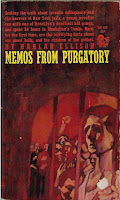
First edition
Ellison's original script is included in Brain Movies, volume one, but the purpose of this essay is to compare the book with what ended up on the small screen.

Memos From Purgatory is a book in two parts: the first half details Ellison's time with the street gang in 1954, while the second half tells of 24 hours he spent in a New York City jail in 1960. As the story begins, Beldone (Ellison's alias) gets a job driving a Coke truck on the docks and begins to hang out at a candy store/malt shop run by Ben Adelstein. After watching the shop, he enters with a tough attitude and confronts kids who have their backs to the counter and their feet against the opposite wall in order to create a barricade. He shows his mettle and they let him pass; after insulting one of their girls, he buys a round of Cokes and begins to chat with the gang members. A week later, Cheech is asked to join the Barons.

The president is named Pooch and his vice president is Fish; that night, Cheech is taken to a tenement basement for initiation; he is put in front of a bright light and knocked around the room before he swears allegiance. Stripped to the waist, he is made to run a gauntlet between boys in the gang as they try to whip him with the sharpened buckles of their belts. He next has to pick a girl to sleep with and chooses Filene; the two retire to a private basement room and consummate their union.

James Caan as Jay Shaw/Phil Beldone
The final step in Cheech's initiation is to take part in a rumble. There is tension with gang members named Candle and Fat Barky and, when Flo accuses Cheech of attacking her at the malt shop, Candle attacks him and Pooch announces that their differences will be settled in a stand, or a duel. That Saturday, the gang gathers at the waterfront to watch a brutal knife fight between Cheech and Candle; each has one arm tied behind his back and they hold opposite corners of a handkerchief in their teeth to maintain proximity. Cheech manages to survive and knocks Candle down but spares his adversary.

In the weeks that follow, rumors of a rumble spread between the Barons and a rival gang called the Puerto Rican Flyers. Weapons are procured and a brutal battle in Prospect Park ensues. Cheech barely survives the rumble and returns to his room, where he gathers up his possessions and leaves for good.

The first half of Memos From Purgatory is an exciting, true-life story where the author engages in a lot of moralizing. The second part of the book, where he spends a day in jail six years after his time in the gang, does not hold up as well and is far less interesting to read.

When Ellison adapted the book for The Alfred Hitchcock Hour, he focused on the first section, where he joins the gang. Unfortunately, the plot was nowhere near enough to fill an hour of TV time, so he expanded the story in ways that were not as successful. The show starts out promisingly, with the opening credits playing over a jazzy score by Lalo Schifrin and the writing credit reading "Teleplay by Harlan Ellison, Based Upon His Autobiographical Work: 'Memos From Purgatory.'" Ellison is played by a young James Caan in one of his earliest screen roles; the show opens with establishing shots of the New York City skyline and the Port Authority Bus Terminal.
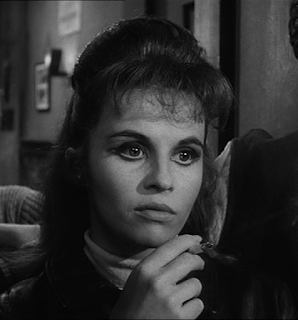
Lynn Loring as Filene
Voiceover narration tells the viewer that the author saved up money and quit college (Ellison was expelled) to come to New York City to "'find out if the streets of Manhattan really were paved with gold.'" The character is renamed Jay Shaw (Ellison's middle name was Jay) and director Joseph Pevney uses what looks like a brief, handheld camera shot of Shaw walking down the sidewalk as his narration explains that he wanted to write a novel about juvenile delinquency based on "'a new view, a truthful view--from the inside.'" Shaw walks straight into the camera and, as his narration reveals that he went undercover as Phil Beldone, the screen goes black for a moment and then the shot continues with Shaw walking away from the camera, his back turned; he has changed clothes from jacket and tie to T-shirt and his hair is now slicked back into a ducktail. The smile on his face has been replaced with a scowl that he will wear for most of the rest of the show.

We see Shaw exit the front door of his new home as he explains in voiceover that it's located in a tough neighborhood called Red Hook. The camera pulls back to watch from across the street and then there's a tracking shot as Shaw walks along the sidewalk, still narrating. He stops in front of a store that's located below street level; the sign painted on the window reads, "Candies, Malt Shop." The opening sequence of "Memo From Purgatory" is effective in setting the stage for what follows, as Shaw enters "'the turf.'"

He walks down the stairs and into the malt shop and we hear rock and roll playing on a jukebox inside. The Barons and their debs are sitting at the soda counter and there is a room in back where teenagers are dancing. Ominously, a Baron pulls down a shade on the front door and the scene at first plays out as it does in the book, with Phil having to walk past the Barons as they block his way with their legs. Pevney uses a mix of closeups, medium shots, and tracking shots to underline the tension inherent in the situation. Unlike the book, however, Ellison sets up a conflict between Phil and Candle right away; Candle does not move his legs to let Phil pass and Phil disrespects him by asking to speak with Tiger. From the start, Candle displays a psychotic smile and attitude. In addition, the Barons' lack of respect for the older generation is shown when the proprietor of the shop tries to defend Phil and Fish, sitting next to Candle, immediately grabs him and silences him.
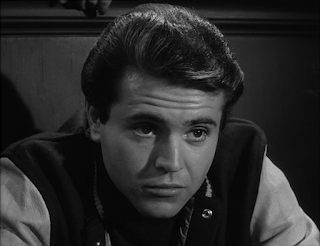
Walter Koenig as Tiger
To add to the tension, Phil insults Candle, leading to a brief action sequence where Phil grabs Fish and holds a knife to his throat. Candle pops open his own switchblade and it looks like a knife fight is in the offing, but Tiger appears and defuses the situation, demonstrating that he is the gang's leader. We get our first look at Filene here and she is by far the prettiest of the Baron debs. Candle threatens Phil, who replies, "'take it up with my agent,'" a remark that seems tough but also slyly refers to his aspiration to be a writer. Tiger and Phil sit together in a booth in the back room and talk and Tiger is clearly amused by Phil and impressed by his bravery. Walter Koenig is excellent as Tiger, in a much more magnetic performance than the one given by Caan, who seems tentative.

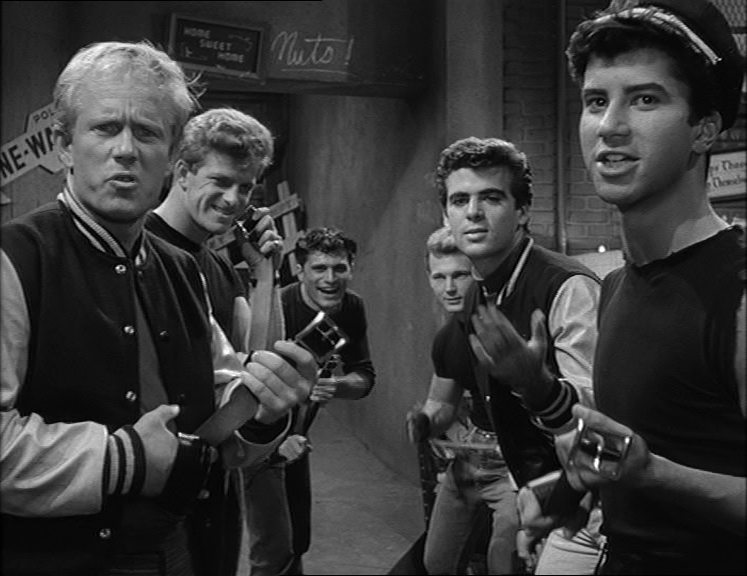
There is a cut to the Barons' basement headquarters a few days later; we see another brief sequence where the gang members and their girls dance to rock and roll music. Phil is led in, blindfolded, for the initiation, and the sequence where he runs the gauntlet between rows of Barons swinging belts is remarkably similar to that in the book and surprisingly brutal for a 1964 TV show. There is a brief cut to Filene, who watches with a look of horror on her face; the shots of her to this point help set up her role in the rest of the episode.

The second part of the initiation in the book involves Phil having sex with Filene, which (of course) had to be changed for TV. Instead of coming together in a dingy room in the basement next to the room where Phil runs the gauntlet, Filene appears at the door of Phil's room, telling him that Tiger sent her to be his deb, if he wants her. She admits that she volunteered for the role and Phil suggests that they "'just tell 'em what they want to hear,'" implying that they forego sex and agree to lie to the gang members and debs about what they have done. They smoke cigarettes together, as if they have just finished having sex, and Filene explains that the third part of the initiation is participation in a rumble. She tells Phil that he's "'different from the others'" and warns him to be careful.

Tony Musante as Candle
The first part of "Memo From Purgatory" is excellent, following the events of the book closely and setting up interesting characters and conflicts. Unfortunately, there's not much more of the TV show that comes from the book, and what follows is less successful. Phil is shown with typed pages of his notes as he explains in voiceover that he was told to get ready to rumble. The book's knife fight/duel between Phil and Candle is replaced with a scene where the gang members rob and attack a lone man on a park bench at night; when Candle threatens to beat the man with a tire iron, Phil intervenes and the man runs away. Tiger arrives and takes Phil's side over Candle, replacing Candle with Phil as the gang's war counselor. Once again, Tiger demonstrates why he's the gang's leader, calming the situation with authority and clearly impressed with Phil's "'smarts.'"

The TV show then goes off in an entirely different direction than the story. There is no rumble and Phil does not gather his possessions and leave. Instead, Candle and Slats (another gang member who smiles slightly less psychotically) break into Phil's room when he's not there. Their intention is to attack him but, when they discover he's gone, they trash the place and find Phil's notes hidden in a folder behind the desk. Slats reads them out loud and we learn that the rumble occurred the night before, meaning that the last big action sequence in the book has been deleted from the TV show. Instead, the discovery of Phil's notes gives Candle leverage against him, as the crazy gang member discovers that Phil is recording the gang's crimes.

Zalman King as Fish
Later that night, Phil and Filene return to his room after a date, laughing together like two kids in love, only to find that his room has been wrecked and his notes are gone. Phil confesses the truth to Filene: "'I'm a writer--at least I want to be one. I came here to write a book about gangs like the Barons.'" She does not react well to the news and accuses Phil of betraying her trust. Two Barons appear at Phil's door and the show breaks for commercial, with the story having gone in a different direction than the book, one that is completely fictional.

In Act Three, Phil is seated in the Barons' headquarters as Tiger reads aloud from his notes. Phil insists that he just wanted to write the truth, but the gang members don't accept his explanation. The tension and excitement of the show's early scenes are absent from this section, where Tiger initially seems inclined to give Phil a break until he is confronted with unflattering passages from Phil's notes about him. For the first time in the show, Candle succeeds in manipulating Tiger, and now Shaw is clearly in trouble. Yet the suspense created in the show's early scenes is missing from this section, which also suffers from lack of music.

Simon Scott as the public defender
Tiger hands Phil an empty gun and tells him that he'll be out front in a rumble with the rival gang, the Flyers. Regular cuts to shots of Filene looking horrified suggest that she is not as angry at Phil as her initial reaction to his confession suggested.

After a long, dull portion of the show set in the Barons' clubhouse, where the characters do little but talk, the action moves back outside and once again there is evocative music on the soundtrack as the gang members emerge and spread out on the shadowy city street at night. The two gangs approach each other in the dark as jazzy, percussive notes play on the soundtrack. Once again, Pevney creates tension and excitement with various shots, until Phil leaps behind the cab of a passing truck and then heads down into a cobbler's shop to escape the impending violence.

He pretends that he means to rob the shop owner, then drops his gun, allowing the man to pick it up and hold him at gunpoint. Candle bursts in, holding a rifle, but the shop owner fires at him and the Barons scatter. The cobbler calls the police and ignores Phil's protestations that he is innocent. Suddenly, the events of the TV show begin to recall the second section of Ellison's book, where the author is wrongly arrested and taken to jail. We see Phil in court, with a busy, distracted lawyer assigned to defend him. Shaw spends time in a cell but is quickly let out; surprisingly, his bail was posted by none other than Filene.

Mark Slade as Slats
Another tracking shot follows Phil walking down a dark city sidewalk at night, with more of Schifrin's percussive score on the soundtrack. The author removes his jacket and throws it off to the side, symbolically discarding his identity as a member of the Barons. He hears Filene call to him from an alley and he goes to her, but she is being used as bait and Candle grabs Shaw and holds him while Tiger threatens him with a knife.

A quick cut shows a woman observe the events in the street from an upstairs window; she runs from the window and we assume she is calling the police. Suddenly this show, which aired in December 1964, has a timely feel, since Kitty Genovese had been murdered in New York City in March of that year and her killer was tried in June. "Memo From Purgatory" was likely filmed a few months after the trial, and the brief shot of the woman in the window suggests that viewers would have made the connection between the Genovese case, where news reports initially said witnesses ignored the murder, and the events of the TV show.

Johnny Silver as Ben
Shaw apologizes to Filene and, as Tiger is about to rush at him, she intervenes and is herself fatally stabbed. Tiger and Candle run for it but are stopped by police cars that appear on the scene. The final shot shows Shaw holding Filene, who is either dead or dying.

"Memo From Purgatory" is a strong effort from a writer new to television. Ellison takes the events of his book and uses them to create the show's most effective sequences, but the need to avoid extreme violence and expand the narrative result in the loss of one of the book's most effective scenes, the knife fight between Beldone and Candle, and the addition of the long sequence in the Barons' clubhouse is too talky. Filene's character becomes more prominent in the TV show, though her death at the end is an unnecessary cliche. The direction by Joseph Pevney is strong in the opening and closing sequences, though the middle section is dull. Finally, while James Caan is rather wooden in the lead role, the rest of the gang members give exciting performances.
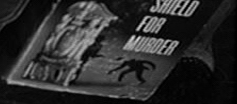
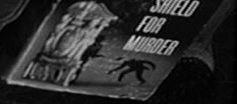
On Jay Shaw's desk is a first edition
 hardcover of Shield for Murder, a 1951
 crime novel by William P. McGivern.

James Caan (1940-2022) was born in the Bronx, so the setting of this show must have been somewhat familiar to him. After some brief work on stage, he began acting on TV in 1961 and was in movies by 1963. His most famous role was in The Godfather (1972), but he also made a lasting impression in Rollerball (1975) and Misery (1990), where he again plays an author. This was his only appearance on the Hitchcock show.

Lynn Loring (1944- ) plays Filene. Born in Manhattan, she started out as a child actress in 1951, appearing on the soap opera Search for Tomorrow for a decade.  She worked as an actress, mainly on TV, into the mid-1970s before becoming a producer. Loring was president of MGM/UA Television from 1984 to 1989 and later ran her own production company in Los Angeles. She appeared in one other episode of The Alfred Hitchcock Hour, "Behind the Locked Door."

The gauntlet
Less than three years before he would join the cast of Star Trek as Chekov and convince viewers that he was Russian, Walter Koenig (1936- ) is utterly convincing as Tiger, the leader of the Barons. He started on screen in 1962 but has spent the last 55+ years (on and off) reprising his Star Trek character. He was also a semi-regular on Babylon 5 (1994-1998); this was his only appearance on the Hitchcock show.

Tony Musante (1936-2013) is superb as the frighteningly crazy gang member Candle. He began acting on TV in 1963 and "Memo From Purgatory" was one of his earliest roles. In 1970 he starred in The Bird with the Crystal Plumage, an Italian adaptation of Fredric Brown's novel, The Screaming Mimi. Musante had the lead role in the TV series Toma (1973-1974) but quit after one season and was replaced by Robert Blake; the show was renamed Baretta and made Blake a star. Musante continued acting on TV and in film until his death in 2013.

In smaller roles:
  • Zalman King (1942-2012) as Fish; this is his first acting credit. He continued acting, mostly on TV, until the early 1980s, but is best known for his work as a director and producer starting in the late 1980s on films like Two Moon Junction (1988) and Wild Orchid (1989).
  • Simon Scott (1920-1991) as the public defender who speaks to Shaw in court; he was on screen from 1952 to 1985, appeared in three episodes of The Alfred Hitchcock Hour (including "The Dividing Wall") and one episode of The Twilight Zone, and was a regular on the TV series, Trapper John, M.D. (1979-1985).
  • Mark Slade (1939- ) as Slats, who breaks into Shaw's room with Candle; Slade began acting onscreen in 1961 and continued until 1985. Today he's an artist and writer with a website here.
  • Johnny Silver (1918-2003) as Ben, proprietor of the malt shop; he started on TV in 1950 but his long career really took off that same year when he appeared as Benny Southstreet in the original Broadway cast of Guys and Dolls. Silver played the same role in the 1955 film of the musical and appeared in two episodes of Alfred Hitchcock Presents, including "The Derelicts."
"Memo From Purgatory" is directed by Joseph Pevney (1911-2008), who started out as an actor in vaudeville in the 1920s and had a short career as a film actor from 1946 to 1950. He then became a director and was more successful, directing films from 1950 to 1966, including Man of a Thousand Faces (1957). His career as a TV director spanned the years from 1959 to 1985 and included 14 episodes of Star Trek and five episodes of The Alfred Hitchcock Hour, one of which was "Starring the Defense."

The jazzy score is composed by Lalo Schifrin (1932- ), who was born in Argentina. He moved to Los Angeles in 1963; this episode is one of his earliest credits and the only episode of the Hitchcock TV show that he scored. His most famous work is the theme for Mission: Impossible.

Watch "Memo From Purgatory" here.

Sources:

Ellison, Harlan. Memos From Purgatory. Pyramid, 1975. 

Grams, Martin, and Patrik Wikstrom. The Alfred Hitchcock Presents Companion. OTR Pub., 2001. 

"Harlan Hits Hollywood." The Classic TV History Blog, 30 June 2018, https://classictvhistory.wordpress.com/2018/06/30/harlan-hits-hollywood/. 

IMDb, IMDb.com, https://www.imdb.com/.

"Memo From Purgatory." The Alfred Hitchcock Hour, season 10, episode 10, NBC, 21 Dec. 1964.

"Memos from Purgatory (1961) by Harlan Ellison." Tipping My Fedora, https://bloodymurder.wordpress.com/2013/04/26/memos-from-purgatory-1961-by-harlan-ellison/. 

"Walter Koenig." Television Academy Interviews, https://interviews.televisionacademy.com/interviews/walter-koenig.

Wikipedia, Wikimedia Foundation, https://www.wikipedia.org/.


Listen to Al Sjoerdsma discuss "The Rose Garden" here!

In two weeks: Things get very weird indeed as we "Consider Her Ways" with author John Wyndham!

Monday, February 6, 2023

The Warren Report Issue 103: May 1979


The Critical Guide to
the Warren Illustrated Magazines
1964-1979
by Uncle Jack
& Cousin Peter


Barbara Leigh
Vampirella #78

"Kiss of the Dragon Queen!"★1/2
Story by Bill DuBay
Art by Gonzalo Mayo

"Little Guy"★1/2
Story by Nicola Cuti
Art by Rafael Auraleon

"Passion"
Story by Steve Englehart
Art by Jose Ortiz

"The Service"
Story by Bruce Jones
Art by Jim Starlin & Alfredo Alcala

"Zooner or Later"
Story by Bruce Jones
Art by Russ Heath

Bruce Charming leaves Vampi and Pantha to their own devices on the streets of Hong Kong and meets with a drug dealer who refers to herself as the Dragon Lady. Pantha goes off with a sexy sailor who wants to show her his big dinghy, while Pendragon appears to have been shanghaied by a Chinese sailor. Vampi hears a scream coming from a warehouse and changes into bat form to investigate; inside the warehouse, she sees a dragon attack an old woman and then disappear down a sewer hole.

Inspector LeGrande rushes to the scene with Conrad and Adam; the police venture into the sewers and shoot the beast, which turns out to be an alligator. In Drakulonian form again, Vampi joins Belasco on a boat and meets the Dragon Lady. Vampi overhears the duo and realizes that they are drug smugglers; meanwhile, the old woman from the warehouse insists that she saw a dragon and not an alligator. Adam joins LeGrande and the police in the sewers to resume the search.

"Kiss of the Dragon Queen!" is better than part one of this saga, but not by much. At least the story is beginning to make sense. I wish I could say the same for Mayo's art, which mostly consists of characters facing the reader in various poses. There are more than a few panels where the dialogue of Chinese characters is rendered in Chinese, leaving the American or English characters as befuddled as the reader. I think DuBay was saving himself the trouble of coming up with word balloon filler.

Can we talk about the cover for a second? Is that an actual, unretouched photo? Good heavens. Barbara Leigh certainly was fit!

John Littleman may be a clown today, but this "Little Guy" was once a successful jockey. His tall, beautiful wife Delores works in show biz as well, as the woman who appears to be sawed in two by a chainsaw-wielding magician named Makjo. The magician has a plan to rob a shipment of gold from a train, but he needs Littleman to hide inside a small box in order to carry off the heist. The little guy refuses and Delores backs him up, so Makjo chainsaws her for real in the middle of his act, calling it an accident. The magician tells Littleman that he now has no reason to object to the robbery plan, but Littleman turns the tables by getting Makjo drunk and convincing him to climb into the box himself. He doesn't quite fit, so Littleman chainsaws his legs off.

A disgusting ending to a dumb story. Auraleon's art is better than Mayo's, but the premise of the story is weak and Cuti has to tie himself up in knots with the plot in order to make everything work out in the end. The robbery idea is far-fetched and Makjo's decision to murder Delores in order to get Littleman to go along with his plan is clearly doomed to fail.

Another guy who wants to show off his big dinghy.
A new recruit in the French Foreign Legion takes the name of Errol Flynn and refuses to divulge any details about his past. He has a strong, negative reaction when he is taken to a Moroccan bordello, but when a gay fellow soldier propositions him, he decks the man. When the soldiers are ordered to march across the desert, Flynn refuses, happily spending a week locked up in the guardhouse. Eventually, Bedouins attack the forts and then flee. Flynn is among the soldiers ordered to pursue them into the desert and he reluctantly agrees. In the middle of the desert, Flynn begins talking about "Passion" and comes face to face with a T-Rex. Later, Flynn is in the hospital, bandaged from head to toe. No one can explain why it looks like he's been gnawed at by a dinosaur--all he can ask is if his captain knows what it means to love!

This story must have been gathering dust in a Warren file drawer for several years, since Englehart was long gone. Little wonder. It makes next to no sense. Perhaps Peter can explain it to me. Did Flynn try to avoid the desert because he was having a passionate, physical love affair with a T Rex? At least the art by Ortiz is the best yet in this issue.

He's tired of showing off his big dinghy.
A handsome male robot named Reggie travels from planet to planet, performing "The Service" for lonely women until he malfunctions. Amy calls for a repairman and Ambrose arrives; when she drags him to bed, she discovers that he's real and threatens to eliminate him, since all men were done away with long ago. He offers to fix Reggie and let him stay a month, but she forces Ambrose to become her slave, cooking, cleaning, loving, etc. till he's worn out. He builds a sexy new robot companion for her and takes off in his spaceship, not realizing that she, too, was a robot.

For some reason, Alcala's inks over a good penciller never look very good to me. The art in this story is mediocre, which fits the narrative. It's corny and predictable and the twist at the end seems pointless. It's disappointing that three good comic creators can't do better than this.

A dinghy joke here
would be inappropriate.
Hatch is 42, rich, and a jerk, so when he's given a diagnosis of terminal cancer, he tries to use his money to find a cure. Nothing works--not experimental drugs, or Jesus, or an Indian witch doctor. His African cook tells him about a jungle tribe called the Zooner who worship the great river horse (hippopotamus) and say they can cure any man. Hatch makes his way to deepest, darkest Africa and finds the Zooner; he is immediately killed with a big knife to his heart. Miraculously, he comes back as a fetus with full, adult knowledge of his situation, but he's disappointed when he discovers he's been reincarnated as a hippo.

Russ Heath gives "Zooner or Later" the old college try but we all see the end coming a mile away. It's unusual for Heath to draw a story without any beautiful, naked women, but the only sign of a female here is a nurse who manages to keep her starched outfit on in two small panels. Perhaps the big hippo in the last panel is a mom. The black cook is the usual, offensive stereotype: "Oh Lord! Ah promised nevah to tell!" Reading these Warren comics 40 years after the fact makes it clear that there was a long way to go toward equality in the late '70s.-Jack

Peter- We're damned if Dube does and damned if he doesn't... write continuing storylines, that is. The one-and-dones tend to be goofy and inconsequential but the longer arcs take a whoooooole lot of time to tell a story that doesn't really feel like a story. Take this chapter of Vampi for instance. It's twelve pages long and yet the plot does not seem to have advanced one bit. Mayo's habit of using stills as an influence continues to grind my gears; none of the characters look at each other when they talk. There's a panel here where our lady from Drakulon mourns the "senseless, grisly carnage" left in the wake of the dragon's attack and yet Mayo depicts her as if she's posing for Playboy, with a pleasant look on her face. Earth to Gonzalo!

"Little Guy" is really dumb; an EC homage gone wrong. Makjo sure had a solid plan: kill the shrimp's wife and he'll definitely go along with the heist. Brilliant. More than a bit of this was stolen from Robert Bloch's "The Sorcerer's Apprentice." Nothing, as far as I can tell, was appropriated for Steve Englehart's "Passion," but then neither can I tell you what the hell the story was about.  Sorry, Jack. This was way past the time Steve was working for Warren so I would guess this was a shelved story; shoulda stayed that way. 

"The Service" is easily the most entertaining story of the month in either magazine. I laughed out loud at least two and a half times (coincides with my star rating, by the way) at Ambrose and his exhausting chores. If I ever met Jim Starlin, first thing I'd ask is if he modeled Ambrose after Roy Thomas. The art is sketchy, yep, and neither artist's style really shows through (other than on that gorgeous splash), but I liked it anyway. Back to the weak stuff with Bruce Jones's "Zooner or Later" (somehow I think Jones came up with the title first and then wrote the story around it), another lame EC knock-off that's predictable from the moment the word "hippo" pops up. I'll give Bruce an extra half-star for working in lyrics to John Lennon's "#9 Dream."


Romas Kukalis
Creepy #107

"The Rubicon"
Story by Budd Lewis
Art by Pepe Moreno

"Family Ties" 
Story by Bruce Jones
Art by Val Mayerik

"The World From Rough Stones" ★1/2
Story by Jean Michele Martin
Art by Joe Vaultz

"Stainless Steel Savior" ★1/2
Story by Len Wein
Art by Leo Duranona

"Quirks" ★1/2
Story by Bob Toomey
Art by Walter Simonson & Terry Austin

"Mindquake" 
Story by Jim Stenstrum
Art by Jose Garcia Pizarro

A group of space explorers, sent to rescue a previous expedition that has gone silent, land on the "non-planet" Scylla and discover it's the resting place of Lucifer. That's it. Pretty simple. In fact, "The Rubicon" is very simple but overwrought with a boatload of pretension and silliness. There's an Alien vibe to the proceedings but I won't level accusations of theft since the flick wouldn't be released for a few more months. The art's not bad (at one point, one of the characters scolds another for looking like a vampire and he certainly does look like he's on the set of Bava's Planet of the Vampires) but, holy mackerel, the dialogue sure is, especially the two-page expository. 


In a post-apocalyptic future, "Dog" searches through the forests for "the old one," the wisest animal left on the planet, in order to learn about man's impending return to Earth. His adventure leads him through a dangerous world filled with bears and deer and horny she-dogs (I'd use that other word but it would probably trigger some sort of Google alarm and they'd come and take me away, never to review Warren funny books again... hey, wait...) until he finally comes to the home of "the old one." Alas, the seer, a circus chimp, has just expired and a "floater" (a being of "pure energy, intellectual utopia") informs "Dog" that man is about to land on Earth and he needs to greet him pronto. Sure enough, a spaceship lands in a nearby field and "Dog" races out to greet his masters. The astronauts are charmed by the canine but disturbed by the levels of radioactivity. A pity the whole planet will have to be burned to a cinder to wipe out all radiation.

There is a charm to "Family Ties," I'll admit, but it's also a very tedious and repetitive ten pages. "Are you 'Bear?' I am 'Dog.' I'm looking for 'the Old One.' Have you seen him? No, well, peace and brotherhood to you!"... "Hey, aren't you 'Deer'...?" And on and on. Bruce takes advantage of Warren's crumbling guidelines and inserts doggie sex, I assume to attract those who are looking for a little something else with their cliched sci-fi comic strips. The charm I mentioned comes at the climax, when "Dog" finally meets man and the pooch is overcome with joy, fetching a stick and enjoying a good scratch under the chin. Val Mayerik does an acceptable job of illustrating a bunch of talking animals.


"The World From Rough Stones" is four pages of Joe Vaultz pin-ups surrounded by words that make no sense whatsoever. A spaceship lands on Earth and explodes, leaving a shell behind. Eons later, that shell becomes Stonehenge. Toldja.

The day they threw away JS-146 for being outdated was the day they created a messiah! JS-146 pulls his metal ass out of the garbage can and hits the city streets looking for a job. When no one will hire an old model, JS-136 takes up with some other discards living in an alley, a handful of old robots and a man named Maxie. At first hesitant, JS finally gives in and hits the bottle with his new friends but the lost weekend leads to a moment of clarity and JS decides he must awaken the world to peace and love. 

JS begins a series of public speeches and each gathering attracts more and more crowds until, soon, he's preaching to a nation. His words of brotherhood lead to peace in the Middle East but also lead to dissatisfaction from old friend Maxie, whose drinking has gotten out of hand. Maxie's hatred for JS leads to a public assassination and, once the circuits and wiring have been revealed, peace and love collapse. The world returns to normal.

For much of the running time of "Stainless Steel Savior," Len had me engrossed. JS-146 seems to be much more than just another Star Wars droid rip-off; he's a funny and warm character. It's when he morphs into a quasi-Bobby Kennedy that the story loses me. Looking at Duranona's character faces, I have to wonder if he's ever drawn a beautiful woman.

Phil and Harry have been trying to clean up the planet "Quirks" for some time now but everything on the planet seems to want to kill them. When Cyrilla Tatterstall arrives and assumes command, she doesn't want to hear any excuses. She demands to see the wild planet herself. While out in the forest, the trio happen upon a cute furry little animal taking a nap under a tree, seemingly oblivious to the carnage taking place around him. Sensing this creature could be the answer to their problems, Cyrilla insists on taking it back to the rocket ship for examination.

But the only hard data Cyrilla gleans from studying her new pet is that the darn thing sure is cute. Suddenly it awakens and speaks telepathically to the three stunned astronauts. The furball explains that the other creatures on the planet hate the explorers because of their intelligent minds. But when Cyrilla asks what the little muskrat's secret to survival is, it shrugs and admits that he's inedible. Phil, Harry, and Cyrilla know when they've been licked so they hop in their respective rockets and head home. Another semi-cute fantasy/sf yarn but it sure takes its sweet time to get to the punchline. Jack mentions below that the art looks rushed and I have to admit I wouldn't have been able to put names to this work without the credits. Doesn't look like any Simonson I've seen. Still the story is good for at least one smile.

The worst is definitely saved for last. "Mindquake" concerns a ship traveling through space, its cargo is "Aaron," a very important member of the "Mind Corps," agents who can... well, never mind, I can't remember that part. But outside the ship are unfriendly aliens known as Tochisians, a race of villains who will do anything to lay their hands on "Aaron," including blasting the ship into teensy weensy particles.  "Aaron" has stolen many vital secrets from the Tochisians and now they want their stuff back. They've even planted two double agents on the ship! Eventually, "Aaron" awakens and save the day and peace is restored to that part of the galaxy.

Oh boy, "Mindquake" sure made my head hurt. Not even the four or five breaks in action to let us know what was going on helped untie the knots in my brain. I know if I scramble the letters in Jose Garcia Pizarro, it'll eventually form "Jerry Grandenetti." Sheesh, I thought this kid of art went out when the Warren Dark Ages closed in the early '70s.-Peter

Jack-
And I thought this month's issue of Vampirella was bad! This is a dreadful issue of Creepy. The worst part is that there are some decent writers and artists involved, yet their work is, for the most part, below what we've come to expect from them. Jim Stenstrum, who has written some very good stories for Warren, turns in the nearly incomprehensible "Mindquake," with art that only occasionally rises to the level of decent. Walt Simonson and Terry Austin, two terrific artists, must have rushed through "Quirks," perhaps due to low page rates. Len Wein was long gone from Warren, so "Stainless Steel Savior" must be a file story; it's not bad, if rather heavy handed, and it's dragged down by more ugly drawings from Duranona.

"The World from Rough Stones" is utterly worthless; four more pages of ads would have been better. "The Rubicon" conflates In Search of Ancient Astronauts with The Andromeda Strain and throws in some gobbledygook about Lucifer to boot. The closest thing to a pretty good story is "Family Ties," with smooth art by Val Mayerik, yet even Bruce Jones seems to be giving weak effort in a story that consists mostly of animals talking to each other.

Next Week...
Introducing...

Thursday, February 2, 2023

Journey Into Strange Tales Issue 79: Atlas/ Marvel Horror


The Marvel/Atlas 
Horror Comics
Part 64
April 1954 Part II
by Peter Enfantino


Marvel Tales 122

“The Baby Sitter” (a: Tony DiPreta)

“Keep Out” (a: Al Gordon & Joe Kubert) ★★★

“The Last Gesture!” ★★★

“The Glasses!” ★★★

“The Man Without a Body”


George is a horrible husband and an even worse step-father, so when his call to “The Baby Sitter” is intercepted by aliens from space, he gets what’s coming to him. Awful science fiction sit-com. A bile-spewing congressman in the far future wants every alien who has immigrated to Earth sent back to their own planet. In the midst of all this hate comes a man from another planet who’s landed his ship here to see what all the fuss is about and whether this is a world he’d like to live in. After listening to the congressman’s speeches, he turns the tables and reminds the politician that aliens landed here centuries before and now just about every earthling came from another land. “Keep Out” gets very preachy and talky towards its climax but the build-up is strong and reminds those of us living in the 21st Century that the more things change… The story features a rare Atlas appearance by one of comics’ greatest artists, Joe Kubert. Here he’s only adding inks to Al Gordon’s pencils but the Kubert pizzazz is all over “Keep Out.”


Kubert!
The aim of Commissar Vasilovitch is to wipe out all rebel dogs from the streets of Moscow. Brought before him is gardener Martin Wlodarczyk, reputed to be the leader of the “swine” who dare to question Russian order. Martin is tortured but he won’t give up the names of his fellow rebels and death seems imminent. Then Vasilovitch gets word that his boss, Fydor Gogoltov, will be paying a visit soon to Moscow and he is a flower fanatic. Gardener Martin wins a reprieve and promises a gala festival for the Russian VIP. 


With all the flowers arranged and Gogoltov about to land at the airport, Vasilovitch executes the gardener and prepares to take all credit. Alas, the gardener gets the last laugh all the way from the grave, as when Gogoltov does a fly-over of the flower arrangement, he hits the roof and orders Vasilovitch imprisoned. The garden has been arranged in the shape and colors of the American flag! “The Last Gesture” almost seems like a parody of Stan’s “red scare” evangelism; it’s over the top like most of the “dirty Russkie” bilge but pushes us through, setting us up for the hilarious final images. The uncredited art is raw and scratchy but perfect for the topic.


Donning 3-D glasses, a man can see evil creatures from another dimension but when they steal “The Glasses,” they can see him as well. Delightful four-page farce with some hilarious creature art. In the finale, “The Man Without a Body,” Eric is in love with Lola but (and this is an age-old story) she won’t marry the dope/genius until he makes a million bucks. With love on his mind, Eric quickly invents a machine that separates his soul from his body, which enables him to do things we’d all like to do such as sit in on secret board meetings and find out if the Rocky Martin fight tonight is fixed. But, of course, Lola is smarter than her scientifically-brilliant beau and, after she gets one more big tip, she burns Eric’s body and runs away with her real boyfriend. Utterly predictable and ridiculous.


Maneely
Mystic 29

“The Couple Next Door” (a: Vince Coletta) ★★

“No Exit” (a: Jack Abel) ★★★

“The Unseen” (a: Sheldon Moldoff) ★★★

“Rest in Peace” (a: Tony Mortellaro)

“It Happened in the Lab” (a: Pete Tumlinson) ★★★


In “The Couple Next Door!,” Bill is tired of the rut he and his wife are stuck in and he proposes that they air out their dirty laundry in an attempt to right the ship. Unfortunately, his wife Carol ‘fesses up that she’s a vampire. Some striking Colletta work here (Carol is a stunner) but the final twist is a little hard to buy.


Despite the fact that there seems to be a wall all around Manhattan and no one can leave, Charlie Dannan is no one’s fool. He’ll get out if it kills him, so he hijacks a small plane and flies off. As a handful of scientists watch Charlie’s plane vanish in the sky, they try to work out how they will tell the population that New York has been “stolen” by Martians for study! “No Exit” is a cute idea executed well, with the final panel, that of Charlie’s ship floating in space above the giant rock heading for Mars, a howler.


Mark is just a nobody jet mechanic who has a crush on Celia, but it’s obvious she only has eyes for ace pilot Barry, who’s about to be the first man ever to “break the time barrier!” So Mark decides to hop in the plane and be the big hero. It all goes well until he lands and no one can see him. He’s become a ghost in our world and every year he comes back to the field where he landed the plane and wonders what would have happened had he gotten the girl.


“The Unseen” is a melancholy little melodrama, marred only by a clunky expository and some possible scientific anomalies (is it possible that Mark and Co. should break the sound  rather than time barrier?), with a truly sympathetic and likable lead character. Compound the fact that Mark isn’t around to bask in the glow of his aerial victory with Celia’s closing remarks, five years after the fact, that Mark was really the man she loved. It’s a heartbreaker.


“Rest in Peace” is thoroughly unenjoyable trash about an abusive door-to-door salesman who gets his in the end when he doesn’t answer a knock on his own door. Much better is our final story this issue, “It Happened in the Lab.” Dr. Gregor has deemed it important that he create a “Fly-Man” to control the world’s fly population and use them as a military weapon. Just think of all the uses: we can send hordes of the winged pests into the Kremlin to bother the Russkies… we can utilize them as soldiers of war… well, Gregor is sure there are thousands of other reasons. Anyway, he steals body parts from graves to build his Fly-Man and once he shoots thousands of volts through the thing, it arises to do Gregor’s bidding. The nutty professor sends his Lord of the Flies out to round up millions of his little friends and bring them back to the lab to map out their strategy. 


Alas, something goes wrong with the Fly-Man’s obedience skills and he doesn’t come back. Just as Gregor is about to give up and concoct a way to kill his wayward Flynkenstein Monster, the thing comes back and destroys the lab. Gregor’s assistant calls the cops and when the police arrive, they find Gregor, his arms torn off! “It Happened in the Lab” could only be devised as a funny book story, a tale stuffed with absurdity and laugh-out-loud nonsense and yet played so straight. The Fly-Man’s brain is a glass bowl filled with thousands of buzzing flies! Our unsung writer doesn’t even stop to explain how that works or why his man grows fly-fur or why Gregor bothers concocting a fly-mask for his critter. All of these questions would be very valid if we weren’t dealing with a 1950s horror comic; the fact that these plot holes exist only adds to my glee while reading these five pages of insanity. Oh, to be a fly on the wall (pun very much intended) when artist Pete Tumlinson got his copy of the script.


Heath
Spellbound 21

“The Face of Death” (a: John Forte) 1/2

“The Night Caller” (a: Bill Walton)

“Too Bad, Ben” (a: Vic Carrabotta)

“Men from the Morgue” (a: Les Zakarin & Bob Bean)

“Listen, Slave” (a: Dick Ayers) ★★


Frank has been assigned to write a series of newspaper articles on the supernatural, but tonight’s seance, where the medium winds up dead, has Frank worried. A paper listing the names of four people appears on Frank’s typewriter out of nowhere and the reporter learns the first three are now dead and Frank’s name is last. “The Face of Death” has a somnambulant pace and a ridiculous pay-off. 


Murderer Lon Berry is involved in a serious car wreck but manages to walk away unscathed. He hoofs it to a nearby house where he intends to hold up until the heat is off but the house seems to be haunted by ghosts. “The Night Caller” is a dismal affair that falls back on the “they’re not the ghosts, he is!” cliche.


Two-time loser Ben is convinced that the third time is a charm, so he’s staking out a bank full of green. Too bad the teller turns out to be Molly, Ben’s steady girl. This knocks him for a loop and the guard gets the drop on Ben. Ironically, the bank manager tells Molly she did so well triggering the alarm that she’ll get a reward. “Too Bad, Ben” contains some really inane dialogue peppered by tough guy lingo but the icing on the cake is that Stan (or whoever edited these things) felt the need to explain each bit of rough language to the reader. Ben seems just as surprised by Molly’s vocation as we are, but his ignorance is glossed over.


“Men From the Morgue” come to take Charlie away despite his protestations. The cadaverous men claim Charlie died the night before at the hands of his wife. It’s all just a misunderstanding in the end, since they got the date wrong. They’ll be back tomorrow night. Really awful bottom-of-the-barrel drivel with barely professional artwork. “Listen, Slave” is the best story this issue by default rather than by virtue of quality. Dr. Kraus develops a serum that increases the size of his brain and he fast becomes the world’s smartest man. But, of course, Kraus decides that using this unlimited grey matter for the good of the people wouldn’t be profitable enough so he goes with Plan B: world domination. Problem is, his serum enlarges his brain to goofy proportions, eliminating the rest of his body. Poor Dr. Kraus is left with no vocal functions and therefore cannot use his superior knowledge to transform the population into mind-controlled slaves.  Way too talky and the Ayers art is just professional enough to get the ideas across and no more.


Harry Anderson
Strange Tales 27

“The Poor Old Man” (a: John Forte) ★★★

“The Cask in the Cave” (a: Joe Sinnott) ★★

“Progress!” (a: Harry Anderson) ★★

“The Garden of Death!“ (a: Vern Henkel)

“Suffocation” (a: Tony DiPreta) 1/2


An old man accidentally conjures up the devil, who tells him he’ll grant him one wish for free and it won’t cost him his soul. “The Poor Old Man” scoffs but Satan reassures him he’s on the level so the man asks for the love of a good woman. John, the old man, gets that in no time flat but, in the end, Satan comes calling as he always does. Bittersweet little fantasy where a really good guy gets one year of the high life and remains a sweet and caring individual. His choice, the big climactic reveal, is genuinely sad and most Atlas characters would opt selfishly, but not John.


When Baron Teufel’s daughter needs a transfusion of a rare blood type, he makes a bargain with a vampire to save the girl. The vampire donates several quarts of his blood and the Baron opens a mountaintop “winery,” stocked with casks of blood. Nonsensical fluff is nicely illustrated by Joe Sinnott but “The Cask in the Cave” climaxes with a maddening head-scratcher. In “Progress!,” old man Scudder fights off the advances of the city men who want to raise his house and build a freeway through his land. Scudder uses weaponry and explosives that would have made Patton smile but to no avail; the town builds a tunnel instead, and Scudder is its first roadkill.


“The Garden of Death!” is three pages better devoted to advertisements. The Grim Reaper is despondent, believing man has decided to quit warring, so he grows mushrooms (as in clouds) in his garden. A preach with no reach. Meanwhile, Tony DiPreta does what he can for a dreary and lifeless script known as “Suffocation.” Vivian and George Cramm lock Viv’s millionaire aunt in a closet until she dies of suffocation. The evil couple get their millions but then discover they’re constantly feeling stifled and claustrophobic. In the end, the police find them dead, suffocated, in the middle of a perfectly large room. Yawn.


Brodsky
Uncanny Tales 19

“More Than Human” (a: Mort Lawrence)

“The Empty World” (a: Ed Moline) 1/2

“Timber!” (a: Sy Grudko) ★★

“Aftermath!” 1/2

“The Man Who Died Again!” (a: Dick Briefer)


A man stumbles onto a race of mutant beings who can regenerate lost limbs and pack ray-guns to eliminate their enemies. “More Than Human” has a scattershot and harebrained narrative that gets foggier with each successive page. Just days before he’s scheduled to fly to Mars, Professor Crews begins seeing green gremlins everywhere he looks. His psychiatrist tells him he’s overworked and to simply ignore the little men. The advice works until Crews gets to Mars and discovers the little green gremlins everywhere. Like “More Than Human,” “The Empty World” is both vacuous and needlessly complicated at the same time.


Blah Briefer
Lumberjack Pierre lives to terrorize accountant, Bruce, but the old guy has had just about enough and his brain is hatching a revenge plot involving the cry of “Timber!” Goofy yarn with some nifty cartoony art by Sy Grudko. Pierre is a dead ringer for Popeye’s buddy, Bluto. “Aftermath!” is a three-pager about the beginning of life on Earth and how the flesh-eating dinosaurs were finally bested by the cunning of man. Whoops! No, this is actually about life after World War III, as witnessed by the cheesy exposition in the final panel. Hydrogen bombs created a second wave of dinosaurs? 


In the final yarn of an abysmal issue of Uncanny Tales, mobster Tom Frazer pays a scientist to create an exact robot replica of himself to sit in the electric chair at the time of his execution. Problem is, the electricity doesn’t kill the robot and he comes back from the grave to kill the humans who put him eight feet under. “The Man Who Died Again!” is strictly amateur hour and that includes the uncharacteristically dreadful Dick Briefer artwork.


In Two Weeks...
The Grand Experiment Ends
with a Whimper.