The Critical Guide to
the Warren Illustrated Magazines
1964-1983
by Uncle Jack
& Cousin Peter
 |
| Larkin |
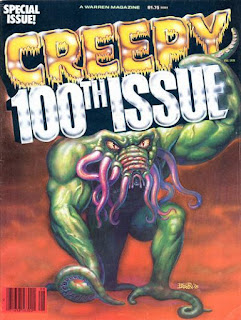
Creepy #100
"The Pit at the Center of the Earth!" ★★★
Story by Gerry Boudreau
Art by Pablo Marcos
"Professor Duffer and
the Insuperable Myron Meek!" ★★1/2
Story by Bill DuBay
Art by John Severin
"Tale of a Fox" ★★★★
Story by Nicola Cuti
Art by Jose Ortiz
"Nobody's Home" ★★
Story by Cary Bates
Art by Joe Vaultz
"Winner Take All" ★★
Story by Len Wein
Art by Luis Bermejo
"Hell Hound" ★★★
Story by Bruce Jones
Art by Russ Heath
"Wisper of Dark Eyes" ★
Story by Gerry Boudreau
Art by Rafael Auraleon
"They're Going to Be Turning Out the Lights" ★1/2
Story by Bill DuBay
Art by Alex Nino
 |
Starring Roger Moore as Sebastian
and Herve Villechaize as Pinky |
The year is 2000. Much of the world's oil has been depleted thanks to those gas-guzzling Oldsmobiles sold in the 1970s, and now man of action Sebastian finds himself guarding a big rig in the middle of the Amen Sea. The Arabs don't take kindly to Americans stealing their precious bounty and they've launched bombing raids on the rig, which was built (for some ungodly reason) on the cliff of an undersea chasm.
An undersea explosion opens a massive crack in the ocean's floor and a black mass oozes out, eating everything it touches. Sebastian and his gorgeous boss, Mrs. Heckman, pilot a bathysphere deep down to see what the fuss is about. They're sucked into the killer blackness just as the Arabs drop a huge bomb on the rig. It's the end of the world as we know it.
A reasonably entertaining apocalyptic thriller, "The Pit at the Center of the Earth!" moves at a fatally frantic speed and would no doubt have benefited with five or six more pages to allow the narrative to breathe. Pablo Marcos seems to see every panel as an excuse to create a Hollywood movie poster; both leads perform all their duties in what appears to be their underwear. Still, this one's better than any of the doomsday crap Warren ran in the last issue.
Professor Duffer takes his protege, Myron Meek, to movie agent Mr. Scrimp for a possible future in films. Duffer seems convinced Myron can bring smiles to the faces of thousands, despite his obvious handicaps. The agent is sold on the pair's audition and the huge key sticking out of Myron's back makes him all the more charming. It's only after Myron Meek becomes the biggest star in Hollywood that Scrimp realizes the kid is really a robot. "Professor Duffer and the Insuperable Myron Meek" is a cute change of pace and, to me, what makes it insufferably cute is that we seem to be the only ones, outside of the professor, who know Myron is a robot! Bill slyly uses that absurdity to his advantage in the reveal panel.
In ancient China, two brothers, Quang and Wu-Fong, are sworn enemies, and each lords over his own province. Quang, seeking to murder his brother and rule over two kingdoms, kidnaps Wu-Fong's daughter, Ming-Toi, with an eye to replacing her with his own daughter, a Ming lookalike named Sun-Li. With Wu-Fong dead, the faux Ming-Toi would be a puppet ruler for her father. But Ming has an ace up her silky sleeve: she's a shape-shifter and can transform into a fox. This comes in handy when the guards come to execute her.

An absolute delight, "Tale of a Fox" is easily the best-written and best-illustrated story in years. There are no cheap shocks or stupid surprises, only a bedtime fantasy tale given time to unfold its clever twists and turns. Cuti and Ortiz seem to have thought this a more prestige project than the usual zombie and barbarian dreck; we don't even get the obligatory Warren "boobies" shot when Ming as a fox slips into her clothes to morph back into a human. I've always been a fan of Ortiz's work, but this might just be his best.
A rebel has ziphoned a hole in the Ion Inclosure [sic] and fully intends to... well, do something. The authorities immediately launch "projectiles" at the rapscallion and he is immediately reduced to rock particles. The NASA Viking probe rolls over his "body" and the astronauts agree that Mars seems to be a dead planet. This harmless five-pager is more like a snippet than a fully formed tale, but Buz Vaultz's art continues to amuse. I assume I'll grow tired of his style (which reminds me of a Pixar movie) eventually, but for now it's still an interesting variant.
The barbarian Gart wins the lovely slave girl, Katika, in a card game with a wizard. As Gart is leaving the village with his new prize, the wizard curses him and swears the barbarian will rue the day he set eyes on Katika. Sure enough, obstacles and violence stand in front of Gart's trek home, but he swears the old wizard will not win. In the end, Gart discovers the danger was always closer than he thought. Meh. A Warren color story is not the cause for celebration it once was. The Bermejo art for "Winner Take All" is nice enough but would have been just as gorgeous in black and white and the color process Warren changed over to can't compare to the vibrancy of the mid-1970s. It looks like cheap newsprint color. Len Wein's script offers no surprises or alterations to the usual sword and sorcery stuff.
After a nasty divorce leaves him an emotional wreck and an alcoholic, Jonathan Hamlin runs across a wounded wolf at the beach and takes it home to nurse it back to health. The wolf becomes Jon's faithful companion, but weird deaths occur shortly afterwards, beginning with Jon's ex-wife. The woman was torn to shreds on a camping trip, as if by some sort of wild beast. Is there a connection between the deaths and Jon's wolf, or is it some mad coincidence?
Well, it's
Creepy so you probably already know the answer to that (and besides, most of you have already read the darn thing) but, thankfully, Bruce Jones doesn't settle for the usual cliches. It's not the ex-wife reincarnated. It's not the beautiful girl Jon picks up at a bar one night. The creature's identity is never really revealed, but for a super-clunky expository in the finale. That finale is a good one; I'd just as soon Bruce left the origin to our imaginations.
A glowing orb descends from the heavens and lands in the ocean beside Halibut Haven. A woman named Gizelda waits for her adulterous husband to come back from his work at sea. Within the orb, an alien presence emerges and takes over Gizelda's body. When her husband Lancaster returns, the possessed Gizelda exerts an erotic power over her mate. She orders him to murder his mistress, which he does, and then watches as the alien "ship" rises from the water and heads back to its planet. Spell ended, the couple realize what they've done and madness ensues.
Well, I have to say my synopsis is based on guesswork somewhere after the "A glowing orb descends..." part, since I fell asleep shortly thereafter. Though not quite in the league of "Orem Ain't Got No Head Cheese," "Wisper [sic] of Dark Eyes" is one of the decade's worst. A hodgepodge of pretension and nonsense but, worse, boring concepts. The three panels on page 56 describing the thing's state of mind (
Invariably in these psychic unions, a residue was deposited in the mind of the subject.) are the prose equivalent of two Tylenol PM capsules.
Equally abysmal is "They're Going to Be Turning Out the Lights," Bill DuBay's commentary on eroding morals and the power of the government. A city's mayor orders martial law and "shoot on sight" in the midst of a violent blackout. Sounds like a good antidote? Pretty heady stuff at a time when no one was commenting on the destruction of decency in humans. But here's this bold writer, no, let's call him a journalist, at a funny book company, giving us his deepest thoughts and exposing his fears about where we were headed should the power fall into the wrong hands. It's the kind of thing Harlan Ellison might have written in the early 1970s, but he probably would have pulled it off. "They're Going..." is about as empty-headed and fanatical as anything the right-wingers ever came up with. I'll also grouse that the sideways paneling gimmick has run its course and Nino's art appears unfinished and faded (perhaps not his fault). Aside from the final pair of tales though, this comes off as a splendid anniversary issue!-Peter
Jack-I'm a fan of silent movies and I love John Severin's art, so "Professor Duffer" was my favorite story in this special issue. A robot obsessed with the poster for
Metropolis? Count me in! I thought the color looked good in "Winner Take All," though I don't think it adds much to Bermejo's art. The ending was satisfying. Nino's strong art is the highlight of "They're Going to Be Turning Out the Lights," which features a powerful story. Too bad the pages are sideways. I also liked "Tale of a Fox," just not as much as you did. I agree that the art is terrific and the twist is clever. "The Pit" has a fairly interesting story, but the ending is a dud; Marcos's art looks more like something we'd see over at Marvel or DC.
"Hell Hound" suffers from some of the most mediocre Heath art I've seen, a confusing story, and a letdown of an ending. "Wisper of Dark Eyes" isn't much better, though the decapitation panel is shocking. The sci-fi elements drag the story down and this is not Auraleon's best work. Finally, I thought "Nobody's Home" was terrible--monotonous art, the usual dull Warren sci fi elements, and a silly twist ending. Overall, issue #100 was better than some others we've seen recently but hardly a milestone. The spelling in this issue was particularly glaring--"Wisper" should be "Whisper," Auraleon is misspelled, as is Cary Bates, and so on, and so on. Does anyone know who's responsible for the lettering? It's a hallmark of the Warren mags, and not in a good way.
 |
| Maitz |
Eerie #94
"The Coming of the Annihilator"★★
Story by Bill DuBay
Art by Luis Bermejo
"Honor and Blood"★★
Story by Nicola Cuti
Art by Leo Duranona
"Dead Man's Ship"★★
Story by Nicola Cuti
Art by Isidro Mones
"Divine Wind"★★★
Story Uncredited
Art by Esteban Maroto
"Don't Drink the Water"★★1/2
Story by Gerry Boudreau
Art by Martin Salvador
"Bruce Bloodletter of the IRS"★1/2
Story by Bill DuBay & Fernando Fernandez
Art by Fernando Fernandez
When the Army detonates a neutron bomb under the Southern California desert, it causes "The Coming of the Annihilator," a big creepy-crawly that heads for the nearest city! In outer space, Vampirella and Pantha are heading for Earth on a spaceship manned by Starpatch, Mother Blitz, and Quark. Vampi wishes that she could turn back time and Starpatch sees Restin Dane and crew flying to the aid of the Army to battle the Annihilator. Starpatch suggests that the Rook could take Vampi and Pantha back in time so they'd be with their own kind.

Mother Blitz recognizes the Annihilator and raises the alarm, telling everyone that it eats energy and Earth is doomed. On Earth, Dane's flying ship has to land when its energy is drained; the Army sends jets after Starpatch's spacecraft once it enters Earth's atmosphere. Vampi thinks fast and suggests that the Rook could take them back in time to prevent the Annihilator ever coming to Earth. The Dane crew meets up with Vampi's crew in a cave and they decide to hop into the Rook and the backup Rook in order to head back in time to try to stave off doom.
I don't know why Bill DuBay felt the need to work Vampi, Pantha, Starpatch, and crew into a Rook story, but this one is twelve pages of nonsense. Seriously, is the solution to every problem going back in time? How well does that ever work out? What if they step on a butterfly? Will Warren comics suddenly improve? As if Vampi's costume isn't silly enough, Bermejo draws Pantha in an outfit that looks like she's auditioning for a part at the house of ill repute on Twin Peaks. Bermejo's art is decent but not great; the story doesn't create much anticipation for part two.
Back in 1841, on Walpurgis Night, a satanic priestess (and dead ringer for Farrah Fawcett) named Sybil, who was both a witch and a vampire, married a man whose identity was hidden because he was wearing an elk's head. Not long after, little Ian Vrykola was born; his furry palms and forked tongue marked him as a vampire. Dr. Hopkins, who delivered the baby, rushed to a nearby cemetery to feed it soil from the grave of a vampire in order to remove the curse. He was followed by Mama Sybil, but when she was still there and the sun came up, she disintegrated. Believing the child's curse lifted, Dr. Hopkins raised Ian as his own son.
Ian grew up to be a lawyer, who got married and had a son named John. When Ian travels to the dangerous neighborhood of Whitechapel (somehow having ended up in London), he is murdered by a criminal named Whitey Looper, but he later awakens in his coffin, having become a vampire. He takes revenge on his killer but soon finds that he can't escape his own lust for blood. Ian heads home to find Dr. Hopkins, who reveals that he was the guy in the elk head and actually is Ian's real father. Hopkins puts a stake through Ian's heart and thinks the curse is ended, unaware that young John Vrykola is showing troubling signs of his future as Jack the Ripper.
"Honor and Blood" is a goofy story that jumps around from place to place and reminded me a little bit of an Eerie version of Forrest Gump. A guy in an elk's head marries a satanic priestess who is a witch and a vampire. Their kid is fine until he dies and suddenly becomes a vampire. His kid is Jack the Ripper. What's next? We'll find out in the next exciting installment!
Out to sea in 1869, a ship's captain spies a "Dead Man's Ship" approaching and pulls up alongside to board it. He finds all of the crew are skeletons and sees evidence of the plague, but he is shocked to find that the dead captain is himself! The captain believes that the ship is his own ship in the future. He blows it to smithereens and tells his crew to keep quiet about what they saw.
Arriving in Shanghai, the captain is told that another ship with the same name as his left port a few months ago. At a tavern, a sexy fortuneteller informs the captain that events will keep happening over and over and he thinks he and his crew are caught in a vortex of time. He gathers his crew and sets sail immediately; soon, his men begin to come down with the plague. They see another ship approaching and the captain orders his men to fire on it, thinking it's yet another version of his ship. Instead, it's a British warship that destroys the unfortunate captain's ship.
Now I'm really confused. Was the ship really caught in a time vortex, or was the captain just a nut? The end of the story suggests that the latter explanation is the correct one. We haven't seen Isidro Mones in the pages of the Warren mags for a while, as best I can recall, and his art is just so so--kind of on the level of Martin Salvador.
In the 11th century, the armies of Kublai Khan sailed for Japan to attack the island nation for the first time. The samurai of Japan saw the invaders coming and prepared for battle, while women and children headed for safety. The Mongol hordes attacked on foot, since their horses were coming later on other ships. The battle between Mongol warriors and Japanese samurai was fierce and bloody; as night fell, a "Divine Wind" brought a storm that led to a lull in the fighting. That same storm destroyed the oncoming ships, drowning the invaders, but many samurai also lost their lives. Japan would not be attacked again until WWII!
A rare story where there are no credits, "Divine Wind" is clearly drawn by Maroto but the writer is unknown. That's a shame, because this mix of history lesson and thrilling battle tale is better than the stories that precede it in this issue of Eerie. Wikipedia tells me that "divine wind" translates into Japanese as kamikaze, and the Mongol invasions occurred in the 13th century, not the 11th; the end of the story gets it right when a caption says that the next invasion came 700 years later.
A head-on collision on a rainy road between a truck and a car leaves both drivers dead. No one notices the canteen that was thrown clear from the car's front seat, but the police are shocked when Doc Willis announces that the car's driver was not human. Later that morning, on the way to play a pickup game of baseball, young Matty finds the canteen and takes a sip of the bad-tasting liquid inside. In a nearby cabin, an alien in human form is dying, bitten by a mosquito and waiting for the antidote that was in the canteen that his fellow alien was bringing to save him.

When a play doesn't go his way in the ballgame, Matty unexpectedly picks up a bat and beats another boy to death. He runs off alone into the woods, taking more sips from the canteen, until he reaches the cabin and finds the now-dead alien. As the police search for him, Matty takes another swig from the deadly container. The cops nearly catch him, but he escapes and tries to escape by swimming downstream in the river. He is killed when he goes over a waterfall; the canteen empties its contents into the town's water source. Matty's little brother takes a drink of water from the tap and, before you know it, his dad comes home to find that the lad has killed his mother and is gnawing on her arm. Similar things are happening all around town.
"Don't Drink the Water" suffers from the usual bland art by Salvador, but the sudden outbursts of violence and the panel of Mark chewing on his dead mother's arm ensure that this is a story that belongs in
Eerie. We are told that the liquid in the canteen is an antidote for the toxin delivered into the alien's body by a mosquito bite, but we don't get much more explanation than that. Still, it's a chilling tale.
"Bruce Bloodletter of the IRS" and Muffie land on the planet Catatonia, searching for a tax cheat disguised as a madman. They are immediately judged demented and jailed after an attempt at escape, but not before they identify Silas Mendicant as the big bad guy. Bruce uses his wits to break them out of prison just in time to witness Mendicant departing the planet in a giant ship.
I can only assume that Fernandez wrote some other dialogue and drew this story before Bill DuBay came in and wrote new dialogue. The whole thing is terribly unfunny and hard to read. This is not the first time we've encountered a screed attacking the IRS; I was not aware that comic book creators felt so strongly about taxes in the 1970s. The art isn't bad, it's just unnecessarily busy.-Jack
Peter-The Rook this time out is indeed a boatload of nonsense, but I found it slightly more enjoyable than the recent Rook adventures. I love Ortiz's art, but he runs into the same problem Jose Gonzalez contends with in this month's Vampirella saga, in that Vampi and Pantha look so much alike you can't tell who is who without guiding captions or dialogue.
"Honor and Blood" reminds me of one of those badly dubbed 1960s Italian horror movies where you never know what's going on (why did our hero suddenly become a vampire when he was murdered and how can grampa be so sure the new kid is free of the curse?), even when they tell you. I don't care what anyone says, Duranona's art is the pits. "Dead Man's Ship" made my head hurt with its convoluted time travel theme but I do have to say I haven't chuckled so much at Warren dialogue in nigh on a century (how about "
With hands coated with sweat and limbs shaking beyond control, I finished what I (the other me) could not do before." and "
It's true! We are destined to meet ourselves at sea. We're caught in a vortex of time!"). The Isidro Mones art is kinda funky, as if he let his six-year-old son doodle some of the panels.
Unless Warren was relaunching Blazing Combat and no one told me, I can see no reason for "Divine Wind" to be in a funny book called Eerie. It's not a bad story but, as Jack notes, it's as if (Uncredited) had been gifted a set of Encyclopedia Britannica and got right to work on making it pay off. "Don't Drink the Water," coupled with "Dead Man's Ship" confirm two things to me about Warren in 1978: 1/ Louise Jones might have been considering the return of an Eerie sans series characters (aside from the Rook) and 2/ Louise had no problem greenlighting loony scripts and assigning bland artists to those loony scripts. Filling three titles with 15+ stories eight-nine times a year had to be a pain in the ass and quality was sure to slide. That's what was happening in the Summer of '78, fer sure. "Bruce Bloodletter" is as funny as an IRS audit notice, but just what we've come to expect from the Dube. I've so had it with these "fill in the box" strips.
Vampirella #71
"The Case of the Connected Clowns and the Collector!" ★1/2
Story by Bill DuBay
Art by Jose Gonzalez
"Trial of the Sorceress" ★★
Story by Bill DuBay & Esteban Maroto
Art by Esteban Maroto
"Night of the Chicken" ★★
Story by Michael Fleisher
Art by Jess Jodloman
"Macchu Picchu: The Treasure of the Incas" ★★
Story by Josep Toutain & Nicola Cuti
Art by Luis Bermejo
"Australopithicus" ★
Story by Bruce Jones
Art by Leo Duranona
Fresh off her last cinematic triumph, Vampirella is cast in her sophomore effort, a thriller about disappearing film starlets. Unbeknownst to our bloodsucking femme fatale, that's exactly what's been going on at Century Studios. Over the last five decades, five actresses have shown up for work and never left the studio, their bodies never found.
Meanwhile, Pantha has been booked on the Frick and Frack Freckles TV show, thanks to the efforts of Pen. Neither girl knows what danger lies ahead of them. Vampi is kidnapped by the murderer of the five actresses, the studio's prop man who keeps the starlets' moldering bodies on display in his office, while Pantha is taken by the stars of the F+F show, who just happen to be Siamese twins: one pure at heart, the other a sadistic madman who likes to inflict pain on women. The girls show their captors their alter egos and the reveal drives the men insane. Pantha and Vampi sigh, chalking the whole episode up to just another day in Hollywood.
Well, at last we're introduced to Frick and Frack who, without any explanation from Dube, headlined the Vampi adventure back in #69 without ever showing their faces. "The Case of the Connected Clowns and the Collector!" is a (all together now) disjointed mess that makes not one whit of sense. So the prop guy has managed to keep rotting corpses in his warehouse for fifty-plus years (even though the guy doesn't look 75-80 years old) without the police checking the building out during that entire time? These cops must moonlight as hick sheriffs in Dube's backwood yarns. I've said it before and I'll doubtless say it again, but is there a goal here? Did Dube have a plan? It sure doesn't seem like it.

In ancient times, a woman accused of witchery is put upon the rack and tortured for her "crimes." There's not much more than that to "Trial of the Sorceress." There's a lot of really nice Maroto artwork here, but the story is way too long and repetitive. I do have to give Bill credit for coming up with a narrative to fit the pretty pitchers, but that monologue is dry and boring for the most part. The caption boxes on page one alone would equal those of the ordinary Warren strip. I'm a big fan of the "woman on the rack" stories that filled the pages of Web Terror Stories, but "Sorceress" has too few cat o' nine tails hijinks.
Lucas Walsh owns the best and most productive chicken farm in the state, but what's his secret? Well, it might be the special mixture he feeds to his chickens, composed of the bones of luckless prostitutes and wayward travelers. Lucas just loves to get a woman dressed up in a sexy chicken outfit and then cleave her skull with a hatchet. But, it turns out, the chickens become very enamored of the bone and gristle meal and decide to cut out the middleman.
There's not much sense to "Night of the Chicken"; it is, in fact, just a more violent version of the sort of stuff Michael Fleisher became famous for in the pages of DC Comics. I'm a big fan of Fleisher's work at that other company, as evidenced by my raves when Jack and I were dissecting the DC mystery titles, but "Chicken" is just dumb and lazy. Lucas's yen for dressing up his women before cutting them down has nothing to do with reducing them to chicken feed, nor does the climax, where the little mothercluckers peck Lucas to death and reduce him to bone. It's just what Fleisher perceives to be the only ending a horror tale like this could be given. When a script is inane, might as well give it an inane twist. Or one could say this is Fleisher commenting on the violence in society and how little we prize human life. Nah, you're right, it's just a dumb story. This is the first Warren contribution by both Fleisher and artist Jess Jodloman, whose work here is quite effective.
Scalawag Diego will do anything to lay his hands on the treasures found inside the temple of Macchu Picchu, including convincing its comely priestess that he will marry her if she helps him access said treasure. But once inside the temple walls, Diego reveals that his heart belongs to someone else, a woman who requires a certain level of wealth before she'll turn her attentions to him, and his promises of unending love to the priestess were empty vows. Betrayed, the woman tells Diego the gods will not surrender their booty until the wedding ceremony is complete. The Gods move out of the shadows, revealing themselves to be alien astronauts, and explain their master plan for the people of Macchu Picchu.
Originally planned for the aborted Warren zine, Yesterday, Today... Tomorrow, "Macchu Picchu: Treasure of the Incas" is a confusing and meandering waste of time, a beautifully imagined jumble of piffle. The cherry on top, of course, is the wild von Daniken reveal in the climax, five or more years after Chariots of the Gods fever had peaked. The highlight, for me, was the series of panels where Diego promises to marry the girl and then immediately admits there's someone else in his future. I'm all in on the Bermejo art, though, so atmospheric and moody. A shame it's set to a TV Movie of the Week plot.
It's uncanny how similar the actions of Marvin, who works at a top law firm, coincide with that of NGH, a caveman at the dawn of time. They both like snazzy suits, both take up with prostitutes (well, with NGH, it's a cavegirl who's wandered in from another tribe), and both are bullied into causing one of their competitors to commit suicide. Y'know, being a caveman isn't easy. But after Marvin does what the boss tells him to do, he and his wife are given tickets for Time Hunter, a new company that provides transportation back to prehistoric times. Marvin and his wife jump in the time pod and arrive in somethingsomething BC, bumping into NGH while he's on security detail. NGH runs Marvin through with a spear, hoists Mrs. Marvin onto his shoulder, and heads back to the cave with his new prize.
In one of those clever split-time narratives, Bruce Jones shows us just how awful the human race can be, timeframe be damned. "Arteriosclerosis" (sorry about the spelling, but I figured since Warren's proofreader couldn't give a damn, why should ?) gives new meaning to the word "bloated." This plot had already been done to death so I'm wondering just what new message Bruce thought he was conveying. Maybe that if you're going to write a turkey, best to place it in an issue this bad. -Peter
Jack-"Night of the Chicken" was so bad that it was good, and easily my favorite story in this issue. I love the last panel and I smiled when the gal tried on the chicken suit and found it "'kind of sexy.'" The whole thing reminded me a bit of the
Alfred Hitchcock Presents episode, "Arthur," if only
AHP were to add women in scanty chicken outfits. The Vampi story is helped immensely by Gonzalez's artwork, but I must admit I got confused midway through and thought there were three gorgeous women with long, black hair: Vampi, Pantha, and the agent. Then it began to dawn on me that Pantha
is Vampi's agent. It might help if Jose drew the women so that they didn't look like twins. Only Bill DuBay would think to have Siamese twins host a kiddie show.
I found the Maroto art on "Trial of the Sorceress" to be sub-par and it seemed obvious that DuBay was given finished pages and told to come up with captions to try to make some sense of them. "Macchu Picchu" started out as a fairly interesting historical adventure, making me wonder if Josep Toutain was the uncredited writer of "Divine Wind" in Eerie (see above), but then the story took a Cuti turn with the astronauts. "Australopithicus" was painful to read, with its alternating pages making a heavy-handed comparison between primitive man and ad agency types. The twist toward the end was unexpected but went nowhere.
 |
Next Week...
The big finale! |