Monday, October 10, 2022

The Warren Report Issue 95: July 1978


The Critical Guide to
the Warren Illustrated Magazines
1964-1983
by Uncle Jack
& Cousin Peter


Kelly
Vampirella #70

"Ghostly Granny Gearloose"★1/2
Story by Bill DuBay
Art by Gonzalo Mayo

"Mask of U'Gin"
Story by Nicola Cuti & Gerry Boudreau
Art by Jose Ortiz

"Swamp Lovers"
Story by Bill DuBay
Art by Leo Duranona

"Reality Twice Removed"★1/2
Story by Gerry Boudreau
Art by Ramon Torrents

"The Terrible Exorcism of Adriennes Pomperau!"★1/2
Story by Luis Vigil & Bill DuBay
Art by Rafael Auraleon

Vampirella changes into a bat to escape the clutches of Rollem Small, but he sends giant robots to grab and keep her prisoner. That night, she has dinner with Rollo and "Ghostly Granny Gearloose," and the food is served by Granny's robots, Frick and Frack. As Vampi appears to respond to Rollo's clumsy attempt at seduction, Restin Dane, Bishop Dane, Pendragon, and Manners the robot rush to her aide in a spaceship. They crash land in Granny's laboratory, where she sets a giant robot to destroy them, but Manners trips it up and it falls to pieces. Vampi appears and displays Rollo's severed head; it seems he was just another android created by Granny. Vampi consoles the old woman by telling her that the authorities will probably put her to work on a government weapons project.

I don't know why this story was broken up into two parts, but part two is worse than part one if that's possible. I sense that Granny's name is a weak takeoff on Barks's Gyro Gearloose, the great duck inventor, while the giant robots and the Granny character seem to be trying to spoof the work of Jack Kirby. Unfortunately, there's little to no plot and the humor falls flat. Mayo is going through the motions and keeps resorting to his posed drawings of Vampi looking at nothing in particular.

A young woman buys a necklace in an occult curio shop and is murdered on the way home by someone wearing an African death mask. Back at the shop, a pretty young widow named Panda laments the death of her husband Alex with her co-worker, his mother Liva, who sold the necklace to the murdered woman. On her way home, Panda is accosted by a police detective investigating the murder; she takes him back to the store to show him the "Mask of U'Gin," but he is also murdered. Panda confronts Liva with the knowledge that the old woman is the killer, and Liva explains that she's trying to provide the late Alex with a partner in the spirit world. Panda kills Liva and Alex's shambling corpse approaches his wife to get her to join him in death.

It's rarely a good sign when two different writers share a credit; it usually means one wrote a mess and the other tried to clean it up. Unfortunately, Cuti plus Boudreau in this case equals even more of a mess. The story is ridiculous and lurches from murder to murder, ending on the unexplained return of Alex from the dead. If any reader did not know Liva was the killer early on, I'd be surprised.

Being a hermit and living alone out in the swamp can get lonely, especially when you start to miss the company of a female. Fortunately for one old coot, he and a giant shrimp became "Swamp Lovers"! The shrimp would appear every now and then in the guise of a woman and they would mate, but when some poachers come along one day and witness the coupling, that's the end of Ms. Shrimp.

Bill DuBay goes on at length (12 pages!) to tell a simple story that has been told many times before. Leo Duranona provides more of his "unfinished" looking pages and some of the panels reminded me of those trick pictures where it can look like a girl or a hat, depending on how you look at it. It's not an awful story, it's just a chore to read.

Burt Roman comes home from work one day in 1985 to find gorgeous wife Adrienne sitting in front of the TV, watching the news reports about a para-military group called the USPA that has declared war on the USA. Burt and Adrienne argue about whether to vacation in Florida or Washington, DC, but when the President drops an atomic bomb on protestors outside the White House, the bickering couple realize they're headed to the Sunshine State.

Some nice work by Torrents elevates this preachy Boudreau tale. "Reality Twice Removed" comments on the American political situation in the late 1970s by extrapolating into the mid-1980s; little did Boudreau know that his dystopia would be eerily close to the world of 2022: the United Spiritual-Political Army is said to be "a coalition of right-wing splinter groups, it includes the Ku Klux Klan, American Nazi Party, JDL, PLO, Unification Church and an ultra conservative branch of the young republicans, among others."

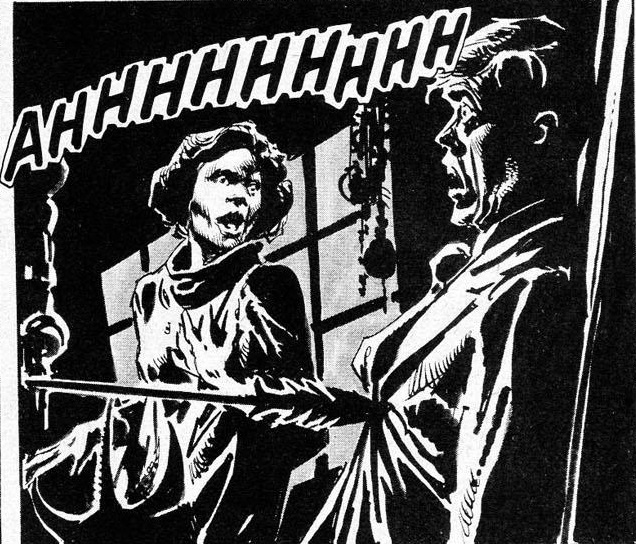
It's 1914, and in a small French village an old woman seeks the help of Dr. DuPont to help her granddaughter, who is having a seizure and speaking in a scary voice. The doctor visits the girl and realizes she may be possessed by a demon, so he goes to see Father Versailles. Both men visit the girl and a demon takes over her body and curses the priest. Father Versailles attempts "The Terrible Exorcism of Adriennes Pompereau!" but fails, so he summons Bishop Ange. The bishop drives the evil spirit out and the sky is filled with lights, as if angels are gathering. Little do the Earthlings know that the ones they call angels and demons are actually warring space folk, whose ships orbit the Earth.


This seemed like a tired copy of The Exorcist until the goofy last page, where the angels and demons are from outer space. Still, Auraleon shines with his depiction of the girl transforming into a demonic creature, and his space demons are impressive as well.-Jack

Peter-
"Mask of U'Gin" has a nice tempo and a decent twist ending, but it's almost sunk by its dopey expository panels ("I never loved him. I just wanted to inherit this shop!") and the telecasting of the big surprise reveal of the killer. The Ortiz art is a definite plus. Perhaps I'm just elevating this one to "readable" status because the rest of the issue is so awful.

I found "Ghostly Granny Gearloose" unreadable. I won't even bother putting the "virtually" in that sentence; this is really dumb, bottom-of-the-barrel drivel. Jack opines that Dube is attempting to spoof Kirby, but I believe the higgledy-piggledy condition of the script is more in line with what Bill thinks is an Eisner homage. There are all sorts of disparate elements thrown together but, unlike with Eisner, none of it comes together. I'd add that the Rook is wasted, but he's never utilized much in his own strip.

The script for "Swamp Lovers" is meandering and silly (but at least it gives Bill a legitimate reason to use backwater hick dialogue) and the art is ugly. What is would-be political satire like "Reality Twice Removed" doing in a title like Vampi? Good question, but it wouldn't stick out like a sore thumb if it was decent satire. And finally, "Adriennes Pomperau" gives us all what we were craving: a PG-13 version of The Exorcist years after the formula had run dry. 


Bob Larkin
Creepy #99

"An Old Game" ★1/2
Story by Nicola Cuti
Art by Pepe Moreno

"Ssshh!" ★1/2
Story by Cary Bates
Art by Joe Vaultz

"Brothers" ★1/2
Story by Bill DuBay
Art by Jose Ortiz

"A Slight Case of Overkill" 
Story by Bill DuBay
Art by Leopold Sanchez

"There Shall Come a Great Darkness" 
Story by Bob Toomey
Art by Alfredo Alcala

"One Hell of a War" ★1/2
Story by Roger McKenzie
Art by Leo Duranona

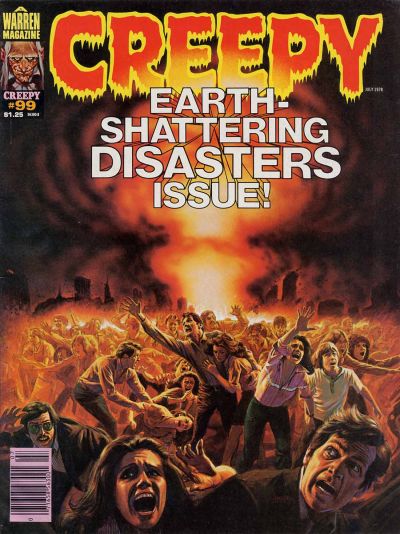
Neil Stern, captain of the nuclear sub, Loki, has discovered his wife is having an affair with a scoundrel named "Acey." Seeing as how the captain is sitting on top of a bushel of big-time firecrackers, an old-fashioned duel just won't cut it, so Stern does what any rejected husband would do: he has his crew fire a nuke at Connecticut (where his wife lives) and prep a second payload for New York (where "Acey" crashes). The crew, believing the U.S. to be at war, comply with the captain's orders, but the Loki is destroyed by an Air Force bomber before the second missile is fired. Ironically, the pilot flying the bomber is "Acey!"

Nothing original (The Caine Mutiny is one of Nick Cuti's obvious influences) here, but "An Old Game" is a decent read nonetheless and has some pretty good graphics by Pepe Moreno. Sure, nuking an entire city to get even with your adulterous wife seems extreme, but this is Creepy, after all. The funny thing, to me, is how much of a similarity there is to The Hunt for Red October. But don't blame Cuti for that one, since the novel wasn't published until the mid-'80s. I'll bet Tom Clancy was a big Warren fan.

Explorers from another world land on a post-apocalyptic Earth and discover (too late) that noise pollution has caused our atmosphere to be explosive. As they launch their ship for takeoff, they set off a chain reaction that destroys the world. Like "An Old Game," "Ssshh!" is not a classic, but it's a fun timewaster. The strip sees the debut of Joe (Buz) Vaultz, whose art comes off as unique but might end up annoying and samey when all is said and done. His art has the look of something created on a computer; competent but not detailed.

Cath and Packy are two fun-lovin' robots who just want to play and breathe in the dirty air in a post-apocalyptic world, but the crazed, murderous band of Mutes always finds the two androids and tears them limb from limb. Luckily, Pa is adept at piecing together the puzzle of wiring and circuitry and rebuilds the pair time and again. Pa explains why the Mutes hate the two kids so much, but Cath and Packy are convinced they can bring the two warring sides together and the Earth can be peaceful once again. As they are cornered once again by the frothing, ugly beasts, Cath and Packy are finally told the whole truth: the Mutes are aliens who conquered Earth years before and Pa was their emissary until he fell under the spell of human emotions. The Mutes destroy Cath and Packy and haul Pa off, promising they'll fix him.

Is it just my imagination, or do we get one of these Jose Ortiz/Bill DuBay wasteland nightmares every issue these days? The only thing missing from "Brothers" is a cute, forty-word title like "Cath and Packy and Pa and the Nightmare Thingy-Dingys!" The reveal of Pa's heritage is a bit of a surprise, but otherwise there's really nothing of substance here, just another slog through rubble.

Years after the stinkin' commies (Stan Lee was right, after all) are responsible for a weapon that de-evolutionizes the human population, reverting everyone to chimpanzees, a man and his grandson remove an Air Force bomber from the mothballs and take to the sky in an effort to halt progress in the human race. It's getting to the point where a "Top Ten Worst Stories of the Year" is infinitely easier to fill than a "Best." With "A Slight Case of Overkill," Bill DuBay lays out an elaborate explanation for his doomsday weapon yet neglects to detail the reasoning behind his two protagonists' Beverly Hillbillies dialogue. Seriously, why was it that Bill had a fondness for characters who talked like they hadn't yet entered the school system (and yet could easily work the controls of a war jet)? Adam Bomb. New Tron bomb. "He creamed a million Japs at Hero Sheema and Naggy Socky..." There are dozens more examples, but you get the picture. The climax is boneheaded as well: Gramps and tyke are going to fly the skies for all eternity while the apes evolve back into men in order to stave off the first sign of violence, but the ol' timer intends to drop a bomb on the rulebreakers. That's a way to eliminate violence, I guess. A stupid, stupid story.

Tom and his brother-in-law, the astronomer, prepare for the end of the world the best they can. Unfortunately, shit happens. There's obviously so much more that's supposed to be made of "There Shall Come a Great Darkness" than my simple twenty-two-word synopsis, but there's really nothing more to see here. The scenes with the mob and the professor's hanging have some impact, but it's wasted within the disposable entirety. The art is sub-par Alcala and nothing inventive is done with the apocalyptic theme. My worst criticism of some of these Warren stories is that if I could have written it, it can't be very good, and I could very easily have written this one. The climax is very reminiscent of "Process of Elimination" (Creepy #83) the Jones/Heath tale about a guy who murders his wife and mistress and then parks on top of a hill to watch a similar doomsday unfold.

I won't even pretend to try to dissect "One Hell of a War," Roger McKenzie's incomprehensible saga of a lone astronaut attempting to save Earth from destruction at the hands of aliens known as the "Trigelians." Suffice it to say, I found "One Hell..." to be just as boring and hard to follow as most of Warren's science fiction of the 1970s. The Duranona art is clearly meant to evoke the grand big screen outer space battles of Star Wars but, instead, is as exciting as a traffic jam at five o'clock on the freeway. Considering that the end of the world is one of my favorite subjects in fiction and film (call me an optimist), Jim Warren and Louise Jones missed the boat with this issue.-Peter


Jack-These theme issues don't seem to bring out the best in the Warren creative team, do they? I liked the splash page of "Brothers" and thought the art by Ortiz was terrific, but there wasn't much substance to the story. I thought "A Slight Case of Overkill" got kind of interesting about midway through, but DuBay's habit of putting offensive speech in the mouths of his hick characters is getting tiresome and the story's ending falls flat.

There's a nice buildup of suspense in "An Old Game," but the average art and letdown of an ending prevent the story from succeeding. I thought the art on "Ssshh!" was reminiscent of Corben's, but the buildup in the story leads nowhere. "There Shall Come a Great Darkness" was just depressing, with mediocre art, and "One Hell of a War!" was long and dull, forcing us to page through even more art by Duranona, who is fast becoming my least favorite Warren regular.


Next Week...
Yet another milestone

Thursday, October 6, 2022

The Hitchcock Project-David Goodis: An Out for Oscar [8.26]

by Jack Seabrook

Born in Philadelphia in 1917, David Goodis has received attention due to his crime novels and the films adapted from them. His first novel was published in 1939, and he wrote for the pulps and for radio in the 1940s, eventually signing a contract to write for Warner Brothers in Hollywood. Yet very little that made its way to the screen is credited to him; he is listed as co-writer for The Unfaithful, released in 1947; he adapted The Burglar in 1957 from his own novel; and he wrote a single episode of The Alfred Hitchcock Hour, "An Out for Oscar," which aired on CBS on Friday, April 5, 1963, near the end of the show's first hour-long season.

David Goodis
Goodis is best remembered for his novels and for the films made from them, such as Dark Passage (1947) and Shoot the Piano Player (1960). Twenty-two of the thirty-two episodes of the first season of The Alfred Hitchcock Hour were adapted from novels, including two books by Henry Kane: My Darlin' Evangeline, which was adapted as "An Out for Oscar," and Run for Doom, which aired under that title. I could not find any information on why Goodis was hired to write this single episode or why he never wrote another; several months after it aired, the popular TV series, The Fugitive, began its four-year run and Goodis believed that the central idea had been stolen from his novel, Dark Passage. He did not write anything else for the big or small screen between "An Out for Oscar" and his death in 1967.

*   *   *   *   *

Cover painting by Barye Phillips
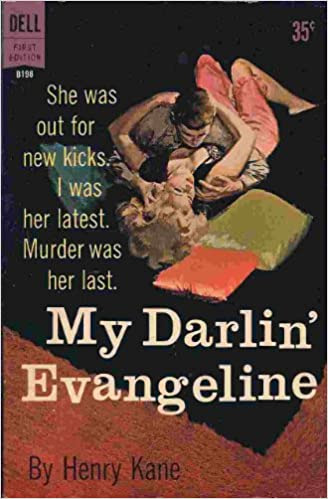
Less well known is Henry Kane, author of My Darlin' Evangeline, which was first published in 1961 as a Dell First Edition paperback. Kane was born in 1908 and received a law degree but made his mark writing novels and short stories as well as scripts for radio and TV. His most popular works were a series of hard-boiled detective novels featuring private eye Peter Chambers; the first in the series was A Halo for Nobody (1947). Kane published over 60 novels between then and 1982, as well as short stories between 1947 and 1967. His TV and movie work spanned the years from 1949 to 1974, though he wrote for the screen mainly in the 1950s. He died in 1988. Lawrence Block wrote an entertaining article about Henry Kane that may be read here.

My Darlin' Evangeline opens as Oscar Blinney checks into a Miami Beach hotel for a month-long vacation. At poolside he meets Adele Roberts, who is there to get a divorce; they spend the night together. The next day, Oscar sees Evangeline (Eve) Ashley in the hotel tearoom and is strongly attracted to the blonde beauty. That evening, she visits her lover, Bill Grant, unaware that she is being watched by Pedro Orgaz, who pays her $1000 a month to be his girlfriend. Pedro later goes to her room at the hotel and removes every trace of his ever having been there; he then goes to the Club Columbo, which he runs, and gets drunk. His wife is the daughter of mobster Mike Columbo.
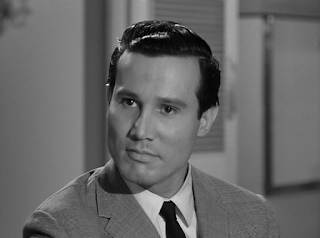
Henry Silva as Bill Grant
The next day, Eve approaches Oscar on the beach and they get acquainted. Soon, Pedro asks his psychopathic brother Diego to murder Bill Grant, but Bill turns the tables and kills Diego. He telephones Eve and takes a flight out of the country, counseling her to leave town but refusing to take her with him. She returns home to find Pedro waiting for her in a drunken rage; she kills him by hitting him over the head with a bottle and then cutting his throat with the broken fragment. She stages the scene to make it look like an attempted rape and then begins to scream.

Oscar's room is next door to hers and he hears her screams and rushes to her aid. He calls the police and they believe her story; after a brief investigation, she is cleared. Oscar and Eve begin spending all of their time together and when he proposes marriage, she accepts, though she is unfaithful to him during their honeymoon in Atlantic City. They settle in New York and the marriage is a disaster, but Eve refuses to give Oscar a divorce. Oscar falls in love with Adrienne Moore, a woman he met in Florida, and Eve announces that she is pregnant and travels to Mexico for an abortion. She returns with Bill Grant, and one evening Oscar comes home early and finds them in bed together.

Linda Christian as Eva
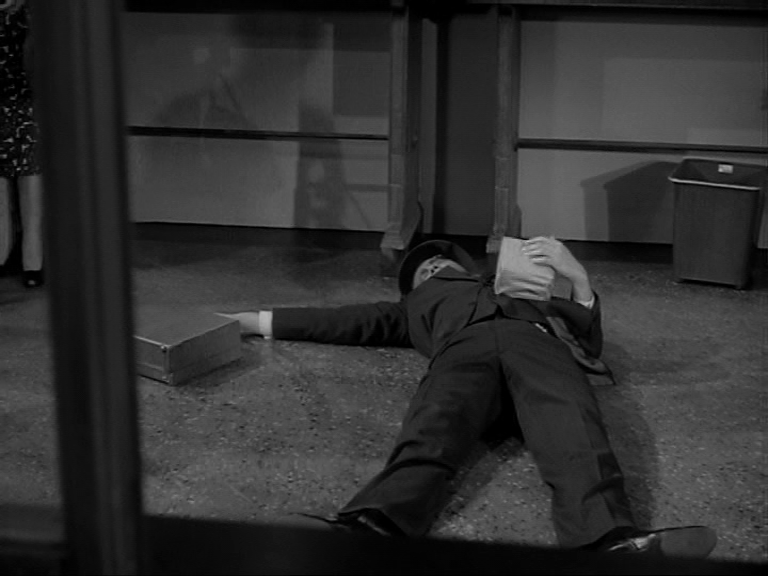
After Oscar leaves his wife, he is summoned to see Bill, who explains that Eve faked her pregnancy and went to Mexico City to find him. Bill offers to kill Eve if Oscar will cooperate with his plan to rob the bank where Oscar works as a teller. Bill tells Oscar, "'there is no out for you...except one.'" Bill explains that he will kill Eve when she visits him the next day and leave her body in the room that he has rented under another name; he will then rob the bank, change his identity, and fly to London. The next day, Bill arrives at the bank and gives Oscar a note. Oscar calmly puts $250,000 in Bill's briefcase, hands the case to Bill, pulls out a gun, and shoots him twice in the head.

The police arrive and question Oscar before receiving a report that Eve has been found dead in Bill's room. Satisfied that they understand what happened, the police exonerate Oscar and discuss the difficulty of committing the perfect crime, laughing at the thought that Oscar could have committed one. Oscar is given the bank's award for heroism and promoted, and he marries Adrienne.
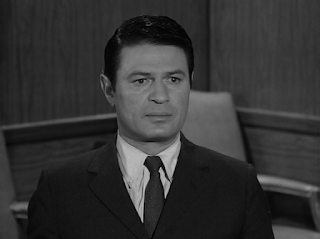
Larry Storch as Oscar
My Darlin' Evangeline is an entertaining novel with a tight plot and a story that moves quickly from start to finish. As bad as Eve is, she does not deserve to be treated the way that Bill treats her, and her death, which is only described after the fact, seems anti-climactic. Oscar trained as a boxer when he was young and that comes into play in one scene where he knocks out a hoodlum who accosts him and Eve on the street one night to tell her to leave town. In addition, all of the employees at the bank where Oscar works are required to train weekly at a shooting range, which comes in handy at the novel's climax when Oscar suddenly shoots and kills Bill.

In the end, Oscar murders Bill, allows Bill to murder Eve, and lies to the police about having any knowledge of their relationship. He is corrupted by those around him and resorts to dishonest acts in order to escape his unhappy marriage and keep his job. In between scenes that advance the plot, Kane fills in the background of his characters. Oscar is tall, muscular, and handsome, but his temperament is gentle and reticent. Eve is the product of a difficult upbringing and she learned to trade on her beauty and to use men from a young age. As a teen, she entered the movie business, sleeping with a series of directors until she met "a silk-sheathed, king-sized, famous, obese master-director of suspense films," with whom she shares a bed. He tells her that she will never be an actress and calls her "'a cheap little girl, bouncing from bed to bed...'" The director, clearly modeled on Hitchcock, tells her to give up acting and go home.
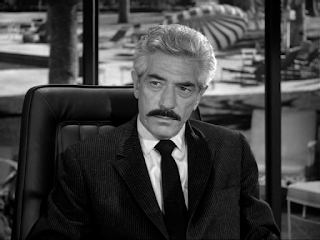
John Marley as Mike Chambers
Did Alfred Hitchcock read this novel? Did series producer Norman Lloyd read it and secretly enjoy hiring David Goodis to adapt it for the Hitchcock TV show? The scenes detailing Eve's background are not part of the TV version, but anyone reading this particular scene must have thought that Kane was referring to Hitchcock when he described the director whose sage advice puts an end to Eve's dreams of movie stardom.

My Darlin' Evangeline was purchased and assigned to David Goodis to adapt for the small screen, and the title, "An Out for Oscar," shows that the focus of the story has shifted from Eve to Oscar. Goodis took Bill's remark to Oscar about there only being one "out" for him and used it as the episode's title. The teleplay is fascinating in the way that Goodis condenses events, removes characters, and both speeds up and slows down the pace of the narrative, depending on where he wants to focus the viewer's attention.

The show eliminates the first three chapters of the novel, where Oscar checks into his room, meets Adele, and is attracted to Eve. Instead, the first scene shows a man looking through a window, observing Bill and Eva (Eve) locked in a passionate embrace. There is a cut to an exterior shot of a street with golf carts and a sign identifying the resort as The Mojave, which suggests that the location has been moved from Florida to California or Nevada. Inside an office at the resort, boss Mike Chambers bullies employee Peter Rogan; Goodis has taken the novel's Mike Columbo and made him less obviously Italian by changing his name to Chambers; he is also an onsite manager at the resort instead of a shadowy figure managing events from another location. The novel's Pedro Orgaz has become Peter Rogan, and instead of conducting his own surveillance, he has a blackjack dealer named Ronald watching Eva.
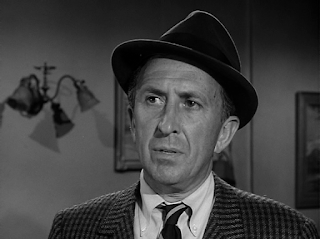
George Petrie as Detective Rogers
In the hallway outside Chambers's office, Ronald tells Rogan about what he saw and Rogan does not take the news well. We then meet Eva, who is at work, arranging flowers in the resort's dining room. She is approached by Oscar, who looks silly in a cowboy hat and western shirt, practicing with a lariat. Instead of the handsome, blond, muscular Oscar of the novel, the TV version is short and average looking, with dark hair. Goodis cuts the scene where Oscar and Eva get to know each other on the beach and he also deletes the entire sequence of events where Pedro tries to have Bill killed by his brother Diego and Bill turns the tables.

Instead, Oscar is clearly smitten with the lovely Eva and follows her back to her bungalow. She enters her room to find Peter, drunk and angry. He hits her and begins to chase her around the room; she smashes a bottle over his head and finishes him off by bludgeoning him with a metal vase, killing him. In the novel, these events occur in her hotel room, which is next to Oscar's, so when she begins screaming, he is able to respond quickly. In the TV version, he is still moping around outside her bungalow after she turned down his invitation to a party, so when she screams, he is the first one through the door. Not surprisingly, her claims of rape in the novel have been eliminated, and the only article of clothing she tears off before screaming is her necklace.
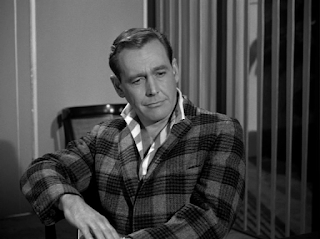
Myron Healey as Peter Rogan
Events move quickly after that: we see Oscar and Eva emerge from the coroner's office after she has been cleared of any wrongdoing. She declines his invitation to lunch but changes her mind and joins him after she telephones Bill Grant and he hangs up on her. Over lunch, Oscar reveals that he works as a bank teller in Los Angeles. He drives her back to the resort, where Ronald summons her to Chambers's office. She arrives to find Bill sitting there and learns that Rogan paid Ronald $100 to follow her, leading to him seeing her with Grant in the show's first scene. Chambers tells Eva that he knows she murdered Rogan and lied to the police, but he wants to avoid publicity and orders Bill to spend some time in Mexico. He fires Eva.

In the novel, Bill's violent murder of Diego causes him to flee the country; in Goodis's version, the order of events has been rearranged and Bill is told to leave in order to avoid bad publicity for the resort because of his relationship with Eva and her attack on Rogan. Eva visits Oscar in his room, pretending that she has come to say goodbye but clearly angling for him to make a proposition, which he does, offering to find her a job and a place to stay in Los Angeles.

Rayford Barnes as Ronald
We next see Oscar back at work at the bank, where Hodges, the manager, offers him a promotion. Oscar has been married to Eva for two months and his description to Hodges of their life together is contrasted with her behavior at home, where we see that she is a sloppy drunk. Their apartment is a mess and she tells Oscar that she only married him because she was broke and he was better than nothing. Subsequent events are set in motion in the next scene, where we see Oscar in the kitchen going over payroll sheets. Back at the bank, Hodges reminds Oscar of his upcoming promotion, tells him not to forget to come to that evening's gun club meeting, and emphasizes the importance of a wife to a man's career.

The character of Adrienne Moore is eliminated and Eva does not go to Mexico for a purported abortion. Instead, Oscar comes home from the bank to find Eva sober and Bill Grant as an unexpected dinner guest. That evening, Oscar attends the gun club and shows himself to have poor aim, blaming it on being distracted. He returns home to find Eva and Bill drunk and uncomfortably close together on the sofa, not in bed together as in the novel. Instead of leaving his wife, as he does in the book, Oscar asks Eva for a divorce and she agrees, adding that it will cost him $50,000 and suggesting that he get it from the bank. We don't know it yet, but Oscar's response is the key to what happens in the rest of the episode: "'I won't let you wreck my career.'" Bill visits Oscar at the bank and offers Oscar an out; that evening, Oscar visits Bill at his hotel room and Bill explains his plan to kill Eva and rob the bank.
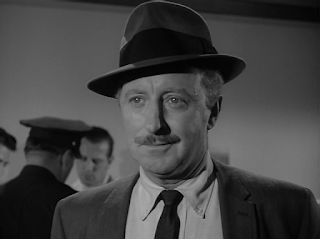
David White as Lt. Burr
Henry Silva, as Bill, is particularly good in this scene; in a single shot, he goes to a mirror, dons hairpiece, glasses, and mustache, and instantly transforms into another person, all without missing a line of dialogue. The rest of the show tracks the events of the novel closely. Bill holds up Oscar at the bank and Oscar shoots him dead. The police come and investigate, taking Oscar to Bill's apartment, where they get word of Eva's murder. The final scene is a dinner held to honor Oscar, who is promoted and given a $10,000 bonus. The show ends with an unexpected shot in which the camera travels down to the end of the banquet table, where the two detectives sit; one posits that Oscar has committed the perfect crime but the other scoffs at the idea.
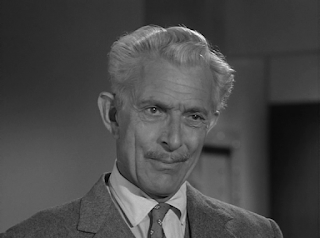
Alan Napier as Hodges
David Goodis was given a challenging task to adapt a violent, sexy crime novel into a forty-eight-minute TV show, where the violence has to be toned down to an acceptable level and the sex has to be eliminated or, at most, only suggested. He did it by eliminating scenes and characters, combining others, removing unnecessary events, and taking the focus of the story away from Oscar's doomed relationship with Eve and changing it to the importance of his job to his sense of self-worth. The novel is a book that can be divided neatly into two sections: the events at the resort and the events in New York. The TV show has a different sense of time; events rush ahead at dizzying speed for the first three acts before slowing down in the fourth. It is surprising that Oscar kills Bill at the end of act three and that all of act four is devoted to the fallout from this act and Eva's offstage death. In the novel, there are only 16 pages (of 192) after Oscar shoots Bill, but in the TV show, the last nine minutes are taken up with the subsequent events. This suggests that Goodis thought that the best way to convey Oscar's motivation was to give extra attention to his behavior during the police investigation and to show the dinner where he gets a promotion and a bonus as the last scene. It makes little sense that the two detectives are at the end of the banquet table, but it does allow them to speak the final lines of the show and hammer home the fact that Oscar committed the perfect crime and the police were not clever enough to understand it.
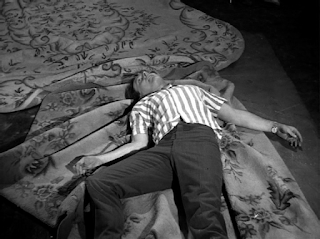
R.I.P. Peter Rogan
Bernard Girard (1918-1997) does a superb job directing this episode, keeping the events moving at a breakneck pace until slowing things down in the fourth act. He was born Bernard Goldstein and worked as both a writer and director of movies and TV from the late 1940s to the mid-1970s. He directed a Twilight Zone as well as four half-hour Hitchcock episodes and eight hour-length Hitchcock episodes, including the Robert Bloch classic, "Water's Edge."

Henry Silva (1928-2022) plays Bill Grant. Born in Brooklyn and trained at the Actor's Studio, he had a long career on TV and film from 1950 to 2001 but only appeared on the Hitchcock show twice; his other episode was "The Better Bargain." He was also seen on Thriller, The Outer Limits, and Night Gallery, and he had a role in The Manchurian Candidate (1962).
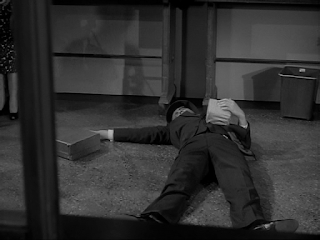
R.I.P. Bill Grant
Eva is played by Linda Christian (1923-2011), in her only role on the Hitchcock series. Born Blanca Rosa Welter in Mexico, she dated Errol Flynn, who gave her the name she used in film and on TV. She later married Tyrone Power. Christian's screen career lasted from 1943 to 1988, mainly on film, and she wrote an autobiography in 1962.

It's unusual to see Larry Storch (1923-2022), who plays Oscar, in a serious role, but he does an excellent job. Born in New York City, he served in the Navy in WWII and made countless appearances on film and television from 1951 to 2010, including a great deal of voice work in cartoons. This was his only role on the Hitchcock show; he also appeared on The Night Stalker and will forever be known as Corporal Agarn on F Troop (1965-67).

In smaller roles:
  • John Marley (1907-1984) as Mike Chambers, the resort/casino boss; he was on screen from 1942 to 1986 and appeared in three episodes of the Hitchcock series, including "The Second Verdict." He is best known for his role in The Godfather, where he wakes up in bed to find a horse's head.
  • George Petrie (1912-1997) as Detective Rogers, who scoffs at the suggestion that Oscar committed the perfect crime; he started out on radio, played many bit parts on The Honeymooners, and appeared in one other episode of The Alfred Hitchcock Hour.
  • Myron Healey (1923-2005) as Peter Rogan, who is brained by Eva; he has countless credits on film and TV from 1943 to 1994 and appeared in five episodes of the Hitchcock show, including "Incident in a Small Jail."
  • Rayford Barnes (1920-2000) plays Ronald, who watches Bill and Eva through the window in the first scene; he was on screen from 1952 to 2000 and appeared in three episodes of the Hitchcock series, including "Night Fever."
  • David White (1916-1990) as Lt. Burr, who figures out what Oscar did but can't convince his partner; he was a Marine in WWII and appeared on Broadway starting in 1949. He was on screen from 1949 to 1989 and appeared in many television shows. He was in four episodes of the Hitchcock series (including "Dry Run") and two of The Twilight Zone, but he is best remembered for his supporting role as Larry Tate on Bewitched (1964-1972).
  • Alan Napier (1903-1988) as Hodges, the bank manager; he uses what might best be described as a ludicrous Southern accent in this role! Born Alan Napier-Clavering, he will always be remembered as Alfred the butler on Batman from 1966 to 1968, but his career onscreen was a long and busy one, stretching from 1930 to 1981. Other TV appearances include Thriller, The Twilight Zone and Night Gallery; his many film roles included parts in Fritz Lang's Ministry of Fear (1944) and Moonfleet (1955), Val Lewton's Isle of the Dead (1945), and Hitchcock's Marnie (1964). He appeared in eight episodes of the Hitchcock series, including "I Killed the Count."
"An Out for Oscar" may be viewed online here.

Sources:

The FICTIONMAGS Index, http://www.philsp.com/homeville/FMI/0start.htm.

Grams, Martin, and Patrik Wikstrom. The Alfred Hitchcock Presents Companion. OTR Pub., 2001. 

IMDb, IMDb.com, https://www.imdb.com/.

Kane, Henry. My Darlin' Evangeline. NY: Dell, 1961.

"An Out for Oscar." The Alfred Hitchcock Hour, season 1, episode 26, CBS, 5 Apr. 1963.

Wikipedia, Wikimedia Foundation, https://www.wikipedia.org/.
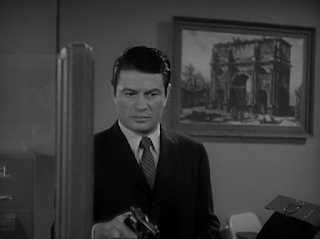

Just after shooting Bill Grant.

Listen to Al Sjoerdsma discuss "Conversation over a Corpse" here!

Listen to Annie and Kathryn discuss "The Greatest Monster of Them All" here!

In two weeks: We start to examine the work of Helen Nielsen with "Letter of Credit," starring Bob Sweeney!

Monday, October 3, 2022

Batman in the 1980s Issue 63: August 1986


The Dark Knight in the 1980s
by Jack Seabrook &
Peter Enfantino


Miller
Batman: The Dark Knight Returns #3

"Hunt the Dark Knight"
Story by Frank Miller
Art by Frank Miller & Klaus Janson

The new police commissioner has issued a warrant for the arrest of Batman for various misdemeanors; the President of the United States has ordered the Man of Steel to bring his old friend in for the good of America; the Sons of Batman have been assassinating jaywalkers; and Robin 6.0 has a mind of her own and thinks nothing of disobeying her mentor. It's been a hell of a day for the Dark Knight.

Add to that the simply asinine decision by psychiatrist Dr. Wolper that the Joker is a cured man and perfectly safe to appear on the David Endochrine Show. Of course, the Clown Prince of Crime uses his deadly smile gas to kill the entire audience and then vanishes. While attempting to apprehend the lunatic, Batman is attacked by the commissioner and the entire police force. He and Robin narrowly escape.

While visiting Selina Kyle, who's hung up her Catwoman suit and become a high-priced madam, Batman learns his former lover has been forced to aid the Joker and that the evil clown's next target is the county fair. The dynamic duo race to the fairgrounds, where the Joker is already mid-terrorism, having murdered dozens with poisoned cotton candy and attaching bombs to roller coaster rides. Robin manages to save most of the coaster riders while Batman sets off after Joker, who has ducked into the House of Mirrors.

With the guilt of knowing that if he had only killed the Joker years before, thousands would still be alive, Batman heads into the attraction with murder on his mind. The two old enemies have a vicious tussle and the Dark Knight is gravely wounded, but Batman just can't commit the final act. With a heavy sigh of disappointment, Joker kills himself.

Peter: There's a whole lot going on here, much more than a short synopsis can contain. As with the first two chapters, this is heavy, heavy reading with Frank Miller tearing away at everything we've learned and believed about superheroes for (at that time) nearly fifty years. Miller's questions about vigilantism and law and order aren't that far off from Don Siegel's Dirty Harry. Laws might need to be broken to bring in the bad guys, but how much force should be used and who should use it? Superman's transformation from morally-grounded world-saver to brainwashed pawn of a crooked politician is startling; I'd forgotten just how startling. And Joker's suicide by self-inflicted broken neck is perfect (Nolan used Batman's inability to kill the Joker to great effect in The Dark Knight), leaving Batman feeling almost guilty for not giving in to his inner rage. We've got one more installment left (which was delayed until December 1986, so we won't discuss that until the Halloween day post) but, to me, this is the strongest, most powerful and memorable chapter yet.

Jack: I didn't dislike this issue as much as I did the last one, mainly because the Joker is such a strong character. Still, I had a negative reaction to Miller's wholesale attack on the icons of the Batman universe. Selina is old and fat and she runs an escort service? Not for me. I like Batman's relationship with the new Robin, but I question how much training she really got and why he lets her participate in such dangerous activities. Miller uses a lot of women in roles previously filled by men; there's the topless Nazi villain with swastikas on her breasts and buttocks; Robin, of course; and the new commissioner. Still, it seems like the women are either evil, stupid, or naive, and I don't think that advances the feminist cause.

Miller's worldview is so dark that it infects every aspect of the story and there's nothing fun about reading it. I don't like the Joker being a mass murderer and the way the world is depicted is much too dark. If one were to argue that this is more realistic than comics had been in the past, stop to think a moment: has anyone ever murdered an entire TV audience? Or killed a large group of kids at an amusement park? It's not realistic--it's hyper-violent and it's done to try to demonstrate that violence and vigilantism are justified in the face of such horror. I don't think that was true in 1986 and I don't think it's true now.

Miller's plotting is good and his artwork is very good, but I think even Peter would have to admit that these pages look very mid-'80s and have dated quite a bit.


Mandrake
Batman #398

"About Faces!"
Story by Doug Moench
Art by Tom Mandrake

Catwoman is annoyed that Batman isn't willing to commit to being her partner in love as well as in fighting crime. They call a truce and head to see Commissioner Gordon on the roof of Police HQ, where Batman explains that he has a plan to capture Two-Face. Meanwhile, Circe and Two-Face head to the Gotham Museum to steal an Egyptian sarcophagus, though Two-Face is unaware that Circe is working with the Caped Crusader and this is all a setup.

Bats and Cats wait and watch as Circe takes out a gold mask from the mummy case and gets Harvey Dent to try it on, hypnotizing him into thinking his good side can prevail. Unfortunately, Two-Face is determined to be a bad guy and he smacks Circe, at which point Batman, Catwoman, and Robin burst in and a fight ensues. Two-Face is defeated, and Catwoman departs, leaving Batman to wonder about the future of their partnership.

Peter: "About Faces!" brings to an end yet another forgettable arc. Nothing new here. Harvey Dent struggles with his duality, then spends quite a lot of time making up his face for a ten-second masquerade, only to become evil Harvey again. Catwoman continues to waffle between loving partner and jealous pain in the arse. Ditto Robin. To make matters worse, Doug opens the story with a rambling dialogue between Batman and Catwoman about... well, I don't know what it was about. Doug's time on the Bat-titles is coming to a close and he's done some good work here and there, but he's not going out with much of a bang.

Jack: This was much more fun to read than The Dark Knight Returns! Mandrake still struggles with his art and I imagine the Batman face on the cover has a bit of help from an uncredited Dick Giordano. The interior artwork reminds me of something we'd see in 1940s comics, where it looked charming and unspoiled. The improvements in comic art over the decades make Mandrake's work look amateurish. I enjoyed most of the banter between Batman and Catwoman and I still think Two-Face is a great villain, so I was glad Moench had room to expand the story. As my summary shows, not much happened, but I liked it anyway, perhaps as an antidote to all the darkness from Miller.


Colan/Giordano
Detective Comics #565

"The Love Killing"
Story by Doug Moench
Art by Gene Colan & Bob Smith

Batman investigates the grisly murder of Mona Lamont, an airline stewardess; not an ordinary crime of passion... this woman was beheaded! Bats's chief suspect is Roy Spivey, the dead woman's ex-boyfriend, but the Dark Knight can find no evidence and the man seems to stay inside his apartment, night and day. 

Meanwhile, the rift between our costumed hero and his lady love, Catwoman, seems to grow wider every day. Now Selina won't even prowl the streets on patrol with him and she's spending more time with her panther. As for Jason, he finds himself falling more and more in love with Rena every day, with his Robin duties suffering as a result.

Unbeknownst to all parties involved, Roy Spivey has been keeping a secret safely hidden in a bucket of solution in his apartment basement. Spivey reaches in and reveals the shrunken head of Mona Lamont!


Peter:
A truly batshit tale and, even as goofy as it is, a welcome rest from the same ol' same ol'. I have no idea what Roy Spivey's game is but, for the first time in a really long while, I can't wait to read part two in Batman #399. The reveal of Mona's teensy tiny head is a macabre shocker. The Rhett Butler/Scarlet O'Hara nonsense with Bats and Cats takes up way too much space; it's repetitive and sappy. In issues past, Bats was giving Cats the cold shoulder and now it's flipped. I get it, Doug wants to point out (several times in this issue) how love can destroy love... that is what he's trying to say, right? Let's just get back to Catwoman being in the Rogues Gallery rather than a sometime squeeze.

Jack: The issue starts off with a great cover by Colan and Giordano, and Colan and Smith keep up the level of quality inside as well. They sure make Harvey Bullock a real slob, don't they? Unlike Frank Miller, Colan has the murder occur off-camera, but it's still effective. I like the way Moench compares the breakdown of the relationship between Batman and Catwoman with the developing relationship between Jason and Rena, all set against the backdrop of the destructive relationship between murderer and victim. I really liked the panel with the severed head, too!

"Death by Misadventure"
Story by Joey Cavalieri
Art by Stan Woch

Green Arrow survives the exploding door (see last issue) and discovers that behind it is none other than Rick O'Connor (a/k/a Hi-Tek) and Mayor Bolt's son Bruce, watched over carefully by the gorgeous Professor Cuthbertson. Meanwhile, Steelclaw's henchmen turn against him after they believe the villain has killed Black Canary (he hasn't, though; he's only given her a knockout drug, because he's really good guy Mayor Bolt, who everyone thinks is a bad guy but he's just acting like a villain so that he can infiltrate the underworld and clean up the city he runs) and left the city wide open for running drugs and guns and all sorts of bad stuff. Both men empty their guns into Steelclaw and beat a hasty retreat. Having heard the gunfire, Green Arrow exits the building to find the unconscious Canary and the apparently-dead Claw. Meanwhile, across town, Onyx reveals exactly nothing to her friend Tommie.

Peter: An enjoyable seven pages, with a whole lot of interesting twists. Well, the Onyx stuff is annoying rather than interesting, but the rest of the events are intriguing. I assume Mayor Bolt/Steelclaw is not dead since the reveal once he's unmasked would leave him a villain in the eyes of everyone living in Star City, including his kid. The art, by newcomer Stan Woch, is very good. Standout is the two-panel page of the thugs icing Steelclaw. Dynamite!

Jack: I didn't think much of the art, which seemed a step back from what we've been seeing recently in this series. I don't like how Cavalieri wraps up the main story and then sticks in the obligatory Onyx page at the end.


Cowan/Giordano
Batman Annual #10

"Down to the Bone"
Story by Doug Moench
Art by Denys Cowan & Alfredo Alcala

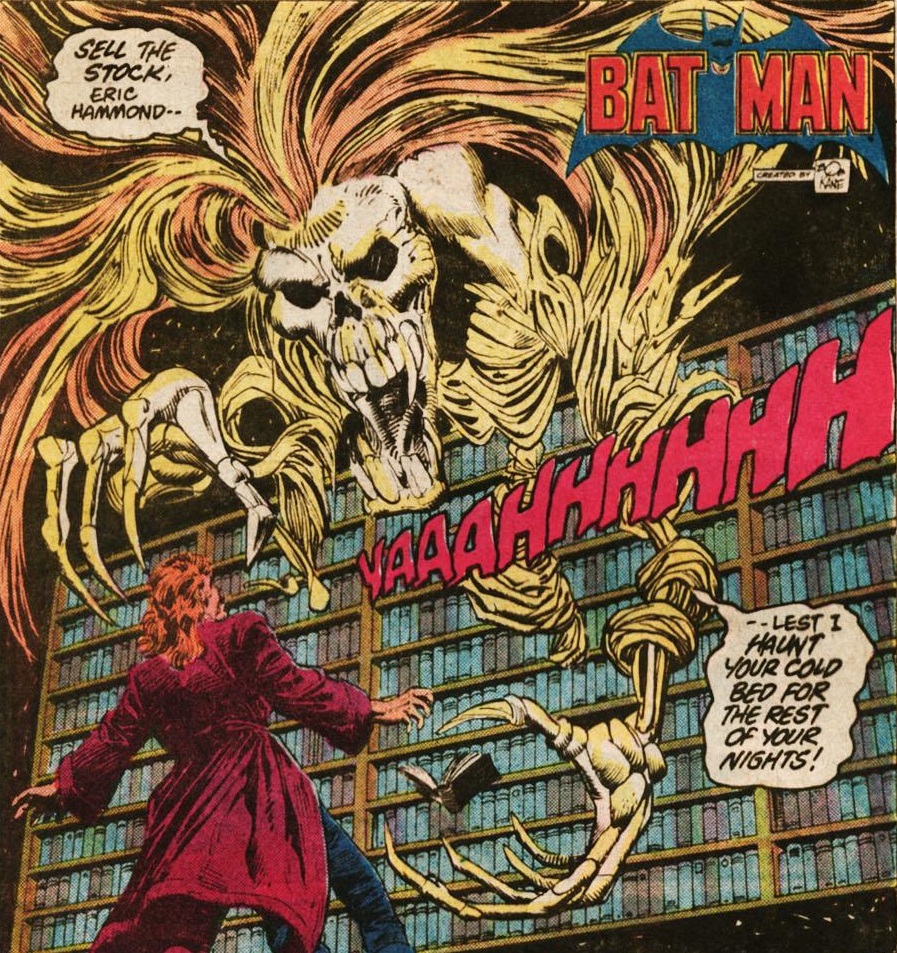
Stockholders in the Wayne Foundation are scared into selling their holdings to a mysterious person who succeeds in taking control of the corporation. Bruce Wayne knows something is not right, so Batman and Robin decide to visit the former stockholders to try to find out what's going on. Alfred receives a visit from the man behind the scheme and is so shocked by his identity that he has a stroke.

Soon, Bruce Wayne is bankrupt and Wayne Manor is sold to the highest bidder, leaving Amanda Groscz to notify him that he's no longer a fit guardian for Jason Todd and the boy will be placed elsewhere. Bruce walks the streets and learns just how little he can buy with $37 in 1986; as Batman, he visits the former stockholders, only one of whom is not too scared to tell him anything much. Once he learns that the man who bought Wayne Manor and took over Wayne Foundation used the name Steven Strangways, Batman proves why he's a great detective and quickly deduces that Hugo Strange is not dead and is behind it all.

Batman grabs Robin from the orphanage and the duo are soon attacked by one of Strange's Mandroids, disguised as the Caped Crusader and riding the Bat-Cycle. The dynamic duo return to Wayne Manor and the Batcave, where they confront the real Strange (and some more Mandroids). Strange escapes in the Batmobile but Batman and Robin chase him in the Bat-Copter (or Whirlybat) and knock him out. Commissioner Gordon arrives to take Strange to the pokey where the villain is convinced that Batman hypnotized him into thinking that the Dark Knight's secret identity is Bruce Wayne, something he realizes cannot be true. Alfred recovers from his stroke and returns home to find Stately Wayne Manor in ruins.

Peter: Despite having 38 pages to breathe, Doug Moench's script feels empty. Hugo Strange doesn't even show up until the closing pages, so perhaps it might have been more of a surprise if his face hadn't been plastered across the cover. Doug gets in plenty of digs at Ronnie Reagan, the rich, and even health care, with his overcooked and cliched observations (In this modern world, objective and subjective are one and the same, inextricably merged, the symbol supplanting reality. Money is not just yachts and VCRs--it is food and shelter and even the life-sustaining care which should come from love and concern... but which actually derives from the goal of a physician's paycheck...).

Batman questions whether an
eight-year-old Robin was a good idea.
The "Bruce Wayne loses everything" storyline has been done before and will be done again; what's interesting to see is if the destruction at Wayne Manor or the life-altering events that led to Batman sleeping on a dirty mattress in a belfry will ever be reflected in the regular titles. The art is top-notch (there goes my Alcala love again), but I will say... yet again... someone at the editor's desk should be hanging post-its around the artists' easels to remind them of Jason Todd's age. Within this single story, the kid seems to age from a toddler to a grown man.

Jack: I had high hopes for "Down to the Bone" due to the excellent cover, but the interior story and art were only fair. When Robin first appears, he looks exactly like the college-age Dick Grayson, but soon it becomes clear that he's Jason Todd and he ages in reverse as the story unfolds. I had a hard time getting worked up over Wayne Foundation's financial troubles and agree that it will be interesting to see if this is a one-off or if the regular titles continue the story. I suspect it will never be mentioned again.


Next Week...
Prepare yourself for disaster!