Monday, November 8, 2021

Batman in the 1980s Issue 40: April 1983


The Dark Knight in the 1980s
by Jack Seabrook &
Peter Enfantino


Hannigan & Giordano
Batman #358

"Don't Mess With Killer Croc!"
Story by Gerry Conway
Art by Curt Swan & Rodin Rodriguez

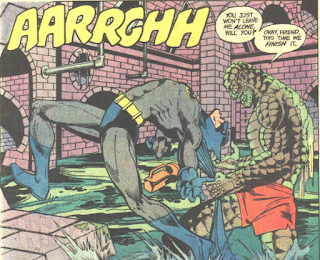
Killer Croc attends a meeting of the Gotham City Tobacconist's Club, a front for the mob, and announces that he's taking over. At the morgue, Batman and Commissioner Gordon learn that the Squid was killed by a special bullet shot from a special rifle--only two prototypes exist. Batman visits a shooting gallery and kidnaps a crook nicknamed Specs, whom he brings back to the Batcave and threatens into revealing that he sold the rifle to Croc, who lives in a slum known as the Point.

Bruce and Dick chat about Croc and Bruce recalls the man in the trench coat who witnessed Batman's escape from the Squid's trap. Dick reveals that Trina Todd has figured out the secret identities of the Dynamic Duo and needs help with a criminal who is trying to shake down the circus owner. Batman heads over to the Point and has a fight with local toughs; not long before, Croc broke into Star Labs to steal an Air Force computer to show the mob how clever he is. The tough guys tell Batman where Croc lives and, while Croc is showing the mobsters the stolen computer, Batman is making himself comfortable in Croc's living room.

Too bad Specs didn't see a big, blurry Abe Lincoln head!
Croc returns home and is not happy to see the Dark Knight in his favorite chair; he trashes the place and sets it on fire, angry that his special hideaway has been discovered. Batman waits for him outside but Croc manages to make his escape.

Peter: This should be an exciting, rollicking adventure, but its clunky art and stuttering script render it anything but. Perhaps the big picture will be revealed at a later date, but I'm not sure why Killer Croc is jumping through hoops for these mafia guys when he can break a man in two with ease. A more pressing question might be why the youth gangs in Gotham always look like the Village People, talk like bad 1960s stereotypes ("When studs trespass on our turf, they get hurt."), dress in three piece suits (love that vest!), and wear snaggletooth necklaces. And the security guys at STAR Labs shouldn't be so hard on themselves. I'd have never been able to tell the difference between Colonel Hardy and the 400-pound lizard who stole his uniform.

Jack: The key word there is "lizard," since it seems to me that the Croc is DC's version of the Spider-Man nemesis, only without the ability to switch to human form and the angst that goes along with it. As I read the story, I thought "Peter's not going to like Curt Swan's art," and I was right. Swan's style seems too smooth for the gritty Gotham City milieu. That said, he's a great comic book artist who knows how to tell a story effectively. I enjoyed the back and forth from scene to scene and especially the way everything was timed so we could understand what was going on and where. I agree that it makes little sense for Croc to have to steal a computer to demonstrate his worth to a room of sweaty mobsters, but I'm willing to wait and see where this all goes.


Hannigan & Giordano
Detective Comics #525

"Confrontation"
Story by Gerry Conway
Art by Dan Jurgens & Dick Giordano

After Killer Croc has burned down his own home and disappeared into the river, Batman and Robin search the area but find no trace of the giant lizard-man. Unfortunately, Bats doesn't look closely enough; Croc is hiding in the shadows. 

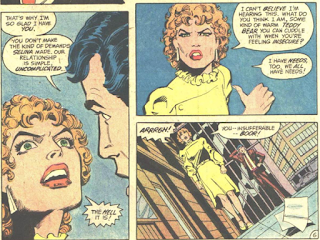
With Croc on the lam, Bruce Wayne re-emerges for a date with Vicki Vale. Unfortunately, that doesn't go well when Bruce makes man's biggest mistake with woman and tells her what's really on his mind: Selina Kyle. Though Bruce insists to Vicki that his love affair with Selina is in the past, Vicki takes it badly and storms off.  Meanwhile, Robin checks out the Flying Todds' performance at the circus and, once the show is over, has a talk with the Todds about working with the police to catch a mysterious "man in a trench coat" who's shaking the circus down for protection money. 

Just at that very moment, Bruce suddenly has the epiphany every other guy on the planet had the day they were born: giant crocodile-men are much easier to figure out and deal with than women. It suddenly occurs to him that Croc was right there next to him in the shadows at the river. He dons his Bat-uni and takes to the sewers. There, he finds Croc and engages in a deadly game of cat-and-mouse with his new adversary before being swept away by the strong current. Batman knows for sure the two will meet again!

Peter: A bit better than the anemic "Don't Mess with Killer Croc!" but still nothing more than an average Bat-tale. The art is an obvious step up but, script-wise, there's just not a lot going on here. Am I the only one thinking this Killer Croc cat might just be a rip-off of that Lizard guy over at Marvel, but there's definitely some potential? The Todd family subplot is obviously working up to a game-changing event, but that's because we have the benefit of being Monday morning quarterbacks. Otherwise, it would be just another uninvolving distraction. 

Obviously, the "world's greatest detective"
doesn't read Cosmopolitan.
Same goes (only double) for the awful Vicki Vale episode. The world's greatest detective doesn't know it's not wise to tell your current squeeze that your sexy, exotic, and dangerous ex is weighing heavy on your mind but that you're glad the new one's around because she's "uncomplicated?" Oh boy. I'm just a dumb comic nerd, but even I know you don't look Medusa in the eyes and tell her she's got a great rack but her hair is kinda funky.

Jack: I think Giordano is doing his best here to make something out of the Jurgens pencils, but he's not succeeding very well. As seems to happen too often in Detective, Conway plays out too many subplots in the limited amount of space he's been given. I won't even comment on Peter's chauvinistic remarks. We respect women here at bare*bones.

"Mob Rule III: The Irresistible Rise of Machiavelli"
Story by Joey Cavalieri
Art by Irv Novick & Ron Randall

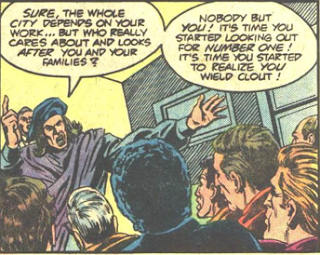
Machiavelli continues his attempts to bring calamity to Star City by convincing the trucker's union to strike, thereby halting all commerce. But, with a well-placed "smoke arrow" in a crowded union hall, Green Arrow convinces the truckers that working as a team and ignoring rabble rousers like Mach is the way to go.

Peter: Like the two chapters that preceded it, "The Irresistible Rise..." is nothing more than space filler. I'm still not sure what Mach's overall plan was (but then maybe I just nodded off during that expository), but I am sure the guy must have one really bad case of dry mouth. In every panel he visits, his yapper is open wider than on those fake zombie things that chased Will Smith in I Am Legend.

Jack: I realize that this is just an old, forgotten backup feature in a DC comic, but did it strike anyone else as eerie that the tale features a politician who is trying to appeal to blue collar workers by playing on their sense of victimhood and his motto is that he looks out for number one? Add to that an image of empty store shelves and 1983 is looking an awful lot like recent history.


Aparo
The Brave and the Bold #197

"The Autobiography of Bruce Wayne!"
Story by Alan Brennert
Art by Joe Staton & George Freeman

On Earth Two, Batman's alter ego sits down to continue typing out "The Autobiography of Bruce Wayne!" and explains how, back in 1955, the Scarecrow attacked Gotham City with his fear gas. The wedding of Bruce's former girlfriend, Linda Page, is disrupted by the toxin, which causes the guests to see a plethora of spiders, snakes, and worms. Batman, Robin, and Batwoman attempt to give chase, but suddenly Batman is overcome by the sight of his loved ones fading into thin air.

With all of his friends seemingly gone, the Dark Knight turns to Selina Kyle, who is serving time in prison. Batman convinces her to don her Catwoman costume again and help him. They drive to Gotham University, where the Scarecrow has set various traps, and working together deepens the bond between the Bat and the Cat. While helping each other overcome fears triggered by the Scarecrow's gas, the unlikely duo reveal their pasts to each other and, eventually, Batman takes off his mask and tells Selina that he's really Bruce Wayne. They defeat the Scarecrow and proceed to get married, living happily ever after until Selina's death twenty years later. Bruce writes his memoirs and waits for the day when he will join his wife.

Peter: Just the right mix of great writing, dynamic art, and good old-fashioned nostalgia. I'm not a big fan of "imaginary" stories (which is ironic, I know, since all funny books are "imaginary stories"), but "The Autobiography of Bruce Wayne!" is a stirring mini-masterpiece, easily the best B+B adventure we've embarked on. The Bats and Cats discourses reminded me quite a bit of the dialogue the same characters exchanged in Nolan's The Dark Knight Rises. Watch this Brennert guy; I bet he's going places. 

Jack: I have been a fan of Joe Staton's art ever since I bought E-Man #1 on the stands in Texas as a kid. I liked his DC work in the latter part of the '70s and I think the art in this issue is superb, perfectly capturing the flavor of the Golden Age comics it recalls. A quick bit of online research tells me that inker George Freeman also deserves praise for his work on this story. Brennert's script is not only clever and exciting, it also demonstrates an understanding of DC history, from the references to the Justice Society having disbanded and only a few heroes still going in 1955, to the appearance of Batwoman and the sign for Bill Finger Hall at Gotham University. I first read this story last year when DC reprinted it as a dollar comic; I still love it. The Aparo cover is great, too.

Next Week...
The very definition of
beating a dead corpse!

Thursday, November 4, 2021

The Hitchcock Project-Joel Murcott Part Six: A Personal Matter [4.15]

by Jack Seabrook

"A Personal Matter" is based on a short story by Davis Dressler (Brett Halliday) called "Human Interest Stuff" that was first published in the September 1938 issue of Adventure and later reprinted in the September 1946 issue of Ellery Queen's Mystery Magazine. It was the lead story in a 1957 Mystery Writers of America anthology titled Dolls Are Murder, which may be where the producers of Alfred Hitchcock Presents spotted it when they chose it to be adapted for the television series. The TV version, retitled "A Personal Matter," was written by Joel Murcott and aired on CBS on Sunday, January 18, 1959.

The short story is told in the second person and narrated by an unnamed man in prison who is scheduled to be executed the next day. He speaks to a newspaper reporter, who is also unnamed and who never responds, about what really happened during the five weeks between the murder of Bully Bronson, an engineer on a job in Texas, and the capture and return of the narrator, who had been in Mexico.

The narrator explains that he "drifted into the railroad construction camp" in need of a job and discovered that the American engineer in charge of the project was sick and there were only six weeks before the start of the rainy season in which a gap in an important railroad line could be filled. The narrator was hired to replace the engineer and shepherd the project to completion. It was a difficult job, grading a four-mile stretch of dirt with Mexican labor and a time limit, and the narrator was relieved when another American appeared and signed on as a second engineer; the man, whose name was Sam,  wore a gun in a shoulder holster under his shirt.

"Human Interest Stuff"
was first published here

The project began to move swiftly toward its conclusion. One evening, the narrator and Sam heard a radio news broadcast about the search for an assistant engineer who murdered his chief, Bully Bronson, "'after an argument in a highway construction camp'" in Texas and escaped into Mexico. The narrator told Sam that Bronson deserved what he got and Sam replied that "'murder is still murder.'" The two men discussed the killing and the current engineering project and agreed to finish the job before talking about other matters. Sam removed his gun and holster and hung them on his bunk until the job was done.

Weeks of hard work brought the narrator and Sam close together. Near the end of the job, two men on horseback approached the camp and the narrator could see that they were armed; he shot and wounded them both, tied them up, and bribed a nearby police chief to lock them up until the engineering project was finished. The job was done a week early and the narrator saw that Sam had put his gun and holster back on. Sam explained that he had to go back across the border to Texas to do his job, now that he had helped see the construction project through to completion. "'I'm ready whenever you are,'" said the narrator, and they crossed the border together.

Newspapers carried headlines about "the lone American who had gone into Mexico and brought out Bronson's murderer single-handed," and the narrator tells the reporter that this is the first time that the story of what happened during those five weeks has been told. The narrator assures the reporter that he is not angry at Sam and knows that he, the narrator, will be electrocuted the next day for the murder of Bully Bronson. It turns out that Sam was a Texas Ranger, chosen to go after the narrator because he had studied engineering, and the two men had agreed to complete the railroad grading project together before Sam brought the narrator back to Texas to face justice.

Wayne Morris as Brett Johnson

There is not a single female character in "Human Interest Stuff," even though it is the lead story in a paperback collection called Dolls Are Murder, and the story recalls Hemingway's work in the way that men put aside other concerns to bond and complete a job. The narrative builds toward the ending, which is not terribly surprising yet effective and satisfying nonetheless. The setting is almost Western in that it takes place in a remote part of Mexico and men arrive on horseback with guns; the railroad that is being built will open a route from St. Louis to the west coast of Mexico. Todd Mason notes that Dresser's story mines "B. Traven territory"; Traven's novel, The Treasure of the Sierra Madre, was first published in English in 1935, three years before the publication of "Human Interest Stuff."

Davis Dresser had his own connections to Mexico and the American Southwest. Born in Chicago in 1904, the author's family moved to Texas when he was five years old. At fourteen, Dresser lied about his age in order to join the Army and served on the border patrol until his real age was discovered. After high school, he worked in construction camps in the Southwest and in Mexico, later studying engineering in college and working as a surveyor. His first novel was published in 1934. "Human Interest Stuff" has been referred to as probably his best story and is one of four engineering tales he wrote that were published in 1938.

Dresser is best remembered under the pseudonym of Brett Halliday. He wrote his first novel featuring private detective Mike Shayne in 1935 and it was published in 1939. Dresser went on to write at least 25 Mike Shayne novels, in addition to many short stories and novelettes; ghost writers penned numerous additional stories and novels starring the character and Dresser helped found Mike Shayne's Mystery Magazine in 1956, a long-running digest that would compete with Ellery Queen's Mystery Magazine and Alfred Hitchcock's Mystery Magazine for three decades. Shayne was popular on radio and television as well. Dresser was a founding member of the Mystery Writers of America and won an Edgar Award in 1954 for Outstanding Mystery Criticism.

Joe Maross as Joe Phillips

The twist ending of "Human Interest Stuff" likely appealed to the producers of Alfred Hitchcock Presents, who assigned it to Joel Murcott to adapt. In translating the story from page to small screen, Murcott made significant changes that end up reducing the story's effectiveness.

As is often the case when a story is adapted for Alfred Hitchcock Presents, Murcott eliminates the narrator and rearranges the events so that the story is told in chronological order rather than in flashback. This removes some of the story's suspense, since we don't know the narrator's fate from the start. It would have been difficult to use a narrator on TV, since the audience would have seen his face and known the identity of the man in prison, which would spoil the surprise ending. Had Murcott tried to conceal the narrator's identity in shadow or by filming him from behind, it would have created suspicion in the viewer's mind that is not present in the story.

Instead of grading ground to run a railroad track, the engineering project in the TV version involves digging through a mountain to create a tunnel. This allows for more visual excitement and danger. A sign outside the tunnel establishes the location as Mexico and there is a point of view shot, with the camera mounted on top of a wagon as it travels on tracks into the tunnel. This gives a sense of claustrophobia as we see timbers supporting the stone ceiling of the tunnel and bare electric light bulbs strung above the tracks to provide light.

Frank Silvera as Roderiguez

Joe Phillips, who corresponds to the unnamed narrator in the short story, is seen struggling to shore up part of the tunnel's ceiling as it begins to collapse; Mexican laborers run away from him and he follows them a moment before the ceiling falls. Phillips angrily asks the men if that is how the engineer he replaced was killed and laments that they just lost 20 of the 82 feet they had dug since his arrival. This opening scene establishes the location, the nature of the project, and the challenges faced.

Outside the tunnel, the men see an airplane approaching; modern methods of transportation have replaced the horses used in the short story! A pretty, Mexican nurse named Maria bandages a wound on Phillips's shoulder and a doctor gives him a shot to prevent infection; Maria is the only woman in the mining camp and serves a purpose in the show that is both decorative and representative of the viewer when she later speaks to the engineers and seems to intuit their thoughts. Senor Roderiguez, whose name we saw on the sign outside the entrance to the tunnel, arrives by jeep, having flown in on the plane. With him he brings a man named Brett Johnson, who corresponds to the character of Sam in the short story. Roderiguez tells an angry Phillips that he has brought Johnson to help; the nearest village is 100 miles away and the only way to get there is by air.

Roderiguez has six weeks to complete the tunnel or he loses his contract; unfortunately, there are still 700 feet left to dig and the most that the crew has dug in a week is 90 feet. Joe angrily goes to his bungalow to pack, intending to leave, while Roderiguez begs Brett to stay, hinting at a secret arrangement between them. Brett agrees that they made a bargain to help each other, but the nature of the agreement is not revealed until the end of the show. Brett enters the bungalow that he will share with Joe, who runs outside to see the plane departing; Brett reveals that Roderiguez will not return for six weeks, so Joe is stuck. Joe tells Brett that he will finish the tunnel as planned.

Frank de Kova as Pedro

One night, as Maria dances for the laborers in front of a campfire, Joe seems to be warming up to Brett. The tunnel is progressing but Brett is reticent to reveal personal details. At the infirmary, Maria treats a wound on Brett's hand and senses his unhappiness. As he gets ready for bed, Joe hears a news report on the radio about the search for the man who killed Dallas building contractor Arthur Bronson after "'a violent argument over safety precautions.'" This explanation for Bronson's death is absent from the story and suggests that the murdered man mistreated his workers. The announcer adds that there is suspicion that the killer crossed the border into Mexico under an assumed name.

Suddenly, as if in response to the news report, Joe begins to search Brett's belongings. Brett's hand reaches in through the door of the bungalow and shuts off the radio before he enters and pulls a gun on Joe. Joe admits that he does not have a gun and tells Brett that Bronson deserved to die. Brett promises to leave the gun in the bungalow until the project is finished.

In the tunnel, solid rock is discovered and an opportunity to speed progress by blasting arises, but Joe and Brett distrust each other regarding the danger involved. Privately, Joe asks one of the laborers to help him get a gun and, that evening, Joe sneaks away from the campfire to take a gun that a laborer has left for him under the saddle of a mule. Brett walks back to the bungalow with Maria, who senses trouble between him and Joe and asks why Joe bought a gun from a laborer. Brett pulls his gun (which he must have decided to carry with him, despite what he seemed to say to Joe earlier) and enters the bungalow, holding Joe at gunpoint while he searches for the newly-acquired gun. He does not find it and Joe reminds Brett that he cannot do anything with Joe until the plane returns.

Leonard Strong as the doctor

In the tunnel, a laborer is injured when a large rock falls. With four days to go and 130 feet to dig, prospects for success look bleak. Things are no better three days later, when 53 feet remain to be tunneled. Joe decides to try blasting through the remaining rock and dirt and the explosion succeeds in completing the tunnel, but Joe and Brett's elation is tempered by the realization that they must now face what comes next. In his bungalow, Joe is packing to leave when he hears the jeep pull up, signaling the arrival of the plane. He takes his gun from its hiding place in the back of the radio and waits for Brett, knocking the gun from Brett's hand when he enters.

Brett tells Joe that he could have killed him anytime, unlike the way Joe killed Bronson. Joe realizes that Brett is a cop and drops his gun. Brett admits that he made a secret deal with Roderiguez that if the contractor flew Brett in to the job site, Brett would help Joe finish the tunneling job. Joe says that he killed Bronson in self-defense when Bronson pulled a knife on him. Brett responds that he believes Joe and hopes a jury will agree.

The end of "A Personal Matter" is a shock to anyone familiar with the short story. Instead of being convicted of murder and sentenced to die in the electric chair, Joe faces an uncertain future where he will stand trial with the support of the policeman who brought him back from Mexico. Joel Murcott's decision to make the construction job a tunnel through a mountain rather than grading ground so it is level allows for some excitement in regard to the collapses of the tunnel's ceiling and the constant danger of more injury from unstable rock and dirt. The reworking of the story's structure to eliminate the framing sequence and the flashback, as well as the newspaper reporter listening to the story being told by a man on death row, makes the final revelation that Joe is a killer and Brett is a cop less surprising. The addition of a female character adds decoration to the show but does not add much substance to the story. "A Personal Matter" is an example of an episode where changes made for television serve to make the story less effective.

Anna Navarro as Maria
The show is directed by Paul Henreid (1908-1992), who began his career as a film actor. His career as a director started in the early 1950s and he directed 29 episodes of the Hitchcock show, including "A Little Sleep."

Top billing in this episode goes to Wayne Morris (1914-1959) as Brett Johnson. Morris appeared in films starting in 1936 but enlisted in the Navy during WWII and had a distinguished record flying planes. After the war, he returned to films and started appearing on TV as well in 1955. His career ended suddenly when he had a fatal heart attack in 1959. "Human Interest Stuff" was his only appearance on Alfred Hitchcock Presents.

Joe Maross (1923-2009) plays Joe Phillips. Born Joseph Marosz, the actor served in the Marines in WWII and had a long career on screen, mostly on TV, from 1952 to 1986. He appeared on Thriller ("Knock Three-One-Two"), The Twilight Zone, The Outer Limits, and one other episode of Alfred Hitchcock Presents.

In smaller roles:
  • Frank Silvera (1914-1970) as Roderiguez; born in Jamaica, he was a busy actor on stage and radio and his screen career lasted from 1949 to 1975. He was in an episode of Thriller and also appeared in "The Life Work of Juan Diaz" on The Alfred Hitchcock Hour. Often cast in Hispanic roles, Silvera was actually an African-American actor (born in Jamaica) whose complexion allowed him to play numerous ethnic roles. He appeared in episodes of Thriller and The Twilight Zone and died when he was electrocuted at home while trying to repair his kitchen sink’s garbage disposal!
  • Frank de Kova (1910-1981) as Pedro; born Frank Campanella in New York City, he had a long career on screen from 1947 until his death. He was Italian-American but often played ethnic roles, the most famous of which was as Chief Wild Eagle on F Troop (1965-1967). He was in one other episode of Alfred Hitchcock Presents.
  • Leonard Strong (1908-1980) as the doctor; like Frank de Kova, he often played ethnic roles and was on screen from 1942 to 1968. He was in three episodes of Alfred Hitchcock Presents, including "The Canary Sedan," and he also was seen on The Twilight Zone and Get Smart.
  • Anna Navarro (1933-2006) as Maria; she had a long career on screen, from 1953 to 1999, and also appeared in Hitchcock's Topaz (1969).
Read the GenreSnaps take on this episode here.

Thanks to Peter Enfantino for providing a copy of the short story!

Sources:
The FICTIONMAGS Index, www.philsp.com/homeville/FMI/0start.htm. 
Grams, Martin, and Patrik Wikstrom. The Alfred HITCHCOCK Presents Companion. OTR Pub., 2001.
Halliday, Brett. "Human Interest Stuff." Ellery Queen's Mystery Magazine, Sept. 1946, pp. 100–109. 
IMDb, IMDb.com, www.imdb.com/.
Lachman, Marvin. "Brett Halliday (Davis Dressler) and the Border." Leftcoastcrime.org, 2005. 
Mason, Todd. "FFB: 7 Quick Reviews: Harlan Ellison, Gary Jennings, R. A. Lafferty, John D. MacDonald, Evan Hunter, Avram Davidson, Kirsten Sundberg Lunstrum, Et Al.." FFB: 7 Quick Reviews: Harlan Ellison, Gary Jennings, R. A. Lafferty, John D. MacDonald, Evan Hunter, Avram Davidson, Kirsten Sundberg Lunstrum, Et Al., 15 Mar. 2013, http://socialistjazz.blogspot.com/2013/03/ffb-7-quick-reviews-harlan-ellison-gary.html.
"A Personal Matter." Alfred Hitchcock Presents, season 4, episode 15, CBS, 18 Jan. 1959. 
Stephensen-Payne, Phil. "Galactic Central." Galactic Central, philsp.com/. 
Wikipedia, Wikimedia Foundation, www.wikipedia.org/.


In two weeks: "Ambition," starring Leslie Nielsen!


Listen to Al Sjoerdsma discuss "The Creeper" here!

Listen to Annie and Kathryn discuss "Sybilla" here!

Monday, November 1, 2021

The Warren Report Issue 71: February 1976


The Critical Guide to
the Warren Illustrated Magazines
1964-1983
by Uncle Jack
& Cousin Peter


Sanjulian
Creepy #77

"Once Upon a Miracle" ★1/2
Story by Bill DuBay
Art by Jose Ortiz

"Tibor Miko" ★1/2
Story and Art by Alex Toth

"The Final Christmas of Friar Steel" 
Story by Budd Lewis
Art by John Severin

"Clarice" ★1/2
Story by Bruce Jones
Art by Bernie Wrightson

"The Believer" 
Story by Budd Lewis
Art by Richard Corben

"First Snow, Magic Snow" ★1/2
Story by Budd Lewis
Art by Leopold Sanchez

"The Final Gift" ★1/2
Story by Bill DuBay
Art by Paul Neary

"The Final Christmas" 
Story by Budd Lewis
Art by Isidro Mones

Two priests discuss an old woman who steals the baby Jesus from the church's manger every year at Christmas. The older priest tells the younger that the woman suffers from mental problems and that she lost her own child years before. The statue represents her own deceased child. And besides, notes the elder man, they've never actually seen the woman take the statue. He blames it on Christmas gnomes.

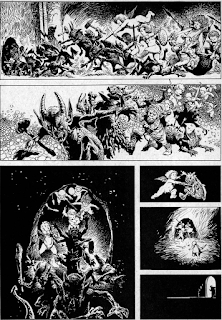
As the two men of the cloth walk away, they do not see a wondrous spectacle unfold. The Christmas gnomes slither and fly out of the shadows to kidnap the baby but a squadron of cherubs flies in from above (armed with spears!) and sends the gnomes right back to Hell. The old woman takes the statue away and, as the priests return and look on in wonder, the lifeless doll becomes a living, breathing baby.

"Once Upon a Miracle" is a bit on the hokey side, but I like how Dube jettisons dialogue and captions (you knew I'd like that) for the bulk of the story and lets Ortiz do his thing. Really nice visuals. I'm not sure what a half-crazed homeless woman is meant to do with what is, ostensibly, the rebooted Christ, but my mind won't dwell on those details long.

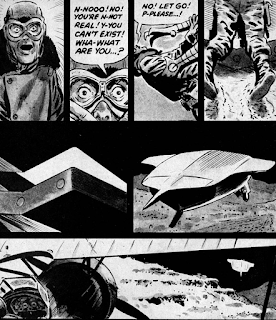
United States Airmail pilot "Tibor Miko" is flying to Gallup when he is approached by a UFO. The craft follows him for miles even as Miko tries to outmaneuver the stranger. Finally, Miko's biplane sputters and dies out, forcing Tibor to make an emergency landing. The spaceship lands as well and Tibor Miko hops out of his cockpit and approaches the vessel. He fires three shots from his .45 but the UFO remains undamaged. Suddenly, the hatch opens and some kind of creature exits and grabs Miko. The alien drags the pilot back into its ship and flies away. Tibor Miko is never seen again.

I have a tendency to rate anything Alex Toth touches highly; his art is simplistic but exquisite. Here, though, his writing sputters out just like Tibor Miko's biplane. There's no real wrap-up (and, yes, I know that's the point) and the buildup is nothing we haven't seen before. Still, there's that art and a few nuggets of good writing, as when Tibor faces down his adversary and yells out: "My name is Tibor Miko, air mail pilot! You have interrupted official delivery of the US Mail and are guilty of a felony, whoever you are! Now come out of there!" Cocky while terrified, no doubt.

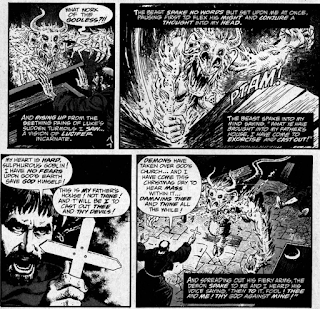
Friar Steel and his merry band of monks have recently been on a mission to rid the Earth of "Ungodly plunderers." Hard work can be tiring, so the holy men decide to rest at an abandoned abbey, but they soon discover that evil forces are at work within the sanctuary. One by one, Steel's comrades are torn to shreds, until he is alone and facing the culprit: a fiery demon who challenges Steel to a battle. The Friar destroys the satanic creature but then complains to his God above for not aiding him and his men. His whining is answered with a lightning bolt and a brand new tattoo on his forearm. Dazed, Friar Steel rises to begin his new crusade, serving his new master, Satan.

Though the climax is a bit confusing (it almost appears as though Steel is working for Satan the whole time and I initially believed the demon was a bouncer for God) and the captions can get a bit preachy, I enjoyed "The Final Christmas of Friar Steel." Budd Lewis tackles a weighty subject and manages to keep the proceedings involving and suspenseful. I've seen firsthand from past Warren stories that it's tough for these 1970s writers not to slip off that ledge of entertainment and fall into the abyss of proselytizing. I know atrocities were (and are) carried out in the name of God, but I don't need it hammered into my head. Lewis does a decent job of walking that thin line and, heck, he could've gone the Archie Goodwin route and revealed that Friar Steel was a ghoul in the end rather than reaching for something a little more deep. Severin's art is gorgeous, some of his best yet at Warren.

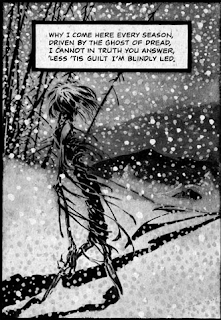
Any work delivered by the dynamic duo of Wrightson and Jones is a celebration and "Clarice" (a very simple tale of a man who loses his true love and then refuses to "let go") is no exception. Told in Poe-esque poetry and delivering a truly surprising climax, "Clarice" is a good example of how quickly Bruce Jones was ascending to the top of the horror comic writers in the 1970s. Wrightson's art, though not as detailed as some of his other Warren contributions, is stunning. That final panel, of the lovers finally reunited, is a stunner. 

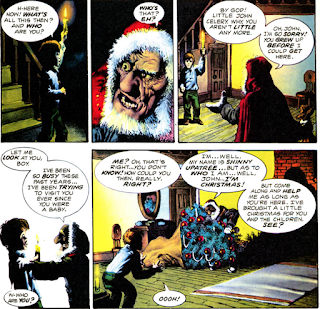
At Christmas, little John Celery and the rest of the children at the orphanage have nothing but the belief in Santa to keep them going. Their headmaster is a sadistic and vile man, who beats them and keeps them working from sunup to sundown. On Christmas Eve, John Celery hears a noise downstairs and explores. The boy is astonished to see a figure dressed in Santa's uniform, emerging from the chimney. 

The man introduces himself as Shinny Upatree and explains that he is Christmas and delivers happiness to believers such as John. Shinny sets out a grand buffet for the children and then ascends the stairs to suffocate the headmaster. His job complete, Shinny says his goodbye to John Celery and heads up the roof to his sleigh. Unfortunately, it seems Shinny is better at mashed potatoes and gravy than suffocation, and the headmaster empties two barrels in the Faux-Santa. Enraged, John Celery kills the headmaster with a well-thrown tree-topper and then boards the sleigh, bound to take over Shinny's role as miracle worker.

Corben and Christmas seem intertwined in my mind, thanks to quality contributions such as "Bless Us, Father" (back in #59), "Anti-Christmas" (#68), and "The Believer." All three (written by three different writers) contain strong characters, interesting conflicts and, above all, that unique Corben look. I'm not sure murdering the headmaster in front of a young, impressionable boy will inspire that boy's belief in everything magical, but I can put that to the side for now. But John Celery flying away and leaving his little comrades snowbound and alone in a huge house with a rotting corpse outside is not being a responsible big brother. At least the table is set. The sequel will show that the children became ghouls when they ran out of turkey and beetroot.

Sam Bleeker is down on his luck, penniless and selling buttons on the street corner. With his beloved wife long dead, Sam has little to live for except the ritual of buying a Christmas candle to light down at St. Mary's for said beloved, long-dead wife. Then, one Christmas, Sam is approached by a little girl who wants to buy a button to sew onto her dead mother's dress. So overcome with emotion, he hands the girl his entire sales case full of buttons and all the change in his pocket. Feigning gratitude for the fifty-pound suitcase she's just been gifted, the girl wanders away and Sam is left to ponder what his beloved long-dead wife would think.

Later that evening, Sam answers a knock on his door to discover the little girl on his stoop. Ignoring the fact that the little imp somehow managed to find him in a city of millions, Sam invites the girl in and is pleased to see she has brought him a book about Frosty the Snowman (no doubt bought with that spare change Sam had been saving for his beloved long-dead wife's St. Mary's candle). They read the book together and then Sam takes the girl home. As he's approaching St. Mary's, he is startled to see none other than... his long-dead beloved wife... emerge from the shadows and embrace him. Later, a patrolman tells the priest of St. Mary's about the "wino" they found frozen to death on the church steps. He hands the father Frosty the Snowman in hopes the book will help some troubled soul find peace.

Call me a Grinch, but I've got so many questions about this dull, schmaltzy, Twilight Zone wannabe. What's with the scene involving Sam and the shady mobster characters? They appear to be shaking him down for his buttons, but then they just part company none the worse. If this little girl is such a beautiful little cherub, then why does Sanchez give her more of a Village of the Damned look? This girl could be Damien's sister. I feel like Lewis was leading us down that The little girl is really dead! road but seemingly forgot to tie that bow. She's creepy looking. She's got one of the creepiest cover stories ever ("My mommy's dead and I want to sew a button on her corpse before they lower her into the ground"). She turns up unannounced at Sam's place. And where does Sam drop her off at the climax? I thought, for sure, the cemetery. Where's her Pop? But Lewis saves the biggest dose of saccharine for that cliched ending. Never saw that one coming. "First Snow, Mawkish Snow."

Years after the second ice age has arrived and rendered the Earth an icy wasteland, three men push their way through the snow, looking for food and rejecting the idea of cannibalism. In the end, though, they must do what they can to survive. I really hated "The Final Gift" and its wishy-washy message. Is eating human flesh good? No, absolutely not. We should never do it. Well, maybe it's okay if you look at it from the right angle. What is the point of DuBay's script when we know from the very first panel where this thing is going to go? If Dube had written this in the early '80s, he'd have titled it something clever like "When the World is Running Down, You Make the Best of What's Still Around!" Neary's art here is up and down (just like his other Warren art) but he gets the message across well enough. 

On Christmas Eve, Father Raymond is about to give his sermon to an empty house when a short, jive-talking demon enters and informs the priest that he's about to claim the world as his own. Thinking fast, the holy man asks if they can bargain for the souls of the world's population. Being a hip, with-it ambassador of Satan, the demon agrees and tells the priest he must give an example of just one good person in the world and the demon will return to Hell. After thinking it through, the priest is about to admit there are no good people in the world when a young boy enters the church and lights a candle for the baby Jesus. The demon throws up his paws and disappears. 
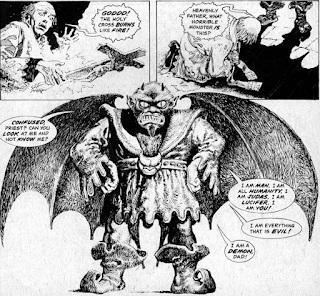
Oh joy! A demon who speaks jive!
Like "First Snow," "The Final Christmas" is more Hallmark Movie of the Week material from Budd, complete with embarrassingly bad dialogue ("Get your stinking hands off me, you jive turkey!") and unbelievable situations. So, this guy is a priest but he seriously cannot produce the name of one good person in his parish? Yikes. Time to turn out the lights, no? I liked Mones's art just as much as Lewis's script. It's muddy, ugly, and looks unfinished in spots. If you can tear the last three stories out of your perfect-bound issue of #77 without destroying the rest of the contents, you've got one damn fine issue of Creepy!-Peter

Jack-While this issue is a mixed bag, two stories rate four stars for me: "The Believer" and "First Snow, Magic Snow." "The Believer" seems like just about the perfect Creepy Christmas story, with superb art, beautiful color, and a narrative that bounces back and forth between heartwarming and horrible. "First Snow, Magic Snow" is another lovely story with outstanding art; it's spooky but not horrible. "Tibor Miko" benefits from the usual, gorgeous Toth panels but the story is only tangentially connected to Christmas and a bit vague. "Clarice" features stunning art by Wrightson and a rather monotonous series of captions in verse by Bruce Jones; I wish Bernie had been less rigid about the page layouts, which are four equal panels on every page.

I usually like wordless sequences, but the dialogue-free pages in "Once Upon a Miracle" did nothing for me and the story seems weak. John Severin is a great comic artist, but perhaps monks were not his strong suit; "The Final Christmas of Friar Steel" left me cold and includes another "vomit" reference by Budd Lewis, who seems to think "vomit" equals "horror." Paul Neary's art can be good, but perhaps he's out of his league in this star-studded issue. "The Final Gift" is a boring, dystopian tale with a rather disgusting finale. The big drawing of the demon in "The Final Christmas" is impressive, but the dialogue is embarrassing and the story unoriginal. I did like the ending, though.


Eisner
The Spirit #12

"The Jewel" (3/12/50)
"Carrion" (3/19/50)
"R-E-S-C-U-E" (4/9/50)
"Pancho De Bool" (10/24/48)
"The Christmas Spirit" (12/19/48)
Story and Art by Will Eisner

"Snow" (12/14/47)
Story by Will Eisner
Art by Will Eisner & Jerry Grandenetti

"Tooty Compote" (10/3/48)
Story by Will Eisner and Jules Feiffer
Art by Will Eisner

"Big Arky" (5/21/50)
Story and Art by Will Eisner

"The Christmas Spirit: A Fable" (12/22/46)
Story by Will Eisner
Art by John Spranger, Will Eisner & Bob Palmer

Jack-For an issue that advertises "The Christmas Spirit" on the cover, this volume isn't very Christmassy! That said, my favorite story is the 1948 "Christmas Spirit," a sentimental tale where a crook escapes from prison only to use his hidden loot to pay for surgery to restore a boy's vision. The 1946 "Christmas Spirit" is a badly-dated dud that makes me wonder just when Eisner got back from his war service and resumed doing these weekly comics. An online article says he got back a year before this, just in time for the 1945 Christmas story, so there's no excuse for the 1946 entry to be so weak.

"The Christmas Spirit" (1948)

The linked trilogy of stories that open the issue are pretty good; I've always liked Sand Saref, Carrion, and Julia (the bird), but the Warren editor left out a story that ran on 3/26/1950, so when the next story pops up here a new character has joined the action and we don't know where he came from. This has been a problem before in the Warren Spirit mags and I don't know why they couldn't get the chronology straight.

The other three stories are average at best--"Pancho De Bool" isn't as funny as it wants to be, "Snow" makes me realize how much I've lost patience with Ebony, and "Big Arky" is rather obvious but has a fitting finish. This is not one of the better Warren Spirit issues.

Peter-I found the three-parter, “The Jewel/Carrion/R-E-S-C-U-E,” to be a thing of beauty, and I love the continuity, but the script, frankly, put me to sleep. A whole lot of nothing going on. In fact, there's not much for me to sing out about in this issue. As Jack says, it's a very sub-par issue of The Spirit, but that may be due to an overload on the character. Maybe once a week was the ideal way to experience Eisner and his brilliance rather than reading nine stories back-to-back-to...


Sanjulian
Eerie #72

"Daddy Was a Demon Man"
Story by Bill DuBay
Art by Jose Ortiz

"The Valley of Armegeddon [sic]"
Story by Budd Lewis
Art by Paul Neary

"Beware: The Scarlet Combine"★1/2
Story by Budd Lewis
Art by Howard Chaykin & Bernie Wrightson

"A Thin Dime of Pain"★1/2
Story by Doug Moench
Art by Leopold Sanchez

"The Pie And I"
Story by Budd Lewis
Art by Luis Bermejo

"The Incredible People-Making Machines"
Story and Art by Jose Bea

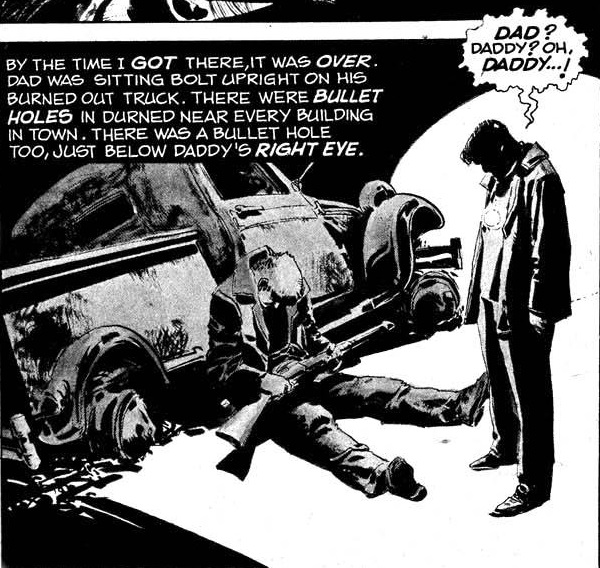
In the small town of Crucifixion Hill, NM, in 1912, a villainous man in a top hat bursts in on the mayor to demand that he turn over a bracelet, after which the man shoots and kills the mayor and announces to his friends that "the town is yours." Mayhem follows, aided by three demons conjured up by the villain by means of the magic bracelet. It seems the villain's name is Jedediah Pan and he has reason to be angry. Twenty years ago, Pan and his family moved into Crucifixion Hill and he built a house in record time, possibly assisted by demons. When his wife got sick he begged the townsfolk for help, but they tried to lynch him instead because they thought he was a Satanist. The good news for him (and the bad news for the townsfolk) was that they were right, and Jedediah summoned up a demon to do away with the townsfolk.

Carnage followed and Jedediah's wife and daughter were killed, but his baby son Jeremiah was saved by a man and his wife, who raised the boy as their own. Now twenty years have passed and the boy is a man. His father explains that he is really Pan's son and that Pan wants him back, along with the other bracelet he used to summon demons. Jeremiah heads into town to confront his father, wearing the bracelet, but when he tries to summon up a demon nothing happens. "Daddy Was a Demon Man," though, and Jedediah summons up a trio of demons, which Jeremiah destroys using his gun and his fists. He then has a fistfight with his father and ends up throwing the bracelet at his feet. Jedediah leaves town, but before he goes he tosses the bracelet back to Jeremiah, not realizing the young man is his son. Jedediah explains that the bracelet can be used to summon three other demons, something Jeremiah is quite interested to know.

I enjoyed this story, even though the story is somewhat confusing. The art by Jose Ortiz is perfect and fits the Old West setting. I'm glad to see that this will be a new, continuing series, since I like the idea of the bracelet that summons demons and the mix of horror and the Old West seems promising.

Boy is that one ugly cover by Sanjulian!


Hunter and the Exterminator are close to the mountain fortress of Yaust; they just have to cross "The Valley of Armageddon" (I corrected the misspelling in the title), which is guarded by an army of goblin warriors. Down into the valley go Hunter and the Exterminator, only to find themselves in the middle of a conflict between goblins and trolls. After a bit of fighting, Hunter and the Exterminator begin climbing toward the fortress, where they are surprised to find themselves welcomed by the wizard Yaust, who knows that they are there to kill him.

I'm happy to report that Budd Lewis keeps his string of references to "vomit" going in this story, which seems not much different than the last few Hunter entries. Hunter and his mechanical pal travel a bit, see some goblins, have a fight, and travel some more. The art is fair to middling, par for the course with Neary.

In 1932, private eye Reuben Youngblood receives a letter from his partner, who is on assignment in Germany and who has uncovered an organization that is smuggling blood into the fatherland. Soon, Youngblood is hired by a beautiful woman named Kelly to be her bodyguard on a flight to Germany the next day. The flight is by zeppelin, but when Reuben and Kelly get on board, they find a costume party. In the middle of the party, they learn why they should "Beware: The Scarlet Combine"--a woman is slaughtered for her blood! Putting two and two together, Reuben figures out that vampires are behind the plot, and he and Kelly escape in a prop plane and blow up the blimp, incinerating the vampire on board.

Howie Chaykin's art is certainly an acquired taste and I see no evidence of Bernie Wrightson's inks in this ten-pager, which features some of the worst spelling I can remember in any Warren story. That said, I was intrigued by the time period and the setting and Chaykin knows how to draw people (and clothing) from the Great Depression. It was obvious that this was a vampire story right from the start, and nothing very surprising happens, but I have to give him an "A" for effort. This story doesn't look like anything else in a Warren mag.

"A Thin Dime of Pain" is all it costs to see the freaks at Goldnut's Carnival of Wonders! The poor souls endure humiliation and hope to save up their money to escape the circus life and get a place of their own. When a nasty young man throws an apple at Sweetpea, the human slug, that's the last straw for Dramulo, the human bat, who attacks the young man.

Unfortunately, the creep in the crowd turns out to be the son of the carnival's owner, who punishes the freaks by docking their pay for the next six months. That night, they bed down in their crowded wagon, and Dramulo gives his cot to Oscar, the thin man, and goes out for a walk. The owner's son sneaks in under cover of darkness and knifes the body in Dramulo's bed, not realizing it's Oscar. Dramulo returns and, when he and the other freaks find out what has occurred, they take revenge on the son and his father by killing them and stitching their body parts back together haphazardly.

Doug Moench tones down his usual pompous over-writing somewhat for this straightforward tale of revenge, which is nicely illustrated by Leopold Sanchez. The vivid colors add to the story's enjoyment. The conclusion is similar to that of the film, Freaks, but it could be a lot worse.

It's 1942 and Richard Harris has grown up, long after the death of the alien he called Pie. Bullies torment Richard when he refuses to sign up to fight in WWII; he goes to college instead and sometimes pulls out the magical gadget that Pie gave him long ago, which he has never used. When he is beaten up for refusing to fight in the war, his father takes his rifle to town, but is shot and killed. Richard grabs Pie's gadget and plans to destroy the town and kill its inhabitants, but the Pie speaks to him from inside the gadget and counsels mercy.

"The Pie and I" is a surprisingly gentle story from Budd Lewis, though as I was reading it I kept thinking that Alex Toth's art looked a little less impressive than usual. No wonder--the story is drawn by Luis Bermejo! It's another straightforward narrative with little to recommend it beyond the memory of the prior story, which was much better.

Walking to school one day, Peter Hypnos hears a strange melody. He follows it to its source and encounters strange people with large heads, heads of animals, and so on. He discovers his friend Willy Whambanger, whose head has grown very large and who leads Peter to a factory where "The Incredible People-Making Machines" create the unusual folks. Peter does not want to be altered and escapes, but when he gets home and tells his mother what happened she doesn't believe a word of it.

Jose Bea must have watched Yellow Submarine, read Willy Wonka and the Chocolate Factory, and then dropped acid when he produced this bizarre story. The art is suitably weird but the whole thing never really goes anywhere and then just ends. Not a bad issue of Eerie, but not as good as it could have been.-Jack

Peter-More and more, I seem to be losing track of what's going on in these Eerie series. That goes double for "Daddy Was a Demon Man," which will see a further three installments in the next few months. Whose daddy is who; whose son is who? I couldn't keep pace and my notebook is filled with more black ink than an Alex Toth story. My decades-old notes remind me that the second installment is actually pretty good. We'll have to see if the older and much wiser me agrees with that young know-nothing. 
My complete lack of perception continues with the latest Hunter II installment (not that I could fathom what was going on last issue, either). Every time one of the characters said something like "What the hell is going on here?" or "This is getting confusing," I would shout at the cartoon, "Right???" There are some serious insults being tossed across the battlefield: "Come down and die, you maggots!"; "the last shot's for you, you vomit!"; and my favorite, "Kill the puking spy!" An adventuresome mangling of verbs and adjectives and how could no one have elbowed the letterer after the umpteenth misspelling of "Armageddon?"

Though the plot of "Beware: The Scarlet Combine" borders on the ludicrous (a company that specializes in importing blood for vampires), I haven't had so much fun reading an Eerie story in quite a while. Youngblood, to me, seemed to be cut from the same cloth as the pulp characters that populated the pages of Byron Preiss's Weird Heroes paperback series. Wrightson and Chaykin make for an unusual team; I'd have preferred one or the other take the reins on the entire strip, but the results are still attractive. We'll have to wait quite a while for a sequel (Eerie #127), but The Warren Companion informs us that the follow-up was written and illustrated shortly after this initial chapter.

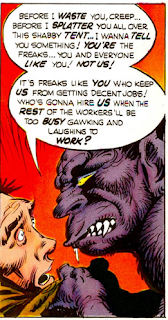
"A Thin Dime of Pain" is a very thinly-disguised rip-off of Tod Browning's Freaks, with Doug's adjective-stuffed narration (a seedy backdrop of moist sawdust and moldering straw, disguised behind a garish facade of gaudy greasepaint and spectacular shuck!) perfectly mirroring that of a carnival barker. Moench's gargoyle ("Before I waste you, creep...") could be lifted straight out of one of his Marvel scripts and the plot is typical revenge nonsense, capped off by a predictable "twist" climax. The color is nice, though.

"The Pie and I" is a perfect example of going to the well one too many times. The original story (back in Eerie #64) was a melancholy and sweet tale (a rare one by DuBay), but this sequel reads like Budd Lewis had just emerged from a viewing of Death Wish and felt he had to contribute his two cents on the evils of revenge. Hilarious that Pie waits until our young hero burns the town down before piping up with a "Let's forgive these rednecks for they know not what they do!" I never liked Magical Mystery Tour or Yellow Submarine, but at least there was some good music. “Peter Hypnos” is just as juvenile and nonsensical and but doesn’t have good music. I suspect the script was rewritten by Dube or Budd and they did their best with the goofy panels Jose Bea provided. Not my cup of tea.


Next Week...
It's Brave...
It's Bold...
It's a Blast from
The Past!