Monday, December 14, 2020

Batman in the 1980s Issue 17: May 1981


The Dark Knight in the 1980s
by Jack Seabrook &
Peter Enfantino


Aparo
The Brave & the Bold #174

"To Trap an Immortal"
Story by Gerry Conway
Art by Jim Aparo

Batman and Green Lantern travel through space in a big bubble with the Guardian in order "To Trap an Immortal." They arrive on Maltus and Green Lantern reunites with his friend, the Old Timer, who had been stripped of his immortality after journeying across America with Green Lantern and Green Arrow. The group then travels to Oa, where they and the Guardians are quickly attacked by a giant green knight brought to life by Sinestro.

Batman uses good-old-fashioned trickery to defeat the knight and then sends Green Lantern off on a secret mission. The Old Timer tricks Sinestro into revealing himself and the villain attacks, drawing huge amounts of energy from the power battery. Green Lantern returns with all the members of the Green Lantern Corps and, when they overwhelm the power battery, Sinestro is defeated and reverts to his true form. The Guardians offer to make the Old Timer immortal again as a reward, but he declines their offer, happy to experience getting old.

Jack: I was happy to see the brief summary of the classic Green Lantern issues by O'Neil and Adams and I enjoyed the interplay between Green Lantern, Batman, and the Old Timer. Sinestro never seems to present much of a menace here, but the team-up succeeds because Batman and Green Lantern work together and use their respective strengths to beat the bad guy. Aparo's art here is outstanding, making it a most enjoyable 17 pages.

Peter: If I'm to be completely honest, there's way too much Green Lantern mythology and battery-powered mumbo-jumbo for my tastes. I can't make heads or tails of what's going on. DC sci-fi hero tales have never been a big draw for me and "To Trap an Immortal" is definitely way too complicated for my little brain. I can, however, appreciate good artwork when it's thrust before me and Jim Aparo makes even a bunch of green yo-yos look like a million bucks.

"Bishop's Sacrifice"
Story by Cary Burkett
Art by Dan Spiegle

Held at gunpoint by an agent of Scotland Yard, Nemesis fails to talk himself out of trouble and must resort to his fists to make his escape. As Valerie arrives in England to help Nemesis defeat the Council, Nemesis disguises himself as a portly Britisher and gains entrance to the home of Mr. Chesterton, only to discover a plot to kidnap British notables, including the queen. He locates two of Chesterton's flunkies, who plan to kidnap a bishop, but when Nemesis realizes that the same duo have nabbed Valerie, he decides he must save her and forget about the bishop.

Jack: The Nemesis series seems to chug along from story to story without ever seeming to go anywhere. The art by Dan Spiegle is easily the worst we're seeing in any of the DC comics we're reading for this series. Still, "Bishop's Sacrifice" isn't awful--it's just not very good.

Peter: This is tedious, boring claptrap with no redeeming qualities whatsoever. I find it hard to believe Cary Burkett was much more interested than I am. The fact that "Nemesis" lasted so long as a back-up in The Brave and the Bold is gobsmacking. Spiegle's character features are interchangeable, making it all the more difficult to figure out exactly what is going on from panel to panel. Well, that is, if I wanted to know.


Aparo
Batman #335

"The Lazarus Affair, Chapter 4:
Ashes to Ashes!"
Story by Marv Wolfman
Art by Irv Novick & Frank McLaughlin

When Ra's al Ghul offers Batman a choice between immortality or death for him and his friends, Batman wisely chooses to obey Ra's al Ghul, even though Ra's knows he's lying. Ra's admits to the Caped Crusader that he was really after Bruce Wayne's vast wealth and Batman changes his tune and spurns Ra's's offer of immortality. The Mutates overwhelm Batman and, fortunately, Robin and the gang manage to escape from the clutches of other Mutates and race to Batman's aid.

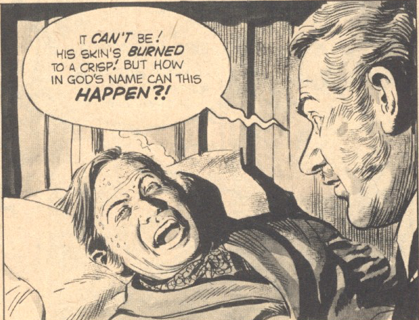
Batman narrowly escapes being transformed into a Mutate himself and Ra's is captured. Al Ghul is upset that his daughter Talia prefers Batman over her father, but when sniveling assistant Saltzer shoots Ra's, family loyalty takes precedence and Talia is subjected to a refreshing dip in the Lazarus Pit, which saves her life. Instead of acting sensibly and carting Ra's back to the U.S. to face the authorities, Batman dismisses all of his friends and engages in a one-on-one fight with al Ghul. Ra's lands in the Lazarus Pit and emerges in terrible pain and on fire; further fighting ends with Ra's again dumped in the Pit. This causes the volcanoes of Infinity Island to erupt and destroy the land mass, but not before Batman and Talia escape by helicopter.

Back in Gotham City, Talia announces to Bruce Wayne that she wants to see what it's like to grow old and she wants to do it on her own. Dick Grayson is ready to reconcile with his old pal and the two head outside to enjoy the sun.

Jack: It wasn't awful, but it wasn't very good, either. "Ashes to Ashes!" wraps up this four-issue story arc by killing off Ra's al Ghul, though I'm sure he'll find a way to come back. I found it puzzling that Batman would prefer to engage in hand-to-hand combat with Ra's rather than just take him along for a plane ride and turn him in. Where's the sense in that? Doesn't Batman have enough scars and broken bones? Why would Robin agree to this? "Oh, OK, Batman, we'll just head home now. Have fun fighting the immortal nut!" Also, Robin, Catwoman, and company round up a bunch of Mutates and take them back to the U.S. for treatment before the island blows up. That was fortunate! Good thing they didn't say, "Hey, Mutates, we'll send someone for you real soon. We've gotta go!" I do hope things improve next issue; the editor writes in the letters column that Roy Thomas takes over as new writer.

Peter: Hard to believe four issues were dedicated to this cheesy, melodramatic dreck. There's no real plot; Ra's stays undercover for three issues to attain what? The island he was already using and Bruce Wayne couldn't be bothered to know about. The properties of the Lazarus Pit remain a mystery to me. Ra's mentions he lies down in the pit to be resurrected after every death, but a few seconds in and he's burning to a crisp. Yet Bats is stuffed into the pit for what seems to be the same amount of time and his cowl doesn't even singe. Perhaps there's a Lazarus Pit website I can google that will give me the full rules. This is Marv's final script for Batman and, after a one-issue fill-in by Bob Rozakis, Gerry Conway will come in to attempt a resuscitation. Hopefully, he'll use his skills as a storyteller, rather than the Lazarus Pit, to attempt that feat.


Aparo
Detective Comics #502

"Who Shot Mlle. Marie?"
Story by Gerry Conway
Art by Don Newton

As Julia and her sympathizers prepare to execute Alfred for the murder of Mlle. Marie, Batman works his way free from his bindings. After a brief tussle, Bats makes Julia promise not to kill Alfred until he comes back with proof of the butler's innocence. The Dark Knight heads to the Sûreté, where he speaks to top inspector Dupre. The officer's tips lead Batman to visit Marie's half-sister, now dying in the hospital, as Bruce Wayne. Mlle. Revel explains that Marie suspected one of her freedom fighters was actually a double-agent for the Nazis--a man named Roget, the man Revel suspects was her sister's assassin. Revel further confesses that she'd saved the bullet she pulled from Marie's shoulder in hopes that it could be matched to the assailant's gun.

Just as the woman finishes her story, bullets riddle the room. Bruce changes into something more comfortable and chases the gunman back to Revel's house, where he discovers Inspector Dupre searching for the bullet. Dupre explains that he knew the jig was up and it was only a matter of time before Marie gave him up as a turncoat, so he had to silence her. Another short scuffle ensues and the Batman makes short work of Dupre/Roget. Back at the barn where Alfred is about to meet his maker, the Dark Knight introduces his prisoner (and the gun that may have killed Marie) to Julia and her buddies. Julia asks the Caped Crusader why Alfred never defended himself against the accusations; a look of understanding passes between master and servant and Bats shakes his head: "'I don't know, Julia, and does it matter?'"

At the airport, Alfred thanks Jacques, Julia's foster father, for not spilling the secret that Alfred is actually Julia's father. He supported her for years, didn't want to disrupt her childhood by invading her life, and didn't know she existed until she was two years old (and a whole lot of other expository nonsense). Alfred and Lucius board the plane and take off, leaving the Batman behind to look on pensively.

Peter: There's a lot to like in "Who Shot Mlle. Marie," but I'll be the first to acknowledge there are logic holes large enough to comfortably house several troops of freedom fighters. The espionage and Roget reveal are handled well; there's a lot of suspense and action. We, of course, never fear for Alfred's life, nor do we suspect for even a nanosecond that maybe he put a bullet in his lover all those years ago. The art is dazzling; Newton's Batman is about as close as you'll get to Bernie Wrightson's and the support characters and background fill-ins (two aspects of the artwork that most of the Bats visualizers tend to ignore) have as much detail and care lavished on them as the foregrounds. 

But let's just talk about those plot holes and unanswered questions for a moment. Alfred comes off as supremely selfish, rather than a caring father from afar, for not owning up to his part in the making of little Julia. Are you telling me our trustworthy Alfred Pennyworth has been sending hush money overseas for thirty-five years instead of maybe asking Master Bruce if he can bring the tyke over for a better upbringing? It's obvious this girl has been one bitter fille all her life; possibly a little TLC was in order? And what's with Jacques standing around with his mouth shut while Julia gets ready to string her own Pop up for a murder Jacques knows he couldn't have committed? Perhaps the oddest bit about this story is the actual fate of Mlle. Marie, who got up in the middle of the night, mere hours after childbirth, and abandoned her newborn daughter to rejoin her fellow fighters. At least that's what I got from the narrative. And it's hinted at that the body may not have been Marie's. Might we learn that our favorite little machine-gun-toting spark plug survived and may well be the focus of some shocking expose down the road? 

Jack: I sure hope so! I found this two-part story to be a delightful surprise after having read so many DC War comics. Who would have expected Mlle. Marie to be referenced in Detective in 1981? I knew she wasn't dead! I love the speedy investigation by Batman and Bruce Wayne and was shocked to learn that Alfred fathered a daughter with Marie! Alfred, you dog! I'll bet Marie returns eventually.

"To Live a Nightmare!"
Story by Cary Burkett
Art by Jose Delbo & Joe Giella

Dr. Voodoo kidnaps darling little Tracy Dover and uses the moppet to lure Batgirl into a trap. But Babs has had enough of being afraid and overcomes her demons just in time to wallop the big, bad voodoo daddy and save the day.

Peter: I really liked the first chapter of this two-parter, but the conclusion is nothing more than a rushed wrap-up. The fear factor that held Babs/Batgirl in a tight vise last issue seems to have diminished to nothing more than a case of the shakes here. Biggest larf for me this issue was Babs's boss, Mr. Stein, pulling his gorgeous, red-headed employee into his office and explaining that he knows the trial may have put a dent in Barbara's schedule and a few essential items might be a tad late, but now is the time to batten down the hatches and get to work. That special report on the city's transit system is due this afternoon! Minutes after agreeing to the old man's request, Babs is back to swinging across town, Transit Report be damned! 

Jack: Cary Burkett's back-up stories this month are not impressive and show just how hard it must have been to pump out comic tales one after the other. Did the villain die in the fall? Batgirl doesn't seem too concerned. The art recalls Don Heck's work on Batgirl in the '70s in spots and the last two panels, where the little girl tells Batgirl all is well, reminded me of those Hostess ads that seem to appear in every DC comic around this time.

CIRCULATION! WE'VE GOT CIRCULATION!

Peter: As is our wont around here, we present the annual circulation numbers for the three regular titles (along with the previous years' numbers, so you can see how the comic world was faring); the figures published in 1981 actually reflect on how the title sold during the previous twelve months.

Jack: I'll bet the numbers are so low for Detective because of the $1.00 cover price.

Batman

1980: 129,426
1979: 166,640
1978: 125,421

Brave and the Bold

1980: 109,307
1979: 153,034
1978: 121,563

Detective Comics

1980: 64,762
1979: 79,872
1978: 129,792

Next Week...
Skeates and Corben
Do Not Let Us Down!

Monday, December 7, 2020

The Warren Report Issue 48: January 1974


The Critical Guide to 
the Warren Illustrated Magazines
1964-1983
by Uncle Jack
& Cousin Peter


Sanjulian
Eerie #53

"Enter: Mr. Hyde"★★1/2
Story by Steve Skeates
Art by Jaime Brocal

"To Save a Witch's Soul!"★★
Story by Al Milgrom
Art by Martin Salvador

"Hunter"★★★
Story by Rich Margopoulos
Art by Paul Neary

"First Night of Terror!"★1/2
Story by Doug Moench
Art by Vicente Alacazar & Neal Adams

"Spawn of the Dread Thing"★★★
Story & Art by Tom Sutton

Looking for the woman who has the amulet that will free him from the ancient body, the mummy breaks into her apartment and reads her diary. In another part of Boston, a scientist named Warren (!) decides to test out his serum to extend life on himself, but he turns into a violent beast! Rushing into the street, he murders the first woman he sees and attacks the first man he sees, but that man turns out to be the mummy, wearing clothes he has stolen in an effort to be less conspicuous. They fight violently and the mummy breaks the beast's neck. The mummy hops a freight car that will take him to the woman; the police find the dead body of the scientist and wonder who killed him.

"Enter: Mr. Hyde"
When you call a story, "Enter: Mr. Hyde," you should find some way of getting Mr. Hyde in there. Instead, Steve Skeates gives us a Boston scientist whose transformation reminds the mummy of reading Stevenson's novel. Really? Is the mummy series going to have a new monster each month for the mummy to polish off after a page of fighting? Next month: the mummy meets the invisible man! At least we have solid art by Jaime Brocal. The idea of the mummy donning a suit of clothes and hopping a boxcar is at once ridiculous and intriguing.

Now that Arthur Lemming understands what we has done as the werewolf, he vows "To Save a Witch's Soul!" If not exactly a witch, he can at least try to prevent his wife from being burned at the stake. He appeals to the police but is thrown into a cell right next to that of his wife, Angela, leading to a speedy reconciliation. She is led out to be burned, but the full moon rises and Arthur transforms into the werewolf again, breaking free of the prison and wreaking havoc on those attempting to turn his wife into toast. He rescues her and runs off. Arthur wakes up the next morning at her side and apologizes for the trouble he has caused, but when the moon rises once again, he returns to werewolf form and kills the woman he just saved.

"To Save a Witch's Soul!"
Martin Salvador is making me wish for Rich Buckler's return. His werewolf looks about as scary as my neighbor's puppy. Arthur sure has a change of heart as soon as he is cursed with the memory of his violent acts; his wife is also awfully forgiving. Didn't they have serious marital problems before he went all hairy, or am I remembering wrong? In any case, the final page of this story is confusing. I'm giving Milgrom the benefit of the doubt with my recap, but that's only my interpretation of what happened. The way it's presented, it looks like the werewolf changed back to Arthur, got cozy with Angela, and changed right back to the werewolf again. The only way to explain it is to assume that Arthur and Angela sat around in the grass from night to morning to night again. And if Arthur knew what was going on, wouldn't he have seen this coming?

Nuclear war in 2001 led to the development of mutant "demons" and, 50 years later, a series of wars between them and humans. When a demon general appears at the farmhouse of James and Elizabeth Hunter demanding help, James refuses and is promptly killed. Elizabeth is then raped repeatedly and, the next year, she gives birth to a half-human, half-demon boy whom she names Demian. Eventually, his mother dies, and the teenaged Demian volunteers to train with the human cavalry and fight demons. A warrior named Jagger teaches him to fight and, when Jagger is killed by demons, Demian takes swift revenge. The Demon Wars come to an end, but the warrior known as "Hunter" fights on against the darkness within his demon half.

"Hunter"
This origin story is very well done, both in writing and art, though I could do without some of the made-up science fiction words like "cyclochicks" and "con-crush-ion grenade"s. The first part of the story reads like a prototype for Mad Max and the middle part is like any number of legends with half-breed children. Part three, where Hunter goes out and trains for battle, is nothing new either, but somehow the whole package works. I'm looking forward to more of this series and to more Paul Neary artwork.

Derek Schreck thinks back to when the Chinese and the Americans obliterated each other's nuclear testing sites on the moon and the radiation made its way to Earth, creating mindless, violent zombies everywhere. Schreck fought his way home through a crowd of zombies and found his wife, Paula, incredibly horny and wanting lots of sex. In the middle of the night, she lost her marbles and attacked him with a meat cleaver, cutting off his hand. He cauterized the bleeding in the fireplace and now writes with a hook.

"First Night of Terror!"
Good lord, if I can have one prayer answered, please don't let this be the first entry in a series. "First Night of Terror!" is twelve endless pages of a mixed-up stew of I Am Legend and The Body Snatchers, with perhaps the most explicit topless female we've seen yet thrown in. How in the world did Neal Adams get involved in this? As inker, he has a heavy hand, and some of the panels have that classic Adams look, but the script by Moench is such dreck (rhymes with Schreck) that it saddens me to see the great artist's time wasted. This is truly awful stuff and I only gave it a half star above the dreaded one-star rating because of the technical expertise of Neal Adams.

Victorian-era (?) detectives gather after a pretty young woman is decapitated by a killer. Inspector MacBaine is brought in, having solved a similar crime many years ago, but he defers to the mysterious Fathom Haunt, a wizard who seems not to have aged since he and MacBaine worked together long in the past. Haunt and MacBaine retire to Haunt's house, where Haunt summons up mysterious creatures who nearly capture MacBaine. The duo proceed to a graveyard, where they battle the "Spawn of the Dread Thing," a giant, ghostly baby with magical powers and a bad attitude. Fortunately for all of us, they defeat it and go their separate ways.

I'm happy to see the return of Tom Sutton, whose work has been scarce in the Warren mags recently. I've never been a fan of Lovecraft knockoffs, and this story certainly is that, but it's also creative and beautifully illustrated. Unlike my reaction to "First Night of Terror," I am looking forward to more Fathom Haunt entries, even if I still don't know how to pronounce Cthulhu.-Jack

"God's what?"
Peter-
By this point, The Mummy and Werewolf plotlines are virtually interchangeable. Mr. Hyde is name-checked in the title, but he makes nothing more than a cameo. Why? Who knows? His appearance is inconsequential and noggin-scratching, as is the climax of this Werewolf chapter, wherein Lemming goes to a whole lot of trouble to rescue his wife and subsequently murder her. Why? Who knows? The only thing I know is that, by this time, Al had obviously seen enough (or written enough) and jumped ship for a very successful career over at Marvel. Steve is going to script the final chapters of Mummy and Werewolf next issue and then do something deliciously radical. 

The second chapter of "Hunter" finds RicMargo plumbing the depths of his inner Moench and spewing forth such pretentious lines as "The ebon night discovered the orphan under a swollen moon..." The promise found in the first chapter is, evidently, on hold. God help me, but I enjoyed "First Night of Terror," Doug's obvious "homage" to Matheson's I Am Legend, a sleazy little vehicle that boasts a strange collaboration between Vi(n)cente Alcazar and Neal Adams. Some of the panels look gloriously Neal and some look Skywaldian in their starkness (but the GGA rates a ten!). I will admit up front that there's very little originality or substance here, but Schreck certainly keeps your interest. Let's see how the remaining two chapters pan out.

"Spawn of the Dread Thing" might be a little shy of a full script, but the fact that the name "Cthulhu" is uttered rather than some second-rate imitation puts me firmly in its corner. Never mind the script, though, this is a Tom Sutton artistic tour-de-force, easily the most intricate tapestry he's unveiled in his Warren years. Every page is a poster for my teen bedroom. Alas, this is the only installment in what was to be a Sutton series; Eerie could have done with at least one more good series.


Sanjulian
Creepy #59

"Destiny's Witch" ★1/2
Story by John Jacobson
Art by Ramon Torrents

"A Dark and Violent Place" ★
Story by Don McGregor
Art by Adolfo Abellan

"Spare That Tree!" ★1/2
Story by Jack Butterworth
Art by Martin Salvador

"Bless Us Father..." ★★★1/2
Story by Bill DuBay
Art by Richard Corben

"Curiosity Killed the Cat" ★★1/2
Story by Doug Moench
Art by Paul Neary

"Not a Creature Was Stirring" ★★★
Story by Don McGregor
Art by Tom Sutton


"Destiny's Witch"
When a series of demonic (some might say vampiric) attacks sweep a small village, suspicious eyes fall upon Mr. Cromwell's pretty handmaiden, Ara, but the girl swears innocence. Well, she's not a vampire, but she is a budding witch, stealing out into the forest each day for a lesson in broom-riding from Mother Hastings. When the creature attacks a tribe of Indians living just outside the village, tensions run high and Ara decides it's time to receive her final lesson. She heads out to Mother Hastings's shack, only to discover the old woman dying and ready to turn her witchy powers over to Ara. 

Ara heads back to the Cromwell estate, where she sacrifices Lizabeth Cromwell and drinks her blood. Unfortunately, she performs the ritual in front of a live audience and the Cromwells, thinking the girl a vampire (rather than a witch), drive a stake through Ara's heart, killing her. Three hundred years later, the stake rots and Ara rises from the grave to take her vengeance. 

What a mess! John Jacobson seems to have wanted to tell three or four stories simultaneously with "Destiny's Witch," but didn't have enough for one. Ara is introduced as a kindly maiden, then we have our doubts, then she's a good girl again, then we discover she's actually a witch, maybe a vampire. Her beau, Oliver, might be a werewolf, but that's never made clear. And you'd think a budding witch would have a good sense of her surroundings, but Ara manages to make embarrassing blunders left and right (not only does she drink blood in front of what seems to be a full house, but she makes a life-threatening admission to Oliver in the forest while three or four men are standing nearby--does she shout her secret out?). The epilogue, where Ara returns to confront her betrayer, Oliver (who's now a tour guide for vampire sites!), is clumsy and raises more questions than it answers. The Torrents art is great but puzzling in spots. One panel seems to meld into the other, not always producing the effect Torrents was striving for.

"A Dark and Violent Place"
Inspector Brannon (the white guy) and Detective Harry Phillips (the black guy) are called to an old, elegant movie theater in a black neighborhood to investigate a bizarre slaying. The murder mirrored the violence happening on screen at the time. Though the two cops have their (racially-centric) differences, both want to catch the killer as quick as possible to prevent a second murder. While strolling through the theater, Brannon is attacked and murdered by a hooded "phantom," who strikes and then fades back into the darkness. Phillips concocts a plan to catch the phantom, involving a street cop and a theater employee, which goes tits up fast. Our harried police detective chases the jive-ass mofo phantom into his lair in the subway, where he watches as the misunderstood (and disfigured) assassin lights himself up on a third rail.

"A Dark and Violent Place"
I've run out of "superlatives" for Don McGregor's Warren work; as soon as I've declared that a current story must be the worst crap McGregor ever produced, he lowers the basement floor yet again. Infused with the type of writing that makes white guys like me shudder (could we actually think black men call every woman "mama" or "sweet sister?"), "A Dark and Violent Place" is an ugly, pretentious, and (hopefully) dated view of racism in the mid-1970s. McGregor wants us to think he's raising cogent questions about the way whites exploit blacks with entertainment but then has his African-American protagonist, a New York detective, mind you, address his partner as "baby." Rather than do some good-old-fashioned detective work, Harry whips up a dangerous and stupid plot to trap the phantom that risks the lives of both cop and citizen. My favorite bit of dialogue:

Harry: You know what your problem is?
Brannon: Not really...! But I do know you're going to tell me... right?

That's my feeling exactly about McGregor's scripts. Preaching via a clumsy re-working of The Phantom of the Opera with dialogue ripped from the pages of Luke Cage, Hero for Hire, comes off as just that, derivative and wrong-headed. Awful art as well, muddy and sketchy. Easily a front-runner for Worst Story of the Year.

"Spare That Tree!"
Dr. Parker arrives at the estate of Sir Edgar Holloway to see a most perplexing sight: the hanging body of one of Holloway's servants. Holloway's butler, Jennings, explains to the good doctor that the corpse belongs to his brother, shot and hung for chopping down a tree on the estate. Perplexed, Parker confronts the master of the manor with the question of "Why?" Sir Edgar explains that, when he was a young boy, he became deathly ill and a local druid took him and his parents into the forest and worked a little magic. A certain tree was tied into the soul of Edgar. Little Lord Edgar was completely cured but, to avoid blackmail, his father murdered the druid and buried him at the base of the tree. 

Unfortunately for Sir Edgar, he never did learn the whereabouts of that tree, so a ban on felling was put into force. Just at that moment, Sir Edgar starts running a fever and the doctor exclaims that the man's skin is boiling to the touch. Jennings enters gleefully to explain that he knew where the tree was all along and, as revenge, has it burning in the fireplace. Butterworth's foundation is an interesting one (druid + tree + soul + big mistake = bad trouble), but the delivery is confused and muddled. At one point, Jennings reveals that his brother was buried alive and rose from the grave (a little worse for wear and tear) years before, but this revelation seems to have no apparent importance. It's just an odd occurrence. Further, Jennings, in his final rant, confesses that he knew where the tree was the whole time, so why not stave off such misunderstandings as befell his poor nitwit brother and, oh, I don't know, erect a fence around the magical tree? That ending really is laugh-out-loud stupid. 

"Bless Us Father..."
A detailed synopsis isn't really needed for "Bless Us, Father..." Obviously inspired by EC's "And All Through the House...," Bill Dubay's "Bless Us, Father..." has one of those dual-narrative thingies where two parties are telling stories that eventually merge into one. There's an escaped mental patient named Randolph, roaming the streets of New York, dressed like Santa and wielding a cleaver, carving up anyone unfortunate enough to cross his path. At the same time, there's a beat cop, separated from his estranged wife, who saves a little girl from the nasty intentions of a street gang (but then, inexplicably, sends her on her way home, unaccompanied!). The paths of loony and cop finally intersect. The story is "narrated" by the nut's parents and the cop's wife and daughter. While I'd be somewhat hypocritical not to note that pieces of the narration come off every bit as pretentious as Doug and DonnyMac, I do have to say that the style kept me engrossed the entire way and the climax, while violent, was very sweet and avoided the maudlin. Corben's art and color are both gorgeous, with the final six panels brilliantly evoking the menace of Randolph (think Harold from "The Disenfranchised" with a new suit). 

"Curiosity Killed the Cat"

A with-it happenin' hippie heads to Wilmot, Indiana (or Wilmont, depending on what page of the story you're on) to trip out on what's goin' down. Day one, as he's checking into his hotel, the cool cat is busted for murdering the proprietor of said inn, despite the fact that he just got there. Wilmo(n)t is hardly the most tolerant city in Indiana, but our hero is surprised when a gorgeous and sultry brunette named Wendy bails him out and invites him back to her pad. She confesses that she totally believes in the UFOs and the "men in black" and, in fact, she saw a saucer land in the forest a few nights before. It's her theory that the aliens are hunting down and killing anyone who's witnessed their arrival, marking the house of their intended prey with a circled "Z." A bit peeved that the man she bailed out of the pokey is a bit wary of her story, Wendy drives him out to the spot and, holy crap!, there's a UFO parked in the forest. Suddenly suspicious of his benefactor, the hippie tosses Wendy out of her own car just as she's transforming back into a multi-tentacled monster and hightails it back to town. Believing himself safe, the young man writes his story down in a rented shack, unaware that the roof has been marked with a circled "Z."

I had a good time with this dopey little thriller, perhaps because, outside of a few "hippies are people too" reminders, Doug just lets the story unfold. "Curiosity Killed the Cat" contains no environmental warnings from space, nothing about chemical companies poisoning the water, no racial divides (in fact, there's nary a non-Caucasian in sight... shame on you, Doug!)--just fun conspiracy theories and some very nice art. I could get nitpicky and snicker at the thought of a small-time jail that would let a prisoner, accused of first-degree murder, out on bail, and wonder why it was necessary to have such an intricate lead-up to a twist we all saw coming anyway. That last panel is a gem. 

Another annoying DonnyMac
conversation
A crazed killer, specializing in street-corner Santas, is terrorizing the city, and Detective David Turner hopes to take the monster out with a bullet to the head. Taking the initiative, Turner dresses like Father Christmas and endures the thirty-below weather of New York. At the same time, Virgil Lockwood, who's paid to be a Santa on the corner, only wants peace and love in the world. At some point, Virgil, Turner, and a very sick Santa-hater are going to pow-wow. In the end, no amount of police work will catch the loony and it's up to the real-life Santa and his reindeer buddies to put an end to the menace.

There's a whole lot more going on here than the slim synopsis above, but "Not a Creature Was Stirring" is not one of those easy-to-explain Creepy stories. There's a subplot about UFOs sighted in the city that kinda ties in to the bizarre twist at the climax (which I really liked), but kinda doesn't. And what's with setting the tale in 1978? Did I miss something there? Anyway, there's not much proselytizing going on and, much like with Moench and "Curiosity..." above, DonnyMac seems to be content just telling a story. Well, aside from the dialogue between two cops riding in a patrol car that immediately reminds one of the similarly annoying scene found in "The Night The Snow Spilled Blood," way back in Eerie #38,  also (not coincidentally) scripted by DonnyMac. Aside from that, though, this might just be the most enjoyable McGregor story to come along in many a moon. This was Warren's entry into the Holiday Issue sweepstakes. Just a toe in the water now, the Creepy Christmas Special would become a much-loved, much-anticipated yearly event, with some of Warren's best stories found between those covers.-Peter

More Sutton goodness!
Jack-I was impressed with the art by Torrents on "Destiny's Witch" and thought, while I was reading it, that it probably works better in black and white than it would in color. The story goes on too long but the setting is interesting and I liked the use of witch and vampire mythology. "A Dark and Violent Place" is pretty entertaining for a preachy McGregor story, though the Abellan graphics are too scratchy for my taste. I enjoyed "Spare That Tree," which seems brisk at seven pages (the first two stories in this issue run twelve and fourteen pages, respectively). The art is average, typical for Salvador, but the twist ending got me.

I really liked "Bless Us Father..." at first, due to Corben's art and amazing color, but the story became too horrifying and gratuitously violent for my tastes. This is the kind of tale that kept me from buying these mags as a kid and I still don't like it. I thought Moench was going to ruin "Curiosity Killed the Cat" with too much hippie talk, but Neary's art carried the day and I ended up enjoying it, especially the panel on the last page with the girl in her half-human, half-alien state. I was happy to see the issue end with another burst of Sutton's creativity, even if it was used with a McGregor story. As with most of the stories we've read this month, the length (thirteen pages) allows the plot to develop and the end is clever. All in all, an enjoyable issue!


Enrich Torres
Vampirella #30

"The God of Blood"★★
Story by Flaxman Loew
Art by Jose Gonzalez

"Re-Birth!"★★1/2
Story by Steve Skeates
Art by Rafael Auraleon

"As Though They Were Living!"★★★★
Story by Gerry Boudreau
Art by Richard Corben

"Memoirs!"★★1/2
Story & Art by Fernando Fernandez

"Captain Death"★★
Story by Carl Wessler
Art by Isidro Mones

A new exhibit of Aztec treasure at a New York City museum is marred by the appearance of the corpse of a man with his heart torn out. Soon, Vampirella and Pendragon arrive in Mexico City for the International Convention of Magicians, where magician Deo Huitz gets one look at Vampi and decides that he must have her. His assistant Zapha is the one who left the corpse at the NYC museum. After both Pendragon and Huitz perform their acts, Deo has a vision of Vampirella embracing the sun god. That night, Huitz is warned in a dream by a servant of Chaos that he may be getting too big for his breeches.

"The God of Blood"
The next day passes and, suddenly, Vampi senses that Pendragon is in danger. She races to his aid but comes face to face with a crowd worshipping before the sacrificial temple of the sun god. She is tied to a table and Huitz, wearing a sun god mask, prepares to cut out her heart, when the real sun god appears, vaporizes the magician, and embraces Vampirella with "cosmic passion."

Another poorly thought out script by Flaxman Loew gets better art than it deserves in "The God of Blood," where Jose Gonzalez continues to impress me with how well he draws the gal from Drakulon (and every other character). I guess we've seen the last of the Van Helsings for the time being, since it seems Vampirella and Pendragon have become a globe-trotting team of magician and assistant. Pendy's constant inebriation is tiresome, but I did like the revelation that the handsome magician Deo Huitz was actually a slob wearing a wig and corset.

A beautiful woman goes home with a man she meets in a bar. Later that night, screams are heard from the man's apartment and a black panther is seen leaping from the window. The panther transforms into the woman and the man is found torn to pieces. Thirty years later, an old man sees an exotic dancer and thinks she resembles the woman from long ago who turned into a panther. Her lack of aging puzzles him, and she notices him staring at her (in a way different from all of the other customers). That night, he is ripped apart by a panther. The woman turns up naked at a reporter's apartment and he lets her stay; of course, he is also torn apart by morning. The girl is at first troubled by the realization of what she has done, but she quickly comes to relish the idea of further violent acts.

"Re-Birth!"
Like the story before it, "Re-Birth!" features outstanding art and a mediocre story. Fortunately, Skeates's plot is slightly more coherent than that of Loew. Auraleon sure can draw beautiful women, though, as we've noted before, they all look the same. This riff on Cat People doesn't go anywhere and seems to be the start of another series, like the werewolf and the mummy, where people get killed violently every few pages. Violence is no substitute for good storytelling, but at least this young lady is prettier than the bandaged or furry stars of those other series.

"As Though They Were Living!"
In Salem, Mass., in the year 1794, it was not wise to spurn a witch like Karyn Haining. Holland Wingate refused to dance with her and she was embarrassed, so she joins with other witches and summons up a demon named Sidhe to take revenge. Villagers attack during the ceremony and Karyn is killed, but Sidhe in turn kills the villagers before assuming human form as handsome Nathan Browne. He appears in the village and quickly kills Holland Wingate, but Wingate's fiance, Shelly Allan, figures out what's going on and invites Nathan to her house, where she locks him in the cellar and burns him to death, returning the demon to Hell.

Less violent than"Bless Us Father..." but more sexy, in line with what appears to be Warren's emerging embrace of drawings of busty, topless women, "As Though They Were Living!" is a gorgeous fantasia of Corben color where each page is a delight for the eye. The story makes sense and the demon is appropriately scary; happily, Corben resists the temptation (unlike in the mummy and werewolf stories) to display panel after panel of people being torn to bits by the demon. I also like the variations in his page designs; no two pages have the same panel layout, and the final page features five panels arranged around a central panel shaped like a pentagram. Excellent work!

"Memoirs!"
Two inmates who share a cell in Ellswood Prison are burned to a crisp in a fire, and the warden is given the "Memoirs!" that one of the victims had written. The man was an escaped mental patient who details his killing spree, starting with a young woman and continuing on through more and more people, until he became an anonymous celebrity, feared for his brutal acts. Finally he was caught, and he wrote his story in blood drawn from his cellmate.

Fernando Fernandez writes and draws another violent tale with an artistic style that I'll describe as elliptical. There's a lot of white space and harsh black lines, with the mind filling in the missing parts. The overall effect is to suggest extreme violence while not depicting it as graphically as it could be depicted; I'm thankful for that, but I still don't care for the trend we're seeing this month toward stories of people being murdered in horrible ways. There's really no plot to "Memoirs"; it's just a catalogue of killings.

"Captain Death"
Walt Marley is a fairly successful syndicated cartoonist who draws a strip titled "Captain Death." His wealthy sister, Nora, refuses his request for an advance on his inheritance, so when his girlfriend Sally and her brother Andrew, who secretly live with Walt, suggest murder, he jumps at the idea. Walt kills Nora and buries her in the cellar, but when he gets home he finds that Sally and Andrew have disappeared and taken his comic strips with them. Walt goes to the police to report the theft and confesses to murder. The cops dig up Nora's body and find two strange things: she is already a skeleton and she clutches the missing comic strips, in which they find the characters of Sally and Andrew. It seems they exist only in Walt's mind and Nora's murder happened some time ago.

Leave it to Carl Wessler to bring a good issue to a close with another of his confusing scripts. He throws a bunch of things into the cauldron and stirs them up, coming up with a mess that makes very little sense. The art by Munes is decent but can't cure the problems with the script.-Jack

"Re-Birth!"

Peter-
The pitchers for "The God of Blood" are pretty enough but I'll be darned if I can make heads or tails of the words. Especially in that climax, which I read a couple of times and still can't decipher. One thing's for sure: Pendy's jokey alcoholism has worn out its welcome. Could you imagine this sub-plot flying in any funny book these days? There'd be all sorts of asterisks and little caption boxes that read "If you think you have a drinking problem..." An answer to a reader on the letters page answers a question I was going to throw out there: what the heck ever happened to the Van Helsings? According to the letter's page answer man, "Adam Van Helsing has been temporarily dropped from the Vampirella series to give our heroine a greater diversity of adventures." 

The opening chapter of Pantha is certainly nothing new (Cat People, anyone?), but it did pique my interest and did what so many series before it could not do: make me want to read the next chapter now. Auraleon's art is gorgeous but it's odd as well; it's as if Bill DuBay told the artist he wanted to see boobies but backsides were out of the question. Pantha's human butt lacks a (how should I say it?) crease (insert smile emoji). Skeates has always been ruthless with his characters and "Re-Birth!" is no exception; Skeates introduces characters we think might have something to do with the story and then he quickly rips their throats out. My kind of guy.

"As Though They Were Living!"
Having never read Vampirella as a kid, there are a lot of stories I'm discovering for the first time with this blog. Finding a Rich Corben tale I'd never read before is like finding the acetate for that rare never-released Flock of Seagulls album (be still my beating heart), but "As Though They Were Living!" has a sketchy, hurried script that begins like a house on fire and then sputters out at the climax (ironically) with a house on fire. We don't always need a twist ending, but we do need a finish that makes us consider the time we spent reading eight pages of illustrated horror worth it. Not sure "Memoirs" does that for me. Both art and script are sketchy; did I miss the part where Fernandez explained how the madman set himself and his bunkmate on fire? Some striking images here and there (that skull over the city, for instance) but, overall, I'm left cold.

"Captain Death" sees the return of EC/Atlas vet Carl Wessler, after a vacation of several years (Carl had been concentrating his energies on horror strips over at DC) and I'll be the first to welcome him back. "Captain Death" doesn't make a lick of sense but at the very least it's original in its wonkiness.


From Vampirella #30


Please do not attempt to cut this
page off your computer screen.


Next Week...
Batman Unmasks
The Man Who Shot Mlle. Marie!

Thursday, December 3, 2020

The Hitchcock Project-Alfred Hayes Part Four: Beyond the Sea of Death [9.14]

 by Jack Seabrook

When shall they meet? I cannot tell,
Indeed, when they shall meet again,
Except some day in Paradise:
For this they wait, one waits in pain.
Beyond the sea of death love lies
For ever, yesterday, to-day;
Angels shall ask them, 'Is it well?'
And they shall answer, 'Yea.'

--from "One Day" by Christina Rossetti
 (1830-1894)

In "Beyond the Sea of Death" by Miriam Allen deFord, which was first published in the May 1949 issue of Ellery Queen's Mystery Magazine and which won a fourth prize in the magazine's story competition that year, an unnamed reporter narrates the tale of Sophie Renford, "a rich young woman" convicted of murder. The identity of her victim is not disclosed at first, and the reporter is determined to examine her motive. Sophie's mother died when she was born and she inherited a fortune when her father died. Not pretty, she was shy and awkward; she was raised by Minnie Briggs, who evolved from Sophie's nurse to her governess, her chaperone and, finally, her adult companion. Briggs "cherished her with a maternal passion" and was crestfallen when Sophie eloped with the family's chauffeur.

"Beyond the Sea of Death"
was first published here

After two years of unhappiness, they were divorced and he was paid $50,000 to disappear. Sophie bought a gun to protect herself if he should return and became convinced that no man would ever love her for anything but her money. Time passes, and one day Sophie answers an ad in a literary magazine and begins corresponding with Keith Holloway, an American engineer living in Bolivia. She conceals her wealth from him and finds that they have much in common; he is also an orphan who lives with an elderly friend. They exchange photos and he writes that he's coming to America for a visit and wants to see her.

Keith arrives and he and Sophie are inseparable. She hides her wealth and large home from him, but when he proposes marriage, she confesses that she is rich and had a prior husband. Keith is not concerned, so she brings him home to meet Minnie, her surrogate mother. He returns to Bolivia and his letters to Sophie are filled with plans for their future together. Sophie's joy comes to an abrupt end when she receives a letter telling her that Keith was killed in a mine explosion. She pores over his past letters and fixates on a quotation from the poem cited above: "'Beyond the sea of death Love lies for ever, yesterday, today.'"

Interpreting the quotation as a premonition, Sophie settles into the quiet life of a spinster with Minnie until, one evening, she reads in the newspaper an advertisement for a talk by Swami Avranyakananda, who uses the same quotation in the ad. She thinks it's a message from Keith, attends the swami's lecture, and makes an appointment for a private meeting with him. She returns home from the meeting convinced that he gave her messages from her dead lover. Minnie is skeptical, especially when Sophie announces that she plans to spend all of her fortune to finance a temple for the swami. Minnie decides to investigate and watches people come and go from the building where the swami is staying, until she selects an unhappy young woman and approaches her.

Diana Hyland as Grace Renford

The young woman tells a tale of heartbreak, involving a Bolivian mining engineer whom she agreed to marry but who was killed in a mining accident. She shows Minnie a photograph of the man and Minnie recognizes him as Keith Holloway. Like Sophie, the woman is convinced that the swami carries messages from her dead fiance. Minnie understands the confidence game now and how Sophie was led astray. Before she goes to the police, she decides that she must tell Sophie, so that the young woman can "face life with more common sense." The reporter tells the reader, "It was a bad mistake. It made a murderess of Sophie Renford."

That evening, Minnie tells Sophie about her investigation and what she discovered. Later that night, Sophie "committed her murder." The reporter explains that he or she met Sophie in prison and later won the Pulitzer Prize for helping break the "'Rich Young Widow Conspiracy Ring.'" But it was not the swami whom Sophie killed. "The one thing she could not endure was the bursting of the iridescent bubble of her dreams"; forced to face the truth that no man had ever truly loved her, Sophie "shot Minnie Briggs through the heart while her old companion slept."

Mildred Dunnock as Minnie Briggs

In the introduction to "Beyond the Sea of Death" in its original magazine publication, the author calls this story "'primarily not a murder story but a story.'" It poses the question, what does one do when a dream dies? Sophie spent years convincing herself that no man could love her for anything but her money. Duped by Keith, she fell hopelessly in love, and when he died, she believed that she could communicate with him beyond the grave. She felt this so strongly that she was willing to give away her entire fortune to build a temple for the man she thought had established communication between her and Keith. When she discovered that Minnie was responsible for the death of this dream, she killed the closest thing to a mother that she had.

Minnie is the victim of her own love for Sophie. She believes that she is helping the young woman by telling her the truth, but she really is destroying the only thing Sophie had to cling to, as false as it was. DeFord's portrait of two women and their tragic fate is well done. As a mystery, it works--we know who the killer is from the start, but we don't know the identity of the victim until the story's final line. Minnie becomes an unlikely detective, but her "client" does not appreciate her efforts and pays her with a bullet.

This short story has been reprinted many times since its original publication; perhaps the producers of The Alfred Hitchcock Hour noticed it in the collection, The Quintessence of Queen, published in 1962. It was adapted for television and aired on January 24, 1964. The story had been adapted for TV once before, airing on the live, half-hour series, The Web, on October 24, 1951, but it is unlikely that this show was available to the writers of the Hitchcock hour and it is probably lost. Like "Bonfire," the adaptation is credited to Alfred Hayes and William D. Gordon, which suggests that there were two versions of a problematic script.

Jeremy Slate as Keith Holloway

The show opens with Grace (as Sophie has been renamed) running up the stairs and going to her room in tears. She speaks briefly in voiceover (the only voiceover in the show) and takes from her dresser drawer a stack of letters tied with ribbon, and a gun, which she loads. We see a framed photo of Keith Holloway on her dresser and there is a dissolve to "'less than a year ago.'" The character of the reporter who narrates the short story has been eliminated and almost the entire show plays out in flashback. Keith checks into a hotel, having traveled from Bolivia to see Grace, and Grace tells Minnie about her beau for the first time, taking her companion to an apartment that Grace has set up to deceive Keith into thinking that she is not rich. The viewer can infer Grace's status by the fact that she has a butler and wears a fur coat; dialogue between Grace and Minnie is used to explain how Grace met Keith and how their relationship developed. The initial section of the story is jettisoned and dealt with in a few lines of dialogue so that the show can get right to the moment where Keith arrives.

In addition, the magazine where Grace saw the ad from Keith was not a literary magazine but rather a magazine called The World Beyond, which Minnie refers to as "'that spooky spirit magazine you read.'" This shows that Grace is already predisposed to believing in the supernatural even before she meets Keith. A scene follows in which Keith, in an ill-fitting suit, visits Grace at her fake apartment, where she ineptly tries to cook and serve dinner; the steaks are inedible and the coffee only hot water. Keith pulls a volume of Christina Rossetti's poetry from her bookshelf and reads from it, setting up the later use of her poem. Keith tells Grace that he became interested in spiritualism when he was in New Dehli and that he felt he was somewhere else when he was in the mountains of Bolivia. He then quotes the line, "beyond the sea of death" from the Rossetti book, again foreshadowing the later importance of this verse.

Abraham Sofaer as Dr. Shankara

In a budget-conscious effort to show their courtship progressing quickly, we see stock footage of a football game and shots of Keith and Grace cheering in a small section of what is meant to be a large crowd at the game but which looks nothing like it. Despite Minnie's counsel to move slowly, Grace accepts Keith's marriage proposal on a romantic overlook above the city of San Francisco. There is yet another mention of the Rossetti poem as Keith says goodbye to Grace before ostensibly returning to Bolivia. After she learns of Keith's death, we see Grace reading from the book of poetry and taking a gun from a case.

The swami, renamed Dr. R.D. Shankara, has already given his lecture when Grace sees his ad, and we next see them in a darkened room together as he speaks as if giving a message from beyond the grave. She immediately believes that Keith is speaking to her. Minnie tells her, "'You're in love with a ghost,'" and Grace replies, "'Keith is real to me. More real than this world or anyone in it.'" This is a big hint about how Grace will react when Minnie tells her the truth. Minnie's investigation is shortened; she meets a woman in the hallway outside Dr. Shankara's room and pretends to need advice. They sit together and the woman reveals that her story mirrors that of Grace, right down to the same photo of Keith.

Unlike in the story, Minnie goes to the police before speaking to Grace and, when she tells the young woman the truth, Minnie brings in police Lieutenant Farrell to talk to Grace. He shows her Keith's mug shot and explains that her beau has used many aliases; she drops the photo and runs upstairs to her room. There is another dissolve and we are back to the opening scene. Minnie enters Grace's bedroom and sees the gun in her hand. Now, rather than thinking that Grace intends to murder the swami, the inference is that she is contemplating suicide. Minnie tries to talk her out of it, but suddenly Minnie realizes that Grace is pointing the gun at her. Minnie tries to run but is shot and killed in a most unconvincing fashion. Grace talks to her companion after shooting her, accusing her of taking Keith away and asking why.

Ann Ayars as Lucy Barrington

The TV adaptation changes the murder mystery of the story, dragging it out and telescoping it in ways that diminish its effectiveness. We don't know until the very end of the TV show that a murder will occur, while the mystery in the story is focused on who will be the victim. Much of the character development in the early part of the story is eliminated and covered in brief lines of dialogue; in its place, the TV show adds a scene where Grace demonstrates her inability to impersonate a less-affluent woman. One wonders if the voiceover that we hear briefly in the first scene might have been a remnant of an earlier draft of the teleplay, and perhaps more voiceover to explain the story's narrative might have been a better way to dramatize it than the dialogue used in the show.

Both the TV adaptation and the short story don't address the issue of Grace's deceit. She is not entirely innocent in her relationship with Keith, deceiving him about her real station in life and seeming to make him fall in love with her under false pretenses. Still, when marriage is proposed, Grace confesses the truth, while Keith maintains his deception.

The co-writer of the teleplay is William D. Gordon (1918-1991), who wrote for radio in the 1930s, served in the Infantry during WWII, and had dual careers as an actor and as a writer and story editor for TV from the late 1950s through the mid-1980s. As an actor, he appeared twice on The Twilight Zone and once on Thriller. As a writer, he wrote two episodes of Thriller and six episodes of The Alfred Hitchcock Hour, including two where he is co-credited with Alfred Hayes. He also worked as a story editor/supervisor for four TV series, from 1963 to 1981.

Orville Sherman as Charles

Director Alf Kjellin (1920-1988) was born in Sweden and started out in the movies in 1937 as an actor. He began acting on TV in 1952 and continued until 1979. He started directing films in 1955 and worked as a director on American television from 1961 to 1985, concurrent with his work as an actor. As an actor, he appeared in the 1966 film adaptation of Jack Finney's Assault on a Queen and in one episode of The Alfred Hitchcock Hour. As a director, he was at the helm for one episode of the half-hour Hitchcock series ("Coming Home") and eleven episodes of the hour series.

Diana Hyland (1936-1977), as Grace, is a pretty, blue-eyed blonde, and it is hard to accept that she would ever have trouble finding a husband. In the story, she is described as not pretty, shy, and awkward, but Hyland does not display those traits. Still, she does her best to portray a hopeless woman. Born Diana Gentner, Hyland appeared mainly on TV from 1955 to 1977. She was on one other episode of The Alfred Hitchcock Hour, she was on The Twilight Zone, and she was a regular on Peyton Place from 1968 to 1969. Hyland was romantically involved with John Travolta after they met while filming a TV movie; she was 40 and he was 22. She died of breast cancer at age 41.

Francis DeSales
as Lt. Farrell

Mildred Dunnock (1901-1991), as Minnie, is excellent, embodying her character with humor and compassion. She was a founding member of the Actors Studio and originated the role of Linda Loman in Arthur Miller's classic play, Death of a Salesman, on Broadway in 1949. Dunnock played many roles on screen from 1944 to 1992 and appeared in Hitchcock's "The Trouble with Harry" (1955). She was on the Hitchcock show four times, including "Heart of Gold," and she was also seen on Thriller.

Jeremy Slate (1926-2006), as Keith, is believable as a con man who knows how to appeal to desperate women. Born Robert Perham, he landed at Normandy on D-Day and later went on to a career in movies and on TV from the late 1950s to the early 1990s. He appeared in five episodes of the Hitchcock series, including "One Grave Too Many." In an interview, he admitted that he acted from 1960 to 1970 and then tuned in, turned on and dropped out, spending the next ten years traveling around the USA in a motor home.

In smaller roles:
  • Abraham Sofaer (1896-1988) as Dr. Shankara. He was on screen from 1931 to 1974 and appeared in three episodes of the Hitchcock series, including "The Changing Heart." He was also on The Twilight Zone, Thriller, The Outer Limits, Star Trek, and Night Gallery.
  • Ann Ayars as Lucy Barrington, the other woman duped by Keith. She was on screen from 1941 to 1967, but this was her only appearance on the Hitchcock show. She also appeared on Batman. Ayars was a star soprano in the New York City Opera and taught music for two decades after her film and TV career ended.
  • Orville Sherman (1916-1984) as Charles, the butler. He was on screen from 1958 to 1982 and also appeared on The Twilight Zone. This was his only role on the Hitchcock show.
  • Francis DeSales (1912-1988) as Lt. Farrell. He was on screen from 1950 to 1978 and has numerous TV credits. He also played a police lieutenant on the radio show, Mr. and Mrs. North (1942-1954) and its TV version (1952-1954). He has an uncredited role in Psycho (1960) and was on The Twilight Zone and The Outer Limits. He can also be seen in "Crack of Doom" on Alfred Hitchcock Presents.
Vince Williams
  • Vince Williams as the first hotel clerk. He was on screen from 1958 to 1971 and appeared in four episodes of The Alfred Hitchcock Hour, including "Death Scene."
Ollie O'Toole
  • Ollie O'Toole (1912-1992) as the second hotel clerk. He started out on radio in the 1930s and was one half of a comedy due with Art Carney, impersonating famous politicians. His screen career lasted from 1950 to 1984 but this was his only role on the Hitchcock show.
Jim Barringer
  • Jim Barringer (1943-2002) as the messenger boy. He appeared in ten TV shows between 1957 and 1964 and this was the only one of them for the Hitchcock series.
Watch "Beyond the Sea of Death" for free online here. Thanks to Peter Enfantino for providing a copy of the story!

Sources:

"Beyond the Sea of Death." The Alfred Hitchcock Hour, season 9, episode 14, CBS, 24 Jan. 1964. 

DeFord, Miriam Allen. "Beyond the Sea of Death." Ellery Queen's Mystery Magazine, May 1949, pp. 40–57. 

The FictionMags Index, www.philsp.com/homeville/FMI/0start.htm. 

Grams, Martin, and Patrik Wikstrom. The Alfred Hitchcock Presents Companion. OTR Pub., 2001. 

IMDb, IMDb.com, www.imdb.com/. 

"Introduction to 'Beyond the Sea of Death.'" Ellery Queen's Mystery Magazine, May 1949, p. 40. 

Wikipedia, Wikimedia Foundation, www.wikipedia.org/. 


In two weeks: Our series on Alfred Hayes concludes with "The Photographer and the Undertaker," starring Jack Cassidy and Harry Townes!

Listen to Al Sjoerdsma discuss "Help Wanted" here!

Listen to Annie and Kathryn discuss "Bad Actor" here!