Thursday, June 4, 2020

The Hitchcock Project-Morton Fine and David Friedkin Part Five: The Monkey's Paw--A Retelling [10.26] and Wrapup

by Jack Seabrook

Morton Fine and David Friedkin's fifth and final teleplay for The Alfred Hitchcock Hour was "The Monkey's Paw--A Retelling," broadcast on NBC on Monday, April 19, 1965. The episode was adapted from the famous short story, "The Monkey's Paw," by W. W. Jacobs.

In the story, the White family's peaceful evening at home is interrupted by a visitor, Sergeant-Major Morris, who tells tales of "wars and plagues and strange peoples." Morris takes from his pocket a monkey's paw, "'just an ordinary little paw, dried to a mummy.'" An old fakir put a spell on it "'so that three separate men could each have three wishes from it.'" The first man's third wish was for death, and Morris has had his three wishes as well, but when he throws the paw on the fire, White grabs it off and insists on keeping it. Morris reluctantly complies but urges his old friend to "'wish for something sensible.'"

"The Monkey's Paw"
was first published here
After the old soldier leaves, White wishes for 200 pounds to pay off the house. He feels the paw twist in his hand "'like a snake'" but, by the next morning, no money has appeared. Herbert, his son, goes off to work but has not returned by dinner time. Instead, a solemn man arrives to report that Herbert was "'caught in the machinery'" and killed; he delivers compensation in the amount of 200 pounds.

A week after her son is buried, Mrs. White awakens in the night and demands that her husband use the monkey's paw to grant her wish: "'I wish my son alive again.'" Soon, there is a knock at the door. Mrs. White runs to the door and struggles to open it as her husband begs her not to. He grabs the monkey's paw from the floor and makes his final wish just as his wife opens the door to find "a quiet and deserted road."

A powerful and justifiably famous horror story that most everyone has read or knows from one variation or another, "The Monkey's Paw" still captivates the reader well over a century after it was written. The themes are universal and it is easy to empathize with Mr. and Mrs. White, both grieving the loss of their son, one desperate to see him again, the other knowing the horror that waits outside the door. Jacobs tells the tale sparingly, using five characters and a single setting, working in magic and the supernatural so subtly that the reader hardly has time to question it.

Leif Erickson as Paul White
W. W. Jacobs (1863-1943) was a British author known more for humor than for horror. He worked as a civil servant for the Post Office and his first short story was published in 1885. "The Monkey's Paw" is his most enduring tale and it has been adapted countless times for stage, film, and television, from a 1903 play to films currently in production. The story itself was first published in Harper's magazine's September 1902 issue. Some sources claim that the story's first publication was in the short story collection by Jacobs titled The Lady on the Barge, but British newspapers of the time confirm that the magazine came out in late August 1902 while the book was not published until October of that year.

Why did the creators of The Alfred Hitchcock Hour choose this story to dramatize near the end of the show's final season? Perhaps they thought they could bring something new to the tale. A teleplay was written by Morton Fine and David Friedkin, but it must not have been thought satisfactory, since it was revised by Anthony Terpiloff. In addition, the first four episodes of this series with teleplays by the team of Fine and Friedkin were also directed by Friedkin and produced by the duo; "The Monkey's Paw--A Retelling" is directed by Robert Stevens and has no producer credited. (Norman Lloyd is executive producer, as he was on the other four episodes produced by the team of Fine and Friedkin.)

Jane Wyatt as Anna White
The episode seems like a rush job, with a script padding the story out to the hour length and direction that recalls some of the less impressive aspects of Robert Stevens's work in early, live television. Set on one of "'the islands,'" presumably in the West Indies, the show opens at a mansion where a large, diverse group of party goers watch with cynicism as a gypsy woman and her sons chant, shake a tambourine, and pound a drum. This initial scene is most interesting for its diversity, reflecting the changes in what was acceptable on network television in the spring of 1965. An African-American woman is paired with a white man, while another white man kisses a woman who may be Hispanic or Asian--quite a progressive group for a broadcast during the civil rights movement.

In an adjoining room, Paul White is having a difficult phone call: he owes $150,000 and must come up with it quickly. This is a huge increase from the short story's $200! Meanwhile, at the party, the gypsy woman foresees "'doom and death for one.'" These initial scenes set up conflicts between characters, including Celina, the girlfriend of Howard White (Paul's son), and his mother, Anna, both of whom compete for his affection.

Collin Wilcox as Celina Royce
The rich, rude Celina (who owns the mansion where the Whites are staying as visitors) tosses fistfuls of money at the gypsy woman in an attempt to pry from her the name of the doomed person. The gypsy woman produces the monkey's paw and, of course, it ends up in the possession of Paul, who is desperate for money and who pulls it out of the fire, as did his counterpart in the short story. Later, after he and his wife have gone to bed, Paul impulsively wishes on the paw. Son Howard is a race car driver in this version, and the conflict between Celina and Anna increases as he completes time trials at the track. Anna begs him not to drive, but he does so anyway; viewers familiar with the short story expect his death to occur, but it is delayed.

Later, on the day of the race, Anna wraps her favorite scarf around her son's neck to bring him luck and, despite Paul's reassurances that everything will be alright, Howard dies in a racing accident. Later that day, Anna thinks she hears a race car's engine revving and looks outside to see Howard's friends gathered silently in the yard, surrounded by fog. In a dreamlike scene, she questions them, but they all walk away without responding. A representative from the company that sponsored Howard's race car appears, breaks the news of his death to his parents, and presents Paul with a check for $150,000.

Lee Majors as Howard White
The gypsy is brought back for a seance to try to get Howard's spirit to speak; the extended scene feels like padding and serves little purpose other than to show Anna's desperate wish to contact her son. In the wake of his death, she becomes increasingly convinced of the value of supernatural methods. She has a sudden inspiration to wish on the monkey's paw, despite Paul's warnings; she insists that Paul make the wish and he reluctantly complies. There is an immediate knock at the door and, once again, those who know the short story thinks it is Howard's corpse knocking, but it is only Celina and a companion; the young woman tells the Whites that they must leave.

In this final confrontation between Celina and Anna, it becomes clear that the shallow young woman no longer loves Howard (and perhaps never did), but she recalls and comments on the beauty of his face, something that has been a refrain throughout the show. That night, there is a knock at the door and the show ends as does the story, with the added detail of Anna's scarf being left on the front landing and an emphasis on Howard having no face, in contrast to the beautiful countenance he had while still alive.

Janet MacLachlan
as Gayle
"The Monkey's Paw--A Retelling" features good performances by the two leads, but Collin Wilcox, in an interview many years later, recalled that "'I hated that... I was terrible!'" and it is hard to argue with her characterization of her work in this episode. Lee Majors, who plays Howard, speaks like Elvis Presley in this, one of his very first credits, and Jane Wyatt, who plays his mother, recalls that he was nervous during filming. Robert Stevens, who directs the show, often falls back on extreme close ups of the sort he used so often in his early, live TV work; the effect is to give the show the look of a production that was put together quickly and without much planning. The extreme close ups were necessary in early, live TV due to the small size of screens and the often poor reception, but by 1965, they were not needed and usually avoided.

Stuart Margolin
as Robin
Anthony Terpiloff (1929-1978), who revised the teleplay from Fine and Friedkin's original effort, was born in New York and died in Wales. He wrote for television from 1963 to 1978 and this is one of his two scripts for The Alfred Hitchcock Hour in its final season. He also wrote two episodes of The Avengers and five of Space: 1999. There is a website devoted to him here.

Robert Stevens (1920-1989) directed mostly television shows from 1949 to 1987, including 49 episodes of the Hitchcock show; "The Monkey's Paw--A Retelling" was his last and one wonders if he was brought in at the last minute to replace David Friedkin. He won an Emmy for his work on the third-season premiere episode, "The Glass Eye." Stevens directed two live TV versions of "The Monkey's Paw" for the early TV series, Suspense; the first, in 1949, starred Boris Karloff; the second was broadcast in 1950. Both are now lost.

Zolya Talma as the gypsy
Starring as Paul White is Leif Erickson (1911-1986), who was born William Anderson. He performed in vaudeville, sang and played trombone in a band, and was on screen from 1933 to 1984. He also served in the Navy in WWII. He was in three episodes of the Hitchcock series, including "The Equalizer," and he was a regular on High Chaparral (1967-1971). He also appeared on Night Gallery twice.

Anna White is portrayed by Jane Wyatt (1910-2006), who was a familiar face on screen from 1934 to 1992. This was her only appearance on the Hitchcock show. She played Spock's mother in a memorable episode of Star Trek and is best-remembered for her co-starring role on the long-running sitcom, Father Knows Best (1954-1960).

Gil Stuart
Collin Wilcox (1935-2009) plays Celina; trained at the Actors Studio, she was on screen from 1953 to 2003 and appeared in three episodes of the Hitchcock series, including "The Jar." She was also on The Twilight Zone and had an important role in To Kill a Mockingbird (1962).

Lee Majors (1939- ) has had a long career on screen and this was just his second TV credit and his only role on the Hitchcock show. He was a regular on many TV series for almost three decades, starting with The Big Valley (1964-1969), reaching huge stardom as The Six Million Dollar Man (1974-1978), and continuing into the 1980s as The Fall Guy (1981-1986). Majors is still performing on screen as of this writing.

In smaller roles:
  • Janet MacLachlan (1933-2010) as Gayle, the outspoken African-American party goer; this was her second appearance on the Hitchcock series and she had a busy career onscreen from 1965 to 2003, including a role on Star Trek.
  • Stuart Margolin (1940- ) as Robin, another party goer; he has been on screen since 1961 and is still working today. He also worked behind the camera as a TV director from 1973 to 2010. He was a semi-regular on The Rockford Files and won two Emmy Awards for his role on that series.
  • Zolya Talma (1895-1983) as the gypsy; she was in a couple of films in 1917 and 1920, appeared often on Broadway from 1918 to 1951, and had a career on the small screen from 1949 to 1974. This was one of her two appearances on The Alfred Hitchcock Hour. Despite the fact that her entire performance on this episode is in another language, she was born in California.
  • Gil Stuart (1919-1977) as the man who brings the Whites the check for $150,000; he was born in London as Derek Grist and he was on screen from 1941 to 1977. He was on Thriller twice and the Hitchcock show three times.
Read "The Monkey's Paw" for free online here and watch the TV version here; it is not yet available on DVD.

Sources:
British Newspaper Archive, www.britishnewspaperarchive.co.uk/.
The FictionMags Index, www.philsp.com/homeville/FMI/0start.htm.
Grams, Martin, and Patrik Wikstrom. The Alfred Hitchcock Presents Companion. OTR Pub., 2001.
IMDb, IMDb.com, www.imdb.com/.
Jacobs, W. W. “The Monkey's Paw.” The Project Gutenberg EBook of The Monkey's Paw, www.gutenberg.org/files/12122/12122-h/12122-h.htm.
“The Monkey's Paw--A Retelling.” The Alfred Hitchcock Hour, season 10, episode 26, NBC, 19 Apr. 1965.
Wikipedia, Wikimedia Foundation, www.wikipedia.org/.

Morton Fine and David Friedkin on The Alfred Hitchcock Hour: An Overview and Episode Guide

Morton Fine and David Friedkin co-wrote five teleplays for The Alfred Hitchcock Hour during its final season. The first three served as the basis for excellent shows, while the fourth was a weaker entry and the fifth had to be rewritten by someone else. The first four teleplays were expanded from short stories that had been published in mystery digests in the 1950s and early 1960s, while the fifth was an unfortunate adaptation of a classic horror story from the early years of the twentieth century.


"Change of Address" tells of a middle-aged man who lusts after a much-younger woman and murders his unhappy wife. In "The McGregor Affair," a man takes advantage of two unscrupulous men who sell bodies illegally to a medical school in order to do away with his drunken wife; unlike the murderous husband in "Change of Address," this man is haunted by his loss. "Crimson Witness" also deals with an adulterous husband, but this time he kills the man who has stolen his wife's affections. The title character in "Thou Still Unravished Bride" is thought to have been murdered by a serial killer but turns out to be hale and hearty, while "The Monkey's Paw" spells death for the son of a man who desperately needs money.

Fine and Friedkin's best teleplays for The Alfred Hitchcock Hour mix murder, marital discord, and humor; they demonstrate great skill in expanding mediocre short stories into longer tales and giving them layers missing from the originals.

It was unusual for the same person to write and direct episodes of the Hitchcock series; David Friedkin co-wrote and directed four, while he and Fine co-wrote and co-produced the same four. This likely gave them an unprecedented amount of creative control over the final product.


EPISODE GUIDE-MORTON FINE AND DAVID FRIEDKIN ON THE ALFRED HITCHCOCK HOUR

Episode title-"Change of Address" [10.2]

Broadcast date-12 October 1964
Teleplay by-Morton Fine and David Friedkin
Based on "Change of Address" by Robert Arthur
First print appearance-The Mysterious Traveler, January 1952
Notes
Watch episode-here
Available on DVD?-no

Episode title-"The McGregor Affair" [10.7]
Broadcast date-23 November 1964
Teleplay by-Morton Fine and David Friedkin
Based on "The McGregor Affair" by Sidney Rowland
First print appearance-Ellery Queen's Mystery Magazine, July 1953
Notes
Watch episode-here
Available on DVD?-no


"Crimson Witness"

Episode title-"Crimson Witness" [10.12]
Broadcast date-4 January 1965
Teleplay by-Morton Fine and David Friedkin
Based on "Crimson Witness" by Nigel Elliston
First print appearance-The London Mystery Selection, December 1962
Notes
Watch episode-here
Available on DVD?-no

Episode title-"Thou Still Unravished Bride" [10.22]
Broadcast date-22 March 1965
Teleplay by-Morton Fine and David Friedkin
Based on "Thou Still Unravished Bride" by Avram Davidson
First print appearance-Ellery Queen's Mystery Magazine, October 1958
Notes
Watch episode-here
Available on DVD?-no


"Thou Still Unravished Bride"

Episode title-"The Monkey's Paw--A Retelling"" [10.26]
Broadcast date-19 April 1965
Teleplay by-Morton Fine, David Friedkin, and Anthony Terpiloff
Based on "The Monkey's Paw" by W. W. Jacobs
First print appearance-Harper's, September 1902
Notes
Watch episode-here
Available on DVD?-no


In two weeks: Our series on Harold Swanton begins with "Premonition," starring John Forsythe and Cloris Leachman!

Listen to Annie and Kathryn discuss "Dip in the Pool" here!

Listen to Al Sjoerdsma discuss "Place of Shadows" here!

Monday, June 1, 2020

Batman in the 1980s Issue 3: March 1980

The Dark Knight in the 1980s
by Jack Seabrook &
Peter Enfantino


Garcia-Lopez
Batman #321

"Dreadful Birthday, Dear Joker...!"
Story by Len Wein
Art by Walt Simonson & Dick Giordano

Commissioner Gordon receives an invitation to the Joker's birthday party and the Joker himself is not far behind, flooding Police Headquarters with laughing gas and kidnapping the commissioner right under Batman's nose. It turns out that the Clown Prince has also kidnapped Robin and, that evening, he breaks into Bruce Wayne's penthouse and spirits away Selina Kyle and Alfred the butler.

At the Joker's Ha-Hacienda, he has his four victims tied to a Victim-Go-Round, which will facilitate his eliminating them all on his birthday the following day. Placing an ad in the paper promising free samples, the Joker attracts a huge crowd to Gotham's coliseum where, the next evening, he paralyzes the crowd with gas and begins his celebration. "Dreadful Birthday, Dear Joker...!" is an appropriate salutation for the nut who displays his enemies tied to giant candles on an oversized cake, ready to be ignited and burned to a crisp.

Enter the Caped Crusader, who volunteers to stand in for the others and finds himself tied up as well by the double-crossing fiend. Batman manages to escape and rescues the others in the nick of time by means of a well-thrown Batarang that cuts the fuses; he chases the Joker to the docks, where an attempted escape by boat ends in a conflagration. Is this the end of the Joker?

JS: Thank goodness it isn't! I thoroughly enjoyed this story, which zips along at a rapid clip and which features delightful artwork by two of my favorite Bat-artists. The Joker's elongated face shows the influence of Irv Novick's work in the 1970s, but Len Wein's decision to revive many of the fun Batman elements from the mid-'60s Bat-Mania days just adds to the story's entertainment value.

PE: It may just be that I love the character so much but it seems as though any funny book story is lifted into another realm of quality when it co-stars the Clown Prince of Crime. "Dreadful Birthday..." is entirely enjoyable (though I do have to ask why Batman bothered breaking into Joker's party, only to zip away on his rocket), one of the best Batman adventures I've read in years. The Walt Simonson-Dick Giordano art is fantastic, but then most everything Simonson touches turns to gold. Could we just have a 12-part Joker saga now instead of all these one-and-dones?


Aparo
The Brave and the Bold #160

"The Brimstone Connection"
Story by Cary Burkett
Art by Jim Aparo

Returning home from his nightly vigil, Batman rescues a man who has been thrown through the window of a high building. Before he dies, the man tells Batman that he's a government agent and that he was tracking the path of the formula for an experimental rocket fuel. It was being sent through Gotham City in four parts along a secret route and the man makes a cryptic reference to "The Brimstone Connection."

Not finding any clues, Bruce Wayne is flummoxed until Linda Danvers bursts into his office to ask for his help in locating her foster father, who has been kidnapped. Bruce's ears perk up when she mentions that her Dad was working on a rocket fuel formula. A caramel apple's core left in the wastebasket of Supergirl's foster father leads Batman to a cheap hood named Casbeer and the duo track down the crook at his arcade. They find a map with clues to the rocket fuel's route and Batman realizes that brimstone is an old term for sulphur, leading to the assumption that the villainous Colonel Sulphur is behind the theft!

Supergirl just read our review of this issue.
Tracking Sulphur to an abandoned arms factory, Batman is captured and tied up in a booby trap with Fred Danvers (Supergirl's foster father) but, of course, the Dark Knight saves himself and the scientist. Supergirl foils Sulphur's escape by submarine, ensuring that both her foster father and the secret formula are safe.

JS: The cover boasts: "Together Again--The Team You Demanded!" but I have to wonder who was demanding this team-up. As Peter understands, "girl" comics were not very appealing in the 1970s to us boys, and Supergirl was particularly troubling--she could be super-attractive but also super-dull. I remember the ten-issue run of her series in the early years of that decade to be particularly boring. In this story, she doesn't serve much of a purpose beyond making up the other half of this month's team-up. Aparo doesn't seem to have a good handle on how to draw her, either; his Batman is great, as are his male crooks, but his Supergirl is not one of his better efforts. I know that Supergirl will become a much better character later on (see Crisis on Infinite Earths) and I liked the first season of her current TV show, but as of 1980, she was not a great partner for Batman.

PE: A police profile that spotlights a "penchant for caramel apples" and a criminal so stupid he'd leave one at the scene of a kidnapping? A goon that talks smack to a girl with a big yellow "S" across her bust? Batman connects the words "brimstone" and "sulphur," ergo the bad guy involved must be Colonel Sulphur, a 6th-tier baddie Bats hasn't faced since 1973! Sounds like a 1980 DC script to me. To be fair, Supergirl is not a character I've ever warmed up to (nor do I have a soft spot for Aqualad, Kid Flash, or Atom Boy); I'd just as soon Bats team up with a character a little more in his range like Ra's or next issue's Adam Strange. At least Jim Aparo is on board to make things look shiny.


Giordano
Detective Comics #488

"The Spook's Death Sentence for Batman"
Story by Cary Burkett
Art by Don Newton & Dan Adkins

When convicted murderer and terrorist Simon Thatcher writes a best-selling memoir from death row, his publishers decide they just have to have a sequel. But, with Thatcher to be executed the very next night, it seems unlikely. Enter... the Spook, who guarantees to break Thatcher out of Gotham Penitentiary for a high price. Luckily, the Spook himself designed the prison and knows where all the nooks and crannies are. As a diversion, the criminal mastermind incites a prison riot and Batman comes to the rescue. While the guards are all standing around soaking up Batman's atmosphere and sheer physical prowess, the Spook unleashes his Hypno-Ray on the men and, suddenly, they see the Caped Crusader as Simon Thatcher.

Quicker than you can say "false imprisonment," Bats is thrown into a cell and told to wait for his execution. Stymied, the Dark Knight can think of only one man to get him out of his bind: Commissioner Gordon! The prison guard allows Bats one phone call. Unfortunately, Gordon picks that time to have a heart attack and so cannot rescue his super friend. When the Spook pays a visit to Bats' cell to gloat, Batman uses some crafty subterfuge to escape the prison and head to Gordon's house. Together, the two figure out the shady characters behind Thatcher's breakout and Batman lowers the boom on the publishing world: no sequel. Turns out, Thatcher was never pulled from the Pen but rather moved to another cell until he could be safely extracted. The Spook is apprehended and sent to Gotham Pen to "cool his heels in Thatcher's old cell!"


PE: "The Spook's Death Sentence for Batman" has to be one of the dumbest, most confusing, and confounding Bats adventures I've read since the Frank Robbins days. This could be the only piece of fiction that features the deadly triad of literary agent, ghost writer, and publisher. How about Gordon's heart attack? It was the Spook impersonating Gordon! Bats finds Gordon tied up in his living room and comes up with some cockamamie hypothesis about the Spook slowing his own heart rate down at the hospital and then escaping when no one's looking. Why the hell would he bother doing that? Wouldn't that send up a red flag? Hello, Commissioner Gordon just ran out of the ER after nearly dying! Why not just conk Gordon on the head and ignore the phone when Batman rings? Better yet, move on to the next exciting adventure in this issue.... um, well...

Then there's the Spook himself (last seen in Batman #304). Every action of this villain is based on preposterous coincidences and devices (just like the similar Gentleman Ghost). His disappearing act is only explained when it's convenient to the plot (such as when he visits Bats in his cell and it's revealed that the Spook has actually slipped an inflatable balloon in through a cell window and the thing floats right over to the correct spot and starts speaking) and the powers of the Hypno-Ray are equally questionable. Is there a dial-the-villain setting that allows for people to see what he wants them to see? And are the only victims of the Ray those who were present when the beam caught their eyes (brain?). If so, how would the Spook pull off Bats' execution when none of the witnesses were in the yard when the Ray went off? I'm still enjoying the art of Newton and Adkins. It's edgy at a time when DC was playing it safe; reminds me of the work of Val Mayerik.

JS: What intrigued me most was that, for the second time this month, we see Selina Kyle lounging around Bruce Wayne's pad and this time there is a reference to her being the former Catwoman. How long till that wears off and she's back in the game? As for the Spook, does he advertise in the Yellow Pages? How do crooks know they can just up and hire him to do their dirty work? And what a coincidence! The Spook is hired to bust a guy out of a prison he just happened to have designed. Good thing the bad guy didn't hire the Riddler! I thought it was clever to have Batman trade places with the convict but the Spook's powers overall seem far-fetched.

"The Last Duty!"
Story by Denny O'Neil
Art by Johnny Craig

It's "The Last Duty!" for veteran Gotham subway cop, Clem Schenectady, and he imagines it will be just as uneventful as the previous 9,000 days in the underground. Boy, is he wrong! A spy nabs a boatload of top secret papers from the U.N. (don't they have a locker room for that stuff?) and he's riding Clem's train. It's up to our hero, who grew up idolizing Sherlock Holmes, to figure out which of the passengers is the crook.

PE: Lightweight fare, again, from Denny, "The Last Duty!" is the first in a series of "Tales of Gotham City" shorts highlighting everyday characters from Gotham. I assume everyone in Gotham is named so subtly, so we'll look forward to the adventures of trash man Bobby Tribeca, pizza deliver girl Susie Brooklyn, and sympathetic dope dealer Paco Manhattan. The reveal is so confusing, I had to reread it a couple times and then asked myself, "Why bother?" "Tales of Gotham City" will run steadily until Detective reverts back to normal size. The most jarring aspect of the tale is not that Denny once wrote the best Batman stories on the planet but that Johnny Craig has wasted away to what could best be described as a 1980s Jack Kamen. This work bears no resemblance to the classic stuff he pumped out for EC and Warren; it's lazy and flat.

JS: Peter! How could you? This was my favorite story in the issue and, based on about five minutes with the Grand Comics Database, it is very nearly the last new story Johnny Craig ever drew. I thought the story was a delightful character piece and Craig still knows how to tell a good tale.

"The Leader of the Dark Lords"
Story by Jack C. Harris
Art by Jose Delbo & Frank Chiaramonte

Babs Gordon is having a hard time keeping her mind on her political career when her alter ego, the "Daughter of Darkness," Batgirl, keeps swinging into bad situations. This time out, the Cowled Coquette must come between two warring street gangs, hell-bent on wiping each other out. Can Babs/Bats head off a major brawl and make the streets peaceful again?

PE: "The Leader of the Dark Lords," like "The Last Duty," is typical, pedestrian comic book storytelling; just enough to fill pages with nothing extra on the bone. All that can be salvaged from the strip is Batgirl's final monologue to the gang members, delivered as if by a congresswoman. That's a nice touch by scripter Jack Harris, but I'm not sure two-syllable-plus words won't be wasted on these thugs. Doubtless this storyline is brought on by the phenomenal success of Walter Hill's The Warriors, which captured America's eye and brought the JD gangs back into a popularity they hadn't enjoyed since the early 1960s. Again, Batgirl's segment in Detective seems to be the only series that embraces continuity.

JS: I did not even think of The Warriors, but you're right! Now I won't be able to get "Warriors! Come out to play!" out of my head for the next day or two. I thought the interactions between Barbara Gordon and her father, Commissioner Gordon, were more interesting than the murder mystery involving the street gangs, and the overarching story arc is promising.

"Minus One Miracle Car!"
Story by Mike W. Barr
Art by Eduardo Barretto & Joe Giella

Ralph Dibny is enjoying a rare day off from crime-fighting as the Elongated Man by taking in a test performance of a brand new, dynamite "miracle car" that runs on fuel made from garbage (I assume bundles of 'tec #488 might have found their way into its system). Of course, no day is complete without someone committing a crime in front of the E-Man and the test car is stolen right out from under the manufacturers' noses. It's up to Elongated Man to slide into spots Batman couldn't, to squeeze into soda machine slots Superman would have problems with, and to lie flatter than a pancake, something Wonder Woman could never do! In the end, a very complicated plot is unraveled to a legion of readers who fell asleep on the second page.

PE: Unless I've missed something in my notes, this is the first new E-Man story to come our way since Detective #444 way back in 1975. The strip was handled by Barr and artist Ernie Chan at the time and I must say that, though I wasn't exactly floored, the previous installment is head and shoulders above this tripe. Barretto & Giella have that same pablum sheen so many artists brought to the DC Universe in the '70s and '80s. There's not one bit of unique style here; most of the art looks unfinished (and if it's not unfinished, that's an even worse scenario) but, good news is this is a one-and-done. I love how the crooks let "Hey, you can't stop me, Elongated Man!" just flow off their tongues. By the time they get the sentence done, E-Man has punched them with a sixty-foot-long fist.

JS: Agreed, this is the worst story in the issue, just six pages of filler. I never much liked Elongated Man, even though he was in my beloved Justice League. Once DC got the rights to Plastic Man it seemed pointless to keep going with Elongated Man. And stop calling him E-Man! That's a different (much better) comic. (P.S.: I think there were some more stories after the one in Detective 444.)

PE: E-Man! E-Man! E-Man!

"The Great Campus Kidnap!"
Story by Jack C. Harris
Art by Kurt Schaffenberger & Vince Colletta

Jack Harris hacks the
Batman '80s blog
On campus to get his class card, Dick Grayson gets word he's supposed to report to Kenmore Hall. A bit perturbed (as that's where the bad boys get sent), Dick trots over to the building but sees a lovely distraction on his way: the super foxy new student, Jennifer Anne. Dick crosses the street to make time with the babe but his move is interrupted by a van full of thugs who grab Jennifer and toss her in the back. Turns out Jennifer ain't the only one to be kidnapped that day so Dick changes into his Robin costume and investigates. He uncovers a pack of scumbags who are nabbing students and demanding ransom from their rich folks. With a little help from the campus fuzz, Robin saves his fellow students and fills a few more cells at Gotham Pen.

PE: Not much to say about this one that I haven't already said about the other back-ups, other than "The Great Campus Kidnap!" adds fuel to my belief that no one really cared about these support strips, in either the script or art department. There's virtually nothing to distinguish the Schaffenberger/Colletta art from the work done by Barretto/Giella or Delbo/Chiaramonte or Johnny Craig. It's uniformly pedestrian, with virtually no pizzazz. I have no idea, if I was a fan of this stuff, how I would defend such weak graphics and lazy writing. No distinguishing characteristics at all. Have a look at Bruce Wayne in the final panel; he looks just like Dick, ferchrissakes. Really awful stuff.

JS: I'm no fan of Schaffenberger and I know you're no fan of Colletta, but I think this was slightly better than the tale that preceded it, probably because it was four pages longer and had to tell more of a story. In comparing this issue of Detective to the prior one, I thought this was an improvement and, in the letters page, Paul Levitz admits that they're trying to get Robin and Batgirl back on track. I'll give them the benefit of the doubt and comment that the preview of next issue's team up between the two looks promising.

Next Week...
We give our fans a chance to debate
as Peter reveals his favorite Warren story
of all time! Be there!

Saturday, May 30, 2020

bare•bones #2 is now shipping!

bare•bones is back IN PRINT — and better than ever!


Inside our second big issue, you will find:
    • Paul M. Riordan’s long-lost bare•bones interview with Richard Matheson on his Westerns
    • Matthew R. Bradley’s detailed look at Richard Matheson’s “Fort College” stories
    • Gilbert Colon on “Book One” of Lin Carter’s “People of the Dragon” saga
    • Richard Krauss digs into crime digests
    • writer/director S. Craig Zahler on The Spider
    • the latest installment of David J. Schow’s R&D column
    • The Sharpshooter
    • Shock Mystery Tales
    • Soy Leyenda: the Spanish adaptation of Richard Matheson’s I Am Legend
    • Sleaze paperbacks of the 60s and 70s
    • DC Comics’ Captain Action comic series

    Order your copy today!


    Monday, May 25, 2020

    The Warren Report Issue 34: February/March 1972


    The Critical Guide to 
    the Warren Illustrated Magazines
    1964-1983
    by Uncle Jack
    & Cousin Peter


    Ken Kelly
    Eerie #38 (February 1972)

    "Stake in the Game"
    Story by Doug Moench
    Art by Jose Gual

    "The Carrier of the Serpent"
    Story by T. Casey Brennan
    Art by Jerry Grandenetti

    "A Stranger in Hell"★1/2
    Story by T. Casey Brennan
    Art by Esteban Maroto

    "The Night the Snow Spilled Blood!"
    Story by Don McGregor
    Art by Tom Sutton

    Photographer John Edwards has the rather odd assignment of doing a study in pictures of the blood bank manned by Drs. Sarno and Hauser. Rumors of missing blood turn out to be due to the fact that Hauser is a lazy vampire who likes to chug from a bottle of plasma when Sarno heads to the cafeteria for his nocturnal coffee break. After photographing his model/girlfriend Pam the next day, Edwards makes a startling discovery: Dr. Hauser does not show up in the photo he develops! The photographer puts two and two together and deduces that the doctor is a vampire; he then comes up with a nutty plan to pour some silver nitrate into a bottle of plasma and kill the bloodsucker by tricking him into drinking the fatal and precious metal.

    Jose Gual must not have read the script carefully,
    because that hair is nowhere near that bosom.
    Back at the blood bank, Sarno observes Edwards pouring the silver nitrate into the bottle and realizes what's going on so, being a nasty vampire, he hotfoots it over to Pam's apartment and puts the bite on the beautiful blonde, who is surprised to realize that she enjoys the experience. Edwards is soon awakened by a telephone call telling him that Pam is at the hospital undergoing a blood transfusion. He races to her side but--wouldn't you know it?--they happened to infuse the bottle of plasma mixed with silver nitrate, killing the patient.

    The final battle recalls a similar scene in Horror of Dracula.
    Edwards goes to Hauser's home, hoping to stake the vampire, but finds him gone, so the photographer decides to wait at home, armed with a stake, garlic, a cross, etc. Sarno eventually shows up and a battle is waged, with Edwards snatching victory from the jaws of defeat by means of a hastily-made stake through the heart. Later, when the authorities don't believe his story, Edwards visits Sarno at the blood bank to tell him about Hauser, only to learn that Sarno is a vampire, too!

    "Stake in the Game" is one of the longest stories we've read so far in the Warren mags. At 21 pages, it rivals some of Vampirella's recent epic adventures. Unfortunately, Doug Moench's script, while reasonably entertaining and a fairly breezy read, drags every last vampire cliche out into the daylight and doesn't do very much new with any of them. Jose Gual's artwork matches Moench's storytelling: it's good enough to avoid mockery but not good enough to be remarkable. The story has the odd distinction of being split in two parts; the first ten pages lead off the issue and the last eleven pages finish it. I was wavering between two and two and a half stars until the epilogue, which caused a half star to be deducted due to the completely unnecessary revelation that the other doctor was also a vampire.

    Clad only in a loincloth, a musclebound gent by the name of Thogar sets off along the road called Agarra-Zin to visit his beloved in the land of Ra-Noon. After Thogar is beaten and left for dead, he is nearly eaten by a huge serpent. When the snake sees that Thogar is alive, he proposes a deal: if Thogar becomes "The Carrier of the Serpent" all the way to Ra-Noon, the serpent will scare off any more bad guys. Thogar accepts and soon discovers the seeming wisdom of the snake's plan. However, Thogar begins to be troubled by some of the acts the snake encourages him to carry out: he kills a gentle beast for food and robs and kills a kindly old man.

    Thogar sees his own reflection in a pool of water and notices a change in his appearance. As he and the serpent approach Ra-Noon, all whom they meet flee at the sight of them. Thogar parts company with the snake and enters the home of his beloved, but she is repelled by the sight of him and he attacks her. Rejoining the snake, Thogar learns that "he who carries a serpent becomes a serpent."

    T. Casey Brennan's morality play did not look promising at first, what with the hyphenated names and the preachy tone. I was also not expecting to like Grandenetti's art, especially based on the murky early pages. But, against my better judgment, I somewhat enjoyed this story, which tells of the dangers of compromising one's principles for expediency. As with the Moench story that precedes it, there's nothing particularly spectacular or surprising, but it is a decent read and Grandenetti's unusual page designs can be eye-catching.

    "A Stranger in Hell"
    A man throws himself in front of a speeding train but does not die. A mysterious, beautiful, scantily-clad woman appears and offers to give him death if he accompanies her. Claiming she is the messenger of death, she points him to the sewers but, though he descends among the hungry rats, he still fails to expire. On they proceed until he meets Death himself, whose son Thanatos attacks the man with a hatchet, yet he lives on. Death explains to the man that he is "A Stranger in Hell," doomed to live on endlessly for the amusement of Death.

    I really have no idea what the heck T. Casey Brennan was getting at here, but Esteban Maroto sure can draw. In my little logbook, I rated this story one star for the writing and four for the art. Maroto's depictions of Death and his minions are stunning. Too bad the prose gets in the way.

    It's Christmas Eve 1976 and the carolers are on the city streets, but Anthony Crane's mission to kill Wendell Bourque is not dimmed by the spirit of the season. Crane goes to Bourque's apartment and murders the man, who was his wife's lover, but the act gives him no peace; as soon as Crane walks outside, he begins to find himself covered in a familiar red liquid. On "The Night the Snow Spilled Blood!" it is Wendell Crane who suffers the torment of the damned.

    "The Night the Snow Spilled Blood!"
    Blood everywhere! Like a modern-day "Tell-Tale Heart," Crane is tormented by the sight of blood wherever he goes. Meanwhile, his wife Claire discovers the corpse of her lover and calls the cops, who respond to the scene. They bring Claire home and, when Wendell arrives, he opens fire on the police and they return a hail of bullets. A chase ensues and Crane is captured, only to sit in the back of the police car and hear a report on the radio that the attempt to manufacture snow for the holiday went horribly wrong and resulted in a bloody snowfall.
    Well, this was a preachy issue of Eerie, wasn't it? Don McGregor follows Doug Moench and T. Casey Brennan with a tale that has bits and pieces of Eisner and Poe, all mixed up with a heaping helping of late-Vietnam War angst and cynicism. Tom Sutton has been absent too often in the pages of Warren lately, so it's great to see him back again and, at twelve-page length, there's plenty of fine, black-heavy art to enjoy. I wasn't that impressed by the tale until the ending, which took me by surprise. Bloody snow falling from the heavens explains why Crane saw everything covered in the red stuff, but it hardly explains why the carolers resemble ghouls!-Jack

    Peter-Doug Moench abandons politics and racism for vampires and... Doug probably should have stuck to the other stuff. My first thought after finishing "Stake in the Game" is who thought it was a good idea to hand over 21 pages to a bad vampire script? Comparisons to The Night Stalker would seem obvious but, to be fair, the movie wasn't aired until just after this issue hit the stands, so it's just coincidence. "The Carrier of the Serpent" is another weak sword and sorcery tale; never mind it's written by my least favorite Warren scribe. Brennan tries to throw in a deep proverb at the end ("He who carries a serpent becomes a serpent"--very deep), but this is just fantasy trash indistinguishable from the stuff Gardner Fox keeps pumping out. "Serpent" is not among Jerry Grandenetti's best work, but there are flashes of Good Jerry here and there (like when he uses the snake to border the action).

    I didn't hate "A Stranger in Hell"; in fact, I spotted glimpses of good writing buried under the usual pomposity of TCB's sermonizing. The moral, that Death is the greatest gift to man, actually makes some sense once you sit down, after rolling a few fat ones, and get lit. Easily, Brennan's most successful script yet but, yep, that's a sideways compliment. Then there's Maroto, who floors me every time he puts pencil to paper. Yes, a lot of Esteban's work has that posed look to it (the whole "gorgeous babe reclining with her ass in the air while looking over her shoulder" thing that Warren excelled at in the '70s), but it's so visually stunning. "How does he come up with this stuff?" I says to myself. It's a perfect warm-up for what Maroto is about to do next issue with a certain warrior named Dax.

    Overlong and over-written, "The Night the Snow Spilled Blood!" still wins best of issue thanks entirely to the skills of Tom Sutton (who's actually only warming up to what I consider the apex next issue). The story is a meandering, bloated mess with McGregor's usual eco-friendly dialogue and convoluted events. The discussion between the two detectives in the car is equal parts pretentious and ludicrous, with the cops transforming the Charlie Brown Christmas Special into Freud ("It's the atmosphere. The small, vulnerable voice in the huge amphitheatre.") in one frame and then stumbling over the word "symbolic" in the next. But Sutton's stark, at times almost noir, visual style elevates Crane's madness from silly to disturbing.


    Vincente Segrelles
    Creepy #44 (March 1972)

    "With Silver Bells, Cockle Shells And..." 
    Story by F. Paul Wilson
    Art by Irv Docktor

    "Something to Remember Me By!!" ★1/2
    Story and Art by Tom Sutton

    "A Certain Innocence" 
    Story by Steve Skeates
    Art by Nebot

    "The Last Days of Hans Bruder" 
    Story by T. Casey Brennan
    Art by Frank Bolle

    "Like a Phone Booth, Long and Narrow" 
    Story by Jan Strnad
    Art by Jose Bea

    "The Ultimate High!" 
    Story by Steve Skeates
    Art by Martin Salvador

    "Dorian Gray: 2001" ★1/2
    Story by Al Hewetson
    Art by Bill Barry

    "Sleep" 
    Story by Kevin Pagan
    Art by Mike Ploog

    "With Silver Bells, Cockle Shells And..."
    Creepy #44 sees a raise in the rent by fifteen cents but we get eight more pages for that extra coin. Even better, we seem to have received better content. Creepy's sister pubs will follow suit (in size, if not in quality) soon.

    Ex-con Bill Carey is looking for the next big score, but the heat is on in the form of cop Kevin Mathis, who's itching to put Carey back in stir. Seems Carey got a very light sentence on a murder rap and that didn't sit well with the detective. Carey stumbles into a bar and meets Professor Storch, an old man who can't hold his liquor and who catches Carey's attention with his boasts of grandeur.

    "With Silver Bells, Cockle Shells And"
    Carey invites the old man to his house, but when the Prof. won't show him the green, the bad guy belts him with a bottle, accidentally killing him. Carey turns out the old man's pockets but all he finds is a packet of seeds. He buries Storch in the back yard with his seeds and hits the sack. The next morning, Detective Mathis shows up at the door, explaining that Storch is missing and was last seen in the bar with Carey. Seems the Professor was a botanist working on "a new seed that copies the genetic code from the wastes of other plants." Plant the seed with an old corn husk and up pops corn. Carey insists that he never met Storch and the cop can look around as much as he likes. Meanwhile, in the garden, Storch-head plants are popping up everywhere.

    "Something to Remember Me By!!"
    Definitely a case of style over substance, "With Silver Bells, Cockle Shells And..." doesn't have much of a story and too much of it is contrived (how quickly that cop shows up at Carey's door the next morning!), but Irv Doktor's art (delivered, according to the letters page, in "black and white oils") is stark and almost unsettling. That final panel, in different hands (let's say, Jack Sparling, for instance), would elicit guffaws rather than gooseflesh. This was F. Paul Wilson's second and final Warren contribution and, to me, it has the feel of a good episode of Night Gallery.

    Paul Hardwick, eldest of the cursed Hardwick clan, is absolutely certain his wife Helene means to dispatch him with black magic. Several of his ancestors died strange deaths (burned alive, chopped into tiny pieces, eaten away in minutes by plague, all in front of a live audience), and he's paranoid Helene has consulted some of his occult tomes for a recipe. Helene has taken a lover and she's well aware of Paul's fears, so she goads him, telling him she's taken a lock of hair and placed it in his mother's antique locket for safe keeping.

    "Something to Remember Me By!!"
    One night, while traipsing through the family cemetery, Paul stumbles across a gravestone, etched with his name and that day's date. Two ghosts surround him, beckoning him to join them, and he keels over, dead of a heart attack. Helene and her beau, Clint, doff their costumes, bury Paul in his new home, and celebrate their new wealth. While drinking it up, Clint peruses the black magic book Helene took her instructions from and notes that the lock of hair must be buried with the dead or "the victim will return to recover it." A loud bang and shadow at the door turn out to be a tree branch in the wind but it successfully unnerves Helene and she talks Clint into going with her to bury the locket with Paul.

    They open the coffin to find the rotting corpse reaching out to them and don't notice when lightning strikes Paul's tombstone. The marker crushes both of them and all three die happily ever after. There are inconsistencies and silliness to be sure (it's noted that Paul's doomed ancestors had "pieces" such as fingernails or a scrap of skin missing from their dead bodies even though they were burned, chopped, and rotten--tough to find evidence of that even with the high level of CSI they had in the 18th century!) but this is a Tom Sutton love fest for me. There were times when it seemed like Sutton was involved in the scripts he was given to illustrate and... times when he wasn't. "Something to Remember Me By!!" is clearly in the "involved" category. All the supporting props (the gnarled trees, the graveyard, the house which seems to have been built on the side of a crooked hill, etc.) are atmospheric and chilling; Paul's desiccated corpse (which somehow rotted down to the bone in a matter of hours!), with its upthrust hand, is a Sutton masterpiece. I'm not sure why Warren didn't just reproduce the panel rather than pay Segrelles to trace it.

    "A Certain Innocence"
    A rock band, The Screaming Turkeys, "hides" a "secret message" on their album cover (visible only under a black light) that triggers a transformation in sexually active teenagers, turning them into giant, tusked beasts who seek out and kill other sexually active teenagers. The "secret message" becomes the new rage. Steve Skeates, doubtlessly searching for a good idea one day at the Warren offices, looks over at T. Casey Brennan's desk and sees his 1971 Warren Bowling Trophy for whatever gawdawful story he wrote that year and figures, "Hey, I can write a story just as muddled!," and then does so.

    There's so much wrong with "A Certain Innocence." First, the script seems... a bit sketchy and meandering. Skeates wants to satirize the music industry with his phony band names (The Automatic Snails, The Dog-Eared Pigeons, etc.) and his vast knowledge of music trivia (such as the "Paul is Dead" fad, here credited by Skeates to the Beatles themselves), but comes off more like a seventy-year-old man who knows nothing about the music biz other than what Paul Harvey had to say that morning. The climax makes no sense whatsoever, but then neither do the preceding incidents. Nebot again proves he's at the bottom of the barrel when it comes to the new wave of Spaniards arriving on the shores of Warren Publishing, mixing elements of innocuous GGA and Frallarico-inspired tusk-monsters and concocting a visual wasteland that perfectly meshes with the lame script.

    "The Last Days of Hans Bruder"
    Dr. Hans Bruder refuses, on a moral basis, to test his anti-cancer vaccine on convicts. He doesn't believe humans should be used as guinea pigs. In a rage, he injects himself with the serum and crashes through a window, disappearing. The police are notified, the radio issues very detailed reports (laughably so, in fact), but only fellow research scientist (and busty babe) Karen locates Hans lying in a park nearby. Karen calls an ambulance, but Hans feels the need to unload his story on her.

    It seems that, back in World War II, Hans Bruder was a German doctor stationed at Buchenwald concentration camp, and he witnessed atrocities committed by fellow medics. Trying hard to stay the course, Hans managed to help his patients rather than perform sadistic experiments. One night, Hans was ordered by guards to give a young girl a complete physical before she becomes the commandant's "play thing."

    "The Last Days of Hans Bruder"
    Hans enters the room to discover the girl is none other than his sweetheart, Sonya, who joined the underground and was caught by the Ratzis. She only joined the freedom fighters "to build a better world, a world with peace and hope" for her and Hans. Knowing that his love will be used by the commandant and his men and then tortured, Hans stabs Sonya to death and is thrown in with the other prisoners to rot. When the Allies liberate Buchenwald, Hans is rescued with the others and reboots his life. Story done, Hans dies peacefully and Karen muses that Hans and Sonya "dreamed of a world of peace. Where they could find the love that was denied them. Perhaps he's found that world at last."

    "The Last Days of Hans Bruder"
    Ethereal worlds and abstract gods behind him, T. Casey Brennan turns his golden Smith-Corona toward inner peace and self-forgiveness in a world so full of evil. Unlike "On the Wings of a Bird" and "Escape From Nowhere World," "The Last Days of Hans Bruder" (I want to type Hans Gruber!) at least kept my eyes open for its entire soap-opera-filled, eight-page length. Make no mistake, this one is monumentally bad, but at least I didn't roll my eyes (well, at least not more than three or four times) or stick my swizzle stick down my throat. "Hans Bruder" is entertaining in the same way Othello performed by fourth-graders would be; it's amazing just how cheesy this thing is. From the start, I'm a bit confused. We open with Hans mid-tantrum, swearing that, by all that is holy, experimenting on cons goes against all he stands for, but the context here is that he's been doing it for a while. Why the sudden upswing in moral values? When he injects himself, he makes a very dramatic exit, but then he goes and hangs out at the park. Why the theatrics?

    Then there's the generic Sunday-strip art of Frank Bolle, with very little dynamic or thought to choreography. The action just lies there dead in each panel. All of Bolle's faces look exactly the same; he's Warren's answer to Jack Kamen! That final page is the pits; I'd even take the Frallarico twins over this boring, milquetoast crap. Even in the WTF? world of Warren Publishing, I don't see T. Casey Brennan winning any awards for this.

    "Like a Phone Booth, Long and Narrow"
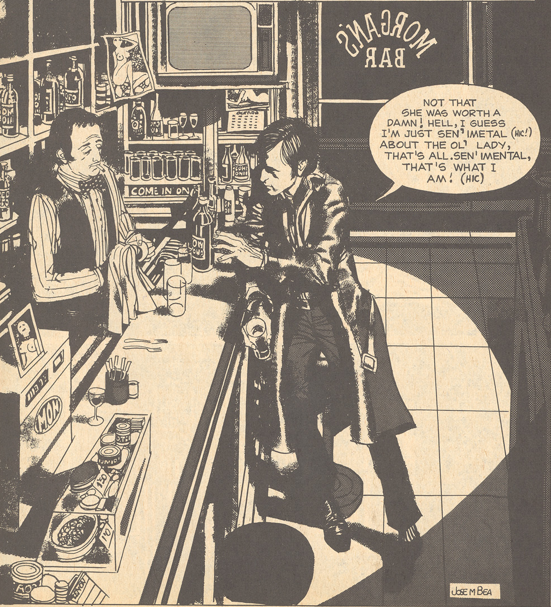
    Harry's wife Delores was a worrier, but she had reason to be. Catalepsy runs in the family and she's not feeling well. Delores makes Harry promise he'll have the mortician install a landline into her coffin and, if she needs anything, she'll call Harry. Inevitably, Delores passes and Harry follows her wishes to a T. Problem is, Harry's an alcoholic. After tying one more on down at Morgan's, the newly widowed drunkard passes out on his bed and can't quite make it to the phone when it rings.

    A stunner, "Like a Phone Booth, Long and Narrow" is, as I recall, the first time I became aware of the power of Jose Bea. It was his first appearance outside Vampirella (a title I did not purchase at the time, since horror stories about girls were yeccchhhy) and, even at the age of ten, I thought this art was scary. You could say there might have been more elegant or clean pencillers around the Warren building (Wood, Crandall, and Gonzalez come to mind), but scary? Nope. Tom Sutton and Pat Boyette had unnerving styles, but they showed you all the horrors; Bea hinted at what might be terrifying in all those long, dark hallways and still creeped you out. For a designer to have that effect on a pre-teen, without showing the boogeyman, is quite an achievement.

    "Like a Phone Booth, Long and Narrow"
    Then you've got the script which, admittedly, borrows elements from Poe, by Jan Strnad (in his Warren debut). Sentimental, not maudlin; I feel as though Harry really does miss his wife. There's no hidden agenda, no life insurance policy, no secret lover. Just a couple of losers shambling through life. Harry's dialogues with Morgan the bartender and Delores sound real rather than forced or pretentious and the finale, despite the spoiler from Uncle Creepy, is unnervingly foggy. Is it really Delores at the end of the line? Strnad won't be around here much (he drops a few more scripts in the next couple months and then pops back in for a brief stay with Richard Corben in the Dark Ages II era), but he definitely leaves his mark.

    John, an entitled young American, hears through well-placed sources that a group of priests living in a Tibetan monastery have perfected a drug that grants the user "The Ultimate High!" When he confronts their leader, the priest tells him that the drug is free but comes with a high price--the user will "waste his whole life upon it." Undeterred by the warning, John swallows the liquid and, indeed, receives the best trip he's ever taken. Coming down, he finds himself transformed into an old man, having literally wasted his life away on the drug. Steve Skeates finally comes up with a winner, a cautionary drug tale that actually avoids the preachy messages and concentrates on delivering an effective twist ending. John's only crime is arrogance, believing it's his right to have a good time, no matter what the cost. We're all guilty of that at one time or another.

    "The Ultimate High!"
    "The Ultimate High!" sees the debut of artist Martin Salvador, another of the Spaniards who sailed in and saved Jim Warren's ass in the early 1970s. Salvador's work can be flat and lack style and imagination at times but, for the most part, he gets his message across just fine; he sits comfortably between the ultimate high of a Bea and the dreaded low of a Nebot.

    The final two stories this issue return us to mediocrity. "Dorian Gray: 2001" is a "futuristic" (funny just how far the writers of 1972 thought we'd get in just thirty years!) bit of nonsense about a vampire who's discovered the perfect subterfuge, living the life of a playboy zillionaire while draining the city dry. The script, by Al Hewteson, resembles one of those patchwork everything-but-the-kitchen-sink stories Skywald is famous for. Of course, it's no coincidence that Al Hewetson was already, at this time, Skywald's number one scribe. "Dorian Gray: 2001" was Bill Barry's sole contribution to Warren; no loss there, as Barry's style is bland and his characters look cookie-cutter, with odd angles to their heads and bodies. If I didn't see a credit on this, I'd have been sure it was Ernie Colon. "Sleep" is equally dismal, save Mike Ploog's drippy and atmospheric art. Two thieves discover the perfect tool for robbing rich mansions. When lighting fire to a finger on a dismembered hand, a spell puts the occupants into a deep sleep. It works really well until they get to a house owned by... (surprise!) vampires! The script, the first in a couple years by Kevin Pagan, is a mish-mash of "The Body Snatchers" and Lovecraft, with a climax everyone saw coming. With half the stories in Creepy #44 receiving three stars or higher, this is the best Warren publication in at least half a decade!-Peter


    "Like a Phone Booth..."
    Jack-I'm glad you liked it, Peter, but I thought it was nothing special, not as good as the issue of Eerie we read this time out and not even close to a typical issue of Vampirella. I liked Sutton's work in "Something to Remember Me By!!" and I really enjoyed Ploog's art in "Sleep," but the rest of the stories seemed mediocre at best. I think Irv Docktor's art on "With Silver Bells" is barely competent and the story is a tired twist on Little Shop of Horrors. I don't mind Frank Bolle's art, so I did not dislike "Hans Bruder" but, again, it was nothing special. "Like a Phone Booth" seemed derivative, pulling heavily from "The Premature Burial" and perhaps from "Long Distance Call" on The Twilight Zone, and I was disappointed in Bea's work and think we've seen better from him elsewhere.

    I don't get your enthusiasm for "The Ultimate High," which seems to me to be just another trippy, early '70s misfire. Tied for worst are "A Certain Innocence," which continues the string of weak stories by Skeates, and "Dorian Gray: 2001," which at least has a decent last page, however random it seems in the context of the rest of the tale. Sutton and Ploog plus a heck of a cover make the issue passable but no more. By the way, there's a story by David Michelinie on the Creepy Fan Page.

    Next Week!
    The return of everyone's
    favorite lunatic!

    From Creepy #44

    From Eerie #38