Monday, May 11, 2020

The Warren Report Issue 33: January 1972


The Critical Guide to 
the Warren Illustrated Magazines
1964-1983
by Uncle Jack
& Cousin Peter


Ken Kelly
Creepy #43

"Three-Way Split" ★1/2
Story by Dennis P. Junot
Art by Jorge Galvez

"The Mark of Satan's Claw" ★1/2
Story by Fred Ott
Art by Jaime Brocal

"The Men Who Called Him Monster" ★1/2
Story by Don McGregor
Art by Luis Garcia

"Quest of the Bigfoot" 
Story by R. Michael Rosen
Art by Jerry Grandenetti

"Mirage" 
Story by Gerry Conway
Art by Felix Mas


"Three-Way Split"
In the not-too-distant future of 1994, the world is at peace but for the nasty feud that exists between multi-billionaire entrepreneurs Byron Brian and Louis Carey. When a scientist visits Brian and promises he can help the man take down Carey, Brian jumps at the chance. This egghead was run out of business due to Carey's greed, so there's bad blood fueling the experiment. The scientist has Carey kidnapped and then switches the two brains.

How that helps Brian get a leg up on his business rival, I have no idea, but "Three-Way Split" devolves from there into a goofy and confusing potato pie. Once Brian's brain is in Carey's head, he goes about taking over the man's business. But these guys were both mega-successful, so what's the point? Then, when Carey wakes up (in Brian's body), the scientist tells him what's going on and allows him to live! Say what? What happened to getting even? I liked the art a whole lot more than the dopey script (writer Junot only wrote two stories for Warren); Galvez has the same sort of style as Pablo Marcos.

"The Mark of Satan's Claw"
Mystery writer Jonathan Howard comes to the small village of Llangwell in Scotland, where a rash of child murders has the villagers living in fear. As can be expected, the townsfolk really don't want to talk about the murders, and the local constable begs Howard to drop his meddling and flee before he becomes a victim as well. Only one man, Edwards, agrees to open up for Howard's project, letting on that he'll provide a list of the satanic worshipers in the village, but he's quickly dispatched by a demon and the constable tells Howard he's responsible "'and get out of town immediately!"). Just as the writer is about to give up, pretty Anne Smith comes forward and tells Howard she was once a disciple of Satan (and has the mark on her breast to prove it), but she and Edwards couldn't stand the child-murders any longer. She's ready to come clean with the same list of devil-loving villagers Edwards had up his sleeve, but Howard tells her "never mind, I'm the devil, Raaaaawr!" and tears the poor girl to shreds.

What had started out as a delightful Gothic thriller winds up failing miserably with a hokey (but predictable) outcome, but I'll give it a passing grade for what works. What doesn't work is the constable telling Howard to get out of Dodge every three panels and a lack of scope as to just how deep this whole cult is. It sure doesn't look like a very big town, so has Satan exhausted the supply of little kids yet?

"The Men Who Called Him Monster"
P.I. Alexander Richards (but you can call him... Mister Tibbs!) is hired by Mrs. Renchada to find and bring back her son, Paul, who seems to have lost his way and joined a hippie cult. Richards manages to track down Paul's girlfriend, the misty-eyed and willowy Hope, who bends the gumshoe's ear, telling him that Paul may have been involved in the murder of a young girl. Richards assures the button-eyed and sublimely attractive girl that he intends to find and help Paul--

Hope: By taking him back to his mother... she only wants to live in yesterday.
Alexander: Be kind, Hope. You may want to live in yesterday someday... too.
Hope: When the yesterday is today?
(they kiss)

"The Men Who Called Him Monster"
Regardless of her vibe about Mrs. Enchilada, Hope still tells Richards where he'll most likely find her beau. The dick is not the most welcome face at the hippie camp but, just then, Paul pops up and runs into the forest. Richards catches up with the youth and the incredibly insightful P.I. waxes poetic about the state of the world in a monologue for the ages:

"Paul... eventually, the basic thing everybody is going to have to realize is that every single human being on the face of this planet... or at least in this culture, is exploited, seduced, programmed, categorized and discriminated against in any of a dozen different ways for any of a dozen, different reasons... we are going to have to interpret the individual's action rather than the cause he professes to belong to... rather than the race he is a member of, or even, for God's sake, the life style he chooses. And until that time, until we can do that, senseless violence will continue: racially, politically pragmatically. Every race will have some who are responsible until we manage to stop generalizing and try to see each and every human being we come into contact with as a separate entity. It sounds kind of simple. but I sometimes doubt whether the human race will ever get there.

"The Men Who Called Him Monster"
Whether it's because the moon is full or he's falling asleep from boredom or, most likely, because he's afraid John Lennon will arrive to put Alexander's words to music, Paul turns into a werewolf and attacks Richards. Hippies to the rescue, Paul is burned to death, and Alexander Richards stands over the corpse, musing how the poor guy was discriminated against (Somewhere, sometime, someone is going to have to realize the trade in hypocritical life styles!) and wondering if equality can be found on this strange, blue orb.

From start to finish, "The Men Who Called Him Monster" is one huge bowl of tuna jello; from McGregor's self-important tone and half-baked plot to Garcia's heavily pop-"influenced" (though admittedly eye-catching) graphics and the poorly-arranged captions, I found myself heavily sighing through the entire thing. McGregor is obviously still reeling from that last Jefferson Airplane concert, struggling to find his niche in the new 1970s (Maybe I'll be there to shake your hand/Maybe I'll be there to share the land), but I can't imagine reading this two or three years later and not cringing at its sledgehammer messages. Werewolf is the new Black.

"Quest of the Bigfoot"
A string of Bigfoot murders brings an expedition to the mountains of Montana but the creatures prove hard to track in the snow. When the two scientists finally find the cave the race of Bigfeet live in, they have a (monumentally silly) surprise for each other. I'm giving "Quest of the Bigfoot" two stars for the JG art and certainly not for the predictable script (which contains at least one twist too many). Gerry Conway's "Mirage" is a bit, but not much, better than "Bigfoot" but, like that previous story, it has some pretty sharp graphics. A man and a boy are left stranded in the desert and experience a string of startling mirages but it turns out the kid can control minds and is punishing the guy for being cruel to him. A little bit more back story on the kid might have helped. Overall, a very average issue of Creepy.-Peter

Jack-My favorite story this time out was "The Mark of Satan's Claw," which features spooky, Gothic art in its opening pages and a twist I did not expect. The art is effective and the tale well-told. "Three-Way Split" has terrific art, but Uncle Creepy's closing comment about "mass confusion" is an accurate summation of the story. "The Men Who Called Him Monster" has rather scratchy art and some trouble with the flow from one panel to another, leading to confusion on my part as to which panel or word balloon came next. The story starts out well but McGregor's preachiness dooms it in the end; I do like the swipe of Werewolf of London, though.

Grandenetti's interesting page designs and use of lettering are the highlight of "Quest of the Bigfoot," although the story is dopey and the dialogue too wordy. Felix Mas's art on "Mirage" reminds me of Ernie Colon's style but Conway's story is nonsense.


Sanjulian
Vampirella #15

"The Resurrection of Papa Voudou!" ★1/2
Story by Archie Goodwin
Art by Jose Gonzalez

"Quavering Shadows" 
Story by Doug Moench
Art by Jose Bea

"A House is Not a Home" 
Story by Dave Mitchell
Art by Nebot

"Welcome to the Witches' Coven" 
Story by Don McGregor
Art by Luis Garcia


"The Resurrection of Papa Voudou!"
After escaping the Isle of the Huntress (see last issue), Vampirella, Adam Van Helsing, and Pendragon find themselves in "the Caribbean republic of Cote de Soleil," amidst a raucous masked celebration. Sensing someone is following, Adam grabs ahold of a skeletal creature behind him. Unmasking, he discovers it's Paul Giraudi, a former pupil of his father's. After introductions are made, Paul explains that Adam's grumpy and blind pop has been kidnapped by the secret police and is being held at an undisclosed site. Evil forces are in the air since the President of Cote de Soleil, Jacques Valier (aka Papa Voudou), a very unpleasant man, died of mysterious causes.

Meanwhile, at that undisclosed site, a broken-down plantation estate, Madame Dominique dances a weird and sinister dance, designed to raise her ex-lover, Voudou, from the grave. Her co-conspirator in this dark act, Colonel Ramm, who even now remains loyal to Voudou, is in the basement torturing Dr. Van Helsing, certain the Doctor is here to put the kibosh on the resurrection ceremony. Van Helsing, for his part, denies any knowledge of wrongdoing; he's just looking for his smitten son, Adam. At this time, Voudou enters the house, having been raised by Dominique's sultry moves, but he's a little off. The rite was supposed to bring him back looking prim and proper but he actually returns with bits falling off him and a lousy disposition.

"The Resurrection of Papa Voudou!"
Dominique insists that, if she was aided in her quest by Van Helsing and a dog-eared copy of Crimson Chronicles, she could return Voudou to his pristine-mint condition. Van Helsing refuses but, in an amazing coincidence, the secret police round up Vampi, Adam, and Paul at a local pub (adding a few bullets to the latter two and completely missing the alcoholic Pendragon, hiding behind the bar) and bring them to the plantation. The senior VH has no choice but to aid Dominique. A mortally-wounded Paul manages to get a gun and head down to the room where Papa Voudou is being kept on a slab, with a view to killing his captors, but he passes out behind the altar.

Dominique and Van Helsing conduct the ceremony but something goes wrong and only the mind of Papa Voudou is returned. The crumbling zombie flies (or shambles) into a rage and murders Dominique and Ramm before Vampi enters to save the day, setting the corpse ablaze. Dr. Van Helsing allows that Vampi may be a blood-sucking slut, but she has her moments. Meanwhile, back at the club, Pendragon finally comes out of hiding and bumps into a well-dressed chap on the street. The man introduces himself as... Count Dracula!

"The Resurrection of Papa Voudou!"
As you may or may not have gleaned from all that verbiage, I enjoyed the heck out of "The Resurrection of Papa Voudou!" despite (or maybe because of) its total disregard for reality. More and more, this series foreshadows the Tomb of Dracula series over at Marvel (which would launch in a couple months and which would be scripted a few months after that by Archie himself), a monster-starring vehicle that most resembles The Fugitive in that its characters seem to pinball from one part of the Weird World to another.

By this time, I firmly believe, Archie not only expected his readers to check their brains at the door but the writer, himself, was leaving his grey matter outside his Warren cubicle. I want to see those missing panels of Vampi doing her laundry (you can't tell me she can keep that G-string clean with all her athletics and the tight spots she gets herself into) or explaining to Adam where she keeps all those handy vials of Faux-Blood or a close-up of the bat with a tiny suit covering up its nasty bits or a tutorial on the publishing history of the rarest book in the world, Crimson Chronicles. Never mind, just close that mind and enjoy all the nuances of what is essentially a vampiric Modesty Blaise and, of course, Jose Gonzalez's insanely exquisite art.

"Quavering Shadows"
More exquisite art follows in the meandering, overlong Gothic piece, "Quavering Shadows." Andrew has become worried about his friend, Jason, who owns a hilltop castle just outside London, so he pays the hermit a visit. What he discovers deepens his worry; Jason is traipsing around the castle in 17th-Century garb, claiming the house is haunted by poltergeists and murderous shadows. Andrew is naturally skeptical but when he accompanies his friend upstairs and witnesses a murderous display put on by shadows on a wall, he must admit to some belief.

When he returns downstairs to find his friend awaiting him, he learns that the poltergeists have taken to impersonating Jason as well. When Jason completely loses his marbles and chases Andrew around the castle with a mallet, it's time to leave. Andrew arrives home to discover the police at his flat and that the strangler who has been terrorizing the area has been caught trying to murder his wife. In the back of the patrol car sits Jason. Way, way too long at eleven pages, the obviously Poe-inspired "Quavering Shadows" does serve one admirable purpose: it lets Doug Moench tackle something other than a PSA. It's hard to picture such a tall crag (with castle atop) in the middle of a valley just outside London, but I suppose there might be such places. The climax makes very little sense if you think about it (does that mean Jason is the mad strangler all along?), so don't think about it. Just move on.

"A House is Not a Home"
Jenny's just gotten married after a lengthy stay in a loony bin. Seems her father was a Satanist and one night his spells cost him his life. Jenny witnessed the whole thing as a little girl and the event snapped her fragile brain. Now, years later, on her honeymoon, she and her new husband, Frank, get a flat on a desolate road during a rainstorm. Frank insists they look for a house to shelter, but Jenny is clutched by an unnamable fear and refuses. Frank leaves anyway and, too frightened to be left on her own, the girl follows. They come upon a house and, despite her protests, Frank drags Jenny upstairs and reveals he's a demon sent by the "other side" to punish her for her father's sins. Jenny is absorbed by a big light. This was the first of only a handful of projects Nebot worked on and I have to say his style does not mesh with the new wave of Spanish artists; it's more akin to art you'd find in a Charlton romance funny book. David Mitchell never wrote another script for Warren.

"Welcome to the Witches' Coven"
Jenny has had enough of her husband, Brad, treating her like a slave, so she does what any put-upon 1970s' free-wheeling, hip girl would do: she joins a witch's group. But when Jenny has to supply the first sacrifice, she gets cold feet and exits stage left. That's not to the liking of Diana, the witch goddess who's been conjured up by the coven, and Jenny is struck by a lightning bolt and burns to death. The moral, I guess, is that Women's Lib can be freeing but it can also be a bitch. "Welcome to the Witches' Coven" furthers Don McGregor's reputation as most conscientious Warren writer and widens his scope from race to gender as well. It all comes off as pretty silly, though, don't you think? There's no denying that Luis Garcia has delivered some stunning good girl art (GGA) here but some of it (especially the head-scratching final act) can be a bit confusing and the finale goes out with a whimper. What I want to know is, with Jenny reduced to a pile of ashes, who's going to wash the dishes for Brad? -Peter


"Welcome to the Witches' Coven"
Jack-I thoroughly enjoyed the Vampirella story and liked the interplay between the main characters as well as the gorgeous art. Archie can write a good comic and this story is entertaining from start to finish, with a great cliffhanger. The art for "Quavering Shadows" is an odd mix of photo swipes and cartoony style. The writing seems like that of a bright teen trying to impress readers with his vocabulary, but I enjoyed this imitation Poe piece more for the story than the art. The last two stories were quite a letdown. "A House is Not a Home" features a nonsensical narrative with art not up to that of the two prior stories, while I'm not quite sure what happened in "Welcome to the Witches' Coven," other than that it had lots of naked women and pretentious prose.


Enrich Torres
Eerie #37

"The Other Side of Atlantis"★1/2
Story by Steve Skeates
Art by Jaime Brocal

"Horror at Hamilton House"
Story by Lynn Marron
Art by Ken Barr

"The Ones Who Stole It From You"★1/2
Story by Don McGregor
Art by Rafael Auraleon

"A Rush of Wings"
Story by Larry Herndon
Art by Jaime Brocal

"Dethslaker"
Story by Doug Moench
Art by Ernie Colon


"The Other Side of Atlantis"
Prince Targo of Manaii, the only surviving kingdom in undersea Atlantis, is swimming around one day, thinking deep thoughts, when he accidentally swims into the evil, ruined land of Karmine. A swirling current pulls him down into a pit on the ocean floor. Weeks later, his sexy, scantily-clad girlfriend sets out to look for him. She heads ashore, not aware that Prince Targo has been transformed into a giant creature by a strange, fluorescent rock. She hears a prophet speaking about a missing person who will return home to cause destruction. Figuring he's not talking to her, she heads back to the undersea kingdom, unaware that the creature that once was Prince Targo is soon to embark on a mission to destroy Manaii.

Jaime Borcal does a very nice job with the art on "The Other Side of Atlantis," and that's a good thing, since the story does a bit of meandering. More Aquaman than Sub-Mariner, Prince Targo swims around aimlessly, thinking his thoughts, which include a history lesson about Atlantis. I hope there's more to the story, since it seems to end right in the middle. Borcal's unnamed girl from Manaii reminds me of the DC character Dolphin, who debuted a few years earlier in Showcase.

"Horror at Hamilton House"
Vince Carter is a creep, but Widow Alice Hamilton is dazzled by his slick line and marries him, much to the dismay of her bookish son, Randolph. Vince wants to sell the Hamilton family property on a remote island and take the cash, but Alice and Randolph don't like the idea and Alice explains that the family has been suffering under a witch's curse for centuries. Once the property is signed over to him, Vince gets rid of Alice by means of a quick shove off of a high cliff. Unfortunately, he returns home to find Randolph transformed into a very angry werewolf.

"Horror at Hamilton House" is run-of-the-mill Warren, a story that loads up the cliches and ends with a "surprise" revelation that one of the main characters is a vampire, werewolf, mummy, etc. Ken Barr's visuals are fine, just not up to the level of quality we're seeing from the Spanish artists.

During WWII, a soldier named Charlie Shores is trapped with corpses in a building after it is hit by a bomb. He resorts to cannibalism to survive while waiting to be rescued. A pretty nurse in the rehab center where Charlie ends up falls for him, but when she discovers him in a graveyard, snacking on the local talent, he kills her and says goodbye to any hope of a normal life.

"The Ones Who Stole it From You"

Decades later, wealthy Andrew Prine is murdered by his lawyer, Arnold Barr, who has been embezzling money from Prine. Barr slips Prine rat poison in a cup of brandy. When Prine attacks Barr, the lawyer shoots him and stages the scene to look like suicide. Prine is buried and his son, Nathan, is certain that he was murdered. Searching his father's house, Nathan finds rat poison. Meanwhile, at the cemetery, Charlie Shores, now an aging ghoul, eyes Prine's newly-filled grave with hunger.

Peter asks the eternal question.
While lying naked in bed, Nathan's annoying (yet hot) wife, Amanda, spends the better part of a page lecturing him on the ills of capitalism. Later, Nathan has his father's body dug up to check for signs of murder; he is shocked to find large parts of it have been eaten. After a short interlude for some more blather about "The Man," Nathan sneaks around his father's grave, waiting to see if his father's killer shows up. Sure enough, Arnold Barr is skulking around the cemetery, watching Nathan, unaware that he himself is being watched by Charlie Shores. In a rather confusing series of confrontations, two end up dead: Charlie is dying from eating Andrew's poisoned flesh and Arnold is impaled on some sort of spike. Nathan is shot by Arnold but survives, anxious to have a political powwow with his wife to reveal that "he is now aware who the real enemy is."

Rafael Auraleon should get some sort of medal for taking McGregor's crazy, mixed-up story and turning it into a highly entertaining 14 pages (!) of murder, grave-robbing, and the usual political ranting and raving. If one were to edit out the superfluous political stuff, it would leave a darn good horror story that starts out in WWII and jumps to the present time. Auraleon does a great job of making sense of it all and some of his more ghoulish panels are terrific. The title, "The Ones Who Stole it From You," refers to Amanda's attempt to open Nathan's eyes to the way society takes everything that matters from a man, but the real fun here is the grave-robbing and outstanding art.

"A Rush of Wings"
An entomologist named Harry Evans discovers a new species of butterfly in the jungles of Burma. He stumbles upon a lost city that is swarming with the flying things, but his net has a hole in it and he is forced to return to camp. Thinking his partner wants to steal the credit for his discovery, he punches him and the man accidentally dies when he falls and hits his head on a rock. Harry returns to the lost city to gather more examples of the new species, against the advice of native cook, Ling Ho, who warns him that the place is evil. Harry should've listened: at the lost city, he hears "A Rush of Wings" and is attacked by Ling Ho, who is really a giant butterfly.

There's an EC story buried in here somewhere and Brocal's art helps it go down smoothly. The greedy explorer who kills his partner is a trope we've often seen, but the final panel (reproduced here) makes the giant Ling Ho look like the scariest butterfly I've ever seen.

A special prize will be awarded to
the first reader to explain what's going on
in this page from "Dethslaker."
In the land of Thasa, mad King Arides lives well in his castle while his people suffer in poverty. Along comes a warrior named Zarthon, who plans to avenge the death of a wizard named "Dethslaker," whose life essence is now imprisoned in Zarthon's sword. Zarthon slices his way through a series of guards and comes face to face with a wizard named Garthstane, who is the next victim of Dethslaker. Zarthon then kills King Arides. Unfortunately, the peasants choose this time to revolt, and they mistake Zarthon for Arides and kill him.

Peter wished me luck synopsizing this issue and, until "Dethslaker," I didn't think it was so bad. Then along came Ernie Colon, whose efforts at creative storytelling leave me cold. There really is very little to this story, but Colon drags it out for eleven endless pages with his head-scratching page designs that keep the reader wondering what the heck is going on. I did not even mention the king's servant girl, Clia, who spends the entire story naked--and it doesn't help.-Jack

Somebody get me a bullet to bite on
("The Ones Who Stole it From You")


Peter-"The Other Side of Atlantis" may be just about the only interesting fantasy story I've read in a Warren zine in years. Yes, its climax is maddening but in a good way; I really want to know what form of mutation Targo has taken, but I'll have to wait for the inevitable sequel (in issue #40) to discover the outcome. Right now I'm tantalized, but check back in a few "months." "Horror at Hamilton House" is yet another swing-and-miss at the Gothic thriller with another of those trademarked "he's really a monster!" final panels.

"The Ones Who Stole it From You" may be Don McGregor's most pompous hogwash yet (and that is definitely saying something). It's hard to keep track of what's going on in between all the dreary monologues. I picture someone like, oh, I don't know, Eve Plumb from The Brady Bunch delivering that 4000-word diatribe about "society building tinier and tinier cages..." What does society have to do with a guy poisoning the client he's embezzling or a ghoul who digs up graves and eats a little bit at a time (but doesn't make much of a mess topside... good trick that)? Did McGregor even read this stuff after he wrote it? "A Rush of Wings" hasn't got a pretentious bone in its body but it also lacks a brain. How the heck did Lin Ho hide his twenty-foot wing span and eight mandible-thingies under the small robe? Answer: don't ask me. I did enjoy the set of panels wherein the two men beat each other to death while screaming "You won't get my butterflies!!!" "Dethslaker" is a befuddling mess, but at least the sword is not a metaphor for the ruling class or herpes or... Colon's art is really good here and there (especially the nekkid chick) but, overall, this is like one of those fan-fiction booklets you pick up at the San Diego Comic-Con freebie table and then toss on your way out.

From Creepy 43

From Vampirella 15

Next Week...
Batman and Ra's make for
unlikely allies!

Thursday, May 7, 2020

The Hitchcock Project-Morton Fine and David Friedkin Part Three: Crimson Witness [10.12]

by Jack Seabrook

Peter Lawford as Ernest Mullett
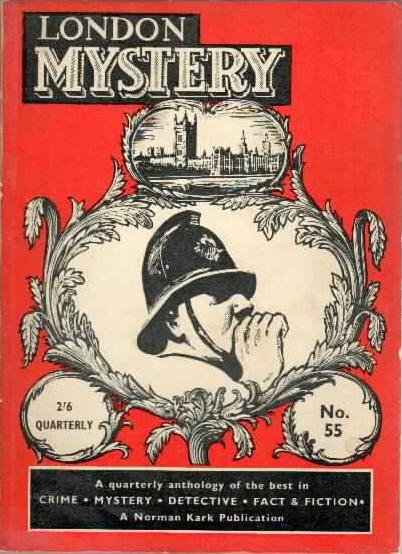
"Crimson Witness," the third episode of The Alfred Hitchcock Hour to be adapted for television by Morton Fine and David Friedkin, is a good example of how to take an unremarkable short story and expand it into an entertaining hour of drama. Nigel Elliston's story of the same title was published in The London Mystery Selection no. 55 [December 1962] and never reprinted.

Ernest Mullet's two successes in life are marrying Judith Harlow and displaying a perfect bloom from his own garden in his lapel each day. When his wife's affections are stolen by his co-worker Roger Farnum, Ernest resolves to kill the man. The Mullets are divorced and things settle down for a few months, but when Roger begins sporting a flower in his buttonhole each morning from a local florist, Ernest's anger and jealousy are rekindled and he sets his mind to murder.

"Crimson Witness"
was first published here
A news report about a bank robbery in which a manager is killed gives Ernest an idea and, after figuring out that Roger has changed the combination on his large office safe to J-U-D-Y, Ernest visits the man one afternoon and kills him with a blow from a lead pipe before hiding his body in the safe. When Farnum's secretary looks into his office before leaving for the day, she thinks that her boss has already departed by the other door when, in reality, Ernest has hidden his body in the safe.

Ernest spends the evening at home with his sister before returning to the office after two a.m. He opens the safe, takes $5000 in cash, and leaves Roger's corpse in full view. A cleaner finds the body just after 6 a.m. and the police question employees as they arrive. Unfortunately, Ernest confirms that Roger had a white gardenia in his buttonhole, while the crimson rose petal found inside the safe matches the flower in Ernest's lapel.

Martha Hyer as Judith Mullett
Just six pages in length, "Crimson Witness" is a brief tale whose success hinges on its twist ending, a conclusion that is set up when writer Nigel Elliston makes the flowers in the main characters' buttonholes affectations that the reader notices, fails to focus on, but recalls at the end. The story's author has no other credits on IMDb or in The FictionMags Index, and a detailed search has only revealed two other possible mentions: the British radio program Morning Story aired a reading of a tale called "Off the Record" by Nigel Elliston on March 7, 1960, and the 2017 obituary of a woman named Olive Elliston, who died in Ipswich Hospital in Southeast England, mentions her late husband, Nigel Elliston. Any other information about the author would be appreciated.

Surely attracted by the twist ending, the producers of The Alfred Hitchcock Hour bought the rights to the story and assigned it to the writing team of Morton Fine and David Friedkin, who expanded it into a highly entertaining television program that aired on Monday, January 4, 1965. Everything works in "Crimson Witness": the dialogue is sparkling, the direction solid, the performances perfect. The music score, by jazz musician Benny Carter, underscores each scene and highlights the absurdity of the situation.

Joanna Moore as Madeline
While the short story is focused on Ernest and the murder of Roger, the TV show takes a different approach and focuses on three beautiful women and their shifting loyalties between the two men. Instead of being co-workers, as they are in Elliston's piece, Ernest and Roger are brothers, even though Peter Lawford, as Ernest, and Roger C. Carmel, as Farnum, look nothing alike. The show begins with Ernest in his large, fancy office, as he checks the walk-in safe that is hidden behind two curtains. When he is done admiring the safe, he turns his attention to his gorgeous secretary, Barbara, who resists his amorous advances in the workplace and instead comments on his habit of embezzlement. Benny Carter's jazzy score serves as a transition between scenes, and the boss, Mr. Baldwin, summons Ernest to his office, only to inform him that he lacks drive and is being reassigned.

Baldwin points out that Ernest wears a different rose in his lapel each day and Baldwin's own beautiful secretary enters, demonstrating that this office is one where women are hired for their looks. The entire episode of "Crimson Witness" is almost like an episode of the much later TV series Mad Men in its depiction of the relations between the sexes in a big-city office in 1965. In any case, Baldwin tells Ernest that he is being replaced as plant manager by his brother Farnum. There is a cut to Ernest's home, where we see Farnum, overweight, balding, and sporting a walrus mustache, contrasted with Ernest, who is suave and handsome. Ernest's wife Judith is nonplussed when Ernest tells her that Farnum is replacing him at work; poor Ernest can't even get the best of his brother physically, as he learns when he tries to throw his long-term house guest out and instead ends up on the floor himself.

Julie London as Barbara
Even worse, Farnum announces that Judy loves him and is leaving Ernie, which she does right then and there. Ernest's life is not all bleak, however, as we see when the scene moves to the apartment of his secretary Barbara, with whom Ernest is carrying on an extra-marital affair. She informs Ernie that Farnum is "'self-centered, cunning, greedy, and calculating'"--and that she finds him "'fascinating, cruel, exciting.'" Like Judy, Barbara is in love with Farnum! Ernest's brother has now stolen his wife, his lover, and his job, and Ernest understandably lashes out, telling Barbara that Farnum has taken up with Judy. Barbara is upset but sighs that she will wait for Farnum to tire of the woman and turn to her.

In his new (smaller) office, Ernest meets his new secretary, Madeline, whom which he shares with five other men. Madeine is beautiful, yet less refined in speech and manner than Barbara. Even she brags about Farnum! Ernest visits his brother in the office that used to be his and Farnum remarks that he now wears a flower in his lapel, though his flower is exotic and must be flown in, unlike Ernest's home-grown variety. Farnum has an annoying habit of quoting great authors, such as Jane Austen and Hegel, and has already discovered that Ernest was "'dipping into the till,'" something he volunteers to cover up. Farnum does not even try to disguise his glee at stealing Ernest's job and wife; in addition to the other negative qualities that make him a success in business and with beautiful women, Farnum is a blackmailer, offering to keep quiet in exchange for his brother's friendship.

Roger C. Carmel as Farnum Mullett
Ernest gets Farnum to open the safe, in a not very subtle attempt to learn the new combination, but Farnum conceals it from view. At home, Ernest prepares the murder weapon, a pipe concealed in a sock, and back at the office Ernest begins to set up his alibi for murder by inviting his new secretary to dinner. He visits Farnum, kills him with a blow to the head, and hides the body and the murder weapon in the safe. Fine and Friedkin pepper the script with repeated references to the safe and the flowers, keeping both in the viewer's mind in preparation for the show's conclusion, while playing out a black comedy of manners and shifting alliances between the two brothers and the three women.

Ernest and Madeline dine out together, allowing him to establish an alibi; she is forward and invites him back to her place for drinks but he declines, instead returning to the office to stage the murder scene for discovery in the morning. When the sun comes up, Ernest is interviewed by two detectives in Farnum's office, where a black outline has replaced the corpse. Now that Farnum is dead, Ernest's unfaithful wife rushes to his arms, begging forgiveness. As Judy, Martha Hyer really pours it on in this scene; she is deadpan and funny, kissing his head and caressing his ear while he speaks to his boss on the phone. It is a credit to Peter Lawford as an actor that he made it through this scene without dissolving into giggles.

Alan Baxter as Baldwin
Madeline catches him kissing his wife and calls him a rat out in the hallway; this is the same term Barbara had used earlier in the episode to describe Farnum. Ernest visits Barbara, who is also suddenly attracted to him once again and, just as he is leaving, the detectives summon Ernest back to Farnum's office, where their discovery of the rose petal in the safe reveals Ernest as the killer. By this time, the mystery has become secondary to the fun of seeing the three beautiful women throw themselves at two undeserving men, making "Crimson Witness" a wry commentary on relationships between the sexes in 1965. Making Ernest and Roger brothers rather than co-workers heightens the irony; the men are physical opposites, yet their natures are similar.

Paul Comi
Peter Lawford (1923-1984) plays Ernest perfectly, never losing his cool and always appearing smooth and refined. Born in London and married to the sister of President John F. Kennedy at the time this show aired in 1965, Lawford was in the middle of a long career on screen that begin in 1931 and ended in 1990. He was in an episode of Alfred Hitchcock Presents way back in 1955 and he later was awarded a star on the Hollywood Walk of Fame. Lawford was a member of the Rat Pack, the group of swinging actors and singers who hung around Frank Sinatra, and appeared in many films.

Judith Mullett, Ernest's unfaithful wife, is played with icy cool by Martha Hyer (1924-2014), who was on screen from 1946 to 1974 and who appeared in one other episode of The Alfred Hitchcock Hour. She published her autobiography in 1990.

Larry Thor
The chatty secretary, Madeline, is played by Joanna Moore (1934-1997). Born Dorothy Joanne Cook, she was on screen from 1956 to 1984 and had a role in Orson Welles's classic film noir, Touch of Evil (1958). She appeared in six episodes of the Hitchcock series, including "Most Likely to Succeed," and was the mother of actress Tatum O'Neal.

Nancy Hseuh
Julie London (1926-2000) plays Barbara, Ernest's first secretary. She was born Nancy Gayle Peck and her parents had a song and dance team in vaudeville. In addition to being a busy actress on screen from 1944 to 1978, London was an accomplished singer who released many record albums. She was a regular on the TV series Emergency from 1972 to 1978 but this was her only appearance on the Hitchcock series.

Giving an entertaining performance as Farnum Mullett is Roger C. Carmel (1932-1986), who seemed to light up the screen whenever he appeared. He was on TV and in film from 1958 to 1986 and played memorable roles on Batman and Star Trek, as well as being a regular on the TV series, The Mothers-In-Law (1967-68). Unfortunately, this was his only appearance on the Hitchcock show.

In smaller roles:
  • Alan Baxter (1908-1976) as Baldwin, Ernest's boss; he served in the Army Air Corps in World War Two and studied at the Group Theatre; he was on screen from 1935-1971 and had a part in Hitchcock's classic, Saboteur (1942). He was also seen on Thriller, The Outer Limits, and in one episode of Alfred Hitchcock Presents, "Backward, Turn Backward."
  • Paul Comi (1932-2016) as the younger of the two detectives who interview Ernest after the murder; he was on screen from 1958-1995, mostly on TV, and appeared on The Twilight Zone, Star Trek, and one episode of Alfred Hitchcock Presents.
  • Larry Thor (1916-1976) as the older detective; he was born in Canada as Arnlelfur Lawrence Thorsteinson and he was known chiefly as a radio broadcaster and announcer, playing roles in film and television from 1952-74.
  • Nancy Hseuh (1941-1980) plays Baldwin's secretary; she was on film briefly as a child from 1945-1947 and then had a career as an adult onscreen from 1960-1978, including a role in Peter Bogdanovich's Targets (1968).
Benny Carter (1907-2003), who composed the score for this episode, was a saxophone player and bandleader who had a long and successful career writing and playing jazz and swing music. He composed scores for TV and film from 1957-1986 and there is a website devoted to him here.

Once again, David Friedkin did not just co-write "Crimson Witness" with Morton Fine; he also directed it, and he does a fine job, keeping the action moving swiftly and handling the humor deftly.

"Crimson Witness" is not yet available on DVD in the U.S. but it may be viewed online for free here.

Sources:
"Crimson Witness." The Alfred Hitchcock Hour, season 10, episode 12, NBC, 4 Jan. 1965.
Elliston, Nigel. "Crimson Witness." The London Mystery Selection, Dec. 1962, pp. 21–26.
Grams, Martin, and Patrik Wikstrom. The Alfred Hitchcock Presents Companion. OTR Pub., 2001.
IMDb, IMDb.com, www.imdb.com/.
"Olive Elliston." Olive ELLISTON - Death - Ipswich Star Announcements - Family Notices 24, www.familynotices24.co.uk/est/view/4289640/olive-elliston.
"Radio Times 1923-2009." BBC News, BBC, genome.ch.bbc.co.uk/schedules/light/1960-03-07.
Wikipedia, Wikimedia Foundation, 19 Apr. 2020, www.wikipedia.org/.

In two weeks: "Thou Still Unravished Bride," starring Ron Randell and David Carradine!

Monday, May 4, 2020

Batman in the 1980s Issue 1: January 1980

The Dark Knight in the 1980s
by Jack Seabrook &
Peter Enfantino


Kubert & Giordano
Batman #319

"Never Give Up the Ghost!"
Story by Len Wein
Art by Irv Novick and Bob Smith (with Bill Wormstedt)

The Gentleman Ghost is back, but right in the middle of robbing industrial diamonds from a warehouse, he and his henchmen are interrupted by Batman! The Ghost escapes but Batman keeps the jewels. Batman drives home to Stately Wayne Manor (I couldn't resist) while, later that night, two of Gotham's Finest are killed by a deadly gas emitted from the mouth of a dummy made up to resemble a certain Clown Prince of Crime.

The next evening, Bruce Wayne attends a costume party dressed as Henry VIII. Bruce leaves midway through the party and reengages with the Ghost at the same warehouse, barely escaping a death trap where he is suspended over a container of sulfuric acid. The Gentleman Ghost crashes the party, intent on stealing expensive jewels on display, but is foiled by the speedy return of the Caped Crusader. Batman chases the Ghost out onto a cliff, but the phantom makes his escape yet again.

Holy Hotfoot!
JS: I am thrilled to be back reading the adventures of Batman, and this first issue is right up my alley. As I read it, I could hear the voice of William Dozier in my head reciting some of the captions. I've always been intrigued by the Gentleman Ghost, whom I think of as really a Hawkman foe, and the Kubert/ Giordano cover is a beauty. It's a treat to see the Batmobile return to Wayne Manor through the hidden entrance to the Batcave, and Wein's habit of teasing upcoming stories with short diversions promises a return appearance by the Joker. I'm also happy to see Irv Novick's solid pencils again. What more could a Bat-fan want?

PE: Just as I was really getting into the Gentleman Ghost character, hoping there might be a supernatural bent to him, Wein has to play the Scooby-Doo card. Love how all the weird twists are explained away in the end, like the projector being in just the right place at the right time on the cliff. Whatever problems the script has, at least Novick and Smith get the job done. In fact, the art for all three Batman strips this month is pretty darn good!


Aparo
The Brave and the Bold #158

"Yesterday Never Dies!"
Story by Gerry Conway
Art by Jim Aparo

When masked robbers crash a swanky party in Manhattan, they are surprised to be accosted by Batman, who usually works the Gotham City beat. Once the bad guys are disposed of, Bruce Wayne makes an appearance and happens upon Diana Prince, who is also in attendance. Soon, a costumed bad guy shows up and Diana switches to her Wonder Woman outfit to engage him. He throws a glass sphere at her and, when it breaks, it releases a gas that makes her hallucinate and think she's reliving the death of her old flame, Steve Trevor.

Bruce Wayne's meeting with the French ambassador is interrupted and, when he ventures outside and talks to a dazed Wonder Woman, the bad guy named Deja Vu leaves the ambassador a babbling idiot. It seems this villain opposes a big business deal between the U.S. and France, so it's off to Paris for Batman and Wonder Woman. She tracks Deja Vu to a factory, where she barely avoids falling into a vat of hot, bubbling liquid; Bruce Wayne works to close the deal by day before donning his Bat-garb by night and tracking down Deja Vu, who uses his special gas to make Batman imagine he's reliving the murder of his parents.

Batman and Wonder Woman fight each other briefly while Deja Vu (or Flashback) attempts to ruin the business meeting between U.S. and French representatives, but soon Batman gets the better of him by means of a good, old-fashioned gas mask. It turns out Deja Vu's father was killed while working at an American canning plant in France, so now he wants to prevent any business deals between the two countries.

JS: First of all, I want to thank Peter for graciously agreeing to add other Bat-books to our blog besides Batman and Detective Comics. This issue of The Brave and the Bold has a pretty run of the mill script that reminded me of many a Marvel Team-Up issue: figure out a way to get two heroes together, have them fight briefly for no good reason, and wrap things up quickly. Still, Jim Aparo's art is usually worth a look and it can't have been easy to have had to draw all of those guest stars every issue!

PE: I couldn't figure out if the villain's moniker was Flashback or Deja Vu; either way, never heard of him. After a quick Google search, I don't feel so bad... this was Flashback's first and only appearance. The character was retconned in the 90s and was (wouldn't ya know it) addicted to crack cocaine. The story itself was nothing much but I liked the art.


Garcia-Lopez
Detective Comics #487

"The Perils of Sergius"
Story by Denny O'Neil
Art by Don Newton & Dan Adkins

Pulp writer Sergius has a target on his back after a misunderstanding leads the League of Assassins to hire Ma Murder to silence the hack. When Batman gets wind of the contract, he becomes Sergius's private bodyguard, which is fine by the scribe since he's always wanted to write Batman's biography. Bats ain't interested in publicity, unfortunately, but Sergius is still glad to have the Caped Crusader watching his back after a couple of botched hits. Ma turns on the heat and gets fancy, attempting to drown both Bats and Sergius in the writer's apartment. Turns out Bruce Wayne is an accomplished plumber and his skills save the day. Ma confesses that her client is the League and then is carted off to Arkham.

PE:  The script for "The Perils of Sergius" is not up to Denny O'Neil's lofty, early-1970s-era standards, but then most of Denny's Bats sagas towards the end of the '70s were iffy; it's a one-note joke based on a ridiculous premise (one of the League muckety-mucks overhears Sergius working a plot out loud and, naturally, believes the writer has uncovered the clandestine organization), but right in line with the kind of entertainment DC was offering up at the end of the 1970s. It's nice to see the team of Newton and Adkins survived the jump from the '70s to '80s as their art was some of the best we saw toward the end of our first run at these titles. Bats is just muscular enough to give you the idea he could kick just about any criminal's ass. Matches Malone makes a brief cameo. Denny will hang around for a few months, contributing a couple more Bats adventures for 'tec and then jump ship for Marvel. These guys had a habit of going back and forth whenever something riled them up.

JS: I liked the classic splash page, a la Jerry Robinson, but I was disappointed overall by both the story and the art, despite having been fond of Don Newton's work since I first saw him in fanzines. The klutz who escapes death repeatedly never worked for me.

"The Aliens Among Us!"
Story by Bob Rozakis
Art by Dave Hunt

Roy Raymond debunks Bigfoot, the Loch Ness Monster, and other myths weekly on his top-rated TV show, Impossible But True. This week, Roy is given the task of deflating four beings who claim to be aliens from outer space. Turns out his co-workers are having one on the celebrity.

PE: For some unfathomable reason, Bob Rozakis thaws out a forgotten, fifth-level (about the lowest you can get on the character scale) character that populated the pages of Detective from 1949 through 1961. You say "Hey, Peter, how could Roy be a fifth-tier loser if he appeared in over 150 issues of a flagship title?" Easy, because Roy, like so many of the DC support acts that were relegated to the back pages, was doomed to repeat the same plot and devices issue after issue. Myth introduced... myth debunked. Bob Rozakis obviously recognized that all he had to do was fill some pages here and that's all he did. "The Aliens Among Us!" has a perfect 1960s DC vibe to it; it's innocuous and fills six pages. The "unmasking" of the various aliens is silly and it wouldn't take a myth-buster to figure out what was going on. The only question left unanswered is why the studio employees would waste their time trying to fool this mastermind on network television. Thankfully, other than a guest appearance in #500, this is the last we see of Roy Raymond, TV Detective.

JS: I remember this character from some of the DC 100-Page Super-Spectaculars from the early 1970s. He's nothing special and this story is essentially fluff. I didn't really understand what Hawkgirl had to do with anything.

"The Iron Solution"
Story by Jack C. Harris
Art by Kurt Schaffenberger & Joe Giella


While on a business trip in Germany, representing Wayne Enterprises, Dick Grayson (aka Robin!) must investigate a bank robbery that has the local authorities baffled. Turns out rogue factions in the army are carrying out heists with the aid of a tank. Robin swoops in and puts an end to the shenanigans.

PE: Move along. Nothing to see. Literally. Both script and art for "The Iron Solution" are bottom-of-the-barrel, Super Friends-style cartoon fare, from the phony subterfuge (Dick actually lets us know that he and Robin should not be seen in the same faraway village lest someone put two and two together and then three pages later, he's shooting the bull with the entire German army in his tights) to the stick-figure graphics. There's nothing more boring than stiff humans and lots of blank backgrounds; it's the epitome of "Just hand it in unfinished... we got a deadline!" "The Iron Solution" is lazy (in fact, even the letterer comes off lazy, misspelling Schaffenberger's name on the title page!), unimaginative filler.

JS: Schaffenberger's art always looks like kid's stuff to me. And where did Robin get the fake, eight-foot-long leg and foot? And where does he store it in that skintight costume?

"The Odd Man!"
Story Steve Ditko & Uncredited
Art by Steve Ditko

The Odd Man tries to get to the bottom of a series of strange jewelry heists. The trail leads him to a crooked pharaoh and his lovely "queen." During a struggle, the queen is accidentally zapped and killed by the pharaoh's "mummification" laser gun. Unable to live without his love, the pharaoh commits suicide.

PE: Steve Ditko tries his hand at yet another colorful character (after his less-than-successful stints on the Creeper, Shade, and the Question), this time a hero who can mess with a villain's perspective. At least, that's what I think is going on in the opening. Wildly, Steve doesn't let the reader in on too many details (this was originally supposed to run as a back-up in the axed Shade, the Changing Man title in 1979, so perhaps the idea was to fill in the blanks as the series progressed); we know the Odd Man's real identity is P.I. Clay Stoner and the action takes place in River City, but that's about it. I'm not sure how Odd Man keeps his eye patches on or why he wears a quilted outfit, but "The Pharaoh and the Mummies!" is mindless fun. Sadly, this was also the Odd Man's last adventure; he'll next see the light of a newsstand in Superboy #65 (August 1999), long after we're retired.

JS: The GCD says an unknown writer rewrote the dialogue for some reason. Why bother? This is just another one of those weird backup stories that Steve Ditko did in the '70s. He also did things like this for Atlas. They are almost always both awful and bizarre. The more bad stories I read by Ditko, the more I question his reputation as a genius.

"The Case of the Campaign Crimes"
Story by Jack C. Harris
Art by Dick Giordano & Steve Mitchell

Batgirl must quash the assassination attempts on the woman running against her alter ego, Barbara "Babs" Gordon, in the next election.

PE: When last we left Batgirl, she was juggling two lives: that of Congresswoman Babs Gordon by day and Batgirl by night. The pace has obviously not slowed and the poor girl finds herself burning the candle at both ends. Jack C. Harris, who never did much of anything with this series, script-wise, actually seems to rise to the occasion of having a talented art crew assigned to his baby. Don Heck, who has had his share of naysayers (myself included in some circumstances), had gotten a good handle on Batchick but 90% of her adventures handled by another crew were swill. While Heck will be back soon, we'll also have to deal with that continuing carousel of guest "talent" for the near future. At the very least, the Batgirl series provides something that the Robin series ignores: continuity.

JS: Continuity, maybe, but entertainment? Not so much. Jack C. Harris's story is just page-filler and, while I love Dick Giordano as an inker, his pencils here are not so great. I remember looking at these $1.00 comics back in the day and thinking that was a lot of money. I would not have been happy with this package for a buck.

Next Week!