The Critical Guide to
the Warren Illustrated Magazines
1964-1983
by Uncle Jack
 |
| Kenneth Smith |
Creepy #35 (September 1970)
"Tough Customers!" ★★1/2
Story by R. Michael Rosen
Art by Tom Sutton
"Legend in Gold" ★★★
Story by R. Michael Rosen
Art by Roger Brand
"Polly Want a Wizard" ★★
Story by Howard Waldrop
Art by Ernie Colon
"Army of the Walking Dead" ★★★
Story by R. Michael Rosen
Art by Syd Shores
"Godslayer" ★★
Story and Art by Bill Stillwell
"It's Grim..." ★★
Story by Al Hewetson
Art by Syd Shores
"The Druid's Curse" ★★★
Story by Buddy Saunders
Art by The Brothers Ciochetti
"Gunsmoke Charly!" ★★★
Story and Art by Alan Weiss
"Justice!" ★★★
Story and Art by Pat Boyette
Snake-Eyes Letera has a fabulous strong-arm business and his thugs keep his pockets lined with dough. After his goons kill old Luigi (of Luigi's Laundry), he learns that a man named Sam has filled the building with his butcher shop. He dispatches his guys to read the law to Sam but is quite surprised when the new proprietor throws the mooks out on their ears. After a hired gun turns up missing after a stop-in at Sam's, Snake-Eyes decides to pay the butcher a visit himself. Bad idea for the mobster. It's then that Snake-Eyes Letera learns why Sam is able to charge so much for his meat.
"Tough Customers!" is an obvious nod to EC by writer Rosen (if not an obvious rip-off); it doesn't make much sense, but Tom Sutton has such a great time waving us over and pointing at his art and exclaiming "Remember Ghastly, guys?" that the plot is incidental anyways. Rosen leaves the identity of the "Tough Customers!" a bit abstract; are they ghouls and if so how can they survive a shotgun blast to the midsection?
 |
| "Polly Want a Wizard" |
A scientist and an alchemist strive to find the philosopher's stone in "Legend in Gold," an involving little fairy tale with some odd work by Roger Brand. Brand's work has always been much starker than the graphics on display in "Legend," which makes me wonder if there wasn't an uncredited inker on board. Similar in theme is "Polly Want a Wizard," about a celebrated magician who wants to turn stone into gold but runs into a deadly obstacle when his assistant doesn't follow orders. "Polly Want a Wizard" is the one and only contribution by writer Howard Waldrop, who would go on to a celebrated career writing science fiction (the
War of the Worlds mash-up,
Night of the Cooters, comes immediately to mind) and crafting (in my mind) the greatest Wild Cards! novella, "Thirty Minutes Over Broadway" (
Wild Cards I, Bantam, 1988). Yep, I'm way off topic, so sue me. Do yourself a favor and read one of the greatest superhero/pulp novellas of all time. "Polly" also shows the usually-formulaic Ernie Colon experimenting with his penciling and passing the test.
Speaking of pulp... a German scientist devises a way to reanimate Nazi corpses and use them against the Allies. Unfortunately, things go wrong when a thick fog confuses the zombies and they turn against their still-living brethren. Pure, dopey funny book enjoyment awaits those who delve into "Army of the Walking Dead" (perhaps a title as shudder-pulpy as Warren ever got), with suitably garish graphics by Syd Shores. "Army" has the feel of a Skywald with its dark inks and caterwauling Hitler.
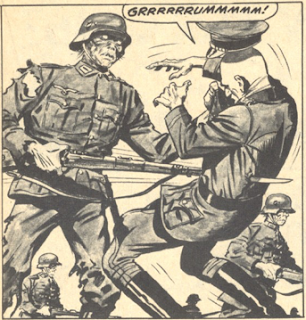 |
| "Army of the Walking Dead" |
On the letters page, wise correspondent Edward Poe of Troy, NY, critiques Jim Warren's science fiction stories thus far: "To put it bluntly, this stuff stinks. If I wanted science fiction, I'd buy a science fiction magazine." Amen to that. But to Poe's condemnation I quickly add, "... and the fantasy stuff reeks as well." My exclamation is due mostly to the up-and-comers who thought Robert E. Howard was the be-all and end-all of the printed word; yep, I'll admit now and then a good SF or fantasy tale would somehow sneak its way to the top of the slush pile but, for the most part, we're getting the stuff that should have run in fanzines. Despite a keen eye for design and a nice pencil, Bill Stillwell pumps out nothing but the same old rot in "Godslayer." Warrior/ swordsman/barbarian/whatever Tyr of Anmut, astride his domesticated lion Rigel, is on a quest to find his beloved Shera, but the god Kali and his faithful subjects stand between his loins and the fabulous Shera. Again, some very nice art, but the script (also by Bidwell) is Howardian nonsense.

Jim is convinced that his partner (in a taxidermy business), Phil, is going to kill him. "It's Grim...," yes, but stoking the fires further is that Jim knows that Darle, Phil's wife, can't stand him either. So, when Jim overhears Phil talking about what sounds like murder, he naturally jumps to conclusions. Boy howdy, was he on the wrong track. Deciding he's going to confront the couple, he barges into their house only to discover Phil has crafted an exquisite stuffed panther for Jim's birthday and, to top it all off, Darlene apologizes for being such a shrew. Imagine that! But... that night, the panther rises from its pedestal and rips Jim to pieces. "Huh?," I hear you saying? Well, see, it turns out Phil was working on this top-secret formula that "induces temporary suspended animation" and... yeah, you're right. That's really dumb. So dumb in fact that it takes a three-thousand word epilogue from Uncle Creepy to explain what we've just witnessed. I do have to admit, though, the image of the pouncing panther is very
creepy (and also very Reed Crandall-esque).
As he's being crucified, a Druid curses a group of Roman soldiers to death by drowning. Sure enough, the soldiers begin dying off one by one. "The Druid's Curse" was the only Warren story illustrated by the Ciochetti Brothers (and I find no further trace of them anywhere), which is a shame as they had an obviously unique style, well-suited to the Warren zines. The script's not half bad either, and it contains a sly twist in its tail.
 |
| Beastly Boyette! |
"Gunsmoke Charly" is that rarity: a good western-horror strip. Charley Fitch has had enough of being a no-nerve yella belly in a time when men could duel in the streets on account of a wrong word or a sideways glance. So, Charly makes a deal with the Devil: bullets can't kill him! But the life of a gunslick turns out to be not as advertised and "Gunsmoke Charly" wearies of the never-ending challenges and the accusing faces of widows, so he tracks down the Devil in order to back out of the bargain. No one ever wins in a deal with the Devil. Tongue firmly planted in cheek (this Satan comes with horns and hooves), Alan Weiss concocts a thoroughly enjoyable scare-oater with a nice cinematic eye in its layouts. Rounding out the best issue of
Creepy in years is Pat Boyette's disturbing "Justice!," about an accountant whose roving eye leads him into lots of trouble and, possibly, cannibalism. The final panel is about as revolting as this title got.
- Peter
Jack- I agree with you, Peter, this is a pretty good issue of
Creepy! Is that because Archie Goodwin has returned as associate editor? I thought Sutton's art in "Tough Customers!" was so entertaining that it made up for defects in the story, and I loved the nod to EC. Tied for best in show is "Gunsmoke Charly!," with an unusual setting for a Warren story and delightful art. The sell your soul to the Devil bit is overused, of course, but Weiss's tongue-in-cheek approach makes it fun. Pat Boyette's work on "Justice!" was next best for me, mainly due to an unexpected ending.
"Army of the Walking Dead" has a good premise but poor execution and the ending is a letdown. Three stories were just average: "Legend in Gold," which is at least cogent and has pretty good art; "Godslayer," which is just more sword and sorcery nonsense and more an illustrated prose tale than a comic story; and "The Druid's Curse," which has an engaging setting but features only adequate art and a predictable ending. "It's Grim..." lives up to the title with an absurd story, ridiculous character motivations, and an incredible ending, but "Polly Want a Wizard" is bottom of the barrel stuff: the pretty pictures are wasted when the story is virtually incomprehensible.
 |
| Gogos |
Eerie #30 (November 1970)
"The Entail"★★★
Story and Art by Pat Boyette
"Mirror, Mirror"★★
Story by Nicola Cuti
Art by Frank Bolle
"Life Species"★
Story and Art by Bill DuBay
"I, Werewolf!"★★1/2
Story and Art by Ken Barr
"In Close Pursuit"★★★
Story by Gordon Matthews
Art by Jerry Grandenetti
"The Return of Amen-Tut!"★★1/2
Story by Don Glut
Art by Jack Sparling
"The Creation"★1/2
Story by Douglas Moench
Art by Carlos Garzon
 |
More Boyette Madness!
("The Entail") |
Riding toward the long forgotten village of Zagoralov, Prince Eric von Rafen ignores a warning to turn back and is welcomed into a man's home just before night falls and the terrible trio of Gormes eats everything left outside, including Prince Eric's unfortunate horse. The next day, the prince makes his way to the castle of Baron Riga Vilka, who tells Eric that he will be an eternal king with perpetual youth and good looks. Eric balks at the suggestion, but the baron says he drugged the prince's wine and now he'll live forever. When Eric tries to leave, the baron orders the Gormes to attack and they tear every bit of flesh from his body save for his head. Now, instead of protecting the baron as king, Eric will protect him as scarecrow!
Pat Boyette's art is quite nice in this bizarre tale, which ends with a memorable and shocking final panel. He experiments with layout, too, setting up page five as a series of five diagonal panels in which he still manages to keep the story moving forward. It reminds me of something Gene Colan might do. Overall, nice work! Love the Basil Gogos cover, too.
When Professor Birch is murdered in a locked room, supernatural investigator October Weir (with his beautiful wife, Vida) is called in to investigate. He figures out that the killing was the work of a mirror demon and Weir and Vida venture through the looking glass into a world that is a mirror of our own, where everyone speaks backwards. Weir identifies the killer as optics expert Dr. Gessler and, after smashing all of Gessler's mirrors, Weir sentences the killer to life imprisonment by painting over the mirror on whose surface he lives.
 |
How to capture a demon?
("Mirror, Mirror") |
I don't mind Frank Bolle's newspaper comic strip art style; it's clean and easy to follow. What bothered me about "Mirror, Mirror" was the dull story. Mirrors, demons, a world where everyone talks backwards--these should be a bit more interesting, no? Weir and his friend appear to capture the first demon by giving it a swift kick and then trapping it under a small trash can. Not much of a demon, if you ask me.
 |
| "Life Species" |
Three space explorers land on a planet, determined to find the remains of a member of the intelligent "Life Species" and reconstruct it. They find something and deduce that it must have died out due to overpopulation and over-consumption of natural resources. What do they find? A Volkswagen Beetle.
At four pages, Bill DuBay's story is at least two pages too long. The spacemen's faces are covered by helmets throughout, so we know something is fishy, and the artist uses every angle he can think of to avoid showing us the thing they're examining until the final panel. It becomes obvious that it's a car long before the end and, when the surprise is not surprising, such a tale loses any impact it might otherwise have.
In the Austrian woods in 1867, a beautiful gypsy girl named Therese and her grandmother find and care for an injured man, not knowing he was bitten by a werewolf. The man is a farmer named Eric Feldman and, because he has been bitten, he is now under the spell of a vampire named Kargos. One night, the vampire summons Feldman, who turns into a werewolf and goes on a rampage while Kargos visits and drains the blood of Therese, killing her. Police Inspector Zanbert questions Eric and then follows him; under the full moon, Eric again becomes a wolf and heads to the old mine where Kargos hides. They fight and Kargos is impaled on a pickax, causing the vampire to disintegrate. Eric turns back into a human and, when the police arrive, he is hailed as a hero.
 |
Cool!
("I, Werewolf") |
The second "longer" story in this issue--it runs nine pages, while "Mirror, Mirror" runs ten--"I, Werewolf" is a bit of a jumble, with gypsies, a vampire, and a werewolf all thrown into a mix that does not exactly work. My biggest problem is the death of Kargos by falling on the metal point of a pickax. I get that a tool like this would be lying around an abandoned mine, but we all know vampires don't die when impaled on metal. Gotta be wood, folks. In any case, I like Ken Barr's art and I'm glad to see a story with some classic monsters instead of more sci-fi or S & S.
 |
| A neat page from "In Close Pursuit" |
Henry Fellows steps off of a bus and sees a man in a black suit who seems to be following him, "In Close Pursuit," through the city in the rain. Is it the cops? Can't be--he didn't break the law. Perhaps an assassin hired by people he wronged? A tall building that Henry had built from substandard materials collapsed, killing many innocent people. Henry runs down an alley, climbs a fire escape, and falls to his death. His pursuer goes home and tells him wife about the "nut" who kept looking at him and who ran down an alley and disappeared.
Once again, Jerry G's ultra-stylized art fits perfectly with the story being told. Almost Eisneresque in its evocation of a dangerous, dark city, though without the master's top-notch draftsmanship, Grandenetti tells a simple yet effective tale of paranoia. Just one question: the man pursuing Fellows does not follow him down the alley, but when Fellows climbs the fire escape he looks up and sees a similar man looking down at him from the roof. Who is that? Just some guy? Not explained, but not fatal to the enjoyment of the story.
 |
Chris saves the day!
("The Return of Amen-Tut!") |
Archaeologist Robert Nesmith and his team discover the mummy of Amen-Tut, who appears to have been buried alive and who left a curse promising that he'd return to terrorize this world if he could not enter the afterlife. Weeks later, Nesmith, his wife, Phyllis, and his young son, Chris, admire the mummy of Amen-Tut in a museum and little Chris thinks the ancient Egyptian doesn't look so tough. Yet "The Return of Amen-Tut!" plays out as promised, with the mummy coming back to life and killing members of the expedition. He arrives at the Nesmith home and is about to start maiming the family when little Chris takes some initiative and begins to unwrap the mummy from the bottom up. With no bandages to hold his ancient form together, Amen-Tut collapses into a pile of dust.
I did not see that coming, and a good (and unexpected) ending can make a story so much more enjoyable than an ending that falls flat. Here, Jack Sparling provides his usual, adequate art, and Don Glut follows the usual points of the return of the mummy story, but that ending is a real hoot.
Dr. Dubrow announces that he wants to be like Dr. Frankenstein and create life by transplanting a brain into a corpse, but his assistant, Wilson, accuses him of blasphemy and quits, intending to report Dubrow to the police. Dubrow's hunchbacked lackey, Karl, murders Wilson and, a few days later, grabs a brain from a lab. Dr. Dubrow transplants the brain into a corpse and it comes alive, but it turns out to be Wilson's brain and the murdered assistant takes his revenge.
 |
"Abby Normal?"
"I'm almost sure that was the name."
("The Creation") |
Had this comic not come out in 1970, I would have thought Doug Moench was stealing from Mel Brooks! There is nothing new here and no surprise, other than the unintended humor of reading a story so clearly based on the film version of Shelley's novel. I knew that the brain would turn out to be Wilson's, so the ending failed.
-Jack
Peter- If "Mirror, Mirror" smells like the launch of a continuing series character, that's because it was, albeit a short-lived one. At the time, one would think "no big deal" but, as Monday Morning Quarterbacks, we know that
Eerie would soon become an all-series title, so October has the prestige of being the book's first-ever carry-over character. It's not a bad story at all; heavily influenced, I'm sure, by Seabury Quinn's Jules de Grandin (and, possibly, itself a spark for Don Glut's "Doctor Spektor," which would pop up at Gold Key a couple years later) and the like. Annoying typos and grammatical errors aside (
If this is ever over, I shall never be able to look into a mirror again for a woman, that is a great tragedy. is
exactly how it's printed), "Mirror, Mirror" feels as though it was ripped from the pages of
Weird Tales.
Pat Boyette delivers yet again with "The Entail," with a closing panel that already makes the aforementioned image in "Justice!" tame. But for some stylish art by Bill Dubay and Carlos Garzon, the rest of the issue is pretty much disposable. "Amen-Tut" and "I, Werewolf!" are brainless monster mashes and "Life Species" is yet another stab at SF that proves predictable but eco-friendly.
 |
| Kelly |
Vampirella #8 (November 1970)
"Who Serves the Cause of Chaos?"★★1/2
Story by Archie Goodwin
Art by Tom Sutton
"The Demon in the Crypt!"★★1/2
Story by Gardner Fox
Art by Billy Graham
"Out of the Fog--And into the Mist!"★★
Story by Steve Skeates
Art by Ken Barr
"Snake Eyes"★
Story by Nick Cuti
Art by Jack Sparling
"Signs of Sorcery"★
Story by Don Glut
Art by George Roussos
"The Gulfer"1/2
Story by Nick Cuti
Art by Bill Fraccio & Tony Tallarico
Much like a certain baby named Kal-El, Vampirella is the last of her race on the dying planet of Drakulon and she is rocketed into space, landing on Earth, where she hunts humans to satisfy her need to drink blood. A jet on which she is flying is hit by lightning and she falls to Earth and awakens to find herself a patient in the remote mountain clinic of Dr. Tyler Weston, who tells her that he had to amputate her wings to save her life. He wants to help her but his nurse Lenore is jealous of the hot number from another planet.
 |
My eyes are up here, Doc...
("Who Serves the Cause of Chaos?") |
Meanwhile, in Michigan, Conrad van Helsing drives a stake through the heart of his late brother, who was killed in the same plane crash that affected Vampirella and whose body had been drained of blood. Van Helsing vows to find the vampire who attacked his sibling. Back at the clinic, Vampirella is troubled by nightmares of a monster and Dr. Weston tells her that he is testing serums on her that will make her a normal human being. Nurse Lenore gathers the other patients at the clinic and stages a meeting of her cult; Vampirella strips down to her skimpy costume, heads down to the basement, and witnesses Lenore leading the meeting.
Vampirella is captured and tied to a stone table so she can be taken by the demon Nuberus, but Dr. Weston kills Lenore before she can plunge a knife into Vampirella. It turns out Dr. Weston is really Ethan Shroud, warlock of Old Salem and first leader of the Companions of Chaos, which is what this particular cult is called. Vampirella wants no part of Ethan and is rescued by the monster, which turns out to be Ethan's decaying body inhabited by the soul of the real Dr. Weston. Nuberus rises, Vampi escapes, the monster turns back into Dr. Weston and breathes his last and, in Denver, Van Helsing settles upon Vampirella as the one who killed his brother. He sets out to find and kill her.
 |
| "The Demon in the Crypt!" |
Archie Goodwin's return to the fold is starting to signal big changes for the Warren mags. Story lengths are beginning to vary from the strict six- or seven-page form, new writers are appearing, and the better artists are replacing the lesser ones. This 21-page Vampirella epic is a real, honest-to-goodness, comic book story, long even for a standard-sized comic of the era at Marvel or DC. Sure, there's some padding, but Goodwin finally takes the main character and uses her as something other than a talking head introducing random tales. "Who Serves the Cause of Chaos?" is no classic, but it sets many things in motion and serves as a springboard for what will hopefully be a new series. Sutton's art seems rushed and not up to his usual level of quality, perhaps due to the story's length, but it's not bad and in places it's quite nice.
Queen Amazonia of Karkassone must head down to the castle basement to kill "The Demon in the Crypt!" Her sword has no effect on the beast and she falls into its own soil, which protects her from its wrath. The demon transforms into yet another hot babe, Baidoba the Beautiful, and heads upstairs to replace the queen, but pretty soon Amazonia feels better, hops out of the soil, marches up to the main level of the castle, and does away with the demon.
Gardner Fox's script is dreadfully overwritten but Billy Graham's art is so intense that it's a pleasure to turn the mercifully-short six pages. The monster in the crypt looks like a very big version of something I seem to recall killing in my own basement, though (despite my frequent trips to the gym) I'm not quite in the top physical condition of Amazonia.
 |
| "Snake Eyes" |
Back in London after fighting in WWII, a soldier is bitter and hateful toward his wife, whose letters trailed off as the war dragged on and who now failed to meet him at the appointed time. He picks up a blonde in a bar and she takes him home but is shocked when he reveals he's a werewolf!
"Out of the Fog--And into the Mist!" was going along great until that terrible conclusion. Skeates has the narrator telling his tale in a hardboiled voice and Barr's dark, shadowy artwork is perfect. This would have been a much better story if the guy hadn't turned out to be a werewolf. I wonder if some classic monster was required to make an appearance in order to justify the story's placement in
Vampirella?
Sara has a face like a snake but Charlie has been her pal and protector since childhood. Now that they're all grown up, Charlie wants to profit from her "Snake Eyes" and takes her to Egypt, where she has some success as a dancer. Charlie makes the mistake of selling her snake pendant and she kills him. She discovers she's a princess/snake goddess and returns to the underground chamber of her ancestors. Too bad she's met there by a representative of the mongoose people!
 |
| "Signs of Sorcery" |
Just when this post was going so well, Cuti and Sparling lay this seven-page mess in our laps. Poor Sara seems to suffer from a real disease known as
Ichthyosis Vulgaris, but all Charlie can think to do is put her on stage in Egypt as a dancer. Of course, this being a Jack Sparling story, she has a smoking body and the only part of her that looks reptilian is her face. Don't even ask where the Mongoose People come from in the final panel. At least she didn't turn out to be a werewolf!
Things are so groovy and far out on Hollywood's Sunset Strip! All the cats and chicks are digging astrology when Craig Smyth gives Sherry a ride on his hog up to a creepy old house in the hills that is rumored to be "the ultimate sign trip." Craig and Sherry are freaked out by spooky laughter that echoes through the house and they find a group of hippies standing like zombies. The dudes and foxy ladies are attacked and eaten by a big lion, the personification (or animalification) of the zodiac sign, Leo. The lion is controlled by a wizard named Zodak, who is horny for Sherry. Craig grabs his magic wand and punches him in the nose; the wand goes nuts and all of the zodiac creatures attack and kill Zodak.
It's a toss-up which story is worse: "Snake Eyes" or "Signs of Sorcery." The hip lingo is embarrassing and George Roussos's art is more amateurish than Sparling's, but the story has a goofy tone that makes it more entertaining than the one about the snake girl. Still, the back end of this issue of Vampirella is putting a big, pointy stake right through my optimism about a trend at Warren toward better comics.
 |
A decent panel from an awful story!
("The Gulfer") |
Little Mindi and her cat, Fluff, explore a scary old house and discover "The Gulfer," a monster that inhabits peoples' bodies and takes them to Hell. It will only go away after it has "engulfed its caller." The monster inhabits the body of Fluff, the cat, and is brought into Mindi's house, but when it tries to expand back to monster size it is choked to death by the kitty's collar, which does not expand.
Hmm. Is there some wordplay here between "caller" and "collar"? That's the best I can figure out as to what happened in this mess. The only thing that was missing from the steady downward trend in quality in this issue was a story drawn by Fraccio and Tallarico, so here we are, placed at the very back of the mag after all of the ads for super 8 movies and such. And it's dreadful. Nick Cuti is writing some awful stuff at this point in his career.-Jack
 |
Ken Barr
("Out of the Fog--And into the Mist!") |
Peter- The long-running adventures of Vampirella and a few of her supporting cast (the Van Helsings and the Cult of Chaos would become mainstays) begins with this issue; it's a juvenile tale filled with peek-a-boobies, beneath Archie's talents, but it does provide a foundation not found in the previous attempts to do something with this character. The script is very Lovecraftian (a good thing) and Tom's pencils look rushed (perhaps the triple-size of the strip has a lot to do with that). It'll be interesting to compare it, when all is said and done, to Marvel's
Tomb of Dracula, which had a similar theme, cast, and superhero-esque tone. Tom Sutton will illustrate the first three installments, with Jose Gonzalez handling art chores thereafter.
Meanwhile... "The Demon in the Crypt" is yet another confusing barbarienne/Lovecraftian story with excellent graphics and "Out of the Fog..." features some stunning pencil work by Ken Barr and an amazingly bad twist in its climax. But nothing can prepare the reader for how truly wretched the final three stories this issue are. "The Gulfer" features a script filled with gobbledygook (something about an engulfer and the backwards Magnus) and perhaps, the nadir in a nadir-filled career of the Fraccarico Brothers. I've said it before but it bears repeating: how could any editor with half a brain accept the smudges and frenetic doodles turned in by these two guys? Seriously!
 |
| "Snake Eyes" |
"Signs of Sorcery" is. perhaps, even more confusing in its "complexity" and if I didn't know better I'd say Jack Sparling had something to do with the horrendous art (at least the breakdowns). It certainly smells like Jack's work. And... speaking of Jack Sparling... "Snake Eyes" is something special altogether. A mish-mash of lunacy, inanity, peek-a-boo art, and (I hope) a huge helping of forked-tongue-in-cheek. Sara's journey from childhood freak to stage sensation ("I gotta idea! Let's take this act all the way to Egypt! It's a natural!") is seven pages of put-on and a wink from writer Cuti. It would have to be, wouldn't it? "Snake Eyes" is tolerable because it's so stupid.
 |
Next Week...
Will Mlle. Marie
spill the beans? |
 |
| From Creepy #35 |


