Monday, August 13, 2018

Star Spangled DC War Stories Issue 136: March 1973

The DC War Comics
1959-1976
by Corporals Enfantino and Seabrook


Mike Kaluta
Weird War Tales 12

"God of Vengeance!"
Story by Robert Kanigher
Art by Gerry Talaoc

"Hand of Hell"
Story by Robert Kanigher
Art by Tony DeZuniga

"The Warrior and the Witch Doctors!"
Story by Arnold Drake
Art by Don Perlin

Peter: In ancient Egypt, Hassup murders the beautiful Dinna when the girl shuns his advances. As she lays dying, she curses Hassup, promising that "God of Vengeance!" Anubis will strike him down. Later, Hassup engages in a battle with the Persians and shows no mercy, beheading their leader, Xeno. A huge sandstorm strikes and Hassup sees what he thinks are two mirages, one of the dying Dinna at the feet of Anubis and the other, the floating head of Xeno. Hassup is buried up to his neck in sand and then set upon by jackals. Dinna's curse has come to fruition. When Big Bob goes supernatural, he likes his Egyptian lore; we saw that years ago when we ran through the DC mystery titles and stumbled across some of Kanigher's work in House of Mystery. I like Talaoc's art (even if it sometimes strays into Frank Robbins territory) but I'm not keen on the story, which is nothing more than standard Egyptian curse fare.

"God of Vengeance!"

"Hand of Hell"
In a quasi-sequel to "God of Vengeance!," Bob Kanigher brings back goddess Dinna to face the evil Nazi, Lieutenant Krantz, an officer serving under Rommel. Dinna doesn't last long, however, since Krantz shoots her (and two Allied soldiers) in cold blood (in front of the statue of Anubis, which sits out in the middle of the desert by this point in time) when the information he's seeking is not forthcoming. Rommel arrives and orders Krantz and his men to advance as the Allies are mounting a huge attack. The Nazis find themselves turning tail quickly and Krantz's tank is destroyed right in front of the statue of Anubis. Even more frustrating than the first story, "Hand of Hell" is obviously Big Bob trying to make a point by tying goddess Dinna in with two time periods (that is, if Kanigher is insinuating this is the same girl as in the first story and not a descendant) and two completely different wars. Yes, the eons pass but man gets no more merciful. I get it. As much as the script makes me snore, Tony DeZuniga's art makes me sit up and take notice. It's dynamic, gritty, and photo-realistic. Joe Orlando may have been a bust when it came to illustrating EC stories but, when it came time for Joe to become editor of the DC mystery titles and he needed new blood, he obviously paid attention to the renovation being done over at Warren, as the DC mystery titles (including WWT) are the spitting image of the kind of material that was being presented in Creepy, Eerie, and (especially) Vampirella. Well, minus the swearing and the naked chicks, that is.

"The Warrior and the Witch Doctors!"
Me and my big mouth. Just as I'm celebrating the influx of new talent to the ranks of the DC bullpen, Joe Orlando goes and throws Don Perlin and Arnold Drake at me. Yeccch. "The Warrior and the Witch Doctors!" is a nonsensical bit of rubbish about a Roman soldier sent forward in time by British druids. There, in Times Square, Claudius hides from police in a grind house playing Rome Against the Druids and sees the light as he's never seen it before. He returns to ancient times to counsel Polonius Maximus and they plan their strategy for total defeat of the Brits. I'm not really sure what this mess adds up to other than, possibly, an homage to all those awful 1950s Sci-Fi tales they would reprint in House of Mystery and Unexpected. No possible motive is given for why the druids would teleport the soldier to 1970s New York but if the explanation were to take up another page, then I'm happy with the obfuscation.

Jack: More Weird than War, "God of Vengeance!" features very good art, an entertaining story, and crisp action. It helps that I love tales set in Ancient Egypt! The art in "Hand of Hell" is even more impressive, and I like how Kanigher continued the theme from the first story into this one set in WWII. "The Warrior and the Witch Doctor!" is not nearly as bad as I expected when I saw that it was by Arnold Drake and Don Perlin. The time travel aspect is fun and Perlin's work is better here than some of what we'd see over at Marvel.


Kubert
Star Spangled War Stories 168

"The Glory Hound!"
Story by Archie Goodwin
Art by Jack Sparling

"The Last Raid"
Story and Art by Tom Sutton

Peter: His super secret mission behind enemy lines must be put on pause as the Unknown Soldier deals with one of his own, a "Glory Hound" Captain by the name of Ransom who wears a red holster and packs a Nazi hand gun. Ransom holds US, decked out in Nazi officer uni, until word comes down from higher-up that this is a man on an important mission and he should be aided in any way possible. The pig-headed Ransom refuses to listen to US's warning that an all-out attack is on the way and Ransom's men need to pull back. No retreat, no surrender for the gung-ho captain until his men start dying around him and the Soldier unwraps his bandaging and assures him that he knows war and a big battle is on the horizon if they don't ease on down the road. Ransom finally listens and orders a pull back but, just then, the squad is attacked by a Tiger attempting to cross an important bridge. Ransom shows he can be just as brave as foolish and the Tiger is dispatched. His job done, the Unknown Soldier heads back to his mission.

"The Glory Hound!"

Just one more foolish, headstrong soldier story, this one with some really bad art and a few silly plot points. The unmasking of the Unknown Soldier begins well enough but ends laughably, with Captain Ransom's near-breakdown upon seeing US's scarred visage. I'm finding myself tuning out to anything Archie is trying to do here for the simple fact that Sparling's art is so rancid it ruins any kind of suspenseful vibe and, instead, elicits chuckles and eye-rolling. As the Losers strip continues its ascent, the previously-essential Unknown Soldier series becomes the 1970s' answer to Gunner and Sarge.

"The Glory Hound!"

"The Last Raid"
In a last-ditch effort to delay inevitable defeat, the Nazis create the largest zeppelin in history (over 700 feet long) and assign Captain Peter Strasser to "The Last Raid," a deadly bombing run over London. This zeppelin (dubbed the L-70) is designed to fly higher and carry a larger payload than any of the previous airships and Germany's idea is to bomb London off the face of the Earth. But Major Egbert Cadbury has something to say about that and, along with his trusty mate, Leckie, he jumps into his trusty DH-4 and hits the sky. It's a long, arduous journey, one that sees Cadbury and Leckie close to extinction several times but, in the end, the good guys win and the L-70 is reduced to burning rubble. A really exciting tale, one that almost pulses with danger and adventure; the panel where Cadbury sees the massive zeppelin for the first time is particularly dazzling. One drawback, of course, is the fact that Tom Sutton excelled at horror comics and most of his characters, no matter what genre he's dabbling in, come off creepy (and that includes the major and captain both). But Sutton nails the air battles, the carnage and, perhaps most importantly, the drama.

Jack: I was in agreement with you that "The Glory Hound!" was a weak story with terrible art until the moment the Unknown Soldier took off his bandages. Is this the first time he's done that? I thought it was a powerful scene and one that was easily the highlight of the story. While I have fond memories of Tom Sutton's work, "The Last Raid" is not among his best. I always like to see new artists and it's a decent tale overall but it seemed kind of plodding and the art looked muddy to me.


Kubert
Our Army at War 255

"What's It Like?"
Story by Robert Kanigher
Art by Russ Heath

"Red Rain"
Story by Robert Kanigher
Art by ER Cruz

Jack: Lamenting that he is desk-bound and never has any excitement, Sgt. Egbert gives Rock another order, this time to rescue a lieutenant and his jeep from a river. Easy Co. makes its way to the river but finds that Nazis set the soldier and vehicle as bait and as soon as the Americans arrive, the shooting starts. "Nick" and "Al" are killed in the gunfire and the lieutenant on the jeep was dead anyway.

Back at H.Q., Sgt. Egbert issues another order: repair some road signs that have been turned around and are causing confusion. The job is accomplished in the pouring rain and a plane flying overhead drops a bomb that kills "Sol" and "Phil." After another return to H.Q., the men of Easy Co. bed down for the night while snow falls outside. Rock takes off on his own to handle Sgt. Egbert's latest order, which involves finding the general's lost bulldog mascot. Rock finds that some Nazis picked up the dog and, after he blows up their tank, he takes the Nazi commander prisoner and brings him back to base. Rock is injured and getting a blood transfusion, so Bulldozer reports in the Sgt. Egbert, who assumes Rock is enjoying coffee and donuts.

"What's It Like?"
I happened to read this issue last of the five we're covering this month, and the quality of "What's It Like?" in both script and art far outpaces any of the other new material. I only have one complaint, and it's a big one. Why, oh why, did they give us a cover that makes it look like Pooch has returned? It's a total cheat, since the dog in the story has nothing to do with Gunner and Sarge. I love Kubert's covers, but this one got my hopes up unfairly! Also, it's a little suspicious that the only soldiers in Easy Co. who ever get killed are the ones we've never heard of before!

"Red Rain"
Allied soldiers in 1917 France are led through a mine field by a brave French soldier who disappears as soon as the coast is clear. The soldiers then enter a village, where they see a statue that looks just like the French soldier. When an enemy tank attacks, the same French soldier charges it and destroys it, allowing the Allied soldiers to fight off German troops and retreat to safety. This time, they see the statue of the French soldier, bleeding from a shot to the heart. The "Red Rain" goes unexplained.

ER Cruz's art isn't up to the level of his fellow Filipinos at this point, but I like the gritty, violent nature of Kanigher's story, another in a string of good "Gallery of War" tales.

Peter: "What's It Like?" is one of the best Rocks, in both script and art, we've seen in some time, but maybe I'm just up for something that doesn't involve the rescue of a frail Fräulein or cute little kid. It's a nice touch that Egbert remains confident that Rock and the boys have a cushy job; there's no final page reveal.  Russ, as always, is aces. "Red Rain" is an interesting change of pace (perhaps one that might have been better suited to Weird War) but it makes no sense. Big Bob tips his hat and the reveal halfway through the story and then continues on with the narrative as if we don't know what's going on. The living statue plot may have been used one too many times.


Kubert
G.I. Combat 159

"Mission: Dead End!"
Story by Archie Goodwin
Art by Sam Glanzman

"Swords at Dawn"
Story by John Warner
Art by Ric Estrada

Peter: "Hard-chargin', gold-plated" General Norton is back (from GIC #148) and he wants the boys of the Jeb Stuart to take on a suicide mission to a POW camp deep behind enemy lines. The boys grudgingly accept their duty and head out, unhappy that the general has decided to send an escort, one of his top dogs, Major Cord, along with them. The presence of extra eyes alerts the men to the importance of the mission. Meanwhile, Arch's true love back home has written him a "Dear John" letter and that's wreaking havoc with his duties.The Jeb arrives at Wehrstadt to find it empty save POWs. Something's up! Sure enough, they find themselves surrounded by Tigers in an ambush. They load up as many POWs as they can carry and hightail it but the boys are taking on loads of artillery and suffering heavy casualties. Only through quick thinking and battle smarts are the boys able to survive. When the smoke clears, Jeb demands to know why they were sent on this mission and the major confesses that one of the POWs was Norton's son. Unfortunately, the man did not survive the battle but the crew are elated that they were able to save a handful of prisoners.

"Mission: Dead End!"

"Mission: Dead End!"
Now that Sam Glanzman's art doesn't irritate me as much (I'm up to "Slightly Irritated" on the Irri-mometer), the Haunted Tank has moved up comfortably to the #3 slot in regular war series for me (far ahead of the "Grossly Irritating" Unknown Soldier but still behind Rock and the Losers); though it's still got its contrivances. Why not ditch the ghostly general altogether since he only shows up for a panel or two each issue? If Archie's not going to throw open the curtain for the rest of the tank crew, don't bother wasting the panels. Archie's a great writer and his scripts are always sharp. "Mission: Dead End!" begins as a cliche ("oh no, not another impossible mission!") but the climax holds a bit of a twist with the death of General Norton's son and the welcome absence of a page of the general's grief. Nice ironic twist that, as Jeb observes, "in trying to save his son, Norton's lost him . . ."; if he had left him alone in the POW camp, chances are he'd have been liberated before long anyway. But what else could a father do?

Samurai Zenkiyata must battle his old mentor, Mulaido in "Swords at Dawn," a well-written but cartoonishly-drawn back-up strip. It's tough for me to get into these ancient tales of war but newcomer John David Warner throws enough interesting twists to keep my attention. Warner would go on to become an editor at Marvel, overseeing several of the black and white titles as well as creating the goofy supernatural superhero, Ulysses Bloodstone.

"Swords at Dawn"

Jack: I'll grudgingly admit that Glanzman's work had its moments of less than awfulness this time out, but I still think it dragged down what is probably a good script. It's discouraging that we've gone from a diet of Heath and Kubert to a diet of Sparling and Glanzman, but the DC War books have recovered before and I hope they'll recover again. If not, maybe we should start blogging about Tarzan. I like to see that Archie studied up on past issues and cites them in Marvel-like footnotes. As for "Swords at Dawn," I'm a sucker for samurai stories, so I was predisposed to like this one and I thought Estrada's art fit the topic well.


Heath
Four  Battle Tales 1

"Be Brave--Be Silent!"
(Reprinted from All-American Men of War #94, December 1962)

"Tin Pot Lottery!"
Story by Bob Haney
Art by Mort Drucker
(Reprinted from Star Spangled War Stories #73, September 1958)

Peter: The DC War line must have been doing better than we thought if the powers that be decided that a reprint series was in order. Four Star Battle Tales (or, to be technical, Four ★★★★ Battle Tales) would last a mere five issues before getting the ax, but more reprint titles would follow.

"Tin Pot Lottery!" has some good art from one of our reprint favorites, Mort Drucker, but there's an overly familiar ring to the script. Three G.I.s wager a month's pay on whether the new sergeant will last three days without being blown to kingdom come. By the end of the story, naturally, the sarge has won three new fans.

"Tin Pot Lottery!"

Jack: Looking back at our post on December 1962's DC War Comics, I see that I was very impressed by the Johnny Cloud story, "Be Brave--Be Silent!" Mort Drucker's work on "Tin Pot Lottery!" is so good that it makes most of the new stories we read this month look bad in comparison. Bob Kanigher may be the king of the DC War Comics writers, but Bob Haney sure could spin a great yarn himself! The one thing I love/hate about Mort Drucker's war stories is that the characters look like movie actors but I can never quite pin down which ones.

Next Week . . .
The septic tank is getting full

Thursday, August 9, 2018

Fredric Brown on TV Part Eleven-I'll Cut Your Throat Again, Kathleen

by Jack Seabrook

Fredric Brown's fondness for clever titles is evident in "I'll Cut Your Throat Again, Kathleen," a story that he completed by January 21, 1947, and sold by February 21, 1947, for $140, according to his logbook. Published in the winter 1948 issue of Mystery Book Magazine, the story's title was a play on an old song called "I'll Take You Home Again, Kathleen," which had been recorded by Bing Crosby and released as a single in 1945.

The story features Johnny Marlin, a jazz musician, who is being kept in a private sanitarium after having cut first his wife's throat and then his own wrists. As the tale opens, Johnny is visited by an intern named Red, who helps Johnny piece together bits of his memory, recalling his career and his marriage to society girl Kathy Courteen. Johnny is examined by a panel of doctors and, when he recognizes band mate Tubby Hayes, he is allowed to go home.

Afraid to confront his wife, Johnny visits a bar with Tubby and is upset when he hears a recording of himself playing Mood Indigo, since his self-inflicted injury will prevent him from resuming his career as a musician. Johnny returns home and finds two straight razors in the bathroom cabinet; he pockets them with the intent of discarding them. Kathy rushes into his arms and expresses her excitement at the prospect of doing what she wants to do now that his band will no longer come between them. As St. James Infirmary plays on the phonograph, Johnny's memory returns and he realizes that he did not attack his wife or wound himself. Instead, he came home to find her with her throat cut and then he passed out. While he was unconscious, Kathy awoke and cut his wrists to end his music career, certain that he would awaken and think he had done it himself. In fact, her jealous brother had attacked her and fled.

When Kathy does not deny her crime, Johnny snaps, takes a razor from his pocket, and cuts her throat for the last time.

David Niven as Johnny Marlin
"I'll Cut Your Throat Again, Kathleen" is set in Chicago, where some of Brown's best work from the mid-1940s takes place (The Fabulous Clipjoint, The Screaming Mimi) and the author's interest in jazz is evident, as the main character is a jazz musician and jazz standards play at key moments in the story. Johnny Marlin grapples with insanity or the fear of it, something many other Brown protagonists struggle with. In her autobiography, Oh, for the Life of an Author's Wife (recently published in paperback and available here), Brown's wife Beth wrote that actor David Niven read the short story in the British magazine Argosy (where it was published in the February 1954 issue) and bought the rights to adapt it for television. Beth writes that it aired on Four Star Playhouse, but that is incorrect--it aired as an episode of The Star and the Story, a syndicated drama anthology series produced by Four Star Productions.

Joan Camden as Kathy
Founded in 1952 by Dick Powell, David Niven, Charles Boyer, and Joel McCrea, Four Star Productions was responsible for a number of television series in the 1950s and beyond. "I'll Cut Your Throat Again, Kathleen" was adapted under a new title, "The Thin Line" and, though online sources claim that it was the 19th episode of the second season of the series, the print available for viewing online lists it as the fifth episode of the first season. Even more curious are the comments by David Niven, who is both host and star, at the beginning of the show, since he seems to be introducing a new TV series, where the star selects the story. The copyright date at the end of the episode is 1954, suggesting that this episode could have been the pilot for the series.

The adaptation is excellent, for the most part, though it is not surprising that the TV show ends happily with a conclusion rather different than that on the printed page. In the first scene, Red visits Johnny in his room at the sanitarium and the conversation is similar to that in the story, with some lines of dialogue lifted from page to small screen. Johnny is self conscious about the scars on his wrists and keeps looking at them. He says that his parents were "poor but honest scholars" and that he comes from Boston, though there is no explanation for David Niven's British accent.

Herb Vigran as Smiley
In the scene that follows, a single doctor speaks to Johnny and Johnny does not have to figure out on his own that his band mate has entered the room and that the doctor is testing whether Johnny recognizes him; in the TV version, this bit of intelligence has been conveyed to Johnny by Red in the prior scene, using dialogue to give the viewer information that was provided through narrative in the story. In the story, Johnny sees a fat man and guesses that he is Tubby Hayes; in the show, he sees a man smiling broadly and guesses that he is Smiley Hayes.

Johnny and Smiley then go to a bar together, as in the story, but the TV version eliminates references to a band mate on heroin or to Kathy's brother. The teleplay is well-written: "Skip the improvisation, just give me the melody," says Johnny when Smiley begins to go into too much detail. Johnny wonders: "Who is this man in here? What is this thin line that divides me from him? How thin is it? Is it as thin as a tight rope and if I fall off do I fall on his side or my side?" Like the initial scene between Johnny and Red, this scene between Johnny and Smiley is well played, especially when Johnny nearly smashes the jukebox that plays one of his records.

At home, when Johnny embraces Kathy, he looks at her neck and remarks, "Just a thin line." Retitling the story "The Thin Line" is a clever choice, since the new title has multiple meanings. There is a thin line between the truth of what happened and the lie Kathy tells, a thin line between sanity and insanity, and the scars on Kathy's neck and Johnny's wrists are thin lines as well. The short story is an example of crime fiction, with references to drugs and a brutal if subtle conclusion. For television, the drug references are removed, the story is simplified by the removal of Kathy's brother, and the conclusion is completely altered.

Chuck Connors as Red
In the final scene, Kathy puts on a record that skips and triggers the return of Johnny's memory. He recalls that he came home and put on the same record; Kathy woke up, came out of her room, and "ripped the arm off the music." They argued about his music taking him away from her, then he blacked out and woke up to find his wrists and her throat had been cut. There is no mention of her brother trying to kill her or being high on heroin, as there is in Brown's story. In the TV version, Kathy argues at first but soon confesses. Instead of killing her, Johnny pities her. He wants her to tell the truth to the police, the newspapers, and his fans, but he relents, realizes that she is sick, and promises to help her. "You'll have to find your own way back," Johnny tells Kathy, "it might be easier if I walk with you."

"The Thin Line" is a faithful adaptation of Brown's short story, with minor changes along the way to remove elements unfit for television, and with a happy ending replacing the story's violent conclusion. I prefer the end of the short story to the sappy finale of the TV show, but it hardly detracts from what is a very good episode overall.

The teleplay is by Frederick Brady (1912-1961), who started out as an actor in film from 1943 to 1950 and then became a writer, scripting films from 1950 to 1953 and numerous TV episodes from 1954 until his death in 1961, including 14 episodes of The Star and the Story.

Directing this episode without much vigor is Roy Kellino (1912-1956), who was born Philip Roy Gislingham in London and whose father, W.P. Kellino, directed silent and early sound films. Roy Kellino worked as a cinematographer from 1935 to 1945 and began directing in 1937, moving into television in 1955 and directing nine episodes of The Star and the Story. He married actress Barbara Billingsley (of Leave it to Beaver) in 1953 and died of a heart attack in 1956.

Joseph Forte as Dr. Glasson
David Niven (1910-1983), who read the story and bought the rights, acts as both host and star of the show, playing Johnny Marlin. Born in London, Niven's screen career lasted from 1932 to 1983 and he was a major film star, appearing in movies such as The Bishop's Wife (1947), Around the World in 80 Days (1956), The Guns of Navarone (1961), The Pink Panther (1963), Casino Royale (1967), and Murder By Death (1976). He won a Best Actor Oscar for Separate Tables (1958) and was a regular in a TV series called The Rogues (1964-1965). This was his only appearance on The Star and the Story, though he did appear in 33 episodes of Four Star Playhouse, which may have been the source of Beth Brown's confusion about where this episode aired.

Johnny's wife Kathy is played by Joan Camden (1939-2000), whose performance is a bit wooden. Born Joan Louise Creears in Los Angeles, she was on screen from 1952 to 1963 and her last credits are a couple of episodes of The Outer Limits.

Dr. Glasson, who speaks to Johnny and lets him out of the sanitarium, is played by Joseph Forte (1893-1927), whose many credits from 1924-1962 include that of a doctor in the camp classic, Reefer Madness (1936).

Familiar face Herb Vigran (1910-1986) plays Smiley. Vigran has over 350 screen credits in a career that lasted from the early 1930s to the late 1980s. Perhaps he is best remembered today for his six appearances on The Adventures of Superman, playing characters with names like Legs Lemmy, Georgie Gleap, and Mugsy Maple.

The biggest casting surprise in "The Thin Line" comes in the opening scene, where none other than Chuck Connors (1921-1992) plays Red, the sanitarium intern. Born Kevin Connors in Brooklyn, he played Minor League baseball in the early 1940s, was on the championship Boston Celtics team in 1946, and had a brief stint as a Major Leaguer from 1949 to 1951 before becoming an actor. His screen career lasted from 1952 to 2001 and he starred in several TV series, but it was The Rifleman (1958-1963), a series produced by Four Star Productions, that made him famous. There is a website all about him here.

"The Thin Line" is available for online streaming purchase here and is well worth a look.

Sources:
Brown, Elizabeth Charlier. Oh, for the Life of an Author's Wife. Booklocker.com, 2017.
Brown, Fredric. “I'll Cut Your Throat Again, Kathleen.” Carnival of Crime: The Best Mystery Stories of Fredric Brown, Southern Illinois University Press, 1985, pp. 146–163.
The FictionMags Index. 10 July 2018, www.philsp.com/homeville/FMI/0start.htm.
IMDb, IMDb.com, 10 July 2018, www.imdb.com/.
Seabrook, Jack. Martians and Misplaced Clues: the Life and Work of Fredric Brown. Bowling Green State University Popular Press, 1993.
Stephensen-Payne, Phil. Galactic Central, 10 July 2018, philsp.com/.
“The Thin Line.” The Star and the Story, 17 Mar. 1956.
Wikipedia, Wikimedia Foundation, 10 July 2018, www.wikipedia.org/.

Monday, August 6, 2018

EC Comics! It's An Entertaining Comic! Issue 63


The EC Reign Month by Month 1950-1956
63: June 1955 Part II


Evans
Aces High 2

"Chivalry!"
Story by Carl Wessler
Art by George Evans

"Revenge"
Story Uncredited
Art by Bernie Krigstein

"Locker 9"
Story by Carl Wessler
Art by Wally Wood

"Footnote"
Story Uncredited
Art by Jack Davis

"Chivalry!"
Battles in the skies above France during World War One were marked by a sense of "Chivalry!" and the rules of fair play were observed by both sides. Lt. Pat Hogan saves the life of his friend, Steve "The Kid" Barry, in an air battle. Three days later, it happens again, when the Kid comes up against Germany's Flying Fox, Baron Walter von Ritter, who refuses to press his advantage when he sees Barry's relative youth. After the battle is done, German Lt. Horst Viegel remarks that the Kaiser instructed his fliers to destroy the enemy, and the next time they're in the air, Horst shoots down the Kid's plane and then mercilessly guns him down as he runs on the ground. Disgusted by this violation of the rules of decency, von Ritter forces Viegel to face Hogan, who finishes off the rash German pilot.

George Evans sure can draw WWI air battles, and Carl Wessler's script is well above average. Even though we get a flashback to how the two pilots first met (something that would later be done to death at DC), the story works well and the ending is completely satisfying. Reading about the respect shown between the two sides in WWI makes what happened in WWII all the more tragic.

"Revenge"
Captain William Warren falls hard for pretty Nurse Ellen Mack when she tends to him in the hospital. Soon, he professes his love but she is killed in an air attack by German pilot von Rustow and Warren vows "Revenge." Before you can say "Great War" he's back in the air, flying his Spad and looking for the villainous Hun. Find him he does and, out of ammunition, Warren crashes his plane into von Rustow's so that both are killed and Nurse Ellen is avenged.

It's interesting to see how weak Krigstein's art can be when he tries to tell a story in a straightforward fashion, without any pyrotechnics. This is just such a story and, with a corny and predictable plot, Krigstein turns in a mediocre six pages.

Down in the muddy trenches, Burt Rolfe yearns to fly a plane in the Lafayette Escadrille and soar high above the war. Up in the sky, Lt. Eddie Blackton pilots his plane over No-Man's-Land and succeeds in downing a feared German Halberstadt. Eddie returns to base for a celebration, but everyone know he's doomed because he has the jinxed "Locker 9." Next time out, his plane goes down in flames and, in the trenches, Burt Rolfe receives word that he has been accepted into the Lafayette Escadrille. He arrives and can't understand why his fellows lament that he has been assigned to Locker 9.

"Locker 9"
Carl Wessler is two for two in this issue with this well-plotted and exciting story of a doomed locker and the men who use it. Wally Wood is great, as usual, making me wonder if he may have been the most versatile of all the EC artists. Is there any genre at which he did not excel?

Major Trout is the new commanding officer of a squadron of flyers and he's a tough one who intends to instill discipline in the young hotshots and who doesn't care whether they like him or not. Insisting that attention to detail saves lives, he tells the men a story of a pilot who ignored a loose cotter pin and ended up losing his leg in a crash. Trout then pulls up his pants leg to display a prosthetic leg and his men get the message. After they leave, he removes the fake leg and reveals that his healthy leg had been strapped behind him. The story was true, but the loss of a leg was icing on the cake.

"Footnote" is a pretty good story until the ridiculous double twist at the end where we're supposed to believe that Trout has been sitting on his leg for an hour and that no one noticed the prosthetic leg was a fake. The old story about the tough commander who only knows what's best for his men has been told umpteen times, but Jack Davis illustrates it well. Too bad the uncredited writer had to add one twist too many.--Jack


"Footnote"
Peter: I'm getting mixed messages from the first two stories in Aces High #2: "Chivalry!" insists that the Germans had a sense of fairness and gamesmanship about them but "Revenge" just strikes home what a horde of dirty rotten scoundrels they were. The art this issue is universally great but "Chivalry!" reaffirms that this is George Evans's book; the excitement of Evans's dogfights just soars off the page. "Footnote" has a great twist, one that plays on our expectations of cliched finales, and "Locker 9" has some great Wood art and an intro that made me laugh out loud since it echoes the kind of plot devices Bob Kanigher ran into the ground over at DC. The guys on the ground always think the guys overhead have it made and vice versa.

"Chivalry!"


Craig
Extra! 2

"Dateline: Oslo"
Story and Art by Johnny Craig

"Stromboli!"★1/2
Story by Colin Dawkins
Art by John Severin

"Hong Kong!"★1/2
Story by uncredited
Art by Reed Crandall

"Dateline: New York City"
Story and Art by Johnny Craig

Intrepid, globe-trotting reporter Keith Michaels is sent on the trail of a woman who may know the secret to uncovering a cache of gold smuggled out of Germany during the war. Following her to Norway, Keith teams up with a hardboiled dame named Erica and, together, they rescue the young woman from some tough characters who look like they'll stop at nothing to pry the secret out of her.

"Dateline: Oslo"
"Dateline: Oslo" is pure Johnny Craig enjoyment! I don't know what it is, exactly, but Craig is my favorite overall creative person at EC. His stories are almost Eisneresque in the way he combines suspense and humor, story and art, and sprinkles a bit of the old hardboiled storytelling in for a topper. When Keith meets Erica, their dialogue is a delight: "You must have a good-looking doll at Bjornigsfjord to want to get there so bad," she says, and he tells her, "Look, honey, I appreciate your troubles, but I have to get to Bjornigsfjord"--all while lighting a cigarette. Love it.

Adventurous press photographer Steve Rampart parachutes on to the Italian island of "Stromboli!" where he witnesses a well-dressed man chasing another man named Colucci. The pursuer is a doctor who tells Steve that Colucci is the only man who can clear his name, but when the pursued dies in a house collapse then Steve must give the doc a pep talk to keep him from giving up on life. The doctor works valiantly to minister to many injured locals and is thrilled when his last patient turns out to be Colucci's wife, who also has information he needs to clear his name.

"Hey! Where'd our knives go?"
(Stromboli!")
Not the best work I've seen from Dawkins or Severin, "Stromboli!" suffers from some corny dialogue ("What? I don't dig you, Jack . . . talk English!) and a predictable finish, but it's reasonably entertaining nonetheless.

Geri Hamilton's pretty nose sniffs out news in "Hong Kong!," where a strike threatens the local government. Of course, a nefarious foreigner is behind the whole thing, and when he loses his cool after Geri's photographer takes his picture, the reporter knows something is up. The story she files leads to the scheme being unraveled.

Reed Crandall's half-page splash is a thing of beauty but the story is a dud. This comic book suffers from the need to have each story focus on an intrepid reporter who uncovers something exciting, and by the third story in this issue the conceit is already wearing thin.


Keith Michaels returns from Norway to find that his boneheaded editor sent his secretary, Vicky, out on what seemed like a safe and simple story, but now she is being held hostage by a psycho on the top floor of a condemned building! Keith races to the scene and heroically leaps from a neighboring building before crashing through the skylight and confronting the psycho. Keith manages to survive a gunshot wound and a beating before he knocks the psycho out a widow to his death. Keith and Vicky also fall from a great height but when he awakens in a hospital bed he learns that they landed in a hastily-set-up police net.

A great sequence from "Dateline: New York!"

Wow! What a great story! There's very little set up and no real investigation in "Dateline: New York City"--just several pages of slam-bang action. We are told that the psycho is the Penguin, who used to run a speakeasy and who just got out of a mental institution, apparently a bit too early. The last four pages, where Keith performs some amazing feats of daring in order to rescue Vicky, could have come straight from a pulp magazine. It may be far-fetched, but hey--it's a comic book! Isn't this why we read them?--Jack

Peter: I'm still trying to figure out exactly what was going on in "Dateline: New York City." The Penguin was holding Vicky hostage and people can jump really far in New York City. That's about it for me. But then that's the secret formula of Extra!, I guess. Just turn your brain off to the nonsense being conveyed by the little words and enjoy the pretty pitchers. Severin and Crandall are aces but I wouldn't mind if this became an all-Craig title (a la Kamen and his Psychobabble); Johnny's pencils handle the high adventure as well as anybody and they've got that Steve Canyon newspaper strip look to them. Extra! is just as good as any of the competitors' adventure titles but perhaps that's the rub: it's not as good as the ECs that preceded it. A little trivia here: Johnny Craig, in an extensive interview with the Comics Journal, reveals that the powers-that-be at EC removed all the knives from Severin's finished art in the fight scenes in "Stromboli!," which is why the choreography looks so funky!

"Dateline: Oslo"


Williamson
Valor 2

"The Champion" ★1/2
Story Uncredited
Art by Al Williamson

"Poetic Justice" 
Story by Carl Wessler
Art by Bernie Krigstein

"The Colonel's Son" 
Story by Carl Wessler
Art by Graham Ingels

"The King's Service" 
Story by Carl Wessler
Art by Wally Wood

Since being taken as a slave by the soldiers of Rome, Flacchus has served honorably as Marcus Aurulis's most durable gladiator. Flacchus misses the wife he left behind but gets on with his business without revenge in his heart. Aurulis, thankful for Flacchus's years of bruised and bloodied service, declares the gladiator a free man and Flacchus opens a nice little sword shop in Rome. One day, a blind beggar comes into the shop and Flacchus immediately recognizes him as a former gladiator, left to wander and beg for his meals. The old man is run down by a horse and chariot and the occurrence leaves Flacchus shaken; soon after, he discovers that he is also going blind and decides to end his life in the arena. "The Champion" enters himself into an event and introduces himself to his opponent, a young Tuscan named Arminius. As the men talk, Flacchus realizes this is his own grown son and decides it's a fitting way to die.

Who doesn't love a well-told gladiator tale? I do, and "The Champion" nicely fills the bill, giving us a fully-developed lead character, pathos, and a sly twist in its tail. What's most welcome is the absence of vengeance; this warrior has just come to realize these were the cards he was dealt, why bitch about it? Sure, the coincidence is a stretch but it works on several levels. It's a better expository than a caption that says, "So here's what happened to Flacchus's wife and oh, he had a son . . ." The whole enchilada is delivered with a delicious Williamson sauce, the closest thing to Frazetta we'll get, dark and broody in spots and fully-lit when the action arrives. It's just like a good Steve Reeves movie!

In 12th-Century China, the cruel emperor Wu Ming has declared poetry to be a crime punishable by death. A group of poets rise up and murder a handful of Wu Ming's guards. All poets, that is, save the pacifistic Chou Po, who shrinks back and awaits the outcome. After the carnage is over, the group of men cast out Chou Po and head for the Emperor's palace to protest the new law. The poets never stand a chance against the horde of guards and are slaughtered in the courtyard to the delight of Wu Ming. Weeks later, the Emperor makes an appearance in the village to strike fear in his subjects but a young, pretty girl dares approach the procession to offer a flower to the Emperor. The girl is immediately arrested and brought to the palace, where she declares love for her ruler. Clearly smitten, Wu Ming brings the girl to his chambers and, an hour later, the girl emerges, telling the guards that the Emperor is asleep. Chou Po heads back to the teahouse, removes "her" wig, and cleans the blade used to murder Wu Ming. "Poetic Justice" has a sly twist that I must admit I never saw coming (though it's pretty obvious, isn't it?) and some glorious Krigstein art that almost matches that of the classic "Pipe-Dream" from Vault #36. It's remarkable how Wessler continually screws with the reader's preconceived notions of Chou Po as a character. Initially, we see him as a coward (as do his fellow poets), a future antagonist or a rat. Certainly not as a savior. That last page serves up some outré suggestions--Wu Ming's counsellors with their winks and "ahem"s at what might have taken place behind closed doors. And just how far did it get? A 12th-Century version of that scene from The Crying Game, perhaps?

Colonel Jean Lescours disapproves of his son's plans to marry the beautiful Janice but, when Napoleon invades Russia, the Colonel devises a way to keep Paul from making a really big mistake. Lescours pulls some strings and has Paul commissioned to accompany him to Russia so that he can keep an eye on him. The other soldiers are envious and spiteful of this coddled young man's place in the detachment and they let it be known loud enough to bother Paul. When his father wades into battle and leaves an officer to watch Paul in a tent safely away from the carnage, Paul pulls a gun and rushes to the front. There, he takes a bayonet and dies, leaving his father heartbroken. Luckily, Paul and Janice were married before Paul's commission and Janice shows the fruits of their wedding night to grandpa. A big steaming chunk of French soap opera, the bastard step-child of Margaret Mitchell and The Guiding Light, "The Colonel's Son" is the standout of the issue, but for all the wrong reasons. The dialogue is sappy ("You see, Colonel . . . he was a man and he loved me . . . so we were married . . . without your blessings!") and the plot threadbare and perhaps a little too reminiscent of "Yellow" (Shock #1), so the only thing that keeps me turning these pages is . . . yep, Graham, who continues to forge ahead in the terror-less swamps of EC.

Young knight Geoffrey wants only one thing in this English world and that's to join the Round Table of King Arthur. To that end, Geoffrey applies for the job but is told to ease on down the road while the knights attend to more pressing matters. After his squire is frightened away in a skirmish, Geoffrey takes Edward, a gnarled old man, as his new squire and the two take a tour of the English countryside, Geoffrey raising his sword to anyone who so much as sneezes a derogatory word in King Arthur's direction. After several battles, the knight and his squire rest by a lake but soon Edward is rousting his master awake to warn him of a nearby danger. Five knights sit around a fire, discussing  the assassination of Arthur. Geoffrey strides in and challenges the men to a battle but Edward pipes up before any damage can be done. Satisfied that Geoffrey is indeed a brave knight, King Arthur removes his old man makeup and he and his Round Table knights welcome Geoffrey into the fold.

A worthy successor to last issue's Arthur tale (and it almost seems like a chronologically-wonky novel we're reading here), "The King's Service" is a rousing adventure tale with fabulous Wally visuals. Much like in "Poetic Justice," Wessler plays with our expectations of the direction Geoffrey's path will take. Just a handful of months after this grand "New Direction" had begun, one thing was crystal clear: EC was finding success (quality-wise, at least) with the genres they'd already mastered (war, adventure, and suspense) and were floundering in the subjects that were new to them (medicine, newspapers, and--choke--psychoanalysis). -Peter

Jack: Williamson's gorgeous cover sets the stage for his brilliant work on "The Champion," an excellent tale by an uncredited author in which a kindness is repaid with more kindness. "Poetic Justice" is an intriguing tale from long-ago China with a surprise ending and a master of disguise whose talents rival those of DC's Unknown Soldier! Krigstein's work is better here than in "Revenge" but it's still the weakest art in the issue. "The Colonel's Son" is sentimental and old-fashioned with a gentle twist at the end and adequate art. Though I guessed the ending of "The King's Service," it was still well-told with even more fabulous art from Wally Wood. In all, a satisfying comic.

In only seven days . . .
Jack envies Peter's he-man lifestyle

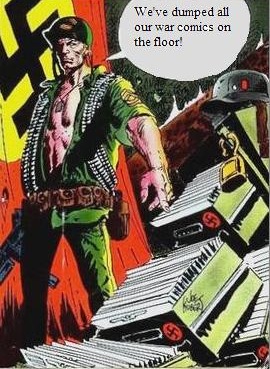
in Star Spangled DC War Stories #136

Thursday, August 2, 2018

The Hitchcock Project-Clark Howard Part Two: Night Fever [10.28] and Wrapup

by Jack Seabrook

Colleen Dewhurst as Nurse Hatch
Hospitalized after being shot in a holdup gone wrong, Gerry Walsh awakens to find himself being questioned by the police, who want him to tell them the location of George Cappo, his partner in crime. Captain Tevell wants to have Walsh transferred to the prison hospital for killing a cop but the doctor says the patient is too sick to move, so Tevell has him handcuffed to the bed, with round the clock guards and steel grilles on the windows. Nurse Alma Hatch, "an extremely plain girl" of about 27, is assigned to care for the prisoner round the clock.

In the days that follow, Walsh flatters Nurse Hatch, telling her that she has "'natural beauty'" and cultivating a relationship with her. He denies having killed the policeman and confesses to having fallen in love with her. After Tevell tells Walsh that he's headed for the electric chair unless he tells the police where to find his partner, Alma offers to help the prisoner and fakes his records so he can stay in the hospital for a few more days. She then agrees to escape with him and helps him prepare.

"One Way Out" was
first published here
When Walsh is well enough to move, Alma gives his guards drugged coffee to put them to sleep before helping him out of the hospital and driving him to a run-down neighborhood. They climb to an upstairs apartment, where Cappo admits them and a voluptuous blond welcomes Walsh, who quickly dismisses Alma. Recalling the many times she has been fooled by men, Alma descends the stairs and tells the waiting policemen where to find the killers.

In "One Way Out," which was first published in the February 1965 issue of Alfred Hitchcock's Mystery Magazine, Clark Howard makes the reader believe that Nurse Hatch is desperate and that she falls in love with the manipulative criminal Walsh, so the conclusion, where the nurse is revealed to have been in control of the situation, comes as a surprise. The producers of The Alfred Hitchcock Hour must have liked the story, because it was bought and filmed right away and it aired as the next to last episode of the TV series on May 3, 1965.

Tom Simcox as Gerry Walsh
Retitled "Night Fever," with a teleplay by Gilbert Ralston, the show follows the story closely and is enhanced by a good selection of music cues from other episodes of The Alfred Hitchcock Hour; the music sounds like it was written by Bernard Herrmann. The character of Tevell has been split in two, with Detective Sergeant Martinez as the older policeman and Detective Gabe Greeley as the younger. Having two detectives allows for dialogue between them; Greeley flirts with pretty young Nurse Winters, setting the scene for the attraction between the male characters and the female nurses that will be more fully manifest in the relationship between Walsh and Nurse Hatch.

Joe DeSantis as Sgt. Martinez
As Nurse Hatch, Colleen Dewhurst is older and more attractive than the character as described in the story, though she still speaks much of the same dialogue about knowing that she is not pretty. Unlike Howard's short story, where Walsh's thoughts are explained in narrative passages and the reader knows that he is manipulating the nurse, the viewer cannot be as certain of what Walsh is doing, since his thoughts are hidden. About halfway through the show, the detectives briefly discuss taking Nurse Hatch off the case. Martinez comments that "'She's got a wife complex. She wants to be a wife like all the other women.'" When Walsh proposes that Nurse Hatch help him escape, she is more resistant than her counterpart in the story, but when she does agree she kisses her patient, making it clear that there is no turning back.

Don Stewart as Gabe Greely
Most of the episode occurs in Walsh's hospital room and the corridor just outside it. When Nurse Hatch helps him make his escape, the action finally moves outside, though the atmosphere remains oppressively noirish because it is nighttime and it is raining. Nurse Hatch takes Walsh out of the hospital in a wheelchair, with a blanket covering his body and a bandage over half his face. There is a moment of Hitchcockian suspense when the nurse's car pulls up alongside a police car, but the duo make it to the apartment of Walsh's partner and the conclusion plays out as it does in the story. Lacking the narrative description of her thoughts that is found in the short story, Dewhurst must convey to the viewer her character's seeming disappointment with Walsh's choice of women by the dejected way she walks and by her facial expressions. Her lack of surprise on encountering the policemen at the foot of the stairs tells us that she has been cooperating with them; no viewer watching her romance with the prisoner blossom would have expected that it was all a ruse to catch his partner.

Richard Bull as the doctor
"Night Fever" is an effective translation of "One Way Out" from the page to the small screen. The teleplay is by Gilbert Ralston (1912-1999), who was born in Ireland and who worked as a TV producer in the 1950s before trying his hand as a writer, with TV writing credits from 1961 to 1972. The FictionMags Index credits him with seven short stories between 1959 and 1961, five of which were published in Alfred Hitchcock's Mystery Magazine. He was also the co-creator of the series, The Wild Wild West. He wrote the screenplays for two camp horror films of the early 1970s, Willard (1971) and Ben (1972), and he also wrote a series of western novels in the early 1970s. "Night Fever" was his only contribution to the Hitchcock TV show.

Don Marshall as the guard
Directing the show is Herbert Coleman (1907-2001), who had a sixty-year career in Hollywood and who is best known as an assistant or second unit director on several Hitchcock films of the 1950s, including Rear Window (1954) and Vertigo (1958). Coleman produced sixteen episodes of The Alfred Hitchcock Hour in 1964 and 1965 but this is the only episode he directed; perhaps he was given the opportunity because the series was coming to an end. He does a competent job, especially in a shadowy shot when Nurse Hatch returns to Walsh's room early in the show, and later, in the noirish sequence that concludes the episode. A memoir was published in 2007, years after his death, called The Man Who Knew Hitchcock; in it, Coleman recalls this episode as "Night Nurse."

Colleen Dewhurst (1924-1991) gives a strong performance as Nurse Hatch. Born in Canada, she was a well-known stage actress who won two Tony Awards. Her television career lasted from 1957 to 1990 and in that time she won four Emmy Awards. She also appeared in films during that period. This was her only episode of the Hitchcock series. At age 40, she is considerably older than the 27-year-old nurse in Clark Howard's story.

Peggy Lipton as
Nurse Winters
Gerry Walsh, the mostly bedridden killer, is played effectively by Tom Simcox (1937- ), whose screen career spanned the years from 1962 to 1991. He appeared in one other Hitchcock hour.

Playing Sergeant Martinez, the older of the two detectives, is Joe DeSantis (1909-1989), whose career on screen ran from 1949 to 1987 and included numerous TV episodes. He was seen on Thriller, The Outer Limits, and one episode of Alfred Hitchcock Presents: "A Night With the Boys."

Don Stewart (1935-2006) plays Gabe Greely, the younger detective. He was on film and TV from 1942 to 2001 but his longest-running role was on the soap opera, The Guiding Light, from 1968 to 1984. This was his only appearance on the Hitchcock show.

In smaller roles:
  • Don Marshall (1936-2016) as the policeman who guards Walsh; he was on screen from 1962 to 1992, had a leading role on Land of the Giants (1968-1970), and appeared in three episodes of The Alfred Hitchcock Hour, including "The Cadaver" and "Isabel."
    Rayford Barnes as George
  • Richard Bull (1924-2014) as the doctor; his long screen career ran from 1956 to 2011 and he was on The Alfred Hitchcock Hour three times, including "Death and the Joyful Woman." He also had a recurring role as a doctor on Voyage to the Bottom of the Sea (1964-1968) and he was a regular on Little House on the Prairie (1974-1983).
  • Rayford Barnes (1920-2000) as George, Walsh's partner in crime; he was on screen from 1952-1997, he was seen on The Twilight Zone, and he had parts in three episodes of The Alfred Hitchcock Hour, including "Water's Edge."
    Laurie Mitchell
    as Pinky
  • Laurie Mitchell (1928- ) as Pinky, Walsh's blonde girlfriend; her brief screen career lasted from 1954-1971 and this was her only role on the Hitchcock show.
  • Peggy Lipton (1946- ) as pretty Nurse Winters; this was her third credit in a career that began in 1965 and continues today; she is best known for a lead role on Mod Squad (1968-1973) and for her part in Twin Peaks (1990-1991 and 2017).
"Night Fever"was remade for the 1985 NBC color version of Alfred Hitchcock Presents and broadcast on October 6, 1985, as a half-hour episode. In this version, Walsh is seen robbing a liquor store and shooting a policeman before being shot by the policeman's partner. Here, there is no partner in crime for the police to seek. Walsh charms the nurse and she helps him escape, but this time she takes him to her own home, where he discovers that the policeman he killed was her husband. The show ends with Nurse Hatch shooting Walsh. The episode is not bad, as an example of 1980s' TV, but the conclusion does not hold up to scrutiny. The police would never let the wife of a dead cop nurse his killer, let alone leave her with him so that she could help him escape and then kill him! Jeff Kanew, who co-wrote this version with Stephen Kronish, admitted that they did not read Clark Howard's story but rather wrote their teleplay after watching the original TV version and reading a synopsis.

The original version of "Night Fever" is not available on DVD but may be viewed online here. The remake may be viewed online here. Thanks to Peter Enfantino for helping me locate the correct short story and for sending me a scan!

Sources:
Coleman, Herbert. The Man Who Knew Hitchcock: a Hollywood Memoir. Scarecrow Press, 2007.
The FictionMags Index. 21 July 2018, www.philsp.com/homeville/FMI/0start.htm.
Grams, Martin, and Patrik Wikstrom. The Alfred Hitchcock Presents Companion. OTR Pub., 2001.
Howard, Clark. “One Way Out.” Alfred Hitchcock's Mystery Magazine, Feb. 1965, pp. 3–15.
IMDb, IMDb.com, 21 July 2018, www.imdb.com/.
“Night Fever.” Alfred Hitchcock Presents, season 1, episode 2, NBC, 6 Oct. 1985.
“Night Fever.” The Alfred Hitchcock Hour, season 10, episode 28, CBS, 3 May 1965.

Stephensen-Payne, Phil. Galactic Central, 23 July 2018, philsp.com/.
Wikipedia, Wikimedia Foundation, 21 July 2018, www.wikipedia.org/.

Clark Howard on Alfred Hitchcock Presents and The Alfred Hitchcock Hour: An Overview and Episode Guide

Two stories by Clark Howard were adapted for the Hitchcock TV series: "Enough Rope for Two," which aired in the third season, and "One Way Out," which was retitled "Night Fever" and which aired as the next to last episode of the tenth and final season. Both shows followed Howard's tales closely, though the first expanded the lead female role to showcase star Jean Hagen and suffered as a result. Each of the episodes stands as a solid example of the crime fiction of its day, and it is unfortunate that the producers of the Hitchcock series did not see fit to adapt more examples of this author's work, especially since his stories became a mainstay of Alfred Hitchcock's Mystery Magazine in the decades that followed.

EPISODE GUIDE-CLARK HOWARD ON ALFRED HITCHCOCK PRESENTS/THE ALFRED HITCHCOCK HOUR

Episode title-"Enough Rope for Two" [3.7]
Broadcast date-17 November 1957
Teleplay by-Joel Murcott
Based on-"Enough Rope for Two" by Clark Howard
First print appearance-Manhunt February 1957
Notes
Watch episode-here
Available on DVD?-here

Episode title-"Night Fever" [10.28]
Broadcast date-3 May 1965
Teleplay by-Gilbert Ralston
Based on-"One Way Out" by Clark Howard
First print appearance-Alfred Hitchcock's Mystery Magazine February 1965
Notes
Watch episode-here
Available on DVD?-no

In two weeks: Our series on Bernard C. Schoenfeld begins with "Decoy," starring Robert Horton and Cara Williams!