The EC Reign Month by Month 1950-1956
42: January 1954
 |
| Craig |
Crime SuspenStories #20
"Fire Trap!" ★★★
Story and Art by Johnny Craig
"The Welchers" ★★
Story by Bill Gaines and Al Feldstein
Art by Jack Davis
"Double Jeopardy!" ★★ 1/2
Story by Bill Gaines and Al Feldstein
Art by Jack Kamen
"Plane Murder" ★★★
Story by Bill Gaines and Al Feldstein
Art by Reed Crandall
It’s just another day at the marital races, and millionaire Martin Simmons thinks he’s tamed a wild one by wedding former concert hall dancer Georgia and breaking her into the high life. Georgia finds Martin’s stables mighty impressive, but the lady seems to have dreams of shoes on her mind… and not the kind that get hammered into hooves, either. Georgia receives news that her brother, GI Bill, has been discharged from the army but is now homeless due to Georgia’s evacuation of their shared apartment. Martin being the good sport that he is invites the young man to stay at the mansion, and he so warms to their new houseguest that Bill ends up moving right in… on Martin’s wife, that is! Turns out good ol’ Bill is a brother from another mother, and he and girlfriend Georgia are scheming to lay their hands on Martin’s riches by staging an elaborate accident that involves locking the old buffoon in the stable with his latest acquisition: a wild, buckin’ bronco that’ll trample anyone within five feet of it. Martin, unbeknownst to the lovers, overhears this plot and gets the jump-rope on Bill, strangling the Lothario to death with a scarf. Hurriedly burying the corpse in the basement, Martin heads out to the stables to finish Georgia off, but wifey shows him for the pushover he is by knocking him into the stable and locking him in with Crazy Horse. For good measure, she sets the stable on fire, going into a distress routine as laborers put the flames out but genuinely fainting after glimpsing the smoked, tenderized steak that is her husband. Upon awaking Georgia’s questioned by the police, who ascertain that the she was in the basement during the accident. Having a look around, the dicks find the tip of a scarf poking out of the dirt, and after digging a little deeper they create a hole that Georgia surely cannot climb out of.
 |
Go, Johnny, go!
("Fire Trap") |
Johnny Craig was a fan of twisty murder plots, and “Fire Trap” is certainly one of his landmarks in this vein. Illustrating the capricious nature of fate or the machinations of a higher justice, they often show their characters plotting or provoked into murder who are then punished for their dalliances with the dark side by death at the hands of another rotten bastard or the cold embrace of law and order. The story also shows what a master of pacing Craig was capable of being; in the grand tradition of Eisner, “Fire Trap” feels exactly as long as it should be. Like Peter notes below, it would’ve been great had the killer horse earned more screen-time, but it seems like Craig was aware that putting the spotlight on the homicidal equine would have taken away from his finely-tuned script. You have to take the good with the bad.
Despite his initial misgivings re: the sincerity of bonafide bums Humphrey and Horace Stoneham, big-time operator Nick Metropolis cuts the rats a break and postpones cementing their feet and dumping them in the harbor when they make mention of the vast inheritance they are due to receive from their uncle that will surely pay for the $7,500 they welched on. The gangster gives the gamblers 24 hours to claim their earnings by any means necessary. Calling on the miserable old coot at his high-rise apartment, the boys are given some bad news when Uncle Alvin takes one look at their disheveled appearance and immediately promises to write them out of his will the next chance he gets. A noted diabetic, Uncle Alvin receives timely injections of insulin from his dutiful butler, a fact that Horace and Humphrey plan to capitalize on in their plot to pull off an “accidental murder.” Later that night Horace makes a midnight visit to the neighborhood pharmacy and gets himself a bottle of double-strength insulin to swipe with the original bottle. The butler, timely as ever, enters to give Alvin his medicine, an overdose that will surely kill him. The brothers go to Nick Metropolis the next day with the good news but are horrified to see that the cementing is still on: Nick has called the apartment house and Uncle Alvin is reported alive! Turns out Humphrey made his own pass at Uncle’s insulin, replacing it with a bottle of glucose solution, a dosage that was nullified with the injection from Horace’s bottle of double-strength medicine.
 |
| I say, sir, what a couple of rapscallions! |
“The Welchers” skates by on the strength of its bizarre, pseudo-humorous patter, an odd mélange of gangster speak and the flowery vocal furnishings of a debauched English professor. It’s a story just to the left of the zaniness that might be found in EC’s own funny book,
Mad, with the polite stylings of P. G. Wodehouse interpreted by the cast of a Warner Bros. B-movie. The climax relies too much on text to explain the twist at the last minute, but the sight of Horace and Humphrey being hauled towards the pier is a wry note to leave the story on.
 |
"I hear what you're saying, Gregg:
you wanna play Blind Man's Bluff!"
("Double Jeopardy") |
Ever since his kid sister Nan married shifty-eyed Eddie Martin, screenwriter Gregg Stanton has suspected that the man’s profuse and overbearing public displays of affection have been a cover for the phony’s true, insidious plans. He even begins to suspect that Eddie may be willing to resort to murder in order to lay claim to the riches of his actress wife. Not wishing to drive a wedge between him and his sibling with no real evidence to go on, Gregg keeps his mouth shut as Eddie proceeds to explain to everyone how he loves Nan and only Nan and could pick her out of a room filled with a hundred women while blindfolded. This bit of vomit-inducing devotion gives Gregg a swell idea, a plan he hatches with his pal, producer Sid Shubert. While visiting Nan one night while Eddie is out of town, Gregg is told by his sister that her husband called her earlier to say that he was coming home unexpectedly that night and asked for her not to tell anyone. Convinced of his brother-in-law’s plans now more than ever, Gregg launches into his plan with Sid, Nan, and some other Hollywood bozos along for the ride. After Eddie arrives home, the gang jumps out in surprise just as the fiend is stabbing his wife to death. Luckily for the Stantons, the woman in the bed is actually Lila Reed, Nan’s stunt double from
African Princess.
Something tells me that Gregg didn’t give Lila Reed the most extensive explanation as to just what his plan of “Double Jeopardy” entailed. If he did, then the part about possibly being hacked to pieces by an avaricious goon must’ve been delivered in that machine-gun fashion that commercial spokespeople reserve for the description of prescription drug symptoms. Aside from this, “Double Jeopardy” is easily one of the most blatantly fun and solid stories ol’ Jack has delivered in some time. It’s seemingly breezy attitude towards the death of a “faceless” movie extra is given a layer of complexity with the final panel as Gregg ends his tale by desperately asking the reader if they wouldn’t have done the same for their own family.
 |
That moment when...
("Plane Murder") |
Phil Stratton may make his living as a daredevil, but he certainly doesn’t have a devil-may-care attitude about his fiery-haired wife, Mildred. Even with their marriage already on the rocks, Phil bristles with jealous rage after finding out that his wife has been carrying on with the new stunt man, Marty, a man that Mildred had claimed was her cousin in order for Phil to take the young buck on more willingly. Phil makes a special midnight trip on the evening preceding one of Marty’s big showcases, and his destination and purpose are made all too clear the next day when Marty’s biplane barely makes it fifty feet from the ground before it crashes hard and burns hot, killing the pilot. Overhearing an old greasemonkey’s assessment that the plane’s propeller had been swapped for a smaller one, Mildred realizes what her husband has done. As Phil hurtles to the Earth during his latest stunt, he takes out the concealed key to the handcuffs that bind him which Mildred has dutifully provided for him. Unfortunately, Phil doesn’t have the right set of keys. He realizes this in the last hundred feet before splattering on the pavement.
“Plane Murder” seems like a tale that would’ve been ripe for George Evans’ particular aviation talents, but the reliable Reed Crandall acquits himself quite nicely, generating a number of images that look as if they could have most definitely been inspired by the former artist’s work. The story itself is a tepid little potboiler for the most part, chaste in the sex department and ambiguous (albeit tantalizingly) in the violence arena. In a surprising turn of events, a teary-eyed Mildred seems to intimate at the story’s end that she plans on turning herself into the police for the act of deception that lead to her husband’s impactful death. This is curious given that no one else seems to have been aware of Mildred’s role in providing Phil with the key to save himself during this particular stunt. Is it possible that we have found in Mildred a pure-hearted character who holds herself accountable to an unwavering inner moral code despite the beckoning call of freedom just in front of her? In an
EC comic book? Heavens to Betsy! --
Jose
 |
Jose and Peter show Jack a little
dance they've been working on.
("The Welchers") |
Peter: Johnny Craig sets up the perfect crime drama with the first few pages of "Fire Trap!," but then resorts to the silly coincidences and devices ("I was in the wine cellar!") that ultimately knock it down a peg to just "Very Good." I do enjoy a mystery that playfully alternates its heavies and Johnny certainly indulges in that art form here. I kept waiting for the killer horse to become more of a factor in the conclusion but that angle just gets kicked to the side. "The Welchers" is almost
MAD-esque with its fancy-schmancy talking toughs and seedy Jack Davis caricatures while "Double Jeopardy" has the makings of a decent thriller but its clunky expository and the Kamen art (only Jack Kamen could make a vicious knife murder look tame) make the read only tolerable. It doesn't get any nastier than Phil's off-panel splatter in "Plane Murder," a nice wrap-up to an otherwise rote triangle melodrama. Was Milly really so blind (or stupid) she couldn't see Phil would eliminate Marty? Is this the only time a text story ("Rope") merited a cover illustration?
Jack: "Fire Trap!" has a gorgeous splash page with a white background and continues with very strong story and art by Craig. The gruesome cover riffs on the story but is not accurate as to what really happens; the panel in the story where the head is yanked out of the dirt is a great shock all on its own. Feldstein's Runyonesque dialogue in "The Welchers" shows the influence of
Guys and Dolls, which premiered on Broadway in 1950 and forever imprinted Runyonesque speech on the American consciousness. The Kamen story is not half bad and prefigures Fredric Brown's "Nightmare in Yellow," which would not be published till 1961 but which has a similar conclusion. By the way, why do so many of Kamen's men smoke pipes? Crandall's photo-realistic art in "Plane Murder" is impressive and this is the second story in this issue where lovers masquerade as relatives. This revenge tale is well-told and satisfying.
 |
| Wood |
Frontline Combat #15
"Perimeter!" ★★
Story and Art by Wally Wood
"McCudden!" ★★
Story and Art by George Evans
"Vengeful Sioux!" ★★ 1/2
Story and Art by Jack Davis
"Belts n' Celts!" ★★★
Story by Jerry DeFuccio
Art by John Severin
 |
| "Perimeter!" |
In Korea, a Sergeant must deal with racism in his platoon, a group of men who are, seemingly, moments away from death. When a black officer is wounded, the Sarge stays behind as his troops retreat, saving the wounded soldier despite incredible odds. Wally Wood kills two birds with one stone, preaching to us about the evils of war and racism (the racism extends not only to the African-Americans in the squad but also to the Koreans who have joined up to fight), but forgetting to pen an interesting story. Perhaps that's not being fair as, in 1953, "Perimeter!" would have been considered cutting edge material but, to me, it just blends in with what we've already seen from Harvey Kurtzman in issues past. Fortunately, we still have Wood's art to keep us gaping.
 |
preach preach preach
("Perimeter!") |
George Evans tells the story of James Thomas Byford "McCudden," a British air mechanic who became an ace and flew to glory in World War I, shooting down 57 enemy planes before his untimely death in an accident at age 23. As with a lot of these profiles, "McCudden!" quickly devolves into a catalogue of greatest hits and reads like an entry in the Encyclopedia Britannica (that was the Wikipedia of your grandparents, young readers) rather than an involving drama. I'm sure, though, George was finally happy not to be under the watchful gaze of Emperor Kurtzman.
 |
". . . and then after that came the 14th Campaign of terror . . ."
("McCudden!") |
 |
| "Vengeful Sioux!" |
Scouts for Custer are ambushed and cut down by Sioux but one soldier plays dead and hopes he can make a run for it when it's clear. A sole Indian lags behind, showing interest in the soldier's hat and saber, but when he turns his back, the scout levels him with a stone. Stealing the Sioux's pony, the soldier hightails it, aiming for desertion, but is held up when he runs into another band of Sioux. The Indian chief gives the soldier a horse and indicates a nearby tepee. Thinking he's got it made, the scout heads to the hut but when he enters, he's killed by an Indian who favors his hat. Like Wood and Evans before him in this issue, Jack Davis sits in both writer and artist chairs for a change. Like the previous two stories, the results are spotty. "Vengeful Sioux!" has a nasty climax but there's not much substance to the rest of it. The protagonist is just about the most unlikable guy you'll meet in an EC story this month so when he gets the (off-panel) ax to the noggin, you feel neither sadness nor glee. He's also just about the dumbest considering the Sioux were on the rampage and any white scalp was desirable; what made this dope think he was "a big man" in the Sioux camp? Jack's art is hot and cold here--the scout's face almost looks like it's been cut and pasted into each panel--mostly running cold, unfortunately. Having said that, I do like the fact that these artists were given a chance to spread their wings a la Johnny Craig.
 |
| "Vengeful Sioux!" |
 |
| "Belts n' Celts!" |
In the late 19th-Century, the Brits need the help of the Scottish and Irish to defeat the Pathans at the Afghan border but keeping the two factions from bruising each other becomes a distraction. An attack by the enemy seems to be the cure. A change of pace from the usual blood 'n' guts, "Belts n' Celts!" is, for the most part, a humorous look at what goes into making a militia out of disparate pieces. The first act, a brawl in a tavern between the Scots and Irish, is tantamount to one of John Ford's raucous and pace-slowing interludes (the best example, of course, being the square dance scene in
The Searchers), an incident designed to lull the reader into thinking this will be a comedy. Then, DeFuccio introduces the violence (though Severin spares the gore we've seen rampant in Jack Davis's war stories), hand-to-hand combat between the Brits and the Pathans, before settling back into "smile mode" with a friendly exchange back in the tavern between fighting men and their Sarge. I've never been a fan of translating dialects in my funny books but DeFuccio's dialogue is fabulous (again like John Ford's westerns), scattershot and clever:
"Come out from behind thim carp'rill shtripes fer a bit, ye boiled sheep's head . . . an' while me fists is discommodin' yer system, ye'll be signin' the praises of county Galway and callin' Loch Lomond a foul puddle as compared with th' fair flowin' river Shannon! Oi'll teach yez th' song o' belt n' buckle!"
This was the final issue of
Frontline Combat. Sales probably weren't great for the war titles (witness
Two-Fisted's demotion to quarterly this month) and, let's face it, no kid wanted to read these depressing war vignettes when they could thrill to the "patriotic" pro-war funnies pumped out by the other companies. --
Peter
 |
| "Belts n' Celts!" |
Jack: The Wood story is powerful and his art is stunning but, in the end, there are no surprises. The issue goes downhill from there. Evans's story is uninvolving despite the fine art; this is in part due to his decision to tell the tale using captions and no dialogue. Davis's entry is boring and his art is mediocre. Worst of all is the seemingly endless DeFuccio/Severin story--the dialogue was so tedious to read and the story so boring that it detracted from the perfectly decent art. If this issue is what
Frontline Combat had come to, it's a good thing it was canceled.
 |
| Feldstein |
Shock SuspenStories #12
"Deadline" ★★1 /2
Story by Bill Gaines and Al Feldstein
Art by Jack Kamen
"The Monkey" ★★★
Story by Bill Gaines and Al Feldstein
Art by Joe Orlando
"The Kidnapper!" ★★ 1/2
Story by Bill Gaines and Al Feldstein
Art by Reed Crandall
"Fall Guy" ★★★
Story by Bill Gaines and Al Feldstein
Art by Wally Wood
Larry Greig used to be a crack newspaper reporter, but that was before he began to do his best work at the bottom of a bottle. He doesn't seem to make the "Deadline" anymore, but when he begs his old editor for another chance he is given one: bring in a front page story and he'll be hired back. Larry is trying to straighten himself out because he's in love with a cute blond named Annie. After he enters a diner for a cup of coffee, he hears a commotion in the back room and finds that the diner's owner has just murdered his wife, who was cheating on him. Larry sees this as his big chance at a story and gets it all from the horse's mouth. He phones in the story from the back room, but when the woman begins to stir he goes ahead and strangles her himself to make sure his story's ending does not have to be rewritten. There's only one problem: he's just murdered his beloved Annie!
 |
Hear, hear!
("Deadline") |
It's not a good sign when any EC comic opens with an eight-page story drawn by Jack Kamen, and this is no exception. I love a story about a seedy, drunken newsman as much as the next guy (think of Fredric Brown's
The Screaming Mimi), but Kamen's work just does not get down and dirty the way it needs to to really sell this tale. The horror of the ending is diluted by the comedic last panel, where Larry says: "I need a drink!"
 |
Just one of the many great panels!
("The Monkey") |
Eddie Anderson needs a fix of heroin! He laments "The Monkey" on his back as he lies alone in a cheap hotel room, wondering when his pusher will knock at the door. He remembers back to when he was a normal high school kid, before he was lured in to the life of a drug abuser by Sid, the local pusher. He went from pot to pills to smack and soon found that he couldn't keep a job and had to shoplift and pawn stolen goods to support his habit. When his father found his drug kit and confronted him, Eddie hit him over the head with a lamp and split the scene. Finally, there's a knock at the door, but it's not Sid--it's a cop, who tells Eddie that he killed his own father.
Joe Orlando takes the ball and runs with it in this story, which is a complete panic. I learned so much from this cautionary tale. Perhaps the most useful thing I learned is to stay away from cheap, dismal hotel rooms. Also, don't hit your Dad over the head with a lamp. Oh, and don't trust the pusher-man. I am glad to know that the slang for pot is just the letter "T," not "tea," as I always thought. I am such a square.
 |
| "The Kidnapper" |
Daniel and Teresa may be poor and they may live in a tenement, but the joy of a new baby boy lifts their spirits until one day when the baby falls victim to "The Kidnapper!" The police are unsuccessful in finding the child and Daniel also fails when he searches the city. Teresa grows distraught and adopts a rag doll that she finds in a trash can as her baby. Turned down by an adoption agency and unable to afford a baby on the black market, Daniel finally resorts to crime himself, snatching a baby from a carriage on the street in broad daylight. An angry mob catches Daniel and beats him to death. The baby is reunited with its mother and we learn that she had purchased it on the black market and it is actually Daniel and Teresa's stolen child.
A depressing story but well told, this is a slice of gritty realism illustrated by Reed Crandall with what is becoming his style of photo-realism. Feldstein goes a bit overboard with the adjectives and adverbs ("Daniel sat nervously upon the bed in their squalid tenement apartment beside his pale smiling wife, Teresa, fingering the soft pink flesh of this miracle of life that was their newborn son.") but points should be awarded for tackling a difficult subject.
 |
Real sensitive police work.
("Fall Guy") |
Danny stands atop the roof of a bar and grill, determined to jump and become a "Fall Guy." The cops encourage him, having seen what he did with a steak knife to the face of the girl in the establishment below. He thinks back to when he was young and wooing pretty Helen, a gold digger. She said she'd marry him if he had a hundred grand, so he stole the money and put it in a safety box under the fake name of Brad Gilbert. He was sent up the river for ten years and when he got out of stir he and Helen headed straight for the bank, but the poor sap couldn't remember the phony name. Helen tried to pry it out of him and he snapped, cutting her and heading for the roof. He finally jumps, grabbing random letters from a neon sign on the way down, turning "Bar and grill beer on tap" into the forgotten name of "B r a d g i l b er t."
Got all that? Wally Wood does his usual bang up job of telling the story with cinematic flair and dramatic close ups, and Helen is a knockout, but Al really stretches things with that finale, doesn't he?--
Jack
Peter: It may have been the most controversial story EC ever ran (and the accompanying cover just as controversial), but "The Monkey," with its irritating Joe Orlando art and its screeching preachiness, does not age well. It's like one of those "Make sure you wear your protective glasses while in wood shop cuz this is what will happen if you don't" videos they show you in junior high. That's a big surprise to me but maybe it's because the last time I read it, I was in grade school and naturally assumed one joint would lead to "horse" and then on to murdering my father. I can't stress enough how much Orlando's art is not appropriate for "The Monkey." Perhaps Wally Wood could have made a silk purse out of a sow's ear but, chances are, it wouldn't have made the message come across less hysterically. I'm ready to be shish kabobbed by my two partners. The surprise of "Deadline" is somewhat muted by the fact that every single Jack Kamen femme looks alike so, naturally, while Mike is relating his tale about his tramp blonde wife, I'm thinking, "Hey, she looks just like Anne!" But again, maybe Al counted on readers thinking the same thing about Kamen's dames and actually being surprised that the two blondes are one and the same! The climax would have been so much more effective if Larry had gone ahead and strangled Anne after realizing who she was just so he'd get his scoop.
 |
The day Jose tried to stay off of Facebook.
("The Monkey") |
"The Kidnapper!" is very effective, especially the breakdown Teresa has after losing her baby (ah, the fabulous fifties when you could leave your toddler out in the yard and not worry about strangers, right?). There's not much heavy lifting here but Reed Crandall does a great job illustrating how Teresa and Daniel seem to age from panel to panel. The climax is a good shocker even if it was telecast in the first panel. The best story this issue, "Fall Guy" is like a really good
Manhunt story or the foundation for a Gold Medal novel (Gold Medals always had the best heartless dames), with Danny being the ultimate dope, falling in love with a woman who makes no bones about telling him exactly
why she'll marry him ("
Look at me! I'm almost
forty! What
chance have I got to find
another sucker?"). The closing tumble across the neon sign is brilliant!
 |
| Davis |
Tales from the Crypt #39
"Undertaking Pallor" ★
Story by Bill Gaines and Al Feldstein
Art by Jack Davis
"The Craving Grave" ★★
Story by Bill Gaines and Al Feldstein
Art by Joe Orlando
"The Sleeping Beauty!" ★
Story by Bill Gaines and Al Feldstein
Art by Jack Kamen
"Shadow of Death" ★★
Story by Bill Gaines and Al Feldstein
Art by Graham Ingels
 |
| "Undertaking Palor" |
Averill Esprock and Mort Grudny have a sweet partnership going: Grudny, the town druggist, poisons the prescriptions of sickly patients and Esprock, the undertaker, cuts Mort in on the funeral profits. Four kids get very interested in the embalming trade, sneaking a peek into Esprock's window, and they overhear the villains planning their next move: to poison the medication of the town's richest man, the father of one of the snoopy kids. When the man dies, three of the boys exact revenge by convincing Esprock that Grudny means to do away with him. The two men argue in a cemetery and Averill stabs Mort to death in front of the hidden youngsters. The crazed mortician sees the boys and gives chase but trips and busts his head open on the newly erected headstone of his latest victim. "Undertaking Pallor" is another quasi-Bradbury story that falls flat thanks to uninspired art and a Frankenstein-like script, seemingly patched together from all the other bad quasi-Bradbury tales. It doesn't get much more generic than this.
 |
| "The Craving Grave" |
"The Craving Grave" mourns its empty insides. Unlike the graves around it, this one lies without contents until wealthy old Cynthia Meadows dies and is buried within its "womb." The grave soon discovers that Cynthia met with foul play, the victim of a greedy nephew and his wife. One night, the grave feels Cynthia claw through its dirt and head back into town. The walking dead woman isn't long though and, when she arrives, she has company: her murderers. Once the dastardly duo are buried and Cynthia lies at peace, "The Craving Grave" smiles because now it's the only double grave in the cemetery. Obviously, Al was shooting for something a little more literary this time out and the early pages do have a somewhat poetic feel to them (
The wind blows sadly across the gnarled and bent trees around me. It whispers past the cold stone monuments that the others proudly hold upward toward the night sky. But upon my breast there is no cold stone for the wind to sing over.) but the obligatory hands clawing through the dirt and reaching for the sky and the shambling dead and its vengeance against avaricious relatives have become old hat. Weak Joe Orlando art doesn't help either; a lot of "The Craving Grave" looks unfinished and amateurish, not what we've come to expect from Joe.
 |
"Ladies and germs?"
Please stop, my sides are splitting!
("The Sleeping Beauty") |
Charming Price Charming arrives at the castle, hoping to awaken "The Sleeping Beauty!" with a kiss but he finds that the castle has become overgrown with an impenet . . . impenet . . . a big load of bramble bushes. With the help of his "solid gold-plated boy scout knife" (acquired through the mail for "the top of a large-sized giant" and his name and address), Charming is able to make his way through the impenet . . . impenet . . . the bushes and kiss the fair maiden who sleeps in the tower. Unfortunately, Charming discovers that the reason the Princess is sleeping is because she's a vampire. She awakens and bites him. Yet another deadly dull and dumb installment of "Grim Fairy Tales," one that tests my patience with each turned page. Not enough that I have to look at Jack Kamen's art but do we really have to put up with the juvenile script that recycles bad jokes from previous entries? The "impenet . . . impenet . . ." gag just doesn't get old, does it?
 |
Our kind of newsstand.
("The Shadow of Death") |
Wheelchair-bound Ezra has held his spot selling newspapers in front of the subway entrance for years and is content with the meager wages the work produces, but now a stranger has invaded Ezra's turf. The gruff, obese huckster stands in front of the station entrance and steals all of Ezra's clients and when the poor old man begs the interloper to move to another spot, the plea is met with derision. Days pass and Ezra can't sell a single paper; his distributor warns that if the sales don't pick up, Ezra will be cut out of the delivery route. The old man sobs but doesn't notice his shadow slip away. The shadow heads for a hardware store, steals the shadow of a shovel, and wallops the shadow of the interloper, before returning to its regular spot on the wall behind Ezra. The next morning, Ezra is shocked to witness the dead body of his business rival but even more shocked to notice the absence of the man's shadow! An interesting concept but one that comes out of nowhere. There's no explanation for the "Shadow of Death" and its deeds nor why the "death" of a shadow would mean the death of the individual but, of course, it's silly to question why. At least Ezra didn't die, come back from the grave, and turn the fat bastard into a stack of newspapers, right? --
Peter
 |
| "The Shadow of Death" |
Jack: The most interesting thing in this disappointing issue is the walking shadow in the last story. This intriguing scene came out of nowhere and reminds me of a scene from Dreyer's
Vampyr. Orlando's story is dull and tries to come to life at the end but, as Peter says, the gimmick has been done to death. Davis's art on the first story is uninspired and the long scene of the kids watching the embalming process seems like padding. Jose may like "The Sleeping Beauty!" but I found it a chore to read and not the slightest bit funny.
 |
| Severin and Elder |
Two-Fisted Tales #36
"Gunfire!" ★★★
Story by Colin Dawkins
Art by Jack Davis
"Battle!" ★★★
Story by Robert Graves and Colin Dawkins
Art by Reed Crandall
"Justice!"★★
Story by Colin Dawkins and John Severin
Art by John Severin
"Dangerous Man!"★★★
Story by Colin Dawkins
Art by John Severin and Bill Elder
Place: Shanghai, New Mexico. Time: the Old West. "Gunfire!" erupts during a bank holdup and Marshal Ben Slaughter is killed in the aftermath by a man with a distinctive facial scar. Slaughter's 16-year-old son Jack leaves town by train and stops sending letters back after he turns 18. Two years later, a tall stranger arrives in town to challenge the bad hombres who are terrorizing the citizenry. Not surprisingly, it's Jack Slaughter, all grown up and handy with a gun. He tells his Uncle Matt to keep his identity a secret. Jack walks into the saloon and orders the head bad guy to shave his beard. The bad guy's henchmen go for their guns and Matt shoots and kills the three of them before they know what's happening. He then has Uncle Matt shave the beard off their leader, revealing him to be the same scarred man who killed Marshal Slaughter. Jack reveals that he's now with the Stockmen's Association and has a legal warrant for the man's arrest.
 |
Unusually smooth work from
Jack Davis in "Gunfire!" |
I am not usually a big fan of westerns, but this story is very entertaining and it is told in a straightforward way, without the excessive verbiage we've come to endure from Al Feldstein. Jack Davis rises to the occasion with above-average art and it looks like he was inspired by the quality of the writing by newcomer Colin Dawkins.
 |
| An impressive panel by Reed Crandall in "Battle!" |
Place: Ancient Britain. Time: 43 A.D. Roman Emperor Claudius is faced with the challenge of how to break the line of British tribal commander Caractacus, whose army had blocked the Romans at a key road. Though his general recommends a frontal assault that would result in high casualties for the Romans, Claudius has another idea--a march by night through marsh and thorny jungle to set up a flanking maneuver. During the next day's battle, the Britons are outdone at every turn, seemingly surrounded by Roman troops that include camels and elephants. The Brits flee in terror and Claudius succeeds in conquering the British isle.
I love Roman history and I love British history, so "Battle!" was a real winner for me. The GCD credits Robert Graves with providing the basis for the story and Colin Dawkins for the translation to the comic book format, so I assume it's an incident from
I, Claudius, a wonderful book. Crandall's art is excellent and does not have as much of the heavy ink shading we see in his work elsewhere this month.
 |
| "Justice!" |
Place: The Old West. Time: The Old West (vague, I know). Three mean, tough gunslingers hang a Pawnee brave from a tree after he refuses to sell them his horse, so Shon-Ton-Ga, the chief, vows that "Justice!" will be done and he and his fellow braves hatch a plan that involves hijacking a train and using it to break into a fort, where they kill numerous people and don't stop till they've found and killed the three baddies.
Perhaps we're supposed to see this as a black and white situation and agree that the Native Americans are justified in wiping out half of the people at the fort to avenge a wrong, but I don't see it. There's plenty of fault to go around. As usual, John Severin's art is technically brilliant but a little cold.
Place: The East Side of Manhattan. Time: Prohibition-era late 1920s. Ruby Ed Coffey is the world's most "Dangerous Man!" His men gun down a Chinese immigrant who is trying to reach Ed but it turns out the man brings a message from a friend saying that Hee-Chin, chief of Red China's Army Intelligence Corps, has been captured in Korea but is about to be part of a prisoner exchange. Ruby Ed must find out which of the prisoners is Hee-Chin and visits Professor Hess at the Oriental-Eastern Museum, seeking a book with a picture of Hee-Chin. Hess turns out to be working for the Red Chinese and a thrilling sword fight ensues between him and Ruby Ed; in the end, Ruby Ed prevails, finds the photo, and Hee-Chin is nabbed right before the prisoner exchange.
Colin Dawkins breathes fresh air into
Two-Fisted Tales and this is an exciting story, made all the better by the winning art combination of John Severin and Bill Elder. The highlight, of course, is the two-page long sword fight between Ruby Ed and Prof. Hess; I could read stories like this all day!
-Jack
 |
Not Peter's cup of tea!
("Dangerous Man!") |
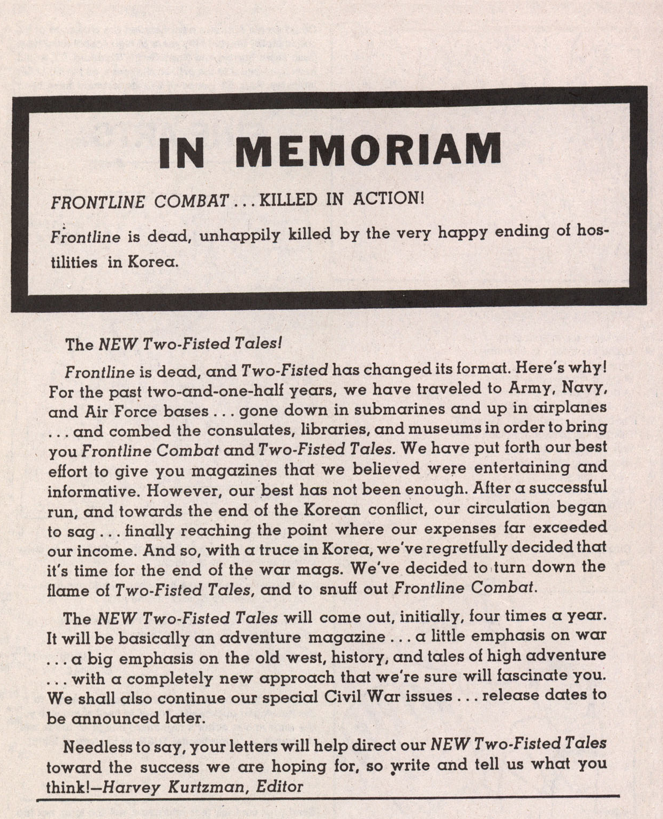
Peter: An announcement (reprinted far below) from editor Harvey Kurtzman announces the new direction
Two-Fisted Tales will take from here on out, a direction that finds new writer Colin Dawkins actually mining old territory (some
very old territory). Dawkins wrote the entire contents of issues #36-39 (and one story each in
Extra #1 and #2) and, according to an interview that appeared in the Russ Cochran
Two-Fisted Tales box set, took over editorship (with John Severin) from Harvey for those four issues. According to Dawkins, Kurtzman hated the direction his baby was taken. Hard to argue with Harvey based on the contents of the first
New TFT. Dawkins obviously did his homework though, as "Battle!" reads just like one of those Kurtzman encyclo-sagas we were getting bored to death of in the last batch of issues. Crandall is now my favorite artist but "Battle!" was all wrong for him; this is one Wally should have been handed. A fool could see that. The dialogue is a bit funky as well. Not sure Caesar would have addressed his men with an "All right, boys!" "Justice!" shows that Dawkins could do preachy just as well as Harvey did. The other two stories are train wrecks "Gunfire!" manages to include every single western cliche that could be found on the range (I love the segment where Black Jack Slaughter dazzles us with his John Travolta-esque dance moves) and Jack Davis phones in his art (bad guy Curly could be a crossover character from one of Davis's
Tales from the Crypt jobs). But nothing can prepare us for the espionage thriller known as "Dangerous Man!" Three detailed pages of fencing thrusts (
thrust . . . parry . . . riposte . . . parry . . .), a Snidely Whiplash villain, tons of hokey dialogue, and a bizarre non-ending that had me searching for a missing page. If I take one thing away from this disaster, it's that the quality of the content is so far removed from what the other EC titles were offering up, it's almost like another publisher took
TFT off Bill Gaines's hands. Not a good omen for when the New Direction arrives.
 |
| Kurtzman |
Mad #8
"Frank N. Stein!" ★★★★
Story by Harvey Kurtzman
Art by Bill Elder
"Lone Stranger Strikes Again!" ★★
Story by Harvey Kurtzman
Art by Jack Davis
"Bat Boy and Rubin!" ★★
Story by Harvey Kurtzman
Art by Wally Wood
 |
| "Frank N. Stein!" |
The 1931 Universal Boris Karloff thriller gets the once over from Kurtzman and Elder. In this version, Dr. Francesco Napoleon Stein has his manservant, Bumble, scouring the countryside for body parts and once everything is assembled (via Stein’s stitchery and quite a few knickknacks like jars of “Instant Chicken Fat,” apple cores, and bike pumps), the doctor prepares the body for resurrection. Only one thing is missing: a brain! Once more, Bumble heads out into the storm, this time to the Uneeda Laboratory, where Melvin and Sherman are cutting up bodies for autopsies. When they leave a brain lying on the window sill, Bumble pops in and snaps it away. The finished product rises from its slab and breaks out of Castle Stein, devastating the countryside and leaving entire armies in a big heap. Finally, the shadowy character is revealed, resembling a certain German dictator of the mid-1900s. While his creator is expressing wonder at his creation, the monster flaps its arms and flies away. Melvin arrives on the scene to reveal that the brain stolen was that of . . . a bird!
 |
Jose and Jack stand in awe at the quality work Peter has contributed.
("Frank N. Stein!") |
 |
Mein herr!
("Frank N. Stein!") |
In his notes for the reprinted
Mad (published by EC in 1998), historian Frank Jacobs notes that “Alone, separated from the art, (Harvey) Kurtzman’s text generates few laughs. But when text and art come together, there is magic--“ “Frank N. Stein!” is one of the best examples of Jacobs’ theory. If you were to read Kurtzman’s captions without seeing the art, the words might be amusing (in some instances, they might even raise a giggle or two) but it’s not until Will Elder works his chaotic, nonsensical mojo on the script that it becomes something much more. At several points in the “narrative,” the plot veers down a different road and then somehow finds its way back again (as when Stein is, ostensibly, toiling over something sinister and we discover he’s: 1/trying to get the radiator fired up; 2/sewing; or 3/playing pinball), leaving us in stitches (pun intended) at every intersection. Perhaps the most WTF? moment comes when Melvin and Sherman discover the brain has been stolen and “the camera” pulls back and we see they’re buck naked and the entire house except for the window has disappeared. Why? Who cares! I loved every panel of this one, which I first discovered (like "Outer Sanctum") in one of those Ballantine pbs published in the early 1960s.
 |
| "Lone Stranger Strikes Again!" |
Silver bullets fly through the air (and sidekick Pronto seeks them out) for “The Lone Stranger Rides Again!” This time, the Stranger must save a wagon train from the deadly Ookabollawonga tribe but, at the last minute, disaster strikes when Stranger is tied to a post and set afire by the mysterious Chief Wonga of the Ookabollawonga tribe. The chief drops his Indian blanket and is revealed to be . . . Pronto! Unlike "Frank N. Stein," "The Lone Ranger Strikes Again!" (a sequel to "The Lone Stranger," from way back in #3) is just not very funny. The first installment was mildly amusing but there was certainly no room for squeezing more yucks out of this dried-up lemon. Where Elder's panels are packed with treasures for the eye, Davis's are constrained by a multitude of words.
 |
| "Bat Boy and Rubin!" |
"Bat Boy and Rubin!" attempt to solve several gruesome murders in Gotham. The clues lead to the Floogle Gang, the Fleagle Gang, and the Flurgle Gang, but the murders continue. It's only once the dynamic dunderheads are back in their HQ that Rubin discovers the true secret behind his partner: he's a vampire Bat-Boy! Wally Wood to the rescue. Wally's art keeps this one afloat but the script is just not a giggler. The funniest bits in this not-so-funny strip are the digs at DC and their legal department. Wally plasters his walls with banners reminding the general public that "this is not a spittoon, not a cartoon, not a harpoon,
but a lampoon!" and, in the funniest comic in-joke, Bat-Boy exclaims that the duo have to be "faster than a speeding bullet" and Rubin scolds, "That 'faster than a speeding bullet' is another character's routine! . . .
it may be copyrighted! Want to get us sued?" That threat was real, even way back in the non-lawsuit happy United States of the early 1950s, and the law (and Irving Berlin) would actually come knocking on EC's door
a decade later.
--
Melvin Enfantino
 |
| "Bat Boy and Rubin!" |
Jack: Maybe they were thinking about the DC vs. Fawcett lawsuit that had spent a decade working its way through the courts and finally resolved, in DC's favor, in 1951. I agree that Elder is the ultimate
Mad artist and that "Frank N. Stein!" is a riot, especially with all of the random bits he inserts in the panels, but the story got a little tedious for me by the end. I thought the "Lone Stranger" story was actually a little funnier than the story before it, though I missed all of the gags. As I read both of these I couldn't help but wonder if they stuck somewhere way back in the brains of Mel Brooks and Bill Cosby, both of whom would mine these same veins for humor later on. Wally Wood's art in "Batboy" is stunning, though that's becoming something I expect from him every time out. I thought the story was very entertaining and loved the last-panel dig at the EC cliche of revealing that a main character is a vampire.
 |
| Craig |
The Vault of Horror #34
"Star Light, Star Bright!" ★★★★
Story and Art by Johny Craig
"While the Cat's Away . . ." ★★
Story by Al Feldstein and Bill Gaines
Art by Jack Davis
"Smoke Wrings" ★★
Story by Bill Gaines and Al Feldsetin
Art by Reed Crandall
"Where There's a Will . . ." ★ 1/2
Story by Al Feldstein and Bill Gaines
Art by Graham Ingels
Hartley Quimb is the new caretaker of an unnamed asylum, and if the news that his immediate predecessor was killed by the inmates wasn’t bad enough, then the ghastly ritual he witnesses as the mad fiends slap, tickle, and generally taunt the corpse of one of their own during a rain-soaked funeral surely sets him over the edge. The nonchalant guards inform Hartley that the practice is necessary in maintaining control and the morale of the inmates, but the new caretaker sees anything but control in the glaring faces that sneer back at him in the mess hall. Retiring to bed, the caretaker awakens in shock later to find himself being bound and gagged by a gaggle of the inmates and hauled out to the carpentry shop. There waiting for him is a makeshift coffin, replete with a flour sack pillow. The loonies lower Hartley into the casket which they then fit with a lid containing an open window through which the degenerates can snub the poor man’s nose and cheeks and leer down at him. The true severity of the macabre rite becomes all too real as Hartley hears the sounds of digging; the fiends plan on burying him alive! Here Hartley awakens back in his room, sick with horror but none the worse for wear. He peers up into the skylight above his bed and breathes a sigh of relief. Just then, a maniac peeks down through the window at Hartley right before a shovelful of dirt smacks the caretaker in the face.
 |
Welcome to your nightmare.
("Star Light, Star Bright...") |
Perhaps even moreso than “Whirlpool” (VOH 32), Johnny Craig’s last contribution to this series, “Star Light, Star Bright...” remains one of the most potently-depicted genuine nightmares from EC’s horror titles. The allusions to the famous funeral sequence from
Vampyr (1932) are evident enough, but the overall tone of the story feels like something that would have been right at home alongside all the RKO chillers that Val Lewton produced just a decade earlier. From the very start Craig establishes a tone of disorientation and tension in a setting that recalls two other genre luminaries, Poe’s institution run by Dr. Tarr and Dr. Fether and the mesmerist-controlled facility from
The Cabinet of Dr. Caligari (1920). Nothing is right here, from the lackadaisical explanations of the guards to the casual desecration performed by the “child-like” inmates. Hartley Quimb is our audience surrogate, an unsuspecting soul dropped right in the middle of a fever dream where he has no control of his body or destiny. The Vault-Keeper tries to save face by working out the unconventional ending for the readers who came in expecting more rotting ghouls and plotting vamps, but Craig needn’t have been so self-deprecating of his own efforts. With “Star Light, Star Bright...” he had tapped into the true power of horror and proven to us that the most haunting and eerie occurrences are the ones that just don’t seem to make any sense.
John Younger and Frank Weston are two con-men who’ve built a pretty nice racket for themselves: setting up shop as a travel agency, the crooks arrange a genuine luxury vacation for their well-to-do clients, quiz them on a few pieces of important information (like if they live alone), and then proceed to break into their houses “While the Cat’s Away…” to plunder all their riches. Yes sir, mighty fine work when you can get it. But all that changes when a crotchety old weirdo going by the name of T. Charles Kingman calls in for a first-class trip to Ecuador and gives the boys his impressive address. The house on the property, they are sad to discover, is not quite so impressive: a rambling old dump, it contains more dust than furniture but the criminals press on anyway, coming to a subterranean metal door with a posted warning to stay out. Younger and Weston break in thinking they’ve found the mother lode, and they’re right: the mother lode of monsters! Bursting from a series of doors nestled within the honeycombed tunnels are packs of zombies, werewolves, vampires, and mummies eager to have some play time with the humans. Younger and Weston do their best to stay out of their way, crawling on hands and knees and eating bats raw just to stay alive. Finally finding the way out, the two crooks pass the threshold of the house just as “Mr. Kingman” returns from his trip. As it turns out, Younger and Weston have just taken a tour of the house belonging to none other than the Crypt-Keeper himself!
 |
Who let the creeps out?
("While the Cat's Away...") |
“While the Cat’s Away…” is undertaken all in good fun by Gaines, Feldstein, and Davis, and the effort at metafictional tomfoolery is much appreciated, but to my eyes at least this story is closer to the fluffy “Horror Beneath the Streets” (HOF 17) and nowhere near as fun and delightful as our pal C-K’s own origin tale, “Lower Berth” (TFTC 33), or the epic introduction of the Old Witch in “A Little Stranger” (HOF 14). Still, it’s quite a kick glimpsing a full-grown GhouLunatic watching as a pair of “normies” who have supped their fill of the horrors stowed away in the Crypt of Terror go babbling away, hopelessly and forever altered, and likely to sign up for the EC Fan-Addict Club come the next mailing day. Historically speaking, it’s also interesting to note the little ways that this story might have held particular influence in the conception and design of the sets for the opening theme to the HBO series, right from the old, dark house on the hill to the winding staircase leading down to C-K’s library.
 |
Still think secondhand smoke is harmless?
("Smoke Wrings") |
Meek Hubert Tillings minces his way into the offices of the B. V. D. & O. Advertising Agency with a million-dollar idea sitting in his briefcase. This he explains in detail to Lorna Jackson, the fierce, man-hating businesswoman who heads up the Llama Cigarettes account, for which Hubert has devised a unique promotion that involves generating and blowing steam from a billboard to simulate the cool, crisp smoke rings of a Llama Cigarette. Lorna, who seems to be gradually warming up to Mr. Tillings, says she’ll do Hubert a big favor by bringing the idea to the boys upstairs herself and presenting it as her own creation in order to better ensure its chances at selling. Hubert is overwhelmed with gratitude and then later overwhelmed by Lorna’s forwardness as she asks the little twerp out for a date and then later for a smooch. Hubert is still eager to find out about the progress of the billboard, and this he certainly does. Cackling that she only romanced the fool to keep him from making trouble as she took all the credit for the idea, Lorna pushes the sap into the vat of boiling water inside the billboard’s fireproof office. Heading out to celebrate the sign’s unveiling, wicked Lorna gets smoke in her eyes when the puffed-out rings end up overcoming her and boiling her alive.
A minor effort to be sure, “Smoke Wrings” is a callback to all those industry-laced horrors of previous issues penned by Feldstein (and usually drawn by Jack Davis) that involved conniving bureaucrats and entrepreneurs taking a big dose of medicine in the form of a fatal punishment that somehow incorporated the goods and services that they dealt in (i.e. “Graft in Concrete,” “Cheese, That’s Horrible,” “99 and 44/100% Pure Horror”). As such Reed Crandall’s considerable powers can’t help but feel somewhat wasted here—and to be fair, so did Davis’ most of the time—but the artist does what he can with the cold, antiseptic material by injecting a little covert dominatrix flavorings in his depiction of Lorna.
 |
There's the Ghastly we know!
("Where There's a Will...") |
In the rheumy eyes of millionaire Harold Farber, the presence of the dozens of gathered relatives who wait in his living room is proof of their unending love and affection for him in his final hours upon Earth, but Dr. James Crotty and lawyer Millard Walker are there to break the news to old Harold: his family is nothing but a bunch of greedy jerks waiting for him to die. Harold won’t hear any of it, but both Crotty and Walker come from such an area of concern that the old goat can’t help but reconsider. They propose a bizarre test of faith to Harold: if he will have his last will and testament redrawn to bequeath his vast fortune to a worthwhile charity, then Crotty and Walker will help him stage a faux funeral wherein he will lay inside his microphone-equipped coffin to discover what his relatives truly thing about him as they pass by to say their final words. Harold says, “Absolutely. I see no possible way in which this could backfire,” and off they go. To his shock and grief, Harold listens inside his casket as every relative exhorts their happiness that the old coot is finally dead so that they can enjoy his money. Harold bursts from the coffin, stunning all in attendance and signing the new will in front of them casting his fortune into the hands of the “Happy Home for Orphan Children” just before dropping dead of a heart attack from all the strain. Afterward, there is much celebrating by all: for the actors who receive a handsome sum for portraying Harold’s relatives during the faux funeral, and for Dr. Crotty and Lawyer Walker, the president/treasurer and vice president/secretary of the “Happy Home for Orphan Children,” respectively.
Sigh. Graham Ingels continues to eke out an existence on the dreary scraps he’s been receiving of late, this time delivering a tale of merry misguidance that wouldn’t have been out of place as an episode of
Alfred Hitchcock Presents. Seen here in an EC title and illustrated by Ingels when it’s a story that almost screams for the standard approach of Jack Kamen, though, it’s merely depressing. “Where There’s a Will…” also oversteps the bounds of credulity more than once, particularly in how the evil duo’s plot hangs on the hope and the prayer that Harold won’t kick the bucket until after he’s signed the new will, among other things that they couldn’t possibly have calculated beforehand. As if it wasn’t bad enough that the story was just boring to begin with. --
Jose
Peter: "Star Light, Star Bright!" contains a very nice twisted twist in its tail that I really had no problem understanding, but thanks for the long-winded explanatory, V-K! It's a pretty creepy tale but Johnny's cover is creepier. Al will dust off the "new asylum supervisor" foundation again soon (and to even better effect). I love when EC surprises us with a self-referential ditty and "While the Cat's Away . . ." is no exception. I did, however, guess who T.C.K. was pretty quickly. I would think that the cops would catch on to Younger and Weston pretty quickly but then this was the non-CSI 1950s, wasn't it? "Where There's a Will . . ." is slightly, um, far-fetched, wouldn't you say? Again, I had the shock ending figured out pretty early on but kudos to Al (and Bill) for leaving the villains unscathed (and two million dollars richer) in the final panel. Far-fetched would be a polite word for the hokum known as "Smoke Wrings." Good to see the writers elevating a woman to nasty scum business muckety-muck for once but, seriously, all this cloak-and-dagger (and ultimately murder) for a billboard? And, just asking, why did the smoke rings malfunction? Pity Al didn't have V-K explain
that one away!
Jack: "Star Light" is an EC classic, with a great concept and perfect execution by Johnny Craig. The point of view panels looking up through the window in the coffin lid are chilling. When I saw that zombies, vampires, werewolves, and mummies were pouring out of basement rooms in "While the Cat's Away . . .," I wondered if this was Peter Enfantino's house! Bill and Al build suspense nicely in "Smoke Wrings" as the story works its way toward the inevitable conclusion, but the finish is a disappointment, despite fine art by Crandall. Finally, Ghastly draws a heck of an old man in "Where There's a Will . . ." but do we really need two stories in one issue where a living character is put into a coffin and observes the reactions of those outside the box? The setup is absurd but at least he didn't get stuck in the coffin.
 |
Next Week!
Has the war finally gotten to
Sgt. Rock?
|