The DC Mystery Anthologies 1968-1976
by Peter Enfantino and
Jack Seabrook
Jack Seabrook
 |
| Mike Kaluta |
"Twilight of the Cat"
Story by Gerry Conway
Art by Ernie Chua
"Just Imagine"
Story by Jack Oleck
Art by Ernie H. Santiago
"The Blank Space"
Story by Steve Skeates
Art by Alex Nino
Peter: Fallen on hard times, "serious" artist William Drake must resort to portrait painting to make ends meet. A friend recommends him for an assignment and he is called to an eerie castle on a deserted hill. There, Drake is met by the lady of the house, Mrs. McGraw, a mysterious old woman who keeps a house full of cats and a couple of very dark secrets. She explains to the artist that he is there to paint a portrait of her and her three sisters for their family gallery, this despite the fact that there is no evidence of any other residents. Wandering into town one day, Drake finds a village full of hostiles and is warned that, as long as he is a houseguest of the McGraws, he can expect nothing from the town but violence. When he remarks of the incident to Old Lady McGraw that night, he's met with equal fury and, later, a strange transformation comes over the artist. He imagines himself becoming a giant cat. It's only the next day, as he's attempting to leave, that he discovers the entire town is a hotbed of were-cats and a feud has been going on for decades. He is told that the friend who sent him on this job had negotiated with the were-cats for his own release in exchange for new meat. In the end, Drake's transformation is complete and he joins the castle full of house cats. Ernie Chua's fabulous, atmospheric splash page seemingly sets us up for eight pages of fun but Gerry Conway's confusing script leaves us lost halfway through the journey. I couldn't figure out what was going on in the struggle between town and McGraws. Cat fight? And, if his friend was reduced to a house cat, how did he call Drake to recommend the job? The grout wasn't set properly between the tiles in "Twilight of the Cat."
 |
| "Twilight of the Cat" |
Jack: You're being charitable. Have you seen the M & Ms commercial where the big yellow M & M says "I have absolutely no idea what you just said"? That's how I felt after reading this. Why does the man turn into a cat and then back into a human halfway through the story? Why are all the townsfolk cats? I know Gerry Conway was 20 years old when this came out but since we haven't seen his name on anything at DC in quite some time I wonder if this was a story left in the bottom of a filing cabinet from a year or two before and dragged out to fill pages in this comic.
Peter: Phil Kelso and his wife are touring England and, at every stop, the man just can't keep his trap shut. When asked, at points like Stonehenge, to "Just Imagine," the man lets out with insults such as "I'm imagining anyone who believes in this stuff is an idiot." At a spot renowned as a Druid sacrifice altar, Phil wanders off in disgust and falls asleep under a tree. When he awakens, his party has left and he believes himself alone. That's until the Druids turn up and show Phil just what a good imagination can do. The next day, surveying his body, an inspector remarks to Phil's wife that her husband must have died of fright. I expect better things out of Jack Oleck stories than this cliched claptrap. Here's DC Mystery Trope #6: the unbeliever will always find out that whatever it is he scoffs at will come back to bite him in "The End." This is the first we see of artist Ernie H. Santiago and, since I can find no further contributions, ostensibly his last. His pencils remind me of early Chaykin, rough but stylish (except for his portrayal of Phil's wife, which is a bit posed and boxy), and they get the job done.
 |
| "Just Imagine" |
Jack: I can't believe this is the only credit for this great artist! Yes, the story was predictable, but two panels stood out for me--one where the Druid brings the knife down on Phil, and the other where we see Phil's bloated, dead face lolling off the altar. I thought those were a little strong for DC and I liked them!
Peter: Walter thinks he's losing his mind. In the middle of conversations with friends, his thoughts drift and he experiences "The Blank Space," a chunk of time he can't place. On the second such "blank space," Walter awakens to find his hands wrapped around the throat of a man he doesn't know. Meanwhile, we learn that a prisoner in a maximum security has mastered mind control and is reaching out to Walter and using him as a tool for revenge against the man who put him behind bars. Walter decides he's become too dangerous to be around his girlfriend, Carol, and breaks off the relationship, unwittingly breaking the prisoner's hold on his mind. Undeterred, the villain reaches out for another mind... and finds Carol's. A really good build-up leads to a disappointing conclusion (if it's more than a sheer coincidence that the bad guy grabs Carol's mind, then we need to know about it), but my indifference to the "twist" of the mind-controlling jailbird may be as a result of having read a similar story just a couple weeks ago (John Albano's "The Creator of Evil" from House of Mystery #208). Nino continues to contribute mind-blowing art (although Carol might have been a bit more attractive with a chin); I'm amazed it took Warren so long to use Nino as his style was perfect for the kind of stories they published.
 |
| Mind-blowing Nino! |
Jack: Skeates is a good writer, so this story remains interesting for most of its length, but you're right--it ends on a weak note and probably too soon. Did you notice the rather blatant drug references? The narrator seems to be puffing on a hookah (or a bong) and the main character remarks that his mind trip must have been from some bad "mushroom soup." Oh, and the hippie narrator wears a swastika in his hair in one panel and on his arm in the next. I think the Comics Code folks were asleep at the switch when this issue was approved! And why in the world would the editor lead off the issue with that terrible Conway story when he had two great pieces of artwork to run?
 |
| Nick Cardy |
"A Specter Stalks Saigon"
Story by Leo Dorfman
Art by Abe Ocampo
"The Ghost of Wandsgate Gallows!"
Story by Leo Dorfman
Art by Ernie Chan
"Death Came at Dawn"
Story by Leo Dorfman
Art by Sam Glanzman
"The Hell Beast of Berkeley Square"
Story by Leo Dorfman
Art by Nestor Malgapo
Jack: It's 1966 in Vietnam, and a ghostly soldier appears to warn living soldiers of danger ahead. After repeated appearances to armies on both sides of the conflict, soldiers follow the ghost back to a large statue of a memorial statute of a soldier outside Saigon. In the years that follow, "A Specter Stalks Saigon," warning in advance of the Tet Offensive and other tragedies. There is little narrative flow but the setting is interesting and unusual, and Dorfman gets points for his even-handed portrayal of both armies. The art is striking, though the colorist can't always decide whether characters are Caucasian or Asian. I wonder if we'll get many stories set in Vietnam as we make our way through the DC war comics? It's pretty cool that this one came out while the war was still raging!
 |
| "A Specter Stalks Saigon" |
Peter: I don't think Leo can decide whether the statue is actually walking around (making deep footprints in the dirt and aiding wounded soldiers) or if it's a spirit emitted from the stone. There's not much of a story regardless (again, this reads like one of those one-page Ripley's entries stretched to six), but at least we get some great Abe Ocampo art to keep our mind off that fact.
Jack: It's 1919 and Jolly Olde England isn't so jolly for Sir Alex Craven, whose brother inherits the bulk of their late father's estate. Sir Alex hires brutish Judd Gibbons to kill the wealthy brother and then good old Alex makes sure that Gibbons hangs for his crime. Gibbons curses him and swears to have his vengeance from beyond the grave. As "The Ghost of Wandsgate Gallows," Gibbons returns and chases Sir Alex, who falls out of a window and dies by hanging in a tree. I know Ernie Chua was one of the most prolific of the Filipino artists at DC in the '70s, and we saw enough of his work on Batman, but sometimes his art is just kind of lifeless.
 |
| Ngaah! |
Peter: I was overwhelmed by the sheer blah-ness of this one in both story and art.
Jack: Engineman Sam Waller on the U.S. Supply Ship Breaker keeps having nightmares of a skeletal figure with a hood and a scythe warning him about a terrible event to come. He tries to get his shipmates to listen to him and turn the ship around, but they think he's nuts. Too bad, because for the Breaker, "Death Came at Dawn" on December 7, 1941, when it was one of the ships sunk in the Japanese attack on Pearl Harbor. At three pages, this is just a vignette. Sam Glanzman's art looks like it belongs in an underground comic.
 |
| Bad DC art? Or good comix art? You decide. |
Peter: At least we found out, in the end, that the poor sailor wasn't on the Titanic. Sam Glanzman's art is about as cartoony and unstylish as a doodle.
 |
| Kinda scary, actually! |
Peter: Leo Dorfman takes a few liberties with the legendary 50 Berkeley Square (one, for instance, is Dorfman's exclamation that the mansion has been abandoned since the early 1900s) but, having taken the "Guided London Ghost Tour" a few years ago, I can attest that many still consider the building to be haunted by a mysterious spectre. It is, in fact, regarded as "The Most Haunted House in London." That's not a rousing "well done" to Leo Dorfman for this snoozer though or to newcomer Nestor Malgapo (yet another Filipino addition to the ever-growing bullpen), whose pencils are a little too stiff for me. Not to worry though, I've seen some of Malgapo's later contributions and the artist definitely hits a groove a little further down the line.
 |
| Bernie Wrightson |
"Waiting... Waiting... Waiting"
Story by Sheldon Mayer
Art by Rico Rival
"No Bed of Roses"
Story by John Albano
Art by Jack Sparling
"The Village on the Edge of Forever"
Story by Steve Skeates
Art by Alex Nino
Peter: Professor Harry Ruppert is a very well-respected bio-chemist but he's also damaged material. He embezzled funds and went to jail for ten years but, he insists, he's changed. At least to Professor Myra Enright he makes that claim. We know better. In the middle of the Arizona desert, Myra is working on an underground planetarium, a miniature version of our solar system. On the miniature earth, life is evolving exactly the same as on ours, just at a much more rapid pace. Smelling money in this experiment, Harry kills Myra and speeds up the process in order to read tomorrow's stock reports. Myra turns out to be the nagging type as her ghost hangs around to beg Harry to see the light. The crazed bio-chemist thinks he has it all figured out but the one thing Harry didn't count on is that the miniature world would blow itself up with an A-Bomb. Now the ghosts of Harry and Myra have nothing to do but hang out at the burnt-out lab, "Waiting... Waiting... Waiting" for the day when our world blows itself up. Another in the seemingly endless series of "kitchen sink" stories. Here we get a bad guy masquerading as a good guy (albeit in a new guise--a dirty, rotten bio-chemist), little planets that develop bombs powerful enough to wipe out an entire facility, and ghost scientists. I'm surprised we didn't have the obligatory hunchbacked lab assistant. I love how the TV anchor identifies the culprit of the lab blast as an A-Bomb. I'd think that teensy weeny atomic bombs would throw up red flags. First DC mystery work by Filipino artist Rico Rival is a little sketchy but still shows promise.
 |
| "Waiting... Waiting... Waiting" |
Jack: Another Filipino artist! They are coming out of the woodwork! I thought this was going to be such a good story until the end just petered out. I wonder if they added the ghosts to make it seem appropriate for House of Secrets. The ghosts don't really seem to belong in the story.
Peter: Mr. Teed has been murdered by a gorilla. Not just your run-of-the-mill Murders in the Rue Morgue-type gorilla but, if what the two inspectors assigned to the case believe is true, the reincarnation of Mr. Teed's wife's first husband. Got all that? Evidently Teed framed Walter Hicks and the poor schmuck hanged himself in prison but not before writing a note promising he'd come back from the dead to put wrong to right. So Hicks is reborn in a monkey suit, breaks free, hangs Teed, and heads home to see his ex. Unfortunately, it ain't "No Bed of Roses" for him once there since the butler is armed. A lot of these stories are so dumb they're fun. This is one is just dumb. It takes a real leap of faith to believe in reincarnation but our two detectives jump off the cliff doing somersaults. I should note that Jack Sparling's art is not horrible here.
 |
| More DC Monkey Business |
Jack: I guess Dr. Hook had it right when he said that it's hard when you're in love with a beautiful woman. The editors at DC just loved to find any way to shoehorn a gorilla into a story, didn't they? And what a patient gorilla, to climb 22 flights of stairs to commit murder! The end of the story, where we finally see the woman whose beauty caused all of this carnage, is bizarre--she is upset that the gorilla, who was the reincarnation of her husband, squashed the flowers in her garden when he fell out of a high window. All I can say is "Huh?" She is cute, though.
Peter: In an apocalyptic future where there are only a few humans left alive, a young man sets out from "The Village on the Edge of Forever" to find another "normal" town. He's attacked by half-human vampire creatures but is luckily saved by villagers sent by his father to rescue him. Once back home, he tells the old man that he cannot rot in this same village the rest of his life, he has to know new people. The next day, he again sets out and this time comes upon a young girl being mauled by two of the creatures. He saves the girl but his arm is torn off, revealing circuitry. At last realizing the truth, he takes his new friend back to confront his father but discovers, too late, the girl is a monster in disguise and the old man is the only human left on earth, building robots to keep him company. Now the monsters have "inherited the earth." Steve Skeates sharpens the skills he will continue to show throughout our journey (although he'll also stumble mightily--see far below)--those of a canny, nasty backstabber who loves to involve us in his characters and then laugh with glee as he slices and dices those characters to bits. Years ago, I wrote that Steve Skeates was either a brilliant writer or a mean son of a bitch in a review of "The Hero Within," one of the best stories Warren ever ran (in Creepy #60, February 1974). Steve appreciated that so much, he made it the title of his bibliography. This was clearly a guy who was writing above the level of most of his "peers." Alex Nino continues to take my breath away, which surprises me since I really didn't appreciate his style when I was a kid. Now, if I see his name in the credits, I'm eager to dig in.
 |
| More Nino... Please! |
Jack: I guess everything is relative. Nino's art is good, but it's so funky that I don't think I could take a steady diet of it. His human characters don't look all that human sometimes. Skeates's story is decent, but the human in the future discovering he's actually a robot has been done before. For some reason, this story didn't excite me as much as it did you. Now, when I read the title, it reminded me of something that did excite me:
 |
| "City on the Edge of Forever" |
 |
| Bernie Wrightson |
"For Money... For Love!"
Story by Steve Skeates
Art by Alfredo Alcala
"Maniacs"
Story by Steve Skeates
Art by Ruben Yandoc
"Tomorrow I Hang!"
Story by E. Nelson Bridwell
Art by Jim Aparo
Peter: John desperately wants to marry his sweetheart but her father doesn't like the amount of zeroes in John's bank account. The smitten young man decides to get himself a job that will swell his coffers and win the approval of dear old dad so he does what any other lovestruck fool would do: he robs graves. The money he's making is fabulous but still not enough so he decides to take on friend Aaron as his partner. Aaron finds new ways of supplying corpses without getting his fingers or shovel dirty and, at first, John looks away. Eventually, the idea that Aaron is responsible for the rash of disappearances around the village becomes too much for John and he confronts his partner, claiming he's had enough. Aaron is agreeable but needs John to help him with one last corpse. When John takes a peek at the body, he discovers that he doesn't have to build up his bank account for his sweetheart after all. Oh my, through the entire story I hoped Steve Skeates (one of my favorite horror comic writers of the 1970s) wouldn't go the "Captain Obvious" route but then he went and did it! Aside from the cliched climax, "For Money... For Love!" has exquisite art from Alfredo Alcala and a genuinely sleazy feel to it, a plus in the age of the Comics Code. Let's call this one a near-miss.
 |
| Alfredo Sauce! |
Jack: I love the mustache and beard that someone drew on the poor dead girl's face in the panel above! You are absolutely right that this is a near miss--the art is just a little off for Alcala and the story never quite works. Still, it's much better than most of the swill we slog through every week.
Peter: A small demon, trapped in a mirror, yearns for the day when a human being will visit the deserted house in which his prison is hanging. He gets his wish but, unfortunately for him, his visitor is a werewolf and there's a posse at his heels. Time and again, we're getting these stories that read like a patchwork of fragments. Here, we get a little demon, a werewolf, and lots of expository about the first victim just before she's dispatched. "Maniacs" reads just as disjointed as it was written. Yandoc pencils a decent werewolf (although I think it more closely resembles a were-pig if I'm pressed) but his women are nothing to sell corpses for.
 |
| "Maniacs" |
Jack: I think Myra could have used a mustache and beard. This story was terrible and the art was amateurish. Weren't we impressed by Yandoc recently? Looks like he was sitting with Jerry Grandenetti in the DC lunchroom and some of Jerry's "quirks" rubbed off.
 Peter: Mario, the grave robber, is sentenced to death after murdering an old man who's witnessed his crime. His captors are surprised to hear Mario chuckling in his cell each day while he awaits the hangman but the defiler has an ace up his sleeve: a vampiress has been bleeding Mario dry in his cell and his transformation is just about complete. No hangman's noose can kill a vampire. Pity then that the king has chosen beheading for Mario, a fate that most definitely will cure vampirism. Jack Seabrook fave Jim Aparo contributes absolutely fabulous art (but then, after inhaling so many of his 1970s Batman stories last year, we knew Jim could draw, right?) to "Tomorrow I Hang!", a fun, albeit fairly predictable, yarn. Nice of Cain to remind us that a vampire can't afford to lose his head only two pages after the vampiress laid out the rules for us. I would be remiss if I didn't ask you to cast your eyes on that classic Wrightson cover. Sometimes it's easy to overlook the best part of the cookie when you're eager to dive in to the soft middle part.
Jack: Stories like this are why I love Jim Aparo's art. Who would have thought that, in an issue with art by Alcala and Yandoc, Aparo would win the prize for best story? There's not a lot to sink my teeth into here, story-wise, since it's only five pages long, but it's about time we had a vampire in one of these comics. More bloodsuckers, I say!
 |
| Nick Cardy |
"Let the Dead Sleep!"
Story by Carl Wessler
Art by Lee Elias
"Now I Lay Me Down to Die!"
Story by Carl Wessler
Art by E.R. Cruz
"Kill Me If You Dare"
Story by Carl Wessler
Art by Ruben Yandoc
Jack: Sacre bleu! When Dr. Emile Tussaud, professor at the Sorbonne, finds a Cro Magnon boy frozen in a block of ice in the caves of Aurignac, does he "Let the Dead Sleep?" Mon Dieu, non! He brings the ice block back to his lab and revives the lad, then speeds up evolution to make him an up to date chap of today. He enrolls him in school and watches him grow into a handsome, intelligent and popular young man. In his senior year at university, young Alfred falls in love with pretty Giselle, but when she spurns his advances to marry his best chum, he reverts to Cro Magnon and drags him off to the cave where Dr. Tussaud had first discovered him. A well placed gunshot from Gisele's hubby-to-be frightens Alfred, who falls down a hole where he will once again be encased in ice. No real horror here, just an entertaining--if a bit far-fetched--story with decent art.
 |
| Creative use of panel borders! |
Jack: Old Nora Gibbs won't let the big bad government buy her house to put a highway through. They try everything they can think of to get her out of the home and off the land, but there she sits at her window, clutching her shotgun and using it to scare off anyone who gets too close. Finally, the engineers come to their senses and curve the road around her property. They keep watching her, sitting at her window watching them, until they realize that she has been replaced by a dummy. When they enter the house, they discover that she had dug her own grave, lay down in it, and died! "Now I Lay Me Down To Die!" is a straightforward story that, like the one right before it, doesn't have much horror or fright. The only "unexpected" thing is that Nora digs her own grave and hops in without telling anyone. We've seen much worse in Unexpected.
 |
| zzzzzzzzzzzz |
Jack: Konrad Morgan is a cold-hearted killer who has been put behind bars. His twin brother Fritz has the unfortunate trait of sharing every emotion and physical sensation experienced by his brother. Realizing this, Judge Reisling lets Konrad out of prison on the theory that Fritz should not have to share the punishment. Konrad then goes on a rampage, dragging poor Fritz along to watch. The bad brother digs up coffins from a graveyard to sell them to an undertaker and kills a night watchman in the process. He then heads for Judge Reisling's home to rob the man who set him free. The judge responds to Konrad's challenge to "Kill Me if You Dare" by shooting him through the heart and killing him. Surprise! Fritz survives because he is that rare person whose heart is on the other side of his chest! Huh? Does that even happen? And what happened to sharing his twin' brother's emotional state? The last several panels are confusing, partly because it looks like one of the word balloons has been attributed to the wrong character. Ruben Yandoc's mysterious art continues to puzzle me. It kind of recalls the work of Jack Davis in this tale.
 |
| I think both word balloons go with the guy on the left . . . |
Peter: Yet another mind-numbingly lame script. Fritz wanted Konrad's crime spree ended so naturally he'd go along with a robbery that could turn out violent? Why not simply shoot his brother before the robbery? Three strikes and Carl Wessler is out this issue.
 |
| Nick Cardy |
"The Burners!"
Story by Jack Kirby
Art by Jack Kirby and Mike Royer
"'I Know Your Future!'"
Story by Howard Purcell
Art by Howard Purcell and Jack Abel
"The Wizard's Gift"
Story Uncredited
Art by Bill Ely
(reprinted from House of Mystery #95, February 1960)
Peter: Dr. Maas ponders the mysteries of spontaneous combustion, citing several historical cases while never once entertaining us. The fourth and (blissfully) final unpublished Spirit World #2 shelf story by Jack Kirby makes us feel all the more lucky there was never a third issue planned. "The Burners" is a horrid mess, from its obvious transgender splash page to its crazed conclusion ("Is there somewhere in the human mechanism the ability to fulfill a death wish - by a self-activating, thermo-chemical process???"), with pitstops for hilarity: Dr. Maas' patient Otto is told that his body may be capable of attaining 10,000 volts of electricity and igniting at any moment. When Otto whines that it's just his luck he's a human flashbulb, Maas tells him to lighten up as it might just be arthritis bothering him! Kirby even throws in one of his trademark "real-life-gizmo-photo-thingamabobs" he used to substitute for real art when trying to convey the magnitude of Ego, the Living Planet or The Negative Zone. Is this really The King only months removed from his run on Fantastic Four? Stan, come back, all is forgiven!
 |
| "The Burners!" |
Jack: If I concentrate really hard, can I erase the memory of this story from my fevered brain? Can I convince anyone that Kirby was an awful writer? Can we talk about his art? I didn't think so. If I were starting to heat up, I wouldn't want Dr. Maas coming to my rescue. He sees a wisp of vapor rising from Otto, immediately realizes the guy's about to burst into flames and, despite his rushing after him and "driving at speeds which might have caused disaster to myself," he can't manage to catch the depressed old guy before Otto goes all Human Torch. What we didn't know was that Otto was secretly the Flash.
 |
| "I Know Your Future!" |
Jack: Wait, it's coming to me--you will spend countless hours reading another 20+ issues of Weird Mystery Tales! Noooo!
Peter: American tourist Joe Wales must hurry into an abandoned English castle when the weather turns inclement. There he finds a dried up stick and a parchment with the story of Gladwyne and Chalton, two rogues on their way to enlist in Prince John's service, who happen upon a man trapped under a fallen tree limb. When Gladwyne frees the man, he reveals himself to be a wizard and rewards the young man's kindness with a gnarled branch. Once Gladwyne uses "The Wizard's Gift" (with a well-timed and fully ad libbed rhyme) three times for acts of kindness, then the stick can be used for selfish gains. There begins adventure, including dragons, trapped princes, and priceless treasure. Not a bad read but obviously lacking in something Marvel had over these guys in the Lord Fauntleroy department: Joe Maneely. A nice, ironic final panel where Joe Wales, seeing the parchment as nothing but a load of baloney, burns the stick for firewood. Ordinarily, I'd feel ripped off by the inclusion of a reprint in a 36-page comic book but, reflecting on the quality of the other stories this issue, I'd say we dodged a bullet.
 |
| "The Wizard's Gift" |
Jack: Peter! Pay attention. You missed the ironic conclusion. Joe did not see the parchment as baloney, he burned the walking stick before he read the story and then wondered if he'd made a big mistake. I can see how reading this issue could lull you into a sense of stupor. This story reminds me of the Prince Valiant Sunday funnies I tried to read when I was a kid. I understood that the art was beautiful but the stories were so boring I could never follow them. When writing about "The Wizard's Gift," tempted am I to give it short shrift. See? Ad libbing rhymes ain't so tough.
Peter: You could see editor E. Nelson Bridwell had no handle on where to steer this ship so we get a little bit of dis and a little bit of dat, adding up to a very weak package. Next issue, things may become a little more focused as the Kirby material dries up, Joe Orlando takes over, and Weird Mystery falls in line with the "harder" titles like House of Mystery and House of Secrets. I've got extremely fond memories of this title (my first issue off the stands was #11) and I'm hoping it doesn't, in the end, add up to just so much nostalgia again. With work in the wings by Redondo, Nino, Alcala, and DeZuniga, the future can only be brighter.
 |
| "Mother of Kamandi" |
Jack: In all of the scads of pages written about Jack Kirby, has anyone ever looked into why he drew such ugly women? Even the ones who were supposed to be hot, like Big Barda, looked like weightlifters. What was with that?
 |
| Nick Cardy |
"End of an Executioner"
Story by Bill Dennehy (Murray Boltinoff)
Art by Jerry Grandenetti
"World of Memories"
Story by Steve Skeates
Art by Dick Dillin and Jack Abel
"How to Win a Witch!"
Story by Carl Wessler
Art by ER Cruz
Jack: Morton Kennelly comes from a long line of executioners, so when he learns that his state plans to outlaw the death penalty and put him out of work, he understandably gets a little depressed. Will this be the "End of an Executioner"? Maybe not, for when he is out walking the streets a mugger chooses the wrong victim. Kennelly snaps and begins to strangle the man before realizing what he's doing and summoning a policeman. For Murray Boltinoff, who has not exactly been one of the star writers of DC horror thus far, this is a fairly subtle story. Grandenetti's art isn't even so bad this time around.
 |
| I'd hate to see him if he was a madman! |
Peter: Despite the histrionics, there's a genuinely interesting premise buried beneath that ugly Grandenetti artwork: an executioner who gets off on legal killing but then can't go through with murder. What does a man like Morton Kennelly do when his "hobby" is taken away from him? How does he find his kicks? That might have been an intriguing path to venture down but, in the end, we're left with an abrupt climax and disappointment that a story which held promise went nowhere.
Jack: John lives in a "World of Memories," lazing away the days in an easy chair recalling heroic events from his past, like the time he saved a boy from drowning. His shrewish wife thinks he should be out finding a job. One night, John's dream changes to one where he was a coward instead of a hero. He argues that this was not how it went down but soon discovers that he has died and is being subjected to the truth about his past, over and over for eternity. Hoo boy, this is the great Steve Skeates? Not very promising.
 |
| "World of Memories" |
Peter: Granted, Steve Skeates serves up a real stinker here but I'm not sure if I should dwell on that or the abysmal art of Dillin and Abel. How about if I adopt the same kind of attitude as John in this story and remember all the stories I've read for this blog as classics? Sheer bliss.
Jack: When Lester Wimpole's wife Chloe leaves to visit mother for a week, he buys a ticket in the "How to Win a Witch!" lottery and arrives home to discover that he has won Camille, a voluptuous witch who says she will do his bidding. he tells her to get rid of his wife but then stops her when she tries, deciding that he can't go through with it. After he frustrates several of her attempts to do away with Chloe, he orders Camille to depart. Camille reveals that she was actually Chloe in disguise and she is delighted that her husband actually cares for her! He is not so thrilled, thinking that his bully of a spouse is also a witch! This has been a weak month for DC horror, but I enjoyed this story and smiled at the conclusion. Cruz's art is just right.
 |
| Not just a fat suit! |
Peter: Let me get this straight: Big fat Chloe pops on an extremely realistic mask and pounds melt? She suddenly becomes the vivacious Camille? And did she set up the entire "Win a Witch" contest or did she just pop into a store for a complete makeover and still make it home faster than her husband? This one's going to be in the running for Worst Story of the Year. Don't get me wrong; there will be some stiff competition for first place but "Witch" is right up there.
Jack: Peter! She's a witch! That's how she could change her appearance. Though why she'd choose to remain a fat slob, I'll never know.
 |
| Nick Cardy |
"The Young Man Who Cried... Werewolf... Once Too Often"
Story by Sheldon Mayer
Art by Bernard Baily and Bill Draut
"Paying With Fire"
Story by Maxine Fabe
Art by Ruben Yandoc
"Moonlight Bay!"
Story by E. Nelson Bridwell
Art by Alex Nino
Jack: Myron Belknap flags down a police car to report that his girlfriend Sylvia has been attacked and killed by a werewolf! The cops confirm that she is dead with two puncture wounds in her neck, but when they come back for the body she has disappeared. Myron surmises that she turned into a werewolf and went hunting. When she turns up hale and hearty with Myron the next day at the police station, they are happy to drop the case, especially since they have become the laughing stock of the TV news.
That night, Myron flags down the cops again and this time it's his new girlfriend Claire who has been attacked and killed by a werewolf. One officer decides to sit tight and make sure she doesn't run off. He happens to be looking the other way when she grows hair and fangs and jumps him! But is Myron "The Young Man . . . Who Cried Werewolf . . . Once Too Often?" The next day, both Claire and Sylvia seem fine, and the other cop begins to worry that both women--and his partner--are now werewolves. He consults a specialist named Thorndyke who explains that they are all vampire-werewolves and sends a leggy blonde named Mercedes out to solve the case. She goes for a moonlight ride with Myron, who turns into a werewolf and bites her neck. But wait! She's a robot, so he breaks his teeth on her metallic flesh. Now he will starve to death unless he pays Thorndyke to feed him blood. Thorndyke tries to shake the cop down for cash but discovers, too late, that the cop is now a werewolf, too! Holy cow, we should get paid by the word. This story had so many twists and turns! I enjoyed it, though, especially Baily's retro art.
 |
| This has to be seen to be believed! |
Peter: "The Young Man Who Cried..." reminds me of the type of story Archie Comics ran in Mad House (their short-lived horror title published in the mid-70s under the Red Circle banner), dumb stories populated by really stupid characters doing really stupid things. I love how Professor Thorndyke knows exactly how much money Charley has in his account so that he can blackmail him.
Jack: Little Billy has the misfortune to live in an apartment building with a sadistic superintendent named Bruno, who treats the children like slaves and makes them clean the basement and stoke the furnace. Billy's parents don't believe a word of it and Billy is miserable until he buys a small Chinese lizard at a pet store. Billy loves his new pet, so Bruno tosses it into the furnace. "Playing With Fire" turns out to be a big mistake! The little lizard grows into a big lizard and eventually eats Bruno, Billy's parents, and a few other adults for good measure. This is the second crazy story in a row in this issue and I got a big kick out of both of them! I guess I just like it when a bully gets his just desserts.
 |
| Fortunately, Billy had an asbestos poncho. |
Peter: Yet another really bad horror story, this time spiced with overtones of pedophilia (how did that get by the CCA?) and child slave labor. You can only groan at the depiction of Billy's parents: dad in vest, tie, and sporting a pipe while mom lounges in her nightie or apron cinched, the both of them parked in front of the tube, TV dinners at the ready. This is what passed for social commentary at the DC office in 1972. Yecchh. Maxine Fabe had a very short stint at the Mystery Line (just two stories) but, judging from "Playing with Fire," we didn't miss much. Yandoc's art here is barely above amateur level in spots, passable at times, but never exciting or individual.
Jack: Ferber is an astronaut who also happens to be a werewolf. He agrees to go on a mission to the moon as long as it occurs when the moon isn't full. When he and his partners reach the moon, he suddenly turns into a wolf, rips open his suit, and dies due to lack of oxygen. Why? He was the first werewolf to change under a Full Earth! "Moonlight Bay!" is heaps of fun and beautifully drawn.
 |
| Paging Spider-Man! |
Peter: I'm digging this Alex Nino art. There's nothing else like it. The story's a lot of fun as well and has a grin-inducing last panel twist. So, let's answer the obvious question: what came first, this or Man-Wolf? Well, this preceded The Amazing Spider-Man #124 by almost a full year but Man-Wolf creator Gerry Conway was working for DC in late 1972 so maybe when it came time to launch a second Marvel lycanthrope, "Moonlight Bay" came to mind. Just speculation on my part.
THE BEST AND WORST HORROR STORIES OF 1972
Peter
Best Script: Gerry Conway, "A Breath of Black Death" (House of Mystery 200)
Best Art: Alex Nino, "To Die For Magda" (HoM 204)
Best All-Around Story: Archie Goodwin/ Mike Sekowsky & Carl Anderson, "Day of the Demon" (HoM 198)
Best Reprint: "Stay Away From Me--You Might Die!" (HoM 202)
Worst Script: George Kashdan,
"Everything You Ever Wanted to Know About Fear But Were Afraid to Ask" (Unexpected 134)
Worst Art: Sam Glanzman, "A Tale of Vengeance" (HoM 201)
Worst All-Around Story: Uncredited (and wise as well!)/ George Tuska,
"Stop Beating Heart! You're Killing Me!" (Witching Hour 19)
Worst Reprint: "The Indestructible Man" (HoS 96)
"Stop Beating Heart! You're Killing Me!" (Witching Hour 19)
Worst Reprint: "The Indestructible Man" (HoS 96)
In addition, I thought I'd list my Ten Best Stories of the Year. It would have been way too time-consuming to pick the ten worst!
1 "Day of the Demon" (HoM 198)
2 "A Breath of Black Death" (Conway/Tony de Zuniga) (HoM 200)
3 "The Mournful Bells of Santa Morte" (Uncredited/Nestor Redondo) (Witching Hour 21)
4 "Beyond His Imagination" (Bill Meredith/Nestor Redondo) (House of Secrets 99)
5 "The Village on the Edge of Forever" (Steve Skeates/Alex Nino) (HoS 102)
5 "The Village on the Edge of Forever" (Steve Skeates/Alex Nino) (HoS 102)
6 "To Die For Magda" (Carl Wessler/Alex Nino) (HoM 204)
7 "The Creator of Evil" (John Albano/E. R. Cruz) (HoM 208)
8 "The Psychic Blood Hound" (Kirby) (Dark Mansion 6)
9 "Sno' Fun" (Sergio Aragones/Wally Wood) (HoM 199)
10 "A Deal with a Sorcerer" (John Albano/Nestor Redondo) (HoM 202)
Jack
Best Script: "Beyond His Imagination" (Bill Meredith) (House of Secrets 99)
Best Art: "All in the Family . . ." (Bernie Wrightson) (House of Mystery 204)
Best All-Around Story: "The Poster Plague!" (HOM 202)
Best Reprint: "Beware the 13th Guest" (Howard Purcell) (The Witching Hour 20)
Worst Script: "Dark Vengeance!" (Carl Wessler) (Unexpected 137)
Worst Art: "How to Get Rid of a Corpse!" (Jerry Grandenetti) (Unexpected 139)
Worst All-Around Story: "Dark Vengeance" (Carl Wessler/John Calnan & Mike Esposito) (Unexpected 140)
Ten Best Stories of the Year (in no order):
1 "Sno' Fun!" (Sergio Aragones/Wally Wood)
2 "The Poster Plague!" (Steve Skeates/Aragones)
3 "All in the Family . . ." (Virgil North & Bernie Wrightson/Wrightson)
4 "To Die for Magda!" (Car Wessler/Alex Nino)
5 "The Mournful Bells of Santa Morte" (Uncredited/Nestor Redondo)
6 "Beyond His Imagination" (Bill Meredith/Redondo)
7 "Rest in Peace" (Jack Oleck/Alfredo Alcala)
8 "Small Invasion" (Sheldon Mayer/Nino)
9 "Happy Deathday, Sweet 16!" (Uncredited/Bill Payne)
10 "Panic!" (Mayer/Redondo)
 |
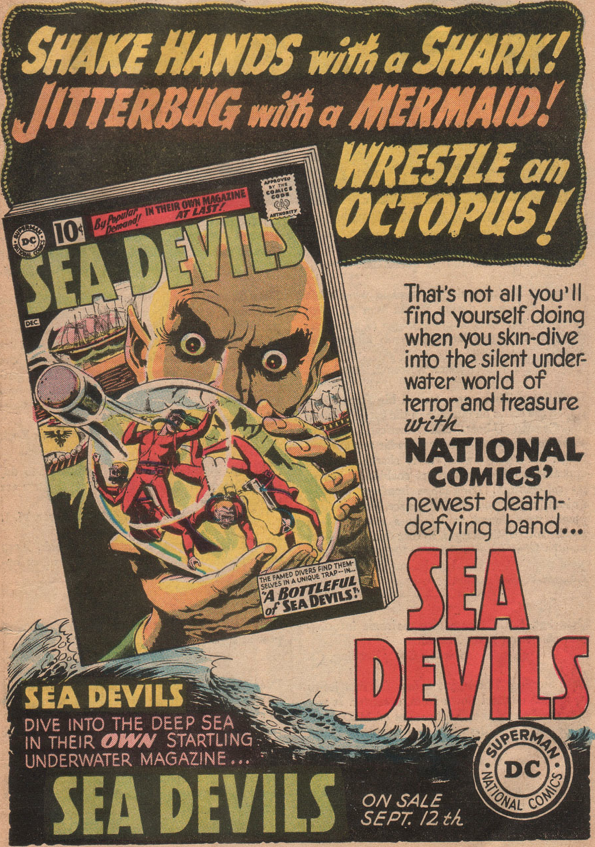
| Guess which one of us was excited by this ad in 1972! |
 |
| Once again, the vintage ads have Jack and Peter scrambling to their computers to outbid each other on eBay! |
 |
| COMING IN OUR NEXT THRILLING ISSUE! |