Monday, March 24, 2014

Do You Dare Enter? Part Twenty-Three: April 1972


The DC Mystery Anthologies 1968-1976
by Peter Enfantino
and Jack Seabrook


Nick Cardy
Unexpected 134

"The Restless Dead"
Story by Carl Wessler
Art by Jerry Grandenetti

"Dressed to Kill!"
Story by Carl Wessler
Art by Ernie Chua (Chan)

"The Bravest Man Alive!"
Story Uncredited
Art by Curt Swan and Ray Burnley
(reprinted from House of Mystery #18, September 1953)

"Time Bomb from 1500 A.D."
Story Uncredited
Art by Paul Parker
(reprinted from House of Secrets #58, February 1963)

"If the Spirit is Willing"
Story Uncredited
Art by George Tuska

"Everything You Always Wanted
to Know About Fear*
*But Were Afraid to Ask"
Story by George Kashdan and Murray Boltinoff
Art by John Calnan

Peter: Sandor and Jan make decent money selling the fresh corpses they've unearthed to scientists. Jan has decided grave-robbing is not his favorite vocation and threatens mutiny. In an effort to show him the error of his ways, Sandor finds a new benefactor: Dr. Harvasch, a brilliant but eccentric scientist who has created a race of "non-men," slaves patched together from dead bodies that "live" only to serve the good doctor. Jan doesn't buy the "now we're doing good for mankind" line and tells Sandor he's out of the biz. Sandor plots his partner's death but, in the meantime, has to fill an order for Harvasch. When he shows up at the doc's lab, Harvasch reveals that he is, in reality, one of his own "non-men" and now, so is Jan! Another grand Wessler/Grandenetti mess, "The Restless Dead" further adds to my argument that these writers really didn't know how to write an original story. Here, Wessler obviously pillages Frankenstein and The Body Snatchers with a "twist" that makes no sense (why would the doctor instruct his slaves to reboot him as one of them?). Harvasch, at one point, tells Sandor that the "non-men" have only enough brain matter to obey orders but then explains that they're smart enough to fabricate new members of their clan by themselves. Grandenetti's name is obviously a bad sign but here he looks even more rushed (if that's possible) and cartoony. I'm going to go out on a limb and say this is the worst I've seen Jerry look ever. Have a gander at the panel to the left (yeah, the one that screams "Ngyaaaaa!") and tell me what's going on.

Jack: I had to look at that panel a couple of times when I read the story before I understood that Jan opened the door and was so scared by what he saw that he yelled and dropped his candle. I kind of liked this story. The idea of creating laborers out of dead bodies makes sense, if you ignore ethics, morals, hygiene, and a few thousand years of religion. I thought Jerry's art fit this story pretty well, though that's not saying much.

"If the Spirit is Willing"
Peter: Two quickies this issue. A rich man pops into Ed Mercer's tailoring shop and orders a suit made to order but it must be delivered the following day. Ed spends the entire night fashioning the suit and arrives just in time to see his tailoring put to good use... on the rich man's corpse. "Dressed to Kill" telecasts its punchline in its title but at least it's only four pages long so we don't have to wait too long until it's over. Ernie Chua (later Ernie Chan) provides decent artwork. The other short-short, "If the Spirit is Willing," clocks in at two pages (which is two pages too long) and is unbearably George Tuska. A man races from medium to medium, seeking a contact with the spirit world. When he finally finds an authentic "spiritual advisor," we discover he was actually a ghost trying to get back to the spirit world.

"Dressed to Kill!"
Jack: I got a kick out of "Dressed to Kill!" and did not see the ending coming. What a relief to get a story drawn by Ernie Chua after another Grandenetti special opened the issue! The Tuska story is just short and silly. I feel like we saw this same gimmick awhile back with two parents of a boy who died in a car crash. Didn't they turn out to be ghosts?

Peter: DuBois and Carlton, two daredevil showmen, vie for the title "The Bravest Man Alive!" To determine who will be allowed to keep the title, the duo launch a reign of terror on each other to see who will crack first. The answer is neither and both. "The Bravest Man Alive!" is another in a series of hugely entertaining "check your brain at the door" stories that populated the DC anthologies in the 1950s, one that reflects the influence the EC line had on all horror comics. The oneupsmanship between the two death-defiers would have been very comfortable between the covers of The Haunt of Fear (albeit with a heaping of gore) and only its goofy final panel (wherein Cranston dies of a heart attack after finding out DuBois has outwitted him and nabbed the title) made me roll my eyes.  Because I'm finding so much pleasure in reading these vintage nuggets, I'm wondering if Jack and I didn't begin our journey in the wrong decade.

"The Bravest Man Alive!"

More proof of that can be found in "Time Bomb From 1500 A.D." Cryptogram whiz Hal deciphers a puzzling message from Leonardo Da Vinci, mapping out his invention of a mysterious device he locked in a time capsule and dumped off the coast near Rome. Wasting no time, Hal and his pal, Dan Summers go diving and, sure enough, they find the capsule. While hauling it aboard their ship, the package splits and a statue is revealed. Investigating further, the pair discover the statue is filled with explosives and that they've been followed by notorious gangster "Sport" Lascar, who wants to use the sculpture to blow up a train carrying gold bullion. Only fast thinking on Hal's part puts the kibosh on Lascar's evil plan. Yep, there's some really silly stuff going on here but that might just add to its appeal. Why would Lascar go to all the trouble of tracking the pair instead of just using dynamite and how did he find out about the sculpture in the first place? Why did it take four centuries for someone to decipher the cryptogram and isn't it amazing that the time capsule wasn't at least buried under a layer of silt? The most important question, I guess, is why does Peter Enfantino excuse silliness from these nutty old yarns and not from the new material being presented? Could it be that the vibe that emanates from the reprints is one of enthusiasm rather than disregard?

"Time Bomb From 1500 A.D."
Jack: I enjoyed "The Bravest Man Alive!" even though some of the stunts the two men pull to torture each other presuppose a level of skill that might even tax James Bond. The Curt Swan/Ray Burnley artwork is very smooth and pure 1953-era DC. "Time Bomb from 1500 A.D." is a perfect example of a story that fits the comic's title of Unexpected without having anything to do with horror. I had never heard of Paul Parker before but I like his art. He had an odd career, according to the Grand Comics Database, and his last credit was in 1965 for a romance mag. I have to mention that a story from 1963 with a helicopter and a statue that is set in Rome makes me want to watch La Dolce Vita yet again!

"Everything You Ever Wanted to Know About Bad Writing*...
But Only Had to Read Unexpected to Find Out."
Peter: The worst is saved for last this issue with the oh-so-cutely titled "Everything You Always Wanted to Know About Fear*... * But Were Afraid to Ask." The wealthy Mr. Gault hires Chivvers to be his new butler and finds the man brings with him many dangers. When Chivvers asks his master if the rest of his family can come to stay, the fun really begins. Another incredibly dumb story that makes no sense whatsoever, wrapped up with a climax that will have you questioning if the title "editor" actually meant anything in 1972. Thanks to the time we invested discussing Batman in the 1970s, we know that John Calnan's art is only going to get worse so, I suppose, let's be thankful that it's at least serviceable here.

Jack: Serviceable? Serviceable? This is almost worse than Grandenetti! Naming the butler "Chivvers" (shivers--get it?) should have tipped us off right away. Apparently, Murray Boltinoff came up with the plot, such as it is, and George Kashdan actually wrote this, which means that it took two writers to put this tripe together! Oh, the humanity. The story's title is a take-off on a 1972 Woody Allen movie, which was an "adaptation" of a 1969 sex manual. Listen, the 1970s weren't all roses.

Peter: On the Unexpected Mail page, Cheryl Janeway asks: "After Boris Karloff and Lon Chaney, Jr., who was the actor that was regarded as king of the mummies?" Answer is: Tom Tyler. I'm impressed with the knowledge of our Uncredited Letter Answerer, but I'd argue that Christopher Lee made a more imposing bandaged beastie in Hammer's The Mummy (1959) than Tyler (in The Mummy's Hand, 1940). Of course, I wouldn't even put the podgy Chaney in the conversation anyway, but that's just me.

Jack: I just watched Chaney in Of Mice and Men. He gave a powerful performance. It's funny that the voice in my head ("Which way did he go, George?") from all those Bugs Bunny cartoons I watched as a kid was actually a takeoff on this very serious and tragic character.


Michael W. Kaluta
The House of Mystery 201

"Put Your Trust in a Killer!"
Story by Steve Skeates
Art by Adolfo Buylla

"Million-Dollar Magic"
Story Uncredited
Art by Bernard Bailey
(reprinted from House of Mystery #60, March 1957)

"Hail the Conquering Aliens"
Story Uncredited
Art by Ruben Moreira
(reprinted from House of Mystery #103, October 1960)

"The Demon Within!"
Story by Joe Orlando and John Albano
Art by Jim Aparo

"A Tale of Vengeance!"
Story by John Albano
Art by Sam Glanzman

"Put Your Trust in a Killer!"
Peter: George Ringler will be going to the electric chair for murder unless his boss, Big Joe, can get him off. Problem is, Big Joe wants George to fry so that the truth, that Big Joe himself is actually the culprit, won't come to light. Ringler's not the brightest bulb in the chandelier so he keeps assuring his wife that she can "Put Your Trust in a Killer!" One night, Cain the caretaker comes to George's room and shows him what would have been had his fingerprints not been found at the crime scene. Ringler sees that Joe would have knocked him off to keep him quiet. Suddenly, George Ringler wants to confess. Not a very gripping or exciting narrative, this one, but Steve Skeates will get better eventually. It is interesting to see Cain play an active role in the story rather than just commenting at the bookends. Yes, we've seen him make two- or three-panel cameos before, but never actually putting the plot through its motions as he does here. This is Adolfo Buylla's first contribution to the mystery line (he'd only appear twice afterwards). I was struck by how much Buylla's work reminded me of the Gold Key titles and their fondness for the Spanish artists. Ironically, Adolfo would soon jump ship and draw for Gold Key's Grimm's Ghost Stories, a title that would be most apropos for "Put Your Trust in a Killer!"

Jack: I really liked this story! The plot held my interest and the art was above average. I don't recall seeing that Cain had magic powers before. Here, he does a Cher and turns back time. By the way, you did not mention the cover by Kaluta and the beautiful single-page intro by Bernie Wrightson, featuring Cain and the Frankenstein monster. Cover, Cain intro, first story drawn by Buylla--a fine start to this issue!

Peter: On the reprint front this time out: Old-timer Caspar Creed spends millions on worthless trinkets, hoping to find the "Million-Dollar Magic" that will regain him his youth. Though Caspar travels the world over, he finally stumbles on the fountain of youth right in his own backyard... and then drinks a little too deeply. The plot's been done to death but "Million-Dollar Magic" is not too bad and its ironic finale actually brought a twinkle to my horror-jaded eyes. What doesn't float my artistic boat are Bernard Bailey's etchings, which lack anything remotely exciting. Smack dab in the middle of a mock alien invasion, we're invaded by aliens! Sounds like a great scenario, you say. Sure does, but the idea for "Hail the Conquering Aliens" is better than the execution. It's a confusing and, ultimately, really silly fluff piece with the typically adequate art of Ruben Moreira, a prolific DC mystery artist and co-creator of the popular Rip Hunter series. The outlandish plot, where a group of soldiers dress up like aliens and hold a town prisoner, could be read as an analogy for the Red Scare of the 1950s, I guess, but that might be giving (uncredited) too much... credit.
"Million-Dollar Magic"

Jack: Peter, are you kidding? Baily's work on "Million-Dollar Magic" is great! As I read it, I was thinking how Baily is becoming one of my favorite artists of the '40s and '50s. I have enjoyed his work on The Spectre in the Golden Age All-Star Comics. I guess it's all a matter of taste! I also realized (once again) as I read this story one of the big differences between old comics and new ones that makes me prefer the old ones--they have a lot more dialog and captions! Comics today seem to be all pictures and few words. "Hail the Conquering Aliens" has plenty of twists and turns, with the story changing directions every few panels. It was better than I expected it to be, though. I guess even adequate DC art in 1960 was better than some of the art we got in the new stories in 1972.

"Hail the Conquering Aliens"
Peter: Little Gary Winters' ability to transform himself into a monster has become a complete embarrassment to his middle-class parents and stuck-up big sister. In an effort to regain their social status, the Winters turn to specialists to tame "The Demon Within" their son and fully accept the consequences. Oh, I get it! Those who are different in our milquetoast and Christian society shall be castigated and castrated before the evil can grow and infect. Yeah, I read One Flew Over the Cuckoo's Nest and so did Albano and Orlando, it seems. Pretension masquerading as art. I like Jim Aparo but has there ever been an Aparo style or has there only ever been Adams-Lite?

"The Demon Within!"
Jack: What a disturbing story! You're right that Aparo is very Adams-like here, though I think it's safe to say that Jim Aparo has a style of his own. You must admit that you don't mistake his work for that of anyone else, and when you read a story that's drawn by Aparo you know it's him right away. I think you must have been in a bad mood when you read this issue, because it's not as bad as you're making it out to be!

Peter: Chet Yovac blames mine owner Whitney Claymore for the death of Chet's father. After burning the Claymore residence to the ground, Chet is institutionalized for years but, once sprung, he kidnaps Claymore's daughter and holds her in one of the old man's mines. Claymore concocts a fool-proof plan: he instructs his assistant to dress as Chet's dead father and talk the boy out of the mine. Once the spectre of Chet's pop shows up, the plan goes pretty well until the mine begins to collapse. All escape but Chet. As Claymore and his daughter flee the mine, they are approached by the assistant who couldn't get to the mine in time for the plan. How many times have we seen that ending? I had to laugh when Chet robs and murders a man at a poker game so that he can afford to buy a police uniform, all the better to kidnap Claymore's daughter. He's a nut with a gun; he doesn't need a uniform. This is truly dreadful stuff, with the cherry on top of the moldy sponge cake being Sam Glanzman's other-worldly pencils (everyone in this strip has a huge nose!). An early favorite for worst art of the year and most yawn-inducing issue of House of Mystery in many a moon.

"A Tale of Vengeance"
Jack: I'm with you on this story but not on the issue as a whole, which I enjoyed. Glanzman's art here looks like it belongs in a 1972-era underground comic, not in a DC comic. It would fit right in alongside Crumb and Shelton. I looked up Glanzman, something I think I've done before, and was interested to see that he has had a career in comics that began in 1939 and went at least into the 2000s. Pretty impressive! Presumably, this story was not his best work.


Nick Cardy
Ghosts 4

"The Crimson Claw!"
Story by Leo Dorfman
Art by George Tuska

"The Ghostly Cities of Gold!"
Story by Leo Dorfman
Art by Jerry Grandenetti

"The Man Who Killed His Shadow"
Story Uncredited
Art by Curt Swan and Ray Burnley
(reprinted from House of Mystery #16, July 1953)

"The Fanged Spectres of Kinshoro"
Story by Leo Dorfman
Art by Ernie Chua

"The Legend of the Black Swan"
Story Uncredited
Art by Ramona Fradon
(reprinted from House of Mystery #48, March 1956)

"The Threshold of Nightmare House"
Story by Leo Dorfman
Art by John Calnan

"The Crimson Claw!"
Jack: Maryland, 1839: Little Johnny's mother thinks she must have imagined it when she saw the baby's hand turn into "The Crimson Claw!" She has a similar vision one Halloween years later. Johnny grows up and has the same vision while having his fortune told by a gypsy. Little did he or his mother know he would grow up to become the notorious assassin, John Wilkes Booth! This is about as dopey as a story can get. Leading off an issue with a 4-pager by Tuska does not bode well.

Peter: For its first 71 issues, Ghosts will carry the subtitle "True Tales of the Weird and Supernatural" (shortly thereafter DC would modify the line to "New Tales of..."). I'm not sure if that means we'll be subjected to the same kind of poppycock as "The Crimson Claw!" for the rest of our journey or at some point saner heads will prevail and we'll get some honest to gosh good storytelling. Since Murray Boltinoff will edit the title for the entire duration of our study, I'm not holding my breath. Now's a good time to recommend a massive article devoted to Ghosts, written by John Wells, that appeared in Back Issue #52. You'll learn much more about the saga of Leo Dorfman and Murray Boltinoff than Jack and I could ever tell you. Pick up a copy at Twomorrows.com. In that piece, it's explained that Ghosts had no letters page because Boltinoff couldn't string together enough LOCs to justify a full page.

"Good" Grandenetti (?)
Jack: On the Yucatan Peninsula, old Esteban uses a magic parchment to retrieve gold from the lost city of Cibola in order to help two Americans who are building homes for his poor people. Greedy Pablo and Miguel force Estaban to give them the parchment but they ignore his warning that their greed will prevent them from bringing back any profit from "The Ghostly Cities of Gold!" They disappear, but are those their skeletons that are found in the ruins months later, with golden manacles on their wrists? Only slightly better than the opening story, this mess proves that Jerry Grandenetti will not give Carl Barks any competition in illustrating stories about Cibola.

Peter: In the same week that I damn Jerry Grandenetti's work over in Unexpected, I have to lightly praise it here on "The Ghostly Cities of Gold," a fairly atmospheric tale with a nice kick in the rear. Jerry's heavily inked here so most of his trademark squiggly-wiggly is hidden and I suspect that's what leads to my favorable reaction. At any rate, this is about the best we've gotten from new material in this title.

"The Fanged Spectres of Kinshoro"
Jack: It's 1934 in Tanganyika, and Dr. Harrison's medical station is being turned upside down by "The Fanged Spectres of Kinshoro," a pride of ghostly lions set loose by a witch doctor. Only by enlisting the aid of a wise old tribesman can Dr. Harrison stop the carnage and set the lions back on the man who sent them. This may not be much of a story, but at least Ernie Chua can draw!

Peter: I can see very clearly from the little number on the bottom of the last page that "The Fanged Spectres" runs seven pages, so why did it seem like ten times that amount?

Guest-starring Paul Lynde
Jack: Debra Wayne has a recurring nightmare of going to a scary house and meeting a ghost of herself. Her shrink prescribes a rest cure at the beach, so her boyfriend rents her a house at Cape Cod. Too bad the house looks just like the one from her nightmares! When she crosses "The Threshold of Nightmare House," her boyfriend leaves her alone and the realtor tells her it's haunted. Sure enough, things go bump in the night, and next evening they find poor Debra dead of a heart attack. Only her little puddy-tat can see the real cause--her ghostly doppleganger! Boy, this has to be the worst issue of Ghosts yet, and we're only on number four. There is just about nothing to recommend in this putrid volume!

Peter: So, you're scared to death of a house in your nightmares that looks just like the one you're going to vacation in. Whattya do? Well, if you're Debra, you ignore the realtor, who tells you of the past renters who claim the place is haunted, and tell your badly-drawn husband you're staying for a month, right? I'm not sure if our resident Ghost-ologist Leo Dorfman is trying to tell us, in the end, that Debra had a poltergeist or Debra was the poltergeist! A really bad gothic ghost story.

"The Legend of the Black Swan"
Jack: Jockey Flash Nesbitt becomes "The Man Who Killed His Shadow" when he murders private eye Jeff Maxon, but soon he is haunted by shadows that seem to reenact the murder everywhere he goes. He sees one too many shadows and crashes his car into a tree, causing his own death. The police reveal that a man with a projector had been following him around and that the shadows were a plot to get him to confess. The cops sure had some advanced technology in those days! A cocky college student does not believe "The Legend of the Black Swan" and bets that he can spend a night on a haunted ship. He barely escapes with his life! Gosh, I was so surprised to learn that the ghosts were real and that the actors hired to scare the poor sap were late in arriving. Never heard THAT one before.

Peter: ... and the award for longest expository ever in a comic book (reproduced below) goes to "The Man Who Killed His Shadow," a truly loony and utterly boring "Is it Supernatural or Not?" tale with art by Curt Swan that makes the strip look as though it was produced in the 1940s. A rare misfire in the reprint department. Not much better is "The Legend of the Black Swan," which begs the question... "how many of these 1950s ghost stories ended with the same punchline: "Oh, so sorry, sir. The car broke down and I wasn't able to make it out to put a scare in your friend!"

"No, Phil, the giant rear projection screen we built over the underpass
only caused 14 accidents and three fatalities. It was the only way we
could catch the perp..."

More indescribable madness from
the pencil of Jerry Grandenetti


Thursday, March 20, 2014

The Hitchcock Project-Henry Slesar Part Twenty-Four: "Coming Home" [6.35]

by Jack Seabrook

At the beginning of Henry Slesar's short story, "You Can't Blame Me," Harry Beggs thinks that:

"First twenty-year old I see, I'll go up to him and say, kid, I'm one guy you never laid eyes on before. I'm one guy you can't blame for anything, because I've been sitting out your lifetime."

By the end of the story, Beggs will discover just how wrong he is. Released from prison after twenty years, the fifty-year old man takes a bus to Purdy's Landing and a taxi to Edge Road. He walks to a secluded, wooded area and digs up a suitcase that still contains the money he had stolen decades before. He makes his way to his old neighborhood, noting the things that have changed and those that have not among the tenements.

Jeanette Nolan as Edith
Going into the local bar, he starts to telephone his wife Edith but he can't go through with it. He has a whisky at the bar and asks about Mike, the former owner, now long dead. A pretty young woman approaches him and talks him into buying another drink. They go to a table together. Next thing he knows, he awakens from a dream of being back in prison. The bartender tells him that it's closing time, but he can't find his suitcase and the woman is gone. The bartender denies that any such young woman works there and throws him out.

Beggs finds his old building and walks up three flights to his apartment, where his wife opens the door. Edith is surprised to see him and he is shy about reconnecting with his wife--the warden had commented that she "'wasn't much for visiting.'" Harry agrees to stay and Edith agrees to let him. He hugs her and she tells him that they have a daughter whom he has never seen. She calls Angela out of the bedroom, and the young woman who emerges turns out to be none other than the B-girl who had stolen his suitcase.

Crahan Denton, Susan Silo, Kreg Martin
The story ends with this shocking turn of events, leaving the reader to ponder what will happen next. Will Harry be relieved to get his money back? Will he resent the fact that his daughter is a thief like himself? The story's title, "You Can't Blame Me," is ironic because Angela can blame Harry for how her life has turned out. She is, in fact, the first twenty-year old he sees after being released from prison, and she can blame him for the person she has become.

"You Can't Blame Me" is a very effective short tale with a good twist ending. Harry is 50 years old and has white hair; much is made about how old he and Edith are. Angela wears "cheap, dead-white pearls" around her neck, and this is the detail that Slesar uses to tell us that she is the same girl who fleeced Harry in the bar. The setting is one of poverty and hopelessness: Edith wears a "soiled housecoat," sunset on the tenement roof is "like make-up on a trollop," Harry has "an old pair of eyes." This neighborhood is tough and unforgiving. In the bar, he hears "hard, feminine laughter," and the B-girl's "slim throat" is "severed by a low black neckline." Even the characters' names have meaning: Harry Beggs is a man who begs for understanding but receives little.

Slesar's story was first published in the May 1961 issue of Alfred Hitchcock's Mystery Magazine. The author quickly adapted it for television and it was filmed as the last of eleven episodes he would contribute to season six. First broadcast on Tuesday, June 13, 1961, on NBC at 8:30 on the East Coast, it was followed at 9 by "The Grim Reaper" on Thriller.

Retitled "Coming Home" for television, the show follows the same basic story as its source but has significant changes. When Beggs meets with the warden prior to his release, we learn that he was a diligent worker during his time in prison and that he will be presented with a check for $1636 as he leaves, representing the money he saved over the last eight years. He tells the warden that he plans to give the money to someone who said he'd never have a nickel--"'to show them.'" That someone turns out to be his wife, Edith.

As Beggs walks out of prison he is accompanied by a younger man, who is met at the gates by a pretty young woman in a car. She runs up to the man and embraces him; in contrast, Harry walks alone to the bus stop. His first destination is the bank, where he cashes the check. The teller warns him that it's "'an awful lot of money to be carrying around,'" and subsequent events prove her right. Small moments show his discomfort at returning to life outside the prison walls: a rude bus driver barks at him, another pedestrian glares at him after an accidental bump on the sidewalk. Harry is uncomfortable returning to his former environment.

Crahan Denton as Harry
He goes to the lobby of his building but can't bring himself to press the buzzer next to Edith's name. At the bar, he telephones Edith but hangs up when he hears her voice. Lucky, the bartender, and Angela, the unnamed B-girl, observe Harry as he fumbles with the stack of bills he takes from his wallet. Their goal of relieving him of his wad of cash is more obvious than in the story, where he has a suitcase full of money but where no one would know unless they looked inside. Angela suggests that he buy another drink and tells him that she will finish it if he can't. She says that it's "'like a money-back guarantee--only you don't get your money back.'" This seemingly humorous remark foreshadows exactly what she plans to do to the man she does not know is her father.

A major change to the teleplay occurs when Harry goes home to Edith. When he comes in, she makes an effort to straighten her hair and her room, suggesting that she usually doesn't care how either appear. She tells him that when he shot a cop in a holdup she decided that she never wanted to see him again. This remark makes the changes from story to teleplay a bit confusing, since Slesar at first makes Harry seem more upstanding by having him save his prison earnings rather than dig up a hidden suitcase of loot. Edith's comment gives her a motive for not visiting Harry but makes one wonder what happened to the money he stole.

Susan Silo as Angela
Harry argues that they needed the money twenty years before and she reminds him that he thought that all she cared about was money and blamed it all on her. There is an extended scene between Harry and Edith in which she tells him that she makes a living washing floors and scrubbing walls and states that her life while he was in prison was as bad as his. He tells her that all of the money that he saved was stolen from him and they begin to warm to each other even though the topic of money continues to act as a wedge between them.

The show ends as did the story, though this time Angela walks in the front door rather than out of the bedroom. As Harry's eyes meet Angela's and their expressions register shock and horror, Edith, not knowing what has happened, introduces them with delight in her voice: "'Your father's come home!'"

"Coming Home" is directed by Alf Kjellin (1920-1988), who allows the story to tell itself and who gives the actors room to play out their parts. He began his movie career in Sweden and moved to the U.S. during World War Two. He was both an actor and a director; he appeared as an actor in Jack Finney's Assault on a Queen (1966) and also in an episode of The Alfred Hitchcock Hour. He also directed twelve episodes of the Hitchcock series, though this was his only half-hour.

Robert Carson as the warden
Crahan Denton (1914-1966) plays Harry. He appeared three times on the Hitchcock show, most recently as the sheriff in Slesar's "Incident in a Small Jail."

Playing Edith is Jeanette Nolan (1911-1998). Nolan often played characters who were much older than she was and it's refreshing to see her with long, brown hair, playing a character her own age. She was on the Hitchcock show five times and she also appeared in Slesar's "The Right Kind of House" and "The Morning After."

Susan Silo (1942- ) plays Angela, the B-girl who turns out to be Harry's daughter. Only 18 years old at the time of filming, she appears a few years older and is convincing as a sultry, seductive young woman. She started her career just a year before this but she had a long run of appearances on episodic TV, including one on Batman. More recently, she has been busy as a voiceover actress; her website contains many interesting biographical details and photographs.

Ms. Silo recently shared the following memories when asked if she recalled filming "Coming Home":

"I do remember the wonderful Swedish director Alf Kjellin . . . he was such a joy to work with! The subject matter was VERY daring for TV at that time and he handled the delicate balance of the bar girl/daughter role with great skill in directing me. I was told that the dress I wore was originally worn by Marilyn Monroe and cut down to to fit my smaller frame . . . that was fun to know! Also, Jeannette Nolan who played my mother was the wife of actor John McIntire whom I appeared with on "Wagon Train" . . . they were a lovely acting couple and treated me like a daughter!"

Kreg Martin as Lucky
Robert Carson (1909-1979) is a familiar face as the warden; he was on the Hitchcock show 11 times, most recently in Slesar's "The Last Escape."

Finally, Kreg Martin plays Lucky, the bartender. He appeared in seven Hitchcock episodes, including "Maria."

"Coming Home" was reprinted in A Crime for Mothers and Others under a third title, "Welcome Home," and is available on DVD here. It may be seen online for free here.


Sources:
"Coming Home." Alfred Hitchcock Presents. NBC. 13 June 1961. Television.
"Galactic Central." Galactic Central. N.p., n.d. Web. 15 Mar. 2014.
Grams, Martin, and Patrik Wikstrom. The Alfred Hitchcock Presents Companion. Churchville, MD: OTR Pub., 2001. Print.
IMDb. IMDb.com, n.d. Web. 15 Mar. 2014.
Silo, Susan. Message to the author. 17 Mar. 2014. E-mail.
Slesar, Henry. "Welcome Home." A Crime for Mothers and Others. New York: Avon Book Division, 1962. 88-95. Print.
"Susan Silo." Susan Silo. N.p., n.d. Web. 15 Mar. 2014.
Wikipedia. Wikimedia Foundation, n.d. Web. 15 Mar. 2014.


Monday, March 17, 2014

Star Spangled DC War Stories Part 23: April 1961


The DC War Comics 1959-1976
by Corporals Enfantino and Seabrook


Jerry Grandenetti
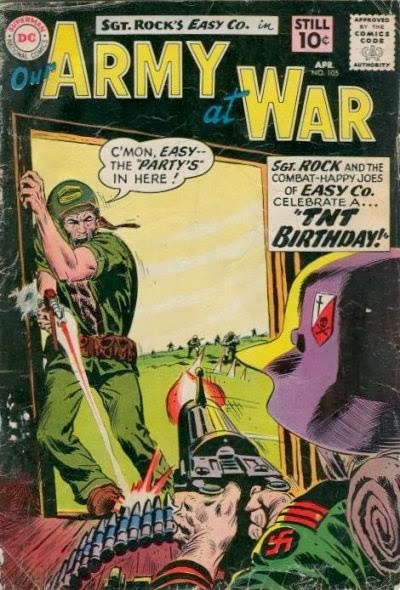
Our Army at War 105

"T.N.T. Birthday!"
Story by Robert Kanigher
Art by Joe Kubert

"No Home for a Frogman"
Story by Bob Haney
Art by Jack Abel

"Double Bait!"
Story by Bob Haney
Art by Jack Abel

Jack: In "T.N.T. Birthday," Sgt. Rock blows a gasket when new private William West reports for duty, looking even younger than his claimed age of seventeen. Before Rock can send the boy back, however, Easy Co. is attacked by Nazi shelling and must take cover in the woods. There, they destroy an enemy tank and then hide in a foxhole, where only some quick work by the new private keeps them from being blown to bits by a well-thrown potato masher. That night, the private leads Easy Co. in a bold stand against enemy attack, finally earning his right to stay with Rock's unit the next morning when he proudly demonstrates his first chin whisker!

"T.N.T. Birthday!"
Peter: An absolutely first-rate thriller, so good I can dismiss its familiar plot (you know, the one that goes "green guy comes to Easy but exits a combat-happy Joe?"). Can Kubert get any better? I especially like how Joe messes with the panel layout and color schemes (some of the panels have an almost black and white look to them) to heighten the tension. As cliched as it sounds, we really do feel we're in the foxholes with Easy.

Jack: Raised an orphan, Andy hopes for a new family of his own when he becomes a frogman with UDT 7. He thinks that underwater action provides "No Home for a Frogman" until one of his fellows seemingly sacrifices his life to save Andy from a mine. Andy plants a charge on an enemy sub and, when it blows sky high, realizes that his fellow frogmen are like a new family.

"No Home for a Frogman"
Peter: An awful story, more of a fragment really, with no flow or reason. We see "Brother" Luke killed when he comes in contact with an exploding mine and yet, there he is, alive and well, to save the day in the climax. We've seen this story countless times already (and I fear we'll see it countless more). I get it: war can make a family out of perfect strangers.

"Double Bait!"
Jack: Preston becomes "Double Bait" when his sub is attacked by depth charges from a Japanese super-cruiser. Preston has been laid up in sick bay due to some broken ribs and, as the situation underwater grows more dire, he has an idea. He volunteers to swim to the surface himself, figuring that the Japanese will think that a surfacing sailor means that the sub has been destroyed and they can halt their attack. The plan works, the sub destroys the super-cruiser, and Preston lives to tell the tale.

Peter: I thought this one was pretty exciting but extremely far-fetched. Preston is one lucky soul to be the only survivor of the sinking of the Tikuri. The puzzler here is Jack Abel's art. The Grand Comics Database lists Jack Abel as inker and artist on both "No Home For a Frogman" and "Double Bait," and Chris Pedrin's Big Five Information Guide (the Bible for DC war fans) confirms that information but the two jobs are like night and day (or like Grandenetti and Kubert, to make a more fitting analogy), with "Double Bait" coming out the obvious winner. I'll continue to scratch my head and wonder until the day we find out that Abel was actually farming out his work (a la Bob Kane and Batman) to keep up with the demand. In any event, this is higher echelon Jack Abel.


Irv Novick
All-American Men of War 84

"Death Dive!"
Story by Robert Kanigher
Art by Irv Novick

"The Desert Mouse!"
Story by Bob Haney
Art by Jack Abel

"The Guys Up Front!"
Story by Bob Haney
Art by Jerry Grandenetti

Peter: Lt. Johnny Cloud, the Navajo Ace, takes to the skies to help a fellow Native American on his last mission. The flight goes terribly wrong and the planes take a "Death Dive!" Johnny's comrade is mortally wounded and the two are taken prisoner by the Nazis, who have an evil plan up their sleeves: they're going to force Johnny to bomb his own battleship, thus allowing the Nazis to have free rein over the area. Suffice to say, Johnny gets the better of his captor and lands a few bombs on the Nazis. Though his friend has died, his image joins the great spirit cloud in the sky. Johnny Cloud's third adventure is the best one yet, with a first half that's very exciting, adorned with the best art I've seen from Irv Novick. Johnny's sudden change in plans, from bombing the allies to sinking the German battleship, was a little far-fetched. If the Nazi officer really wanted to stop our hero, he could have blown him away and given his life for the Fatherland.

"Death Dive!"
Jack: The Indian jargon is awful thick in this one, as Johnny thinks thoughts such as "I laughed deep inside my belly, in the manner of a Navajo . . ." Who speaks or thinks that way? I don't walk around daily thinking, "Gosh, I'm acting just like someone from New Jersey!" Once the heap-big pow-wow talk lessens and the air fighting gets underway, the story improves, though I agree with Peter that the Nazi plan is far-fetched. I was surprised when the other pilot also turned out to be an Indian! Johnny had only spoken with him by radio and only knew his pilot nickname, so even Flying Cloud could not identify another brave.

Peter: After his plane goes down in the desert, Corporal Edward Stone is harassed by the crew of a Nazi tank. The Germans want the beleaguered soldier to lead them back to his camp. Without water, Stone has no choice but to play out his part in their game. Using his crafty brain, the Corporal manages to outwit the Nazis and not give away his comrades. "The Desert Mouse" is another step back for Jack Abel, who'd been climbing the ladder of quality art for the past several months (with the exception of OAAW's "No Home For a Frogman"). It's very much like his old sketchy, primitive style, almost like a shelved job (over at our sister blog, Marvel University, we're just discovering Jack Abel, circa the 1970s). The story's not bad, just not very inventive. I'm not sure why the climax is portrayed as a happy ending ("And then the 'mouse' who'd beaten the enemy and the desert itself--went home...") since our hero is now afoot in the middle of the desert without water. Doesn't sound to me like he beat the desert at all.

"The Desert Mouse"
Jack: I didn't mind the art and I didn't think the ending was so downbeat. The soldier was already back to the point where he'd last seen his unit, so I assumed he had enough water to find his way back to his buddies. The fact that he was able to destroy the Nazi tank with a single grenade, and that he managed to find a couple of pineapples in the sand, stretched credibility, but I thought this was a decent story.

Peter: Fox Company, the fourth wave of soldiers to hit Green Beach Able, marvels at the swath the first three waves managed to cut through the enemy. It seems to be easy sailing until Fox reaches a deserted house filled with Nazis. It's only after they've cleared the obstacle of all enemies that they realize they're now "The Guys Up Front!" We've been blissfully free lately of the catch phrase that makes you gnash your teeth by the end of the story but it comes back with this story, guns a-blazin'! Two catch phrases actually, since we hear the title a dozen times and "first wave" several more. As if we're not catching on, the letterer makes sure to bold face the offending words so they stand out even more. Thank you, oh uncredited man of letters. I've mentioned that Jerry Grandenetti's art was so much different in the early 1960s than it was at the end of the decade (where we've been complaining about it when we discuss the DC mystery line every other week) but with "The Guys Up Front!" we see the first traces of the transformation.

Jack: Boy, it must've been tough for the Guys Up Front. We think we have it bad? Just think about those guys up front! They REALLY had to face some challenges. And by the Guys Up Front, I mean the poor kids in 1961 who had to read stories like this!

Peter: The Sarge's mail bag this issue touches on a question I've often pondered: the order of Army organizational units. I'm sure, being the non-military dunce I am, that I've mislabeled a squad as a regiment or vice versa but thanks to the query from James Mallory of Great Barrington, Mass., that's all behind me now! For the record, the order, from smallest to largest is: Squad, Section, Platoon, Company, Battalion, Regiment, Brigade, Division, Corps, Field Army, and Army Group. Thanks a lot, James! Also, sales figures are given this issue: 176,000 copies sold on average in 1960.

Jack: Did I mention that the Guys Up Front really had it tough?


Jerry Grandenetti
Our Fighting Forces 60

"Tank Target!"
Story by Robert Kanigher
Art by Jerry Grandenetti

"Balloon for a Hawk!"
Story by Bob Haney
Art by Russ Heath

Jack: Gunner is getting tired of being a "Tank Target" every time he and Sarge go out on patrol. After the two of them take out another Japanese tank using nothing but their guns, Gunner tells the Captain that they really need some more sophisticated anti-tank weaponry. Like a gift from above, a supply plane drops the very sort of weapons Gunner dreamed of, and Sarge rustles up a posse of intrepid soldiers to head off toward the enemy's position, new weapons in tow. Unfortunately, the anti-tank gun sinks in an unexpected patch of quicksand. The rest of the new gear is similarly useless, leaving our heroes to resort to their wits once again to disable still more tanks. I learned a new term: PBY, which is a flying boat used in the '30s and '40s by the U.S military.. Who says this blog isn't educational?

Good boy!
Peter: I know Jack's upset his favorite Pooch is side-lined (on his own cot in the field hospital, at least!) but I must confess that, as Gunner and Sarge adventures go, this one's not completely horrible. Damning praise, I know, but considering what a mess this series has been, it's a bit heartening to make it through a chapter without nodding off or feeling ill. I could be forced to admit that I smiled at some of the intentionally humorous bits as well but this art is gawdawful chicken scratch and, as we've seen in our bi-weekly look at the mystery line, Grandenetti's only going to get worse. I feel like ONE OF THE GUYS UP FRONT!

Jack: An American lieutenant finds himself the first U.S. soldier to be sent to France in WWI to fly a fighter plane. He sets his sights on the German Ace known as the Red Hawk, but his initial mission ends badly when the Red Hawk shoots his plane down. The lieutenant is grounded by Col. Jacques, the French commanding officer, until he sees the Red Hawk cruelly shoot down a French plane as it is landing. Taking to the sky once again, the lieutenant chases the Red Hawk but is shot down over the Red Hawk's own field, where he runs for the safety of the basket under a large balloon that the Germans use to guard the field against strafing. The lieutenant uses a "Balloon for a Hawk," shooting at the enemy flyer with a machine gun mounted on the balloon's basket. The balloon rises and soon falls, victim of the Red Hawk's bullets, but our hero triumphs and manages to bring down the villain.

Peter: We're luckily graced with an extra long, extra exciting helping of Sir Russ's art this issue and it's nice that the script is up to the man's talents. It's an edge-of-your-seater that's marred only by the obligatory "Saved by the Grace of God" climax. Some of these warriors actually sacrificed their lives now and then (history books have told us so) so I think it would have been a testament to those heroes if The Two Bobs allowed a protagonist to make the ultimate sacrifice rather than writing them out of a dead end. Having your plane land on a well-placed bed of mattresses (or your scuttled sub rescued by Martians) in the end tends to dampen the suspense that came before it.


Jack is so jealous!