Monday, August 19, 2013

Do You Dare Enter? Part Eight: June-July 1970


The DC Mystery Line 1968-1976
by Jack Seabrook,
John Scoleri,
& Peter Enfantino


Neal Adams
House of Mystery 186 (June 1970)

"The Secret of the Egyptian Cat"
Story by Robert Kanigher
Art by Bernie Wrightson

"Nightmare"
Story by Jack Oleck
Art by Neal Adams, Dick Giordano, and Joe Orlando

Peter: Wrightson and Adams in the same issue! What could be better than that? Two good stories maybe? Well, let's add that to the equation then.  The evil wizard Konassos covets Egyptian priestess Isha but the young lady is not for sale, so he utilizes a magic potion to transform the girl into a cat. Since they are both immortals, Konassos keeps Isha under lock and key throughout the centuries until they take a room at the House of Mystery. One night, out prowling, Isha meets up with a stray cat and falls in love. Seeing this, Konassos poisons a saucer of milk and dispatches his competition. Bad mistake! This stirs Isha into action and she's able to get hold of the potion that transforms her back into a woman. Awakened from his nap, Konassos discovers the priestess has transformed him into a rat and Isha's feline friends await him at the door. Bernie's art, of course, is the draw of "The Secret of the Egyptian Cat" but, thankfully, Robert Kanigher delivers a witty script topped with a delightful twist ending. Again, we have Cain interacting with the characters of the story, blurring the line between narrator and participant. Just two years away from revolutionizing the horror comics genre with Swamp Thing, Bernie's art just keeps getting better. Literally, you can tell the difference from strip to succeeding strip as he moves away from Ingels-imitator to developing a style of his own. We'll be lucky enough to witness this ascendancy.


Jack: The two-page splash that opens the story is tremendous, depicting the transformation from cat into Egyptian beauty. It has all been done before, of course, from The Wolf Man through She Wolf of London, with a dash of The Mummy's Curse tossed in for good measure, but Kanigher and Wrightson tell a smooth and engaging tale. Peter is right that one can see Wrightson's style developing rapidly, and knowing that Swamp Thing is not too far in the future allows us to spot its antecedents here and there in the dark and shadowy scenes that fill this story.

John: I wasn't impressed by this one. I felt the story was not particularly interesting, and thought that this was another case where aside from a handful of nice panels, Wrightson's normally exceptional art felt rushed.


Peter: Young and sickly, Judy is given to flights of fantasy. Since she's left on her own at her father's estate for much of the day with no one to play with, she creates a playmate out of the stone statue of Pan in the garden's fountain. But is Judy fantasizing? Pan takes Judy to his kingdom, a veritable Eden where the sun always shines and unicorns run free, but warns the girl never to open a large ominous door, the only drawback to this paradise. Being a precocious child, Judy investigates while Pan is napping one day and discovers another land behind the door: a nightmare world where all is black and monsters lurk behind every tree. Pan arrives to rescue her, sending Judy back to her own world, where we learn she's had a near-fatal fever and has just emerged from a deep sleep. Days later, trying to convince his daughter that the tales she's been telling him are nothing but delusions, Judy's father insists she touch the Pan statue to prove it's nothing more than stone. The girl does so and allows that she may have hallucinated the whole incident after all. As the pair turn, they miss a tear falling from the eye of the stone figure. Wow! What a powerful story! I first encountered this gem at the ripe old age of 12 in one of those over sized reprint volumes that were the rage at Marvel and DC for a couple years (the size designated at the GCD is "Tabloid" and I guess that fits better than any word I could come up with). DC was reprinting key back issues in a large format and the experiment had been such a success (so much so that Marvel quickly jumped into the water as well) that the company expanded the line to feature "treasury" editions, 84 pages packed with that title's "greatest hits." The House of Mystery collection (#C-23, Winter 1973) featured the cream of the HOM crop including "House of Gargoyles," "Widow's Walk," and the two stories comprising HOM #186 (in all, 7 stories from the title's first two dozen issues). I bought into that super-expensive investment (one whole buck!) and must have read it cover to cover a dozen times within a week. Even my pre-teen brain knew that "Nightmare" was something special, a story within a story. This could be Neal Adams's best DC horror work, evoking both wonder and fear in the mesmerized reader. Jack Oleck did his best to convert the classic to prose for the first Warner House of Mystery paperback but, without Adams's art, it's obviously lacking.


Jack: I'm right there with you on this one, Peter. Adams is one of my favorite artists and, as we learned while reading Batman, 1970-71 DC Comics featured some of his best work. Dick Giordano was probably his best inker (though Adams inking his own work may have surpassed that mark) and the story is good enough to allow the art to soar. The GCD has a couple of interesting notes on this story: one, that Jack Oleck had used this plot before in a 1950s story for Marvel; and two, that Adams based the girl on his own daughter, Kris. If there's anyone who would be able to pinpoint the source story in a 1950s Marvel (probably Atlas) comic, it would be Peter!

John: I'm pleased to report that we're all in agreement on this one. Great art, great story. When the girl passes through the 'doorway', Adams already fantastic art reaches new levels. If Neal Adams has better horror work to come, I can't wait to see it. I do want to make a point of mentioning Sergio Aragones, who has several particularly fun single panel cartoons in this issue's 'Cain's Game Room.'


Peter: A bit more on the DC treasury editions can be found here at this wonderful resource tool. Also, I'm not sure about the legal side of these things but if you don't have a copy of "Nightmare" and would like to read it online, you can do so here.

Jack: I was a big fan of the DC Treasury editions in the mid-70s; the Marvel versions never seemed quite as special. It was quite a thrill at the time to own facsimile copies of Action 1, Detective 27, and so on.

John: I recently picked up a beautiful copy of the HOM Treasury, believe it or not, for the same $1 Peter paid for it back in the day. Of course, my introduction to Treasury editions came via Star Wars (Issue #1 reprinting the first three issues of the film adaptation, Issue #2 reprinting the remainder, and Issue #3 an omnibus of all six issues).


Neal Adams
House of Secrets 86 (July 1970)

"Strain"
Story by Steve Skeates
Art by George Tuska

"The Golden Tower of the Sun"
Story by Gerry Conway
Art by Gray Morrow

"The Ballad of Little Joe"
Story by Gerry Conway
Art by Big Bad Bill (Bill Draut)

"The Day After Doomsday..."
Story Uncredited
Art by Jack Sparling


Peter: Steve Skeates continues his plundering of Ambrose Bierce's "An Occurrence at Owl Creek Bridge" (for his previous "homage," see "The Big Break" in The Witching Hour #7, March 1970). How many times could Joe Orlando accept the exact same story from this guy? In "Strain," the protagonist is a young composer driving madly down a country road, having just murdered his wife. He overhears a haunting melody, stops the car and follows the music to an ancient estate. Inside, he finds his wife, apparently still alive and having mastered the piano. The oddity of the situation bothers him a bit but he gets over it, still fascinated by the lovely music emanating from his formerly tone-deaf, undead wife. When he approaches her, she turns into an old hag and slams the keyboard cover on his hands. His car crashes into a tree and he's dead. One of the cops remarks that it's funny, the corpse has "bruises on his fingers... as if something had been slammed down on them." That bit is hilarious because our young composer would resemble a large salami after the impact of the car, so why some bruising on his fingers would stand out is answerable only to the (comic book) cop and Skeates himself. So was the entire trip in the imagination of the character or just bits of it? Who is the hag? I'm not sure. The George Tuska art is about what you'd expect (and accept) from Tuska: no energy, very few backgrounds, shoddy and on the fly. The whole thing is forgettable and that's just what I aim to do. Well, that is, until Skeates's next "adaptation" of "Owl Creek Bridge."

Jack: I think you're being unfair to Ambrose Bierce by mentioning him in the same breath as Steve Skeates. The best thing I can say about this story is that Tuska's art has been worse. Oh, and it's only six pages long.

John: As I'm not as well-versed in Tuska's art as my colleagues, it's hard for me to imagine it being much worse.

Peter: DC and Marvel used to run one-page prose pieces in each of their anthology comics. This was done, for some reason or another, as a requirement for their postal licenses. I think. Anyway, those pretty much went the way of the dinosaur in the early 1970s so to have a prose piece here in HOS #86 is a bit surprising. You'd be forgiven if you thought "The Golden Tower of the Sun" was a sequel of sorts to "Strain" as the opening act has the undead protagonist, a rock 'n' roll singer, thrown from the burning wreckage of his car. We come to find out he'd wanted out of the band but the rest of the members and his agent didn't agree. Rather than letting him split the group up, they kill him and stage an accident. Only problem is that the singer has a wandering spirit and gets his revenge against the men who killed him. "Golden Tower" is more than a tad pretentious and flowery:
Bubbling chaos echoed around me, became a golden-spired tower of darkness in the distance. I groped towards it, felt reality slip away beneath me, become a river of rippling water then ran tumbling over into a waterfall of endless white.

"Why?" I screamed again, my soul a bleeding thing inside me. I sobbed in the silence of eternity.
And from the dark hand there was no answer.
The Gray Morrow art is disappointing, resembling bad 1960s water color rock music posters. I'm not sure prose pieces will make their comeback any time soon.

John: I didn't read the story, and while I think it does have that 60s rock poster look, I didn't think it looked bad. Of course I was coming right off Tuska...

Jack: To prove my dedication to this blog, I actually read all five pages of this. It reminded me of something a high school student would write. In fact, I might have written this in high school. Or perhaps junior high. Conway was 17 years old at the time but I would bet this is not one of the things he still puts on his resume.

Peter: The alien race of Quaros lives under the Earth's surface and it's high time they conquered our world. Their plan is to steal one of Jonathan Poe's life-like dolls, give it life, and then use it as a spy. The Quaros didn't bargain for "Little Joe" though, Poe's most beloved puppet, and the doll lets Poe in on the secret. Unfortunately, the old man believes he's losing his mind when his wooden friend begins talking to him and he has a massive heart attack. The aliens shut Little Joe down and, ostensibly, wait a few years until they can inhabit a Transformer. (Big Bad) Bill Draut's pencils save this weak effort from being disposable. The subplot concerning Poe's daughter (who may or may not be a money-hungry leech) does generate some interest but then is abandoned until the climax when it becomes sappy. HOS #86 is the antithesis of HOM #186: sloppy, lazy writing and (for the most part) uninspired artwork.

John: The teary eye didn't tug on your heartstrings like it did in "Nightmare"?

Jack: I never would have thought of having green spacemen get involved in the story of Pinocchio! This story is such a mess. I don't think Geppetto Poe has a heart attack because Little Joe starts talking--Little Joe throws himself in front of some sort of alien death ray aimed at his "father" and the old man keels over, clutching his chest. I suppose it's useful to watch Gerry Conway learn how to write comic book stories, but it's not very entertaining.


Peter: There also a 2-page piece titled "The Day After Doomsday." After a nuclear holocaust of biblical proportions, the last man on Earth crawls from the wreckage of a city and encounters the last woman on Earth. His name is Adam and hers is ... Gertrude. They quickly make peace and decide they'll repopulate the world. There's not really enough here to complain about since Jack Sparling barely has room to screw anything up. This serialized strip will continue throughout the years and various DC horror titles. The second installment appears in this month's Witching Hour.

Jack: Good Lord, you mean Adam and Gertrude's story will continue? Is there no mercy? And why are the last man and woman on Earth always so attractive? Think Charles Bronson and Elizabeth Montgomery on The Twilight Zone. Isn't it more likely they'll be a couple of fat slobs?

John: I'm a sucker for LMOE-type stories, but if within minutes of rising from the rubble you spot another survivor, isn't it a tad narcissistic to assume you're the last man? And what's up with how this story just ends? Is this one of those cases where they needed to fill pages at the 11th hour, and so they decided to split the story across magazines?


Unexpected 119 (July 1970)

"Mirror, Mirror on the Wall,
Who's the Deadliest of Them All?"
Story Uncredited
Art by Bernie Wrightson

"The Swampchild!"
Story by Carl Wessler
Art by Werner Roth and Frank Giacoia

"Rachel Isn't Ready to Die"
Story by George Kashdan
Art by Sid Greene and Vince Colletta

Peter: "Mirror, Mirror..." is a really silly story about an accountant who murders his client and the supernatural mirror that witnesses the act. Not even Bernie's art can help this one stay afloat. Equally badly written is "Swampchild," a pulpish bit of nonsense about Doctor Starke, who creates a child from scratch and then gives it up for adoption. Years later, the hot-tempered Evans brothers, Ben and Luke, come sniffin' around the doc's assistant, Julia. Could one of the brothers be the swamp child? When Julia learns the secret from Clarke's ancient notebook, she has to know the truth. I'll give Wessler a bump up to a full star (out of four) for the twist ending, the revelation of who the real swamp child is. I was fooled. Werner Roth's art is about as middle-of-the-road as it was when he was the regular penciler for Marvel's The X-Men in the mid-60s. Not the kind of embellishment you want if you're trying to elicit goosebumps from an audience.

Jack: I read "Mirror, Mirror" and expected a rave from you! I thought it was an excellent story, with twists and turns that I did not expect and art that flowed beautifully and creepily from start to finish. At first I thought we were in for a retread of the "Mirror" episode of the classic British horror anthology film, Dead of Night, but this story goes in a different direction. I did not expect the man who ended up with the mirror to be blind, and as for the big finish--when the broken pieces of the glass all reflect the murder--I admit I saw that coming but I enjoyed it anyway. That little bit reminded me of "The Purple Testament" episode of The Twilight Zone--there's a scene where a broken mirror's fragments reflect a future event. As for "The Swampchild!" it's hard to believe this is not a reprint. It looks like it does not belong in the same issue as the Wrightson story.

John: "Mirror, Mirror" has got nothing on the Dead of Night segment. And while Wrightson's art doesn't get a lot of opportunity to shine in this story, it's better than his story in this month's HOM. As for "The Swampchild", I thought it did find some redemption in: "Julia reverts to a greyish, gelatinous mass... once again a pulsating mass of swamp muck."

Peter: The first two stories in this issue are gems compared to the finale, "Rachel Isn't Ready to Die," seven and a half pages of deliriously bad hooey. So bad it threatens to spill into "guilty pleasure" territory. At some point in the witch-burning days of yore, Rachel has been deemed a witch by the town's religious zealots and sentenced to hang in the town square. Swept up by the crowd on the way to the spectacle is nattily-dressed blind man Myles (who looks, for all the world like Matt Murdock, aka Daredevil), who roars his disapproval to the crowd. The hanging is temporarily halted and Myles is stoned by the good people of the town until Rachel casts a spell and the hoods are run off. The kindly witch takes the blind man back to her swamp shack to tend to his cuts and bruises. While there, Myles allows that he thinks she's a gorgeous chick by the sound of her voice. Completely smitten, Rachel conjures up a potion that will give Myles his sight back despite the whopping side effect it will have on her: it will render her powerless. Deciding that she'd rather have Myles regain his sight even if it means it'll scare him away once he gets a gander at her, she goes through with the process. No longer blinded, Myles is puzzled by Rachel's standoffish behavior. She runs down to a stream and Myles confronts her. It's then that she looks at her reflection and realizes that, with the loss of her witchly powers, she has become a real babe. Ah, even witches can find true romance now and then! I love Myles's Hugh Hefner-esque wardrobe, which doesn't exactly blend in with the times but does put him at the top of the 16th Century GQ Best Dressed List. The really mushy climax makes me think that Joe Orlando was straddling the fence between horror and gothics with the line and, praise the lord, in the end he sided with horror. There will be a few more stories of this ilk in the coming weeks but this will pass.


Jack: I thought this was a nice story and I liked the happy ending. This issue concludes with a one-pager, "Rest in Pieces," and a two-pager, "A Phantom in the Tree!" that features some pretty bad art by Jerry Grandenetti. The latter story is notable for having a young man go off to war in Vietnam, something I don't recall seeing mentioned before on our journey.


The Witching Hour 9 (July 1970)

"The Lonely Road Home!"
Story by Steve Skeates
Art by Jerry Grandenetti (?) and Murphy Anderson

"The Day After Doomsday..."
Story by Len Wein
Art by Jack Sparling

"The Last Straw"
Story Uncredited
Art by Jose Delbo

"Trumpet Perilous!"
Story Uncredited
Art by Jack Sparling and Jack Abel

Peter: Rob makes a wish and gains eternal youth but, as he watches all his friends grow old and die around him, he discovers being young forever ain't all it's cracked up to be. Seeking some kind of peace, Rob heads back to his hometown where he meets Linda, a girl he went steady with decades before. Linda seems to have discovered the fountain of youth as well, but she quickly tells Rob the real secret: she's dead and so is he. She takes him to a haunted house where all the dead live and they, ostensibly, live (or die) happily ever after. A total waste of time from beginning to end, "The Lonely Road Home" makes no sense whatsoever. If Rob's a ghost, why can people on the street see him? If Linda knows she's dead, why doesn't Rob? To add insult to injury, Murphy Anderson destroys anything Jerry Grandenetti might have brought to the table, with the result resembling a Superman installment. Steve Skeates, for his part, stops just short of ripping off "Owl Creek" for a third time but clings on to the eventual outcome: Surprise! Surprise! Surprise! The guy was dead the whole time!


Jack: I had the same concerns until I decided that Rob isn't really dead--Linda is using a metaphor. You see, the fact that he never changes means it's like he has been dead, since--as Linda tells us--life is change. At least that's my take on it. The GCD credits Grandenetti with pencils but isn't sure. As I read it, I saw absolutely no sign of 1970 Grandenetti and thought it was Murphy Anderson on pencils and inks. I know he was usually an inker but he did draw the whole thing sometimes, and I think it looked like this!

John: I thought some of the art (not involving the human characters) looked okay. Okay, I guess it's just the one panel with the Nealson's home. In "The Day After Doomsday" I once again found myself asking why the main character is continually referred to as the last man on Earth when he can't go one panel without bumping into someone else. The most interesting thing about this story is that if it does in fact follow the HOS installment, we can imagine he likely killed (and perhaps ate?) Gertrude...

Peter: The second installment of "The Day After Doomsday" makes me wonder if there was a grand scheme to this thing or did Joe Orlando throw out an order for "Last Man on Earth" stories. Ostensibly, the last man on Earth from the first chapter (seen in House of Secrets #86, above), Adam, is the same guy here who stumbles across the corpses of two soldiers who had just shot each other after the big apocalypse. So where is Gertrude? Much better is "The Last Straw" which mixes a bit of humor in with the tale of Chou, a lazy Chinese heir to a vast estate who is forced to sweep his family tomb every year (during the local Ching Ming festival) lest the estate fall to the local war lord. Chou tries to sidestep his duties by purchasing a magic broom from a wizard but, in the end, Chou finds that it's always best to get one's hands dirty. I really liked the breezy way (uncredited) told his story with dollops of larfs ("Chou explained his problem to the ancient warlock--and quicker than you could say Have a Ring-A-Ding-Ding Ching Ming!")  while not detracting from the narrative itself. The tale actually goes from Point A to Point B and ends satisfactorily, without straying from the course and adding unnecessary nonsense that can't be explained later on (Steve Skeates, take notice). The art, by Jose Delbo, is fabulous. A complete surprise all around for me.


Jack: "The Day After Doomsday" made me recall
Doomsday + 1, one of the short-lived Charlton Comics that came out in the mid-'70s when that company tried to compete with the big two. In a similar way, "The Last Straw" had art that reminded me of something either from Charlton or from Atlas Comics, the beloved but doomed comics company that tried to pay writers and artists fairly at around the same time Charlton was making a go of it. I agree that this is an above-average story. It certainly is original, at least in comparison to what we've grown used to.

Peter: The best is saved for last! "Trumpet Perilous" finds Elliott Summer, bored archaeologist, traipsing up "a mountainside deep within the wilds of Central Asia" with his explorer buddy, Ramsey, and a crew of four climbers. Disgusted by the current state of the world ("computers, television, and traffic jams"), Elliott strives to keep exploration alive despite the general disinterest from the rest of mankind. His goal is to find the Lost City of Athai, rumored to be buried atop the mountain behind a false front. Indeed, the men do find a cave leading to an incredible hidden city, complete with impressive architecture and lush vegetation but, curiously, lacking anyone at home. In the middle of the city, they find a main building with Sanskrit carvings. Translating the etchings, they discover they are in "the place of sound." Ramsey rings a bell placed next to a chalice engraved with the Sanskrit word for "water" and the cup magically fills with water. Exploring further, Elliott comes across a huge horn labeled "Trumpet of Doom." An etching tells the men that, should the trumpet be blown, a new age shall begin. Disregarding warnings from Ramsey, and feeling this could be the key to mankind's modern maladies, Elliott blows the horn... and ends the world. Not many writers at this time would have risked their work getting chopped up by the CCA but (uncredited) had the balls to give it a try and succeed. That final panel of the Earth ablaze (with the word "End" reaching out into space) is a powerful one. Jacks Sparling and Abel, two artists I've ripped both here and in the DC war comic blog, somehow overcome the odds and deliver a fine piece of storytelling. Every panel ripples with excitement and wonder. Overall, a stellar month for the DC mystery line.

John: Yep, that was a fun one. Gotta love a story in which the world ends.

Jack: This was a Boy's Adventure type of story that was enjoyable enough. What I most enjoy in The Witching Hour is the framing story, which sometimes threatens to overshadow the tales in between. This time, the comic ends with the world destroyed, and a white half-page panel that features word balloons of the witches discussing what just happened! Rest assured, they tell us, they'll have the world back together in time for the next issue.


Limited Collectors' Edition C-23


Monday, August 12, 2013

Star-Spangled DC War Stories Part 8: January 1960


By Corporals Enfantino and Seabrook


Kubert
Our Army at War 90

"3 Stripes Hill!"
Story by Robert Kanigher
Art by Joe Kubert

"A Jet Called Ace!"
Story by Hank Chapman
Art by Jerry Grandenetti

"Rearguard!"
Story by Bob Haney
Art by Bob Forgione and Jack Abel

PE: "3 Stripes Hill" is the first real look we've had at the making of Sergeant Rock. Early in World War II, we find Buck Private Rock in the newly formed Easy Company, heading off disaster after disaster and rising up as the higher ranking officers are killed off. One by one, he earns his three stripes the hard way, by watching comrades fall and facing death around every corner. Before long he's the only surviving member of Easy until reinforcements arrive just in the nick of time. A really well done "origin" (or at least a piece of a large puzzle) story, with Joe Kubert back where he belongs. In some panels there's an obvious resemblance in Rock to Robert Mitchum. I wonder if Mitchum was the initial inspiration for the character or if it's just an angle. Jack's point about a regular supporting cast is a good one and I would assume Kanigher will be filling in that background before too long. It only makes sense to add more pieces to that big puzzle.

Rock? Or Mitchum?
JS: There is a lot of death in this flashback, and it makes for a powerful story. Kubert's art seems a little uneven in spots, but he does something interesting with the flashback that takes up most of the story: the backgrounds in many of the panels are white, giving the comic a very modern look. One thing that bothers me is the timing of Rock's development. According to this story, he was a buck private at some point in WWII. Now, the US started fighting in Europe in the summer of 1943 with the invasion of Sicily. Fighting with the Nazis was over by spring 1945, less than two years later. Unless Easy Co. was fighting Nazis in North Africa--and these stories don't look like they occur there to me--Rock went from green kid to experienced Sergeant in very short order.


PE: It sure doesn't look like Jerry Grandenetti's art on "A Jet Called Ace" but then I've pretty much given up trying to tag the guy. He's like an elevator and this time he's heading up. Hank Chapman contributes three-quarters of an excellent script here, the story of arrogant World War II pilot, Lt. Farr, who left the "Big Bang-Bang Two" one kill shy of being an ace (you need to destroy five enemy aircraft to become an "ace"). Now that he's joined the Korean War, all that's on his mind is getting that last big score. Never mind the cost or the danger, all that Farr knows is that his pilot buddies all made ace in WWII and he didn't. When he can't get that last notch on the gun, he begins blaming his jet and is told, time and again, by his commanding officer to relax and let it come to him. While making a run in "mig alley" an enemy jet manages to pierce Farr's cockpit and discombobulate his controls. His guns start blazing on their own and Farr has to bail. His jet continues blasting away and eventually brings down the enemy. Farr's jet becomes the ace! We've not met a more unlikable "hero" than Lt. Farr in our journey so far. Here's a selfish bastard who'll do anything to bask in the glory, regardless of whom he hurts. The only downside to the story is Farr's epiphany at the climax, which doesn't sit well with his behavior previously. Chapman should have left the character an S.O.B. but, like the rest of the writers in 1960 comic books, Hank probably had his hands tied. A good read nonetheless.

JS: Farr is a jerk and the climax of this story is ridiculous. I did not buy for one minute that the plane started shooting on its own and managed to shoot down the Chinese jet after the pilot had been ejected. At least this is a story about the Korean War for a change. I'd like to see more of those.

PE: There's no mistaking the generic art of Bob Forgione and Jack Abel on "Rearguard", a story about the most feared placement in a fighting company. The story is educational enough but doesn't have the room to tell a proper yarn. The art is abysmal. Forgione/Abel fall back on the cliches that have filled the work we've see so far: lots of "sky" backgrounds (so as not to necessitate a lot of complicated drawing stuff), lots of panels of the main character looking over his shoulder at "the audience," and a final panel that has our hero in the foreground and his comrades in the back. It's almost as though the artists had a diagram on the wall of their studio, showing them how to get from point A to point B.

JS: This one's pretty dull and the art is not worth commenting on.


Grandenetti
Star Spangled War Stories 88

"The Steel Trap!"
Story by Robert Kanigher
Art by Mort Drucker

"The Glass Hill!"
Story by Bob Haney
Art by Jack Abel

"The Sergeant is a Monkey!"
Story by Hank Chapman
Art by Russ Heath

PE: Well, smarty pants Jack was right and Commandant Von Ekt escaped that train explosion last issue and quickly got back to the nasty business of quashing the revolt of Mademoiselle Marie. The Commandant's fool-proof plan this time involves a double agent (versed in the ways of Satchmo and "chicks") disguised as an American flying in to aid the freedom fighters. A staged plane crash seems to convince Marie of the agent's loyalty but our Mademoiselle is just too smart for the Ratzis and the stinkin' double agent ends up machine gun fodder for his own men. "The Steel Trap," the fifth installment of  Marie and her merry band of Frenchies, is the best so far but I want to see the excised panels from last issue that show Von Ekt dropping through the trap door of his carriage car to safety just like Doctor Octopus would have done. Kanigher's done something I didn't think possible--made me enjoy an episode of this silly soap opera. If DC and Marvel characters had crossing family trees, I'd say Natasha (The Black Widow) would be kin to Marie, whose dive from an exploding bridge this issue proves she could have donned the spandex and fought more outlandish villains after zee war ended.

JS: I had a feeling that Lt. Messer's quick temper did not bode well for his undercover mission as "Lt. Harry West," and sure enough he blew it! I am quickly getting used to Mort Drucker's art on this strip and I agree that this was the best one yet in the series. In fact, this was an excellent story all around. The business of calling it a "two-parter" is nonsense, but I seem to recall that the early Justice League issues--which started to come out later in 1960--also broke the stories into multiple parts, so perhaps it was just what DC was doing to try to jazz things up.

PE: "The Glass Hill" concerns a G.I. whose Corporal keeps telling him (over and over) that the hill they're about to climb is a "glass hill" because everyone who goes up can see himself as a boy or a man. It's as tedious as a one-line joke that just keeps going on and on. Just as tedious would be my critical commentary on Jack Abel's "art" but you could literally write a dozen stories around his panels as they look exactly like the last story he did.

JS: Is Abel your least favorite DC war artist so far (yep-Peter)? This is a run of the mill story but there are some decent panels, such as the one where the soldier's face is blown sideways by a blast and the one at the end where we finally see him as a man.

PE: "The Sergeant is a Monkey" is a very silly tale about a monkey who charms the grenades right out of a gruff sarge. Yeah, it's a change of pace, not the kind of story I'd like to see very much in a "gritty" war comic, but it does feature Russ Heath in a rare non-aircraft story. Russ shows he's just as much an award-winner in the jungle as in the sky.

JS: Leave it to DC to find a way to work a monkey into a war story! The monkey turns out to be a life-saver when he imitates everything the Sarge does, down to tossing a grenade into a nearly impregnable pillbox. This was a surprisingly good issue of SSWS, from the outstanding cover to the end!


Grandenetti & Adler
G.I. Combat 79

"Big Gun--Little Gun!"
Story by Robert Kanigher
Art by Russ Heath

"No Test for a Mustang!"
Story by Bob Haney
Art by Joe Kubert

"Flying Jeep"
Story by Hank Chapman
Art by Jack Abel

PE: "Big Gun--Little Gun" gives us a behind-the-scenes view of World War II we haven't seen previously in our study of DC war comics--the men that man the Howitzer 155. Basically a cannon towed around and fired from a mile away at enemy positions, the weapon requires 9 men to load and fire it (and yes, I did have to look up that info on Wikipedia!) and can be a mighty pain in the ass. The men assigned to the 155 are sitting ducks most of the time and rarely know if they've actually hit their target until radioed. Our G.I. protagonist, Al, spends most of his day complaining about all that and he's getting on his buddy Nick's nerves. We witness several battles and incidents (the cannon becomes dislodged from its trailer and rolls down a hill, necessitating a push back up) until, finally, the 155 is destroyed in a fiery attack by two Nazi tanks. Both informative and harrowing, "Big Gun--" is the perfect marriage of great writer and artist. When the 155 is blasted by one of the Nazi tanks, Nick takes the brunt of the explosion and Al describes his buddy as "a ragged scarecrow that looked a little like Nick..." This is what I imagined DC war comics could be had they not had a CCA noose wrapped around their necks but Kanigher and Heath manage to subtly tell/show us what's going on (all we see of Nick is his outstretched arm) without the graphic.

"Big Gun--Little Gun"
JS: This is a powerful story that has an especially exciting ending, but I don't think it's Heath at his best. Still, middling Russ Heath is worth a look, and Kanigher's writing is solid.

PE: "Fancy Dan" is a test pilot who demonstrates new jets for fighter pilots and has never seen action. Dan believes the "real pilots" hold him in disregard for that shortcoming until one day, while performing for a batch of pilots, Dan must hold off a squadron of enemy planes while his audience suits up for battle. Just as it was odd to see Russ Heath penciling a jungle tale (in Star-Spangled), it seems out of whack to read a fighter pilot strip ("No Test for a Mustang") by Joe Kubert. I've not seen anything but GI grunts out of Kubert's pencil but he proves (just as Heath did) that he's a man of all battles.

JS: If I didn't have the GCD to rely on, not to mention Kubert's signature on the first page, I'd have said that Mort Drucker was involved in the art on this story, especially the faces in the splash page's first panel. The story is fine for a six-pager, but the final air battle really got me--Kubert draws a very nice horizontal panel that shows the key maneuvers.

PE: The aerial battle between a tank and a MIG in "Flying Jeep" is a bit far-fetched (how could our hero, PFC Handley, keep a jet in his crosshairs while his parachuted jeep is heading for the ground, buffeted by the wind?) but at least it's a short read. Jack Abel's GI template comes with freckles this time out.

JS: Don't all of Jack Abel's characters sport freckles? This story strained credibility. The PFC keeps calling his jeep "Baby." To quote Franz Liebkind, "Why does he say this Baby?"

An Aside:

War titles were just as prevalent in the 1950s as westerns and horror (and vastly outnumbering hero titles, which were on the wane) and, since Jack and I are studying the DC war books, I thought it might be a good idea to sample some of the titles offered up by the other companies. Now and then I'll weigh in with my findings.  Atlas had no fewer than a half dozen war books in 1952 and one of the best was Battlefield. Unlike Our Army at War or GI Combat, the majority of the stories took place during the then-current Korean War. One of the benefits the artists and writers of Battlefield enjoyed that later eluded Robert Kanigher and Bob Haney was the freedom to tell a story set in a conflict without worrying about the watering-down inherent with the CCA. How do you tell a story filled, by necessity, with violence without showing any of the after-effects of that violence? “That’s an Order” (from #2) concerns Captain Murdock, good air force man who follows all orders until his two sons are killed on Heartbreak Ridge and he suddenly becomes a one-man assassin, disobeying orders and seeking out enemy trains to destroy. His superiors are hesitant to ground Murdock for various reasons (how does a military man deal with his grief otherwise?) but he is stripped of his command and forced to take orders from another captain. The finale sees Murdock splitting away from his mission and pulling a kamikaze on another train, screaming “This one’s for Eddie and Bob!” as his plane explodes. The Comics Code would never have approved the suicidal final mission of Captain Murdock. Soldiers under the CCA always tended to be gung-ho and, if not peppy, at least imbued with a sense of patriotism. Though patriotism and anti-Communism oozes out of every story in the pages of Battlefield, its soldiers are worn out and psychologically wounded. Death is displayed rather than hinted at or ignored altogether.    -Peter Enfantino

A bit outlandish? You be the judge!


Thursday, August 8, 2013

The Hitchcock Project: Henry Slesar Part Nine-"Not the Running Type" [5.19]

by Jack Seabrook

Norman Lloyd was quoted as saying that "Not the Running Type" was "one of the most popular shows we ever did." What was it about this, the first Slesar story to be adapted for season five of Alfred Hitchcock Presents, that made it a favorite of viewers in 1960?

The source story, also called "Not the Running Type," was first published in the January 1959 issue of Ellery Queen's Mystery Magazine.  It begins as Police Captain Fisher tells Lieutenant Hogan the story of Milt Potter, who embezzled money from Metro Investment twelve years before and was released from prison two days ago. When he was jailed, he was 34 years old, single, "short and kind of owlish-looking." He stole about $200,000 from his employer and disappeared, then suddenly turned himself in and confessed. He said he did not want to live a life on the run, pled guilty, and was sent to prison, never telling the police where he put the money stolen loot.

Captain Fisher visits Potter at a boarding house and tells him he cannot keep the money. Potter agrees with him and turns the money in. Later, he buys tickets on a round-the-world cruise, having invested the money and kept the $84,000 in interest that it had earned while he was in jail.

The story was adapted for television by Jerry Sohl and the episode was directed by Arthur Hiller. Once again, a very short story is expanded to half-hour length by using tried and true techniques. The show opens with stock footage of modern police work, with voice over narration explaining scientific methods. This is filler that sets up what is essentially a half-hour of light comedy satirizing a police procedural. A large part of the show is an extended flashback that follows Fisher's investigation twelve years before and Potter's unexpected confession.

Potter is shown working at his desk before he suddenly disappears from the scene by means of trick photography. Newton, who appears to be a middle manager, meekly reports to Halverson, the blustering bank president, that Potter's books don't add up and that he has embezzled a large sum of money. The background music reinforces the sense that we are watching a comedy. Fisher investigates and questions Newton and Halverson; Newton has a voice like Wally Cox and is contrasted with Halverson, who speaks loudly and with confidence even when contradicting his own statements.

O.Z. Whitehead as Newton
Potter turns himself in and is questioned by Fisher and Ellison, whose role is expanded in the show. One of the episode's best scenes is a direct spoof of the typical scene where the cops try to force a confession out of a suspect. A neon sign blinks outside the window and crumpled paper cups are strewn on the detective's desk as the men yell at Potter and threaten him with jail time, getting close to his face and trying to sweat the location of the money out of him. Their efforts are a complete failure, however, since Potter is unfailingly polite, stubborn and unflappable.

Another stock shot with voice over narration bridges the gap as the scene shifts back to the present. Fisher visits Potter at a shabby boarding house room and Paul Hartman, as Potter, is especially convincing here as he returns the money, much to the surprise of Fisher. The final scene is memorable--Potter relaxes in a deck chair on an ocean liner as two leggy women play shuffleboard in front of him. He drinks champagne with another man and explains that he is traveling around the world, having retired on the interest he made from investments--$154,862.25 in all. When asked how he accumulated enough money to invest, he wryly replies that he borrowed it!

Wendell Holmes as John B. Halverson
Why did this episode prove so popular? The script by Sohl is straightforward, keeping a light touch without trying too hard for humor and failing, like "The Right Price." Director Arthur Hiller, who also directed "The Right Price," does nothing special with the camerawork or setups but does manage to keep a steady hand on the action and the story is told clearly and cleanly. The acting is very good, with Paul Hartman quite believable as the unexpectedly clever embezzler. Robert Bray is straight as an arrow as Fisher and Bert Freed is tough as nails as Captain Ellison, giving an air of authenticity to the interrogation scenes, light as they are.

Robert Bray
Yet these elements are not substantially different than those found in most any mid-level episode of the series. I suspect that the twist ending, which seems very familiar when seen today, must have seemed fresh at the time. Perhaps viewers in 1960 had not considered the possibility that one could steal a sum of money and later give it back, keeping the interest. It is the sort of idea that resonates with the average viewer, who might imagine himself doing the same.

Jerry Sohl (1913-2002), who wrote the teleplay, was a successful author of science fiction novels who is remembered best for his TV scripts for series such as The Twilight Zone, The Outer Limits, and Star Trek. Several of his scripts were credited to Charles Beaumont, who was ailing at the time; Sohl ghost-wrote them to assist his sick friend. Matthew Bradley's overview of Sohl's career may be read here.

Paul Hartman
Arthur Hiller (1923- ), the episode's director, began making movies and TV shows in the mid-1950s, and directed seventeen episodes of Alfred Hitchcock Presents, including the disappointing Slesar adaptation, "The Right Price."

Starring as Milt Potter is Paul Hartman (1904-1973), who began his career as a dancer in vaudeville and moved to Broadway before starting in the movies in 1935 and branching out to TV in 1948. He was on the Hitchcock series three times, including playing the unfortunate Mr. Adams in John Collier's adaptation of H.G. Wells's "The Magic Shop."

Robert Bray (1917-1983) plays Captain Fisher, who refuses to forget about Potter even during the latter's 12 years in jail. He began his movie career in 1946 and his TV career in 1952; his most familiar role was as the bus driver in Bus Stop (1956). He appeared five times on the Hitchcock series and later found fame as one of the stars of the Lassie TV series from 1964-1968.

Bert Freed
Playing Captain Ellison in the extended flashback sequence is Bert Freed (1919-1994), whose grey, brush-cut hair and scowling facial expressions make him perfect for the role of detective. He was on Alfred Hitchcock Presents twice and can be seen in episodes of The Outer Limits and Kolchak, The Night Stalker. He also appeared in Otto Preminger's noir classic, Where the Sidewalk Ends (1950).

Finally, Wendell Holmes (1914-1962) plays bank president Halverson and O.Z. Whitehead (1911-1998) plays Newton; Whitehead was a member of John Ford's stock company and appeared in such films as The Grapes of Wrath (1940) and The Man Who Shot Liberty Valance (1962).

If you want to see "Not the Running Type" to figure out why Norman Lloyd said it was so popular, either purchase the DVD here or watch it online for free here.


Sources:


"Galactic Central." Galactic Central. N.p., n.d. Web. 4 August 2013.
Grams, Martin, and Patrik Wikstrom. The Alfred Hitchcock Presents Companion. Churchville, MD: OTR Pub., 2001. Print.
IMDb. IMDb.com, n.d. Web. 4 August 2013.
"Not the Running Type." Alfred Hitchcock Presents. CBS. 7 February 1960. Television.
Slesar, Henry. "Not the Running Type." Clean Crimes and Neat Murders: Alfred Hitchcock's Hand Picked Selection of Stories by Henry Slesar. New York: Avon, 1960. 9-14. Print.
Wikipedia. Wikimedia Foundation, n.d. Web. 4 August 2013.

Monday, August 5, 2013

Do You Dare Enter? Part Seven: April-May 1970


The DC Mystery Line 1968-1976
by Jack Seabrook,
John Scoleri,
& Peter Enfantino


Neal Adams
House of Mystery 185 (April 1970)

"Boom!"
Story uncredited
Art by Jerry Grandenetti

"Voice From the Dead..."
Story uncredited
Art by Wayne Howard

"The Beautiful Beast"
Story by Joe Gill
Art by Al Williamson

Peter: What's that loud "Boom!" on the roof of the House of Mystery? Terrified Cain discovers a stray parachutist has landed atop the HOM and when the man attempts to leave, he discovers no one on the road will acknowledge him. Finally, two hearse drivers pull up to the House and we discover (well, actually, we already know) that the parachutist died in the fall. The most interesting thing about this little trifle is that Cain actively plays a role in the drama, not just intro and outro but interacting with the spectre during the entire run of the story. We also learn that The House of Mystery lies on the Kentucky state line. I'm making a note of that for future reference.

"Boom!"
Jack: More clunky art from Jerry Grandenetti does not help this tale, which has been told about a million times before. The events of the story occur in September 1968. This issue probably came out in very late 1969 or early 1970. It seems like a mistake to have the date of the story be more than a year in the past.

John: For such a one-note story (which I think should be more appropriately titled, "THUD!"), they sure took their time with it. A missed opportunity to have some fun with creepy undertakers, in my opinion.

Peter: "Voice From the Dead" is one of those "true ghost stories," this time concerning a spirit who contests his own will. Not much substance and the art is generic. Nothing generic, however, about Al Williamson's work on "The Beautiful Beast." Another EC Comics graduate, Williamson makes every panel look like a painted masterpiece. It's a shame he's saddled with a cliched script (I'm sure I read this exact story line in half a dozen Vampirella's). How many stories of escaped convicts coming across something weird in the swamp do we have to slag through? Was it a fad at the turn of the 70s? I certainly hope so but, of course, the bonus is that it forced Williamson to draw half-naked Amazonians. A fair trade, I guess. Williamson would go on to do (and here's another cliche for you) stellar work for Warren in the mid- to late-70s. Circulation statement this issue shows House of Mystery selling an average of 173,206 copies per month.

"The Beautiful Beast"
John: I'm a huge Williamson fan, becoming familiar with his work years later on the Star Wars Marvel comic and Star Wars newspaper strip. He certainly loves putting spots on giant reptiles, which done by anyone else would look ridiculous. For some reason, it's just a hallmark of Williamson, and like Wrightson (perhaps even more), it's a treat to peruse his panels, regardless of the underlying tale.

Jack: I loved "The Beautiful Beast," both for the terrific art by Williamson and for the lack of word balloons, especially in the latter pages of the story. You may have read this story many times before but I have not, so I really liked it. The Wikipedia article on Williamson says that Mike Kaluta assisted on this story, but the interview with Kaluta it cites doesn't seem to mention it.


Neal Adams
Unexpected 118 (May 1970)

"Play a Tune of Treachery"
Story by George Kashdan
Art by John Calnan and Murphy Anderson

"The Face in the Ball"
Story by Jack Oleck
Art by Jerry Grandenetti

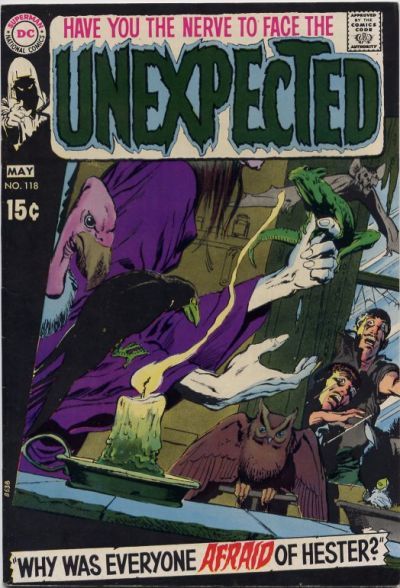
"Why Was Everyone Afraid of Hester?"
Story by Jack Philips (George Kashdan)
Art by George Tuska

Peter: Mr. Destine sells unique tape recordings to his customers, recordings that enable the buyer to step into the past and review an incident from different perspectives. Destine approaches syndicate boss, Mr. Jennings, about a rub-out Jennings had performed on a lawyer in his employ. Jennings eagerly buys the tape (for five dollars) and enters the past to search for the evidence his lawyer had threatened to expose should he end up dead. Jennings finds the evidence but becomes trapped in the past when the tape breaks. Not my cup of tea in either story or art (Calnan and Anderson were the prototypical DC hero artists--bland and uninspiring), "Play a Tune of Treachery" is unique for only one reason and that's the host, Judge Gallows. Though this wasn't the character's first appearance (that was in #113), it's our first look at him. He'll pop up in three more issues and then, years later, play a part in the Sandman offshoot, The Dreaming.

Jack: Judge Gallows is a big improvement over the Mad, Mod Witch. This is an interesting story in that it prefigures the sort of virtual reality experiences that technology would bring decades later. Here, the virtual reality is created by a reel to reel tape, which is not that far off from today's computers. I am no fan of John Calnan, having read his dreadful Batman stories from the 1970s, but I respect Murphy Anderson's great inks.

John: I thought the panels with the Judge himself were the creepiest of all. I guess they were really committed to the idea of ghost-hosts. I'm with Jack, though, I'll take Judge G over the Mad, Mod Witch any day of the week! The one-pager, "The 7,000 Ft. Grave" could serve as a prequel to HOM's, "Boom!"

Peter: "The Face in the Ball" is another pulpish quickie from Jack Oleck, about a man who becomes obsessed with a crystal ball. It's tough to decipher exactly what's going on through Jerry Grandenetti's muddy artwork (although a panel or two show some noir-ish hope) but suffice to say, this is one to skip.

John: I second the motion!

Jack: I am going to have to do some research on Grandenetti. It's hard to believe that the same man who drew the war comics ten years before drew this dreck. The thick black lines are starting to give me that Frank Robbins feeling. And that's not a good thing.

What a game leg!
Peter: Not much better is "Why Was Everyone Afraid of Hester?" The whole town believes Hester to be a witch and so they avoid her like the plague. All but little Cedric, who loves Hester and her menagerie of pets, a boy whose Uncle Uriah has been trying to run Hester off her land for years. Uriah schemes to use his nephew to bring the witch down but the plot backfires and Uriah becomes yet another pet in Hester's care. I've never liked George Tuska's cartoony art (especially his stint on Marvel's  Man-Wolf series) and this is no exception. The centuries-old plot offers no surprises. It's revealed in the letters page for Unexpected #119 that George Kashdan wrote "Hester" under the nom de plume of Jack Philips "To avoid hogging the limelight." Another weak issue of Unexpected. Circulation figures published this issue show that Unexpected was selling an average of 155,110 copies per month for the previous year. In comparison, DC's #1 title, Superman, was selling 511,984 copies, Star-Spangled War Stories 149,170, and DC Showcase at the back of the pack with 130,219. The overall, best-selling comic book in America at that time (with 515,356 copies sold every month) was Archie!

Jack: Archie Comics were probably better than this Tuska tale. Poor Uriah's game leg looks fine in one panel and then like a piece of spaghetti in another.

John: On the bright side, that almost makes it good for some laughs. Almost.


Neal Adams
House of Secrets 85 (May 1970)

"People Who Live in Glass Houses..."
Story by Len Wein
Art by Don Heck

"Reggie Rabbit, Heathcliffe Hog, Archibald Aardvark, J. Benson Babboon, and Bertram, the Dancing Frog"
Story by Len Wein
Art by Ralph Reese

"Second Choice"
Story by Gerry Conway
Art by Gil Kane and Neal Adams

Peter: After months of covers featuring children in peril, we finally get a story featuring some of the little monsters. A group of young boys being pesky happen upon the true secret of Mordecai Gaunt, a strange cat who keeps a set of distorting mirrors. After the boys watch Gaunt step into one of the mirrors they get a little too close and are pulled in to another dimension by Mordecai. There he explains to his captured audience that this land in the  mirror sucks the old age out of him if he visits once a year. Sadly, he can't allow them to go back. In a panic, the boys race back through the mirror and shatter it, trapping Mordecai Gaunt in his alternate universe forever. "People Who Live in Glass Houses..." is not a bad story, not great, but features some of Don Heck's better art (that I've seen, at least). Mordecai Gaunt is suitably gaunt but I found laughable the panel of Mordecai's true visage at 100 years. I've seen several folk who have hit the century mark (my colleague, Jack, for instance) and none of them look like a sharp-fanged ghoul with claws!

Jack: Can we set the record straight here? You are OLDER than I am, brother Cain. Can we agree that a good art job by Don Heck is not something to be thrilled about? Why did the three boys in the story turn into two girls and a dog on the cover? And why are all of Neal Adams's people so good looking?

John: Funny that you say that, Jack. I would have preferred that Mr. Gaunt looked a bit creepier, but for the purposes of the story, I think he actually should have looked normal (as Neal Adams portrayed him on the cover).


Peter: "Reggie Rabbit..." is a silly two-page comic strip satire that belongs elsewhere (three years later it would have landed in Plop!) but I do appreciate the larfs it provided. A band of comic book characters becomes tired of the crappy dialogue they have to "balloon" every issue and board their spaceship back to the planet they came for, deciding Earth is too stupid to invade. Amen on the crappy dialogue protest. I've been thinking of boarding just such a ship. Anyway, it's very funny, very inside-y, and should have been longer. Best laugh I've had in a while. There's a Reggie Rabbit currently presiding as mascot for an Australian rugby team so, perhaps, our rabbit protagonist had a change of heart in the end. The story features Ralph Reese's first DC work.

Jack: The panel to the right looks like a swipe from Pogo. Like Wayne Howard, Reese came up through the Wally Wood studio.

John: This story definitely seemed out of place to me here in the pages of HOS.

Peter: "Second Choice" is the obvious gem of this issue. Eighteen year-old wonder boy Gerry Conway scripts a unique "pick your own ending"-like tale featuring rebellious peasant Henry Lansbury and his quest to unthrone the Black Wizard, a demonic sorcerer who holds Henry's village in his power. Years before, Henry's father had attempted to overthrow the villain but had paid with his life. In the first climax, Henry discovers the White Wizard and together they prove to be too much for the Black Wizard. Call that the "happy ending." In the "not-so-happy" ending (and my preferred text), Henry travels alone, armed only with his sword, to the castle of the Black Wizard and eventually pushes his nemesis into the "edge of Hell," a pit the wizard had opened to drop the young pest into. As the sorcerer topples, he reveals that he is, in fact, Henry's long-lost father and Henry realizes that the "tempting, near-overpowering prize--to be supreme, to own the world... must have been too tempting" and that he himself will become the new Black Wizard. Kane delivers a half-dozen obligatory up-the-nose shots but Neal seems to rein him in a bit. Both story and art are top-notch. I've got a feeling we'll be seeing a lot of sword and sorcery stories from here on out.

Jack: I love Kane and Adams, so their art saves this tale for me. I think sword and sorcery stories often seem long-winded and boring, with characters spouting the same overblown dialogue and situations that are predictable. Still, the Kane poses are like a lesson in dynamic art and we get a few prime Adams panels, including a pterodactyl that looks like Sauron from the almost contemporary work he was doing in X-Men. In all, an above average issue of House of Secrets!

John: I know I was AWOL on the last Mystery installment, but I thought I somehow timed it to miss out on an overabundance of Sword & Sorcery tales. Explain to me how those fit in the Mystery line again? Sure, it's Kane and Adams, but if I wanted to read this sort of tale, I'd be digging into the Conan tales over at MU. 


Nick Cardy?
The Witching Hour 8 (May 1970)

"Above and Beyond the Call of Duty!"
Story by Sergio Aragones and Neal Adams
Art by Neal Adams

"Three Day Free Home Trial!"
Story by Sergio Aragones and Nick Cardy
Art by Nick Cardy

"ComputERR"
Story by Sergio Aragones and Alex Toth
Art by Alex Toth

"The Sign of the Hook!"
Story by Ron Whyte
Art by Jack Sparling

Peter:  Jonas Sentry, an old decrepit millionaire vows he'd give anything to have the body of his young butler so he could put it to his young maid. One day Jonas speaks the wish out loud and up pops Satan, ready to make that bargain. Sure enough he lands the body of the young butler and excitedly kicks the hollow shell of his former self down the stairs. Being the crafty devil he is, Satan calls the police and reports the murder of Jonas Sentry. Jonas II spends the rest of his long life behind bars and Old Scratch enjoys some time with the beautiful maid. "Above and Beyond the Call of Duty" is a "deal with the devil" tale with the most restrained Neal Adams art I've seen. Don't misunderstand me, it's still better than 90% of the art we get in the mystery titles, but it's not vintage Neal (or, I guess, the vintage Neal we know of now). The story itself is fun (sure, we've read this same story a thousand times) and the sheer joy on Satan's face as he dials the phone is a treasure.

John: A tried and true deal-with-the-devil tale done just right. Nothing groundbreaking, but effective nonetheless. 

Jack: The credits for this story (and this whole issue) are interesting. The Grand Comics Database credits Aragones with co-writing the three longer stories with the artists (and cites The Comic Reader as the source, so I believe it). Aragones is know for his short, usually wordless comedy strips, so it's unusual that he would be doing the writing but not the art. This story just goes to show you how a great artist can make anything worth reading.

Peter: Emily Carson is greeted at the door one day by Winifred, a woman claiming she'll be her maid for three days free of charge just so she can live in Emily's gorgeous house. Since she's a penny pincher, Mrs. Carson takes her up on the offer. Over the next three days, Emily can't seem to find the strength to pull herself out of bed but, thank goodness, Winifred makes a killer cup of tea. One night, Emily is awakened by a ruckus in her living room and drags herself to the keyhole where she witnesses a party of ghouls. The next day, her cousin finds her in a state of disarray and the only clue is a note from Winifred thanking Emily for the use of her house and hoping to see her again next year. This is one of those dopey stories where you're pretty sure you know what's going on but you're probably wrong. Aragones and Cardy opt not to give us enough information to compose a theory of our own but the obvious answer is pretty lame. Is Winifred one of these ghouls she's partying with? If so, why would she leave proof of her existence? Nick Cardy's art is sharp (especially that "eye through the keyhole" shot) and I can excuse some vagaries when they're attached to a fun read.

Jack: I thought this story was very funny and I loved the art. Doing this blog has given me new appreciation for the work of Nick Cardy. He's someone whose work I loved as a kid but never knew who drew it.

John: I was less enamored with this one than you two. I was actually disappointed to find out what was going on. I thought it was going to be a true tale of terror, and that somehow Winifred was feeding on the life force of Emily. Having it turn into a Mad Monster Party was indeed funny, but funny wasn't what I thought the story was building up to. 


Peter: The great Alex Toth contributes more of his genuinely unique art to the unfortunately-titled "ComputERR." Newlyweds Kipp and Rod, both orphans, move into Rod's spacious modern house with his butler, Ferencz. Soon, Rod begins spending quite a bit of time away on business, leaving the vibrant Kipp feeling like a prisoner inside with the creepy Ferencz. When Rod returns home and Kipp confronts him about her inability to contact anyone, Rod denies her the freedom she desires and, in a rage, Kipp steals the car and races off, but not before accidentally running over her husband. Ferencz carries his master back into the house and lays him out on a work table, revealing Rod's insides as clockwork gizmos, springs and dials. Rod's a robot! Now, with a title like "ComputERR", you know something's up and since nothing in the story has to do with computers I saw this "twist" coming a mile away and you will too. What I didn't see coming was the second twist, a nice little epilogue that provides a quick jolt and a satisfactory reading experience. Art and story combine to make this Best DC Mystery of the Month.

Jack: I agree! I especially liked the little rectangular punch holes on Toth's pages that made them look like computer punch cards. I recall taking a computer programming course at Indiana University in 1982 and we were still using punch cards then, so this story is pretty early for the topic of computers.

John: I was put off by Toth's art on this one. Overall it worked, and I particularly liked that epilogue, it just seemed like no time was spent on the art in the panels (despite all the work that went into the ticker-tape).


Peter: The art on the cover, by the way, is uncredited and the GCD drives right down the middle of the road, with Nick Cardy on one side and Neal Adams on the other. Yep, it's tough to tell as some of those background characters definitely look like they came out of the end of Neal's pencil (and Emily, in the foreground, seems very Neal-ish) but, putting my little thinking cap on and using what little comic expertise I have, I'd say that the fact that Emily and Winifred look so much like the characters in the story puts it square on Cardy. Think about the typical Neal Adams cover--it's sorta kinda about one of the stories inside maybe sometimes. This cover nails "Three Day Free Home Trial" right down to Winifred's outfit. It's Cardy. Neal can write me if he disagrees. This was, if you couldn't tell, the best all-around issue I've yet read in the Mystery Line.

Jack: I think the cover could be Cardy with Adams revisions. The old lady on the left looks to be 100% Adams but the characters on the right could be Cardy. I have read that Adams would turn up at the offices and go around making improvements on pages drawn by other artists.

John: I would have guessed Adams based on the left hand side alone, but you do make some interesting points. For what it's worth, in the SHOWCASE PRESENTS trade paperback I'm sourcing from, they give credit to Adams. So there you go.

Another breath-taking Toth splash!


Coming Next Week!