Tuesday, November 9, 2010

It's An Entertaining Comic! Part 3: Weird Fantasy

by Peter Enfantino

No one even turned their head when EC Comics’ Moon Girl became A Moon...A Girl...Romance with its ninth issue in 1949 and, if we’re to believe William M. Gaines, EC’s publisher, not many more noticed when that title was dropped for the catchier Weird Fantasy in 1950. Moon Girl featured the title superheroine created by Sheldon Moldoff and written by Gardner Fox, while A Moon...A Girl... was stocked with love stories with titles like “I Was Jilted and Had No Desire to Live” (written by Al Feldstein), “I Thought I Loved My Boss” (art by Wally Wood), and “Hearts Along the Ski Trail” (also by Wood).

Moon Girl’s real claim to fame is that it featured EC’s first horror story, “Zombie Terror” in issue 5 (by Johnny Craig). So, lost in a sea of romance titles, A Moon...A Girl... gives way to EC’s first science fiction anthology title (well, technically it’s tied for first since the premiere issue of Weird Science appeared the same month).

WF didn’t exactly get off to an auspicious debut with a story called “Am I Man - Or Machine?” written and drawn by Al Feldstein (with a little co-authoring by Gaines), inspired by the disembodied brain stories that were the rage at the time (Curt Siodmak’s novel Donovan's Brain being the most famous example). Roger Harvey shows up at the door of his fiance Diane, who’s a little shocked to see him since he was killed in a car crash two years before. Roger explains that, though his body was killed in the accident, his brain was kept alive by two brilliant scientists in a jar of liquid. With amazing technologies, the two doctors manage to create a plastic body for Harvey’s brain (one that is, amazingly, so lifelike no one notices Harvey looks like a lifesize GI Joe doll) and teach him how to use it. When Roger finishes his story, Diane sighs and admits that two years was a long wait and she went off looking for love elsewhere. Though she’s married, she offers to dump her husband and run away with Roger. Realizing that he can’t give her the love she’ll need, he instead tells Diane that the whole story was an initiation prank and, one would think, heads off to find a window mannequin he can call his own. Of course, my warped brain wants to see the alternate ending where Roger takes Diane up on her offer and shows her just what this plastic body can do!

As you’ll see, writing synopsis’ for these stories is a little more work than those for Crime Suspenstories or Haunt of Fear (as I recall, I used the phrase “so he kills his wife” over 100 times in those first two articles), because these tales are more than just a decent idea with real nice art. These are stories populated by fascinating characters caught up in bewildering and deadly adventures. A major reason why the SF titles were not as popular as the horror line is that Weird Science and Weird Fantasy were very text heavy. They had to be. You can’t illustrate a theory like you can a rising corpse.

As in the pages of the horror titles, Gaines and Feldstein borrowed liberally from other sources (H. P. Lovecraft’s imaginary occult bible Necronomicon is featured in “The Black Arts” in the August 1950 issue), but for the first time, the other sources were alive and paying attention. When the two EC-men morphed the Ray Bradbury stories “Kaleidoscope” and “The Rocket Man” into the powerful morality play “Home to Stay” in the June 1952 issue, Bradbury semi-playfully sent EC a letter inquiring if the men had forgotten to send him his adaptation payment. Once the “oversight” had been corrected, Bradbury authorized his stories to be used in the EC titles. In all, 28 stories (including the two unauthorized) by Bradbury were adapted by EC (6 of which appeared in Weird Fantasy). Bradbury’s words seem to have brought out the best in EC’s artists (not that they were slouches otherwise), as evidenced by “The Million Year Picnic,” a “Martian Chronicles” story about the last human family left on Mars with fabulous art by John Severin and Will Elder.

One thing becomes crystal clear after reading a full run of this title: Wally Wood was to Weird Fantasy what “Ghastly” Graham Ingels was to the horror titles. He not only drew the lion’s share of stories, he also wrote a few of them. You’ll see his name pop up quite a few times in the next few pages.

Only Time Will Tell (#13, June 1950)
Art: Wally Wood/Story: Harry Harrison.

Steve Dorner is working on a time travel machine but just can’t seem to get it right. One day, a hole opens in his wall, a man steps through and asks Steve to accompany him through the portal to the future where he’s working on a similar gadget. Evidently, Steve knows something Mr. Future doesn’t. Steve helps the man and then ducks back through the portal, clutching half of the blueprint for Mr. Future’s machine. Having only half of the blueprint, Steve is only able to get his portal to semi-work. After decades of work, Steve finally cracks the code, but needs some assistance. Realizing that the only man who knows enough about the portal to help is himself, he steps into his time tunnel and goes back twenty years to enlist the aid of...Steve Dorner. When the big picture finally hits Steve, he’s left to ponder the circle he’s eternally trapped in. Fabulous time travel tale that raises lots of complicated and fun questions. As the scientist himself wonders about the half of the blueprint he has in his possession after twenty years:
“It matches perfectly with the half that was just left here. That means that the half of the blue print which my younger self just tore off and took back with him, and this half that I have here - which I took from myself twenty years ago - are the same piece. Therefore, I only managed to build this machine with the aid of the half of the diagram that I took from myself! But who originally drew the half that I stole, copied and later put in the drawer?”
Who indeed?

Harry Harrison, the author of “Only Time Will Tell,” later became a major force in science fiction, authoring hundreds of novels and short stories, including four very popular SF series: The Stainless Steel Rat, the Deathworld trilogy, Bill the Galactic Hero (a hilarious spoof of SF that later became a comic book series), and Eden (intelligent dinosaurs). Harrison also wrote Make Room, Make Room (1966), the basis for the film Soylent Green (1973).

Cosmic Ray Bomb Explosion (#14, August 1950)
Art: Al Feldstein/Story: Al Feldstein and Bill Gaines

Al Feldstein and Bill Gaines are brainstorming stories before the ominous deadline doom comes crashing down around them. When “trips to the moon” and “time machine” stories prove useless, Bill lays out his idea for a “cosmic ray bomb,” a device “thousands of times more devastating than an atomic bomb.” To the dismay of the scientists working on the weapon, the bomb is stolen and, while explaining as much to the Secretary of Defense, detonated over Washington. Boom! End of story, right? In the comic within the comic, that’s just how it ends, but Al and Bill soon find they’ve stumbled on something when they’re visited by F.B.I. agents who want to know just how the duo got ahold of classified info on the new “cosmic ray bomb!” As the two exit the building, chuckling about how wacky the situation is, we see a plane fly overhead and Washington is destroyed.

It’s evident from “Cosmic Ray Bomb Explosion” that the creators behind Weird Fantasy had a lot of fun spoofing themselves and the often outlandish science factoids they would invest their stories with.

The Last City (#16, December 1950)
Art: Al Feldstein/Story: Al Feldstein and Bill Gaines

Two visitors from Mars hover over what’s left of New York and tell the wild story of Professor Farley’s Electro-Magnetic Force-Field Generator. Years before, in an effort to stave off atomic annihilation, Professor Farley creates a machine that enables him to cover all of New York with a protective shield. Unfortunately, the gizmo proves to be too effective when the Professor attempts to turn it off and finds it’s permanent. With no way to ship in food, the inhabitants of new York die a slow, painful death. Ironically, the world becomes embroiled in World War III and the earth is left a smoldering pile of ashes, save for New York, whose skyscrapers live on under the indestructible force field. Ivat and Cugo, the two narrating Saturnites agree that New York should remain as a museum, a testament to what “earthmen had once...and destroyed.”

“The Last City” is no-hold-barred science fiction. Whereas other publishers (Atlas of the 1950s for instance) would have its protagonists devise a way to destroy the force field and rain happiness and relief down upon mankind, Gaines and Feldstein almost gleefully kill off an entire planet and leave only remnants for alien passersby. One panel stands out as particularly grim: two starving New Yorkers stand over a dying man; one says: “He’ll be dead, soon!” the other answers: “Light a fire!” Stephen King recently visited the theme of the covered city in Under the Dome.

The Mysterious Ray From Another Universe (#16, December 1950)
Art and Story: Harvey Kurtzman

It’s 1970 and everyone in the world is captivated, no, obsessed with television. Everyone, that is, except radio station magnate Norman Network. Norman can’t seem to get his head around why so many people find the tube fascinating. With his station revenues falling to an all-time low, Norman devises a plan to rid the world of TV. He hires a scientist to travel the world, in search of any disease that can be linked to television viewing. The scientist discovers that TV can lead to disintegration and, for a time, Norman wins his battle. It’s only in the end that Norman discovers that humans watch TV in order to disappear (literally) and he’s very soon the last man on earth (and without a TV, to boot). Prescient satire in the Kurtzman style. Could very easily have found a place in MAD Magazine a few years later.

The Enemies of the Colony (#8, July 1951)
Art and story: Wally Wood

On a distant planet, The Galactic Colonization Authority is on the verge of ridding itself of the dangerous Hydra-files, creatures with a taste for the G.C.A.’s favorite pets, the monkey-like Mokos (which reproduce faster than rabbits). After the final Hydra-file is eliminated, the G.C.A., to their dismay, find that the Mokos are actually carnivores and the larger monsters were keeping the population down. A wonderful alien story as only Wally Wood could illustrate (the Mokos have the trademark Woodian “popping eyes”). As strange as it may seem, the climax of “The Enemies of the Colony” is reminiscent of the famous scene in John Ford’s The Searchers where John Wayne and his “posse” are drawn away from the ranch only to realize they’ve set up the ranchers for an Indian raid.

The Mutants (#10, November 1951)
Art: Wally Wood/Story: Al Feldstein

The fallout from a Hydrogen bomb test create a race of mutants. “Normal America” rises up in fear to fight these passive mutants and eventually herd them onto a couple of spaceships. Soon after liftoff, it’s discovered that a meteor is hurtling towards Earth. The only possible way to divert the big rock is for one of the ships to fly straight into it. Should the mutants sacrifice themselves for the millions who shunned them or set off for another planet where they can find peace? Yes, there are the obvious McCarthy-esque trappings, but this is just terrific storytelling with plenty of pathos. Wally Wood once again demonstrates why he was the best science fiction artist who ever graced the EC titles. Strange that the mutants are held “off-camera” for three pages and when they’re finally revealed, it’s very matter-of-fact.

The End (#13, May 1952)
Art: Wally Wood/Story: Bill Gaines and Al Feldstein

A high power telescope reveals that a comet is hurtling towards Earth. Before it can collide with Earth, it disintegrates but the massive radiation leaves all life on our planet sterile. In another generation, all life will vanish. Two scientists are, luckily, working on a time travel machine and devise a plan to go back in time before the comet and transport virile men and women to the future where they can repopulate the planet. They build their gizmo on the site of what once was Grand Central Station, citing the large amounts of foot traffic as the main reason. Unfortunately for the two well-meaning geniuses, they find their portal is located inside the Men’s room!

A fun, ironic climax to another Wood masterpiece.


Home to Stay (#13, May 1952)
Art: Wally Wood/Story: Bill Gaines and Al Feldstein

A rocket pilot of the future continually promises his wife and son he’ll give up the interplanetary life but, like an addict, he can’t fight what he craves. Every couple years he comes home to see his growing son. One night the boy wishes on a falling star that his father will come back “home to stay,” not knowing the star is actually his father burning up in Earth’s atmosphere after a rocket mishap. Forget that this is the infamous “Bradbury plagiarism” story and experience a powerful tale with a tragic climax, the kind of experience you won’t get from any other 1950s comic company.

The Aliens (#17, January 1953)
Art: Al Williamson/Story: Bill Gaines and Al Feldstein

Three aliens are en route to Earth to warn us that Atomic power is not always a good thing when they witness the drawbacks for themselves. They watch as Earth is blown to bits and, curious about the civilization, land on a large part of the rubble. They come across an issue of Weird Fantasy #17 and discover that the third story is about three aliens en route to earth to warn us…
A funny parody of all the “time bends back on itself” tales found in EC’s sci-fi comics, helped along nicely by Al Williamson’s art and capped off with a rare last page splash. Spa Fon!

Zero Hour (#18, March 1953)
Art: Jack Kamen/Story: Ray Bradbury and Al Feldstein

Precocious seven year old Mink plays a new game called “Invasion” with the local kids. The tots are collecting household items, conversing with invisible pals, and spouting dialog like “Beam 4-9-7-A-B-X.” Mink’s mom gets worried that maybe there’s more to her daughter than just a very active imagination.

Ray Bradbury spins more magic with children (no writer could blend childhood and dark fantasy like Bradbury), the only drawback being the Jack Kamen art. While Kamen has his fans, I remain unimpressed with the standard “talking head” narrative. The artist’s payoff panel (the unveiling of the invaders) looks more suited to a ghost story than science fiction.
“Zero Hour” proved to be very lucrative for Ray Bradbury. In addition to the WF classic, the story was also adapted several times for radio (by Suspense, Escape, X Minus One, and Dimension X) and, in 1992, for Ray Bradbury Theater, a syndicated TV show that lasted 65 episodes (over 6 seasons), all revolving around Bradbury’s short stories.

The Million Year Picnic (#21, October 1953)
Art: John Severin and Will Elder/Story: Ray Bradbury and Al Feldstein

Powerful Bradbury “Martian Chronicle” tale of the last human family left on Mars shows just how good EC science fiction could get when the best writing collided with the best art. Resembles a Father Knows Best on Mars. Severin’s art as usual is fabulous and meshes perfectly with Elder’s inks .


NEXT UP: FRONTLINE COMBAT


BIBLIOGRAPHY AND RECOMMENDED READING

The EC Library: Weird Fantasy. 4 hardcover volumes. (Russ Cochran, publisher. 1980). Reprinting of the entire series, with story-by-story notes and critique by Bill Spicer, John Benson, Mark Evanier and Doug Menville. Also features insightful interviews with Gaines and Feldstein.

Weird Fantasy (22 issues, EC Comics, June 1950-December 1953). (reprinted by Russ Cochran/Gemstone, January 1992-October 1998).

THE ENCYCLOPEDIA OF SCIENCE FICTION
Hardcover, by John Clute and Peter Nicholls. (St. Martin’s Press, 1993)

FOUL PLAY: The Art and Artists of the Notorious 1950s EC Comics
Softcover, by Grant Geissman (Harper Design, 2005)

THE MARTIAN CHRONICLES by Ray Bradbury
Originally published in 1950, a collection of 28 science fiction stories.

TALES OF TERROR/THE EC COMPANION
Hardcover, by Fred Von Bernewitz and Grant Geissman. (Gemstone/Fantagraphics, 2000)


Sunday, November 7, 2010

Richard Matheson - The Original Stories: The Science Fiction Digests Part 2

by John Scoleri

In the first six parts of this ongoing series, I looked at Richard Matheson's short fiction appearances in Playboy, the Sci-Fi Pulps, the Mystery Digests, The Magazine of Fantasy & Science Fiction, Gauntlet Chapbooks and the first batch of Science Fiction Digests. We return with the second part of the Science Fiction digests Matheson contributed to, which will make up the next four installments of this ongoing series.

The Original Stories - Part 7: Gamma and Fantastic

The bulk of Matheson's short stories originally appeared in science fiction digests like those featured in this installment.

"Crescendo"
Gamma
1963, Vol. 1 No. 1

Subsequent appearances (as "Shock Wave"): Collected Stories HC, Shock III, Button, Button, Collected Stories TP v3

Editorial Comment: At 37, with 11 books to his credit, Richard Matheson has achieved an enviable position as one of the nation's finest writers. The Beardless Warriors, his savage, compelling novel of teen-agers in World War II (based on his own experiences as a young replacement with the 87th Division) drew high praise—and his 75 short stories and novelettes (most of them in the sf field) have been hailed as outstanding by readers and critics alike. As an example of this, his Playboy novelette, "The Distributor," won the magazine's annual $1,000 fiction award in 1958. Matheson grew up in Brooklyn, planning to become an engineer, but after graduation from the University of Missouri (where he earned a Bachelor of Journalism degree) he changed plans when his first short story (the classic "Born of Man and Woman") sold to the Magazine of Fantasy & Science Fiction in the summer of 1950. He began to write professionally, finally moving into the motion picture field in Hollywood (based on the very favorable reception of a screen adaptation of his own novel, The Shrinking Man). Dick has written most of the Poe-based series for American-International, as well as numerous TV stories. Although Matheson ably supports his wife and four children by film and television work, his heart remains in his prose fiction, and he i at work on several new novels. Gamma 1 is fortunate in having acquired his latest short story, a carefully-crafted study in mounting tension which never lets down from first word to last.

Notes: Gamma's managing editor was Matheson's friend and fan, William F. Nolan. It is no surprise that the line-up of the magazine's run was often made up of the Southern California School of Writers. This issue contains an interview with Rod Serling, reprints from Ray Russell and Ray Bradbury, as well as new stories from Charles Beaumont ("Mourning Song"), George Clayton Johnson ("The Freeway"), John Tomerlin ("Shade of Day"), and go figure—a William F. Nolan story ("To Serve the Ship")! There are no less than three mentions in this issue of the contents of the next, which would also include a Matheson story.


"Deus Ex Machina"
Gamma
1963, Vol. 1 No. 2

Subsequent appearances: Collected Stories HC, Shock Waves, Collected Stories TP v3

Editorial Comment: When American-International released The Raven, with script by Richard Matheson, fantasy film fans were happy to discover that three of the screen's Favorite Monsters, Boris Karloff, Peter Lorre and Vincent Price, were all turned loose in the same picture. This was Matheson's idea. As a veteran fan of horror movies, dating back to the days of Frankenstein and Dracula, Matheson took special delight in scripting a vehicle in which three of his old favorites could star. Now, in Comedy of Terrors, his latest effort for A-I, Matheson has added a part for Basil Rathbone, another past master of fantasy—which should provide first rate screen entertainment in the popular Matheson manner. When he isn't scripting for A-I or Rod Serling's Twilight Zone, Dick continues to fashion his unusual fiction for book and magazine markets. A new collection of his stories (his first since he best-selling Shock! in 1961) is due any month now from Dell, and while we're all waiting, here's a grim, thought-provoking sample of the "monstrous mind of Matheson."

Notes: Contributors in this issue also included Beaumont ("Something in the Earth"), Bradbury ("Sombra y Sol"), Nolan! ("I'm Only Lonesome When I'm Lonely"). There are also two 'coming soon' references (not advertisements) to 1) a forthcoming anthology of humorous fantasy and science fiction stories (A Funny Thing Happened On The Way To The Moon) featuring Matheson, Bloch, Beaumont, Bradbury and Anthony Boucher and 2) a suspenseful paperback anthology (A Funny Thing Happened On The Way To The Morgue) featuring Matheson, Bloch, Beaumont, Bradbury and Anthony Boucher and others. I could find no reference to either anthology actually having been published.


"Interest"
Gamma
September 1965, Vol. 2 No.5

Subsequent appearances: Collected Stories HC, Collected Stories TP v3

Editorial Comment: The prolific Richard Matheson is currently hard at work on a new feature film for Academy Award winner Sidney Poitier, is creating the pilot film for a science-fiction series based on one of his own ideas, and is writing another novel which threatens to become a best seller.

Dick's ability to capture a mood and sustain it was obvious from his first published story many years ago, the chilling "Born of Man and Woman." He has since lived up to that promise, in his many screenplays adapting the Edgar Allan Poe classics. "Interest," which follows, carries on that tradition.

Notes: I could find no information on the Sidney Poitier film referenced (not even in Matthew Bradley's exhaustive and indispensable Richard Matheson On Screen). In an unrelated bit of trivia, the two men share the same birthday (Februrary 20), with Matheson a year Poitier's senior. This issue also features stories from Beaumont ("Auto Suggestion"), Johnson ("Lullabye and Goodnight"), and Dennis Etchison ("Wet Season").


"To Fit The Crime"
Fantastic
November-December 1952, Vol. 1 No. 3

Subsequent appearances: Collected Stories HC, Born of Man and Woman, Third From the Sun, Collected Stories TP v1

Editorial Comment: Do you suffer from cliché-itis? Does "Hot enough for you!" chill your blood? When your neighbor tells you "That's the way it goes!" do you ache to tear him loose from his tired tongue?

In that case you'll feel a real pang of sympathy for old Iverson Lord, who died from a combination of hardening of the arteries and semantic seizures. Not because of his death; for death comes to us all. It is what lay beyond the grave for ancient Iverson that will move you to tears. For the fires of hell are reserved for those who are most allergic to hear; and the Devil gives unto sinners tortures attuned to the most exacting taste.

Illustration: David Stone
Notes: Matheson was featured on the inside cover of this issue with an illustrated portrait and biography.

"I sold my first story to my mother for 8¢. My fictional outbursts were thoroughly activated when my sister gave me a typewriter for my thirteenth birthday. But for the grace of Smith-Corona, I'd probably be a plumber today. In addition to writing, I make fancy airplane parts out in Los Angeles where I live, and where I plan to write more and better science-fiction-fantasy."
This issue also contains "The Veiled Woman" by Mickey Spillane and "The Moon of Montezuma" by Cornell Woolrich. "To Fit the Crime" was reprinted in the August 1969 issue (Vol. 18 No. 6) of Fantastic Stories alongside Robert Bloch ("Let's Do It For Love").


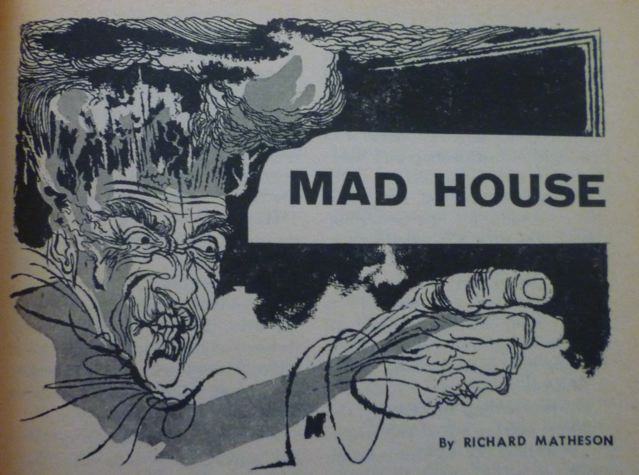
"Mad House"
Fantastic
January-February 1953, Vol. 2 No. 1

Subsequent appearances: Collected Stories HC, Born of Man and Woman, Third From the Sun, I Am Legend and Others, Nightmare at 20,000 Feet: Horror Stories, Collected Stories TP v1

Editorial Comment: Do petty annoyances upset you? Do you find yourself slapping the desk top when your eraser slips out of sight under loose papers? Do you give your pen a savage shake when it jams?

If so, you want to watch it, brother! Anger is acid, and it can get into more than your blood. The desk might start slapping back, the shaken pen may try spraying you with ink?

...We met Dick Matheson recently, for the first time. He wasn't what we expected—especially after reading "Mad House." Our sigh of relief rattled the roof...

Illustration uncredited
Illustration: Bill Ashman
Notes: This issue also contains "Close Behind Him" by John Wyndham, and "The Lighthouse," an unfinished Edgar Allan Poe tale completed by Robert Bloch. "Mad House" was reprinted in the January 1967 issue (Vol. 16 No. 3) of Fantastic Stories alongside Robert E. Howard's novel The People of the Black Circle. That subsequent appearance had a different editorial introduction:
Although it may be a bit hard to believe—especially for some of us near-oldtimers—it's now more than fifteen years since Richard Matheson jolted the field with "Born of Man and Woman"—a first story only a few pages long but each of them fraught with enough horror to keep us from rereading it all these years. But that's not at all how we feel about later Matheson, some of which we've reread many times, particularly "Mad House"—just so we could get back to that terrifying moment when Professor Neal's straight razor decides to open up all by itself!

"Mother By Protest"
Fantastic
September-October 1953, Vol. 2 No.5

Subsequent appearances (as "Trespass"): Collected Stories HC, The Shores of Space, Duel: Terror Stories, Collected Stories TP v2

Editorial Comment: This is a delicate story about a delicate subject, or possibly we should say a daring story about a daring subject. but then again, maybe not. In this dat and age it's hard to judge what's daring and what isn't. Anyhow, the period of gestation in all biological entities—including homo sapiens—is definitely established. So, when David got home from his trip and found things the way they were, all he had to do was make a few fast mathematical calculations and—well, go straight through the roof! On the basis of every known law on the subject, Ann was lying like a trooper. But with everything moving so fast nowadays, what can a man believe? There are laws and there are—possibilities.

Illustration: Ray Houlihan
Notes: Matheson adapted "Trespass" ("Mother by Protest" was applied by the editors of Fantastic) for the TV movie The Stranger Within starring Barbara Eden, now available on DVD through the Warner Brothers Archives.


"The Curious Child"
Fantastic
June 1954, Vol. 3 No. 3

Subsequent appearances: Collected Stories HC, The Shores of Space, Collected Stories TP v2

Editorial Comment: First, he forgot where he parked his car. Then his memory really started playing tricks—until he said: "Who am I—I never heard of a man named Robert Graham!"


Illustration: Tom O'Sullivan
Notes: This issue features excerpts of letters to the editor, including two concerning Matheson under the heading Best Story of the Year (1953):
Sir:
If nominations are open for the best story in '53, I want to place "Mother By Protest" by Richard Matheson, on the ballot.
Paul French - Phoenix, Arzona

...Richard Matheson as the best author, and "Mad House" as the best story...
Lewis Doyle - Oak Park, IL


There's more to come! Stay tuned for future installments of Richard Matheson - The Original Stories.

Friday, November 5, 2010

The Complete Guide to Manhunt Part 7

by Peter Enfantino

Continuing an issue by issue examination of the greatest crime digest of all time.

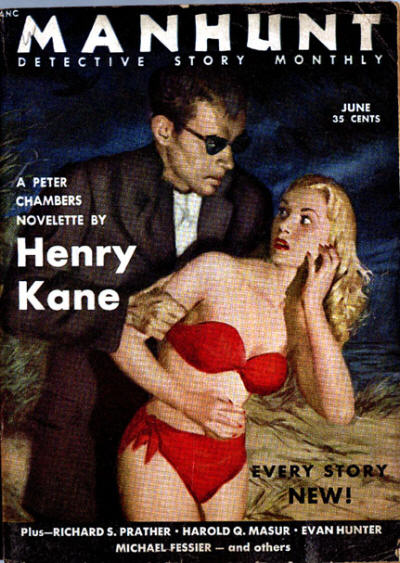
Vol. 1 No. 6 June 1953

Far Cry by Henry Kane
(11,000 words) *
Other than a change of scenery (this bar’s handle is “The Raven”), this is the same ol’ song and dance as Peter Chambers’ last escapade. More sleep-inducing head trauma, bedded broads, and double-crosses than you can shake a shot glass at.

Small Homicide by Evan Hunter
(4000 words) *** illo: J. Q. Farris
The strangled body of a baby girl is found in a church pew. The detectives of the 37th Precinct attempt to track down her killer. Not to be confused with McBain/Hunter's famous 87th Precinct series.

Ybor City by Charles Beckman, Jr.
(4000 words) **
Our nameless protagonist witnesses the murder of a blackmailer and pieces together the whereabouts of his murderers. When we finally find out who our narrator is, it’s not much of a surprise.


The Loyal One by Richard Deming
(4500 words) ***
A mortally wounded racketeer holes up in a snowed-in cabin with his wife Cynthia and their bodyguard. When it becomes apparent the mobster won’t make it, the loyal henchman sees Cynthia in a different light. Nasty climax.

The Faceless Man by Michael Fessier
(4000 words) **
Farmer Henry Rankins hires ex-con Claude Warren to help him tend to the farm. This angers the townspeople and, when Rankins is found dead, they become a brutal mob (the “faceless man” of the title) out for blood. The only thing standing in their way is Sheriff Ben Hodges. Not much in the way of an original plotline. This was Fessier's third and final story to appear in Manhunt, but he didn't stop writing. He turned his attention to writing teleplays, with several dozen produced for such diverse shows as Have Gun, Will Travel, Johnny Stacatto, Alfred Hitchcock Presents, The High Chaparral, Mister Ed, and Lost in Space.


The Double Frame by Harold Q. Masur
(4500 words) *1/2
Lawyer Scott Jordan’s third Manhunt adventure finds him stalked and confronted by an ex-con who’s convinced Jordan has stolen his stashed loot. The reader will know the identities of the real looters before it dawns on the slow-witted lawyer.

The Caller by Emmanuel Winters
(5000 words) *** illo: R. Cossette
Some foul-mouthed brute has been calling Miss Turner and reading her the works. Miss Turner, being prim and proper, is properly disgusted and goes to the police to file a complaint. When the police knab the lothario, he tells them he had been hired by one of Miss Turner’s work associates. The true identity is a mild surprise.

Hot-Rock Rumble by Richard S. Prather
(14,500 words) **
Shell Scott is hired by wealthy Jules Osborne to recover his mistress’ stolen jewelry before she makes trouble for the man. Scott engages in his usual romantic antics and his noggin suffers the requisite blows, all wrapped up tidily in a novelette. The Scott character is a fairly well-written character, but I guess my problem with the lesser Scott stories (this being one of them) is that they’re not tough enough for Manhunt. They’re lightweight in the same way that formula crime shows like Mannix, Ironside and Barnaby Jones are. There’s no sense of danger to the lead or his trusted supporting cast.

One Down by Hunt Collins
(1000 words) ** illo: Tom O'Sullivan
Adele hates Ben’s job and the fact that it keeps him away from home so much. Ben’s decided to keep the job and rid himself of Adele. Another of McBain/Hunter's pseudonymous stories.

This issue's "Mugged and Printed" features Henry Kane, Richard Deming, Evan Hunter, Richard S. Prather, Charles Beckman, Jr., and Michael Fessier.

Also in this issue, Vincent H. Gaddis' "Crime Cavalcade" and "Manhunt's Movie of the Month" (Ida Lupino's The Hitch-Hiker).


Vol. 1 No. 7 July 1953 Cover art by L.M. (?)

The Wench is Dead by Fredric Brown
(8500 words) **1/2 illo: Tom O'Sullivan
A motley assortment of humans: Howard Parry, ex-Bachelor of Arts in Sociology, now stinking drunk; Wilhelmina Kidder, aka Billie the Kidd, exotic dancer, hooker, and Parry’s drinking partner; Mamie Gaynor, heroin addict and soon a cooling corpse and a royal pain to our two drinking buddies. Add to this several junkies, whores, and alcoholics and you have a perfect picture of life in Los Angeles in the 1950s. Brown’s unrelenting gloom rivals that of the king of depression, Davis Goodis, in bleakness if not in quality.

Quiet Day in the County Jail by Craig Rice
(4000 words) ** illo: JQ Farris
For her own protection, a State’s witness is kept locked in a cell under constant watch. Though she’s protected by several guards, the woman seems convinced she’ll be killed by the mobster she’s to testify against.


I’ll Kill for You by Fletcher Flora
(4000 words) ** illo: Tom O'Sullivan
A very short and unaffecting tale of love, adultery, and murder. An early line: “A last whimper of regret at the doorway to Hell,” sounds like something George Chesbro would cook up for the title of one of his Mongo novels a few decades later.

Day’s Work by Jonathon Lord
(1000 words) **
Short-short about two hitmen on the way to a job who witness a hit and run.

Good and Dead by Evan Hunter
(5500 words) ** ½ illo: R. Cossette
Skid row bum Matt Cordell puts his old gumshoe skills to the test when one of his drinking buddies is found with a hole in his head. One of the weaker of the Cordell entries.

Say Goodby to Janie by Bruno Fischer
(8000 words) * illo: Rus Anderson
Paul Sherman, head of the City Crime Commission finds himself in all manner of bad ways – he’s convinced the mayor is accepting bribes but can’t prove it just yet; he’s having an affair with the mayor’s wife; then, to top it all off, he’s accused of murder. A meandering, unmemorable mess that reminds me of the Grade-Z noir melodramas that sometimes find their way onto late night cable. The kind of tale where the protagonist holds a gun on the bad guys at the climax and explains (to the audience and the patient police) how he came up with his suppositions (often in an unbelievable way).

The Follower by Hunt Collins
(2500 words) ** illo: R. Cossette
Ella Brant is convinced someone is following her home from the busstop every night but her husband thinks she’s got an overactive imagination. She doesn’t.

I’m Getting Out by Elliot West
(3500 words) **** illo: JQ Farris
Farm hand Tom has finally had enough of his boss Jake’s bullying and murdering ways. He leaves the farm, but before he can get on the bus, Jake’s wife Poppy begs him to take her with him. Tom wants no part of the soulless woman but decides to go back to the farm to get wages owed him. When he gets there, Poppy convinces Jake that Tom assaulted her and murder follows. Lots of interesting twists in what could have been a cliched “love triangle” in that Tom can’t stand the sight of the beautiful woman and wants only to get his money. Topped off with a really nasty climax.

Evidence by Frank Kane
(4000 words) *1/2 illo: Tom O'Sullivan
Swingin’ dick Johnny Liddell hands are full again. This time, a beautiful redhead enlists Johnny’s help when she’s blackmailed. You’ll never guess what the babe uses as her retainer.

The Double Take by Richard S. Prather
(11,000 words) **
Bad guys are using Shell Scott’s good name and his office to bilk unsuspecting folk out of large quantities of money. Shell doesn’t take this lying down. At least not until he gets the girl in the end.

Heirloom by Arnold Marmor
(1000 words) **
Hired gun Del only has to steal a necklace to earn his hundred bucks. The boss warns him not to touch the beautiful owner of the jewelry but Del is his own guy. Lurid ending is right out of Tales From the Crypt.

This issue's "Mugged and Printed" features Fredric Brown, Frank Kane, Bruno Fischer, and Craig Rice.

Also in this issue, "Crime Cavalcade" by Vincent H. Gaddis and the second installment of "Portrait of a Killer" by Dan Sontup. This issue's killer is Charles Henry Schwartz, a man who faked his own death for life insurance payouts.

Addendum: As you've probably noticed, I've added credits for interior illustrations when they're noted. Manhunt was lousy when it came to giving credit to its artists. I'll also note cover artists when they're credited.

Also, I should have noted price and page count for each issue. Each of the first seven issues contained 144 interior pages and sold for thirty five cents.

Finally, beginning this week, as you also may have noticed, I've increased the issues covered in each week's column. Cross your fingers and pray for me.

Tuesday, November 2, 2010

Random Reads: The Mystery Digests

By Peter Enfantino

There's something about a digest. Conservatively, I've got about 5,000 digests in my collection (it was easily double that until I sold off several lots a couple years ago). Several genres: horror (The Magazine of Horror), science fiction (Fantastic Universe), western (Double Action Western), crime (Mike Shayne), and even mainstream (Short Stories). I wish I had time in the day to read them all but I know, realistically, I'll never be able to read my full runs of Hitchcock and Ellery Queen. But that doesn't stop me from pulling the random issue off the shelf now and then.

I’m not much of a P.I. fan, which is odd, I guess, considering I’m a crime digest collector and good chunks of crime digests are composed of P.I. tales. The allure of the P.I. has always escaped me. I’m bored by what I’ve come to call “The Shell Shayne Formula.” You know what I’m talking about. Shell comes to work at his unkempt office. His beautiful, but maybe a bit frigid, secretary tells Shayne there’s “someone to see him in his private office.” Shell opens the door to find a beautiful, but somehow icy, blonde sitting on his desk, skirt hiked up a sleek, hosed leg. The babe is in trouble, her boyfriend/husband stole some money from the mob and he’s disappeared. She’ll do anything to find him. “Won’t Shell take her case?” Of course he will. Hundred a day plus expenses (and, of course, her company in bed). After several severe blows to the head, trips to the local precinct (where he’s grilled by his buddy, the detective), and possibly a betrayal by the beautiful blonde, Shayne tracks the guy down or finds him dead. Yawn.

This formula doesn’t just permeate the P.I. fiction of the 1940s and 50s, but finds its way into today’s crime novels. All the top guys do it. When was the last time you read a Private Investigator story that didn’t involve sex with the client? A blow to the noggin? A misunderstanding with the cops?

The reason I bring all this up is that I was corresponding with a fellow writer who was kind enough to give me some feedback a past column and, in the course of our back-and-forth, I unveiled that, for me, reading and enjoying P.I. fiction is tantamount to mastering Geometry. Ain’t gonna happen. “But what about Hammett, Chandler, Queen, or even Spillane?” he types. “Zzzzzzzzz” is my reply.

“Well, then you better let your readers know what they’re dealing with right from the start. This is like the music critic who hates Dylan and the Beatles, the comic historian who disses Kirby and Ditko, the movie lover who ignores Scorsese and Hitchcock.” Point taken, I guess, but there’s so much more to these little zines than P.I.s., thank goodness. There’s the guy who murders his wife for the “other woman.” The con man who’s going to retire after that one last “big job.” The beautiful dame who hides an icy heart. Well, you see my point, right? An endless succession of street life and dark alley dealings.

Which leads me, roundabout, to Alfred Hitchcock's Mystery Magazine, second longest-running mystery digest of all time (the first being Ellery Queen). Since December 1956, AHMM has offered up a dozen or so crime stories every month, favoring domestic crimes over the espionage and detective fiction offered up monthly in EQMM. In any given issue, you could find Donald Westlake, Henry Slesar, Evan Hunter, and William Link and Richard Levinson (who would later go on to create Columbo). You could also read great work from writers who might not have been household names but still contributed fine prose: Donald Honig, C. B. Gilford, Robert Edmond Alter, Jack Ritchie, Bryce Walton, Talmage Powell, and Stephen Wasylyk (who became to AHMM what Ed Hoch was to EQMM, placing more stories than any other author in the history of the zine). You can also read several of the stories filmed for Alfred Htchcock Presents, since many of the teleplays were based on stories first published in the digest.

AHMM has had lots of ups and downs as far as quality goes, but the issues published in its first twenty or so years are both affordable and enjoyable. Like Manhunt, AHMM dipped its toes into the”bedsheet” waters for a short time (May 1957-January 1958), and these are the only issues that will cost you more than a couple bucks (in fact, these bedsheets are scarcer than those Manhunts). It’s no surprise that I prefer the 1960s and 1970s AHMM to the EQMM published at the same time since EQMM, for the most part, ran the kind of stories I bemoan in the first few paragraphs of this column.
Since the 1980s, however, my zine of choice has shifted over to EQMM when AHMM became the place to read the latest exploits of “Mrs. Mable’s Crime-Sniffing Cat” or the “Two Clue-Solving Tea-Drinking Old Ladies in the Garden.” The 1980s have no place in this column though, so I’ll reach up to the 1960s AHMM shelf and bring down the September 1966 issue.

CONTENTS: A Money Season - James McKimmey; Cool O’Toole - Donald E. Westlake; Sycophant - Clark Howard; That’s How the Caper Crumbles - Lawrence Wasser; The Red Ferrari - Robert G. Anderson; The Volcano Effect - Elijah Ellis; Ambition - Michael Brett; The Tin Ear - Ron Goulart; Grand Prix in Diamonds - Glynn Croudace; Roundabout - Jaime Sandaval; Dead Oak in a Dark Woods - Hal Ellson; The Trouble with Blackmail - Carroll Mayers; The Conjuration - W. Sherwood Hartman; Payment Received - Robert L. McGrath; The Late Unlamented - Jonathon Craig.

First thing, off the bat, I have to say that I never cared for the covers of AHMM, which highlighted Hitch (photo or sketch) in a different ridiculous pose: Hitch in a baseball cap, graduating from college, with a Yale pennant, in diapers, etc. By the 1970s, obviously, the art director had exhausted dopey poses and discarded the props, leaving only Hitch as, well, Hitch. Months upon months of similar sketches of the director. This continued until the 1980s when the art was replaced by action-themed photos of suave cat burglars and babes with guns. Suddenly, I developed a nostalgic fondness for Hitch in a bathrobe with a dagger behind his back.
So, by the September 1966 issue, the editors had perfected a formula each issue that would keep AHMM selling reasonably well month in and out (1) . Inside its 160 pages, readers would find 13 to 15 short stories (averaging anywhere from 2000 to 6000 words) and one “novelette” (about 10,000 words), populated by the usual suspects: cat burglars, scheming bank tellers, heist crews, cuckolded wives, etc. Editor G. F. Foster would seek out stories that ended on an O. Henry note (just like the Hitch TV show) and readers would gasp in surprise at the fact that it wasn’t the butler that did it.

The September 1966 issue has its share of solid writers (Westlake, of course, being the prime example), but for the most part it’s not a very good package. What we get is a variety of five good stories and a lot of drek. Rather than rehash each story, I’ll point out the few highlights and spotlight the novelette.

Donald Westlake’s title character, “Cool O’Toole,” is a hip deejay who comes home to find he’s in the process of being burglarized by a trio of decidedly uncool teenagers. O’Toole tries to jive talk his way out of the situation, but the kids are having none of it, and Westlake gives us one of his patented “they’re my characters and I’ll put them through hell if I want to” finishes. In Elijah Ellis’ “The Volcano Effect,” a couple come to Sheriff Ed Carson, seeking protection for a cuckolded (and swindled) ex-boyfriend, but the sheriff’s not biting. The race car driver turned cat burglar of “Grand Prix in Diamonds” is a shade too reminiscent of The Pink Panther, but writer Glynn Croudace spins a fun yarn and it’s hard not to be drawn in.

Ironically, the best story in the issue, “The Conjuration,” finds Dan Martin, Confidential Investigator, helping a client who’s been bilked out of $25,000 by a con man and his beautiful assistant. The con goes: The babe picks up a rich, married man in a bar, takes him back to her place “for a drink,” only to have her “husband” come home early. She and her “spouse” argue, she stabs him (with a trick retractable knife), and begs the terrified dope for dough so she can head out of town. When Dan Martin gets himself invited over to the girl’s pad, he switches the knife before her violent act and leads the girl to believe the weapon was real and her partner is really dead. Only a last paragraph ruins the shock the reader feels that Martin could support cold-blooded murder when we learn that the P.I. replaced the trick knife with...another trick knife. If this had been Manhunt, I’m sure author W. Sherwood Hartman would have deleted that final expository.

The novelette of the issue, Jonathon Craig’s “The Late Unlamented” is an episode of Craig’s ongoing series starring police detectives Pete Selby and Stan Rayder. Selby was the poor man’s Steve Carella but was popular enough to headline short stories and novels for over a decade. Craig’s downfall on his Selby exploits was the staccato Dragnet-style dialogue and uninteresting supporting characters. This rang true for Craig’s other series, “The Police Files” which ran in Manhunt in the 1950s. Selby and Rayder were interchangeable with “Police Files” detectives Steve Manning and Walt Logan. Unlike Ed McBain’s Carella and the entire 87th Precinct characters, we knew nothing about Craig’s cops. We didn’t hit the bars with them, nor did we shop at the local grocer, nor take out the gun and badge and dump them on the nightstand before bedtime. Seemingly, the detectives simply appeared at each crime scene, did their work, caught the bad guys, filled out their paperwork back at the Precinct (in this case, the 18th), and showed up at the next murder. To be fair to Craig, I haven’t read the novels and no less an expert than Bill Crider (who knows more about crime novels than anyone in the world, I’m sure) writes that “Craig’s work has now faded into undeserved obscurity (2)” and that “Craig has a good narrative sense (2),” but his series short stories don’t display that gift for “narrative style” that Crider points to nor do they have the grime and darkness that jump from the pages of such Craig classics as “Services Rendered” and “The Quiet Room” (both from Manhunt).

This particular episode of the Selby/Rayder saga finds the detectives investigating a man who has suffered an embarrassing “death by bowling ball.” Luckily enough, the ace cops are able to crack the case when they discover a police report on a stolen bowling ball in the same neighborhood. When pressed, the owner of the stolen sphere admits that, yes, he is the murderer and in a sleep-inducing expository (“Here’s why I killed Cody Marden with my AMF Three-Dot”) he reveals that he killed the man for his cache of rare ambergis (a substance, derived from whales, used in perfume). Are you still with me?

Justice (May 1955-January 1956) was one of those short-lived digests that just seemed to fall through the cracks. Published by Non-Pareil Publishing (owned by Martin Goodman, who had made a fortune in the pulps and comics), Justice certainly bore the look of a high-class production. 160 pages of gritty crime drama behind covers tough and sexy enough to be mistaken for Manhunt (every cover painting featured the three Gs: Gals, Guys, and Guns). Each issue featured a reprinting of a recent Lion Books novel (Lion was also owned by Martin Goodman) and a handful of short stories and novellas. Despite roping in a good number of the best crime writers of the day, Justice couldn’t rise above its competitors in terms of sales and vanished from the stands after only four issues.

An argument could be made that the digest also failed to rise to its competitors’ output in terms of quality as well. Editor Harry Widmer certainly knew who wrote great crime fiction. He just didn’t get the best those writers had to offer. Because of the calibre of its writers (and despite the poor quality of most of its content) Justice is highly sought after by noir and crime collectors, fetching anywhere from $20-30 an issue, depending on condition, when you can find them. The October 1955 Justice is the issue you’ll fork over the most amount of dough for (if you can find it, that is), thanks to the inclusion of a condensed version of Richard Matheson’s Someone is Bleeding retitled “The Frigid Flame.” I love Matheson’s work, but this one’s clearly one of his lesser novels (it’s also his first published novel, so some slack shall be cut here).

If you’re looking for the best issue in terms of quality, that’d be the final issue (Vol. 2 No. 1, January 1956).

CONTENTS: The Black Bargain - Cornell Woolrich; Don’t Go Away Mad - Robert Turner; Hot Snow - Vin Packer; Scented Clues - Richard Deming; Die, Darling, Die -Gil Brewer; Pepper in His Tracks - Shep Shepherd; Backbite - Frederick Lorenz; The Sinkhole - James P. Webb; The Cocktail Jungle - Bruce Elliott.

Skip the dogs by Cornell Woolrich and Vin Packer. Woolrich’s “The Black Bargain” is a nearly unreadable, confusing mess, while Packer’s “Hot Snow” is not indicative of her work in the 1950s. Robert Turner, who could usually be counted on for solid contributions, hits the bullseye with “Don’t Go Away Mad.” During their getaway from a payroll heist, Briggs and Connaught are attacked by a ferocious dog. Later, when police broadcast a warning that the dog was rabid, Briggs, who was bitten, begins to exhibit some of the symptoms of rabies and his partner begins to exhibit the symptoms of Partnerus Greedus. Turner’s climax is outlandish but amusing all the same.

Richard Deming’s “Scented Clues” is a wild whodunit that keeps you guessing right until its climax. Detectives London and Sully investigate the brutal homicide of London’s adulterous wife, Marge, who didn’t cotton to the lonely life of a policewoman’s wife and sought comfort in the arms of another man (actually, several other men) before being murdered in a cheap hotel room. It’s up to the two detectives to sort through the dead woman’s love letters for clues to the identity of her killer. Big question becomes: could it be Detective Sully, who always had an eye for the beautiful Marge, or Detective London, who knew full well what his wife was up to (or down to). We all know that there's no way London could get assigned to this case but, hey, it's the 1950s, alright? Anything could and did happen.

In “Die, Darling, Die,” Gil Brewer shows why he’s one of the most respected (and collected) of the Gold Medal writers. The set-up? Please pay attention. Joe Morley’s in love with Miriam the registered nurse. Actually, Joe is what would be classified today as a stalker. He’s been following, cornering, and manhandling Miriam any chance he can get. Miriam’s starting to like it. But wait, it gets better. Joe’s the hero of this sordid melodrama! Miriam the nurse is actually Miriam the gunmoll, waiting for her murderous husband to arrive with the loot from his latest bank robbery. She’s set her hubby up to be sniped so she can deposit the loot in her private bank account. The cops know this and they’ve been staking out her pad. They want to use Morley to get inside and find out what’s what. That’s how Joe the creepy stalker becomes Joe the hero. Six years after Gil Brewer’s death, Bill Pronzini wrote (in Mystery Scene #21, May 1989) of the writer’s dark, decaying final years filled with drink and not much else. It’s a nasty, sad story, topping most any noir I’ve ever read.

In “The Sinkhole” by James P. Webb, Eli Cole has two problems: One, a giant sinkhole is eating away his farm and he needs to fill it with something large. His other problem, his neighbor who’s been spending way too much time with Eli’s wife, may just solve Eli’s first problem. Eli decides to kill two birds with one stone, or one big bird with lots of little stones. Humorous twists add up to a pleasurable read. I can find only four other crime short stories by James W. Webb: “Death Drives a Bus”, “Footprints of Death”, “Death at the Wheel”, and “Detour to Death.” I’ll get back to you when I find the elusive “Atlas of Death,” which completes the famous “Transportation to Death” quintet.

This issue’s Lion novel reprinting turns out to be the masterpiece in the Justice run. A retitling of One is a Lonely Number (1952), “The Cocktail Jungle” is one gritty, violent gem, a book you’ve probably never heard of by an author mostly forgotten today. Larry Camonille is among the ten cons who stage a jailbreak. On the lam, Camonille washes ashore in the Justice version of Peyton Place, a small town in Ohio. Every peace-loving citizen seems to have the proverbial skeleton in the closet and the need for someone who can kill. Enter the stranger Camonille, who relishes the idea of absorbing bucks while playing each side against the other. Unfortunately for Larry, this town isn’t comprised of dupes and each side plays against the middle.

Author Bruce Elliott also wrote You'll Die Laughing (Five Star, 1945), the soft-core A Woman (Midwood, 1961), Asylum Earth (Belmont, 1968) as well as several short stories for such pulps as Triple Detective, The Shadow (“The Case of the Melting Artichokes” and “Death Paces the Widow’s Walk”), Doc Savage, and Thrilling Detective. If you’re looking for one of those “unsung heroes” of 1950s crime fiction, you could do worse than Bruce Elliott.

FOOTNOTES

(1) Postal records require that, once a year, publishers must reveal their circulation numbers. For digestaholics like myself, these records are always fascinating. In 1966, AHMM was selling an average of just above 105,000 copies a month (second in sales only to EQMM’s 166,714 copies a month), a fraction of the numbers it would reach at its peak in 1992 (259,000), but 1966 was years before subscription companies would make it so easy to get zines at a cut-rate price. In fact, that 1992 figure included a whopping 245,000 paid subscribers.

(2) Both quotes are from 1001 MIDNIGHTS. Edited by Bill Pronzini and Marcia Muller (Arbor House, 1986).