Showing posts with label Sarett Rudley. Show all posts

Thursday, June 16, 2022

The Hitchcock Project-Sarett Rudley Part Seven: The Diamond Necklace [4.20] and Wrapup

by Jack Seabrook

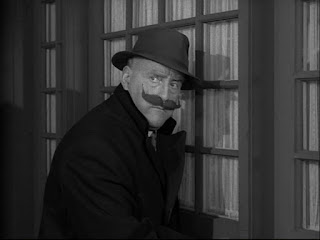
Claude Rains as Andrew Thurgood
Sarett Rudley's final teleplay for Alfred Hitchcock Presents was "The Diamond Necklace," which aired on CBS on Sunday, February 22, 1959. Unlike the other episodes she wrote, this one was an original teleplay, not based on anyone else's work, and it ends with an unexpectedly modern, feminist twist!

Andrew Thurgood represents the third generation of Thurgoods to serve as loyal employees at Maynard & Co. Jewelers; he has been employed for 37 years and looks forward to retirement in three years. One Monday morning, he is called into the office of young George Maynard, the latest in his family to own and run the store, and told that the venerable institution will be renovated along modern lines--three stories high, with a ramp going up and display cases from which customers may select their own jewels. Unfortunately, Andrew, the aging and loyal employee, does not fit the new look of the store, and his boss informs him that he will be retiring early--in five days, as a matter of fact.

Betsy von Furstenberg as Thelma Thurgood
pretending to be Mrs. Rudell

In the week that follows, Thurgood sells jewelry to his regular customers at a rapid clip, impressing Maynard with his devotion and skill. Come Friday, when Maynard suggests that Thurgood leave early, the salesman refuses, and his boss goes out to lunch. Just then, a fashionable young woman in a full-length fur coat and a large hat asks Thurgood to show her an expensive diamond necklace, telling him that she wants her husband to buy it for her to celebrate their anniversary. The necklace costs $181,500 and the woman asks Thurgood to bring it to her home, where her husband, psychiatrist Dr. Anton Rudell, has his office.

Alan Hewitt as George Maynard
Thurgood does as he is told, visiting Mrs. Rudell at her home and handling her the necklace, which she takes into another room. When Dr. Rudell emerges and Thurgood informs him of the impending purchase, the doctor angrily summons his wife Jessica, who looks nothing like the woman who has disappeared with the valuable piece of jewelry! Back at Maynard's, Thurgood is distraught, but his employer is sanguine, since the necklace is insured. Maynard comments that the theft was "'obviously done by a master criminal'" and it seems that there have been two prior thefts in the 117 years that the store has been open.

Stephen Bekassy as Dr. Rudell
Thurgood goes home and meets his daughter, who is revealed to have been the thief! They congratulate each other on a job well done, and Thurgood tells her that he is following in the family tradition of robbing Maynard's just once in his career, as did his father and his grandfather. Unfortunately, Thelma cannot follow in the family tradition, due to her gender, lamenting that "'I can't help being a girl.'" George Maynard unexpectedly appears at the door and, though Andrew fears that his former employer has discovered his deception, the boss is only there to hand Andrew his bonus and gold watch, two valuable items he forgot to take in his distress.

Andrew introduces Maynard to his daughter Thelma and is surprised when the store owner invites her to report to work on Monday morning, "'breaking a Maynard rule.'" Maynard remarks with pride that "'the Thurgood tradition will go on.'"

Selmer Jackson as Henry
Herschel Daugherty directs "The Diamond Necklace" smoothly, keeping the action moving swiftly from start to finish. Claude Rains gives another marvelous performance as Thurgood, his personality a mix of pride and subservience, at once both the loyal employee and the third in a series of familial thieves. Rains is completely believable as the jewelry salesman, while Betsy von Furstenberg, as his daughter, is less convincing in her portrayal of a young woman pretending to be a wealthy wife with a foreign accent. Alan Hewitt plays George Maynard, who has inherited a jewelry store and who at first seems callous in dismissing his long-time employee. At the end, however, he displays an unanticipatedly modern attitude when he asks Thelma to be the store's first female employee. With this surprise twist, Rudley gives the story a feminist flavor that is in line with several of the female characters in her earlier teleplays.

Herschel Daugherty (1910-1993) directed 27 episodes of the Hitchcock TV show and 16 episodes of Thriller in a career that lasted from 1952 to 1975, almost exclusively on TV. Among the other episodes he directed are "Summer Shade" and "The Star Juror."
Dorothea Lord as
Mrs. Rudell

Born in London, Claude Rains (1889-1967) was the son of a stage actor. He emigrated to America in 1913 but went back to Europe to fight for England in WWI. After the war ended, he acted on the London stage before returning to the United States, where he began working on Broadway in 1926. A film career followed, from 1933 to 1965, and his many great films included The Invisible Man (1933), The Wolf Man (1941), Casablanca (1942), and Hitchcock's Notorious (1946). He was in five episodes of Alfred Hitchcock Presents, including "The Horse Player." He won a Tony in 1951 for Darkness at Noon and has a star on the Hollywood Walk of Fame.

Betsy von Furstenberg (1931-2015) was born Countess Elizabeth Caroline Maria Agatha Felicitas Therese von Furstenberg-Herdringer in Germany and moved to New York City as a child to study ballet. A teen model, she acted on Broadway from 1951 to 1976 and on screen, mostly on TV, from 1951 to 1983. She was in one other episode of Alfred Hitchcock Presents.

The role of George Maynard is played by Alan Hewitt (1915-1986), who was on Broadway from 1935 to 1957 and on screen from 1954 to 1978. He was in three episodes of Alfred Hitchcock Presents, including "Invitation to an Accident."

In smaller roles:
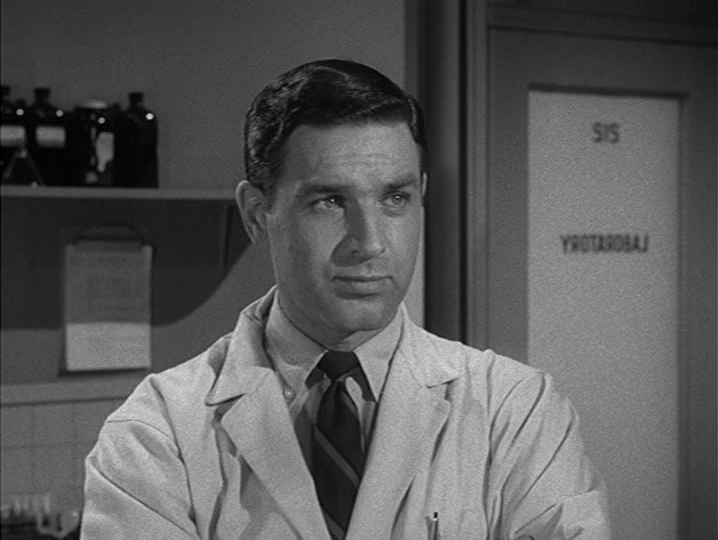
  • Stephen Bekassy (1907-1995) as Dr. Rudell; born Bekassy Istvan in Hungary, his film career lasted from 1930 to 1937 in that country, then from 1945 to 1964 in the U.S. This was his only appearance on the Hitchcock show.
  • Selmer Jackson (1888-1971) as Henry, the security guard; he often played small, uncredited roles in film or on TV from 1921 to 1963. He appeared in Hitchcock's Saboteur (1942) and was in six episodes of the Hitchcock show; his last credited role was in "Starring the Defense."
  • Peter Walker (1927- ) as one of the young jewelry store clerks; he was on screen from 1952 to 2000, appeared on The Twilight Zone and Thriller, and was seen in two other episodes of Alfred Hitchcock Presents, including "Invitation to an Accident," with Alan Hewitt.
  • Norman DuPont (1927-2021) as the other jewelry store clerk; his screen career lasted from 1952 to 1976, and then he spent many years managing hotels. This was his only appearance on the Hitchcock show.
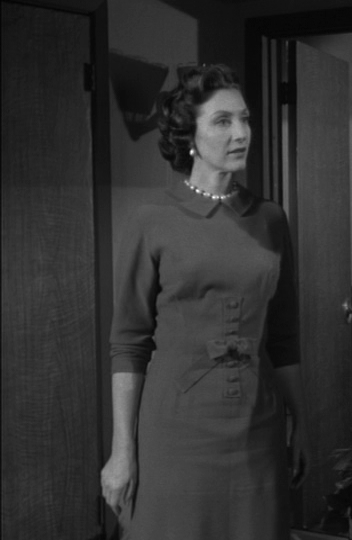
  • Dorothea Lord (1920-2000) as the real Mrs. Rudell; she had a short career on TV, from 1958 to 1962, but managed to appear in seven episodes of Alfred Hitchcock Presents, including "No Pain."
Peter Walker and Norman DuPont as the clerks

Watch "The Diamond Necklace" online here or order the DVD here. Read the GenreSnaps review here.

Sources:

"The Diamond Necklace." Alfred Hitchcock Presents, season 4, episode 20, CBS, 22 Feb. 1959.

Grams, Martin, and Patrik Wikstrom. The Alfred Hitchcock Presents Companion. OTR Pub., 2001.

IMDb.com. IMDb, https://www.imdb.com/.

"Norman E. Dupont Obituary: Honolulu Star." Advertiser, https://obits.staradvertiser.com/2021/09/12/norman-e-dupont-12092021/.

Wikipedia, Wikimedia Foundation, www.wikipedia.org/.

*  *  *  *  *

Sarett Rudley on Alfred Hitchcock Presents: An Overview and Episode Guide

Sarett Rudley wrote nine teleplays for Alfred Hitchcock Presents, starting with her adaptation of "The Baby Sitter," toward the end of season one, where she changes the main character's motivation and expands the story unsuccessfully. Of her five scripts for season two, the first, "Mr. Blanchard's Secret," is the weakest; like "The Baby Sitter," there is an over-reliance on voiceover narration and, despite having Hitchcock behind the camera, the episode is a talky failure.

"My Brother, Richard" isn't much better; this adaptation of a radio play sets up interesting parallels between the two men at its center yet fails to deliver satisfying dramatic action. "The Cream of the Jest," adapted from a short story by Fredric Brown, is better than the episodes that preceded it, yet once again Rudley's changes to the story's ending are not as good as the source. Another unsatisfying ending mars "The Three Dreams of Mr. Findlater," a show that mixes murder and humor and features a terrific cast.

Rudley finally found her feet with "A Man Greatly Beloved," adapting an A.A. Milne short story and opening it up to take it in a different and entertaining direction. "The Young One" is based on an unpublished story by Phillip S. Goodman and Sandy Sax, so it's not possible to compare the source with what ends up on the small screen, but Rudley's script is strong and, buoyed by Robert Altman's direction and Carol Lynley's excellent performance, the episode is a success. "Bull in a China Shop" is one of Rudley's best half hours, as she improves on C.B. Gilford's short story, mixing murder and humor in a story so effective that Gilford used aspects of it when he revised his own short story as a stage play.

Finally, "The Diamond Necklace," Rudley's sole contribution to the show's fourth season and her last script to be broadcast, is an original effort that features theft but no murder, with a light touch and a satisfying ending. Sarett Rudley may not have written the best group of episodes of Alfred Hitchcock Presents, but she wrote some good ones and, along with Marian Cockrell, she was one of the few women to write multiple scripts for the series in the latter half of the 1950s.


EPISODE GUIDE-SARETT RUDLEY ON ALFRED HITCHCOCK PRESENTS

Episode title-"The Baby Sitter" [1.32]

Broadcast date-6 May 1956
Teleplay by-Sarett Rudley
Based on "The Baby Sitter" by Emily Neff
First print appearance-Cosmopolitan, May 1953
Notes
Watch episode-here
Available on DVD?-yes

"The Baby Sitter"

Episode title-"Mr. Blanchard's Secret" [2.13]
Broadcast date-23 Dec. 1956
Teleplay by-Sarett Rudley
Based on "Mr. Blanchard's Secret" by Emily Neff
First print appearance-Ellery Queen's Mystery Magazine, June 1978
Notes
Watch episode-here
Available on DVD?-yes

"Mr. Blanchard's Secret"

Episode title-"My Brother, Richard" [2.17]
Broadcast date-20 Jan. 1957
Teleplay by-Sarett Rudley
Based on "Turnabout" by Jay Bennett
First print appearance-none; broadcast on radio on Suspense on 24 Jan. 1960
Notes
Watch episode-here
Available on DVD?-yes

"My Brother, Richard"

Episode title-"The Cream of the Jest" [2.24]
Broadcast date-10 March 1957
Teleplay by-Sarett Rudley
Based on "Last Curtain" by Fredric Brown
First print appearance-New Detective, July 1949
Notes
Watch episode-here
Available on DVD?-yes

"The Cream of the Jest"

Episode title-"The Three Dreams of Mr. Findlater" [2.30]                                                                          
Broadcast date-21 April 1957
Teleplay by-Sarett Rudley
Based on "The Three Dreams of Mr. Findlater" by A.A. Milne
First print appearance-Cosmopolitan, April 1949
Notes
Watch episode-here
Available on DVD?-yes

"The Three Dreams of Mr. Findlater"

Episode title-"A Man Greatly Beloved" [2.33]
Broadcast date-12 May 1957
Teleplay by-Sarett Rudley
Based on "Greatly Beloved" by A.A. Milne
First print appearance-Good Housekeeping, Feb. 1950
Notes
Watch episode-here
Available on DVD?-yes

"A Man Greatly Beloved"

Episode title-"The Young One" [3.9]
Broadcast date-1 Dec. 1957
Teleplay by-Sarett Rudley
Based on an unpublished story by Phillip S. Goodman and Sandy Sax
First print appearance-none
Notes
Watch episode-here
Available on DVD?-yes

"The Young One"

Episode title-"Bull in a China Shop" [3.26]
Broadcast date-30 March 1958
Teleplay by-Sarett Rudley
Based on "Bull in a China Shop" by C.B. Gilford
First print appearance-Ellery Queen's Mystery Magazine, Sept. 1957
Notes
Watch episode-here
Available on DVD?-yes

"Bull in a China Shop"

Episode title-"The Diamond Necklace" [4.20]
Broadcast date-22 Feb. 1959
Teleplay by-Sarett Rudley
Notes
Watch episode-here
Available on DVD?-yes

"The Diamond Necklace"


Listen to Al Sjoerdsma discuss "None Are So Blind" here!

Listen to Annie and Kathryn discuss "Dead Weight" here!

In two weeks: Our coverage of Victor Wolfson begins with "The Perfect Murder," starring Hurd Hatfield and Mildred Natwick!

Thursday, June 2, 2022

The Hitchcock Project-Sarett Rudley Part Six: Bull in a China Shop [3.26]

by Jack Seabrook

"Bull in a China Shop"
was first published here
C.B. Gilford's short story, "Bull in a China Shop," opens as Detective Dennis O'Finn announces to a group of five little old ladies that he finds "'no evidence of foul play'" in the death of their friend, Mrs. Eloise Albertson. She accidentally took arsenic, he explains to her housemates, whom he identifies by their clothes: Miss Green Shawl, Miss Necklace of Pearls, and so on. They insist that he stay for tea and he agrees, unaware of how attractive he is to the women. O'Finn tells them that "'the case is closed,'" to their disappointment, and leaves after advising them not to "'leave that rat poison where someone can get hold of it again and take another lethal dose.'"

The next day, O'Finn tells his partner, Ginsberg, that he felt like a "'bull in a china shop.'" Three and a half weeks later, he returns to the women's house to investigate another suspicious death. Miss Old-Fashioned Bonnet lies dead on the kitchen floor and O'Finn questions her housemates, who are cooperative and anxious for him to return. The next day, the police determine that the victim died of arsenic poisoning. O'Finn suspects that she was not specifically targeted and Ginsburg suggests that the murder was committed to lure O'Finn back to the house. "'They're in love with you, O'Finn,'" he adds.

Dennis Morgan as O'Finn
Returning to the house to question the women, O'Finn begins to think that Ginsburg's assessment of the situation is accurate. He is unable to figure out which woman is at fault, so he announces that it must not have been murder and stays away from the house to see what happens. Three weeks later, another murder is reported. O'Finn rushes to the house and finds Miss Green Shroud dead, having been found by Miss Starched Apron, who dropped her "'tray of cups and things'" in surprise. O'Finn surveys the three remaining women and examines the broken china, deducing that Miss Starched Apron is the culprit, since she frugally brought less expensive cups into the room with the corpse, knowing that she would drop the tray in feigned surprise. O'Finn bids the last two women farewell, lying that he is being transferred to the Arson Squad and later lying awake, "listening for the sound of Fire Department sirens."

"Bull in a China Shop" was first published in the September 1957 issue of Ellery Queen's Mystery Magazine and was later chosen for the 13th Annual Collection of Best Detective Stories of the Year, edited by David C. Cooke and published in 1958. The title has more than one meaning; the straightforward meaning refers to "a person who breaks things or who often makes mistakes or causes damage in situations that require careful thinking or behavior," which seems to refer to O'Finn's place in the old women's home; "bull" is also slang for a policeman and it can also refer to "bull****," which the women could be said to provide to O'Finn in lieu of honest explanations.

Estelle Winwood as Hilda Lou
Gilford's story recalls Arsenic and Old Lace in that it features eccentric older women and arsenic and shares the humorous touch found in the earlier play and film. The women are only given names once they die; other than that, O'Finn identifies them by their outdated clothing. He is both "a magnificent Irish cop" and a caricature of the type.

The story was purchased for Alfred Hitchcock Presents and assigned to Sarett Rudley to adapt for television. It aired on CBS on Sunday, March 30, 1958, in the latter part of the third season. The TV version improves on the short story, adding some scenes, compressing others, and giving the story more depth. The age of the women's home is signified in the initial shots; there is a closeup of house number 909 above the front door before the camera pulls back to show O'Finn ringing an old-fashioned doorbell that requires him to turn a crank.

Unlike the story, the women are given names; Miss Hilda Lou welcomes him in, as coquettish as a 75-year-old woman can be. She joins Miss Birdie, Miss Bessie, and Miss Amantha, forming a foursome of spinsters who stand together, giggling like schoolgirls. In the TV version, O'Finn lives "'across the court'" from the women, which is how they got to know him and developed an interest in the detective. They have been watching him and know that he is 45 years old and single, with a strawberry mark on his left shoulder.

Elizabeth Patterson as Miss Bessie
The women stand together in front of a sofa, hiding it from sight, until they shuffle sideways as one to reveal the corpse of Miss Elizabeth, who is decked out in death with items that remain precious to the other women. O'Finn departs with no sense that she was poisoned; he first learns of the cause of death when he is back at the station, speaking with his partner, who has been renamed Kramer. Instead of a second death bringing him back, the news that the victim was poisoned sends O'Finn back to the house, where the women have set the table in anticipation of his return. He gives them back the items that had been placed on the corpse and sees that they have a spyglass with which they have been watching him through the window.

This scene corresponds to the first scene in the short story, but it is followed by one where the women watch O'Finn through their spyglass as he dresses; he even sings a few bars of a song about being Irish, until he realizes that he is being watched and pulls down the shade, disappointing his elderly neighbors. The second and third murders in the story are compressed into a single murder in the TV show; this time, it is Miss Amantha who is found dead, and O'Finn figures out the killer's identity by piecing together the broken teacup at the police laboratory, rather than at the women's home.

Ellen Corby as Miss Amantha
Returning to 909 Lexington, he identifies Miss Hilda Lou as the murderer and she is delighted by his cleverness. He explains his rationale and the women's reaction is priceless; Miss Hilda Lou puts on a hat and makes it clear that she is looking forward to being questioned, leaving with O'Finn as if going on a date. While the short story ends here, the TV show goes on, with a scene at the police station where Kramer teases O'Finn, who reveals that he asked to be transferred to Arson. His offhand remark to the women in the story becomes reality in the show, and it is followed by a brief, final scene: O'Finn is at home in the evening when he hears fire trucks outside. He turns on the police radio and hears cars being summoned to 909 Lexington to respond to a fire; in the final shot, he looks out of his window and the flames next door are reflected on his face. The fear that ends the short story has become reality in the TV show.

In adapting the story for the small screen, Rudley expands the dialogue and the scenes among the women; it remains a black comedy where murder is played for laughs and the loneliness of elderly women drives them to crime. Yet there is tragedy beneath the surface. Miss Hilda Lou compares Detective O'Finn to her fiancee Jonas, whom she could not succeed in bringing back to her long ago. Now, she succeeds in bringing O'Finn back by resorting to murder. "Bull in a China Shop" is a humorous treatment of a tragic story of a lonely old woman who once lost her love and is determined not to let it happen again.

The elderly women at 909 Lexington support each other, living together in a boarding house that is like a fortress, a bastion against advancing years. The house is a relic and inside it the women can maintain the illusion among themselves of being youthful. They act like young girls when O'Finn visits; he tolerates it, but it is ridiculous to the outside observer. There are only two ways out of the prison that is 909 Lexington: death or crime. At the end, Miss Hilda Lou bravely sets off into the real world, excited to resume the life that was put on hold many years ago when her fiancee failed to return. The other two women realize what she has done and set fire to the house, symbolically destroying their haven and crying out to join her.

Ida Moore as Miss Birdie
Top billing goes to Dennis Morgan 1908-1994) as O'Finn. Born Earl Stanley Morner, he began his career as a radio announcer and later began singing on the radio. He was initially billed in films as Stanley Morner, then as Richard Stanley, and finally as Dennis Morgan. He appeared on screen beginning in 1933 and his career lasted until 1980. He was often teamed with Jack Carson in film roles and this was his only appearance on the Hitchcock TV show.

Estelle Winwood (1883-1984) is superb as Hilda Lou. Born Estelle Ruth Goodwin in England, she appeared on stage there until coming to the U.S. in 1916. She appeared on Broadway for decades and made a few films before her TV debut in 1946. She was frequently seen on TV up to 1980, guest starring in five episodes of Batman as well as episodes of The Twilight Zone and Thriller. She was in one other episode of Alfred Hitchcock Presents, "There Was an Old Woman," where she plays a character similar to Hilda Lou.

Miss Bessie is played by Elizabeth Patterson (1874-1966), who was on Broadway from 1913 to 1954 and on screen from 1926 to 1961. She had a key role in one of my favorite films, Remember the Night (1940), and she also appeared on Alfred Hitchcock Presents in "The Blessington Method."

Ellen Corby (1911-1999) was decades younger than the other actresses in this episode, yet she convincingly portrays Miss Amantha. Born Ellen Hansen, she started out as a script girl in Hollywood and played many uncredited roles on film from 1928 until she got her first screen credit in 1948. Her career continued until 1997 and included appearances on Thriller, Batman, The Odd Couple, and Night Gallery. She was in Hitchcock's Vertigo (1958) and she was featured in five episodes of the Hitchcock TV show, including "Party Line." She is best remembered for her role as Grandma Walton on The Waltons (1972-1980), for which she won three Emmy Awards.

Joseph Downing as Kramer
The last of the women in the boarding house is Miss Birdie, played by Ida Moore (1882-1964). She sang to accompany silent films and appeared in a few in 1925, then had a screen career from 1943 to 1959. This episode was the first of her two appearances on Alfred Hitchcock Presents; the other was "I'll Take Care of You."

Joseph Downing (1903-1975) plays O'Finn's partner, Kramer; he was on screen from 1935 to 1963 and also appeared in "The Big Switch" and "Place of Shadows" on Alfred Hitchcock Presents.

Finally, the lab technician is played by Paul Maxwell (1921-1991), a Canadian actor who was on screen from 1957 to 1991. He was on Alfred Hitchcock Presents four times, including "The Equalizer" and "The Right Kind of House," and he also played a lab technician in "Backward, Turn Backward." He later provided the voice for Col. Steve Zodiac on Fireball XL-5.

"Bull in a China Shop" was directed by James Neilson (1909-1979), who had directed 33 episodes of Janet Dean, Registered Nurse in the 1954-1955 television season; that show's producer was Joan Harrison, who was also the producer of Alfred Hitchcock Presents and who probably brought Neilson along with her to her new assignment. This was one of 12 episodes he would direct for the Hitchcock series, including "On the Nose."

C.B. Gilford (1920-2010), who wrote the short story, was born in Kansas City, Missouri, and had early success as an author when his novelette "The Liquid Man" was published as the cover story in the September 1941 issue of Fantastic Adventures (read the story here). After this auspicious beginning, Gilford's name disappears from the lists of story credits until 1953; he was graduated from college in 1942 and served in the Army Air Corps from 1942 to 1945. He began work as a college teacher in 1947 and would continue teaching speech, English, drama, theatre, and creative writing for the rest of his career. He married and had four children.

Paul Maxwell
After earning an M.A. in 1947 and a Ph.D. in 1952, he became a prolific writer of short stories, with one source claiming that he wrote over 200 of them; publication dates for the short stories were concentrated in the years between 1953 and 1961. In addition to his own name, C.B. Gilford used pseudonyms such as Donald Campbell, Elizabeth Gregory, and Douglass Farr. He also wrote at least 11 short plays between 1957 and 1969, and at least four novels between 1961 and 1969. A handful of his works were adapted for television, including four episodes of Alfred Hitchcock Presents and one of The Alfred Hitchcock Hour. His short stories often have been anthologized, and he told Contemporary Authors that play writing was his first love and that, while he enjoyed writing short stories and novels, "they seem to be harder work, more words have to be gotten on paper. I have no great messages to communicate; just believe in a well-plotted story."

Gilford must have appreciated the TV adaptation of "Bull in a China Shop," because he adapted his own short story as a three-act play of the same title in 1958. In the notes that precede the play, it refers to the TV adaptation in the past tense, suggesting that the play followed the TV show. The play owes quite a bit to Rudley's teleplay; O'Finn lives next door to the women and they spy on him, his partner is named Kramer, and the women are given names. Scene changes are minimized and the majority of the action takes place at the house; there is a significant addition of a new character by the name of Jane Rogers, a female crime reporter who flirts with O'Finn and ignites jealousy in the elderly women. Jane nearly drinks poisoned tea but is spared; at the end of the play, she announces her engagement to O'Finn, and this spells her doom: she is given a box of candy laced with arsenic as an early wedding present and later is reported to have died!

The three-act play must have been successful, because Gilford adapted it once again in 1963 as a one-act play called Any Body for Tea? In this version, Gilford switches the order of events around so that the plays opens with O'Finn explaining to a police captain why he asked to be transferred to the Arson Squad. The story then unfolds in flashback as O'Finn tells the captain what happened. The fact that O'Finn lives across the street from the old women is again central, as is their surreptitious observation of the detective with binoculars, so Rudley's changes and additions to the story for the TV version remain important in the subsequent stage versions. Comparing the short story, the TV show, the three-act play, and the one-act play leads to the conclusion that Gilford had a great idea, Rudley made important changes, and then Gilford refined it over the course of two dramas in the years that followed.

Both versions of the play continue to be performed to this day.

Gilford also adapted two other short stories into plays after they had been adapted as episodes of Alfred Hitchcock Presents: "Whodunit" and "Guest for Breakfast."

Watch "Bull in a China Shop" online here or buy the DVD here.

Read the GenreSnaps review of "Bull in a China Shop" here.

Sources:

"Bull in a China Shop." Alfred Hitchcock Presents, season 3, episode 26, CBS, 30 Mar. 1958.

The FICTIONMAGS Index, http://www.philsp.com/homeville/FMI/0start.htm.

Galactic Central, http://philsp.com/.

Gilford, C.B. Any Body for Tea?. Baker's Plays, 1963.

Gilford, C.B. Bull in a China Shop. Baker's Plays, 1958.

Gilford, C.B. "Bull in a China Shop." Best Detective Stories of the Year (13th Annual Collection), Dutton, New York, NY, 1958, pp. 151–164.

Grams, Martin, and Patrik Wikstrom. The Alfred Hitchcock Presents Companion. OTR Pub., 2001.

IMDb, IMDb.com, https://www.imdb.com/.

Legacy.com, https://www.legacy.com/.

Wikipedia, Wikimedia Foundation, https://www.wikipedia.org/. 


Listen to Al Sjoerdsma discuss "Kill with Kindness" here!

Listen to Annie and Kathryn discuss "Bull in a China Shop" here!

In two weeks: Our coverage of Sarett Rudley ends with "The Diamond Necklace," starring Claude Rains!

Thursday, May 19, 2022

The Hitchcock Project-Sarett Rudley Part Five: The Young One [3.9]

by Jack Seabrook

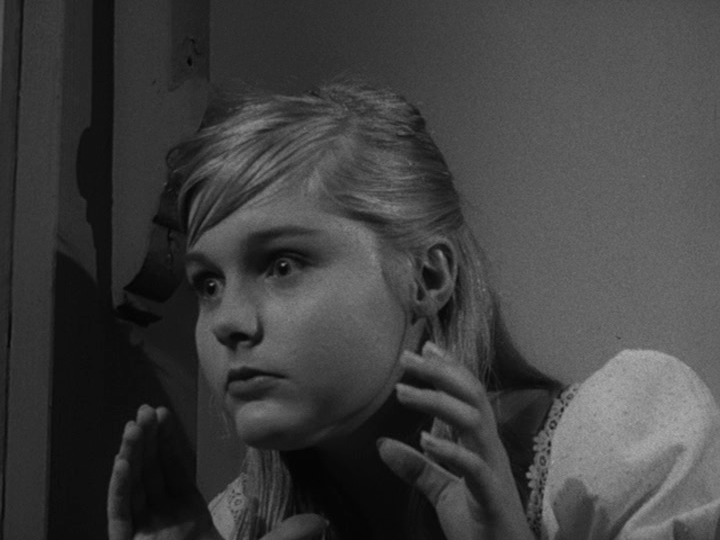
"The Young One" is the story of a teenaged girl whose selfishness leads to tragedy. The story unfolds over the course of several hours in a single night; the teleplay is by Sarett Rudley, based on a story by Phillip S. Goodman and Sandy Sax. This was the first of two episodes of Alfred Hitchcock Presents to be directed by Robert Altman, and it aired on CBS on Sunday, December 1, 1957. Fifteen-year-old Carol Lynley stars as Janice, and Vince Edwards plays Tex.

The show opens with a closeup of a sign on the wall of a roadhouse that reads, "No Person Under 21 Years of Age Served Alcoholic Beverages." The camera pulls back and pans around to show men sitting at a bar, an older couple dancing to a big band record that is playing on the jukebox, and a young couple sitting together at a table. The camera focuses in on the young couple, Janice and Stan, as they argue. The bartender brings them two glasses of lemonade and Janice complains that she wants alcohol, lying unconvincingly that she is over 21. The opening shot of the show effectively establishes the scene and introduces three of the main characters.

Carol Lynley as Janice
Janice is anxious to get away from the town and from her Aunt May's house. Stan begs her to wait until he is all set with a job, but she does not want to wait; he says that he is 18 and she replies that he is too young for her. The young woman gets up from her seat and dances alone, drawing looks from men at other tables and especially from one man who sits at the bar. Janice boldly approaches him, while Stan demonstrates his frustration with her by walking out of the room.

The man at the bar introduces himself as Tex and Janice accepts a cigarette from him, smoking it to demonstrate her maturity. Tex calls her both pretty and honest and Janice replies that "'it's easy to be honest with strangers.'" Tex warns the girl that she could get into trouble and she replies, "'Not unless I wanted to,'" a statement that proves true later in the episode. Unfortunately, Janice toys with each man in turn and is anything but honest. Tex confesses that he is a drifter and Janice asks him to take her with him; wisely, he gets up to leave before he gets into trouble with the young woman and he agrees with her when she accuses him of being afraid.

Janice leaves the roadhouse and there is a dissolve to a scene in front of her Aunt May's house as Janice and Stan walk up the front path together. The house is old-fashioned, with a picket fence and a porch, and represents the sort of traditional, safe place that Janice complains makes her sick. Stan takes her inside and the camera looks down on them from the top of a staircase, foreshadowing a key event that will happen later. Janice ignores Stan and begins to climb the stairs, her figure filling the frame as she approaches the camera. Stan speaks and she stops her ascent and smiles; she knew he would do this and is pleased at seeing her power over him demonstrated. Janice dominates the frame just as she dominates Stan; she is high on the stairs, her figure large and close to the viewer, while Stan is below, smaller and farther away.

Jeanette Nolan as Aunt May
Knowing that her youth and beauty give her power over men, Janice uses it ruthlessly, toying with Stan and offering to let him kiss her. He rushes up the stairs, but when he leans in for a kiss, she turns her head and again asks him to take her away. Suddenly, Aunt May's voice calls to Janice from the second floor and Janice shoves Stan away. The scene on the staircase foreshadows the show's tragic conclusion. The sound of Aunt May's voice triggers fear and apprehension in the young woman, emotions that have been absent up to this point. May welcomes Janice into her bedroom and the two women are contrasted: May is middle-aged, wearing a bathrobe, her long hair pulled back in a braid, while Janice is young, wearing a pretty dress, her blond hair flowing freely.

The women eye each other with a mixture of fear and apprehension. Janice lies about her evening, claiming that she and Stan drove out to the lake with other "'kids'" and then went to the soda fountain, painting an imaginary picture of her activities that she thinks appeals to her conservative, traditional aunt. However, Aunt May is not fooled and tells Janice that she knows that the young woman went to The Wooly Bear, "'that cheap roadhouse.'" They argue and, although May shows concern for her niece, Janice shows no regrets.

Janice then provides some insight into her upbringing and a possible explanation for her emotional problems. She laments the good house that she one lived in, but May reminds her that her parents were servants there and she was born in the gardener's house, where they lived. Janice creates fantasy worlds for herself and resists accepting the reality of her situation; she grew up poor but seems to think that she can use her power over men to better her station in life. Janice blames her Aunt May for taking her away from the beautiful home and falls to the floor in a childish tantrum, yet she is able to switch it off in an instant when it fails to have the desired effect.

Janice emerges from the bedroom and now the camera is placed at the bottom of the stairs, looking up at her in a shot that again foreshadows the tragic conclusion. As before, Janice approaches the camera and May follows her, a small figure at the top of the stairs, compared to Janice, who seems to wield the power in the frame. Yet this time, Janice stops and slowly walks back up the stairs when summoned by her aunt, a woman not subject to her power. Janice still submits to Aunt May, unable to dominate her the way that she dominates Stan. Janice begs May to let her go away and suddenly it appears that their relative positions on the stairs are ominous: Janice stands above May, who is bent backwards, holding Janice's wrists as the young woman leans toward her. May orders Janice to bed and Janice yells, "'Just leave me alone,'" as the camera fades to black.

After the break, the picture fades in on a closeup of Tex, still sitting at the bar. Janice enters, alone, and approaches him; now a policeman sits further down the bar, watching Janice and Tex. This is more foreshadowing of the climax, which will involve these three characters. Matt, the policeman, asks Janice why she is out so late and tells her to go home where she belongs, promising to check up on her later. She appears to obey the authority figure and walks out. The cop then warns Tex to keep going if he is just passing through town. Tex gets up and walks out as well, only to find Janice standing under a sign that reads, "No Minors Allowed." She convinces him to leave with her and he does so, after putting up token resistance.

Vince Edwards as Tex
There is a dissolve to a shot of Tex and Janice walking up to the front of Aunt May's house, just as she and Stan did earlier that evening. Janice again begs Tex to take her with him and he asks her for a kiss; he is older and bolder than Stan. This time she resists, standing behind a post and telling him that her aunt is asleep and he cannot come inside. He ignores her and asks to come in, so she lets him, but they enter quietly, in shadow. Importantly, the entranceway is completely dark, so neither Tex nor the viewer can see any part of the stairs. Janice leads Tex past the stairs and into a dark parlor, closing the sliding doors behind them.

Janice lights a table lamp once the parlor doors are closed and she and Tex discuss Aunt May, whom Janice calls "'so good she makes you sick.'" Tex gets bored and is heading for the doors when Janice orders him to stay, playing at being an adult by telling him to "'kneel down, so I can look at you.'" Janice fantasizes that she is a grand lady, perhaps in her mind still living in the fine house where her parents were servants when she was a little girl. Tex grabs her and she pulls away, leaving the room to get him a drink. She slips out into the dark entranceway, barely opening the parlor doors and leaving the lights off outside the room. She soon returns with two glasses of milk, just as Tex was about to open the doors and flood the entranceway with light. She mentions Matt, the cop from the roadhouse, and wonders aloud what he would think if he were to arrive to check on her and saw Tex leaving the house.

Rusty Lane as Matt

Tex says perhaps the worst thing he could say to Janice, remarking: "'You know something? You really are a kid.'" She proceeds to demonstrate just how wrong he is when she hears Matt's police car approaching outside. Janice throws a glass of milk in Tex's face, slaps him, and screams. She pushes the lamp off of the table so that it smashes in the floor, plunging the room into darkness. Janice runs to the parlor doors and exits the room. The next shot is outside, in front of the house, as she emerges, the shoulder of her dress torn. She rushes into the policeman's arms and claims that Tex tried to kill her. Matt goes into the house to investigate, pushing open the front door and switching on the light in the entranceway, revealing the dead body of Aunt May lying upside down on the bottom steps, with Tex standing next to her. The camera pans up his body and he tries to explain what really happened, but Janice claims that he followed her home and attacked her. When she screamed, Aunt May came downstairs and Tex killed her.

As Tex telephones the police station, Stan walks in unexpectedly and reveals that he returned to the house after Janice left. He saw Aunt May and says that "'she was lying there where you left her.'" The truth revealed, Janice backs away and suddenly turns fierce. She bursts into tears and falls to the couch where, suddenly childlike again, she says the last lines of the episode before the fadeout: "'I didn't want to kill her! It's just that she wouldn't leave me alone!'"

The final shot of a childlike Janice recalls...

"The Young One" boasts a strong script by Rudley and is effectively directed by Altman, but it is the central performance by Carol Lynley as Janice that makes the show such a success. She is in control at all times, alternating between child and young woman, playing one character off of another and reveling in her newfound power over men. The revelation that she must have pushed Aunt May down the stairs to her death is a shock, but even more shocking is the planning that must have taken place between Aunt May's death and Janice's reappearance at the roadhouse. She must have composed herself sufficiently to realize that she could lure Tex back to the house; she carefully orchestrated his entrance into the parlor so he would not see the corpse on the stairs, and she kept him an unwitting prisoner there until the policeman arrived.

Her choregraphed actions from that point on are impressive; had Stan not appeared when he did, she might have succeeded in pinning her crime on the drifter. Stan's actions are less clear. He says that he returned to the house after Janice left, intending to go along with her plan to take her away from her Aunt May. He somehow saw Aunt May's corpse inside the house, even though the entranceway was so dark that Tex did not see it when he walked right by it, and Stan then did nothing. He did not go to the police and he seems to have been walking around in a daze. Was he so much under Janice's spell that he was willing to overlook the murder? Was he in shock? This is never explained, and his return and explanation are simply used to add another twist to the surprise ending.

...Carroll Baker in Baby Doll, which was
released a year before "The Young One" aired.

Altman's direction of "The Young One" is excellent, as he uses the camera to demonstrate the power dynamics among the main characters and to show key relationships and settings that foreshadow the tragic conclusion. The camera is positioned at the bottom or the top of the stairs in key scenes at the house, suggesting that this will be the site of an important event, and Janice's placement in the frame more than once demonstrates her ability to manipulate other characters. It is likely that much of the power in Lynley's performance was drawn out by Altman's coaching.

Phillip S. Goodman (1926-2015), who is co-credited with writing the story upon which Sarett Rudley's teleplay is based, served in the Army in WWII, and wrote for television from 1965 to 1966. He also directed a movie in 1963. I have been unable to find any evidence that he ever wrote anything other than TV scripts, so it seems likely that the story he wrote for this episode was either an unpublished treatment or a teleplay that was revised by Rudley.

Sandy Sax, who gets co-credit for the story, is a mystery. I found no information at all about him (or her), other than two credits for TV scripts, both co-written with Goodman--this episode and an episode of another series that aired in 1955.

Just before the screen fades to black, with
Janice above Aunt May on the staircase.
This episode was the first of two to be directed by Robert Altman (1925-2006), whose career had begun after WWII when he started out directing industrial films. He moved into directing episodic TV, mainly between 1953 and 1965, before embarking on a successful film career with such movies as M*A*S*H (1970), The Long Goodbye (1973), and Nashville (1975). He was given an honorary Oscar in 2006, not long before he died.

Alfred Hitchcock was said to have liked Altman's work, so he was hired to direct episodes of Alfred Hitchcock Presents. He directed only two; he was supposed to direct a third but claimed that he was fired after he criticized the screenplay. This may have been a bit of self-mythologizing on Altman's part because, after the story got around, Joan Harrison was asked about it and recalled no such incident. Altman also worked for Hitchcock, scouting locations for episodes of Suspicion, a series for which Hitchcock's Shamley Productions produced ten episodes in the 1957-1958 TV season, the same period during which Altman directed the two episodes of Alfred Hitchcock Presents. The other episode he directed was "Together."

Carol Lynley (1942-2019) stars as Janice. Born Carole Ann Jones, she took the stage name of Carolyn Lee early in her career and changed it to the homophone Carol Lynley when she found out that someone else was already using Carolyn Lee. Lynley's TV and movie career began in the mid to late 1950s and she appeared in one Hitchcock hour ("Final Vow") in addition to "The Young One." Her most memorable roles for me both came in 1972, when she appeared in The Night Stalker TV movie and The Poseidon Adventure. Lynley's onscreen presence was always unusual, and "The Young One" is no exception. Her beauty was unquestionable, however, and she posed nude for Playboy in 1965.

Stephen Joyce as Stan
Tex is played by Vince Edwards (1928-1996), in his only appearance on the Hitchcock series. Edwards started out in film in 1947 and on TV in 1953; his most famous role was as the star of the medical drama, Ben Casey, which ran from 1961 to 1966. He continued appearing on screen until 1995.

After serving in the Air Force during the Korean War, Stephen Joyce (1931-2017), who plays Stan, began appearing on stage and was in Broadway plays on and off from 1950 to 1983. He also appeared on TV and in films from 1957 to 1997. This was his only role on the Hitchcock show, but he also appeared on The Outer Limits and in many soap operas, including hundreds of episodes of Love is a Many Splendored Thing in 1971-72.

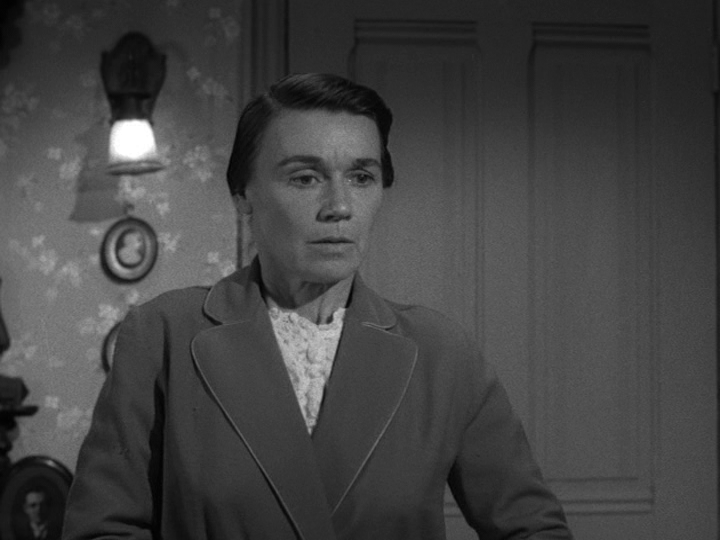
Jeanette Nolan (1911-1998) plays Aunt May. She started out on stage and was a busy radio actress in the 1930s and 1940s. She appeared in films from 1948 to 1998 and on TV from 1953 to 1990. Among her many film roles were parts in Fritz Lang's The Big Heat (1953) and Hitchcock's Psycho (1960), as one of the actresses voicing Mrs. Bates; she was also on classic TV shows such as Thriller, The Twilight Zone, and Night Gallery. This was one of her five appearances on the Hitchcock show, including "Triumph."

In smaller roles:
  • Rusty Lane (1899-1986) as Matt, the policeman; born James Russell Lane, he was in nine episodes of the Hitchcock series, including "The Manacled."
  • Frank Marlowe (1904-1964) as the bartender at the roadhouse; he was in movies from 1931 to 1961, appeared twice on Alfred Hitchcock Presents, and had small parts in Hitchcock's Saboteur (1942), Notorious (1946), and North By Northwest (1959).

Frank Marlowe

Read the GenreSnaps review of "The Young One" here.

Order the DVD here or watch this episode online here.

Sources:

DGA, Homepage, https://www.dga.org/VideoHTMLNew.ashx?id=%7BEB58FB76-6DB7-4ACA-BFCC-7D54889EBB94%7D&db=web.

The FICTIONMAGS Index
, www.philsp.com/homeville/FMI/0start.htm.

“Film Card.” Torino Film Fest, https://www.torinofilmfest.org/en/29-torino-film-festival/film/alfred-hitchcock-presents:-the-young-one/9241/.

Grams, Martin, and Patrik Wikstrom. The Alfred Hitchcock Presents Companion. OTR Pub., 2001.

IMDb.com. IMDb, https://www.imdb.com/.

McGilligan, Patrick. Robert Altman: Jumping off the Cliff. New York: St. Martin's, 1989. 131-32. Print.

Wikipedia, Wikimedia Foundation, www.wikipedia.org/.

"The Young One." Alfred Hitchcock Presents, season 3, episode 9, CBS, 1 Dec. 1957.


Listen to Al Sjoerdsma discuss "Kill with Kindness" here!

Listen to Annie and Kathryn discuss "The Young One" here!

In two weeks: Our coverage of Sarett Rudley continues with "Bull in a China Shop," starring Dennis Morgan and Estelle Winwood!