Showing posts with label Leigh Brackett. Show all posts

Thursday, January 26, 2023

The Hitchcock Project-Leigh Brackett Part Two: Terror at Northfield [9.3]

by Jack Seabrook

Leigh Brackett's second and last teleplay for The Alfred Hitchcock Hour was "Terror at Northfield," which was based on a story called "Terror Town" by Ellery Queen that was first published in the August 1956 issue of Argosy.

The story begins as Susan Marsh, a young librarian in the New England town of Northfield, is driving the ramshackle 1940 Buick that was given to her by Flora Sloan, the town's "undisputed autocrat," and worrying about the missing Tom Cooley, the 17-year-old son of truck farmer John Cooley. She had encouraged the boy to consider college but he would not agree to leave his father to tend the farm alone. Tom disappeared in early November and now Susan is concerned enough to visit sheriff's deputy Linc Pearce, the only policeman in town. They had played together as children and it frustrates her that he still treats her like a tomboy. Linc agrees to ride out to the farm with her and makes fun of her car, which she got three weeks ago after Flora won a new one.

"Terror Town" was
first published here
At the Cooley farm, John says that Tom has not been seen for over a month. A search is organized and three search parties comb the woods and countryside for weeks without success. Susan grows frustrated with Linc's failure to find Tom; she hears disturbing rumors about the Cooley farm going to seed. In the spring, heavy rains reveal a hole not far from the farm, and in the hole are Tom's remains. At the site, Susan sees the boy's distraught father taking items from the hole and putting them in his coat pocket. The coroner says Tom's body has been there since the fall and the back of his head was crushed.

Linc at first rejects Susan's offer to help find Tom's killer, but he is unable to solve the case and one night he visits Susan at home and admits that he has no good theory. He gets a call telling him that the body of bar owner Frenchy Lafont has been found in the hole where Tom's body was found. At the site, townsfolk blame Linc for not finding Tom's killer before he killed again. No clear motive is seen for Frenchy's killing; the back of his head was knocked in, just like Tom's. Susan fails to find a link between Tom and Frenchy and grows frustrated with Linc.

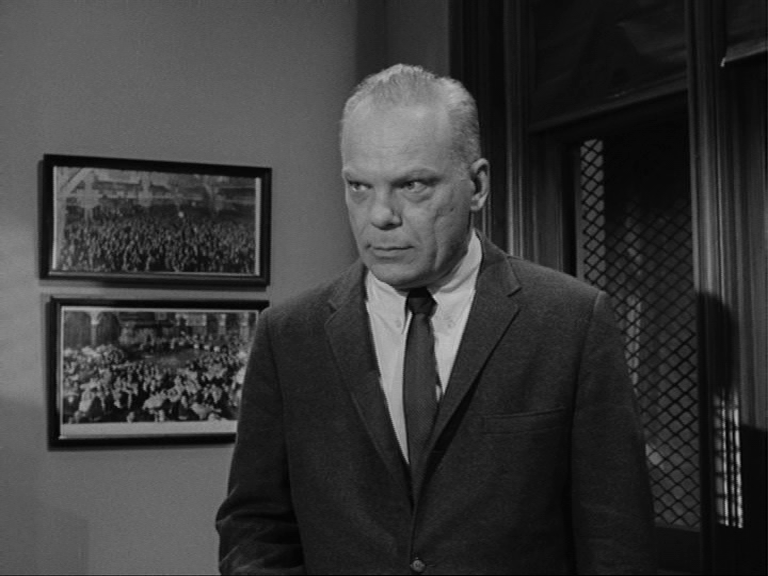
Dick York as Will Pearce
Two nights later, Flora Sloan's body is found in the same place, the back of her head battered in, again with no clear motive. At a town meeting, Linc lays out the facts and the apparent lack of connection. This time, the townsfolk support him. Alone in his office, he recalls seeing John pick up items from the hole where his son was found and pocket them. He wonders if one of the items was a clue and rushes to Cooley's house, which is empty. Linc finds a piece of glass in the farmer's coat pocket; he suddenly realizes what happened and that Susan is in danger. At her house, John Cooley has broken down the door and she realizes that he killed Frenchy and Flora with the metal butt of Tommy's hunting rifle. John explains that Tommy was killed by Susan's old car, which had been owned previously by Flora and Frenchy. Since the exact date of death is unknown, he has been killing all those who might be responsible. Linc arrives just in time to rescue Susan. Soon, he has proposed marriage, and no one ever finds out who accidentally ran over Tom.

Jacqueline Scott as Susan
"Terror Town" is an entertaining story with a central mystery that is not hard to figure out. It's the only short story by Ellery Queen not to feature Queen as the detective, and Francis M. Nevins wrote that the authors hoped to sell it to television. Ellery Queen was the pen name of Frederic Dannay (1905-1982) and Manfred B. Lee (1905-1971), two men who were the most important figures in crime and mystery fiction in the twentieth century. Their novels and short stories, most featuring Ellery Queen, appeared from 1929 to 1971, and the character flourished on radio, TV, and film. The authors also championed other writers, especially in Ellery Queen's Mystery Magazine, which has been publishing great mystery fiction for over 80 years.

Unfortunately, the TV adaptation of "Terror Town," retitled "Terror at Northfield," is a mess. It aired on CBS on Friday, October 11, 1963, and it was director Harvey Hart's first effort for The Alfred Hitchcock Hour. He tries to create a spooky atmosphere with some unusual shots and lighting, but there's not much he can do with the flawed teleplay and poor casting.
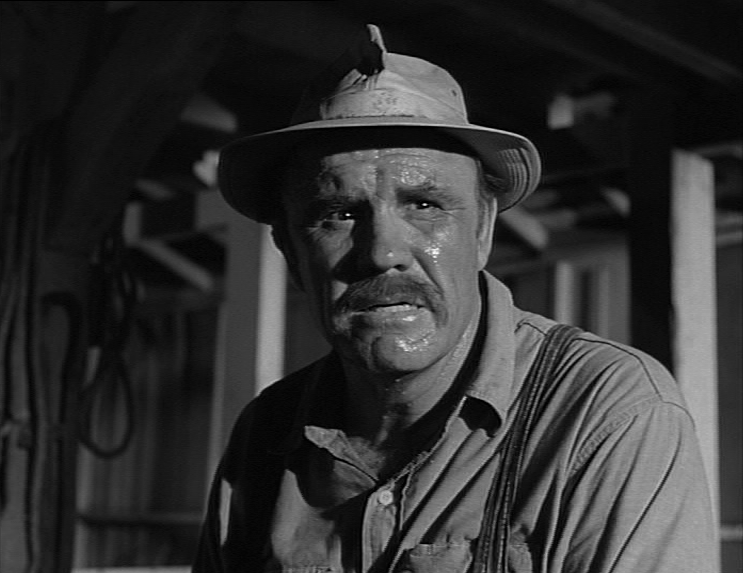
R.G. Armstrong as John Cooley
The show begins with Will (as Linc has been renamed) pulling up in his police car to the Cooley farm, with Susan in the passenger seat. The farm appears to have been deserted for weeks, but we see John observing the visitors from the shadows. They soon hear him working in the barn, fixing a tire with the large hammer that he will later use to commit two murders. We learn that his son Tom is missing. By starting the story at this point, Brackett removes the first section of the short story, including background on Susan, Flora, and the car. Also gone are the details of Susan and Linc growing up together and their familiarity with each other, so the tension in their relationship that exists in the story is absent from the show.

Back in town, Susan gets out of the police car and into her own car; Will points out the broken headlight. Susan drives a short distance and parks outside the library, where she meets Flora; we learn that Flora sold the car to Susan.
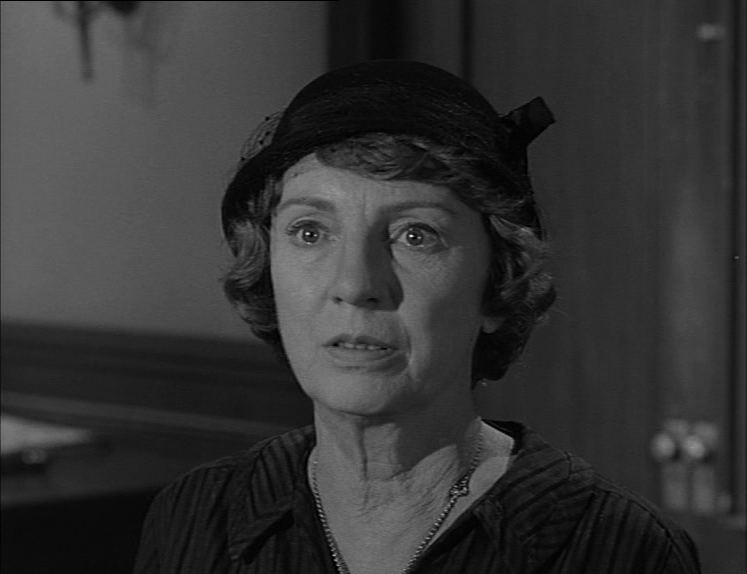
Katherine Squire as Mrs. Lafont
A closeup of a library book on the ground, its pages blowing in the wind, begins the following scene; Tom's body has been found at the bottom of a steep hill. Frenchy Lafont is seen holding onlookers back from the edge, though his character is not yet identified. Gone are the story's search party and the extended period of time before Tom's body is found. Cooley leaps into the hole and picks up the button and piece of broken glass, but he conceals the glass from Will and only admits to finding the button, suggesting that the glass is an important clue, something that is not revealed in the short story until the end. In the next scene, Will, the mayor, and the coroner discuss the mystery of Tom's death, compressing the story's long investigation into a brief exchange.

A major change follows as the next scene begins with a closeup on the broken headlight on Susan's car. John fits the piece of glass into the broken section, so the viewer knows how Tom was killed, something that was not revealed until the end of the short story. John then looks into the window of Susan's home at night before he is chased off by a barking dog. Since we know from dialogue in an earlier scene that Flora sold Susan the car, we now know that Flora and Susan are in danger and that John is the villain.

Peter Whitney as Bib Hadley
The scene shifts to the Cooley farm, where we see John erecting a For Sale sign as Frenchy drives up and expresses interest in buying the property. They explore the farm until John suddenly takes his hammer and murders Frenchy. In the story, Frenchy's body is found in the same spot where Tom's body was found, so his murder is not described. However, Leigh Brackett decides to show the viewer the murder, which removes any mystery about the killer's identity. The only mystery in the show is why John kills Frenchy. John dumps the body in the ravine and in the next scene the crowd is back at the site as Will investigates.

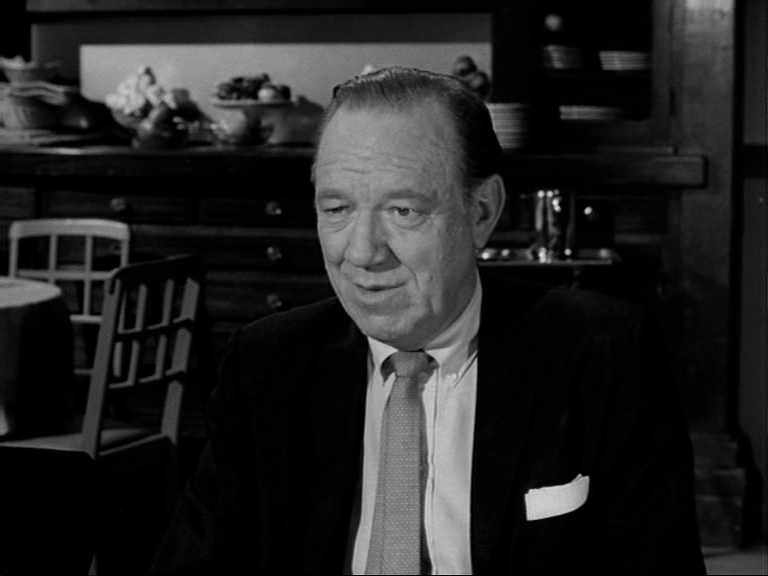
Bib Hadley, who is a bartender at Frenchy Lafont's bar in the short story, excitedly tells Susan what happened. At the end of this scene, it's clear that Will and Susan are already a couple, unlike in the story, where they don't get together till the end. In the TV show, he calls her "'honey,'" says he'll pick her up and take her to work to keep her safe, and kisses her goodbye. In the following scene, set at the police station, another new character is introduced: Frenchy's mother, who Will interrogates as he tries to find a link between the murders. The show slows to a crawl here with the only interesting aspect being Bernard Herrmann's moody score.

A night scene follows, as John Cooley buys groceries in the town, which seems deserted. Director Harvey Hart tries to create viewer interest with unusual camera placements that only serve to draw attention to themselves, such as putting the camera on the far side of John's truck and shooting through the window at the action across the sidewalk. John's repeated references to "'the Lord'" also become tiresome very quickly. He creeps around outside the library after dark and the scene continues inside the library, where camera placement becomes a major problem as Hart continually shoots through the stacks, looking at people on the other sides of shelves of books.

Susan and Flora both work at the library in the TV show, unlike the story, where Flora is a wealthy town resident. They discuss the murders in the shadowy library interior until Susan sends Flora home early; the numerous shots through the stacks are a pointless exercise in trickery that distracts from rather than enhances the content of the scene. Outside the building, the camera briefly takes Cooley's point of view as he watches Flora drive away. Susan is left alone in the library, waiting for Will to arrive and take her home, when we see a shadowy figure approach the outside door and unlock it. We are meant to think it's Cooley coming for Susan, but the show's second commercial break postpones the truth.

After the break, Susan panics when a stranger enters the library, but it turns out to be Bib Hadley, whom we had seen briefly at the ravine, telling Susan about Frenchy's murder. He exhibits bizarre behavior and there is more showy camera work with the camera looking out from behind the stacks. The lighting and Bib's unusual proclivities make him seem like he might be the killer, but since we have already seen John commit the crimes, we know he is innocent. Susan does not, however, and as Bib talks about how much he used to enjoy slaughtering animals, she runs out the door and into Will's arms. Will puts her in his car and enters the library, gun drawn, to confront Bib in an anticlimactic, unnecessary scene. The entire section with Bib is a tasteless waste of time and feels like padding.

The real danger follows, as Flora is home alone. John Cooley knocks at her door and she lets him in, ironically commenting that he and Will are the only men she would admit. John asks her if she killed his son and confesses to killing Frenchy; she faints and he puts on gloves before the camera cuts away from her murder. For the second time in "Terror at Northfield," the story suffers a significant change; in "Terror Town," Frenchy and Flora are found dead in the same spot where Tom's body was found, but in the TV show we witness their murders (or the lead up to them) at the hands of John. The only mystery in the TV show is why Cooley is killing these people. In essence, a mystery short story has been converted into a TV show where suspense is more important than whodunit.

Dennis Patrick as Frenchy Lafont
As in the story, a town meeting follows, but even here it looks like Harvey Hart thought the dull teleplay needed some help, so he puts the camera in an odd place for a few shots, as if it's showing the point of view of someone in the back of the crowd. This dull scene goes on too long and ends on what is supposed to be a high note right before the third commercial break when Frenchy's mother walks to the front of the room and announces that Frenchy killed Tom. The short story ends with no one ever knowing which of the car's drivers actually killed Tom, but in the TV show, Mrs. Lafont hands over a confession that Frenchy wrote  before he died, explaining that Tom's death was due to a drunk driving accident, after which he sold the car to Flora.

In the story, Linc thinks about the clues before visiting Cooley's house, finding the piece of broken glass and realizing what must have happened. In the TV show, Mrs. Lafont's confession leads to Will's understanding the sequence of events and he rushes off to try to save Susan's life. Meanwhile, she is at home when she gets a call from John, who tells her that he is going to be with his son. He hangs up and she fears he means to commit suicide. A bit of suspense is created by using alternating shots to show Will telephoning Susan and the phone ringing in her empty house; we suspect that she has gone to try to prevent John's rash act.

Curt Conway as Dr. Buxton
Will then drives to the Cooley farm and the ravine where the bodies were found, looking for Susan. As he drives away from the ravine, we see John peek out from behind a bush. Susan drives up and stands at the edge of the road, calling for John, who comes up from behind, grabs her, and drags her down the side of the hill. He holds a hammer over her, but before he can kill her, Will appears and stops him, telling him that Frenchy killed his son. Will and Susan embrace and he explains what happened; he confronts John, who admits that he wanted to kill all of the car's owners because he did not know which one of them killed Tom. He hands Will the piece of broken glass and the show ends with everyone climbing up and out of the ravine, symbolically exiting the pit of Hell and returning to normal life on Earth's surface.

"Terror at Northfield" is a poor adaptation of a good story, where Leigh Brackett tries to turn an intriguing mystery into a TV film focused on suspense. The weak teleplay forces director Harvey Hart to resort to showy camera placement to try to create viewer interest, but it just ends up calling attention to itself and distracting from the events on screen. Dick York is miscast as the heroic, small town sheriff, and Jacqueline Scott gives a dull performance as Susan, the heroine of the short story, who is reduced to just another woman in peril in the adaptation. The best performance among the leads comes from R.G. Armstrong as John Cooley, though even he is saddled with repetitive dialogue that finds him constantly talking about the Lord.

Gertrude Flynn as Flora Sloan
Harvey Hart (1928-1989), the show's director, was born in Canada and worked for the Canadian Broadcasting Company from 1952 to 1963 before moving to the U.S. and working in Hollywood. He directed, mostly for TV, from 1949 to 1989 and this was the first of five episodes of The Alfred Hitchcock Hour where he was behind the camera. Another was the classic episode, "Death Scene."

Dick York (1928-1992) stars as Will Pearce. York was born in Indiana and his screen career lasted from 1953 to 1984. Plagued by terrible back pain caused by an injury sustained on the set of a film, he nevertheless appeared in seven episodes of the Hitchcock show, as well as being on The Twilight Zone and Thriller. York's most famous role, however, was as Darrin Stephens on Bewitched, the popular situation comedy where he co-starred with Elizabeth Montgomery from 1964 to 1969, when he quit the show due to his back problems. Among his other episodes was "The Blessington Method."

Co-starring as Susan is Jacqueline Scott (1931-2020), whose screen career stretched from 1956 to 2009, mostly on TV. She was on The Twilight Zone once and The Outer Limits twice, but her most significant role was probably as the sister of Dr. Richard Kimble on The Fugitive, a part she played in several episodes.

R.G. Armstrong (1917-2012) plays John Cooley. He was on four episodes of the Hitchcock show, including "Final Vow," and had a long career, spanning the years from 1954-2001. He was also in many westerns. Online sources report that he grew up in a family of fundamentalists and that his mother wanted him to be a pastor, but he became an actor instead and his onscreen roles sometimes played off the tension between his upbringing and his profession. One wonders what he thought of the character of John Cooley.

In smaller roles:
  • Katherine Squire (1903-1995) as Mrs. Lafont; she was on Broadway from 1927 to 1959 and on screen from 1949 to 1989. Squire was in five episodes of the Hitchcock series, including "Man from the South," where she plays the scolding wife of Peter Lorre's character, and she was seen on Thriller and The Twilight Zone. Later in her career, she was a regular on the soap opera, The Doctors (1970-1975).
  • Peter Whitney (1916-1972) as Bib Hadley; seeming like a cross between Andy Devine and Pat Buttram, Whitney was busy in films from 1941 to 1970 and on TV from 1951 to 1972. He appeared in Fritz Lang's The Big Heat (1953) and his final role was in an episode of Night Gallery.
  • Dennis Patrick (1918-2002) as Frenchy Lafont; he was on the Hitchcock series three times, including "The Last Escape." Patrick made more than 1800 TV appearances in his career, including "Age of Peril" on Tales of Tomorrow and a recurring role on Dark Shadows.
  • Curt Conway (1913-1974) as Dr. Buxton; he was on screen from 1947 to 1974. He played Adolf Hitler on The Twilight Zone episode "He's Alive," appeared on The Alfred Hitchcock Hour episode, "Beast in View," and was in two episodes of The Outer Limits, but he is best known for his role as the judge in The Odd Couple episode, "My Strife in Court," when Felix Unger uses a blackboard to break down the word "assume."
  • Gertrude Flynn (1909-1996) as Flora Sloan; she was active on the Broadway stage from 1929 to 1952 and on screen from 1952 to 1987, including an episode of The Twilight Zone and five episodes of the Hitchcock series; one was "A Tangled Web."
Watch "Terror at Northfield" online here and judge for yourself.

Sources:

The FICTIONMAGS Index, http://www.philsp.com/homeville/FMI/0start.htm. 

Grams, Martin, and Patrik Wikstrom. The Alfred Hitchcock Presents Companion. OTR Pub., 2001. 

Grost, Mike. Ellery Queen - by Michael E. Grost, https://mikegrost.com/queen1.htm. 

IBDB, IBDB.com, https://www.ibdb.com/. 

IMDb, IMDb.com, https://www.imdb.com/. 

Nevins, Francis M. "[Editor's Note.]." Hitchcock in Prime Time, edited by Francis M. Nevins, Avon, New York, 1985, p. 293.

Queen, Ellery. "Terror Town." Hitchcock in Prime Time, pp. 264–293. 

"Terror in Northfield." The Alfred Hitchcock Hour, season 2, episode 3, CBS, 11 Oct. 1963. 

Wikipedia, Wikimedia Foundation, https://www.wikipedia.org/. 


Listen to Al Sjoerdsma discuss "The Better Bargain" here!

Unfortunately, Annie and Kathryn have suspended their podcast on Alfred Hitchcock Presents indefinitely; click here for a list of episodes they reviewed.

In two weeks: Harlan Ellison on Hitchcock? Don't miss "Memo from Purgatory," starring James Caan!

Thursday, January 12, 2023

The Hitchcock Project-Leigh Brackett Part One: Death of a Cop [8.32]

by Jack Seabrook

Leigh Brackett (1915-1978) was born and raised in Los Angeles. She began publishing short stories in 1940 and novels in 1944, and the majority of her tales were in the science fiction genre. She co-wrote several classic films, including The Big Sleep (1946), Rio Bravo (1959), El Dorado (1966), and Rio Lobo (1970), and she wrote the screenplay for The Long Goodbye (1973). She wrote a draft screenplay for The Empire Strikes Back (1980) and is credited as co-scripter. She only wrote a handful of teleplays in her lifetime and the first two were episodes of The Alfred Hitchcock Hour that aired in 1963.

*   *   *   *   *

Leigh Brackett
Her first was "Death of a Cop," which aired on CBS on Friday, May 24, 1963, as the final episode of The Alfred Hitchcock Hour's first season. The show is outstanding and improves on the novel on which it is based. According to The Alfred Hitchcock Presents Companion, that novel is Death of a Snout (1961) by Douglas Warner, and it may be read online here. Douglas Warner (1917-1967) was born in England and spent seven years before WWII writing for newspapers in the northern part of the country. From 1954 to 1959 he traveled abroad before returning to England and co-writing The Shame of a City (1960) with John Gosling, an ex-detective superintendent. The book was a non-fiction "inquiry into the vice of London" and Warner followed it up with his first novel, Death of a Snout. The book tells of the death of a snout, or police informer, and its complicated and violent aftermath. It's an enjoyable, fast-moving story about cops and crooks in London, featuring a great deal of cockney slang. It is not, however, the source for "Death of a Cop."

The teleplay by Leigh Brackett was adapted from Warner's second novel, Death of a Bogey, which was published in the U.K. in 1962. It was reprinted there in paperback and in a book club edition, but it has never been published in the U.S. and is thus little known. Warner followed this novel with Death of a Tom (1963), Death of a Dreamer (1964), Death of a Nude (1966), and Death on a Warm Wind, which was published in 1968, the year after his death.

"Bogey" is slang for "detective" or "cop," and the novel, like the TV show, is bookended with two such killings. The book is divided into four sections, the first of which is titled "Murder." Tronc, an ex-criminal, knows everything that goes on in his part of London and sometimes informs the police. He warns Matt Greaves, who has come to collect on a winning bet, that Matt's recent altercation with a member of the Lane mob could have dangerous repercussions. Sure enough, Matt goes home to find gang members waiting for him and he is badly beaten.

Victor Jory as Paul Riordan
Detective Inspector Paul Raven investigates and is frustrated at the fake alibis provided by the gang members. His son Philip is a young policeman and the two have recently reconnected after an estrangement. Philip learns from an informant of an upcoming crime by the Lane gang and unwisely decides to handle it himself. The Lane gang is in competition with the Sparrow gang and they are pressuring club owners to replace Sparrow jukeboxes with Lane jukeboxes and pay protection money. Philip confronts Boxer Lane, the gang leader, and embarrasses him; as a result, Boxer and his gang follow Philip and beat and stab the young policeman to death before dumping his body in the Thames.

In section two of the novel, "Pursuit," D.I. Raven investigates his son's murder, intimidating two witnesses until they divulge details of the events surrounding the killing. The gang members are arrested and section three, "Trial," describes the court proceedings where the guilty men are made to look innocent and Raven is made to look overzealous. To no one's surprise, the Lane mob members are acquitted.

Peter Brown as Philip Riordan
The final section of the novel is titled "Execution," and it tells of a gold bullion heist by the Sparrow gang and of the efforts by Raven and Tronc to set them against the Lane gang in a confrontation that will wipe out both criminal organizations. The Lanes steal the gold from the Sparrows and Raven rides under the truck that holds the gold, hanging on as best he can until he discovers the gang's hideout. He tells his police colleagues where the Lanes are hiding with the gold and, that night, the police stake out the location, expecting the Sparrow gang to attack in order to recover the gold. When the Sparrows don't show up, Raven takes it upon himself to draw the Lanes out, walking into their midst in the guise of an inexperienced policeman. The Lanes attack and kill him and, as he dies, he hears the gangsters trading gunfire with the police.

Death of a Bogey is a novel of contrasts. Paul Raven and Tronc represent the cops and crooks of decades before, as opposed to young Philip Raven and Boxer Lane. There are numerous snouts (informers) and it's clear that the police could not do their job without the help of witnesses willing to talk. Women are either overbearing (Paul's ex-wife/Philip's mother) or prostitutes, who live on the fringes of the gangs, both depending on them and giving them advice. The legal system is broken and fails to convict the guilty, in large part because of witness intimidation and unethical lawyers. In the end, it is only through the sacrifice of a good man that the criminals are punished; D.I. Raven believes that he has nothing more to live for after the death of his son.

Paul Hartman as Trenker
Leigh Brackett faced a challenge when she was asked to adapt this novel for a 46-minute TV show. First of all, the extensive use of cockney slang required her to revise the dialogue so viewers could understand it. Second, the book is too long and has too many events and characters to fit into the show's running time. Finally, the idea of D.I. Raven riding underneath a truck in the final section would be hard to portray on TV. In writing the teleplay, Brackett did a superb job of maintaining the themes of the novel while compressing the events and moving them to the U.S., specifically, New York City.

The show begins with parallel stakeouts: Paul and Philip Riordan (not Raven) sit in a car, watching a liquor store, while around the corner, two young hoods are watching the same store, waiting for a customer to leave. The cops and the crooks are both bored and waiting for something to happen; the first scene sets up one of the show's main themes, which involves people witnessing events. The dialogue between father and son quickly establishes their relationship as one where they have "'a lot of catching up to do'" and we learn that Paul is divorced and that a conflict with his ex-wife, who is Philip's mother, over home life and police work has driven son to reunite with father.

The customer leaves and the hoods enter the store; the cops see them and spring into action. A shootout ensues and Philip wounds one young man who has pulled a gun. Paul confirms that the wounded crook is a junkie and remarks that "'his old man used to think he'd be president someday,'" making another parallel, this time between fathers and sons. Back at the station house, Lt. Mills praises Philip for his shooting and father and son part, looking forward to a fishing trip on Saturday. Paul doesn't know it yet, but this is the last time he will see his son alive.

Richard Jaeckel as Boxer Lane
Paul then visits Trenker, who corresponds to the novel's Tronc. Trenker comments on Paul's more cheerful attitude since he reconnected with his son. We see Philip exiting a subway station at dawn; down the street is the Lane Bottling Co. and Philip sees suspicious activity in front of the building. There is a cut to a car parked out front; Boxer Lane sits in the back seat, loading a gun, which he slips under the seat in front of him as Philip approaches. A tense conversation follows and, when Philip asks Boxer to get out so he can search the car, we see other people in the neighborhood who witness the event but stand frozen with fear. Boxer's men grab Philip and push him into the back seat; he observes that all of the witnesses have scattered.

The car drives off and the arrogant crooks show no respect for the young cop who is new to the neighborhood. Once again, the theme of witnessing is reinforced as Philip is pressed to agree that he did not see anything inside the car. The car swerves suddenly and the gun and a plastic bag of heroin slide out from under the front seat. Philip tells the driver to stop the car and Boxer punches the helpless cop. The car pulls off in a remote area, where Philip is pushed out into a puddle of water and Boxer shoots and kills him.

The first section of the book, "Murder," is thus transformed into the first several scenes of "Death of a Cop": both end with the murder of Philip. Brackett introduces most of the main characters and themes, creating parallels between cops and crooks and establishing the tragic relationship between Paul and Philip. Heroin dealing replaces the novel's protection racket.

Lawrence Tierney as Herbie Lane
In the scenes that follow, Paul views his son's corpse at the morgue and his wife arrives and blames him for Philip's death. The police then go into "Pursuit," as section two of the novel is titled. They soon realize that Philip was killed in Herbie's Lane's territory--Herbie is the head of the Lane gang. Instead of having Paul do an extended search for witnesses that ends with his interrogation of a prostitute and a young man, as in the book, the cops head straight to the Lane Bottling Co., where Herbie Lane already has his lawyer by his side, just hours after the murder. Paul questions a druggist, who saw Philip being abducted but who denies everything. Again, the theme of witnessing is central to the story; after Paul leaves, a member of the Lane gang visits the druggist and intimidates him into making a harassment complaint against the detective.

Brackett's teleplay next uses a tried-and-true method to show various characters and the effect they have on Paul's psyche--a dream sequence. Simpler than the more elaborate and surreal dream sequences in films like Murder, My Sweet and Vertigo, this one uses a whirlpool special effect that is superimposed over the sleeping detective's face, as he sees one witness after another refusing to cooperate, Lane and his gang mocking him, and Philip begging him for help. Following the dream, Paul resolves to do whatever it takes to solve his son's murder. Paul and other police barge into the Lane Bottling Co., arresting Herbie and his gang members on false charges in order to bring them in for questioning. This sequence corresponds to the end of the novel's second section, where the criminals are rounded up and trial preparations begin.

Instead of having a trial, however, as in the novel, the criminals are questioned and released. Lane's lawyer, Chaney, tells Paul that he has no witnesses and thus no case, and Paul replies that "'There are never any witnesses on Blake Street, Chaney, you know that.'" Like the defense lawyer at the novel's trial, Chaney excuses Paul's rash charges by explaining that he has been under great strain since his son's death. Privately, Paul admits that the charges were a ruse and hands in his badge to Lt. Mills.

John Marley as Ed Singer
The novel's final section, "Execution," is significantly changed for TV. In the show, Boxer Lane and two other gang members wait for Paul at home, aware that he is no longer a detective, and beat him up. A bruised and battered Paul then meets with Trenker and asks him for a favor, though Trenker's role in the final scenes is greatly diminished. In the book, Tronc visits the Lane gang and convinces them to go after the stolen gold; in the TV show, Trenker arranges for Paul to have a room where he can watch (another act of witnessing) out the window as a drug dealer named Gabby Donovan delivers heroin every few days.

Gone are the novel's sequences where Paul Raven hangs on under a truck, riding along to determine the location of where the gang has hidden the gold. Instead, Paul watches Donovan until he knows his routine; he then visits the drug dealer and beats a confession out of him. Paul finds a large supply of heroin and telephones Herbie Lane, offering to trade the valuable drug for the name of the man who killed his son. Herbie quickly admits that Boxer is guilty and Paul tells him to send Boxer and another man to a meeting place the next morning to make a trade: the drugs for the killer. When Herbie hangs up the phone, the camera pulls back to reveal a smiling Boxer, who is in on his boss's plan.

The next morning, a car pulls up outside the meeting place and parks. Inside the car are Herbie, Boxer, and two other members of the Lane gang. Trenker stands in a nearby doorway, watching--this time, Paul has ensured that there will be a witness to the events that follow. In the book, Paul has the entire police force standing by to observe him being killed by the Lanes; in the TV show, the only certain witness is Trenker. Paul watches from his window as Boxer and Freddie (who drove the car when Philip was killed) enter the building and approach his room. In the hallway, Boxer screws a silencer onto his gun, making it clear that he plans to murder Paul.

Paul Genge as Tom Mills
As Boxer enters the room, Paul shoots him, then adds another shot to make sure that he's dead, just as Boxer had done to Philip. Freddie enters with his hands up and asks Paul for the heroin, showing no concern at all for Boxer. Paul tells Freddie that he gave the heroin to the cops and orders him to leave. Paul then looks out the window and exchanges nods with Trenker. The ex-detective leaves his gun on a table and walks outside, as Freddie gets back in the car and tells Herbie that Paul has double-crossed them. Paul walks down the outside steps toward the sidewalk, like a man walking down Death Row; witnesses emerge to see his final act. Herbie jumps out of the car and shoots Paul several times before the car speeds off with the crooks.

Paul lies dead on the steps as a crowd gathers and Trenker tells the beat cop that he saw the whole thing and now realizes that Paul had asked him to be present so he would be sure that there would be a witness who would talk. Trenker tells the cop that Paul "'waited a long time, but now he was going fishing. He meant the trip that he and Philip never made.'" Detective Riordan will be reunited with his son in the afterlife, but he also has had a successful fishing trip prior to his death, catching and killing the man who murdered his son and making sure that the gang boss will be caught and prosecuted for murder.

Jean Willes as Eva
Leigh Brackett's teleplay for "Death of a Cop" is outstanding, successfully condensing Douglas Warner's novel and making changes that result in a meaningful character study and an exciting story. She jettisons portions of the novel that are unnecessary to the show's central theme and she deepens the parallels inherent in the story. Instead of two rival gangs there is just one and, in the early scenes, Philip is not trying to make up for a recent mistake, he is overconfident due to a recent success. In the book, Philip is tipped off to an upcoming crime; in the show, he stumbles upon one and is kidnapped and killed with a gun rather than a knife.

The investigation that follows is streamlined and the trial is eliminated; since there is only one gang, there is no theft of gold by the Sparrows and no subsequent attack by the Lanes. In the book, Tronc seeks out Paul Raven to set up the final events, while in the TV show, Riordan seeks out Trenker to use him as a witness. The somewhat incredible scenes where Paul rides under a truck are deleted and replaced with the surveillance of the heroin dealer. In the end, Paul is killed in front of citizens, not a gathering of policemen.

Wilton Graff as George Chaney
Leigh Brackett took a good book, Death of a Bogey, and adapted it into a teleplay that resulted in a great short film, "Death of a Cop." In addition to the excellent teleplay, the show benefits from the sure hand of director Joseph Newman, who keeps the action moving quickly and who manages to juggle a large cast without ever losing sight of his characters; at no point do any of the numerous cops and crooks seem unfamiliar. The acting is also excellent, for the most part, especially Victor Jory as Paul and Peter Brown as Philip. In short, "Death of a Cop" is a terrific episode of TV noir!

The show is directed by Joseph Newman (1909-2006), who started out as an assistant director in the Golden Age of Hollywood, from 1933 to 1942, before becoming a director of short subjects from 1938 to 1947, and finally of features, starting in 1942. His most memorable film is probably This Island Earth (1955), a science fiction classic. He worked in television from 1960 to 1965 and directed ten episodes of The Alfred Hitchcock Hour, including "The Second Wife". Newman also directed four episodes of The Twilight Zone.

Victor Jory (1902-1982) stars as Paul Riordan. Born in the Yukon, Canada, he was a champion boxer and wrestler in the Coast Guard who played many roles on stage, film, radio, and TV from 1930 to 1980. He also taught acting at the University of Utah and has a star on the Hollywood Walk of Fame. Among his many film roles was one in Gone with the Wind (1939), and he starred in a TV series called Manhunt from 1959 to 1961. He appeared in an episode of Night Gallery and this was his only role on the Hitchcock TV show.

Read Morgan as Freddie Arnold
Peter Brown (1935-2016) plays Philip Riordan and is effective in his few scenes. Born Pierre Lynn de Lappe in New York City, Brown appeared on film and TV from 1957 to 2005. He co-starred in the series, Lawman (1958-1962) and was featured in several soap operas from the early 1970s to the early 1990s, including Days of Our Lives, The Young and the Restless, One Life to Live, and The Bold and the Beautiful. Brown appeared in one other episode of The Alfred Hitchcock Hour and there is a website devoted to him here.

Trenker is played by Paul Hartman (1904-1973), who started in vaudeville as a dancer and had a successful career on Broadway, in movies, and on TV. He appeared on Thriller and The Twilight Zone and his five appearances on the Hitchcock series also included "Not the Running Type."

Boxer Lane, whose arrogance borders on the psychotic, is played with smiling, gum-chewing menace by Richard Jaeckel (1926-1997), a recognizable tough guy from TV and movies who started his film career in 1943 and his TV career in 1951. He was on the Hitchcock series four times, including a key role in "Off Season." Jaeckel had regular or semi-regular roles in six TV series in his career; the most memorable was as Martin Quirk, the police captain on Spenser: For Hire.

Classic Hollywood tough guy Lawrence Tierney (1919-2002) appears as Herbie Lane, the mob boss. Born a policeman's son in Brooklyn, Tierney's career in film and on TV lasted from 1943 to 1999 and his onscreen persona was not dissimilar to his life off screen, which was marked by years of problems with alcohol and fighting. This was his only appearance on the Hitchcock show. He played a memorable part in Reservoir Dogs (1992) and a biography of him was just published, titled Lawrence Tierney, Hollywood's Real-Life Tough Guy.

In smaller roles:
  • John Marley (1907-1984) as Detective Ed Singer; he was on screen from 1942 to 1986 and appeared in three episodes of the Hitchcock series, including "The Second Verdict." He is best known for his role in The Godfather, where he wakes up in bed to find a horse's head.
  • Paul Genge (1913-1988) as Lieutenant Tom Mills; he served in the Army Air Corps in WWII and was on stage, film, and TV from the early 1930s to the mid-1970s; he appeared on The Twilight Zone and had a small role in North By Northwest.
  • Jean Willes (1923-1989) as Eva; her screen career lasted from 1942 to 1976 and included a role on The Twilight Zone and parts in two films adapted from novels by Jack Finney, 5 Against the House (1955) and Invasion of the Body Snatchers (1956)
  • Wilton Graff (1903-1969) as George Chaney, the lawyer; he was on screen from 1939 to 1964 and also appeared in two episodes of Alfred Hitchcock Presents.
  • Read Morgan (1931-2022) as Freddie Arnold, who drives the car and accompanies Boxer to Paul's room at the end; on screen from 1949 to 1994, he was also in two episodes of Alfred Hitchcock Presents, including "Hitch-Hike," as well as episodes of The Twilight Zone, The Outer Limits, and The Night Stalker.
Watch "Death of a Cop" online here.

Thanks to Phil Stephenson-Payne for his help with research on Douglas Warner.

Sources:

Crime Fiction IV - Allen J. Hubin, http://www.crimefictioniv.com/Part_43.html. 

“Death of a Bogey.” Vramonline, 21 July 2018, https://vramonline.wordpress.com/2018/07/21/death-of-a-bogey/. 

“Death of a Cop.” The Alfred Hitchcock Hour, season 8, episode 32, CBS, 24 May 1963. 

The FICTIONMAGS Index, http://www.philsp.com/homeville/FMI/0start.htm. 

Grams, Martin, and Patrik Wikstrom. The Alfred Hitchcock Presents Companion. OTR Pub., 2001. 

IBDB, IBDB.com., https://www.ibdb.com/. 

IMDb, IMDb.com, https://www.imdb.com/. 

Warner, Douglas. Death of a Bogey. Cassell & Co. Ltd., 1962. 

Warner, Douglas. Death of a Snout. Internet Archive, New York, Walker, 1962, https://archive.org/details/deathofsnout00warn. 

Wikipedia, Wikimedia Foundation, https://www.wikipedia.org/. 


Listen to Al Sjoerdsma discuss "The Better Bargain" here!

Listen to Annie and Kathryn discuss "The Three Dreams of Mr. Findlater" here!

In two weeks: Our look at episodes written by Leigh Brackett concludes with "Terror at Northfield," starring Dick York!