Showing posts with label Blazing Combat. Show all posts

Monday, May 6, 2019

The Warren Report Issue 7: July/August 1966


The Critical Guide to 
the Warren Illustrated Magazines
1964-1983
by Uncle Jack
& Cousin Peter


Gray Morrow
Eerie #4 (July 1966)

"House of Evil!" ★1/2
Story by Archie Goodwin
Art by Jerry Grandenetti and Joe Orlando

"Hatchet Man" ★★★1/2
Story by Archie Goodwin
Art by Gene Colan

"Gnawing Fear!" 
Story by Ron Parker
Art by Rocco Mastroserio

"Shrieking Man!" ★★
Story by Archie Goodwin
Art by Steve Ditko

"Undying Love!" 
Story by Archie Goodwin
Art by Norman Nodel

"Island at World's End!" ★★1/2
Story by Archie Goodwin
Art by Gray Morrow

"House of Evil!"
Lee Hargraves heads to his brother's moldy estate, answering an urgent telegram from Richard, but finds nothing but dust, cobwebs, and rot when he enters the huge house. Luckily, Richard had begun using the tape recorder Lee had sent him and, once the tape begins, Lee hears his brother's voice relate the macabre story behind the cursed house. The previous owners, the Japes, were a "barbarous clan of maniacs" who robbed and murdered until the nearby villagers tired of their shenanigans and did the full-out mob scene. The Japes were wiped out but the house survived. Richard's voice takes on a tone of panic as he admits that the Japes still hold court in this house. Just then, a rotting creature shambles through the door and Lee beats it to a pulp. At that point, the tape explains that anyone entering the house will develop rot. The creature, Richard, melts into a pool of muck and, as Lee looks at the mold developing on his hands, he knows he will meet the same fate soon.

"House of Evil!" sure feels like a story that needed to breathe; it's rushed and we only get bits of the information we need to set up a satisfactory conclusion (for instance, was there an occupant in the Japes house just before Richard took hold?). According to the GCD, Jerry Grandenetti ghosted this one for Joe Orlando (who receives credit and signed it). Truth be told, both artists are so awful by this time that either could have been responsible, but I suspect Grandenetti penciled and Orlando inked (or maybe vice versa), as it doesn't totally look like a Grandenetti job. It's a moot point, though, because the art here is truly dreadful, about as moldy and rotten as Richard himself.

There's a "Hatchet Man" terrorizing the city, slicing up women and leaving a bloody message for the cops to decipher: "Harry did it stop him before he kills more," but all Phyllis's husband Harvey can worry about is the missing button on his shirt. Phyllis scolds Harvey before he heads to work and this gets the guy thinking (as guys will do sometimes), "Why couldn't the Hatchet Man take care of Phyllis?" So, Harvey clocks into work, stops at the store to buy gloves and a hatchet, and heads home to sort things out with Phyllis. Once Phyllis is sorted into different pieces on the floor, Harvey leaves the telltale message on the wall and walks back to work. The next morning, Harvey comes home to a house full of police. Unfortunately, the detectives are liking Harvey for this and the other Hatchet Man murders. It doesn't help when they find a suitcase containing a blood-stained hatchet. As Harvey is hauled away, he tries to plead his case but then his other personality, Harry, materializes and gives away the show.

A fabulously layered script and dazzling illustrations propel "Hatchet Man" into the stratosphere of Eerie classics. Gene Colan never struck me as a "Warren artist," perhaps because of his crowning achievements at DC and Marvel (not to mention his incredible work in the pre-code Atlas bullpen). "Hatchet Man" is so cinematic you could mistake it for a set of storyboards. And that splash is a marvel. Archie outdoes himself here with twists and double-twists (when the hatchet surfaced in Harry's bedroom closet, I assumed we were going to get a groaner reveal like "Phyllis did it!") that trick the reader at every turn. Perhaps it's already a cliche and we should stop comparing the Warren work to EC, but this really does feel like a story that could have fit nicely in Shock SuspenStories!

"Gnawing Fear!"
With the aid of his assistant, Edward, Dr. Hahn has been working on and perfecting a serum that would wipe out the rodent population on Earth and make mankind safe again. One night, after a particularly grueling session in the lab, Edward is awakened by screams from the den. When he races downstairs, he finds Hahn missing, with bloodstains leading to the cellar. A huge hole in the wall leads to a series of vast tunnels under the house and Edward heads in to look for the missing professor. Over a mile in, he discovers the chewed and mutilated body of Professor Hahn, covered with rats. He empties his revolver into the vermin but the shots set off a cave-in and Edward is buried up to his neck. The commotion attracts hordes of rats, who make a quick meal of the unlucky assistant. Ron Parker's script for "Gnawing Fear!," like his first published story ("A Vested Interest" in Creepy #8), is nothing more than an EC rip-off (or homage, if you want to be polite). It's got the requisite obsessed professor, animal hatred, and ironic climax, but it's missing logic. Why are these huge caverns under Hahn's house? Surely these normal-sized rodents didn't dig tunnels large enough for a man to walk through. And is Ron Parker suggesting that these same normal-sized rodents carried the professor off to his doom? What's missing here are the equally illogical giant rats, a solution that would tie up all the loose ends. Al Feldstein would never let such a sloppy script see print.

"Shrieking Man!"
Colbert has been assisting Dr. Mandrell at the insane asylum, but the old man doesn't seem to listen to much Colbert has to say. For instance, there's that "Shrieking Man!" in the padded cell who just won't shut up. Surely, the new experimental LSH-90 drug will help ease the mind of the disturbed inmate, but Mandrell insists he's tried everything. When Mandrell takes a night off and heads down into the nearby village, Colbert takes it upon himself to experiment on the Shrieking Man and it doesn't turn out well. Unnecessarily complicated and wordy, "Shrieking Man!" is a boring dirge redeemed only by the chaotic art of Steve Ditko, who always could work wonders with bad scripting. It's revealed that Mandrell has been experimenting on corpses, resurrecting them from the other side, but motivation is not provided and the hoped-for twist in the climax never materializes. Yep, this one ends with a whimper, not a "shriek."

Count Renaldo is in love with the beautiful Esmerellda, but the comely maiden won't give the nobleman the time of day, so Renaldo does what any smitten man would do: he pays a sorcerer to enchant Esmerellda. The wizard assures Renaldo that Esmerellda will love him to the end of time and the Count rides away, happy as a clam at high water. It's only when he gets to Esmerellda's place that the bad side of black magic rears its ugly head; the beautiful girl is dead, murdered by a vampire, and now she rises from her grave to sup on local villagers. At first, the revelation shocks and sickens Renaldo but, soon, he realizes that his love will never age or wrinkle and he settles into wedded bliss with a bloodsucker. That bliss doesn't last, though, since sleeping with a woman as cold as a fish (literally) is not Renaldo's cup of tea, so he drives a stake in her heart and cuts her head off as she lies in her casket. Unfortunately, the wizard's magic works too well. "Undying Love!" is a pretty silly story with a predictable wrap-up and sluggish, by-the-numbers art by Classics Illustrated mainstay Norman Nodel (as by Donald Norman). This would be the first of five contributions to Eerie and Creepy by Nodel.

"Island at World's End!"
The Celtic, a whaling ship, rescues a man named Sturgis, set adrift for months and barely alive, who tells an amazing story of how he came to be stranded at sea. Sturgis was a victim of mutiny who managed to escape the ship he was on and make it to an uncharted "Island at World's End!" There, Sturgis is set upon by half-human creatures who take him to a volcano, ostensibly to be sacrificed to their god. Up from the depths of the volcano comes a gorgeous woman by the name of Cthylla, borne on the hand of a hideous giant, the God known as Shoggath. The goddess deems that Sturgis should be her mate and she saves him from certain death, but Sturgis can't stand idly by when the God demands sacrifices. He pulls a gun and fires at Shoggath but hits Cthylla instead, killing her. Sturgis escapes the island in a small boat, destined to be rescued by the crew of the Celtic, but he can't escape the ire of Shoggath, who rises from the sea for his revenge. "Island at World's End!" is a weird one; it's very much in the Jules Verne adventure vein with more than a dash of Lovecraft thrown in (makes you wonder why Archie didn't go whole hog and adapt an HPL story or two, but maybe the rights were cost-prohibitive). I like it, it's never boring, and Gray Morrow's art is perfect for this sort of thing. Oh, and about Gray Morrow: he's no Frazetta but I gotta say that his covers are pretty darned atmospheric. -Peter

Jack: I'll agree with you about the cover, but my dislike for Lovecraft made me yawn as I read "Island at the World's End!" I assumed it was an adaptation from HPL, what with all of the "y" and "h" names (Cthylla and Shoggath), but I guess it's just a warmed-over imitation. I thought the main character in "Undying Love!" proved himself to be a "glass half full" kind of guy when he looked at the bright side of his gal pal becoming a vampire and reasoned that at least she'll always be hot. "Shrieking Man!" has prime Ditko art and I thought the whole story was original and creative, though no classic. "Gnawing Fear!" was not bad, and the finish reminded me of "Blind Alley," but the art was only so-so. "House of Evil!" was a weak story with the usual mediocre art by Jerry G, though one three-panel sequence--the one where the camera gets closer with each panel until there's just an eye and a nose in the frame--reminded me of Grandenetti's early mentor, Will Eisner. Best in show has to be Gene Colan's "Hatchet Man"; Colan's page designs and panel layouts are like no one else's, and his shadowy work here already looks ahead to the fantastic job he'd later do in Tomb of Dracula. I did not see the end coming and found the story thoroughly enjoyable.


Frazetta
Blazing Combat #4 (July 1966)

"Conflict!"★★★
Story by Archie Goodwin
Art by Gene Colan

"How It Began!"★★
Story by Archie Goodwin
Art by George Evans

"The Edge!"★★★1/2
Story by Archie Goodwin
Art by Alex Toth

"Give and Take"★★★1/2
Story by Archie Goodwin
Art by Russ Heath

"ME-262!"★★★
Story by Archie Goodwin
Art by Wally Wood, Ralph Reese, and Dan Adkins

"The Trench!"★★★★
Story by Archie Goodwin
Art by John Severin

"Thermopylae!"★★★
Story by Archie Goodwin and Reed Crandall
Art by Reed Crandall

"Night Drop!"★★★
Story by Archie Goodwin
Art by Angelo Torres

"Conflict!"
A Black medic in Vietnam stops to aid a wounded Viet Cong soldier. A white racist named Remick asks why he bothered and complains that the Black medic is uppity. Land mines tear up the squad and the medic rescues Remick, who is completely unappreciative and who later complains that the medic nearly killed him. When asked why he risked his life to save such a man, the medic responds that it's his job and he doesn't differentiate by skin color.

Once again, Gene Colan turns in excellent work and elevates what could have been a run of the mill lesson in tolerance from Goodwin. It's interesting that Warren was confronting issues of racism in Vietnam in a 1966 comic book; "Conflict!" is a more adult treatment of war than we saw around the same time over at DC, where the war comics--even the good ones--were aimed at a younger audience.

"How it Began!"
"How it Began!" is a two-page quickie in which Goodwin and Evans explain how the first fighting planes were developed during the Great War. It's interesting stuff and Evans is at his best when drawing aircraft.

In the Korean skies in 1952, Major Lowell Tucker, pushing forty and still flying combat missions, leads a squadron of four planes into MiG Alley, where the U.S. fighters encounter Chinese jets. Thrilling battle action follows and Major Tucker's years of experience allow him to anticipate enemy movements, giving him "The Edge!" he needs to avoid being shot down, destroy the Chinese jets, and return home safely with his squadron.

It's no surprise that Alex Toth can do anything, and here he demonstrates how to make a story about high-speed jet fighting both exciting and instructive. Goodwin shows plane mechanics commenting that Tucker is "pushing forty" at the start of the story and remarking that flying jets is a young man's game; at the end of the tale, those same mechanics boast that it is Tucker's experience that helps him defeat the enemy. As a person who has been working in the same field for a quarter century, I empathize with the worry about keeping up with young folks and welcome the conclusion that experience is valuable.

Pushing forty? ("The Edge!")

During the Allied push up through Italy in the spring of 1944, American soldiers watch a farmhouse being destroyed by mortar shells and then inspect it to see what's left. One of the Italian-American soldiers finds a bottle of high quality wine intact in the cellar, but before he can get away safely, Nazi soldiers appear and there is a gun battle. The German troops are too numerous, so the Americans are forced to race for their own ditch, but the wine-loving soldier realizes he forgot his precious bottle of wine and races back to the farmhouse to retrieve it. Despite covering fire provided by his fellows, he is shot down on the way back to safety. American mortars once again provide cover, but before he heads back to the farmhouse one more time, the dead soldier's friend smashes the wine bottle on the ground, angry at the loss of life it caused.

"Give and Take"

Four stories in, and this is shaping up to be a stunning issue of Blazing Combat with one of the finest group of War Comic artists ever assembled. Russ Heath, who was a mainstay in the DC War books, provides gorgeous art in "Give and Take," using a highly realistic technique whose name I don't know. Of course, the soldier was going to get killed retrieving that bottle of wine, but the art is just so darn good that any cliches in the story can be overlooked.

"ME-262!"
Early May 1945, and the end is near for the Third Reich, with the Russians approaching Berlin from the east and the Americans closing in from the west. One slim hope remains: the "ME-262!" is a new fighter jet much faster than anything the Allies are flying. Going back as early as 1938, the German government did not put a priority on jets, insisting that bombers were more necessary to the war effort. Even in 1943, when the tide was turning against the Germans, Hitler insisted that the planes be developed as bombers rather than fighters. Finally, in 1945, there are but a few of the jets available, and they are wiped out by the superior Allied air numbers.

More great work by Wood, Reese, and Adkins marks yet another terrific tale of air war, only this time the historical aspects are more interesting than the human aspects. It's fascinating to look back at wars and see the bad decisions that seem to have made victory or defeat almost inevitable; reasonable minds surely differed at the time, but hindsight is always 20-20.

"The Trench!"
During WWI, "The Trench!" was a place where soldiers waited and waited and slowly went mad. One man grows tired of waiting and climbs out, only to be shot dead by German bullets. His friend is assigned to a night patrol to find a German listening post. A flare goes up and a sergeant is shot, but the man and another soldier survive and find the German hideout, at which point brutal hand to hand combat erupts. The other man is wounded and, despite our hero's best efforts at keeping the injured man quiet, moans of pain alert nearby German soldiers. The Allied soldier shoots and runs, barely making it back to the trench, alive but now gripping the sides of the beloved, safe gash in the earth.

Wow! The soldier may love the trench, but I have grown to love John Severin's war stories! In a tremendous issue, I vote this story the best so far. The tale is thrilling and the art matches it perfectly, demonstrating humanity, brutality, fear, and relief in black and white.

Just one of Crandall's terrific
pages from "Thermopylae!"
In 1941, as Allied soldiers fight a delaying action at "Thermopylae!," one soldier tells another the story of King Leonidas and his 300 men, who guarded the same pass against the superior army of Persian king Xerxes in Ancient Greece. Just as Leonidas and his men delayed the Persian advance long enough to buy time for the rest of Greece to prepare for invasion, so do the soldiers in WWII hold off advancing Nazis in order to allow for Athens to be evacuated.

Reed Crandall is given co-writing credit along with credit for the art, and this story is stirring and instructive, with nary a rippling abdominal muscle in sight. Crandall must have done a fair bit of research for this tale, as his depictions of the ancient forces are brilliant. I really liked how the modern battle was compared to the ancient one.

A group of American paratroopers are dropped from a plane over Nazi-occupied France and soon, the Americans who survive the initial landing are huddled in a farmhouse, surrounded by German soldiers. After some grenades are thrown, only one soldier remains alive, but when the Nazis are summoned elsewhere in a hurry the prisoner of war is quickly executed by an enemy soldier who hates his job but reasons that he is just doing his duty.

"Night Drop!" is exciting but seems to end abruptly and doesn't quite get it's message across as successfully as it might. I think Archie is trying to tell us that soldiers on both sides are capable of evil deeds in the name of duty, but he doesn't accomplish this in the short space allotted to him. On the other hand, Angelo Torres ends the issue with more superb art, capping off one of the most consistently excellent comic mags we're likely to see.-Jack


"Night Drop!"
Peter: There's no warning to dedicated Blazing Combat readers that the fourth issue would be the last. In fact, Archie ends a response to a letter from a member of the West Virginia Comic-Collectors Association (who had informed Goodwin that Creepy had won the group's Best Regularly Published Fantasy Comic Award and Blazing Combat had finished in the top five), "Hope our efforts this year will produce something to represent us in next year's awards." Jim Warren had been able to continue publishing BC for four issues despite a staggering drop in circulation, thanks to the continuing success of Famous Monsters and the initial strong numbers for Creepy. The bottom finally dropped out and Warren was forced to axe his favorite child. There's some decent stuff here, but perhaps Archie was running out of steam. "Give and Take" and "The Trench!" fit in with those ironic little ditties Harvey used to pump out for Frontline; "ME-262!" and "Thermopylae!" could pass as two of Harvey's Two-Fisted history lessons; and "Conflict!" is well-meaning but a bit forced (certainly not as forced as Big Bob's 1970s takes on Ebony and Ivory Go To War). I think the most powerful story in the final batch is "Night Drop!," even though it seems oddly incomplete thanks to a very abrupt ending. Angelo Torres's work has never looked so good. Though Blazing Combat lasted a mere four issues, its reputation grew through the subsequent decades. Warren would publish a compendium of 17 of the best BC tales in 1978, and further reprintings would occur in 1993 and 2009 (by Apple Press and Fantagraphics).


Frazetta
Creepy #10 (August 1966)

"Brain Trust!"★★
Story by Archie Goodwin
Art by Angelo Torres

"Into the Tomb!"★1/2
Story by Archie Goodwin
Art by Joe Orlando

"Monster!"★★
Story by Archie Goodwin
Art by Rocco Mastroserio

"Midnight Sail"★★
Story and Art by Johnny Craig

"Backfire!"★★1/2
Story by Archie Goodwin
Art by Gray Morrow

"Thing of Darkness!"★★1/2
Story by Archie Goodwin
Art by Gene Colan

"Collector's Edition!"★★★★
Story by Archie Goodwin
Art by Steve Ditko

"Brain Trust!"
Dr. Elliot just wants to help, so why won't Chester Holcomb let the doc enter his home? Elliot thinks back to when he first met Holcomb, at the funeral of the prior town doctor. Holcomb was unshaven yet drenched in shaving lotion. Soon, Holcomb smelled so bad that the town grocer refused to serve him. A week before the old doctor had died, Holcomb was hit by a truck and thought dead, yet he surprised everyone when he survived. Soon, a very smelly someone is stealing food all over town and Elliot rushes to the Holcomb house, determined to help Chester before a mob takes matters into its own hands. Elliot is turned away and goes back to the old medical files and diaries, where he learns the horrible truth. Returning to Chester's house, Elliot insists on switching on the light, but before he can do so Holcomb shoots himself. The light reveals what the doctor had learned from the diaries: Chester was a twin, the other twin was a giant head whose massive brain controlled both bodies, and the body that stunk had been dead and decaying for some time.

"Brain Trust!" is one of those, "there's something weirdly wrong here and I'm gonna find out what it is!" stories that horror comic writers love so well. The storytelling is rather convoluted, and it took me a little thinkin' to figure out what happened, but what really struck me was the (to me) obvious swipe of at least the last panel's imagery from a 1954 story by Jack Kirby called "The Head of the Family!" I read it when it was reprinted in Black Magic #1 by DC in 1973 and it's one of those gross images that always stuck in my head, even 46 years later. I don't think Goodwin and Torres came up with the idea all on their own. Uncle Creepy even refers to Chester as "head of the family" in his closing comments.

The shading around the eyes is classic Grandenetti, but
we can't be sure..."Into the Tomb!"
On an archaeological dig in Egypt in 1908, Professor Peters disappears! His daughter Laura and another archaeologist named Armand had gone to Cairo to fetch Laura's fiance Alan, but when they got back to the site of the dig Professor Peters was gone. Armand leads them down ancient stone steps into the long-hidden burial chamber of Pharaoh Amen-Thet, where they find Professor Peters dead and installed in a sarcophagus. Armand reveals that he is the reincarnation of the pharaoh, but when he tells his faithful servant Horuta (a shambling, bandaged mummy himself) to kill Laura and Alan, Horuta instead turns on Armand, ensuring that the reincarnated pharaoh is once again sealed "Into the Tomb!" for eternity.

Whew! This moldy bit of mummy nonsense stinks worse than Chester Holcomb did in the story before it! I guess this must really be Joe Orlando's art, since it's not obviously ghosted by Grandenetti, but the art is no treat. The story makes very little sense and I only gave it one and a half stars rather than one star because I always liked mummies.

"Monster!"
A "Monster!" emerges from his hiding place in the sewers, anxious to learn what awaits him above. He wanders through the streets of a deserted village and comes to the cemetery, where he hears a couple discussing how he murdered a man named Paul. The monster's memory is jogged and he recalls carrying Paul's corpse and being chased and attacked by villagers. One man helps him hide in the sewers and he recalls that the man had created him in a lab. That same man, a scientist, had used him to murder and dispose of Paul's body. The monster grabs the scientist and carries him to a bog, where they both sink in quicksand. The scientist's last words reveal that Paul was fatally injured in a lab accident and his brain was transferred into the monster's body, so the monster is actually Paul, the man everyone thinks he killed.

Got that? If I mixed anything up, please forgive me. The story is somewhat convoluted and it doesn't help that the pages appear to have been printed out of order! The scientist--or at least I think it's the scientist--at one point wears a hat with a buckle, like something out of the 1600s, but later seems more like Victor Frankenstein. The whole thing doesn't make much sense and the twist is pretty weak. Mastroserio's art is in the lower end of the middle of the pack of Warren artists.

"Midnight Sail"
Some young folks can't seem to get their sailboat going until a salty old sea dog happens along and is more than willing to take the helm and head out on the water. He relates a tale of when he was on the good ship Kilgore, where all but a handful of crew members had died mysteriously. Felton (the old sea dog) insisted on keeping hold of the ship's wheel and when the captain tried to take it from him, Felton killed the man by tearing out his throat with his own teeth! With just a cabin boy and a woman left alive, Felton steered the ship off the end of the Earth and was killed. Luckily, the other two jumped overboard in time to safety. It turns out that, in the present, the old sea dog steered the ship over some falls and was killed, while the young folks survived.

"Midnight Sail" is hardly Johnny Craig's best work, but it's pretty cool when the ship seems to sail off the end of the Earth. It's too bad that the story as a whole makes little sense and the time shifting back and forth from the present to the past of the story is so clumsily handled. Did the storyteller really kill everyone on the other ship? Was he a vampire or a ghoul? And what happened to the other two people on the sailboat?

"Backfire!"
In the Old West, gunfighter John Terrell rides into a town and enters a saloon, where an old man tells him that a trial is about to begin in the back room as soon as the twelfth juror arrives. There are 11 notches on Terrell's gun for the 11 men he's killed, but he reveals that he just killed the twelfth--a young plowboy--in a nearby town. A funeral coach pulls up and disgorges the final juror, who is the dead plowboy. The jury of 12 ghosts sentences Terrell to death and carries out the sentence with gunfire. Terrell again rides into town, thinking he had a nightmare, but soon learns that the sentence will be carried out a dozen times.

One of Colan's great pages from
"Thing of Darkness!"
At least "Backfire!" makes sense from start to finish, something I can't say about the two stories that came before it. Morrow's art is fairly good but not up to his usual standard. The story yields no surprises but gets an extra half star for being coherent.

A "Thing of Darkness!" frightens New York City subway worker Sid Avery one day while he's below the city inspecting the tracks. The creature turns Sid's hair white and he barely avoids being run over by a train. After spending a month in the hospital, Sid goes home, afraid of the dark and certain that light is the only thing that will keep the monster away. Unfortunately, the lights start to flicker, the monster pushes at his door, and everything goes dark in the big blackout of 1965.

Once again, Gene Colan's spooky art and dynamic page layouts take a run of the mill story and make it a page-turner, at least until the fizzle of a finish, where we have to assume that the monster got Sid. Goodwin was so pleased with himself for using the blackout as a twist ending that he forgot to show or tell us what happened to his main character.

Danforth is an obsessive collector of strange books, and Murch is the dealer in rare items who usually finds what he needs. When Murch mentions that he might have a lead on a volume called Dark Visions by the Marquis Lemode, Danforth can think of nothing else. Lemode was an artist and devil-worshiper in the 17th century who collected all of his knowledge in one book before being executed at the guillotine. All copies of his book were meant to be destroyed but a few survived, and Danforth will pay any price to get his hands on one. He takes all the money from his wife's emergency fund and is shocked to learn that Ramsey, the man whom Murch suggested might possess the rare book, has been murdered.

"Collector's Edition!"
Danforth rushes to Murch's shop and forces his way in, killing the dealer when Murch refuses to part with the book. Danforth races home to peruse his new treasure and is in for a surprise--the pages show recent events, such as Murch killing Ramsey, Danforth killing Murch and, a few moments hence, Mrs. Danforth cleaving her husband's skull with an axe. Sometimes the collecting bug is unhealthy!

A tepid issue of Creepy ends with classic work by Goodwin and Ditko. The story is gripping, especially to those of us who tend to collect rare items, and Ditko's art is at its best. Not only does he propel the story along, but he also adds little horizontal panels (reproduced below) with closeups of eyes, and I think they're meant to show the deteriorating mental status of Danforth. Bravo!-Jack


Peter: I think this must have been the very first issue I picked up on the newsstands (or rather my dad picked it up, since I would have been about five), and I have several fond memories, but nostalgia can be a double-edged sword when you look at something fifty years later. "Brain Trust!," for instance, has an expository so detailed and complicated that I'm still trying to wrap my head around all the "nuances." So, Chester was a walking corpse who smelled funny but, otherwise, showed no signs of decay until the second he pulled that trigger? And there must have been a disconnect between Archie and Angelo, since Archie's prose clearly pronounces Doc Elliot a "young man" on page one. "Into the Tomb!" and  "Monster! are equally unimpressive. "Tomb" suffers from a banal plot and awful Orlando art, while "Monster" is insufferably confusing (and not only because its pages were published out of order). I'm going to start sounding like a parrot but Johnny Craig's "Midnight Sail" confounded me, since there doesn't seem to be any transition from flashback to present during Felton's monologue. As with past Craig contributions to Warren, I find no fault with his penciling. The Creepy Fan Page serves up an early illo by future Warren contributor, Frank Brunner.


"Backfire!" is an okay "weird western," and "Thing of Darkness!" has fabulous Gene Colan art (and thank goodness for that, because Archie's script is thread-bare), but Creepy #10 really only offers up one masterpiece this issue and that's "Collector's Edition!" I've probably read Archie's story of an obsessed occult book collector dozens of times over the last half-century and it never gets old. Goodwin is in full-on Lovecraft mode here (a speed I wish he'd have shifted into more regularly at Warren), crafting two very oily and cutthroat bibliophiles and a whopper of a climax. All through the story, we're treated to Ditko's prescient bottom-page panels, and we wonder what's up with this guy. A little too much brandy? Up late reading his forbidden tomes? When Steve delivers that reveal, the reader can't fail to smile and whisper: "Got me!"


Next Issue...
Our picks for
Best DC War Stories of 1974

From Creepy 10

Monday, April 8, 2019

The Warren Report Issue 5: March/April 1966


The Critical Guide to 
the Warren Illustrated Magazines
1964-1983
by Uncle Jack
& Cousin Peter


Frazetta
Eerie #2 (March 1966)

"Footsteps of Frankenstein!"★★★
Story by Archie Goodwin
Art by Reed Crandall

"One for De-Money"★★1/2
Story by E. Nelson Bridwell
Art by Angelo Torres

"Eye of the Beholder!"★★
Story by Archie Goodwin
Art by Johnny Craig (as Jay Taycee)

"Flame Fiend!"★★
Story by Otto Binder
Art by Gray Morrow

"To Pay the Piper!"★1/2
Story by Larry Ivie
Art by Gene Colan

"Vision of Evil"★★★
Story by Archie Goodwin
Art by Alex Toth

"Ahead of the Game!"
Story by Archie Goodwin
Art by Jerry Grandenetti and Bill Draut


"Footsteps of Frankenstein!"
Dr. Byron King has second thoughts about his trip to the town of Low Kilburn in the north of England after the locals react poorly to his questions about where to find Dr. Amos Sebastian. After he is beaten unconscious in the street, he awakens in the doctor's lab and finds that Sebastian has created a huge, lumbering monster that lacks a high quality brain. Amos begs Byron to transplant Amos's brain from his aging body into that of his creation and, after some studying, Byron succeeds in doing just that. Nosy villagers see lights at the doctor's castle and head up there, with intent to destroy the new creation, but Dr. Sebastian, now in a large and powerful body, pushes Dr. King and the angry villagers aside and strides out into a thunderstorm, where a lighting bolt finds his electrodes and vaporizes him.

I have to admit I enjoyed this story right up to the disappointing ending, mainly because of Reed Crandall's art, which illustrates the parade of cliches perfectly. The creature (don't call it a monster!) looks just like Karloff in Frankenstein, but the idea of transplanting the doctor's brain into the creature's head made me think more of Gene Wilder and Peter Boyle in Young Frankenstein. It may not be a classic story, but it's fun!

"One for De-Money"
Vernon is a young dandy who never has any dough. When he visits his Uncle Cornelius and asks for a handout, the old man tells him he can stay for free but he's not getting one red cent. Vernon witnesses his uncle summon a demon in the basement; the demon must give Cornelius money and can't step outside the pentagram where he stands. Vernon murders his uncle and summons up the demon but neglects to notice that he accidentally rubbed off some of the pentagram's chalk outline, allowing the demon to step outside it and kill the greedy young man.

"One for De-Money" has (here we go again) gorgeous art by Angelo Torres and a weak, poorly-executed script by DC stalwart E. Nelson Bridwell. Speaking of DC, the demon looks like one of the Demons Three trio drawn by Mike Sekowsky for early Justice League of America stories.

The horror of dark socks, dark shorts, and dark shoes
is revealed in "Eye of the Beholder!"
Gerald's beautiful wife is dead, and he can't stand it! Seeking magical help, he finds an old man and gives him a lot of money to bring Eve back, "beautiful and alive as I remember her." Gerald goes home and finds Eve there, but soon bad things start to happen: the family dog dies of fright and the flower delivery man runs screaming out the door. Only when Gerald embraces Eve before a mirror does he discover the horrible truth: everyone but he can see that she is a rotting corpse!

I was so excited for the return of Johnny Craig to our reading list, and "Eye of the Beholder!" certainly looks like his work, both as we recall it from the EC Comics and as we saw it change in the EC Picto-Fiction series. There are some weak sections, sure, but overall it's good to have the old boy back. The end prefigures the horrific scene in The Shining where the beautiful woman in the bathtub turns out to be a rotting old hag. Not a great story, but good to see Craig back at the drawing board.

"Flame Fiend!"
After John Murdock kills his business partner, Henry Todd, by planting an explosive device in his car, Henry's image appears as a "Flame Fiend!" rising out of John's fireplace and warning John that he will die in flames. Murdock vows to avoid fire of any type, and this leads to one awkward moment after another, as he keeps away from cigars, birthday cakes, and the like. Out hunting on a cold winter's day, Murdock encounters an out of control campfire and jumps in a freezing brook to avoid the flames. He comes down with pneumonia and thinks he's beaten the curse, until Henry's flaming, spectral image tells John that he's "burning up" with fever!

Otto Binder runs a bad idea into the ground with this story, and it gets laughable as John freaks out every time he sees a little flame. Gray Morrow's art, as always, is impressive, especially in his use of blacks and shadows, but he deserves better material.

"To Pay the Piper!"
In 17th-century Germany, the village of Meingott has a vampire problem. A stranger named Sandor offers to get rid of the foul fiends for 1000 gold marks and does so by playing his flute that night, luring the vampires out into the open where they all (I think) die when the sun comes up. The town burgermeister stiffs the piper of the 1000 marks, so the piper, like his namesake in Hamelin, pipes another tune and all the town's children follow him outside the village. The burgermeister set a trap and the piper is killed by three arrows to the chest. The children return, but that night they all turn into werewolves, since the field outside of town was full of wolfbane and they got scratched by it and ... you get the picture.

Our first exposure to the great Gene (or Eugene, as the credit reads) Colan at Warren is, sadly, on a rather idiotic story called "To Pay the Piper!" by Larry Ivie. Acknowledging that you're copying the classic tale of the Pied Piper in your story doesn't excuse it, and how many times in the few issues of Warren horror comics we've read so far have we seen the old switcheroo of one monster menace to another? Too many for my liking. At this point, Colan was also drawing romance comics for DC and superhero comics for Marvel--a true pro.

"Vision of Evil"
Art collector Simon Norton is so entranced by a ghoulish painting by obscure artist Conrad Archer that he tracks the painter down at his residence, which happens to be the Kingsford Asylum for the Insane! Norton finds Archer sitting in a trance in front of his latest painting, which depicts the artist in the clutches of a demon. Dr. Young then shows Norton Archer's other painting, a mural on the rec room wall depicting a "Vision of Evil" in which ghouls and ghosts attack poor souls. They hear Archer scream and rush to his cellar studio, only to find Archer gone, a burning smell, a finished painting, and red "paint" dripping on the floor. Norton goes back to the rec room to study the mural, but now he notices figures of himself and Dr. Young painted in the claws of a demon! There is a loud booming on the door ...

Okay, I'll admit it doesn't make a lot of sense, and we've seen similar stories before, but I am in such an Alex Toth phase that just about anything he does appeals to me. It's funny how one can get hooked on an artist, especially one with such an individual style. I used to think his work was juvenile but now I really like it.

Big game hunter Harry Black kills an albino gorilla and cuts off its head as a trophy, ignoring warnings from a native about the animal's sacred status. On the ship heading back to the states, mayhem ensures in the luggage room where Harry's trophy is kept, and his wife insists on flying home. Harry gets home and displays the gorilla's head on his trophy wall, but soon trouble follows as the groundskeeper is killed. Harry's wife flees the scene and Harry sits alone, rifle on lap, until he sees the gorilla's headless corpse coming toward him. His wife returns with the cops; they hear shots from inside and enter to find Harry decapitated and his head now in place of the gorilla's on the trophy wall.

The guy in the middle is pure Grandenetti
("Ahead of the Game!")
"Ahead of the Game!" is the pits! I won't bother commenting on the terrible, incomprehensible story. Rather, I have to ask why Jerry Grandenetti and Bill Draut are ghosting for Joe Orlando. Does this mean some of the bad Orlando art we've been complaining about was not his work at all? And how about the good Orlando art in the late '60s (Cain, I'm looking at you!)--was it not Orlando's work either? My world is rocked! Grandenetti's worst instincts are tamped down by Draut's inks, but I can still see signs of the artist we loved to make fun of on our DC War Comics blog shining through here and there.-Jack

Peter- The first official issue of Eerie is jam-packed with mediocre material. From the big-game hunter who ends up with his head mounted on a wall to the village that gets rid of its vampire plague only to be infested with werewolves (notice how the two monsters seem to mingle in stories so frequently?) to the Universal Monsters reboot with little or no feeling. On and on and on. Again, the major asset to the Warren books, so far, is the insanely good artwork. Well, yes, I know we also get Grandenetti and Draut but I'm trying to be a bit positive. I love Craig's shift from one medium to another halfway through "Eye of the Beholder!" (a rare non-Johnny written story) and Crandall's detailed penciling elevates "Footsteps of Frankenstein!" to at least "readable" status.


Frazetta
Blazing Combat #3 (April 1966)

"Special Forces!" 
Story by Archie Goodwin
Art by Jerry Grandenetti and Joe Orlando

"Foragers" 
Story by Archie Goodwin
Art by Reed Crandall

"U-Boat" ★1/2
Story by Archie Goodwin
Art by Gene Colan

"Survival!" ★1/2
Story by Alex Toth and Archie Goodwin
Art by Alex Toth

"The Battle of Britain!" 
Story by Wally Wood
Art by Dan Adkins and Wally Wood

"Water Hole!" ★1/2
Story by Archie Goodwin
Art by Gray Morrow

"Souvenirs!" ★1/2
Story by Archie Goodwin
Art by John Severin

"Foragers"
Captain Curtis Bradford leads his "Special Forces!" team through the jungles of Viet Nam on a suicide mission. Their job is to provide themselves as bait for ambush, pulling the Viet Cong out of hiding. Bradford does his job well and the men plow through a multitude of enemy soldiers, "all in a day's work." "Special Forces!" is another disappointing Blazing Combat story; I almost feel guilty saying that, given this title's place upon a mantle of greatness. But there it is, just another story about grunts doing grunt work, sacrificing themselves and their bodies for the men who sit in offices a world away.  War s Hell. I get it. Joe Orlando continues to be the weakest link in the Warren bullpen, laying down sub-par doodles and panels almost too muddy to wade through. But Joe will be around for a while so I better get used to him.

"U-Boat"
During the Civil War, one of General Sherman's tactics was to send out "Foragers" to harass civilians, burn their homes, and loot their belongings. This would, he believed, lead to disenchantment and, eventually, utter surrender. Our protagonists, a band of "Foragers," are picking Georgian households clean of food and then leaving the families homeless and having a real good time doing it. When the soldiers come across an old man who won't give up his shack, they fire on him and the gunfire is returned, killing all but two of the Union soldiers. When the old man runs out of ammo, a corporal is about to execute him when he's shot by one of his own soldiers. "Foragers" has a powerful climax and some gorgeous Reed Crandall work. Jack often says the best stories send him off to do more research and that's exactly what this one did for me. In fact, you can read a very good summary of role the foragers (or "bummers") played in the Civil War here.

A transport ship is torpedoed and sunk with only two sailors, Dawes and Ramsey, left alive. The "U-Boat" that sunk her takes the two mariners aboard as POWs and then has to dive quickly as a destroyer looms on the horizon. Dawes becomes enamored of the efficiency the German captain displays, but Ramsey's only thought is that he must warn the destroyer above them before the U-Boat has a chance to add another notch to its periscope. When Ramsey explains his plan to make noise, Dawes warns the U-Boat commander and a struggle ensues. The racket warns the destroyer above, which launches its depth charges and destroys the German killer. Thought its plot twist owes quite a debt to The Bridge Over the River Kwai, "U-Boat" is masterful in both script and art departments. Colan is at the top of his game here (and about a half year away from his classic stint on Marvel's Daredevil), and the black and white only enhances his talents. Archie's script reads like a one-hour noir film that happens to be set aboard a submarine.

"Survival!"
"Survival!" is a change of pace for this title, a post-apocalyptic tale about a scavenger who fights off mad packs of dogs and hunts for tinned food in the wastelands of a burned-out city. As far as he's concerned, he's the last man on Earth, until he comes across a raft on the beach and several sets of footprints. His excitement turns to rage when he comes across one of the new immigrants digging up one of his caches of food and he beats the man's skull in. Now driven to find the rest of the newbies and kill them before they can steal more of his hard-earned grub, the man inherits an assault weapon from his victim and heads out into the night. It's not long before he finds them and, yep, they're eating his vittles, so he mows them down. A single survivor crawls from the wreckage and the scavenger strangles him to death. Only upon inspection does he discover his latest victim was a woman. He screams in the night. That final panel is a bit of a head-scratcher. Is our violent lead character upset because he just saw a more exciting Friday night go down the tubes or was he thinking "there goes repopulating the Earth?" Like Colan, Alex Toth's work is much more powerful when delivered sans color, possibly because so many of Toth's scenes are built around the blackness. Archie stretches the parameters of blazing combat, but that's okay as long as he can pump out strong stories such as this. Life after the apocalypse will be a favorite subject of future Warren writers (DC and Marvel will try their hands as well and, for the most part, fail miserably).

"The Battle of Britain!"
The Jerrys are fast eliminating the R.A.F. It's up to a handful of brave men to stanch the bleeding and save England from the clutches of Der Führer. "The Battle of Britain!" is gorgeously rendered by Wally Wood's ward, Dan Adkins (despite the Wally Wood sole credit on the splash page, Adkins claimed it was 90% his work), who had just as sharp an eye for aerial battles as Wood himself. The script is one part Encyclopedia Britannica and a heaping helping of late night Hollywood reruns (something with Van Johnson or Rod Taylor, I would think), nothing particularly original. "Water Hole!" concerns a cavalry troop attacked by Apaches in the desert. The water hole becomes a last stand for both sides. A clever twist and some decent Morrow art. Finally, in "Souvenirs!," American G.I. Holloway finds a fortune in the mouths of the dead Japanese soldiers lying stacked like cords of wood all around him. His CO orders him to halt his ghoulish practice but Holloway's greed finds him slithering back to the carnage after his comrades have bedded down that night. Bad idea. About as close to EC as BC is gonna get, "Souvenirs" is a bit slow, but Severin's art keeps us interested until we get to the startling reveal. -Peter

"Souvenirs!"
Jack-I know I've said this before, but when you  have such a great lineup of artists, why lead off with a story drawn by Joe Orlando--or in this case, Jerry Grandenetti? I recognized Joe's work right away from the way he draws the shading over soldiers' eyes from the bill of their caps as if they're wearing domino masks. "Special Forces!" is unusually dull for a Vietnam War story. Things perk right up with "Foragers," in which the unexpected ending elevates the whole story and Reed Crandall's work sparkles. Gene Colan conveys a real sense of excitement and danger in "U-Boat" and I love his use of unusual panel shapes and layouts. In contrast to the story before it, empathy with the enemy's professionalism leads to disaster.

"Survival" seems like a sped-up version of A Canticle for Leibowitz, but the end is disappointing. There's too much "I say" and "old chap" in "The Battle of Britain!" and the story ends up being more historically interesting than engaging. "Water Hole!" starts well and features gorgeous art but fizzles at the finale and seems anticlimactic. Finally, in "Souvenirs!," John Severin again shows how he can say so much with just the look on a character's face. I wonder if his scripts were less verbose than others in order to leave room for his silent panels.


Morrow
Creepy #8 (April 1966)

"The Coffin of Dracula!" 
Part I  
Story by Archie Goodwin
Art by Reed Crandall

"Death Plane" 1/2
Story by Larry Ivie
Art by George Evans
(see Eerie #1 for review)

"The Mountain" 1/2
Story and Art by Johnny Craig (as Jay Taycee)

"The Invitation" 
Story by Larry Engleheart, Russ Jones, & Maurice Whitman
Art by Manny Stallman
(see Eerie #1 for review)

"Adam Link's Mate!" 
Story by Otto Binder
Art by Joe Orlando

"A Vested Interest" 
Story by Ron Parker
Art by George Tuska, Don Heck, Frank Giacoia, & Mike Esposito

"Fitting Punishment" ★1/2
Story by Archie Goodwin
Art by Gene Colan

"The Coffin of Dracula!"
Lord Adrian Varney has inherited a warehouse full of junk from his recently-deceased uncle, but one piece catches the young Lord's eye: a casket with the Dracula crest. He and one of his workers crack "The Coffin of Dracula!" open and Varney can't help himself as he tries the box on for size. An immediate change comes over Varney, one that proves fatal for his assistant. Meanwhile, across London at Varney's mansion, several guests are partying and awaiting Varney's arrival. These guests include Jonathan Harker and his bride, Mina, recently returned from a vampire-staking exercise in Transylvania. At last, Varney arrives and is immediately taken with Mina's beauty, asking her to dance. She becomes nervous and asks to cut their dance short but the lights go out and the pair disappear from sight. Jonathan catches a glimpse of Varney, carrying Mina, as he escapes down the back steps. Varney assaults Parker and flees in a coach with the unconscious Mina. Knowing he has nowhere else to turn, Harker hoofs it to the asylum where Dr. John Seward works. Not coincidentally, Dr. Van Helsing is also at the asylum and informs Seward and Harker that a vampire has been spotted in "the seacoast village of Whitby" and that the three of them must destroy the bloodsucker if Mina is to live. Van Helsing believes that Dracula's spirit has possessed Lord Varney and is luring him to Whitby for a bite from the vampire.

"The Mountain"
For some strange reason, "The Coffin of Dracula!" was chopped into two pieces (the second part will be unveiled in #9), despite the fact that "a bonus-length chiller" is advertised right on the cover. Even weirder is the fact that the story's length is listed as sixteen pages on the contents page (omitting "Death Plane" in the process), rather than the presented ten. Enough of my trivia, you say, does the story work as a sequel to Stoker's original novel? Yes and no. It's a fast-moving and exciting little vampire story (actually lacking a true vampire until the final page) but it feels way too compressed, as if we're missing out on a few pages (in addition to the six we won't get until next issue) and some necessary expository. We get a flashback of Dracula's demise, a page we probably didn't need, and some annoying head-scratchers (if Varney is not really a vampire until he's bitten, why does he have fangs when he attacks his assistant?) but, overall, "The Coffin of Dracula!" is enjoyable.

"The Mountain"
"Death Plane" and "The Invitation" were reviewed in our last issue as part of the contents of the Eerie #1 ashcan edition. I'll just repeat that the versions printed here are immeasurably cleaner and less murky than those that ran in the ashcan issue. In fact, I've rated "The Invitation" slightly higher here because of the nicer art reproduction). One of our favorite EC writer/artists returns to horror in the same capacity with "The Mountain." A gorgeous woman trudges up a snow-covered mountain, chased by a torch-bearing mob for sins undisclosed to us. She's a "brazen hussy" and they're "narrow-minded" and "sanctimonious," and that's all we know. At the top of the mountain, she collapses on the porch of a secluded cabin and awakens hours later in front of a blazing fire. A man introduces himself to her as Luke (hmmmm ...), and explains that he stays in the desolate cabin to research the black arts. The babe says the dark arts may come in handy against her enemies in the town below; Luke tells her to bring him the mayor and everything will work out exactly as she wants. At gunpoint, the mayor is forced to slog through the snow and enter the cabin, where Luke touches the man's forehead. A blank look comes over the mayor's forehead and our lass, pleased with what she sees, cries out her intention to take over the politician's mansion. A change comes over Luke, telling the woman she's a fool for setting her sights so low. He grows horns and a tail, revealing his true identity, and explains that he needed a body to possess to walk the Earth. Our gal with a 'tude is lifted and hurled into the fireplace, a gateway to ... (surprise, surprise, surprise) Hell!

Well, "The Mountain" certainly began on an intriguing note. Just who is this woman and why are the townspeople intent on killing her? We never find out, but that's not my major complaint with the story. In fact, I think the secrecy adds to the intrigue. No, the fault is in the pat climax, a supreme cop-out. Why is the devil wasting his time with a no-place town and why does he need this woman to draw the mayor up the hill? Did it have to be the mayor? Again, this is Satan, who can open fireplaces and raise Hell. Why such small stakes? Any problems I have with Johnny Craig's writing do not extend to his penciling, which is just as exquisite as it was when we last encountered Craig in the final issues of the EC Illustrated zines. So what was Craig up to between the years of EC's collapse and his startling resurrection at Warren? Craig did a couple of stories for Atlas in the late 1950s (Battle and Wyatt Earp), then hoofed it to an ad agency, before returning to the comics field, working briefly for ACG (Unknown Worlds and Adventures Into the Unknown) before Archie recruited him for Creepy and Eerie. I've seen all six stories he did for Atlas and ACG and none of them come across as stylish or innovative, two adjectives that adhere to Craig's work for EC and Warren. Flotsam like "Treasure of Bad Luck Point" (under Craig's pseudonym of Jay Taycee and found in Unknown Worlds #47) is barely recognizable as Craig's work; rushed and lacking any imagination.

"Adam Link's Mate!"
Fully intent on committing robotic suicide (by letting his battery run down), Adam Link wants nothing to do with mankind after his romance with human Kay Temple went chest plates up. His solace is interrupted by the entrance of Professor Hillory (who happens to own a cabin nearby), a scientist who convinces Adam that all he needs is a companion to fulfill his robotic existence. The two get to work on crafting a female robot and Kay Temple arrives to invest the automaton with female traits (you know, like enjoying flowers, charging clothes on a Macy's card, cleaning the kitchen, etc.). The transformation from a bucket of bolts to gorgeous, gleaming, stainless steel chick is complete, and Adam and his new bride, Eve, enjoy a life of wedded bliss, until Hillory returns and unveils his true motive: he wants to compel Adam and Eve to do his evil bidding by placing mind-controlling skull caps atop their heads, leaving them helpless to defy his orders. Under Hillory's spell, Eve begins a dastardly campaign of evil, robbing the local banks and completely ignoring the household chores. Only a chance visit by Kay Temple can break the spell Hillory has over the metallic pair; Kay knocks the antennaed hat off Hillory's head and Adam can think on his own again. Unfortunately, Hillory regains control over Eve and forces her to shove Adam over a cliff to the rocks below. Is this the end of Adam Link? We can only hope so!

"A Vested Interest"
Alas, being the Monday Morning Quarterback I am, I know this wretched series is far from over. "Adam Link's Mate!" could very well be the dumbest chapter yet, filled with dopey cliches and some really awful art. I love that the first female trait Kay imparts upon Eve is"flowers freshen up a home" (and you thought I was being sarcastic!) and that Professor Hillory might just as well have shown up with a Snidely Whiplash mustache; there's absolutely no doubt that from the first we know this guy will be up to no good. The final page deals with the "exciting" hand-to-hand battle between Eve and Adam and all I could think was "just knock the damn hat off her head, you tin dimwit!" Whenever these big brain deviates get it in their minds to use their smarts to rob banks, I wonder why it is they never set their sights higher. Binder doesn't bother explaining what the nutty professor intends to do with all the wealth. I almost want to say I'm looking forward to reading the next chapter to see if it's even worse.

Huh?
("Fitting Punishment")
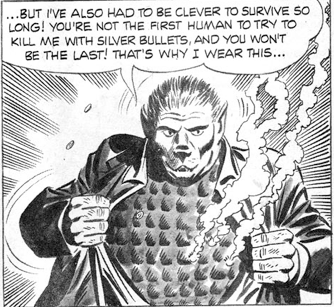
A drunk sees a werewolf attacking a man in a dark alley but the cops won't take the word of a booze-hound, but a chance meeting with a stranger convinces the bum to return to the scene of the crime with a camera for proof. This guy's no dummy, so he tricks out his camera with a gun that shoots silver bullets (no, really!) and heads for the alley. Turns out (surprise, surprise, surprise!), once they're alone, his new buddy reveals himself to be the lycanthrope. Our hero shoots the monster, but nothing happens. The werewolf strips down, revealing a bullet-proof vest (no, really!). Oh boy. Marvel mainstay George Tuska (mercifully, his only Warren appearance) contributed some decent work to the Atlas horror titles I'm currently dissecting, but his art here clearly shows he was already past his prime and pumping out the dreary stuff he'd become "famous" for at Marvel in the early 1970s. Ron Parker's debut for Warren is, hopefully, the worst of the seven stories he wrote for the company; it's silly and predictable. We'll see a variation on the werewolf vest twist in a mid-70s issue of Creepy but you'll have to wait a while before we get to it. Just as dumb is the finale, "Fitting Punishment," about Max Troy, a grave robber who gets caught red-handed and, to make his escape, exchanges suits with the corpse he's just robbed. For some reason (don't ask me why and I'm not sure Archie would have been able to tell you), the suit shrinks on Max and cuts him "to ribbons," leaving only a huge bloodstain oozing over the well-cared for cemetery lawn." The WTF? climax really ruins whatever suspense was built up, but at least we have some very nice art from "Gentleman" Gene to waste our time with.

The inaugural "Creepy Fan Club" page offers up a detailed bio of artist Gray Morrow and our first look at fan art. Send that money in, boys and girls, and you too can contribute! -Peter

Jack-Despite a stunning cover by Gray Morrow, this is a poor issue of Creepy. "The Coffin of Dracula!" is oddly dull for a Reed Crandall story about the reincarnation of the vampire; ten pages is too long and there's more to come! The two reprints from Eerie #1 don't improve much in my eyes and the Evans entry seems unfinished. Of course, I'm happy to see a story by Johnny Craig but, as you note, the ending is a stinker. Then we have the last three stories, each of which rated one or one and a half stars in my notebook. Enough of Adam Link already! As if Orlando isn't bad enough, we then get saddled with George Tuska--it seems like the stable of top artists is getting less selective. The Colan story is wonderful to look at but I agree that the last page is incomprehensible.

Next Week...
Big Bob gets deep again,
but does it work?

In Two Weeks...
Oh, yeah, you
remember
this one!