Oscar Millard's second and last teleplay for The Alfred Hitchcock Hour was "One of the Family," based on the short story of the same name by James Yaffe that was first published in the May 1956 issue of Ellery Queen's Mystery Magazine. The TV version aired on NBC on Monday, February 8, 1965.
As the story opens, Joan Porter is worried about finding a new nurse to care for her three month old son, Bruce. The Porters live in New Rochelle, an affluent suburb of New York City. Her husband Harry announces that Freida, who nursed him until he was six years old, contacted him to say that she was available. Frieda arrives, a no-nonsense German woman in her early sixties, and fits in right away, caring for Bruce but not shutting out Joan; it's like she's one of the family and Joan wonders if it's too good to be true.
 |
| "One of the Family" was first published here |
Joan's mother cautions her and Joan is relieved that Freida is not like a nurse in San Francisco, who a news report says murdered the baby in her care and then disappeared. Joan thinks nothing of it when Bruce has stomach pains that last a few days; Dr. Flowers assures her that it's nothing to worry about. Joan reads another news report about the San Francisco nurse and remarks that her description fits that of Freida. Harry scoffs but the idea sticks in Joan's head and she casually asks Freida where she last worked; the nurse claims that she worked for the Munster family in Bakersfield, California.
A further news report says that the San Francisco nurse bought a train ticket to New York and would have arrived around the time that Freida appeared. Joan decides to telegram her brother in Los Angeles to ask him to look up the Munsters and find a picture of their nurse, whom the newspapers have nicknamed Nurse Butcher. In Bruce's room, Joan finds a suspicious bottle containing a thick, brownish liquid, which Freida claims is medicine for the baby. Joan's brother sends a telegram to report that there is no Munster family in Bakersfield.
When Bruce develops more stomach pains, Joan begins to spend every moment at his side, afraid to leave him alone with Freida. The women's relationship grows more tense. Joan receives a newspaper clipping from her brother with a picture of Nurse Butcher and is shocked to see that it is a picture of Freida. She rushes to the nursery and finds Freida about to give the baby a spoonful of her medicine. Joan knocks it away, accuses the nurse of murder, and passes out.
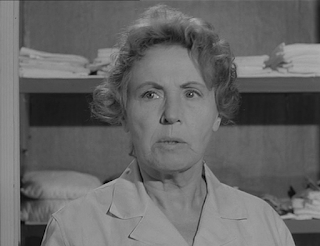 |
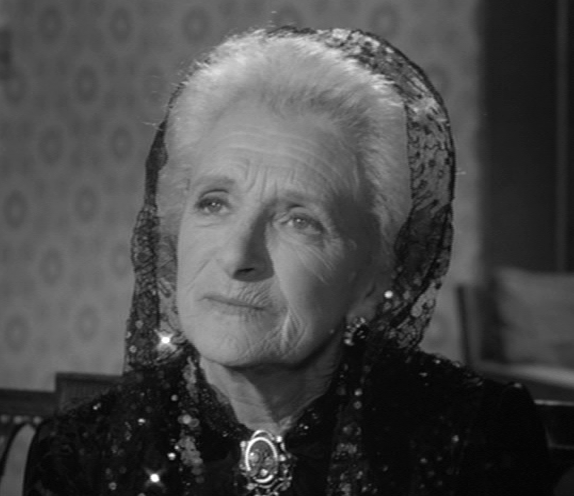
| Lilia Skala as Freida |
She awakens to find Harry with her. He explains that, while Freida was the nurse in San Francisco, she did not kill the baby--he was killed by an "'old-maid aunt'" who confessed to the crime. Joan apologizes to Freida, who tells her that she is giving up nursing and moving out.
"One of the Family" is an entertaining story that has echoes of
"Our Cook's a Treasure" by Dorothy L. Sayers, a 1933 short story that was adapted for
Alfred Hitchcock Presents in 1955. In that story, a man reads a news article about a cook poisoning people and, when he develops stomach pains, he begins to suspect his own cook, who turns out to be blameless. Yaffe's story has several similarities to the story by Sayers but ends on a more positive note.
When Oscar Millard adapted the story for television, he followed the basic structure but added many small details that enrich the narrative and increase suspense. Most importantly, he altered the ending to make it more dramatic and, in doing so, deepened the story's focus.
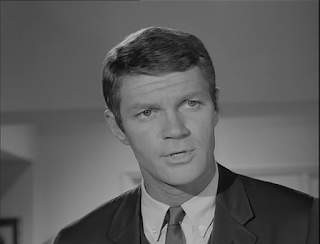 |
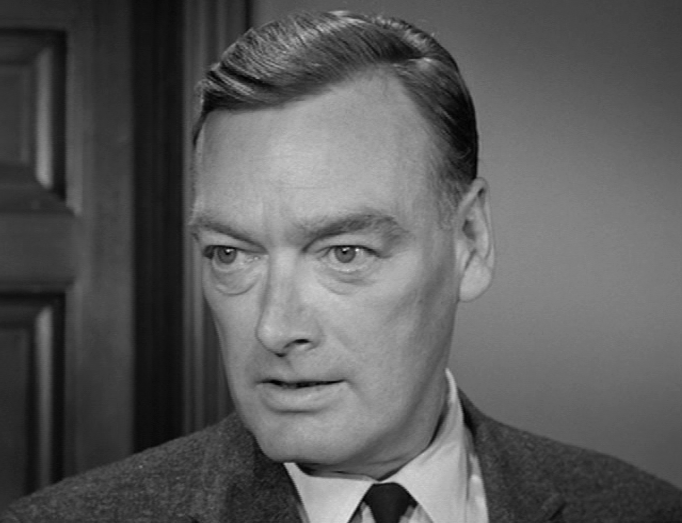
| Jeremy Slate as Dexter |
The show opens with a taxi dropping Freida off in front of the house of Dexter and Joyce Dailey, as the Porters have been renamed. She rings the doorbell and is welcomed by Joyce, who remarks that Dexter went to pick her up at the bus depot but they must have missed each other. This small detail seems innocuous at the time but is really the first of a series of unexplained events that begin to create suspicion. The Daileys live in an expensive home in Los Angeles, not the New Rochelle of the story. Freida is clearly German, with an accent and a braid in her hair. When Joyce shows her to her bedroom, which has its own TV set, Freida comments that she doesn't watch much TV anymore, since "'they took off my program...wrestling.'" At the time, this remark seems unexpected and humorous, but as Joyce later begins to suspect Freida of having a violent nature, it seems ominous.
Freida proudly tells Joyce that, when Dexter was a boy, he called her "mutti," the German word a child would use for "mother." At this point in the show, Joyce seems young, vibrant, and full of life, in contrast to the frightened attitude she will later display. Dexter comes home and says that he was at the bus station; he was "'there when the Bakersfield bus came in'" and "'watched every passenger get off''"; this is another oddity about Freida's arrival and, as we will learn later on, she did not come from Bakersfield at all. Certain that their new nurse is trustworthy, the Daileys plan to take a trip to Europe for a couple of months and leave the baby with her.
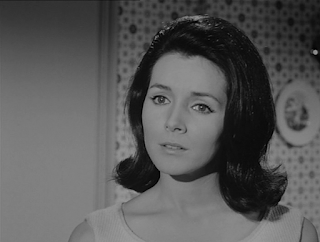 |
| Kathryn Hays as Joyce |
At breakfast, the first sign of disagreement between nurse and mother occurs when Freida tells Joyce that she canceled the diaper service and will wash the baby's diapers herself. Joyce instructs her not to do it and to call the service and ask them to resume picking up the dirty linen. Dexter and Joyce leave the kitchen and Freida enters just in time to hear a radio news report on the death in San Francisco of the six month old son of Mr. and Mrs. George Callendar; the discovery of a bottle of arsenic has led to a demand to exhume the child's body. Freida looks frightened when she hears this and tries to turn off the radio but accidentally turns up the volume before she is able to shut it off, suggesting that she is old-fashioned and unfamiliar with new technology. Before she turns off the radio, we hear that the nurse sought for questioning is an elderly woman of German origin. The viewer begins to suspect Freida before Joyce does, since Joyce does not hear the report.
That evening, the baby, Dexter Jr., is left alone with Freida while the parents go out. Ominous lighting of Freida as she enters the nursery adds to the viewer's growing concern. The baby starts to cry and Freida takes a bottle of liquid from her suitcase and gives a spoonful to the infant. The parents come home and, when Joyce hears the baby crying, she asks Freida what's wrong. This is the second time mother and nurse disagree; Freida says that there is no need to call the doctor but Joyce insists.
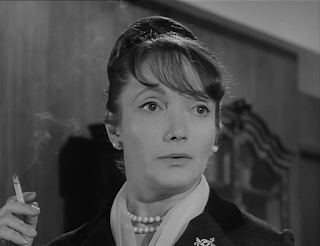 |
| Olive Deering as Christine |
The next day, Joyce's mother is visiting and tells Joyce about the San Francisco nurse who killed the baby by feeding it arsenic. The nurse is named Gretchen Reuter but Joyce remarks that her description fits Freida. In the kitchen, Freida tells Joyce that she used the morning paper to wrap up the garbage, which causes the viewer to be even more suspicious of her for potentially hiding the news from Joyce. Joyce asks Freida for her social security number in order to declare her as an employee for tax purposes but Freida claims she doesn't have one; once again, she seems to be concealing her identity. Freida's last name is Schmidt and she says that her last employer was Mrs. Frank Mueller of Bakersfield, but she claims that she can't remember their street address and insists that she never worked in San Francisco.
When Freida leaves to take the baby for a stroll, Joyce enters her room and looks in her dresser drawer, where she finds a photograph of Freida with a baby. This photo will appear again later in the show. There is a dissolve to Joyce reading the newspaper about the San Francisco nurse and beginning to worry; she decides to stay home with the baby rather than accompany Dexter on his business trip to New York. She expresses her concerns about Freida to her husband and recalls having received a Christmas card from Freida, who was in San Francisco, contradicting the nurse's claim that she never lived there.
 |
| Willis Bouchey as Dr. Bailey |
When the baby has more stomach pains and the doctor visits, Joyce seems to think Freida is to blame. After the doctor and Dexter have left, Joyce looks angry as she tells Freida not to pick up the baby and to let him rest. It seems that too many things are happening at once for Joyce to be comfortable: the regular doctor is away, Freida is new on the scene, Dexter is going on a business trip, there are troubling news reports about a nurse, and the baby is suddenly getting sick for the first time. When Joyce again catches Freida about to give medicine to the baby there is a tense exchange and, thereafter, we see Joyce holding the baby herself.
In the story, she contacts her brother on the West Coast to help with her investigation. In the TV show, Joyce lives on the West Coast and begins the investigation on her own, attempting to telephone Mrs. Mueller in Bakersfield only to learn that she does not exist. Pulling out the newspaper, she next telephones Mrs. George Callendar, whose baby was killed; she looks at the door to Freida's room with a worried expression on her face; it's not clear whether she is concerned that Freida might emerge in the middle of the call or whether she is starting to wonder if Freida is guilty of murder.
The Callendars are not home and their maid answers the phone. Joyce leaves a message that she's calling about the German nurse and later receives a return call from Christine Callendar, George's sister, who tells her that the baby's parents went away to rest. Christine is a character who is only mentioned in the short story, but she becomes a very important figure in the TV show. She tells Joyce to call the police when Joyce airs her suspicions that Freida is Gretchen Reuter, but Joyce is hesitant to take this step until she's certain. Christine says that she has a photo of Gretchen that she will send to Joyce by special delivery; she adds that Gretchen is "'quite insane'" and the camera zooms in on the photo, which is identical to the one Joyce found in Freida's dresser drawer.
 |
| Shadows make even an innocent act look ominous! |
Later that evening, Christine surprises Joyce by ringing her doorbell, claiming that she was worried about leaving Joyce alone with the nurse. Joyce remains uncertain until she sees the photo, at which point she rushes into the nursery. There is a great shot with lighting used to make Freida look menacing from Joyce's perspective as she enters the room; Joyce shoves Freida into a walk-in closet, locks the door, picks up the baby, and rejoins Christine in the living room. The viewer witnesses Christine pretend to call the police while her finger is pressing down the button on the telephone to disconnect the call; Joyce doesn't know it yet, but suddenly the viewer begins to wonder what's going on and who is guilty.
When Christine asks Joyce to bring her a cup of coffee and Joyce hands her the baby, we are suddenly worried for his safety. Joyce returns with the coffee and, while we hear Freida banging on the closet door from the nursery, Joyce explains why Freida Schmidt and Gretchen Reuter are the same person, despite having different names. Christine tells Joyce that Gretchen Reuter was the name on the social security card and Joyce recalls Freida's resistance to getting a card when they discussed the matter earlier. At this point, Christine launches into a monologue about herself, explaining that she and her brother had been happy together until he married. When the baby was born, it was "'sickening'" to see how his parents doted on him.
Christine begins to seem more unhinged and recalls a cruel nurse who beat her when she was a child. She starts to mix up the present, the recent past, and the distant past, complaining that babies are powerful and can ruin one's life, and she reveals that her brother asked her to leave, deeming the baby more important. Joyce is understandably wondering why Christine is telling her all of these personal details and, when Joyce suddenly remarks that Christine hated her nephew, Christine pretends to hear Freida trying to escape from the closet and takes a tiny gun from her purse.
Christine grows increasingly frantic, conflating Freida with her nephew's nurse and with her own childhood nurse. She rushes into the nursery and, when confronted by Joyce, she admits that she never called the police. All of a sudden Joyce is thrust into the unexpected role of having to protect Freida! Christine opens the closet door, but when she sees the stern German nurse she jumps back in fear. Freida takes control of the situation and tells Christine that she doesn't need a gun, addressing her like a child and ordering her to "'Give it to me!'" The baby's sudden cries drive Christine deeper into her unbalanced mind, recalling childhood trauma and mixing it up with recent events and the current standoff.
 |
| Doris Lloyd as the Callendars' maid |
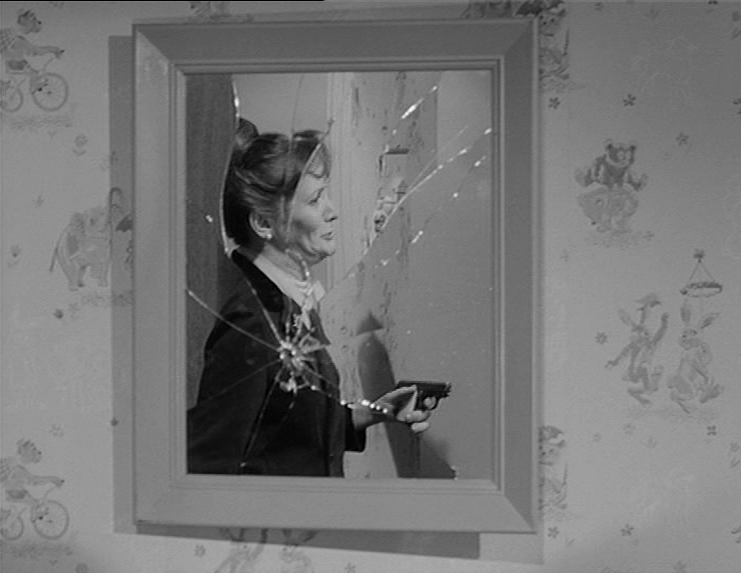
Joyce leaves the room for a moment to stop the baby's crying and, while she's in the next room, she hears a struggle and the gun going off. She rushes back into the nursery to see that Christine has shot her own reflection in the mirror in an effort to try to wipe out her real enemy, herself. Freida speaks to her like a child, professing her love and embracing her. Joyce gently takes the gun from Christine's hand; Christine has reverted to childhood and apologizes to "'Nanny.'" Joyce takes Freida's hand as the nurse hugs the deranged woman--mother and nurse finally trust each other and reconcile as the screen fades to black.
What a tremendous finish to a strong episode! The final scene takes the show in a different direction than the short story, exploring the effects of childhood trauma and demonstrating the value of a good nurse and the way a bad one can cause lasting harm. Unlike the story, Freida does not leave at the end of the TV show; instead, it ends with her being cleared of wrongdoing and bonding with Joyce. The performances by the three actresses are superb, with Joyce being pulled back and forth between conflicting emotions as she tries to navigate a series of confusing clues that seem to point to Freida's guilt before she is confronted with a much more dangerous figure in the unbalanced Christine. Christine is a complex character who goes from sane to insane right before our eyes. Driven to kill her brother's baby out of jealousy and fear when she was ordered to leave the home where she grew up, she suddenly recalls traumatic childhood events that resurfaced when replayed anew with the new baby and its nurse.
The TV version of "One of the Family" also hearkens back to other episodes of The Alfred Hitchcock Hour that dealt with women's issues and motherhood:
- in "The Lonely Hours," a woman loses her baby and her mind and ends up taking another woman's baby as her own;
- in "The Dark Pool," a baby accidentally drowns and there is an image of a large, stuffed panda in an empty crib; a stuffed animal in this episode resembles the one in the earlier show;
- in "Beast in View," an insane woman is shoots her own reflection in a mirror.
Yet "One of the Family" is unique in the way it deepens its source story, making the motive for Christine's actions not simply spinsterhood but rather childhood trauma and adult jealousy. This is a show about women's roles and men's absences. Joyce's husband leaves on a business trip and pays little attention to his son even when he is home. At one point he tells Joyce, "'Having a nurse around to do everything for you sure takes the sting out of being a parent,'" and she replies, "'You are an unnatural father.'" In addition, the baby's doctor is away and an unfamiliar doctor has taken his place; Joyce tells Dexter that she doesn't trust "'these cheerful, fatherly types.'" Christine's father was often gone when she was a girl, leaving her with a cruel nurse. The show examines how women harm or support each other in the absence of men. For her part, after the baby dies in San Francisco, Freida hides in plain sight, reverting to her maiden name and returning to care for the son of the man she had cared for as a child. Unfairly suspected, she flees into a safe, comfortable past, recreating her role as Dexter's nurse with his son, who even shares the same name as his father.
"One of the Family" is an outstanding hour of television that rewards repeat viewing. According to IMDb, a writer named William Bast (1931-2015) also did uncredited work on the teleplay. His papers at UCLA appear to include something from
The Alfred Hitchcock Hour and, since this is his only credit listed for the show, IMDb may be correct.
The show is directed by Joseph Pevney (1911-2008), who started out as an actor in vaudeville in the 1920s and had a short career as a film actor from 1946 to 1950. He then became a director and was more successful, directing films from 1950 to 1966, including
Man of a Thousand Faces (1957). His career as a TV director spanned the years from 1959 to 1985 and included 14 episodes of
Star Trek and five episodes of
The Alfred Hitchcock Hour, one of which was
"Starring the Defense."James Yaffe (1927-2017), who wrote the short story, had a story published in the July 1943 issue of
Ellery Queen's Mystery Magazine, making him, at age 15, the youngest author ever to be published in that magazine. Yaffe served in the Navy and spent 26 years as an English professor at Colorado College. He was a prolific writer who wrote short stories, plays, novels, and non-fiction; many of his stories and books featured a policeman named Dave and his mother, known as "Mom," solving crimes. He also wrote for television, but this is the only episode of the Hitchcock show to be based on one of his works.
Receiving top billing is Lilia Skala (1896-1994) as Freida. She gives an outstanding performance. She was born Lilian Sofer in Vienna and worked as an architect before becoming an actor. She was in films in Europe from 1931 to 1937, then fled the Nazis in 1939 and came to America, where she was on TV and in films from 1949 to 1990. She was also on Broadway, on and off, from 1941 to 1981. Her most famous role was in Lilies of the Field (1963).
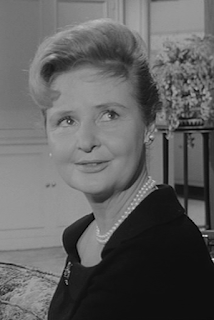 |
| Frances Reid as Joyce's mother |
Jeremy Slate (1926-2006) is billed second, even though his role as Dexter is limited. Born Robert Perham, he landed at Normandy on D-Day and later went on to a career in movies and on TV from the late 1950s to the early 1990s. He appeared in five episodes of the Hitchcock series, including
"One Grave Too Many." In an interview, he admitted that he acted from 1960 to 1970 and then tuned in, turned on, and dropped out, spending the next ten years traveling around the USA in a motor home.
Joyce is played by Kathryn Hays (1934-2022), who bears a strong resemblance to Diana Rigg in this episode and gives a fine performance. Born Kay Piper, she acted mostly on TV from 1952 to 2010, including roles on
Star Trek and
Night Gallery, but she was best known for her continuing role on the soap opera,
As the World Turns, from 1972 to 2010.
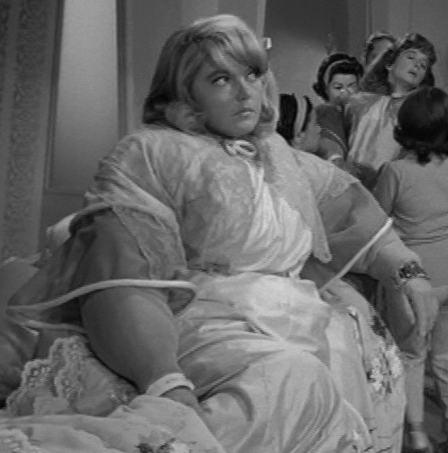
Olive Deering (1918-1986) gives a moving performance as Catherine, who quickly deteriorates from seeming sane to clearly insane before our eyes. She was the sister of actor Alfred Ryder and a member of the Actors Studio, onstage beginning in 1933 and in movies and on TV from the late 1940s. She also appeared in one episode of
Alfred Hitchcock Presents, "The Kind Waitress," and had a role in the classic
Outer Limits episode, "The Zanti Misfits." "One of the Family" was her last TV role; she appeared in one more film in 1973.
In smaller roles:
- Willis Bouchey (1907-1977) as Dr. Bailey; He was the voice of Captain Midnight on radio and played numerous character roles in a screen career that spanned the years from 1951 to 1972. He was in Fritz Lang's The Big Heat (1953) and John Ford's The Man Who Shot Liberty Valance (1962), and his many TV roles included episodes of The Twilight Zone, Thriller, and three Hitchcock hours, including "I Saw the Whole Thing."
- Doris Lloyd (1896-1968) as the Callendars' maid; born in Liverpool, she started out in vaudeville in 1916 and appeared in over 150 films from 1920 to 1967, including Phantom Lady (1944). She was in four episodes of Thriller and nine episodes of the Hitchcock show, including "The Schartz-Metterklume Method."
- Frances Reid (1914-2010) as Joyce's mother; she was onscreen from 1937 to 2009 and also appeared in an episode of Alfred Hitchcock Presents, "A Jury of Her Peers." She mostly worked on TV, rather than in film, and her longest role was on the soap opera, The Days of Our Lives, where she appeared from 1965 to 2009. Like Olive Deering, she was in the Actors Studio.
Watch "One of the Family" online
here.
Sources:
The FICTIONMAGS Index, http://www.philsp.com/homeville/FMI/0start.htm.
Grams, Martin, and Patrik Wikstrom. The Alfred Hitchcock Presents Companion. OTR Pub., 2001.
IBDB, IBDB.com, https://www.ibdb.com/.
IMDb, IMDb.com, https://www.imdb.com/.
"James Yaffe: Authors." Macmillan, https://us.macmillan.com/author/jamesyaffe.
Marks, Jeffrey. "A Tribute to James Yaffe." SOMETHING IS GOING TO HAPPEN, 30 Aug. 2017, https://somethingisgoingtohappen.net/2017/08/30/a-tribute-to-james-yaffe-by-jeffrey-marks/.
"One of the Family." The Alfred Hitchcock Hour, season 10, episode 16, NBC, 8 Feb. 1965.
Stephensen-Payne, Phil. Galactic Central, http://philsp.com/.
Wikipedia, Wikimedia Foundation, https://www.wikipedia.org/.
Yaffe, James. "One of the Family." Hitchcock in Prime Time, Avon, 1985, pp. 310–329.
Listen to Al Sjoerdsma discuss "The Rose Garden" here!
In two weeks: Our brief series on Lou Rambeau begins with a look at "Hangover," starring Tony Randall and Jayne Mansfield!