
Horace is a 40-year-old confirmed bachelor when he marries Sybilla, a thirty-five-year-old delicate, pale blonde with large green eyes. He proposed to her on the spur of the moment during a romantic walk in the woods and they were wed, but when he brought her home on their wedding night, he initially insisted on sleeping in separate rooms until he gave in and joined her.
The reluctant husband lives on an income he inherited from his parents and, rather than working for a living, he spends long hours alone in his den, writing in a journal to let off steam. His favorite topic is his wife, whose quiet devotion to him he finds incredible and horrific. What most men would delight in drives him to consider murder and he begins to make cocktails to share with Sybilla every night before bedtime.
Horace writes articles for magazines and, one day when he returns home from visiting his editor in the city, he finds Sybilla coming out of his locked den, explaining that she was checking to see if the drapes needed cleaning. He tells her to let Mrs. Tibbet, the housekeeper, tend to such details and, in response, she asks him about his mother.
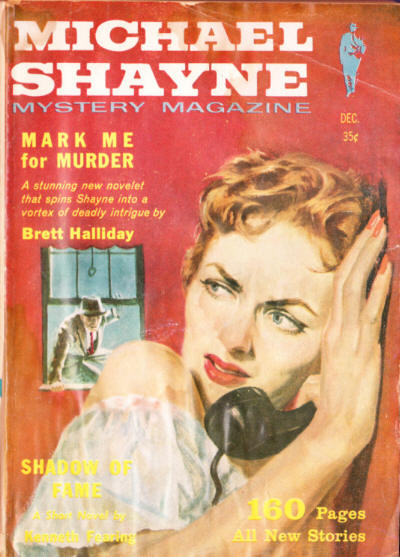 |
| "Hard Way Out" was first published here |
One night he makes her a cocktail that includes an overdose of sleeping crystals; she drinks it but, to his dismay, it has no effect on her. The next morning, exhausted, he drinks a normal dose of the sleeping medicine and vomits. Later, after Sybilla helps him rinse out his mouth, she explains that, when she was tidying up, the bottle of sleeping crystals spilled and she replaced the crystals with bath salts until she could get a prescription from his doctor.
Horace does not believe his wife's story. He goes out and returns to find her reading a thriller. She tells him that she recently read a book on psychology that explained that children often fight their parents and resist what they really want. Though he disagrees, she tells him that she understands. Sybilla adds that, in the novel she's reading, a man finds evidence in a diary that someone intends to kill him, so he makes a copy of the diary and gives it to his lawyer with instructions to give it to the district attorney if he dies. He then tells his would-be killer what he's done. Horace notices that Sybilla has a key to his desk and believes that she has read his diary and knows that he tried to kill her. He thinks that she was subtly telling him this when she related the plot of the novel she's reading.
At this point in their marriage, Horace begins to change, at first out of fear that he will be exposed as an attempted murderer. He and Sybilla remain married for ten years until she dies quietly after an illness. To his surprise, he misses her; after he believed she had uncovered his secret, he felt that he had to ensure her survival and he began to appreciate her and to consider her the perfect wife. After she dies, he discovers that their lawyer's safe does not contain a copy of his incriminating diary and concludes that she acted to save her husband rather than herself.
"Hard Way Out," by Margaret Manners, was published in the December 1956 issue of Michael Shayne Mystery Magazine and is an interesting study of a paranoid husband and a devoted, understanding wife. Horace has managed to reach the age of 40 without marrying, even though he is educated and wealthy. Sybilla, whom he describes as being 35 but looking 18, is also rather old not to be married (in the world of 1956) and, when she does tie the knot, she works hard to please her husband. Yet these very efforts drive him crazy and lead him to try to kill her. Sybilla, clearly the more understanding of the two, realizes that Horace has psychological problems and mother issues, and she probably understands that she has taken the place of his late parent. She is satisfied with this unusual arrangement, which begins on their wedding night when he insists on separate bedrooms.
 |
| Barbara Bel Geddes as Sybilla |
Did Sybilla really read Horace's diary? Did she intentionally save her own life by replacing the sleeping medicine with bath salts? Margaret Manners, the story's author, never lets Horace or the reader know for sure, but it seems likely that Sybilla did just that. When she reveals that she has been reading up on psychology, it suggests that she understands her husband better than he does himself, and her subtle message regarding the thriller she's reading, which eerily parallels their marital situation, is cleverly concocted to produce a change in her husband's murderous behavior.
Change he does, and after his narrow escape Horace begins to see what the reader saw from the start, that Sybilla is the perfect wife for this troubled man. Their marriage becomes a success, and when she dies, he not only misses her but comes to realize that her actions were intended to save him more than herself. What did she save him from? From being a murderer and from losing the love of his life. The twist in the conclusion, when he discovers that she never gave anything to the lawyer, is not very surprising and is consistent with her personality--she did not need to follow the plot of the thriller she read in order to orchestrate the same outcome, she simply needed to let Horace think that was what she had done.
Horace and Sybilla both take the "Hard Way Out," as the story's title says, having to go through an attempted murder and a false suggestion of giving a copy of an incriminating diary to a lawyer in order to turn their marriage into a happy one. When the producers of Alfred Hitchcock Presents chose this story to adapt for TV and assigned it to Charlotte Armstrong to write, they gave her a challenge, one that was often faced by authors adapting short stories for the series: she had to figure out how to convey the details of a story that is narrated in the first person by a character whose thoughts are never explicitly shared with anyone else.
 |
| Alexander Scourby as Horace |
Armstrong's teleplay for "Sybilla," as the TV version is titled, succeeds in conveying nearly everything that occurs in the short story, though she does make minor revisions for the change in medium. The show begins with Horace, in voiceover, saying that "'Sybilla is dead,'" a line he doesn't utter in the story until past the halfway point. He takes out his journal and sets the stage for the viewer by remarking that he found it incredible that he married Sybilla at age forty. The screen then dissolves to a flashback, where Mr. and Mrs. Carter, Horace's maid and butler, welcome the newlyweds home, addressing Horace as "'Mr. Meade'"; in the story, he is never given a surname.
Gone from the TV version is the story's initial buildup that establishes Horace's intense dislike of his wife and the explanation of how they met and decided to marry. Without the benefit of Horace's twisted thoughts, he becomes a much less nasty character. In addition, either Charlotte Armstrong or the show's director, Ida Lupino, decided to set the events at what seems to be the turn of the (twentieth) century, though this is never spelled out for the viewer. Horace and Sybilla both dress rather formally, and there will be more clues later in the episode that suggest the story is not set in the present day, unlike the short story, which seems to be set in the 1950s.
Horace shows Sybilla the house she will now share with him, which he has decorated with valuable antiques. This suggests that Sybilla has never before entered the home of the man she has just married. He bristles when she asks if the furnishings belonged to his mother and sneers that the woman had "'atrocious taste.'" As Horace tells Sybilla how and when he likes his meals, Armstrong lifts lines of dialogue from Manners's story, removing the incident where Horace tries to avoid spending his wedding night with his new bride.
 |
| Bartlett Robinson as the lawyer |
Sybilla asks Horace to show him where he works and he takes her to his den, where he finds a surprise--a new writing desk, on top of which are a large ribbon and a key to its drawer. The desk is Sybilla's wedding present to her husband and, by adding this detail, Armstrong gives Sybilla control of the desk and underscores its importance to the viewer.
More voiceover by Horace occurs in the following scene, where he and Sybilla have breakfast together and he puts the seemingly happy domestic scene in a different light with his internal monologue of complaints. The voiceover narration continues seamlessly into another scene, where he sits reading while she sews. In a dialogue exchange between the two, he suggests that she might like to take a small place of her own in town with a generous allowance, but she refuses, and he resumes voiceover narration by telling the viewer that he "'cannot bear it much longer'" and "'must put an end to it.'" As in the story, he comes home one day to find that Sybilla has been in his den and, very soon, he is preparing a fatal glass of wine mixed with an overdose of sleeping medicine for his wife.
There is a shot of Horace climbing the stairs to Sybilla's bedroom, holding a tray with two glasses of wine, that recalls the famous scene in Suspicion where Cray Grant is thought to be bringing a poisoned drink to his wife; however, in that film, the wife thinks her husband a poisoner even though he turns out to be innocent. The unsuccessful attempt at murder unfolds just as it does in the story, with snippets of dialogue interspersed with voiceover narration that reveals Horace's dark thoughts.
In the short story, this is the point where there is a break in the action and Horace writes that "Sybilla is dead," causing the reader to think that he murdered her at some later date. In the TV show, Armstrong compresses events and, instead of Horace waiting all night to see if Sybilla is dead and finding her alive the next morning, he goes right back to his room and, unable to sleep, takes some of the sleeping medicine, only to have Sybilla reveal that the medicine spilled when she was tidying up and she replaced it temporarily with lotion.
 |
| Night of Horror, the hardcover edition |
The following scene hews close to the short story, but the thriller that Sybilla is reading is a hardcover titled Night of Horror, the same book (with the same cover) that other characters in other episodes ("Nightmare in 4-D," for example) of Alfred Hitchcock Presents have been observed reading. She calls it "'a mystery book'" and tells Horace that it's "'psychologically interesting.'" References to the copy being a "photostat" are removed from the teleplay, which is set decades before the story.
Horace sees the extra copy of the key to his desk and draws the same conclusions as he does in the story. The husband who wanted to murder his wife now realizes that he must keep her alive. We see him bringing her breakfast in bed and telling her to rest; they have been married for eight years and she has not been feeling well. They agree to take a trip to the seashore and she shows Horace bathing suits that she has bought for them; if there was any doubt before this that the events of the TV show are set at the turn of the century, it is wiped out by the Gay Nineties-style bathing suits she displays. He is protective of her, not wanting her to swim in the dangerous ocean and unwilling to visit the mountains, where there are hazardous trails and steep places.
This added scene shows the change in Horace, who is now a devoted, doting husband. In the next scene, a doctor visits and tells Horace that "'there's nothing more we can do.'" As in the story, Sybilla dies without Horace knowing for certain that she had copied his journal and given it to her lawyer. Horace visits the lawyer and learns that he has no incriminating evidence; there is a bit of suspense as Horace watches the lawyer open a box and remove the few papers Sybilla left. The episode ends with more voiceover narration as Horace returns home and realizes that Sybilla really was a perfect wife and that he should have said "'I love you'" to her before she died.
 |
| Madge Kennedy as Mrs. Carter |
"Sybilla" is essentially faithful to its source, and Charlotte Armstrong uses a large amount of voiceover narration to convey Horace's thoughts to the viewer. However, the reduction of Horace's cruel thoughts in the first half of the show, as compared to the story, makes him seem less evil and thus his decision to try to murder his wife seems capricious, rather than inevitable. The switch to doting husband from attempted murderer is less believable, since he doesn't seem as menacing in the show's early scenes and the revelation of his change in behavior toward his wife, forced by his belief that she discovered his plans and has put a safeguard in place, is less surprising, the contrast between his good and bad behavior less stark.
The decision to place the story back in time is odd and adds nothing to its effectiveness. Perhaps director Ida Lupino thought that the character of Sybilla, who is so patient and determined to do everything to please her husband, even when he tries to murder her, was not credible in 1960 and would be easier to accept if the story were set in an earlier time. Whatever the reason, the confusion over when the story takes place distracts from the plot and keeps the viewer on the lookout for clues to the story's date that have no bearing on what happens to its characters. Perhaps a simple title card at the beginning reading, "New York, 1910," or something to that effect, would have helped.
In any case, despite the pedigree of the writer, director, and stars, "Sybilla" is not completely successful as an adaptation of its source, the short story "Hard Way Out," because it fails to capture the story's key element: the sudden change from murderous husband to solicitous partner that comes over Horace once he realizes that Sybilla has figured out that he tried to kill her and ensured that he will never try again.
 |
| Gordon Wynn as the doctor |
"Sybilla" stars Barbara Bel Geddes (1922-2005) as the title character. She started as a stage actress in 1941, moving into film in 1947 and TV in 1950. In addition to a key role in Vertigo, she appeared in four episodes of Alfred Hitchcock Presents, including "Lamb to the Slaughter," and later starred in the television series Dallas from 1978 to 1990, winning an Emmy in 1980. A website devoted to her career may be found here.
Making his only appearance in the Hitchcock series is Alexander Scourby (1913-1985) as Horace. Born in Brooklyn, he made his Broadway debut in 1936 and had roles on film and TV from 1950 to 1985, including Lang's The Big Heat (1953) and an episode of The Twilight Zone. Scourby's most lasting legacy is his audio recordings of books, including the entire King James Bible.
In smaller roles:
- Bartlett Robinson (1912-1986) as the lawyer; Robinson was on screen from 1949 to 1982 and was in 11 episodes of the Hitchcock show; including "Man With a Problem."
- Madge Kennedy (1891-1987) as the maid, Mrs. Carter; she was on Broadway from 1912 and in films from 1917 to 1928 before taking a long break. She returned to the screen in 1952 and kept working until 1976. She has a small part in North By Northwest (1959) and was in six episodes of the Hitchcock show, including "Help Wanted." She was also on The Twilight Zone and The Odd Couple.
- Gordon Wynn (1914-1966) as the doctor; Wynn played small parts on film and TV from 1942 to 1964 and was in four episodes of Alfred Hitchcock Presents, including "Together."
Charlotte Armstrong wrote three teleplays for Alfred Hitchcock Presents: "Across the Threshold," "The Five-Forty-Eight," and "Sybilla." In each of these episodes, a woman fights back when a man tries to exert power over her: Sophy Wintor unintentionally turns the tables on her murderous son in "Across the Threshold," Sybilla teaches her murderous husband a lesson in love, and Miss Dent humiliates her faithless lover, Blake, in "The Five-Forty-Eight." Armstrong's writing was said to address "the injustice that the wealthy and powerful often inflict upon the less fortunate," and this is borne out in her trio of scripts for the half-hour Hitchcock TV show. It's a shame she did not write more!
"Sybilla" aired on NBC on Tuesday, December 6, 1960, and may be viewed online here, or the DVD may be purchased here. Read the GenreSnaps review of this episode here. Thanks to Peter Enfantino for providing a copy of the short story, "Hard Way Out"!
"Charlotte Armstrong." Contemporary Authors Online, Gale, 2003. Contemporary Authors Online, http://link.galegroup .com/apps/doc/H1000003000/CA u=lawr69060&sid=CA&xid= bd5286ca. Accessed 10 June 2018.
The FICTIONMAGS Index, www.philsp.com/homeville/FMI/0start.htm.
Galactic Central, www.philsp.com/index.html.
Grams, Martin, and Patrik Wikstrom. The Alfred Hitchcock Presents Companion. OTR Pub., 2001.
IMDb, www.imdb.com/.
The FICTIONMAGS Index, www.philsp.com/homeville/FMI/0start.htm.
Galactic Central, www.philsp.com/index.html.
Grams, Martin, and Patrik Wikstrom. The Alfred Hitchcock Presents Companion. OTR Pub., 2001.
IMDb, www.imdb.com/.
Manners, Margaret. "Hard Way Out." Michael Shayne Mystery Magazine, December 1956, 113-122.
"Sybilla." Alfred Hitchcock Presents, season 6, episode 10, CBS, 6 Dec. 1960.
Wikipedia, www.wikipedia.org/.
Listen to Al Sjoerdsma discuss "My Brother Richard" here!
In two weeks: Our series on Frank Gabrielson begins with a look at "Reward to Finder," starring Jo Van Fleet and Oscar Homolka!
Wikipedia, www.wikipedia.org/.
Listen to Al Sjoerdsma discuss "My Brother Richard" here!
In two weeks: Our series on Frank Gabrielson begins with a look at "Reward to Finder," starring Jo Van Fleet and Oscar Homolka!


