Showing posts with label Richard Fielder. Show all posts

Thursday, January 25, 2024

The Hitchcock Project-Richard Fielder, Part Two-To Catch a Butterfly [8.19]

by Jack Seabrook

Conflicts between fathers and sons are nothing new, going back at least as far as Oedipus, the mythical king of Ancient Thebes. In his second and last teleplay for The Alfred Hitchcock Hour, Richard Fielder updates the struggle to 1963 and, in a gripping episode, demonstrates how past and present acts of violence shake the foundations of an outwardly serene suburban neighborhood.

"To Catch a Butterfly" is an original teleplay, not based on any short story or novel, which aired on CBS on Friday, February 1, 1963. Fielder wrote a draft of the teleplay as early as February 1961, well before the Alfred Hitchcock TV show had expanded to hour length; this first version, titled "Can't Catch A Butterfly," may have been written for one of the other anthology shows to which Fielder contributed scripts around this time, such as Alcoa Premiere. By the time it aired, two years later, the title had been changed.

Bradford Dillman as Bill Nelson
As the show begins, Bill and Janet Nelson have just moved to a home in the suburbs. A young, childless couple, they are not prepared for Eddie Stander, the little boy who lives next door. Bill first meets Eddie when he finds the boy teasing Charlie, the Nelsons' dog ("'can't catch a butterfly,'" taunts Eddie). Eddie's father, a brash salesman named Jack, defends his son after Bill finds Eddie seemingly mistreating the dog inside his father's garage. Bill begins to suspect that Eddie may be more than just a mischievous child.

When Bill catches Eddie searching through the glove compartment in his car and chases him home, Eddie drops several sheets of paper. Picking them up, Bill sees that they are covered with disturbing drawings, but when Bill confronts the boy in the garage and threatens to tell his father, the child responds: "'You say one word to him, I'll kill your dog.'" When Bill speaks to Jack, the boy's father denies that Eddie did anything wrong and reveals that, when Eddie was four years old, "'that kid got his in a way he'll never forget'" and has never since lied to his father. The next day, when Bill's house is empty, Eddie breaks in and murders the dog.
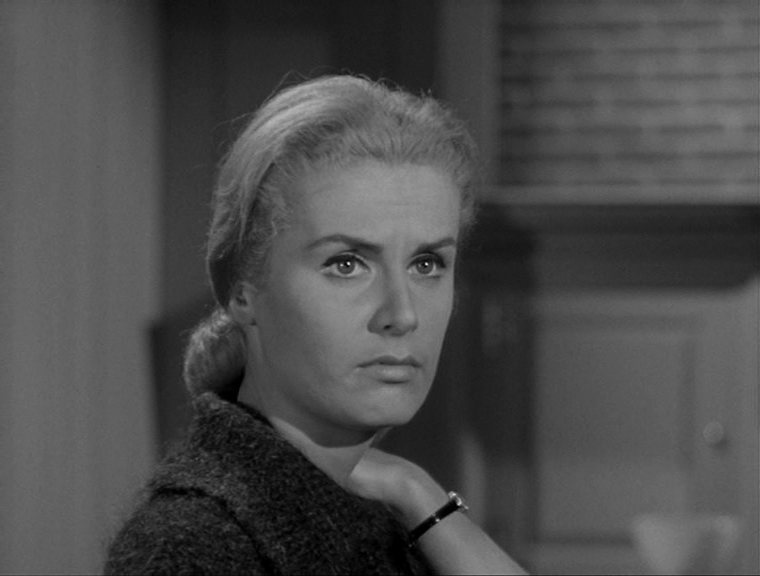
Diana Hyland as Janet Nelson
Bill calls the police but, when Jack claims that Bill has been "slapping [Eddie] around,'" Bill drops the charges. The next day, Bill is called away from home to play golf with his boss. He fears for Janet's safety, but she insists she'll be fine and locks the doors after her husband leaves, unaware that Eddie is already in the house. From upstairs, she hears a sound in the basement and investigates, only to see that Bill's power drill is on and running, lying on the workbench. She walks down the stairs to the basement and trips and falls over a wire that Eddie has strung across the bottom step; while she lies on the floor, her hand stuck between two wooden balusters, Eddie picks up the power drill and advances toward her. The electric cord pulls out of the wall right before he reaches her and she screams, at which point Eddie drops the drill and looks at his own hand, grabbing his wrist with a horrified look on his face.

Edward Asner as Jack Stander
That night, Bill returns home and confronts Jack in the garage, only to learn what happened when Eddie was four: his father caught him in a lie and slapped him across his face as hard as he could. When the child fought back, Jack dragged Eddie across the kitchen and forced his son's hand into a pot of boiling water. Jack insists that Eddie has not told a lie since that day. Meanwhile, Eddie takes a gas can from a shelf and lights the garage on fire before trying to prevent the adults from escaping. They emerge and chase the boy upstairs to his room. In the hall, the final confrontation takes place, ending when Eddie's mother and a policeman appear in order to take the boy away. Bill consoles Eddie and urges Jack to help his son.

"To Catch a Butterfly" is harrowing and Fielder does a brilliant job of developing the main characters and contrasting personalities and parenting styles between Bill Nelson and Jack Stander. Bill reveals that, when he was twelve years old, his father disappeared and was never heard from again except for a single Christmas card. All Bill has left of his absent father is a shamrock pin that he wore on his honeymoon; it represents a happy memory and, at the end of the episode, Bill gives it to Eddie. Bill had told Janet that he hoped to give the pin to his own son someday and, in giving it to Eddie, Bill symbolically adopts the troubled boy.

Mickey Sholdar as Eddie
From the start of the show, Bill reacts to aggressive behavior with patience and kindness. He is friendly to a brusque moving man and gives him a tip, he is kind to Eddie after he finds the boy teasing his dog and, when Janet tells Bill that he let the movers "'walk all over'" him, he refuses to take the bait. Bill is a good man, but his encounters with Jack and Eddie make him doubt himself. Partway through the show, he confesses to Janet that he is having a crisis of confidence and is "'scared of my own shadow.'" In the final confrontation with Jack in the garage, Bill is more forceful and, in response, Jack nearly breaks down in tears. Yet in the end, when Eddie is about to be taken away by the police, Bill is gentle with the boy, giving hope that his kindness might succeed in helping the child heal from trauma.

In contrast to Bill Nelson is Jack Stander. On more than one occasion, Jack presents the image of a macho man, telling Bill that Janet is "'a real knockout'" and later inviting the Nelsons to come over and play a game of spin the bottle. Jack offhandedly admits to Bill early on that his family has moved three times in five years; we never learn whether this is because of Jack's job or because of trouble caused by Eddie. Either way, the child is growing up in an unstable environment. Each time Bill confronts Jack with Eddie's misdeeds, the man angrily denies any fault on the part of his son, either blaming another boy (for the disturbing drawings) or claiming that Bill is lying. When Eddie sets the garage on fire in Jack's presence, the father can no longer ignore the proof of his son's guilt.

June Dayton as Barbara Stander
Jack is not a one-note character, however, as is shown when he confesses what he did to his son when the boy was four years old. He has fooled himself into thinking that the act of violence cured the boy of lying, but as he continues to talk, nearly crying as he insists that if he can "'keep him in line'" and "'keep it hushed up'" then "'he'll grow out of it,'" it becomes apparent that Jack Stander is a man without the tools to deal with a difficult parenting situation that he was instrumental in creating. Perhaps he was bullied as a child by his own father and had no other role model to follow when dealing with Eddie; whatever the case, his approach to relationships with both his neighbors and his family members seems doomed to fail.

Most interesting is the character of Eddie. The actor playing him was thirteen years old, about the same age as Bill Nelson was when his father disappeared, and the parallel between Bill and Eddie is clear. Bill suffered trauma on the cusp of adolescence but grew up to be a gentle man; what will the traumatic events portrayed in this episode do to Eddie? Bill's kind speech to the boy at the end, when he gives him the treasured shamrock pin, provides hope for a similar trajectory into maturity, yet Eddie suffered unthinkable trauma when he was just four years old, and it is this event that is identified as the source of his present, horrific behavior.

Than Wyenn as Dr. Burns
From the first time Bill speaks to Jack, Stander refers to his son in terms that are less than human. "'He usually snaps to when he hears his master's voice,'" says Jack, "'I mean, that kid is really trained.'" "His master's voice" is a term that refers to the trademark of the RCA Victor company that showed a dog listening to a phonograph. When Janet sees Eddie outside the screen door looking in, she tells him, "'Don't you think you should knock instead of scratching like a dog?'" Eddie replies, "'I am a dog,'" which suggests that he has internalized the characterization of himself as less than human. The dog metaphor continues when Bill tells Janet, referring to his boss, that "'I won't snap at every little bone that guy tosses our way'"; in a sense, Bill and Eddie are different versions of the same little boy whose father mistreated them. When Eddie teases, mistreats, and finally kills Bill's dog, perhaps he is destroying a representation of himself. In the final scene, when Eddie is about to be taken away by the police, he runs to Bill and clings to him rather than to his father. Does Eddie sense a kindred soul or is he just gravitating toward the man less likely to do him harm?

And what of the women? Eddie's mother, Barbara, is not seen often, but she seems nervous when she comes to the door to speak to Bill, who is looking for Eddie. Has she seen this sequence of events play out before? Does she fear that Eddie's behavior will necessitate another move? At the end, it is Barbara who brings the police to "'take my baby,'" a step that Jack has resisted. She holds the boy and says that she loves him, but she has never been strong enough to protect her son from her husband.

Clegg Hoyt as the moving man
Much stronger is Janet Nelson, who supports and encourages her husband throughout the ordeal. Frustrated with the movers, she snaps at Bill, but his patient response allows her to realize her bad mood and apologize. Janet uses self-deprecating humor to deal with situations throughout the episode and, when Bill doubts himself, she tells him that "'You don't know who you are or what you can do until you try.'" In a happy moment she suggests, "'Let's have a baby'" and, when Bill is discouraged by his inability to get through to Eddie, she tells him, "'You're a wonderful husband and you are going to be a wonderful father.'" Janet and Bill are well-matched; each combines traits of sensitivity and strength that allow them to be what the other needs at any given time.

Authority outside the two families comes in two forms in "To Catch a Butterfly." There are the police, who respond when Bill reports that Eddie killed his dog and who finally come in the end to take Eddie away. They represent the harsh, black and white approach to justice favored by Jack Stander. Representing a different type of authority is the doctor who emerges from Janet's room when Bill comes home after she has fallen down the stairs. He tells Bill that Eddie needs psychiatric help and says that he will report the boy to the authorities. His approach is more like that of Bill, who begins to realize that Eddie needs therapy after he sees the disturbing drawings. In the end, a mixture of both types of authority is necessary to deal with the child: the police handle the immediate need to calm the situation and remove Eddie from his home, while the medical professionals will address the cause of his mental illness and deal with his long-term needs.

John Newton as the policeman
"To Catch a Butterfly" is a fascinating look at parenting styles in America in the 1950s and 1960s. Eddie was four years old in the 1950s, when his father took the adage "spare the rod and spoil the child" to horrifying extremes. By 1963, when the episode aired, new ideas were taking hold, and corporal punishment was no longer seen as the only way for a father to discipline a son. The portrait of the horror behind a calm suburban front in this episode prefigures similar commentary in films like Risky Business and American Beauty; Eddie's extreme behavior shows just how damaging parental violence can be.

The year 1963 was a particularly violent one in American life. In the months that followed the airing of this episode, racial tensions led to the murder of Medgar Evers and the bombing of the 16th Street Baptist Church in Birmingham; the year ended with the assassination of President Kennedy. In retrospect, it is not surprising that the seemingly idyllic Eisenhower years gave way to the upheaval of the decade that followed, and the events portrayed in "To Catch a Butterfly" can be read as a metaphor for what was going on in the country as a whole.

John Pickard and Andy Romano
In addition to a great teleplay, "To Catch a Butterfly" features outstanding direction by David Lowell Rich (1920-2001), who elicits strong performances from the lead actors and keeps the action moving relentlessly toward the climax. The scene in the basement, where Eddie menaces Janet with a power drill, is a classic scene of horror and it demonstrates that TV shows were not afraid to frighten their audiences in the early 1960s. Rich directed many TV shows from 1950 to 1987, as well as a number of films. He won an Emmy in 1978. This was one of two episodes of The Alfred Hitchcock Hour that he directed.

Bradford Dillman (1930-2018) gives a sensitive performance as Bill Nelson. Dillman began acting on stage, in film, and on TV in the 1950s. He was on The Alfred Hitchcock Hour twice ("Isabel" was the other episode) and Night Gallery once and continued acting until 1995. In 1997, he published an autobiography entitled Are You Anybody?: An Actor's Life. In 1963, he married model Suzy Parker, one of the most famous and beautiful models in America at that time.

The role of Janet Nelson is played by Diana Hyland (1936-1977). Born Diana Gentner, Hyland appeared mainly on TV from 1955 to 1977. She was in one other episode of The Alfred Hitchcock Hour, "Beyond the Sea of Death," she was on The Twilight Zone, and she was a regular on Peyton Place from 1968 to 1969. Hyland was romantically involved with John Travolta after they met while filming a TV movie; she was 40 and he was 22. She died of breast cancer at age 41.

Edward Asner (1929-2021) plays Jack Stander as a man who is gruff on the surface but who reveals unexpected depth when challenged. This was Asner's only appearance on the Hitchcock TV show, but he had a long career on TV and in film from 1957 to his death in 2021, winning seven Emmy Awards along the way. Asner is best known for his portrayal of Lou Grant, first on The Mary Tyler Moore Show  (1970-1977) and then on Lou Grant (1977-1982); Jack Stander can be seen as an early version of Grant, albeit a more violent one.

The difficult role of Eddie is played by Mickey Sholdar (1949- ), whose career was mostly on television from 1960 to 1975. He was best known as a regular on The Famer's Daughter (1963-1966). He did not appear in any other episodes of the Hitchcock TV show.

In smaller roles:
  • June Dayton (1923-1994) as Barbara Stander. She was born Mary Jane Wetzel in Dayton, Ohio, and took the city's name as her stage name. She appeared mainly on TV from 1950 to 1986 and this was her only role on the Hitchcock TV show.
  • Than Wyenn (1919-2015) as Dr. Burns; his screen career lasted from 1949 to 1985 and included three episodes of The Alfred Hitchcock Hour, including "Triumph," and appearances on The Twilight Zone, Thriller, and Night Gallery.
  • Clegg Hoyt (1910-1967) as the moving man who accepts a tip from Bill; he was on screen from 1955-1967 and he was in six episodes of the Hitchcock series, including "The Day of the Bullet." He was also on The Twilight Zone, Thriller, and Star Trek.
  • John Newton (1925-2012) as the policeman who comes to the door after Bill's dog has been killed; his screen career lasted from 1957 to 2000 and he also appeared on The Twilight Zone (twice) and The Outer Limits, though this was his only role on the Hitchcock TV show.
  • Andy Romano (1936-2022) as the second fireman; he was on screen from 1961 to 2003, including an appearance on Batman and parts in eight episodes of the Hitchcock show, including "The Black Curtain."
  • John Pickard (1913-1993) as the first fireman; he played many small parts in films and on TV in a career that lasted from 1941 to 1987. This was his only appearance on the Hitchcock TV show.
Watch "To Catch a Butterfly" online here.

Richard Fielder's two teleplays for The Alfred Hitchcock Hour are both strong episodes. "Night of the Owl" is a successful adaptation of a novel that makes significant changes to the climax, while "To Catch a Butterfly" is a thrilling original script. Both episodes examine relationships between fathers and children: in "Night of the Owl," a father goes to great lengths to try to protect his daughter from the  knowledge of the truth about her birth parents, while "To Catch a Butterfly" examines the damage that overly harsh punishment by a father can cause to a son. It's too bad Fielder didn't write more scripts for the series!

Sources:

"Archives West Finding Aid." Richard Fielder Papers - Archives West, archiveswest.orbiscascade.org/ark:80444/xv778738. Accessed 15 Jan. 2024.

Grams, Martin, and Patrik Wikstrom. The Alfred Hitchcock Presents Companion. OTR Pub., 2001.

IMDb, www.imdb.com.

"To Catch a Butterfly."  The Alfred Hitchcock Hour, season 1, episode 19, CBS, 1 February 1963.

Wikipedia, www.wikipedia.org.


Listen to Al Sjoerdsma discuss "The End of Indian Summer" here!

In two weeks: Our series on Irving Elman concludes with a look at "Murder Me Twice," starring Phyllis Thaxter!

Thursday, January 11, 2024

The Hitchcock Project-Richard Fielder, Part One-Night of the Owl [8.3]

by Jack Seabrook

Richard Fielder (1925-2000) wrote the teleplays for two episodes of The Alfred Hitchcock Hour, "Night of the Owl" and "To Catch a Butterfly," both of which aired in the first season of the hour-long show. Fielder's credits include numerous TV episodes from 1957 to 1997 and two movies, released in 1964 and 1970. Many of the TV shows he wrote were Westerns. I have not found any books or short stories credited to him, so he seems to have confined his work to the screen.

*   *   *   *   *

"Night of the Owl" is based on The End of the Track, a novel by Andrew Garve. In the book, Peter Mallory is a forest warden in the south of England who lives on an open heath. He left British Guiana twelve years before when his wife, Linda, couldn't stand the heat, and they now have three children: two young boys and fifteen-year-old Anne, who was adopted. Their happy family life is threatened when a man named Gill arrives and threatens to tell Anne that her late father, an alcoholic named Herrick, murdered his wife in British Guiana and died in prison. Gill reveals that he has an associate named Parker and tells Mallory to bring £2000 to Oakham Heath on Monday evening. Mallory goes to the police and speaks to Superintendent John Ames, who hatches a plan for Mallory to deliver counterfeit bills and for the police to follow Gill until he leads them to Parker so that both men may be apprehended.

Richard Fielder
Gill does not show up for the meeting and later calls Mallory to explain that he saw the police arrive. Another meeting is set, this time without the police. All is not well between Gill and Parker, however; they were in prison with Herrick and Parker distrusts Gill. Parker follows Gill to the second meeting with Mallory, but when Gill insists that Mallory did not bring the money, Parker accuses him of lying and chokes him, accidentally killing him. Parker hides the body in the woods and sets a fire to keep it from being discovered.

Mallory and his team fight the forest fire and put it out, but he finds Gill's partially burned body and realizes that Parker killed him. Ames questions Mallory and seems to suspect him of killing Gill; a policeman is assigned to watch Mallory's house. The next day, Parker calls Mallory and tells him to put £200 in an envelope under a forest notice board that afternoon. Parker takes a billhook and escapes out the back door of his house, unseen by the police. That night, he encounters Parker in the woods and a fight ensues, in which Parker is killed after Mallory strikes him with a broken bottle.

First edition
Mallory returns home and tells his wife what happened before returning to the woods to look for the billhook that he dropped during the fight. He decides to stage Parker's death to look like an accident after seeing a nearby sharp tree root. Back at home, he calls Ames, claiming that he is to meet Parker later that night in the woods with money. After the police find Parker's corpse, Ames reveals that they found evidence showing that Parker killed Gill. Mallory's attempt to cover up the circumstances surrounding Parker's death fails when the police find his footprint under the body; he confesses the truth to Ames, only to learn that the sharp root, not the bottle, really did cause Parker's death. Mallory tells Ames the whole story from the beginning and the policeman agrees to keep it quiet; Mallory's family's life goes on without incident, and his daughter never learns the truth about her real father.

Brian Keith as Mallory
The End of the Track is a thrilling novel, well-told, fast-paced, and suspenseful, with enough surprises to keep the reader guessing. The title comes from a sentence near the end when Mallory is said to have "reached the end of the track" after Ames explains the cause of Parker's death. The book is focused on a father's determination to keep his daughter's sordid past from being revealed to her and, in the last lines, Anne remarks, with feigned injury, "'Nobody bothers about me.'" Of course, she is able to say this due to her father's success in defeating the blackmailers and preventing her from knowing her heritage. Andrew Garve's novel was published in 1956 and, when Richard Fielder adapted it for The Alfred Hitchcock Hour in 1962, he changed the title to the evocative "Night of the Owl," though his original title was "Whisper a Secret."  The TV version follows the novel's events for the most part, while changing the focus and expanding Anne's role.

Patricia Breslin as Linda
As with so many entries in the Hitchcock TV series, the events are moved from England to America and some of the characters' names are changed slightly. Peter Mallory becomes James Mallory and the show opens with an establishing shot of a sign that identifies him as a District Ranger in the Forest Service. While the novel's first chapter provides some background on Mallory's prior posting in British Guiana, where Anne's parents died, the TV show skips this exposition and moves right into the story, with George Locke, as Gill has been renamed, arriving at the Mallory home. Locke tells Linda that he was chaplain of the "'Seabrook State Prison in the Smokies'" many years ago and that he knew Anne's real father.

Claudia Cravey as Anne
Jim and Anne return home and, when Jim speaks privately with Locke, a theme is introduced that is not in the novel: Locke remarks that Anne has seen a psychiatrist and Jim explains that it was due to her putting too many demands on herself in regard to her schoolwork. Locke maliciously suggests that she might be too much like her real father, adding that her mental health might be harmed were she to learn the truth about her parents. The contrast between the characters is marked, since Brian Keith, as Jim, has a strong physical presence, his anger barely lurking below the surface, while Philip Coolidge, as Locke, is tall, thin, and balding, presenting no physical threat at all, yet he clearly holds the upper hand when he tells Mallory that "'All her life she'll wonder: Am I insane, like my real daddy was? Will I commit suicide like my real daddy did?'"

Mike Kellin as O.D.
Anne knocks on the door and enters the room, apologizing for interrupting her father's conversation. She wears white gloves and a dress, her innocence standing in sharp contrast to the verbal picture that Locke had painted of her father a moment earlier. Anne's appearance demonstrates what her father wants to protect. Claudia Cravey gives an excellent performance as Anne and is convincing as a young woman beset by doubt about her place in the world. That evening, Anne's role is further expanded from the novel when she learns that her sister ruined a science experiment she was conducting. Anne loses her temper and twists her sister's arm; Linda makes Anne apologize, and the scene suggests that Anne puts too much pressure on herself and is emotionally fragile. In the following scene, which also is not in the book, Jim consoles Anne, who laments that she does not know how to make people happy and that she fears that something is wrong inside her.

Philip Coolidge as Locke
A nicely staged scene follows, where Jim and Linda wash the dishes in the kitchen and discuss the blackmailers' demands. Their daughters are seen in the next room, framed between their parents but far enough away so that they cannot hear their conversation; the girls innocently watch TV and the contrast between their activity and the discussion of the blackmailers' demands shows the necessity of keeping the truth hidden in order to maintain the family's happiness.

After visiting the police station, Jim waits in the woods at night and an owl is heard hooting. The owl is heard in all of the scenes that take place at night in the forest and serves as a harbinger of bad luck or death. The novel's chapter eight, where details of the blackmailers' background are provided along with an explanation of how they met Anne's real father, is removed, and another discussion between Jim and Linda is added in which Jim underlines his concern for his daughter's mental health. The first part of the novel's chapter ten is omitted, which delineates Parker's actions in the hours leading up to the night he murders Gill. Instead, in the nighttime scene between Mallory and Locke, Parker is seen up close for the first time. He speaks with a thick Southern accent and drinks from a bottle, his rough appearance and behavior are contrasted with Locke's more polished demeanor.

Robert Bray as Ames
Parker refers to himself as "O.D." and murders Locke before taking the dead man's cigarette lighter and setting fire to the forest; his eyes are seen in extreme close up with the lighter's flame dancing before them. After the mid-show break, the second half begins with stock footage of firefighters battling a forest fire. Jim discovers Locke's corpse, which is not shown, and in the next scene he is back at the police station, being interrogated by Lieutenant Ames and Captain Garner. Jim admits that he killed Locke "'in my mind a hundred times I wanted to, but I didn't'" and Ames asks if he is disturbed by the thought that he might have been a murderer; the comment makes a subtle parallel with Anne's situation and Jim's fear of harming her with the truth.

Back at home, Jim awakens from a nightmare after having slept all day, exhausted from fighting the fire and spending time with the police. Anne comforts him and their close bond is shown when she intuits that he is worried about something having to do with her. Parker calls Jim and demands that he bring money to the woods tonight; when Jim and Anne discuss Parker, Anne overhears them talking about him being a killer, something that is new to the TV show. In the novel, Mallory sets out to meet Parker carrying a billhook; in the TV show, he carries a gun. A major change occurs to the story when Anne climbs out of a window and follows her father to the woods.

Frank Ferguson as Garner
As in the book, Jim finds Parker up in a tree and confronts him, with a gun instead of a billhook. The shots of Parker up in the tree are evocative, his grinning face illuminated only by the beam of Jim's flashlight. Suddenly, Anne appears, and when Jim tells her to go home and tell Linda to call the police, Parker threatens to kill Jim if she leaves. The young woman is torn and, at this point, the TV show takes a sharp turn away from the novel by having Parker tell Anne that he is her "'second cousin, twice removed.'" He goes on to reveal that her father killed her mother with an axe and then "'hung'" himself in prison! Anne screams and holds her head in her hands; this powerful scene is new to the TV show and definitely not in the novel, in which Anne never learns the truth about her parents.

Norman Leavitt as Ben
The young woman runs off and the men struggle, the fight ending with Jim thinking he has killed Parker. Much of the latter part of the novel is eliminated from the TV show and Mallory does not attempt to stage Parker's death as accidental for the benefit of the police. Instead, there is a new scene between father and daughter at home in her room, which resolves the show's psychological theme. Instead of being distraught, Anne tells Jim that she feels sorry for her real parents and is grateful for the love that she has received from the parents who adopted her. "'I never felt special until now,'" she tells Jim, showing a completely unexpected reaction to learning the horrible truth. Claudia Cravey, as Anne, is particularly good in this emotional scene.

The novel ends with Ames explaining to Mallory that Parker's death was accidental. The TV show ends with Ames telling Mallory that Parker is not dead after all and that he has confessed to Locke's murder. "Night of the Owl" is an interesting adaptation of The End of the Track, keeping most of the book's plot details while greatly expanding the character of Anne and changing the focus from her father's efforts to keep the truth from his daughter to her father's concern about her fragile psyche and the revelation that she was stronger than he thought. The climax, where Anne follows Jim into the woods and learns the truth, only to process it successfully when back at home, works mainly because of the acting skill of Brian Keith and Claudia Cravey. In the book, Mallory succeeds in maintaining the illusion he has created for his child; in the show, his failure to do so allows her to take an important step toward maturity, one that may well allow her to alleviate some of the doubts that have been plaguing her.

"Night of the Owl" is directed by Alan Crosland, Jr., and the direction is a mixed bag. Many of the shots are close ups that surely worked well on small TV screens in 1962; on today's larger TVs they are less successful. The stock footage used for the forest fire adds little to the show, but a few scenes are evocative, especially the one near the end when Parker is in the tree, lit only by Mallory's flashlight. Crosland (1918-2001) started out as a film editor, working on features from 1944 to 1954 and on TV from 1955 to 1957, then began directing episodic television in 1956. He directed 16 half-hours and three hours of the Hitchcock series, including "The Woman Who Wanted to Live," as well as episodes of The Twilight Zone and The Outer Limits. Crosland directed a handful of movies, but his main focus was on TV, and he directed his last show in 1986.

Andrew Garve, who wrote The End of the Track, was a pseudonym of Paul Winterton (1908-2001). Winterton began his career as a reporter and published his first novel in 1938. He also wrote under the names Roger Bax and Paul Somers. In 1947, he retired from journalism "to become a full-time thriller writer." He published 40 books between 1938 and 1978. A few of his stories were adapted for TV or film, including two for The Alfred Hitchcock Hour; the other was "House Guest."

Giving a strong performance as Jim Mallory is Brian Keith (1921-1997), who was a popular actor in TV and on film. Born in New Jersey, he made his film debut in 1924 at age three. He was a Marine air gunner in World War II and went into acting as an adult after the war. He started on TV in 1952 and eventually would star in no less than 11 TV series and miniseries, the most famous being Family Affair (1966-1971). He also appeared in the film 5 Against the House (1955), based on a novel by Jack Finney. He appeared on the Hitchcock series five times, including "Your Witness." He committed suicide in 1997.

As Linda Mallory, Patricia Breslin (1931-2011) portrays a woman who is a strong wife and mother, giving good advice to her husband and not afraid of letting him take the lead when dealing with their adopted daughter. She acted mostly on TV from 1950 to 1969 and was in five episodes of the Hitchcock show, including "O Youth and Beauty!" She was a regular on a series called The People's Choice (1955-1958) and on Peyton Place (1964-1965); she also made appearances on The Twilight Zone and Thriller. She was in a handful of films, including Homicidal (1961) and I Saw What You Did (1965), and she left acting in 1969 and married Art Modell, owner of the Cleveland Browns football team. She spent the rest of her life engaged in philanthropy.

Terry Ann Ross as Barbara
Claudia Cravey (1948- ) gives an excellent performance as Anne. She began studying dance as a child and spent ten years as a professional ballerina, in Chicago, New York City, and overseas. While in New York, she began teaching dance, and she has been teaching since the 1960s. In addition to this episode of The Alfred Hitchcock Hour, she appeared in two films under the name Claudia Corday.

Mike Kellin (1922-1983) plays the menacing O.D. Parker; he served in the Navy in WWII and then attended the Yale School of Drama. He was busy on Broadway and appeared on screen from 1950 to 1983. In addition to this episode, he was in one episode of Alfred Hitchcock Presents, "And the Desert Shall Blossom."

Philip Coolidge (1908-1967) is suitably cast as Locke; a radio announcer turned stage actor, he was on screen from 1947 to 1968, appeared in Hitchcock's North By Northwest (1959), and was in seven episodes of the Hitchcock TV series, including "Whodunit." He was also on The Twilight Zone.

Robert Bray (1917-1983) plays Lt. Hank Ames; he was a Marine in WWII and who followed his service with a screen career that lasted from 1946 to 1968. He played Mike Hammer in My Gun is Quick (1957), was a regular on Stagecoach West (1960-61), appeared on The Twilight Zone, and was in five episodes of the Hitchcock series, including "Not the Running Type." He is best-known for his role as a regular on Lassie from 1964-68.

In smaller roles:
  • Frank Ferguson (1906-1978) plays Captain Garner, who is with Lt. Ames at the police station when Mallory is interrogated. Ferguson played numerous roles on screen from 1940 to 1976, including parts in This Gun for Hire (1940), Abbott and Costello Meet Frankenstein (1948), and Rancho Notorious (1952). This was his only appearance on the Hitchcock TV show.
  • Norman Leavitt (1913-2005) as Ben Kaylor, who is the other firefighter who speaks with Mallory right before Locke's body is discovered; he was on screen from 1946 to 1978 and appeared in seven episodes of the Hitchcock show, including "One More Mile to Go."
  • Terry Ann Ross (1952- ) as Barbara, Anne's younger sister; she had a brief career on screen from 1955 to 1962 and this was her only role on the Hitchcock series.
Watch "Night of the Owl" online here. It is not available on DVD in the US.

Sources:

"Archives West Finding Aid." Richard Fielder Papers - Archives West, archiveswest.orbiscascade.org/ark:80444/xv778738. Accessed 2 Jan. 2024.

"Artistic Staff." Ballet Palm Beach, 8 Nov. 2023, balletpalmbeach.org/the-company/artistic-staff/.

Garve, Andrew. The End of the Track. NY: Lancer Books, 1963. [1955.]

Grams, Martin, and Patrik Wikstrom. The Alfred Hitchcock Presents Companion. OTR Pub., 2001.

IMDb, www.imdb.com.

"Night of the Owl."  The Alfred Hitchcock Hour, season 1, episode 3, CBS, 4 October 1962.

"Out My Backdoor: Halloween Superstitions and Backyard Wildlife." Out My Backdoor: Halloween Superstitions and Backyard Wildlife | Department Of Natural Resources Division, georgiawildlife.com/out-my-backdoor-halloween-superstitions-and-backyard-wildlife#:~:text=Owls%20have%20also%20long%20been,that%20can%20live%20with%20ghosts. Accessed 2 Jan. 2024.

Wagner, Jodie. "Longtime Dancer Now Ballet Mistress at Palm Beach Gardens' Esther Center." The Palm Beach Post, Palm  Beach Post, 8 Apr. 2012, www.palmbeachpost.com/story/news/2010/09/29/longtime-dancer-now-ballet-mistress
/7275724007/.

Wikipedia, www.wikipedia.org.

Listen to Al Sjoerdsma discuss "The End of Indian Summer" here!

In two weeks: Our series on Richard Fielder concludes with a look at "To Catch a Butterfly," starring Bradford Dillman and Diana Hyland!