Showing posts with label Jim Mooney. Show all posts

Monday, March 4, 2024

Batman in the 1960s Issue 17: September/ October 1962


The Caped Crusader in the 1960s
by Jack Seabrook
& Peter Enfantino


Dillin
Detective Comics #307

"Alpha, the Experimental Man!"
Story by Bill Finger
Art by Sheldon Moldoff & Charles Paris

"Alias Scarface Scanlon"
Story by Jack Miller (?)
Art by Joe Certa

Dr. Burgos has finally done it! He's created a synthetic man! But "Alpha, the Experimental Man!" is like clay and must be molded into something much better and useful for mankind, so the government suits ask Batman to teach Alpha coordination and reflex skills. Bats is only too happy to help in this monumental event in scientific history. He and Robin head to the Burgos lab to begin their work.

Alpha begins to get with the picture, but he has questions: why does he not have "emotions" like regular human beings? Batman explains that someday even those traits will come naturally to the walking doll. Batman suggests to Burgos that they take Alpha out for a drive to get some air and take in the Gotham countryside and, while cruising past a construction scene, they catch sight of four "armed escaped convicts" and stop the Batmobile. A kerfuffle ensues and Alpha gets to throw his first right cross. The thugs are rounded up and the day is saved.

Once the action has finished, Batwoman rides up on her cycle and apologizes for being late to the battle. Alpha catches one glimpse of the shapely heroine and feels a twinge deep inside. Tired of waiting for his emotions to show up, Alpha rushes back to Dr. Burgos's lab and zaps himself with the full power of the machine that created him. Suddenly, Alpha's body is granted super-powers! He rushes out into the night and somehow stumbles onto Batman and Robin trading punches with the Green Mask Bandits high atop a Gotham building. Very quickly, Alpha puts an end to the tussle, displaying his newfound strength and almost killing the crooks.

Worried, Batman consults with Burgos, who tells our hero that, when the machine was turned to "Full Power," it degenerated the synthetic man's mind and body. If not found and given proper treatment, Alpha will die! Well, finding him is no problem, because the android just happens to walk up to the scientist's window and overhear part of the conversation. Misunderstanding the intent, Alpha goes on the defense and proclaims mankind his enemy! He immediately heads into Gotham and wreaks havoc, drawing the attention of Batwoman, who follows her admirer out into the country. After a mishap with her cycle, Batwoman is left hanging off a cliff, death imminent.

After a lengthy conversation, Alpha decides he's been wrong about the whole "evil mankind" thing and saves Batwoman, giving up his life in the process. Our heroes and Dr. Burgos grieve in front of Alpha's grave (with a really wordy gravestone) for what could have been. I've said it before and I'll say it again, it's amazing to me how many genius scientists call Gotham their home. At least Dr. Burgos (a nod to famed Marvel artist Carl?) doesn't create Alpha to rob newspaper vendors and pet stores but, if I were Batman, I'd tell the government brass (who assign duties and then disappear) I was too busy catching the Joker and Catwoman to train their new toy. I love me some Batwoman cheesecake (even if she is buttoned up to the neck), but that climax was as sappy and maudlin as a Hallmark Movie of the Week. My favorite bit of '60s dialogue is when Bats tells his female counterpart that she's always late... "'just like a woman!'" Ouch! Kathy should store that one in her memory banks for the next time Bats is dangling over a shark tank.

In an effort to smoke out the "Scarface" Scanlon gang, Detective John Jones goes undercover, disguised as Scanlon (it's too long a story to go into but, basically, Scanlon took a header off a high bridge and is presumed dead), and infiltrates the gang. Unfortunately, the real Scanlon pops up and makes matters a bit complicated. With a quick change to the Martian Manhunter, J'onn is able to nab the real Scanlon, hand him over to authorities, and convince the gang that he's the real Scarface. And then, like clockwork, gorgeous patrolwoman Diane Meade stumbles into the forest cabin lair of the Scarface gang and is captured. The Martian Manhunter must save Diane and put the kibosh on the gang. No problem. 

I was waiting for J'onn to scold Diane with a "just like a woman. Always late to the party," but alas, MM has more manners and is a little more educated when it comes to 1960s women's lib than Bats. Though I'm not nuts enough to say "Alias Scarface Scanlon" is a good story, I will say that it was at least entertaining, in a mind-numbing sort of way. It is amazing how little energy Joe Certa put into his penciling; every one of his thugs looks alike.-Peter

Jack-This Batman story has it all! A cameo by Ace, the Bat-Hound, a key role for Batwoman—all it’s missing are the hijinks of Bat-Mite! I’m not sure that showing Alpha a Jerry Lewis flick is the best way to teach him about the ways of people in the outside world. I’m surprised the android didn’t start mugging for the camera! I agree that the J’onn J’onzz story is not bad. I was most intrigued by the two instances where the Martian Manhunter changes from his human alter ego back into his Martian self, right in front of a bunch of crooks. Is this the first time we’ve seen him able to take on the appearance of any human he chooses? That could prove handy!


Mooney (?) & Moldoff
Batman #150

"The Secret Behind the Stone Door"
Story by Bill Finger
Art by Sheldon Moldoff & Charles Paris

"The Girl Who Stole Batman's Heart"
Story by Jerry Coleman
Art by Sheldon Moldoff & Charles Paris

"Robin, the Super Boy Wonder"
Story by Bill Finger
Art by Jim Mooney

The president of Global TV asks Batman to keep an eye on Chetley and Bradley, who produce TV documentaries and who are working on a big story but keeping it a secret. Batman disguises himself as Trevor Cornelius, the English nephew of the network president, and is hired as assistant to the producing duo. He and Robin follow them separately and Batman witnesses Chetley and Bradley enter a hidden valley behind a stone door that is camouflaged in the side of a mountain.

Cornelius reveals his presence to the producers and learns that they've found "'a secret training center for the underworld army of a would-be dictator who intends to take over the United States'"! Chetley and Bradley are filming proof of the nefarious activities that they can turn over to the authorities. Cornelius whips off his disguise and reveals himself as Batman; he is quickly located and captured by the red and black garbed minions of the leader, who calls himself Caesar.

Batman is attacked by a huge, metal bird and Robin suddenly appears to help. Caesar then attacks with a giant metal snake that he calls the Crusher. It doesn't take Batman long to defeat him and, a week later. a documentary airs on TV about the heroic events.

"The Secret Behind the Stone Door" is a good example of Bill Finger throwing everything at the wall to see what will stick. It's one of the lesser tales we've encountered thus far in the '60s Batman titles. Having Batman monitor the newsmen in disguise is silly, but it's even sillier that those newsmen don't just call the cops when they discover Caesar's hidden training camp. No, they'd rather film a documentary first! Seems irresponsible.

After three crooks steal $2,000,000 in cash and gems from an armored car, Batman is put under a spell by an old man who waves magical, ancient fumes under his nose. As a result, the Caped Crusader falls madly in love with the first woman he sees, a visiting French brunette named Elise. Robin takes over crime-fighting duties in Gotham City with his new partner, the Batman robot. while the real Caped Crusader dances the night away with Eloise, ignoring Batwoman's caution that he's ruining his career.

Gangster Jack Pine uses the distracted Batman and his lady love to get a missing clue to the location of the $2,000,000 in stolen loot, but it turns out that Batman was faking the whole thing in order to follow the crooks to the cash. "The Girl Who Stole Batman's Heart" is really Sgt. Helen Smith of the Gotham P.D., and Alfred masqueraded as the old man with the magic spell.

The second story in this issue is marginally better than the first, though Jerry Coleman has to go through some real plot gymnastics and spend a lot of time having Batman explain what happened to make it all work out. When you only have seven and a half pages to tell a complicated story, and page one is a splash page that doesn't advance the plot, it requires a lot of word balloons.

Batman and Robin fly over the Yucatan jungle, searching for gangster Biff Warner. They take to their Whirly-Bats to get a closer look, but a sudden, violent tropical storm causes them to crash and they are separated. Soon, Batman is chased by three natives wielding spears, and he is shocked when "Robin, the Super Boy Wonder" appears on the scene, not knowing Batman and possessing great strength.

Batman escapes and makes his way to a nearby Indian village, where he witnesses Super-Robin under the control of an Indian. The Caped Crusader is discovered and saves Robin from a thrown spear, knocking his head into a rock in the process. That brings the Boy Wonder's memory back, and he saves Batman. They chase the main bad Indian and Batman pulls off his wig to reveal that he's really the missing Biff Warner! Robin's super powers are wearing off; the Dynamic Duo say goodbye to the now-friendly Indians and take Biff Warner back to Gotham City.

The only positive about this story is the Jim Mooney art, which is slightly more enjoyable than the art by Moldoff. Otherwise, it's rather dopey. A pretty weak issue of Batman, and no mention of the landmark number 150.-Jack

Peter-"The Secret Behind the Stone Door" highlights several of the lunacies inherent in the 1960s Bat-stories. Could you imagine Frank Miller writing a yarn about Batman becoming a bodyguard for documentary filmmakers? Or how about a story where a terrorist threat has his henchmen dress in spandex? I'm surprised the Joker, who knows everything that happens in Gotham, didn't take this as the perfect opportunity to pull a Gotham Gumball Factory heist. But the biggest laugh of them all is reserved for the scene where "Cornelius" rips off his mask to reveal... Batman in his cape and cowl! How the heck did he hide those ears? "The Girl Who Stole Batman's Heart" and "Robin, the Super Boy Wonder" are convoluted, foolish nonsense and perfect examples of how low the character had sunk in between the noir period and the Adams/Rogers/Miller rebirth. Once again, the lightning bolt grants extra-special powers to its strike. The last page expositions in both defy logic and push my patience to the breaking point.


Dillin/Moldoff
Detective Comics #308

"The Flame-Master"
Story by Bill Finger
Art by Dick Sprang & Sheldon Moldoff

"The Day John Jones Vanished!"
Story by Jack Miller (?)
Art by Joe Certa

Hot on the trail of criminal Pete Dale, Batman and Robin find the man hiding out, disguised as a trapeze artist, in a circus in the southwest. Dale gets the jump on the Dynamic Duo and races out of the circus in a chariot (no, seriously!), eventually taking refuge in an old Indian pueblo in the desert. As our heroes arrive, Dale exits the ruins with a smile on his face and bursts into flames, proclaiming himself The Human Torch "The Flame-Master"! 

Dale speeds down the road to a nearby town, where a film crew is shooting a TV western. Batman and Robin arrive in time to see Dale make flame-animals in order to destroy the town. Batman unleashes a torrent of water on the criminal but, to everyone's amazement, Dale simply transforms into "Liquid Man!" and jumps into a nearby stream to escape. The Caped Crusaders give chase in a canoe but Dale lifts himself from the river and, touching the bank, becomes "Earth-Man!" He quickly causes an earthquake, destroying a nearby grain silo and then transforms into "Cyclone-Man!" Destroying the forest around him and making a general mess, he wishes the boys a good day and twirls himself to Gotham (which is a at least a couple thousand miles away!).


Wondering how Dale got his newfound powers, Batman heads back to the Indian pueblo and discovers a secret passageway that leads to a room filled with Indian relics and graffiti. The symbols and the small globes on the floor (one broken open) lead Batman to the conclusion that Paul Dale was granted one month of unlimited elemental powers thanks to a gas captured inside the globes. Batman decides the only way to stop Dale is to (literally) fight fire with fire. 

Meanwhile, in Gotham, Dale (as Flame-Master) has enlisted asbestos-uniformed henchmen and is robbing Gotham's largest bank. As Earth-Man, Dale stomps his foot and the ensuing tremor cracks the building in half. Just then, Batman and Robin arrive in the Batmobile and the Dark Knight exits the vehicle, transforming into Earth-Man II and immediately engaging Dale in a furious, violent, and cataclysmic war that threatens the very Earth itself. In the end, the World's Greatest Detective uses a trick taught to him by the ancient Mayans who left the powerful gas in the pueblo and defeats Paul Dale once and for all!

Wow! Not only an exciting and intelligent script but some dynamic visual thrills as well. This could be the best Batman adventure we've seen since starting this 1960s journey. Of course, I have my nits to pick (how did Dale find the secret room, get gassed, and suddenly know everything about his new powers in the time it took the boys to get to the ruins?), but I wouldn't be doing my job if I didn't raise the important questions. Shouldn't Dale have monikered himself something along the lines of "Elemental Man!" or "Everything Guy!" or "Earth, Wind and Fire!"? Can you imagine how large his Wanted poster would be? Picture Gordon ringing the Bat-Phone, alerting Bats to the presence of Earth-Man in Gotham, Bats loading all his dirt weapons in the trunk, and arriving in town to find Water-Boy flooding the streets? I'm all in on Dick Sprang over Shelly Moldoff. Just look at that panel reprinted above of Batman delivering the final blow to Dale. You can feel the power!

Detective John Jones is tasked with returning a priceless jewel box to its rightful owner, King Leo of Lavonia. Jones makes the long flight okay but his coach is ambushed by masked men as he's on his way to the palace and the box is stolen. Jones transforms into the Martian Manhunter and quietly knocks a tree down in front of the crooks (MM can't be seen thousands of miles away in the same spot as John Jones or his alter ego will be public knowledge!) but, unfortunately, he's struck by lightning and stuck in the body of J'onn J'onzz!!! 

At that moment, King Leo rides up with his band of merry men and is handed his box by the local constabulary. J'onn hides but overhears the king mention that the box is in good shape but the ring within is missing. King Leo looks around, sees no American detective, and puts two and two together. "Bring Me the Head of John Jones!!!" The Martian Manhunter knows he can't show his face in Lavonia, so he rockets back to Captain Harding's office, where he discovers the news of John Jones's theft has already reached America. Can the Martian Manhunter find the missing ring and restore his Earthbound alter ego's good name and reputation? 

Just as silly (maybe even sillier) than the previous MM sagas, "The Day John Jones Vanished" does have one clever little bit, in which MM flies back to America and gets Harding to plead for his help locating Detective Jones, thus making it natural that both would be in the same faraway place. But the reveal that Diane made the flight to "help" in the search is pretty lame, adding fuel to the notion that the character is only kept around to use in hostage situations and for a little eye candy. Jack Seabrook will be happy to see the ol' "One electrical shock is bad but the second one negates the effects of the first one" trope used yet again in the sappy, crappy climax.-Peter

Jack-I am shaking my head in wonder at your positive review of the Batman story, which I thought was one of the worst I've read. Dick Sprang is among my favorite Bat artists, but this story looks rushed and most of the panels include tiny figures that are hard to make out. The story is absurd, and this is coming from someone who got a kick out of Bat-Baby! I was really disappointed. The J'onn J'onzz story was slightly better, mainly because the characters were drawn big enough to make out. You're right about the electric shocks--they're as dumb as the knocks to the head.

Next Week...
The Return of Bernie Krigstein!

Monday, January 8, 2024

Batman in the 1960s Issue 13: January/ February 1962


The Caped Crusader in the 1960s
by Jack Seabrook
& Peter Enfantino


Dillin (?) and Moldoff
Detective Comics #299

"Prey of the Alien Hunters"
Story Uncredited
Art by Jim Mooney

"Bodyguard for a Spy"
Story by Jack Miller (?)
Art by Joe Certa

"Aquaman's Secret Teacher"
Story Uncredited
Art by Nick Cardy

While on patrol one night, Batman and Robin are zapped by a sparkly red ray and transported to a "weird, unknown world," where they encounter violent alien beings who attempt to hunt them down. None of the alien hunters are able to nab our heroes and, as they catch their breath, a strange orb in the sky explains that they are to be stalked by extraterrestrial hunters. If the Caped Crusaders can elude capture, they will be granted their freedom.

More attacks follow and the Dynamic Duo are even menaced by giant, dinosaur-like creatures. Luckily, the boys stumble upon a band of friendly natives, led by green-skinned Alta, who reveal their plan to overthrow the barbaric emperor Kaale; would the Earthlings like to help? Did you have to ask?

After some fierce battles, Batman and Robin conquer the three alien hunters and bring them to the emperor in his palace. When Kaale congratulates Batman and Robin on their feats, the Dark Knight gives him a quick right uppercut and Alta and his boys arrive to stage their coup. Batman and Robin smile and shake the hands of their new alien friends, never once wondering why they could breathe on the strange, distant planet.

Not one of the better weird fantasy tales of Batman, "Prey of the Alien Hunters" feels like a patchwork of lots of other stories (chief among them, of course, being "The Most Dangerous Game") and Mooney's art isn't as strong as it was last time out; his alien designs look patterned after those of Moldoff. The script wanders all over the place, like a really bad acid trip. Still, superheroes, dinosaurs, and aliens must have been the trifecta for an eight-year-old kid in 1961.

Detective John Jones is assigned as bodyguard for visiting Princess Cassandra, but a jealous Diane Meade knows a phony when she sees one. Sure enough, Diane overhears the princess discussing the sale of secret government documents with some ruffians in a darkened alcove. When the princess gets into a car with the hoods, Diane gives chase and the Martian Manhunter must follow before Diane does something really dumb. Too late! Diane is captured and brought before the ringleader and the princess in a shack in the woods. Cassandra suddenly pulls a gun and blurts out that she's working with Detective Jones on the espionage ring and she'll blow the hell out of anyone who moves.

The mob boss guffaws and (inexplicably) reveals that he had the princess's gun emptied on the way to the cabin. Cue J'Onn J'Onzz, who breaks through the thin wall and makes quick work of the out-of-shape criminals. The Martian Manhunter gets a kiss on the cheek from a grateful Cassandra and an exasperated sigh from an embarrassed Diane Meade. It's been a long time since we saw MM take credit for any of his actions; usually he's using his super-breath to blow a car off the road and attributing it to a brave beat cop or some such poppycock. Not here; J'Onn makes his grand entrance and wallops the baddies, sending one through the roof and on to what is surely a life-ending head injury. The variant in M.O. doesn't make "Bodyguard for a Spy" any more readable; I just thought it was worth noting.

Captain Bean is a braggart, but he's a sweet old guy who loves telling the seashore scalawags all about the many times he helped Aquaman and Aquakid save the world. Then, one day, in the middle of a whale of a tale, the Aquaduo walk out of the water and onto Capt. Bean's beach. The kids insist Bean go see his old friends, but the salty sea dog is a bit hesitant. When the kids bombard Aquaman with questions about past team-ups with their local hero, the Sea Sleuth pauses. Luckily, the awkward moment is saved when a ship is enveloped in a sudden typhoon.

Captain Bean remarks that the ship would probably survive if it were a submarine, and Aquadude exclaims that that is a fabulous idea. He has jellyfish close up all openings on the ship and then a pod of whales arrives to drag what must be a terrified sea crew and ship under the water. The typhoon passes in record time and the ship is brought back to the surface, all hands... well, let's suppose they're just fine.

Missed it by that much!
Aquaguy praises Captain Bean's brilliant solution to the problem and tells him he wishes he were around for all the hero's problems. Aquateam heads back into the water and Captain Bean goes back to lying to his pre-teen audience. "Aquaman's Secret Teacher" is goofy, sweet fun; easily the best strip this issue. I love these deadly sea storms that rise up and pass in mere minutes while an audience stands right on the beach and suffers no ill effects.-Peter

Jack-Not a great issue of Detective. Among the influences I thought of while reading the Batman story, in addition to "The Most Dangerous Game," were King Kong, DC's "The War That Time Forgot" series, and "Arena." The story is full of business but never seemed interesting. I was initially glad to see the return of Patrolwoman Diane Meade in the Martian Manhunter strip, but that quickly devolved into exasperation at her idiocy. At one point, J'Onn causes a big oak tree to fall right in front of her to stop her pursuit. Wasn't that a bit risky? A few inches one way or the other and she'd have been squashed. I agree that the Aquaman story was the best of the issue, only because Nick Cardy drew it. The real highlight is probably the cover, showing once again that Dick Dillin's pencils are much smoother than Shelly Moldoff's.


Moldoff
Batman #145

"Hunt for Mr. 50"
Story by Bill Finger
Art by Sheldon Moldoff & Charles Paris

"The Tiniest Villain in the World"
Story by Bill Finger
Art by Sheldon Moldoff & Charles Paris

"The Son of the Joker"
Story by Bill Finger
Art by Sheldon Moldoff 

Gems wrapped in rice paper lead the Dynamic Duo to fly the Bat-Plane to the newest state, Hawaii, to crack a diamond-smuggling racket. The "Hunt for Mr. 50" is on when they learn that the mysterious figure behind the crimes goes by that nickname. A stop at the Honolulu Police Department leads Batman and Robin to Chinatown, where they catch a crook who tells them that he collects gems from a sailor and mails them to Hilo.

Batman and Robin follow the trial to the island of Hawaii, where they hop into their Whirly-Bats to follow the man who picks up the gems at the post office. Batman catches the rascal but must rescue Robin when the volcano known as Mauna Loa suddenly erupts and the Boy Wonder's Whirly-Bat flies dangerously close to the opening. Next, it's on to Oahu by Bat-Plane, where Batman is caught, tied up, and left to die in a cane field that has been set afire. Robin comes to the rescue and the Duo catch the elusive Mr. 50, who was hiding stolen gems in sacks of sugar to ship them around the world.

Hawaii become a state in August 1959, but it took until January 1962 for it to be featured in a story in Batman. The tale is more travelogue than anything else, with Batman and Robin trailing one low-level crook after another through the Hawaiian islands.

Joe Burr is a fugitive who kidnaps a scientist who has invented a shrinking machine. Joe tests out the machine on the scientist and, when the inventor is a few inches high, Joe turns the machine on himself and becomes "The Tiniest Villain in the World." In order to have himself smuggled out of the country, Joe heads to the Gotham Toy Company, figuring that he can hide in a shipment of toys bound for an overseas destination.

Did this toy really exist? Apparently so!
Joe did not count on the appearance of Batman, who has Robin shrink him down to Joe's size so that he can locate and capture the tiny crook! Being so small in a toy shop brings a new set of challenges, however, and the Dark Knight must avoid giant darts and a hungry pussycat before he can successfully imprison Joe in an improvised cage made from a model dinosaur skeleton. Fortunately, Robin is on hand to return everyone to normal size, and it's off to prison with Joe.

The Incredible Shrinking Batman would have saved himself a lot of trouble if he'd told the toy shop owner not to let any shipments leave the premises until Joe either turned up starving or was killed by the cat. As it is, the story is fun, and it allows Moldoff and Paris to draw lots of seemingly giant toys--for once, the giant-sized objects that seem to populate Gotham City are normal sized and only seem large in proportion to the shrunken humans.

From the typewriter of Alfred the butler comes "The Son of the Joker," another imaginary tale set in a future where Dick Grayson is Batman and Bruce Wayne Jr. is Robin! The New Dynamic Duo are judging a charity water skiing obstacle race when an impossibly young looking Joker on water skis makes off with the money! Announcing that he is the Joker's son, the white-faced and green-haired criminal escapes using skin-diving gear after Batman knocks him off his skis.

The original Batman pays a visit to the original Joker, who is now more interested in tending to his garden than robbing banks. The former Clown Prince of Crime calls the Joker's son an impostor and claims he wants to live out his remaining years in peace. Soon, the Joker's son challenges Batman II to a game of wits and grabs a priceless necklace that is being used in a new film about Ancient Rome. Batman II and Robin II track the son to the home of the original Joker and, before you know it, the new crime fighters have been tied to the wall. Just as the Joker is about to unmask Batman II, in comes Batman I and, after some fisticuffs, the crime-fighting trio have defeated the Joker, his fake son, and their gang. In the end, the Joker remarks: "'That fool! He's not worthy of my famous name! BAH!'" and we see that the Joker's son is just a run of the mill criminal in a Joker mask.

Whew! There's a lot to unpack in this story. Has anyone else noticed that the most entertaining stories in the 1961-62-era Batman comics have to do with Batman II, Robin II, Batgirl, or Batwoman? What does that say about the original Dynamic Duo? I guess they're too busy keeping Earth safe from aliens to do much of interest.

The Joker's son is first seen on water-skis, wearing swimming trunks; his skin is the same color as that of every other character (no Black people in DC comics in 1962), but his face is chalk-white and his hair is green. I recall the Joker's origin story and I always assumed his entire body turned white when he fell into that vat of chemicals, so would his son inherit the condition? The question is solved (somewhat) when the Joker tells Batman that the guy pretending to be his son is an imposter. We finally learn the truth in the third-to-last panel, when Robin II tackles the Joker's son and his mask pops off! He looks like every other criminal drawn by Moldoff. The story is a blast, by the way--easiest the best in this issue. We first covered this story in 2012!-Jack

Peter-Sure seems like a whole lot of wasted tension in "Hunt for Mr. 50." After all the suspense regarding the secret identity of this master criminal, we discover that it's... no, not the Riddler, the Joker, or even the Polka-Dot Man, but a common plantation foreman named Narkin! Holy letdown, Batman. "Tiniest Villain" shows Bill Finger once again combining several checklist items for the average eight-year-old funny book fan: gigantism (or shrinkage, in this case), dinosaurs, and toys. All that's missing is the reveal that Joe Burr is actually an alien from Planet 6 in Solar System Z. Joe Burr certainly seems short-sighted; he's got what could potentially be one of the greatest weapons known to mankind and he wants to be shrunk down to doll size and smuggled out of Gotham? At least pull a candy store heist before you tuck your tail and head out of town.

I sure hope Bruce isn't paying Alfred to sit in front of his typewriter all day instead of dusting the Bat-cave or washing Robin's tights. "The Son of the Joker" is goofy fun; the highlight has to be the panels of old Joker tending his garden and complaining about back pain. Gotta love it!


Moldoff
Detective Comics #300

"The Bizarre Polka-Dot Man"
Story by Bill Finger (?)
Art by Sheldon Moldoff & Charles Paris

"The J'Onn J'Onzz Museum"
Story by Jack Miller (?)
Art by Joe Certa

"The Mystery of the Undersea Safari"
Story by Jack Miller (?)
Art by Nick Cardy

While (yet again) out on patrol, the Dynamic Duo witness a villainous trio drop through the skylight of the Spot Service Carpet Cleaning Company and approach for a closer look. They too drop through the roof and face two of the hoods cracking a safe. They engage in battle but are interrupted by a voice from behind. "Call me Mr. Polka-Dot!" says the snazzily-dressed rapscallion as he rips one of the dots from his suit and hurls it at the bewildered duo. The dot becomes a buzzsaw in mid-air and only some fast acrobatics prevent DC from renaming their cash cows "The Fantastic Four." Polka and his men flee.

The next night, Batman and Robin are watching TV when an announcer reports that emissary Ran Jafir has arrived in Gotham with his pet leopard, Dagar. "Great Scott!" chortles the Caped Crusader, "That's the next target for the Polka-Dot Man!" The boys head down to the embassy where, sure enough, a heist is in full swing. Polka nabs the ruby from Jafir's turban and hurls a Sun-dot at the heroes, while the baddies escape in a giant bubble. 

Using his vast detective skills, Batman deduces that Polka-Man is centering his heists around the theme of circles or dots. So Robin stakes out the Red Mill ice skating rink (with a trademark of a big red circle) and Batman hangs out at "The Bull's-Eye." Knowing that ice skating rinks are a huge money-maker in Gotham, Polka hits the Red Mill and hits it hard. Robin throws on a pair of skates but he's stymied by a dot that transforms into a plethora of bullying fists. The Polka-Dot Gang escape yet again. 

When Robin regains consciousness, he's hit with a brainstorm of epic proportions: he hoofs it to the embassy where he convinces Ran Jafir to loan him his leopard to track the Polka-gang to its lair. The cat indeed picks up the scent but he and Robin are gassed as they approach the building. Robin awakens in a cage and is ordered by Polka to write a letter luring Batman into a trap. If Robin refuses, Dagar will die! The kid agrees but (using detective skills taught to him by his boss) also jabs a secret braille message to Batman on the same page while penning the missive.

The world's greatest detective receives the coded warning not to walk into a trap and, instead, arrives at the warehouse where Robin and Dagar are being held. Bats kayos the Polka-hoods but their boss is out on the town, casing another heist. Back in the Bat-cave, while studying a map of Pokemon's previous heists, Batman guesses the next target is the Drummond Map Company (Mr. Polka thought he'd be a wise guy by mapping out his robberies in the form of a stick figure). The Duo race over to the building where a violent battle rages on for four panels before Batman apprehends the latest addition to his Rogues' Gallery and the Dynamic Duo head back out to the street for yet another patrol.

The general outline of these adventures (at least the ones involving human adversaries) seems to be: pull a job, escape; pull a job, escape; pull a job, escape; pull a job, get captured in some sort of clever fashion. I think we need a little variety now and then. Having said that, "The Bizarre Polka-Dot Man" is yet another pleasurable experience, with several goofy elements to keep the smiles coming. The Bat-villains of the 1970s and 1980s had long before realized that there were probably more ill-gotten gains to be had from a savings and loan or an armored car than from a pillow factory or an inflating-needle manufacturer. Seriously, why are Polka's goons not questioning the boss's targets? 

Who knew that you could domesticate leopards and, with a simple whisper in their ear, turn the big cat over to a superhero for tracking purposes? Genius. For once, this is a 1960s lower-tier villain who actually makes a return visit years later. In fact, this guy's most famous appearance might be in the James Gunn-directed Suicide Squad of a couple of years ago. The art is back to the barely-there team of Moldoff/Paris, who probably giggled at the chance to draw panel after panel of circles.

Though the intentions of Aloysius Bean, Martian Manhunter fan extraordinaire, are admirable, his opening of "The J'Onn J'Onzz Museum" leads to one of MM's most dangerous adventures. At the gala opening of the museum, Bean shows "home movies" of MM busting up several heists and the fact that J'Onn avoids fire in every clip is not lost on a couple of well-dressed thugs. A few nights later, Detective Jones gets the assignment: stop the Torch Raiders, criminals wearing flame-throwing helmets! 

Knowing full well that he can't come near the flames, J'Onn wisely grabs Bean's full-figure animatronic replica of the Martian Manhunter and manipulates the dummy from afar. J'Onn puts the kibosh on the Torch Raiders and bids a fond farewell to his lifeless twin. I was frankly surprised that A. Bean was able to edit together enough footage of MM actually displaying his powers rather than hiding in a bush somewhere and manipulating  the clouds. I'm still not sure why criminals who dress so nattily have to rob banks in the first place.

Aquaman and Aqualad attempt to save a treasure-seeking professor who may have been lost under the sea. Unfortunately, the Aquateam discover they've been manipulated by sea pirates. Fortunately, Aquaguy has the entire sea population at his beck and call. "The Mystery of the Undersea Safari" is another enjoyable installment; I'm beginning to dig the "Sleuth of the Sea." Nick Cardy's art is top-notch (resembling Russ Heath's work here and there), that's a given, but the script (which may or may not have been written by Jack Miller, a genre-hopping strip writer responsible for a whole lot of DC scripts) is clever and has a really good twist in its climax. Unfortunately, the Aquaboys were about to be jettisoned from the pages of 'tec since they had their own title by that time, so "Undersea Safari" would be the swan-song for this feature. Double unfortunately, this would mean, rather than create yet another six-page back-up, the powers-that-be decided that, as of issue #301, it would be great to double the Martian Manhunter's page count. Joy to the world.

A couple of sidenotes: this here is the 300th issue of Detective Comics and yet you wouldn't know it unless you paid attention to the little number in the top right hand corner of the cover. No celebration. No "Super-sized Anniversary" banner. Just another issue of America's longest-running funny book title. What a difference a few years will make. Also, we get our yearly circulation figures this month. 'tec weighs in at a healthy 325, 000 sold each month (up from 314,000 the year before) while Batman moves a whopping 485,000 on average (down slightly from 502,000). Both titles combined would not measure up to the holy-crap 820,000 copies Superman was selling at the time.-Peter

Jack-I guess that's why everyone Superman knew got his or her own comic eventually! I was disappointed in the story of "The Bizarre Polka-Dot Man" and surprised that he ever made another appearance. This is not the first time that a character has one name in the story's title and on the cover and another in the story. The best thing about this one was the scene where polka-dots turn into disembodied flying fists that pummel the Boy Wonder. The Martian Manhunter story is yet another example of people figuring out either who he is or what his weakness is and him using a dummy or something like it to confound the crooks. The Aquaman story has more good art and a quick setup and resolution--it's hard to do much in six pages.


Swan/Moldoff/Sprang/Paris
Batman Annual #2

"The Underseas Batman"
Story by Edmond Hamilton
Art by Dick Sprang & Charles Paris
(Reprinted from Batman #86, September 1954)

"The Lord of Batmanor!"
Story by Leigh Brackett & Edmond Hamilton
Art by Dick Sprang & Charles Paris
(Reprinted from Detective Comics #198, August 1953)

"Batman--Indian Chief!"
Story by Ed Herron
Art by Sheldon Moldoff & Stan Kaye
(Reprinted from Batman #86, September 1954)

"The Jungle Batman!"
Story by David Vern
Art by Bob Kane, Lew Sayre Schwartz & Charles Paris
(Reprinted from Batman #72, September 1952)

"When Batman Was Robin"
Story by Edmond Hamilton
Art by Dick Sprang & Charles Paris
(Reprinted from Detective Comics #226, December 1955)

"Batman the Magician!"
Story by Bill Finger
Art by Sheldon Moldoff & Charles Paris
(Reprinted from Detective Comics #207, May 1954)

"Batman--the Superman of Planet X!"
Story by Ed Herron
Art by Dick Sprang & Charles Paris
(Reprinted from Batman #113, February 1958)

Peter-
Just what is an annual? Webster's defines annual as "an event that occurs yearly." Well, clearly DC had a different outlook after Batman Annual #1 sold like hotcakes only six months before. Eighty pages of long-out-of-print Batman adventures for a quarter! Bat-loving kids would eat that up every month if they could. So DC issued Batman Annuals every six months through 1964 and then the 80-page giants were absorbed into the regular numbering the following year. But try telling your English teacher that annual means "every six months."

If I were a dorky little kid (instead of a dorky old geezer) in 1961, I'd also be confused about the science of "the bends." In "The Underseas Batman," Batman is clearly told he has to stay put for two days and yet the boys have no problems when they infiltrate the "basement" of the aquarium. The thing that jumps out at you when you read most of these 1950s adventures is the detailed artwork. No blank Shelly Moldoff backgrounds or half-finished character features. Dick Sprang's work truly is "art." All seven stories are readable but my "Best Reprint of the Issue" award would have to go to "The Jungle Batman," which has enough twists and turns to fill two or three Bat-adventures.

Jack-These annuals are great! The story and art quality are high throughout. The earliest story is "The Jungle Batman," from 1952, while the latest is "Batman--The Superman of Planet X!" from 1958. What struck me, apart from the art, were the names: Edmond Hamilton and Leigh Brackett both contributed scripts and they were two accomplished science fiction writers. I saw a bit of a Chester Gould influence in the way Sprang drew "Slant" Stacy's slanted face in "The Underseas Batman," but I guess Gould was always an influence on Batman and his Rogue's Gallery. In "The Jungle Batman," when the Dynamic Duo must leap off a sinking ship, Batman orders Robin to join him in removing all nonessential clothing, so both gents strip down to their underwear and leave their masks on! Robin sports some pretty chic leopard skin skivvies.

The other notable story is "When Batman Was Robin," in which we see a teenaged Bruce Wayne left at home by his parents while they take a vacation. Of course, we all know that they were murdered when Bruce was a child, so this is some serious revisionist history! In addition, Bruce dons his first costume here, but it's as Robin, not Batman! The influence of the space race is seen in the last story, from 1958, which points the way toward all of the outer space/alien tales we've been reading from the early '60s.

From Batman #145

Next Week...
John Severin to the Rescue!

Monday, December 4, 2023

Batman in the 1960s Issue 11: September/October 1961


The Caped Crusader in the 1960s
by Jack Seabrook
& Peter Enfantino


Moldoff
Batman #142

"Batman's Robot-Guardian"
Story by Bill Finger
Art by Sheldon Moldoff & Charles Paris

"The Crimes of the Ancient Mariner"
Story by Bill Finger
Art by Sheldon Moldoff

"Ruler of the Bewitched Valley"
Story by Bill Finger
Art by Sheldon Moldoff & Charles Paris

Batman's friend from outer space, Tal-Dar (last seen in Detective 282), sends him a gift: a robot programmed to save his life whenever he's in danger. Realizing that this might put a crimp in his crime-fighting, Batman orders the robot to go home, but when the Dynamic Duo confront crooks stealing a shipment of gold at the Gotham Airport and one bad guy takes a shot at the not-so-Dark Knight, "Batman's Robot-Guardian" swoops in from above and blocks the bullet from reaching its target.

The next day, the robot gets in Batman's way when he and Robin are battling crooks who are trying to steal the company payroll from a steel mill. Even worse is the following morning, when the robot won't even let Batman try to stop a group of thieves from stealing a shipment of art from a warehouse because it might put his life in danger. Back at the Batcave, Batman wonders out loud if this "will eventually mean the end of our crime-fighting careers!" The following night, Batman finds a box of explosives hidden in a shed by the TNT Gang, but when the robot tries to grab the box, it explodes, and Batman appears to be dead. The robot short-circuits and falls over, only to have the real Batman emerge from the shed. He used the Batman-Robot to trick Tal-Dar's robot, thinking it would return to its home planet; instead, when it was no longer needed, it malfunctioned and no longer poses a threat.

This story presents an interesting problem, in that it demonstrates that Batman has to take risks in order to be effective in fighting crime. Having a robot nanny, which eventually would not let him cross the street for fear of being hit by a speeding car, prevents the Caped Crusader from doing the job he loves. It's good to see Tal-Dar return, since a lack of continuing characters can make these early '60s stories seem like they're not part of an ongoing narrative. The story has its silly aspects, but there's a hint of danger and thoughtfulness beneath them.

Old Mr. Stubbs has been pensioned off by Dutton Shipyards and hangs around the waterfront, bitter that he's lost his job. Tom Travis, who runs the boarding house where Stubbs lives, gives him a pet albatross named Davy Jones and tells Batman that Stubbs is known as the Ancient Mariner. The next evening, a wave of events that will come to be known as "The Crimes of the Ancient Mariner" get underway, as Batman witnesses Stubbs running off with the shipyard payroll.

The next day, Stubbs sets sail on a stolen model of an ancient Phoenician War Galley, from which the Ancient Mariner launches a giant spear with an explosive attached that damages a nearby freighter. Later that night, the Dynamic Duo locate Stubbs in his hideout and neutralize his pet albatross with a bagful of fish. Batman pulls off Stubbs's mask to reveal Tom Travis, who was impersonating the old man and committing crimes; Stubbs was tied up in a back room the whole time. Batman sets him free and leaves a smile on the old seaman's face when he tells him that he's the new ferry captain.

A terrible story with below-average art from Moldoff, this one smells like rotting fish. The ending, where Batman pulls the mask off of Travis, is the sort of twist that elicits groans and thoughts of Scooby-Doo.

Batman and Robin fly the Bat-Plane to Central America, landing near a Mayan temple in a remote valley. They are there to search for Detective Regan, who disappeared a month ago while trailing a wanted criminal. Suddenly, Tezcatlipoca, god of the Mayans, appears atop the temple, warning Bat-Hombre (as a local farmer calls him) and Robin to get lost. A giant jaguar leaps out of the tall grass and is only repelled by a powerful blast of exhaust from the Bat-Plane. When Batman and Robin approach the temple, a huge, flying serpent emerges, and they have to retreat.

Next morning, Batman and Robin sneak into the temple and discover that the jaguar and the serpent are really robots. It seems that the phony Mayan god is using the temple as a hideout for wanted crooks, several of whom tie Batman, Robin, and Detective Regan to posts atop the temple. Tezcatlipoca announces to the peasants gathered below that the trio will be sacrificed, but when the jaguar and the serpent emerge, they blow a gasket. Batman frees himself and the others and quickly mops up the criminals and the phony god. He later explains that he short-circuited the wires on the robots before he was captured, and a friendly peasant thanks him for ending the reign of terror.

It's always nice to see Batman and Robin in a new setting, and I liked that the local farmer referred to him as Bat-Hombre. The ability of crooks to build giant robots that look just like the real thing never ceases to amaze me.-Jack

Peter-Neither "Robot-Guardian" nor "Ancient Mariner" are anything above silly fluff. I love how Bats immediately figures out what the robot is up to when it issues a few beeps and snorts. "Something I said caused the robot's electronic 'memory' to record some new information." Just once, I'd like for the Boy Blunder to look over his shoulder and tell the boss he's full of crap.

I liked "Ruler of the Bewitched Valley" much more (even if it climaxes with the obligatory "the monsters were just robots that were probably more expensive than the booty the villain had hoped to gain."). Renting out an ancient Mayan temple as a BnB seems like an idea whose time has come. I'll eat my cowl if Tezcatlipoca wasn't heavily influenced by the then-recent Reptilicus movie and funny book (which I covered to the extreme in the 4th issue of the print version of this here blog).


Moldoff
Detective Comics #295

"The Secret of the Beast Paintings"
Story by Bill Finger
Art by Sheldon Moldoff & Charles Paris

"The Martian Show-Off"
Story by Jack Miller
Art by Joe Certa

"The Curse of the Sea Hermit"
Story by George Kashdan
Art by Nick Cardy

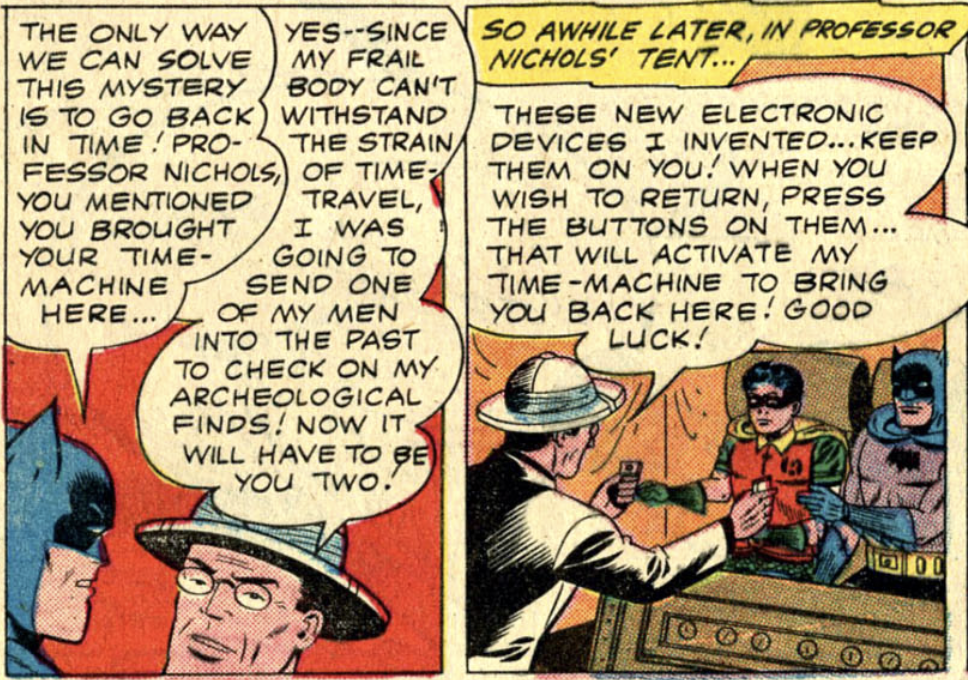
Batman receives an excited phone call from old friend (well, to be clear, he's an old friend to Bats, but we've never heard of the guy and probably will never see him again), Professor Nichols, who has stumbled across some insanely excellent find in the 'burbs of Egypt. Jumping into the Bat-plane (which is always cleared by the FAA, no matter where our heroes go), Batman and Robin jet to the "faraway rendezvous" and meet up with the excitable egghead. But this find proves to be more than just King Am-A-Toot's cigar holder or Princess Namamoka's brassiere; Nichols has found evidence that Batman lived in pre-BC Egypt!
 
Well, that's what we would surmise from the paintings found deep in an ancient structure, graphics depicting Bats fighting two gigantic Kaijus. One, a giant green guinea pig with a third eye on a stalk atop its head, suddenly materializes in the desert and attacks the explorers with a sizzling "disintegrating beam" emanating from its giant orb. Bats makes quick work of the thing by tying up the eye-stalk but, oddly, the creature disappears. Very soon, the other beast depicted in the comics on the wall takes its monster-brother's place, this one an orange beetle with deadly pincers. Quickly noticing that the monster has no eyes and must detect its enemies via its super-powered nostrils, Batman tosses a handy bucket of gasoline on the thing and it, too, disappears.

While this has been going on, Professor Nichols evidently thought it wiser to investigate the inner chambers of the temple and finds a third Sheldon Moldoff original on one of its moldy walls. This panel shows a scarlet-hued Batman and Robin standing before a pharaoh. Suddenly remembering an unimportant conversation our hero had with the uber-brainy Prof, Bats asks if the archaeologist happened to pack his time machine on this voyage. "Why yes! I did!" blurts out the absent-minded professor. The Dark Knight explains that the only way to get to the bottom of "The Secret of the Beast Paintings" is to go to the source, the Pharaoh himself! Disregarding the old standard that messing with the past screws up the present, the boys hop into Nichols's machine (which could double as a ride car at Disneyland) and buzz back to... whenever!

Entering the temple (which is now sparklingly new), our heroes are immediately assaulted and captured by a band of (what else?) aliens. Picture J'Onn J'Onzz with a yellow head and beak. The captain of the creatures identifies himself as Torg, from the world of Nakor, a planet far beyond our solar system, and further proclaims that he intends to invade and conquer Earth as a summer home for Nakorians. The creatures that attacked Batman in the present time were sent there to see if earthlings were easy pickings (or something like that--please don't stop to think about it) for the marauding band of space conquerors. Watching Batman battle his pets, Torg decides that humans are more clever than he suspected, so he heads back to his ship to discuss plans with his war council. (No, I don't follow the logic, either.)

While the beaked bastard is orating, Batman notices Robin hiding behind a pillar, but "the flaring end of his red jerkin is sticking out..." Torg doesn't seem to notice as he exits the chamber and Robin emerges to free his mentor. The two escape the temple and round up a group of friendly Egyptians to head back and defeat the aliens. Batman deduces that the reason Torg missed Robin is that the Nakorians don't see the color red, so he has Khau-Re, leader of the local Egyptian rumble gang, round up as much red dye as he can find. The Caped Crusaders paint themselves red and head back to the temple, where they cause quite a ruckus amongst Torg's henchmen. Realizing there's no way the Nakor Nabobs can defeat an invisible enemy, Torg packs his beaked bozos into his ship and blasts off into space. Our heroes zip back into the present and explain their crazy adventure to Professor Nichols, who admits that maybe this whole Butterfly Effect is a lot of hogwash. 

Yeah, there's the usual eye-rolling to be had in "The Secret of the Beast Paintings!" but I really enjoyed its ditzy logic and frenetic pacing. This time machine that Prof. Nichols brought along as an after-thought intrigues me. Why would any archaeologist bother digging when he has a time machine? Couldn't Nichols simply set the way-back machine for 23 B.C. and find out where all the good stuff was buried? In fact, wouldn't the gizmo fly in the face of whatever standards and practices the digger has upheld all these years? A time machine would effectively render an archaeologist unnecessary. Speaking of which, how does Nichols know what year to set his contraption to? Did the artist sign his name and date it? That Robin. Entrusted as number two to Gotham's savior, and yet the kid can't even hide behind a pillar. 

As enjoyable as the script may be, we really have to talk about Shelly's seeming inability to craft new alien designs that don't look suspiciously like the twenty that passed before them. Or perhaps the poor guy shouldn't be handed script after script of alien invasions (of course, his Gotham bad guys all look alike, too).

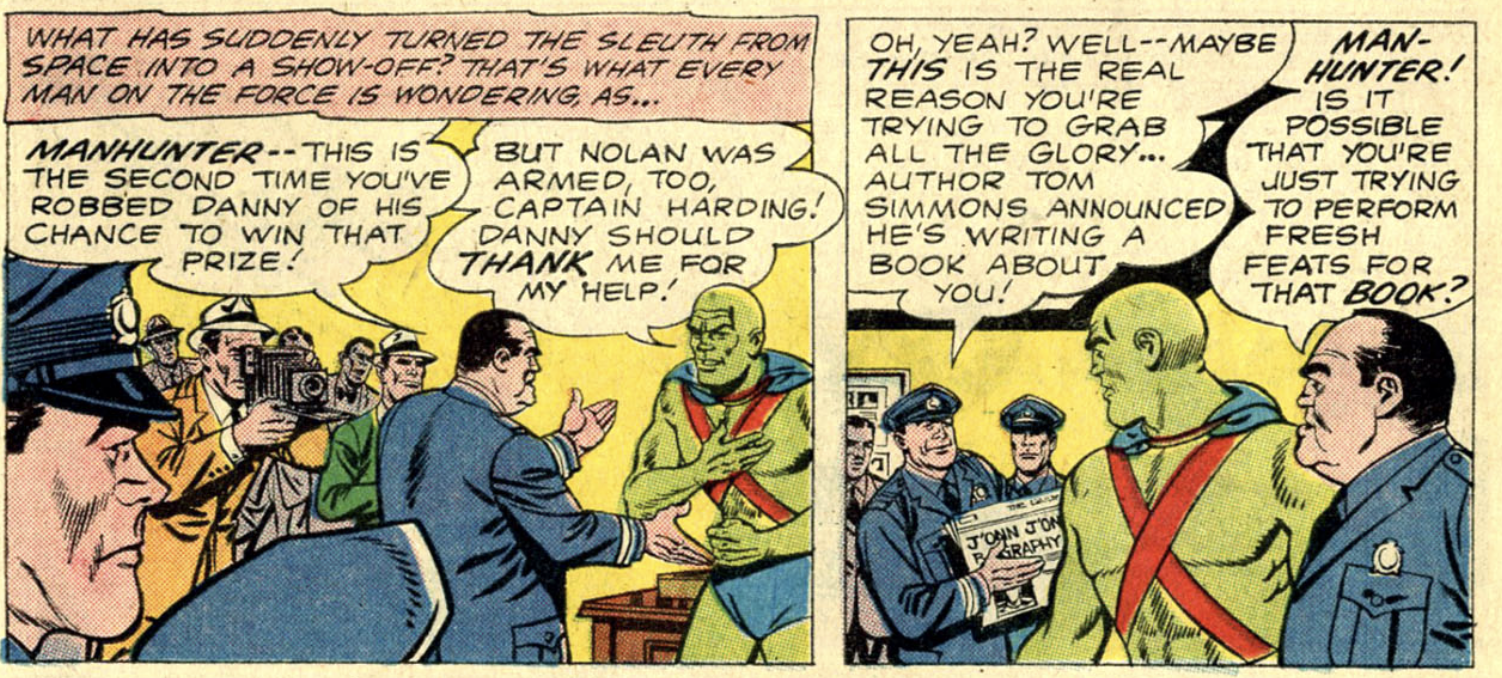
Patrolman Danny Jensen needs only one more arrest to nab him that coveted trip to Paris, where he'll study with the great French detective, Jacques Clouseau, but damn that Martian Manhunter for constantly butting in and nabbing the bad guys before Danny. Of course, J'Onn explains that the bad guys he's been apprehending are armed to the teeth with semi-automatics and dynamite, but the chief ain't buying it. He's had enough of "The Martian Show-Off"! Either the hero stands to the side and lets Danny get his man, or the chief will out J'Onn as a glory-hunter. J'Onn suspects something's up, so he follows Danny to a rural shack and discovers a gang of baddies holding the real Danny Jensen hostage. You see, one of the villains, Biff Stearns (!), needed a way out of the country and, with the help of some minor plastic surgery, became Danny Jensen. The free prize was the perfect escape, fingerprints be damned! The Martian Manhunter forgives the chief for his blackmailing tactics and allows Danny to collar Biff, thus winning the prize. Everybody wins... except for Biff!

Another simply dreadful chapter of DC's worst back-up feature (to be fair, I haven't read any of the other titles, so I'm just guessing but, I assure you, I will not put my theory to the test), with awful story and amateurish art. Imagine a police chief admonishing a superhero for bringing in a dangerous felon because his star beat cop can't get to one thousand arrests. Surely, there were hundreds of jaywalkers and candy store shoplifters to pad those stats.

Aquaman and Aquasquirt encounter a sea hermit who claims to have been cursed by an ancient Aztec sorcerer for daring to seek out a treasure chest. Now no one can approach the miser's ship without perishing in boiling water or octopus tentacles or being chained to a chair and forced to listen to Taylor Swift's entire oeuvre. Of course, in the end, it turns out the old hermit is actually Biff Stearns, a survivor from a recent Aquaman bust, disguised as a crusty old codger to keep the authorities off his tail. Below his ship lies an insanely elaborate set of gizmos designed to churn up the ocean. Aquaboys put the kibosh on the villain's plans and return him to jail. Broken record time... good art, lousy writing. It's amazing these tenth-rate hoods can figure out elaborate mechanisms but forget that a quiet shack in the back woods would probably attract less attention than churning boiling waters. I do love that this bad guy has set up this plot so that he and his sea pirates can wait out "the statute of limitations" on his crimes. At least he was trying to travel the straight and narrow path, eh?-Peter

Jack-My problem with Aquaman stories is that various fish escapades always have to be shoehorned in, not to mention the fact that the stories all take place in or around a body of water. It gets predictable. Unfortunately, also predictable is the mediocre quality of the J'Onn J'Onzz tales. They're at least readable, and the art meets minimum standards, something one can't always say about Atlas Comics, but the Martian Manhunter's adventures have a sameness to them that quickly gets tiresome.

That's not the case with the lead story, which I enjoyed a great deal, despite the aliens. I love stories about Ancient Egypt, so I was happy to see hieroglyphics portraying the Dynamic Duo. It only got better when they traveled back in time as if it were something we all do on a daily basis, and I liked the business with the aliens' not being able to see red.


Moldoff
Batman #143

"The Twice-Told Tale of Batman and Robin"
Story by Bill Finger
Art by Sheldon Moldoff & Charles Paris

"The Blind Batman"
Story by Arnold Drake
Art by Sheldon Moldoff

"Bat-Hound and the Creature"
Story by Bill Finger
Art by Sheldon Moldoff & Charles Paris

After Batman and Robin succeed in capturing Nitro Joe at his mountain hideout, Dick wonders how the story might be told far in the future. A story-teller would have the Dynamic Duo flying on Batwings, rather than using Whirly-Bats, and the stool pigeon they shake down for the location of the hideout would be a small genie with the power to transform into a giant serpent.

Instead of a shack, Nitro Joe (renamed Nidor) would live in a fortress atop a glass mountain, and the big lug outside would become a giant holding a massive club. Nidor is a wicked sorcerer who conjures up the symbols of the Zodiac in living form to battle Batman and Robin. However the story is told, the result is the same, and good triumphs over evil.

It's not quite Rashomon, but "The Twice-Told Tale of Batman and Robin" does a fair job of showing how mundane events can be reinterpreted as great heroics when viewed through the lens of history. Dick is reading a book at home in the evening after Nitro Joe's capture and remarks to Bruce that "the real facts about heroes like King Arthur have been exaggerated through the ages;" this level of thoughtfulness is often absent from Batman and Robin tales.

Dr. Pneumo blows the door off the Burke Street Bank vault by pumping the vault full of compressed air. Batman and Robin arrive before the doc can escape in his pneumatic car (hovercraft), but the doc knocks Batman off his feet with a blast of compressed air. Batman hits his head in the fall and is struck blind due to an optic nerve injury! The Dynamic Duo keep this development a secret from the public, as Batman uses radar earplugs to increase his hearing to compensate for his loss of sight.

The next day, Batman and Robin confront Dr. Pneumo as he attempts to rob a factory safe. All is going well until the doc dumps a box of tinfoil; when the pieces of metal float through the air, they interfere with Batman's radar, and he is unable to get over his blindness. That night, Dr. Pneumo deduces that Batman has lost his sight so, when the doc and his gang burgle the Yang Sung Curio Shop, the Dynamic Duo respond and plunge the space into darkness to even the playing field. Once again, Dr. Pneumo knocks Batman over with a blast of compressed air. Batman and Robin follow Dr. Pneumo to his hideout, where Batman easily captures the villain; his sight returned with his second fall!

Bill Finger takes a break this time out and Arnold Drake provides a fun script for "The Blind Batman." Dr. Pneumo is yet another one-time villain whose use of compressed air leads to fun developments. The cliche about going blind with one knock to the head and regaining sight with another allows Drake to show Batman figuring out some amazing ways to hide and get around his blindness; for once, this is a story that could have gone on longer and remained enjoyable.

Batman, Robin, and Bat-Hound trail the Yates Gang to a paper mill and capture most of them, but Bat-Hound disappears after the fighting ends. The Dynamic Duo find him near an astonishing scene: state troopers are shooting at a huge, alien creature that resembles a big red and green insect. Surprisingly, Bat-Hound jumps at a trooper who is about to fire on the alien! Why is Bat-Hound protecting the creature? Batman and Robin discover a space capsule and deduce that the creature emerged small but grew gigantic when exposed to the Earth's atmosphere. It was launched as an experiment from another planet and is confused and frightened, something Bat-Hound instinctively sensed.

When the crime-fighters are captured by Lippy Yates and his gang, the alien helps to free them, and the huge creature saves their lives by holding up a trestle bridge after Yates throws a bomb and blows it up. Yates is apprehended but the bridge collapses, killing the alien creature. As the sun sets, Batman and Robin bury the creature and erect a memorial to it; Bat-Hound lies next to the pile of stones, missing his alien friend.

"Bat-Hound and the Creature" takes a surprising turn halfway through when it's revealed that the alien creature is not a threat. The ending is surprisingly downbeat, with the creature dying and being honored with a memorial. Batman 143 is an unusually good issue!-Jack

Peter-What occurs to me after reading "The Blind Batman" is that the Caped Crusader's body took quite a pounding in the 1960s. The guy was super-sized, elemental, turned into an alien, baked in a giant cake, and now rendered blind. The other thing that occurs to me while reading two of the three stories in this issue is that Bill Finger was running out of ideas. Oh, Bill could still come up with some entertaining twists now and then, but most of these scripts (especially the shorter ones in the Batman title) are drivel. The best of the three is the imaginative "Bat-Hound and the Creature," simply because it made me laugh the loudest (well, except for the ending, which was sad and not at all maudlin). My favorite part of these space operas is when either Bats or the Boy Wonder steps out on a ledge and gives a perfectly reasonable explanation for what's going on ("People on another planet must've launched the small animal on a space experiment, just as we do--and the capsule drifted through space until it landed here" says Robin, as a very patient Batman nods his head, possibly in boredom), and that theory usually holds up. Oh, and I can't get enough of Bat-Hound with a mask on. Could you imagine Frank Miller doing Batman: Year Two with the masked mongrel at our hero's side?


Dillin/Moldoff
Detective Comics #296

"The Menace of the Planet-Master"
Story by Bill Finger (?)
Art by Jim Mooney & Charles Paris

"The Alien Bodyguard"
Story by Jack Miller (?)
Art by Joe Certa

"The Mystery of Demon Island!"
Story by Jack Miller (?)
Art by Nick Cardy

Holy solar system! The Dynamic Duo encounter their most dangerous and powerful foe since last issue's alien Egyptians! The Planet-Master! A villain who has designed his weapons and planned his heists around the (then) nine planets in our universe. The metal-melting fires of Mercury shoot from his wrists; he can summon the mists of Venus; make ordinary items grow to the size of Jupiter; and then there's the trick with Uranus. The guy even has multiple costumes!

Batman, using his skills as the World's Greatest Detective (and the fact that one of Planet-Master's discarded weapons actually has a manufacturer's label!), tracks the Planet-Master to the home of well-regarded genius, Professor Norbet. Waking Norbet, the Caped Crusaders climb through his bedroom window to interrogate the old timer. Norbet suggests that the Planet-Master has snuck into his lab and stolen some of the Prof's contraptions. Later, after Batman and Robin leave, the egghead opens his secret lab door and discovers the uniforms of the Planet-Master hanging right next to the Liberace outfit he wears to parties on Friday nights.

Norbet immediately calls Batman who, for some reason, happens to be hanging around a Gotham police precinct, and theorizes that the Planet-Master must be... Norbet's estranged assistant, Edward Burke, who stole some platinum from the Prof some time before. Batman tells the Prof to stay put and they'll be right there, but when the boys get there, the scientist is nowhere to be found. The Duo head to Burke's place and the ex-lab asst. admits he's been doing nothing since he was fired but reading the newspaper and listening to the radio; Bats works him over, demanding that the lazy bum hand over Professor Norbet. Burke pleads his innocence just as a bulletin screams out over the airwaves: "The Planet-Master, wearing a costume suggesting Saturn, has been seen at the Gotham Gold Refinery." Bats unhands Burke, admonishes him about the dishes in the sink and the dustballs in the living room, and hightails it, leaving Burke to scratch his chin and ponder a trip to his old boss's lab.

Batman and Robin arrive at the Gold Refinery and, sure enough, there's P-M dressed to the nines in a natty outfit resembling the sixth planet from the sun. The boys barely miss being sawed in half when P-M hurls his deadly rings. Realizing he's in a pickle, P-M nullifies gravity and propels himself through the air. Batman suggests to Robin that they head back to Norbet's to head off the master criminal. Meanwhile, at said laboratory, Burke finds the hidden closet just as Professor Norbet arrives, dressed as the Planet-Master! Burke hides and overhears Burke's expository: while opening up a meteorite, Norbet was exposed to an evil gas from another world, which overpowers his senses and makes him do bad things. Even though he has the wherewithal and time to design and manufacture nine different costumes and elaborate weapons, he also is granted full amnesia, so he doesn't even know he's a criminal by night.

Batman and Robin arrive and are, to say the least, nonplussed at the sight of the septuagenarian wearing tights. Burke takes advantage of the situation and explains to Norbet that together they can become the greatest crime force in the universe. Norbet agrees and then hurls a Saturn ring at Burke, directing Batman to take the man (who was, to be honest, a lousy lab assistant) to prison and claiming he knew nothing about his own evil deeds. Batman, becoming judge and jury on the spot, assures Norbet that he'll serve no time if he has anything to say about it. Everyone wins... except Burke!

"The Menace of the Planet-Master" is another masterpiece of excitement and lunacy, packed full of wild ideas and puzzling science facts. I love the twists and turns behind the true identity of the Planet-Master and it gives me some hope for my future that a 70+-year-old amnesiac can craft intricate toys and plots while juggling a full lab schedule. At least Bill Finger (?) addresses the age-old question, "Where does he get those fabulous toys?" when the Dark Knight discovers the Acme Criminal Weapon Plant stamp inside the P-M's "Growth-Dome." I only wish we had more pages to show us what Pluto could do.

Let's bring up a subject I usually avoid: the art. This is the first we've seen of Jim Mooney and it might just be the fact that it's an artist other than the bland and rote Sheldon Moldoff, but I really like our first look. The choreography is dynamic, the suits (as goofy as they may be) actually show a little originality, and the backgrounds are filled in with something other than a solid blue or yellow. There are things going on in these panels. I will say that the inking looks denser on pages 2, 3, 10, and 11; I'm not expert enough to say what's going on there, but it's a bold, refreshing look, and I hope we see more of it. For the sake of my sanity, if nothing else.

Once again, J'Onn J'Onnz must hide in the shadows and act as bodyguard for some poor sod, this time the gorgeous Diane Meade, who has been struck with temporary amnesia while investigating underworld boss, Biff Stearns Rocky Dawson. For some inexplicable reason, Diane's doctor thinks she should return to duty and that will jog her memory. This despite the fact, as J'Onn notes, Diane has forgotten everything she's learned about the judicial system and its practices. No red flags here! 

So now the Martian Manhunter must follow the beautiful blonde around the city and save her as she wanders from one calamity to another. Eventually, Diane finds herself wandering by the van where Rocky Dawson bases his multi-million-dollar crime empire and, just as J'Onn is about to save her, a huge fire engulfs a nearby building and drains the Martian Manhunter of his powers. The alien hero must dig his way underground, setting off still more gas fires and destroying a vast number of water pipes before emerging through the flooring of Dawson's crime wagon and saving the day. Suddenly, Diane's memory comes back, just as John Jones walks the bad guys to prison. Diane is justifiably furious that she missed the collar. Jack brought up in our last visit how the Martian Manhunter does very little besides spin and hide. I agree. In fact, how did this dope get his reputation as a hero when he gives all the credit to everyone else? There's being a nice guy and then there's being a wallflower. You only hope that when the Martian Mutilator starts to dig, he's not under a hospital that just might need electricity and running water.

Aquaman and AquaKid come to the aid of some dim-witted coastal residents who are being forced to donate their valuables to a sea demon who lounges atop a huge sea horse and holds a trident that shoots bolts of electricity. In the end, Aquaman unmasks the demon as a con man, taking advantage of the village idiots. I'm not sure why, but every time the boys encounter a semi-sorta-supernatural force, Aquatoddler swallows the mirage hook, line, and sinker, despite the fact that in 97.5% of all their adventures (based on exhaustive research conducted by yours truly, the hardest-working comics scholar in the industry), the demons are unmasked as crafty hoods with a lot of extra money lying around to pay for elaborate special effects. If I were Aquaman, the next time Aquakid says something along the lines of "Hey boss, it's all true, this really is the ghost of Davey Jones!" I'd backhand the twerp. Shelly could learn something from Jack Miller (?)'s creature design.-Peter

Jack-The Aquaman story was a bit better than the one in the last issue, though not by much. I like Cardy's art, but these stories suffer from the problem of everyone being fooled by masks and "underwater cycles" (whatever they are) that look remarkably like demons and seahorses. The Martian Manhunter story is silly; here, the patrolwoman gets amnesia after a blow to the head, unlike Batman, who suffered blindness. Lucky for her, her memory returns without a second blow.

I agree about the promise of the Batman story, due to the arrival of Jim Mooney. The cover is penciled by Dick Dillin, who will eventually draw Justice League of America for years and years, and it looks more exciting than any of the many Moldoff covers we've seen.

Next Week...
Mort Drucker invites you into...
The Locked Room!