Thursday, November 14, 2024

The Hitchcock Project-Forecast: Low Clouds and Coastal Fog by Lee Erwin [8.17]

by Jack Seabrook

"Forecast: Low Clouds and Coastal Fog" aired on CBS on Friday, January 18, 1963, and was the only episode of the Hitchcock TV series to be written by Lee Erwin (1906-1972). Born Irwin Lieberman, he wrote for TV from 1952 until his death and his credits also include co-writing an episode of Star Trek. "Forecast" is an original teleplay that is not based on a story or a novel; it is well-structured and suspenseful and it contains subtle social commentary addressing relationships between the sexes in the early 1960s.

The show takes place in and around a beautiful beach house that is supposed to be in Los Angeles County, California, judging from the uniforms worn by policemen in the show. The exterior shots of the house and the beach it sits next to were filmed in Oxnard, a city in Ventura County about an hour west of downtown L.A. The house is still there at 1101 Capri Way.

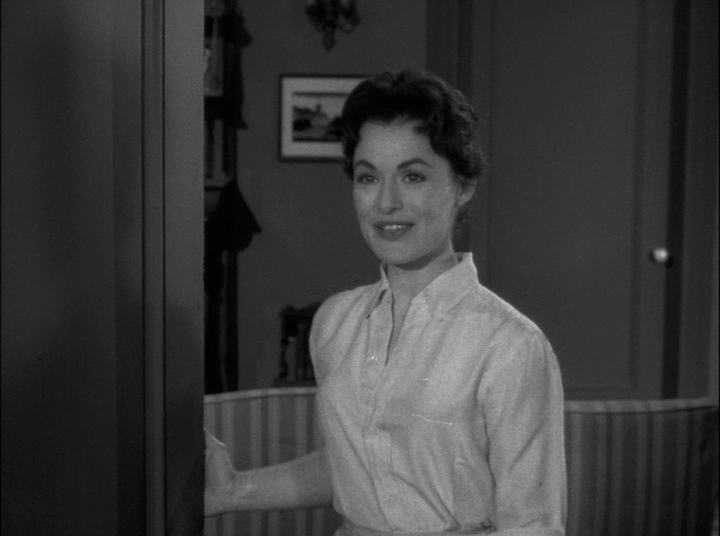
Inger Stevens as Karen Wilson
After an establishing shot of the isolated beach house at night, located at the edge of a fog-enshrouded beach, the scene dissolves to the interior, where Karen Wilson, an attractive, young, blonde woman, is alone, tending to a fire in the fireplace. A foghorn is heard blowing outside and she turns on the radio; a weather report says that visibility is at zero. She looks out of the sliding glass doors that separate the living room from the outdoor patio, which faces the beach and the Pacific Ocean. The telephone rings and her husband Stan is calling from San Francisco, where he is working on a business deal. The deal is not done, so he tells her that he has checked into the Mark Hopkins, a real luxury hotel that opened in 1926. He has to stay overnight and remarks that Karen has never spent the night alone in their house before. She tells him about the fog and he replies that it "'sounds cozy,'" instructing her to lock up, take a sleeping pill, and go to bed.

Karen hangs up the phone and, just as soon as she has locked the front door, the doorbell rings and ominous music plays on the soundtrack. Outside, a man with a Spanish accent tells her that he has had car trouble. She opens the door, which is on a chain, and when the man tells her that his car has run out of gas, she tells him to walk to a gas station half a mile down the road. Karen refuses to let the man in to use the telephone, even though he tells her that his girl is in the car and he does not want to leave her alone. Karen shuts the door in his face, cutting him off. After locking the kitchen door, she goes to the bookshelf and selects a book; on her way up the stairs to bed, she hears a woman scream outside and then the loud engine of a car roaring off. Karen goes to the front door and looks out but, seeing nothing in the dark and the fog, she goes upstairs to bed.

Dan O'Herlihy as Simon Carter
Later that evening, she is awakened when the doorbell rings again. She gets up, puts on a robe, and goes downstairs to admit Deputy Sheriff Geary, along with another policeman and Sanchez, the man who had earlier come to her door. He is now in custody. She confirms his story about having come to her house earlier that evening and learns that his girl is in the hospital; she was missing when he returned to the car with gas. Karen tells the deputy sheriff about hearing a scream and a car driving off and he tells her that Sanchez's girl was found about a mile up the beach, unconscious, her skull fractured. Sanchez angrily accuses Karen of leaving the woman alone outside to die, but the deputy sheriff reassures her and tells her that they will be patrolling the area all night.

After the police leave with Sanchez, Karen calls her husband in San Francisco and wakes him up. She is hysterical and he agrees to get a car and drive home right away, since the fog has grounded all of the planes. She spends the rest of the night asleep on the living room sofa. Karen is awakened in the morning by the doorbell; her neighbor Simon Carter enters and makes coffee, and they discuss what happened the night before. He is a writer who says that his alibi for the prior evening is that he was watching a TV show that he wrote, commenting that "'watching what happens to one's story is a form of masochism I don't usually practice,'" perhaps speaking on behalf of some of the writers of The Alfred Hitchcock Hour!

Chris Robinson as Rick
As they sit outside on the patio in the sun, the fog having burned off, he confesses that he falls for happily married women. Karen ignores his comment and admits that she feels responsible for what happened to the woman. Just then, a trio of surfers walk by on the beach carrying their boards. They call to Karen, who refers to them as her friends and offers them coffee. Simon says that he loathes the younger men and leaves. After he exits, Karen hears a car engine that sounds very much like the one she heard the night before, right after the woman's scream.

The first act of "Forecast: Low Clouds and Coastal Fog" sets Karen up as a woman alone in a remote, possibly dangerous setting. She refuses to help a suspicious male stranger, who represents the "other" because he is Hispanic and speaks with an accent. In contrast, Karen is portrayed as the ideal American woman, white, blonde, and well-off. Sanchez turns out to be innocent (at least, it seems that way at the end of act one), but his girl has been hurt by a person or persons unknown. Karen summons her much-older husband home to act as her protector. In the morning, another older man visits who implies that he also desires her; he seems suspicious, especially when she hears a loud car engine right after he leaves. At this point in the story, the surfers seem irrelevant, but that will change.

As the second act opens, the three surfers, whose names are Rick, Ed, and Tom, have replaced Simon on the patio and are having coffee and chatting with Karen. They encourage her to come surfing with them and, after brief resistance, she agrees. Later, her husband arrives home to an empty house, having driven four hundred miles in a hurry thinking that his wife was terrified. Instead, she is shown to be out in the ocean, surfing with the young men in a scene with unfortunately obvious rear-projection. She falls off her board and they rescue her as Stan runs to the water's edge. After the surfers have left and she is inside with Stan, he is upset at her for engaging in seemingly frivolous activity when he thought she was upset.

Peter Brown as Ed
Stan receives a telephone call that his deal has not fallen through as he thought, so he immediately decides to fly back to San Francisco with Karen, since the sun is out and the fog is gone. In one of the show's inexplicable decisions, she declines to accompany him, instead saying that if he cannot make it back by evening she will stay with their friends, the Baileys. Karen opens a desk drawer to get Stan's checkbook for him and sees his automatic pistol; she takes it out and brandishes it, joking that "'Anybody comes messin' around here I'll just pull out old Bessie and blast 'em.'" Stan demonstrates that Karen doesn't know what to do with the gun; he takes it from her, loads it, and engages the safety catch. The viewer familiar with the principle of Chekhov's gun expects that, if a gun is introduced in act two, it will most likely be fired in act four.

After Stan leaves and Karen is alone again, she telephones Deputy Sheriff Geary to ask about the injured girl, whose name is Marta Garcia. Karen drives to the hospital, where she encounters a doctor named Foster in the hall and asks him about Marta, whose condition is unchanged. From down the hall, Sanchez watches Karen; he angrily confronts her outside the elevator, telling her that her concern has come too late and insisting that, although she would have taken in a stray dog that came to her door, she would not let him in. She offers to help pay for Marta's medical care and he replies, "'You will get your chance to pay and I will be there to collect.'"

Richard Jaeckel as Tom
In act two, the surfers are introduced and they claim to have seen Sanchez fighting with his girl on the beach the evening before, which they think means he is guilty of the attack. Karen's poor judgment is shown when she goes surfing with them and has to be rescued; throughout the episode, she is portrayed as a helpless woman who makes poor choices. Another bad decision on her part comes when she declines Stan's invitation to come with him to San Francisco; instead, she plays with his gun, suggesting that she does not understand the gravity of her situation. She then goes to the hospital and is threatened by Sanchez, who seems dangerous yet unlikely to have attacked the girl, as the surfers assume. In fact, the most likely suspect at this point in the show is Simon, Karen's lustful neighbor.

Act three opens with Karen returning home from the hospital in a taxi; Stan has taken their only car, so she is unable to drive anywhere on her own. As the day goes on the fog again rolls in off the ocean. At the hospital, Dr. Foster and Deputy Sheriff Geary tell Sanchez that Marta has died. He is distraught and seems determined to exact revenge, driving to Karen's house after dark has fallen. Expecting Stan to return, Karen sets a candlelight dinner for two, unaware that Sanchez is outside the front door, trying to pick the lock. He peers in through the kitchen window before setting to work on the lock on the back door. Meanwhile, the events of the prior night begin to repeat themselves as Stan calls from San Francisco to tell Karen that the airports have shut down due to the fog and he cannot come home. This time, she says that she will go to the Baileys' house, unaware that Sanchez has successfully picked the lock on the back door and entered the house. As Karen dials the phone to make another call, he sneaks into the living room and runs up the stairs when he hears the back door opening.

Simon Scott as Stan Wilson
Karen hears it too and grabs the gun, only to discover that Simon Carter has walked in through the unlocked kitchen door. Karen points the gun at Simon, whose number she had been dialing, but he tells her to put it down and places it in the drawer of the living room's coffee table, unaware that Sanchez is watching their every move. Karen lies and tells Simon that Stan will be home at any moment, but he knows that she is wrong and pompously begins to speak about the basic drives that men have that led to the events of the prior night. Although Karen hears a noise upstairs, Simon continues to talk, theorizing that every man has a murderer inside him and speculating that the man outside in the fog the night before was overcoming frustration. He sits uncomfortably close to Karen and remarks that his goal is attainable; he grabs her and she fights him off and runs. Suddenly, the doorbell rings and Karen runs outside to encounter the three surfers in the dense fog.

Act three unfolds as a repeat of the events of the night before, with Karen trapped at home again by herself and Sanchez bent on revenge, blaming Karen for his girl's death in a show of misplaced anger because he does not know who is really responsible. Stan is once again incapacitated. Sanchez breaks in and becomes the first threat to Karen's safety; the second threat arrives in the person of Simon, whom Karen foolishly trusts. He acts on his lust and she runs out into the fog, since the interior of her home is now unsafe; she takes the place of the girl from the night before and again meets the surfers.

The final act begins as Rick, Ed, and Tom assure Karen that they will protect her. Sanchez runs back upstairs as they enter the house; we will later learn that he came downstairs and took the gun from the coffee table drawer after Simon left through the patio doors. The surfers think that Simon is the hidden threat, unaware that Sanchez is in the house, and Rick wields the fireplace poker as he and Tom search the second floor, Sanchez barely managing to avoid them as they go from room to room. In a Hitchcockian touch, the viewer's loyalties are momentarily transferred to Sanchez, as we fear his capture and thrill to his escape.
Christopher Dark as Sanchez
Finding no one, Rick and Tom return to the living room, where they discover that the sliding glass doors have been left open and realize that Simon left that way. Rick telephones the police, saying that he is calling from the Wilson house at Red Rock Point, a fictional location, and asks them to come to Karen's home. The scene that follows is chilling and finally reveals what has really been going on. Karen sits in the living room with the three surfers and they explain that they heard about the fog on the radio and that the planes had been grounded, so they decided to check on her. She says that she feels sorry for Simon and thinks he is sick. She begins to wonder why the police have yet to arrive and Rick begins to discuss the surfers' love  of "kicks"; Ed shuts off a table lamp and there is a subtle mood change as Simon and Sanchez have been forgotten and Karen thinks that she is alone with three young men.

Ed slides the chain on the front door to lock it and Karen begins to get scared. He turns off another light and suddenly the truth comes out as the surfers explain that they siphoned the gas out of Sanchez's old truck the day before. Fortunately for Karen, Sanchez is at the top of the stairs, watching and listening to every word. Now he knows who is responsible for his Marta's death. The surfers begin to threaten Karen, explaining that they ripped the phone lines out of the wall outside the house before entering and that the call to the police was fake. No one is coming to save her and they will have their way with her and then set fire to her house when they leave, expecting the police to blame Sanchez and preventing her from identifying them.

Karen pulls open the coffee table drawer, expecting to see the gun, but it is gone. She is pinned down on the sofa with a hand over her mouth. Suddenly, a gunshot rings out from the stairs and Ed is hit. Sanchez rushes down into the living room, holding the gun and standing over Tom, who begs for his life and receives a kick in the face. Ed lies on the floor, shot in the arm, as Rick runs out the sliding glass doors, over the patio and onto the beach. Sanchez runs out onto the patio and shoots at Rick, but Simon suddenly appears and tackles the surfer. Sanchez follows and holds the gun on Rick, who tells him to go ahead and shoot. Instead, Sanchez pulls the man to his feet and marches him back inside Karen's house. Simon apologizes to Karen outside on the patio and she bursts into tears as a plane flies overhead. The fog has lifted and the danger has passed.

Russ Thorson as Deputy Sheriff Geary
The last act cleverly plays with the viewer's emotions, transferring our loyalties to Sanchez as the surfers search the house for Simon, who has already left. The scene that follows is chilling, as the surfers' guilt gradually comes to light while the mood and the room darken. They are exposed as brutal, amoral men, whose only interest is in kicks and who are willing to rape and kill without remorse. Unexpectedly, Sanchez is the one to rescue Karen, aided by Simon! But in the end, who wins? The guilty are caught yet the women continue to suffer; Marta is dead and Karen has been through a harrowing experience.

The men in "Forecast: Low Clouds and Coastal Fog" are mostly varying degrees of bad. Stan, Karen's husband, is much older than she, a protective husband who cares more about his business than his wife. It's fitting that she wears a baby doll nightgown to bed, since Karen is essentially a baby doll for her older husband. Sanchez may come to the rescue at the end but that doesn't excuse his threats and we never know what he would have done if the surfers had not arrived. Simon may apologize to Karen at the end, but he was so overcome with lust for the "'happily married'" woman that he nearly attacked her before being interrupted by the arrival of the surfers, whose amorality and guilt tops that of any of the other male characters. Even the policemen and the doctor are unable to help either of the women.

The show is well directed by Charles Haas (1913-2011), who helmed only this single episode of the Hitchcock TV series. He started his Hollywood career as an extra before becoming an assistant director and then a director of documentaries and industrial films. After making training films for the Army in WWII he went back to directing industrial films before becoming a TV director in 1951. He continued directing until 1967, making a few films along the way, as well as four episodes of The Outer Limits.

Robert Millar (?)
Lovely Inger Stevens (1934-1970) plays Karen Wilson; she was in one other episode of the Hitchcock TV series, "My Brother, Richard." Born Inger Stensland in Stockholm, Sweden, she was on screen from 1954 to 1970 and also appeared on The Twilight Zone twice. She starred in the TV series The Farmer's Daughter from 1963 to 1966 and died of an overdose in Hollywood.

Creepy Simon Carter is portrayed by Irish actor Dan O' Herlihy (1919-2005), who started out as a stage actor in Dublin and appeared on screen from 1947 to 1998. He was a regular on The Travels of Jaimie McPheeters (1963-1964) and co-founded the Hollywood School of Drama with fellow Irish actor Charles Davis, who also appeared on several episodes of the Hitchcock TV series. "Forecast" was O'Herlihy's only role on the show.

Rick, who seems to be the unofficial leader of the trio of surfers, is played by Chris Robinson (1938- ), who started out on Broadway in 1954 and began acting in films in 1957, including playing the title monster in Beast from Haunted Cave (1959). He appeared frequently on episodic TV during the 1960s, including two episodes of The Alfred Hitchcock Hour (see "The Dividing Wall"). He wrote the screenplays for three films in the mid-1970s and also directed movies and TV shows during that period. As an actor, he had long-running roles on two soap operas: General Hospital, from 1978 to 2002, and The Bold and the Beautiful, from 1992 to 2005. Robinson's most recent acting credit was in 2022.

Greg Morris as Dr. Foster
Peter Brown (1935-2016) plays Ed, the surfer who gets shot in the shoulder. Born Pierre Lynn de Lappe in New York City, Brown appeared on film and TV from 1957 to 2005. He co-starred in the TV series Lawman (1958-1962) and was featured in several soap operas from the early 1970s to the early 1990s, including Days of Our Lives, The Young and the Restless, One Life to Live, and The Bold and the Beautiful. Brown appeared in one other episode of The Alfred Hitchcock Hour, "Death of a Cop," and there is a website devoted to him here.

The third surfer, Tom, is played by Richard Jaeckel (1926-1997), a recognizable tough guy from TV and movies who started his film career in 1943 and his TV career in 1951. He was on the Hitchcock series four times, including a key role in "Off Season." Jaeckel had regular or semi-regular roles in six TV series in his career; the most memorable was as Martin Quirk, the police captain on Spenser: For Hire.

Simon Scott (1920-1991) plays Karen's husband Stan; he was on screen from 1952 to 1985, appeared in three episodes of The Alfred Hitchcock Hour (including "Memo from Purgatory") and one episode of The Twilight Zone, and was a regular on the TV series, Trapper John, M.D. (1979-1985).

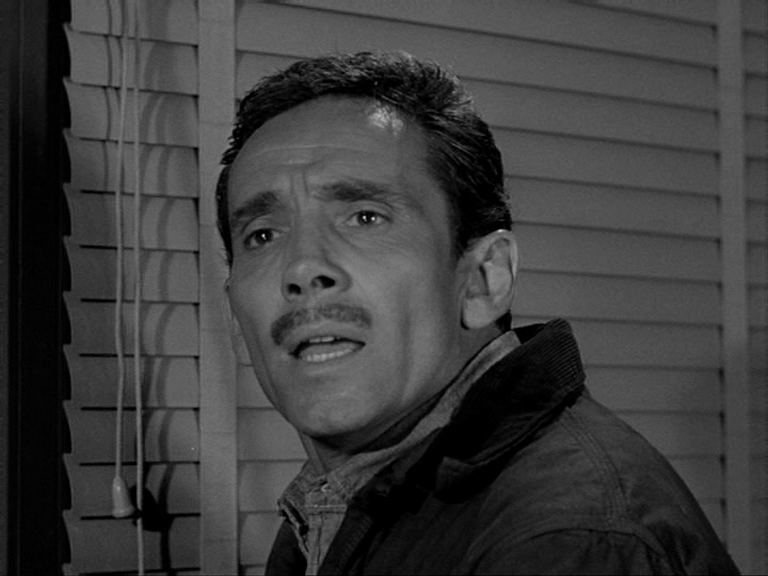
Christopher Dark (1920-1971) plays Sanchez. Born Alfred Francis DeLeo, he served in the Army in WWII and acted on screen from 1950 to his death, usually on TV. He was in one other episode of Alfred Hitchcock Presents.

In smaller roles:
  • Russ Thorson (1906-1982) as Deputy Sheriff Geary; he was on radio in the 1940s and on screen from 1949 to 1978, appearing once on Night Gallery and twice on The Odd Couple. He was in one other episode of the Hitchcock TV series, "The West Warlock Time Capsule."
  • Robert Millar is credited as Mitch and must be the second policeman who comes to Karen's house with Geary and Sanchez; he was on TV from 1960 to 1969.
  • Greg Morris (1933-1996) as Dr. Foster; he served in the Army during the Korean War and also appeared in "Final Escape" on The Alfred Hitchcock Hour. He was in one episode of The Twilight Zone and was best known for his long-running roles on Mission: Impossible (1966-1973) and Vega$ (1978-1981).
Kathleen Quinlan as Karen
This episode was remade for the late-1980s revival of Alfred Hitchcock Presents as "Fogbound," which aired on USA on October 8, 1988. Lee Elias is credited as the writer, though he had been dead for sixteen years. The episode is half the length of the original but appears to have used the same teleplay, which was cut and altered slightly by an uncredited writer. This version opens with a radio report stating that there have been three murders in the area in as many months, and the Wilsons' house is on a marina rather than a beach. Stan never appears and the trio of young men are seen sitting on a boat docked at the marina; there is no surfing. The doctor at the hospital is a woman this time and when Sanchez returns to Karen's house, he carries a switchblade.

Ric Sarabia as Sanchez
In the final scenes, Simon's attack on Karen is more aggressive, as he grabs her, pushes her down on the desk, and kisses her until she grabs the gun and hits him in the side of the head before running outside. At the end, Sanchez shots Tom and Ed in the chest before running outside, where he takes another shot at Rick and points the gun at Simon, telling him that he witnessed his attack on Karen. In the end, Sanchez tells Karen that "'I came here to harm you, but I couldn't have done it.'" She invites him into her home and the show ends as they walk together through the fog.

While this version as a whole is poorly acted and directed, Ric Sarabia gives a good performance as Sanchez and the additional dialogue between him and Karen at the end provides closure to his story that was missing from the original. Kathleen Quinlan plays Karen and Mark Sobel directed the show.

Watch "Forecast: Low Clouds and Coastal Fog" online here. It is not available on U.S. DVD. Watch "Fogbound" online here and compare the episodes.

Sources:

Grams, Martin, and Patrik Wikstrom. The Alfred Hitchcock Presents Companion. OTR Pub., 2001.

"Fogbound." Alfred Hitchcock Presents, season 4, episode 1, 8 October 1988.

"Forecast: Low Clouds and Coastal Fog." The Alfred Hitchcock Hour, season 1, episode 17, CBS, 18 January 1963.

IMDb, www.imdb.com.

Wikipedia, www.wikipedia.org.

Listen to Al Sjoerdsma discuss "The Hands of Mr. Ottermole" here!

In two weeks: "Diagnosis: Danger," starring Michael Parks!

Monday, November 11, 2024

Batman in the 1960s Issue 35: September/October 1965


The Caped Crusader in the 1960s
by Jack Seabrook
& Peter Enfantino


Infantino/Giella

Detective Comics #343

"The Secret War of the Phantom General"
Story by John Broome
Art by Carmine Infantino & Joe Giella

Commissioner Gordon calls on the Bat-Phone to let the boys know that Ralph Dibny, the Elongated Man, wishes to speak to them at the New Gotham Hotel but, while en route, they're distracted by a call from the police. There is a disturbance at Gotham City Terminal. Away they go!

When they arrive, they come across a heavily-armed group of thugs holding prisoners inside the building. Batman and Robin put the wham-bam-slam on most of the bad guys but, thanks to a special gas screen, a few escape down into the subway. They board a train and head off, free as the proverbial birds.

With nothing more to do at the site, the Dynamic Duo head for the hotel, where they find Ralph and Sue Dibny hanging out in their "spacious suite." Sue heads out to the Music Hall, cuz she's just a girl, and lets the boys talk manly business. Batman gives his stretchy friend the rundown on what just transpired at the Terminal and Ralph stutters out a "Wh-wh-what?" He then lets our heroes in on the big secret: General Von Dort, infamous Nazi war criminal who was presumed to have died in Hitler's bunker, is alive and well and vacationing in Gotham. Well, he does have a purpose. He's looking for a stash of the very radioactive M-244. If Von Dort does get ahold of the isotope, he can destroy the world.

At that moment, Von Dort's army parachutes into Gotham Park during a charity auction and attempts to heist a cache of priceless paintings. The Caped Crusaders arrive in time to put a dent in the plan but it turns out Von Dort had an ace up his sleeve; he had his henchmen commit the robbery while he was stealing the M-244 from a safe across town. He and his man Friday, Heinrich, then board a jet out of Gotham and fly to South America to assemble their super-secret death ray!

Batman, Robin, and Elongated Man hop in the Bat-Plane and give chase, landing just outside Von Dort's secret hideaway in the Andes Mountains. With the combined brain and brawn of three costumed heroes, Von Dort doesn't stand a chance. Even facing a deadly monocle eye-beam. Batman delivers the final right cross and freedom is restored to the world!

Not a bad little adventure, "The Secret War of the Phantom General." There are definite Big Bob Kanigher vibes in the script and, especially, that catchy cover. It screams "Sgt. Rock" cross-over, but we get Ralph Dibny instead. There are a couple of bizarre throwaway inserts here where John Broome explains what's going on. I'm not sure what the point was but the panels (one featuring a dart board with Julie's pic as a bullseye) are amusing. Von Dort is a one-and-done but his son, Willi (no, seriously, that's his name!), will battle Bats and "The New" Wonder Woman in Brave and the Bold #87 (January 1970).-Peter

Jack-My favorite parts of this overstuffed book-length story were the cameos by John Broome, which made me flip to the first page to confirm that there was no byline attributing the story to Bob Kane. On the letters page, the editor asks readers if they can figure out who wrote this issue's tale and, if so, how. I think that was a fun idea. The art isn't up to the usual high standards set by Infantino and Giella and Elongated Man didn't add much to a tedious issue.


Infantino/Giella
Batman #174

"The Human Punching Bag!"
Story by Gardner Fox
Art by Sheldon Moldoff & Joe Giella

"The Off-Again On-Again Lightbulbs!"
Story by Gardner Fox
Art by Sheldon Moldoff & Sid Greene

B.G. (Big Game?) Hunter is the world's best, but he wants to capture Batman to prove his mettle. He holds Roy Reynolds, "genius of the getaway gimmicks," (last seen in Batman #170) in a cage and makes him come up with a great crime and a super getaway to lure Batman into Hunter's trap. Robin is away on a Teen Titans adventure, so Batman responds to an alarm and beats up three crooks robbing a jewelry store, who manage to get up and run away.

When Batman gives chase, he is stopped by a leaf storm and ground sprinklers that cause him to stumble and crash into a park bench. The crooks get away, but Batman notices that they ran through butterfly bush flowers, so he can track the fragrance on them using a florameter. The trail leads to Hunter's mansion, where Batman again knocks around the hapless trio of crooks until he falls through a trap door and into a big plastic bag. Three boxers practice on "The Human Punching Bag!" but Batman uses guile to defeat them and B.G. Hunter.

B.G. Hunter? Seriously? Will he hire the law firm of Dewey, Cheetham, and Howe to defend him? This is juvenile stuff and a real letdown, especially in light of the terrific cover. Giella certainly makes Moldoff's art look better than Paris did, but it's still stiff and simplistic, just like the story.

After helping Robin catch the Islip gang, Batman rushes to the latest meeting of the Mystery Analysts of Gotham City, where a heavy, bald porter tells the members that it's Friday, not Wednesday, as they all thought. He uses a special chandelier to hypnotize everyone but Batman, who engages in fisticuffs and demands to know what's going on. The porter refuses to talk and, after he's sent to jail, Batman fears that the rest of the club members are in danger. The Cowled Crusader deduces that Al Cutshaw must be out for revenge; fortunately, he saves two of the club members from a bomb in the nick of time. The porter is unmasked as Cutshaw and Batman reveals that he was wearing contact lenses that prevented him from being hypnotized.

Slightly better than this issue's lead story, "The Off-Again On-Again Lightbulbs!" suffers from a plot that jumps around too much and depends on fistfights to move it along. The last page, where Robin pulls a bald cap off of the villain, is about at the level of a Scooby-Doo reveal. Not a good issue!-Jack

Peter-He's defeated super-strength cavemen, diabolical aliens from Uranus, and masterminds of crime, but Batman is foiled this issue by... a leaf storm. Sorry, a bit anti-climactic for me. Gardner Fox gets mileage out of "The Human Punching Bag" since its script is very similar to that of "The Crime Boss Who Was Always One Step Ahead of Batman!" in 'tec #344. "Off-Again" is lame with a capital L. Once again, I'll bemoan the atrocious art. One panel (reprinted below because my simple words cannot do it justice) seems to visualize a Batman punch that knocks a criminal's head off!

On the Letters to the Batcave page, an anonymous fan reveals that the fanzine, Batmania, conducted a poll to determine the best Batman story of 1964  and the award went to... "Castle with Wall-to-Wall Danger" from 'tec #329 (July 1964). Hard to argue with that choice.


Infantino/Giella
Detective Comics #344

"The Crime-Boss Who Was Always One Step Ahead of Batman!"
Story by Gardner Fox
Art by Sheldon Moldoff & Joe Giella

While doing their early morning rounds, Batman and Robin notice there's something a little off about sweet old Apple Annie, an octogenarian who donates fruit to the boys every morning. She seems to be nervous while handing over her prizes. They don't call him the World's Greatest Detective for nothin' and Batman's keen instincts tell him that the guy on the corner is watching their every move. 

Using his noodle, Bats parks around the corner and follows the shadowy figure to an apartment high atop a nearby building. Using his insanely sharpened senses, the Dark Knight is able to read lips (hanging upside down!) and learns the characters inside the room are about to pull a caper and are en route to a car parked outside the building. Using deaf-and-dumb sign language, Bats tells his junior crime-fighting partner to go hide in the boot of the car while he remains to see what's what. Robin does what he's told and the car speeds off, taking him far outside the city.


When the car finally stops and Robin hops out of the trunk, he's annoyed to find several gun barrels pointing right at him. The Boy Wonder gives it the old college try, knocking out two of the three hoods, but number three draws our hero out into the woods where the Teenage Tornado falls into an underground pit. It was all a trap! As if to put an exclamation point on the event, the hood that Batman has been watching outside the apartment building opens the window and tells Bats all about Robin's fate. "Always remember, Batman," the criminal mastermind explains, "Johnny Witts is thinking one move ahead of you every step of the way." He convinces Bats to come in from the cold and then brags about his heightened intellect.

Witts speeds for the door but when Bats follows, he finds himself nearly falling down a four-story elevator shaft. Witts escapes and the Caped Crusader survives only though his skilled training. Back at the Bat-Cave, Robin returns to find the boss already hard at work on a new theory revolving around Apple Alice. He's convinced that Alice isn't "an old hag" at all but a pretty young maiden. With the help of the Bat-Identi-Sketch-Kit, the duo is able to come up with an exact sketch of Annie. Rather than give their sketch to the cops (who never seem to be doing anything anyway), our heroes use their noggins and visit every fashion salon in town, finally unmasking Annie with the help of a seamstress, who also agrees to sew a tracker button onto Annie's latest dress.

The tracker works and the Dynamic Duo follow Annie to a brownstone, where they discover Witts and his henchmen. After some violent fisticuffs, our heroes turn Witts and Co. over to Gotham's finest (Bats had hung a giant donut and a "50% off Sale" sign outside the brownstone) and head back to the Bat-Cave to gloat over their latest victory.


There is some odd language used here that would not make it past 21st-Century censors; "old hag" and "deaf-and-dumb" have long been seen as less than complimentary but fall under the 1966 fair usage act for primitive phrases in funny books. Winning the Most Long-Winded Title of 1966 Award, "The Crime-Boss Who Was Always One Step Ahead of Batman Until the End When His Scheme Fell Apart" is nowhere near as much fun as "Phantom General" and the art... well, let's not go there again. The script is flimsy but readable. My favorite Bat-ism this issue would have to be the gizmo in the Batmobile that apes an engine fading off into the distance. Just how big is that crazy control panel?

On the Batman's Hot-Line letters page, future comic book scripter Mike Friedrich (his first pro sale will arrive in the June 1968 Batman) taunts Julie about the secret identity of the Outsider: "Actually, I think you yourself don't know who he is; making up the rules as you go along." I side with Mike.-Peter

Jack-Johnny Witts isn't much of a criminal mastermind. When the going gets tough, he clutches his noggin and complains that he needs peace and quiet to think of a way out. The highlight of this story occurs when Batman and Robin put on various disguises to follow the knockout gal around Gotham City. It sure beats hanging upside down trying to read lips!
Next Week...
More Uncanny Commie Tales!

Monday, November 4, 2024

Journey Into Strange Tales Issue 124: Atlas/Marvel Horror & Science Fiction Comics!


The Marvel/Atlas 
Horror Comics
Part 109
June 1956 Part III
by Peter Enfantino
and Jack Seabrook


Strange Stories of Suspense #9
Cover by Bill Everett & Carl Burgos

"Breaking Through the Time Barrier" (a: Joe Sinnott) ★1/2
"Nightmare" (a: John Forte) ★1/2
"Look to the Stars?" (a: Bob McCarthy) ★1/2
"The Unknown Man" (a: Mac L. Pakula) 
"Flight from Mars!" (a: Dick Ayers) 
"The Man Who Knew!" (a: Syd Shores) 

After crashing his time-travel plane, a scientist moves to a remote estate where his neighbors laugh at him until one day a UFO lands in his yard and aliens greet him, telling him he's on the right track and should just persevere, so he throws away his cane and greets the new day. You think my synopsis of "Breaking Through the Time Barrier" is alternately confusing and full of blueberry muffins? You should read the crap my words attempt to describe. Gorgeous Sinnott work is wasted on words that go nowhere.

No better is the inane "Nightmare," in which a jailbird dreams every night that he lives in another dimension. His prison psychiatrist tells him he must go into that world and face his demons, but it turns out the other world is his world and our world is a dream. Got that? Again, some striking graphics are wasted on juvenile twaddle. In "Look to the Stars?" a weatherman forecasts earthquakes, hurricanes, and tornadoes with uncanny accuracy. What's his secret? He's an alien, of course, receiving messages from another planet.

Jerry Hudson wants to skin-dive for treasure in the ocean but his mom says it's not safe and he'll always be her little boy, even if he is eighteen. Proving he's his own man, Jerry stands up to his mother by sneaking out his bedroom window and meeting up with buddy Slim down at the beach. The dive goes swimmingly but, while walking along the ocean floor, Jerry happens upon a deep-sea cave and enters. Astonished, he finds a set of stairs that lead right into his own house!

Acting as though nothing is wrong, Jerry puts on some clothes and asks his ma what's for dinner. She ignores him and Jerry, despondent, heads over to the clubhouse where his buddies hang out. Again he is met with silence, except for a man who berates Jerry and demands he pay the twenty-five bucks he's owed. What gives? Well, it turns out that stairway led to an alternate world that somehow blurred into our own world and... are you still awake? Let's just say that "The Unknown Man" makes four duds so far this issue, but the difference is that Pakula's art is dreadful.

Even though his Martian foster parents have always been kind and loving to him, orphan George wants to return to Earth to soak up the vibes. His real parents died shortly after their spaceship crash-landed on Mars, so all George has ever known is the red planet. George stows away on a rocket ship bound for Earth, but he gets a whale of a surprise when he gets there. Well, it's a big surprise to George but not to the reader (he was actually on Earth the whole time and the spaceship he boarded went to Mars), nor to this grizzled old Atlas vet or anyone paying attention to the title ("Flight from Mars!")

Genius Martin Cabell believes that six or seven great brains should be running the world instead of dopey politicians, but how does he get his message across? Luckily, his buddy, John, has invented a time machine so Martin can travel into the future and see if his idea would work. He makes the jump and lands hundreds of years in the future, where the population relies on those six or seven great brains to do everything for them. Mankind has become brainless, emotionless Tik-Tok viewers. Quickly, Martin jumps into the tin can, makes it back to the present, and tells John, "Yeah... never mind!" It's obvious the scripter of "The Man Who Knew!" wanted to make some deep statement on Communism and I admire that unknown scribe for rising above his colleagues this issue and actually pondering what might make a good story. But, in the end, the story is way too preachy (as these things often are) and we are left to wonder why Martin didn't foresee the ramifications of his big idea if he's got such a keen brain.-Peter


Strange Tales #47
Cover by Sol Brodsky

"When Mankind Vanished!" (a: Frank Bolle) ★1/2
"Overflow" (a: Tony DiPreta) ★1/2
"When Sorcerers Meet" (a: Bob McCarthy) 
"The Trial of Dr. Voltron!" (a: Ed Winiarski) 
"The New Member!" (a: Vic Carrabotta) 
"The Hands" (a: Jim McLaughlin) ★1/2

In "When Mankind Vanished," grumpy multi-millionaire Gregory Winston is sick of the unwashed masses he must wade through every day to get his business done. At the eye doctor one day getting new glasses, he mentions his disdain for anything that walks on two legs and the oculist scolds him and tells him he'd miss the warmth of fellow earthlings if he were ever alone. "Like hell," the man mutters and exits the office. Suddenly, the streets are empty, cars pass by without drivers, and buildings are erected without construction workers. He can hear their voices but he can't see them! 

Sure enough, within three panels, Gregory Winston wants companionship. Sure as the name of this comic is Strange But Uplifting Stories, the oculist was right. But when Gregory heads back to the man's office, the building has become a different storefront. Winston swears, as God is his witness, he'll find that strange oculist and get his vision back. Just once I'd like one of these selfish bastards to enjoy the fruits of their labor before being transformed into a caring individual. It's really sad to see how far the line has plummeted since the advent of the CCA. One of the great "what ifs" has to be: would the quality have declined without the witch hunt?

The government of an overpopulated Neptune sends a recon team to Earth in anticipation of a full-scale invasion, but the dopes land smack-dab in the middle of the production of a science fiction movie. Mistaking the special effects for a ready, willing, and able militia, the boys from Neptune head back with their tails between their legs. "Overflow" reuses yet another overused plot device, but I still have a soft spot for Tony DiPreta's unique style.

Helen tells Chris she's dumping him because he's poor and won't get a real job, instead insisting he's a great magician. With a heavy heart, Chris admits she might be right but, gosh, magic is so... magical! Luckily, he gets a good-paying gig at a birthday party and sets out in the rain to prove just how wrong Helen is, but the dope gets lost in the storm and ends up at a creepy, rundown mansion in the middle of the woods. Seeking shelter, he enters the building to find it filled with oddballs. 

Chris learns that the other men (and one gorilla) are there for the annual sorcerers convention. When they discover there is an outsider in their midst, the wizards attack. Convincing them he's a wizard too, Chris escapes and heads home to Helen, promising his life as a magician is over. Tomorrow, he'll get a job running numbers. My gosh, this post has been filled with even more dogs than usual. The only highlight of "When Sorcerers Meet" is when Helen tells her beau she's not marrying him because his lack of a bank account will lead to quarreling. Good point, but why in the climax is she taking the guy's word for it that things are gonna change?

At "The Trial of Dr. Volton," the brilliant scientist is accused of sending his son up into space in a rocket ship but, as we learn in the twist climax, son Eddie is just a robot. The Winiarski art is pretty rough but the script elicits a few giggles. In "The New Member," Compton, a man from outer space, seeks to join a hunter's club on Earth since they don't have lions and rhinos back on Pluto. In the climax, Compton takes one of his new friends for a ride in space in his convertible space car (without aid of oxygen or any of that annoying stuff), proving once and for all that life in the 1950s was very cool.

In the preachy finale, "The Hands," a pair of disembodied hands appear in a stinkin' commie country that looks a heck of a lot like Russia, floating through the air, heading for the palace of dictator Grigor. Turns out the hands belong to Torloff, the country's "last Democratic leader," who was slain during Grigor's rise to power. Torloff, who can somehow speak through his hands (yeah, yeah, I know, this is a story about floating hands... so what if they can talk...), explains that he's there to avenge his own death and restore freedom to the (unnamed, but clearly the USSR) country. 

When Grigor's henchmen raise the possibility that the hands might be right, the dictator pulls out his Makarov to shoot them dead but the bullet ricochets and kills Grigor instead. Peace and harmony are restored to (whatever this country is called). Dreary and pretentious, two adjectives that should not be applied to a funny book strip. Artist Jim McLaughlin (who penciled only one other Atlas tale, "The Wrong Man," back in Strange Tales #32) gets the job done; he's neither awful nor brilliant, but my eyes didn't bleed (as they tend to do while looking at Dick Ayers's work) so there's that. I have to parrot Jack in that the Atlas tales seem to be getting worse and worse; trite and lazy.-Peter


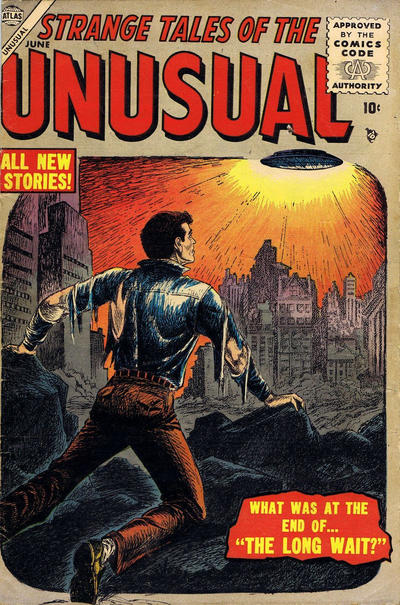
Strange Tales of the Unusual #4
Cover by Carl Burgos

"The Long Wait!" (a: Paul Reinman) 
"The Life Saver!" (a: John Forte) 
"Flames of Fury!" (a: Bill Benulis) ★1/2
"The Warning Voice" (a: Tony Mortellaro) 
"The Talking Horse! (a: Bob Forgione & Jack Abel) ★1/2
"Mission to Jupiter" (a: Bob Bean) 

As two archaeologists named Henry and Agnes explore an underground vault in Egypt, they discover what appears to be a guardian statue that seems to move! Putting it down to a case of the jitters, they round a bend and discover a fleet of solar ships and a scroll that tells a strange story. Agnes deciphers the hieroglyphics and learns that it was written by Torus of Mandu, a planet that orbits Earth's sun far more distantly.

The Mandurians flew to Earth long ago in their solar ships and, because their orbit around the sun takes so long, the minutes that their trip takes equal millennia in our time. When they reached Earth, they found hostile cavemen and hid underground. All of the Mandurians were rescued except for Torus, who was still hiding, and he began "The Long Wait!" on Earth. Henry and Agnes realize that what they thought was a statue was really Torus but, when they run back to where they saw him, they see that he has been rescued and is being taken home in a flying saucer.

Among the many puzzling aspects of this sub-par tale is why Torus would move so slowly and last so long when he and his fellow Mandurians were moving perfectly well when they encountered the cavemen. The point of the story seems to be that the concept of time on Mandu is so different than ours that his wait of thousands of Earth years was equal to minutes in Mandurian time. Sadly, Paul Reinman's art is some of the worst I've seen from a very good artist.

As Craig Parker walks through a train terminal, he sees an old man nearly fall from a high walkway. Craig is "The Life Saver!" and catches the man before he falls. Unfortunately, important papers fall from Craig's pocket and are immediately swept up by a maintenance worker and tossed in an incinerator. Craig explains that the papers were the only proof that existed that he owned property, which he had planned to sell in order to raise money to get married. The originals burned in a courthouse fire in 1895.

The old man encourages Craig to continue on his way and Craig boards the train to Fairview. When it stops an hour later. Craig's head is spinning and he feels compelled to exit the train. He finds himself in Fairview in 1895 and runs to the courthouse, where he rescues the papers before they burn. He gets back on the train and soon finds himself at the lawyer's office, holding a singed sheaf of papers that prove he owns the land. Outside the window, the man he saved, Father Time, is glad that he turned back time for a while to help Craig.

It was obvious from the first page that the old man was Father Time, so the ending was no surprise. John Forte's art is serviceable. Once again, I feel like Rod Serling was mining old Atlas comics when he wrote episodes of The Twilight Zone--this one reminds me of "A Stop at Willoughby." Crazy, I know.

Tom Jordan, an experienced forest ranger, calls in a report that he saw flames, but when the chief arrives, he sees nothing. Later, Tom sees them again, investigates, and discovers flames shaped like people emerging from a hole in the ground. The "Flames of Fury!" tell Tom that they come from Earth's molten core and want to come up to the surface, where there is light. A bit of rain scares them, so they take off into space in a big ball and Tom is the only one who knows where a mysterious comet came from.

The GCD and the signature on page one say that Benulis drew this, but the long faces of the human characters remind me of the work of Mort Lawrence. The story is a dud but I like how the flame people are drawn.

A redhead named Phineas Ferguson is looking forward to seeing a movie called Tough Guy from Tulsa at the local theater, but he's not interested in the eight vaudeville acts also playing. Accidentally shoved by another man in line, Phineas drops a quarter and it rolls through a grate and into a sewer. He hears a voice urging him to go down below and find his quarter, so he climbs down a ladder into the sewer and finds the coin.

"The Warning Voice" tells him to keep looking, so Phineas finds more change, gets lost, and emerges in the Middle Ages, where knights bring him before the king. The voice tells him to light a cigarette and turn on his portable radio; the king is amazed and appoints Phineas the royal magician. Phineas makes a run for it and returns to his own time. In the theater, he watches the vaudeville acts until he hears the warning voice again and sees that it's the voice of a ventriloquist onstage who is talking to a wooden dummy that looks just like Phineas!

Huh? Only Carl Wessler could create such confusion in the space of a mere four pages. It was bad enough that Phineas traveled through time and back again, but the conclusion with the ventriloquist came out of left field. Again, a Twilight Zone episode comes to mind--"The Dummy."

Billy Ross sneaks out of bed every night to talk to the horses in his dad's corral. When Pop finds out, he forbids Billy from maintaining his nightly ritual. Billy insists that one horse answers back, but his dad won't hear of any discussion of "The Talking Horse!" Every night at midnight, Billy sits by his window, looking out at the corral and waiting for Conrad, the talking horse, to appear. One night, Conrad stops coming. A week later, in the woods, Billy encounters Conrad, who says that his existence will be their secret because the world doesn't believe in... centaurs!

At three pages, this story seems long, and the surprise ending is just creepy, especially since Billy has his hand placed on the centaur's waist.

Emperor Taarg knows his subjects on Jupiter will revolt unless their work is lessened, so he sends a flying saucer to Earth to bring back an Earthling to see if they would make good workers. On Earth, Professor Keller and his musclebound assistant Harold happen to see the ship from Jupiter land nearby. That's handy, since the prof wants Harold to go to Jupiter to take pictures that will prove that there is life on that planet.

The aliens capture Harold and bring him back. He soon astounds them with his feats of strength but, when he takes out his camera to photograph them, they think it's a weapon and go nuts. When Harold is chased and cornered, he uses his strength to destroy the palace, leading the emperor to order that he be sent back to Earth, since Earthlings would surely take over Jupiter if they were brought as workers. Professor Keller welcomes Harold back and opens his chest to make a few adjustments--Harold is a robot.

Another convoluted mess of a script by Carl Wessler is saved by the final panel, which caught me by surprise. Bean's artwork is average at best, but I gave this story two stars simply because I did not guess the ending in advance.-Jack

Next Week...
An Extra Long (yuck, yuck, get it?)
Adventure Co-Starring
The Elongated Man!

Thursday, October 31, 2024

The Hitchcock Project-The Indestructible Mr. Weems by George F. Slavin [2.37]

by Jack Seabrook

The Knights of the Golden Lodge have a problem. The four board members meet and recite their pledge: "'We, Knights of the Golden Lodge, pledge ourselves in brotherhood unstintingly to help our fellow members and those less fortunate than ourselves.'" Cato Stone, currently in charge, sits in a large, wooden, throne-like chair at the head of the table and leads the discussion of the difficulty they have been having in selling plots in their new cemetery, which they have recently renamed Elysium Park in an effort to make it more appealing.

Brother Elkins fondly recalls when the cemetery was a golf course and Harry Brown comments that no one wants to be the first to sign up. He mentions Clarence Weems, whom no one has seen at lodge meetings recently, since his wife died, his business went sour, and he got sick. The poor man is not expected to live out the year. Brown proposes a solution: the lodge will offer to pay Weems the sum of fifty dollars a week if he will agree to be the first person buried in Elysium Park.

Robert Middleton as Cato Stone
The foursome agree to give it a try and visit Brother Weems, who lives in a fourth-floor walkup apartment. After they trudge up the stairs, Weems's pretty daughter Laura greets the lodge members at the door. Cato is noticeably winded from the climb. To the surprise of three members, Laura is dating Harry and reminds him that he is taking her to the movies tonight. Harry confesses that their wedding had to be postponed last December but, before he can explain why, they are summoned into Clarence's bedroom, where he lies in a large, four-poster bed and admits that he may not last much longer.

Cato makes an "'honest business proposition'" and Weems points out that Stone's real estate office handled the sale of the golf course to the lodge. Weems accepts the offer, remarking that "'it has the sound of an honorable arrangement,'" and signs a contract. He tells the lodge brothers that, now that Laura knows he has been taken care of, she can give up her job and get married; Cato shoots a look at Harry, aware that he will also benefit from the arrangement. Brodsky optimistically assures Cato that Weems won't last a month.

Joe Mantell as Harry Brown
After Cato and the other lodge brothers leave, Mrs. Collins, Weems's neighbor, brings him chicken broth, but he perks up and says that he feels like a steak. He also surprises her by complimenting her appearance and telling her, "'Call me Clarence.'"

Sometime later, at another board meeting, Brodsky remarks that Harry is getting married next month and Harry opens an application for active membership from Clarence Weems, who enclosed six months' worth of dues. Elkins rushes in to announce that he saw Weems walking with a woman in the park and looking very healthy! The four men head back up the three flights of stairs to check on Weems, with Cato looking visibly winded at the top and fanning himself with his hat, only to have Laura answer the door and say that her father is napping and can't be disturbed. Brodsky looks on the bright side and suggests that perhaps Clarence is just holding on until his daughter's wedding.

Russell Collins as Clarence Weems
At a lodge dance, Cato is shocked when Clarence and Mrs. Collins enter and Weems buys two tickets. Cato calls an emergency board meeting and accuses Harry of fraudulently talking the others into the scheme to support Weems so that he could marry Laura. Harry fires back that Cato's firm got the commission for the sale of the old golf course. They agree to speak to Clarence's doctor to find out how sick he really is.

Back in the Weems apartment, the board members uncomfortably share a sofa as Laura serves coffee. Dr. Allen emerges from Clarence's bedroom and explains that Weems had given up and was wasting away until the lodge gave him a reason and a will to live. The doctor compliments the men for having "'brought a dying man back from the grave.'" Stone, Elkins, and Brodsky leave while Harry stays with Laura.

At another board meeting, the brothers try to figure out how to stop the financial bleeding. Cato suggests offering Clarence $500 to tear up the contract and the others agree that it's worth a try. They climb the three flights of stairs again, with Cato rushing at first but getting progressively more winded. On the fourth-floor landing, Weems is seen pushing a heavy piece of furniture toward Mrs. Collins's apartment; when Cato sees this he cries out, "'Look! He's as strong as an ox!'" and collapses, dying of a heart attack at the top of the stairs. Dr. Allen arrives on the scene moments later and explains that Stone's heart failed because he was climbing three flights of stairs every week to check on Weems.

Don Keefer as Elkins
At Cato's funeral, there is a large flower arrangement donated by Clarence, who admits that he also gave Stone his cemetery plot: "'It was the least I could do; he tried dreadful hard to make a success out of this place.'"

"The Indestructible Mr. Weems" is a wonderful, comedic episode of Alfred Hitchcock Presents with an original teleplay by George F. Slavin that is a textbook example of story construction. There is no murder or crime at all, beyond some questionable ethical decisions by two of the lodge brothers: Cato Stone profits off of the sale of the golf course to the lodge to be used as a cemetery, and Harry Brown frees his girlfriend from the burden of working to care for her father by talking his lodge brothers into providing a steady stream of income for the older man. The surprise ending, where Cato Stone collapses from a heart attack, is set up beautifully by having him display a temper and by showing him get tired every time he has to make the long ascent to Clarence Weems's apartment, yet there is never a sense that he is in danger until the end.

Harry Bellaver as Brodsky
Stone and Weems are on opposite trajectories during the episode; Stone starts out seeming hale and hearty, only to decline and suffer a fatal cardiac event at the end, while Weems begins the show in bed, lamenting the short time he has left to live, only to improve steadily throughout the tale until, in the end, he outlives Stone. The direction of the show by Justus Addiss is excellent, using only a few minimal sets to tell an engaging and fast-moving story. Funniest of all are the stairs leading up to the Weems apartment; each level is clearly the same set, but on the first level there are two framed pictures on the wall, while on higher levels the walls are bare. The design of the lodge meeting room is also effective, with Stone's large, ornate chair demonstrating his seeming power and influence in what is really a social gathering place for local businessmen.

The Alfred Hitchcock Presents Companion quotes Slavin as saying that this was the first comedic episode of the series; earlier episodes had had humorous elements but this does appear to be the first one not focused on crime or murder. Slavin added that a rabbi told him the story that became "The Indestructible Mr. Weems" at his father's funeral! He comments that the production was kept quiet from Hitchcock, who was on vacation at the time and who was not in favor of comedies on the series. In the end, Slavin said that his teleplay was nominated for a Writer's Guild award.

Rebecca Welles as Laura Weems
George F. Slavin (1916-2001) served in the Air Force in WWII and then wrote for film and TV from 1947 to 1980. In addition to writing this episode of Alfred Hitchcock Presents, he wrote an episode of Star Trek. His papers are held at the University of Wyoming.

Director Justus Addiss (1917-1979) worked in television beginning in 1953 and directed ten episodes of Alfred Hitchcock Presents, including "A Bullet for Baldwin." In his private life, he was the lifetime companion of Hayden Rorke, who played Dr. Bellows on I Dream of Jeannie. Addis worked almost exclusively in television, from 1953 to 1968. He also directed three episodes of The Twilight Zone. His only feature film was The Cry Baby Killer (1958) for producer Roger Corman; this film was notable for being Jack Nicholson's first onscreen role.

Gladys Hurlbut as Mrs. Collins
Leading a terrific cast of character actors is Robert Middleton (1911-1977) as Cato Stone. Middleton was a formidable presence on TV and in films from 1951 to 1977. Born Samuel Messer, he was on Alfred Hitchcock Presents three times, including "Crack of Doom," and he was on Thriller twice.

Joe Mantell (1915-2010) plays Harry Brown. Mantell appeared twice on Alfred Hitchcock Presents; his other episode was "Guilty Witness." He was on screen from 1947 to 1990, appeared twice on The Twilight Zone, and had a role in Hitchcock's The Birds (1963). Film fans will best remember him for delivering the final line in Chinatown (1974): "Forget it, Jake, it's Chinatown."

Theodore Newton as Dr. Allen
The indestructible Clarence Weems is played by Russell Collins (1897-1965) in one of ten appearances on the Hitchcock TV show. A wonderful actor whose stage career began in the 1920s, he began appearing in films in the 1930s and on TV in the early 1950s. Most of what we see of him today is from later in his career, such as his role in "Kick the Can" on The Twilight Zone and his appearances on the Hitchcock show, including Fredric Brown's "The Night the World Ended."

In smaller roles:
  • Don Keefer (1916-2014) as Elkins; a familiar face to viewers of The Twilight Zone from his role in the classic episode, "It's a Good Life," he was in three episodes of that series and three episodes of the Hitchcock series, including "The Percentage." Keefer had a long career on screen, from 1947 to 1997, and was also on Star Trek and Night Gallery as well as being part of the original Broadway cast of Death of a Salesman (1949-1950).
  • Harry Bellaver (1905-1993) as Brodsky; a veteran of stage, screen and television, he appeared on Alfred Hitchcock Presents twice (see "Silent Witness") but is best known as one of the policeman on Naked City, appearing in nearly every episode of the series, which ran from 1958 to 1963.
  • Rebecca Welles (1928-2017) as Laura Weems; prior to 1957, she acted under her real name, Reba Tassel. She was married to director Don Weis and appeared in four episodes of Alfred Hitchcock Presents, including "Backward, Turn Backward." Her career was mostly on TV from 1951 to 1964.
  • Gladys Hurlbut (1898-1988) as Mrs. Collins; she worked on Broadway from 1920 to 1949 as both an actor and a playwright before starting a screen career that lasted from 1951 to 1961. She was in one other episode of Alfred Hitchcock Presents, "The Perfect Murder."
  • Theodore Newton (1904-1963) as Dr. Allen; he was on Broadway from 1928 to 1951, in films from 1933 to 1963, and on TV from 1949 to 1963. He was in seven episodes of the Hitchcock show, including "O Youth and Beauty!"
Watch "The Indestructible Mr. Weems" here or order the DVD here. It aired on CBS on Sunday, June 9. 1957. Read the GenreSnaps review here.

Sources:

Grams, Martin, and Patrik Wikstrom. The Alfred Hitchcock Presents Companion. OTR Pub., 2001.

IMDb, www.imdb.com.

"The Indestructible Mr. Weems." Alfred Hitchcock Presents, season 2, episode 37, CBS, 9 June 1957.

Wikipedia, www.wikipedia.org.

Listen to Al Sjoerdsma discuss Fredric Brown's "The Night the World Ended" here!

Listen to Annie and Kathryn discuss "The Indestructible Mr. Weems" here.

In two weeks: "Forecast: Low Clouds and Coastal Fog," starring Inger Stevens!