Thursday, January 19, 2023

Journey Into Strange Tales Issue 78: Atlas/ Marvel Horror


The Marvel/Atlas 
Horror Comics
Part 63
April 1954 Part I
by Peter Enfantino


Syd Shores
Adventures into Terror 30

“They Fly By Night” (a: Bob Correa) ★★1/2

(r: Giant-Size Dracula #5)

“The Dead Don’t Sleep” (a: Al Eadah) 1/2

“The Man in the Shadows”

“Don’t Nod” (a: Sy Grudko) ★★★

“A Scream in the Night” (a: Vince Colletta) 1/2

(r: Vault of Evil #20)


John Burton and his wife take their son,Tom, on a trip to Hungary but at the inn where they stay, they are attacked by a vampire. Tom survives but both his parents die and are buried in a local cemetery. Tom grows up hating vampires, swearing some day to return to the village of Mirov to avenge the death of his parents and, once he’s a grown man, he does just that. He stays at the same inn and leaves his window open at night, hoping to attract the monsters. The bait is taken but Tom is horrified to see the vampires are his parents, come to convince their son to join them in undeath. Our final panel shows Tom walking towards the two vampires, but will he join them or stake them? “They Fly By Night” contains the first of four contributions to the Atlas catalogue by artist Bob Correa, an adequate and sometimes atmospheric penciler, known primarily as one of the initial artists on Dell’s popular Turok, Son of Stone.


In “The Dead Don’t Sleep,” the spirit world becomes quite tired of being disturbed by a local seer so they put an end to the medium's career. Almost a quasi-sequel to last issue’s “The Horrible House” in that Al Eadah resurrects the same ghosts that haunted that tale. A bank teller meets an exotic woman who has expensive taste and embezzles five grand to keep her happy. The money is lost at a roulette table and the dope discovers the girl is a con artist. He kills her and her partner in a lust-filled spree of violence. But who is “The Man in the Shadows” and why does this all seem like deja vu all over again? Never mind. The answer is not worth your trouble.


Communist tyrant Chung-Ku abhors the modern methods of genocide and asks his master assassin, Li-Po, to put aside the machine gun and perfect his sword skills. Li-Po does his master proud, crafting a weapon that leaves nary a hair out of place on the dead noggin. Unfortunately for Chung, all despots fall some day and, very soon, he becomes next in line for Li-Po’s blade. Chung talks his old friend into simulating the execution and allowing him to walk away just for old time’s sake. Li agrees and come the dreaded deadline, Chung swears he feels the blade fall but his head still sits upon his shoulders. Later that day, after escaping, Chung calls to thank the headsman, only to hear the warning, “Don’t Nod.” Perplexed, Chung turns his neck and loses his head. These “red scare” strips were usually pumped out by Stan, but he was busy with Menace about this time and I can’t see “The Man” not signing the splash, as was his wont. “Don’t Nod” has a steady pace, telling its story at just the right speed. Most of us know how this will end but the climactic panel, of Chung sans head (as ludicrous a concept it is), is a hoot. 


Wrapping up this issue is “A Scream in the Night,” the tale of Kent, a washed-up horror writer who stumbles onto a satanic cult in the forest and must swear (with his blood) never to tell a soul what he’s seen. Unable to control himself, Kent writes what he believes to be a dynamite story revolving around, what else?, a meeting of devil worshippers in the forest. The members of the cult don’t take this betrayal lightly and, through a series of events, have Kent committed to an asylum. 


Harry Anderson
Adventures into Weird Worlds 28

“Heads Will Roll” (a: Paul Reinman) ★★★

“The Supreme Test” 1/2

“In the Bag!” (a: Doug Wildey) ★★1/2

“The Strange Shop!” (a: Ed Moline)

“From the Dead” (a: Sam Burlockoff) ★★1/2


In 16th-Century London, James Jurgens is in charge of hoisting, on poles, the severed heads of those convicted and executed. The Crown pays Jurgens a good salary to maintain the grisly poles, so when there is a downturn in violence in the city, the headsman has no problem accusing innocents of bad behavior in order to earn a living. One night, while admiring his handiwork, Jurgens hears the severed heads whispering to each other. As two guards pass, one of the heads screams out that a man is trying to burn the bridge down and, in the scuffle, Jurgens is beheaded. Soon, his noggin rests alongside those he accused. Though the climax is one hundred per cent predictable, the morbid sight of staked heads leaning against the rail of London Bridge makes “Heads Will Roll” a deliciously sick pleasure.


The Commies kidnap scientist James Vance, who has invented a revolutionary new A-Bomb, one that dwarfs all those other 1950s devices. Once in Russia, Vance is told he’ll be tortured until he gives up the secret. Vance agrees to spill his guts once he’s had an aspirin for his headache. Holy cow, those Russians sure are dopes! The aspirin sets off a “chain reaction” in Vance’s atoms, transforming him into a human atom bomb. Moscow is reduced to rubble. 


“The Supreme Test” is another in a line of endless “red scare” thrillers designed to ease the worried minds of readers waiting for the big one to fall. “Never fear,” we hear Stan typing on his Smith-Corona, “America will always come through because we are the greater good. And besides we have bigger bombs!” What a wonderful country America is in the 1950s Atlas Universe, devising human bombs.


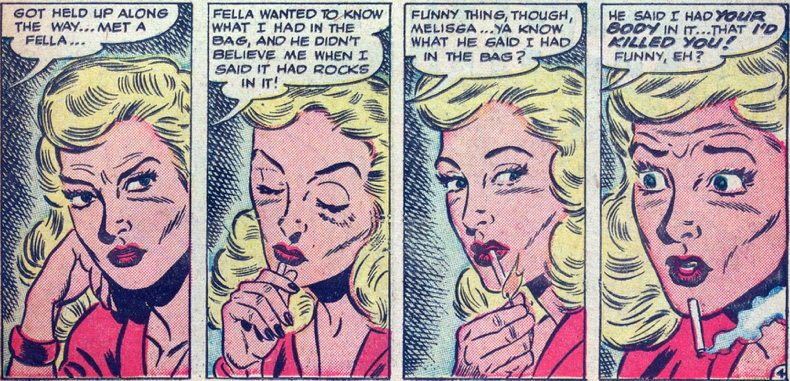
Carl wants to know what Joel has “In the Bag!” he’s carrying on his shoulder. Joel tells him he’s got a bag full of rocks but Carl insists that it’s the body of Melissa, Joel’s adulterous wife. Unaware of his wife’s infidelity, Joel takes one of the rocks out of his bag and kills Carl, puts the body in the sack, and heads home to have a talk with Melissa. It’s quick but effective and darkly humorous. The look on Melissa’s face, moving from smug to terrified in four successive panels, is priceless.


Cops can never find evidence of stolen property at the most popular pawn shop in town but that’s because the owner is Satan. The twist at the climax of “The Strange Shop!” is certainly not the most original but perhaps there might be a bit more surprise for the reader if the pawn shop owner didn’t have pointed ears and a satanic goatee from panel one.


In “From the Dead,” Charles Chute is paid to debunk fortune tellers and seers but runs into a brick wall known as Guirraini, a man whose pencil is used as an instrument of communication with the dead. Chute can’t prove the man is a phony and it drives him to murder. In the end, Chute gets the chair after Guirraini reaches out from the dead to force a confession note. 


Harry Anderson
Astonishing 32

“The Werewolf Takes a Wife” (a: Paul Reinman) ★★

”Arrival” (a: Tony Mortellaro)

“Her Other Face” (a: Chuck Miller)

“Initiation Fee!” (a: Mannie Banks)

“Double or Nothing” (a: Tony DiPreta) ★★1/2


While they’re busy having supper, a farmer and his three daughters are terrorized by a werewolf who huffs and puffs and blows their front door down. Thinking fast, the farmer makes a deal with the lycanthrope: if he leaves them be, he can stay in the house as long as he wants. The werewolf agrees and becomes immediately smitten with the farmer’s youngest daughter, Essie, who makes it quite evident that the affection is a two-way street. Essie finally gets the werewolf to propose to her and they live happily ever after at the farm, with Essie’s two vampire sisters bringing home enough victims for them all to eat. Silly beyond compare, “The Werewolf Takes a Wife” is goofy fun and does not take itself seriously for one second. This werewolf reclines on the couch and moans about the hard day he had. The cover advertises this one as “The Vampire Takes a Wife” (which is odd since the character depicted is awfully shaggy).


Professor Kurtz watches as a spaceship lands and out pops a handful of aliens. The space travelers discuss their upcoming invasion and then turn invisible in order to infiltrate the Earth society. Kurtz tries to get the top brass to listen to him but no one will believe him. He’s finally committed to an asylum and we see that the doctor in charge of Kurtz’s case turns invisible. Boring as hell, and loaded down with some truly awful artwork, “Arrival” uses one of the oldest reveals known to comic writers. And they’d use that hook many more times afterwards. 


    Con man Jeff marries Matilda for her millions but quickly tires of her homely face. He insists that his new wife get plastic surgery but she nixes that idea, claiming she’s already had a face lift and another might bring up bad memories. But Jeff is persistent and the surgery occurs; Matilda is beautiful until Jeff kisses her and her face cracks apart. Two layers down is Matilda’s real face, that of a vampire. Ludicrous horror story almost makes it into the “so bad it’s good” file but it’s not quirky enough. After “Her Other Face” pops up, Matilda magically sprouts fangs as if the first surgery hid those as well! When the surgeon refuses to put Matilda under the knife due to her protestations, Jeff simply triples his offer and the doc caves! Women’s lib has come far since 1954.


Carlton Jones (nicknamed “The Pusher” for his underworld dealings) has worked himself up the ladder in the community but he still can’t buy respect. He decides that joining clubs might do the trick but there’s one very exclusive club that won’t have him until he bullies its most famous member. Too late, he discovers he’s joined a “suicide club!” Filled with more limp scripting and dreadful art, “Initiation Fee!” is nothing more than talking head panels and stuffed expository balloons.


Professor Wendell Witt has discovered the secret of cloning and it’s going to make him a very rich man. The first thing he thinks of is duplicating diamonds and being the world’s most powerful man but fate pees on his cornflakes. The formula will only create doubles of living objects like rats and monkeys, so diamonds, greenbacks, and nice suits are out of the question. Wendell sighs and realizes he can still make a bundle by cloning himself, so he does just that. Unfortunately, the nutty professor didn’t wait long enough to see if there were any ill effects from the formula, and he finds out much too late that the clones turn jealous and violent. Wendell’s clone has something special planned for his big brother when he gets home. The art is a bit shaky (the professor’s head size seems to change from panel to panel) but the climactic twist is a good one. 


Sol Brodsky
Journey into Mystery 15

“Satan Can Wait” (a: Paul Reinman) ★★★1/2

(r: Vampire Tales #1)

“Till Death Do Us Part” (a: Vic Carrabotta) ★★1/2

(a: Vault of Evil #4)

“The Face That Followed” (a: Al Luster) 1/2

(r: Vault of Evil #4)

“Bewitched” (a: Mannie Banks) ★★

(r: Vampire Tales #2)

“The Man Who Was Nobody” (a: Ed Winiarski)

(r: Journey Into Mystery #8)


Danny is a friendly, hard-working chap with a lovely wife and great kids. He likes to pal around with his buddies at a bar on Friday nights and on this particular visit, the idea of true evil is debated. Is there a Satan? Danny scoffs at the thought, even though his friends keep open minds. At that moment, a stranger approaches the table and offers Danny one million dollars for his soul. Just for kicks, and to prove to his friends how silly the situation is, Danny signs the contract. Oddly enough, the stranger vanishes in thin air.
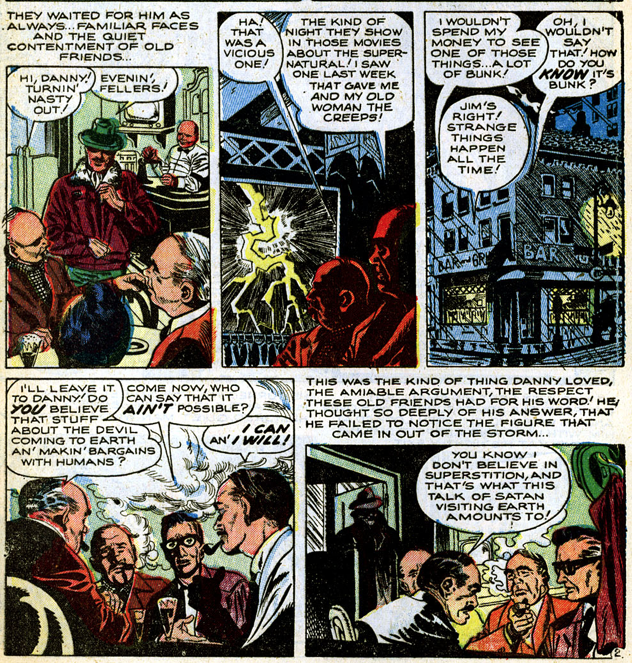

When he arrives at home, his wife meets him to give him the bad news that his father has died, leaving Danny a factory worth a quarter of a million. In short order, Danny becomes a workaholic, loses his family, and is told his fortune has reached one million dollars. Just at that moment, the stranger returns to inform Danny that the whole thing was a joke. Danny murders the man and heads out into the lightning storm, ready to pay up on his unholy pact. Though the climax is a bit of a letdown (honestly, the revelation that the man was actually Satan probably would have been anticlimactic as well), “Satan Can Wait” is a thoughtful and intelligent tale, filled with some very good dialogue (especially during the round table discussion between Danny and his bar buddies) and one of those rare “innocent” protagonists who doesn’t deserve the fate that’s handed to him. The final panel, of newly-minted murderer Danny heading out into the storm to meet whichever maker claims him, is very powerful: He walked into the raging night and a cloud, blacker than all the others, hovered low over him! Then Danny disappeared into the darkness… forever!


Herbert can’t stand his wife, the lusty adulterous trollop named Stella, but she knows all about his shady business dealings and has sent her lawyer the obligatory “Open upon my death” letter, so life moves on at a miserable clip. Finally, Herbert decides he’s had enough and jail be damned, he’s going to strangle his shrewish wife. Just then, an atomic bomb blast rips through the house (no, seriously!) and life on Earth changes. Herbert’s worst nightmare becomes true; he will spend eternity with Stella by his side. Literally, since the bomb grafted the two lovebirds into one body. “Till Death Do Us Part” has some great Carrabotta art, a wild twist, and a smile-inducing climax. 


In the simple “The Face That Followed,” convicted killer Tony Trent escapes prison and heads into the swamp, the dogs trailing just behind. Trent’s destination is a summer cottage in the fishing village of Bedford. There, beneath the floorboards, lies a quarter-million in cash. But first Trent must shake his posse. The con comes across a shack and enters, but is pulled up short by the sight of a shotgun pointed at his chest. The old man attached to the weapon explains that he knows who Trent is and the price for his silence is a quarter million. 


Knowing he’s facing an electric chair if he’s caught, Trent draws the old man a map leading to the cash and then gets a face full of buckshot. Dying, Trent promises the old man that he’ll see the con’s face until his dying day. The old codger buries Trent under his shack and heads out to his big payday. But, once he gets the green, the cops close in, sure the old man is Trent. Despite his protests, the police blast him full of holes and, once his body has been turned over, we see he has Trent’s face. The only surprise coming in the Paul S. Newman-scripted “The Face That Followed” is that Trent is dispatched so quickly and the story’s bad guy becomes the old shack owner. Al Luster’s graphics are suitably histrionic.


There’s some striking Mannie Banks visuals in “Bewitched,” but the script is microwaved. It’s that old chestnut about beautiful Prudence in 17th Century Salem, who refuses to marry the old neighbor, Caleb, so he rats her out as a witch to the town elders. The woman is set to be hanged but through a series of misadventures she escapes. The climactic showdown between Caleb and Prudence reveals that innocent Prudence was an authentic broom-rider the whole time. That reveal had been done to death already by 1954.


In “The Man Who Was Nobody,” Greg Garlan applies for a passport only to discover every trace of his past has been wiped out. No birth certificate, no school records, no work papers. There’s no explanation except that… you guessed it, Greg is actually an undercover  Martian, sent to worm his way into society and report back to his bosses. 
Harry Anderson
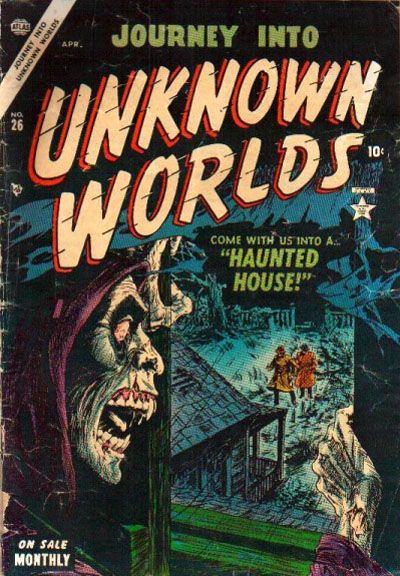
Journey into Unknown Worlds 26

“The Haunted House” (a: Pete Tumlinson) ★★★

“Unharmed” (a: Bob McCarty) 1/2

“It Floats in Space” (a: Bill Savage) ★★★

“The Hiding Place” (a: Seymour Moskowitz) ★★

“Betrayal” (a: Bob Forgione) 1/2


A paranormal expert named Ben is hired by a man to rid his house of his father’s ghost. The man’s mother wants no part of it and she inserts herself into every nook and cranny in order to delay Ben’s findings. After much research, the specter is traced to the property’s well; it’s there that Ben finds the skeleton of the elder Anderson, a hatchet embedded in its skull. Ben brings the bones up and dissolves them in lime, thus releasing the spirit into the “other side.” Unhappy that her secret has been unearthed, Mrs. Anderson buries a hatchet in Ben’s head and dumps his body down the same well. Now Ben’s ghost haunts the Anderson place and a new paranormal expert is hired. “The Haunted House” is a clever, violent little gem that contains more creepy Tumlinson work; Anderson’s ghost is not your jolly, happy spook. The only thing that jumped out at me in terms of a reality check would be Ben’s ignorance of the fact that a murder had been committed and that the police should be called in. The axe in the skull might have been a red flag to me.


Physicist Eric Sands receives a “Make-a-Martian” kit from an unknown source for his birthday. Thinking the gift a joke, he builds the miniature robot but then is amazed that the thing can't be destroyed. When an A-Bomb test on the base is announced, Eric has a brilliant idea and hides the little android in one of the test buildings. The Martian survives the blast “Unharmed,” and radios Mars that the best weapon Earth has is like a peashooter compared to Martian arms. “It is safe to attack!” Suffering greatly from the unexciting pencils of Bob McCarty, “Unharmed” is a generic “menace from Mars” yarn that can’t work up much enthusiasm.


A spaceship comes across a derelict craft in the middle of nowhere and boards it, finding one crew member dead, with an expression of pure fright on his face. A journal tells the story of the ship’s captain coming across the frozen body of an escaped criminal (recognizable by the etched “x” in his forehead) and bringing it on board. The “corpse” thaws and comes to life, with the escaped con telling the captain to turn the ship away from Earth. He’s not going home. Unfortunately, the craft runs out of fuel and the two men starve. So, why the frozen fear on the captain’s body and where is the fugitive? The extremely ridiculous final panel of “It Floats in Space” explains those two mysteries. Otherwise, this is an imaginative space opera, with some (literally) chilling scenes provided by Bill Savage. But why does the ship’s captain man his controls in a suit and tie?


A jewel thief hides in a freshly dug grave and discovers, to his horror, that a funeral is about to take place and a coffin is being lowered down on him. The choice is: scream and lose the jewels to the authorities or keep quiet and spend eternity in “The Hiding Place” with his beautiful treasure. Guess which choice he opts for. In the loopy final tale, “Betrayal,” aliens from the planet Torz kidnap and torture Howard and Laura and try to make them reveal earth’s weapon capabilities. Howard’s all for the torture route but Laura gives in lickety-split since the lead alien is a dreamboat. After the girl spills the beans, the Torzians kill Howard and whisk Laura back to their planet, where they take their “itchy suits” off, revealing ant-like beings. Laura isn’t thrilled. At one point, Howard actually calls the alien captain a “brutal swine!”


In Just Two Weeks...
More Twisted Tumlinson Terror!


Monday, January 16, 2023

Batman in the 1980s Issue 70: September/October 1987


The Dark Knight in the 1980s
by Jack Seabrook &
Peter Enfantino


Hannigan & Giordano
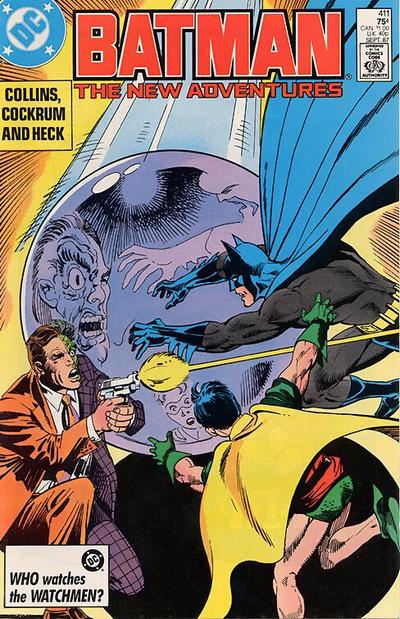
Batman #411

"Second Chance"
Story by Max Allan Collins
Art by Dave Cockrum & Don Heck

Two-Face has the audacity to hold up the Second National Bank of Gotham in broad daylight, following his attempted heist at a casino the night before. Batman suspects the villain of planning four robberies in four days (Two-Face sent two pairs of playing cards) and gets Jason out of bed, where the boy has been pouting.

The next evening, Two-Face robs the box office at a baseball game and Robin loses his cool, trying to strangle the man he knows killed his father. Two-Face gets away and, back at the Batcave, Jason tells Batman that he is angry at not being told the truth about his father's death. The Dynamic Duo patch things up quickly and get a "Second Chance" to nab Two-Face when he tries to rob the same casino a second time. Two-Face hops on a giant roulette wheel and Robin redeems himself by rescuing him from being crushed by a big metal ball.

Peter:
It was natural that, after an arc as stunning as "Year One," we'd take a step back in quality, but this doo-doo is like getting in your Pinto and backing up three city blocks. The credits say "Dave Cockrum" but I can't see it under the typically bad Heck inking. No matter though since the script covers old territory and Max's dialogue doesn't sound like words that would be coming out of the mouths of these characters (example: Gordon labeling Two-Face a "fruitcake"). The Jason Todd hissie-fits are cringe-worthy. Someone needs to throw this title a lifeline pronto.

Jack: Don Heck is one of those artists whose work I'm never happy to encounter. It's not bad, it's just average. You're right that there's almost no sign of Cockrum with the heavy inks. The story is bland, with a brief bit of excitement near the end involving a giant roulette wheel.


McFarlane/Marcos
Detective Comics #578

"Batman Year Two, Chapter 
Four: ...So Shall Ye Reap..."
Story by Mike W. Barr
Art by Todd McFarlane & Pablo Marcos

Batman is working with Joe Chill (yep... that Joe Chill) to set up mob boss Moritz for a heavy fall, unaware that the Reaper has tipped off Gordon and his men as to where the big meeting is being held. Meanwhile, Bats's alter ego has proposed to Rachel (now that she has put her nun's duds in the attic), unaware that the girl's pop is actually the Reaper!

Gordon, the Reaper, and Batman converge on Moritz's hideout simultaneously and bullets fly. Moritz is gutted by the Reaper but Joe Chill and Batman manage to get away. The moment of truth for Bruce Wayne has arrived: he drags Chill to Crime Alley and unmasks, promising to put a bullet in the head of his parents' killer. Before he can take action (as if he would), the Reaper does the dirty work for him. Reaper tells Batman to meet him at the Wayne Foundation building where they can finish their battle once and for all. Once there, the Reaper is unmasked, revealing to Batman the true identity of his enemy: the father of the woman he loves! The villain falls to his death and Batman, his vengeance muted, buries the gun that killed his parents in the foundation of the Wayne Building (oh, Irony, how sweet is thy sting?).

Distraught, Rachel unpacks her habit and rejoins the sisterhood, leaving Bruce Wayne a broken and bitter womanizer, cursed to roam the Earth alone for at least one more issue. Leslie Thompkins gets her clinic and Batman soars through the night, awaiting the arrival of Year Three.

Peter: I'm a bit puzzled about Alfred's sudden peculiar butler accent ("Mawster Bruce...") and McFarlane's obvious confusion between Bruce Wayne and Clark Kent, but Todd's grip on the Batman (despite the obvious exaggerations of the cape's length) and the Reaper is dynamic and exciting. McFarlane's visions are somehow amateurish and stylish at the same time; any hint of an uncredited Pablo Marcos has been muted by said styles (and judging by Marcos's work over at Warren, that might be a good thing). Mike Barr's story is fairly simple and predictable (we all know the wedding will never happen so it's only a matter of what circumstances stand in the way) yet still captivating. This is not Frank Miller but it's head and shoulders above the writing found in this month's Batman.

Jack: Well, yes and no. Oddly enough, the cover credits Alfredo Alcala with work on the interior but the interior credits don't list him and the art doesn't look like he was involved. It's too bad, since I think he's needed to smooth out some of McFarlane's rough edges. The comic is certainly more noirish than Batman, but it's all more of the same, with graphic violence added to make it seem more "adult." I'm not impressed with McFarlane's excesses and his use of forced perspective makes things look abnormally big, like Reaper's blade on page eight. The ridiculously large cape doesn't work for me at all.


Nowlan
Batman #412

"The Sound of Silence"
Story by Max Allan Collins
Art by Dave Cockrum & Don Heck

Who stole the clapper from the big bell at St. Martin's Cathedral? Apparently, the same person who's been stealing clappers from church bells all over Gotham City, resulting in "The Sound of Silence" on Sunday morning.

That evening, in the theater district, a female mime performs in the middle of the street, drawing some cheers, some jeers, plenty of dollar bills, and one very angry taxi driver. The mime pulls out a gun and shoots him before running off into the park. The Dynamic Duo arrive just after the event and Batman gives chase on foot, but when he offers a hand to help the fallen mime to her feet, she takes his hand and he receives a big electric shock, leaving him dazed as she runs away.

Batman knows that the mime is Camilla Cameo and he visits Vicki Vale to do some quick research on the performer before returning home to tell Jason that she had a brief success as a performer before dropping out of sight. Batman and Robin locate her that evening at a concert performance by the heavy metal band, Blister Twister, who do hard rock versions of songs by Simon and Garfunkel. She zaps the musicians but this time Batman is insulated and has no trouble defeating her.

Peter:
"Introducing... The Mime!" the cover screams like we're getting a major new villain, but then we get a silly female Joker with an equally silly backstory and some Twisted Sister/KISS mash-up cliched funny book heavy metal band (I love how their one line is "Hello Darkness..." because I assume DC was afraid they'd have to pay Paul Simon for using more than two words). The choreography is stiff and unexciting; if only the interior art could be on a par with Kevin Nowlan's dynamic cover. This title needs an enema. The capper is the Batman quote at the end as he watches Dee Palma and Blister Sister belt out their two words and wonders if he did the world a favor saving the band from the Mime's deadly attack. As noted in the previous issue's commentary, it seems Max just didn't get these characters; Gordon and Bats don't utter the off-the-cuff lamisms that would work in a Nolan or Quarry novel. Collins is still one of the greatest crime writers of all time but Batman wasn't his finest hour.

Jack: Once again, the story is competently plotted and told, it's just dull and pales in comparison to the recent highlights we've read. The art is just as plain; there's nothing wrong with it and it's much better than the dreck we suffered through when Tom Mandrake was drawing the series, but it's uninspired. Other than the sharp cover that you noted, the most interesting thing in this issue is a note in the letters column that explains the rebooted origin of Jason Todd and clarifies that the events in his new origin story take place about three years ago.


Breyfogle
Detective Comics #579

"The Crime Doctor's Crimson Clinic"
Story by Mike W. Barr
Art by Norm Breyfogle

Matthew Thorne, aka The Crime Doctor, is the man the bad guys go to if they need medical assistance off the books. "Big Moe" McAllister is in need of a heart transplant but he's on the lam and can't chance going to a regular doc, ergo his visit to the Crimson Clinic. In exchange for a hundred grand to go to his wife and young daughter, ex-con Shuyler Reems has agreed to give up his heart--and life--so that McAllister can flee the country in good health.

Thanks to the Batman and Robin, "The Crime Doctor's Crimson Clinic" is shuttered and his golden hands put into handcuffs. McAllister winds up dead but, hey, eggs gotta be broken and all. And Schuyler saves the life of Batman and is granted a reprieve from prison and a new cushy job (janitor?) at the Wayne Foundation. Happy endings all around.


Jack:
 The switch from McFarlane to Breyfogle means we have some uneven art to look at in this story. It seems like drawing regular people and their faces can sometimes be a challenge for artists who do perfectly well with costumed characters. I love the new cover logo; we'll see how long it lasts. The story is a good one and, for a change, the villain doesn't seem like a throwaway character.

Peter: You ain't kiddin' about the art, pardnah. It amazes me how so many of these artists can draw brooding, atmospheric caped crusaders and then drop the ball completely when the cowls come off. The "human" characters are cartoony to the max, with the Doc's assistant, Nurse Rench, looking like a smocked Kingpin and Schuyler straight out of an Archie strip. I wasn't blown away by the story; there's really not much going on here but then most one-offs lack the space to breathe, anyway. I did like the scene where Bats takes advantage of Dr. Thompkins by searching through her computer for rare blood donors without permission. Very reminiscent of the tension between Bats and Lucius Fox in The Dark Knight.

Next Week...
Join us for another subtle
Michael Fleisher outing!

Thursday, January 12, 2023

The Hitchcock Project-Leigh Brackett Part One: Death of a Cop [8.32]

by Jack Seabrook

Leigh Brackett (1915-1978) was born and raised in Los Angeles. She began publishing short stories in 1940 and novels in 1944, and the majority of her tales were in the science fiction genre. She co-wrote several classic films, including The Big Sleep (1946), Rio Bravo (1959), El Dorado (1966), and Rio Lobo (1970), and she wrote the screenplay for The Long Goodbye (1973). She wrote a draft screenplay for The Empire Strikes Back (1980) and is credited as co-scripter. She only wrote a handful of teleplays in her lifetime and the first two were episodes of The Alfred Hitchcock Hour that aired in 1963.

*   *   *   *   *

Leigh Brackett
Her first was "Death of a Cop," which aired on CBS on Friday, May 24, 1963, as the final episode of The Alfred Hitchcock Hour's first season. The show is outstanding and improves on the novel on which it is based. According to The Alfred Hitchcock Presents Companion, that novel is Death of a Snout (1961) by Douglas Warner, and it may be read online here. Douglas Warner (1917-1967) was born in England and spent seven years before WWII writing for newspapers in the northern part of the country. From 1954 to 1959 he traveled abroad before returning to England and co-writing The Shame of a City (1960) with John Gosling, an ex-detective superintendent. The book was a non-fiction "inquiry into the vice of London" and Warner followed it up with his first novel, Death of a Snout. The book tells of the death of a snout, or police informer, and its complicated and violent aftermath. It's an enjoyable, fast-moving story about cops and crooks in London, featuring a great deal of cockney slang. It is not, however, the source for "Death of a Cop."

The teleplay by Leigh Brackett was adapted from Warner's second novel, Death of a Bogey, which was published in the U.K. in 1962. It was reprinted there in paperback and in a book club edition, but it has never been published in the U.S. and is thus little known. Warner followed this novel with Death of a Tom (1963), Death of a Dreamer (1964), Death of a Nude (1966), and Death on a Warm Wind, which was published in 1968, the year after his death.

"Bogey" is slang for "detective" or "cop," and the novel, like the TV show, is bookended with two such killings. The book is divided into four sections, the first of which is titled "Murder." Tronc, an ex-criminal, knows everything that goes on in his part of London and sometimes informs the police. He warns Matt Greaves, who has come to collect on a winning bet, that Matt's recent altercation with a member of the Lane mob could have dangerous repercussions. Sure enough, Matt goes home to find gang members waiting for him and he is badly beaten.

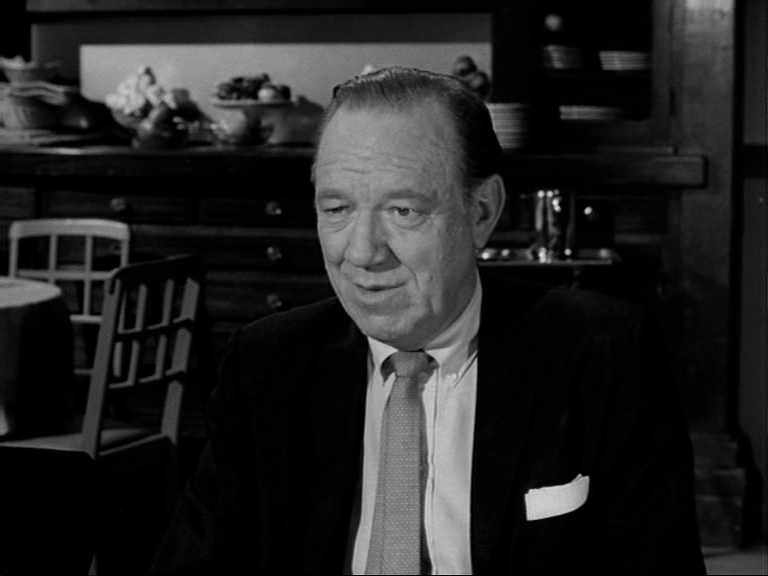
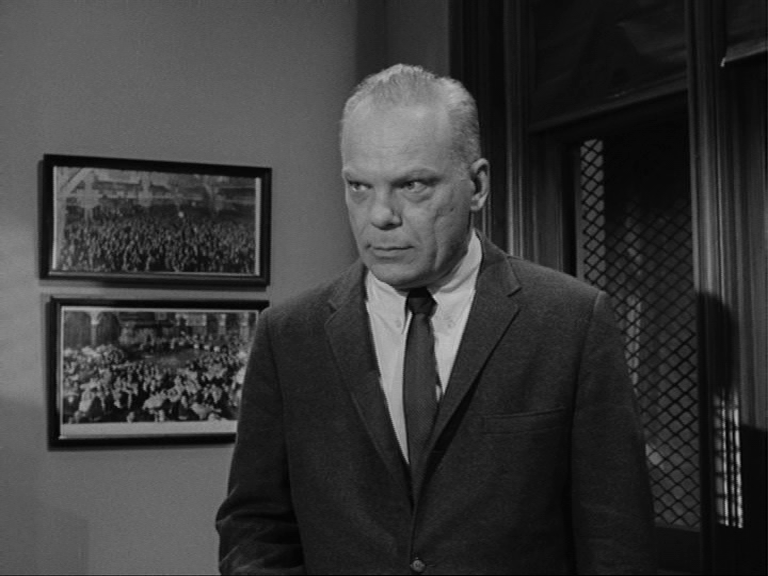
Victor Jory as Paul Riordan
Detective Inspector Paul Raven investigates and is frustrated at the fake alibis provided by the gang members. His son Philip is a young policeman and the two have recently reconnected after an estrangement. Philip learns from an informant of an upcoming crime by the Lane gang and unwisely decides to handle it himself. The Lane gang is in competition with the Sparrow gang and they are pressuring club owners to replace Sparrow jukeboxes with Lane jukeboxes and pay protection money. Philip confronts Boxer Lane, the gang leader, and embarrasses him; as a result, Boxer and his gang follow Philip and beat and stab the young policeman to death before dumping his body in the Thames.

In section two of the novel, "Pursuit," D.I. Raven investigates his son's murder, intimidating two witnesses until they divulge details of the events surrounding the killing. The gang members are arrested and section three, "Trial," describes the court proceedings where the guilty men are made to look innocent and Raven is made to look overzealous. To no one's surprise, the Lane mob members are acquitted.

Peter Brown as Philip Riordan
The final section of the novel is titled "Execution," and it tells of a gold bullion heist by the Sparrow gang and of the efforts by Raven and Tronc to set them against the Lane gang in a confrontation that will wipe out both criminal organizations. The Lanes steal the gold from the Sparrows and Raven rides under the truck that holds the gold, hanging on as best he can until he discovers the gang's hideout. He tells his police colleagues where the Lanes are hiding with the gold and, that night, the police stake out the location, expecting the Sparrow gang to attack in order to recover the gold. When the Sparrows don't show up, Raven takes it upon himself to draw the Lanes out, walking into their midst in the guise of an inexperienced policeman. The Lanes attack and kill him and, as he dies, he hears the gangsters trading gunfire with the police.

Death of a Bogey is a novel of contrasts. Paul Raven and Tronc represent the cops and crooks of decades before, as opposed to young Philip Raven and Boxer Lane. There are numerous snouts (informers) and it's clear that the police could not do their job without the help of witnesses willing to talk. Women are either overbearing (Paul's ex-wife/Philip's mother) or prostitutes, who live on the fringes of the gangs, both depending on them and giving them advice. The legal system is broken and fails to convict the guilty, in large part because of witness intimidation and unethical lawyers. In the end, it is only through the sacrifice of a good man that the criminals are punished; D.I. Raven believes that he has nothing more to live for after the death of his son.

Paul Hartman as Trenker
Leigh Brackett faced a challenge when she was asked to adapt this novel for a 46-minute TV show. First of all, the extensive use of cockney slang required her to revise the dialogue so viewers could understand it. Second, the book is too long and has too many events and characters to fit into the show's running time. Finally, the idea of D.I. Raven riding underneath a truck in the final section would be hard to portray on TV. In writing the teleplay, Brackett did a superb job of maintaining the themes of the novel while compressing the events and moving them to the U.S., specifically, New York City.

The show begins with parallel stakeouts: Paul and Philip Riordan (not Raven) sit in a car, watching a liquor store, while around the corner, two young hoods are watching the same store, waiting for a customer to leave. The cops and the crooks are both bored and waiting for something to happen; the first scene sets up one of the show's main themes, which involves people witnessing events. The dialogue between father and son quickly establishes their relationship as one where they have "'a lot of catching up to do'" and we learn that Paul is divorced and that a conflict with his ex-wife, who is Philip's mother, over home life and police work has driven son to reunite with father.

The customer leaves and the hoods enter the store; the cops see them and spring into action. A shootout ensues and Philip wounds one young man who has pulled a gun. Paul confirms that the wounded crook is a junkie and remarks that "'his old man used to think he'd be president someday,'" making another parallel, this time between fathers and sons. Back at the station house, Lt. Mills praises Philip for his shooting and father and son part, looking forward to a fishing trip on Saturday. Paul doesn't know it yet, but this is the last time he will see his son alive.

Richard Jaeckel as Boxer Lane
Paul then visits Trenker, who corresponds to the novel's Tronc. Trenker comments on Paul's more cheerful attitude since he reconnected with his son. We see Philip exiting a subway station at dawn; down the street is the Lane Bottling Co. and Philip sees suspicious activity in front of the building. There is a cut to a car parked out front; Boxer Lane sits in the back seat, loading a gun, which he slips under the seat in front of him as Philip approaches. A tense conversation follows and, when Philip asks Boxer to get out so he can search the car, we see other people in the neighborhood who witness the event but stand frozen with fear. Boxer's men grab Philip and push him into the back seat; he observes that all of the witnesses have scattered.

The car drives off and the arrogant crooks show no respect for the young cop who is new to the neighborhood. Once again, the theme of witnessing is reinforced as Philip is pressed to agree that he did not see anything inside the car. The car swerves suddenly and the gun and a plastic bag of heroin slide out from under the front seat. Philip tells the driver to stop the car and Boxer punches the helpless cop. The car pulls off in a remote area, where Philip is pushed out into a puddle of water and Boxer shoots and kills him.

The first section of the book, "Murder," is thus transformed into the first several scenes of "Death of a Cop": both end with the murder of Philip. Brackett introduces most of the main characters and themes, creating parallels between cops and crooks and establishing the tragic relationship between Paul and Philip. Heroin dealing replaces the novel's protection racket.

Lawrence Tierney as Herbie Lane
In the scenes that follow, Paul views his son's corpse at the morgue and his wife arrives and blames him for Philip's death. The police then go into "Pursuit," as section two of the novel is titled. They soon realize that Philip was killed in Herbie's Lane's territory--Herbie is the head of the Lane gang. Instead of having Paul do an extended search for witnesses that ends with his interrogation of a prostitute and a young man, as in the book, the cops head straight to the Lane Bottling Co., where Herbie Lane already has his lawyer by his side, just hours after the murder. Paul questions a druggist, who saw Philip being abducted but who denies everything. Again, the theme of witnessing is central to the story; after Paul leaves, a member of the Lane gang visits the druggist and intimidates him into making a harassment complaint against the detective.

Brackett's teleplay next uses a tried-and-true method to show various characters and the effect they have on Paul's psyche--a dream sequence. Simpler than the more elaborate and surreal dream sequences in films like Murder, My Sweet and Vertigo, this one uses a whirlpool special effect that is superimposed over the sleeping detective's face, as he sees one witness after another refusing to cooperate, Lane and his gang mocking him, and Philip begging him for help. Following the dream, Paul resolves to do whatever it takes to solve his son's murder. Paul and other police barge into the Lane Bottling Co., arresting Herbie and his gang members on false charges in order to bring them in for questioning. This sequence corresponds to the end of the novel's second section, where the criminals are rounded up and trial preparations begin.

Instead of having a trial, however, as in the novel, the criminals are questioned and released. Lane's lawyer, Chaney, tells Paul that he has no witnesses and thus no case, and Paul replies that "'There are never any witnesses on Blake Street, Chaney, you know that.'" Like the defense lawyer at the novel's trial, Chaney excuses Paul's rash charges by explaining that he has been under great strain since his son's death. Privately, Paul admits that the charges were a ruse and hands in his badge to Lt. Mills.

John Marley as Ed Singer
The novel's final section, "Execution," is significantly changed for TV. In the show, Boxer Lane and two other gang members wait for Paul at home, aware that he is no longer a detective, and beat him up. A bruised and battered Paul then meets with Trenker and asks him for a favor, though Trenker's role in the final scenes is greatly diminished. In the book, Tronc visits the Lane gang and convinces them to go after the stolen gold; in the TV show, Trenker arranges for Paul to have a room where he can watch (another act of witnessing) out the window as a drug dealer named Gabby Donovan delivers heroin every few days.

Gone are the novel's sequences where Paul Raven hangs on under a truck, riding along to determine the location of where the gang has hidden the gold. Instead, Paul watches Donovan until he knows his routine; he then visits the drug dealer and beats a confession out of him. Paul finds a large supply of heroin and telephones Herbie Lane, offering to trade the valuable drug for the name of the man who killed his son. Herbie quickly admits that Boxer is guilty and Paul tells him to send Boxer and another man to a meeting place the next morning to make a trade: the drugs for the killer. When Herbie hangs up the phone, the camera pulls back to reveal a smiling Boxer, who is in on his boss's plan.

The next morning, a car pulls up outside the meeting place and parks. Inside the car are Herbie, Boxer, and two other members of the Lane gang. Trenker stands in a nearby doorway, watching--this time, Paul has ensured that there will be a witness to the events that follow. In the book, Paul has the entire police force standing by to observe him being killed by the Lanes; in the TV show, the only certain witness is Trenker. Paul watches from his window as Boxer and Freddie (who drove the car when Philip was killed) enter the building and approach his room. In the hallway, Boxer screws a silencer onto his gun, making it clear that he plans to murder Paul.

Paul Genge as Tom Mills
As Boxer enters the room, Paul shoots him, then adds another shot to make sure that he's dead, just as Boxer had done to Philip. Freddie enters with his hands up and asks Paul for the heroin, showing no concern at all for Boxer. Paul tells Freddie that he gave the heroin to the cops and orders him to leave. Paul then looks out the window and exchanges nods with Trenker. The ex-detective leaves his gun on a table and walks outside, as Freddie gets back in the car and tells Herbie that Paul has double-crossed them. Paul walks down the outside steps toward the sidewalk, like a man walking down Death Row; witnesses emerge to see his final act. Herbie jumps out of the car and shoots Paul several times before the car speeds off with the crooks.

Paul lies dead on the steps as a crowd gathers and Trenker tells the beat cop that he saw the whole thing and now realizes that Paul had asked him to be present so he would be sure that there would be a witness who would talk. Trenker tells the cop that Paul "'waited a long time, but now he was going fishing. He meant the trip that he and Philip never made.'" Detective Riordan will be reunited with his son in the afterlife, but he also has had a successful fishing trip prior to his death, catching and killing the man who murdered his son and making sure that the gang boss will be caught and prosecuted for murder.

Jean Willes as Eva
Leigh Brackett's teleplay for "Death of a Cop" is outstanding, successfully condensing Douglas Warner's novel and making changes that result in a meaningful character study and an exciting story. She jettisons portions of the novel that are unnecessary to the show's central theme and she deepens the parallels inherent in the story. Instead of two rival gangs there is just one and, in the early scenes, Philip is not trying to make up for a recent mistake, he is overconfident due to a recent success. In the book, Philip is tipped off to an upcoming crime; in the show, he stumbles upon one and is kidnapped and killed with a gun rather than a knife.

The investigation that follows is streamlined and the trial is eliminated; since there is only one gang, there is no theft of gold by the Sparrows and no subsequent attack by the Lanes. In the book, Tronc seeks out Paul Raven to set up the final events, while in the TV show, Riordan seeks out Trenker to use him as a witness. The somewhat incredible scenes where Paul rides under a truck are deleted and replaced with the surveillance of the heroin dealer. In the end, Paul is killed in front of citizens, not a gathering of policemen.

Wilton Graff as George Chaney
Leigh Brackett took a good book, Death of a Bogey, and adapted it into a teleplay that resulted in a great short film, "Death of a Cop." In addition to the excellent teleplay, the show benefits from the sure hand of director Joseph Newman, who keeps the action moving quickly and who manages to juggle a large cast without ever losing sight of his characters; at no point do any of the numerous cops and crooks seem unfamiliar. The acting is also excellent, for the most part, especially Victor Jory as Paul and Peter Brown as Philip. In short, "Death of a Cop" is a terrific episode of TV noir!

The show is directed by Joseph Newman (1909-2006), who started out as an assistant director in the Golden Age of Hollywood, from 1933 to 1942, before becoming a director of short subjects from 1938 to 1947, and finally of features, starting in 1942. His most memorable film is probably This Island Earth (1955), a science fiction classic. He worked in television from 1960 to 1965 and directed ten episodes of The Alfred Hitchcock Hour, including "The Second Wife". Newman also directed four episodes of The Twilight Zone.

Victor Jory (1902-1982) stars as Paul Riordan. Born in the Yukon, Canada, he was a champion boxer and wrestler in the Coast Guard who played many roles on stage, film, radio, and TV from 1930 to 1980. He also taught acting at the University of Utah and has a star on the Hollywood Walk of Fame. Among his many film roles was one in Gone with the Wind (1939), and he starred in a TV series called Manhunt from 1959 to 1961. He appeared in an episode of Night Gallery and this was his only role on the Hitchcock TV show.

Read Morgan as Freddie Arnold
Peter Brown (1935-2016) plays Philip Riordan and is effective in his few scenes. Born Pierre Lynn de Lappe in New York City, Brown appeared on film and TV from 1957 to 2005. He co-starred in the series, Lawman (1958-1962) and was featured in several soap operas from the early 1970s to the early 1990s, including Days of Our Lives, The Young and the Restless, One Life to Live, and The Bold and the Beautiful. Brown appeared in one other episode of The Alfred Hitchcock Hour and there is a website devoted to him here.

Trenker is played by Paul Hartman (1904-1973), who started in vaudeville as a dancer and had a successful career on Broadway, in movies, and on TV. He appeared on Thriller and The Twilight Zone and his five appearances on the Hitchcock series also included "Not the Running Type."

Boxer Lane, whose arrogance borders on the psychotic, is played with smiling, gum-chewing menace by Richard Jaeckel (1926-1997), a recognizable tough guy from TV and movies who started his film career in 1943 and his TV career in 1951. He was on the Hitchcock series four times, including a key role in "Off Season." Jaeckel had regular or semi-regular roles in six TV series in his career; the most memorable was as Martin Quirk, the police captain on Spenser: For Hire.

Classic Hollywood tough guy Lawrence Tierney (1919-2002) appears as Herbie Lane, the mob boss. Born a policeman's son in Brooklyn, Tierney's career in film and on TV lasted from 1943 to 1999 and his onscreen persona was not dissimilar to his life off screen, which was marked by years of problems with alcohol and fighting. This was his only appearance on the Hitchcock show. He played a memorable part in Reservoir Dogs (1992) and a biography of him was just published, titled Lawrence Tierney, Hollywood's Real-Life Tough Guy.

In smaller roles:
  • John Marley (1907-1984) as Detective Ed Singer; he was on screen from 1942 to 1986 and appeared in three episodes of the Hitchcock series, including "The Second Verdict." He is best known for his role in The Godfather, where he wakes up in bed to find a horse's head.
  • Paul Genge (1913-1988) as Lieutenant Tom Mills; he served in the Army Air Corps in WWII and was on stage, film, and TV from the early 1930s to the mid-1970s; he appeared on The Twilight Zone and had a small role in North By Northwest.
  • Jean Willes (1923-1989) as Eva; her screen career lasted from 1942 to 1976 and included a role on The Twilight Zone and parts in two films adapted from novels by Jack Finney, 5 Against the House (1955) and Invasion of the Body Snatchers (1956)
  • Wilton Graff (1903-1969) as George Chaney, the lawyer; he was on screen from 1939 to 1964 and also appeared in two episodes of Alfred Hitchcock Presents.
  • Read Morgan (1931-2022) as Freddie Arnold, who drives the car and accompanies Boxer to Paul's room at the end; on screen from 1949 to 1994, he was also in two episodes of Alfred Hitchcock Presents, including "Hitch-Hike," as well as episodes of The Twilight Zone, The Outer Limits, and The Night Stalker.
Watch "Death of a Cop" online here.

Thanks to Phil Stephenson-Payne for his help with research on Douglas Warner.

Sources:

Crime Fiction IV - Allen J. Hubin, http://www.crimefictioniv.com/Part_43.html. 

“Death of a Bogey.” Vramonline, 21 July 2018, https://vramonline.wordpress.com/2018/07/21/death-of-a-bogey/. 

“Death of a Cop.” The Alfred Hitchcock Hour, season 8, episode 32, CBS, 24 May 1963. 

The FICTIONMAGS Index, http://www.philsp.com/homeville/FMI/0start.htm. 

Grams, Martin, and Patrik Wikstrom. The Alfred Hitchcock Presents Companion. OTR Pub., 2001. 

IBDB, IBDB.com., https://www.ibdb.com/. 

IMDb, IMDb.com, https://www.imdb.com/. 

Warner, Douglas. Death of a Bogey. Cassell & Co. Ltd., 1962. 

Warner, Douglas. Death of a Snout. Internet Archive, New York, Walker, 1962, https://archive.org/details/deathofsnout00warn. 

Wikipedia, Wikimedia Foundation, https://www.wikipedia.org/. 


Listen to Al Sjoerdsma discuss "The Better Bargain" here!

Listen to Annie and Kathryn discuss "The Three Dreams of Mr. Findlater" here!

In two weeks: Our look at episodes written by Leigh Brackett concludes with "Terror at Northfield," starring Dick York!