Monday, January 18, 2016

Star Spangled DC War Stories Part 70: March 1965


The DC War Comics 1959-1976
by Corporals Enfantino and Seabrook


Joe Kubert
 G.I. Combat 110

"Choose Your War!"
Story by Robert Kanigher
Art by Joe Kubert

"Battle Exterminator!"
Story by Hank Chapman
Art by Irv Novick

Peter: The Haunted Tank comes under fire from heavy enemy artillery and the only way they make it through is with a hand from the ghostly General Jeb Stuart. After a particularly close blast, the men are transported back to the Civil War, where
they're finally able to pay the General back for all his help. Or is it all a battle-induced hallucination? There are both pros and cons to this 24th chapter of the Haunted Tank saga. I like the fact that the General actually has more of a role in the action rather than just issuing the standard warning of "Storm clouds on the horizon!" The ghost actually lays hands on his descendant's and guides the younger Jeb into blasting a few Ratzis off the face of the planet. That's a big plus as usually the story could stand (or fall) without the inclusion of the specter. The other selling point here is the art by Kubert; dynamic and well-choreographed. Granted, there are only so many ways to show the lid being blown off enemy armor but Kubert always manages to make you smile with his visuals. The cons are not enough to sink the battleship but they are eye-rollingly silly. Why would two enemy tanks line up closely on a wooden bridge just to blow away a sinking Allied tank? That's a recipe for disaster, I would think, and something they should have taught in basic Nazi tank training. The sequence that made me laugh out loud though is when Jeb gets locked out of the tank as it's rolling down a hillside. How does he not get crushed? He just hangs on, that's how! This guy is unkillable.


Jack: Seeing the ghost of the Confederate general so much in this issue with his C.S.A. hat got me wondering if this comic could be published today, what with all of the controversy about the Civil War and the Confederacy. Would readers take issue with a heroic Confederate general? Would they have a problem with the modern-day tank commander fighting for the rebel side in his (dream?) trip back in time? I'll just bet they would, but I sure don't!

Just hang on for the ride, Jeb!


Joe Kubert
Our Army at War 152

"Last Man--Last Shot!"
Story by Robert Kanigher
Art by Joe Kubert

Jack: Sgt. Rock is driving a jeepload of replacement soldiers to meet up with Easy Co. when they are attacked from above by a Nazi plane. Rock has to shoot down the plane by himself when none of the new recruits can manage to unfreeze and pull the trigger. To motivate them, he tells the story of Ziggy Austin, a replacement who froze under fire but swore he'd shoot at the enemy if it was the last thing he did. In a battle with a Nazi tank, Ziggy suddenly found himself holding a bazooka and soon after that was shot to death. Somehow, his finger managed to squeeze the trigger after he had stopped breathing.

Rock's inspirational story falls on deaf ears and the men in his jeep remain frozen when they are attacked by enemy sharpshooters. Once again, Rock must act like a one-man army and toss a grenade at the enemy, putting them out of action. Deciding another story is in order, he tells the new men about a soldier nicknamed Hopeless, who couldn't do anything right if it involved a gun. He was assigned to a desk job but put his own name on a list of replacements for Easy Co. and ended up leading an assault on a beach. With his last breath, he threw a grenade that destroyed an enemy tank.


Incredibly, the replacements remain unmoved! The jeep is attacked for a third time and Rock fights his own battle once again. When he gets hung up in some barbed wire, the men see that he is only human and come to his aid, finally showing their mettle and blowing up a hidden Nazi tank. By the time Rock arrives at Easy Co., the men look like veterans!


"Last Man--Last Shot!" runs a full 25 pages and features the usual strong art by Joe Kubert, but the repetitive nature of the story gets a little tired. I was waiting for Rock to smack the new recruits around a little bit or give them a good chewing out. Instead, he keeps telling inspirational tales. I suppose the story could have gone on and on like this but comics were only so long.

Peter: While reading this, I was remembering Robert Stack at the end of Airplane!, telling inspirational stories while everyone else had moved on. This one just went on and on and... The transformation of the greenies, from scared little children to battle-crazy kill machines, comes right out of left field. Two inspirational stories (one detailing battle beyond death) can't do the trick but seeing Rock in hand-to-hand wakes these kids up pronto (even though they'd already seen the Sarge fighting for his life a couple times that same day!). Yeah, right. And though I love Kubert's art, "Last Man..." featured way too many close-ups and tiny frames; not Kubert's strength. Although, having said that, I thought the most powerful panel in the story was of Rock looking over his shoulder at the new recruits and thinking, "They all look alike!"


Ross Andru & Mike Esposito
Star Spangled War Stories 119

"Gun Duel on Dinosaur Hill!"
Story by Robert Kanigher
Art by Ross Andru and Mike Esposito

"Desert Rat!"
Story by Hank Chapman
Art by Jack Abel

Peter: "Sheriff" and "Wild One" are the latest recruits of the Suicide Squad to hit Dinosaur Island but the history between the two men may be more dangerous than the "monsters from a prehistoric stone age." Back in their home town, "Sheriff" was, indeed, a sheriff and "Wild One" was a local kid who had been caught rustling steer. When the two meet in a town street, the youngster draws on the lawman and has his gun shot right out of his hand. He holds a grudge from then on and, in a wild bit of coincidence, the two men are accepted into the Suicide Squad, with "Sheriff" given the task of taming the impetuous youth. But once they land on the prehistoric isle, it becomes a "Gun Duel on Dinosaur Hill" until "Sheriff" convinces "Wild One" that camaraderie is the way forward.

Did we stumble into Star Spangled
Western Stories by accident?
At first glance, it's an interesting fusion Kanigher makes with the Wild West meeting dinosaurs, but there's nothing new about the set up since this is exactly the same plot device Bob used with the previous two SS members, Morgan and Mace. And though I'm sure some of the Wild West was still untamed by 1942, the scene of "Sheriff" and "Wild One" facing each other down on the dirt street outside the saloon throws up red flags. But that's not the only thing about "Dinosaur Hill" that makes you go "say what?" The conversion of "Wild One" from angry, potential killer to softy who buys into the system literally happens in one panel. There's no rationalizing it; it just happens. When the boys land on the island, they mention their mission is to find the missing SS men who had landed before them. This means that either Mace and Morgan were eaten by thunder lizards or they'll spend the entirety of the series wandering around on the same island, having adventures. Not to tease you, DC war fan, but that little walnut will be cracked open next issue! On an interesting note, as the GCD reminds us, "Sheriff" lets the reader know that this is his third SS mission (obviously his first to Dinoville) but the first one recorded for posterity.

Awwwww.....
The second story this issue, "Desert Rat," is an awful Hank Chapman story about a proper CO who takes a dislike to a grunt who's always looking dirty and disheveled. After a day spent with the "Desert Rat," the CO sees how much of a true soldier the rat is and adjusts his way of thinking. But we knew he would.

Jack: What a terrible issue! After the monotony of Morgan and Mace, I thought we'd be in for a treat with two new characters, but it quickly became apparent that they were just Morgan and Mace with new names. One interesting thing about the lead story is that Sheriff and Wild Man don't seem at all surprised to come across dinosaurs. Did the word finally get out to everyone in that part of the world that there were dinos roaming about? It's about time. The less said about "Desert Rat," the better. It's one of those stories where Chapman repeats the title phrase to death. I liked Abel's art better than Andru and Esposito's though.

In the 70th Issue of
Do You Dare Enter?
On Sale January 25th!


Monday, January 11, 2016

Do You Dare Enter? Part Sixty-Nine: May/June 1976


The DC Mystery Anthologies 1968-1976
by Peter Enfantino and
Jack Seabrook


Ricardo Villagran
The House of Mystery 241

"Paid in Full"
Story by Jack Oleck
Art by Frank Robbins

"Death Pulls the Strings"
Story by Bill Finger
Art by Nestor Redondo

Peter: "Death Pulls the Strings," about a sadistic sideshow carny who talks three "midgets" into becoming puppets, is obviously a "file" story since writer Bill Finger had died two years earlier. I'd love to say that Finger, the guy who helped create Batman and wrote a whole bunch of the Dark Knight's 1940s adventures, left behind some quality work but "Strings" is not a very good story. The carny becomes obsessed with the fame the puppets have brought him and loses sight of the fact that they're real people. The troupe members decide to strike out on their own and the boss doesn't like that so he beats them to death. He's struck by lightning when he exits the tent and... The End. That's it. The scale of the little people and their tormentor seems to change from panel to panel. Not much better is the opener, which Jack Oleck typed up in the dark while re-reading some of his old scripts. Yet another variation on the "bad guy who runs across the old witch and has her conjure up some goodies for him until his evil behavior spells curtains for him" with the evil cat supporting character (inevitably named "Lucifer!") thrown in for bad measure. The non-linear storytelling that begins "Paid in Full" makes no sense whatsoever when you start to think about it. Here's a tip: don't think about it. All covered in a special Frank Robbins cream sauce. Robbins does have the ingenuity to draw his protagonist with a rat-like face so that the climax is ironic. I could complain about the mere 15 pages of story content this issue but... nah, I'll count my blessings.

A rare example of Frank Robbins subtlety 

Jack: The large cat looming over the burial scene on page one of the story reminded me of the giant figures Jerry Robinson used to draw on 1940s Batman splash pages, and I liked the way Robbins drew a few more large cat shadows lurking behind some of the panels on subsequent pages. The twist is not bad and I did not expect it, but ending the story by having Cass become the cat's plaything was a letdown. You're right about the skimpy 15 pages of story in this issue. By the mid-1970s, the economics of comic books were starting to require lower page counts or higher cover prices and eventually something had to give.


Luis Dominguez
The Witching Hour 63

"Face of Fright"
Story by George Kashdan
Art by E.R. Cruz

"Sweet Dreams, Bitter Nightmares"
Story by Wesley Marsh (Murray Boltinoff)
Art by Gerry Talaoc

"The Thing in the Teakwood Chest"
Story by Carl Wessler
Art by Fred Carrillo

Jack: Paul Chalmers is a millionaire racehorse breeder with a pretty daughter named Pamela who is in love with Eric, the deformed son of Chalmers's stable groom who died in a fire 18 years ago. Chalmers will do anything to keep Pamela away from Eric and his "Face of Fright," but boy loves girl too much to let go. One day, Chalmers attacks Eric and Pamela collapses. She can only be saved by a blood transfusion and guess who is the only guy around with the same rare blood type? Yes, it's Eric, who is happy to volunteer to donate blood to his beloved. Pamela survives but the transfusion makes her just as ugly as Eric! E.R. Cruz's steady hand with a pencil makes this run of the mill story look good and, even though I saw the ending coming a mile away, it was satisfying when it happened.


Peter: This is one awful issue of The Witching Hour from start to finish. "Face of Fright" climaxes with a blood transfusion that makes Pamela a malformed freak. What kind of blood would do that? How about the second feature, "Sweet Dreams, Bitter Nightmares," which reads like one of those really bad Gothic strips and features a finale guaranteed to raise chuckles rather than goosebumps? Worst of all is Carl Wessler's predictable "The Thing in the Teakwood Chest," with amateurish art by Fred Carrillo and a hook that makes no sense whatsoever. What really bugs me the most about The Witching Hour is that annoying 1960s hipster dialogue spouted by cutesy pie witch, Cynthia ("What a gas!" "Some bummer!" "Hang loose!"). It sounds like just what it is: a stable of writers out of touch with the outside world.

Jack: Cynthia does have great legs, though.


Luis Dominguez
Unexpected 173

"What Scared Sally?
Story by Bill Dennehy (Murray Boltinoff)
Art by Fred Carrillo

"I, the Imprisoned Brain"
Story Uncredited
Art by Fred Carrillo

"Hunger of the Dying"
Story by Jack Philips (George Kashdan)
Art by Tenny Henson

Jack: Dr. Volke shoots and kills his partner, Dr. Thurman, but Prof. Osgood preserves Thurman's brain in a glass jar and hooks up eyes and ears to it. If only he could figure out a way to get the darned thing to talk! "I, the Imprisoned Brain" has no problem thinking (and narrating the story), however, so when Dr. Volke comes to kill the brain (don't ask) and murders a meddling night watchman instead, Prof. Osgood has a Eureka! moment. At the murder of trial of Dr. Volke, the first witness turns out to be none other than the dead night watchman, reanimated by having Dr. Thurman's brain transplanted onto the top of his head and covered with a fishbowl for easy display.

All three of the stories in this issue of Unexpected are dreadful, so I picked this one to write about because it gave me an excuse to reproduce here the ridiculous final panel!


Peter: You're not kidding, Jack. You don't have to wrap a fish in a copy of Unexpected #173 for it to stink. I do have to mention the opener, "What Scared Sally?" (a title which makes no sense, by the way), wherein we're presented with the two dumbest kids on Earth. Well, they have to be dumb if two suspicious characters grab Sally and her brother, Davey, from behind, identify themselves as government agents (even though they're in street clothes and look pretty mangy) and ask the kids where they can hide out... and the kids believe them! They set the bad guys up in the local mine and then bring them food. At least Sally, who's in her late teens, comes around to the truth eventually but by then it's too late; the bad guys bury the siblings by collapsing a mine support and hightail it. Luckily enough, Sally and Davey took a course in breathing under tons of rubble and there's a happy ending when a search team digs them out. Fred Carrillo is fast becoming the new Jerry Grandenetti, an artist whose name I shudder to see on the contents page. Couple this with The Witching Hour #64 and you can see why the walls were crumbling at the DC horror palace.

Jack: Sally starts out looking about eight years old but when one of the crooks starts to think about jumping her bones, Carrillo ages her to about 16 real quick.


Luis Dominguez
The House of Mystery 242

"The Balloon Vendor!"
Story by Michael Fleisher and Russell Carley

"Blood Money"
Story by Jack Oleck
Art by Jess Jodloman

Peter: Andy Vogel, "The Balloon Vendor" for a ramshackle carnival, is in love with gorgeous snake-charmer Gay Lynn Foster, but Gay won't give Andy a second glance until the meek mouse presents her with a genuine pearl necklace. Turns out Andy (not the smartest tool in the shed) borrowed the dough from the syndicate and, soon after, two goons come to collect. The mobsters tell Andy they'll excuse his debt if he burns down the carnival tent (the owner owes them money as well!) and, with no way to pay, the little man agrees. The arson goes off without a hitch... unless you consider the thirty people who died in the flames... and the hoods give Vogel a little spending money to boot. Unfortunately for Andy Vogel and the hoods, the spirits of the dead (led by Gay, who also died in the fire) refuse to remain quiet. The next morning, three unique balloons float in Andy's workshop. It wasn't long ago that the name "Michael Fleisher" on a splash page would elicit excitement and anticipation but, by 1976, Fleisher was cashing a paycheck and rewriting his old classics into dreadful new time-wasters. All the cliches are packed tight into "The Balloon Vendor," including the nebbish and unrequited love, the carnival (which was becoming as frequent a backdrop as the swamp witch's shack), and the "ironic" twist ending where the evil doer is done in by his own hobby (see also: "Night-Stalker in Slim City" way back in HoM #224). Andy's 180 degree turn in personality, from sweet, child-loving nerd to uncaring murderer is not so much startling as eye-rollingly silly. I must say that, though I've never been a Frank Robbins fan (to say the least), he does know his way around the female figure now and then.


Jack: The fact that this is one of the better stories I've read recently in the DC horror books shows how far the quality had fallen by mid-1976. The story is almost entertaining and the art is almost bearable, but two issues in a row of House of Mystery featuring lead story art by Frank Robbins is not a good trend. His characters seem to inhabit a strange, timeless universe where clothing styles from the 1940s through the 1970s are all mixed up. The art in the backup story is by Jess Jodloman and it's hideous.


Luis Dominguez
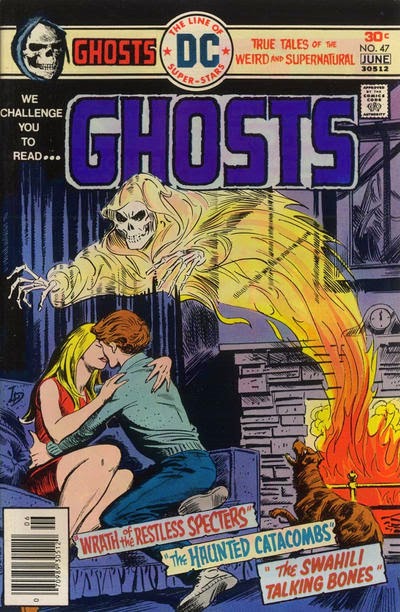
Ghosts 47

"Wrath of the Restless Specters"
Story Uncredited
Art by E.R. Cruz

"The Swahili Talking Bones"
Story Uncredited
Art by Franc Reyes

"The Haunted Catacombs"
Story Uncredited
Art by Abe Ocampo

Jack: It's 1974 and Stan Kappel and his wife Phyllis are vacationing in Rome. He decides to spend their last day there touring the catacombs while she goes shopping. When she gets back to the hotel, there is no sign of Stan, so she heads to the catacombs, where the night watchman tells her that no one visited all day because they are closed. Finding Stan's scarf by the entrance, she sneaks in but is scared away from a sinking patch of ground by a ghost. The night watchman discovers Phyllis and together they locate Stan's corpse; he was killed in a cave-in and his ghost warned her away from danger. A straightforward ghost story with an interesting setting and reasonably good art by Abe Ocampo, "The Haunted Catacombs" is much better than the other two dull tales that populate this issue. I nominate Leo Dorfman as the uncredited writer of all three, since they don't quite reach the level of confusion necessary to credit them to Wessler or Kashdan.


Peter: "Catacombs" is atmospheric and builds suspense quite well. I actually thought "Wrath of the Restless Specters" was a decent read even if it seemed like I was reading the Encyclopedia Britannica at times. Rasputin tells secret Bolshevik Vasily Treplev that if he does not renounce his ways, he and his entire family will die and roam the earth as restless spirits. One by one, his family dies but Treplev does not sway. In the end, he is shot dead and, indeed, rises as a disturbed specter. A nice twist and the bad guy wins! Nice art by E.R. Cruz as well.

Jack: Ghosts was bi-monthly at this point and the last panel says the next issue will go on sale during the first week in April. Does that mean that this issue, with a June cover date, went on sale during the first week in February? That's a long lead time! By the way, the sales figures in this month's batch of comics show sales of about 115K per issue.

Filthy, Dirty, Grimy, Gritty Battle Action
Coming Next Week
In Star Spangled DC War Stories #70
Reserve Your Copy Today!

And beginning in just eight weeks...

Thursday, January 7, 2016

The Hitchcock Project-Robert C. Dennis Part Thirteen: "One for the Road" [2.23]

by Jack Seabrook

"One for the Road" is based on a short story called "Partner in Crime" by Emily Neff. In the story, Marcia Hendrix, a "sweet-faced but plain" former nurse, has been married to Charles Hendrix for 11 years and is devoted to him, so when she finds a woman's cigarette lighter with the monogram "B.A." in his coat pocket she thinks nothing of it. He often travels in the course of his job and tells her that the lighter belongs to "a female buyer in Hadley" who has "knock-knees and a hooked nose." Marcia's suspicions are aroused when she finds a crumpled piece of paper in the trash with a note signed "B," but she chooses not to confront Charles.

When she tries to telephone him at the hotel where he always stays in Lockton, she learns that he stopped staying there months ago. She calls a forwarding number and, when a woman named Beryl Abbott answers, Marcia realizes that Charles has a mistress. Meanwhile, Beryl is having martinis with Charles; she presses him to divorce his wife and marry her, but he grows angry and she quickly backs off.

As Charles drives home, he thinks that "he had always been prudent, confining his amours to other towns and keeping the relationships casual and brief." He gets home and Marcia confronts him about Beryl. Charles angrily says, "I can't stand a jealous woman" and, from then on, for Marcia, "Their life together, which had always seemed so perfect, had suddenly crumbled into a travesty of marriage."
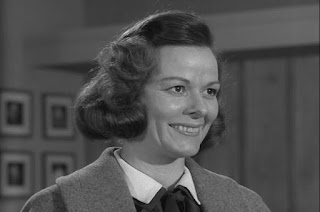
Louise Platt as Marcia
Beryl continues to suggest marriage. Marcia sinks into despair and convinces herself that Charles is a victim, so she comes up with a plan: she visits the hospital where she used to work and then drives to Lockton and finds Beryl's home.  Pretending to be a door to door salesperson to gain entrance, Marcia drops "deadly powder" into the coffee pot in Beryl's kitchen. She drives home and learns that Charles will not be home until late, having gone to Lockton. She tries to call Beryl but the number has been changed, so she starts the three-hour drive back to Lockton. Meanwhile, Charles visits Beryl, having decided to make a clean break. Marcia arrives at Beryl's and reveals who she is and that she poisoned the coffee. Beryl says she's too late--Charles drank his coffee and left half an hour ago.

John Baragrey as Charles
Marcia leaves and Charles comes out of hiding. Beryl asks him if he's sure about his decision to break up with her. He says yes and she offers him a cup of coffee for the road.

At the end of the story, the reader is left to wonder, who is whose "Partner in Crime"? Charles deserves what he gets but it is ironic that he was in the process of breaking up with Beryl when Marcia set in motion events that would lead to his death. Beryl is the one guilty of murder, since she has the knowledge needed to stop the crime but chooses to allow it to happen. Charles will surely die after the story ends, leaving both Beryl and Marcia alone. Marcia will think she is solely responsible for her husband's death and will never know that Beryl was her secret "Partner in Crime."

Georgeann Johnson as Beryl
Emily Neff's story was first published in a paperback original called Wicked Women. The copyright page says that the book was first printed in December 1959 and published in February of 1960; the story is copyright 1960 and is printed by permission of McIntosh and Otis, Inc. The author, Emily Neff, is herself a mystery. I have been unable to find any biographical information on her in any print or online sources. A query to McIntosh and Otis, a literary agency, garnered a response that they have no information about her. I have found six stories credited to her, four of which were adapted for the Hitchcock show; one of those four was "Mr. Blanchard's Secret," which was directed by Alfred Hitchcock. "Partner in Crime" was chosen by Barzun and Taylor for inclusion in their 1983 collection, Classic Short Stories of Crime and Detection, which was part of their series, 50 Classics of Crime Fiction 1950-1975. Why is Emily Neff unknown today? Is the name a pseudonym? If anyone has any information about her, please comment!

Although it was first published in 1960, "Partner in Crime" must have been written prior to Sunday, March 3, 1957, when the TV adaptation was broadcast on CBS. Written by Robert C. Dennis and directed by Robert Stevens, the show is a triumph of television craftsmanship that tells its story with only three actors: John Baragrey as Charles, Louise Platt as Marcia, and Georgann Johnson as Beryl.

The first closeup of a hand

A detailed examination of the show and a comparison of it to the story will demonstrate that everyone involved was performing at a high level. The show opens with a closeup of Charles's hand spooning two teaspoons of sugar into a coffee cup; this is followed by a deep-focus shot with Charles in the foreground and Marcia far away in the bedroom, seen through an open door.

This deep focus shot shows Charles in the
foreground and Marcia far in the back

She watches his diet carefully and they seem very much in love, but the first surprise comes when she holds out the cigarette lighter and the shot shows her hand with the lighter in the foreground and Charles in the background.

The lighter in the foreground

There is an insert of the lighter in closeup as Charles caresses it with his thumb; it is as if he is caressing Beryl.

Charles's thumb caresses Beryl's lighter

He walks out, carrying his suitcase, and the scene dissolves to Beryl, glamorous in a sleeveless black dress that contrasts with the apron worn by Marcia in the prior scene.

Both women's faces merge in this dissolve

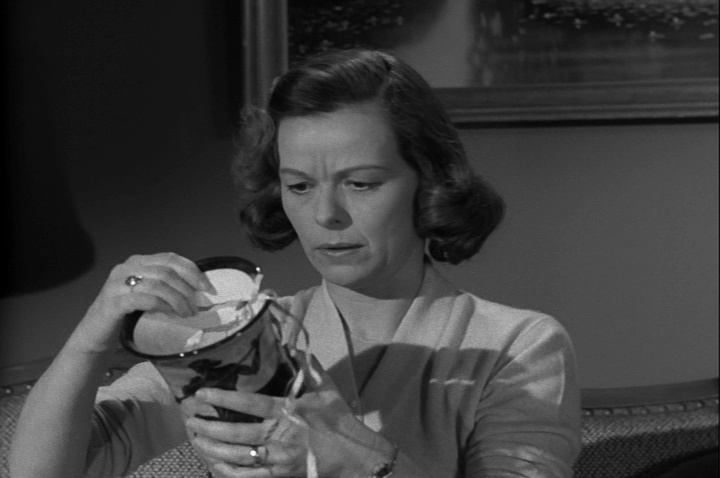
Beryl holds two martini glasses and hands one to Charles, who reclines on the couch. She refers to having to fill up four days; Charles is leading a double life, where he spends four days each week with Marcia and the other three with Beryl. Another hand holds out a lighter in a shot similar to the one in the first scene--this time, it's Charles's hand as he confronts Beryl. The scene ends with a closeup of Beryl's face that dissolves to that of Marcia, who excitedly opens a box containing an anniversary gift from Charles: it is a broken vase that recalls the complex symbol of marriage and adultery in Henry James's novel, The Golden Bowl.

The broken vase

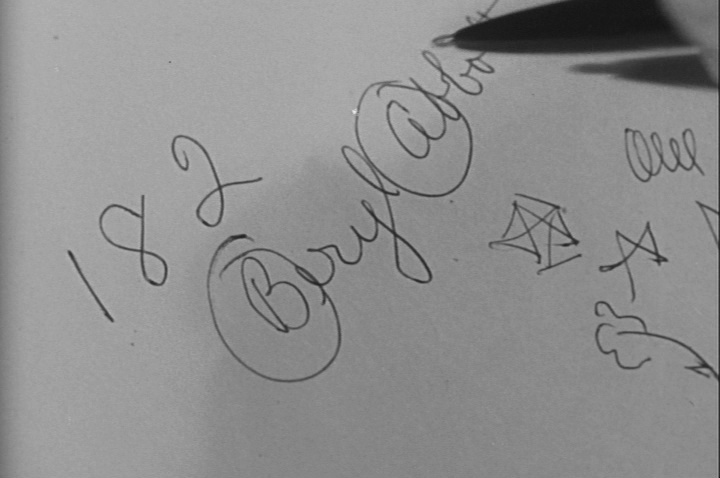
Marcia calls Charles's secretary and gets a telephone number, with which she telephones Beryl. As they speak, she writes the woman's name on a pad of paper and, after she hangs up, she has a thought and circles the "B" in Beryl and the "A" in Abbott, the initials recalling those on the cigarette lighter.

Marcia figures it out

Later, Charles is at home and Marcia confronts him; her anniversary present arriving in a broken state "seemed like an omen." Charles at first denies and then admits the affair. The shot dissolves again to Beryl, as she and Charles discuss his talk with Marcia--he lies and says that he told Marcia that he would not see Beryl any more. He suggests that Beryl change her telephone number and the camera frames the two of them with a pot on the stove between and behind them, foreshadowing the deadly cup of coffee that will appear at the end of the show.

We then see Charles and Marcia in twin beds and Charles is reading a book that looks like the same paperback read by Henry Jones's character in "Nightmare in 4-D," the last episode written by Robert C. Dennis.

Charles is reading Night of Horror, the fake
paperback we've seen before

A closeup of the cover

Marcia accuses Charles of still seeing Beryl; he claims that he's breaking it off slowly in order to avoid scandal and protect Marcia. She seems to accept his story and we can tell from the look on her face that she's hatching a plan as she asks her husband if she can use the car tomorrow. The shot then dissolves to the next day, as Marcia drives with an intent look past a sign that says "Lockton City Limits." Framed behind the wheel, Marcia is a noir heroine on a deadly mission.


Another dissolve (this episode is full of them!) and we see another closeup of a hand--this time, it's Marcia's as she rings Beryl's doorbell. She waits for an answer and clutches her purse tightly, making us wonder what's inside.


In the scene that follows, Beryl answers the door and Marcia sizes her up, pretending to be collecting old clothes for the Welfare Association. Marcia ignores Beryl's initial resistance and keeps at it, sneaking into the house while Beryl is in the back closet looking for clothes to donate. We see a framed photo of Charles on a table in the front room before Marcia notices it. Marcia walks into the kitchen and spies a bowl of sugar; she pours a large amount of powder into it from a packet in her purse.


Beryl comes out as Marcia hurries from the kitchen and they talk; Marcia's eyes light on the photo of her husband as Beryl gives her an old raincoat. The way Marcia looks at the coat tells us that it must have belonged to Charles. Marcia comments on how she has trouble keeping her husband on a diet while Beryl says she rather indulges hers--it is as if they are both married to Charles and he is leading a double life. There is a constant theme of doubling throughout this episode, including shots that dissolve from one woman to the other, alternating scenes, and the final two meetings between the rivals.


At the end of this scene there is another dissolve from Beryl's face to Marcia's; she looks despondent as the phone rings. She answers and learns that Charles was called out of town, went to Lockton and won't be back till late. Another dissolve back to Beryl and we see her doing the dishes and wearing an apron, which she quickly removes, not wanting Charles to see her in a domestic role. Charles breaks it off with her, though he suggests that they get back together after a few months. She responds, "Well how very clever of you to work it out so neatly."

Marcia drives up and rushes to Beryl's door, where she identifies herself and admits to poisoning the sugar bowl. Beryl says it's too late: "You know Charles and his coffee. Exactly two teaspoonsful for every cup." The women seem united for the first time but it's all a lie. Just as Marcia lied to Beryl the first time she visited, Beryl now lies to Marcia. Marcia leaves to go to the police, saying "Nothing matters except Charles" when Beryl tells her that she's a murderess.

After Marcia leaves, Charles emerges from a room off the kitchen and Beryl says it was a woman from the Welfare Association collecting old clothes, making reference to Marcia's lie of earlier that day. Beryl lights her cigarette with her lighter, reminding us of how it all began to fall apart back in the first scene. Charles says he's tired of hiding every time someone comes to the door and Beryl tells him that it "adds spice," recalling his words from an earlier conversation about their relationship. "Too much seasoning can spoil any dish," he comments, unaware of the sugar seasoned with poison that sits in a bowl nearby. "Your troubles will soon be over," says Beryl, and there is another closeup of her hand turning on the burner to heat the coffee pot. Her hand is shown again in closeup as she takes the bowl of poisoned sugar.


Their conversation is banal but what's going on in their heads is very different from the words they speak. Charles thinks that he has gotten away with adultery once again while Beryl is sad about the end of their affair and her decision to kill him. Her hand is seen in closeup as she puts the sugar bowl and coffee cups on the tray and pours coffee. He confirms that he won't divorce Marcia and she takes the tray to him. The camera follows the bowl of sugar as the tray is carried across the room. "How about one for the road?" she says and hands him a cup of coffee. The last shot is another closeup of a hand--this time, it's his as he spoons two teaspoons of sugar in, stirs the cup, and lifts it to drink.


"One for the Road" is an exemplary episode of Alfred Hitchcock Presents that rewards close attention. Robert C. Dennis's adaptation takes a strong story and turns it into a finely crafted script, using doubling and parallel scenes to compare and contrast the two female characters. Robert Stevens does superb work directing the episode, with extensive use of dissolves and closeups to focus the viewer's attention on small details and make sure that we understand what is going on at all times. Were you to listen to this episode without watching it, you would not have any idea of what is really happening. Were you to watch it without listening to the dialogue, you would miss so much of the richness and subtlety that comes from the contrast between what is seen and what is heard. Putting the two together flawlessly is what Stevens does best.

Robert Stevens (1920-1989) directed 49 episodes of the Hitchcock series. The last one reviewed here was "John Brown's Body."

The three actors also turn in fine performances. John Baragrey (1918-1975) had a long career on stage and on screen, beginning when he toured the South Pacific with the USO from 1943 to 1945. He appeared on many early TV shows and was in two episodes each of Alfred Hitchcock Presents and Thriller.

Georgeann Johnson (1926- ) is still alive today at age 89. She was on screen for over 50 years, from 1952 until 2007, and her three appearances on Alfred Hitchcock Presents also include Henry Slesar's "Night of the Execution."

Finally, the best performance of the episode comes from Louise Platt (1915-2003) as Marcia. Se began her career on stage in 1936 and was in movies from 1938 to 1942, including a key role on John Ford's Stagecoach (1939). She then went back to the stage for a decade before an 11-year career on TV from 1952 to 1963 that included two episodes of Alfred Hitchcock Presents: this one and Roald Dahl's "Dip in the Pool."

Do yourself a favor and either order the DVD of "One for the Road" here or watch it for free online here. It's a great show.

Sources:

Grams, Martin, and Patrik Wikstrom. The Alfred Hitchcock Presents Companion. Churchville, MD: OTR Pub., 2001.

IMDb. IMDb.com. 27 Dec. 2015.

Neff, Emily. "Partner in Crime." Wicked Women. [Pocket Book no. 1263.] Ed. Lee Wright. NY: Pocket Books, 1960. 73-85.

"One for the Road." Alfred Hitchcock Presents. CBS. 3 March 1957.


Wikipedia. Wikimedia Foundation. 27 Dec. 2015.

In two weeks: "Martha Mason, Move Star," starring Judith Evelyn and Robert Emhardt!

Monday, January 4, 2016

Star Spangled DC War Stories Part 69: February 1965


The DC War Comics 1959-1976
by Corporals Enfantino and Seabrook


Irv Novick
All American Men of War 107

"Flame in the Sky!"
Story by Robert Kanigher
Art by Irv Novick

Peter: The mind of Navajo Ace Johnny Cloud wanders back to a girl he had fallen in love with as a boy, the gorgeous Running Deer. Synchronistically/ coincidentally, Cloud happens to be listening to the radio one night when Running Deer's voice blares over the airwaves, first as a shill for the Nazis then showing her true colors as an Ally. Coincidentally, Johnny discovers that Running Deer is now being held captive at a nearby Nazi terror base called Nachtzig and that base is about to be bombed by... you guessed it, Johnny's boys. Cloud asks his C.O. if he can opt out but the chief shames Johnny into staying. With a heavy heart and lots and lots of memories, the Navajo Ace realizes that, to bake a cake, you must break some eggs. All is not lost, though, when Johnny decides he's really got to save Running Deer (and thereby risk the lives of his men) and veers his jet into enemy fire. He's shot down and taken prisoner but (as we've come to learn) there's a bright side to every bad DC situation as Johnny learns that Running Deer was not on the bombed base but (coincidentally) at the very spot he's being held! The two are put on an experimental, pilotless, magnet plane designed to guide rockets to their destination. Knowing that the Great Spirit awaits them in death, the daring duo opt instead simply to break the glass between cockpit and cargo and fly the plane to safety!
A really big groan escaped my lips after finishing "Flame in the Sky," a padded 22-page "explosive air-war novel!"  After 25 JC adventures, I'm mostly immune to the whole "Johnny's thinking back to a time when a man stole one of his weenies at the camp fire and became a life-long enemy and then, lo and behold, the villain's one of the Nazis dropping bombs on Johnny's vegetable patch!" plot line but, seriously, this one contains about five too many coincidences to remain even a bit believable. Just how many of these precognitive flashbacks are swirling around Johnny's head at one time? Wouldn't it be great if he had two of them at once and then ran into both characters/farm animals from his past? And how about Cloud's forgiving skymates, dismissing any foolish behavior on their comrade's part and, instead, praising him for his smarts and bravery when the suicide mission JC initiates could have spelled curtains for the entire squadron? Irv Novick, usually very reliable when it comes to the art chores, mucks up several of the air battles this time around by trying to cram way too much into some very little boxes. This story reminds me of the time when I was young...

Clutter, clutter, clutter.

Jack: One of the best Johnny Cloud stories I've read so far, "Flame in the Sky!" shows how good Robert Kanigher could be when given space to stretch out and tell a longer story. While the tale begins with a heavy dose of Indian cliches--"lift my scalp" and "rip at my tail feathers," for example, it has a thrilling conclusion and a good mix of past and present. At one point, Kanigher looks like he's again trying to make an Easy Co. out of Cloud's flying mates, naming them Tex, East Side-West Side, Slim and Tall Man, but I doubt this will stick. Running Deer is an appealing character and I hope we see her again; in a flashback, Johnny displays his silver tongue when he slays her with the compliment that "You paint like a medicine man!" Irv Novick may muddle some of the air battle scenes but his human figures in action are great, especially a couple of panels where Johnny's body is thrown by an explosion.


Joe Kubert
Our Army at War 151

"War Party!"
Story by Robert Kanigher
Art by Joe Kubert

"Enemy Ace"
Story by Robert Kanigher
Art by Joe Kubert

Jack: WWI German pilot Hans von Hammer is the "Enemy Ace," so named for the 50 Allied planes he's shot down in battle. On his 51st mission he is shot when a British pilot fires wildly from a Lewis gun, but von Hammer recovers in time and shoots down the Englishman's plane for his next kill. Even though he is victorious, when he is on the ground he is lonely, so he escapes to the Black Forest and meets his only friend, a black wolf. Von Hammer comments that they share the "lonely business of killing." He takes off again at night, silhouetted by a full moon, and flies above a zeppelin, intending to protect it from attack. Battle ensues and the Enemy Ace downs two French planes before the third flies into the zeppelin, destroying it as he sacrifices his own life. As von Hammer returns to his base, he thinks that the French flier deserves respect and realizes that it's "kill or be killed" in the skies of WWI.


Finally! Kanigher and Kubert take a chance by presenting us with an anti-hero, but the risk works perfectly. Von Hammer is a German pilot who wrestles with his conscience and remains true to his calling as a killing machine. The story would not have worked in WWII, where the nature of the enemy was so different, but it will be fascinating to see it unfold in the context of WWI. Couple this story with a great Sgt. Rock lead-in and we have one of the classic issues of DC War comics.


Peter: Totally agree, Jack! It's a pretty bold experiment for Kanigher, placing the enemy at the forefront and jettisoning the usual cliches of the dirty rotten stinkin' Germans. Von Hammer is a very human character; he doesn't have pointy ears and a tail, he has a conscience, he questions the duties he's to perform, and we see the enemy's side of the war through his eyes. According to Bill Schelly in his superb bio of Joe Kubert, Man of Rock, Kanigher was able to push the project forward thanks to his "special arrangement for creative autonomy." Effectively, Bob could get away with whatever he wanted thanks to his past success with not only the war books but writing for such superheroes as Wonder Woman, Hawkman, and the Flash. Enemy Ace became a very popular feature for decades and even had some crossover appearances in Swamp Thing and Detective Comics. In an interview Kanigher gave to The Comics Journal in 1983, the writer claimed none of his other projects received greater positive fan response.

More Enemy Ace, please!


Joe Kubert
Our Fighting Forces 90

"Stop the War!"
Story by Robert Kanigher
Art by Jack Abel

"Number One"
Story by Hank Chapman
Art by Joe Kubert

Jack: All his life, Lacy has been "Number One" at everything, so when he's drafted he's certain that he'll be the first G.I. to hit the beach. As D-Day approaches, everyone in Charlie Company puts in a dollar and the first man to reach the beach wins the pot. Lacy thinks he has it made, but a Nazi plane and a Nazi sub make his task more challenging then expected. Shot as he swims toward the beach, he blows up a pillbox before being pulled back and sent to a British hospital, where he is first to win a medal for the D-Day invasion. Kubert does his best to tone down Chapman's trademark goofy writing, and he does a nice job--much better than the opening story in which Gunner, Sarge and Pooch see right through Col. Hakawa's fake surrender.


Peter: I had had enough of "Number One" by the third page. He's the number one boy born in the number one hospital and he'll be the number one guy to drink Coca-Cola from a can and he'll be the number one guy to... Even Joe Kubert's customarily great art can't save this exercise in tedium. This was the "Number One" most repetitive story this month. And, strangely enough, I didn't hate the Gunner and Sarge story as much as usual, possibly because there was a bit more of a story line and it avoided an overload of buck-toothed Asians. It's a so-so waste of paper.


Joe Kubert
80 Page Giant 7
Sgt. Rock's Prize Battle Tales

"The Rock and the Wall!"
(from Our Army at War #83, June 1959)

"Flying Saddle"
Story Uncredited
Art by Irv Novick
(from G.I. Combat #58, March 1958)

"The Steel Ribbon!"
Story by Robert Kanigher
Art by Joe Kubert
(from G.I. Combat #69, February 1959)

"The Sparrow and the Hawk!"
Story by Robert Kanigher
Art by Russ Heath
(from Our Army at War #80, March 1959)

"Mission X!"
(from Star Spangled War Stories #96, May 1961)

"The Silent Jet"
Story by Robert Kanigher
Art by Joe Kubert
(from G.I. Combat #64, September 1958)

Peter: Of the six reprints collected for this 80 page giant, there are four stories that were published in the years prior to the scope of our journey. Of the four, the standout is easily "The Silent Jet," wherein Korean War pilot Nick Brady bounces from one tension-filled mission to the next. After being shot down in enemy territory Nick must use first his wits then his fists to survive. Though the gorgeous art is clearly that of Joe Kubert, it's almost as though the master hadn't yet... mastered the form and his work is closer to that of Frazetta or Al Williamson than the JK we've come to know and love on the Sgt. Rock series.


Joe Kubert
Showcase 54
GI Joe

"The Battlefield Jury"
Story by Robert Kanigher
Art by Joe Kubert and Irv Novick

"Blind Night Fighter"
Story by Robert Kanigher
Art by Joe Kubert
(from Our Army at War #75, October 1958)

"Cliff-Hanger!"
Story by Robert Kanigher
Art by Ross Andru and Mike Esposito
(from Star Spangled War Stories #50, October 1956)

"The Clean Sweep"
Story by Bob Haney
Art by Russ Heath
                                                             (from All American Men of War #67, March 1959)

Jack: According to the Grand Comics Database, "The Battlefield Jury" is a four-page framing sequence, where Kubert drew page one and Novick drew pages two and three. Who drew page four?


Next Issue!
The multi-talented Frank Robbins returns!
On Sale January 11th!