Monday, April 9, 2012

Batman in the 1970s Part 13: September and October 1971


by Peter Enfantino &
Jack Seabrook


Detective Comics #415 (September 1971)


"Challenge of the Consumer Crusader"
Story by Frank Robbins
Art by Bob Brown & Dick Giordano

Batman learns that a contract has been put out on Tom Carson, a leading consumer advocate, and arrives just in time to prevent Carson from becoming part of the Gotham landfill. Carson tells Batman that his latest target is Magna Industries, a firm attempting to market a microwave anti-pollution device that may have safety issues. If Magda is forced to pull their product from the market, they could face huge financial losses. The Dark Knight hides Carson out at Commissioner Gordon's house while he sorts out the trouble. His first stop is the home of Magna president Ben Ames, where he scares the businessman into confessing about hiring the assassins but claims Tom Carson was attempting to extract some dough from Ames. When Batman heads to Carson's office, he discovers the truth: one of Carson's lab-techs, Joan Wilde, with the aid of her army of "private commandos," has been blackmailing Ames.

PE: More gawdawful tripe from Frank Robbins. We're to believe that Batman can putty his face up into a likeness of Tom Carson, spray himself with phosphorescent paint and hang himself from the top of Ames's mansion so that he can drum a confession out of him? There are easier, and less melodramatic, ways. Sillier yet, Ames has a calm, collected conversation with what he assumes is Tom Carson's ghost! Want more? How about the consumer lab that Wilde and her goons trap Batman in? Why do you need to test products with psychedelic lighting?


Jack: Terrible! Frank Robbins again veers into Batman TV show territory with his efforts to put Batman in a seemingly-inescapable death trap as a car plunges at 80 miles an hour from a great height--thank goodness for an early prototype of the air bag, not to mention a jackknife rear somersault!

PE: You gotta love a guy who can jackknife somersault into the backseat of a car traveling 80 miles an hour straight down. This must be the month that Babs is smitten with Robin as she didn't even remove the curlers from her hair when Batman returned to her house to pick up Carson.

Batgirl sans makeup
"Death Shares the Spotlight!"
Story by Frank Robbins
Art by Don Heck

Investigating the shooting at the theater (as seen last issue), Batgirl tracks the would-be assassin to a rodeo. Turns out the shooter was a spurned lover of Tiz Marlow's. Batgirl and Jason team up to put down the rifleman after they find out he's actually shooting blanks.

Jack: Barbara Gordon's boyfriend Jason comes to the rescue of Batgirl (sort of) in this uninspired Robbins/Heck collaboration. Heck's characters all have very high cheekbones and without a good inker his art looks sketchy.

Not a good issue for Batgirl
PE: It's hard to find anything worthwhile here. The pace is so quick since it's only seven pages long but at double the length it's padded. My favorite bit is when Batgirl spies gunpowder residue on Big Chuck Walla's glove from the rafters of the arena just as Big Chuck notices it himself! Not wanting to be conspicuous, Big Chuck drops what he's doing (as he's being introduced to the crowd) and heads for the backstage area to burn his gloves. I've seen subtler exits.

"The Forbidden Trick!"
Story by Bill Woolfolk
Art by Leonard Starr
(from Detective Comics #211, September 1954)

Those Egyptians sure could build 'em
Jack: Mysto the Magician solves a mystery from ancient Egypt. Sadly, this story was better than the two new ones this issue!

PE: If you have no problem suspending disbelief, this is a lot if fun. Mysto seems to have more than tricks up his sleeve. In one scene, he utters an incantation and Jarko, a rival magician, is pinned to the floor, unable to free himself. Later, Mysto explains he slipped a giant magnetic plate under the rug and a "similar magnetized plate of opposite polarity" down the back of the other man's suit! Talk about sleight of hand. And how about the razzle-dazzle of Mysto's mid-air rescue of Jarko, caught in an ancient urn suspended from an airplane thousands of feet in the air? Mysto puts his plane on autopilot, climbs out on the wing and jumps onto the urn, releases Jarko, then gets back into his own plane and lands it! Indiana Jones has nothing on this magician.

"The Case of Finders Keepers"
Story by ?
Art by John Prentice
(from Gang Busters #54 October-November 1956)

Jack: A halfway interesting story spoiled by the far-fetched denouement. The art looks like swipes from photos, especially regarding the main character.

PE: I'm assuming that police didn't have what we call now "warrants" back in 1956 as we see Sgt. Welky enter the con man's house, not through a door but through the window! I think I'd rather have seen the story behind the chompers Welky's holding in the second panel. Might have been more interesting than this turkey.

Not bloody likely!
Batman #235 (September 1971)

"Swamp Sinister"
Story by Denny O'Neil
Art by Irv Novick & Dick Giordano

Bruce Wayne receives a delivery--a hideously deformed body in a pine box! Ra's Al Ghul appears and confesses to having sent the macabre present in order to capture Batman's attention. It seems that Ra's has developed a chemical that serves as a deadly plague carrier when exposed to air, and one of his employees has stolen it! Batman sets out to find the criminal before Talia, Ra's's daughter, can track him down. Batman trails the evil-doer to the Louisiana bayou, where he finds Talia holding the thief at gunpoint. After a fight, the bad guy is exposed to the plague, and Batman escapes safely with Talia.

Jack: Like next month's Man-Bat story in Detective 416, this is an example of a major character who was last drawn by Neal Adams and is now drawn by another of the Batman artists, this time the solid Irv Novick. This story moves along at a fast pace and is reasonably satisfying, though it is not one of O'Neil's strongest tales.

PE: It's not a bad story but I found it uninteresting, which surprised me given the guest star. If you can't have Neal Adams then I guess Irv Novick, whose art looks quite a bit like Adams's at times, is a fair substitute.


Jack: If we ever needed proof that the DC editors did not want continuing stories or cliffhangers, here it is. In Batman 232, Ra's Al Ghul tricks Batman into traveling halfway around the world because Ra's wants Batman to marry his daughter Talia and take over his empire. That issue ends with such a surprise that I thought surely it would be continued in the next issue, but it was not to be. Batman 233 was a giant reprint issue, and Batman 234 featured the Neal Adams Two-Face story. Now here we are in Batman 235, returning to Ra's Al Ghul, and it seems like all is forgiven and pretty much forgotten. One would think Batman would be at least a little bit annoyed at Ra's for dragging him to the Himalayas, but no--this time, Ra's delivers a plague-ridden body to stately Wayne Manor to get Batman's attention, tells Batman that there is a vial of plague on the loose, and Batman leaps into action! It's as if Ra's Al Ghul is the new Commissioner Gordon!

PE: That was my problem with the story. Batman's a lap dog for Ra's here. The future arch-enemy shows up at Wayne Manor with a dead body, tells a story, and Batman completely puts his trust in him. Too quick for me. I'm wondering if, at this point, O'Neil hadn't made his mind up yet whether Ra's Al Ghul would be sometime ally (a la Man-Bat) or enemy.

I do like Talia's fashion sense!
"The Outcast Society"
Story by Mike Friedrich
Art by Irv Novick & Dick Giordano

Robin accuses Nancy's boyfriend, Pat Whalon, of shooting her father, the cop, because Robin can show that the bullet Nancy wears around her neck as a protest reminder was fired from her father's gun. Unfortunately, my copy of this issue ends halfway through the Robin story, so I can't say for sure if Pat is really the culprit or if Robin has jumped to the wrong conclusion.

Jack: This is another preachy Robin story in which the hippies at the commune explain how they are living the way man was intended to live. I wonder how that worked out for them?

PE: Ask how it worked out for me, Jack. More hippie mumbo jumbo. I especially liked the bit where the eight foot tall hippie puts his arm around Robin and tells the Boy Wonder about the founding of America and hippie rituals such as battling any outsiders visiting the camp. Can you dig that?


"Castle with Wall-to-Wall Danger!"
Story by John Broome
Art by Carmine Infantino
(from Detective Comics #329, July 1964)

While Bruce Wayne and his youthful ward Dick Grayson are having a bit of breakfast, Commissioner Gordon calls to let Batman know he's gotten a lead on a criminal who slipped through his gloved hands. Gordon has seen what looks to be the criminal in a magazine article about a castle in England. Eager to erase the name of Vincent Pragnel from his "at-large" chalkboard, Batman hops aboard his Bat-plane with Robin and heads overseas. When they get to the castle, they are greeted by the man in the article. It's not Pragnel, but Albert Maunch, who invites the Caped Crusaders to stay for dinner once he's heard their wild story. Once inside the castle, the boys are subjected to several perils including quicksand and falling suits of armor. In the end, we learn that Maunch is the cousin of Pragnel and the bad guy is holding Maunch's family hostage while he looks for gold under the castle. Batman makes short work of him and the dynamic duo and their prisoner head back to Gotham City, extradition papers in hand.

PE: If you feel the need to read one of these dopey 1960s yarns, you could do worse than "Castle with Wall-to-Wall Danger!" I'm glad Batman mentions that Pragnel would have gone unnoticed if he hadn't demanded Maunch to keep the boys at the castle. I was thinking the same thing. Some criminals are just plain dumb.

Detective Comics #416 (October 1971)

"Man-Bat Madness!"
Story and Art by Frank Robbins

Man-Bat and Woman-Bat Kirk and Francie tie the knot and begin their new life, hopefully, as simply man and woman. To this end, Batman is kind enough to provide anti-bat serum to keep them human for as long they need it. The lure of the night skies and eating small insects proves to be too great for Kirk Langstrom, though, and he's quickly working on new Man-Bat potions. At a performance at the Gotham Opera House, the high notes during an aria trigger Kirk's transformation into Man-Bat. He flees, Batman in pursuit, via the Gotham subway. An emergency stop causes a fire but Man-Bat proves there's still some humanity under all that rubbery skin and fur as he helps The Dark Knight evacuate the subway cars and get the riders to safety. Langstrom then heads to his office to drink down his new "permanent Man-Bat potion" but Batman, two steps ahead, has switched vials and the creepy but cuddly giant Bat with a tux quaffs an "anti-Bat antidote." Will the change back to human form be permanent? Only time and sales figures will tell.

Jack: Once I got over my knee-jerk reaction to seeing that Frank Robbins drew this story, I decided to try to give it a chance, and it's actually pretty interesting. The art, that is! Robbins's art is so stylized that it doesn't really fit in with the more naturalistic style of other Batman artists of this era, but it seems like he could've drawn horror comics very well with this style. The coloring is also quite unusual, with lots of yellows standing in for black and white and giving the story a film noir feel. While of course I would rather have seen this story drawn by Neal Adams, I have to say that Robbins's art was kind of intriguing.

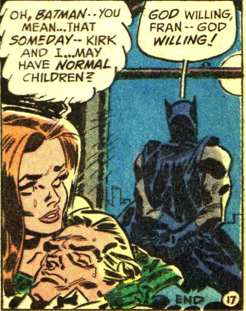
PE: The only thing worse than a Frank Robbins script, it seems, is a Frank Robbins art job as well. I've got history with Robbins' art. It turned my favorite mid-70s Marvel title, Roy Thomas's glorious The Invaders, into unreadable drivel. His run on Captain America and the Falcon, following a classic stint by Sal Buscema, signaled the end of Captain America as a top Marvel title (the return of Jack Kirby to Cap in 1976 was the icing on top of that cake). Robbins was the anti-Ditko. Where Steve could make the contorted body look natural, Frank would render the human form almost boneless. The perfect example this issue of bad writing and horrid art melding together to make something almost the perfect parody would be the transformation of Kirk into Man-Bat in the middle of an opera. "A squirming Langstrom tries desperately to conceal his 'flashback' from Francie and those around him" reads the caption above a panel of huge bat ears blocking the view of theatergoers. And just as he's about to take the anti-bat serum, the diva onstage hits a High-C and shatters the vial! This could almost be funny, like an excerpt from a Batman spoof perhaps,  if Robbins wasn't so serious about the events. I'll grant you this, Jack: the two or three panels of the subway train have an eerie quality to them, but they seem lost in a haystack of rubber limbs and uncharacteristic features.


Jack: Do you think that Robbins intended this as some sort of Vietnam vet analogy? It's odd that Kirk Langstrom fears "flashbacks" and when he turns into Man-Bat, the word "FLASHBACK . . !" appears.

PE: Hmmm. What to give the newlyweds for a wedding present? I've got it! Enough antidote to keep them from turning into Bat-monsters and a personal, loving note from their best friend, Batman, that reads "Hey guys, just remember, as you head out on your honeymoon, that you could turn into killer bats at any second!" Gee, why do you think Kirk and Francie reacted so badly to the present? But then, Batman may have a point. Immediately after the honeymoon, Kirk is ready to turn into a Man-Bat again. Itching to. If only Batman had left well enough alone.


"The Deadly Go-Between"
Story by Frank Robbins
Art by Don Heck

After the killing of Officer Jim McLean, Commissioner Gordon devotes every waking hour to tracking down the murderer, to the detriment of his health. Worried for her father, Babs Gordon dons her Batgirl uniform and stalks the night, searching for clues. Meanwhile, the crooks have sent out a fake Batgirl to fool Gordon into thinking the gunman is Zed Kurtz, the very unpopular leader of the revolutionary gang, "The Ice-Men." Gordon and FakeBatgirl head to the den of the Ice-Men, where Gordon draws his service revolver and awaits Kurtz's exit.


PE: Another story that reminds me why the lack of any continuity in this strip bugs me. Officer McLean is an integral part of the plot here but we learn nothing about him. No personal information. He's just a name and worse, he's a name that will be forgotten by the next arc. Any rash moves made by Gordon will be wiped away by the end of this storyline. Not that Gordon will make any rash moves as I suspect he'll come to his senses by the beginning of our second chapter.

Jack: It's amazing that the crooks found a girl who was a dead ringer for Batgirl, then put her in an exact duplicate of Batgirl's costume so she could ride around with Commissioner Gordon and fool him completely!


PE: The real question is: why would the villains send a faux Batgirl rather than Batman? The Dark Knight is known to be tight with Gordon so I'd assume he'd get the nod. It's amazing to me that ace detective Batgirl considers lifting the receiver upstairs the same time as dad downstairs a "phone tap." The easy capture of Babs by the thugs just adds more weight to my argument that, without the Big Guy, Batgirl and Robin aren't worth the paper they're printed on. Though I must say that Don Heck's art seems to be back up the hill from the valley it's been in. I found it serviceable. What I found less than serviceable was the matronly outfit (complete with whatever that is she's got on her head) Babs wears to bed. I see the point of making her look like Adrian in Rocky but this goes way beyond the curlers we saw a few issues ago. Gordon's house looks like it could be Wayne Manor. Perhaps it's time for the guys down at IAD to check into The Commish's finances.

"Rex--Circus Detective!"
Story by Robert Kanigher
Art by Alex Toth and Sy Barry
(from The Adventures of Rex the Wonder Dog #3, May-June 1952)


PE: Hard to imagine that Rex was so popular he fronted his own title for 46 issues (January 1952-October 1959)!

Jack: Gee, Rex is so smart he even thinks in English!

PE: I'll be monitoring the letters pages as I have to believe that reprints about wonder dogs (even those performed by the crack team of Toth and Kanigher) could not be sitting well with the majority of comic readers who plunked down their two bits for a comic featuring Batman.

The always reliable Alex Toth
"The Case of the Gold-Dust Death!"
Story by ?
Art by Ramona Fradon
(from Gang Busters #30, October-November 1952)

Jack: I would not make a very good detective. I did not solve this one. Ramona Fradon was one of the rare female comic artists of the early 1950s.

PE: I enjoyed this little ditty but I would defy anyone to guess what the cop sees that tells him who the murderer is.

Thursday, April 5, 2012

Robert Bloch on TV Part Twelve-The Alfred Hitchcock Hour: "A Home Away From Home"

by Jack Seabrook

Ray Milland as Dr. Howard Fenwick
"A Home Away From Home" was Robert Bloch's second script for The Alfred Hitchcock Hour. It aired on September 27, 1963, as the premiere episode of the hour-long Hitchcock program's second season. The teleplay was based on Bloch's story of the same name, which had been published in the June 1961 issue of Alfred Hitchcock's Mystery Magazine. Bloch later wrote that he penned the story for a contest the magazine was running and that it had won a prize.

The story, which is very short, is set in England and concerns Natalie Rivers, a young woman who has traveled by train from London to Hightower Station in the West Country to see her uncle, Dr. Bracegirdle. When no one meets her at the station, she telephones her uncle, who sends Miss Plummer to pick her up in a station wagon. Natalie hails from Canberra, Australia; her parents were killed in a car crash two months before. She has never left Canberra before and she has never met her uncle.

Natalie arrives at her uncle's house only to find that a party is going on. Her uncle, who is a psychiatrist, welcomes her, bringing her into the parlor to meet the other guests. They are having a farewell celebration with plenty of alcohol. Natalie sees her uncle's consulting room across the hall through a partially open door. She enters the room and notices that the telephone cord has been cut. She realizes that the man claiming to be her uncle was really a party guest and she sees the corpse of her real uncle lying on the floor.

Natalie appeals to the other guests, telling them that her uncle's death was "the work of a madman" who "belongs in the asylum." Miss Plummer informs Natalie that "this is the asylum," locking the door to the consulting room as the other guests move toward her.

"A Home Away From Home" is a chilling story of very short duration. Bloch was soon approached by the producers of The Alfred Hitchcock Hour to expand it to fill an hour-long episode and he wrote that doing so was "no easy task . . . it wasn't easy for me to enlarge and maintain the same level of suspense, but I think the dramatization worked."

In order to expand the story, Bloch added scenes and characters, fleshing out the tale and changing its focus. Almost the entire first act is composed of new material. The story begins as Sarah Sanders, an aging actress of British stage and screen who now spends most of her time in bed, proudly displays her scrapbook to Dr. Fenwick. Clues to what is going on are liberally sprinkled among the lines of dialogue, as Sarah tells the doctor "I'm as sane as you are."

The doctor, whose name is Howard Fenwick, turns out to be a patient himself, and a woman whom he claims is his wife visits him. They must speak to each other in a room where they are separated by a wire screen; he begs her to use her influence on the sanatorium's doctor to get him discharged. Unlike the story, where the fact that the house is an asylum is withheld until the end, the television show features a closeup of a sign reading "Norton Sanatorium" in one of its opening shots.

Claire Griswold as Natalie Rivers
Fenwick's wife speaks to Dr. Norton in his office and learns that Fenwick will not be released any time soon. After she leaves, Fenwick himself enters Norton's office and strangles him, killing the nearsighted little doctor. The office phone rings and Fenwick answers it; he immediately assumes Norton's identity and welcomes Norton's niece Natalie, who asks to spend the night while on her way to Lake Louise for a vacation. This is where the teleplay and short story first dovetail, since the story opens with Natalie's phone call to her uncle. For television, however, she did not travel by train and she does not require a ride to the home; the action has also moved to North America, since Natalie is on her way to Lake Louise, in Alberta, Canada.

In act two, Natalie begins to meet and interact with various people in the Sanatorium. The Major (a stuffy old British officer) and Nurse Gibson tell Sarah Sanders, the old actress, that Dr. Norton has taken a short vacation, leaving Dr. Fenwick in charge. In the kitchen, the cook Martha tells orderly Nicky that he has to carry meals upstairs by hand because the dumb waiter is out of order. Natalie speaks with Dr. Fenwick in his study, thinking he is her uncle. He shows her a book by Howard Fenwick, M.D., titled Permissive Therapy; the script is particularly witty here, as Fenwick calls his own work "brilliant" and explains that it recommends setting lunatics free and giving them a role to play--exactly what he has done, unbeknownst to Natalie.

Ben Wright as Dr. Norton
Natalie meets Sarah, who insists that she wants her dinner. Natalie goes to pull up the dumb waiter but is distracted; she ventures up to the third floor and finds Andrew locked behind bars, claiming that he is the real Dr. Norton's assistant and that the lunatics have taken over the asylum and imprisoned the real staff. Andrew's behavior is more unstable and dangerous than that of anyone else, so Natalie is understandably reticent to believe his tale

Act three begins with Dr. Fenwick telling Natalie that Andrew and several others are kept locked up on the third floor because they are violently disturbed. Natalie meets Donald, a shy young man who is also a kleptomaniac. The script continues to blur the line between the criminally insane and the merely nutty, as Natalie, some of the patients, and even the viewers grow increasingly unable to tell who is a patient and, more importantly, which of them represent a danger.

Again meeting Sarah, who claims to need bed rest because she is pregnant and has been about to give birth for five years, Natalie goes to the dumb waiter and pulls it up, only to find Dr. Norton's body lying crumpled inside. The final act brings Inspector Roberts onto the scene. He looks the part of a classical detective in his trench coat, and when Natalie shows him the dumb waiter the body has disappeared. She goes looking for her uncle in his office and finds the body in a roll top desk. Inspector Roberts identifies it as that of Dr. Norton, and Natalie realizes that Dr. Fenwick as been impersonating her uncle.

Fenwick explains to Natalie that Roberts is not really an inspector, but rather a patient playing a part, just like all the others she has met. "I am trying to live the role!" cries Roberts. Fenwick informs Natalie that she is now a prisoner and that he will decide what he is going to do with her later that night. She asks the Major about Dr. Fenwick and learns that he, too, is a patient, committed to the asylum due to "some nonsense about killing his wife." The visitor we saw early in the show was his sister, but he pretends she's his wife.

In the tense final scene, Natalie tries to escape from her room and then gets a set of keys to let Andrew out of his cell on the upper floor. Sarah betrays her and sends Dr. Fenwick up after her. He begins to strangle her but she is rescued at the last minute by real police who burst on the scene unexpectedly. It turns out that Inspector Roberts played his role a little too well, calling the real police to report the murder of Dr. Norton.

Robert Bloch's expansion of the short story into the hour-long teleplay is a model of how to fill out a story by using characterization, adding plot elements, and infusing humor. While much of the program is suspenseful, the final twist is humorous and would fit very well as the ironic ending of an episode of the half-hour Hitchcock series. The show is directed by Herschel Daugherty, who directed twenty-four episodes of the half-hour series and three of the hour series. His use of shadows and high contrast lighting is especially effective in this episode, and he moves his camera fluidly on several occasions. The scene where Dr. Norton is killed is particularly clever, since it is shot from Norton's point of view after his thick glasses have been crushed, and the murderer's face is blurry and almost indistinct.

One of the most striking aspects of this program is the score, composed by Bernard Herrmann. Herrmann was one of the foremost movie music composers of his time, having scored a number of Hitchcock's greatest films in the 1950s and early 1960s. His music for "A Home Away From Home" sets the mood in the opening shots with a combination of violins and a harp; the music recurs throughout the episode and is essential in creating suspense, especially in scenes where there is no dialogue and little sound. The score is somewhat reminiscent of that from Psycho (also by Herrmann), though without the shrieking violins.

The cast of "A Home Away From Home" is top notch. Starring as Dr. Fenwick is Ray Milland, making his only appearance on the Hitchcock series. Milland (1905-1986) was one of the great actors from Hollywood's Golden Age, appearing in films from 1929. He won the Best Actor Oscar for The Lost Weekend (1945) and appeared in such classics as The Uninvited (1944), Fritz Lang's Ministry of Fear (also 1944), The Big Clock (1948), Hitchcock's Dial M for Murder (1954), and Roger Corman's The Premature Burial (1962) and X: The Man With the X-Ray Eyes (1963). He starred in two TV series: Meet Mr. McNutley/The Ray Milland Show (1953-1955) and Markham (1959-1960). He also appeared in a Night Gallery episode. His autobiography, Wide-Eyed in Babylon, was published in 1974. His performance as Fenwick is menacing, yet there is always a subtle gleam in his eye that lets the viewer know he is having fun.

Richard Peel as the first inspector
Claire Griswold plays Natalie, the niece who finds herself trapped. She lived from 1936-2011 and had a brief career. She appeared in one other Hitchcock hour show, as well as the Twilight Zone episode "Miniature." She retired from acting in 1963 to raise children with her husband, the director Sydney Pollack, who had also been her acting teacher.

Among the other cast members was busy character actress Virginia Gregg as Nurse Gibson; Gregg lived from 1916-1986 and had her most memorable moment behind the scenes as the voice of Norman Bates's mother in Psycho.

The role of Dr. Norton, who is murdered early in the show, was played by Ben Wright (1915-1989), who would go on to his most famous role a few years later as Herr Zeller, the Nazi captain in The Sound of Music. He is the one who stops the von Trapps on the road as they are trying to escape with their car right before the climactic festival.

The first inspector, one of the two real policemen who comes on the scene at the end of the episode, is played by Richard Peel (1920-1988), who was turning up regularly as a policeman on the Thriller series right around this time.

Beatrice Kay as Sarah Sanders
Finally, and closest to my heart, is Beatrice Kay (1907-1986), who plays Sarah Sanders. Ms. Kay was born Hanna Beatrice Kuper and was on stage from age six. She starred in vaudeville and then had a radio show in the 1940s. She was a popular nightclub singer who released several record albums; known as the Gay Nineties Girl, she sang old songs from the 1890s and was hugely popular for a short time, selling an astonishing 12 million copies of her record, "Mention My Name in Sheboygan." It can be heard here, but I warn you--it is an addictive tune. Her performance as Sarah Sanders, the batty old British actress, is perfect.

"A Home Away From Home" aired on Friday, September 27, 1963, as the premiere of the second season of The Alfred Hitchcock Hour. The series had been on Thursdays at 10 pm the season before; now it moved to Fridays, where it followed right after The Twilight Zone. That night, at 9:30 pm, season five of The Twilight Zone premiered with the episode "In Praise of Pip," starring Jack Klugman.

The TV show can be viewed here. The story was reprinted in the Bloch collection. Tales in a Jugular Vein, which is easily available from online booksellers.

Sources:

Bloch, Robert. "A Home Away From Home." Tales in a Jugular Vein. New York: Pyramid, 1965. 83-90.
Grams, Martin, and Patrik Wikstrom. The Alfred Hitchcock Presents Companion. Churchville, MD: OTR Pub., 2001.
"A Home Away From Home." The Alfred Hitchcock Hour. CBS. 27 Sept. 1963. Television.
IMDb. IMDb.com. Web. 01 Apr. 2012. <http://www.imdb.com/>.
Wikipedia. Wikimedia Foundation. Web. 01 Apr. 2012. <http://www.wikipedia.org/>.


Monday, April 2, 2012

Batman in the 1970s Part 12: July and August 1971


by Jack Seabrook
& Peter Enfantino


Detective 413 (July 1971)


"Freak-Out at Phantom Hollow!"

Story by Frank Robbins
Art by Bob Brown and Dick Giordano

On his way back to the Batcave after a hard day of crime-fighting, Batman is hailed by an old friend, ex-Gotham cop Bill Wilcox, now constable of the small town of Phantom Hollow. His town is in the grip of hysteria over some strange incidents conjuring up the name of a long-dead woman, Ol' Nell, hanged as a witch 300 years prior. Chief among the startling events is the ringing of a bell long silenced, local folk reckon, because of the curse placed on the town by the witch. Batman soon discovers that there are very human forces at work in Phantom Hollow.

PE: Where the hell is the scarecrow? That cover promises so much eeriness that never gets delivered. At least give us a ghost then, Frank Robbins! Aside from a splash page of ol' Nell, nothing but lip service. A double cheat this issue. Not even one of those cliched, "well, it might have been supernatural after all, kiddies" final panels. And, for gosh sakes, just how big can a human being be in the DC Universe? Doing a quick scale check, based on the panels below and the supposition that Batman is at least six feet tall (although that would make Shecky and Jamie about four feet tall each), I'd say Slow Lannie (who really ain't that slow) is a good twenty feet tall. So let's get this straight: Slow Lannie acts like the country idiot all his life so that he can surprise the town folk some day by blowing them all up. That's quite a well thought-out plan. Why bother playing dumb?


Jack: Unfortunately, that great Adams cover has nothing to do with the weak story inside, courtesy of our favorite writer, Frank Robbins! It's always a bad sign when words like "freak-out" start getting thrown around early in a Batman tale, and this one is no exception. Even the bad guy, Big Lanny, lives in a "cave pad." And there's no scarecrow anywhere in sight.


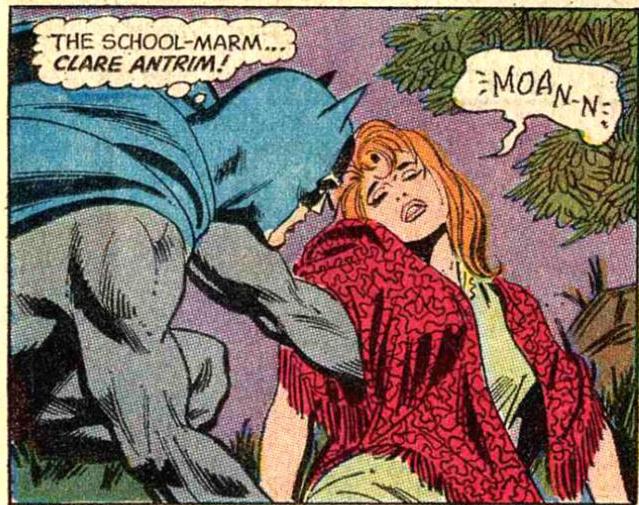
Some schoolmarm!

"Squeeze-Play!"

Story by Frank Robbins
Art by Don Heck

More crazy anatomy!
Batgirl is at the mercy of the "diabolical head-splitters," two evil wig-makers who use their talent to force rich women to hand over their valuables or face a splitting headache. Though she gets the upper hand on Vazly, the male of the team, his wife Wanda gets away and attempts one more blackmail.

PE: Oh my goodness, this is dreadful stuff. Not much to say except that Jack and I take our job seriously and you readers owe us one if we've scooted you away from this swill. Hard to imagine Julius Schwartz thought this was publishable material.

Jack: More sub-par art by Don Heck and an uninteresting story doom the conclusion of this Batgirl two-parter. It's really a shame that such a great cover had to wrap around such a bad issue of Detective.


PE: Heck almost looks like he's trying to imitate Gene Colan in this strip. I especially liked the panel of Batgirl fighting off the killer wig while her legs and torso move in different directions. No mere mortal could attempt this.


Bruce Wayne, you silver-tongued devil!

Whoops! Forgot the chest emblem!
PE: But at least he remembered the chest! My definition of GGA.


Batman #233 (Giant Batman G-85) (July-August 1971)                                                     


"The Death Cheaters of Gotham City!" (Batman 72, Aug.-Sept. 1952)

Story by David V. Reed
Art by Jim Mooney


Jack: "The Death-Cheaters of Gotham City" features a plot point that is far-fetched even for Batman, when Bruce Wayne poisons himself and is declared legally dead before reviving. This is the only way he can join the death-cheaters club and find out who is killing off its members. Jim Mooney did the art for this entry; I only knew him from his work on 1970s Marvel comics like Omega the Unknown, but he actually started in comics in 1940!

PE: I've been enjoying Mooney's work in the pre-Torch Strange Tales. In fact, I picked one of his art jobs, "The Monster's Son," as one of the best of the first ten issues. I like the battle of underworld goons atop a billboard advertising beer. One thug rides the bottle like a rocket. That would be Joey the Rod. I'm not a big fan of these Batman stories from the 1950s but this one's enjoyable enough. I do wonder if I'm the only one that noticed that Robin looks like he's seven years old in several of the panels. What would his age have been around this time? Nice gimmick having the final four panels, revealing the killer's identity, upside down.


"The Other Bruce Wayne" (Batman 111, Oct. 1957)

Story by Bill Finger
Art by Sheldon Moldoff and Charles Paris

Jack: Our hero meets his cousin, Bruce N. Wayne, a renowned private detective who is determined to make a man out of the millionaire playboy.

PE: Someone explain to me the scene where Bruce Wayne is called to the phone by Commissioner Gordon and it's automatically assumed that the only reason he's calling is because the Commish has finally taken those advanced mathematics classes, added 2 plus 2 and come up Batman? And then, to add to the laughter, Batman feels the need to change back into his Bruce Wayne uniform just to answer the phone! Later, Bruce switches to Batman and vice versa as many times as Mrs. Doubtfire to make sure his cousin doesn't catch on. But Bill Finger saves the best for last. Bruce (the cousin) is already enrolled in that math class and quickly deduces his millionaire slob cousin is actually Batman. To throw him off the track, Bats catches the bad guy that his cousin has been tracking, makes him up to look like his secret identity and convinces Bruce N. Wayne that he was wrong! I guess the inflatable Bruce doll wasn't packed in the Bat-trunk that week.


"The Murder of Bruce Wayne!" (World's Finest 58, May-June 1952)

Story by David V. Reed
Art by Bob Kane, Lew Sayre Schwartz and Charles Paris

Jack: Commissioner Gordon fires Batman and Robin, showing the same poor judgment he would continue to demonstrate into the 1970s.

PE: Here's a rarity: an art job signed by Bob Kane that, reportedly, he actually had a hand in aside from cashing a check! My disdain for Kane might color my feelings about this reprint but I found it to be nothing special.

"Bruce Wayne's Aunt Agatha!" (Batman 89, Feb. 1955)

Story by Bill Finger
Art by Sheldon Moldoff and Stan Kaye

Jack: Coming to the rescue of her nephew and his ward, she wears a Joker costume!

PE: A good example of why I don't like the 1950s Batman.


"The Crime of Bruce Wayne" (Detective 249, Nov. 1957)

Story by Bill Finger
Art by Sheldon Moldoff and Charles Paris

Jack: When Bruce Wayne ends up on Death Row, Robin must enlist the aid of Batwoman to save his guardian. Batwoman? Where did she come from? Well, according to Wikipedia, she was introduced in 1956 to counter charges by Dr. Wertham that Batman and Robin were gay. If I ever knew this, I must have erased it from my memory!

PE: Notably absent from any of these stories--but in keeping with Schwartz's policy of "no classic Bat-Villains"--are solid bad guys. These are all interchangeable sketches.


Detective 414 (August 1971)


"Legend of the Key Hook Lighthouse!"

Story by Denny O'Neil
Art by Irv Novick and Dick Giordano

Batman has been staking out a gang of gun-runners who intend on making a big sale to a South American general hoping to shoot his way into owning his country sometime soon. The Dark Knight busts up the gang but one of them, a former club singer named Loosy (yep, Loosy), looks to cut a bargain for herself and her partner, Artie, by giving Batman her boss. The Caped Crusader agrees and he and Loosy hop aboard a boat and head for the spot the deal was to go down at: a deserted lighthouse with a ghostly legend attached.

PE: Another of those nicely done "Batman in The House of Mystery" type stories that almost feel like an "Elsewheres" story where anything can and will happen. I still find it detrimental to this series that there are no subplots nor continuity. I'm 99% sure that was by design. Editor Julius Schwartz obviously thought he'd garner more sales if a casual reader picked up the latest Batman or Detective and was able to jump right in without the feeling of entering the room while the movie was in progress. I used to hear complaints from comic fans in the 1970s that Marvel's history was so dense, so complicated, and so daunting that fewer new fans were jumping on the wagon. With these Batman stories, that fan could jump in at any time and not miss a thing. Chances are Bruce Wayne will never mention Key Hook or Phantom Hollow ever again. I'm not sure if the absence of subplots (and, lately, a supporting cast) is a bad thing based on some of the abysmal characterizations and story lines we're reading over at Marvel University.

Jack: I thought the first page was evocative and almost like a different style of art than the rest of the story. I liked this story quite a bit, and I think it demonstrates how much better a writer Denny O'Neil was than was Frank Robbins. The characters have depth and shadings that take them beyond cliches. Take Loosy, for example. Her love for Arnie and her confession to Batman about her past mistakes make her act of nobility believable. Irv Novick's art is solid and Dick Giordano's inks are so good that there are panels where the images approach Neal Adams-like quality. The art team does a good job of rendering Loosy so that one can see that she was once a beautiful woman but that the ravages of time and her lifestyle have tarnished her appearance. This story also continues the trend of unexplained, supernatural forces that we have seen in the early 70s Batman tales. Nicely done all around.

Looking ahead, in the letters column of Detective 418, Denny O'Neil writes that he spent extra time on the character of Loosy, "as an experiment in the kind of characterization not usually found in our medium."


"Invitation to Murder"

Story by Frank Robbins
Art by Don Heck

Don Heck + Batgirl = zzzzz
Barbara Gordon and her beau, Jason take in a play, only to find that, aside from one other couple and the actors on stage, they're the only ones in the auditorium. When the curtain goes up, someone appears behind Jason with a rifle. Attempting to subdue the gunman (and make some points with his date), Jason is struck unconscious and Barbara must change into Batgirl.  A shot rings out and the sniper gets away. When the lights come up, it's discovered that the other attendees are Hollywood's latest "it" couple, Tiz and Robbie Marlow, the latter of whom was the recipient of the lone bullet. Babs has a hunch as to what's up but we'll have to wait until next week to find out what that hunch may be.

PE: Why would someone wanting to kill Tiz and Robbie go to the trouble of hiring out an entire theater complete with a stage full of witnesses? Wouldn't it be fairly easy for police to find the assailant (granted, it's the Gotham police department, but still...)?  I'm sure no one notices Barbara Gordon changing in to Batgirl in a near-deserted theater. Batgirl just happens to be there when the action occurs. If I was one of the three other people in the auditorium, I wouldn't question it. Nope. Don Heck's art seems to be getting proportionately as bad as Frank Robbins's writing.

Jack: The only good thing I can say about this effort by Robbins and Heck is that Batgirl did not have to choose a skirt style or don a tight wig. Heck's art is very sketchy here, which doesn't make the characters look good. I really miss Gil Kane's work on this series.

Jack: This was the first issue of Detective to cost 25 cents and feature a longer page count. Editor in chief Carmine Infantino inserts a half-page explanation and wants to rap with the readers about why they have to shell out more of their hard earned bread. He tries to say that the extra pages include more specially selected stories to make the increased cost worthwhile. And what stories do we get?

Does he remind anyone else of John Kerry?
"The Australian Code Mystery" from World's Finest #66 (Sept.-Oct. 1953), a ten-page long wartime code-breaking story with some decent art by Alex Toth (above), and "Private Eye of Venus" from Strange Adventures #83 (Aug. 1957), a six-page science fiction detective story with art by none other than Carmine Infantino (left). If they had to pad the page count with reprints, why not use stories involving Batman?

PE: Good question, Jack. I can only assume that editor Schwartz simply wanted to reassert that these are Detective Comics and other detectives would find a home here as well. The practice will continue and expand in a few years to include such supporting acts as Jason Bard (Batgirl's beau in solo stories), Hawkman, Elongated Man, The Atom and, perhaps most famously, Walt Simonson's Manhunter. The larger quarter-dollar format would last eleven issues (roller coastering from 52 pages to 48 and back again) and then return to 32 pages (at a twenty-cent price tag).


Batman #234 (August 1971)                                                    


"Half an Evil"

Story by Denny O'Neil
Art by Neal Adams and Dick Giordano

Commissioner Gordon asks Batman to investigate an unusual occurrence--a giant hot dog balloon is stolen from the annual Gotham City Merchants' parade by means of a helicopter. The Caped Crusader breaks up a robbery at the Nautical Museum and discovers that Two-Face is behind it. Batman tracks the crooks to a marina, where he witnesses the sinking of an old schooner. The next morning, Two-Face uses the stolen balloon to raise the ship near a convenient pier. He brains Batman and ties him up before uncovering a fortune in gold that had been hidden aboard the ship. Batman plays on Two-Face's decent side to convince him to rescue a derelict from the ship, which is sinking a second time. Batman knocks out Two-Face and takes him and the bum to safety.

Jack: I had a hard time figuring out the end of this story, but it looks like Batman punches Two-Face and carries him off over his shoulder. It was a strange way to end things, as if they ran out of space and had to wrap it up too quickly.

PE: Great art as usual (do I sound like a broken record?), but here's a story that has an unusual problem: no finish. It literally ends amidst some action. Who's the hobo on the mast? I assumed we were going to get some "House of Mystery"  cross-over again and this would be the ghost of some salty sea pirate, but no, we never find out who he is. He's just a convenient plot device. In fact, as far as we know, Batman has left him atop the mast and headed off with Two-Face, over his shoulder, for another adventure. And, though I like the concept and character of Two-Face, in the end he doesn't exactly measure up to the other members of Batman's rogue gallery.

Jack: If you look very close, I think the hobo is slung over Batman's shoulder as he walks off in the last panel.


PE: When I rediscovered Batman several years ago (after reading the "No-Man's Land" epic, I was flabbergasted that Batman's gallery of fiends would pop up right and left. Penguin would literally show up every eighth or ninth issue. Ditto Joker, Mad Hatter, Scarecrow, etc. I began to wonder if the Batman writers had run out of creative juice and couldn't create new bad guys. Since we took up this project, I've been missing those old arch-enemies. Only goes to show that you can never satisfy an old comic reader! Now bring on The Joker!


Jack: This marks the first appearance of an old-time Batman super-villain since we started reading these comics with the January 1970 issue. As in a prior issue, where Adams took the opportunity to retell the origin of Batman, he takes about a page and a half here to retell the story of Two-Face. The art is terrific, as usual, but the story doesn't hold together for me.

"Vengeance for a Cop!"

Story by Mike Friedrich
Art by Irv Novick and Dick Giordano

A policeman who has been shot on the outskirts of Hudson U. asks Robin to track down his daughter Nanci, who ran away to a commune upstate. As soon as Robin finds Nanci, he is joined by Terri Bergstrom, his friend from Hudson U., who gives him a message that the cop-shooter fled to the same commune where Nancy lives. Nancy and her boyfriend invite Robin and Terri to visit the Van Winkle commune, but first Robin must fight Jonathan, a strapping hippie who guards a bridge. The Boy Wonder loses the battle of staffs and falls into the water, but his humility is enough to allow him to continue. Robin announces that he has deduced the identity of the shooter, but the hippies tell him he can't take the criminal back to Hudson U.

Jack: This is one of the best of the Now Generation stories I've read so far, probably because of the strong art by Novick and Giordano. I will go out on a limb and guess that Nanci's boyfriend is the shooter. By the time Robin guesses his identity (which will be revealed in the next issue), he has only met Pat (the boyfriend) and Jonathan, and Jonathan tells Robin that he can't take "him" back, referring to someone else. So doesn't it have to be Pat?

PE: I'm sorry I don't share your enthusiasm, Jack. To me it's just another uninteresting and unimaginative back-up story. The sequence where Robin is effortlessly knocked off a log by a big hippie perfectly illustrates why this strip makes me yawn. The kid is nothing without the big black bat. I think the splash (of the cop complaining about his job and lack of respect) is the single best-written panel in all of the Robin solo adventures and I wish the entire story had taken off from that point and remained engaging. Just for a moment, there was a spark of something resembling an Ed McBain novel. The rest of the story, though, in Robin's words, "really bums me out!"

"Trail of the Talking Mask!" (Detective 335, Jan. 1965)

Story by Gardner Fox
Art by Carmine Infantino and Joe Giella

Jack: According to an editor's note, the "new look" Batman was introduced in 1964 and signified by an oval around the chest insignia. I am abashed to admit I did not notice this change from the reprints in the Giant Batman tales. This story seems pretty typical of what I recall of mid-60s Batman, and it shows the development of the character and the storytelling at a point midway between the kids' stuff of the 1940s and 1950s and the more adult fare of the 1970s. Whatever you think of Carmine Infantino's art, it is light years ahead of what we're seeing in the 1950s stories reprinted, for example, in the previous issue of Batman. The 15-page long story is kind of dull, though, and Infantino's excellent draftsmanship can't make up for a tedious parade of panels without much variety.

PE: Once again, we're on the same wavelength. Infantino's pencils are swell but the story is nothing but The Dynamic Duo running from one place to another for 15 looooong pages. I nodded off halfway through the first half. The story was originally run in Detective Comics #335 (January 1965). I dig that original cover much more than story itself. The back-up to the original appearance was Infantino's Elongated Man strip.


SOME OF THOSE COOL ADVERTISEMENTS!


Kitty Genovese was murdered in 1964.
By 1971, the idea of New Yorkers'
ignoring crimes was a punchline for kids.


(Additional help with credits and cover for Batman 234 from the DC Comics Database.)