Sunday, April 17, 2011

The House of Mystery: I, Vampire Part 1

by Peter Enfantino

DC's horror comics (often referred to as "the mystery line") have always fascinated me and issues of House of Secrets, Weird Mystery Tales, and House of Mystery provided hours of pleasure as a pre-teen. A lot of the stories from these titles still hold up today. The following is the first in a long series of articles on the DC Mystery Line. We'll take a look at each title individually in the future. For now, you'll meet DC's answer to Marvel's long-running Tomb of Dracula.

            By the time 1981 had rolled around, House of Mystery’s best days were years behind it. Beginning in 1951, HOM had bided its time, presenting the kind of 1950s science fiction and fantasy comics that prevailed in its day: giant radiated turtles, alien encounters, men with occult powers, and rampaging robots. Viewed from a comic collector’s eyes, it didn’t look any different than the material being published by Atlas (Tales of Suspense, Strange Tales, and Tales to Astonish being the prime examples).
            For 17 years, HOM continued to showcase mostly unmemorable material (with the exceptions being the title’s brief flirtations with series characters in J’onn J’onzz and “Dial H for Hero”) until Joe Orlando accepted the editor’s reins and shook up the “DC Mystery Line” consisting of House of Mystery, House of Secrets, and Tales of the Unexpected. Jim Warren was enjoying success with Creepy and Eerie so, sensing a coming trend, Orlando brought in new talent and shifted the focus from SF and fantasy to horror.  Neal Adams, Bernie Wrightson, Gil Kane, Alex Toth, Wally Wood, just to name a few.

            Once Wrightson and Adams left for other projects, the quality fell and the title became a mirror of its 1950s self, only now readers were inundated not with men who became giant Totem poles but with men who found out their wives were werewolves or vampires (themes that had already been worked into the ground in the 1950s by EC). From the mid 1970s then, HOM just chugged along, losing more readers each month.
            Back to 1981: Then, as now, vampires were the hottest thing around. Everyone was doing them. Warren had added the phenomenally popular Vampirella to his magazine roster, Marvel had Dracula’s Daughter (a ridiculous cross between superheroine and monster), and the movie studios were churning out vampire flicks at a maddening pace.
            So it was inevitable that DC would introduce a vampiric “hero’” and the responsibility for the chronicles of this vampire fell to J. M. DeMatteis, who had recently begun writing Marvel’s The Defenders.
            Handling the art chores was Tom Sutton, an artist, much like Bernie Wrightson, who excelled when it came to horror comics. Unfortunately, “I, Vampire” was not a highpoint in Sutton’s career. As perhaps best exemplified in Sutton's work for Charlton in the 1970s, no one could touch Sutton when it came to Lovecraftian creatures, but the artist had his problems with human characters. Put some tentacles, leprosy, or the plague on a body and Sutton could create the image without peer, but the same could not be applied to the artist’s renditions of Bruce Wayne, for example.

            Andrew Bennett is a “cheerful Lord of Queen Elizabeth’s Court” when he runs afoul of a nasty vampire in our first episode (HOM #290, March 1981). Bitten by the monster, Bennett tries to keep the secret from his love, Mary Seward, but Mary discovers the truth and begs Andrew to let her join him in eternal life. Unable to say “no,” Bennett converts Mary to vampirism, but rather than try to conceal the curse as Andrew does, the vampire revels in her new condition and heads out into the night, seeking fresh victims. Andrew spends centuries tracking down Mary (now known, I guess to vampires and vampire hunters across the world, as Mary, Queen of Blood) and finally catches up to her as our premiere installment opens. Bennett has enlisted the aide of  Deborah Dancer (who loves the vampire) and Dimitri Mishkin (who conversely loathes the vampire but might be sticking around for the shapely Deborah). The two assistants strongly echo, not coincidentally, I’m sure, the characters created for the VAMPIRELLA series.


            Bennett learns that Mary has aligned herself with a terrorist organization known as “The Blood Red Moon,” and as chapter 2 (“Night of the Living Undead” HOM #291) opens, we find the vampire attending a nightclub known as “The Gates of Hell.” Along the lines of the classic story “Midnight Mess” (from Tales from the Crypt #35), the club’s only partygoers are “creatures of the night.” Here, Andrew overhears two patrons discussing “The Blood Red Moon.” Bennett and his two cohorts go undercover to bust up a drug-smuggling ring led by the seedy Emil Veldt (at one point, child molestation is more than hinted at), a vampire selling heroin to finance the Moon’s devilish deeds. Undone by both his heroin addiction and the rays of the sun, Veldt is dispatched with great ease by Bennett.
            During his battle with Veldt, Bennett comes into possession of a diary written by Mary, wherein she divulges her evil plan for world domination, nicknamed “Operation: Interior.” Why a vampire would have to set down a plan for world domination in black and white for all to see is beyond me. 


            Bennett and his dynamic duo head off to investigate Project: Interior in “The Burning” (Chapter 3, HOM #293), and find themselves involved with The American Freedom Party, a racist cult headed by the deranged Q. B. Stonewall. Suspecting Stonewall to be a vampire, Bennett follows the man and his associate, the mysterious Miss Smith. While en route to a fire started by the cult, Andrew is attacked by another vampire bat. Cornered, the bat resumes human form, that of Miss Smith. Moving in for the kill, Andrew is stopped by Mishkin, who allows the woman to escape. When pressed, Mishkin offers up that the vampire is, in reality, his mother.


            The full back story of that astonishing admission becomes Chapter Four (“Mother Love! Mother Hate!,” HOM #295). We learn why Mishkin is a vampire hunter in the first place. During childhood, his mother is attacked and infected by Mary in front of the youth and the boy makes a promise to track down his mother and put her out of her misery. It’s also revealed that the boy made that promise to Andrew Bennett and they’ve spent all these years searching for their respective vampires. So why Mishkin didn’t stake his mother when he had the chance is not explained. Though I’m not fond of Tom Sutton’s work on “I,Vampire,” I must say that the series of panels on the final page of “Mother Love…” are very atmospheric.


            As Chapter 5 (“Zen Flesh! Zen Bones,” HOM #297) opens, Bennett, Deborah, and Mishkin are following up on another of the sects mentioned in Mary’s journal, The Temple of the Ineffable Tao. There they meet Billy Kessler, a young man who spins a yarn about his Chinese mentor, Master Shoju. Kessler and Shoju are the latest victims of Mary’s insatiable lust. The quartet hunt down Shoju, only to find out it is Kessler who is the monster. After staking Billy, the newly formed quartet (including Shoju) seemingly walk into the sunset, off to another unholy adventure.

            “Zen Flesh” was to be J.M. DeMatteis’ final “I,Vampire” installment (he jumped ship and wrote the final issues of the first incarnation of one of Marvel’s supernatural titles, Ghost Rider), and Bruce Jones took over scripting chores for the series. Jones had become, arguably, the best horror writer in the business over at Warren and had lent his services to DC’s mystery titles in the past as well (one of Jones’ stories, “Fetched,” appeared in HOM #298). 

            Not one to cruise along on the coattails of previous series writers (he would prove this yet again two decades later with his controversial run on The Incredible Hulk), Jones sets out on his own journey with Andrew Bennett (“The Sun Also Burns,” HOM #299). While traveling down a stretch of highway, Bennett and his crew (minus Master Shoju, without explanation) are forced off the road by Mary’s minions. Just as they are going to expose Bennett to sunlight, an earthquake opens up a fissure and swallows the whole bunch of them. Bennett, Deborah and Mishkin are safely deposited into a fissure with enough air to hold them until help arrives. During their imprisonment, Andrew very nearly succumbs to his unearthly desires and, fearing for his friends’ safety, decides to go it alone once they are rescued. Andrew hitches a ride, but is once again set upon by Mary’s monsters. The climax of the story sees Andrew taking on the life of the man he had hitched with, hoping that the assassins will believe the vampire had perished in the car wreck. He heads off to start a new life alone (again, ala Jones’ Hulk).

            In Chapter Seven (“Blood Ties,” HOM #302), Andrew journeys to the home of Matt Kitner, the man who had given him a ride and perished. Kitner’s wife agrees to rent a room to Bennett and the vampire attempts to settle down to a life of peace and sheep’s blood (one of the opening panels shows an entire flock of sheep drained of blood). Of course, the Moon won’t allow that to take place and, after tracking Andrew to the Kitner farm, they make quick work of the widow and her young son (the boy is dispatched in a nasty manner and I’m surprised it escaped the wrath of the Comics Code). Andrew, much like a vampire version of The Fugitive, shambles off to the next town. With this installment, “I, Vampire” began appearing in each issue of HOM.
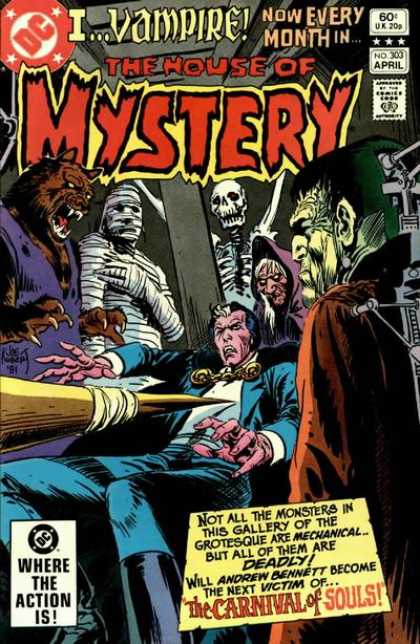

            From the farm to the carnival (“Carnival of Souls”, HOM #303), Andrew finds himself once more facing Mary and her slaves. The Queen of Blood is using the sideshow as a front for white slavery to further fund her conspiracy for world conquest (why would a vampire have to stoop to such levels for money?). With the help of reporter Margo Jennings, Andrew attempts to shut down the slavery ring, but is once more thwarted by Mary. The monthly schedule obviously didn’t help Tom Sutton’s art jobs. “Carnival of Souls” looks like bad Ditko.


TO BE CONTINUED
           

Monday, April 11, 2011

Fredric Brown on TV Part 4: Alfred Hitchcock Presents "The Cream of the Jest"


by Jack Seabrook

“The Cream of the Jest” was broadcast on March 10, 1957, as the first Fredric Brown adaptation to appear on the Alfred Hitchcock Presents TV series.  It has the distinction of having been published under three different titles.  It first appeared as “Last Curtain” in the July 1949 issue of the pulp, New Detective.  It was reprinted in the July 1956 issue of Ellery Queen’s Mystery Magazine as “The Cream of the Jest.”  The next reprint came in the collection, Ellery Queen’s 1962 Anthology, as “Good Night, Good Knight.”  Finally, Brown collected it in his 1963 volume, The Shaggy Dog and Other Murders, as “Good Night, Good Knight.”
 
    In the story, Sir Charles Hanover Gresham, has-been actor and blackmailer, sits in a Bowery bar reading Stagecraft, only to discover that Wayne Campbell has written a new play.  Gresham has been blackmailing Campbell for years and plans to use this as leverage to get a part in the play, The Perfect Crime.  He visits Campbell, who suggests that he inhabit the role of the blackmailer, since it’s so close to the truth.  Campbell insists that Gresham audition for shady gambler Nick Corianos.  Gresham visits Nick at his club, The Blue Flamingo, and recites the blackmailer’s big speech.  He realizes too late that he has been tricked and that the words ring true to Nick, who shoots and kills Gresham, thinking he knows about a real crime.

    “The Cream of the Jest” includes a protagonist who drinks too much and is partly set in a bar, like so many other Brown tales.  What makes it special is Brown’s use of quotations from great literary works, spoken either by Gresham (who essentially admits he’s not really a knight and thus not entitled to be addressed as “sir”) or by Campbell.  The quotations are not random but are carefully selected to advance the story.
 
    In the story’s first scene, as Gresham converses with Mac, the bartender, he quotes Fitzgerald’s The Rubaiyat of Omar Khayyam (“Ah, with the Grape my failing life provide”) and makes a pun at his own expense (“They sneer at me from leaning all awry”), noting that he is a ham actor and thus would be “Ham awry” (or ham on rye).  The quotations and pun are meaningless to Mac, showing that Gresham is an educated and literate man who has fallen on hard times.
 
    In the second scene, when Gresham begs Campbell for a part in his play, he recites Macbeth’s “Tomorrow, and tomorrow, and tomorrow” speech from act five, scene five of Shakespeare’s Scottish play.  Here, the speech is simply an opportunity for Gresham to show his acting skill, as he takes on the character of the murderous king who has just learned of his wife’s suicide.  However, at the end of the story, when Gresham realizes he is about to be killed, he recites the speech again, with greater meaning, as he says “Out, out, brief candle,” and the candle about to be extinguished is himself.
 
    Finally, in the scene where Gresham auditions for Campbell, the playwright answers with a quotation of his own, this time from Hamlet:  “Speak the speech . . . trippingly on the tongue.”  This quotation is from act three, scene two, and in the play it is spoken by Hamlet to the players who are about to act out a pantomime show for the new king.  Hamlet has prepared a play that mimics the king’s recent murder of his father in order to catch “the conscience of the king”—he thinks that when the murderer sees his recent crime acted out he will react.  In Brown’s story, neither Gresham nor the reader realize it at the time, but Campbell’s speech has been prepared for Gresham in order to reveal a real crime and cause his death.
 
    “Last Curtain” was an unusual story for a detective pulp in 1949, with its use of literary quotations and its layers of meaning.  It is likely that the producer of Alfred Hitchcock Presents came across it in the 1956 reprint in Ellery Queen’s Mystery Magazine and purchased the rights for the TV show.  The adaptation follows the story closely while adding a few elements to lengthen it for a half-hour slot.  While the characters are the same, the TV version has Gresham come up with the idea of blackmailing Campbell on the spot after Campbell refuses to cast him in the new play.  Gresham pleads, “I’m only real when I’m acting.  The rest of the time I’m nothing.”

 
    Gresham reminds Campbell that they both come from the tough part of Philadelphia, and he threatens to reveal Campbell’s stint in jail for embezzling from a bank.  These details add depth to the story without taking anything away from its effect.  The other big change is that, at the end, Gresham forces his way into Corianos’s office in costume and in character and recites the blackmailer’s speech from the play.  Corianos does not know he is an actor and shoots him on the spot.  This is a bit more far-fetched than the way it is done in the story, where Corianos knows Gresham is an actor there to audition for a part.  As Gresham dies, he recites “To be or not to be” from Hamlet, a good choice for a dying man but not as good as the speech from Macbeth in the story.
    The TV show adds a further twist ending, as Corianos finds a sheet of paper with the speech typed out on Campbell’s letterhead.  We are left with the impression that Campbell will be his next victim.
 
    “The Cream of the Jest” was adapted by Sarett Rudley, who penned nine episodes of Alfred Hitchcock Presents, and directed by Herschel Daugherty, whose atmospheric work was seen in 24 episodes of the series, as well as on 16 episodes of Thriller.  Starring as Gresham was Claude Rains, whose long and impressive career included memorable roles in The Invisible Man, Notorious, Casablanca, and Mr. Smith Goes to Washington.  James Gregory played Campbell, and his gravelly voice enlivened countless TV shows for decades, including episodes of just about every fantasy and crime show from The Twilight Zone to The Wild, Wild West.  Jerry the bartender was played by Johnny Silver, an actor who never seemed to get a big part but who seemed to pop up regularly on TV, including on five episodes of The Odd Couple.

 
    “The Cream of the Jest” can be seen on Hulu and is included in Universal’s DVD set of season two of Alfred Hitchcock Presents.  It was a popular episode of the series, as demonstrated by its being among the few reruns in the summer of 1957 and again in the summer of 1959.
 
    I also want to point out how impressive the July 1956 issue of Ellery Queen’s Mystery Magazine is!  In addition to “The Cream of the Jest,” it includes “The Destructors” by Graham Greene, “The Double Clue” by Agatha Christie, “The Flaw in the System” by Jim Thompson, and “Snowball in July” by Ellery Queen.  The magazine also seems to have incorporated Black Mask, and a section in the middle includes two hardboiled stories for fans of the classic pulp!  This is a digest well worth seeking out! (EQMM ran "Black Mask" stories from May 1953 through March 1958 after acquiring the trademark when the legendary pulp went belly-up in 1951. There were grand plans for the title according to the editor but nothing special seems to have come from it other than some choice reprints and, later in the run, some original stories done "the Black Mask way." Though the BM stories vanished with the March 1958 issue, the words "including Black Mask" remained on the contents page for years after. The gimmick was revived in the January 2008 issue-PE)
 
Sources:
Brown, Fredric. "The Cream of the Jest." Ellery Queen's Mystery Magazine July 1956: 101-09. 
"The Cream of the Jest." Alfred Hitchcock Presents. Season Two.  Universal Studios Home Entertainment, 2006.  DVD.
EBay - New & Used Electronics, Cars, Apparel, Collectibles, Sporting Goods & More at Low Prices. Web. 11 Apr. 2011. <http://www.ebay.com/>.
Galactic Central. Web. 11 Apr. 2011. <http://www.philsp.com/>.
Grams, Martin, and Patrik Wikstrom. The Alfred Hitchcock Presents Companion. Churchville, MD: OTR Pub., 2001.
The Internet Movie Database (IMDb). Web. 11 Apr. 2011. <http://www.imdb.com/>.
Khayyam, Omar, and Edward FitzGerald. The Rubaiyat of Omar Khayyam. New York: Dover Publications, 1990.
Seabrook, Jack. Martians and Misplaced Clues: the Life and Work of Fredric Brown. Bowling Green, OH: Bowling Green State University Popular, 1993.
Shakespeare, William, and G. Blakemore Evans. The Riverside Shakespeare. Boston: Houghton Mifflin, 1974.

Monday, March 28, 2011

Fredric Brown on TV Part 3: Alfred Hitchcock Presents "Human Interest Story"

by Jack Seabrook
“Human Interest Story” began as the short story, “The Last Martian,” published in the very first issue of Galaxy Science Fiction (October 1950).  It was collected in Best Science Fiction Stories: 1951, then again in the Fredric Brown collections Honeymoon in Hell (1958), And the Gods Laughed (1987), and From These Ashes (2001).
The story features many of Brown’s favorite themes.  It takes place in the city room of a small-town newspaper and in the bar across the street, and it mixes the naturalistic details of Brown’s crime fiction with the fantastic aspects of his science fiction.
As the story opens, a dull evening in the city room of The Trib is enlivened by news that there is a man across the street in Barney’s Bar claiming to be from Mars.  Reporter Bill Everett is sent over to investigate because he has “a light touch on the human interest stuff.”
At the bar, Bill meets Howard Wilcox, a rather intense man who is convinced that he is really Yangan Dal, the last Martian.  He tells Everett that, until a few hours before, he had been on Mars, where he had been locked in a small room and had to escape, only to find every other Martian inexplicably dead.
Finding millions of dead Martians gathered on Games Field in Zandar (the capital city), he pushed a button on a copper column in the center of the field and suddenly found himself inhabiting the body of Mr. Wilcox, on Earth, heading home from work.  He stopped in a bar to ask the bartender for advice.
Everett hears him out and counsels him to resolve himself to the fact that he is Howard Wilcox, telling him to go home to his wife.  Back at The Trib, Everett reveals that he, the city editor, and Barney are all from Mars, and that Wilcox was an imbecile who had been mistakenly left alone in a mental institution when the other Martians got “the mentaport rays that carried our psyches across space.”
Everett agrees that he will keep an eye on Wilcox “until we take over,” and tells his fellow reporters that the man was “just a drunk being the life of the party.”
“The Last Martian” was adapted for television by Fredric Brown himself, and this is the only instance I have been able to confirm of Brown adapting one of his stories for television.  The teleplay is reprinted in the collection, The Pickled Punks, and it is retitled “Human Interest Story.”
The script follows the story closely but there are some changes worth noting.  Wilcox (or Yangan Dahl, his Martian name) tells Everett that there is no alcohol on Mars, since it is poison to Martians.  This was probably an in-joke for Brown, who was known for his own prodigious drinking as well as that of many of his fictional characters.  Dahl says that on Mars he was eight feet tall, while in the story he was three feet tall.
While the story takes place in the city room and the bar, the teleplay adds another location—that of Wilcox’s flat, where he and Everett go to visit Mrs. Wilcox.  In the teleplay, Wilcox tells Everett that he told his wife that the two men met when they attended Hughes High School in Cincinnati together.  This is another in-joke, since Hughes is where Fredric Brown attended high school.
Finally, after a scene at Wilcox’s home, Everett and Wilcox walk into town for beer and Everett leads him down a dark alley.  Back in the city room, Everett tells his editor that he had to kill Wilcox to prevent him from revealing the truth about the Martians to his wife.  The added scenes and the additional twist ending add an element of menace to the tale that is lacking in the short story, which ends on a more wry note.
The filmed episode of Alfred Hitchcock Presents does not stick closely to the dialogue in the script.  The program was rehearsed and filmed over a two-day period on April 8 and 9, 1959, and starred Steve McQueen as Everett and Arthur Hill as Wilcox.  McQueen had just turned 29, and the first season of his series, Wanted: Dead or Alive, had just ended its run earlier that month when “Human Interest Story” was broadcast on May 24, 1959.  McQueen’s’ performance is memorable, though he takes many liberties with the dialogue in the teleplay.  He affects a cool, dispassionate air when listening to Wilcox’s story, as if he’s heard it all before, but he exudes a subtle menace at the end when he reveals that he had to kill the last Martian.

Arthur Hill was 36 years old and had a 50-year career in TV and movies.  He played Owen Marshall: Counselor at Law in a series that was spun off from Marcus Welby, M.D., in the early 70s.
  On “Human Interest Story,” his performance is suitably intense, and he follows the dialogue in the script much more closely than does his co-star.
The show is directed by Norman Lloyd, who had a long association with Hitchcock as an actor and a producer.  Lloyd does a nice job here, opening up the teleplay by moving the section in the bar out of a booth and around to various locations in the bar.  There is a memorable bit of business where McQueen plays pinball as Hill tells him the most exciting part of his story; McQueen’s cool detachment is perfect for the jaded newsman.  Lloyd and director of photography John F. Warren also change the camera angles and lighting subtly in the last scene to increase the sense of danger as Everett and his editor discuss the murder of Wilcox and the upcoming Martian takeover.  The lighting suddenly changes and Lloyd uses low angle shots to shift the mood, as the episode ends with the editor spinning a globe.
The story was remade as an episode on the 1980s revival of Alfred Hitchcock Presents.  Retitled “The Human Interest Story,” it was reworked by Karen Harris.  While this episode is available online as a bootleg DVD, I have not seen it recently (if ever), and I remember this revival series as being subpar.
The original 1958 version of “Human Interest Story” is one of the best adaptations of a Fredric Brown story to television, made better by Brown’s own involvement as writer of the teleplay.  In a future article I will discuss how Brown began to develop an interest in writing for television, and where this interest took him.

Sources:
Brown, Fredric.  “Human Interest Story.”  Rpt. In The Pickled Punks.  By Fredric Brown.  Hilo, HI: Dennis McMillan Publications, 1991.  139-176.
Brown, Fredric.  “The Last Martian.”  Rpt. In And the Gods Laughed.  By Fredric Brown.  W. Bloomfield, MI: Phantasia Press, 1987.  159-167.
Galactic Central. Web. 26 Mar. 2011. <http://www.philsp.com/>.
Grams, Martin, and Patrik Wikstrom. The Alfred Hitchcock Presents Companion. Churchville, MD: OTR Pub., 2001.
"Human Interest Story." Alfred Hitchcock Presents. CBS. 24 May 1959. Television.  Collected in Alfred Hitchcock Presents Season Four DVD set, Universal Classic Television, 2008.
The Internet Movie Database (IMDb). Web. 26 Mar. 2011. <http://www.imdb.com/>.
Wikipedia. Web. 26 Mar. 2011. <http://www.wikipedia.org/>.

Thursday, March 17, 2011

Fredric Brown on TV Part 2: Alfred Hitchcock Presents "The Night the World Ended"

by Jack Seabrook

    “The Night the World Ended” was first published in the January 1945 issue of Dime Mystery.  The story is set among the newspapermen and drunks that Fredric Brown so often wrote about, most memorably in novels like The Screaming Mimi and Night of the Jabberwock.
 
    The tale begins in Nick's bar, where a newspaperman named Halloran is known for his cruel pranks. He works the copy desk at night on the city paper, and he cooks up a trick to play on Johnny Gin, who is described as “just another punchy stew-bum.”  Halloran has a fake newspaper made up and he pretends to buy it from the local paperboy.  The headline on the front page reads, “World Will End at 1:45 Tonight!”

    Fredric Brown's fondness for mixing science fiction and detective tales surfaces briefly here, as an impending collision with the planet Mars is given as the reason for the impending cataclysm.  Johnny sees the headline and, in his drunken, fog-enshrouded mind, he believes it to be true.

    Johnny's initial thoughts are entirely practical and positive at first; he thinks that “the end of the world came only once.  A guy ought to do something . . .”  He wants to take a bottle of quality booze, borrow Nick the bartender's gun, go outside, and shoot a celebratory shot into the air.  When Nick steps out of the bar for a minute, Johnny fulfills his wishes, taking the gun and some expensive cognac.  Brown deepens his character by having him recall drinking it before while on leave in France (presumably in World War One).

    Nick picks the wrong time to walk back into his own bar, sees Johnny with the bottle and gun, loses his temper, and gets shot by the confused alcoholic.  “Blind panic hit Johnny Gin,” who races outside and away from the bar.

    “You fool, Johnny Gin, what does it matter that you've killed a man when he was going to die within an hour anyway?”  Johnny follows this up by shooting a policeman who confronts him, then jumps off of a bridge into shallow water to hide from the law.  The cold water shocks him back to his senses and he realizes he's been duped.

    The story ends as Johnny shoots and kills Halloran outside the newspaper building at 1:45 a.m.—“The end of the world for Halloran, and just when he'd predicted it.”
 
    “The Night the World Ended” was reprinted in Mostly Murder, Brown's 1953 collection of short mystery fiction.  The producers of Alfred Hitchcock Presents, which would air an adaptation of another story in that collection (“The Dangerous People”) less than two months later, also liked this story, and it was broadcast on CBS on April 28, 1957.

    The teleplay was written by Bernard C. Schoenfeld, who wrote 16 episodes of the series in all, an episode of The Twilight Zone, the 1944 noir classic Phantom Lady (based on the Cornell Woolrich novel), and the Oscar-nominated 1950 film, Caged.  Unlike “The Dangerous People,” which is a very faithful adaptation of the short story, “The Night the World Ended” takes a very different path on TV than it does on the printed page.

    The program begins in a similar vein to the story, as Halloran plays his prank on Johnny, though this time the world will end at 11:45 p.m., in three hours.  

As Johnny leaves the bar, eager to make the most of his final hours, Halloran quips: “His world ended years ago.”  Justus Addiss, the show's director, repeatedly shows clocks or has chimes on the soundtrack to demonstrate the passage of time for the doomed Johnny.  At 9 p.m., Johnny goes to a liquor store, from which he steals two bottles of expensive liquor.  He drinks alone in a park but accidentally smashes the bottles when he trips and falls over a group of dogs being walked by a dotty old woman.

    The woman, Felicia Green, is a lonely spinster who invites Johnny back to her home to have a cup of tea.  We learn a bit more about Johnny's past as he talks to Felicia and tells her that his wife and baby died 30 years before.  She cleans the spilled booze off of his sport jacket and we see that it's now past 10:30.  Johnny comes on too strong and she calls for help, driving him away.

    In the second act, Johnny meets three boys in an alley and takes them to a sporting goods store.  He breaks in and they play with the balls, bikes, and guns.  This scene—and much of the show—is more sad than suspenseful.  Johnny, not caring about consequences, loads a gun and shoots a security guard who arrives to stop the boys' fun.

    Johnny wanders the streets and happens upon a newsstand, where he sees the real edition of that evening's newspaper.  Knowing he's been tricked, he goes back to the bar and shoots Halloran.  “Every joke's gotta have a payoff,” says Johnny, and the clock reads 11:45.

    Russell Collins, born in 1897 and 59 years old at the time the program was broadcast, is very good as Johnny.  He appeared in numerous TV shows and had a role in Spencer Tracy's Bad Day at Black Rock.  As Johnny, he is wonderfully dissolute, sporting a few-day growth of white stubble on his face and staggering around in his rumpled coat and hat.

    Harold J. Stone plays Halloran and, although he does not have much screen time, he embodies the character of the cruel prankster.  Stone is instantly recognizable from his decades of TV work; he also appeared in Roger Corman's X-The Man With the X-Ray Eyes.

    The most bizarre performance comes from Edith Barrett as Felicia—she was only 50 years old at the time but comes across as a very odd and flighty spinster.  Surprisingly, she had an amazing year in 1943, when she appeared in Jane Eyre, The Song of Bernadette, The Ghost Ship and I Walked With a Zombie!

    Finally, I must mention the 13 year old Harry Shearer, who is the eldest of the three boys who Johnny meets in an alley.  

Shearer looks the part of the poor, dirty-faced city boy whose affinity for guns leads Johnny to make a deadly mistake.

    “The Night the World Ended” is not as good a TV episode as “The Dangerous People,” but Russell Collins's performance as the drunken Johnny is worth seeing.


Sources:

Brown, Fredric. “The Night the World Ended.” Dime Mystery (1945). Rpt. in Carnival of Crime: The Best Mystery Stories of Fredric Brown. Eds. Francis M. Nevins, Jr., and Martin H. Greenberg. Carbondale & Edwardsville: Southern Illinois UP, 1985. 101-10.

Galactic Central. Web. 14 Mar. 2011. http://www.philsp.com/.

Grams, Martin, and Patrik Wikstrom. The Alfred Hitchcock Presents Companion. Churchville, MD: OTR Pub., 2001.

The Internet Movie Database (IMDb). Web. 14 Mar. 2011. http://www.imdb.com/.

“The Night the World Ended.” Alfred Hitchcock Presents. CBS. 28 Apr. 1957. Collected in Alfred Hitchcock Presents, Season Two.  Universal Classic Television, 2006.  DVD.

Saturday, March 12, 2011

Bloodstock: Four Days of Stress, Chaos, and Wonderment

by David J. Schow

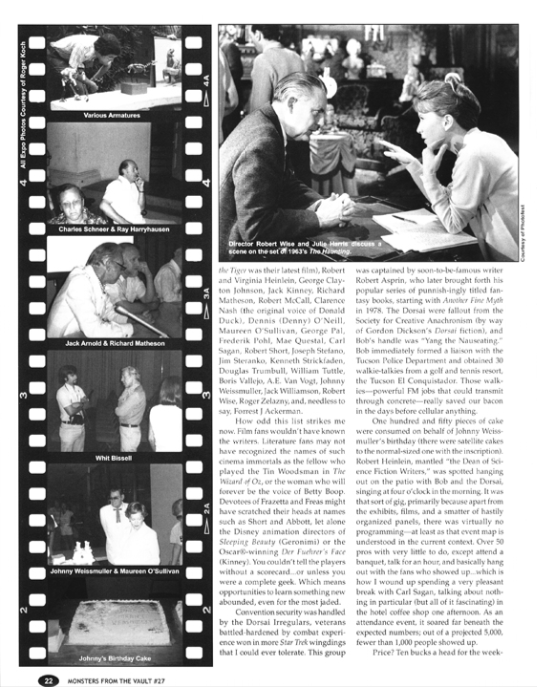
bare•bones is pleased to bring you David's Rondo-nominated article from Monsters From The Vault #27.


(Click pages to enlarge)


Copyright © David J. Schow, 2010.  All Rights Reserved.  Used by permission and by special arrangement with the author and Monsters From The Vault publisher Jim Clatterbaugh.